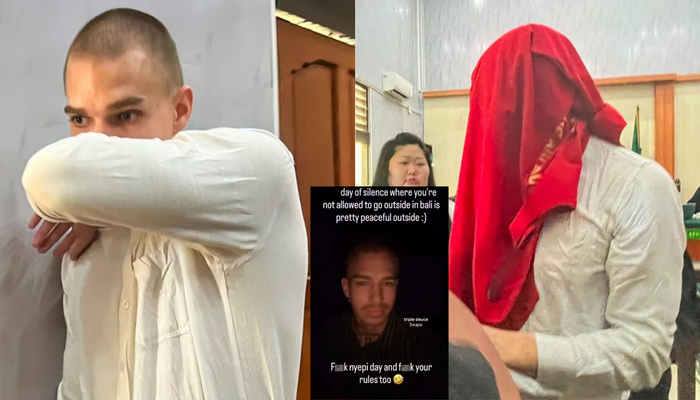
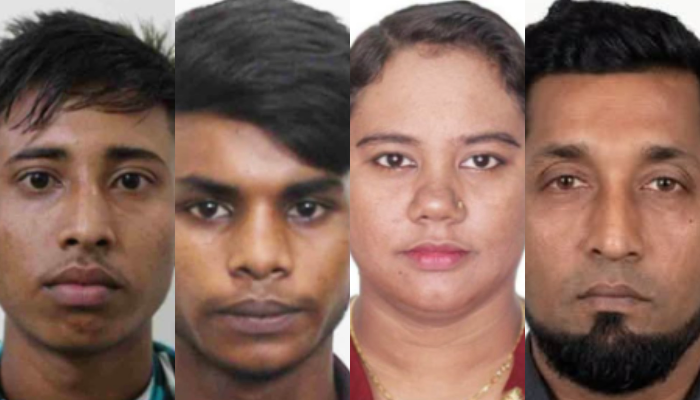
A Swiss tourist in Bali learned a hard lesson when he was sentenced to one year in jail for his Hinduphobia, after he insulted a sacred Hindu tradition in Indonesia. The 26-year-old tourist named Luzian Andrin Zgraggen was punished by a Denpasar District Court for violating Indonesia’s new criminal code by insulting a local Hindu tradition.
As per reports, Luzian made a social media post disrespecting the Nyepi or ‘Day of Silence’, which is the Balinese Hindu New Year. He also deliberately violated the curfew observed by locals on the day. He did so despite being informed by the staff of the hotel he was staying in about the local restrictions. This year, Nyepi was observed on 19th March and Luzian was arrested in the same month after his derogatory acts sparked widespread outrage.
During his trial, Luzian apologised before the court and said that he made the video out of frustration because he was hungry and could not find food during the entire day. He further told the court that he did not understand the local rules regarding the restrictions, and regretted his actions. He said that he apologised to the Balinese people for disrespecting their religious traditions. “I deeply regret what I did. I apologise to the Balinese people,” Luzian reportedly said.
However, presiding judge Tjokorda Putra Budi Pastima, unconvinced by Luzian’s apology, said that he had hurt religious feeling the Balinese people and offended them. “The defendant must be held accountable for his actions,” the judge reportedly remarked.
Luzian Andrin Zgraggen has already spent five months in pre-trial detention. The period spent by him in jail will be deducted from his one-year jail term. Meanwhile, Swiss authorities are providing consular access to him.
What was the case?
Nyepi is an annual holiday in Indonesia and is observed as period of complete quietness, fasting, and self-reflection. The island of Bali celebrates the day with complete shutdown of activities across the island, and turning off the lights. A curfew-like situation prevails on the island for the entire 24-hour period. The restrictions relating to Nyepi apply to everyone on the island irrespective of religion, including tourists. Locals store groceries in advance ahead of the day, so that they do not need to step out on the holiday.
However, in a complete disregard for the local Hindu tradition, Luzian openly disrepencted the Hindu tradition and posted multiple clips on Instagram flouting the local rules. He posted a highly offensive message on Instagram about the festival, which read as, “Fuck Nyepi and fuck your rules too”.
He also filmed himself walking to an empty beach describing the scene as “crazy” and posted the clip on Instagram. “I made it to the beach, they didn’t catch me, it is completely dark, there is nobody out here, this s**t is crazy,” he remarked in the clip.
Even after Luzian was arrested by the Balinese authorities, he showed no remorse for his acts and went on to mock the local rules.
Local senator confronted the Swiss tourist
Luzian was confronted by a local senator, Niluh Djelantik, for his acts and remorseless attitude. The senator posted a video of the interaction on social media. In the video the senator can be heard telling him that she would make sure that he is barred an entry into Bali.
“Today you insulted Hindus,” senator Djelantik told him, to which he casually replied that he still “doesn’t like the rule that you can’t go outside.” The senator reminded him that Bali was not his home and that he need not visit it. “So don’t come. Bali is not your home; it is a place that gives you a room in your hotel,” she said.
“That you pay by the night. But Bali is not your home. If you say you think this is unfair, I will make sure you never come to this country ever again. I will make sure of that,” she warned Luzian. “You will never accept that we have this one day, in a year, that we need to be quiet,” she added.
Senator Djelantik warned all foreign tourists that if they violated this rule, they will not only be deported but also be blacklisted and barred from entering Bali.
Realising that he was in serious trouble, the Swiss tourist tried to talk his way out of the situation. He nonchalantly told the senator that he was ready to apologise for his comments in the police station. The senator however, refused to let him get away. He was arrsted and tried by a local court, which sentened him to one year in jail.
Later on, the senator reportedly posted photos of the tourist in handcuffs. Demanding criminal proceedings against him, the senator called for his deportation and a lifetime ban on entering the country. Explaining her stern response to the case, Djelantik said that she did not act out of obligation but to uphold the dignity of Indonesia and it its people.
Tourists faced action in the past for disrespecting Bali’s Hindu culture
Bali authorities have cracked down heavily on tourists who disrespect the island’s Hindu culture. In 2023, the Balinese authorities took legal action against three Russian tourists after they disrespected a local temple. The three tourists were arrested by the Balinese authorities for dancing and posing disrespectfully at the Pengubengan Temple in Besakih.
Bali immigration data for the first four months of 2023 reportedly showed that the island administration deported 96 foreigners during the period for various violations, including disrespect to the local Hindu culture.
In another similar incident, a Russian influencer and her husband faced deportation from Bali in 2022 after they staged a nude photo shoot on a sacred tree in Tabanan district. A month before that a Canadian actor also faced a similar action by the Balinese authorities after a video showing him naked at holy Mount Batur, doing the Haka, went viral.
Bali is the only Hindu-majority island in the Muslim-dominated country of Indonesia. The island has preserved its Hindu culture and traditions and is fiercely protective of them. Bali island is popular tourist destination and its welcome people from across the world. But, at the same time, it values its Hindu culture deeply and does not tolerate any disrespect to them.
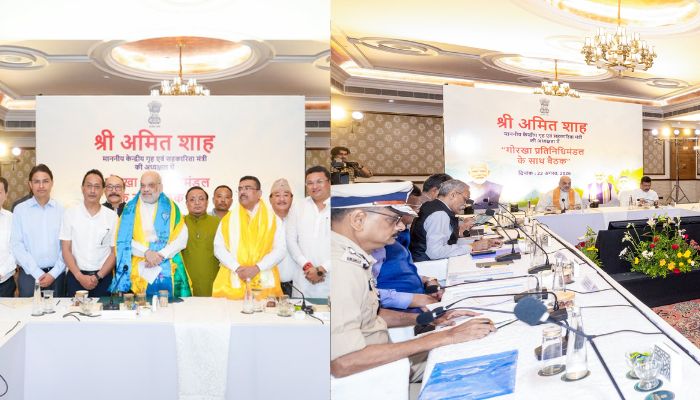
The long-pending Gorkha identity issue in the Darjeeling hills has once again come into focus after Union Home Minister Amit Shah met West Bengal Chief Minister Suvendu Adhikari, Gorkha leaders and other stakeholders in Siliguri on Saturday, 22nd August. The meeting, held at a hotel in Sukna on the final day of Shah’s visit to West Bengal, ended with the Centre announcing a committee to work out the details of an agreement aimed at finding a “permanent political solution” to the concerns of the Gorkha community.
Held a meeting with Gorkha Member of Parliament, MLAs, and prominent Political Leaders along with CM of West Bengal in Siliguri today.
Discussed the long-pending aspirations and genuine concerns of the Gorkha people and a practical roadmap forward. Reiterated that under the… pic.twitter.com/CEIJrNI9ey
According to the Ministry of Home Affairs, the meeting discussed the major demands of the hill population, including a distinct identity, a permanent political solution and recognition under the Constitution. The Centre said that any solution would be worked out within the constitutional framework. “All issues relating to the hill population of West Bengal were discussed in detail. Their demands about a distinct identity, a permanent political solution and recognition under the Constitution of India were taken up,” the MHA said.
The Ministry of Home Affairs, Government of India, has constituted a high-level Committee under the chairmanship of former Deputy National Security Advisor and Interlocutor Shri Pankaj Kumar Singh to prepare the comprehensive framework for a Permanent Political Solution with… pic.twitter.com/xoA7c9lHv3
The committee will be headed by Pankaj Kumar Singh, the Centre’s interlocutor for issues concerning the Darjeeling hills, Dooars and Terai. Singh is a retired IPS officer who has also served as Director General of the Border Security Force and Deputy National Security Adviser. He was appointed as the government interlocutor in October 2025 to lead the political dialogue on the long-standing demands of the region.
The MHA said the committee would finalise the modalities and details of the agreement that will be drafted for a permanent political solution. “To finalise modalities, it was decided to form a committee under Shri Pankaj Kumar Singh, former deputy national security advisor and current interlocutor, to finalise the details regarding the final agreement that will be drafted towards a permanent political solution for the people of the hill areas of West Bengal under the Constitution of India,” the ministry said.
Shah also assured the representatives that the Centre would look sympathetically at other demands of the community and said adequate central funding could help address pending issues in the region. The meeting was attended by Gorkha Janmukti Morcha chief Bimal Gurung, senior GJM leader Roshan Giri, Gorkha National Liberation Front chief Mann Ghisingh, BJP MPs Raju Bista and Harshvardhan Singla, BJP MLAs from the hills, state ministers and senior officials.
Roshan Giri said the Gorkha leadership was ready to find a solution through constitutional means. “Union Home Minister Amit Shah has clearly said that whatever solution is reached to address the issue will have to be under the constitutional framework. I am in favour of a constitutional solution and have put forward my suggestions in accordance with that,” he said.
Siliguri, West Bengal: General Secretary, Gorkha Janmukti Morcha, Roshan Giri says, "Home Minister Amit Shah has clearly said that whatever solution is reached to address the issue will be a constitutional solution. We are in favour of a constitutional solution…" pic.twitter.com/f8utSoNEQ8
BJP MP Raju Bista called the meeting historic as it took place on the date of the signing of the 1988 Gorkha accord. The accord had ended the violent phase of the Gorkhaland agitation at that time and resulted in the creation of the Darjeeling Gorkha Hill Council.
VIDEO | Siliguri: Darjeeling MP Raju Bista, after a meeting with Union Home Minister Amit Shah, says, “Today is a historic day for the Gorkha community and Darjeeling, as the Gorkha Accord was signed on this day in 1988. Representatives of the Gorkha community, including MPs,… pic.twitter.com/DysLGP0DYu
The latest move also comes months after the BJP promised to resolve the long-standing Gorkhaland issue within six months of forming the government in West Bengal.
How the Gorkha identity developed in Darjeeling
The roots of the Gorkhaland issue go back much further than the present political movement. The present Darjeeling district was formed in 1866 when Kalimpong was merged into the Darjeeling district. During the Bhutanese regime, Kalimpong was part of the Western Duars, but after the Anglo-Bhutanese War of 1865, Kalimpong was transferred to the Darjeeling district while the Western Duars were attached to Jalpaiguri district in undivided Bengal. Consequently, the Darjeeling district was created using territories ceded by Sikkim and Bhutan.
The hills were home to communities such as Lepchas, Nepalis and Bhutias, while Mech-Rajbanshis were largely found in the Terai plains. Over time, the population of Nepali origin became the majority in the hills. The British administration encouraged Nepali settlement, particularly because of the growing tea plantation economy and the need for labour. The 1901 Census recorded that 61% of Darjeeling’s population belonged to the Nepali community.
The growth of the Nepali-speaking population also helped create a shared cultural identity. Different communities had their own languages and dialects, but interaction in tea gardens, markets and other public spaces helped the development of Khas-Kura or Gorkhali as a common language in the hills. This shared language gradually became an important part of Gorkha identity.
A new Gorkha middle class began to emerge around the 1930s. Organisations such as the Nepali Sahitya Sammelan encouraged people to take pride in their language and culture. In 1934, a social union was also established with the aim of creating greater fraternity among Lepchas, Bhutias and Nepalis and working for the development of hill communities.
At the same time, the identity of the Gorkhas remained complex. The term “Gorkha” was increasingly used as a marker of Indian Nepali identity, even though people belonging to the broader Gorkha community lived both in India and Nepal. This distinction later became important in the political demand for recognition and security of identity in India.
The first political demands
The political organisation of the hill people can be traced back to the early twentieth century. The Hillmen’s Association, formed in 1907, raised demands for maintaining the separate administrative character of the hills. It brought Nepali, Lepcha and Bhutia communities together under the idea that they shared a common hill identity.
The organisation also demanded a separate administrative unit consisting of Darjeeling and parts of the adjoining areas. However, its politics remained closely connected with the colonial administration, and its demand for keeping the hills separate from the plains also reflected linguistic, racial and geographical differences.
After Independence, the political demand gradually changed. The All India Gorkha League became an important organisation representing Gorkha interests. It raised issues such as recognition of the Nepali language, Indian citizenship for Gorkhas and separation of Darjeeling from Bengal. Over the years, different proposals were put forward, including making Darjeeling a separate administrative unit or combining Darjeeling and adjoining areas into a separate province.
The Nepali language movement also achieved an important success when Nepali was recognised as an official language in the Darjeeling hills in 1961. However, the broader demand for political autonomy remained unresolved.
The 1980s: Gorkhaland becomes a mass movement
The demand took a much more aggressive form in the 1980s under Subhash Ghisingh and the Gorkha National Liberation Front (GNLF). Several developments contributed to the revival of the movement. The creation of smaller states in other parts of India and ethnic movements in the Northeast encouraged similar aspirations in Darjeeling. The expulsion of Nepali people from Meghalaya in 1986 also created anxiety among Nepali-speaking people in Darjeeling.
The GNLF turned the demand for a separate state into a major mass movement. Protests, strikes and clashes with the state government became common. The movement increasingly adopted strong ethnic symbols, including the khukri, and attracted large numbers of young people.
The agitation continued for nearly two years and caused widespread disruption. Around 2,000 people were arrested under anti-terror laws, while violence and counter-violence continued. The prolonged shutdowns also affected food supplies, fuel, tourism and the local economy.
Eventually, both sides were pushed towards a settlement. On 22nd August, 1988, the Centre, the West Bengal government and the GNLF signed a tripartite agreement. The accord resulted in the creation of the Darjeeling Gorkha Hill Council (DGHC). Gorkha agreed to drop the demand for a separate Gorkhaland state.
However, the Hill Council could not provide the lasting political and developmental solution that many people in the hills expected. Discontent continued to grow over governance, development and the limited nature of political autonomy.
From DGHC to GTA
The DGHC experiment failed to bring lasting peace or development. The developmental authority transferred to the council suffered from administrative inefficiency and fiscal mismanagement. To pacify rising discontent, Ghisingh demanded Sixth Schedule status under Articles 244(2) and 275(1) of the Constitution. A tripartite agreement was signed between Chief Minister Buddhadeb Bhattacharjee, Union Home Minister Shivraj Patil, and Ghisingh to grant special tribal council status, but the move lacked demographic backing and triggered severe public backlash.
This dissatisfaction, combined with the popular surge of support for hill singer Prashant Tamang in a reality show, created space for Bimal Gurung, a former close associate of Ghisingh, to form the Gorkha Janmukti Morcha (GJM) in 2007. Gurung reignited the demand for full statehood, enforcing indefinite strikes and blockading National Highway 31A, the primary economic lifeline of neighbouring Sikkim.
Unlike previous movements, GJM expanded its Territorial claims to include Siliguri and the entire Duars belt. This created tensions with Bengali and Adivasi communities living in those areas. Protests and counter-protests affected places such as Siliguri, Naxalbari, Bagdogra and parts of the Dooars. Meanwhile, internal hill politics grew increasingly tense, marked by the tragic assassination of AIGL leader Madan Tamang.
Several rounds of talks were held between the Centre, the West Bengal government and GJM, but no agreement on a separate state could be reached. Finally, another political arrangement emerged in 2011 with the creation of the Gorkhaland Territorial Administration, or GTA.
The tripartite agreement was signed on 18th July 2011 in the presence of Union Home Minister P. Chidambaram, West Bengal Chief Minister Mamata Banerjee and Bimal Gurung, creating the Gorkhaland Territorial Administration (GTA). Upon signing, Gurung reiterated that the GTA was merely an interim setup, stating that “our main objective will be achieved in Gorkhaland.” The GTA was intended to provide greater administrative powers to the hills, but it did not end the demand for Gorkhaland.
Why the issue remains complicated
The Gorkhaland question is not simply about the creation of another state. At its core, it combines questions of identity, political representation, development, language, culture and constitutional recognition. Over the years, different groups within the hills have also developed their own demands.
The idea of a single Gorkha identity has increasingly faced challenges from various indigenous communities. Groups such as Rai, Gurung, Bhujel, Thami, Sunuwar, Jogi, Khas, Magar and Newar have sought recognition of their separate ethnic identities and, in some cases, Scheduled Tribe status and development boards.
This has made the political situation in the hills more complex. While the broader Gorkha identity has historically been used to unite different communities, many groups now want their individual cultures, traditions and political interests to be recognised as well.
The latest meeting between Amit Shah, Suvendu Adhikari and Gorkha representatives therefore comes against the background of more than a century of political mobilisation. The Centre’s decision to create a committee under Pankaj Kumar Singh does not itself announce the creation of Gorkhaland. Instead, it begins a new process to work out a “permanent political solution” within the Constitution.
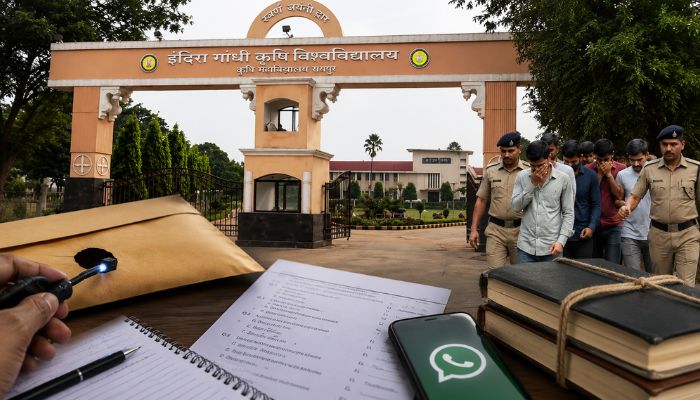
A question paper leak at Indira Gandhi Krishi Vishwavidyalaya (IGKV) in Raipur has turned into a major controversy after police arrested a professor from a private college in Durg and five students in connection with the case. The investigation has revealed a surprising method used to copy the question paper: an endoscopy camera was reportedly inserted through a tiny hole made in a sealed envelope.
#WATCH | Raipur, Chhattisgarh: On the Indira Gandhi Krishi Vishwavidyalaya (IGKV) Entomology paper leak case, DCP (Crime) Smruthik Rajanala says, "On the 20th, the case came to light at the Agricultural University where the Controller of Examinations reported a suspected leak of… pic.twitter.com/BFXaLP6dEy
The matter came to light on 20th August, when the university’s B.Sc. Agriculture second-year, second-semester entomology examination was being held. The paper, AENT 221 Pest Management in Crops and Stored Grains-I (Rabi Crops), was scheduled from 10 am to 1 pm. The examination was conducted at 34 colleges across Chhattisgarh.
The controversy began after a document circulated on WhatsApp was found to have questions that closely matched the actual examination paper. Initially, the university said it could not confirm whether there had been an internal leak. However, after protests by student groups and a complaint to the police, an investigation was launched.
The university later cancelled the examination and announced that it would be conducted again in the first week of September. While the initial report said nearly 70% of the circulated document matched the actual paper, the police investigation eventually led to the arrest of six people.
Endoscopy camera used to copy the paper
The police investigation has brought out the method used to obtain the question paper before the examination. According to DCP (Crime and Cyber) Smruthik Rajanala, 38-year-old Yogesh Sonkesariya, a professor at Bharti Agriculture College in Durg, received the question paper in a sealed envelope on 17th August.
Instead of opening the envelope, Sonkesariya reportedly made a very small hole at the bottom of it. He then inserted an endoscopic camera through the opening and used it to capture images of the question paper inside.
The question paper was a one-page document, with the entire content printed on one side. After taking the images, the opening in the envelope was covered with glue so that it could appear sealed.
Police said the professor did not simply keep the information for himself. He manually copied 15 questions from the paper and sold them to students. Investigators said the questions were then passed from one student to another before the examination.
According to the police, the investigation also found a link between the professor and students at the same college. Officials said some students paid around ₹12,000 for the questions.
The police have also said that the accused were connected with another examination that was scheduled for 7th August, and that this aspect is being examined as part of the investigation.
How police traced the source
The investigation started after the university received information that questions from the examination paper were circulating before the test. The Agriculture College and Research Centre at Kawardha received an email at around 8.41 am on 20th August claiming that the paper had been leaked. Other university officials received similar information shortly after.
Students and their representatives also contacted the university through WhatsApp and reported that some questions were already in circulation.
Following the complaint, police registered a case against unidentified persons under the Chhattisgarh Public Examination (Prevention of Unfair Means) Act, 2008, and Section 316 of the Bharatiya Nyaya Sanhita, 2023, which deals with criminal breach of trust.
A team of more than 100 police personnel was then formed. It included officers from the Anti-Crime and Cyber Unit, the Crime Branch and Telibandha police station.
Investigators examined the question paper that had gone viral, along with screenshots, photographs, messages and social media posts. These digital clues helped police trace the source to a student in Durg. The investigation then led them to Professor Sonkesariya and the other students.
DCP Rajanala said the police followed the trail from students who had received the copied questions to the professor who had accessed the sealed paper.
BJP government and police take strict action
The paper leak case has also put the focus on the action taken by the BJP-led Chhattisgarh government and the state police. Rather than treating the matter only as an examination irregularity, the authorities moved to investigate it as a criminal case.
The university lodged a formal police complaint after cancelling the examination, allowing the police to investigate whether the paper had been accessed from inside the examination system and identify everyone involved.
The police formed a large investigation team involving specialised cyber and crime units. More than 100 personnel were involved in tracing the source of the leaked questions, checking digital evidence and questioning people connected with the circulation of the paper.
The investigation resulted in the arrest of six people: Professor Yogesh Sonkesariya and five students. Police said the professor had obtained access to the sealed question paper, copied questions using an endoscopic camera and then passed them on for money.
The arrests indicate that the police investigation is not limited to the person who first circulated the questions. The role of the students who received and further shared the material is also being examined.
The case has been registered under the Chhattisgarh Public Examination (Prevention of Unfair Means) Act, 2008, along with the relevant provision of the Bharatiya Nyaya Sanhita. The legal action is aimed at establishing how the paper was accessed, who benefited from it and how widely the questions were circulated.
The police are also looking into the possibility of the accused being involved in another examination paper leak. This could widen the investigation if evidence establishes a similar pattern.
Student protests add pressure
The controversy had already led to protests on the university campus before the arrests were announced. The National Students’ Union of India (NSUI) staged a protest demanding action, while the Akhil Bharatiya Vidyarthi Parishad (ABVP) also protested and submitted a complaint to the university.
Both groups sought cancellation of the examination and a detailed investigation into the matter.
The university eventually cancelled the AENT 221 examination, saying it had been cancelled for administrative reasons, and announced that a fresh examination would be held in the first week of September.
The decision affected students across the university’s affiliated colleges. While the initial account referred to around 500 students at the Raipur examination, the later police account said around 1,500 students enrolled in different IGKV-affiliated colleges were scheduled to take the examination.
Chhattisgarh has faced paper leak cases before
The latest case has also brought attention to previous examination paper leaks in the State. Earlier this year, the Chhattisgarh Board of Secondary Education cancelled the Class 12 Hindi examination held on March 14 after a WhatsApp-based paper leak was confirmed and an FIR was registered.
The issue has also reached the Chhattisgarh High Court in another major examination case. Earlier this month, the court rejected the bail plea of a retired IAS officer arrested by the CBI in connection with alleged corruption in the recruitment process of the CGPSC State Civil Services Examination, 2021. His son, who was also accused in the case, had been selected as a deputy collector.
The High Court had described examination paper leaks as a crime that affects the wider society and observed that their impact goes far beyond the students who appear for an examination.
The IGKV case now adds another chapter to the debate over the security of examination papers in Chhattisgarh. With six arrests, a large police team working on the case and a probe into the possible involvement of the accused in another examination, the focus is now on finding out whether others were involved in obtaining, buying or circulating the questions.
For the students, the immediate result is a cancelled examination and a fresh test in September. For the authorities, the bigger challenge is to ensure that the system used to prepare, transport and store question papers does not become vulnerable to similar attempts in the future.
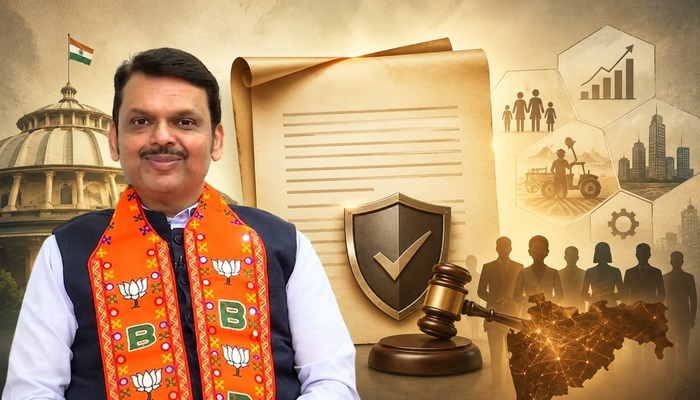
The BJP government in Maharashtra is all set to regulate and improve private coaching and tuition centres in the state for the overall improvement of the level of school education. The Maharashtra government’s School Education Department has released the draft Maharashtra Private Coaching Classes (Registration and Regulation) Act, 2026 on Saturday (22nd August), inviting suggestions and objections from the public till 4th September.
Through the bill, the state government has made a comprehensive attempt to bring the sprawling private coaching and tuition industry in the state under a legal framework. With a rising number of students appearing for various competitive examinations, private coaching centres have emerged as a parallel educational framework not just in Maharashtra but across the country. However, unlike schools and colleges, private coaching centres are unregulated and do not operate under any legal framework. This led the Maharashtra government to come up with a legal solution to fix accountability of coaching and tuition centres towards students.
A framework to ensure students’ safety and well-being
The bill aims “to provide a framework for registration and regulation of private coaching classes; especially in relation to the education imparted, mental well-being of the students and facilities provided to them; and to make provisions for effective redressal of grievances and issues incidental thereto”, as mentioned in its statement of objectives and reasons.
The bill would also regulate who would be able to teach students in coaching and tuition centres. It mandates graduation as the minimum qualification for a teacher in all coaching centres and prohibits coaching centres from hiring any person as a teacher or other staff against whom a cognisable offence has been registered under the IPC or BNS.
To protect young children from being overburdened with the pressure of studies, the bill bars the enrollment of students under 13 years of age in coaching centres. The bill ensures students’ safety by prohibiting coaching classes operating from basements. The bill would also require coaching centres to retain at least a month’s CCTV footage and hold fire and building safety certificates.
For the mental and physical well-being of the students, the bill mandates a weekly off for students and tutors. It restricts daily coaching hours to five hours a day and prohibits scheduling of tests on the day immediately after that weekly off. Additionally, coaching centres would be required to schedule leave around major festivals.
Mandatory registration of coaching centres
Once the bill is passed, coaching centres in the state would not be able to operate without mandatory registration, which will be renewed periodically. Registration will be valid for three years and would be renewable at least three months before expiry. The application for registration would be filed in online mode through a dedicated online portal that the state government is required to build. Besides, coaching centres with multiple branches will have to register each branch separately.
Existing coaching centres would get six months’ time to register through the online portal, and the registration would be valid for three years. Coaching centres would be required to register, regulate their fees and comply with requirements on safety, staffing and student welfare.
The bill prohibits coaching centres from making any misleading advertisements regarding guarantees of ranks, marks, results pr facilities. Centres would have to disclose on their website all necessary information, including the qualifications of teachers, courses offered, duration of courses, and physical facilities and amenities provided in coaching centres.
Ban on ‘dummy school model’
A major highlight of the bill is the explicit prohibition on the “integration” of schools and coaching centres, commonly known as the dummy-school model. Schools found to be in violation may face derecognition.
The bill bars coaching centres from hiring the services of any person or tutor or teacher who has been appointed and is working as a teacher in any approved or recognised school or junior college. Also, a private coaching centre would not be allowed to operate on the premises of any school or college duly approved or recognised by the government.
It defines a ‘coaching centre’ as any centre established, run, or administered by any person or body of persons or institute or a company, other than government-approved schools or educational institutions, to provide coaching to more than 25 students for any study, program or competitive examinations or academic support to students.
Fee transparency and refunds
The bill makes it mandatory for private coaching centres to immediately provide a receipt for full or part payment of the fee in an appropriate format. Besides, coaching centres cannot charge extra fees for prospectus, notes, study material, internal examinations and other related items. All of this would be covered in the course fee. Coaching centres would not be allowed to alter the course fee during the continuation of the course.
If any student who has made full payment of the fee wants to leave the course in the middle of the course duration, the coaching centre will refund the fee for the remaining period of the course on a pro-rata basis, within 10 days. If the student was staying in the hostel of the coaching centre, then the hostel fees and mess fee, etc. shall also be refunded in the same manner.
Grievance redressal
The bill mandates all private coaching centres to formulate a detailed grievance redressal mechanism and publish it on their websites. The grievance redressal mechanism should include details, guidelines and provisions regarding the manner of raising complaints or grievances, and the officer or authority responsible for grievance redressal.
Coaching centres can place complaint boxes within their premises, where students can drop their complaints. For complaints relating to the POCSO Act or the POSH Act, action must be taken within 24-hours from the filing of the complaint.
Inspections and Penalties
The bill grants sweeping powers to Inquiry Officers to be appointed by the government to inquire into complaints raised under the Act. The powers include the right to enter and inspect centres, summon witnesses, examine records, and search premises and seize documents or electronic devices.
The bill categorises violations of provisions contained therein as “major” and “minor”. Major violations include hiring unqualified or ineligible tutors, illegal school tie-ups, or failing to set up a grievance mechanism. Minor violations include exceeding the daily five-hour limit for classes, publishing assessment results, segregating students based on academic performance or failing to provide drinking water.
Major violations under the bill can attract fines between ₹10 lakh and ₹50 lakh, along with suspension or cancellation of registration. Minor violations carry fines of ₹1 lakh to ₹5 lakh, rising to ₹10 lakh for repeat offences.
A curious pattern has been recently developing in the Maldives, where several people, interestingly from Bangladesh, have either been flagged as immigration fugitives or summoned by the immigration authorities to make an appearance. What makes this particularly intriguing is not merely the fact that they entered the island nation, but the trail they left behind, or rather the absence of one.
The individuals landed in the Republic of Maldives, but there seems to be little to no trace of their whereabouts, triggering the immigration department to act. Their sudden disappearance raises obvious questions about how they managed to penetrate the archipelagic country, their movements thereafter and how they slipped beyond the reach of the authorities.
More strikingly, this is not an isolated phenomenon pertaining to any specific nation. Similar cases have surfaced in other parts of the world, where Bangladeshi intruders have crossed borders and successfully evaded detection, posing a grave challenge for the government to locate or find them for multiple years and even decades. The Maldives is apparently confronting the same menace at this time.
The immigration department has sent out notices either instructing such persons to appear before the authorities or to categorise them as “immigration fugitives.” Some even received multiple such directives after repeatedly failing to comply.
On 20th August, 38-year-old Bangladeshi Rahima Begum was summoned to present herself in person within five days during the department’s working hours from 8:00 am to 4:00 pm. Enforcement & Compliance Division, Maldives Immigration detention centre, Hulhumale Phase 2, was named as the venue. Furthermore, people were also encouraged to provide any information concerning her location by using a designated phone number and the official website.
A similar notice was issued for 44-year-old Bangladeshi man, Mir Ramzan Ali, a day earlier on 19th August.
On 16th August, sex male Bangladeshi nationals, aged between their early 20s and late 30s, were also served with these summons. These included 23-year-olds, MD Abu Thaher and Mujahid Hasan, along with 25-year-old MD Ikbal Hussain, 27-year-old Muhammad Hussain, 29-year-old MD Tajul Miah and 37-year-old MD Sharif Uddin.
They were told to present themselves before the authorities within a span of 5 days during the 8:00 am to 2:00 pm working hours at the Risk Intelligence Section, M. Star Cloud building 10th floor, Majeedhee Magu, Male.
On 9th August, a separate list of Bangladeshi “immigration fugitives” was published by the authorities. The accused ranged in age from their early 30s to their late 40s. They were identified as 32-year-old MD Imran Miah, 39-year-old Billal Hossein, 41-year-old MD Rasel Madbar and 48-year-old MD Anowar Hossen. The authorities had called upon the populace to communicate any information about them at the provided address and website.
On 9th July, a similar public appeal was made for 21-year-old “immigration fugitive” from Bangladesh, MD Fahim.
Notably, a corresponding release was made for Fahim a few days earlier, on 2nd July, together with 25-year-old Bangladeshi MD Naim Hosen. They were “summoned to appear in person within 5 days to Maldives Immigration during working hours, from 8:00 am to 2:00 pm (Risk Intelligence Section, M. Star Cloud building 10th floor, Majeedhee Magu, Male).” The public was similarly instructed to share details regarding their whereabouts.
On 24th June, 42-year-old Bangladeshi citizen Ibrahim Khalil was subject to the same notice by the immigration authorities.
MD Imran Miah, who was labelled an “immigration fugitive” in August, also received a “notice to appear” at the Enforcement & Compliance Division on 11th June.
On 9th June, Abir Hawlader, a 23-year-old from Bangladesh, was pronounced an “immigration fugitive” and the people were told to disclose any relevant details they might have about him.
Of course, other individuals or nationals faced such notices, but Bangladeshi Muslims made up the overwhelming majority.
The problem hits closer to home
The issue also echoes a similar and growing concern in India over illegal immigration from Bangladesh. These people have lived in different regions of the nation for generations, gradually embedding themselves into local communities while acquiring forged identification documents, including Aadhaar cards and voter cards.
They have gained access to government schemes intended exclusively for Indians and, more seriously, participated in elections to decide India’s political future. Over 20 lakh such infiltrators are reported to be in Karnataka alone, a figure that raises profound fears about the possible scale of the problem across India. They have abused the country’s resources, acquired homes and properties and even procured passports using their fabricated identities.
Predictably, “secular parties” have facilitated these actions for vote bank politics, but the entire scenario has also been a result of a great violation of Indian laws by the intruders who obscure their real identities and remain under the radar of the centre and security agencies, much like the situation currently observed in the Maldives.
The severity of the matter was further brought to light during the nationwide Special Intensive Revision (SIR) of the electoral roll, which revealed the role played by Bangladeshi illegals in India’s democratic exercise.
In fact, the detect, delete and deport of the newly elected Bharatiya Janata Party (BJP) government in West Bengal exposed how they had been comfortably staying in the country for several years, pretending to be Indians and were eventually pushed to return to their homeland.
Moreover, this does not mark the end of the difficulties posed by these intruders, who also occupy vast expanses of government property, such as national parks, forests and agricultural areas, to build their unauthorised colonies. Hence, the state governments have to initiate eviction drives to safeguard both the economy and the environment from such encroachments. Moreover, these Bangladeshi intruders have deep involvement in criminal activities, creating a law and order crisis for both citizens and officials.
Conclusion
The point of the matter is that no country can afford to let illegal immigrants enter and reside within its territory with impunity, irrespective of their religion. India is often criticised for protecting its borders and taking action against intruders, but such an influx needs to be regulated as it can create challenges that no government can afford to overlook.
Furthermore, the matter is about individuals entering a country and then defying the system and regulations. This has been a persistent problem in India, especially in cases involving infiltrators from Bangladesh, and the events in the Maldives offer another reminder of the difficulties that can emerge when the laws are circumvented.
Unsurprisingly, no law-abiding citizen would engage in such actions, raising concerns that these persons could be potential threats to law and order as well as internal and external security in addition to placing an additional burden on the country’s economy and resources.
Whether it is India, the Maldives or even the United States of America, every country wants to secure its borders, national security and interests. The mounting problem of illegal immigration from Bangladesh has emerged as a prominent challenge for both New Delhi and now Male as well.
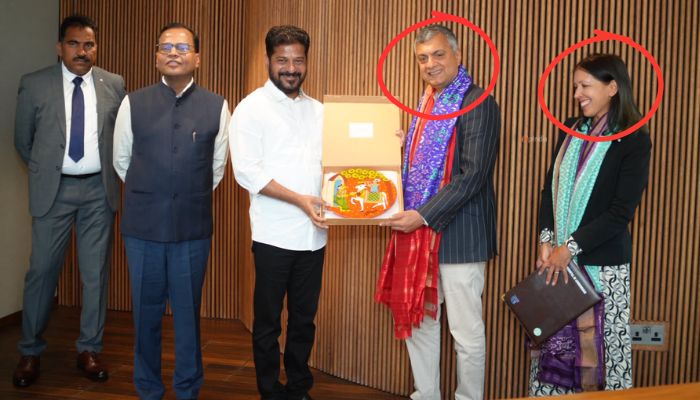
Telangana Chief Minister Revanth Reddy is on an official visit to the United Kingdom. During this visit, CM Revanth Reddy arrived at the Blavatnik School of Government and met professors Maya Tudor and Faisal Devji as a part of the state’s “global education outreach”. CM Reddy’s meeting, however, has triggered outrage back in India.
The Telangana Chief Minister’s Office (CMO) informed that CM Revanth Reddy visited the Blavatnik School of Government, which is an institution affiliated with the University of Oxford. CM Reddy was accompanied by a delegation, including K Ramakrishna Rao, the advisor and ex officio special chief secretary to the chief minister, among others.
తెలంగాణ యువతకు ప్రపంచస్థాయి విద్య, పరిశోధన అవకాశాలు.. హైదరాబాద్ను ప్రపంచస్థాయి విద్యా కేంద్రంగా తీర్చిదిద్దే దిశగా మరో ముందడుగు. ఆక్స్ఫర్డ్ యూనివర్సిటీకి చెందిన ప్రముఖ విద్యావేత్తలతో సమావేశమై, తెలంగాణలో అంతర్జాతీయ విద్యా కార్యక్రమాలు, పరిశోధన, నైపుణ్యాభివృద్ధి రంగాల్లో… pic.twitter.com/7bFj3SkhzC
CM Reddy presented the overview of Telangana Rising and the plan to transform Hyderabad into a global education hub.
However, the meeting between Telangana Chief Minister Revanth Reddy and Maya Tudor and Faisal Devji has triggered outrage in India over the duo’s record of peddling anti-India propaganda. The BJP has accused CM Revanth Reddy of coddling anti-India propagandists.
‘Maya Tudor believes under the Modi government, ‘India’s Democracy is dying’
Maya Tudor is a professor of Politics and Public Policy at the Blavatnik School of Government and a Fellow of St Hilda’s College, University of Oxford. Tudor’s research and work centres on the origins of effective and democratic states, with regional emphasis on South Asia.
Tudor, however, has received flak earlier for her biased assessment of India’s democracy.
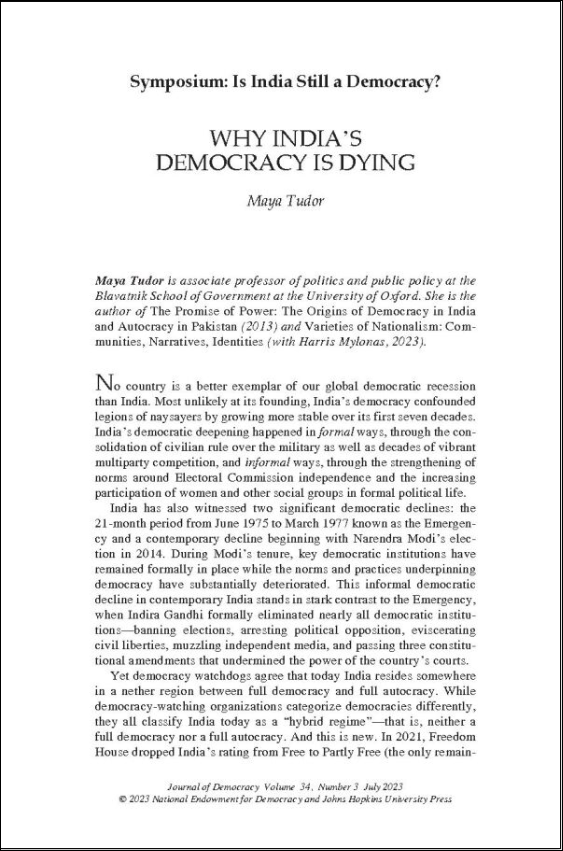
In July 2023, Maya Tudor published an article headlined “India’s Democracy Is Dying” in the Journal of Democracy. The piece contends that India exemplifies global democratic recession and emphasises that India has been downgraded to a hybrid regime.
Maya Tudor cited dubious democratic freedom indices like Freedom House that downgraded India to the “Partly Free” category, and V-Dem, which declared India an “electoral autocracy”.
Back in 2021, according to the ‘renowned’ think tank Freedom House in Washington, India’s freedom score had been downgraded from “free” to “partly free,” with the organization citing attacks on Muslims, the use of the sedition law, and the government’s response to the coronavirus, which included the lockdown, as reasons why rights and civil liberties “have been eroding since Narendra Modi became Prime Minister in 2014”.
Freedom House had made this outrageous assessment about India’s democracy based on the reports published by Islamo-leftist propaganda rag The Wire.
Minister of External Affairs S Jaishankar slammed Freedom House for their “hypocrisy”. He called them “self-appointed custodians of the world who find it very difficult to stomach that somebody in India is not looking for their approval”.
Interestingly, back in November 2022, Freedom House, which had downgraded India from ‘Free’ to ‘Partly Free’ based on The Wire’s now retracted reports on Tek Fog, said it had updated its FreedomOnTheNet 2022 report and claimed that Tek Fog stories had no impact on India’s score. It, however, was evident that Freedom House was attempting to distance itself from The Wire’s Tek Fog fiasco.
Freedom House’s downgrading of India’s status also relied on the fake news peddled by Alt News co-founder Mohammed Zubair, The Wire, and several other left-leaning websites about the assault of an elderly man in Ghaziabad. It also relied on crowdfunding scam-accused Islamist propagandist Rana Ayyub to tarnish India’s reputation internationally.
Maya Tudor’s journal also relied on the George Soros-funded V-Dem Institute’s report to back up her claim that somehow India’s democracy is ‘dying’ under PM Modi’s watch.
The Varieties of Democracy (V-Dem) Institute is an independent research organisation created in 2014 and funded by many other institutions and governments. Fund contributors to the institute range from the Canadian International Development Agency to the World Bank Group.
The Open Society Foundation, which George Soros leads, also funds the institute. Soros is a self-proclaimed philanthropist and Hungarian-American investor who has sworn to ‘fight nationalists’ and conservative governments throughout the world, which he commonly refers to as ‘authoritarian governments.’ Soros has publicly expressed his disdain for India and the Modi government.
According to V-Dem, India had ‘lost’ its status as an electoral democracy and had devolved into an electoral autocracy.
The credibility and unbiasedness of V-Dem’s reports can be understood from the fact that back in 2022, it placed Pakistan and Taliban-ruled Afghanistan above India in the Academic Freedom Index
Coming back to Maya Tudor, in her journal ‘India’s Democracy Is Dying’, she audaciously equated ‘Modi’s India’ with the June 1975 to March 1977 Emergency imposed by then Prime Minister Indira Gandhi-led Congress government.
“No country is a better exemplar of our global democratic recession than India. Most unlikely at its founding, India’s democracy confounded legions of naysayers by growing more stable over its first seven decades. India’s democratic deepening happened in formal ways, through the consolidation of civilian rule over the military as well as decades of vibrant multiparty competition, and informal ways, through the strengthening of norms around Electoral Commission independence and the increasing participation of women and other social groups in formal political life. India has also witnessed two significant democratic declines: the 21-month period from June 1975 to March 1977 known as the Emergency and a contemporary decline beginning with Narendra Modi’s election in 2014,” Tudor wrote.
“During Modi’s tenure, key democratic institutions have remained formally in place while the norms and practices underpinning democracy have substantially deteriorated. This informal democratic decline in contemporary India stands in stark contrast to the Emergency, when Indira Gandhi formally eliminated nearly all democratic institutions- banning elections, arresting political opposition, eviscerating civil liberties, muzzling independent media, and passing three constitutional amendments that undermined the power of the country’s courts…While democracy-watching organizations categorize democracies differently, they all classify India today as a “hybrid regime” that is, neither a full democracy nor a full autocracy. And this is new,” she added.
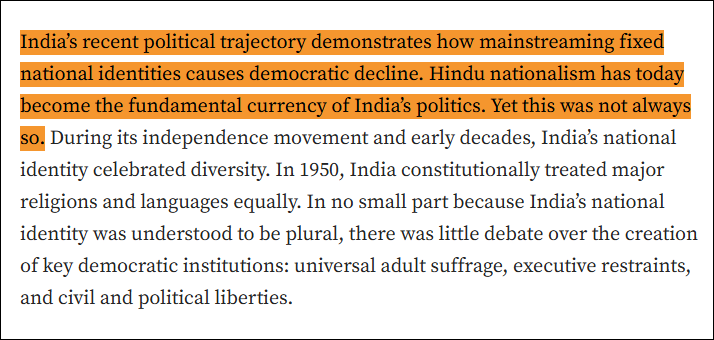
Back in 2021, Maya Tudor had written an article headlined “How India exemplifies the world’s democratic recession”. This piece was riddled with usual Islamo-leftist villainisation of Hindus, Hindutva and ‘Hindu nationalism’. Tudor argued that India is witnessing a democratic decline because “Hindu nationalism has today become the fundamental currency of India’s politics.”
Citing Freedom House’s propaganda, Tudor peddled the typical Islamo-leftist one-sided Muslim victimhood bogey.
In addition to writing journals and op-eds steeped in anti-India and anti-Hindu bias, professor Maya Tudor has also been actively participating in events and seminars to further her apocryphal ‘India’s democracy under threat’ narrative.
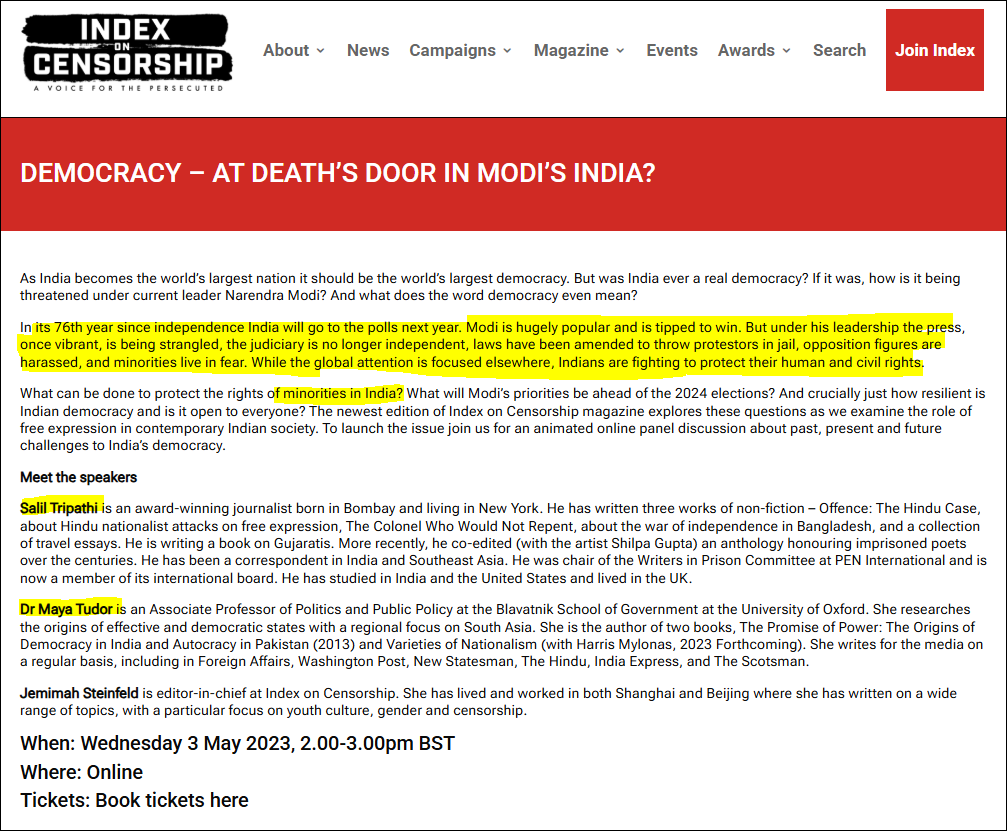
In May 2023, Maya Tudor appeared as a speaker on an online event titled “Democracy – at death’s door in Modi’s India?” While the title itself is quite self-explanatory about the kind of anti-India and anti-Modi alarmist propaganda must have been peddled during the event, the discussion organised by ‘Index on Censorship ’ was attended by ‘journalist’ Salil Tripathi.
Source: Index on Censorship
Salil Tripathi is the contributing editor at the leftist propaganda magazine ‘The Caravan’. Back in August 2024, when Islamic fanatics were killing, raping, and looting Hindus, and vandalising Hindu temples after PM Sheikh Hasina’s forced ouster, Tripathi was at the forefront of peddling the Islamist narrative of ‘Muslims protecting Hindu temples in Bangladesh’ without highlighting the religious affiliation of the attackers. He also downplayed Islamic mob attacks on Hindus in Bangladesh.
From opposing Narendra Modi’s UK visit in 2013 to villainising his government, Faisal Devji pushes Islamo-leftist narratives with nuance
Beit Professor of Global and Imperial History, Fellow of Balliol College, Oxford (previously St Antony’s), Faisal Devji is a Canadian citizen of Indian origin.
Faisal Devji has also been churning out propaganda pieces vilifying Hindutva and the PM Modi-led ruling dispensation.
In his 2024 article, “The end of India’s politics of necessity”, Devji characterised the BJP’s electoral rise as linked to Hindutva. He insinuated that the ‘Hindu nationalist’ BJP is essentially opposed to and intolerant of Muslims and Christians.
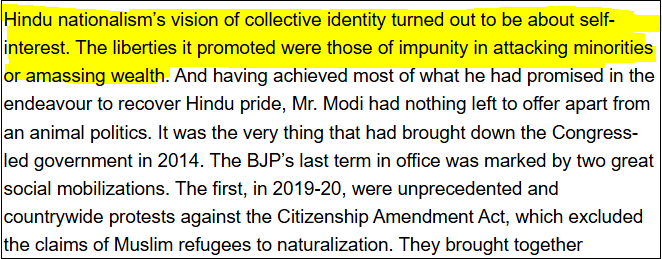
While the article hailed Congress leader Rahul Gandhi for focusing on “unity, justice, and love in large, country-wide rallies that hark back to the Mahatma’s still living political tradition”, it calls Hindu Nationalism’s vision of collective identity a tool for ‘self-interest’.
Faisal Devji claimed that Hindu nationalism turned out to be about granting impunity to its adherents to attack ‘minorities’, by which he essentially meant Muslims.
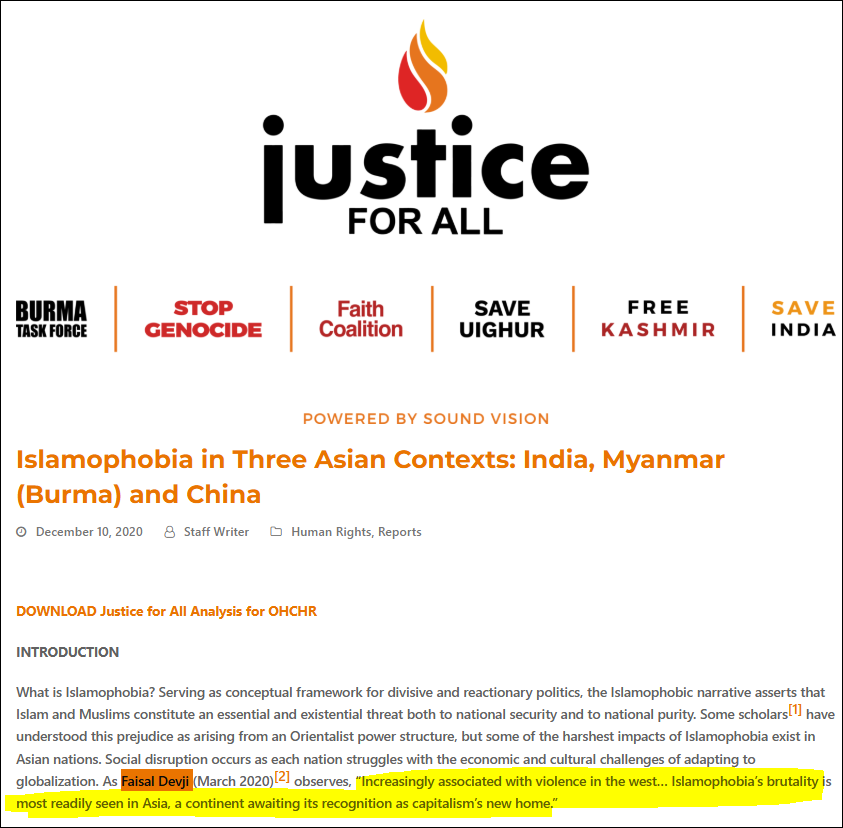
Cited by Islamist organisation Justice for All in its 2020 article, Faisal Devji opines, “Increasingly associated with violence in the west… Islamophobia’s brutality is most readily seen in Asia, a continent awaiting its recognition as capitalism’s new home.”
Interestingly, Justice For All has been at the forefront of the ongoing campaign against Rashtriya Swayamsevak Sangh (RSS) chief Mohan Bhagwat ahead of his New York visit.
Faisal Devji has earlier been interviewed by Pakistani-born American imam, author and media operator Imam Malik Mujahid, who is also the founder of Justice For All, the outfit that equates the RSS activities and ideology to Nazism. Mujahid, who was born and educated in Sindh, was also the president of Islami Jamiat-e-Talaba (IJT), which is affiliated with Jamaat-e-Islami Pakistan. Jamaat-e-Islami was created in British India to implement Islamic Law.
In the interview uploaded on Muslim TV Network’s YouTube channel, Faisal Devji peddled nuanced propaganda against the RSS, painting it as an Islamophobic militia.
This interview was also published on Sound Vision, an offshoot of the Islamic Circle of North America (ICNA) that has intimate links with terror groups such as Hamas, the Muslim Brotherhood, Jamaat-e-Islami, and other Islamic terror organisations.
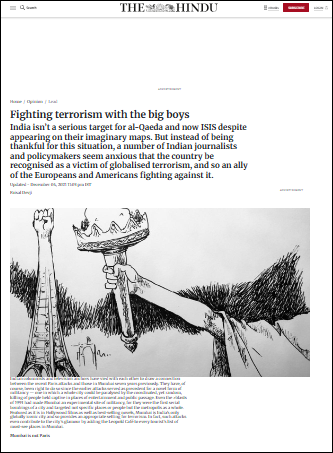
Back in 2015, Faisal Devji authored an article headlined, “Fighting terrorism with the big boys”. In this article published in The Hindu, Faisal Devji claimed that despite its apprehensions, India is not a “serious target” for various Islamic terrorist outfits like the Islamic State (ISIS), Al-Qaeda and others.
He even argued that India was desperate to be seen by the world as a victim of globalised terrorism and thus an ally of Europe and America in the counter-terrorism fight.
“India isn’t a serious target for al-Qaeda and now ISIS despite appearing on their imaginary maps. But instead of being thankful for this situation, a number of Indian journalists and policymakers seem anxious that the country be recognised as a victim of globalised terrorism, and so an ally of the Europeans and Americans fighting against it,” Devji wrote.
Faisal Devji framed India’s supposed longing to join the “all-white club of terrorism’s leading enemies” as a “perversion of the older desire that India take her place among the great powers.”
In this one article, Devji not only villainised the countries actively involved in the counter-terrorism fight, dismissed the fact that India indeed is a victim of Islamic terrorism and has been on the radar of ISIS, Al-Qaeda and other such jihadist groups, but also described the 26/11 Mumbai attacks “a novel form of militancy”, which was “coordinated, yet random, killing.”
In a 2023 article headline, The Fate of Muslim Politics in India, Faisal Devji lamented how Muslims have lost their ability to “mobilise” and are thus emptying their “political lives”. He claimed that Muslims were cowed by the Babri Masjid demolition-related violence and the 2002 Godhra riots, and did not mobilise despite the BJP government’s decisions like a ban on Triple Talaq, or the court-ordered construction of Ayodhya Ram Mandir, or the Hindu side’s pushback against Love Jihad.
He described the 2020 Anti-CAA protests as somewhat a partial return of Muslim mobilisation. While contrary to Devji’s observation, Muslims have in the last decade resorted to mob violence against Hindus over the BJP government’s policy decisions concerning Muslims, the Oxford scholar essentially lamented that Muslims are not violently pushing back against their supposed ‘persecution’.
Interestingly, the BJP has highlighted that Faisal Devji was also among the signatories of the 2013 letter opposing then Gujarat Chief Minister Narendra Modi’s UK visit.
BJP MP from Telangana’s Nizamabad, Arvind Dharmapuri wrote on X, “Meet Faisal Devji of Oxford University. In 2013, he along with others had written an open letter opposing @narendramodi Ji’s visit to the UK. He in one of his interviews, said, “Indians repeatedly say India is great, but it really doesn’t look like that to many people. Shame on Revanth Reddy for meeting such a venom-spewing dimagi naxal.
Meet Faisal Devji of the Oxford University. In 2013, he along with others had written an open letter opposing @narendramodi Ji's visit to the UK.
He in one of his interviews said, "Indians repeatedly say India is great, but it really doesn't look like that to many people”.… pic.twitter.com/UZccDLzHYt
It appears that Congress leaders, including Chief Ministers like Revanth Reddy, are following their boss Rahul Gandhi’s pattern of coddling anti-India and anti-Hindu elements during foreign visits, apparently because of their shared disdain for the Modi government and Hindutva.
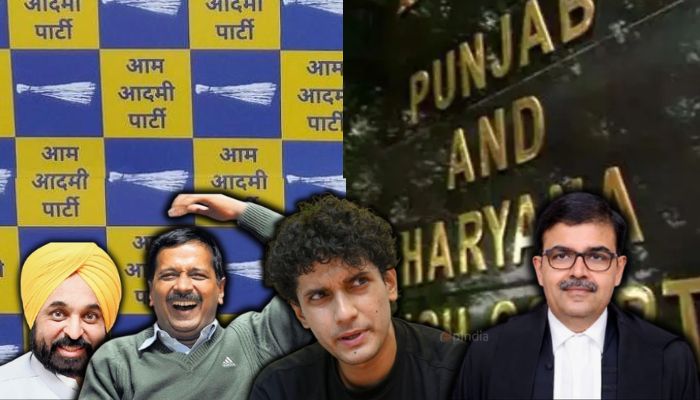
Throughout its journey from an online satire movement, orchestrator of violent protest to inducting former Aam Aadmi Party (AAP) functionaries in working committee post transition into a ‘pressure group’, the Cockroach Janta Party (CJP) has been accused of being an unofficial B-Team of AAP. Despite the repeated denials, the ideological imperative has forced CJP leader Saurav Das to bat openly for the AAP government in Punjab and open a front against the Punjab and Haryana High Court’s Acting Chief Justice Ashwani Kumar Mishra.
In an X post published on the evening of 20th August, CJP co-convenor Saurav Das claimed that the Acting Chief Justice of the Punjab and Haryana High Court, Justice Ashwani Kumar Mishra, withdrew a ‘politically sensitive’ case pertaining to Punjab State Power Corporation Ltd’s Dearness Allowance from another ‘independent’ bench.
Casting aspersions on the integrity of Justice Ashwani Kumar Mishra, Saurav Das claimed that the ACJ heard this case himself by violating the roster as these matters were not before him. He further claimed that Justice Mishra passed an order on 3rd August against the AAP government, which is an ideological-political adversary of the BJP.
The CJP ‘cockroach’ further alleged that Justice Mishra not only created a financial liability of Rs 20,000 crore on the AAP government in Punjab, but also reduced the time period to pay the amount from 30 days to 15 days, to the employees.
“Another controversy has hit the Punjab & Haryana High Court again. Its Acting Chief Justice (ACJ) had withdrawn a politically sensitive case relating to Dearness Allowance of PSPCL from another bench that had a reputation of being independent, hears it himself in violation of roster since such matters were not before him, and passed an order on 3 August against the Government of Punjab, political adversary of the BJP, creating a financial liability of Rs 20,000 crores. He even reduced the time period to pay the amount from 30 days to 15 days, which in all terms is a practical impossibility. Remember, Punjab’s debt-related issue is being raked up before the upcoming state election,” Das wrote.
“Days later, on 6 August, the ACJ gets promoted as the Chief Justice of the same High Court. Is this a coincidence?” he asked.
The CJP ‘cockroach’ further targeted former Punjab and Haryana High Court Chief Justice Sheel Nagu, who was recently elevated to the Supreme Court.
“If you remember, I had reported how the previous Chief Justice too had violated the roster to withdraw and list politically sensitive cases related to AAP-to-BJP defector MPs. That Chief Justice was elevated to the Supreme Court recently. Why are roster violations and misuse of master of roster powers being accepted? Several such instances in opposition ruled states. We must guard our institutions from being weaponised to meet political ends,” Das added.
Another controversy has hit the Punjab & Haryana High Court again.
Its Acting Chief Justice (ACJ) had withdrawn a politically sensitive case relating to Dearness Allowance of PSPCL from another bench that had a reputation of being independent, hears it himself in…
While the timeline of the events given by Saurav Das checks out, his claims of withdrawing the matter from an ‘independent’ bench, by which he meant politically unbiased, roster violation, liability figures and even those about Justice Mishra’s promotion are inaccurate. It is amusing how liberals glorify their failed or successful forum-shopping tactics as a preference for ‘independent judges’ over ‘biased judges’.
Notably, on 3rd August 2026, a Division Bench of the Punjab and Haryana High Court comprising ACJ Ashwani Kumar Mishra and Rohit Kapoor dismissed Letters Patent Appeals (LPA) filed by the State of Punjab and the PSPCL.
The court upheld a single-judge order dated 8th April 2026 and directed payment of pending Dearness Allowance (DA)/Dearness Relief (DR) to employees and pensioners at rates matching the Central pattern for All India Services officers.
Since the original single-judge deadline set for 30th June 2026 had expired while the appeals were pending, the Division Bench altered the timeline to “within a fortnight [15 days]”, with 6% simple interest on default and a bar on certain “unproductive expenditures”, including large-scale advertising until the dues are cleared. The court also sought a compliance affidavit from the Chief Secretary by 31st August 2026.
Estimated liability not Rs 14,000 crore not Rs 20,000 crore
The court’s decision created a liability for the AAP-led Punjab government and PSPCL. As per reports, the estimated DA figure stands roughly at Rs 14,000-15,000 crore, while broader outstanding employees-related dues stand between Rs 18,000-21,000 crore. However, the Division Bench order itself concerned the DA/DR arrears, and thus, CJP ‘cockroach’ Saurav Das’s “Rs 20,000 crores liability” claim is an overstatement.
No proof that Punjab and Haryana HC Acting Chief Justice Ashwani Kumar Mishra withdrew the PSPCL DA case from another bench in violation of the roster
Regarding Saurav Das’s claim that Justice Ashwani Kumar Mishra withdrew the PSPCL DA case from ‘another independent bench’, there are no contemporaneous reports or court records that corroborate the CJP co-convenor’s conspiracy theory. There is no evidence that Justice Mishra heard the matter in violation of the roster because “such matters were not before him”.
As Acting Chief Justice, the judge is essentially the master of the roster and often heads such benches; beyond Saurav Das’s politically motivated conspiratorial insinuations, there is no public evidence of illegal assignment in this matter.
No, Justice Ashwani Kumar Mishra did not reduce the DA payment window from 30 to 15 days, as claimed by CJP ‘cockroach’ Saurav Das
Saurav Das’s claim that the Division Bench led by Justice Ashwani Kumar Mishra reduced the time period to make DA payments from 30 days to 15 days also doesn’t stand the scrutiny of facts.
While the single-judge order had set a deadline of 30 June 2026, which is around 2.5 months from the April ruling, the Division Bench made a 15-day deadline period modification only because that date had already passed during the pendency of the appeals.
This essentially means that the deadline for the state government to disburse DA to state employees was not reduced to 15 days but only adjusted to ensure that the government gets the requisite 30-day window.
If the court had set a fresh 30-day deadline, that would have meant allowing additional time beyond the fixed 30-day window to the state government, which would have translated into further delays in the release of an already much-delayed release of Dearness Allowance (DA).
Chronic delays by Punjab government in release of DA
Notably, Punjab had accepted the 6th Pay Commission recommendations 2021, adopting the Central Government’s pattern of deciding DA rates. The Punjab government released some instalments, reportedly reaching 42% in state rates and there have also been successive DA enhancements. However, the requisite full parity with All India Services officers, essentially central rates, was not maintained, and post 2022-2023, it remained staggered.
In February 2025, the AAP government approved a Liquidation Plan to pay the estimated Rs 14,191 crore DA/DR arrears in phased instalments over several years, up to 36 for employees and 42 for pensioners, without interest in many cases. The courts, however, quashed major parts of this plan as arbitrary and discriminatory.
Then, on 8th April 2026, a single-judge bench ordered a full release of pending DA/DR arrears at central rates by 30th June 2026, striking down the staggered plan.
In early August 2026, thousands of state government employees staged a protest in Chandigarh demanding payment of their pending DA arrears. Employees said that since the AAP government led by Chief Minister Bhagwant Mann came to power in March 2022, it has only released one DA instalment of 4% for July-December 2022.
On 21st August, it has been reported that the Punjab and Haryana High Court has issued contempt notices to the Punjab Chief Secretary, Finance Secretary and PSPCL Chairman-cum-Managing Director, over their alleged non-compliance with the court’s directions regarding the release of Dearness Allowance (DA).
Justice Ashwani Kumar Mishra was not ‘promoted’ as Chief Justice of the Punjab and Haryana High Court on 6th August
Saurav Das’s post claims that Justice Ashwani Kumar Mishra was “promoted” as the Chief Justice of the Punjab and Haryana High Court on 6th August 2026. However, on 6th August, the Supreme Court Collegium had “recommended” Justice Ashwani Kumar Mishra as the Chief Justice of the Punjab and Haryana High Court.
As of 21st August 2026, Justice Mishra is still the Acting Chief Justice (ACJ) of the Punjab and Haryana Court, and not yet ‘promoted’ as the Chief Justice, as claimed by CJP leader Saurav Das.
A formal issuance of the Central government’s notification and assumption of office as permanent CJ by Justice Mishra had not yet occurred. Therefore, Saurav Das’s “gets promoted as the Chief Justice” framing is imprecise.
Punjab’s struggling economy, AAP government’s prodigal advertisement spending, and Saurav Das’s ‘political’ outrage over judicial rulings and appointments
There is no doubt that Punjab is grappling with serious financial constraints. Punjab is facing high committed expenditures in the form of salaries and pensions, while around 70 to 85% of its revenue receipts are consumed by interest. The state has outstanding liabilities of around Rs 4.5 lakh crore, a debt-GSDP ratio around 44-46%, one of the highest in the country; in addition, the state is also struggling with revenue and fiscal deficits, and surging debt-servicing costs.
While Punjab’s plunge into the bottomless quagmire of economic crisis cannot solely be blamed on the AAP government, despite the financial challenges and dependence on borrowing, the AAP government doled out several freebies, including 300 units of free electricity.
Besides freebies, the AAP government in Punjab has also been accused of squandering taxpayers’ money, essentially the funds from the state exchequer for needless advertising and even for AAP’s electoral victory marches.
Back in April 2022, it was reported that AAP spent over Rs 14.63 lakh from the state exchequer for its electoral victory celebration march.
While the state’s financial health was worsening, the AAP government prioritised “image management” more than economic management. In March 2024, it was reported that the AAP government in Punjab spent Rs 7 crore in the Ludhiana district alone on promotions.
In October 2022, it was reported that the debt-ridden AAP government in Punjab spent over Rs 1.8 crore on Facebook ads, with over 77% in the then poll-bound Gujarat.
In 2025, an RTI reply revealed that over the last eight years, the Punjab government, with a notable portion under AAP, spent over Rs 1,500 crore on print and electronic advertisements.
Taking note of the AAP government’s misplaced priorities in terms of spending state funds, the High Court recently explicitly barred the Punjab government from running “large-scale advertising campaigns in print or social media” until the DA dues are cleared, calling them “unproductive expenditures” that in no way justify denying employees their legitimate dues.
The previous and the current AAP government failed to honour dues that became legally binding since the state adopted the Central DA pattern. Both employees and pensioners have waited through inflation and endured great difficulties to receive their legitimate dues. And yet, the AAP government prioritised advertisements and freebies while the DA of employees remained unpaid.
While Saurav Das claims that Justice Ashwani Kumar Mishra ‘created’ Rs 20,000 crore liability for the AAP government, particularly to overburden it ahead of elections and to give ammo to the Opposition (BJP) to attack AAP Punjab, the court only enforced the state’s own policy commitments and is preventing indefinite deferral in DA/DR payments.
Instead of accusing the courts of acting at the behest of AAP’s political adversaries, the BJP specifically, Saurav Das should demand accountability from the AAP government.
However, how can the unofficial B-Team of AAP, the CJP, demand accountability from its own ideological overlord? Through its selective targeting of the BJP on paper leak and exam irregularities, and government school infrastructure issues, the CJP has demonstrated that it’s outrage and activism are reserved only for their one single bete noire, the BJP.
Interestingly, earlier this month AAP supremo Arvind Kejriwal had also made claims similar to the conspiracy theory Saurav Das is peddling now about Justice Mishra’s recommendation as permanent CJ, and Justice Sheel Nagu’s elevation to the Supreme Court. The liberal cabal has this shared penchant for casting aspersions on the integrity of everyone, be it the Election Commission, the judiciary, and even common voters, whose actions do not align with their whims.
The anti-BJP cabal first hated and villainised Justice Bela Trivedi and ex-CJI DY Chandrachud, and has now painted a target on the back of Justice Ashwani Kumar Mishra and Justice Sheel Nagu.
The national capital region is looking at a potential health crisis as cases of H1N1 and other respiratory infections have surged in the past few days. Amid the emerging situation, the Delhi Health Department reportedly held a meeting on Thursday (20th August) with the Municipal Corporation of Delhi (MCD) health department and hospitals to review preparedness. The department has been instructed to step up surveillance, strengthen preparedness and implement necessary health protocols. Hospitals across the Delhi NCR have geared up to handle cases of the infection, including any complications.
Union Health Minister JP Nadda also convened a meeting with the Delhi Health Minister and officials from the Ministry of Health and Family Welfare and the Government of NCT of Delhi on Friday (21st August) to review the ongoing situation. According to the Health Ministry, Nadda reviewed the national surveillance and epidemiological situation, trends in influenza-like illness (ILI) and severe acute respiratory infections (SARI), testing and laboratory surveillance, and preparedness of healthcare facilities to manage seasonal influenza cases.
“The Ministry continues to coordinate with States/UTs, hospitals, laboratories and other stakeholders to ensure effective surveillance, early detection, timely clinical management and proactive preparedness for seasonal influenza, including H1N1,” the Ministry said. Health authorities have urged people not to panic as the situation cannot be described as an outbreak. At the same time, people have been advised to exercise caution to avoid catching the infection.
Delhi: Union Minister JP Nadda reviews the prevailing situation and preparedness for H1N1 Influenza in the country with particular focus on the National Capital
Delhi health minister Pankaj Kumar Singh also attended the meeting. “A report is being prepared to assess the number of cases and the overall situation. Everything is under control. There is no need for general panic. All government hospitals have been directed to ensure adequate treatment facilities,” Singh reportedly said.
The H1N1 infection, commonly known as the Swine Flu, has spread rapidly across the Delhi NCR region, with several people, including journalists and health professionals, testing positive for the infection. Patients are reporting flu-like symptoms and falling oxygen levels, indicating the severity of the respiratory illness.
I tested positive for H1N1 last evening. My fever was 103 for two days & over the past 72 hours, I experienced intense body aches, delirium and nausea. This is my second hospitalisation this month, first being for severe rhinitis
A look at the numbers shows a sharp increase in the cases of Swine Flu this year compared to last year. Delhi has recorded over 1700 H1N1 infection cases so far this year compared to 229 cases during the corresponding period last year. Humid weather amid the monsoon seems to have exacerbated the situation.
What is H1N1 infection?
H1N1 is a respiratory infection caused by the influenza A(H1N1) virus. Its symptoms can include fever, cough, sore throat, runny or blocked nose, body aches, headache, chills and fatigue. In some cases, patients can develop breathing difficulties and low oxygen levels. People are advised to seek medical attention if they experience breathlessness, chest pain, persistent high fever, confusion, bluish lips or worsening symptoms.
Since the infection is contagious, its spread can be prevented by following basic hygiene, including washing hands and avoiding touch, following cough etiquette, avoiding close contact with others when unwell, staying home while symptomatic and seeking medical advice if symptoms become severe. Influenza vaccination can also help reduce the risk of infection and complications.
The infection shows influenza-like symptoms in healthy people, who recover faster. In elderly people, children, pregnant women and people with conditions such as diabetes, chronic heart or lung disease, or weakened immunity are at greater risk of severe illness. In cases of high-risk patients and those with moderate to severe disease, treatment plays an important role.
The Ahmedabad Municipal Corporation (AMC) has intensified its action against unsafe food and poor hygiene in restaurants across the city. On Wednesday, the AMC health department issued an advisory to 11,123 restaurants and food business operators, asking them to install CCTV cameras in kitchen areas and display the live feed near the reception or seating area. This will allow customers to see how food is prepared and whether basic hygiene standards are being followed.
The civic body said food businesses must follow cleanliness and sanitation standards under the Food Safety and Standards Act and Food Safety and Standards Authority of India (FSSAI) guidelines. These include maintaining personal hygiene among food handlers, keeping raw and cooked food separate, using clean water, storing food safely, controlling pests and disposing of waste properly. Kitchens and utensils must also be cleaned and sanitised regularly.
Restaurants have also been told to protect food from dust and contamination, use only FSSAI-approved colours and ingredients and handle cooking oil properly. The AMC has warned that negligence can lead to legal action. Repeated or serious violations could result in licence cancellation and sealing of premises.
Although live kitchen CCTV is not legally mandatory, the AMC has strongly encouraged restaurants to adopt the practice voluntarily. The move comes alongside inspections that have already found several serious violations. Some establishments were sealed during Wednesday’s inspections.
Ahmedabad restaurants face action
Mad Over Grills in Kankaria was sealed after inspectors found pests in stored refined flour. Santosh Ghee Bhandar in Madhupura was shut after an Agmark desi ghee sample tested positive for a compound found in vegetable oils, indicating possible adulteration.
Rajesh Dudh Ghar in Kubernagar faced action after its paneer failed quality tests. Sabru Chinese Mughlai & Tawa Fry Centre in Sarkhej was shut for unhygienic conditions and not having a pest control certificate. Samrat Bakery in Behrampura was sealed for operating without a valid licence and maintaining filthy premises, while Bhairavnath Bhojanalay in Rakhial was sealed after its paneer sample failed quality testing.
The AMC also inspected eight school and college canteens. The Mahatma Gandhi Physiotherapy College Hostel canteen in Saijpur Bogha was sealed for operating without a valid food licence and for several hygiene violations. Inspectors found insects in food, unhygienic conditions and missing medical fitness certificates for staff, pest control records and water quality reports.
5-year-old girl dies, family falls ill after restaurant meal
The dangers of unsafe food were highlighted by a tragic incident in Surat, where a five-year-old girl died after her family fell ill following a restaurant meal.
The family, living in Ranujadham Society, had ordered Kaju-Paneer Curry from Sheetal Restaurant. Five family members were hospitalised, and five-year-old Arya died during treatment.
According to the family, Ashokbhai Kalsaria and one of his daughters developed severe stomach pain around 4 am on 16th August. They visited a local clinic around 9 am, but their condition worsened. Other family members soon became unwell and were taken to Sadvichar Hospital. The family said Arya died within 15 to 20 minutes of reaching the hospital emergency room.
The incident has once again raised concerns over the importance of proper food storage, preparation and hygiene at restaurants.
Rotten meat and expired food found in Bengaluru
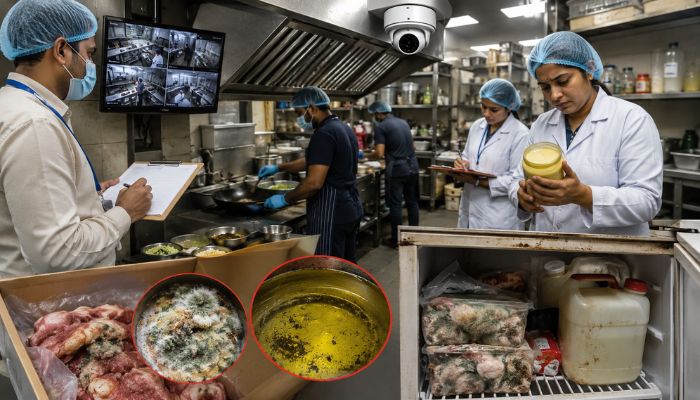
Several other food safety cases have also come to light in Bengaluru. On Sunday, 9th August, during a raid at Skyye Lounge in UB City, Karnataka food safety officials found 45 kg of rotten meat, 6 kg of rotten vegetable cutlets and 15 litres of used cooking oil. The inspection also found an unhygienic kitchen, while meat and beef were reportedly covered with fungus. Milk and curd had expired around 10 days earlier.
Across five establishments, officials seized or discarded 132 kg of food articles and 15 litres of used cooking oil. Royal Chain Hotel accounted for 50 kg of duck and 5 kg of fish, while food items were also seized or discarded at Madras Kitchen, Tescon Hotel and Sanchez Hotel.
The inspections also found serious storage violations. Officials reported that meat at one establishment had been kept in cold storage for more than six months, while fish at another was reportedly stored for more than a year. Notices were issued to establishments that violated food safety rules, and samples were sent to laboratories for testing.
The crackdown followed another drive on 7th August, when officials seized large quantities of meat, vegetables, fish, bakery products and milk from several prominent Bengaluru hotels. LaLiT Ashok Bengaluru later disputed some of the findings, saying its frozen meat and food products were not spoiled or unfit for consumption and that the milk had only crossed its “Best Before” date by one day.
KFC outlet inspected after complaint
In another case, food safety officials raided a KFC outlet at City Centre Mall on KS Rao Road in Mangaluru after a customer complained that an online order contained spoiled and foul-smelling chicken.
Officials inspected the kitchen, storeroom and cold storage areas before sealing the outlet’s go-down. Food samples were collected and sent to a laboratory, with further action to depend on the test results.
The food safety drive was later expanded to Mysuru, where officials seized 9 kg of expired chicken from Rio Meridian Hotel, 68 kg of meat from Grand Mercure Hotel and 4 kg of mushrooms from Q Star Hotel.
KFC said it follows FSSAI guidelines and global quality standards, carries out multiple safety checks and is cooperating with the authorities.
Can CCTV improve restaurant hygiene?
Kitchen CCTV alone cannot completely end food adulteration or unsafe practices. Regular inspections, food testing, proper storage and strict action against violations remain equally important.
However, making kitchen activities visible to customers can create greater accountability. Restaurants may be more careful about cleanliness, food handling and storage when their practices can be watched.
The AMC’s move, combined with inspections and action against violations, could therefore push restaurants towards better hygiene standards. The larger goal is not only to punish businesses after violations but also to encourage them to maintain safe and clean kitchens every day.
On 20th August (Thursday), the Supreme Court declared that hurling alleged casteist slurs in private settings does not fulfill the legal criteria to be classified as an offense under the Scheduled Castes and the Scheduled Tribes Prevention of Atrocities (SC/ST) Act. The judgement was pronounced in a case against a school manager. He was accused of attacking and subjecting the father of two students to caste-based abuses.
However, the proceedings were quashed as the court dismissed the case. The court highlighted that purported statements did not meet the necessary statutory criterion as the occurrence transpired inside a closed space that was not accessible to the public.
The decision was delivered by a bench of Justice Vikram Nath and Justice Sandeep Mehta. They were considering an appeal against a 2023 verdict announced by the Allahabad High Court, which had rejected the appellant’s plea pertaining to section 14A(1) of the Act.
The incident took place in January 2020. The respondent’s (R2) sons attended the school where the appellant was the manager. After his son was wounded during a fight with other students, he went up to the appellant, who was accused of using derogatory casteist terms against him. The latter also claimed to be assaulted by him and the school authorities.
A First Information Report (FIR) was submitted against the appellant under sections 3(1)(r) and 3(1)(s) of the SC/ST Act and sections 147, 323, 342, and 504 of the Indian Penal Code, which are sections 191, 115 and 352 of the Bharatiya Nyaya Sanhita. This led to a chargesheet which was lodged in March and the matter reached the Special Judge, SC/ST Act.
Notably, a counter FIR was filed that same day by the appellant’s wife. She charged that the respondent had assaulted and abused her in the school office. Furthermore, her spouse was also targeted upon intervening. As a result, a chargesheet was also submitted against the respondent and cognisance was taken.
“Having considered the rival submissions and the material on record, we find merit in the submissions advanced on behalf of the appellant,” the court declared. It outlined that sections 3(1)(r) and 3(1)(s) of the Act specifically mention that such an offence has to take place within “public view.” The bench even cited its earlier ruling to emphasise the point.
“Tested on this principle, the prosecution case does not satisfy the statutory requirement. The FIR does not state that the alleged caste-based abuses were uttered in the presence or hearing of members of the public. On the contrary, the incident is alleged to have occurred inside a room in the school,” the court conveyed. It stated that the room was enclosed and lacked a window or public access based on the documented details.
The court mentioned that the absence of a particular accusation related to caste-based abuse against the appellant further undermined the prosecution’s case. It added that the appellant is not charged with using any such specific language or insulting remarks in either the FIR or the respondent’s testimony, referring to the claim as “general in nature.”
“The material relied upon by the prosecution, at the highest, discloses a quarrel and scuffle between the parties. It does not disclose any specific caste-based utterance attributable to the appellant,” the bench expressed.
According to the judges, the four private witnesses who are teachers at the school reported a quarrel and scuffle, as their statements were taken under section 161 of the Code of Criminal Procedure during the probe. However, none of them asserted to have been in the office at the time of the supposed abuses or to have heard any such comments.
“While they stated that they were present in the school, their statements do not establish that they witnessed or heard the alleged caste-based abuse. Their mere presence in the school premises, therefore, does not establish that the alleged utterance was made within public view,” it noted, remarking that the respondent failed to prove otherwise.
The bench determined that the evidence presented to the court must reveal the fundamental elements of the offence. However, the evidence in this instance does not support the key requirement that the purported caste-based slander or intimidation took place in a location that was exposed to the public.
The judges pointed out that the facts presented on the record did not support the high court’s conclusion that the incident happened in public view. They underscored that the necessity for public view hinges on whether the utterances were made in conditions where members of the public could observe or hear them. “The mere fact that the occurrence took place within the premises of a school does not, by itself, satisfy this requirement,” the court announced.
It reiterated that both the FIR and the site plan suggested that the incident unfolded within an enclosed space, while the witness accounts do not substantiate their presence in the room or that they heard any caste-based remarks. “The material on record, therefore, does not establish that the alleged utterances were made in the presence or hearing of members of the public. The essential requirement of public view is consequently not satisfied,” the bench reaffirmed
Therefore, the court indicated that the charges under sections 3(2)(r) and 3(1)(s) of the Act are not established prima facie against the appellant. It stated, “The summoning order dated 8th August 2022, insofar as it relates to the aforesaid offences, therefore cannot be sustained.”
The high court’s order was “set aside,” allowing the appeal. “The proceedings arising out of FIR No. 37 of 2020, insofar as they relate to the offences under Sections 3(1)(r) and 3(1)(s) of the SC/ST Act against the appellant, stand quashed. The proceedings shall, however, continue insofar as they relate to the remaining offences under IPC. 20. Pending applications, if any, are disposed of,” the court declared.
The Allahabad High Court rejected the appellant’s petition against the Special Judge’s summons, deciding that a prima facie case had been established based on the available proof. It added that the fact that the current case was a counterblast could not be grounds for quashing on its own. Hence, the appellant went to the Supreme Court to challenge the verdict, which ruled in his favour.
The apex court has clarified that allegations alone cannot lead to a conviction, and it is mandatory to produce proper evidence (public view in this case) in compliance with the Act to substantiate a case.