Home Blog Page 282

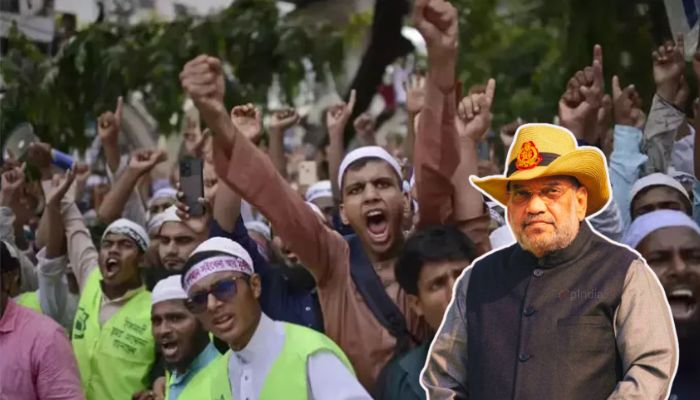
From Nobel to Nightmare: How Muhammad Yunus is eyeing to scrap the constitution of Bangladesh and induct his own ‘Islamic Revolutionary Army’

The remaining weeks of June and the month of July may usher in dramatic and unprecedented political developments in Bangladesh. Muhammad Yunus is swiftly advancing his agenda of establishing himself as an oppressive ‘Sultan’ of a so-called ‘Second Republic’ by nullifying the nation’s existing 1972 Constitution.

Central to this transformation is the impending “July Declaration”, which, if enacted, would effectively convert Yunus’s “interim government” into a “revolutionary government”.

Once the Constitution is scrapped, Yunus will acquire unchecked authority to dismiss President Muhammad Shahabuddin and Army Chief General Waker Uz Zaman, replacing the Bangladesh Armed Forces with his envisioned “Islamic Revolutionary Army” (IRA).

Bangladesh could thus be hurled into the dark abyss of a radical Islamic Caliphate – far more oppressive than Khomeini’s Iran, Pakistan’s militarized Islamism, or Erdoğan’s autocratic Turkey.

Yunus has already hinted at this ominous transformation, claiming that his regime is working on a comprehensive ‘July Charter’ – a set of reform proposals allegedly agreed upon by all political parties – that will be presented to the nation. According to him, this charter will lay the foundation for a “welfare-oriented state”, and signatories will pledge to implement its radical reforms.

Yet only months earlier, in December 2024, Yunus’s press office vehemently denied any association with the July Declaration, calling it a “private initiative unrelated to the interim government”. This deliberate obfuscation was likely a strategic maneuver to avoid early scrutiny while preparing the ground for a sweeping power grab.

Prominent leaders of the National Citizen Party (NCP) – a core ally of Yunus -have been more candid. Hasnat Abdullah described the July Declaration as an instrument to render the Awami League irrelevant, comparing it to Nazi forces, and marking the “burial of the Mujibist 1972 Constitution”. Another NCP leader, Sarzis Alam, stated that the declaration would serve as a “guideline for future governance” and “reflect the hopes and aspirations of all Bangladeshis”.

The truth is far more sinister.

Leaders of NCP, along with the Anti-Discrimination Student’s Movement and other jihadist-aligned entities involved in the anti-Hasina coup that claimed hundreds of lives – including law enforcement officers, Awami League supporters, and religious minorities – are now pushing for the July Declaration to be passed before the next general election. They fear that if a future elected government comes to power, Yunus and his Islamist cabal could be tried for high treason and crimes against humanity.

These fears gained traction following the February 12, 2025 report by the UN Human Rights Office (OHCHR), which in Chapter 6 documents shocking details of lynchings, targeted assassinations, and brutal violence committed by jihadist groups. The report confirms that extremist factions, operating in close coordination with Yunus, carried out violent campaigns to paralyze the state and stage a political takeover.

Following the release of the report, Yunus’s regime deliberately suppressed the damning Chapter 6 while cherry-picking portions that criticized the previous Awami League government. Backed by enormous financial resources, Yunus launched a coordinated media and public relations blitz – domestically and internationally – framing his administration as a beacon of justice while concealing its own crimes.

Despite persistent denials, mounting evidence confirms that the July Declaration is part of a meticulously orchestrated plan involving Yunus and his powerful backers – most notably elements within the US Deep State and Pakistan’s Inter-Services Intelligence (ISI). Their objective is to use Yunus as a proxy to destabilize Bangladesh, dismantle democratic institutions, and gain full control over the country’s strategic and geopolitical assets.

Yunus knows full well that neither he nor his Islamist partners enjoy significant public support – barely 5 percent at best. Holding a free and fair election would be suicidal, as the Awami League or the Bangladesh Nationalist Party (BNP) would easily secure a landslide victory. Having already banned the Awami League from elections, Yunus now seeks to marginalize BNP as well, enabling a sham election that will grant him and his Islamist allies illegitimate power through deceitful manipulation.

In this endeavor, Yunus is attempting to use the United Nations as a key enabler. During a recent meeting, UN Resident Coordinator Gwyn Lewis expressed “unwavering solidarity with Bangladesh’s reform and transition process” and shockingly supported the Awami League ban, claiming that “inclusive elections” are possible without the party that commands over 45 million of the 120 million registered voters. Her statement amounts to an implicit endorsement of the authoritarian regime and its jihadist backers.

Even more disturbingly, Volker Türk, the UN High Commissioner for Human Rights, admitted during a BBC interview that the UN discouraged the Bangladesh Army from intervening during the July–August 2024 protests, which were, in fact, coordinated by jihadist factions. Türk confessed that the UN warned Bangladesh’s armed forces that participation in peacekeeping missions would be jeopardized if they intervened. This emboldened the coup plotters and helped Yunus topple the legitimate government of Sheikh Hasina.

These revelations raise grave questions about Türk’s connections to controversial figures such as Muhammad Yunus and George Soros, and whether key UN officials have been complicit in the destabilization of Bangladesh. The world must now ask: Has the UN abandoned its mission to uphold human rights and instead become a facilitator of regime change at the hands of radical Islamists?

As the crisis deepens, Yunus is preparing to depart for the United Kingdom to receive the so-called “King Charles Harmony Award” from a British monarchy plagued by corruption and scandals. Local media-manipulated by Yunus’s propaganda wing – have been instructed to promote this event as a “moment of national pride” and exaggerate the award’s significance.

However, political observers in Dhaka view this trip with suspicion. They believe Yunus may orchestrate the declaration of the “Second Republic” while abroad, anointing himself as its President and replacing senior military figures with loyalists drawn from Jamaat-e-Islami, Hizb ut-Tahrir, and other jihadist groups – including Ansar al-Islam, the Al-Qaeda franchise operating in Bangladesh. This coup by proxy could see the formal declaration of Bangladesh as an “Islamic Republic” or even a “Caliphate”, granting Yunus unchecked power to indefinitely suspend elections and form a so-called Revolutionary Government.

To garner support from the potential Trump administration in the US, Yunus reportedly plans to lease out the strategically vital Chittagong Port to DP World – a company allegedly linked to the CIA – and offer additional concessions including a transit corridor to Myanmar’s Rakhine State and US military base at the St Martin’s Island. He may also covertly hand over control of Lalmonirhat Airport and the Bangladesh Ordnance Factory to the US via intermediaries in the Pakistani or Turkish military, posing a severe security threat to neighboring India.

In this perilous hour, the onus lies with the Bangladesh Armed Forces and General Waker Uz Zaman. The only viable path to preserving Bangladesh’s sovereignty and democratic character is to take immediate, decisive action against Muhammad Yunus and his jihadist collaborators. If the military fails to act, Bangladesh will descend into a vortex of radicalization, serving as a battleground for proxy wars orchestrated by foreign powers and Islamist terror groups. The time for hesitation is over – the survival of the nation depends on bold leadership, patriotic resolve, and an unwavering commitment to defend the republic from the looming shadow of tyranny.

Another IAS officer caught red-handed in Rs 20 lakh bribery case in Odisha: India’s rotten bureaucracy exposed again

In a fresh reminder of the rot that runs through India’s administrative framework, Dhiman Chakma, a 36-year-old IAS officer from the 2021 batch, has been caught red-handed while allegedly accepting a bribe of ₹10 lakh from a businessman in Odisha’s Kalahandi district. The arrest was made by the Odisha Vigilance Directorate, following a formal complaint that triggered a sting operation.

Chakma, who was posted as the Sub-Collector in Dharamgarh, had allegedly demanded ₹20 lakh in total from a local businessman, threatening him with official harassment and punitive action if he didn’t comply. Feeling cornered and fearing retaliation, the businessman chose to record the demand and approached the Vigilance authorities—an act of courage that ultimately led to Chakma’s downfall.

On the basis of this complaint, the Directorate initiated surveillance and launched a trap. Chakma was nabbed while accepting the first installment of the bribe. A case has now been filed against him under the Prevention of Corruption Act, and officials have confirmed that a deeper probe is underway to uncover the full extent of the misconduct. His financial records, assets, and earlier postings are all under the scanner.

Promising resume, shocking conduct

Hailing from Kanchanpur in Tripura, Chakma is an alumnus of the National Institute of Technology (NIT) Agartala, where he studied Computer Science. Before cracking the civil services exam and joining the IAS, he had briefly served in the Indian Forest Service (IFS) in Mayurbhanj, Odisha.

His educational and professional credentials had painted him as a high-performing officer with a bright future. Yet, behind that promising façade lay a bureaucrat allegedly neck-deep in greed.

Not an isolated case

Unfortunately, Chakma is not an anomaly. Just earlier this year, IAS officer Abhishek Prakash was suspended in Uttar Pradesh after a probe revealed he demanded a 5% commission to approve a solar energy project. The investigation, initiated after a complaint reached the Chief Minister’s office, found that Prakash had amassed hundreds of croresthrough illegal land deals and luxury properties, including 700 bighas of land and multiple bungalows in Lucknow.

Under Yogi Adityanath’s tenure alone, 11 IAS officers have been suspended for corruption in UP. That’s merely the tip of the iceberg.

From the upper echelons of the IAS to the ground-level bureaucracy—corruption is institutionalized, widespread, and deeply entrenched. Whether it’s an RTO constable caught with assets worth crores, a tainted tehsildar with luxury cars, or high-ranking IAS officers with black money stashes—it paints a grim picture of the Indian state machinery.

The system that betrays merit and public trust

Despite a rigorous UPSC examination process touted as one of the toughest in the world, India’s elite civil service continues to produce not just bureaucrats—but often ‘white-collar extortionists in uniform’. The rot isn’t just moral—it’s systemic. The real question is no longer how these officers get caught, but how so many continue to get away.

Even as some get nabbed by vigilance agencies, the majority continue to operate with impunity, shielded by political patronage, and loophole-ridden laws. Suspension is rare. Conviction is rarer still.

India moves forward but bleeds internally

What’s remarkable—and tragic—is that despite this pervasive corruption, India continues to function, build highways, launch satellites, and grow its economy. But imagine the lost potential. Imagine the number of schools that could have been built, hospitals upgraded, roads repaired—if the nation’s arteries weren’t clogged with graft.

As long as positions of power are seen as license to loot, and not as platforms to serve, the cycle will repeat—Chakma today, someone else tomorrow.

This isn’t just about one rogue officer in Odisha. It’s a wake-up call for a country that’s far too used to waking up and falling asleep again.

Removal of Article 370, CAA, drastic reduction in poverty and more: BJP President JP Nadda highlights the achievements of Modi Govt during the past 11 years

As the Narendra Modi-led NDA government completes 11 years, BJP President and Union Minister JP Nadda, on Monday June 9, shared how India has made significant progress in economic growth, social welfare, and global leadership under Prime Minister Modi’s leadership. He also mentioned that the people of India firmly believe that “Modi hai toh Mumkin hai” (If Modi is there, it is possible).

JP Nadda highlighted the three main achievements of the government: development, invention, and innovation. 

Mr Nadda also highlighted achievements like India rising to the fourth-largest economy, success in rescue operations like Operation Ganga, effective COVID-19 management, and efforts to uplift women, SC, ST, and OBC communities.

He said that Prime Minister Narendra Modi has started a new era by changing the political culture of the country, where accountability, transparency and development have replaced appeasement. The BJP President described the Narendra Modi-led government as a strong government and said that this is a government that takes strong decisions and brings economic discipline.

PM Modi changed India’s political culture

Talking about the change brought by PM Modi in India’s political culture, JP Nadda said, “We are completing 11 years under PM Modi’s leadership. It is very difficult to confine 11 years in a press conference. The work done under PM Modi’s leadership is written in golden words because of the unimaginable and unique works. PM Modi has changed the country’s politics, political culture. The country was appeased 11 years ago. Earlier, saving a political chair by dividing the society was the norm. When I say he changed the political culture of the country, it means politics of performance, responsive and responsible government, along with politics of report card, which means we are accountable. The work we are doing is in front of the public.”

“I can proudly say that in the last 11 years, the government led by PM Modi has changed the culture of Indian politics and established a new normal, a new order. This government is effective, this government takes strong decisions, it is a government that brings economic discipline,” he added.

JP Nadda highlights Indian economic progress in 11 years of Modi rule

Addressing a press conference, JP Nadda said, “In the last 11 years, we jumped to the fifth position from the 10th position in the world’s economies. The new data from the IMF confirmed our move to the fourth position. We have been the fastest growing economy in the world…If we talk about Operation Ganga, PM Modi proactively brought back the Indian citizens from Ukraine. Not only Indians but people from other countries also came back from Ukraine under this operation.”

JP Nadda lauds Modi government’s leadership in Covid era

The BJP President said that the Modi government showed strong and proactive leadership through major rescue and relief operations, including during COVID-19. He said that India ran the world’s largest and fastest vaccination drive, giving 220 crore free double-dose vaccines, and that no other country responded to the pandemic like India did.

“We’ve demonstrated proactive governance through various operations like Operation Devi Shakti, Operation Rahat, Operation Maitri, Operation Vaccine Maitri, and Operation Ganga. Our COVID-19 management was exemplary, with the world’s largest and fastest vaccination program…The way India responded to COVID-19, no other country could do it. In India, India gave 220 crores free double-dose of vaccines,” JP Nadda said.

Article 370, CAA, Triple Talaq and Waqf Act: Modi government’s decade of tough decisions and reforms

The BJP President highlighted the notable decisions taken under the leadership of Prime Minister Modi, including abrogation of Article 370, abolition of Triple Talaq, bringing of the Waqf Amendment Act and the Citizenship Amendment Act (CAA), etc.

Mr Nadda said, “In the last 11 years, we have moved forward with the mantra of ‘Sabka Sath, Sabka Vikas, Sabka Vishwas, Sabka Prayas’. Abrogation of Article 370, the country had accepted that this was not possible, but the Modi government removed Article 370 from Jammu and Kashmir. The turnout in the Lok Sabha was 58.46 per cent, while the turnout in the Jammu and Kashmir Assembly elections was 63 per cent. This change has come due to the bold decision of the Modi government. Similarly, Triple Talaq was against the interests of women and was even against humanity. Even Muslim countries didn’t have the system of Triple Talaq, it was removed under Modi government. Similarly, the Waqf Amendment Act, the Citizenship Amendment Act, demonetization, and women’s reservation were undertaken under Modi Govt.”

JP Nadda highlights Modi govt’s efforts towards social justice, women-centric initiatives and upliftment of poor

JP Nadda said that the Modi government has worked for the welfare of SC, ST, and OBC communities, and has promoted women-led development. “Over the past decade, we have worked with deep concern for all sections of society, including SC, ST, and OBC communities. At the same time, we have actively promoted the vision of Women-Led Development. From empowering Lakhpati Didis to promoting Self-Help Groups (SHGs), the Modi government has made dedicated efforts to bring women, as well as SC, ST, and OBC communities, into the mainstream of national development. We’ve increased maternity leave from 12 to 26 weeks with salary and promoted women-led development, with women excelling in various fields, including space exploration (Chandrayaan),” he said.

He said that the Modi government has focused on real work for the poor, not just slogans. He said 25 crore people have come out of poverty in the last 10 years, and extreme poverty in the country has dropped by 80 per cent. “We have not come with the slogan of eradicating poverty, we have shown the results by doing welfare for the poor. When I talk about accountable government, we talk about gareeb kalyan.. The statistics are proof of this…25 crore people in the country have come out of the poverty line. In this way, extreme poverty has been reduced by 80 per cent,” Mr Nadda added.

He further talked about the recently inaugurated Chenab Bridge and said, “…In 1995, during the time of Narasimha Rao ji, the foundation stone of Chenab Bridge was laid, Atal ji declared it a “project of national importance” and PM Modi completed this project and dedicated it to the nation on 6th June 2025. Postponing problems has neither been the policy nor the practice of this government. The government took care of all sections of the society and tried to improve their lives, and today we are ready to take a leap towards a developed India with full strength.”

It must be recalled that Narendra Modi first took oath as the Prime Minister of India on May 26, 2014, and is currently serving his third consecutive term. Last year, he took oath as Prime Minister on June 9 after winning elections for the third term. Marking the occasion, the Union government also released a comprehensive e-book detailing achievements across various sectors over the past 11 years. The year 2025 marks 11 years of Prime Minister Narendra Modi’s government.

Honeymoon, hitmen and murder: How authorities unravelled the plot behind the killing of Indore businessman Raja in Meghalaya and arrested mastermind Sonam

The murder case of 29-year-old businessman Raja Raghuvanshi of Indore has turned into a horrific story of betrayal. On 2nd June, his body was discovered in a gorge close to Meghalaya’s Weisawdong Falls along with the murder weapon. According to reports, it was a well planned action that was carried out by his “missing wife” Sonam Raghuvanshi (27).

She is accused of employing contract killers to execute the shocking crime which was initially perceived as the outcome of a robbery gone wrong. The couple had been missing for 18 days during their honeymoon in Meghalaya. They were married only last month and disappeared while traveling in Sohra on 23rd May, just 50 kilometres away from Shillong.

She was caught from a resturant in Ghazipur of Uttar Pradesh after her relatives alerted the authorities to her presence. “I was kidnapped, I am the victim,” she reportedly told the owner. Three of the assassins she hired from Madhya Pradesh were taken into custody after days of search involving multiple agencies that comprised scouring a rough and forested area in the northeastern state.

“One person was picked up from UP, and another two accused were apprehended from Indore by the SIT (Special Investigation Team). The accused have named some more persons. They revealed that the victim’s wife had hired them. Sonam surrendered at the Nandganj police station in UP and was subsequently arrested,” informed Meghalaya Director General of Police (DGP) Idashisha Nongrang.

Three accused have been identified as Vicky Thakur, Anand and Akash. The arrested mastermind, Raj Kushwaha maintained continuous communication with Sonam throughout the period preceding the murder. Authorities are looking into whether the two are in a relationship. According to other reports, Raj Kushwaha, Vishal Chauhan and Akash Rajput were captured.

According to Vipul Raghuvanshi, Raja Raghuvanshi’s brother, Raj was not merely a friend but also her employee. “I have never seen Raj Kushwaha till now, I have just heard his name. Sonam can be involved in this,” he conveyed.

Vipul also pointed out that Sonam and Raja Raghuvanshi’s intention was solely to travel to Assam to offer prayers at the Goddess Kamakhya Temple. “We don’t know who out of the two planned their visit to Meghalaya. They did not book any return tickets,” he added.

“Sonam surrendered under pressure last night, bringing the total number of arrests in the case to four. One accused remains absconding. Sonam will be brought back to Meghalaya for court proceedings,” highlighted Meghalaya Inspector General of Police (IGP) Dalton P. Marak.

A rejected tour guide helps autorities to crack the case

On 22nd May Albert Pde, a trekking guide in the Nongriat village offered his services to the newlyweds, however, they took another guide. He then noticed them again the next day climbing the 3,000 steps back to Mawlakhiat with three unidentified men.

On 7th June he told the police, “I saw the couple with three men on the way up. The men were walking ahead and the woman was behind them. They were speaking in Hindi,” providing investigators with a new piece of information in the case which became central to the probe.

On 3rd June, a damaged cell phone and a machete were last collected by the authorities from the canyon where the body was deteced by a drone. However, they continued to struggle to make headway despite an airborne effort to track Sonam.

The search was conducted by volunteers from the West Jaiñtia Hills Adventurers and Mountaineering Association, the State Disaster Response Force, the National Disaster Response Force as well as the Meghalaya Police, fire and emergency services along with dog squads.

The machete, according to an investigator, did not look like the ones that are customarily used in Meghalaya. Its handle was made of plastic rather than wood, which is unusual for sharp objects made locally. Police reported Sonam’s disappearance as strange and unexplained and the machete was sent for forensic analysis to determine whether it was used in her husband’s death.

Police believed his death was not an accident and suspected foul play. The matter was investigated by a Special Investigation Team. The couple’s rental scooter was uncovered abandoned at Sohrarim, around 25 kilometers from the gorge, with the key hanging from the ignition despite the intense wind and rain.

The corpse, recognized by a tattoo on his right hand that read “Raja,” was found together with a white shirt, medication, a smartwatch and a piece of a phone screen.

According to her father, Sonam came to Ghazipur on the night of 8th June and phoned her brother who notified the police and they caught her. Meghalaya police stated that she turned herself in under pressure at the Nandganj police station while Uttar Pradesh police informed they found her at the Kashi Dhaba in Nandganj with a slight fever. Uttar Pradesh DGP Rajiv Krishna stated that Sonam will be turned over to Indore Police as soon as they arrive in Ghazipur.

Gujarat: Shells, stone tools, and other evidence of human habitation: IITGN uncovers pre-Harappan human presence dating back at least 5000 years in Kachchh

The researchers from the Indian Institute of Technology Gandhinagar (IITGN), in collaboration with IIT Kanpur, IUAC Delhi, and PRL Ahmedabad, have discovered firm evidence of pre-Harappan human presence in the Kachchh region of Gujarat. The study suggests human habitation dating back at least 5,000 years before the emergence of the Harappan civilisation in the region. It was reportedly centred around ancient shell middens and stone tools found across Khadir and adjoining islands.

Source: PIB

Shell middens reveal food habits and cultural patterns

The prehistoric communities inhabited mangrove-dominated landscapes and consumed shell species such as oysters and gastropods. They left behind massive heaps of discarded shells now identified as shell middens. Professor VN Prabhakar of IITGN, the study’s lead investigator, said, “Our study is the first to identify these sites, confirm their cultural significance, and establish a chronological context.”

Source: PIB

Notably, the British surveyors had long misidentified these shell heaps. They have now been firmly linked to human activity. The finding confirms a well-adapted human settlement thriving in coastal conditions much earlier than previously understood.

AMS dating provides firm chronological evidence

The scientists measured radioactive Carbon-14 in the shell to accurately estimate their age using Accelerator Mass Spectrometry (AMS). These results were calibrated with tree-ring data to ensure chronological accuracy. Shell samples analysed at PRL Ahmedabad and IUAC Delhi confirmed dates significantly predating the Harappan period.

Prof Prabhakar added, “This study not only establishes an early timeline but also sets a new benchmark for identifying similar sites in western India.”

Links to Pakistan and Oman coastal regions

Interestingly, the cultural features of these sites are similar to coastal settlements in the Las Bela and Makran regions of Pakistan, as well as the Oman Peninsula. This suggests that early coastal communities across this entire geography may have followed similar survival strategies.

Source: PIB

Stone tools and early technology

The researchers uncovered a range of stone tools including cutters, scrapers, and splitters. They also discovered cores from which these tools were made. Dr Shikha Rai, co-author and postdoctoral researcher at IITGN, said, “The presence of tools and raw materials hints at prolific tool-making and daily-use applications.” The stone material may have originated from Khadir Island itself, now known for housing the Harappan site of Dholavira.

A gradual evolution, not sudden urbanism

It is believed that the urban development in Kachchh was entirely Sindh-driven. However, the theory has now been challenged based on the new findings. Prof Prabhakar noted, “What we see here is a gradual, locally rooted process of adaptation.” The knowledge accumulated by these early inhabitants may have later helped the Harappans in planning water management, settlement placement, and trade.

Climate records embedded in shells

Apart from the cultural insights, the study may help reconstruct palaeoclimate conditions in prehistoric Kachchh. Shells preserve environmental signals which, when studied, can indicate climate patterns spanning thousands of years. IITGN has previously mapped the climate history of Khadir Island over the last 11,500 years, and these middens offer fresh data points.

Source: PIB

Lessons for today from ancient resilience

The team believes that there is contemporary relevance in ancient resilience. Dr Rai said, “Early humans adapted to different climatic zones without modern technology. There is much to learn from their sustainable approach to ecology.” The researchers now aim to chart Gujarat’s cultural journey from prehistoric to historic periods.

Global recognition for the study

Findings from this research were presented at the 17th Annual Workshop on South Asian Archaeology (Hartwick College & University of Chicago), a seminar at Sorbonne University, Paris, and the 50th ISPQS Annual Conference in Raipur, all in 2025.

The core team includes Prof Vikrant Jain (IITGN), Prof Javed Malik and Debajyoti Paul (IITK), Pankaj Kumar (IUAC), and Mahendrasinh Gadhavi (L.D. College, Ahmedabad).

Over 1 million Afghans forced back into Afghanistan from Pakistan amid deportation drive: UN Human Rights body

0

More than 1.055 million Afghan citizens have returned from Pakistan to Afghanistan between October 2023 and May 2025, marking an unprecedented trend in recent years, according to the United Nations High Commissioner for Refugees (UNHCR), Tolo News reported.

UNHCR Assistant Communications Officer Faramarz Barzin said, “From October 1, 2023, to May 31, 2025, more than 1.055 million people have returned from Pakistan to Afghanistan. UNHCR is present both at the border and in the settlement areas and where we have cash centers, providing a wide range of services to them.”

In 2025 alone, since the beginning of April, an average of around 3,500 people have been crossing daily from Pakistan into Afghanistan, Tolo News stated.

Many of these families, forced to leave Pakistan after decades, are now grappling with serious challenges including lack of shelter, employment opportunities, and limited access to health and education services.

Deported migrants have also raised concerns about their treatment in Pakistan. Torkhal, one such returnee, said: “We are suffering at Torkham. I swear, we are facing hardship. The Pakistani police expelled us with great disrespect.”

Another returnee, Arefullah, said, “House owners in Pakistan treated us very badly, and the Pakistani government should not disgrace the people.”

The World Food Programme (WFP) has reported assisting more than 600,000 migrants returning from Iran and Pakistan since October 2023.

Zia Safi, WFP Communications Officer, said: “At the borders, families are provided with special nutritious foods to prevent malnutrition among pregnant and breastfeeding mothers.”

Meanwhile, the Pakistani government has announced its plans to deport around three million Afghan migrants this year, Tolo News reported.

(This news report is published from a syndicated feed. Except for the headline, the content has not been written or edited by OpIndia staff)


FIR to be filed against ‘Blue gamchhadhari’ MP creating trouble for Switzerland-based PhD scholar of Valmiki community, victim exclusively speaks to OpIndia

In India, the anti-Hindu gang often conspires to sow division within the Hindu community, and for this, their first weapon is to incite Dalits. The anti-Hindu cabal employs myriad tactics to make Dalits feel that they are not a part of Hindu community.

In such a case, if a Dalit Hindu girl starts her speech in the United Nations with ‘Jai Shri Ram’, then it is natural for self-declared ‘Thekedars’ of Dalits to fear that their foundations will be shaken. This, however, is not a hypothetical scenario but a real incident involving a Dalit Hindu girl, Rohini Ghavari Valmiki.

Rohini’s father was a sanitation worker in Indore, however, she received a scholarship of Rs 1 crore for PhD in Switzerland. Dr Rohini Ghavari Valmiki, who runs ‘Janpower Foundation’, is also a social worker. Rohini, however, is in news these days not for her academic achievements but for some other reason.

Rohini is quite vocal against a Member of Parliament. The said MP is known for the blue gamchha (scarf), runs his own political party in the name of India’s most famous Dalit icon and enjoys Y+ security. If you go through Dr Rohini Ghavari Valmiki’s social media handle, you will know very well about that newly elected MP.

Rohini has also released several videos of the MP, in some of which he is seen lying on the ground and apologizing, while in some he is seen crying. Many chats have also gone viral, in which he is not tired of praising Rohini. 

Rohini Ghavari Valmiki set to file FIR against blue gamchhadhari MP

In an exclusive conversation with OpIndia, Rohini said that due to legal advice, she is not able to connect with media organizations through video, but after the FIR is filed, she will soon speak out and make some new revelations. She is also going to knock the doors of the court. Dr. Rohini Ghavari has been vocal against the said MP even before this and has accused him of ruining the lives of many girls.

Rohini had told how the MP (he was not an MP then, he was an activist) played with the dignity of many girls by hiding the fact of his marriage . While talking to OpIndia, Dr. Rohini Ghavari also divulged how all sorts of tactics were used to defame her and to prove her a liar in front of the Valmiki society and by putting pressure on her, those posts were deleted from X. She told that she is still being threatened, the MP is telling his people that nothing will happen to him, the girl will ruin her own career.

However, Rohini remains adamant and said that even if she has to go to jail, she is not sad, she wants to become an example for all the women of this country that you have to fight against the atrocities happening to you without getting scared. Rohini says that initially she thought that this matter should not be given much importance because she had the idea of ​​Dalit unity in mind, she was afraid that this will break the Dalit unity. Let us tell you that while the accused MP belongs to the Jatav community, Rohini belongs to the Valmiki community.

Dr Rohini Ghavari aggressively backs her allegations against the blue gamchhadhari MP

Rohini has been quite aggressive for the past one week. She has used all these words for the MP – deceptive, traitor, tainted, mean, impotent, useless. You can understand from this how aggressively she is fighting her battle. While talking to OpIndia, Dr Rohini that she is angry, and the Valmiki community stands with her. She said that the public judges everyone, earlier she thought that the society itself will do justice, that is why she did not adopt any legal process – but, not anymore. During this time, she also seems angry with the because she feels that in this struggle till now she has been defamed, slandered and many unpleasant things have been said about her.

What is Dr. Rohini Ghavari’s ideology? When OpIndia questioned Dr Rohini about her ideology, she called herself an Ambedkarite, but at the same time says that she does not divide the people of India into different castes. When she looks from abroad, she feels every Indian is her own. She is irritated by words like ‘Manuvadi’ and looks at Brahmins with respect. She has once told that it was a Brahmin teacher of hers who informed her about the scholarship in Switzerland, when she was new there, it was a Brahmin friend who made her comfortable, it was also a Brahmin who showed her the way to the UN. She says that dedication and unity are important for her, when she can live and eat comfortably with foreign friends abroad – then why not with countrymen?

Which ‘big parties’ support the MP?

Dr. Rohini Ghavari feels that the said MP has the support of some big political parties as well. However, she is confident that once his real character is revealed, these political parties will be ashamed of associating themselves with such a tainted person and they will distance themselves from him. Many people from India have called her and asked her to file an FIR so that they can raise their voice for justice. Protests will start as soon after an FIR is filed against the blue gamchhadhari MP. Many activists from the Brahmin community have also assured her of support. Rohini, who has once represented India thrice in the UN’s ‘World Parliament’, had given many arguments defending the construction of the Ram temple.

While what happens after Dr Rohini Ghavari Valmiki files a police complaint against the said MP and approaches the court remains to be seen, it is clear that the newly-elected MP is not having a good time. Dr Rohini is also sharing the stories of some other girls on social media so that she can confirm her allegations. She is not in a mood to back down now. Rohini expressed her anger about Indian laws as well because she believes that in Switzerland, even if someone stares at her in a wrong way, action will be taken against him. But Rohini does not want to discuss this by saying that she does not want to say anything negative about her country.

Devotees demand corridor in Banke Bihari temple then why sevayat Goswami community is opposing it: OpIndia’s ground report throws light on every aspect of the controversy

Have you had the good fortune to visit the Shri Banke Bihari Mandir situated in Uttar Pradesh’s Vrindavan? If you have, then you likely navigated through the narrow streets. You must have experienced the crowded pathways and the jostling crowds. You must have observed the surrounding chaos. Furthermore, you may even have sensed the necessity for the development of this area to make things easier for the devotees.

The last few years have showcased examples like Kashi, Ujjain and Ayodhya to the Hindu community, illustrating how the image of sacred locations can be positively altered by constructing a corridor around the holy temples. The problems of mismanagement and accompanying misery for the devotees could soon be behind us. The Supreme Court’s verdict has also cleared the path for the creation of the corridor at the Shri Banke Bihari temple.

However, parties such as Samajwadi Party and Congress are engaging in petty politics regarding this decision while the local Goswami community is also expressing their opposition. The motives of SP and Congress are clear that they want to get some political benefit out of it. NMeanwhile, OpIndia visited the location to understand the reasons behind the objection from those connected to the temple.

We interacted with all involved parties to provide readers with an accurate picture of the matter, including both, the opposition and the support. This will also help end the propaganda being pushed by the media in the name of opposition from the Goswami community.

Why is Banke Bihari Temple Corridor necessary

We arrived in Vrindavan, located approximately 150 kilometre from Delhi, on 5th June. As soon as we arrived, a Home Guard personnel stopped our vehicle and asked us to leave our vehicle in the parking area. However, once he learned we were from the media, he allowed us to continue. We arrived at the Gautam Pada crossing, navigating through the congested e-rickshaw traffic. The Banke Bihari temple is about 500 meters from this location, but it was not possible to drive the car any further. We then parked in the designated area and proceeded on foot.

We walked approximately 500 metres and arrived at the main street of the temple which is close to the Banke Bihari police post at around 11 am. There were shoes and slippers in front of the majority of shops that sold pedas. Many areas had clogged drains and litter was strewn everywhere. The situation was similar at the temple’s gate number 1 and 2. The stairs were full with the scattered footwear of the devotees.

There is no management: Devotees

AP Pandey from Ayodhya was returning after praying to the deity. He retrieved shoes from the lower section of a store and remarked to OpIndia, “What to do? There is no arrangement. A corridor should be developed here.” A fellow devotee named Ashok Kumar Gupta commented, “There are many problems while having darshan in the temple. Darshan is carried out properly in Ayodhya. Our children were crushed amidst the crowd here.”

A female devotee accompanying him voiced, “Some individuals are charged 501 rupees while others are asked for 1001 rupees, in the name of VIP darshan. The crowd was overwhelming, causing distress to the children. They came outside without having darshan. What could be more heartbreaking than coming such a long way and not being able to perform darshan? The behavior of the guards inside is quite unacceptable. A corridor should be built here too.”

A corridor should be built for Banke Bihari temple: Devotees

A young devotee who returned after the darshan stated, “If a corridor is constructed here similar to those in Kashi, Ujjain and Ayodhya, it would greatly benefit the devotees. Currently, there is no drinking water or resting area available for them here.” Another devotee conveyed, “We would come every day in the past, but we now visit only once a month. We frequently turn back after observing the massive crowd. The construction of the corridor is necessary.”

A devotee from Haridwar who was seated at a shop near the entrance of the temple’s gate number 1 while enjoying rabri, complained, “Just as there are provisions for devotees in Gurdwaras, such amenities are lacking in our religious places. The situation in Vrindavan is similar. Temple committees are driven by greed for money. If a corridor were constructed here, the influx of devotees would increase tenfold along with the employment.”

Devotees gathered for darshan at Banke Bihari temple. (Source: OpIndia Hindi)

The temple doors were scheduled to open at 5:30 pm. However, devotees began arriving as early as 3 o’clock and hence a line of devotees nearly 250 meters long had formed by the time it was 5:30 pm. Meanwhile, the devotees were seated on the ground at Gate No. 1 under the intense sun, fanning themselves as they awaited the opening of the temple doors. Upon noticing the camera, they started chanting “Radhe-Radhe” in unison and declared their support for the development of the corridor during conversation.

Temple committee did not make any arrangements: Business community

Rajkumar Khandelwal’s shop is on the main lane of the temple since 1948. “The corridor needs to be constructed. However, the owners of the shop and houses should be compensated,” he asserted. “The situation here is extremely poor. The drains are blocked. There is filth everywhere. Shoes and slippers are scattered about. Facilities such as a locker room or toilets for the devotees are nonexistent. Even drinking water is unavailable,” he highlighted while pointing down the lane.

He added, “Whether you attribute this to the administration’s failure or the temple committee’s negligence, there is no space for the devotees to sit. The accident that took place in 2022 was due to the temple committee’s shortcomings.”

Image via OpIndia Hindi

Businessman Govind is also in favor of the corridor’s construction. He emphasised, “It is essential at this time. We even approached the high court for this issue. However, it is important to ensure that the construction does not undermine the significance of the Kunj lanes in Vrindavan and their historical importance.” He further mentioned that the government should prioritize crowd management before the corridor’s construction.

“We are not against the development of the corridor. Nevertheless, the character of Vrindavan should not be altered,” insisted a businessman, Naveen Gautam. He referred to the Goswami community and stated that the government should act decisively against any threat. “No one can take away our Thakur ji,” he pointed out.

Not all businessmen are in favor of the corridor. Some are opposed to it and we discovered that many were reluctant to speak candidly about this issue in front of the camera.

Why is Goswami Samaj opposing the Banke Bihari Corridor

Shrinath Goswami, a sevadar inside the premises of the temple informed OpIndia, “There is no need for a corridor in this area. We had proposed two alternative options to the government. However, the government disregarded those suggestions. When Akhilesh Yadav suggested a similar corridor in 2016, Yogi Adityanath opposed it. It is unclear why he is now endorsing this corridor himself.”

Goswami community is opposing the corridor. (Source: OpIndia Hindi)

OpIndia also talked to Gopesh Goswami who serves as the spokesperson for the temple committee and holds the position of Shayanbhog Sevadhikari at the temple. He initially referred to the statements regarding the “increasing crowd in Vrindavan” as hard to believe when we inquired about his opposition to the corridor. He claimed that the escalating number of devotees in Vrindavan does not warrant any changes to the temple or its surrounding area. He attributed the entire controversy to “Tirtha Vikas Parishad” Chief Minister Yogi Adityanath government’s initiative.

“The panel was founded with the aim of guiding devotees to various temples in Vrindavan. However, it did not succeed in its mission. The vice-president Shailjakant Mishra has regularly sought government involvement in the temple’s operations. The corridor is a product of collaboration between certain officials and land mafias,” he charged.

Rajyoga Sevadhikari Gyanendra Kishore Goswami stated, “We are now confronted with two possibilities. We can either run away or be forced into suicide. This corridor is intended only for the VIPs. As long as we were in charge of the temple, there was no chaos.”

Women of Goswami community gathered to protest against Banke Bihari Corridor. (Source: OpIndia Hindi)

During our conversation with the members of the Goswami community, their women also assembled to demonstrate outside the Banke Bihari temple. They expressed that Yogi Adityanath has been ignoring their concerns despite his position as Mahant of Gorakhnath Temple. They cited the example of adulterated laddus at the renowned Sri Venkateswara temple in Tirupati and warned that similar problems could occur here as well.

Supreme Court has authorized the Uttar Pradesh government to acquire land for the development of the corridor. The land will be registered under the name of Banke Bihari. The government will have the ability to utilize temple funds for this purpose. It is anticipated that following the completion of the corridor, over 10,000 devotees will be able to visit the place at the same time. The state government has also formed a trust for the Banke Bihari temple.

Reported by Keshav Malan and Anurag Mishra

‘Auto driver’ Imran entraps Hindu girls with fake identity, blackmails them using obscene videos, threatens to slaughter Hindus on Bakri Eid: Read FIR details

On 8th June, Mathura Police arrested an auto driver named Imran for trapping Hindu college girls under a false Hindu identity, filming obscene videos of them, and later blackmailing them. According to police sources and local Hindu organisations, his phone contained dozens of such explicit videos and chats. The accused reportedly had a target of trapping at least 50 girls, specifically Hindu minors and college-goers.

Hindu organisations stage protest after inflammatory posts surface online

Tensions in the matter escalated after provocative social media posts featuring obscene images of Hindu girls started circulating online. The accused behind the posts was soon identified as Imran, a resident of Machhli Mohalla in Kotwali Police Station limits.

Reportedly, he posed as a Hindu boy and gained the trust of school and college girls while offering them free rides in his auto and gradually trapped them in fake romantic relationships. Under pressure and deceit, he recorded their intimate moments and later used the content for blackmail.

As the information about the matter reached Hindu organisations, members of Bajrang Dal, Dharma Jagran Samnvay, and Banke Bihari Gau Seva Sansthan held a protest late Saturday night outside Bharatpur Gate Police outpost. They demanded immediate action and submitted a formal complaint against the accused.

Targeted 50 girls, blackmailed 23 so far: Hindu groups allege love jihad

Police officials have confirmed that the accused had saved several obscene videos and chats with multiple girls on his phone. Many of his victims are suspected to be minors. Hindu groups said that Imran had set a personal target of trapping 50 girls and had already manipulated at least 23.

The Hindu Raksha Dal has termed the incident a clear case of love jihad and demanded that the matter must be investigated with due seriousness.

OpIndia accessed recordings of his social media stories where he openly claimed trapping 23 victims and said his target was 50.

Source: VHP

In a recent video, he was heard threatening Hindus warning them not to go out on Bakrid. He said, “As Muslims were asked not to go out on Holi by someone, you [Hindus] should not go out on Eid. This is “bhaichara”. Who ever has a problem with blood and qurbani, should not go out. There will be blood [on the streets].” With that story, he also shared a video of woman dicing meat and blood flowing on streets.

Source: VHP

Details of FIR

OpIndia accessed a copy of the complaint and FIR in the matter. The complaint was filed by Vishnu Chauhan, Gau Raksha Pramukh. He is affiliated with Vishwa Hindu Parishad, Mathura. In his complaint, Vishnu said that Imran consistently posts provocative social media posts against the Hindu community. He also accused Imran of posting obscene comments on Hindu girls, demanding strict action against him.

Source: VHP

Based on his complaint, an FIR was registered at Kotwali Police Station under Sections 296 and 299 of Bharatiya Nyaya Sanhita (BNS).

Source: VHP

Speaking to the media, Circle Officer Bhushan Verma confirmed that Imran was arrested near Bharatpur Gate on Sunday at around 4 PM. According to reports, the police have seized his mobile phone and other digital devices. Investigation is ongoing to identify all the victims and uncover the extent of his network.

In a video statement, CO Verma confirmed that Imran has been arrested and is being questioned by the police.

Hindu activists accuse police of showing leniency

Speaking to OpIndia, Vishnu Chauhan accused the police of showing leniency in investigating the case and tempering with the evidence. He said, “We saw videos and photos of multiple victims on Imran’s phone. However, when we went again demanding strict action against him, the police said the data was wiped. Now police is saying that his phone will be sent to forensics to recover the data.” Vishnu demanded a serious investigation into the matter, fearing many of his victims were minors.

Muslim gang targeting Hindu girls busted in MP

In Bhopal, a Muslim gang led by Farhan targeted and raped Hindu girls, considering it a virtuous act and Jihad, as revealed during police interrogation. The gang, hiding their identities with Hindu names, used expensive cars to lure girls, made obscene videos to blackmail them, and planned to sell these on porn sites. Eleven members, including Farhan, Ali, Saad, Sahil, and Nabeel, were arrested in May, with Abrar still at large. The police are investigating, contacting potential victims, and an SIT has been formed. Chief Minister Mohan Yadav has promised strict legal action.

Hashtag #ArrestAarfaKhanam continues to trend on top after Congress leader Aarfa Khanam promoted cow slaughter on Eid-Al-Adha

The hashtag #ArrestAarfaKhanam has been trending on top on X for over 24 hours, amassing approximately 500,000 posts, as netizens demand action against Okhla-based Supreme Court advocate and Congress leader Aarfa Khanam for a now-deleted Eid-Al-Adha post that hurt religious sentiments of Hindus.

The controversy began when Khanam shared a post on X related to Eid-Al-Adha, which was clearly offensive to Hindu sentiments. She posted an illustration of a Muslim kid in skullcap with a cow, with the message Eid-Ul-Adha Mubarak on it. It clearly meant that the cow was being taken for slaughter as part of the Bakrid or Eid-Ul-Adha, the Islamic festival where animals are sacrificed in the name of the messenger of Allah.

Screenshots of the deleted post spread rapidly, fuelling outrage and prompting the hashtag to surge to the top of India’s trending topics by Saturday afternoon.

X users urged the police to register an FIR against Aarfa Khanam for hurting Hindu sentiments.

In response to the outrage, Khanam issued a public apology on Saturday, claiming that she had no intention of hurting the sentiments of any religion including Hindus. She said that she removed the post immediately after she realised her ‘mistake’.

She posted, “On the occasion of Eid-ul-Azha, a post was shared with me from x account, which had no intention of hurting the sentiments of any religion or community. But if that post has hurt anyone – especially the sentiments of any member of the Hindu community – then I sincerely apologize for that. I have full respect for all religions and beliefs. As soon as I realised my mistake, I removed it immediately. My intention was only to share festival wishes and not to hurt anyone’s religious sentiments. Let us all join together to promote harmony, peace and mutual respect.”

She accompanied the apology with a video message, reiterating her lack of intent to offend.

But, despite the ‘apology’ and saying the post was a mistake, she reposted several posts claiming that the image was not offensive.

Complaints have been lodged against Khanam by several people in different places. However, there is no update on any police action on her so far.