Home Blog Page 5285

Manojātasatya: Speak up for, not stigmatise, mental health! The necessity of reducing the stigma and how we can go about reducing it

In India, since times immemorial, we have always believed in the principle of holistic well-being – physical, mental and even spiritual. Among our civilisational claims to fame in the times of yore are the ancient medical science known as Ayurveda (that arises from the Sanskrit words Ayur or life, and Veda or science) as well as the addressing of mental health.

In the Rig Veda, topics such as the exploration of methods for attaining mental happiness, prayers for mental happiness and methods of increasing medha (intelligence) have been looked at. In first six mantras of Shiv Sankalpamastu, important characteristics of Manas has been described, where subjects such as the speed of mind and the state of mind during different states of wakefulness and consciousness are spoken about.

The mind has been described as the instrument of knowledge and basis of consciousness in these ancient texts. Classification of mental disabilities based on endogenous and exogenous factors has been done systematically in Ayurvedic texts such as the Sushruta Samhita and Charak Samhita: we have Nijmanasrog (endogenous mental disabilities), which is further divided into Manas Dosh Janya caused by psychological factors and Sharir Doshanubandh Janya caused by physical illnesses, and Agantujmanasrog (exogeneous mental disabilities).

Even with such extensive knowledge and understanding of this side of human existence, the tragedy is the way many Indians treat mental health, mental disabilities and disorders today.

Within the health related Sustainable Development Goals (SDGs), one target that is directly associated with mental health is Target 3.4:

By 2030, reduce by one third premature mortality from non-communicable diseases through prevention and treatment and promote mental health and well-being.

As per a report by the WHO 7.5% of the Indian population suffers from some form of mental disability or disorder, and India accounts for nearly 15% of the global mental, neurological and substance abuse cases. WHO predicted that by 2020, roughly 20% of Indians shall suffer from mental illnesses, and to make matters worrisome, we have no more than around 4,000 mental health professionals to tackle this challenge!

The National Mental Health Survey of India 2015-2016, supported by Ministry of Health and Family Welfare (Government of India) and implemented by the National Institute of Mental Health and Neuro Sciences (NIMHANS) – Bengaluru, had some eye-opening findings in this regard. The National Mental Health Survey quantified the burden of those suffering from mental, neurological and substance abuse problems and found that while nearly 150 million Indians needed mental health care services, less than 20% were actively seeking support and care!

Some startling findings included: 1 in 20 people in India suffered from depression, there is high prevalence of psychoactive substance abuse, high suicidal risk for nearly 1% of the population and people in the ‘productive age group (30-49 years)’ (terminology from the Survey Report) were affected the most. It was also seen that

Mental disabilities and disorder affect everyone, regardless of gender, age, lifestyle or residence, even though some groups are at higher risk for certain illnesses

In India, even today and among the youth too, if someone says they are undergoing treatment or support for any mental health issue, you can get a range of reactions from some people: from judgemental astonisment to outright humiliation with derogatory comments such as ‘pagalpan‘ – madness and even ‘defect’, as crass and inhuman as that is!

Even today, we have people who take it as an insult if someone is asked to seek help or support for a point of concern when it comes to mental health. Even today, we have people who find it much better to outcast and throw out people from their circles and lives for mental health issues than engage with them with understanding, love, trust and respect. People will speak about you behind your back, insult and mock, gossip and deride any such individual rather than having the least bit of true understanding and concern.

People with mental health disabilities do not need anyone’s pity or mercy, they need understanding.

For anyone to discuss their mental health can be scary, especially in a society that stigmatises mental illnesses. However, it is of utmost importance to do so, so that the people who care for you are able to support and help you. It also liberates you from either living with the fear of someone finding out about your struggle or adversely affecting anyone without their full knowledge of your condition.

Untitled
Prevalence of mental disabilities and disorders (Source: National Mental Health Survey of India 2015-2016, Government of India)

Stigma and discrimination are consequences of misinformation and ignorance. Some studies on mental health literacy, particularly one titled ‘Mental Health Literacy Among Late Adolescents in South India: What They Know and What Attitudes Drive Them‘ published in the Indian Journal of Psychological Medicine in 2016, show a grim reality: mental health literacy among adolescents is extremely low with depression being identified by around 29% and schizophrenia/psychosis being recognized only by around 1.3%. Invariably stigma was seen to influence (worryingly) help-seeking.

As per the work titled ‘The burden of mental disorders across the states of India: the Global Burden of Disease Study 1990–2017‘ published in The Lancet Psychiatry in February 2020, more than 197 million people had mental disorders in India in 2017. In 2017, depressive disorders were seen to contribute the most to the total mental disorders Disability-Adjusted Life Year (DALY).

For my readers who are not familiar with DALY, a Disability-Adjusted Life Year is a measure of overall burden of a disease or disorder, expressed as the number of years lost due to disability, ill-health or early death. Depressive disorders contribute around 33% to DALYs in 2017, followed by anxiety disorders at 19%, idiopathic developmental intellectual disability or IDID at around 11%, schizophrenia at around 10%, bipolar disorder at around 7%, conduct disorder at around 6%, autism spectrum disorders at around 3%, eating disorders at around 2% and Attention-Deficit Hyperactivity Disorder (ADHD) at 0·3%.

As you can see, the range of disabilities and disorders is large, as is the seriousness and nature of each as and when manifested in different individuals. There is no one category or classification or broad wording that can be or must be presented for individuals with mental health disability.

Some disorders are from birth while some emerge over time. Some are curable and temporary while others are more sustained and possibly life-long. As you can see, governments across the world have taken significant steps to help bridge the gap between people with these disabilities and those without:

Untitled2
Main types of government social support provided for persons with mental disorders, global
percentages (Source: WHO Mental Health Atlas Report 2017)

However, as mentioned previously the biggest hurdle seen in India, as around the world, is

Breaking the barrier

Every individual must be able to discuss mental health, disability or disorder and speak up on the same, with ease and understanding, and not as a point of discomfort, shame or stigma, as is seen by multiple studies and groups studying mental health in India over the years. Whether you tell one person, talk to a doctor or a health professional or become an advocate for mental health awareness, it is extremely important to share your story to help yourself and others.

I have known instances, very closely, where someone not doing so has ended up affecting the professional lives (with attention deficit syndrome coming into play without active acknowledgement, in one case), relationships (with somebody, in another case, even being rejected for a mental health condition instead of being spoken to caringly!) and general welfare of individuals, especially when the other side that learned about their disability or disorder was insensitive or misinformed about mental health! And it can be devastating.

There is no greater pain a person can have than be judged and spoken about in harsh terms, due to something not in one’s control. The only way out is trying to reach out, engage, share and seek support wherever one can. If the other side has the capacity and sensitivity to understand, well and good; if not, well, don’t bother!

In a society with stigma around mental health, do not beg or plead anyone to understand your condition or disability, if any. Mental health disabilities and disorders need not be convoluted with any loss of dignity and self-respect!

What’s most important is to think about who you want to share and how much information you want to share. Not everyone will care or have the understanding or sensitivity to hear you out or understand you. Some may even mock you or gossip about you. If you feel vulnerable and unable to cross this initial boundary, it makes sense to talk to your closest friends first. Just try to prioritize those you can be frank and open to, and who shall be supportive and understanding.

There are some ways to make sure that your point reaches across to the person you are communicating to: prime the conversation (start by letting the person know what you are about to say is serious and important to you), write it out if that helps (so that you can gather your thoughts and place them in one place before sharing), use examples (this is useful to communicate disabilities and disorders especially to those who have never experienced and cannot go all the way in realising the seriousness and nature of the condition), let them know how they can help and ask the person to help you talk to others. These are various nuances and points that are hardly discussed or known in India today!

On the other side, if someone opens up to you about their mental health, disability or disorder, the first and most important thing you can do is: listen. Simply listen. Do not make assumptions and definitely do not jump to conclusions. Make them feel comfortable and secure, and listen to them thoughtfully and carefully.

The second most important thing is to believe them. It is easy to just shrug it off as somebody making something up or joking but when somebody with a genuine issue faces this, it is devastating for them. It makes them feel alone and afraid, especially if they needed to muster a lot of courage to tell you! If they feel judged or dismissed, it might discourage them to talk to you or anyone else about their problems in the future.

Do not treat them differently, like a ‘mental case’ as some very insensitively and inhumanly put it. Ostracisation or discrimination is the worst punishment a person with a mental disability or disorder can be given, for no fault of theirs. Do not gossip mindlessly about their condition (since the person opening up is sharing private medical information and this must not be shared lightly) and instead ask how you can help. Gently ask them to seek support from professionals if need be and accompany them, if you can.

Not once with the feeling of charity or pity but understanding. Not once with misinformation or insensitivity. For the worst thing you can do to someone is misuse this condition or information about it, in society. As they say, scars on your body can heal with time but scars like this, almost like on the soul (subject to your belief in souls; heart would do otherwise), never go.

During this period of crisis and uncertainty, as we battle Coronavirus the world over, it is important to look after your mental health. I have always spoken for spiritualisation and calming the mind. However, I feel some of the following points and steps can also be quite helpful:

covid19-mental-health-Desktop
Points and steps for the battle within (Source: The Federal)

I write here with experiences and thoughts that I have collected over the years, particularly while working on mental health in my Stephanian days and in the University of Cambridge as a student leader and activist. This is the Manojātasatya – मनोजातसत्य or the truth emerging from (and of) the mind, and it is this truth that is of significant importance for us to develop and flourish holistically.

I will end by saying that many of us may have watched the famous movie A Beautiful Mind. For me,

All minds are beautiful. They are just sometimes beautiful in different ways!

Speak up, on mental health. Stigmatise not!
No new users, old users can’t access: TikTok gone completely from your phones

Chinese video sharing app TikTok has also stopped working for the existing users a day after the government of India banned the app over security concerns. Essentially, the problematic app has now completely stopped working.

As can be seen, the existing users get a notification that due to government of India directive, TikTok is in process of compliance of the same.

On Tuesday, however, the app was removed from Google Play Store and Apple store. Hence, new users cannot download the app till the ban is lifted, if it is lifted. Following that, many were wondering whether the existing users will still be able to access the app. However, later in the day, even existing users were unable to access the app.

The government of India has announced a ban on 59 Chinese apps that were listed on the Google Play Store and the Apple iOS App Store in India over concerns that these apps were engaging in activities that threatened national security, defence of India, sovereignty and integrity of India. The list includes the popular short video service TikTok, which considers India as its biggest market, UC News from Alibaba Group, CM Browser, file sharing service Shareit, shopping app Shein, popular mobile game Clash of Kings, and more.

China issues statement on ban on 59 Chinese apps including TikTok, expresses ‘serious concern’ and ‘opposes the move’ by Indian govt

Following the Indian government’s decision to ban 59 Chinese apps, including TikTok, for “engaging in activities which are prejudicial to sovereignty and integrity of India, defence of India, the security of the state and public order”, the Embassy of China has issued a statement asking the Indian government to shun its “discriminatory practices” and continue the momentum of China-India economic and trade cooperation, and treat all investments and service providers equitably.

Statement by China on ban of 59 apps by India including TikTok

Opposing the action taken by the Indian government of banning a slew of Chinese apps, the Chinese Embassy in India counsellor Ji Rong, in his statement, raised concerns over India’s decision to outlaw 59 Chinese apps. Rong claimed that India’s measure selectively and discriminatorily aims at certain Chinese apps on unclear and unconvincing grounds, runs against fair and transparent procedure requirements, abuses national security exceptions and suspects of violating the WTO rules.

The Chinese counsellor further added that the banned apps worked in accordance with the Indian laws and regulations and provided fast and efficient services for Indian customers, creators and entrepreneurs. “The ban will affect not only the employment of local Indian workers who support these apps but also the interests of Indian users and the employment and livelihoods of many creators and entrepreneurs,” the press release said.

India imposes ban on 59 Chinese apps including TikTok on the grounds of jeopardising its sovereignty and integrity

The Indian government has red-flagged usage of 59 China-linked apps, including TikTok as being a threat to national security. The Ministry of Information Technology, invoking its power under section 69A of Information Technology Act, with the relevant provisions of the Information Technology (Procedure and Safeguards for Blocking of Access of Information by Public) Rules 2009 has ordered a block on the use of 59 apps saying that these apps are “engaged in activities which are prejudicial to sovereignty and integrity of India, defence of India, the security of the state and public order”.

The ministry in its press release said that it has recently been receiving complaints from various sources including several reports about the misuse of some mobile apps available on Android and iOS platforms for stealing and surreptitiously transmitting users’ data in an unauthorised manner to servers which have a location outside India. The compilation of these data poses which threat to national security and sovereignty and is a matter of deep concern said the statement.

The ban on the Chinese apps came at a time when the two countries are involved in an intense standoff along the Line of Actual border in Eastern Ladakh and had recently clashed in the Galwan Valley in which 20 Indian soldiers attained martyrdom and a comparable but undisclosed number of Chinese soldiers had died in the violent brawls.

After govt’s TikTok ban, demand for Indian ‘Chingari’ app skyrockets, 90,000 new users joining every hour

Homegrown video-sharing app ‘Chingari’, which was launched in November 2018, has been witnessing a steady rise in its traffic ever since calls to boycott Chinese products gained momentum on social media. The demand for indigenous or ‘Made-in-India’ services has been growing, especially after the violent clash between India and China at Galwan Valley in Ladakh.

Overwhelmed by the success of his venture, Sumit Ghosh, one of the co-founders of the platform informed that Chingari had surpassed all records of the past. He stated, “Approximately 10,000 users per min in the app. 3 million videos are being swiped/watched per hour. 26 million videos have been watched in the last 24 hours. 90,000 new users joining the app per hour. And guess what? Our tech and Infra handles it with ease”.

As per Google Analytics data shared by Sumit Ghosh on Twitter, Chingari has users not just from India but also from United Arab Emirates, Kuwait, Singapore, Saudi Arabia and even the United States.

On June 24, co-founder of Chinagri, Biswatma Nayak, had taken to Twitter to express his happiness after the app suppressed 1 million downloads on the Google play store. The feat was achieved in just 24 hours, with an increase of more than 5,00,000 users.

Earlier, industrialist Anand Mahindra also applauded the homegrown app and tweeted, “I hadn’t ever downloaded TikTok but I have just downloaded Chingari… More power to you.”

What is ‘Chingari’?

Hailed as an alternative to Chinese TikTok, Chingari was developed by Sumit Ghosh, Siddharth Gautam and Biswatma Nayak. The app is available in multiple languages such as Bangla, Gujarati, Marathi, Kannada, Punjabi, Malayalam, Tamil, and Telugu. Besides creating content, the Indian app allows users to socialise and browse trending and entertainment news, funny videos, song videos, love quotes, and so on. Users can watch, download, and even share information or entertainment videos with friends and family. It also allows people to earn money on the basis of the virality of the videos. Views can be converted into points and then monetised.

TikTok and 58 other Chinese apps banned

On Monday, the Government of India banned 59 apps including TikTok over security and privacy concerns. The Ministry of Information Technology, invoking its power under section 69A of Information Technology Act, with the relevant provisions of the Information Technology (Procedure and Safeguards for Blocking of Access of Information by Public) Rules 2009 has ordered a block on the use of 59 apps saying that these apps are “engaged in activities which are prejudicial to sovereignty and integrity of India, defence of India, the security of the state and public order”.

After PM Modi extends free foodgrains for poor till November, West Bengal CM Mamata Banerjee announces free ration for people till June 2021

Within an hour after Prime Minister Narendra Modi announced the extension of free food grains for poor till November, given the surging coronavirus situation in the country, West Bengal chief minister Mamata Banerjee, in what appears as an attempt to outsmart PM Modi, declared that she will provide free ration for another 12 months, till June 2021.

PM Modi announces free ration to poor till November 2020

Earlier today, PM Modi, in his address to the nation, announced that the centre’s key central scheme—PM Garib Kalyan Anna Yojana (PMGKAY) will be extended till the end of November in which free ration will be provided to the poor. The scheme is set to cost Rs 90,000 crore to the government, PM Modi said.

While highlighting the work done by the central government to alleviate the concerns of poor adversely affected by the coronavirus induced lockdown, PM Modi said that the scheme to provide free ration to the poor will continue for an additional five months, adding that 80 crore people will get the benefit from the scheme.

Eye on the West Bengal state elections?

It is worth noting that the measure by the Mamata Banerjee government in West Bengal comes at a time when she is facing tough headwinds from the BJP in the state, which was also reflected in the General elections held in 2019 where the saffron party won an unprecedented 18 Lok Sabha seats. The state of West Bengal is scheduled to go to polls in 2021 and it is all but impossible to view Mamata Banerjee’s push for pro-poor policies independent of the forthcoming state elections in 2021.

Dubai: Chimera on a spiral towards its death

Dubai is again back in the news but for the wrong reasons. With the ongoing Covid-19 pandemic, Dubai is staring at a recession with experts forecasting Dubai’s economy is going to shrink by 5.5% in 2020. Dubai faces about $10 billion in debt maturities this year with revenues expected to drop in line with the pattern of the 2009 crisis. Bank of America estimates that Dubai’s fiscal deficit could widen to $4.4 billion, or 3.9% of GDP, and could be as high as 5.3% if interest payments on a loan from Emirates NBD, Dubai’s biggest lender, are included.

The pandemic and the associated lockdowns have hit Dubai’s economy which relies majorly on retail sales, travel, tourism and real estate sectors really hard. One survey expected, 70 per cent of Dubai companies to go out of business within six months due to the pandemic. Amid the current uncertainty, businesses in UAE’s seven emirates, as elsewhere across the world, are slashing salaries, putting employees on unpaid leave, and reducing staffing levels and Dubai is no exception.

The state-owned airline, Emirates recently fired 600 pilots including a few Indians with what is being seen as one of the largest layoffs in the aviation industry. The airline has also announced 50 per cent salary cuts for employees in all grades 4 and above until September.  Dubai’s property developers are cutting salaries by as much as half as the pandemic hits Dubai’s property developers and mall owners. Joyalukkas, is closing its “weak performing” outlets, while Malabar Gold & Diamonds, with more than 100 outlets in the GCC states, has decided to delay opening all its stores until there is clarity on rent reductions from its landlords. Similarly, it’s likely more retail stores will face closure leading to job losses.

The topic of these articles though is actually not on the short term pain faced by Dubai. Almost any nation today is facing the same acute economic crisis due to the pandemic and Dubai is definitely no exception. You can pick any country in Europe, the Americas or the Asia Pacific and you will be to gather enough headlines about business closures, job losses, defaults and recessions. The point that I want to stress is the long term decline of Dubai and its slow death. Let me elucidate the same

Setting the context for the decline of long term decline of Dubai, one has to understand the most critical factor and that is oil and the petrodollar economy associated with it.

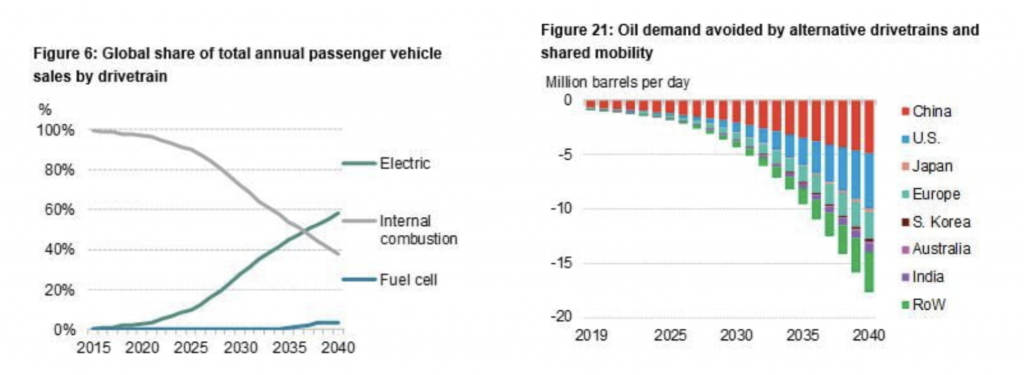
Decline in Oil prices: Coronavirus just laid bare the real strength of petrodollar economies. It has heralded the long term decline of Oil and the purchasing power associated with it. The focus on renewable energy and electrification of transportation has reached a tipping point. Read what the latest Bloomberg New Energy Finance had to say about this – There are over 500,000 e-buses, ~400,000 electric delivery vans and trucks, and 184 million electric mopeds, scooters and motorcycles on the road globally today as we speak. EVs’ share of global car sales is around 3 per cent in 2020 and is expected to rise to 10 per cent by 2025 and 58 per cent in 2040.

Some 30 per cent of global 2- and 3-wheeler sales & 20 per cent of the existing fleet are already electric. Sales of internal combustion passenger vehicles peaked in 2017 and are in permanent decline. EVs across all segments are already displacing 1 Mn barrels of oil demand per day. Oil demand from passenger cars is hit hard by Covid-19 and will never recover to 2019 levels. But growth in commercial vehicles keeps overall road oil demand growing until 2031 when it starts to decline. With long term structural decline in demand, the oil will see more periods of a low price point than high price points.

Global share and oil demand

Of course, the counter-argument that is thrown around is that Dubai is the least dependent on Oil revenues among gulf economies and hence the long term structural decline in oil prices shouldn’t impact it. Dubai’s diversification is going to ensure that not only does it survive but also prosper in this new world bereft of petrodollars. I do agree that Dubai on the surface looks well-diversified and that Dubai has a negligible contribution from direct production and export of oil.

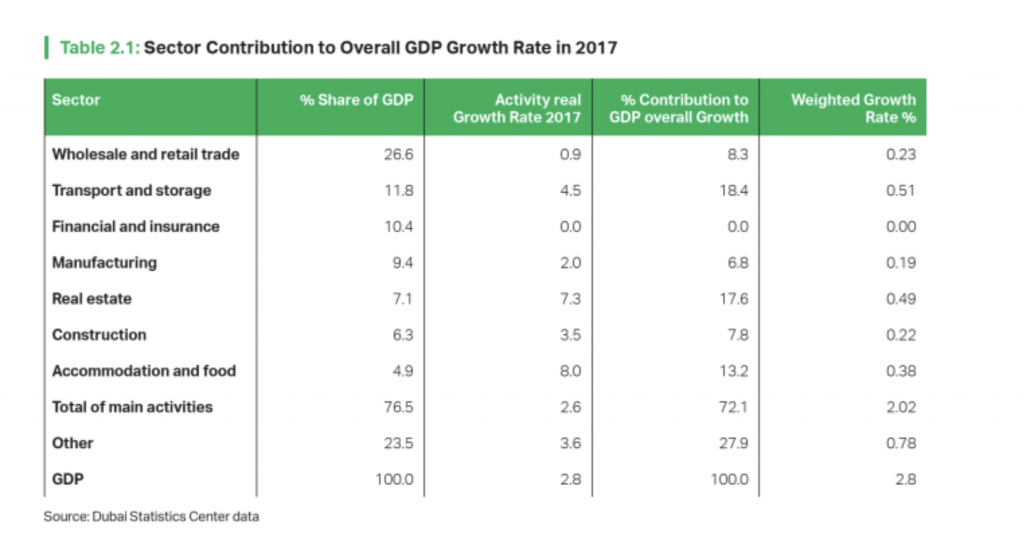
However one tends to miss the forest for the trees and while Dubai does truly have a well-diversified economy across multiple non-petroleum sectors, it, however, is intrinsically linked to the larger oil-based economies powering the Gulf countries and its neighbours. Dubai has negligible energy resources, but its role as a petrodollar recycling hub means its fortunes have long swung in tandem with its larger oil-exporting neighbours. Let me elaborate on how that’s the case, today the major sectors contributing to Dubai’s economy are listed below

Source: http://www.dubaided.ae/StudiesAndResearchDocument/Dubai-Economic-Report-2018-Full-Report.pdf

The three major pillars supporting Dubai’s economy are. – Trade (physical and financial), Retail (Wholesale incl) and Real Estate (Construction incl).

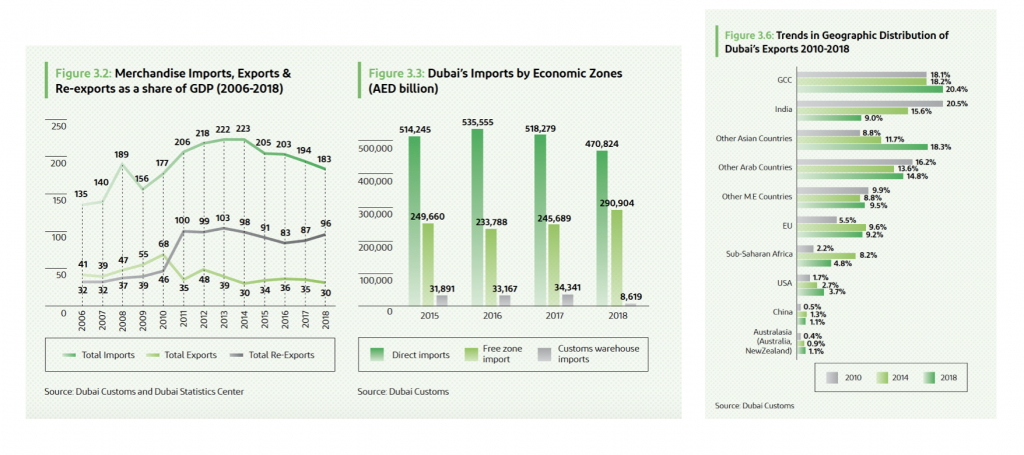
Let us start with trade, Foreign trade is a very important contributor to the economy. Foreign trade value is nearly 321 per cent the value of the GDP. Dubai is an important financial and trading hub for the Middle East, South Asia and Africa. Dubai imports commodities, manufactured goods and re-exports the same to these markets. However, Dubai’s role as a key trading hub is built on weak foundations. Re-export of imported items account for nearly 75 per cent by value of total Dubai’s exports with only 25 per cent of Dubai’s export-driven by domestic production. Hence the trade is not powered by a strong domestic industry, unlike China or Singapore. Domestic exports account for nearly 50 per cent in the case of Singapore.

Singapore is a manufacturing powerhouse with 20 per cent contribution to overall GDP as compared to 10 per cent for Dubai. Additionally, an even more important point to note is that other the Middle East and Arab countries such as Saudi Arabia, Oman account for nearly 45 per cent of Dubai’s exports. Even though Dubai itself is not directly dependent on oil, its major trading partners accounting to nearly half of its trade are heavily dependent on the fortunes of oil. Hence long term decline in purchasing power of oil economies means a direct hit on the trade and economies of Dubai’s partner countries.

The decline in trade will impact in more than one ways as loss of significant share results in loss of scale which originally helped Dubai achieve competitive advantage to emerge as the trading hub of choice. Re-export to South Asia will eventually move to Mumbai or Gujarat with the ongoing up-gradation of infrastructure and East African ports can one day replace Dubai’s as the key trading hub for Africa.

Source: https://dubaided.gov.ae/StudiesAndResearchDocument/DER2019_EN_Report_f4.pdf

This also reflects in services. Take for example the Tourism industry, nearly 27 per cent (1 in 4) tourists coming to Dubai are from GCC or the Middle East and Arab countries. The drop in oil price will reduce the disposable income available with an average Saudi or Kuwaiti reducing their spend in Dubai. This will have a chain reaction with impact retail sales, hospitality and allied sectors. With most Middle Eastern oil-producing nations drawing down their reserves due to low oil prices, there will be less scope for investments and recycling of petrodollars in the days to come. This will impact the financial, consulting and export of other services to the wider Middle East. Hence decline in oil prices will not only result in lower trade of physical goods but also in lesser trade in services.

The next important sector we will look at is the real estate and construction sector. Real estate and construction collectively accounts for 13-15 per cent of GDP. But the real estate sector in Dubai is in a big mess. It all started with the tremendous growth of Dubai’s real estate market leading up to 2014 correlate with the spike in oil prices. That spike created a glut in supply which is yet to be cleared after 6 years. And with Pandemic, the supply overhang might never get fully cleared in the coming years. The real fact is that Dubai’s real estate market is not purely driven by domestic considerations.

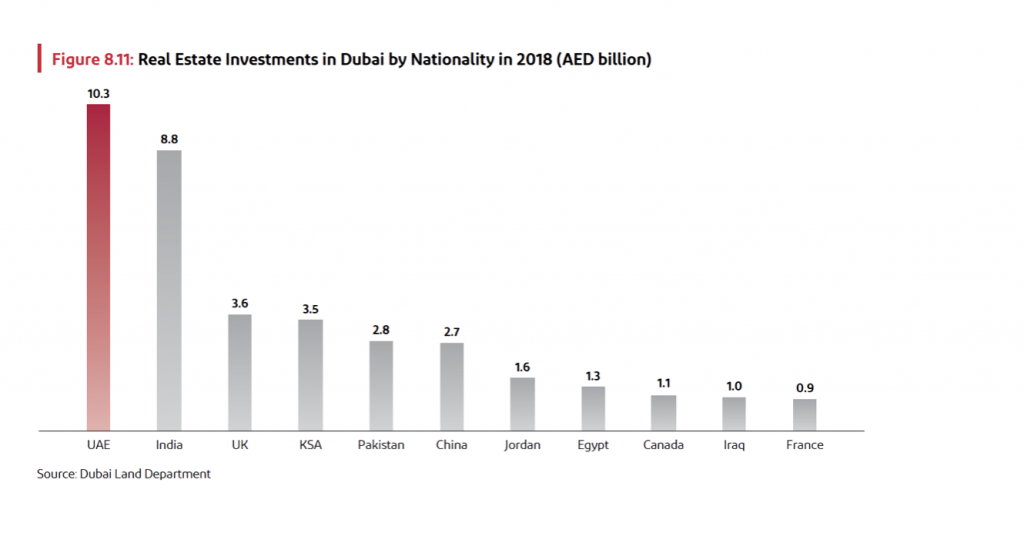
Given the lax or lightly regulated nature of Dubai, a significant share of money from outside investors is parked in Dubai’s real estate. Dubai is an attractive destination for parking of illicit, corrupt or black money. Domestic investment in real estate by Emiratis account for only 20 per cent of total investment.

To elaborate on the impact of illicit money flow into Dubai’s real estate, let us look at India which accounts for nearly 20 per cent of all investments into Dubai real estate. While there are no accurate estimates on how much of the above is illicit or black money. The bulk of purchases are made by wealthy Indians to escape political strife and taxes. According to industry sources in Dubai, close to $100 million moves from India to Dubai every single day!

This money uses the ‘hawala’ route, an informal money transfer system, where rupee gets converted to a dollar at a premium to market exchange rates. In the process, Indian black money is invested in Dubai property. And since Dubai charges no tax on rental income or any capital gains for the purchased property, cash-rich Indians know their investments are safe. The modus operandi is also used by money launderers, smugglers, underworld gangsters and drug traffickers to make payments to propel working for them. Take for example, recently in Jan 2020, ED conducted searches at the residence of a former chief engineer of BMC. ED, in a statement, said incriminating documents with regard to illegal acquisition of a property held in Dubai was recovered during the search operation. The property was in Dubai at ‘Park Island, Bonaire Marsa, Dubai’ measuring 89 square metres purchased for Rs 70 lakh in 2012.

This flow of illicit money into Dubai’s real estate is one of the major causes for the subsequent crisis that we are seeing today.  The emirate’s decision in 2002 to allow foreign ownership of so-called “freehold” properties drew a rapid construction boom that attracted developers from across the world. Money quickly flowed in from all corners of the world from Pakistan, India to Mexico and Russia. This flow of money resulted in real estate boom where people could easily flip luxury properties for a quick profit. Speculators made a fast buck by selling off-plan properties for a large profit within weeks of their initial investment – with no intention of ever living there. This caught the attention of the Dubai government who wanted to get into the action.

The result was government today controls some of the emirate’s biggest developers. The state-linked firms, created to speed up construction, used cheap and often free land to compete for buyers. Some paid upfront without waiting for homes to be completed by depositing only 5 per cent of the value. And excessively optimistic projections of growth in Dubai’s population, which consists largely of foreigners, only fed the building boom leading up to 2014 when the bubble finally burst with the collapse of oil prices. Much of today’s property glut is of the government’s own making with land sales remaining an important source of state revenue.

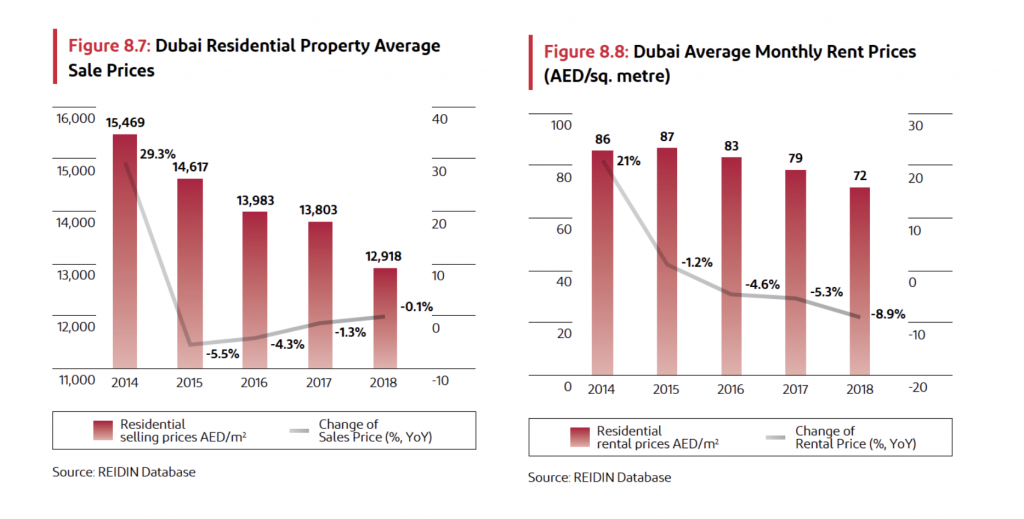
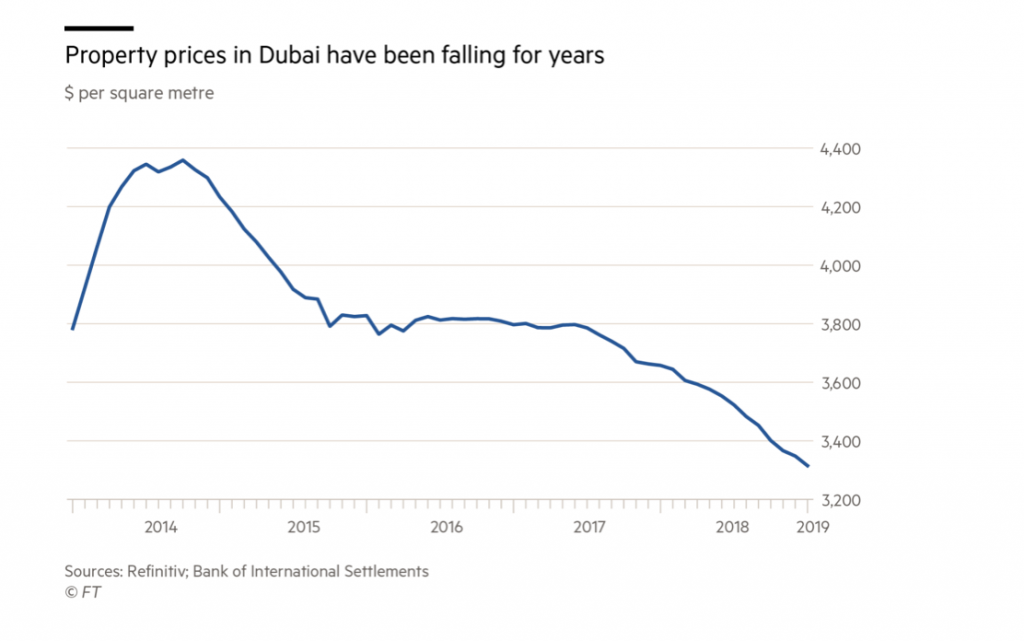
This chronic oversupply resulted in the reversal in property value and rental yields in Dubai. Dubai’s property value has seen consistent decline in prices since 2014. Residential property prices have fallen 16 per cent from 2014 to 2018. Rental yields have followed suite dropping similarly by 16 per cent in the same period. The falling prices makes Dubai real estate a bad investment destination today irrespective of advantages with regards to hiding from regulators and tax authorities.

And the Real Estate prices and rental yield will continue to drop for two reasons. Supply overhang – With a massive guaranteed oversupply of properties and top developers taking losses in 2019, S&P Global ratings said for 2020, it could see another a potential decline of 5 to 10 percent. And this estimate was before Covid-19 stuck the world. The market is already struggling, and 2020 is expected to be a year of the very high delivery cycle. There are still launches with small deposits and long-term payment plans. The oversupply situation is so bad that Dubai is even considering committee to control Dubai’s housing supply.

This brings to the next important factor for the decline of the real estate sector and that is ex-pat population. In fact, one can argue that Dubai is highly dependent on one commodity which defines its success and that is the ex-pat population. Dubai is one of those few countries along with its fellow GCC members where ex-pats outnumber locals. Only 15 per cent of Dubai’s population is local Emirati with ex-pats accounting for 85 per cent of the total population. It is estimated that an average ex-pat contributes to 30,000 to 40,000 USD to Dubai’s economy. At an estimated population of 2.8 Million, Ex-pats are estimated to contribute 85 Billion dollars accounting for nearly 20 per cent of Dubai’s economy. However, the continued slump post-oil crash in 2014 and now the coronavirus pandemic is resulting in a drastic outflow of the ex-pat population.

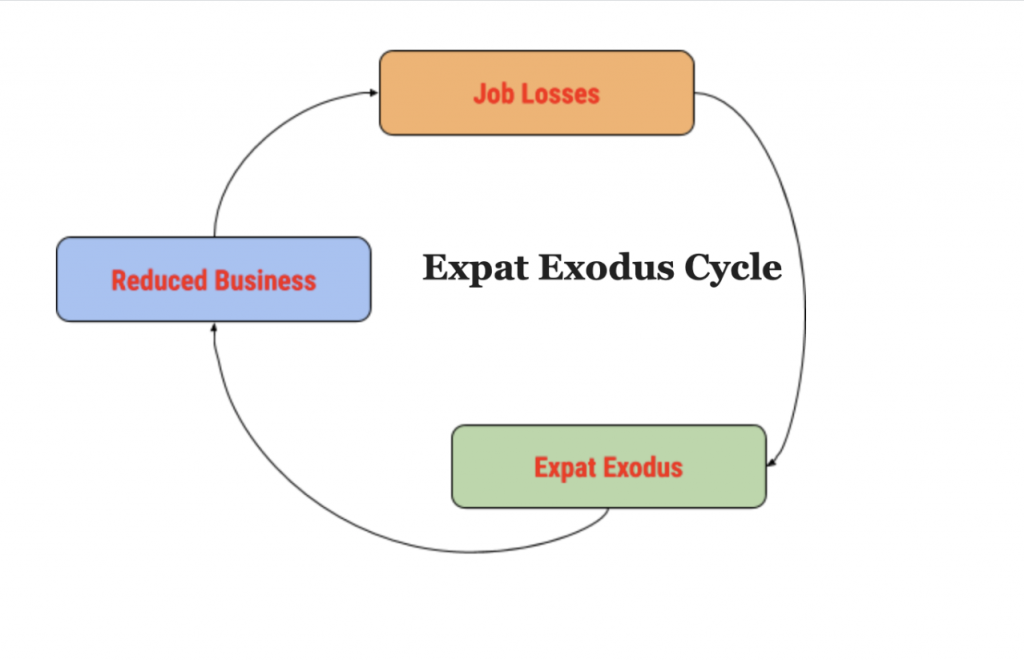
Oxford Economics estimates the United Arab Emirates, of which Dubai is a part, could lose 900,000 jobs — eye-watering for a country of 9.6 million — and see 10 per cent of its residents uproot. The coronavirus is the trigger that is going to start an ex-pat exodus resulting in a death spiral. As ex-pats move out, sectors that relied on those professionals and their families for business such as restaurants, luxury goods, schools and clinics will all suffer. This will create more job losses in these sectors which will trigger further exodus resulting in a self-fulfilling cycle.

Ex-pat exodus cycle

With no formal route to citizenship or permanent residency and no benefits to bridge the hard times, it’s a precarious existence for most ex-pats. Education is emerging as a deciding factor for families, Dubai has the region’s highest median school cost last year at $11,402, according to the International Schools Database. With falling revenues, the Dubai government might decide to introduce Income tax, destroying the main attractive factor for wealthy and educate the ex-pat population.

Hence more and more ex-pats are reconsidering their choice to stay in Dubai. And as more ex-pats decide to leave, more business will be impacted by the reduced spending which will result in more job losses triggering the next wave of the exodus. This will put sharp pressure on Dubai’s real estate sector. Already suffering from the overhang of excess supply and with new property launches planned till 2022, the ex-pat exodus will trigger a further sharp fall in real estate prices and rental yields. With property prices already seeing up to 25 per cent reduction in prices, any further drop would exacerbate the capital loss for the investors. The continued fall in property prices will deter any investors including those with ill-gotten wealth who will now think twice before in investing in Dubai.

The final important sector that we will look at is the wholesale and retail trade. It is the largest employer accounting to nearly 20 per cent of the total employees. The drivers of demand in the wholesale and retail trade are mainly domestic population growth and tourism. I have already elaborated how low oil prices are going to impact Tourism. Additionally, the main attractiveness of Dubai is the presence of major brands which results in tourists purchasing items not available in domestic markets.

However as Brands continue to go global, the retail attractiveness for tourists will decline. Add to this the fact, globally retail is moving online and Dubai cannot be immune to such changes, the retail industry will definitely be impacted. E-commerce already accounts for nearly 10 per cent of retail sales in Dubai in 2018. This will put further pressure on the offline retail industry. On top of all of these is the ex-pat exodus elaborated previously which will bear immense damage to this sector. With ex-pats accounting for 85 per cent of the population, any drop in the ex-pat population will have a direct and proportional impact on retail sales. So while retail and wholesale sector accounts for the largest share of GDP (25 per cent), they are the most sensitive to global macroeconomic factors.

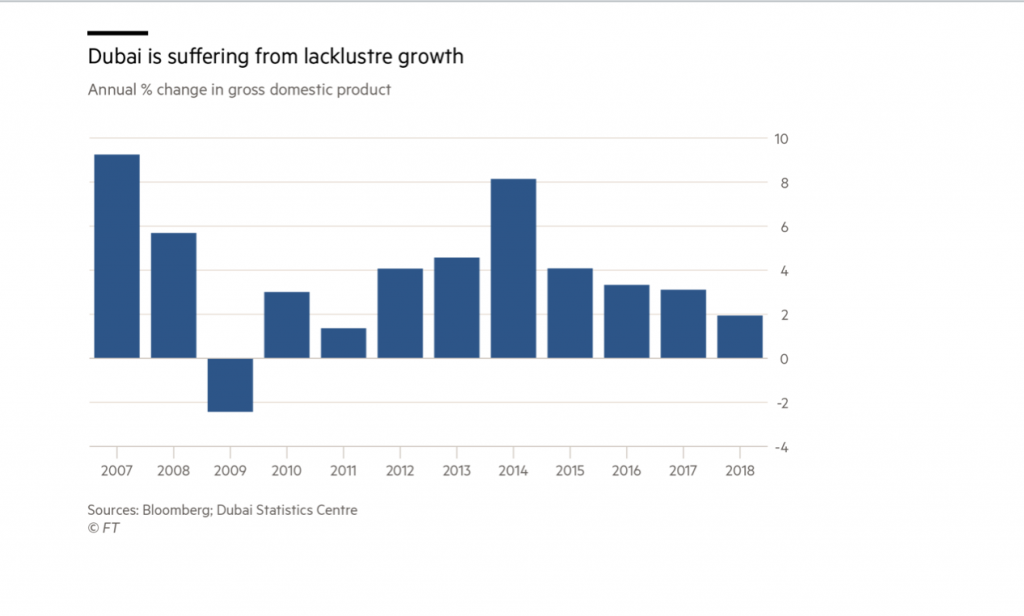
Thus Dubai’s economy while seemingly diversified from the vagaries of oil production is actually built on weak foundations and indirectly rely on two commodities – Petrodollars via spending by other gulf countries and ex-pat population. These trends were well on their way even before Covid-19 stuck Dubai. This FT article illustrates some of the above problems that Dubai was already facing in 2019 much before Covid-19 pandemic appeared on the scene. From clothing to cars, retailers saw sales slump by 50 per cent since the slowdown began with the collapse in oil prices in 2014. Hoteliers were slashing room rates as tourism growth was slowing, hampered by the strong dollar-linked currency and a surfeit of new rooms.

Restaurants were shutting their doors as wealthy expatriates were replaced by less experienced ones, who were being paid less and were saving more because of job insecurity. PepsiCo had made redundancies at its Dubai headquarters and moved about 30 per cent of roles into larger markets such as Egypt and Saudi Arabia. The growth in tourist numbers had slowed since 2017, despite waves of Chinese and Russian nationals arriving, falling short of the relentless pace of hotel construction. So Covid-19 pandemic is not the trigger of the long term crisis Dubai is facing but a catalyst expediting the pace of its decline.

So are we going to see Dubai’s death in 2020, is this the end of it. The answer is no, while the above factors are going to impact Dubai, some of these take a longer-term to play out. It will take another decade or so for Dubai to see the full implications of these factors. Additionally, the above scenario doesn’t take into account any black swan geopolitical events such as the potential crisis in Oman and chaos associated with it or a new Saudi – Iran war with Dubai being one of the centres of such hostilities.

Any such black swan event will expedite the above decline triggering a bigger exodus and further collapse of its economy. The Best case scenario for Dubai today is its rulers take continued measures to slow down the rate of decline and provide a smooth landing. Dubai and all its glitz and glamour with its towering skyscrapers and island villas will disappear into the sunset just like the glitzy gold rush towns of the previous century.

Sharia law in Minneapolis and Antifa’s role: How concerned should we be?

0

Not all ideas come to fruition but given appropriate stimuli, the political, financial, and media support, there is a high probability of some ideas becoming a reality. Sharia law in Minneapolis- is it just an idea and why? It is because, Minneapolis experienced the tragic death of George Floyd, a death which was avoidable, unwarranted, and undoubtedly a sign of racial prejudice by a White policeman against a Black man.

While the prejudice has been part of us as human beings for time immemorial, by the privileged toward underprivileged, Floyd’s death led to climatic conditions with the unprecedented and sinister idea as dire as the city governed under Sharia law.

What is troubling is how the tragedy associated with Floyd’s death is being politicized as (a) a case of police brutality, which it is, (b) a call for disbanding and/or defunding the police department but to what end, and (c) the revival and sustained movement of “Black Lives Matter (BLM)” as we approach Presidential elections in the U.S.

The intent of this write up is to further analyze the ill-gotten idea by the opportunists to govern Minnesota under Sharia law. Could it be a microcosm of Islamization around the globe and a threat to other religions that have otherwise co-existed for centuries?

Following Floyd’s death, the street protests, arson, and looting for weeks in Minneapolis and the cities around the world, shook the human conscience to the core. This included the leadership in Minneapolis city council, who, on June 7, pledged to “disband” the city’s police department and replace it with a new system of public safety. A resolution was passed with a veto-proof majority to “dismantle” and “abolish” the embattled police agency responsible for Floyd’s death.

Ever since the debate and discussions have followed about what do disband, dismantle, defund, and abolish mean; all added to the mix? Are these synonyms? The Mayor of Minneapolis is in favor of a long-overdue major overhaul of the police department but not let it disappear and risk public safety. The city council President herself appears conflicted although she led the way. I characterize the current stalemate as a state of confusion among the citizens and city leadership.

While that cloud of confusion hangs over Minneapolis, the headline, “Antifa and Muslim Groups Plan to ‘Police Minneapolis Under Muslim Rule’” heightens the cause of concern. It matters because a lawmaker raised the issue and asserted that Antifa and Muslim organizations plan to “police Minneapolis under Muslim rule.” Reportedly, the residents of Somali descent in Minneapolis in 2016 verbalized that they preferred Sharia law over American laws. I live in this community but had never known or heard that anyone would have such a preference. As an immigrant myself, I embraced the U.S. as the land of opportunity with the freedom of expression and protection under the law.

The article by Robert Spencer, a noted author (21 books) and expert on Jihad Watch goes on to suggest that the Sharia patrols have been in Germany, Britain, and even New York City, where the Muslim Community Patrol (MCP) is decked out in uniforms that strongly resemble New York Police Department (NYPD) uniforms. The MCP drives cars carefully designed to look like NYPD cars, to enforce “fundamentals of the Sharia.”

Should this ill-gotten idea gain further momentum in Minneapolis, there is no telling where it goes and how fast it spreads like the wildfire. The political winds during the months leading to the Presidential elections may add fuel to this fire beyond Minneapolis and reach global destinations due to our interconnectedness on social media and the Internet.

I had hardly ever heard of Antifa nor cared about it prior to Trump’s tweet to declare, “ANTIFA as a Terrorist Organization,” during the protests in Minneapolis. Since then, Antifa has unexpectedly become headline narrative with possible real-world consequences. First, what is Antifa? By all accounts, it is not an organization but a loosely structured group of likeminded people with antifascist (Antifa in short) ideology.

Arguably, the Minneapolis protests and similar protests elsewhere may have been incited and/or aided by Antifa believers but there is no documented evidence yet. It is important to underscore a recent Washington Post report according to which 437 articles, posted between May 25 and June 4, featured the term “antifa” using “organization” or “movement” interchangeably, and using the vague term “group” most often.

Furthermore, “Often, the articles described antifa as rioters, criminals, terrorists, and the like; implying that if antifa members are rioters, then acts of rioting might also make you antifa.” The Black Lives Matter movement was mentioned alongside antifa or presented as also involved in violent actions.

Recently, Trump has not hesitated to accuse BLM leader guilty of “treason,” a very serious charge indeed. Trump, as the President, perhaps knows something about Antifa and BLM we don’t but it is significant to cause an alarm about Antifa as an ideology.

Equally significant is the association of certain influential persons mentioned in the report, “The term antifa was also used to characterize specific individuals like Keith Ellison, Minnesota’s attorney general who criminally charged the four police officers involved in George Floyd’s killing; George Soros, the financier, and philanthropist often demonized by the right-wing; left-leaning Democratic politicians like Rep. Alexandria Ocasio-Cortez (N.Y.) and Rep. Ilhan Omar (Minn.); as well as actors and media personalities or Twitter CEO Jack Dorsey, whose company recently began flagging some of the president’s tweets as false or inciting violence.” The U.S. Attorney General Barr, on the contrary, blamed the Antifa group for inciting violence and sowing discord which is still under investigation.

No matter what Antifa stands for, it has gained unprecedented notoriety to have the potential for real-world consequences. The alleged association with elite politicians, financiers, and media leaders provides Antifa their eyes, ears, and mouth (advocacy) as well as the resources and power of media to practice and promote the ideology unabated with no geographical boundaries.

What must be feared most is the perceived or real association between the militant Muslim faithful and Antifa believers. Why? There have been numerous terrorist activities that were linked to Muslim Jihadis, Mujahidin, ISIS, or similar groups operating in an Islamic country or allegedly receiving financial backing from those countries.

The most gruesome example of terrorism is the 9-11 in New York City, funded and masterminded by Bin Laden and executed by the nationals of Saudi Arabia. How ironic it is that Pakistan continued to accept the U.S. funds to help U.S. hunt Bin Laden while hiding him in Pakistan for many years? Is not it an extreme example of the United States rewarding a perpetrator with no consequences even after Bin Laden’s death?

The Washington Post research directly describes antifa as a terrorist entity or explicitly agreed with Trump’s tweet. Most often, the right-wing websites mention antifa’s “violence;” usually accusing antifa of violently destroying property, rioting or looting (perhaps Minneapolis is an example), or less often attacking “police” or “journalists.” Often, when mentioning antifa’s “violence,” these sites accused antifa of “hijacking” or exploiting protests after traveling across state lines.

Extrapolating the travel from across state-lines to across countries, the brotherhood between Muslim jihadis and Antifa believers is a real threat to non-Muslim nations and societies. For example, India with the Hindu majority was occupied by Muslim rulers over many centuries. They forcibly converted Hindus to the Muslim faith and committed heinous atrocities such as sexual exploitation of Hindu girls and women, demolition of Hindu temples and building mosques there, job discrimination against Hindus, etc.

That religious acrimony has never stopped even after the partition of India with an exclusive Muslim nation (Pakistan). Unfortunately, India has witnessed constant threats by Muslim militants both within and beyond who have so much accumulated hatred to seek the annihilation of Hinduism and openly labeling Hindus as “Kafirs,” the common insulting term for all non‐ Muslims.

There are many radical Muslims around everywhere who, if given the power, would have no hesitation forcing non-Muslim to accept conversion to Islam and become the believers. It was not too long ago that the European countries graciously accepted Muslim refugees and they are now being threatened by Sharia law at the peril of their century’s old faith and traditions.

It is ironic that Floyd’s tragic death occurred in Minneapolis making the city a hotbed for the violence-ridden protests which otherwise has been known for Minnesota Nice. Did the city deserve such notoriety? Today, the city council leadership is discussing police department reforms, the right thing to do. But the idea of police enforcing Sharia law is frightening which is coming from a lawmaker who should know more than the average citizen.

I was dumbfounded that the select city residents, welcomed by Minnesotans not too long ago, preferred Sharia law. I have seen the images of live protests and feel threatened not knowing if Antifa was/continues to be active in any part of local protests and politics. I wonder if the choice of Sharia law among Minnesotans has been further investigated and questions asked why? How deep-rooted is the influence of the Antifa group and/or ideology in this community and beyond? How well Minnesota and global politicians, policymakers, and people know about Antifa and the conspiracy of Sharia law and agree with the research offered by the Washington Post?

As difficult as it is to disregard the politics of Left versus Right, we must be wary of Sharia law in Minneapolis, the United States, and all other non-Muslim nations and communities. While I attempted to connect a few dots, I remain baffled and confused at best with the idea of an American city under Sharia law. However, remaining silent, not trying to get familiar with Antifa, short for antifascists, and not fighting Sharia ideology head-on are not the options for any responsible citizen globally.

Note for Readers: The use of “antifa” is the choice of the author of the Washington Post article which I did not change but I used Antifa as a noun.

Imran Khan parrots Indian liberals, panics over ‘change in demographic structure’ after India issues domicile certificates in Jammu & Kashmir

It is rightly said “old habits die hard”. Pakistan Prime Minister Imran Khan, was once again seen frothing at India’s Jammu and Kashmir domicile law. While members of Gorkha community, Valmiki Samaj and West Pakistan refugees feel that the domicile certificate has restored their dignity and honour, Imran Khan, probably taking a cue from our Indian liberals and Kashmir centric parties, expressed panic and concern over the “change in the demography structure”.

Taking to Twitter the Pakistani PM claimed that the domicile certificate issued in the union territory of Jammu & Kashmir is ‘illegal’ and ‘in violation of UNSC resolutions & international law’.

Khan claimed that he has written to the UN Secretary General and will also reach out to world leaders to ‘stop India’ from the ‘unacceptable path’. A friendly reminder: the world leaders have stood by India and even during abrogation of Article 370 they refused to comment on the internal matter of India. Even UN snubbed Pakistan saying Kashmir is a bilateral issue between India and Pakistan.

Imran Khan started his nonsensical rants on Twitter comes days after the Kashmiri separatists and ‘liberals’ in India expressed their fear and anger against the domicile certificates.

Soon after it was reported that almost 25,000 people, including people from Dalit and Gorkha community, have been provided domicile certificates of the union territory of Jammu & Kashmir, the Mehbooba Mufti-led People’s Democratic Party (PDP) and Omar Abdullah-led National Conference (NC) along with the Pakistani-sponsored Hurriyat Conference on Friday condemned the issuance of domicile certificates.

They claimed that issuance of domicile certificates to non-locals is the first major step towards changing the demography of the Muslim-majority region. They also accused the RSS of hatching the conspiracy of trying to change the demography of Muslim-majority state. The PDP alleged that the Modi government was attempting to change the J&K’s Muslim majority character, target its unique identity and facilitate loot of its resources.

Muslim cleric Mirwaiz Umar Farooq, who leads the Pakistan-sponsored Hurriyat conference said that while initiating the implementation of a demographic change in Jammu and Kashmir, the government is simultaneously exploiting its natural wealth and resources and rendering local people jobless, taking advantage of the situation as people are struggling with the COVID-19 pandemic and its adverse effects on their daily lives and livelihood.

Moreover, Sr. Advocate of Supreme Court, Prof. Bhim Singh and his political outfit party, National Panthers Party on Monday strongly condemned the issuance of Domicile Certificate to outsiders in Jammu and Kashmir and urged the President of India, Ramnath Kovind to immediately intervene into the matter in order to save the history, integrity and the fundamental rights of Permanent Residents of the state. 

Shekhar Gupta and ThePrint joins the bandwagon

Besides, the so-called liberals also took to Twitter to express thier displeasure with Modi government’s decision to issue domicile certificates to non-locals in Jammu and Kashmir.

As expected the ‘liberal-secular journalist’ Shekhar Gupta, was also quick to join the bandwagon. Sharing an article from his leftist propaganda portal ThePrint, Shekhar Gupta insinuated that the domicile certificate issued to an IAS officer Navin Kumar Choudhary, a senior J&K-cadre officer from Bihar who has been posted in the region since the 1990s has triggered panic amongst the Kashmiris who now fear a demographic change in Jammu and Kashmir.

Shekhar Gupta’s tweet on ‘fear of demographic change’

The fears for ‘change in demography’ have been sown long back. Congress mouthpiece National Herald in an article in April had claimed that the issuance of domicile would be an attempt to ‘do a Palestine’ in the Union Territory. It likened settlement of Indian citizens within Indian boundaries as to Jewish settlement by Israel. “There is little doubt that the BJP will like to aggressively resume the implementation of its Hindutva agenda once the menace from Coronavirus subsides,” The Congress mouthpiece had claimed.

Similarly, leftist propaganda website The Wire in an article in May had also drawn parallels between India and Israel. The Wire had also indulged in fearmongering that if domicile certificates are issued to non-Kashmiri people, the Kashmiris may be rendered shelterless themselves. “All these initiatives have sparked fears of demographic change, militarised settlements, dispossession and alienation of land in Kashmir,” The Wire claimed.

Such fears were picked up by other international media outlets and shared by Indians who like to identify themselves as ‘liberals’.

And now, taking cue from the Indian ‘liberals’, Pakistan, too, has started parroting the same.

Meanwhile, over 30,000 people have till now received domicile certificates online in Jammu and Kashmir after the Indian government changed laws to grant residency to different categories of non-residents in the Union territory. As per the new domicile law, non-permanent residents who have residency proof of at least 15 years in Jammu and Kashmir are entitled to get domicile certificates.

Security tightened outside Taj hotels in Mumbai after a call threatening 26/11 style attack

The Mumbai police have deployed additional forces outside the Taj Mahal Palace and Tower Hotel at Colaba and Taj Lands End at Bandra (West) in South Mumbai following a threat call from Karachi. The caller identified himself as an operative of Pakistan-based terror outfit Lashkar-e-Taiba.

Reportedly, two separate calls were made to the hotels at the moment after four security personnel of Pakistan Stock exchange in Karachi was attacked by the BLA militants. The call was made around 12.30 am on Tuesday.

A Mumbai police official revealed that the hotel authorities received the threat calls and the security has been intensified at the respective locations. Quick Reaction Teams(QRT), counter-terrorism units have been deployed at the hotels.

The Police have stated that the first threat call was made at 12:30 am on Tuesday to the famous Taj Hotel at Colaba and was attended by an employee of the hotel. The caller threatened to blow up the hotel in ’26 November 2008 style’ in which 9 terrorists had attacked the Taj hotel and the struggle had gone on for over 60 hours.

Two separate threat calls were made

A similar call was made later to the Taj Lands End in Bandra west. Reportedly, both the calls were made from the single number which is being investigated by the cyber cell.

Meanwhile, both luxury hotels are observing a shut down due to novel coronavirus pandemic. A tight security cover has been provided to both hotels following the call, said the Mumbai police official.

Mumbai police have laid vigilance across the major spots of Mumbai and patrolling across the city to chase down any suspicious activity following the threat calls.

When Nehru curbed press freedom and freedom of expression to protect ‘moral standards’ of Indians and faced opposition by all his opponents

The First Amendment in the United States of America protects constitutionally the right to freedom of speech and expression of its citizens. Under no circumstances can governments in the United States prosecute an individual for an opinion. Ironically, the First Amendment in India had exactly the polar opposite effect. It was brought in to curb the free speech rights of its citizens.

The first Prime Minister of India, who is again ironically hailed as a beacon of liberalism, was insistent on curbing the freedom of the press. According to a report published by The New York Times on the 17th of May, 1951, Nehru was steadfast in his commitment towards curbing free speech.

Nehru claimed that the First Amendment was necessitated by the “vulgarity, indecency and falsehood” that the press was supposedly indulging in. In his view, it was, therefore, necessary to empower the State to crack down on newspapers to ensure that the “main purposes of the Constitution are not defeated”.

Source: The New York Times

Jawaharlal Nehru said, “It has become a matter of the deepest distress to me to see the way in which the less responsible news sheets are being conducted… not injuring me on this House much, but poisoning the minds of the younger generation and degrading their mental integrity and moral standards.”

“It is not for me a political problem but a moral problem,” Nehru said before opining that it had become “impossible to distinguish what is true and what is false.” Here we see the Indian Prime Minister anointing himself as the moral arbiter of the country. Of course, the problem for him was entirely political as he and his party were coming under intense criticism but since it would not be feasible to curb free speech rights of citizens on the basis of his personal predicament, he externalised the issue and presented it as a grave moral crisis.

It is known that at the time the Prime Minister himself and his coterie of ministers were facing intense criticism from the media as well as his political opponents in the form of both communists and the Hindu Mahasabha. Therefore, he decided to use the state machinery to crackdown on his political opponents in order to ensure that his power remains unchallenged.

Stalwarts such as Shyama Prasad Mookerjee said that nothing had occurred thus far that justified the curbing of the freedom of the press. But Jawaharlal Nehru would have none of it. He proceeded with his measures and ensured the enactment of the amendment of the First Amendment that would severely restrict the freedom of the press.

The Indian Government lists in its statement of object and reasons section regarding the enactment of the amendment, “The citizen’s right to freedom of speech and expression guaranteed by article 19(1)(a) has been held by some courts to be so comprehensive as not to render a person culpable even if he advocates murder and other crimes of violence. In other countries with written constitutions, freedom of speech and of the press is not regarded as debarring the State from punishing or preventing abuse of this freedom. The citizen’s right to practise any profession or to carry on any occupation, trade or business conferred by article 19(1)(g) is subject to reasonable restrictions which the laws of the State may impose “in the interests of general public”.”

Source: Indian Government

The First Amendment with regards to the freedom of speech and expression of an individual “imposes reasonable restrictions on the exercise of the right conferred by the said sub-clause in the interests of the security of the State, friendly relations with foreign States, public order, decency or morality, or in relation to contempt of court, defamation or incitement to an offence.”

The enactment of the First Amendment, predictably, led to the persecution of those critical of Jawaharlal Nehru. Poet and lyricist Majrooh Sultanpuri was arrested and spent a year in prison for a poem that was critical of the first Prime Minister of India. He also allegedly got a Timjes of India column discontinued because it was too critical of him.

Since then, the Congress party has regularly curbed the freedom of speech and expression of citizens and the press in order to maintain its hegemonic control over India. The most notable of it was, of course, the Emergency of 1975 under Prime Minister Indira Gandhi, however, there have been numerous other occasion on which the party has arrested editors and journalists simply because they were too critical of the party.

The desire of the Congress party to control the the press is still very much alive to this day, even at a time when they have lost all relevance at the national level. For instance, senior Congress leader Kapil Sibal said recently that the press is not entitled to free speech rights and implored the Judiciary to regulate the media and social media. The reasons provided were the same that Nehru gave all those years ago, that they are apparently responsible for sowing the seeds of division within the country.

The Congress party in its election manifesto for the 2019 General Elections had also promised to regulate social media. It appears that they were promising the return of section 66A, an extremely unpopular move during the UPA regime. Like Nehru, the Congress party also claims that all of this is to preserve the ‘moral integrity’ of the country but in reality, it is only an attempt to shield themselves from criticism and preserve their power.