Home Blog Page 5350

TikTok star Faizal Siddiqui, who glamorised acid attack, banned from platform over multiple guidelines violation

TikTok star Faizal Siddiqui has been banned by the Chinese video sharing platform over multiple guidelines violation.

TikTok bans Faizal Siddiqui (image courtesy: @indiantweeter on Twitter)

However, despite his account being banned by TikTok, his videos are still visible for all to view and download. The warning that the account is banned also pops up and goes away within seconds.

Faizal glamorised acid attack via viral video

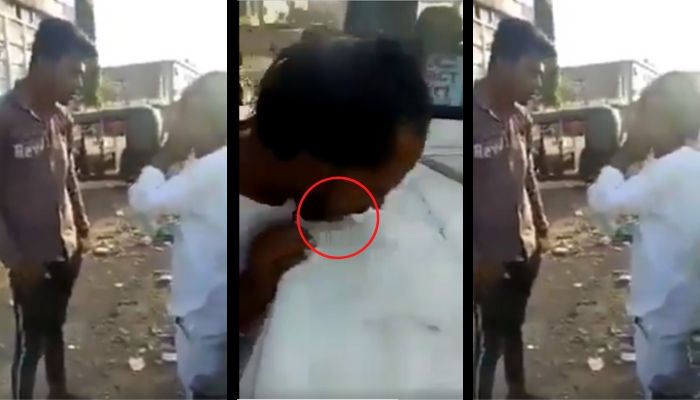
Faizal Siddiqui has been amongst various other TikTok influencers who have glamourised acid attack as a form of revenge for jilted lovers. Multiple people have made similar contentious video where a man can be seen drinking liquid from a glass while asking a woman how the man she had left him for has now left her. He then splashes the liquid on her face. The video then gets chopped and the woman then appears with acid burn wounds on her face. The ‘acid attack victim’ in the video is the same makeup artist actor Deepika Padukone had hired for her publicity stunt for her film Chhapaak where she asked the makeup artist to create her ‘acid attack look’.

FIR filed, NCW takes cognisance

Following the social media outcry, an FIR was registered against him. The NCW too took cognisance of the incident and demanded action against him. NCW has written to DGP Maharashtra Subodh Kumar Jaiswal to take action against Siddiqui.

Whitewashing acid attack recreation scene

Soon, liberals joined in to whitewash Faizal Siddiqui’s acid attack recreation scene.

ThePrint journalist Jyoti Yadav explained how it was water and not real acid used to recreate the scene.

Milli Gazette went on a completely different tangent where they even psychoanalysed the acid attack recreation scene.

Free Press Journal Editor too defended the acid attack recreation because Faizal was drinking water and not the ‘acid’.

Meanwhile, acid attack survivor Laxmi Agrawal, who was the inspiration behind Deepika Padukone’s Chhapak, too called out Siddiqui and his video. “You’d know how it feels if you put one drop of acid on your finger,” she said.

Amidst lockdown and migrant crisis, Congress spokesperson shares an image from Nepal as that of India to play politics over misery of the poor

On Tuesday, Congress spokesman Randeep Surjewala shared the image of a woman, carrying a toddler on her back on Twitter. In the picture, the poor woman is also seen carrying a heavy sack on the pillion seat of the bicycle.

Surjewala’s tweet was accompanied by a politically motivated caption that read, “New India ka Saach!“. The loose translation of the tweet goes as, “This is the truth of new India.” The Congress leader from Harayana wanted to suggest that the condition of people in the ‘New India’, the India that is not ruled by his party anymore, is miserable.

Screenshot of the tweet shared by Randeep Surjewala

What is the Truth?

However, alert Netizens were quick to debunk the misleading claims of the Congress spokesperson. A Twitter handle (@NegiBijju) pointed out that the picture shared by Randeep Surjewala belonged to Nepal. Taking a dig at him, the Twitter user wrote, “Real news always ends badly for them (Congress).”

Popular Twitter user Ankur Singh too pointed out that the image belonged to Nepalgunj city in Nepal. The picture was saved to Pinterest from a website, infonews.com. He tweeted, “New India mein Surjewala ka jhooth.” The loose translation goes as “These are the lies of Randeep Surjewala in New India.”

Another Twitter user Akshay Singh wrote that the Congress spokesperson is trying to pass pictures from Nepal as that of India to spread fake propaganda. He also took a dig at Priyanka Vadra over the Bus scam.

Randeep Surjewala spreads fake news during pandemic

This is not the first time when Randeep Surjewala has resorted to ‘poverty porn’ and fake news peddling in order to gain political mileage. Earlier, Surjewala shared a picture of a migrant worker trying to put a child on top of a truck that is bound for their hometown, to target PM Modi. A simple fact check revealed that the picture belonged to the Congress-ruled State of Chattisgarh.

Congress’ social media handles have been found spreading fake news earlier too. Dalit Congress had earlier shared an image of a Rohingya refugee in Bangladesh to claim negligence of the poor by the Modi government.

Zee News anchor Aman Chopra teaches a Maulana a lesson in secularism

On Monday, in a programme titled ‘Taal Thok Ke‘ on Zee News, anchor Aman Chopra took a Maulana to task over the notion of ‘secularism’. The discussion was based on the recent communal incident in Davanagere in Karnataka wherein Muslim mobs harassed and hounded Muslim women for purchasing clothes from Hindu shops.

Chopra began by asking Maulana Nadeemuddin to condemn the incident perpetrated by the radical Islamists. The Zee News journalist can be heard saying, “The onus of Ganga-Yamuni Tehzeeb (Hindu-Muslim brotherhood) cannot lie on one community. It requires two hands to clap.”

He further stated that Hindus do not refrain from welcoming Muslims through Islamic greetings such as ‘Salam’. “But, do muslims reciprocate by greeting us ‘Ram Ram’? We have seen Iftar and Namaaz in temples, but not Havaan or Langar in Masjids. Why?”, Chopra said.

Addressing the Maulana, he pressed, “Say ‘Ram Ram’ and Jai Shri Ram.” After Nadeemuddin was caught in a state of fix, the journalist repeated the Islamic greetings and reiterated that he was not communal. He said if two communities have to live in harmony and follow Ganga-Yamuni Tehzeeb, then, it needs to be mutual and not a one-way street.”

The viral video

Muslim women harassed by Muslim men

In several videos that went viral, Muslim mobs were seen descending on the streets to abuse Muslim women for purchasing clothes ahead of Eid from Hindu owned shops in Davangere in Karnataka. In one such incident, a mob had harrassed two burqa-clad women coming out BS Channabasappa and Sons, a popular cloth shop owned by Hindus. They then abused and attacked the Muslim women for buying clothes from Hindu shops during the month of Ramzan. One guy was seen snatching an orange coloured package from the burqa-clad women.

A second video of the same incident shows how Muslim mob forcing the Muslim women to return the goods purchased from the Hindu store. Similarly, another Muslim mob, continuing similar act in another part of Davangere city, threatened two women and a child for purchasing at a store in the city. 

Journalist points out that the list of ‘buses’ sent by Priyanka Gandhi to UP includes auto-rickshaws, Congress threatens him with FIR

The Congress party, which suffered a major embarrassment after the list of 1000 ‘buses’ sent by Congress General Secretary Priyanka Gandhi was found to contain blacklisted numbers, cars and even three-wheeled autorickshaws, has now resorted to threatening journalists for pointing errors in their list.

On Tuesday, Executive Editor of India TV – Sushant Sinha, took to Twitter to question Gandhi-scion Priyanka Gandhi regarding the details of blacklisted autorickshaws, motorbikes in her list of ‘buses’, which she had promised to deliver to Uttar Pradesh government to transport stranded migrant labourers.

In his tweet, Sushant Singh committing a typo had tweeted that Priyanka Gandhi had promised 10,000 buses instead of the 1,000 buses. However, within minutes, realising it, he corrected it stating that it was a list of 1,000 buses which Priyanka Gandhi had promised to UP government to ferry stranded migrants.

The Congress, however, decided to bully and threaten India TV journalist Sushant Sinha with an FIR for criticising Priyanka Gandhi’s list of ‘buses’.

Taking to Twitter, the Uttar Pradesh Congress targetted Sinha by referring to him as fake news peddler and said that a case will be filed against him in Rajasthan. The Congress party claimed that attempts to not let the stranded workers return home will not be successful.

Responding to the threat, Sushant Sinha said that the Congress party has continued its FIR politics by threatening him. He added that the Congress party wanted to silence and threaten people whom it fails to control. Instead of attacking him, Sinha asked the Congress party to send an original list of Priyanka Gandhi containing the details of buses she had promised to the Uttar Pradesh government.

Priyanka Gandhi’s list of ‘buses’ to Uttar Pradesh government

On 16 May 2020, Priyanka Gandhi Vadra had tweeted a letter wherein she had written to UP government seeking permission to ply 1,000 buses for migrant workers. The Uttar Pradesh government had accepted Congress General Secretary Priyanka Gandhi Vadra’s offer of providing 1,000 buses for migrant workers and asked the list of drivers and co-drivers of these 1,000 buses so that the UP government can make use of them in bringing back the migrant workers.

After Uttar Pradesh Government asked for a list of buses which were offered by Congress General Secretary Priyanka Gandhi Vadra for ferrying migrants, the Congress party had published a list of about 200 vehicle registration numbers with corresponding names of some individuals next to them.

However, in a major embarrassment to Congress, the list of ‘buses’ sent by Congress General Secretary Priyanka Gandhi was soon found to contain the numbers of blacklisted vehicles, cars and even three-wheeled autorickshaws.

Bihar: 8% of initial lot samples from migrant workers returned to state tested coronavirus positive so far, similar patterns in Jharkhand

651 new cases of coronavirus have been detected in the state of Bihar among thousands of migrant laborers who have returned to their native places till Monday. As per estimates, 8% of 8,337 results that have come in so far from the initial lot of 11,800 samples that were taken randomly from 7.4 lakh returnees.

As per a Times of India report, Chief Minister Nitish Kumar has ordered the health department to raise testing by 1000 per day. Till now Seven government medical institutions are testing an average of 2,000 samples per day collectively.

Similar pattern in Jharkhand

The same pattern has been reported in neighbouring state Jharkhand. The bulk of new cases emerging in the state are of the migrant labourers.

The Hazaribagh area was about to be declared as Green zone but hours later a migrant returnee was detected as coronavirus positive. 22 more cases were reported in the same area in a span of a week.

In the Garhwa district of Jharkhand was about to be listed as an Orange zone till May 8. In a single night, 20 people had tested positive. All of them were migrant workers who had arrived from other states.

Principal Health Secretary of Jharkhand Dr Nitin Madan Kulkarni said, “With thousands still returning home every day, we do not have the infrastructure to put all of them in institutional quarantine.”

As per reports, the majority of the migrant workers came back from the Red zones of Gujarat, Maharashtra, Telangana, and Karnataka. The country’s first Shramik special trains brought migrant workers from Hyderabad to Ranchi on May 1. More than 62000 had returned by 52 special trains till 17 May. Another 30000 arrived by bus from the neighbouring states.

Man hangs by balcony railing as he tries to jump off over fight with wife over spiciness in food, rescued by neighbours. Watch video

In a bizarre incident, a man threatened to jump off the third floor of his building by hanging himself from his balcony’s railing in Chandkheda, Ahmedabad after he had an argument with his wife over the taste of the food he was served.

Man tries to jump off the balcony in Chandkheda, Ahmedabad

According to a report in Ahmedabad Mirror, in the incident that happened in Keshav apartments in Ahmedabad’s Chandkheda area, the husband allegedly demanded spicy food from his wife, which culminated into an argument between the two. This argument prompted the husband to hang himself by the balcony’s railing, threatening his spouse to jump off the balcony.

The man was ultimately rescued by his neighbours. Three neighbours caught hold of him and pulled him over.

Video of the man hanging from the balcony of his apartment has now gone viral on social media. In the 1.02 minute video, a man donning a green shirt and blue trousers can be seen hanging from a balcony. After a while, three men, who were probably called by the family members, are seen pulling the man over.

What did the Chandkhela polive have to say

Chandkheda police inspector BK Gamar said, “This is a three to four day old incident. No complaint or application of the incident has been made at the police station. But it was a fight between the husband and wife with the husband wanting the food to be spicier. This led to a heated exchange and the incensed husband threatened to jump out of the balcony.”

“No other details of the incident are available as a complaint has not been filed,” Gamar said.

Similar incident in Gorakhpur

In a similar incident, a labourer attempted to commit suicide, on May 13, by hanging from the railing of a three-story building in Gorakhpur after his wife advised him to not return home due to Coronavirus pandemic. Fortunately, this was spotted by locals and police reached the spot on time to save his life. A video of the incident had also surfaced. In the video, the police could be seen pulling a young man hanging from the railing.

Talking to media after being rescued, Deepak Patel said that he had got tensed and emotional when his wife asked him not to come home last night on phone.

“They demand we stop worshipping Hindu deities and worship only Babasaheb”, says a Dalit family alleging attack by Bhim Army members in Bihar

A Dalit family in Bihar’s Kishanganj district has accused the local Bhim Army unit of attacking them for their beliefs, desecrating a temple as they object to their reverence for Hindu deities and saffron flags. According to a report by Swarajya, a police case has been filed by both sides (the Bhim Army side and the temple side) in Kashganj police station.

FIRs lodged by Dalit family as well as Bhim Army

The first FIR was filed by a member of the Bhim Army. 27-year-old Deepchand Ravidas, in his statement to the police, said that around 3.30 pm on May 13, a group of men attacked him with a sword near a Shiva temple on Thakurbari road. The statement also says the group attacked his sister too when she came to his rescue. On the basis of his complaint, the Kashganj police booked 8 members, including members of the Dalit family namely, 55-year-old Gyani Ram and three of his four sons — Santosh Ram, Shyam Sundar Ram and Birendra Ram.

On the other side, 28-year-old Santosh Ram in his FIR alleged that on May 13 at around 4:30 pm a group of men entered the Shiva temple (that’s adjoining their house) and tried to desecrate it. The group entered the premises with iron rods, bricks and stones and demanded the temple be removed. They also tried to break the Shivling.

The report by Swarajya says that when Santosh and his family objected, the group attacked them with a motive of murder. The statement read that the Bhim Army group attacked Santosh’s father, brothers and sisters.

Based on this statement, the police booked four named persons and other unidentified persons, under the same IPC sections as in the first FIR.

FIR lodged by Santosh Ram

The incident as narrated by one member of the Dalit family

Birendra Ram, who has been named as accused in the FIR lodged by members of the Bhim Army rejected the charges imposed on him and his family member’s and recalled how he and his family were often mocked by the members of the Bhim Army for their belief in Hindu gods.

“We are BJP voters. They don’t like this. They constantly tell us to join their outfit. They demand we stop worshipping Hindu deities and worship only Babasaheb (Bhimrao Ramji Ambedkar),” Birendra says.

Birendra alleged that on May 10 a group entered the temple and told everyone to remove the saffron flag bearing an image of Bajrang Bali installed there. An old animosity culminated into violence recalls Birendra, who’s two brothers, Santosh and Guddu, are recovering in hospital.

Birendra also says that once in the past, during a discussion the local Bhim Army members had insisted that the shivling be broken to show that “I (Birendra) don’t support any false gods. I grew really angry and left the discussion. I said that if that was the condition, I would never support his group again,” he recalls.

Birendra furthers how on Ambedkar’s birthday on April 14, the Bhim Army members had gathered along with several Muslim men in a room adjoining the temple to celebrate Ambedkar’s birthday. “They had brought many Muslim men from outside. We suggested that they should shift the celebrations to the nearby community hall, but they, in turn, abused us and told us to replace the idols in the temple with that of Ambedkar,” Birendra says, adding that “an ugly spat broke out.”

A picture of the celebration on 14 April, as shared by Birendra Ram

“All this has now culminated in violence. We have been thrashed for our religious beliefs,” he says.

What the Police have to say

Commenting on the case, investigating officer Arvind Kumar Yadav told this correspondent over the phone that two persons from each side have been arrested so far.

“You know how it is in such scuffles, both sides give complaints. The truth will come out only in the probe. That is going on,” Yadav said and declined to speak more.

The Tragedy of 19 May 1961: When 11 Bengalis lost their lives for their mother tongue

The significance of the 19th day of May 1961 is probably as alien a concept to the modern-day Bengali of Kolkata, as civilization is to a Vandal. By a strange twist of fate and deliberate design of the Left-Liberal ecosystem, the largest Bengali Language Movement of post-Independence India and the martyrdom of eleven refugee Hindus from East Pakistan is relegated to an obscure memorial in Silchar and condemned to obsolescence in Kolkata, the nerve centre of Bengali culture. Strangely an unrelated 21st February of East Pakistan, which in reality was a struggle for resources between the East and the West in the garb of a language movement, have been imposed on the Bengalis in India, in the form of a black tombstone in Curzon Park, adjacent to a busy thoroughfare of Kolkata.

Come 21st February and the collective intellectual uprising of the Bengali language chauvinists and their Leftists cohorts are quite a spectacle to behold. From sporting Bangladeshi flag in their social media accounts to display maps of ‘United Bengal’ and even supporting Bangladesh in Indo-Bangladesh cricket matches, a very thin line is retained between linguistic chauvinism and downright sedition. A parochial ‘pro-Bengali’ group who routinely abuse the ‘cow belt’ for a living, is at the forefront of this tomfoolery. When it comes to 19th May, the collective silence of these quislings is deafening. Perhaps the Bengali name Kamala Bhattacharya is not as glamourous as the Arabic names of Rafique or Jabbar. Another probable reason is to mask the backstabbing of the Bengali-speaking Muslim population in the form of subsequent Hailakandi communal riots which if exposed would deflate the much propagated 21st February beyond redemption.

The genesis of the movement is as follows. After the annexation of Assam in 1826, the British administered it as a part of the Bengal Presidency. This decision led to the use of Bengali as an administrative language in multilingual Assam, which was a cause of resentment among the native Assamese. In 1874, Assam was carved out as a separate province, however, the Bengali-speaking districts of Goalpara, Sylhet and Cachar were also a part of it. During the Partition of India, the British left the fate of Sylhet to a referendum, because of the Muslim majority. Owing to foot-dragging of the Assam Congress who, allegedly, wanted to get rid of the Bengali-speaking population, the indecision of the Congress Central Command and mass intimidation and rigged polls orchestrated by the Muslim League, Sylhet was literally gift-wrapped to Pakistan in the Sylhet Referendum. Thousands of Bengali Hindu refugees from Sylhet swamped into Cachar following the Partition.

The chronology leading up to the fateful day commenced in 1960 when Bimala Prasad Chaliha, the then Chief Minister of Assam presented a bill in the state assembly seeking to declare Assamese as the sole official language of the state. The bill was opposed by Ranendra Mohan Das, the legislator from Karimganj, on the ground that it was tantamount to imposing the language of one third on the rest of the population since apart from Bengalis, ethnic groups from the modern-day states of Arunachal Pradesh, Nagaland, Mizoram and Manipur Meghalaya were also part of Assam. When the controversial bill was passed it added fuel to fire. Bengal Kheda erupted again across the Brahmaputra Valley, leading to a gruesome massacre of Bengali Hindus in Goreswar.

In the Barak Valley, a peaceful language movement started under the banner of Cachar Gana Sangram Parishad to include Bengali also as an official language and give similar recognition to other ethnic languages. On 14th April 1961, Sankalpa Dibas (Determination Day) was observed leading to mass-scale movements also joined by non-Bengali linguistic groups such as the Manipuris. On the fateful day of 19th May, a Satyagraha was observed in Silchar railway station and trains came to a standstill.

Police could not disperse the protesters even after use of brute force and the paramilitary was requisitioned. Assam Rifles opened fire on unarmed protesters and eleven people, including a teenage girl, courted death in the love of their mother tongue. All of them were Bengali Hindu refugees from East Pakistan. This led to massive protests in Cachar, neighbouring Tripura and West Bengal. Kolkata Maidan and Subodh Mallick square erupted in mass movements. Non-Bengali linguistic groups such as the Khasis of Shillong also took part in the protests. Legendary freedom fighter Ullaskar Dutta sent a bouquet to each of the language martyrs.

Under unrelenting pressure, Assam government had to withdraw the circular and Bengali was given official status in Barak Valley as per Section 5 of Assam Act XVIII, 1961 which recognizes the use of Bengali in Cachar district. As a long term effect of this movement, Nagaland, Manipur, Mizoram and Meghalaya ultimately achieved separate statehood. 

The 19th day of May should not be observed in the narrow prism of Assamese-Bengali confrontation, but a struggle for equal rights of all languages in an erstwhile multilingual state. Also, due credit needs to be given to the martyrs who despite being refugees and subject to absolute penury after the Partition fought for the love of their language oblivious to their physical or material wellbeing.

A deliberately hidden aspect of this movement is the rank betrayal of the movement by the Bengali-speaking Muslim population of Cachar who tried to thwart the movement by organizing virulent communal riots targeting Bengali Hindu refugee colonies. In highest traditions of Al Taqiyaa or ‘the art of deception’, the Bengali-speaking Muslims turned against their co-linguists in favour of the Assamese chauvinists. On 19th June, thousands of riotous Bengali Muslim mobs descended in Hailakandi, shouting slogans like ‘Allah Hu Akbar’, ‘Chaliha Sarkar Zindabad’ (Long Live Chaliha Government) and ‘Asomiya Bhasha Sikhte Hobe’ (Learning Assamese is a must). The mother of all ironies is that all the slogans were given in Bengali. The murderous mob, supplied with weapons from the local Muslim shops carried out massive riots and arson against Hindu-owned shops and Hindu refugee colonies. Nearly two hundred houses were gutted and nearly ten people were killed in police firing and the ensuing riots. The dead included a thirteen-year-old teenager called Rabindra Kumar Ghosh and two labourers employed by MLA Gourishankar Roy’s brother. 

Circumstantial evidence implicated Mainul Haq Choudhury, the then Agriculture Minister of Assam Cabinet for complicity. Incidentally, Mainul Haq Choudhury was a PA to Mohammed Ali Jinnah, the architect of the partition of India, who assured Jinnah that he would ‘present Assam to him on a silver platter’. The fact this character could become a minister in Assam cabinet explains the level of depravity of Nehruvian Secularism. A massive infiltration also took place from Pakistan in this period with ulterior objectives of separation of Assam. A Pakistani citizen called Taslim Ali was arrested in Aurangabad, who confessed that he had entered India without a passport and worked at the residence of Mainul Haq Choudhury. Nehru, of course, sacrificed these concerns with his characteristic nonchalance at the altar of secularism though alarm bells should have been set off at the highest quarters. A detailed account of the Hailakandi episode can be found in the book, ‘Assame Bhasha Andolan O Bangali Prasanga 1947-1961’ (in Bengali), by Sukumar Biswas.

Fifty-nine years have passed since 19th May 1961 and fate has again placed us as crossroads. With the anti CAA protests in Assam and NE the situation is an eerie reminder of the past. While the Assamese nationalist elements are pitted against Bengali Hindus, primarily of Bangladeshi origin, the Muslim infiltration from neighbouring Bangladesh has already irreversibly altered the demography of around ten districts of Assam and three districts of West Bengal. These illegal infiltrators and their patrons are trying to fish in troubled waters by taking part in anti CAA protests just like their counterparts in Hailakandi in 1961. The Left-Liberal ecosystem is still in place, spinning a web of lies and like the dark fairy of ‘sleeping beauty’ lulling the entire society into a deep slumber oblivious to the clear and present danger. In order to face this existential crisis, we need to cut through the clutter and ask hard questions to the apologists. Why 21st February and not 19th May? Why Rafique-Jabbar and not Kamala Bhattacharya? Why Dhaka and not Silchar?

In Arnab v Antonia, this round goes to Goswami: SC extends protection by three weeks, emphasises importance of freedom of the press

The Supreme Court on Tuesday dealt a great blow for Arnab Goswami in his ongoing tussle against Antonia Maino aka Sonia Gandhi and the Congress party. The Court emphasised on the importance of press freedom and proceeded to quash all the subsequent FIRs and complaints against the Editor-in-Chief of Republic TV after all FIRs were merged into one earlier. The Court also said that no further FIRs related to the matter shall be entertained. Arnab Goswami was also protection from coercive steps for the next three weeks.

The investigation related to the FIR filed in Mumbai will continue as the Court observed that the FIR could not be quashed under Article 32. It was also said Arnab Goswami is free to approach a competent for the same. Mumbai Police has also been directed to provide him with protection. However, Arnab Goswami’s request to transfer the case to the CBI was rejected. The Court also observed that the content of the multitude of FIRs and complaints were completely identical. Its order said, “All FIRs and complaints arising out of the same broadcast made by the petitioner. Complaints in identical terms. The language content and sequencing of complaints are identical.”

Delivering the verdict, Justice Chandrachud said, “Article 32 of Constitution of India entrusts the court to protect Fundamental Rights. Journalistic freedom lies at the core of Freedom of Expression. India’s freedom of press stays as long as journalists can speak truth to power.” “Freedom is not absolute. Multiple complaints will have a stifling effect. The right of journalists under Article 19(1)(a) is higher and free citizens cannot exist without free media. Questions you cannot answer are better than questions you cannot question,” he added.

The Court observed, “There can be no quashing of FIR under Article 32. The Petitioner has the liberty to pursue remedy before the competent court. The FIR does not cover offence of criminal defamation, therefore it is not necessary to address prayer on that issue.” “Subsequent FIRs and Complaints are quashed, and no other FIR or complaint shall be entertained or pursued on basis of broadcast made by Petitioner on 21st April. Second writ petition regarding the alleged attack is dismissed,” it said.

Arnab Goswami vs Sonia Gandhi

Earlier, after senior party leader Kapil Sibal was grilled by the Supreme Court for photocopied FIRs across numerous states in the country, the Bombay High Court had refused to ban Republic TV from airing across television sets, as demanded by members of the Congress party. The petition for the same was filed by Bhai jagtap, a member of the Legislative Council from the Congress party, and Suraj Thakur, state president of the Maharashtra Youth Congress in the said court.

On April 27, 2020, Arnab Goswami was questioned by Mumbai Police for over 12 hours for questioning Congress interim President Sonia Gandhi’s silence over Palghar Sadhu lynching. He was questioned after the Congress party filed more than 150 FIRs against him in various states of the country. The Supreme Court had merged all the FIRs into one and transferred to Mumbai. A week later, a fresh FIR was filed by Raza Academy.

Over the Palghar incident, Arnab, during the hearing on quashing of FIR requested that the case be transferred to the CBI for further investigation since he has made serious allegations against the local police in Palghar incident. “It’s a union vs state problem and I have become a party to this. Of course I can go to Bombay High Court, my request is that the CBI can probe and file report,” Goswami said in the court.

“No interference in the internal affairs of any country”, Afghan Taliban rubbishes claims of ‘Ghazwa-e-Hind’ in Kashmir

On Monday, Suhail Shaheen, the spokesperson of the Islamic Emirate of Afghanistan (IEA), reportedly debunked fake tweets suggesting that the Taliban was interested in ‘Ghazwa-E-Hind’ or Holy War against India. He said, “India is not relevant to the Islamic Emirate.” Suhail added that the Taliban’s policy regarding the neighbouring countries is clear and that it does not interfere in the internal affairs of any country.

Screenshot of the original Tweet along with Google translation

Reportedly, the fake tweets had claimed that the Taliban wanted to take Kashmir from the ‘infidels’ and that there was no scope of friendship between the Islamic terror group and India. Following the clarification by the official spokesperson, it becomes clear that the Taliban will not toe Pakistan’s line on Kashmir.

In early May, Suhail Shaheen told WION that it has ‘positive relations’ with India based on ‘national interest’ and ‘mutual respect.’ He had also praised India’s contribution to the reconstruction of the Islamic Republic. He reiterated that the Taliban has no agenda outside its territory in Afghanistan. The spokesperson of the Ministry of Foreign Affairs of Afghanistan has also appreciated India for being one of the biggest donors and its cooperation in the development of the country. “We expect India and other neighbouring countries to play a significant role in the Afghan peace process”.

Taliban and US sign peace deal

On February 29, the United States and Taliban signed a peace deal in Doha, Qatar after months of negotiations between both sides, potentially ending the war in the country that is going on for 18 years. The deal was signed by US special envoy Zalmay Khalilzad and Taliban political chief Mullah Abdul Ghani Baradar with US Secretary of State Mr. Mike Pompeo as a witness.

The deal had four parts – withdrawal of American and NATO Troops from Afghanistan within 14 months, a guarantee that the Taliban will not launch attacks on the USA and its allies from Afghanistan, beginning of intra-Afghan negotiations between Taliban and Afghan government, and a permanent and comprehensive ceasefire.