Home Blog Page 5408

The spread of Covid-19 pandemic has added a unique dimension to the ‘Great Game’ between the two economic giants of Asia

0

Behind all the hand-shakes and friendly gestures between Indian PM Narendra Modi and Chinese President Xi Jinping, the underlying feelings of competition for regional dominance mixed with nationalism were not difficult to decipher when the two leaders met last in Oct 2019 during the visit of the Chinese President to India. Little would Xi Jinping knew then, that a strange catastrophe was going to affect lives of people living in ‘All Under Heaven’, spreading further to the entire world, shaking geopolitical dynamics like never before. Relations between India and China have always been complicated, but the spread of Covid-19 pandemic has added a unique dimension to this ‘Great Game’ between the two economic giants of Asia.

Even prior to spread of Covid-19 pandemic, offensive stance and open criticism of Donald Trump towards lack of transparency in economic policies of China, especially the trade deficit between the world’s largest economies, had seen an all time high. Spread of the pandemic gave birth to ‘Blame-Game’ between the two nations over birth of the virus wherein China pointed fingers at US Army while US questioned the Wuhan lab.

On the economic front, Donald Trump raised the issue of disparity between funding of WHO. According to reports, US contributed $893 million in 2018-2019, while China gave $86 million only. Facing criticism from the international community over the issue, China increased its funding by $30 million, in addition to the previous additional funding of $20 million in March this year.

EVOLVING GEOPOLITICAL DYNAMICS: COVID-19 PANDEMIC
▶ US-China trade war prior to the spread of Covid-19 pandemic.
▶ US cutbacks on funding WHO; China forced to pledge an additional $ 30 million for WHO.
▶ China supplying faulty Covid-19 test kits to India alongside faulty equipment to other countries; loss of face and reputation in business all over the world.
▶ India’s change in FDI policy to safeguard the economic interests of its companies.
▶ The blame game between the US and China over the origin of Covid-19 virus; call for WHO-led probe.
▶ Continued aggression of Chinese militia in the South China Sea; US forced to deploy its warship.
▶ Series of Indo-China border clashes.
▶ Chinese diplomats engaged in an all-time high ‘Wolf Warrior Diplomacy’ to safeguard the national image and economic interests in the longer run.
▶ CCP facing the heat domestically as well as globally; WHA conference and NCP Parliament session a testing ground for Xi’s credibility

Amongst this crisis, India took a lead from the rest of the major economies of the world and changed its policy related to FDI. The revised policy ruled that economic firms in any country that shares a border with India will have to approach the government for investing in India and not go via the automatic route. The step was taken to ensure no neighbouring country, especially China, takes undue advantage amid the COVID-19 pandemic. For obvious reasons, China was infuriated and has criticized India’s new policy.

Relations between India and China soured even more when India rejected the Chinese Covid-19 test kits, claiming them to be inaccurate. ICMR had to halt Covid-19 testing for two days and is now procuring the test kits from South Korea. Similar issues regarding the accuracy of Chinese test kits and poor quality of medical equipment from many other nations has caused the loss of face and reputation for Chinese companies. It has proved to be disastrous for Beijing as a large number of US and German companies are mulling over moving their production bases from China to India while Japan has announced an assistance package for companies shifting their production from China.

In a typical Chinese response, PLA suddenly revived the unresolved Indo-China border dispute by instigated Indian Army troops at Finger 5 area near Pangong Tso (lake) in Eastern Ladakh on 05 May. The second round of clashes between the two forces was reported near Naku La in Sikkim on 10 May leaving almost a dozen troops injured on both sides. Also, Indian Air Force scrambled its jets in response to PLA helicopters flying close to LAC. Chinese have also pitched in tents in Galwan Valley in Aksai Chin, accusing India of constructing defence facilities in the disputed area. Even indirectly, China is using its influence over countries like Nepal, by provoking them to object Indian road construction in Kalapani.

Not only against India, Beijing has been intensifying its military activities in South China Sea as well as in East China Sea, thereby drawing international criticism. In December 2019, Malaysia and Indonesia lodged a complaint against Chinese aggressive activities in the disputed region of the South China Sea and even deployed their naval assets in the region. Vietnam too protested at the UN when on April 2, China sank a Vietnamese fishing vessel in the region. China continued its domination by harassing a Philippine Navy ship. In the second half of April, it unanimously instituted two new municipal districts, carving up the governance of the Paracel and Spratly island groups. Even in the East China Sea, Chinese ships have intruded in waters near the Japanese-controlled islets seven times this year. Spurt in presence of ‘Chinese Maritime Militia’ in disputed regions forced US to move its guided-missile cruiser ‘Bunker Hill’, and amphibious assault ship ‘The America’ into Malaysian maritime territory claimed by China. Australia has also sent a frigate, ‘Parramatta’, into the area.

With the growing international criticism against Chinese ‘handling’ of Coronavirus’ threat along with associated economic setbacks, China has directed its diplomats to engage in an all-time high ‘Wolf Warrior Diplomacy’. The diplomats have been named “Wolf Warrior” after a Chinese patriotic film starring a muscle-bound Chinese commando killing American bad guys in Africa and Southeast Asia with his bare hands. Chinese diplomats are increasingly taking to Twitter and Facebook — platforms that are blocked in their own country. They have been engaging with the international community over social media with an offensive tone to safeguard national image and economic interests in the longer run.

Chinese Communist Party is facing an unprecedented challenge, both domestically as well as in global political domain. As the rate of unemployment climbed to almost 20.5% with up to 70 million unemployed people alongside 205 million people with uncertain employment (set to exacerbate due to COVID-19 pandemic), Beijing is feeling the heat in managing its recessing economy. Belt and Road Initiative, the landmark project of Xi Jinping’s political career, is under immense criticism due to its Non-Performing Assets worth up to USD 101.8 billion. As he faces annual political session of National People’s Congress (annual parliamentary session) on 22 May, he also needs to prepare his stance at the World Health Assembly conference scheduled the same day. He has already softened his stand by allowing a WHO-led probe into the cause of the spread of Coronavirus, to which he had opposed for long. This also signals his first defeat in the global political domain!

From a historical perspective, whenever cornered by foreign powers, Chinese have always preferred to show their teeth, and not a smiling face. Once again, when almost entire world is criticising them for poor handling of the pandemic alongwith supply of inferior quality medical equipment, China is not likely to show a defensive posture. For China, protection of its economic interest remains Priority 1, as it aims to challenge US for a place in the ‘First World’ of superpowers by 2050. It is best known to take desperate measures to safeguard economic interests of the nation. With the entire world backing away from Chinese companies and Chinese products, it is natural for China to feel cornered. However, ‘The Dragon’ is not habitual of laying low and bearing the punches.

What threats and opportunities do these present before India?

As almost all major companies of the world are contemplating shifting their businesses out of China, Indian leadership is required to proactively engage with them presenting the most practicable and convenient option. In the times of ‘Revival of Economic Nationalism’, India needs to create favourable conditions for these companies to set up their manufacturing bases. With the loss of reputation of Chinese companies, especially in the medical sector, Indian companies would only stand to gain.

Militarily, Indian Armed Forces are well poised to thwart any offensive maneuver by PLA. Indian troops at the border remain fully resolved to counter any challenge to Indian sovereignty. It only needs to be backed by a strong political will.

The moment is ripe to expand political clout of India as a nation. When the world is pointing fingers at China for their derisory approach in handling COVID-19 spread, India needs to project itself as the major power of South Asia and create a conducive global environment aligned with its national interests.


About the author

Lt Col Anand Bohra, SM is a serving officer of the Indian Army. A decorated soldier, he holds vast experience in Counter Insurgency Operations in the North Eastern sector of India. He has represented the Indian Army in United Nations Mission in South Sudan and attended prestigious foreign training. The officer is a passionate scholar of China and possesses first-hand knowledge of PLA having served at Indo-China border for four years.

Ashok Gehlot government in Rajasthan sends a bill of Rs 36.36 lakh to UP government for the buses used to ferry students from Kota

Even as the row between the Congress party and the Uttar Pradesh government continues with regard to buses to ferry migrants to UP, the Rajasthan govt has sent a bill of Rs 36 lakh to the UP govt for some buses they had arranged last month. The Rajasthan govt is asking the UP govt to pay Rs 36,36,664/- for 70 buses that they had provided to transport students from Kota to UP last month.

Almost one after the Coronavirus Lockdown was imposed in the country, the Yogi Adityanath government had sent 560 buses to Kota to bring the students from UP to their home state. The UP govt was the first state to initiate steps to bring back their natives stuck in other states during the lockdown, which was done after students in Kota had sent desperate messages to the state govt asking to be brought back.

Accordingly, between 17 and 19 April, 560 buses sent by UP govt had returned with around 10 thousand students from Kota in Rajasthan. But after that more students from UP, who had not initially registered to return, demanded that they also want to go home. As a result, the UP govt decided to rent 70 buses from the Rajasthan Transport Corporation to carry the additional students. When the Corporation sought money for diesel, the UP govt had said that the same will be paid later. But as the Corporation didn’t agree to that, Rs 19.76 lakh was paid for the fuel, and the students recached home safely.

But now the Ashok Gehlot government in Rajasthan has sent a bill of Rs 36,36,664/- to the UP government as rent for the buses from Kota to Agra and other places in UP. The letter sent to the UP state transport corporation asks the amount to be transferred through RTGS.

Congress is playing petty politics at the time of crisis

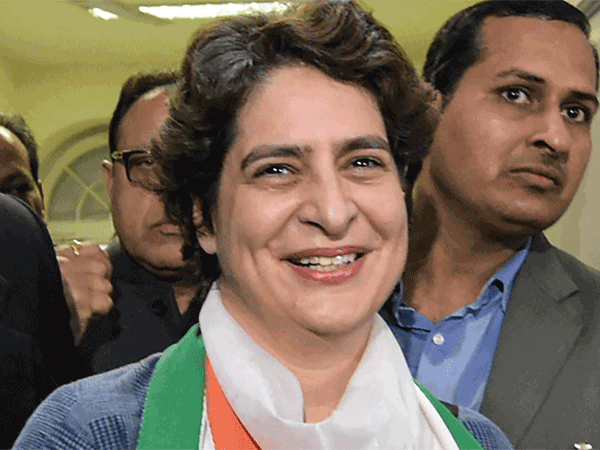
It is notable that this bill has been sent at a time when a political war is been going on between Congress party General Secretary Priyanka Gandhi and UP government over buses to ferry migrants. After Priyanka Gandhi had offered 1000 buses to carry migrants from Rajasthan to UP, the Yogi govt had agreed to the offer. But when the Congress party submitted the list of buses for approval, it was found that the list also contains auto-rickshaws, trucks, ambulances, cars etc.

An FIR against Ajay Lallu and Priyanka Gandhi’s private secretary Sandeep Singh was filed at the Hazratganj police station in Lucknow for cheating and forging documents, and later Ajay Lally was arrested. Even before Congress party had submitted the list of buses, they had already run the buses and over 500 buses carrying migrants had reached UP border near Agra. As the buses were yet to be approved, the local admin didn’t allow them to enter the state, which created another conflict between Congress and UP govt. The Congress workers had staged a protest due to the same, after which Ajay Lallu was removed by UP police from the spot.

US deports Telangana engineer Ibrahim Zubair Mohammad to India who was convicted for financing Al Qaeda leader

The United States have deported an Indian convicted of terror funding on Tuesday. 40-year-old Ibrahim Zubair Mohammad was convicted in a terror-financing case in the USA and was sentenced to five years of jail. He landed in India on Wednesday after he was deported as his jail term was over. He is currently isolated at a quarantine centre in Amritsar, Punjab.

Mohammad, an engineer from Telangana capital Hyderabad, was arrested in 2011 for providing monetary and material assistance to Al Qaeda leader Anwar al-Awalki. He was sentenced to jail for five years after he had pleaded guilty of the charges. According to the US justice department, he was accused of financing terrorism in a bid to support violent jihad against Us military personnel in Iraq.

According to the US justice department, Ibrahim Zubair Mohammad, along with two Pakistani nationals Asif Ahmed Salim, and Sultane Room Salim, had pleaded guilty of financing terrorism, as they had transferred thousands of dollars to Anwar al-Awlaki to support violent jihad against U.S. military personnel in Iraq, Afghanistan and other places in the world in 2009.

Zubair’s brother Yahya Farooq Mohammad was sentenced to 27½ years of jail, because he had also hired a hitman to kill a judge hearing a terror case.

In 2009 Farooq Mohammad and two other people had travelled to Yemen and gave around $22000 to Al Qaeda leader Anwar al-Awalki’s associates. $17000 of this amount was given by Asif and Sultane in the USA. Ibrahim Zubair Mohammad had facilitated in transferring the money to Farooq overseas so that the same can be handed over to the Al Qaeda leader. Farooq had moved to Dubai, and has used Zubair’s US address for bank transactions. Zubair had collected cheques from Asif Salim and Sultane Salim, and deposited in his brothers account. Between 2004 and 2009, approximately 50-60 transactions were made by Ibrahim Zubair Mohammad in his brother Yahya Farooq Mohammad’s account.

According to justice department statement, Ibrahim Mohammad is an Indian citizen who studied engineering at the University of Illinois Urbana-Champaign from 2001 through 2005.  In or around 2006, he moved to Toledo, Ohio, and married a U.S. citizen.  He became a lawful permanent resident of the United States in or around 2007.

After Zbair landed in India on Wednesday after he was flown in a special flight, Indian security officials questioned him to find out if he had any terror links in India. According to the officials, he seem to have been self-radicalised after watching videos of al Qaeda leader Anwar al-Awlaki.

Migrant bus row: Uttar Pradesh Congress Chief Ajay Lallu sent to 14-day judicial custody

Ajay Lallu, the Uttar Pradesh Congress Committee Chief, has been sent to 14-day judicial custody. Ajay Lallu was arrested in Agra on Wednesday in connection with the protests held by Congress leaders over the movement of migrant workers in the 1000 buses provided by Congress on instructions of Congress General Secretary Priyanka Gandhi. He has been lodged in temporary jail.

Ajay lallu rearrested for forging documents

As per reports, Ajay Lallu was granted bail on Wednesday in connection with the case lodged against him under sections 188 and 269 of the Indian Penal Code and Epidemic Act in the Fatehpur Sikri Police Station. But before coming out after release, another FIR was lodged against him and he was rearrested for allegedly forging documents.

An FIR against Ajay Lallu and Priyanka Gandhi’s private secretary Sandeep Singh was filed at the Hazratganj police station in Lucknow for cheating and forging documents.

This came after UP government’s regional transport officer R P Dwivedi verified the bus numbers and found many vehicles that were mentioned in the list are auto-rickshaws or goods carriers, trucks and ambulances, etc.

Indian National Congress suspends Rai Bareli MLA

The Indian National Congress MLA from Rae Bareli Aditi Singh from the position of General Secretary of the women’s wing of the Congress party and has initiated anti-disciplinary action against her. Aditi had been National In-charge of Priyadarshini, the Congress women’s wing.

Aditi Singh had slammed her own party for playing “cheap politics” over the issue of arranging 1,000 buses by general secretary Priyanka Gandhi Vadra to ferry stranded migrant laborers to their homes amid coronavirus lockdown.

Taking to Twitter, she condemned Congress for playing petty politics at the time of such a disaster. She informed that in the list of 1000 buses provided by Congress, a staggering 297 vehicles are junk buses, 98 of it are auto-rickshaws or other vehicles like trucks and ambulances and 68 vehicles are without papers.

Uttar Pradesh government takes control of Shia and Sunni Waqf Boards in the state: Read details

The Uttar Pradesh government has taken over the control of Shia and Sunni Waqf Boards, after their five-year term ended last week and elections to the boards were postponed because of the coronavirus lockdown.

According to the reports, Uttar Pradesh Minister for Minority Affairs Mohsin Raza said that CEOs will be appointed by the government in the meantime to look after the work of the two boards.

“Both the boards were constituted during the previous Samajwadi Party regime and large-scale irregularities have been committed by both the boards while dealing with Waqf properties. Muttawalis (caretakers) of Waqf properties have been appointed without adhering to rules. The government has already recommended a CBI inquiry into this,” said Minister Raza.

The Sunni Waqf Board’s tenure was completed on March 31, while that of the Shia Waqf Board ended on May 18.

Notably, at present, all the files and documents related to the Supreme Court’s decision on the Ayodhya Mandir case and the consent for the construction of a mosque on five acres of land at any other place in Ayodhya are with the outgoing chairman of Sunni board, Zufar Farooqi. Farooqi said that he was willing to hand over the concerned files to the designated authority of the state government.

The governance, administration and supervision of waqfs boards in Uttar Pradesh are done under the provisions of Uttar Pradesh Muslim Waqfs Act, 1960. Both Shia and Sunni Waqf Boards are statutory bodies under the law passed by Uttar Pradesh legislative assembly.

Earlier, the outgoing Shia board chairman Waseem Rizvi had written a letter to UP govt seeking an extension of his term due to the prevailing situation. However, Sunni Board chairman Zufar Farooqui didn’t seek any extension.

Waqf Boards have more than 3 lakh properties in Uttar Pradesh

Reportedly, there are around 3 lakh Sunni waqf properties and 7,225 Shia waqf properties in the state of Uttar Pradesh. These properties are controlled by these respective Waqf boards.

Meanwhile, Waseem Rizvi, former chairperson of the Uttar Pradesh Shia Central Waqf Board, has written a letter to the state government seeking an extension of its five-year tenure.

“Powers resting with the board under the Waqf Act can only be fulfilled by the board and not by a government-appointed administrator. The election process should have begun long before the pandemic struck, but nothing was done,” said Waseem Rizvi, who is a four-time chairperson of Shia Waqf Board between 2005 and 2020.

However, Sunni Central Waqf Board’s former chairperson Zufar Farooqui has not sought an extension. The Sunni Waqf Board had earlier intimated the government in February last week about completion of tenure.

How Sikkim, once a different country like Nepal, became a state of India

In what it construes to be a diplomatic offensive, the Communist government in the Himalayan nation Nepal, on the behest of China has provoked its neighbour India by not only releasing a new political map consisting Indian regions of Limpiyadhura, Lipulekh and Kalapani as parts of Nepal but also pinning the blame of the spread of coronavirus in Nepal on India.

Displaying his arrogance and ignorance, the Nepal Prime Minister had claimed that Indian virus to be “more virulent” than the coronavirus that ravaged Italy and China. The dangerous diplomatic manoeuvre by Nepal govt to alter the status quo is not just being condemned by India, but also within the society of Nepal as the pro-Indian people of Nepal has taken offence against communist government’s recent anti-India rhetoric.

However, as history has shown, especially, in the most of the cases associated with despotic governments, it is not the will of the ‘elected’ governments but the will of the people which decides the fate of such governments. Particularly, in Nepal’s case, the communist government, alleged to be a ‘puppet’ at the hands of China, seems to be losing the confidence of its own people following its repeated anti-India stance.

The Nepalese populace, ardent Hindu followers, have often chosen what is right for them and has gone to the extent of revolting against the existing political structure to achieve what is best for its nation’s interest. With communists in Nepal are increasingly moving against India, another political revolution in the Himalayan nations may soon be on the cards.

Is Nepal going Sikkim way?

From a being buffer state during British era to being ruled by monarchs and to its later shift towards democracy, the Himalayan country has seen a lot of political turbulence. The constant feud between the country’s long-ruling monarchs and the masses has resulted in perpetual instability in the country’s political structure.

Ever since Parliamentary democracy was introduced in Nepal in the early 50s, it has already been suspended twice by the Nepalese monarch. The Himalayan country has also experienced a civil war more than once, first in the 1990s and then later in 2000s, resulting in the abolition of the monarchy and to be replaced by a ‘secular republic’ in 2008, ending the world’s last Hindu monarchy.

The common masses of Nepal have always found a way to impose their political will to further their interests and well being of the country. As per the early signs, the Himalayan country seems to be on a cusp of another major turn in its political system. The increasing proximity towards China followed by the anti-India rhetoric, perhaps, has sown a seed for another major revolution in the erstwhile Himalayan Kingdom.

Interestingly, the latest geopolitical shift in Nepal has a striking similarity with the case of India’s Himalayan state of Sikkim. The rulers of Sikkim, who had enjoyed relatively much more autonomy than other states soon after Indian independence, had attempted to exert its own influence over India by going against the will of their people, however, ended up completely merging with the Indian union while losing its erstwhile limited amount of autonomy.

In 1947, Sikkim under the rule of the Chogyal Kings had joined India union, as a result of which Sikkim’s foreign policy, security and communications were left to Indian government. However, Sikkim retained a small amount of independence.

Palden Thondup Chogyal, Sikkim’s last monarch, began to exert his own influence by involving foreign powers in its affairs to gain some kind of leverage against the country. However, the people of Sikkim were very much against the anti-India stand of Chogyal, resulting in a rebellion in the small Himalayan state.

The increasing interference by foreign powers in Sikkim’s affairs caused a scare in the country, leading to people of Sikkim hitting the streets to dethrone the ruling monarch of the Himalayan state. A referendum was soon held in which people of the state overwhelmingly voted in favour of the complete merger of Sikkim into the union of India. In 1975, Sikkim merged completely with India, becoming the 22nd state.

The Sikkim’s merger with India, perhaps, teaches a lesson for the ruling communist government of Hindu-majority country of Nepal, who have lately shown extra-enthusiasm to exert its influence against India, which has historically supported the impoverished nation in its developmental agenda.

The general will of the common Nepalese has always been inclined towards India, who considers the country to be the cradle of the Hindu civilisation. Any bravado by the Communist government against neighbouring India will invoke a strong resentment within the Nepalese society, which could even create another major political transition in the country, including creating an existential crisis to the Himalayan nation.

India, as the big brother to the entire South Asian region, has always been respectful for its neighbours and has tried to stay away from the country’s internal affairs. At the same time, India has always been cautious about its national security interests and has time-and-again taken important steps to keep its security interests intact.

Perhaps, Nepal could learn a bit or two from the island country of Sri Lanka. The Sri Lankan government headed by Mahinda Rajapaksa, which had tried to bargain India with the China-card, was faced with the anger of Sri Lankan public in 2015, who threw them out of power and enabled a pro-Indian government led by Maithripala Sirisena to take over the reigns of the island nation.

Nevertheless, at the end of all, it is still the will of common masses, who has every bit of awareness regarding what is best for them and their homeland. We can just wait to see whether the popular resentment of the Nepalese will grow larger and dethrone the communist government, who then may replace it with the age-old monarchs or may be a merger with its eternal philosopher-friend India.

Is Pakistan govt website really showing the entire Kashmir as part of India, a fact check

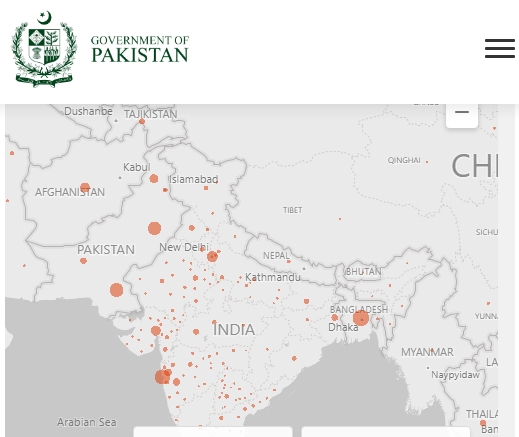
On Thursday, several people on social media claimed that Pakistan is showing the entire Jammu and Kashmir area as part of India. Sharing a screenshot from Pakistan government’s Coronavirus portal, it has been claimed that finally Pakistan has accepted that Kashmir is part of India.

At present Pakistan is illegally occupying the PoK and Gilgit-Balistan regions, and the areas are generally included in the map of Pakistan published by the Pakistani government. Similarly, the same region is also included in the map of India published by India, as the region officially belongs to India.

The same was also reported by a portal called The Real Kashmir News. It said that Pakistan Government’s official website on Covid-19, www.Covid.gov.pk has shown Jammu and Kashmir as part of Indian Territory.

But when one goes to the international section of the Covid19 website of Pakistan, one can indeed see that the map shown here is how India projects the map, with the whole of Kashmir shown as part of India. Although it looks like a big development, as a official govt website of Pakistan is carrying this map, actually this does not mean Pakistan has given up their claim on Kashmir. Moreover, the map is showing that way only in India, outside India it shows differently.

This is because, the map shown on the website is not made by the Pakistan government, and they have merely embedded a map created by Microsoft. Tech giant Microsoft has created a Coronavirus database which is projected on their Bing maps. That same map has been embedded in the Pakistan’s Covid portal, which is why the map shows Kashmir in India when viewed from India.

The online maps that we frequently use, like Google Map and Bing Map, are not shown as same in every part of the world. As there are many disputed territories in the world, the same is reflected in the maps, and the maps depending on from where it is being accessed. Generally disputed territories are marked with doted lines, as opposed to normal lines used for non-disputed boundaries. Apart from that, in some cases the map is shown the way it is mandated to be shown in a particular country. As Indian laws mandate that the maps must show the entire Kashmir region in India, the Google and Bing maps comply with that ruling. But when the same maps are viewed from outside India, actually the PoK and Gilgit Balistan as shown as part of Pakistan, and the line of control is shown as dotted lines.

When viewing the website from India

As the Pakistani Covid portal was accessed by Indians from India, the embedded Bing map showed the map as per India. But when it is viewed from outside India, a different map can be seen. This can be verified by accessing the map from outside India. Or the same also can be done by using a VPN (virtual private network) client, which lets one mask their own IP address and allows to set the location to some other country. Thus, one can check how a website is seen in different countries by using a VPN and selecting a country.

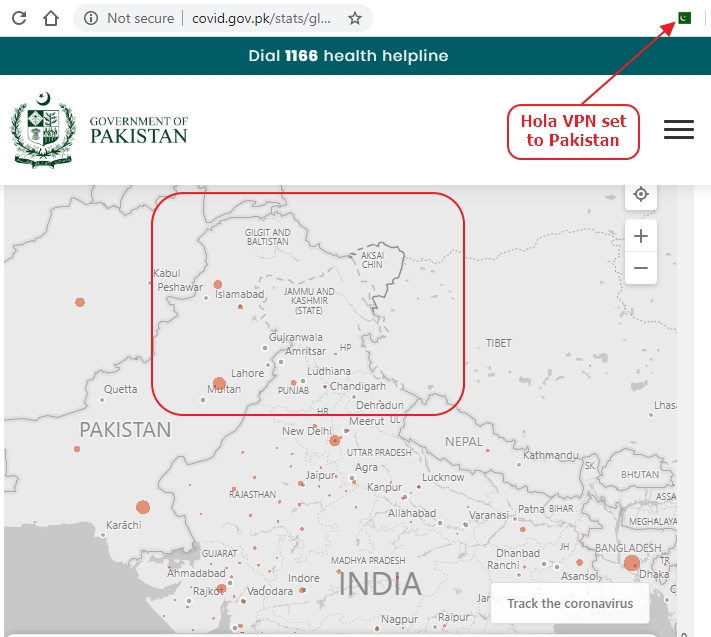
When viewing the website by setting location as Pakistan in VPN

We checked the same by using this technique. First, when visited the page, it indeed showed Kashmir in India. But when we activated our VPN client and set the location as Pakistan, we saw that PoK and Gilgit Balistan are now in Pakistan, Aksai Chin in China, and dotted lines for LoC and LoAC. The same appears when the location is changed to different countries like USA and UK.

The same experiment can be repeated by going directly to Bing’s COVID19 website directly and through VPN, and the same results can be seen.

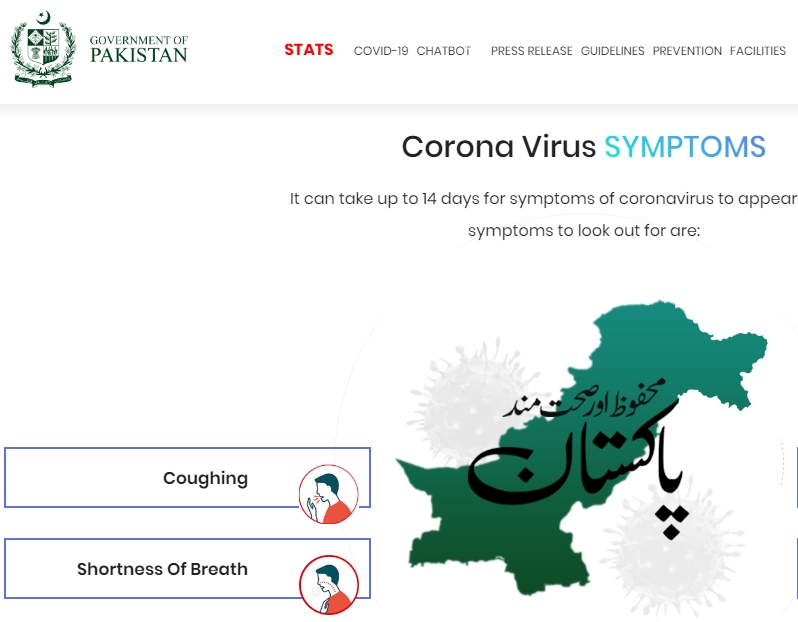
Moreover, the homepage of the portal features a map of Pakistan which shows the usual map that the country uses. They have used an image file as the map which shows PoK and Gilgit Balistan in Pakistan.

Therefore, although it is true that Pakistan’s COVID19 portal shows whole Kashmir India, that is happening only when viewing the portal from India. This is happening because the Pakistan govt has embedded a third party mapping program, they have not created the same. Pakistan govt is not changing their position on Kashmir as evidenced by the map used on the homepage.

Congress General Secretary Priyanka Gandhi recalls ‘buses’ sent to Uttar Pradesh for migrants

Congress General Secretary Priyanka Gandhi has now recalled the ‘buses’ she had sent for migrants in Uttar Pradesh after blaming Yogi Adityanath government of ‘playing politics’. The decision was taken on Wednesday. Uttar Pradesh Deputy Chief Minister Dinesh Sharma said that they could not risk the lives of migrants by letting buses which are unfit to ply to transport them.

Congress claimed that they had about 900 buses ready at the UP border, waiting for permission from UP government to enter to take migrants to their hometowns but the partial list of these buses included ambulances, private vehicles as well as auto rickshaws. Later the bus drivers who were arranged for by the Congress in Rajasthan chanted anti-Congress slogans over stale food served to them.

The political slugfest turned ugly after UP government and Congress indulged in FIR war. UP Police booked Priyanka Gandhi’s adie Sandeep Singh and Congress UP chief Ajay Lallu for forgery and cheating. After that, Rajasthan Police filed a retaliatory FIR against UP Additional Chief Secretary (Home). Later on Tuesday, Lallu was arrested by Agra Police for sitting on a dharna amid coronavirus lockdown.

Congress’ Rae Bareli MLA Aditi Singh called out her party’s bluff and praised Yogi Adityanath for handling the migrant crisis in state amid coronavirus crisis. She was later suspended from Congress.

Terrorists attack patrol party of Jammu and Kashmir police in Pulwama, one cop martyred

A patrol party of Jammu and Kashmir police was attacked by terrorists in Pulwama today. A J and K police jawan was martyred and another was injured in the attack while a CRPF jawan has also received injuries, as per reports.

The attack happened in the Prichoo area of Pulwama in South Kashmir. The CRPF jawan has received superficial bullet wounds and has been evacuated for treatment.

2 BSF jawans killed in an attack yesterday

This is the second attack on security forces within two days. Earlier on Wednesday, terrorists who were on a motorcycle fired on two BSF jawans at the Pandach area on the outskirts of the Srinagar city. Two BSF jawans were killed in action in that attack.

The BSF jawans, aged 35 and 36, were shot in the head by the terrorists, as per reports. The terrorists had fled after snatching their weapons.

Newly recruited terrorist arrested in Kupwara

Jammu and Kashmir police in a joint operation with security forces on Thursday arrested three newly recruited terrorists at Sogam of Kupwara district. They were newly recruited by Lashkar-e-Taiba. Two of them have been identified as Zakir Ahmad Bhat and Abid Hussain Wani.

Gujarat: Woman gives birth in ambulance in Gir Somnath as the road was blocked by lions

In Gujarat’s Gir Somnath district a woman gave birth in an ambulance as a pride of lions blocked the way of the ambulance while it was taking the pregnant woman to the hospital for delivery. The pregnant woman had called the 108 emergency ambulance after feeling labour pains.

According to reports, the incident happened on the night of May 20 after a 108 emergency ambulance received a call from Bhakha village about a woman who was in labour. Soon the ambulance arrived and carried the woman Afsana heading for the hospital in Girgadhada. But around mid-way, they found that the road was blocked by a pride of four lions. 

Finding no other way around to escape as the road was too narrow, the ambulance stopped at the spot and waited for the lions to move. But suddenly the woman started having extreme labour pain, which forced the staff of the ambulance to carry out the delivery. Emergency Medical Technician Jagdish Makwana and driver Bharat Ahir carried out the delivery in the vehicle itself successfully. The mother and the baby were taken to the hospital after waiting some more time, as the herd of lions stayed there for 20 more minutes.

Similar incident has been happened earlier

In July 2017, a woman identified as Makuben Makwana had delivered a baby in the ambulance that was on its way to hospital. The herd of lions had blocked the way in Gir forest. The paramedic staff conducted delivery when the ambulance was surrounded by the lions.

As per reports, the emergency technician contacted the physician over phone for directions to conduct delivery. Other lions sensing the human presence came out of bushes and surrounded the ambulance.

Chetan Gaadhe, the emergency management executive said, “Though Jadav, who is a local and understood the behaviour of lions, tried to scare them away, the lions refused to budge. Some of them even sat in front of the vehicle, blocking its passage.”

They helped woman deliver the baby inside the ambulance while Jadav monitored the movement of the ‘curious’ lions.