Home Blog Page 37

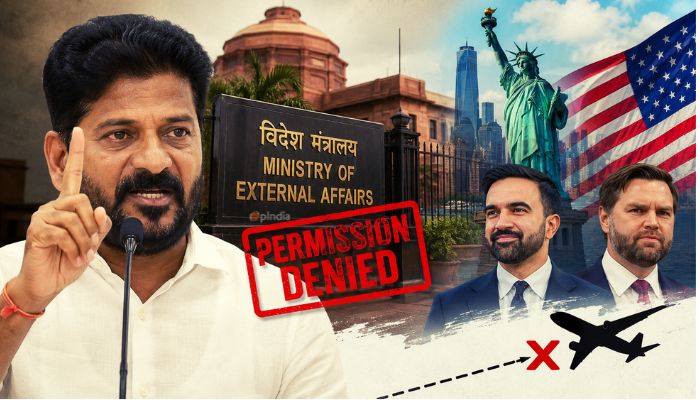
Zohran Mamdani, JD Vance and an unrouted itinerary: Why MEA blocked US visit of CM Revanth Reddy

Telangana Chief Minister Revanth Reddy has stirred a row over the Ministry of External Affairs denying him permission for his visit to Boston, US, for “political reasons”. After returning from the UK to Hyderabad, CM Reddy described the Centre’s denial of permission for his US visit as an “insult” to Telangana and also defended his possible meeting with New York Mayor Zohran Mamdani.

CM Revanth Reddy claimed that the purpose of his US visit was to promote Telangana as a sports and investment hub as well as to attract world-class universities to the state

“We had informed the MEA about the visit. The CMO had informed the MEA about the purpose of the visit. The objective was to promote Telangana as a sports and investment hub and bring world-class universities to the state. MEA examined the proposal and informed that, for political reason visit was declined,” CM Reddy said.

CM Revanth Reddy gives a ‘Telangana vs Gujarat’ spin to the MEA snub

Revanth Reddy, who leads the Congress government in Telangana, gave a Gujarat-BJP versus Telangana-Congress spin to the issue.

“I was denied permission to travel to lead the Telangana Rising delegation even as the Gujarat CM was allowed to travel under the banner of Vibrant Gujarat. This is an insult to the self-respect of Telangana…This is not the permission denial to Revanth Reddy but a disrespect toward the Telangana people. It’s because of Gujarat supremacy. It is like obstructing Telangana’s growth and development,” CM Reddy said.

“What is the political angle – Modi is BJP, Revanth Reddy is Congress, Modi is Gujarat, Revanth is Telangana, is this the ‘political angle’ which they mentioned while denying the permission? It is totally against federal cooperation. Gujarat is conspiring against Telangana; I condemn it,” he added.

CM Revanth Reddy claimed that the Central government discriminated against him and a non-BJP-ruled Telangana by denying clearance for his US visit, and that this denial was about ‘Gujarat supremacy’. A question, however, arises: if the Centre had to discriminate against the Congress-ruled state, why would it grant clearance to CM Reddy even for his UK visit?

If Prime Minister Narendra Modi “did not care about the federal structure” in the context of Reddy’s planned US visit, why would he care about the same when his government granted permission for Reddy’s UK tour?

Training his guns against PM Modi, CM Reddy asked whose permission PM Modi took before his unplanned visit to Lahore, Pakistan in 2015.

Reddy, however, forgot that the Prime Minister is the highest authority of the executive government, requiring no legal permission or clearance from any other authority, including the President of India. PM Modi visiting Pakistan in 2015 was a bilateral call he was well authorised to take; Revanth Reddy, on the contrary, is the Chief Minister of an Indian state and would require the Centre’s clearance for his official foreign visits.

Notably, CM Reddy was reported to visit the campuses of Harvard University and MIT on 24th August. He was also scheduled visit to the North-Eastern campus and hold a meeting with a team of Virginia Tech University in Boston on 25th August the North-Eastern campus and meeting with a team from Virginia Tech University in Boston on 25th August. A meet-and-greet event with the Indian Overseas Congress in New York on 26th August was planned.

However, the most controversial part of his itinerary was a possible meeting with New York Mayor Zohran Mamdani and US Vice President JD Vance.

Citing MEA sources, NDTV reported that Reddy’s proposed meetings included those with JD Vance and Zohran Mamdani; however, the programme was not routed through the MEA.

Why did the MEA deny clearance for Revanth Reddy’s US visit?

Telangana Chief Minister Revanth Reddy planned to visit the United Kingdom and then to the US before returning to India; however, the MEA granted permission only for the UK leg of the tour. The MEA said that clearance was not granted because the proposed purpose of Reddy’s visit did not match the itinerary of the visit.

Notably, the political clearance system is used by the Central government to assess official and political foreign visits by Indian dignitaries.

“Let me say that the visits of chief ministers, as indeed those of other dignitaries, are assessed by the Ministry of External Affairs in order to accord political clearance. The programme proposed in such cases should be appropriate to the office held and the purpose of the visit. In this particular case, that was not so with respect to the United States,” MEA spokesperson Randhir Jaiswal told the media.

“Therefore, the clearance was denied and not given. Incidentally, let me also tell you that clearance was given for his visit to the United Kingdom,” he added.

Reports citing sources privy to the development say that while the Telangana Chief Minister’s Office (CMO) was working on the Reddy’s proposed meetings with Vance and Mamdani, these engagements were not communicated to the MEA but were independently communicated to the respective US officials.

After returning to India, however, Revanth Reddy denied having plans to meet JD Vance, though he confirmed that there were talks of his meeting with Zohran Mamdani.

‘He’s not an anti-social element’: Telangana CM Revanth Reddy defends Zohran Mamdani despite his anti-Hindu and anti-India shenanigans

Confirming the reports that there was indeed a possibility of a meeting with New York Mayor Zohran Mamdani, CM Revanth Reddy said that no appointment was fixed.

Defending Zohran Mamdani, CM Revanth Reddy said, “Besides, Mamdani is not an anti-social element. He is an elected Mayor.”

While Revanth Reddy said that Zohran Mamdani is not an anti-social element but an elected Mayor, Mamdani’s disdain for India and particularly Hindus is widely known.

In May 2025, Zohran Mamdani called PM Modi a “war criminal” during a public forum. He said in the context of the 2002 Gujarat Riots, which erupted after Islamists burnt a train bogey full of 59 Hindu pilgrims returning from Ayodhya, who were burnt alive. Mamdani claimed that Modi, who was then the Chief Minister of Gujarat, helped the slaughter of Muslims and that hardly any Gujarati Muslims are there.

This, however, was a blatant lie as the Indian Supreme Court has already given a clean chit to PM Modi. Moreover, the population of Muslims in Gujarat, far from decreasing, has only increased over the years.

At the event, titled “New Mayor, New Media”, Mamdani also compared Modi to Israeli PM Netanyahu, saying, “This is someone we should view in the same manner we do Benjamin Netanyahu. This is a war criminal.”

Born to ‘filmmaker’ Mira Nair and Islamic terrorist-sympathiser Mahmood Mamdani in Uganda, Zohran Mamdani is notorious for making derogatory remarks against Indian Hindu leaders, especially PM Modi.

In 2020, he called Hindus associated with the Bharatiya Janata Party (BJP) “fascists” and attacked fellow New York politicians Jenifer Rajkumar and Kevin Thomas for not denouncing PM Modi.

Back then, Rajkumar responded strongly, calling Mamdani’s comments “extreme and divisive,” and urged voters to “reject hate, whether from the far left or far right.”

A video from August 2022 showed him leading a mob shouting, “Who are the Hindus? “Harami (Bastards),” which went viral on social media

Behaving like a rattled Islamist, when the Ram Mandir was being built in Ayodhya in 2020, Zohran Mamdani led a rally opposing its construction. While he was speaking at the rally, derogatory remarks against Hindus were being raised behind him. The rally was organised by Khalistani terrorists.

In 2023, when PM Modi was scheduled to visit New York, Mamdani spewed venom against him and peddled blatant lies, accusing him of the 2002 Gujarat Riots.

In January 2024, Zohran Mamdani co-organised and endorsed protests in New York City that condemned the consecration of the Ram Mandir in Ayodhya, branding the event as “Hindutva extremism.”

Earlier, Zohran Mamdani defended the anti-semitic “Globalise the Intifada” cry, which essentially calls for hatred and violence against Jews across the world. He also refused to acknowledge Israel’s right to exist, a common trait among Islamists and their liberal cheerleaders.

In March 2025, assembly members Steven Raga, Zohran Mamdani, and Karine Reyes, among other cosponsors, introduced bill AB 6920 to add caste as a protected category in New York. The bill was crafted to villainise Hindus and paint a target on their back.

Zohran Mamdani has also received funding from anti-India and anti-Hindu groups active in the US, including the Council on American-Islamic Relations (CAIR). This Islamist outfit contributed $100,000 to New Yorkers for Lower Costs, the largest Parliamentary Action Committee (PAC) backing Zohran Mamdani. Not to forget, CAIR officials were among those who celebrated the Palestinian Islamic terror group Hamas’s massacre of innocent Israeli civilians on 7th October 2023.

OpIndia has reported earlier about how CAIR, which always complains about alleged ‘Islamophobia’ in the US, has been aggressively promoting Hinduphobia and anti-Hindu propaganda in India. 

Earlier, CAIR was offended when the names of the Lashkar-e-Tayyba (LeT) terrorists and scenes from the deadly 26/11 terror attack were displayed on a mobile billboard truck in New Jersey.

Mamdani also received funding from Anti-Semitic activist Linda Sarsour and many anti-Israel groups. He also received support from Soros-funded Hindus for Human Rights (HfHR), an anti-Hindu outfit, co-founded by Sunita Vishwanath.

As reported earlier, HfHR was formed in the year 2019 by two Islamist advocacy groups: Indian American Muslim Council ( IAMC) and the Organisation for Minorities of India (OFMI).

Unsurprisingly, Zohran Mamdani is also a supporter of the 2020 anti-Hindu Delhi Riots accused mastermind Umar Khalid. In January 2026, he co-signed a letter by 7 to 8 Democrat politicians, demanding the release of Khalid from jail. Mamdani had also penned a personal note for the accused rioter.

While it has not directly been confirmed by the Central government if the proposed meeting with Zohran Mamdani was the major reason for the MEA’s denial of permission for Revanth Reddy’s visit to the US, the denial makes sense given Mamdani’s track record and the Telangana CMO’s reported failure to route the proposed meeting with Mamdani through the MEA for political clearance.

CM Revanth Reddy met anti-India propagandists Maya Tudor and Faisal Devji in the UK

Beyond the official clearance process, preventing Revanth Reddy from supposedly engaging with foreign leaders like Zohran Mamdani, who have earned notoriety for peddling anti-India and anti-Hindu propaganda, makes even more sense given who all CM Reddy met in the UK.

During his UK visit last week, Telangana CM Revanth Reddy arrived at the Blavatnik School of Government and met professors Maya Tudor and Faisal Devji as a part of the state’s “global education outreach”.

However, the meeting between CM Reddy and Maya Tudor and Faisal Devji triggered backlash in India over the duo’s record of peddling anti-India propaganda. Through their journals, books, articles, and various seminars, both Maya Tudor and Faisal Devji have been pushing anti-Hindu narratives and contributing to concerted Islamo-leftist efforts to tarnish India’s image globally.
Large-scale violations, extrajudicial killings, ‘targeting’ of Rohingyas after Pahalgam attack: UNCERD peddles anti-India propaganda in its latest report

On 25th August (Tuesday), the United Nations Committee on the Elimination of Racial Discrimination (UNCERD) has accused India of alleged “large-scale violations” by authorities against the members of the SC-ST community, the tribal people and “non-citizens,” in its latest release.

The UN body somehow made Rohingya Muslims the bigger victims of the April 2022 Pahalgam attack wherein Hindus were singled out and shot dead by Islamic terrorists for being Hindus, as the Central government launched a crackdown against illegal immigrants.

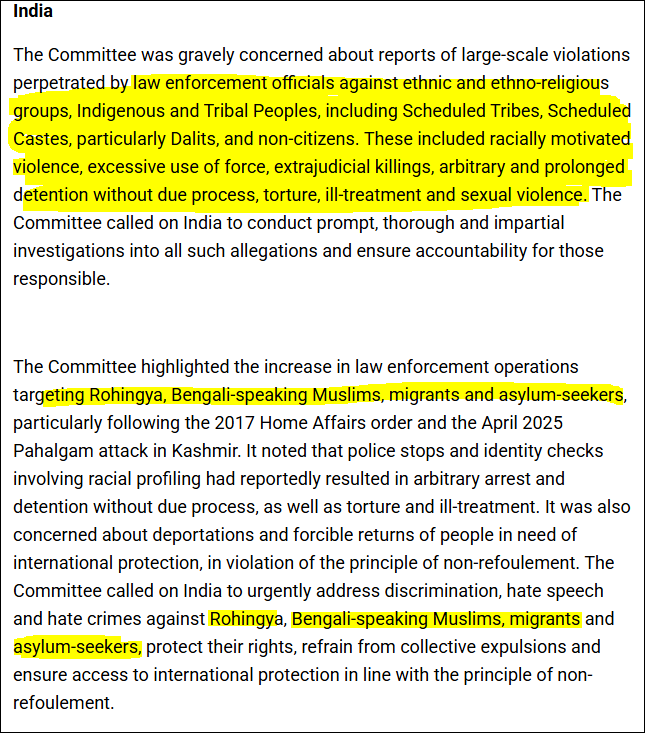
It read, “The Committee was gravely concerned about reports of large-scale violations perpetrated by law enforcement officials against ethnic and ethno-religious groups, Indigenous and Tribal Peoples, including Scheduled Tribes, Scheduled Castes, particularly Dalits, and non-citizens. These included racially motivated violence, excessive use of force, extrajudicial killings, arbitrary and prolonged detention without due process, torture, ill-treatment and sexual violence.”

Source: UNCERD August 2026 report

“The Committee called on India to conduct prompt, thorough and impartial investigations into all such allegations and ensure accountability for those responsible,” the UNCERD report added.

There is nothing new about a foreign body making such sweeping and unsubstantiated allegations against India, completely blurring the line between fact, anti-India rhetoric and unverified claims. It also conveniently ignores the fact that the country has a fully functioning Constitution, courts, statutory bodies and investigative agencies that provide avenues for scrutiny and redress. Hence, the calls for inquiry are just as much a farce as the investigations that do not align with their expected results or outcomes are never accepted.

The reality remains that these claims appear less rooted in genuine concern or ground realities and more in an attempt to attack India and damage its global reputation. Their alleged concerns have effectively become a licence to make judgments about an entire country with the apparent purpose of denigrating it.

UNCERD further charged, “The Committee highlighted the increase in law enforcement operations targeting Rohingya, Bengali-speaking Muslims, migrants and asylum-seekers, particularly following the 2017 Home Affairs order and the April 2025 Pahalgam attack in Kashmir. It noted that police stops and identity checks involving racial profiling had reportedly resulted in arbitrary arrest and detention without due process, as well as torture and ill-treatment.

“It was also concerned about deportations and forcible returns of people in need of international protection, in violation of the principle of non-refoulement. The Committee called on India to urgently address discrimination, hate speech and hate crimes against Rohingya, Bengali-speaking Muslims, migrants and asylum-seekers, protect their rights, refrain from collective expulsions and ensure access to international protection in line with the principle of non-refoulement,” it continued.

A country that has repeatedly been targeted by terrorist attacks from across the border has been lectured against taking measures to protect the lives of its citizens. The body appears to want India to put national security on the back burner and turn a blind eye to illegal immigration and its potential risks, even as countries ranging from the United States to Bangladesh seek to curb such inflows.

Likewise, the brutal massacre of 25 Hindu men in Pahalgam seemed to generate greater concern for those detained by the authorities than for the victims themselves. The familiar rhetoric of discrimination and human rights followed, with India once again being lectured on its responsibilities. The contrast is difficult to overlook: a country facing real security threats is expected to remain vulnerable, while the rights of those entering it illegally appear to command greater attention.

The claims concerning Indian communities such as Scheduled Castes and Scheduled Tribes further serve not only to deepen the fault lines but also as a tool to portray India as mistreating its own people, yet without providing even an iota of evidence to substantiate these allegations except dubious or already refuted reports. The concern is neither rooted in reality nor genuine concern for these communities but driven by an agenda to denigrate India at every opportunity.

Of course, attempts by United Nations bodies to weigh in on India’s internal affairs and attack the country are neither new nor novel. United Nations Special Rapporteurs appointed by the UN Human Rights Council had similarly raised allegations of “human rights violations” during India’s counter-terrorism operations following the Pahalgam attack.

Nevertheless, the body was more focused on Islamophobia than on the incidents that resulted in the loss of lives and the devastation of families. It is important to highlight that these organisations consistently overlook the serious incidents that occur prior to any action taken by the authorities, and any expressions of condolences are merely feeble attempts to seem neutral while concealing the true objective.

The USCIRF has been leading the charge in promoting this anti-India narrative. The body repeatedly seeks to classify India as a country of particular concern. It even advocates for sanctions against the Rashtriya Swayamsevak Sangh (RSS) and India’s Research and Analysis Wing (RAW). Furthermore, it has been openly campaigning against the US visit of RSS chief Mohan Bhagwat.

“We are all aware that the organisation—or entity—you are referring to is biased; for years, it has been making disparaging and inflammatory remarks about India. I would say we should steer clear of such organisations, as they operate with their own agendas and lack any credibility or trustworthiness. That is my response to that point,” External Affairs Ministry spokesperson Randhir Jaiswal countered the outrageous submissions of the commission.

These groups are permeated with a foulness of bigotry, Hinduphobia and antagonism against India, and they essentially operate as a pressure arm of the global Islamo-leftist alliance. The use of anti-India rhetoric, including invoking purported hate speech directed at specific groups or accusations of discrimination and violations of “human rights,” has become a convenient refuge for such organisations to advance their agenda of demonising India. And the recent UNCERD report is yet another case in point.

Trump administration weighs steep new H-1B, OPT fees: Why Indians could be hit hard

0

The Trump administration is weighing a fresh set of measures that could significantly increase the cost of working and studying in the United States for foreign nationals, with H-1B workers and international students on Optional Practical Training (OPT) potentially facing steep new fees.

The US Department of Homeland Security (DHS) has sent proposed regulations to the White House Office of Management and Budget (OMB), including a proposal that could push the H-1B visa fee to $103,265. The administration had introduced a $100,000 H-1B fee last year, but its implementation was subsequently blocked by the courts.

The proposals could have major implications for Indians, who account for more than 70 per cent of H-1B beneficiaries. In 2024, the US Citizenship and Immigration Services approved 399,402 H-1B petitions, with Indian-born beneficiaries accounting for around 71 per cent of them.

According to immigration services firm Fragomen, the DHS proposals could also introduce a fee of around $100,000 for certain OPT applications. The firm said the proposed rules have already cleared the OMB review process, although their exact provisions remain confidential until they are formally published.

The proposals could therefore make the US significantly more expensive for foreign professionals, international students transitioning from universities into employment, and American employers seeking to sponsor skilled foreign workers.

H-1B and OPT fees could rise sharply

Fragomen said an OPT fee proposal was submitted to OMB on August 20, while a proposal concerning fees for certain H-1B petitions was received and cleared by the OMB a day earlier, on August 19.

The immigration services firm cautioned that the DHS could propose a $100,000 fee for OPT applications. The proposed H-1B fee, meanwhile, could be linked to the ongoing legal battle over the administration’s earlier $100,000 H-1B petition fee.

The exact details of both proposals are not yet public and will only become clear once the regulations are officially released.

Indians among the biggest stakeholders

Any major change to the H-1B system is particularly significant for India because Indian nationals dominate the programme.

USCIS data shows that Indians accounted for roughly 71 per cent of approved H-1B beneficiaries in 2024. That means higher visa costs, tighter rules or increased financial burdens could disproportionately affect Indian technology professionals and other skilled workers seeking employment in the US.

The impact could extend beyond workers themselves. US companies that depend on H-1B talent could also face substantially higher costs when sponsoring foreign employees.

For international students, a steep OPT fee could make the transition from an American university to the US job market considerably more expensive.

H-1B workers could also lose a 60-day grace period

The proposed fees come alongside another potentially significant change.

Earlier this month, DHS proposed eliminating the existing 60-day grace period available to certain H-1B workers after their employment ends. Under the current system, eligible workers can generally remain in the US for up to 60 days after losing their jobs while seeking new employment or otherwise resolving their immigration status.

If the proposed rule is finalised, affected workers and their dependants could be required to leave the US much sooner after employment ends, potentially creating additional uncertainty for thousands of families.

The proposed changes signal a broader tightening of the US immigration system under the Trump administration, with foreign workers, international students and employers likely to bear a greater share of the financial and regulatory burden.

For Indians, who form the overwhelming majority of H-1B beneficiaries, the consequences could be particularly significant.

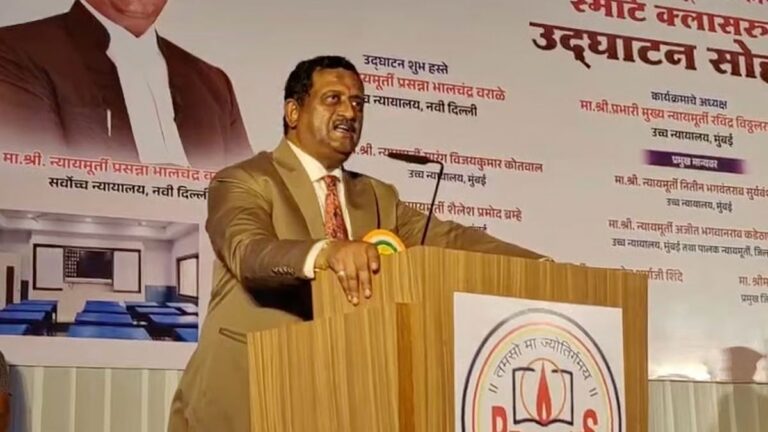
SC Justice PB Varale says 0.1% of Nashik Kumbh Mela funds could save Marathi schools: How the Leftist trope of pitting Hindu faith against welfare is flawed

There is little to disagree with in the concern expressed by Supreme Court Justice Prasanna Varale over the deteriorating condition of Marathi-medium schools and residential schools in Maharashtra. If schools are genuinely being forced to shut down for want of a relatively small amount of money, the Maharashtra government must answer why it has failed to provide that money.

But the argument that even 0.1 per cent of the money allocated for the Nashik Kumbh Mela could have saved more than 100 Marathi schools gets the priorities of governance completely backwards.

Justice Varale, speaking during a visit to his former school in Nashik, said that if around Rs 32 crore, 0.1 per cent of the Kumbh allocation, had been spent on education, more than 100-150 Marathi schools could have been prevented from shutting down. The concern over educational infrastructure is legitimate. The comparison with the Kumbh, however, is not.

Why must schools and the Kumbh be competing priorities?

The first question that needs to be asked is: Why must the Kumbh Mela and Marathi schools be presented as competing priorities in the first place?

Maharashtra is perfectly capable of doing both.

The state has approved a comprehensive Rs 22,425.39 crore development plan for the Nashik-Trimbakeshwar Simhastha Kumbh Mela. The plan is not simply a cheque being handed over for religious festivities. The Kumbh requires enormous temporary and permanent infrastructure because lakhs of devotees will descend on Nashik, creating extraordinary requirements for roads, sanitation, water supply, transportation, medical facilities, crowd management, public safety and other civic infrastructure. The state has constituted dedicated committees and an authority precisely because the event requires large-scale administrative coordination.

So when someone says, “Take 0.1 per cent of the Kumbh allocation and save the schools”, the obvious response should be: Why take it from the Kumbh at all?

Why not ask the government to find Rs 32 crore elsewhere?

Why not ask why schools were allowed to reach a stage where Rs 32 crore could supposedly make the difference between survival and closure?

And if the state has Rs 32 crore to spare, why should that money become available for schools only after taking it away from an infrastructure programme connected with one of India’s largest religious gatherings?

Kumbh infrastructure is not simply “religious expenditure”

The comparison itself creates an unnecessary hierarchy: education is presented as an essential public good while the Kumbh is subtly reduced to an expendable cultural or religious expenditure. That is where the argument becomes problematic.

The Kumbh Mela is not some private religious function for a handful of people. It is a civilisational and spiritual gathering followed by millions of Hindus. The administration has a responsibility to ensure that people who participate in it have access to basic civic facilities and, more importantly, can do so safely.

Imagine the consequences if the government simply said that sanitation, roads, medical facilities, crowd-control infrastructure or public amenities at the Kumbh were unnecessary because the money could instead be spent elsewhere. The same people would quite rightly ask why the state failed to prepare for an event in which an enormous number of people are expected to gather at the same place.

The purpose of Kumbh expenditure is therefore not merely to “spend money on a religious event”. It is to build the infrastructure required to manage a massive congregation safely and efficiently.

Criticise waste, not the existence of the expenditure

To oppose wasteful expenditure is legitimate. To question whether every rupee is being spent wisely is legitimate. To demand greater allocation for education is legitimate.

But turning Kumbh expenditure into the explanation for the failure of Marathi-medium schools is not.

If Marathi schools are shutting down because of inadequate funding, the government should be asked why it failed to fund them. Period.

The state does not have a binary choice between a school and a toilet at the Kumbh.

It must provide both.

The larger question of government priorities

There is another uncomfortable question here. Maharashtra has several large welfare commitments, including the Mukhyamantri Majhi Ladki Bahin Yojana, under which eligible women receive Rs 1,500 per month. The scheme itself provides for the monthly Rs 1,500 benefit from July 2024.

One can certainly argue that welfare schemes serve a legitimate social purpose and that their beneficiaries cannot simply be deprived of promised assistance. But that is precisely why governments must be subjected to scrutiny on all expenditure, rather than selectively identifying one particular expenditure as the source of every fiscal problem.

If Rs 32 crore is the amount required to save 100-150 schools, why is the debate not about finding Rs 32 crore within a state budget running into lakhs of crores?

Why is the Kumbh being made the villain?

Would the same framing have been used if the expenditure were for a large government programme associated with another religious community? Would a commentator casually suggest that 0.1 per cent of the expenditure on an Islamic or Christian religious gathering should be diverted to save Marathi schools?

Perhaps that question is uncomfortable. But it is worth asking because public policy should not operate on the assumption that expenditure associated with Hindu religious traditions is inherently frivolous, while expenditure on religious congregations of other communities is automatically accorded greater social legitimacy under India’s famed secular framework.

The Kumbh deserves scrutiny over unnecessary expenditure. The government should be questioned if projects are overpriced, delayed or poorly executed. But the mere fact that money is being spent on Kumbh-related infrastructure does not make that expenditure illegitimate.

In fact, the irony is that the argument provides the government with an easy escape.

Instead of asking why it could not protect Marathi schools while simultaneously spending on the Kumbh, the government can simply say that education and Kumbh infrastructure are competing demands and that difficult choices have to be made.

No.

The government should not be allowed that cop-out.

Maharashtra can and must do both

A government capable of undertaking a massive infrastructure programme for the Kumbh should also be capable of ensuring that Marathi-medium schools do not collapse for want of basic funding. These are not mutually exclusive responsibilities.

Justice Varale’s concern about education deserves serious attention, particularly his reported remarks about the condition of residential schools and the need for modern classrooms, computers and laboratories. But the remedy cannot be to pit one legitimate public priority against another.

The better question is not whether 0.1 per cent of Kumbh funds could have saved Marathi schools.

The better question is: Why did the government need to be reminded about Marathi schools at all?

And there is a larger principle at stake.

The Kumbh Mela is not something that Maharashtra should be embarrassed about spending money on. It is an event that brings together an extraordinary number of people and therefore requires extraordinary civic preparation. Providing them with toilets so that people do not have to defecate in the open, ensuring drinking water, building roads, arranging medical facilities and preventing stampedes are not luxuries. They are basic responsibilities of a government hosting a congregation of such magnitude.

If the state can provide all of that and also keep every Marathi school functioning, it is doing its job.

If it cannot, the failure lies in its budgeting and governance, not in the fact that Hindus gathered for the Kumbh.

It is not an either-or choice

The government should therefore be asked to save the schools.

It should be asked to improve ashramshalas. It should be asked to modernise government schools. It should be asked to review inefficient spending and welfare expenditure wherever necessary.

And it should be asked to ensure that the Kumbh infrastructure is delivered efficiently and without waste.

But Maharashtra should not be forced into the false choice of schools versus Kumbh.

Both deserve to survive.

Both educational institutions and religious traditions deserve to be protected and supported. They are not competing priorities, nor should public policy force a choice between the two. It is not an either-or proposition; both deserve to be treated with equal seriousness.

How the Left employs sophistries of school over Hindu congregation, hospital over temple

There is also a familiar pattern in the way such debates are framed. The comparison of religious traditions, temple construction and religious infrastructure with hospitals, schools or other welfare institutions has long been a convenient rhetorical device for questioning the legitimacy of Hindu religious expenditure.

The argument is deceptively simple: why build a temple when a hospital could have been built instead? Why spend money on a religious gathering when the same money could fund schools? Why invest in religious infrastructure when there are supposedly more “useful” things the state could be doing?

The problem with this framing is not that hospitals and schools are unimportant. They are immensely important. The problem is the assumption that the existence of one legitimate social need automatically delegitimises another.

The same argument was prominently deployed around the construction of the Ram Mandir in Ayodhya. After centuries of contestation and a nearly 500-year-long civilisational struggle over the Ram Janmabhoomi, sections of the Left and its ideological ecosystem repeatedly asked why a hospital or other public institution could not be built at the site instead of a temple.

But why should the choice have been presented as Ram Mandir versus hospital in the first place?

India needs hospitals. India also has the right to build temples.

India needs schools. Hindus also have the right to preserve and celebrate their religious traditions.

A hospital does not become more valuable because it is rhetorically positioned against a temple. Nor does a temple become frivolous merely because someone can identify another public good that could theoretically have received the money.

This is precisely why the Kumbh-school comparison needs to be viewed with some scepticism. Once the debate is framed as religion versus development, Hindu religious expenditure is almost automatically placed on the defensive, as though every rupee spent on a Hindu religious tradition must first justify why it was not spent on a school, hospital or welfare scheme.

That is not secularism. It is a double standard masquerading as public-policy prudence.

The legitimate question is whether public money is being spent efficiently and whether citizens are receiving value for it. That standard should apply equally to every expenditure. But the answer to a school funding shortfall cannot always be to point at a temple, a Kumbh, a religious festival or some other Hindu institution and declare that the money should have gone there instead.

A civilised society does not have to choose between preserving its civilisation and building its institutions. It can, and must, do both.

FIR against Ajeet Bharti under SC/ST act: If unsavory words and sexually coloured remarks are to be booked, Ambedkarites should be jailed first

On Sunday (23rd August), a First Information Report (FIR) was registered against YouTuber Ajeet Bharti under the draconian SC/ST Act, which allows arrest without a preliminary inquiry by the police.

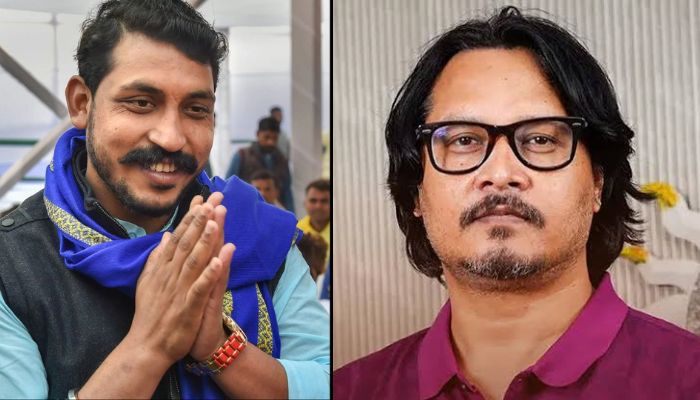
The complainant, identified as one Balakram Bauddh, had alleged that Ajeet Bharti resorted to ‘caste-based abuse’, promoted ‘caste-based hatred’ and supposedly made ‘sexually degrading remarks’ about B.R. Ambedkar and Bhim Army chief Chandra Shekhar Aazad Ravan.

The Ambedkarite ‘activist’ also claimed that Bharti used ‘casteist slurs’ targeting the family members of Ravan. The development was widely shared on social media by Bhim Army supporters and Ambedkarites.

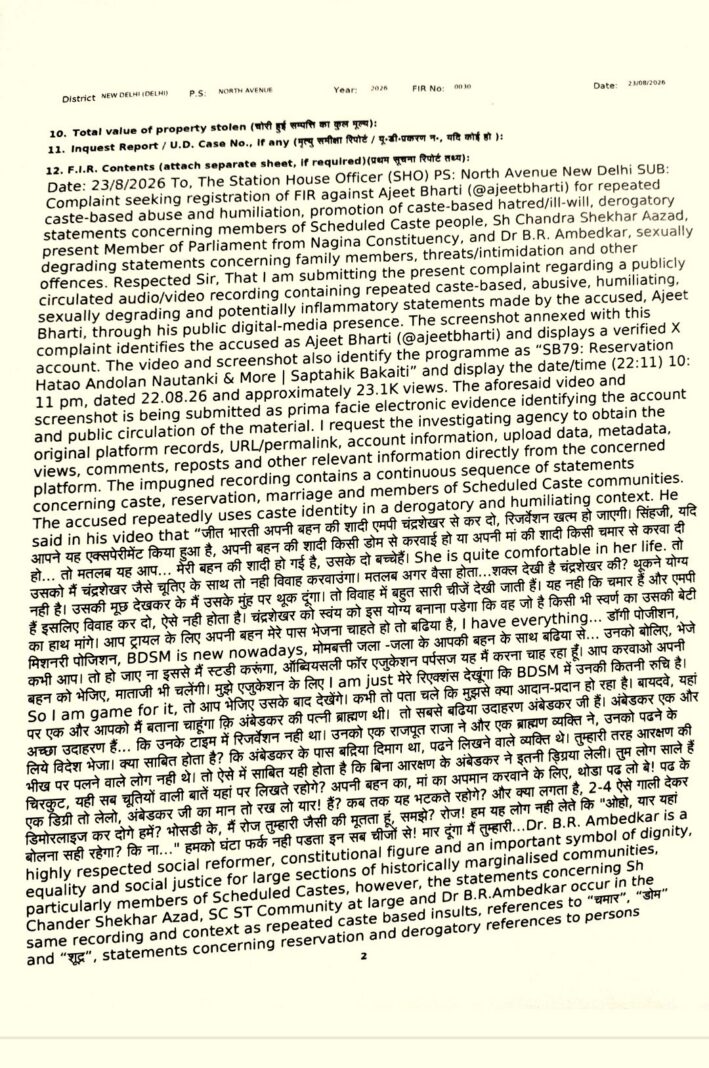
Screengrab of the FIR copy

What does the police complaint allege

The FIR has been filed in connection with the video posted by Ajeet Bharti on his channel about the ongoing ‘Reservation Hatao Andolan’.

A man identified as ‘@singhden’ left a disgusting comment, suggesting that the YouTuber send off his sister to the Bhim Army chief and that would end the need for reservation.

This stems from a disturbing patriarchal and borderline rape-apologist mindset, where women can be traded off to other men for the sake of ‘inter-caste harmony’.

In response to this comment, Ajeet Bharti asked ‘singhden’ if he had tried out such an experiment with his mother and sister. “My sister is already married and has two children. She is quite comfortable in her life,” he continued.

“Have you seen Chandrashekhar’s face? It is not even worthy of being spat on. Looking at his moustache, I would spit on his face. Many things are considered at the time of marriage. Just because he is a Ch*mar and an MP, marriages don’t happen like that. Chandrashekhar will have to make himself worthy enough to ask for the hand of a daughter of any Savarna [General category] individual.

“If you (referring to ‘@singhden’) want to send your sister to me for a trial, that is fine, I have everything…Send her sometime. I want to do this for educational purposes. You arrange it. Send your sister; your mother will also do. I will observe reactions as to how much interest they have in BDSM,” he had concluded.

“I would also like to tell you that Ambedkar’s wife was a Brahmin. So the best example is Ambedkar-ji. During his time, there was no reservation. A Rajput king and a Brahmin individual sent him abroad to study. What does this prove? Ambedkar had a sharp mind and he was an educated/learned person.”

“Unlike you, he did not survive on the alms/begging of reservation. So in this manner, it is proven that without reservation, Ambedkar obtained so many degrees. You people are petty loafers…Study a little, man! Obtain at least one degree and uphold Ambedkar ji’s honor, friend!”

It is thus clear from the police complaint and the associated video that Ajeet Bharti did not issue rape threats to the sister or family members of Chandrasekhar Azad. This is contrary to claims made by Ambedkarite activist Suraj Kumar Bauddh.

Ajeet Bharti, however, mentioned the mother and sister of ‘@singhden’, which should not have been done and is highly condemnable.

But it is crystal clear that there was neither a rape threat nor was it directed to the family of the Bhim Army chief. And in this debate about the use of unsavory and sexually coloured terms (which are derogatory), let us not forget the original comment by ‘@singhden’ which started the entire controversy.

The caste identity of this individual remains unknown. He might as well be from the ‘upper caste.’ This is for the courts to decide.

But, there is a pattern of Ambedkarite activists demanding that Hindus from the General Category give away their mothers, sisters, and daughters to them to end ‘casteism.’ The broader insinuation is that unless these women are sexually exploited by Ambedkarites, there will be no equal playing ground for all.

Ajeet Bharti reflects on the controversy

After the matter came to light, Ajeet Bharti put out a detailed tweet highlighting the rapist mentality of the Ambedkarites and their cheerleaders.

“If someone directly says to me about my mother or sister that I should get them married to Chandrashekhar, and I stay silent, then tell me, what kind of son or brother am I?” he pointed out.

“Even after that, I didn’t use any casteist words regarding Chandrashekhar, which are in the said video. When things are said from the stage about dragging away Brahmin daughters, and some SC leader’s follower deliberately provokes by saying such things, how can I stay silent?” he added.

He pointed out that the SC/ ST Act against him will not hold in court. “If such a comment appears on my video again, I will respond in the same way as I did before,” he added.

Ajeet Bharti concluded, “I want to ask the Savarna society: Should I have tolerated such a comment”

Give your daughters and sisters for ‘caste equity’: A perverted mindset

This perverted, deranged mindset exhibited by ‘@singhden’ in Ajeet Bharti’s video is not an isolated case.

In November last year, IAS officer Santosh Verma addressed a gathering and remarked, “Reservation should be given only to one person in a family until a Brahmin gives his daughter to my son or establishes a relationship with her.”

His disgusting comment was applauded by the crowd. Not to forget, Bhim Army Chief Chandrasekhar Azad Ravan came out in support of the disgraced bureaucrat and said, “How many Santosh Verma(s) will you oppose? They will come out of every home.”

The Ambedkarite activist gave credence to what everyone feared all along – Unless you give away your women to satisfy the lust of this vicious group, they will not consider it as ‘caste equity’ and ‘fairness’ in society.

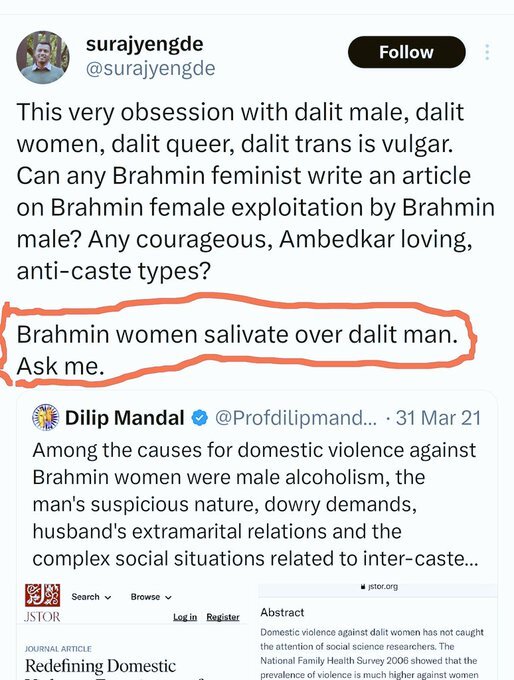
There are many takers of this perversion in academia as well. Ambedkarite activist Suraj Yengde had given a sneak peek into his perverted mindset by claiming, “Brahmin women salivate over Dalit men. Ask me.”

Screengrab of the tweet by Suraj Yengde

A prominent Ambedkarite magazine named ‘Dalit Nation’ had called for the extinction of Brahmins by systematically marrying the women of their community. “If you want to finish brahmins, marry brahmin women. Dalits should marry brahmin women & take them out of their varna. Brahmins will have no women left to marry & breed. They’ll die a natural death & become extinct,” it wrote.

It is clear that the rot runs deep. Bhim Army’s official programmes have called for impregnating women belonging to the Brahmin, Rajput, and Bhumihar communities so that their identity can be erased through childbirth.

Neo-Ambedkarite Lakhshya Lakey, a champion of Jai Bheem-Jai Meem narrative and known for open anti-Brahmin tirade, had DMed influencer Tulip Sharma, “My Brahmin gf sucks me off, problem?” to score brownie points.

This is besides the plethora of songs, widely shared among Ambedkarites, dehumanising women belonging to the General Category and calling for their abduction and rape

What’s disturbing is that the brazen misogyny and objectification of Brahmin women as ‘sex objects to be traded’ by these Ambedkarites had no serious consequences.

Despite these repeated vile remarks (from influencers and bureaucrats to Bhim Army Chief and his supporters), not a single Ambedkarite has been arrested so far.

Due to rabid appeasement and tolerance of their antics for far too long, the situation has now spiralled out of control. Today, the same Ambedkarites are hounding Ajeet Bharti for referencing the ‘mother’ and ‘sister’ of a person who made snide remarks and whose caste identity is unknown.

If Ajeet Bharti has been booked for those words, these perverted Ambedkarites lusting for Brahmin women need to be jailed first.

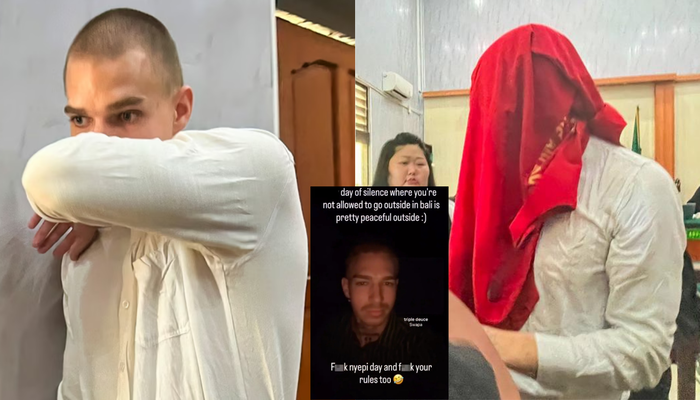
Bali cooks Swiss tourist, sends him to 1 year in jail: How he disrespected Hindu tradition, refused to apologise and said ‘F*uck your rules’ when caught by Senator

A Swiss tourist in Bali learned a hard lesson when he was sentenced to one year in jail for his Hinduphobia, after he insulted a sacred Hindu tradition in Indonesia. The 26-year-old tourist named Luzian Andrin Zgraggen was punished by a Denpasar District Court for violating Indonesia’s new criminal code by insulting a local Hindu tradition.

As per reports, Luzian made a social media post disrespecting the Nyepi or ‘Day of Silence’, which is the Balinese Hindu New Year. He also deliberately violated the curfew observed by locals on the day. He did so despite being informed by the staff of the hotel he was staying in about the local restrictions. This year, Nyepi was observed on 19th March and Luzian was arrested in the same month after his derogatory acts sparked widespread outrage.

During his trial, Luzian apologised before the court and said that he made the video out of frustration because he was hungry and could not find food during the entire day. He further told the court that he did not understand the local rules regarding the restrictions, and regretted his actions. He said that he apologised to the Balinese people for disrespecting their religious traditions. “I deeply regret what I did. I apologise to the Balinese people,” Luzian reportedly said.

However, presiding judge Tjokorda Putra Budi Pastima, unconvinced by Luzian’s apology, said that he had hurt religious feeling the Balinese people and offended them. “The defendant must be held accountable for his actions,” the judge reportedly remarked.

Luzian Andrin Zgraggen has already spent five months in pre-trial detention. The period spent by him in jail will be deducted from his one-year jail term. Meanwhile, Swiss authorities are providing consular access to him.

What was the case?

Nyepi is an annual holiday in Indonesia and is observed as period of complete quietness, fasting, and self-reflection. The island of Bali celebrates the day with complete shutdown of activities across the island, and turning off the lights. A curfew-like situation prevails on the island for the entire 24-hour period. The restrictions relating to Nyepi apply to everyone on the island irrespective of religion, including tourists. Locals store groceries in advance ahead of the day, so that they do not need to step out on the holiday.

However, in a complete disregard for the local Hindu tradition, Luzian openly disrepencted the Hindu tradition and posted multiple clips on Instagram flouting the local rules. He posted a highly offensive message on Instagram about the festival, which read as, “Fuck Nyepi and fuck your rules too”.

He also filmed himself walking to an empty beach describing the scene as “crazy” and posted the clip on Instagram. “I made it to the beach, they didn’t catch me, it is completely dark, there is nobody out here, this s**t is crazy,” he remarked in the clip.

Even after Luzian was arrested by the Balinese authorities, he showed no remorse for his acts and went on to mock the local rules.

Local senator confronted the Swiss tourist

Luzian was confronted by a local senator, Niluh Djelantik, for his acts and remorseless attitude. The senator posted a video of the interaction on social media. In the video the senator can be heard telling him that she would make sure that he is barred an entry into Bali.

“Today you insulted Hindus,” senator Djelantik told him, to which he casually replied that he still “doesn’t like the rule that you can’t go outside.” The senator reminded him that Bali was not his home and that he need not visit it. “So don’t come. Bali is not your home; it is a place that gives you a room in your hotel,” she said.

“That you pay by the night. But Bali is not your home. If you say you think this is unfair, I will make sure you never come to this country ever again. I will make sure of that,” she warned Luzian. “You will never accept that we have this one day, in a year, that we need to be quiet,” she added.

Senator Djelantik warned all foreign tourists that if they violated this rule, they will not only be deported but also be blacklisted and barred from entering Bali.

Realising that he was in serious trouble, the Swiss tourist tried to talk his way out of the situation. He nonchalantly told the senator that he was ready to apologise for his comments in the police station. The senator however, refused to let him get away. He was arrsted and tried by a local court, which sentened him to one year in jail.

Later on, the senator reportedly posted photos of the tourist in handcuffs. Demanding criminal proceedings against him, the senator called for his deportation and a lifetime ban on entering the country. Explaining her stern response to the case, Djelantik said that she did not act out of obligation but to uphold the dignity of Indonesia and it its people.

Tourists faced action in the past for disrespecting Bali’s Hindu culture

Bali authorities have cracked down heavily on tourists who disrespect the island’s Hindu culture. In 2023, the Balinese authorities took legal action against three Russian tourists after they disrespected a local temple. The three tourists were arrested by the Balinese authorities for dancing and posing disrespectfully at the Pengubengan Temple in Besakih.

Bali immigration data for the first four months of 2023 reportedly showed that the island administration deported 96 foreigners during the period for various violations, including disrespect to the local Hindu culture.

In another similar incident, a Russian influencer and her husband faced deportation from Bali in 2022 after they staged a nude photo shoot on a sacred tree in Tabanan district. A month before that a Canadian actor also faced a similar action by the Balinese authorities after a video showing him naked at holy Mount Batur, doing the Haka, went viral.

Bali is the only Hindu-majority island in the Muslim-dominated country of Indonesia. The island has preserved its Hindu culture and traditions and is fiercely protective of them. Bali island is popular tourist destination and its welcome people from across the world. But, at the same time, it values its Hindu culture deeply and does not tolerate any disrespect to them.

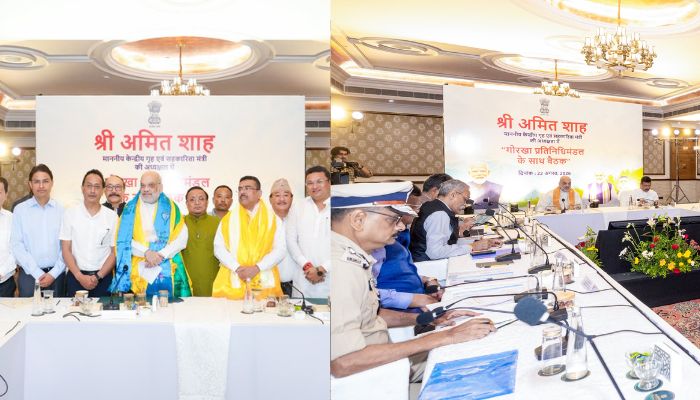
Modi govt forms panel to permanently solve the issue of ‘Gorkhaland’ in West Bengal: Read about the history and the evolution of the political demand

The long-pending Gorkha identity issue in the Darjeeling hills has once again come into focus after Union Home Minister Amit Shah met West Bengal Chief Minister Suvendu Adhikari, Gorkha leaders and other stakeholders in Siliguri on Saturday, 22nd August. The meeting, held at a hotel in Sukna on the final day of Shah’s visit to West Bengal, ended with the Centre announcing a committee to work out the details of an agreement aimed at finding a “permanent political solution” to the concerns of the Gorkha community.

According to the Ministry of Home Affairs, the meeting discussed the major demands of the hill population, including a distinct identity, a permanent political solution and recognition under the Constitution. The Centre said that any solution would be worked out within the constitutional framework. “All issues relating to the hill population of West Bengal were discussed in detail. Their demands about a distinct identity, a permanent political solution and recognition under the Constitution of India were taken up,” the MHA said.

The committee will be headed by Pankaj Kumar Singh, the Centre’s interlocutor for issues concerning the Darjeeling hills, Dooars and Terai. Singh is a retired IPS officer who has also served as Director General of the Border Security Force and Deputy National Security Adviser. He was appointed as the government interlocutor in October 2025 to lead the political dialogue on the long-standing demands of the region.

The MHA said the committee would finalise the modalities and details of the agreement that will be drafted for a permanent political solution. “To finalise modalities, it was decided to form a committee under Shri Pankaj Kumar Singh, former deputy national security advisor and current interlocutor, to finalise the details regarding the final agreement that will be drafted towards a permanent political solution for the people of the hill areas of West Bengal under the Constitution of India,” the ministry said.

Shah also assured the representatives that the Centre would look sympathetically at other demands of the community and said adequate central funding could help address pending issues in the region. The meeting was attended by Gorkha Janmukti Morcha chief Bimal Gurung, senior GJM leader Roshan Giri, Gorkha National Liberation Front chief Mann Ghisingh, BJP MPs Raju Bista and Harshvardhan Singla, BJP MLAs from the hills, state ministers and senior officials.

Roshan Giri said the Gorkha leadership was ready to find a solution through constitutional means. “Union Home Minister Amit Shah has clearly said that whatever solution is reached to address the issue will have to be under the constitutional framework. I am in favour of a constitutional solution and have put forward my suggestions in accordance with that,” he said.

BJP MP Raju Bista called the meeting historic as it took place on the date of the signing of the 1988 Gorkha accord. The accord had ended the violent phase of the Gorkhaland agitation at that time and resulted in the creation of the Darjeeling Gorkha Hill Council. 

The latest move also comes months after the BJP promised to resolve the long-standing Gorkhaland issue within six months of forming the government in West Bengal.

How the Gorkha identity developed in Darjeeling

The roots of the Gorkhaland issue go back much further than the present political movement. The present Darjeeling district was formed in 1866 when Kalimpong was merged into the Darjeeling district. During the Bhutanese regime, Kalimpong was part of the Western Duars, but after the Anglo-Bhutanese War of 1865, Kalimpong was transferred to the Darjeeling district while the Western Duars were attached to Jalpaiguri district in undivided Bengal. Consequently, the Darjeeling district was created using territories ceded by Sikkim and Bhutan.

The hills were home to communities such as Lepchas, Nepalis and Bhutias, while Mech-Rajbanshis were largely found in the Terai plains. Over time, the population of Nepali origin became the majority in the hills. The British administration encouraged Nepali settlement, particularly because of the growing tea plantation economy and the need for labour. The 1901 Census recorded that 61% of Darjeeling’s population belonged to the Nepali community.

The growth of the Nepali-speaking population also helped create a shared cultural identity. Different communities had their own languages and dialects, but interaction in tea gardens, markets and other public spaces helped the development of Khas-Kura or Gorkhali as a common language in the hills. This shared language gradually became an important part of Gorkha identity.

A new Gorkha middle class began to emerge around the 1930s. Organisations such as the Nepali Sahitya Sammelan encouraged people to take pride in their language and culture. In 1934, a social union was also established with the aim of creating greater fraternity among Lepchas, Bhutias and Nepalis and working for the development of hill communities.

At the same time, the identity of the Gorkhas remained complex. The term “Gorkha” was increasingly used as a marker of Indian Nepali identity, even though people belonging to the broader Gorkha community lived both in India and Nepal. This distinction later became important in the political demand for recognition and security of identity in India.

The first political demands

The political organisation of the hill people can be traced back to the early twentieth century. The Hillmen’s Association, formed in 1907, raised demands for maintaining the separate administrative character of the hills. It brought Nepali, Lepcha and Bhutia communities together under the idea that they shared a common hill identity.

The organisation also demanded a separate administrative unit consisting of Darjeeling and parts of the adjoining areas. However, its politics remained closely connected with the colonial administration, and its demand for keeping the hills separate from the plains also reflected linguistic, racial and geographical differences.

After Independence, the political demand gradually changed. The All India Gorkha League became an important organisation representing Gorkha interests. It raised issues such as recognition of the Nepali language, Indian citizenship for Gorkhas and separation of Darjeeling from Bengal. Over the years, different proposals were put forward, including making Darjeeling a separate administrative unit or combining Darjeeling and adjoining areas into a separate province.

The Nepali language movement also achieved an important success when Nepali was recognised as an official language in the Darjeeling hills in 1961. However, the broader demand for political autonomy remained unresolved.

The 1980s: Gorkhaland becomes a mass movement

The demand took a much more aggressive form in the 1980s under Subhash Ghisingh and the Gorkha National Liberation Front (GNLF). Several developments contributed to the revival of the movement. The creation of smaller states in other parts of India and ethnic movements in the Northeast encouraged similar aspirations in Darjeeling. The expulsion of Nepali people from Meghalaya in 1986 also created anxiety among Nepali-speaking people in Darjeeling.

The GNLF turned the demand for a separate state into a major mass movement. Protests, strikes and clashes with the state government became common. The movement increasingly adopted strong ethnic symbols, including the khukri, and attracted large numbers of young people.

The agitation continued for nearly two years and caused widespread disruption. Around 2,000 people were arrested under anti-terror laws, while violence and counter-violence continued. The prolonged shutdowns also affected food supplies, fuel, tourism and the local economy.

Eventually, both sides were pushed towards a settlement. On 22nd August, 1988, the Centre, the West Bengal government and the GNLF signed a tripartite agreement. The accord resulted in the creation of the Darjeeling Gorkha Hill Council (DGHC). Gorkha agreed to drop the demand for a separate Gorkhaland state.

However, the Hill Council could not provide the lasting political and developmental solution that many people in the hills expected. Discontent continued to grow over governance, development and the limited nature of political autonomy.

From DGHC to GTA

The DGHC experiment failed to bring lasting peace or development. The developmental authority transferred to the council suffered from administrative inefficiency and fiscal mismanagement. To pacify rising discontent, Ghisingh demanded Sixth Schedule status under Articles 244(2) and 275(1) of the Constitution. A tripartite agreement was signed between Chief Minister Buddhadeb Bhattacharjee, Union Home Minister Shivraj Patil, and Ghisingh to grant special tribal council status, but the move lacked demographic backing and triggered severe public backlash.

This dissatisfaction, combined with the popular surge of support for hill singer Prashant Tamang in a reality show, created space for Bimal Gurung, a former close associate of Ghisingh, to form the Gorkha Janmukti Morcha (GJM) in 2007. Gurung reignited the demand for full statehood, enforcing indefinite strikes and blockading National Highway 31A, the primary economic lifeline of neighbouring Sikkim.

Unlike previous movements, GJM expanded its Territorial claims to include Siliguri and the entire Duars belt. This created tensions with Bengali and Adivasi communities living in those areas. Protests and counter-protests affected places such as Siliguri, Naxalbari, Bagdogra and parts of the Dooars. Meanwhile, internal hill politics grew increasingly tense, marked by the tragic assassination of AIGL leader Madan Tamang.

Several rounds of talks were held between the Centre, the West Bengal government and GJM, but no agreement on a separate state could be reached. Finally, another political arrangement emerged in 2011 with the creation of the Gorkhaland Territorial Administration, or GTA.

The tripartite agreement was signed on 18th July 2011 in the presence of Union Home Minister P. Chidambaram, West Bengal Chief Minister Mamata Banerjee and Bimal Gurung, creating the Gorkhaland Territorial Administration (GTA). Upon signing, Gurung reiterated that the GTA was merely an interim setup, stating that “our main objective will be achieved in Gorkhaland.” The GTA was intended to provide greater administrative powers to the hills, but it did not end the demand for Gorkhaland.

Why the issue remains complicated

The Gorkhaland question is not simply about the creation of another state. At its core, it combines questions of identity, political representation, development, language, culture and constitutional recognition. Over the years, different groups within the hills have also developed their own demands.

The idea of a single Gorkha identity has increasingly faced challenges from various indigenous communities. Groups such as Rai, Gurung, Bhujel, Thami, Sunuwar, Jogi, Khas, Magar and Newar have sought recognition of their separate ethnic identities and, in some cases, Scheduled Tribe status and development boards.

This has made the political situation in the hills more complex. While the broader Gorkha identity has historically been used to unite different communities, many groups now want their individual cultures, traditions and political interests to be recognised as well.

The latest meeting between Amit Shah, Suvendu Adhikari and Gorkha representatives therefore comes against the background of more than a century of political mobilisation. The Centre’s decision to create a committee under Pankaj Kumar Singh does not itself announce the creation of Gorkhaland. Instead, it begins a new process to work out a “permanent political solution” within the Constitution.

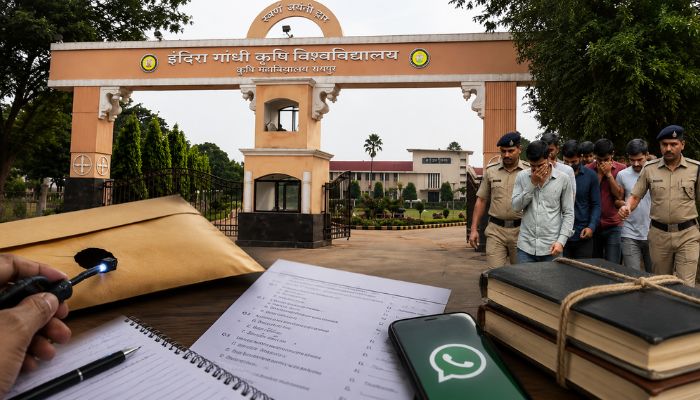
Chhattisgarh Paper Leak: How a Professor used endoscopy camera to copy sealed exam paper

A question paper leak at Indira Gandhi Krishi Vishwavidyalaya (IGKV) in Raipur has turned into a major controversy after police arrested a professor from a private college in Durg and five students in connection with the case. The investigation has revealed a surprising method used to copy the question paper: an endoscopy camera was reportedly inserted through a tiny hole made in a sealed envelope.

The matter came to light on 20th August, when the university’s B.Sc. Agriculture second-year, second-semester entomology examination was being held. The paper, AENT 221 Pest Management in Crops and Stored Grains-I (Rabi Crops), was scheduled from 10 am to 1 pm. The examination was conducted at 34 colleges across Chhattisgarh.

The controversy began after a document circulated on WhatsApp was found to have questions that closely matched the actual examination paper. Initially, the university said it could not confirm whether there had been an internal leak. However, after protests by student groups and a complaint to the police, an investigation was launched.

The university later cancelled the examination and announced that it would be conducted again in the first week of September. While the initial report said nearly 70% of the circulated document matched the actual paper, the police investigation eventually led to the arrest of six people.

Endoscopy camera used to copy the paper

The police investigation has brought out the method used to obtain the question paper before the examination. According to DCP (Crime and Cyber) Smruthik Rajanala, 38-year-old Yogesh Sonkesariya, a professor at Bharti Agriculture College in Durg, received the question paper in a sealed envelope on 17th August.

Instead of opening the envelope, Sonkesariya reportedly made a very small hole at the bottom of it. He then inserted an endoscopic camera through the opening and used it to capture images of the question paper inside.

The question paper was a one-page document, with the entire content printed on one side. After taking the images, the opening in the envelope was covered with glue so that it could appear sealed.

Police said the professor did not simply keep the information for himself. He manually copied 15 questions from the paper and sold them to students. Investigators said the questions were then passed from one student to another before the examination.

According to the police, the investigation also found a link between the professor and students at the same college. Officials said some students paid around ₹12,000 for the questions.

The police have also said that the accused were connected with another examination that was scheduled for 7th August, and that this aspect is being examined as part of the investigation.

How police traced the source

The investigation started after the university received information that questions from the examination paper were circulating before the test. The Agriculture College and Research Centre at Kawardha received an email at around 8.41 am on 20th August claiming that the paper had been leaked. Other university officials received similar information shortly after.

Students and their representatives also contacted the university through WhatsApp and reported that some questions were already in circulation.

Following the complaint, police registered a case against unidentified persons under the Chhattisgarh Public Examination (Prevention of Unfair Means) Act, 2008, and Section 316 of the Bharatiya Nyaya Sanhita, 2023, which deals with criminal breach of trust.

A team of more than 100 police personnel was then formed. It included officers from the Anti-Crime and Cyber Unit, the Crime Branch and Telibandha police station.

Investigators examined the question paper that had gone viral, along with screenshots, photographs, messages and social media posts. These digital clues helped police trace the source to a student in Durg. The investigation then led them to Professor Sonkesariya and the other students.

DCP Rajanala said the police followed the trail from students who had received the copied questions to the professor who had accessed the sealed paper.

BJP government and police take strict action

The paper leak case has also put the focus on the action taken by the BJP-led Chhattisgarh government and the state police. Rather than treating the matter only as an examination irregularity, the authorities moved to investigate it as a criminal case.

The university lodged a formal police complaint after cancelling the examination, allowing the police to investigate whether the paper had been accessed from inside the examination system and identify everyone involved.

The police formed a large investigation team involving specialised cyber and crime units. More than 100 personnel were involved in tracing the source of the leaked questions, checking digital evidence and questioning people connected with the circulation of the paper.

The investigation resulted in the arrest of six people: Professor Yogesh Sonkesariya and five students. Police said the professor had obtained access to the sealed question paper, copied questions using an endoscopic camera and then passed them on for money.

The arrests indicate that the police investigation is not limited to the person who first circulated the questions. The role of the students who received and further shared the material is also being examined.

The case has been registered under the Chhattisgarh Public Examination (Prevention of Unfair Means) Act, 2008, along with the relevant provision of the Bharatiya Nyaya Sanhita. The legal action is aimed at establishing how the paper was accessed, who benefited from it and how widely the questions were circulated.

The police are also looking into the possibility of the accused being involved in another examination paper leak. This could widen the investigation if evidence establishes a similar pattern.

Student protests add pressure

The controversy had already led to protests on the university campus before the arrests were announced. The National Students’ Union of India (NSUI) staged a protest demanding action, while the Akhil Bharatiya Vidyarthi Parishad (ABVP) also protested and submitted a complaint to the university.

Both groups sought cancellation of the examination and a detailed investigation into the matter.

The university eventually cancelled the AENT 221 examination, saying it had been cancelled for administrative reasons, and announced that a fresh examination would be held in the first week of September.

The decision affected students across the university’s affiliated colleges. While the initial account referred to around 500 students at the Raipur examination, the later police account said around 1,500 students enrolled in different IGKV-affiliated colleges were scheduled to take the examination.

Chhattisgarh has faced paper leak cases before

The latest case has also brought attention to previous examination paper leaks in the State. Earlier this year, the Chhattisgarh Board of Secondary Education cancelled the Class 12 Hindi examination held on March 14 after a WhatsApp-based paper leak was confirmed and an FIR was registered.

The issue has also reached the Chhattisgarh High Court in another major examination case. Earlier this month, the court rejected the bail plea of a retired IAS officer arrested by the CBI in connection with alleged corruption in the recruitment process of the CGPSC State Civil Services Examination, 2021. His son, who was also accused in the case, had been selected as a deputy collector.

The High Court had described examination paper leaks as a crime that affects the wider society and observed that their impact goes far beyond the students who appear for an examination.

The IGKV case now adds another chapter to the debate over the security of examination papers in Chhattisgarh. With six arrests, a large police team working on the case and a probe into the possible involvement of the accused in another examination, the focus is now on finding out whether others were involved in obtaining, buying or circulating the questions.

For the students, the immediate result is a cancelled examination and a fresh test in September. For the authorities, the bigger challenge is to ensure that the system used to prepare, transport and store question papers does not become vulnerable to similar attempts in the future.

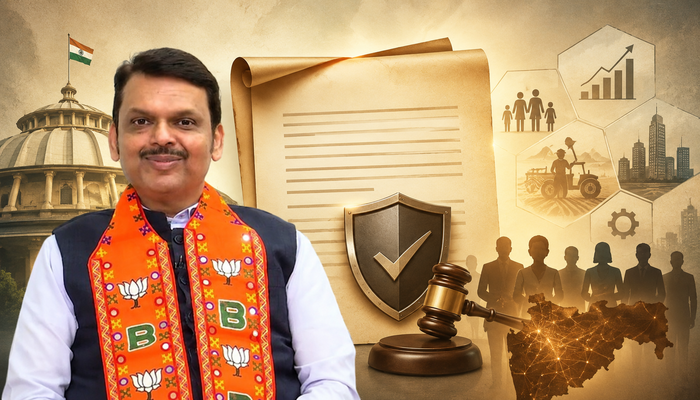
Maharashtra govt releases draft bill for regulating private coaching and tuition industry, invites suggestions from the public: All you need to know

The BJP government in Maharashtra is all set to regulate and improve private coaching and tuition centres in the state for the overall improvement of the level of school education. The Maharashtra government’s School Education Department has released the draft Maharashtra Private Coaching Classes (Registration and Regulation) Act, 2026 on Saturday (22nd August), inviting suggestions and objections from the public till 4th September.

Through the bill, the state government has made a comprehensive attempt to bring the sprawling private coaching and tuition industry in the state under a legal framework. With a rising number of students appearing for various competitive examinations, private coaching centres have emerged as a parallel educational framework not just in Maharashtra but across the country. However, unlike schools and colleges, private coaching centres are unregulated and do not operate under any legal framework. This led the Maharashtra government to come up with a legal solution to fix accountability of coaching and tuition centres towards students.

A framework to ensure students’ safety and well-being

The bill aims “to provide a framework for registration and regulation of private coaching classes; especially in relation to the education imparted, mental well-being of the students and facilities provided to them; and to make provisions for effective redressal of grievances and issues incidental thereto”, as mentioned in its statement of objectives and reasons.

The bill would also regulate who would be able to teach students in coaching and tuition centres. It mandates graduation as the minimum qualification for a teacher in all coaching centres and prohibits coaching centres from hiring any person as a teacher or other staff against whom a cognisable offence has been registered under the IPC or BNS.

To protect young children from being overburdened with the pressure of studies, the bill bars the enrollment of students under 13 years of age in coaching centres. The bill ensures students’ safety by prohibiting coaching classes operating from basements. The bill would also require coaching centres to retain at least a month’s CCTV footage and hold fire and building safety certificates.

For the mental and physical well-being of the students, the bill mandates a weekly off for students and tutors. It restricts daily coaching hours to five hours a day and prohibits scheduling of tests on the day immediately after that weekly off. Additionally, coaching centres would be required to schedule leave around major festivals.

Mandatory registration of coaching centres

Once the bill is passed, coaching centres in the state would not be able to operate without mandatory registration, which will be renewed periodically. Registration will be valid for three years and would be renewable at least three months before expiry. The application for registration would be filed in online mode through a dedicated online portal that the state government is required to build. Besides, coaching centres with multiple branches will have to register each branch separately.

Existing coaching centres would get six months’ time to register through the online portal, and the registration would be valid for three years. Coaching centres would be required to register, regulate their fees and comply with requirements on safety, staffing and student welfare.

The bill prohibits coaching centres from making any misleading advertisements regarding guarantees of ranks, marks, results pr facilities. Centres would have to disclose on their website all necessary information, including the qualifications of teachers, courses offered, duration of courses, and physical facilities and amenities provided in coaching centres.

Ban on ‘dummy school model’

A major highlight of the bill is the explicit prohibition on the “integration” of schools and coaching centres, commonly known as the dummy-school model. Schools found to be in violation may face derecognition.

The bill bars coaching centres from hiring the services of any person or tutor or teacher who has been appointed and is working as a teacher in any approved or recognised school or junior college. Also, a private coaching centre would not be allowed to operate on the premises of any school or college duly approved or recognised by the government.

It defines a ‘coaching centre’ as any centre established, run, or administered by any person or body of persons or institute or a company, other than government-approved schools or educational institutions, to provide coaching to more than 25 students for any study, program or competitive examinations or academic support to students.

Fee transparency and refunds

The bill makes it mandatory for private coaching centres to immediately provide a receipt for full or part payment of the fee in an appropriate format. Besides, coaching centres cannot charge extra fees for prospectus, notes, study material, internal examinations and other related items. All of this would be covered in the course fee. Coaching centres would not be allowed to alter the course fee during the continuation of the course.

If any student who has made full payment of the fee wants to leave the course in the middle of the course duration, the coaching centre will refund the fee for the remaining period of the course on a pro-rata basis, within 10 days. If the student was staying in the hostel of the coaching centre, then the hostel fees and mess fee, etc. shall also be refunded in the same manner.

Grievance redressal

The bill mandates all private coaching centres to formulate a detailed grievance redressal mechanism and publish it on their websites. The grievance redressal mechanism should include details, guidelines and provisions regarding the manner of raising complaints or grievances, and the officer or authority responsible for grievance redressal.

Coaching centres can place complaint boxes within their premises, where students can drop their complaints. For complaints relating to the POCSO Act or the POSH Act, action must be taken within 24-hours from the filing of the complaint.

Inspections and Penalties

The bill grants sweeping powers to Inquiry Officers to be appointed by the government to inquire into complaints raised under the Act. The powers include the right to enter and inspect centres, summon witnesses, examine records, and search premises and seize documents or electronic devices.

The bill categorises violations of provisions contained therein as “major” and “minor”. Major violations include hiring unqualified or ineligible tutors, illegal school tie-ups, or failing to set up a grievance mechanism. Minor violations include exceeding the daily five-hour limit for classes, publishing assessment results, segregating students based on academic performance or failing to provide drinking water.

Major violations under the bill can attract fines between ₹10 lakh and ₹50 lakh, along with suspension or cancellation of registration. Minor violations carry fines of ₹1 lakh to ₹5 lakh, rising to ₹10 lakh for repeat offences.

The curious case of ‘missing’ Bangladeshis in Maldives

A curious pattern has been recently developing in the Maldives, where several people, interestingly from Bangladesh, have either been flagged as immigration fugitives or summoned by the immigration authorities to make an appearance. What makes this particularly intriguing is not merely the fact that they entered the island nation, but the trail they left behind, or rather the absence of one.

The individuals landed in the Republic of Maldives, but there seems to be little to no trace of their whereabouts, triggering the immigration department to act. Their sudden disappearance raises obvious questions about how they managed to penetrate the archipelagic country, their movements thereafter and how they slipped beyond the reach of the authorities.

More strikingly, this is not an isolated phenomenon pertaining to any specific nation. Similar cases have surfaced in other parts of the world, where Bangladeshi intruders have crossed borders and successfully evaded detection, posing a grave challenge for the government to locate or find them for multiple years and even decades. The Maldives is apparently confronting the same menace at this time.

The immigration department has sent out notices either instructing such persons to appear before the authorities or to categorise them as “immigration fugitives.” Some even received multiple such directives after repeatedly failing to comply.

On 20th August, 38-year-old Bangladeshi Rahima Begum was summoned to present herself in person within five days during the department’s working hours from 8:00 am to 4:00 pm. Enforcement & Compliance Division, Maldives Immigration detention centre, Hulhumale Phase 2, was named as the venue. Furthermore, people were also encouraged to provide any information concerning her location by using a designated phone number and the official website.

A similar notice was issued for 44-year-old Bangladeshi man, Mir Ramzan Ali, a day earlier on 19th August.

On 16th August, sex male Bangladeshi nationals, aged between their early 20s and late 30s, were also served with these summons. These included 23-year-olds, MD Abu Thaher and Mujahid Hasan, along with 25-year-old MD Ikbal Hussain, 27-year-old Muhammad Hussain, 29-year-old MD Tajul Miah and 37-year-old MD Sharif Uddin.

They were told to present themselves before the authorities within a span of 5 days during the 8:00 am to 2:00 pm working hours at the Risk Intelligence Section, M. Star Cloud building 10th floor, Majeedhee Magu, Male.

On 9th August, a separate list of Bangladeshi “immigration fugitives” was published by the authorities. The accused ranged in age from their early 30s to their late 40s. They were identified as 32-year-old MD Imran Miah, 39-year-old Billal Hossein, 41-year-old MD Rasel Madbar and 48-year-old MD Anowar Hossen. The authorities had called upon the populace to communicate any information about them at the provided address and website.

On 9th July, a similar public appeal was made for 21-year-old “immigration fugitive” from Bangladesh, MD Fahim.

Notably, a corresponding release was made for Fahim a few days earlier, on 2nd July, together with 25-year-old Bangladeshi MD Naim Hosen. They were “summoned to appear in person within 5 days to Maldives Immigration during working hours, from 8:00 am to 2:00 pm (Risk Intelligence Section, M. Star Cloud building 10th floor, Majeedhee Magu, Male).” The public was similarly instructed to share details regarding their whereabouts.

On 24th June, 42-year-old Bangladeshi citizen Ibrahim Khalil was subject to the same notice by the immigration authorities.

MD Imran Miah, who was labelled an “immigration fugitive” in August, also received a “notice to appear” at the Enforcement & Compliance Division on 11th June.

On 9th June, Abir Hawlader, a 23-year-old from Bangladesh, was pronounced an “immigration fugitive” and the people were told to disclose any relevant details they might have about him.

Of course, other individuals or nationals faced such notices, but Bangladeshi Muslims made up the overwhelming majority.

The problem hits closer to home

The issue also echoes a similar and growing concern in India over illegal immigration from Bangladesh. These people have lived in different regions of the nation for generations, gradually embedding themselves into local communities while acquiring forged identification documents, including Aadhaar cards and voter cards.

They have gained access to government schemes intended exclusively for Indians and, more seriously, participated in elections to decide India’s political future. Over 20 lakh such infiltrators are reported to be in Karnataka alone, a figure that raises profound fears about the possible scale of the problem across India. They have abused the country’s resources, acquired homes and properties and even procured passports using their fabricated identities.

Predictably, “secular parties” have facilitated these actions for vote bank politics, but the entire scenario has also been a result of a great violation of Indian laws by the intruders who obscure their real identities and remain under the radar of the centre and security agencies, much like the situation currently observed in the Maldives.

The severity of the matter was further brought to light during the nationwide Special Intensive Revision (SIR) of the electoral roll, which revealed the role played by Bangladeshi illegals in India’s democratic exercise.

In fact, the detect, delete and deport of the newly elected Bharatiya Janata Party (BJP) government in West Bengal exposed how they had been comfortably staying in the country for several years, pretending to be Indians and were eventually pushed to return to their homeland.

Moreover, this does not mark the end of the difficulties posed by these intruders, who also occupy vast expanses of government property, such as national parks, forests and agricultural areas, to build their unauthorised colonies. Hence, the state governments have to initiate eviction drives to safeguard both the economy and the environment from such encroachments. Moreover, these Bangladeshi intruders have deep involvement in criminal activities, creating a law and order crisis for both citizens and officials.

Conclusion

The point of the matter is that no country can afford to let illegal immigrants enter and reside within its territory with impunity, irrespective of their religion. India is often criticised for protecting its borders and taking action against intruders, but such an influx needs to be regulated as it can create challenges that no government can afford to overlook.

Furthermore, the matter is about individuals entering a country and then defying the system and regulations. This has been a persistent problem in India, especially in cases involving infiltrators from Bangladesh, and the events in the Maldives offer another reminder of the difficulties that can emerge when the laws are circumvented.

Unsurprisingly, no law-abiding citizen would engage in such actions, raising concerns that these persons could be potential threats to law and order as well as internal and external security in addition to placing an additional burden on the country’s economy and resources.

Whether it is India, the Maldives or even the United States of America, every country wants to secure its borders, national security and interests. The mounting problem of illegal immigration from Bangladesh has emerged as a prominent challenge for both New Delhi and now Male as well.