Home Blog Page 1916

Gujarat ATS arrests 3 ‘highly radicalised’ youths from West Bengal with links to Al Qaeda

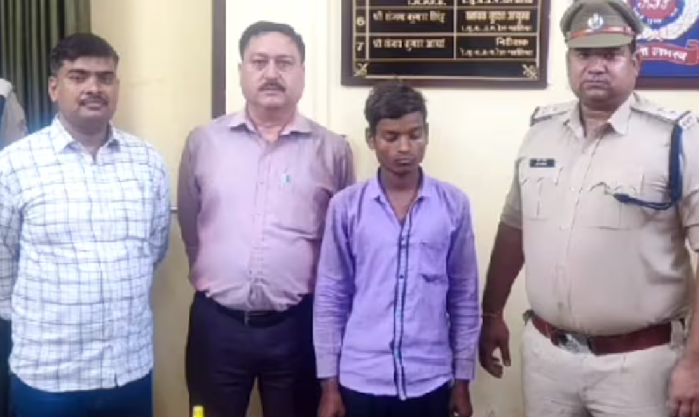
On Tuesday, the 1st of August, the Gujarat Anti-Terrorism Squad (ATS) busted the terror network of Al Quaeda and arrested three highly radicalised men from Rajkot. The security agency also recovered a weapon from their possession. The arrested accused have been identified as Abdul Shukur, Aman Malik, and Saif Nawaz. The Police officials stated that the three accused hail from West Bengal. 

According to the officials, the terror suspects worked in the jewellery industry and had been under surveillance for some time. They were allegedly running the Al Qaeda terror network in Gujarat. 

Speaking with The Indian Express, a senior ATS officer said, “The three accused are highly radicalised individuals. We recovered a semi-automatic pistol, 10 cartridges, and radical literature from their possession.” The ATS officials asserted that the accused were planning some terror-related activity. 

The officials said, “The suspects were also in touch with foreign handlers. They had acquired a pistol and ten rounds of ammunition. We suspect that they were planning to commit some terror-related activity.” 

The three accused were in touch with operatives of the Jamaat-ul-Mujahideen Bangladesh (JMB), a banned terrorist organisation with links to Al Qaeda, officials said. JMB is a terrorist organisation banned in Bangladesh, India, and other countries.

The officials stated that the three accused were allegedly involved in the radicalisation of youth and recruiting people through the Internet to join their terror network in Gujarat.

The ATS is currently interrogating all three terror suspects. Later, they will be taken to Ahmedabad where the ATS will produce them before the court and seek their remand. 

The arrests are part of an ongoing probe by ATS in connection with four Bangladesh nationals who illegally entered the country. According to a statement by ATS, it was alleged that the four accused were trying to radicalise local youth in Ahmedabad and collecting money.

Gujarat’s ATS crackdown against Illegal Bangladeshi and Al-Qaeda terror module

On 11 July, the Gujarat ATS and Surat Crime Branch jointly launched an operation to arrest a Bangladeshi national in Surat. 

The arrested accused allegedly had links with Al-Qaeda. The preliminary investigation revealed that the arrested suspect was a member of a different Al-Qaeda module than the suspects detained on May 21 in Ahmedabad. 

However, the handler of the accused arrested in May and those arrested in July were the same. According to reports, the accused were guided by handlers named Shariful Islam and Shayba.

Meos of Mewat: Anti-Hindu crimes amid a rising Muslim majority population. Know why it is called ‘mini Pakistan’

Violence was unleashed by a Muslim mob on 31 July 2023, Monday, in Nuh, Haryana as they attacked a religious Hindu procession on Shravan Somvar. 5 people including two home guards were killed in the violence and at least 50 others including policemen & deputy superintendent of police (DSP) were injured.

OpIndia spoke to Nuh police and found that the two home guards who were killed were trapped when the Islamist mob went on a rampage. Initial probe reveals that one home guard was shot and the other died in stone pelting.

Thousands of Hindus sought shelter in nearby temples of Nuh to save themselves from the Islamist mob which went on a rampage setting vehicles alight. In response to the attack on Jalabhishek Yatra, workers of Vishwa Hindu Parishad (VHP) also retaliated by pelting stones back at the assailants.

Haryana Nuh VHP violence
Vehicles were torched and stones pelted on VHP rally in Haryana’s Nuh (Image Source: India.com)

The Hindus who sought shelter in the Nalhar temple have been rescued and were escorted home as police filed FIRs to launch an investigation.

Several videos went viral online showing the extent of damage before the administration restricted internet services and imposed Section 144 in the area. The videos showed a hostile mob charging at the rally with threatening chants of “Allahu Akbar”.

Temples were also desecrated while smoke could be seen billowing showing the extent of damage in videos recorded by the residents living at a distance from the scene of the incident.

The Vishwa Hindu Parishad (VHP) has stated that the violence was planned. Several videos of planned attacks by Islamists doing rounds on social media confirm this allegation, which is not the first in this region. Mewat is notorious for a variety of crimes reported extensively by OpIndia. Its history has branded it as a ‘mini Pakistan’ in neighboring areas.

Mewat – A mini Pakistan

Nuh is a district in the Muslim-majority Mewat region, known as the “homeland of Meo Muslims”. Out of its 1.09 million population, Muslims account for 79.20% (862,647) of the population whereas the Hindu minority accounts for 20.37% (221,846), according to the 2011 census.

In the Punahana tehsil of Mewat, Muslims make up 87% of the population, and 85% in Ferozepur Jhirka tehsils. In Nuh, the district currently in the news after the attack on a Hindu procession, Muslims make up more than 76% of the population. And the numbers are only rising at an alarming rate.

Five tehsils of the Mewat region that fall in Haryana comprised more than a million Muslims in 2011. Their population share rose from 62% in 1971 to 75% in recent years. The report published by the Centre for Policy Studies reads, “From the data, it is clear that the Muslims of Mewat have numerically flourished in the period following Independence. And, they seem to be in the process of establishing an exclusively Muslim pocket in the near future.”

The district, carved out of Faridabad and Gurgaon in 2005, is also the land of origin of the Tablighi Jamaat in 1926, a community that has grown parallel to a surging crime rate. The Tablighi Jamaat was founded in Mewat by Maulana Muhammad Ilyas with the aim to suppress and challenge Hindu values by converting to and propagating Islam across Indian villages. Naturally, Hindus often fall prey to the notorious majority.

A committee headed by former Justice Pawan Kumar in 2020 investigated cases of Muslim atrocities in the region. Based on the findings, the committee chair likened Mewat to Pakistan and said that the district is becoming a “graveyard of Dalits”.

The committee found that owing to the fear of Islamists, only 19 out of 48 Dalit victims could muster the courage to file complaints. Statistics released by the Haryana government also corroborate the committee’s findings. In 2021, only 19 crimes against SCs were registered.

The findings of the team revealed that the molestation of girls and women has become pervasive all over Mewat which has been hindering girls from continuing their studies. The report revealed that more than two hundred instances of forced conversion have come to light. Because of the lack of action by the authorities, families are under pressure to be converted.

The communally charged atmosphere of Mewat is not recent. It is a virus that has been infecting Mewat gradually over decades. According to this report, in 2010, the official number of some of the crimes was thus; 21 cases of murder, 32 cases of rape, 33 kidnappings, and 241 bike thefts.

But this is only a fraction of the factors that make Mewat a mini Pakistan. In September 2018, the National Investigation Agency (NIA) busted a hawala module and arrested 3 terrorists associated with Falah-e-Insaniyat Foundation, an organisation run by Hafiz Saeed’s Lashkar-e-Taiba.

The accused were identified as Mohammad Salman, Mohammad Salim, and Sajjad Abdul Wani. Interestingly, Salman was a resident of Uttawar village in Mewat. A month later, it came to light that the Khulafa-e-Rashideen mosque in the same village was built with funds received from the terrorist organization Lashkar-e-Taiba. 

This hotbed of crime is witnessing more and more crimes against Hindus, and the violence on 31st July has exposed what can be a sinister and organized anti-Hindu crime campaign.

From cybercrime, cattle-smuggling to crimes against women and Hindus, here is a list of cases reported by OpIndia showing just how deep the rot runs.

26 October 2020: Nikita Tomar brutally murdered in broad daylight

A terrifying incident of attempted love jihad and forced conversion of non-Muslims into Islam came to the fore with the blood-curdling murder of a 21-year-old student named Nikita Tomar in Mewat. She was shot dead in broad daylight by two men outside the Aggarwal College in Ballabgarh, Faridabad.

Screengrab of the incident (L) and Screen Grab (R) (Photo Credits: Twitter/ Raj Shekhar Jha)

One of the two assailants, Tauseef had been repeatedly harassing her and making advances at Nikita. She had filed a complaint of molestation and harassment against Tauseef earlier. The shocking incident was caught on camera, visuals of which had gone instantly viral in the aftermath of the brutal killing.

The murder sparked massive furor across the country. The prime accused of Tomar’s murder, Touseef, belonged to Mewat.

25 July 2023: Muslim mob threatens to attack police

On Tuesday, 25 July 2023, a mobster identified as Jabir Ghatmika from Mewat issued open threats to the police in a video. In this approximately 3-minute-long viral video, Ghatmika can be seen provoking the Muslim mob urging them to assault police personnel over the alleged custodial death of a Shekul Khan.

“I am telling the public. If the CIA police enter a village without information, if they are not from your local police station, then break their hands and legs. Cut them apart. Because there is a section for self-defense. Tell me, Sir, how do we know if there are goons? Are there any stars? Is there anything written on their forehead? Are they here to protect us? Because they themselves have become terrorists, my brothers”, the Islamist warned.

27 April 2023: Cybercriminals raided

Haryana Police conducted multiple raids in the Nuh district as part of its massive crackdown against cyber criminals. 102 police teams comprising over 5,000 personnel raided 14 villages in Nuh and apprehended 125 cybercriminals or hackers. Due to the increase in “sextortion” cases and online fraud, the Nuh region in Haryana has become a hotbed for cybercrime.

2 November 2022: Minor raped by Sajid, 32

An 11-year-old minor Hindu girl was raped by 32-year-old Sajid for six months. At first, he lured her with food and raped her. He then threatened her as he continued the sexual abuse. The victim was six months pregnant when Sajid was caught.

10 September 2022: Mining mafia attacks police team

Two months after the murder of Nuh DSP Surendra Singh Bishnoi, the mining mafia attacked a joint team of police, the local Mining Department, and the Regional Transport Authority (RTA) during a raid at an illegal mining site in Haryana’s Nuh district. During the raid at an illegal mining site near Nuh, the team was attacked by unidentified individuals.

5 September 2022: Missing minor’s body recovered in Madrasa

The dead body of an 11-year-old boy was recovered from a madrasa in Shah Chokha village in Punhana sub-division in Nuh district of Haryana.

Haryana
Crowd at madarsa where the body of 11-year-old was found on September 5 (Image: ANI)

The boy had left his house on 3rd September to offer prayers at the madrassa but did not return home that night. Following a search, the child’s body was found buried in sand inside the premises of the madrasa.

19 July 2022: DSP murdered by mining mafia’

Haryana DSP Taoru Surendra Singh Bishnoi was run over by the mining mafia and killed in Panchaon near Nuh in Mewat region of Haryana. As per reports, DSP Bishnoi had gone for a surprise inspection of a site where illegal mining was taking place.

However, the mining mafia ran the dumper over him and killed him. The primary accused in the Nuh DSP killing, Shabir alias Mittar, was caught on July 20 during an encounter with the Haryana Police.

6 July 2022: Mewat man offers Rs 2 crores to slit Nupur Sharma’s tongue

An Islamist in Mewat declared that he will give Rs 2 crores to any person who slits Nupur Sharma’s tongue. The incident took place days after the Supreme Court judges said that Nupur Sharma’s ‘loose’ tongue is responsible for the communal disharmony in the country and Kanhaiya Lal’s brutal murder by Islamists in Udaipur.

Nupur Sharma (Image: FGN)

In a viral video, the Islamist said, “I am giving this on behalf of the whole Mewat. If somebody slits Nupur Sharma’s tongue and brings it to me, the offer is Rs. 2 crores for the one who does so. Rs 2 crores. I will give it on behalf of the whole Mewat. And if you slit her tongue, you journalist, I will give you Rs. 2 crores. You get this offer.”

A large number of Rohingyas sheltered by Nuh Muslims

The Muslim-majority Nuh is also infamous for harboring a large number of Rohingya Muslims who have been provided shelter by the locals. Most of the Rohingyas took shelter in Haryana after they were removed from Delhi, where they were living earlier.

Rohingya Muslims settle in Haryana
Representational Image (via AFP/ Cek Mad)

There are reportedly 600-700 Rohingya families currently settled in the state. Around 2 thousand Rohingyas are said to be living in Mewat district alone. Most of the Rohingyas living in Haryana are reportedly settled in Mewat (Nuh), Faridabad, Gurugram, Palwal, and Yamunanagar districts.

Other districts in the state also have Rohingya Muslims but it is difficult to trace them since most of them have forged IDs like Aadhar cards, Ration cards, and voter cards.

Mewat Region: hotbed of criminal elements

To think that the rapidly changing demographics in Nuh are only limited to the district is to build a roadmap for jihadists to sneak into surrounding pockets impacting the larger demography of the state of Haryana and even beyond in a few years. This impact can be seen already in the pattern of crimes that appear to have spilled over from Mewat into the adjoining areas that include Gurugram, Ferozepur Jhirka, Palwal, Faridabad, Rewari, and parts of adjoining Alwar and Bharatpur districts of Rajasthan.

Even the national capital is bearing the brunt of the Mewati gangs operating in its backyard.

Here are some of the recent cases of crime reported from these regions and why investigative research should be launched into the geographic and demographic pattern of these crimes.

26 July 2023: Girl gang-raped by four men

In Haryana’s Palwal, a girl was abducted by Akram and Mansaad who stuffed a cloth in her mouth and took her to a location in the forest. Two more men were present there. The four youths gang-raped the girl, who was later found lying unconscious in the field.

The family has said that they fear for their life and that the accused, who they claimed are local goons, could harm them (the family).

19 July 2023: Seven men assault mother-daughter duo

Nasir, Rashid, Majru, Samsu, Jahoor, Tasneem, and Taufeek harassed a woman and her daughter in Palwar last month. The seven accused, armed with sticks and axe, barged into the house of a man while he was away for work and attempted to force themselves on the mother-daughter duo.

21 May 2023: Mohammed Ikhlash entraps Dehradun woman

Palwal-based Mohammed Ikhlash posed as Manoj and trapped a Hindu woman from Dehradun in Uttarakhand. The victim met Ikhlash online in 2019. He identified himself as Manoj and told her that he was studying at GD Goenka University in Gurugram. He trapped the woman, blackmailed her to have physical relations with him, and extorted money from her, until one day the victim learned of his real name Ikhlash. He was arrested from his hometown in Hathin in Palwal.

30 June 2022: Hindu man stabbed by a mob led by Anjum and Bilal

A Hindu man named Vicky Bharadwaj was attacked by Anjum and Bilal with a sharp weapon in Haryana’s Palwal district. The miscreants brutally stabbed Vicky and tore his chest open. The two accused were accompanied by 5-6 persons.

“Anjum stabbed me in my chest and I collapsed on the street. Some people came to help me after my friends screamed for help. Anjum threatened me to kill some other time again and he ran away from the spot”, Vicky said.

18 October 2022: Mewati gang kingpin arrested in Delhi

A Kingpin of the Mewati gang named Zalaluddin was arrested for cyber fraud. He was a wanted criminal in several cases of cybercrime and cheating across Delhi, Kurukshetra Ambala, and other states. Zalaluddin was running a gang cheating innocent people.

The cops conducted a technical and manual surveillance raid in Ferozepur Jhirka, a district bordering Mewat in Haryana.

27 November 2021: Mewat man travels 50km to Gurugram to offer Namaz in public

Amidst peaceful protests staged by the Hindu community against offering Namaz at public places in Gurugram in Haryana, a Muslim man had confessed to travelling 50 km from Mewat to the protest site to offer Namaz on the streets.

Gurugram: Man confesses to traveling 50 kms to offer namaz on road
Visuals from Gurugram protest site (Photo Credits: Twitter/Swati Goel Sharma)

“This is Sector 10 of Gurugram. I am coming here (every Friday) for the past 10 years,” the man named Khalid informed. Local residents were also outraging against biased coverage of the peaceful Gurugram protests against the offering of Namaz on the streets.

Here is a list of crimes emanating from Mewat and crimes that have been exported and/or spilled over into other regions, sometimes adjoining areas, and sometimes other states.

Contribution of the ecosystem and the works

Being a Muslim-majority region has its own perks in a leftist liberal ecosystem. Going by their logic, if crime statistics in a Muslim-majority area are alarming then poverty, lack of development, ignorance etc etc are to be blamed. One is expected to feel sorry for the Mewat Islamists for the rampant crimes they commit and supply to the surrounding regions. Take for example this bunch of reports to understand just how strong the fence is to protect even the criminal so long as it is a certain ‘minority’.

24 December 2021: Islamist media gives communal colour to peaceful Hindu rally

Meer Faisal, a multimedia “journalist” with Islamist outfit Maktoob Media, took to Twitter to post a host of videos about a Bajrang Dal rally in Mewat to fear monger about Hindus outfits trying to create a “communal divide” between Hindus and Muslims of the area. After the videos, he shared an article by Maktoob Media that essentially said that Muslims of Mewat, popularly known as Mini Pakistan because of the rapes, abductions, Jihadi violence, and forced conversions of Hindu women, were living in eternal fear of Hindu outfits.

Meer Faisal stated in his Twitter thread that on the 12th of December, Bajrang Dal member Jeet Vashisht took to Facebook to post videos of a saffron rally in Nuh, the Muslim-majority area in Mewat. He said that Jai Shree Ram slogans were raised in front of Muslim households and that the rally was carried out with over 500 cars filled with “Hindutva supporters” who had entered the area to saffronize Mewat.

This narrative was being spun even as Jeet Vashishth received several threats.

28 June 2021: SC dismisses plea seeking protection for Hindus from Muslims in Mewat

The Supreme Court of India dismissedpetition seeking protection of Hindus from the dominant Muslim community in the Nuh district (Mewat) of Haryana.

As per reports, the petition was filed by a group of lawyers and activists through advocate Vishnu Shankar Jain. It read, “A number of Hindus have been forcibly converted to Islam and a number of Hindu women and minor girls have been abducted and raped. The Hindu women are not safe at all. The Muslims at a large number have committed atrocities on members of Schedule caste.”

The petitioners highlighted that the local police, the district administration, and the State government have failed to exercise their power in upholding the life and liberty of the Hindu community. The petition stated that the Hindu population in Nuh had declined from 20% (in 2011) to 10-11% now while the Muslim population has increased under the patronage of Tablighi Jammat.

29 October 2021: Muslim groups mobilise mob from Nuh

Muslim groups called more people from Nuh and Pataudi for ‘support’ against a peaceful protest called by Hindus against the offering of Namaz in public places in Gurugram.

29 April 2019: Cong neta plays religion card in Mewat

A Congress leader, Zahida Khan, while asking for Rohingya-affected Mewat region in Rajasthan, urged the Gujjars and the Muslims to come together to vote especially if they could ‘come together to rob’.

The controversial statement was given in Kaman, Rajasthan where Khan said, “If Mewat backs a candidate, then 36 communities back that candidate. The way I have been welcomed here I am hopeful that if God willing, Abhijit will become the MP here. But do give him more votes than you’d give me. For five years you supported but when it came to casting vote, you displayed your Gujjar identity. This time I request with folded hands to not repeat this mistake.”

15 October 2018: Mosque built with LeT money

The National Investigation Agency revealed that the Khulafa-e-Rashideen mosque in the Uttawar village of Palwal, Haryana has been built with funds received from terrorist organization Lashkar-e-Taiba.

According to reports, a team of NIA officials visited the mosque in Uttawar village in Haryana on October 3. NIA searched the documents and bank account details related to the mosque. The team had reportedly confiscated the fund registers and several financial documents in the mosque.

Courtesy: Hindu Janjagruti Samiti

The situation is so visibly grim that the Meo Muslims, combined with Rohingyas, combined with Tablighi Jamaat, combined with the left-liberal ecosystem, combined with appeasement politics consider themselves strong enough to openly attack a peaceful minority Hindu rally.

These are the same Mewatis who were all packed and ready to leave India for the Islamic Banana Republic of Pakistan in 1947 until that fateful day when Gandhi convinced them to stay back. And to think that on 15 August 2023, India will mark its 76th Independence day.

Faux pas: Congress uses image of poorly constructed road from the UPA era to shame the Modi government

On Monday (July 31), the official Twitter handle of the Congress party committed a faux pas after it posted a picture of an UPA-era road to shame the incumbent Modi government at the Centre.

In a tweet (archive), it wrote, “The truth is far from false promises (jumla).” The Twitter handle shared three images, with the captions ‘How India should be’, ‘How India is’ and ‘How PM Modi portrays it.’

In its desperate bid to target the Modi government, the Congress party attached a picture of a poorly constructed road that dated back to the UPA era. The image featured a crater-sized pothole in the middle of the road with a truck stuck under it. It was accompanied by the caption ‘How India is’.

Screengrab of the tweet by Congress party

The grand-old party suggested that Indian roads, under the Modi government, were in poor condition and thus unfit for commutation. The disturbing image of potholes, in the middle of the road, was added to portray misrule and mismanagement by the Centre under the current political dispensation.

Interestingly, the image used for making such an insinuation has been around for over a decade. A quick Google reverse image search led us to a blog named ‘Cute Pictures Gallery.’ The image, bearing the watermark of ‘My India pictures,’ was uploaded on September 24, 2012.

Another WordPress blog named ‘Ashwin Sharma’ also posted the same image in November 2012.

Screengrab of the image

In October 2019, the French international news agency AFP conducted a fact-check and determined that the image was indeed from India. The electric poles on both sides had advertisements in Hindi, with one written as ‘Gemini Circus.’

AFP also noted that the images have been on the internet since 2012. Interestingly, the Modi government came to power at the Centre only in May 2014 i.e. 2 years after the image had first made it to the sites mentioned above. At that time, the Congress-led UPA government was in power.

While the grand-old party wanted to taunt the BJP government over the condition of roads, it was left embarrassed after people realised that the pictures were taken during the UPA era. Despite the misleading character of the images, the official handle of Congress did not bother to delete the tweet or cite an apology.

Delhi: Irshad Mumtaz Khan held for abducting a minor girl from Bihar’s Sewree

0

A 23-year-old individual identified as Irshad Mumtaz Khan from Bihar has been arrested from Delhi for kidnapping a 17-year-old girl from Sewree.

The incident happened on July 23 when the girl left her house unannounced at about four in the afternoon. After two days of waiting in the hopes that she would return voluntarily, the parents decided to file a case of kidnapping against an unidentified person on July 25.

The cops started looking since it was most important to track down the minor. Police looked into the victim’s parents’ mobile phones, her house number, and the numbers of her friends; call data records (CDR) of all these numbers were gathered. The cops began looking into a certain number after noticing that the victim called it regularly.

The same man had taken the girl to Delhi by rail on the day she vanished, according to reports and CCTV footage. After that, a team was sent to Delhi, where they started the search operation alongside the local police stations.

Due to the suspect’s continuous moves, the police were unable to track down his specific location even though they had the suspect’s tower position. “We obtained his current CDR with the help of our technical team and found his most contacted number and the location of the same. During this we understood that the suspect was working at a bag factory, a little away from the main town,” said an official.

The accused was then nabbed by the police with the help of the local police. After the arrest, Khan confessed to the case.

Both, the accused and the girl were taken to Sewree police station in Delhi after they were presented at a municipal court. The accused was taken into custody on kidnapping allegations while the girl was returned to her parents.

Islamists accuse 2 Hindus of burning a Gurugram under-construction mosque, Hindus say they were on their way from Nuh after Islamists unleashed violence

On 31st July, almost 4000 Hindus participated in a Jalabhishek Yatra by Vishwa Hindu Parishad. The religious procession came under attack by an Islamist mob in Nuh, Haryana. While Hindus were trapped in a hostage-like situation, news emerged that two home guards have been killed in the violence unleashed by Islamists during the Jalabhishek Yatra on a Shravan Somvar, the auspicious Monday of the Sravan month. 

The police told OpIndia that one of the home guards was killed in the stone pelting by Islamists while the other was shot dead when the violence by Islamists was unleashed. 

Speaking to OpIndia, VHP also informed that several temples had come under attack in the Nuh area of Mewat after the Islamists unleashed premeditated violence against Hindus. 

VHP also said that the violence was planned and that the stones and bricks had been collected by the Islamists at least 2 days in advance. OpIndia was told that they were using Bajrang Dal activist ‘Monu Manesar’ as an excuse to spread fake news and incite violence. Interestingly, almost on cue, several Islamists on Twitter started sharing an old video of Monu Manesar alias Mohit Yadav, claiming that he was present at the Shobha Yatra and therefore, the violence erupted. This, however, turned out to be false. 

OpIndia did a detailed fact-check confirming that the video was from last year and that Monu Manesar was not present at the religious procession. 

After spreading fake news and defending the violence that Islamists unleashed against thousands of Hindus, the Islamists on social media started alleging that two Hindus, VHP workers, were responsible for burning an under-construction, disputed mosque in Gurugram hours after the Nuh violence had been unleashed against Hindus. According to reports, a “mosque” was allegedly burnt down on the night of 31st July in Sushant Lok Phase-III in Sector 57 of Gurugram. Identified as the Anjuman Imam Masjid, it was reportedly attacked by a group of 70-80 people. During the incident, the imam of the ‘mosque’ was allegedly killed while another person was injured. They were later rushed to the hospital.

There were several social media accounts that alleged that two Hindus called Amit Hindu and Praveen Hindustani were responsible for burning the mosque.

OpIndia reached out to both the individuals who were being named by these Muslim handles as the accused who had allegedly burnt the mosque down. Talking to OpIndia, Amit Hindu said that he and Praveen Hindustani were a part of the religious procession that came under Islamist attack in Nuh. He said that they only reached Gurugram by 2-2:30 AM on Tuesday morning under the protection of the police, after they were rescued from Nue, Mewat.

Amit Hindi said that they were returning from the Mandir at 1 AM when they were attacked with stones, petrol bombs and gun fire. After that, they had taken shelter in the mountainous area. Post which, they had reached Gurugram at 2 AM – 2:30 AM under the protection of the police. He alleged that the Islamists are trying to frame them because they work extensively on the ground for the protection of Hindus. They save Hindu girls from love jihad when they get a call from the family, they work extensively in trying to protect cows and are also on call when Hindus are in duress. He believes this is why the Muslims are trying to frame him and paint a target on his back.

While speaking to OpIndia, he also demanded that the Haryana police investigate and book the culprits who were spreading fake news and painting a target on Praveen and his back. He said that because of this fake news, there could be more unrest in the city.

Speaking about the violence at Nuh, Amit told OpIndia that he was attacked and had hurt his knee. He also said that red chilli was thrown into his eyes. Further in the conversation, Amit said that he did not know who had burnt down the Mosque and he sees a dangerous conspiracy in the burning of the mosque. He also says that he suspects the Hindus involved in the religious procession had nothing to do with it.

Interestingly, according to sources, 5 individuals have been arrested in the case of mosque burning in Gurugram, none of them are Amit Hindu and Praveen Hindustani. We were also told that there could be an angle of personal enmity between the people who have been arrested and the Imam of the mosque. All angles are being investigated and strict action will be taken against the culprits.

Remembering Lokmanya Bal Gangadhar Tilak on his death anniversary, the greatest freedom fighter

Lokmanya Bal Gangadhar Tilak, a prominent Indian political leader, a modern commentator on the Bhagvad Gita, an expert in ancient Indian scriptures, and a great Indian freedom fighter.

Tilak was born in Ratnagiri on 23rd July 1856, and his original name was Keshav, but he later became known as Bal. His ancestral village was Chikhali, now in the Ratnagiri district. His father, Gangadharpant, and mother, Parvatibai, faced financial difficulties, which led Tilak’s father to leave their native place to work as a schoolteacher. Bal Gangadhar Tilak completed his traditional Sanskrit studies at home. In 1866, due to a transfer of his father’s job, the family moved to Pune, where Tilak’s mother passed away shortly after their arrival. While living in Pune, Tilak matriculated in 1872.

Humble Beginnings of Tilak

Gangadhar Pant passed away in 1872. To support his children’s education, Gangadhar Pant Tilak managed to save some money and therefore Bal Gangadhar Tilak enrolled at Deccan College, in Pune. In his first year of college, he focused on maintaining and earning good health by exercising regularly. This was of great use to him later in his political life and especially during his imprisonment years. In 1876 he passed his B.A. in the first class. However, he could not become an MA. He eventually earned the degree of LLB.

In Deccan College, Tilak and Gopal Ganesh Agarkar developed a strong friendship and made a resolution to contribute to the country’s welfare. Around this time, Vishnushastri Chiplunkar, a renowned essayist, decided to quit his government job to start a school, and both Tilak and Agarkar joined him. On 1st January 1880, they established the New English School, with Tilak voluntarily becoming an unpaid teacher.

Starting Public Life and Activism with Journalism

Later, in 1881, Chiplunkar, Tilak, and Agarkar founded two newspapers, Kesari in Marathi and Maratha in English. Initially, Agarkar was the editor of Kesari, while Tilak held that position for Maratha. Through these newspapers, they began their historic work of promoting public education, raising political awareness, and fighting against governmental injustices imposed by British Rule.

Some of their articles, especially criticising the policies of the British government and the administration of Diwan Madhavarao Barve of Kolhapur State, gained widespread recognition. They strongly criticised his mismanagement and the attitude of the British government towards Chhatrapati Shivaji. Tilak and Agarkar were sentenced to four months in jail and lodged in Dongri jail. They were released on October 26, 1882.

More Work in the Field of Education

In 1882, Vishnushastri Chiplunkar passed away, but in 1884, with the help of friends like Wadarburn, Wordsworth, Mandlik, Telang, Dandekar, YM Kelkar, RG Bhandarkar, and others, Tilak and Agarkar established the Deccan Education Society. In 1885, they founded Ferguson College as part of this society. Tilak taught subjects like Mathematics and Sanskrit there. However, later on, differences arose between Tilak and Agarkar regarding the management principles of the institution.

Tilak believed that the institution’s financial management should be based on “salary based on needs” or “salary as per financial capacity,” and it should run as a self-sufficient organization, whereas Agarkar advocated for relying on government aid for running the institution.

The Great Debate Tilak and Agarkar

Another debate between this duo was centred around the question of whether the focus should be on social reforms or political reforms. Agarkar considered social reforms important and preferred social reforms to improve the country or freedom. Tilak’s position was that as long as the pride of freedom or nationality is bright and awake, no matter what the social structure is, its faults do not come in the way of the progress or prosperity of the nation.

Tilak acknowledged the importance of social progress, but he argued that without political progress and a sense of nationalism, society’s issues couldn’t be effectively resolved. He believed that the true spirit or soul of the nation lies in its sense of pride, enthusiasm, and commitment to nationalism. He saw this spirit as the driving force behind social reforms as well.

However, Agarkar’s stand was the exact opposite. He argued that the country would not be eligible for freedom without social reform, so first, it should be freed from the shackles of society’s customs, ignorance, superstitions, ideas of sin, and caste discrimination and these evils should be eliminated. Agarkar believed that foreign governments should make appropriate laws for reform, regardless of public opinion.

Tilak would, on the other hand, contend, “We will do our reforms, foreign power or governments should not interfere in our social or religious affairs. However, if public opinion is favourable and there is a compromise on the scriptures, then we have no objection to making such a law.”

Both Tilak and Agarkar played crucial roles in society, but their approaches differed. While Agarkar focused on social reforms as a necessary step towards independence, Tilak emphasised the importance of nationalism and political progress to fuel social reforms.

Lokmanya Tilak and Hindu Nationalism

Tilak was as proud of Hinduism as the nation. Dharma was his subject of interest. He studied the Vedas, Upanishads, philosophy, the scriptures, and the Geeta and Shankaracharya’s commentaries. He believed that Hindutva is the essence of one’s selfhood. He used to say that anyone who is not proud of Hindutva or Hinduism or his Hindu identity has no right to tell the Hindu people what social reforms they should undertake.

In a society where the caste system and religious beliefs from the Vedas and other scriptures were prevalent, debates and discussions on such topics were common. Tilak also played a significant role in these religious matters, driven by his deep faith in Hinduism and nationalism.

In simpler terms, Tilak emphasised the importance of Hinduism and Hindu pride in bringing about social reforms. He believed that without a strong sense of Hindu identity and pride, people wouldn’t be motivated to work towards the betterment of Hindu society.

Tilak’s brief stint in social work became the foundation of political endeavours in future

Tilak’s work in the early years of 1890-97, after leaving the Deccan Education Society, was diverse. During this period, the following cases arose: (1) the Law of the Consent Age, (2) the Gramanya case, (3) Pandita Ramabai’s Sharda Sadan, (4) the Hindu-Muslim riots, (5) public social work, etc.

In all these cases, his role was that of a political man and a desire to act for the objective of Swaraj was his primary notion underlying all his activities. Tilak started by critically analysing and commenting on the flaws and injustices of the British government through his newspapers and publications. He became the first person to handle legal matters in this regard with utmost integrity. He actively participated in the Provincial Council and Congress activities, gradually transforming himself into a nationalist leader who inspired people with a strong sense of patriotism and love for freedom. He constantly engaged in a relentless struggle against the narrow-minded policies of the British government and made efforts to instil the spirit of nationalism and freedom in the hearts of the people.

He had to constantly fight against the moderate group within the Congress party that was doing politics through mere applications and requests rather than an assertion of rights. Moderates would often contend that ‘British power being active in India is a part of our destiny and the best policy is to rely on the goodwill of the liberal British who will gradually accept India’s political rights’. On the other hand, Bal Gangadhar Tilak would assert that leaving this submissive stance and taking people to the position that ‘Swarajya is my birthright and I will get it’ is his resolve. He effectively worked to awaken the people with brilliant articles in Kesari and Maratha as well as on occasion intense speeches. Let us now see the contribution and roles played by Tilak in various issues during this period one by one.

Law of the Consent Age

Tilak led the anti-law party in the uproar that prevailed across India over the law of consent age for marital relationships. Tilak espoused the idea that reform should be done, but it should not be done by government law, rather it should first come from within the community through a proper understanding of the issue. The controversy involved the complexity of theology, so Dr Bhandarkar wrote an article supporting the law. At that time, Tilak strongly countered it.

Even though Tilak started a movement against the law, he was thinking of setting up an institution to implement some reforms. Some fundamental reforms were also discussed by the organisation. These discussions took place about issues like Girls should not be married before sixteen years and boys should not be married under twenty years, no one should give dowry to anyone, heads of the widows should not be shaved, etc.

This confirms that Bal Gangadhar Tilak was not against social reforms. He was willing to see a Hindu society where no evil practices prevail. But he essentially wanted those things to come from community education and discussions rather than by imposing a law through a colonial establishment.

The Sharda Sadan Controversy

Pandita Ramabai had set up Sharda Sadan for women’s education. Pandita Ramabai was originally a Hindu but later became a Christian. Tilak believed that the institution was not actually aimed at the intellectual, educational, and practical advancement of adult girls or widows, but was primarily aimed at spreading Christianity.

She began seeking help from Christian missionary organisations and enlisted the help of Christians. During this, two girls from Sharda Sadan converted to Christianity. At that time, Tilak heavily criticised this evangelist activity running in the guise of education. As a result, Pandita Ramabai left Pune and continued her work on women’s education in Kedgaon. It is notable that Daund Taluka shares a border with the Ahilyanagar (formerly Ahmednagar) district of Maharashtra. Today this district leads the chart of the Christian population in the state.

The Hindu-Muslim Riots

Hindu-Muslim riots occurred in many places in 1893. Tilak proposed that the causes of the riots would not be known unless we realised that there were not only two parties in this conflict, but that the government was a third party. He criticised the government’s biased policy as contributing to the riots.

It was only after these riots that the idea of making Ganpati Utsav and Shiv Jayanti public festivals appeared. These festivals were made public gatherings as a means of public awareness. In two issues of Kesari on September 18, 1894, and April 15, 1896, respectively, Tilak explained the purpose of these festivals: to create national awareness, to increase the aspirations of freedom, to remember great men and to make the common people aware of religion and culture.

Tilak guided farmers to ask for their rights

Pune Sarvajanik Sabha was a club of elite social activists in Pune. It was dominated by people inclined towards moderate thoughts. In 1895, Bal Gangadhar Tilak decisively defeated that clout and took control of the society in his hands. Through this society, he initiated the works for drought relief.

During the drought of 1896, he told the farmers that if the crop was low, then the waiver was their right, so they should ask for it. According to the government’s policy, people should ask for help as the government is responsible to take care of the people, he asserted.

Tilak laid ideological grounds for armed revolution

The famine was followed by the plague. At that time, when the British officers under Commissioner Rand, appointed for the prevention of plague, made a ruckus and bullied Indians, Tilak strongly criticised it. He set up cheap ration shops and opened public hospitals for the epidemic victims.

Rand was murdered by the Chaphekar brothers on June 22, 1897. Lokmanya Tilak’s fierce criticism of the British Rule was an inspiration for them. At that time, the British government unleashed endless atrocities in Pune. Tilak wrote sharp and pointed articles against it one after another. His editorials were characterised by fierce headlines. ‘To rule is not revenge’, and ‘Is the head of the government in place?’ are must to mention here.

As a result, Tilak was charged with sedition and sentenced to eighteen months in prison. “He’s a great scholar, so it’s not good to punish him,” Max Mueller told the government. As a result, the government reduced his sentence by six months and he was released from prison on September 6, 1898. It should also be noted that it was Lokmanya Tilak who recommended Veer Savarkar’s name to Shyamji Krishna Varma to get a scholarship for him to get higher studies in the UK.

Bal Gangadhar Tilak corrected the course of the Congress

Tilak’s real political career and his prime leadership in freedom struggle for the rest of his life gained momentum only after 1899. At that time Tilak had returned from the punishment of sedition and his popularity had increased. Despite jail sentence, his goals were not changed in the slightest, as is evident from his editorial article in Kesari titled ‘पुनश्च हरिः ॐ !’ written on July 4, 1899.

He criticised Lord Curzon’s tenure, especially the restrictions on the educational institutions he imposed. Moreover, he strongly attacked the policy of colonialism, and in his editorial, he said that England was undergoing moral and intellectual decline. It was at this time that he offered new ideas about the functioning of the National Congress. He believed that the strength of the whole nation should be put behind the demands of the Congress by building a massive movement among the people.

The partition of Bengal

Lord Curzon declared the partition of Bengal on 20 July 1905. There was outrage all over the country and violent protests broke out. Tilak supported the movement in Bengal. He championed the four pillars of the movement namely Swadeshi, Boycott, Nationalist Education and Self-government. The first three were activities taken up by people while the fourth was the demand put before the British government with a fearless approach. Use Made in India things, Boycott foreign manufactured things, impart a Nationalistic Education through dedicated schools started by patriots, and keep pursuing the demands of Self-government through parliamentary affairs was the agenda.

The rift between the extremists and the moderates

As the anti-Partition movement became more and more aggressive, the National Congress members differed over the programmes of moderates and extremists. Swadeshi, boycott, etc. were principally accepted by the Calcutta session of the Congress. However, the Congress session held in 1907 in Surat saw violent dispute between the members themselves.

Tilak had objected to the election of the president itself, which caused a ruckus. Tilak was standing firm still amid that ruckus, even though he was attacked sticks and shoes were thrown at him. The police later seized the pandal. Tilak was against reducing the intensity of the anti-partition movement by any means. And he did not let the moementum go in the hands of moderates who were relying more on collaborating with British rule rather than openly opposing and criticising their policies.

Another sedition case landed Tilak into Mandale

Soon after this split in the Congress, on June 24, 1908, Tilak was again arrested in Mumbai on charges of sedition and he was tried in the court. The reason for this was the editorial articles he wrote in the Kesari with headlines – ‘the misfortune of the country’ and ‘these measures are not sustainable’ on May 12, 1908 and June 9, 1908 respectively. There were seven Englishmen and two Indians on the jury panel. The jury found him guilty by a vote of seven versus two, and the court sentenced him to six years of jail at Mandalay in Myanmar and a fine of Rs 1000 was also imposed. Tilak’s bold statement after the sentencing is memorable and

Tilak said, “I maintain that I am innocent. There are higher powers that rule the destiny of things and it may be the will of Providence that the cause which I represent is to prosper more by my suffering than by my remaining free.” A marble plaque still exists outside room no 46 of Bombay High Court with Tilak’s words etched on it. Court room no 46 has been kept preserved and is not used for regular hearings but used only on special occasions and events.

Tilak was kept in Mandalay jail in Burma for punishment. Two important events took place in Tilak’s life while he was in Mandalay jail. During this captivity, he wrote his famous book, ‘Geeta Rahasya’, while his wife Satyabhamabai died in Pune in 1912. He was released by the government on June 15, 1914, after six years in prison.

The Home rule League

In 1915, Tilak wrote four articles on the subject of Hindi Swarajya Sangh and explained what kind of polity and government would be desirable in India. On May 1, 1916, he founded the Home Rule League or Hindi Swarajya Sangh in Belgaum. It was only in 1915 that Annie Besant founded the Home Rule League in Madras. The movement of Home Rule was jointly run by Tilak and Benzat. In March 1918, he went to England with a delegation from the Home Rule League. Before that, he rejoined the Congress in 1916 during the annual Congress session held in Lucknow.

When Tilak was in England, the Rowlatt Act was promulgated and the Jallianwala Bagh massacre took place when people were protestig against this act as appealed by MK Gandhi. “I am sorry that I was not with you during Gandhi’s Satyagraha, and the terrible events that followed,” Tilak said as soon as he landed in Mumbai.

Lokmanya Tilak became the Father of the Indian Unrest

Tilak had filed a defamation suit in a London court against Sir Valentine Chirol for publishing defamatory content against Tilak in his book ‘Indian Unrest’ in 1915. In February 1919, its verdict went against Tilak. Tilak suffered a great loss in this case, but it was this book that introduced Tilak’s glorious title of ‘the Father of the Indian Unrest’.

On the occasion of Tilak’s 60th birthday a grand ceremony was held in June 1916 in Pune and a sum of one lakh rupees was offered to him. Announcing that all that money will be used for national causes, he said, “Our motherland is appealing to all of us to join this movement. Let us all contribute our lives for the national cause without any discrimination as we hear this call of the motherland.”

Leaving the Congress again

Lokmanya Tilak was among the first few mass leaders who realised that with less inclusion of and importance given to the people with a staunch nationalistic attitude and pride for the Indian civilisation and culture, Congress remains a useless platform for the work of a national cause. Afterall, it was not started by an Indian but a British officer AO Hume.

With the intention of deploying political reforms at the will of the Indians themselves – rather than depending upon the mercy of the British rulers or being a collaborator with them like what Congress did later – Lokmanya Tilak founded the Democratic Swarajya Party. The party’s manifesto was published on April 20, 1920. This declaration is a historical document. It mentions the principles of India’s equal place along with Great Britain in the Empire, the establishment of world peace, freedom from commercial plunder, etc. He had shown it to MK Gandhi before publishing the manifesto and Gandhi had agreed to it.

Social Service beyond politics and varied topics of interest of Lokmanya Tilak

In addition to political work, Tilak’s various social activities were going on. After the Surat Congress, he started the movement for prohibition of liquor. He also wrote an article on it and gave many lectures against alcoholism. The movement went so far as to actual deterrence on ground. Tilak raised millions of rupees for social welfare through an activity called ‘Paisa Fund’. Almanac research was ingrained in him at an early age. He later published it in a more scientific way through his independent ‘Panchanga’.

Tilak was always thinking about the industrial progress of his country and he used to discuss on occasion what businesses could be taken up with a little capital. Instilling industrious entrepreneurial attitude among the youths was his motive. The idea of improving the Marathi script alphabets for the printing purpose was there in Tilak’s mind for many years. He also actually experimented with it in 1904. Later, while in England, his efforts were successful and many improvements were made to the Marathi typeset accordingly.

Literary contribution of Lokmanya Tilak

Tilak wrote most of his Marathi articles from Kesari. Apart from Kesari, Tilak wrote some writings in his English newspaper Maratha. Tilak had a deep study of Sanskrit and English literature. His favourite subject was Indian philosophy. He also studied Western philosophy. The best reflection of his broader interest can be seen in the ‘Geeta Rahasya’.

While tilak was working in the political field, sometimes in jail and at other times he got a little rest, during which time he wrote some books. Most of his writings are research-oriented, and in each book he expresses some independent opinions. His major works are Geeta Rahasya, Orion, Arctic Home in the Vedas and Vedang Jyotish.

In the Mandalay jail, Lokmanya Tilak wrote ‘Geeta Rahasya’ in the winter of 1910-11 and published it in 1915. This book is a commentary on the Geeta and is essentially focussed on the ‘Karma Yoga’. In its initial parts, Tilak has explained the understanding of the Geeta he had by observing only the Geeta separately putting all commentaries and criticisms aside. According to him, Geeta promotes Pravrutti – which means proactive nature in a person and provokes the possibilities of great activities hidden within; rather than inspiring Nivrutti – which means a retiree attitude of giving up actions.

‘Orion’ is one of his dissertations. He prepared it for the Oriental Conference in London in 1892. It dealt with the subject of ascertaining the time of the Vedas. Tilak was of the opinion that ‘since Max Müller had decided the time of the Vedas on linguistic research, it was not correct and this method of research was one-sided’. Therefore, he combined all the references to astrology in divine scriptures, linguistics, various samhitas and Brahmanas of Vedas and determined the time of the Vedas as 4500 BC with the mathematical calculations of this astrology. The book has been praised by Western Orientalist scholars Jacobi and Bloomfield.

Arctic Home in the Vedas is also a research thesis of Tilak and he came up with the idea in 1898 when Tilak was in jail in Yerawada. In this book, he has tried to propose that the origin of the Aryans must be somewhere in the region of the North Pole, and this he deduced mainly on the basis of the verses of the Vedas.

The End of the Tilak Era

Lokmanya Tilak’s name was suggested by Pandit Malviya as the president of the historic Congress session which was then to be held in Calcutta, but before that Tilak died in the Sardar Grih in Mumbai following a few days of illness. He had diabetes for 15 years. In the last few days, malaria fever and overwork had led him to an unrecoverable fatigue. At the time of his death, he was survived by his sons, daughters and other relatives, as well as NC Kelkar, Dr Sathe, Dr Deshmukh, KP Khadilkar and other friends were also present there.

The news of Tilak’s death spread in Mumbai and across the country. The whole country was plunged into a sea of sorrow. Tilak gave the freedom movement the supreme and authentic acceptance of people from all walks of life. He was truly a leader accepted by people – not imposed by some colonial legacy or political dynasty. Lokmanya literally means accepted by people. Therefore, the Tilak era is considered to be a very important phase in the history of modern India.

References Used: Old Archieves of Kesari quoted in various biographies of Lokmanya Tilak, Lokmanya Tilak in the Makers of India Series by (Sahitya Akademi), Lokmanya Tilak by Bharatiya Prakashan Nagpur, and articles on Lokmanya Tilak, Gopal Ganesh Agarkar, Pandita Ramabai, Vishnushastri Chiplunkar etc. in the Marathi Encyclopedia published by the Government of Maharashtra.

Rajasthan: Nasiruddin, Rashid, and Mushtaq among 7 arrested for assaulting a woman for allegedly being a BJP supporter

A disturbing video from Rajasthan’s Jaipur is going viral on social media in which a mob can be seen thrashing a woman while police officials are trying to save her from getting lynched. The mentally challenged woman, who belongs to the Muslim community, was attacked by co-religionists allegedly for some slogans she wrote on her house.

The incident reportedly took place ten days ago, however, the video of the assault on the woman surfaced recently. The attempted lynching occurred on 21 July in Kalyan Nagar, located in Malpura Gate Police Station area. 

On the day of the incident, an angry mob gathered outside the house of the woman. Threatened for her life, the woman locked herself in her house. But the Islamist mob forcibly entered the woman’s house and broke the house gate. Later, they broke down the door of the room on the upper floor and started brutally assaulting the woman. 

They dragged her out by pulling her hair and clothes and threw her into the mud. On receiving the information, Police reached the spot. 

After an hour or so, Constable Dholi Bai posted at Malpura Gate police station and other police personnel saved the 40-year-old woman from getting lynched. 

Constable Dholi Bai said information was received that a woman has locked herself in a house in Kalyan Nagar. A crowd of about 100 to 150 people has gathered outside her house and is trying to kill her. Subsequently, she along with Harlal and SI Anil reached the spot.

She added that there we saw that a mob had gathered outside a house. There some people were trying to break the gate of the house by climbing on the second floor. In no time, they broke the gate of the house and started beating the woman. Police personnel also went inside with the mob, but they were outnumbered and overpowered by the mob and they forcefully dragged the woman out.

After dragging the woman out of her home, the mob continued to thrash her in the presence of police personnel. Constable Dholi Bai added that the mob also pushed and tried to attack the police personnel. But they held the woman and tried to protect her while the mob kept thrashing the woman for about an hour. 

When more help arrived, they successfully rescued the woman from the mob and sent her to the hospital.  

According to the Police officials, the woman is mentally challenged and it is alleged that she had written some objectionable things on her house walls which hurt the sentiments of the local residents. 

Muslim woman targeted by co-religionist for writing pro-BJP slogans

On the basis of the complaint of the woman’s husband Sahadat Ali, Police filed a case of assault. The police stated that in the wake of Muharram, they didn’t arrest the accused back then. However, on the basis of the video footage of that day, they arrested seven accused who were part of the mob on Sunday, 30 July, ten days after the incident took place. 

Malpura Gate station in-charge Satish Kumar said that the arrested accused include Kalyan Nagar residents Nasiruddin, Rashid, Mustaq, Irfan Khan, Ejaz Khan, Ikram Deshwali, and Kalamuddin.

Navbharat Times reported that the Muslim woman was attacked by the Islamist mob because she is a BJP supporter and the alleged objectionable things were Pro-BJP slogans. The report added that the Muslim woman is a BJP supporter. She drew a lotus flower on the wall of her house and wrote some slogans in support of the BJP. This allegedly infuriated her co-religionists and it culminated in the attempted lynching. 


However, Times Now reported that the mob alleged that the woman had allegedly burnt pages of the Quran which led to the violent assault.

ED raids Hero MotoCorp chief Pawan Munjal’s residence in connection with Revenue Intelligence case

0

On Tuesday, August 1, the Enforcement Directorate raided Hero MotoCorp’s chairman and Chief Executive Officer (CEO) Pawan Munjal’s residence and other locations linked to him in Gurugram. As per reports, around 12 locations are being raided by the central agency’s officials.

In a statement to the news agency ANI, ED said, “The searches are being conducted at Hero Group chief Pawan Munjal’s residence and many other locations after taking cognisance of a Directorate of Revenue Intelligence (DRI) case.”

Recently, the Directorate of Revenue Intelligence (DRI) apprehended a close aide of Munjal in possession of undeclared foreign currency. PTI quoted unnamed sources in ED that the raid at locations linked to Munjal was part of a money laundering probe.

IT raid at Hero MotoCorp in March last year

In March 2022, the Income Tax department raided 40 premises, including Hero MotoCorp officers and the chairman’s residence, as part of a tax evasion investigation.

In a statement, the company said, “Officials from the Income Tax Department visited two of our offices in Delhi and Gurugram and the residence of our Chairman and CEO Pawan Munjal on Wednesday. We have been informed that this is a routine inquiry, which is not uncommon before the end of the financial year.”

During the investigation, the IT department found bogus expenses worth Rs 1,000 crores. Furthermore, it was reported that property worth Rs 100 crores was bought was Pawan Munjal to save taxes. It was believed he used black money to buy those properties.

‘Masjid’ allegedly burnt down in Gurugram after Islamist violence was a disputed structure, construction was put on hold by courts: Details

Amid the violence unleashed by Islamists in the Nuh district of Haryana, a ‘mosque’ was allegedly set ablaze on Monday (July 31) night in Sushant Lok Phase-III in Sector 57 of Gurugram.

Identified as the Anjuman Imam Masjid, it was reportedly attacked by a group of 70-80 people. During the incident, the imam of the ‘mosque’ was allegedly killed while another person was injured. They were later rushed to the hospital.

While speaking about the matter, police commissioner Kala Ramachandran informed, “The attackers have been identified by the police and following raids conducted throughout the night, several of the attackers have been rounded up. Security around places of worship has been tightened.”

It has now come to light that the said masjid is a disputed structure, the construction of which was stopped by the courts on several occasions. As per reports, the Anjuman Jama Masjid is built on ‘government-allocated land’ in the New Gurugram area.

According to the Chairman of the Haryana Anjuman Charitable Trust, Aslam Khan, the Om Prakash Chautala-led-Haryana government allocated the land for the ‘mosque’ in 2002.

He claimed, “In 2002, the Government allocated land for 17 temples, two gurdwaras, one church and one mosque. Though one mosque is not enough in view of the growing population of Muslims, the stay on construction has added to our woes.”

The construction of the ‘mosque’ began in 2004 but it came to a halt within 6 months. According to the Sushant Lok Extension Residents Welfare Association, the land was originally earmarked for the construction of a police station as per the demand of the local residents.

However, the land was later allotted to the Haryana Anjuman Charitable Trust in Gurgram and converted into a religious place by allowing a change of land use.

Several petitions, including Public Interest Litigations (PILs) were filed over the years to stop the construction of the ‘mosque’, including one by the Malibu Towne Residents Welfare Association and a resident of Malibu Towne named Mukesh Bhanont.

Punjab and Haryana High Court directed regulatory mechanism for mosque, SC ordered status quo maintenance

A Division Bench of the Punjab and Haryana High Court however held that “since the mosque is in an area which is predominantly residential in character, it would be wise for the authorities to ensure that no nuisance is caused to the residents of the area by the devotees and that a proper regulatory mechanism is established to eliminate traffic and noise pollution etc.

In an order on June 6, 2012, the Supreme Court ordered the maintenance of the status quo. Given the matter was sub-judice in 2013, a 2-Judge Bench of Justice Satish Kumar Mittal and Justice Amol Rattan Singh refused to entertain petitions that objected to the change in land use.

The matter is yet to be decided by the apex Court. As such, the construction of the disputed structure had been stopped half-way. In pictures taken from the site, iron rods could be seen protruding from unplastered pillars. A board at the entrance reads, “Anjuman Jama Masjid”, although the matter is still stuck in court.

Demands for additional 5 mosques turned down by BJP government in 2016

Vice-President of the Haryana Anjuman Charitable Trust, Mohammad Abul told The Hindu, ” In 2013, the construction for the ground and the first floor began after we won the case in the High Court. But the opposite party moved the Supreme Court and the construction was stayed yet again.”

“This time we did not even find time to remove the shuttering for the ongoing construction. The construction was immediately stopped and the trust ended up paying lakhs for the shuttering,” he said.

The disputed structure serves as the place of congregation for the Muslim community during Juma Namaz, with more than 1500 people use the site for prayer. Demands for the allocation of areas for an additional 5 mosques in Gurugram were turned down by the BJP-led-Haryana government in 2016.

Violence in Nuh

On Monday (July 31), tensions gripped several parts of Haryana when stones were pelted at the Jalabhishek Shobha yatra in the Muslim-majority region of Mewat. The procession was taken out to mark the auspicious occasion of Shravan Somwar.

In several videos of the clashes, a mob charging in a hostile way at the yatris ccould be heard raising “Allahu Akbar” and indulging in riotous activities.  Two home guards were killed and about a dozen policemen injured as a mob in Haryana’s Nuh district tried to stop a Vishva Hindu Parishad procession, pelting stones and setting cars on fire, police said.

To stop the spread of misinformation and rumours, internet services were suspended in the region. Following the violence at Nuh, VHP president, Alok Kumar issued a video statement urging the police and administration to quickly rescue the devotees stuck at several locations including Nuh temples, chowk, and near the police station. He stressed that the yatra is an annual affair and this year it was targeted in a pre-planned and organised attack

Meanwhile, the Union government deployed 20 companies (about 2000 personnel) of Central Armed Police Forces (CAPF) to bring the law and order situation under control. It is worth noting that Haryana’s Mewat has been under the spotlight for the last few years for the increase in terror activities, cow smuggling, and forced conversions.

Media peddles communal angle in Jaipur-Mumbai train shooting case, but Chetan Singh had demanded early release citing illness: What the FIR says

On July 31, a 33-year-old Railway Police Force constable identified as Chetan Singh was arrested by the police after he fired 12 rounds of his service rifle killing his senior and three other passengers on the Jaipur-Mumbai Express. Singh was not well and wanted some hours free from duty but his seniors didn’t allow him and asked him to complete his duty instead. In a fit of rage, Singh is said to have fired on the train killing his senior ASI Tikaram Meena and 3 other passengers.

According to the initial reports, Singh was arrested when he tried to flee from the train in the Dahisar region of Mumbai. While the police and the FIR mention no actual reason for the firing, the incident is being given a communal turn after the Indian Express reported that the passengers identified as Asgar Abbas Ali (48), Abdul Kadar Mohamed Hussain Bhanpurwala (64) and one another were killed following a spat that took a communal turn.

The Indian Express also said that it had obtained a video in which Singh could be allegedly heard saying that “… Pakistan se operate hue ye, aur media yehi coverage dikha rahi hai, unko sab pata chal raha hai ye kya kar rahe hain. inke aaqa hai wahan… Agar vote dena hai, agar Hindustan mein rehna hai to mai kehta hoon Modi aur Yogi, ye do hain, aur aapke Thackarey”.

The authenticity of the viral video cannot be established: Western Railways

The Railway authorities commented on the video and said that the authenticity of the video could not be established and that it was quite possible that the video was a morphed product. “Its location and authenticity cannot be established. It can also be morphed. The matter is under investigation,” Sumit Thakur, the spokesman for Western Railway, was quoted as saying by the Indian Express.

In spite of the official statement, Islamists and leftists furthered the video and claimed that Singh had killed the passengers following a fight over two communities. Islamists, leftists Twitter users and several other leftist media channels based their say on an anonymous ‘source’ from Western Railways who told the Indian Express that a fight had allegedly broken out following an argument over communities.

Leftists, and Islamists further the incident as ‘hate crime’

Alt News Co-founder Mohammed Zubair raised the issue on social media and indicated that Singh had killed the passengers over a community issue. He further tried to give a communal angle to the incident even as the police is still investigating the case.

Later the Alt News co-founder also happened to delete some of his tweets.

Following Zubair, several other leftist liberals posted the video whose authenticity could not be established by the authorities and claimed that Singh was no less than a ‘terrorist’. “Don’t call him mentally unstable and be insensitive to the entire cause of ‘mental illness’. He calculated his moves, and identified his prey. Took the names of the people he worships. He is a terrorist! That too in the uniform! Stop the whataboutery. Chetan Singh is a specimen of many more radicalised minds unleashed amongst us. Scary hell!” tweeted Radio Mirchi RJ Sayema.

Author and ‘journalist’ Sagarika Ghosh, who is infamous for peddling fake news of semen-filled balloons hurled at women on Holi, also furthered the claim that the incident was a ‘hate crime’ though neither the police nor the FIR copy has mentioned any specific reason behind the firing imposed by Singh.

The Wire’s ‘journalist’ Arfa Khanum Sherwani indicated that the youth of India was radicalised by the ruling government and that it was a fact to worry about. “4 murders by RPF Constable Chetan Singh on a moving train using his official rifle is an act of terror by a man in uniform. Radicalization project is complete and India is at a point of no return We should be worried, very worried,” Sherwani tweeted.

Print ‘journalist’ Swati Chaturvedi said, “Communal clashes in NCR, spreading to the millennium city of Gurugram, RPF constable, Chetan Singh kills four rants about “Modi & Yogi” join the dots who have radicalised New India? The pliable panna pramukhs who do Hindu vs Muslim daily. Takeaway Your money and gated community won’t keep you safe GGN.”

Some of the anti-Modi and anti-India global media channels like Al Jazeera also reported the news claiming that Singh had fired the Muslim passengers after they engaged in a fight over communities. Basing its report on one of the ‘sources’ of the Indian Express, the global media report indicated that this was the result of the hate that has been allegedly spread all over the nation by the ruling government in India.

Political parties also call it deliberate targeting

Further political parties like the Indian National Congress and the AIMIM also called the incident a hate crime and claimed that the passengers were deliberately targeted by Chetan Singh who has now been arrested by the police. “The cold-blooded murders carried out by an RPF constable is the result of a hyper-charged and highly polarised news media and social media atmosphere. The genie of hate is now out of the bottle and it will take a lot of collective effort to put it back in,” Congress’ Jairam Ramesh said.

“It is being said that the terrorist of Mumbai Express who killed 4 innocent people was mentally ill. If saying that “If you want to live in India, vote for Modi, Yogi or Thackeray” is a sign of mental illness, then don’t know how many people of Watan-e-Aziz are patients. If he was mentally ill then why was he put on duty? If someone had taken my name even after being caught in a minor crime, I would have been crucified by now,” tweeted AIMIM chief Asaduddin Owaisi.

Western Railways denies the angle of argument over communities

While it suits the narrative of left-leaning propagandists and opposition political parties to brand the incident as a ‘hate crime’, it is worth noting that Western Railways has denied the claims that the firing took place after an argument over communities. The Railways has also hinted that the video that is doing the rounds on the internet could have been edited and morphed.

“Its location and authenticity cannot be established. It can also be morphed. The matter is under investigation,” Sumit Thakur, spokesman for Western Railway, said in a statement to the Indian Express.

Also, GRP Commissioner Ravindra Shisve commented on the issue and said that the police are yet to ascertain the motive of the killing. The Railway officers meanwhile also said that the accused officer was hot-headed and that he had some mental health issues. “Apparently he is known to be hot-headed. But then we found no such instance in his record of the past five years. His record has been clean and that’s why I posted him in Mumbai when he requested six months ago,” P C Sinha, Principal Chief Security Commissioner of Western Railway was quoted as saying.

Refusing any angle of argument in the incident, Sinha further said, “He had a short fuse. He was quite hot-headed. There was no altercation. He just lost his temper and shot his senior, then fired at whoever he saw.” The officers further say that the investigation in the case is at a premature stage and that a high-level committee has been constituted to conduct an inquiry into the incident.

Here’s what actually happened on July 31 as per the FIR

Team OpIndia accessed the FIR in the case and learned that 33-year-old Chetan Singh was not feeling well and had informed the same to his colleagues. He wanted some hours free from his ongoing duty but was suggested by his seniors to rest after finishing the duty hours. As per the FIR filed by another RPF constable Amey Acharya, Singh continued to say that he was unwell and that would get off the train at Valsad station.

But his senior, ASI Tikaram Meena contacted the Mumbai Central Control and complained about Singh. The Control then asked Singh to stay calm and finish off his pending duty of three hours. Meena then asked the Acharya to get some cold beverages for Singh but the accused RPF officer refused to have any.

“I had gone to see ASI Meena as I wanted to submit my work report. On reaching his bogey ASI told me that Chetan Singh was not well and that he wanted the rest of his work hours off. I touched Singh to check but I could not gauge whether he had a fever. Singh did not agree as ASI insisted he completes his duty,” Acharya said in the FIR.

He then added that ASI asked him to take Singh’s rifle and allow him to take rest for some time. However, Singh could not sleep for more than 15 minutes. “I was seated next to him while he was resting but after 10 to 15 minutes he suddenly got up and forcefully took the rifle from me. As I was not ready to give the rifle, he even tried to strangle me,” the FIR read.

Later, Acharya realized that Singh had accidentally exchanged his rifle so he along with other RPF men chased Singh. “Even while returning my rifle and taking possession of his own rifle, I saw that Singh was very furious. Meena was still trying to explain to him but Singh kept arguing. Even I intervened in between and tried to make him understand to stay calm, but he was not listening to either of us. So I decided to go away from there,” Acharya’s police statement read.

The firing happened but the reason is unknown, mentions FIR

Meanwhile, Acharya also noticed that Singh had removed the safety catch of his rifle and that he suspected that he was in the position to fire. Acharya informed ASI about the same and left as Singh was not ready to listen to anyone. “After half an hour one of the RPF officers called me from the office and informed me that ASI Meena had been shot. I ran to the bogey in which ASI Meena was sitting. Later I saw Singh with rifle and he was still furious. I asked passengers to be safe and informed the control room. Singh moved with the rifle and continued to fire the train,” the FIR read.

FIR copy obtained by OpIndia

Notably, the FIR clearly mentions that Singh fired bullets from his rifle due to unknown reasons and not the communal angle attached to the incident by the leftists. FIR against Singh has been filed under the Indian Penal Code, 1860, Arms Act, 1959 and Railways Act, 1989. While Singh has been arrested, the police are investigating the case to know the reasons behind the firing and are also verifying the viral video.