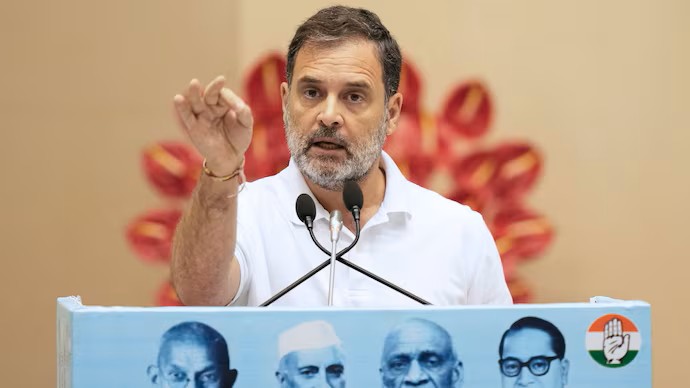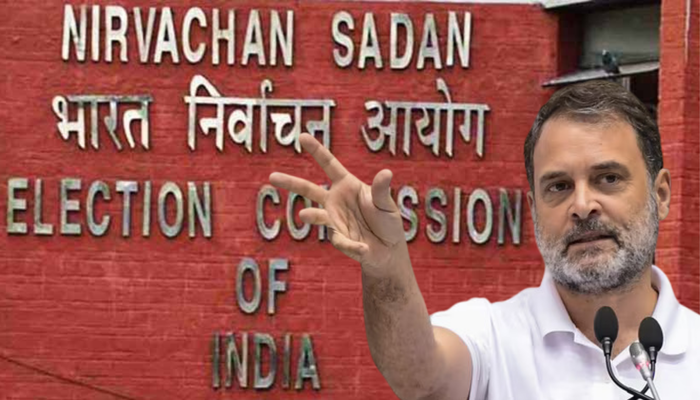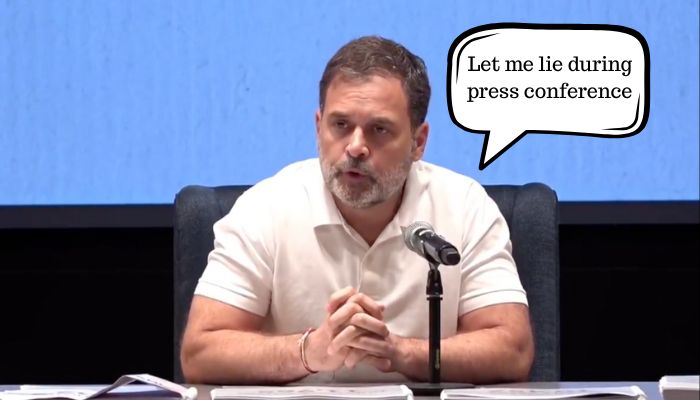
On Thursday, August 7, Congress leader Rahul Gandhi intensified his attacks on the Election Commission of India (ECI), levelling serious allegations of electoral malpractice and accusing the Commission of colluding with the ruling BJP to manipulate the 2024 Lok Sabha election results.
Speaking at a press conference in Delhi’s Indira Bhawan, Gandhi declared that a “criminal fraud” had been perpetrated against the Indian Constitution. Citing what he described as “clear evidence” of voter list tampering in Maharashtra and Karnataka, he alleged the EC had refused to provide machine-readable voter data to cover up large-scale manipulation.
Among his most pointed allegations was that the Maharashtra Assembly elections had been “stolen”. He also cited Bengaluru’s Mahadevapura Assembly segment as a hub of “vote chori,” claiming that over one lakh fake votes were cast there alone.
But a closer examination of these assertions reveals a patchwork of flawed logic, unverified assumptions, and stunning extrapolations. Below is a detailed point-by-point rebuttal of the key claims made by Gandhi, particularly around Karnataka’s Mahadevapura constituency.
1. Internal polls vs actual results: A misguided benchmark
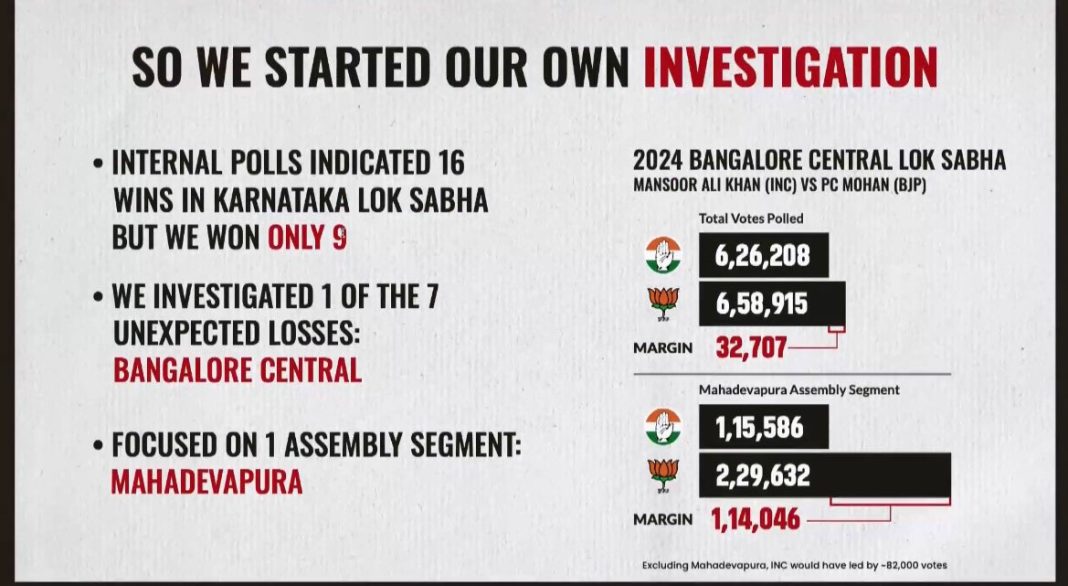
Rahul Gandhi claimed that internal surveys conducted by the Congress party had projected wins in 16 of Karnataka’s 28 Lok Sabha seats, but the party ended up winning only 9. He used this discrepancy to allege “definite voter fraud,” once again pointing fingers at the Election Commission.
But this line of reasoning is deeply flawed. Internal polls are neither transparent nor independently verified, and often reflect the optimism of campaign teams more than ground realities. They are not binding predictors of public sentiment and cannot be held up as a benchmark for electoral legitimacy. In any democracy, it’s actual votes, not internal projections, that determine outcomes.
If internal polls were a foolproof benchmark for electoral outcomes, then by that logic, the BJP should have cried foul for not crossing the 400-seat mark it once projected. But it didn’t, because unlike the Congress, the BJP understands that internal surveys are not incontrovertible facts and respects the democratic mandate instead of insulting voters by floating absurd conspiracy theories.
If internal poll mismatches are grounds for alleging fraud, then any political loss becomes suspect, a precedent that undermines democratic principles.
2. The myth of “missing” anti-incumbency
Gandhi also questioned how the BJP, despite completing two terms at the Centre, managed to secure a third consecutive win. “Anti-incumbency hits every party in every democracy,” he said, suggesting that the absence of such sentiment pointed to manipulation.
This claim again rests on shaky logic. The absence of anti-incumbency is not proof of fraud. Voters re-elect governments when they perceive stability, delivery, and leadership, particularly in the absence of a compelling alternative. India has seen this before under leaders like Nehru and Indira Gandhi, just as Germany did under Angela Merkel.
What stood out most was Rahul Gandhi’s insinuation that every time anti-incumbency sentiment rises against the Modi government, a new ‘script’ is enacted. He cited Operation Sindoor, insinuating that the Pahalgam terror attack may have been a false-flag operation by the Indian state, eerily echoing the very narrative Pakistan uses to deflect from its role in harbouring Islamist terrorists.
Suggesting that consistent voter support is inherently suspicious only highlights the Congress’s struggle to regain public trust, something no conspiracy theory can fix.
3. Opinion polls and exit polls: Not the ultimate truth
Another argument Gandhi advanced was that the deviation between opinion polls, exit polls, and actual results indicated foul play. He cited the 2024 results in states like Haryana and Madhya Pradesh as evidence.
But opinion and exit polls are statistical projections based on limited samples, prone to error due to methodological differences and unpredictable voter behaviour. They are not final vote counts.
From Brexit to Trump’s 2016 win to multiple elections in Israel, global democracies have seen polls miss the mark, without descending into accusations of fraud. In fact, the exit polls have also been completely off the mark from actual reality when it concerns the BJP. In 2015 Bihar elections, almost all exit polls suggested a close contest, but eventually, the RJD-JDU-Congress alliance winning it comfortably, with the RJD emerging as the largest party. This outcome was a stark contrast to the intense tussle predicted by exit polls.
Even exit polls during the 2024 Lok Sabha elections predicted a lanslide victory for the BJP. As we know it, the polls were spectacularly wrong as the BJP manage to win only 240, a far cry from 330+ most exit polls were suggesting.
Therefore, to argue that discrepancies between polls and results constitute rigging is both alarmist and unfounded. Worse, it sets a dangerous precedent that undermines public trust in the very idea of elections.
4. Alleged voter fraud in Mahadevapura: Mistaking possible administrative overlaps for election manipulation
Gandhi zeroed in on Mahadevapura, one of eight Assembly segments under Bangalore Central Lok Sabha constituency, claiming that over 1 lakh votes out of 6.5 lakh were either duplicated or linked to fake addresses.
As an example, Rahul Gandhi cited the case of one Gurkirat Singh Dang, whose name allegedly appeared on voter rolls at four different booths. From this single instance, he extrapolated a sweeping claim of “thousands” of such cases, without presenting any independently verified evidence. What Gandhi fails to acknowledge, however, is the very real and common phenomenon of intra-city and inter-state migration, particularly in urban hubs like Bengaluru, where people frequently shift residences for work, education, or housing constraints.
In such cases, it’s not unusual for individuals to be enrolled at their new address without having formally applied for the removal of their names from earlier rolls. This administrative overlap can result in multiple entries, but it does not automatically mean that the person voted more than once, let alone that they were part of any coordinated fraud. To conflate registration anomalies with actual voting malpractice is not just misleading; it grossly misrepresents how electoral rolls evolve in dynamic urban settings.
Moreover, Gandhi also conveniently overlooked the fact that parties receive voter rolls well in advance and are free to raise objections during the verification phase. If such large-scale discrepancies truly existed, why weren’t they flagged before polling day?
5. Voter duplication: Systemic flaws, not partisan conspiracy
If Rahul Gandhi alleges that certain voters cast their votes twice, the critical question remains unanswered: whom did they vote for? There is absolutely no evidence to suggest that such voters exclusively supported the BJP. In fact, in a secret ballot system, it is impossible to determine the direction of any individual’s vote without breaching the very foundation of electoral privacy. For all we know, duplicate voters could have voted for the Congress or any other party. Yet, Gandhi conveniently assumes, without proof, that any such irregularity must have benefited the BJP, exposing the deeply partisan nature of his accusation.
Moreover, highlighting instances of individual malpractice does not automatically implicate the entire democratic process or justify branding an entire election as “fraudulent.” If some people have gamed the system, and that has happened across decades, under multiple governments, including those led by the Congress, it reflects a systemic loophole, not a partisan conspiracy. By projecting isolated cases as proof of a grand BJP-led conspiracy, Rahul Gandhi not only undermines institutions but also insults the intelligence of Indian voters who did not vote for his party.
6. Addresses missing point to clerical errors and bureaucratic flaws, not election rigging
Gandhi also claimed that many addresses in voter rolls were missing, unverifiable, or outright fake, labelling thousands of such entries as fraudulent.
This oversimplifies a more nuanced administrative reality. In urban constituencies like Mahadevapura, rapid migration, outdated address records, or digitisation errors are common. Incomplete fields showing “0” or “#” could be due to data formatting issues, manual input errors, or legacy record-keeping problems, not evidence of a voter fraud conspiracy.
Without physical verification of each individual case, such claims remain speculative at best. Mistaking clerical inconsistency for criminal intent is reckless and unfair to legitimate voters.
6. Missing Photos on electoral rolls: A flimsy foundation
Among Gandhi’s more startling assertions was the claim that around 4,000 voters were “fake” because their electoral roll entries lacked photographs.
Missing photos, while not ideal, are often the result of administrative lapses, not fraud. Voter databases in India are vast and periodically updated. Delays in image syncing or glitches during digitisation can result in such anomalies. Importantly, the absence of a photo on a public list doesn’t confirm that the individual voted, let alone that they were fake. In fact, Gandhi himself highlighted how some of the pictures in the electoral roll were too small to be clearly visible. It only underscores the technical glitch and clerical errors the electoral system faces, not a coordinated conspiracy to steal votes.
To equate missing photos with fake voting displays a fundamental misunderstanding of how the electoral database functions.
7. Misuse of Form 6: Misunderstood and misrepresented
Gandhi further alleged that Form 6, the application for voter registration, was misused by middle-aged and elderly voters, implying that only 18- to 22-year-olds should be using it. He pointed to a 70-year-old woman who applied twice and suggested she may have voted twice.
This betrays a misunderstanding of electoral procedure. Form 6 is for first-time registration, regardless of age. People may register later in life for numerous legitimate reasons: returning from abroad, acquiring new documents, or simply developing political awareness. Many middle-aged and senior citizens proudly voted for the first time in 2024, a sign of democratic inclusion, not fraud.
Claiming misuse based solely on age is not just factually incorrect but it betrays shocking level of ignorance, unbecoming of India’s Leader of Opposition.
8. ‘I’m a politician’: Rahul Gandhi when asked to take oath for ‘vote chori’ claim
A revealing moment unfolded during Rahul Gandhi’s press conference. When an attendee asked whether he was willing to take a formal oath to back his explosive ‘vote chori’ allegation, Gandhi skillfully dodged the question. Instead, he said,” I am a politician. every word I speak in public is under oath.” He then meandered into a vague defence, asserting that his claims were based on Election Commission data, and conveniently noted that the poll body hadn’t explicitly denied it.
RAHUL GANDHI: "I am a politician. What i say to the people is on oath."
— Rahul Shivshankar (@RShivshankar) August 7, 2025
Here are some "oaths" Rahul Gandhi has revealed to the people over the last few years.
"I agree. India is a dead economy."
"Chinese thrashed Indian army in Galwan." pic.twitter.com/ssOk0VuHTy
Rahul Gandhi may insist he never lies to the people, but the Supreme Court’s verdict on the Rafale controversy tells a different story, one that exposes the Congress leader’s claims as misleading and devoid of truth. In fact, he was also called out for his lies on Maharashtra elections, something which he repeated earlier today. So his claim that he doesn’t lie to people don’t hold water.
Notably, the Karnataka Election Commission came down hard against the Congress leader for making unfounded claims of voter theft in his press conference. The poll body formally asked Rahul Gandhi to submit a signed declaration and furnish names of voters he alleges were fraudulently included in the electoral rolls as part of his “vote chori” (vote theft) claims.
The Commission emphasised that electoral rolls were prepared transparently and warned that any false declaration could attract legal consequences under both the BNS and the Representation of the People Act, 1950. The declaration, mandated under Rule 20(3)(b) of the Registration of Electors Rules, would be necessary to initiate any official proceedings.
9. Rahul Gandhi highlights duplication of voters but opposes SIR in Bihar
While Rahul Gandhi highlighted duplication and discrepancies in voter rolls during the press conference, particularly in constituencies like Mahadevapura, his track record reveals a contradictory stance. In Bihar, when the Election Commission launched the Systematic Investigation of the Electoral Roll (SIR) to weed out exactly such irregularities, it was Rahul Gandhi, his Congress party, and many other opposition parties had cried foul. Instead of welcoming a long-overdue clean-up of bloated and error-ridden rolls, the Congress accused the Election Commission of colluding with the BJP and manipulating the process, going so far as to challenge the initiative in court.
This duplicity exposes the political convenience behind Gandhi’s rhetoric. Voter list discrepancies are not new; they’ve been a systemic issue that likely persisted during Congress regimes as well. However, the current Election Commission has taken unprecedented steps to ensure transparency and accountability through processes like SIR. Ironically, Gandhi now opposes the very effort that seeks to solve the problem he claims to highlight.
As the BJP, along with several political commentators noted, Rahul Gandhi’s recent press conference was a roaring endorsement of the revision exercise underway in Bihar. But more importantly, his shifting stance raises a fundamental question: is the issue the duplication, or the fact that his narrative no longer controls the debate?
10. Conspiracy or convenient cover?
Rahul Gandhi’s sweeping claims of electoral fraud are built not on verified evidence but on unsubstantiated projections, anecdotal irregularities, and speculative logic. They rely on conflating administrative imperfections with malicious intent and on dismissing legitimate outcomes simply because they didn’t favour his party.
Rather than engaging in introspection about the Congress party’s electoral shortcomings, be it ineffective messaging, weak grassroots mobilisation, or a lack of public connect, Gandhi appears intent on discrediting institutions his own party once helped build. He repeated the same debunked claim that Maharashtra polls were rigged. There is a pattern to disinformation and propaganda that Rahul is disseminating, one that seeks to systematically undermine the legitimacy of the Modi government’s electoral victories against Congress.
Allegations of fraud in any democracy must be taken seriously. But they must also be backed by credible evidence, presented through appropriate legal and electoral channels, not post-facto press conferences laced with conjectures, suppositions, and unverified guesswork.
In the absence of such evidence, what remains is a troubling attempt to undermine public faith in India’s democratic process. And that, more than any Form 6 or voter roll discrepancy, is the real threat to the legitimacy of elections.
Congress’ past attempts at undermining EC’s credibility
In its repeated attempts to discredit the BJP’s electoral victories, the Congress party has actively tried to undermine the credibility of the Election Commission, most notably through baseless EVM hacking conspiracy theories. One such farcical episode occurred in 2019, when Congress backed a so-called “EVM hackathon” in London featuring an alleged ‘EVM expert’ Syed Shuja, who claimed via Skype, with his face covered, that BJP had hacked the 2014 general elections and multiple state polls. He even alleged that BJP leader Gopinath Munde was murdered for uncovering the tampering. No proof was offered, only sensational claims.
Senior Congress leader Kapil Sibal’s presence at the event raised eyebrows, especially as Shuja’s claims grew more absurd such as BJP’s IT cell allegedly using military frequencies to “ping” EVMs. Ironically, Shuja claimed the same EVMs delivered a fair outcome when Congress won in Rajasthan, MP, and Chhattisgarh. The Election Commission firmly rejected the allegations, stating that Indian EVMs are standalone devices with no communication capabilities and are produced under strict security.
This episode exposed Congress’s willingness to propagate wild conspiracy theories and cast aspersions on constitutional institutions when elections don’t go their way. Rather than accepting public verdicts, the party has shown a pattern of attempting to delegitimise the process itself, a dangerous precedent in any democracy.
Rahul Gandhi’s latest claims of “voter fraud” in Mahadevapura follow the same tired playbook: dramatic allegations, zero evidence, and a clear attempt to sow doubt in democratic institutions. Just like the EVM hacking drama, Gandhi’s insinuations rest on political convenience rather than verifiable facts. While he demands accountability from the Election Commission, he has also opposed genuine electoral reform efforts like the SIR process in Bihar, which seeks to clean up duplicate and erroneous voter entries. This selective outrage reveals the underlying strategy: if the Congress loses, the system must be broken.