Home Blog Page 3069

Can someone steal money from your Paytm account by scanning FASTag on your car? Know the truth of claims made in a viral video

The PIB fact check has clarified that the FASTag stickers attached to vehicles to collect tolls can not be used to fraudulently steal money from money keep in online wallets. The Fact Checking section of the Press Information Bureau was responding to a video where such a claim was being made. The video, posted on Facebook by a page named BakLol Video has gone viral with around 2.7 lakh views so far.

In the video, a man claims that kids that clean the windshields of vehicles at traffic signals are wearing smart watches that scan the FASTag sticker, and when it is scanned, money kept in Paytm for paying road tolls is automatically deducted.

In the video, a boy is seen cleaning the windshield of a car, who has a digital watch on his wrist. The boy flips his wrist a few times, showing the face of watch with red LCD display. After cleaning the windshield, the boy starts to go away, without asking for money. The man calls him back, saying why he was going without taking money.

The visibly frightened boy asks for the money. The man asked him why he was not taking money, and why he is wearing the watch and asks to see it. Hearing this, the boy runs away, the co-passenger in the car chases him, but can’t catch him and returns to the car.

After that, the man driving the car explains his co-passenger what had happened. He claimed that these boys are cleaning car windshields with watches that have scanners. Every time the tag is scanned using the watch, a predetermined amount is deducted from the FASTag account in Paytm, he claims.

He also said that some people have given such watches to street kids, beggars etc, and probably the kids don’t know what is done with the watches. He claimed that he had faced such an incident before, and advices people to careful about this ‘new scam’.

However, claims made in the viral video are fake, and FASTag stickers can’t be scanned such way to deduct money from account of users. As PIB Factcheck informed, each toll plaza has a unique code, which is mapped with a specific bank account and a geo-code. All these information is mapped on the National Electronic Toll Collection (NEPC) program.

The NEPC system enables the customer to make the electronic payment of toll at any NETC-enabled toll plaza on the road without stopping at the toll, as the tag is read using RFID technology and the toll amount is automatically deducted.

Apart from the Geo code mapped to each toll plaza, the IP are also whitelisted by banks and NPCI (National Payments Corporation of India). These means, only the authorised merchants like toll and parking plazas can collect money using the FASTag system. Apart from this, for the transaction to go through, the system needs the toll plaza ID.

The NPCI is linked with the banks with secure network, which can’t be breached. Therefore, by scanning the tag, it is not possible to steal money from the account of an user, as claimed by the video.

Moreover, after a toll is paid using FASTag, the customer receives a message on the registered phone number. Therefore, if there is any ‘stealing’, they will be alerted immediately and will be able to take preventing measures.

Therefore, the claims made in the video are incorrect, and it looks like the video was staged to make the fake claim.

Iran: Teenage girls arrested for not wearing hijab during skateboarding event

Iranian officials have reportedly arrested a number of juvenile girls and others for not wearing hijabs during a skateboarding event in Shiraz, a city in southern Iran.

A video purportedly depicting Tuesday’s ‘Go Skateboarding Day’ celebration on Chamran Boulevard in Shiraz went viral on social media in Iran, infuriating orthodox religious conservatives in a country where all women and young girls are required to wear a hijab.

According to Shiraz police commander Faraj Shojaee, as quoted by state news agency IRNA, a number of girls “removed their hijab at the end of the sports event without observing the religious considerations and legal norms.” “With the coordination of the judiciary, a number of perpetrators and people related to this gathering were identified and arrested on Thursday,” he said.

“Holding any mixed sports or non-sports gathering without observing the religious and legal norms is prohibited… and the organisers will be dealt with according to the law,” Shojaee further added.

It is worth noting that under Islamic law, which has been in effect in Iran since the 1979 revolution, women are required to wear a hijab, which covers the head and neck thus hiding the hair. While Iranian women struggle to be liberated and break free from the confines of headscarves, the hijab is exploited to forward the Islamic agenda over the world.

The hijab has been a major source of controversy in India in recent months. The Karnataka hijab controversy caused enough uproar and violence in the country for authorities to intervene and the judiciary to provide certain directives.

As Shiv Sainiks go on a rampage vandalising offices of rebel MLAs, here is how a sympathetic ‘journalist’ working for ThePrint defends their violence

Going by their reputation, the Shiv Sainiks have begun using street and muscle power to intimidate MLAs who have defected from the Uddhav Thackeray camp to support the ‘rebel’ Eknath Shinde group. The Uddhav Thackeray supporters have been vandalising offices and defacing posters of the ‘rebel’ MLAs for the past two days as they run riot across the streets of Maharashtra.

However, rather than denouncing this thuggish behaviour, a ‘journalist’ affiliated with the leftist propaganda news website ‘The Print’ went on to publicly sympathise with the Shiv Sena goons.

According to ANI, Shiv Sena goons today (June 25) vandalised the office of the party’s MLA Tanaji Sawant in the Balaji Nagar area of Katraj, Pune. Sawant is one of the dissenting MLAs from the state who is currently camping in Guwahati, Assam, along with other MLAs who have sided with Eknath Shinde.

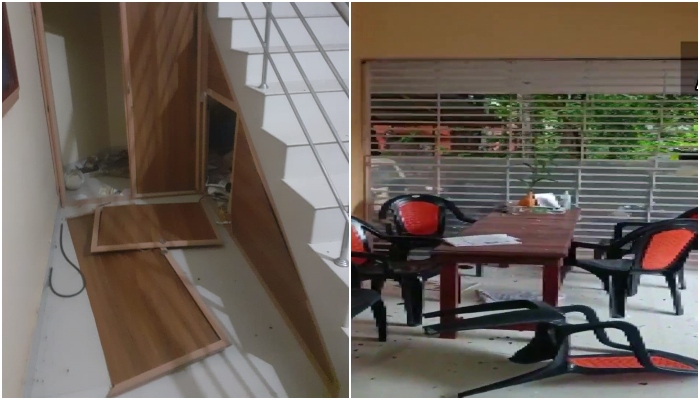
In the video shared by the news agency ANI, Shiv Sena goons can be seen charging Tanaji Swant’s office while brandishing rods, batons, and the party’s saffron flag. They vandalise the walls outside the office with graffiti and breaking the window panes. The Shiv Saniks then barge into the office and vandalise it, shouting slogans against Sawant. They then bring out a poster of the party founder Balasaheb Thackeray that was kept in the MLA’s office and wave it in the air, raising slogans in support of Uddhav Thackeray.

Justifying the act, Sanjay More, Shiv Sena’s Pune head threatened the other dissenting MLAs, “Our party worker vandalised Tanaji Sawant’s office. All traitors and rebel MLAs who have troubled our chief Uddhav Thackeray will face this type of action. Their office will also be attacked… No one will be spared.”

Yesterday (June 24) too, Shiv Sena goons vandalized the board outside the office of Mangesh Kudalkar, who is one of the rebel MLAs of Shiv Sena currently in Assam. Shiv Sainiks in Nashik were also seen throwing eggs and black ink on the posters displaying rebel leader Eknath Shinde. A few more Shiv Sainiks gathered in the Chuna Bhatti area of Mumbai and raised slogans against Mangesh Kudalkar.

Dilip Lande, another Shiv Sena MLA representing the Chandivali constituency in Mumbai also faced the ire of Shiv Sainiks. In Chandivali, they destroyed banners and posters of MLA Dilip Lande. Somnath Sangle, a former corporator of Shiv Sena took some Shiv Sainiks with him to Sakinaka to vandalize Dilip Lande’s banners put up in that area.

While the Shiv Sainiks continue to resort to hooliganism and vandalism to intimidate the MLAs, Hemant Desai, a senior ‘journalist’ working for The Print openly expressed his sympathy for these goons on a debate program hosted by India TV.

In a snippet of the program shared on Twitter by popular user Amit Thadani, The Print ‘journalist’ is heard saying that the Shiv Sainiks have been left with no other option but to resort to violence. Hemant Desai is heard saying that he doubts that the Shiv Sena workers have resorted to hooliganism in multiple places. He said that as far as his knowledge goes Shiv Sainiks have resorted to vandalism only in Kurla.

Desai continued, “The latest hooliganism as compared to their former stance is insignificant. The level of the uproar that the Shiv Sainiks resorted to earlier was considerably more extreme.”

“There have been fewer instances of hooliganism under Uddhav Ji’s leadership, and the Shiv Sena is far more moderate than it once was”, The Print writer expressed his sincerest sympathy with the Shiv Sena supremo and his henchmen, adding that although Aditya Thackeray is likewise opposed to violence, they currently have little choice but to take a slightly aggressive attitude.

Shiv Sena MP Sanjay Raut threatens rebel MLAs with violence

Notably, until yesterday, Rajya Sabha MP and Uddhav Thackeray loyalist Sanjay Raut was issuing implicit threats of violence to the party MLAs who have joined Eknath Shinde’s rebel camp.

Speaking to ANI on Friday, Sena’s Rajya Sabha member Raut said, “The (Eknath Shinde) faction that’s challenging us must realise that Shiv Sena workers are yet to come on the roads. Such battles are fought either through law or on the roads. If need be then our workers would come on the roads.”

Similarly on Thursday, while speaking to NDTV, Sanjay Raut had directly threatened the rebel MLAs with street violence. When questioned about whether or not Uddhav Thackeray will stay as the chief minister, he stated, “Let all the MLAs come to the floor of the House. We will see then. These MLAs who have left will ultimately have to come back to Maharashtra. They will find it difficult to return and move around in Maharashtra.”

Meanwhile, rebel Shiv Sena MLA Eknath Shinde informed that he has the support of 50 MLAs, which is enough to oust the Maha Vikas Aghadi government from power.

He made the revelations during an exclusive telephonic conversation with TV9 Marathi. Shinde confirmed that about 40 of the MLAs are from Shiv Sena. It implies that the rebel leader has the numbers to bypass disciplinary action under the anti-defection law.

Apart from the Shiv Sena MLAs, about 60 Members of the Legislative Council (MLCs) from Maharashtra are also set to join Eknath Shinde’s rebel camp.

Maharashtra political crisis: Eknath Shinde forms a new group named “Shiv Sena Balasaheb’

The Eknath Shinde camp of Shiv Sena form a new group and named it ‘Shiv Sena Balasaheb’. On 25th June 2022, rebel Shiv Sena MLA Deepak Kesarkar while speaking to ANI informed about this new development. The rebel MLAs are staying at Hotel Radisson Blu in Guwahati.

MLA Deepak Kesarkar said that the earlier application given by the group to the deputy speaker of the assembly was just to recognize Eknath Shinde as the leader of the Shiv Sena legislature party. While speaking to India Today, Deepak Kesarkar said, “We are still in Shiv Sena. We will be having our own separate group named Shiv Sena Balasaheb. We will have our leader, whip, office and everything else just like a party has. We are calling it Shiv Sena Balasaheb because we are sticking to the thoughts and ideology of the founder of the party.”

According to rules if two-thirds of the total MLA of a party form a group, the MLAs don’t lose their membership and they are recognized as the party. We are trying to assert that thing. We have tried a lot to explain the things to Uddhav Thackeray but we don’t know why he chose to keep the things pending.”

Deepak Kesarkar also said that the decision to support BJP, to make a government with BJP, or to go into the new elections will be taken only as per the directions given by Eknath Shinde. Deepak Kesarkar also said that the chief minister should take strict action on the Shiv Sena goons vandalizing the offices of the rebel MLAs.

Kesarkar said that there are so many MLAs in Maharashtra who are elected because people like them and not the party name alone is to be credited for their win. Shiv Sena rebel MLAs are holding a meeting today and they will declare their next steps after the meeting. On 25th June 2022, the rebel MLAs also wrote to Uddhav Thackeray and asked him to restore the security of their families which was suddenly removed.

As Amit Shah blames ideologically aligned journalists for making the 2002 Gujarat riots worse, here is how they impacted the entire media narrative

(The following is an extract from the book ‘Sanghi Who Never Went To A Shakha’, and is being republished here in the wake of the recent interview by Amit Shah to ANI. In his interview, Amit Shah said that the riots and circumstances were exacerbated by the efforts of a nexus, which included opposition political parties, politically driven media reporters and journalists, and certain non-governmental organisations. 

Amit Shah stated that all the allegations against the government of Gujarat were fake and fabricated. He said that the sting operation by Tehelka was also fake and ideologically motivated. “All the sting operations were fabricated. The court has itself observed that efforts were made to put a bad tag on the state government. It was we who agreed to constitute the SIT. Why there was no SIT after the 1984 riots in Delhi?” Shah remarked fiercely when asked about the BJP’s denial of the SIT.

Interestingly, all the lies that Amit Shah busted in his interview were peddled by the media and he, in his interview, also mentioned that the riots were made worse by the media. The following excerpt from the book only confirms how the media functions. This experience of the author of the book as a young journalist goes on to confirm how the Lutyens media tried its best, historically, to peddle lies and propaganda to defame Modi and Shah).

Following is the excerpt from the book reprinted here:

The horrific attack on the train at Godhra took place in the morning that day, at around 8 AM. At that time, I was on my way to catch a DTC bus from Ber Sarai to Jhandewalan, where Aaj Tak had their office. By the time I reached, it was already making headlines. The initial news reports didn’t term it as a terror attack or even an incident of violence. Information was still trickling in. I too assumed that it could have been an accident, maybe the pantry car of the train caught fire.

Within an hour, as reporters from Gujarat started sending more information, everyone in the newsroom knew that it was not an accident. As the reporters talked to the authorities and other people who were travelling on the same train, it became clear that the fire was set by a mob. Curious to know the details of what had happened, I filled a paper cup with tea from the vending machine in the office and stood near the desk where a bunch of copy editors typed away information that would be either made into news reports (‘package’ as they were called) or read out by the news anchor, while visuals played on-screen (‘voice-over’).

Copy editors received information from what was known as the ‘input desk’, which in turn got raw information and reports from reporters in the field or from news agencies. I saw one input guy standing next to one such copy editor while the news of the Godhra incident played on the TV sets in the newsroom. Assuming that they will have the latest information, I sneaked up to them and stood there to overhear their conversation as I pretended to watch the news being played on the nearest TV set.

Pata chala kaun kiya?’ (‘Do we now know who did it?’), asked the copy editor to the input guy, who immediately replied ‘Musalmaan sab aur kaun?’ (‘The Muslims did it, who else?’) in a hushed but disgusted tone.

After a brief pause, the copy editor said, ‘Ab yeh toh nahi likh sakte na.’ (‘Now, we can’t really write this.’)

I furtively tried to have a look at the input guy. He didn’t say anything after this. Anger was discernible on his face and so was the disgust. His eyes met mine and I immediately averted them, lest he thought I was trying to spy. He then walked away, leaving some fax or photocopies at the desk of the copy editor, presumably the raw reports sent by the reporters from the ground. I too walked back to my desk, silently.

This conversation of barely ten seconds, which would include some uncomfortable pauses too, revealed so much in retrospect. The mainstream can write headlines like ‘Frenzied Hindu mob brings down sixteenth-century mosque’ and ‘Dabang Rajputon ne Dalit dulhe ko ghodi se utaara’ (when some men from the Rajput community force a Dalit groom to alight from the horse during a wedding procession), mentioning the religion or caste of the perpetrator of a reported crime in some cases, but it feels greatly uncomfortable about mentioning the religion when the perpetrator of the crime is a Muslim — this when religion was clearly the main element in the crime committed at Godhra.

‘Muslim mob sets a train carrying Hindu pilgrims on fire’ is not seen as a legitimate or ‘responsible’ headline, even though it is factual. It is a template that Indian journalists have religiously internalized over decades. Any attempt to break away from this template is seen as losing your ‘moral compass’.

Highlighting and shouting about caste is seen as fighting for justice, while hiding and keeping mum about religion is seen as indulging in responsible behaviour, except of course when the religion of the perpetrator is Hindu and the victim a Muslim. In which case, the same journalists shout with double the intensity and even exaggerate the incident with made-up claims about ‘beef’ and ‘Jai Shri Ram’ slogans.

This unwritten rule or the moral compass of the Indian mainstream media ensures that we grow up with a strongly ingrained belief that a Hindu cannot be a victim of any injustice or hate crime, unless he belongs to the so-called lower castes (and in that case the perpetrator has to be a Hindu too). The Hindu–Muslim relationship in this country has been presented as that of the oppressor-oppressed, where Hindus by default are the oppressors.

This induces an element of guilt in an average Hindu, who tries to go an extra mile to appease and accommodate Muslims, including and invariably the ones with an Islamist mindset. That’s what we saw when thousands of Hindus came out in the streets to oppose the CAA, standing shoulder to shoulder with those who idolized Jinnah and the leader of the Moplah massacre.

I can literally give hundreds of examples from just the past few years where the Indian mainstream media has indulged in such glaring double standards, and this is in the era of social media where people have other means to know the ugly truth. You can imagine how skewed the reporting and beliefs would have been almost two decades earlier. This is the ‘truth’ that was fed to unsuspecting consumers by the media, and when people started speaking up and show showing the other side, the media talking heads invented the term ‘post truth’.

For now, I’ll go back to 27 February 2002 and that moment in the newsroom. The conversation between the copy editor and the input guy, which lasted barely 10 seconds, showed that most journalists knew within an hour that the Godhra incident was not an accident but an organized act of violence. They knew that it was veritably a terror attack by an Islamist mob against helpless, unarmed Hindus. Yet, around two and half years after the carnage, when the Congress returned to power in the Centre, cobbling up a post-poll alliance, and when it announced the formation of a commission to declare the carnage an ‘accident’, hardly any journalist protested saying it was a mockery of justice.

What that short conversation also showed was how a journalist, even if he wanted to speak the ugly truth, would have to surrender to the moral compass. Since he won’t be able to control the narrative, he would be left to control his anger and disgust, failing which he will be branded a Sanghi and unprofessional and whose career path would be cut short.

(The book ‘Sanghi Who Never Went To A Shakha’, authored by Rahul Roushan, was published by Rupa Publications and released on 10 March 2021. The link to buy the book is here.)

From fetus killed with sword to Sanjiv Bhatt’s imaginary meeting with CM Modi: Busting 5 myths used to defame Modi and Shah after 2002 Gujarat riots

On Friday, 24 June 2022, the Supreme Court of India upheld the SIT’s clean chit to the then Gujarat CM Narendra Modi in the 2002 Gujarat riots. The SC was hearing a plea filed by Zakia Jafri, widow of former Congress MP Ehsan Jafri, who was killed during the violence at Gulbarg Society in Ahmedabad on 28 February 2002, challenging the clean chit given by the SIT to PM Modi and 62 others for their alleged role in the violence.

While delivering its verdict, the apex court said that the “appeal is devoid of merits”. A bench headed by Justice A M Khanwilkar refused to order a probe into allegations of a “larger conspiracy” behind the Gujarat riots.

The apex court, with its ruling, has brought the curtains down for a propaganda industry that relied on churning out sensational conspiracy theories to keep the pot boiling about the Godhra train burning incident and the riots that erupted in its wake. With its dismissal of Zakia Jafri’s plea, the court has effectively undermined the efforts of the propagandists who sought to bolster their narrative that the Gujarat riots were a planned conspiracy carried out under the aegis of the highest state political leadership.

While the top court’s verdict gave a clean chit to PM Modi in the 2002 Gujarat riots, it would be foolish to assume that the judgment would deter the propagandists from weaving fictional tales about the tragedy. It is, therefore, germane to bust the myths that were propped up by the

Nevertheless, it is important to recount the myths perpetuated by the propagandists who build a career out of peddling misinformation, hearsay, hyperbole and fake news regarding the Godhra train burning incident and the consequent riots.

Here are some of the popular myths that were bandied around after the fateful day when 59 Hindus, including women and children, were incinerated in a train bogey in Godhra, which touched off an ugly spate of riots across the state.

Myth 1: Pregnant Kausar Bano was raped and her fetus was pulled out of her womb and flung into the fire

In the aftermath of the Godhra train burning incident that triggered widespread violence across Gujarat, many media outlets at that time ran a story that a pregnant Muslim woman was raped by a Hindu mob, her pregnant belly slit open and her foetus flung into the fire. Some versions also included that the above act was done with a sword.

Most reports cited Saira Bano, Kausar Bano’s sister-in-law who claimed “What they did to my sister-in-law’s sister Kausar Bano was horrific and heinous. She was nine months pregnant. They cut open her belly, took out her foetus with a sword and threw it into a blazing fire. Then they burnt her as well.” Some versions of the story narrated horrific versions of the fate of the foetus. In other versions, the foetus was slaughtered with the sword, while in some, the foetus was swung on the point of the sword and then thrown into a fire.

However, the postmortem of Kausar Bano told a different story.

A 2010 report states that the doctor who conducted a post-mortem on Kauser found the foetus intact. Dr J S Kanoria, who had conducted the autopsy on 2nd March 2002 presented supporting documents to the special court and said that the foetus was intact in the woman’s womb. The foetus weighed 2,500 gms and was 45 cms long.

Further, during the postmortem and cross-examination of the witness, it had come to light that Kausar Bano died of suffocation, fear and shock and her body bore no external or internal injuries. As per reports, during his deposition, Kanoria stated that Bano’s body bore no internal or external injury; moreover, there was no sword injury on her body. Dr Kanoria was working at the government civil hospital during the riots and had given a statement that Kausar Bano’s foetus was removed after the post-mortem. The post-mortem was conducted on 1st March 2002.

Myth no. 2: A stove spill caused the fire inside the Sabarmati express

Another popular myth that was widely shared by propagandists and even media outlets is the “accidental fire” theory that said the Godhra train burning was an incidental fire caused from within the bogey and not by a bloodthirsty mob of Islamists, who harboured deep antagonism for the passengers of the Sabarmati express since they had been to Ayodhya for karseva of the Ram Temple to be built at its original place.

However, the Nanavati-Mehta commission, a commission of inquiry appointed by the government of Gujarat to probe the Godhra train burning incident of 27 February 2002, squarely rejected the claims that fire happened inside the compartment after some inflammable liquid from a stove spilt after some karsevak tried to cook a meal in the compartment. The Commission report said, “The witness has denied that such fire could have taken place in the coach as a result of inflammable liquid in a vessel getting spilt in the coach. This witness has produced photographs taken by his office at the time of examination of that coach.”

Further, Mukesh Joshi, Scientific Officer at FSL, had gone to Godhra thrice in 2002 and he had observed, “n hit marks on the outer side of coach S/6 caused by stones hitting the coach. There were burn marks also on the outer side of coaches S/6 and S/7.”

The Nanavati-Mehta Commission report then talked about the statements of various eyewitnesses. Multiple eyewitnesses narrated how the mob started pelting stones from the left side of the compartment as the train started to move away from the platform. “Sajjanlal Raniwal has stated that as soon as the train had moved out of the platform, a mob standing on the left-hand side had started throwing stones at it and for that reason, he was required to close the door and shutters of the windows of their compartment. If really that had not happened, there was no other reason for Sajjanlal to say so. He would not have closed the windows unless he was compelled by the circumstances to do so.”

“The passengers have also said that as the persons on the left-hand side of the train had started throwing stones at the train, they were required to close the windows of their coach. Some of the witnesses have stated that stones which were thrown on the train had a broken glass of one or two windows and therefore, the passengers in the coach were required to close the tin/metal shutters of the windows on that side. Hariprasad has also clearly stated that right from the time the train had moved out of the station, pelting of stones on the train had started and because of that passengers had closed the windows of their coach. There is no reason to doubt this part of their evidence. Hariprasad and other witnesses would not have said so unless it was true as they had nothing to gain by saying something that which was not correct,” the commission further said.

Myth no.3: Short circuit caused a fire inside the train

Another conspiracy theory about the fire that was floated by Mukul Sinha’s Jan Sangharsh Manch was ‘short circuit’. The Nanavati-Mehta Commission had this to say about the claims: “A short circuit is another probability canvassed by the Jan Sangharsh Manch. No evidence has been led and no material has been produced before the Commission to show the possibility of a short circuit has occurred in the coach. The reason given in support of this possibility is that there was smoke in the coach at first and flames were seen after some time. Not a single passenger of coach S/6 examined by the Commission was asked if anything like short-circuit had happened in the coach.”

Further, the report said, “During the inspection by the Commission in presence of advocates appearing for the parties it was noticed that the electric wires were in the upper parts of the coach. If there was a fire because of a short circuit the passengers who were near that place would have immediately come to know about it. In that case, the passengers who were sitting on the lower seats would not have climbed up on the upper berths to protect themselves. On the contrary, those who were sitting on the upper berths would have immediately come down for saving themselves from fire and electric shock. The passengers would have left the coach immediately through all the four doors and so many persons would not have lost their lives.”

While motivated individuals tried to paint the Godhra train burning incident as an accidental fire from within the bogey, the Justice Nanavati-Mehta Committee report [pdf] talked about what actually conspired in Godhra that led to the deaths of 59 Hindus. Right after the Godhra platform and boundary, there is a road and a locality named ‘Signal Falia’. “It extends up to the culvert and goes further towards A cabin. It is a locality mainly inhabited by Ghanchi Muslims,” the report mentions. When the train arrived, a lot of unauthorised vendors, mainly Ghanchi Muslims, would come on the platform and sell snacks, cold drinks, bidis, etc.

The report further states that the train arrived at the platform at 7:43 AM as it was running about 5 hours late and there was a halt of about 5 minutes. In its evidence portion, the report cites media reports from 28th February 2002, the day after the carnage, where leading mainstream media had reported that a mob has set Hindus on fire. They mentioned how Hindus were returning from karseva and how the mob set the train coaches on fire with petrol.

The Times of India had mentioned how the train was stopped at Signal Falia where someone had pulled the chain and after initial pelting of stones on coach S6 and S7, windows were broken and petrol bombs were thrown inside. The Indian Express, too, carried eyewitness statements on how the mob had set the coach ablaze after pelting stones.

Myth no. 4: Karsevaks attempted to abduct a Muslim girl that goaded the mob into burning the train

Yet another fictional tale talks about a “scuffle” following which ‘karsevaks’ tried to abduct a Muslim girl, raising the hackles of the Muslim mob and eventually leading them into doing what occurred at Godhra. However, the Nanavati-Mehta commission rejected the hypothesis, stating that the claims of karsevaks abducting a Muslim girl were far-fetched and did not belong to the realm of reality.

“From the evidence of all these witnesses and other material on record it becomes clear that except overcrowding in the train and occasional raising of slogans inside the train and on platforms of the intervening stations, the Ramsevaks had not done anything and no incident had happened earlier which could have led to the incident which later on happened at Godhra,” the commission concluded on the rumours of a scuffle that triggered the train burning.

Regarding the ‘attempted’ abduction of a Muslim woman following the “scuffle”, the Commission comes to the conclusion that the version given by the lady did not appear to be true. “If they had really gone to the station for going to Vadodara, they would have boarded the Sabarmati Express train as it would have taken them to Vadodara earlier, but they had not done so. The alleged attempt to abduct her was made while they were near the bookstall. That would mean that they were almost in the middle of the covered portion of the platform and very close to the offices of the railway staff,” the commission observed.

“The evidence discloses that there were many persons on the platform. Apart from passengers, many Muslim vendors were there. The railway staff was present in their offices. Some policemen were also present. If she had raised shouts to save her then they would have been heard at least by some persons who were near about but not a single vendor or anyone else has come forward to support her version,” the commission noted while debunking the testimony of the Muslim woman.

“According to her evidence, they had then gone inside the office of the booking clerk. They did not inform anyone there about what had happened. When inside that office, they had no reason to be afraid of anything thereafter and return immediately to their relative’s place instead of waiting for the Memu train which was about to arrive. Her explanation that she was much frightened and had giddiness and, therefore, they had decided not to go back to Vadodara on that day, does not appear to be true,” the Nanavati Mehta Commission report stated.

Myth no.5: Tainted former IPS officer Sanjiv Bhatt met CM Narendra Modi at his residence on 27 February 2002

Another popular myth that is widely shared among liberal circles is that former IPS officer Sanjiv Bhatt met with CM Narendra Modi in the latter’s residence on 27 February 2022. This meeting is especially highlighted to implicate PM Modi for being complicit in the carnage that followed in the wake of the Godhra train burning incident.

However, the Nanavati-Mehta commission concluded that the former IPS officer Sanjiv Bhatt, who is currently serving life imprisonment in a custodial death case, had lied and made up stories about him attending a meeting at the then Chief Minister Narendra Modi’s residence on February 27, 2002.

Bhatt, who became a big face of the anti-Modi lobby, alleged in 2011 that during the 2002 post-Godhra riots, the then Chief Minister Narendra Modi had called a meeting at his residence on 27 February 2002 to “let Hindus vent out their anger against Muslims so that repeat of Godhra-like incident never happens in the state”.

Bhatt, in an affidavit submitted to the Supreme Court, had claimed that this meeting took place following the Sabarmati Express burning incident in which 59 Ayodhya Kar Sevaks had died.

At the time of the alleged meeting, Bhatt was the deputy commissioner of the state intelligence bureau. He further stated in the affidavit that the meeting was attended by eight top police officers. Bhatt also alleged that the SIT constituted to probe the riots was trying to protect the Gujarat government.

The Nanavati-Mehta commission report has, however, rubbished Bhatt’s allegations saying that he used a false document, a fax message, to support his presence at the meeting. “On consideration of the evidence, it clearly appears that Bhatt is not telling the truth with regards to what happened in the meeting held on February 27, 2002, at the CM’s residence. Claims made by him of being present in the meeting appear to be false,” stated the second part of the report of the ‘Commission of Inquiry’ by Justice G T Nanavati and Justice Akshay Mehta.

The report adds that Bhatt’s claims about chief minister Modi’s statements were a story made up by him and “deserve to be discarded as false.”

The commission stated that the copy of the fax message, which Bhatt had used to claim he was present in the February 27, 2002 meeting with the then Gujarat CM Modi, was, in fact, sent on March 2, 2002, by one PP Upadhyay, about an incident in Pandarva, Panchmahal.

‘You are responsible for the safety of MLAs and their families’, Eknath Shinde camp writes to Uddhav Thackeray calling removal of security a political vendetta

Rebel Shiv Sena leader Eknath Shinde and other MLAs in his camp have written a letter to Maharashtra’s Chief Minister Uddhav Thackeray, Home Minister Dilip Walse Patil, and Maharashtra’s DGP Rajnish Seth asking them to restore the security provided to the rebel Shiv Sena MLAs and their families with immediate effect. Eknath Shinde has said that the security of the dissident Shiv Sena MLAs was removed as political revenge.

Eknath Shinde tweeted, “The protection of Shiv Sena MLAs has been withdrawn on the orders of the chief minister and the home minister due to political vendetta. It is the government’s responsibility to protect them and their families.”

Eknath Shinde wrote in his following tweet, “In the last two and a half years, the Shiv Sena was and is being decimated in a similar manner by the constituent parties in Maha Vika Aghadi.”

In the letter signed by the rebel MLAs, it is said, “We are current sitting MLAs, however, the security provided to us at our residence as well as to our family members as per the protocol has been illegally and unlawfully withdrawn, as an act of revenge. Needless to mention, this sinister move is another attempt to break our resolve and arm-twist us to give in to the demands of the MVA government comprising of NCP and INC goons.”

The letter further said, “We state that the reason to give security is a threat and not which side of the politics we are. However, the threats due to which we were forced to leave the state of Maharashtra have been compounded by these actions on the part of MVA leaders. We further state that not only the security of our families and relatives have been compromised by removing the security personnel but also there is an ongoing agenda wherein various leaders of the MVA government are instigating the cadre of their respective parties to take up violence to further intimidate us which is evident from the media reports published on 23.06.2022 at various print and digital publications.”

The rebel MLAs also quoted Sanjay Raut’s threats in this letter. They said in the letter, “Mr. Sanjay Raut threatened the Petitioners and the other members by stating that he would make it difficult for the MLAs who have left to return to Maharashtra and move around in the State of Maharashtra. The relevant part of the interview given by Mr. Sanjay Raut is extracted herein: Let all the MLAs come to the floor of the House. We will see then. These MLAs who have left… they will find it difficult to return and move around in Maharashtra.” The rebel MLAs also attached the NDTV report’s link in which the quoted statement of Sanjay Raut is included.

The offices of the rebel Shiv Sena MLAs Mangesh Kudalkar and Tanaji Sawant are vandalized by the Shiv Sena goons and the rebel MLAs have held Sanjay Raut responsible for this. The rebel Shiv Sena MLAs in the Eknath Shinde camp wrote in the letter, “The impact of these statements was borne by two of our members as their offices were vandalized by the carders of Shiv Sena merely after hours of withdrawing the security from MLAs. It will not be out of place to mention that recently the same scenario had happened in the State of Punjab also where the security of several high profile persona was removed by the state government due to which most of the high profile people became targets of gangsters/goons in the state and the withdrawal of security from MLAs is likely to create a similar impact in the state of Maharashtra as well.”

Concluding with the request to restore the security as before, the rebel MLAs said that if any harm is caused to their families, the Maha Vikas Aghadi leadership should be held responsible for the same. They said, “We state and demand that the security which we are entitled to under protocol should be provided to our families with immediate effect. We further state that if any harm were to come to our family members, the Chief Minister and the leaders of the MVA Government like Mr. Sharad Pawar, Mr. Sanjay Raut, and Mr. Aditya Thackrey will be responsible for the same.”

Eknath Shinde is an influential leader of Shiv Sena from Thane. He is currently leading a group of more than 40 rebel Shiv Sena MLAs and a few other independent MLAs. All of them are currently staying in the Hotel Radisson Blu in Guwahati.

75 ‘concerned citizens’ including retired IAS and IPS officers, and Ramchandra Guha, send a letter to Karnataka CM to express concern

A group of 75 ‘concerned citizens’ comprising of some retired IAS and IPS officers along with former cricket expert Ramchandra Guha have written a letter to Karnataka Chief Minister Basavaraj Somappa Bommai sharing their concerns about the recent developments in the state.

The group calling themselves ‘concerned citizens’ said, “We believe the restoration of communal harmony is an important and urgent task and trust that the government you head will not wish to go down in history as the one that precipitated a steep downturn in the reputation and fortunes of our state through inaction.”

The letter further added, “It is even more alarming and distressing that some people in responsible positions, including several who hold office having taken an oath to uphold and abide by the letter and spirit of the Constitution of India, now openly violate that solemn pledge and demonize members of certain minorities.”

Apart from Ramchandra Guha, the signatories include retired civil servants, writers, artists, and academics like Yellappa Reddy, Indian Forest Service (retd), Ravivarma Kumar (former Advocate General, Karnataka), Chiranjiv Singh, IAS (retd), Ajai Kumar Singh IPS (retd), Raghunandan IAS (retd), Shashi Deshpande (writer), and Vaidehi (writer)

The letter comes just weeks after the communal violence seen in Karnataka where Hanuman Jayanti and Ram Navami celebrations were attacked.

Urging active promotion of peace, harmony, and justice for the state’s continued development, the concerned citizens urged the CM to direct the state’s police force to do its Constitutional duty to uphold the law and safeguard vulnerable citizens.

‘This is man-made flood’: Assam CM assures strong action against those who damaged an embankment causing massive flood in Silchar

Assam Chief Minister Himanta Biswa Sarma has said that strong action will be taken against those people who broke the bethukandi embankment, which led rising water from Barak River to enter the Silchar town, causing unprecedented flood. While Silchar faces floods almost every year, this year the situation is very bad, with flood waters reaching roofs of some single floor houses in the largest town in Southern Assam.

However, this flood has been described as man made flood by officials and the CM, not natural flood. While on a visit to Silchar on June 23 to review the flood situation, Himanta Biswa Sarma said that people willing breached the vital embankment, and not action but strong action will be taken against the culprits. The CM added that if people break embankments, than there can be no solution of the flood problem.

‘This was not a natural flood, this flood was created. What measure can be taken to prevent a created flood. For natural flood we can think about solutions, but if people decide that they will bring in water, what can be done’, the CM said.

It is notable that last month, some people had cut the vital embankment to let water from a lake to enter the river. While the water level had risen in May, the embankment was not breached. But the rising wated had flown over the embankment and entered the area. Due to this, the water level of the Mahisha Lake had gone up. As the flood situation was still worrying, the irrigation department had not opened the sluice gate, and the water in the late didn’t recede, even though the water in the Barak river started to recede.

Due to this, people living in the area had started to dig a pathway for the water to move from the lake to the river. This did solve the problem, and the water level in the lake came down. But this was a big mistake by people, because when the water in the river started to rise again due to non-stop rain earlier this month, there was no embankment to keep the water away from the town. The strong water current quickly widened the drain that was dug through the dyke, and water started to enter Silchar through it.

While the Water Resource Department had filed an FIR after it was learnt that the embankment was breached by people, allegedly the authorities didn’t taken action in time to repair it. The department later did repair the damage, but by that time it was too late and it could not hold back the water.

Talking about the issue, Assam State Disaster Management Authority CEO GD Tripathi said, “the action by the miscreants turned out to be counterproductive and it resulted in widespread flooding in Silchar. Many parts of the town are still flooded.”

An FIR has been registered with Cachar police in the matter.

Chandigarh: Complaint filed after video of youths desecrating Shivling goes viral, Bajrang Dal demands action after they poured beer on Shivling

A viral video has emerged where two young people in Chandigarh were seen pouring beer on a Shivling while the song “Bhole Baba” played in the background.

On the banks of a river, one man was observed pouring beer from a tin can while another was seen drinking next to it. Both were seen wearing shoes. The video was reportedly shot by an accomplice of the two. According to reports, Bajrang Dal and Bharatiya Janata Party representatives lodged a complaint with the IT Park police station, demanding stern action against the youngsters.

According to reports, the youth and his accomplices who poured beer on the Shivling have been identified by Chandigarh Police. The water body near where the incident was performed, however, does not appear to be from Chandigarh. According to Rohtash Yadav, SHO of the IT Park police station, the crime in question did not occur under his jurisdiction. However, a complaint about this incident was filed at his police station. The location, including the river flowing in the video, does not appear to be situated in Chandigarh. The video and complaint have also been forwarded to the UT Police cyber cell, which will now examine the matter.

According to the information collected, the accused in the video are Vinod Kumar of Panchkula, Naresh alias Kalia of Manimajra, and Vivek of Bapudham. Two of the accused are seen on the video, and one is filming the act. Shiv Bhakti songs were also played in the background. The person who poured alcohol on the Shivling is Naresh alias Kalia. Hindu groups have reportedly identified him. He is said to be on the run. Hindu organisations also paid visits to his Indira Colony house, where his mother said he has not returned to his home yet.