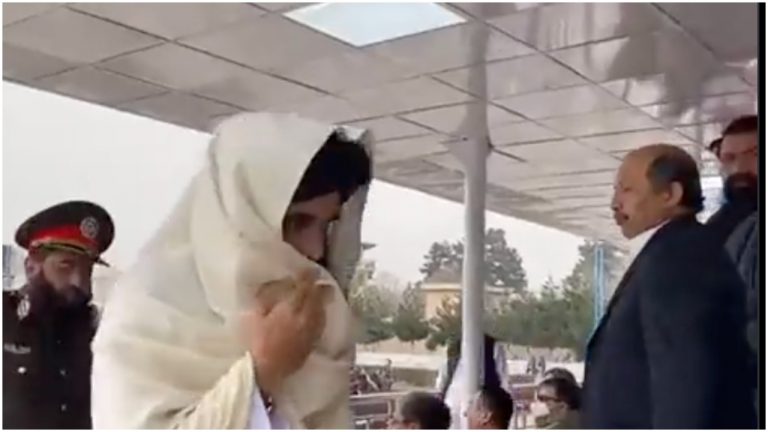
In a major embarrassment to Pakistan, Sirajuddin Haqqani – Taliban’s Interior Minister and head of the Haqqani terror network ignored Pakistan’s Ambassador to Afghanistan even as the latter stood from his seat to greet him.
According to the reports, Sirajuddin Haqqani – one of the most wanted terrorists and head of the Haqqani network- attended the police graduation ceremony at Kabul Police Academy on Saturday. This is the first-ever media appearance of the Taliban’s deputy leader, who has a $10 million FBI bounty on his head.
In a video shared by journalist Aditya Raj Kaul, it was seen Sirajuddin Haqqani leaving the event after addressing the graduates at a police graduation ceremony in Kabul. The Pakistan Ambassador to Afghanistan Mansoor Ahmad Khan got up in a panic to wish Haqqani as the Taliban leader passed him.
Pakistani Ambassador stands in attention when Haqqani Network Chief terrorist and Interior Minister of Taliban Sirajuddin Haqqani leaves. But Haqqani ignores him and walks away. pic.twitter.com/E3Q42Eq13U
However, the Haqqani leader ignored the Pakistan Ambassador and walked away even as the latter greeted him.
According to experts, the incident is only the reflection of the distrust that has developed between the Taliban and the Pakistan Army, the one time beneficiaries and supporters of the terror group.
Who is Sirajuddin Haqqani?
Sirajuddin Haqqani is the head of the ‘Haqqani Network’, based in North Waziristan, Pakistan. The Haqqani Network is responsible for high-profile attacks like – June 2011 assault on the Kabul Intercontinental Hotel, suicide bombings—in 2008 and 2009—against the Indian Embassy in Kabul and 2011 attack on US Embassy, International Security Assistance Force (ISAF) headquarters, the Afghan Presidential Palace in Kabul.
Sirajuddin Haqqani and his network were designated as a terrorist in 2012 because of their ties to the Islamic terror groups – Taliban and Al-Qaeda. After the Taliban took over Afghanistan, he was appointed as Interior Minister of Afghanistan.
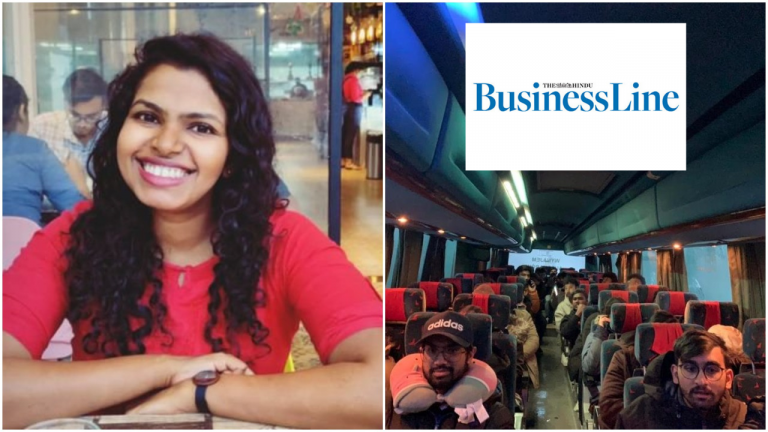
As India continues to evacuate all its stranded nationals from the war-torn country, a concerted misinformation campaign is being run by a section of left-wing media and journalists to mislead and scare the Indian nationals stuck in Ukraine. Parvathi Bindu Benu, a journalist working with the left-wing media outlet – The Hindu Business Line, was caught propagating lies about the evacuation of students from Ukrainian’s city Pisochyn.
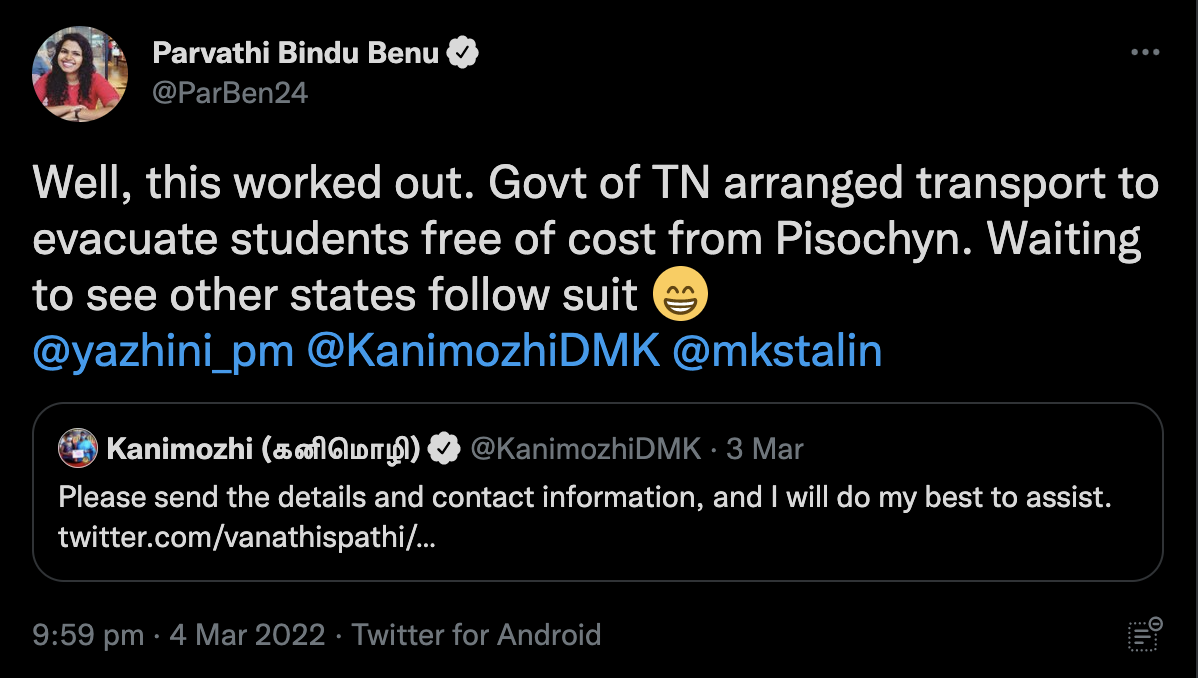
On Thursday, Parvathi Bindu Benu quoted a tweet of DMK Rajya Sabha MP Kanimozhi in which she had asked for details and contact information of certain students who were allegedly stuck in Pisochyn of Kharkiv province. In fact, Kanamozhi was responding to one of the earlier tweets put out by Parvathi asking for information about how to reach Lviv.
Source: Twitter
As Kanimozhi intervened to resolve the issue, the Hindu Business Line journalist got excited and declared that the government of Tamil Nadu arranged the transport to evacuate students free of cost from Pisochyn. The alleged journalist also ridiculed other states, saying they must follow suit.
Essentially, the ‘journalist’ was insinuating that the Tamil Nadu government directly arranged the bus to bring back the stranded students bypassing the Ministry of External Affairs. The journalist made a claim despite having no proof to suggest that the DMK-led Tamil Nadu government had arranged a bus to evacuate Tamil Nadu students from the war-torn country.
However, according to official data, the buses were arranged by the Indian government contrary to the claim of the Hindu Business Line ‘journalist’ saying that it was the Tamil Nadu government that came to the rescue of stranded Indian students by arranging the bus.
MEA had announced earlier in the day that buses will be arranged in Pisochin for evacuation; 900-1000 Indians are stranded there pic.twitter.com/Dz74QUK8JV
On Friday, the Ministry of External Affairs (MEA) Spokesperson Arindam Bagchi had said that some Indians were stranded in Kharkiv while five buses were waiting to take a section of citizens out of the Pisochyn area.
Highest attention on the eastern #Ukraine particularly Kharkiv and Pisochin. We have managed to get some buses there. 5 buses already operational, more buses later in the evening; 900-1000 Indians stranded in Pisochin & 700+ in Sumy. We are concerned about Sumy: MEA pic.twitter.com/f2MLcHvfUy
The Indian Embassy in Ukraine has also tweeted out on Saturday they were reaching out to the 298 students in Pisochyn. The Indian Embassy added that more buses are en route and expected to arrive soon to pick up students. The Embassy asked the students to follow all safety instructions and precautions.
Reaching out to our 298 students in Pisochyn. Buses are enroute and expected to arrive soon. Please follow all safety instructions and precautions. Be Safe Be Strong. @opganga@MEAIndia
The buses were arranged by MEA and local mission at the Government of India’s expense and not by the Tamil Nadu government as suggested by the alleged journalist.
More importantly, the entire evacuation process is being handled and monitored by the Ministry of External Affairs. The Government of India has launched ‘Operation Ganga’ to evacuate Indian nationals from Ukraine. No state government is running independent evacuation operations in Ukraine.
The Tamil Nadu government, which has announced its intentions to bring back Tamil Nadu students stuck in Ukraine, cannot directly coordinate with authorities in Ukraine. There is a strict protocol regarding the evacuation of Indians in Ukraine.
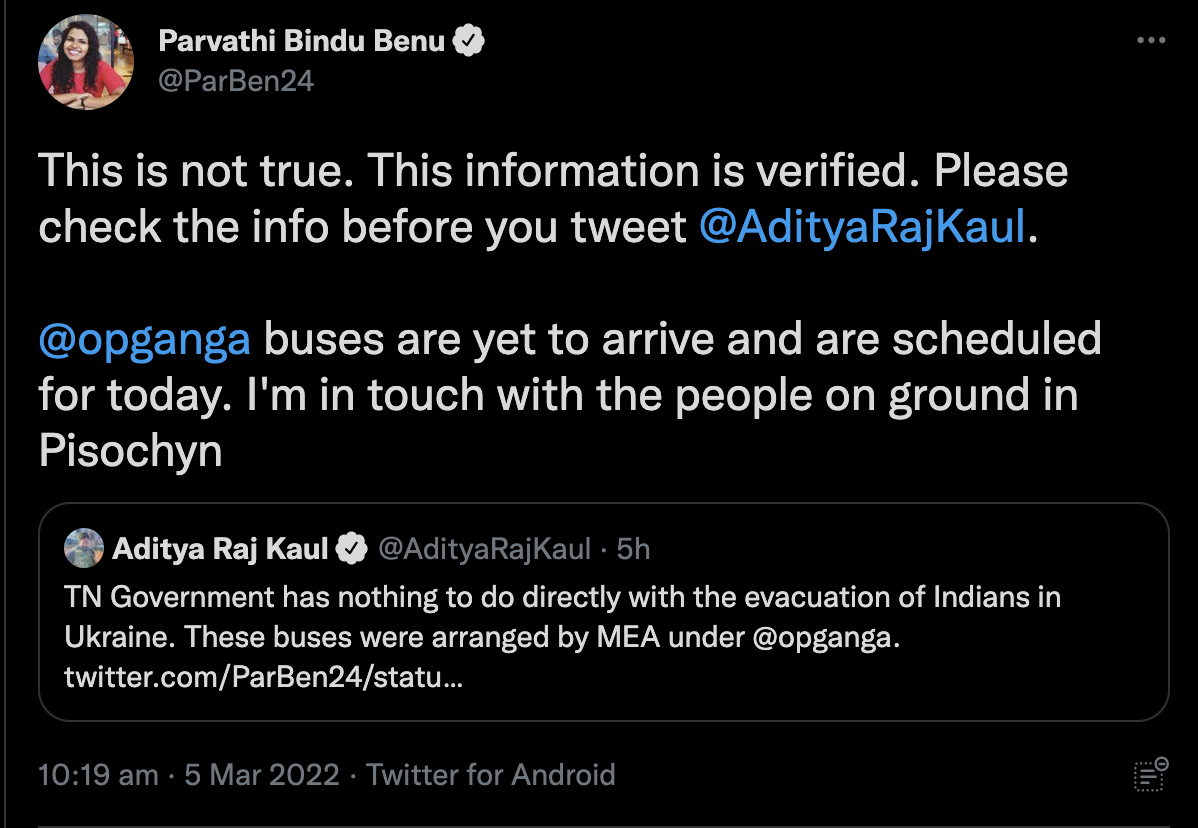
According to journalist Aditya Raj Kaul, the evacuation process is handled through an MEA Control Room and Indian embassies abroad. Tamil Nadu cannot arrange the buses, instead, it is the MEA and the embassies that are arranging buses in Pisochyn to evacuate stranded citizens.
Despite clarifications and official reports, the alleged journalist continues to mislead the public by claiming that her information is verified.
Soure: Twitter
Hence, the assertions made by the Hindu Business Line journalist is not factually correct.
Ever since the Tamil Nadu government announced that they would be sending four legislators to Hungary, Romania, Poland, and Slovakia to evacuate stranded Tamil Nadu students, there has been a concerted campaign to discredit the centre’s efforts to bring back Indian students.
I remember during mid-sixties MF Hussain – Maqbool Fida Husain- was seen in Connaught Place, inner circle New Delhi, quite often. If I remember correctly he had a 1958 make fiat which he had painted crazy with different colours like a jigsaw puzzle and one could see him driving in CP where there were hardly any cars on the road those days. This was quite a sight. At that time MF Hussain who turned into a great painter had just become famous and soon became a darling of the art circle. He was called Pablo Picasso of India!
He became so famous for his horses and modern art that some of his paintings sold at a mind-boggling price- one of his creations was sold for USD 1.6 million in 2008, setting a world record at Christie’s South Asian Modern and Contemporary Art sale.
Later in India, his talent earned him the Padma Bhushan in 1973, the Padma Vibhushan in 1989, and a nomination to the Rajya Sabha in 1986. So the man was more than big enough for any boots.
But he had a peculiar habit of not wearing any footwear, not even chappals. This was entirely a matter of choice and his argument was that he was bare feet because he liked to feel the earth under his feet.
Because of this during the peak of his career he was denied entry seeing his bare feet by a club in south Bombay – now Mumbai. No shoes no entry. Some clubs to date do not allow sports shoes and insist on collared shirts- tucked in – period. You may be anybody, rules of the institution are rules for everyone. You can’t go to the court and say, ‘it is my freedom to dress the way I want and I will wear chappals and come’. A man like this whose autographs were sought by the rich and famous was asked to go back. Though the media made some headlines he had to retreat.
The same MF Hussain was seen in boots in UK or New York during winters to protect his feet. Sensible no- he knew that frostbite doesn’t spare anyone including the rich and famous. He was neither finicky nor foolish and knew where the line needs to be drawn with rules as well as nature.
Of course, you are free to wear or not to wear shoes but you need to follow the rules. This freedom for freedom is being stretched to a breakpoint in modern times. And don’t give this ‘Convoluted Constitutional’ argument which seems to have run out of steam as a point of deflection, defence- it now looks flimsy. You cannot say I will wear Tommy Hilfiger underwear and a dollar vest to my class in school or college as it is hot, because so and so section of the constitution gives me freedom!
With the same logic if a teacher asks you a question in the class and you turn around and say:
‘I invoke my right to remain silent’ or the teacher says ‘please go and sit down in the class’ and you say ‘Sorry sir, Article 19(d) of the constitution gives me a right to roam around anywhere within India!’ when the result comes and ten out of 60 students fail, the ten who failed to give an application ‘you must pass all of us under the right of equality.’
If one has rights one also has responsibilities. One has to respect the law and respect the institution one goes to go to. Instead of making a school that teaches children to do better in life a place to be grateful for one should not think one has bought the teachers and the institution by paying the fees. No one is doing a favour- remember they are working to better our life and our children’s future.
Where will this end?
This is heading towards doom. There are plenty within the peer group to instigate children and many from the outside for their petty gains are exploiting children – our children.
Along with the heady ideas of freedom and rebellious attitude being shown in films, and the liberal brigade coaxing us, it will spell doom for the parents. Remember, governments will come and go, judges will go but our children will be ours forever. We have to take charge of our sons and daughters and support the teachers- remember if teachers go, we will have illiterate and arrogant, ill-mannered people now kids and tomorrow adults. We should not create any ill feelings in our children and should not outsource values to schools- it is our job and if we don’t the lightening will first fall on us. Remember we in a family have two or four kids to tame, the school teachers handle in hundreds. We should not make their task more difficult.
So to all the parents who are watching some tamasha or the other on some issue or the other in the society every day involving children, need to smell the coffee. All this will boomerang and wreak havoc on us only. And then there will be nowhere to go. Teachers will raise their hands, the government will not be able to do much and courts will say that it is not their job.
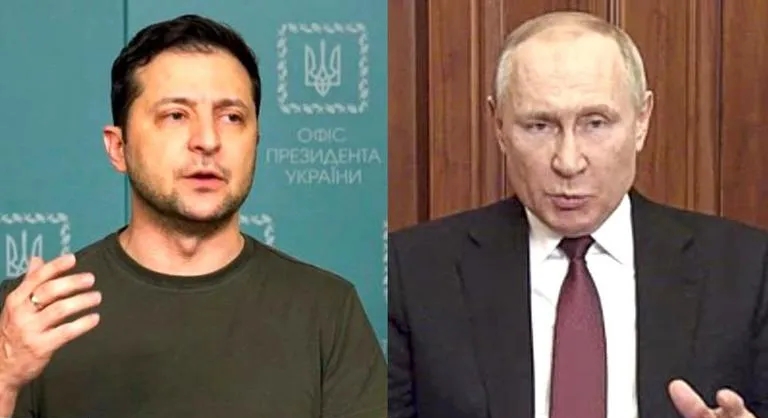
On Saturday 5th March 2022, Russia declared a ceasefire of its invasion of Ukraine to open up a humanitarian corridor for the civilians to leave the war zone safely. Russian news agency Sputnik News reported the update citing a statement by the Russian defense ministry.
According to the report, the Russian defense ministry has said, “Today, March 5, from 10 AM Moscow time, the Russian side declares a regime of silence and opens humanitarian corridors for the exit of civilians from Mariupol and Volnovakha.” According to this, civilians living in Mariupol and Volnovakha cities will find it easier to evacuate from the war-hit zone. It is notable that Mariupol is a port town and it holds strategic importance.
Mariupol and Volnovakha are located in south-eastern party of Ukraine, and are part of Donetsk Oblast. Notably, ahead of the invasion, Putin had announced that Russian govt is recognizing Donetsk and Luhansk as “independent”. The Russian president had signed a decree recognizing the self-proclaimed “Donetsk People’s Republic” (DPR) and the “Luhansk People’s Republic” (LPR) as independent.
Sputnik news agency tweeted from its Twitter handle saying, “Russia declares ceasefire in Ukraine from 07:00 GMT to open humanitarian corridors for civilians.”
CORRECTION | Russia declares ceasefire in Ukraine from 07:00 GMT to open humanitarian corridors for civilians
The Russian defense ministry has also made it clear that they have discussed the details of the humanitarian corridor and the exit routes with their Ukrainian counterparts earlier in the second round of discussion that was held in the Brest city of Belarus. Ukraine had urged in these discussions that Russia should immediately declare a ceasefire and make humanitarian corridors to evacuate civilians safely.
On Thursday 3rd March 2022, Ukraine’s presidential advisor Mykhailo Podolyak had tweeted, “The second round of negotiations is over. Unfortunately, the results Ukraine needs are not yet achieved. There is a solution only for the organization of humanitarian corridors.”
The second round of negotiations is over. Unfortunately, the results Ukraine needs are not yet achieved. There is a solution only for the organization of humanitarian corridors… pic.twitter.com/0vS72cwYSX
Sputnik News has reported that according to Mykhailo Podolyak, around 20000 people want to leave the city of Volnovakha which is situated in the Donetsk region which along with Luhansk is identified by Russia as an independent entity just before the war began. Currently, the forces of the so-called people’s republics of Donetsk and Luhansk have blockaded the city of Mariupol which is a port city. According to the report of the Sputnik News agency, the ceasefire will provide time for the local residents to secure essential items.
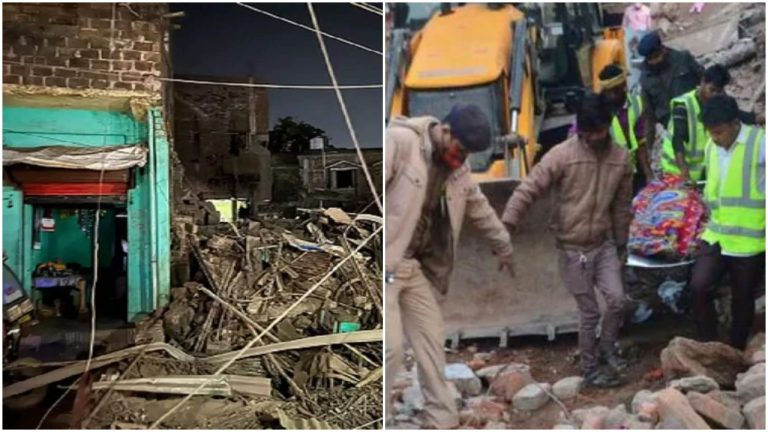
A powerful explosion swept through a three-storey structure in Bihar’s Bhagalpur district’s Kajvalichak area on the night of Thursday, March 3 and Friday, March 4. The house where the massive explosion took place was less than 100 metres from the Kotwali police station. The blast killed at least 14 individuals, including six women and two children aged 2 and 3, and injured another ten.
Under the impact of the bomb, four adjacent houses were completely destroyed, while few others suffered cracks or partially caved in. The house where the blast occurred, according to the authorities, belonged to one Mohammad Azad Malik, who had rented it out to a woman named Lilawati Devi.
Kajwalichak is a densely populated area whose inhabitants were said to be involved in illegal firecracker business.
Mohammad Azad might have visited the sight in Bhagalpur before the blast
The SIT team investigating the case is now probing the role of Mohammad Azad Malik, the owner of the house where the blast took place. It is believed that Azad had visited the scene after the bomb blast but then suddenly disappeared. Azad has been absconding ever since. As a result, the police suspect that Azad might be involved in the occurrence of the blast.
It is being believed that Azad had visited Lilawati Devi before the explosion took place. In the given situation the police believe that Azad would undoubtedly be aware of the presence of gunpowder in the house and the illegal firecracker business that was being carried out in the house. It is being doubted that even Azad might be engaging in unlawful activity under the pretence of running an iron grill manufacturing business in the same premises.
Meanwhile, the special investigation team (SIT) probing the case stormed Azad’s home and apprehended his two brothers, Mohammad Scholzer and Shahzad. Aside from that, the authorities are looking into Azad’s ties to West Bengal and explosives smugglers.
SHO suspended for dereliction of duty
Furthermore, in view of the incident of illegal storage of gunpowder and manufacturing illegal firecrackers in the area, the Station house officer of the local Tatarpur police station, Sanjay Kumar Sudhanu, has been suspended for dereliction of duty, Bhagalpur’s senior superintendent of police Babu Ram said.
Notably, the Bihar DGP SK Singhal had told reporters, “Primary investigation has suggested that an unlicensed firecracker manufacturing unit was being run from the rented house. The ATS will probe the matter. FSL samples are being collected”. Gun powder and iron nails, used in making crude bombs and firecrackers, have been seized from the spot, he said.
Large quantity of gunpowder, illegal firecrackers and country-made bombs stored in the house caused the blast
Preliminary investigation has revealed that the large quantity of gunpowder, illegal firecrackers and country-made bombs stored in the house caused the blast. As such, the explosion was so powerful that its sound was heard and trembles felt up to 10 km from the spot. The blast sent splinters flying as far as half a km. The smell of burning gunpowder was reported to have extended several kilometres by residents of nearby towns. The house where the explosion occurred was reduced to rubble, as were three other pucca dwellings nearby.
Though the Bomb Disposal Squad has not yet found any bomb or its remains anywhere during the investigation, seven-eight kgs of gunpowder have been recovered from the debris. A huge quantity of ammonium nitrate and sulphur, used in the manufacture of firecrackers, besides wrappers and plastic, have also been found at the spot, revealed DGP SK Singhal.
Power supply lines were snapped due to the blast’s intensity and the rubble was hampering rescue operations. An earthmover was used to clear the rubbles, said the DGP.
Meanwhile, an FIR has been filed based on the statement of Tatarpur police station Inspector Purnendu Kumar. Mahendra Mandal and his family have been charged in this case, along with Mohammad Azad, Lilawati Devi, and their entire family. The FIR has been filed under Section 304 (culpable homicide not amounting to murder) of the Indian Penal Code (IPC) and under sections 3 and 4 of the Prevention of Explosive Substances Ac
The deceased have been identified as Lilawati Devi (55) her daughter-in-laws Pinki Devi (30) and Aarti Kumari (24) Pinki’s son Priyansu Kumar (14) and Aarti’s son Ayansh Kumar (2), said police. Others killed in the incident were identified as Mahendra (60) (Lilawati’s neighbour), his wife Sheela Devi (55) their son, Sunil Mandal (28), Nandani Devi (daughter-in-law ) (25) and her son Moon Kumar (3).
Not the first time that such an incident occured in the area in Bhagalpur
According to local residents, this is not the first time that a blast occurred at Navin’s house. Similar incidents were reported from the spot in 2002, 2008 and 2018 but the local administration remained a mute spectator alleged the people living in the neighbourhood.
In the 2002 incident, four people were killed on the spot and two others sustained serious injuries.
“In a similar incident on October 24, 2002, Mahendra’s Suresh Mandal and three others were killed,” said Singhal, adding that a charge sheet was filed in the case against four who died in the incident.
It is worth noting that earlier there was a blast in the Khagaria district of Bihar. Prior to that, in June 2021, a bomb exploded in a non-operational madarsa in front of the Noori Masjid Islampur complex in Navtolia under the Town police station area in the Banka district of Bihar. Many people, including Maulvi Mohammad Momid of the madrassa, were injured in the blast.
Similarly, on June 10, 2021, a bomb kept in a bag exploded in Bhuvaneshwari Rampur village of Bairagachi police station area of Araria district of Bihar. A person named Mohammad Afroz was badly injured in this blast. Later it was told that Afroz was carrying the bomb in the bag. But after colliding with the bar, it exploded in his hand. Two live bombs were also recovered.
On Friday (March 4), the cricketing world woke up to a rude shock when it learnt about the untimely demise of former Australian leg spinner Shane Warne.
Warne, who was just 52 years old, died of a ‘suspected heart attack’ in Ko Samui in Thailand. Tributes poured in from all corners for the cricketing legend, who took a whopping 708 wickets in test and 293 wickets in one-day matches.
On Saturday (March 5), the Indian cricket team observed a minute’s silence in memory of Shane Warne, ahead of Day 2 of the First Test match against Sri Lanka. The players also wore black armbands when they took the field against the Lankan side.
A minute’s silence was observed before the start of play on Day 2 of the first Test for Rodney Marsh and Shane Warne who passed away yesterday. The Indian Cricket Team will also be wearing black armbands today.@Paytm#INDvSLpic.twitter.com/VnUzuqwArC
Both the Australian cricket team and the Pakistan side also observed a minute’s silence at the Pindi Stadium, before the start of the second day’s play, in the aftermath of the Peshawar attack and demise of Shane Warne.
The Australia women’s national cricket team also observed a moment of silence and wore black armbands to pay tribute to former cricketers Rod Marsh and Shane Warne, ahead of their match against the England team in the ICC Women’s Cricket World Cup 2022.
A moment of silence and black armbands in memory of two legends of Australian cricket – Shane Warne and Rod Marsh ❤️pic.twitter.com/RlEQFjsN4P
— Australian Women’s Cricket Team ? (@AusWomenCricket) March 5, 2022
In light of his contribution to the field of cricket, Cricket Australia has decided to rename the Great Southern Stand at the Melbourne Cricket Ground (MCG) as the S.K. Warne Stand.
In a heartfelt tribute to the ace spinner, former Indian captain Virat Kohli said, “I got the sad news last night about the demise of Shane Warne, out of nowhere to be honest. We carry on doing what we do in life. We are only involved in the present moment. Life is fickle and unpredictable. We need to be grateful for all the moments that we are alive. Passing away at the age of 52 is totally unexpected. Went far too early. I stand here in disbelief and shock.”
“Life is fickle and unpredictable. I stand here in disbelief and shock.”@imVkohli pays his tributes to Shane Warne. pic.twitter.com/jwN1qYRDxj
Australian Prime Minister Scott Morrison tweeted, “Shane was one of our greatest cricketers of all time, one of only a few that could approach the extraordinary achievements of the great Don Bradman. His achievements were the product of his talent, discipline & passion for the game he loved. But Shane was more than this to Australians. He was one of our nation’s greatest characters. His humour, his passion, his irreverence, his approachability ensured he was loved by all.”
His achievements were the product of his talent, discipline & passion for the game he loved.
But Shane was more than this to Australians. He was one of our nation’s greatest characters.
His humour, his passion, his irreverence, his approachability ensured he was loved by all.
UK Prime Minister Boris Johnson also paid his condolences to Shane Warne. While hailing him as a cricketing genius, Johnson thanked him for introducing disadvantaged kids to the sport.
Totally shocked and saddened to hear about Shane Warne – a cricketing genius and one of the nicest guys you could meet, who also did a lot to help disadvantaged kids into sport. pic.twitter.com/EO3K6Ipwh6
Shane Warne is immortalised in the field of cricket by his two extraordinary deliveries
Shane Warne will forever be remembered for his iconic ‘ball of the century‘, which he bowled on June 4, 1993, to English cricketer Mike Gatting. The delivery took Gatting off-guard and the batsman was bowled even before he could read the movement of the ball.
Warne bowled the leg-spin during the 2nd day of the First Test match of the 1993 Ashes series at the Old Trafford cricket ground in Manchester. The delivery by an inexperienced Warne hinted at the revival of leg-spin bowling in international cricket. Interestingly, it was his first-ever ball in an Ashes test series.
A modest Warne had said, “The ball of the century was a fluke. It really was. I never did it again in the first ball of any time. So it really was a fluke and I think it was meant to be.”
12 years later, the ace spinner went on to deliver the ‘Edgbaston ripper’ in 2005.
He bowled a leg-spin delivery from round the wicket to dismiss English batsman Andre Strauss. The spin was so massive that it left the batsman bamboozled and earned Warne the title of one of the greatest spinners in history.
A Commerce Secretary level meeting between India and Bangladesh was held in New Delhi on 4th March 2022. The commerce secretary of the government of India, B.V.R. Subrahmanyam led the Indian delegation while Mr. Tapan Kanti Ghosh, who is the senior secretary in the ministry of commerce of the government of Bangladesh, led the Bangladesh delegation.
According to a report by ANI, in this meeting, both sides held extensive discussions on a variety of issues of mutual interest. The discussed issues include the development of railway infrastructure, port infrastructure, Joint Study on Comprehensive Economic Partnership Agreement (CEPA), Border Haats, Regional connectivity through Multi–Modal Transportation, Harmonization of Standards, Mutual Recognition Agreement.
It is notable that Bangladesh is the sixth largest trade partner of India. Keeping this thing in mind, both sides discussed various aspects of improving the multimodal connectivity between the two countries. Among the issues discussed for the facilitation of trade between India-Bangladesh through railways, a Detailed Project Proposal (DPP) was approved for developing a container handling facility at Sirajganj Bazar.
A 900-meter long new siding line is constructed at Benapole for running freight trains between India-Bangladesh. Besides, the construction of the loading and unloading platform is completed at Darshana in order to allow the import of all commodities from India by rail via Darshana. A DPP is also approved for the development of Rail and Road-based ICD at Ishwardi.
A consensus was made over the use of returning empty railway wagons/containers by Bangladesh. The overall logistics cost of India’s exports to Bangladesh will be significantly reduced due to this. Both the countries also agreed upon opening the border haats which were closed due to covid restriction. CEPA study will also be finalized soon.
Press Information Bureau has said in its press release that the meeting was preceded by the 14th meeting of the Joint Working Group (JWG) on Trade, at the level of Joint/Additional Secretaries of the Ministry of Commerce and Industry, Government of India, and Ministry of Commerce, Government of Bangladesh on 2-3 March 2022 in New Delhi. Comprehensive discussions were held on various areas of mutual interest. In the meeting, it was agreed that the next meetings of the JWG and Commerce Secretaries will be held in Bangladesh and the dates of this meeting will be decided as per mutual convenience.
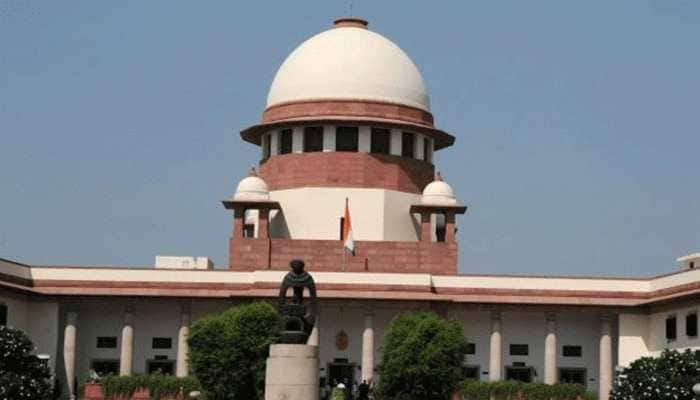
The Supreme Court on Friday rejected a Special Leave Petition (SLP) filed by the Central Bureau of Investigation (CBI) demanding a stay on an order passed by the Kerala High Court grating bail to CPI(M) members accused of “brutally killing” an RSS member.
Dismissing the petition, a bench of Justices SM Kaul and MM Sundresh stated that it had grave reservations on the factual findings of the case, along with the fact that the CBI did not bring up the case for more than a year and no aggravating circumstances were shown after the respondents were released in pursuant to the impugned order.
However, the premier probe agency also contended that the Kerala HC granted bail through the impugned order in 2021 taking into consideration that the accused were in jail for over six years without a trial, which the CBI said was not due to any delay on its part.
Kerala HC granted bail to accused despite noting they were prima facie guilty of the offences: CBI
The CBI in its petition had argued that the Kerala HC granted bail to the accused despite noting that it was “prima facie convinced that the accused are guilty of committing the offences alleged against them.”
The accused, members of CPI(M), are charged with brutal broad daylight murder of RSS member Shri Janithottathi Manoj and an attempt to murder of one Mr Pramod.
According to the charge-sheet filed in the case, the attack which involved targeting the victim and Pramod with bombs, swords, choppers, etc., which led to the death of RSS member Manoj, was a well-thought-out conspiracy and a planned murder.
In the preliminary charge-sheet, 19 people were named as accused, and later a supplementary charge-sheet was filed which added another 6 to the list of accused.
The court took cognisance of the case in March 2015 and a trial has been pending before the Special Judge (CBI) since then. The CBI noted that the accused had filed several applications from 2015 to 2018, which were rejected on merits while observing that prima facie allegations against them were true.
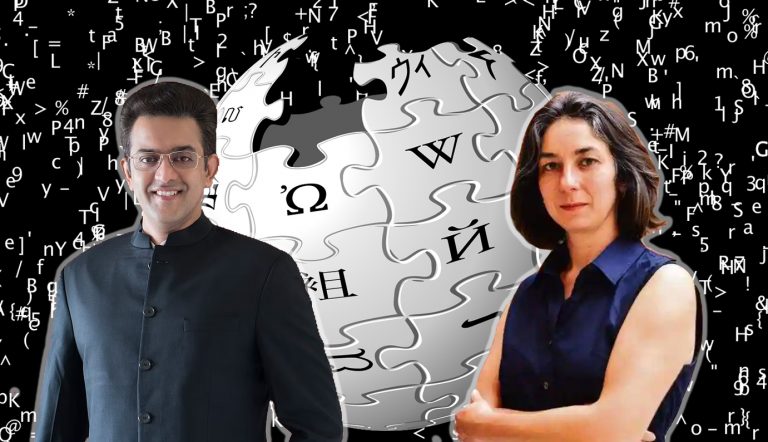
Historian Vikram Sampath has been under attack of Leftists and Islamists in the recent weeks, making false allegations of plagiarism against him. It was led by three professors from universities in the US, Ananya Chakravarti, Rohit Chopra and Audrey Truschke. While the allegations were proved fake, Hinduphobic professor Audrey Truschke has now launched a massive attack against Sampath, including vandalising his Wikipedia page.
It was pointed out by Vikram Sampath himself on February 27, when he tweeted that his Wikipedia page was vandalised by an editor with a history of vandalising pages linked to India.
Even as the forged signatures unravel Trangabellam continues to vandalize my @Wikipedia pg, which she joyfully acknowledges?. Note Trangabellam created Dr Truschke’s page; vandalized @sanjeevsanyal ‘s page & also Balakot strikes!! Are they the same person – AT & TB: alter-egos? pic.twitter.com/0ByGymX8VU
The Wikipedia page of Vikram Sampath is seeing hectic edits for last few weeks, and every random allegation made against the historian was added to the article. Although Wikipedia rules say that only verified information backed by credible sources should be added to its articles, baseless allegations and plain opinions were added to the page, mostly by an editor with the ID TrangaBellam, like a Scroll article titled “How historian Vikram Sampath uses decolonisation rhetoric to make Hindu domination sound reasonable”.
As the Audrey Truschke continued to make charges against Vikram Sampath, all of them were updated on the Wikipedia page. And interestingly, the professor herself proudly announced that her allegations against Sampath had made their way to Wikipedia.
It is notable that the changed to Wikipedia were made on nearly real-time basis, which means they were added to the page immediately after the allegations were made against the historian, completely violating the Wikipedia policy of publishing only verified information.
The page had added details about an ‘open letter’ against Vikram Sampath purportedly signed by several persons in India and across the globe, a majority of which were found to be fake.
Audrey Truschke had tweeted about the letter, claiming that ‘75+ concerned scholars’ have signed it.
Open letter of support by 75+ concerned scholars for Drs. Ananya Chakravarti, Rohit Chopra, and Audrey Truschke regarding their service to the profession and academic freedom in calling attention to Dr. Vikram Sampath’s plagiarism. https://t.co/4GO10qC9PY
However, after several ‘signatories’ of the letter including Ramchandra Guha, Pratap Bhanu Mehta, Sanjay Raut etc clarified that they had not signed it, the reference to the letter was later removed. It is notable that actually the name of Ramchandra Guha was not even in the letter, a name Ram Guha was there. But the Wikipedia editor assumed it to be Ramchandra Guha and added that he had signed the letter before removing the entire para.
Later, it was found that the ‘open letter’ by Audrey Truschke was filled with forged signature, and it has no mechanism to verify the identity of the signatories to make such grave allegations against Sampath. It was just an open Google document which anyone could sign by giving any name.
However, even after it was comprehensively proved that most signatures on the open letter were forged, and they were added either by Audrey Truschke or someone from her team, the Wikipedia editor TrangaBellam refused to believe that. While one prominent name after another, name of whom appeared in the letter, had clarified they had not signed it and didn’t even see the letter before, the editor claimed it was ‘not a forgery’.
In the talk page of the article, when one user had pointed out that the letter comes under forgery, TrangaBellam said that he had removed the reference to the letter, but added, “It was not a forgery but a harebrained way of using technology”. The editor implied that Audrey is not well versed in technology, and that’s why she created the open letter in such a way that anyone could sign it using any name. This raises the question, how does TrangaBellam know that Audrey Truschke is not good with technology, do they know each other personally?
Morever, this is a shocking defence of an open forgery done by Audrey Truschke, and proves that the editor TrangaBellam is highly partial to the professor, who might be personally known to her. Therefore, the editor should not even be eligible to edit the page of Vikram Sampath as he has direct interest in defaming him.
Several editors also rightly pointed out that the plagiarism section has become too large compared to the overall article. The Wikipedia page of Vikram Sampath is very brief, but now the new section added to it had increased its volume by more than double. They said that a 300 word section on the plagiarism allegations is too much for a 570 word bio. But TrangaBellam rejected all these arguments, saying that “Coverage of “alleged plagiarism” is on a steady increase,” pointing out media reports on the allegations and the case filed by the historian against it at the Delhi High Court.
There are more arguments by TrangaBellam showing that he is openly biased against Vikram Sampath, and he was showing most interest in editing the historian’s page to add as much unverified allegations against him as possible. In fact, reacting to the clarification given by Sampath to the allegations, the editor said, “I am not buying Sampath’s arguments.”
After several prominent left-liberal personalities issued statements that their signs were fraudulently added to the letter, Audrey had blamed ‘Hindu Right IT cells’ of vandalising it.
Social media user Soumyadipta also recorded the vandalism of the Wikipedia page by the team of Audrey, and said that due to this, his IP address was blocked from the site. He alleged that TrangaBellam is part of a team of Wikiepedia editors, some of whom have admin rights, and therefore they can block people who expose them.
Alert: Wikipedia Admins have blocked my IP after gaining access to my profile. Both Vanamonde93 & Newslinger are Admins and have those rights. They might be after you too. If you have interacted with me citing specific conversations with Kautilya or TrangaBellam, please delete it pic.twitter.com/Z3HfUHVmPw
Most of the edits against Vikram Sampath in the Wikipedia page are made by one single editor, TrangaBellam, who has a history of vandalising Wikipedia pages to defame India and Hinduism. Anytime any Wikipedia adds a single line that seems to be favourable to Vikram Sampath, this editor appears and reverts the changes. And any time any allegation against Sampath appears, the same editor adds that even without verifying the facts.
The Wikipedia page of Audrey Truschke was created by this editor, and seems to regularly maintain the page of the Hinduphobic professor. This again points out to the possibility that both may be linked beyond Wikipedia.
This incident of Wikipedia editor TrangaBellam being biased towards the leftist Hinduphobic and Aurangzeb apologist professor Audrey Truschke is just one example of the larger problem at Wikipedia, its senior editors and moderators are dominated by Leftists and Islamists. Time and again we have recorded such bias of Wikipedia, and this has been confirmed by none other than Wikipedia cofounder Larry Sanger, who is no longer with the organisation now. He had said on several occasions that nobody should trust Wikipedia, because the site has been taken over by leftists who reject content that doesn’t fit their agenda.
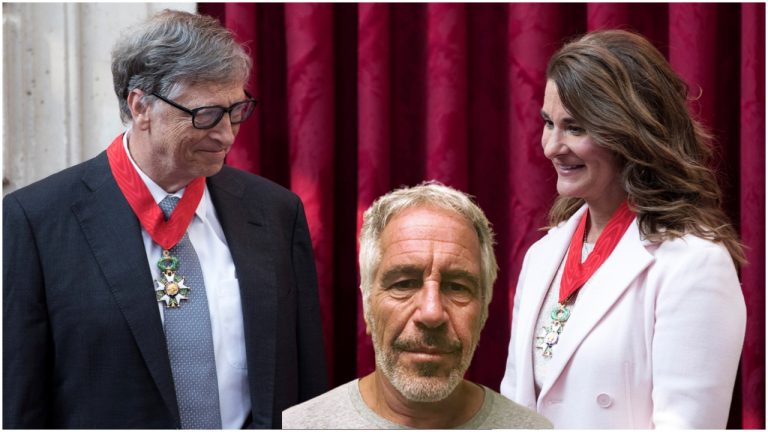
In a sensational disclosure, Melinda French Gates on Thursday criticized her ex-husband Bill Gates for meeting Jeffrey Epstein, the financier accused of child sex crimes, multiple times.
In her interview with CBS News on Thursday, Melinda Gates revealed that she had met Epstein once, saying that afterwards, she “had nightmares.” “I wanted to see who this man was, and I regretted it from the second I stepped in the door,” the former wife of Microsoft founder Bill Gates said.
This is the first interview of Melinda French Gates since her divorce from multi-billionaire Bill Gates.
Melinda Gates referred to Epstein as “abhorrent” and “evil personified” but did not disclose whether she asked her husband to stop meeting with him.
Jeffrey Epstein, who was awaiting charges of sexual exploitation of underage girls, hanged himself in his Manhattan jail cell in August 2019.
On the question of whether her husband’s relationship with Epstein played a role in their divorce, Melinda Gates said that it was one of “many things” that contributed. In the interview, Melinda disclosed that she cried for days after the divorce, questioning herself about how she would move forward following the split.
“Well, I think it’s really important to say, look, I had a lot of tears for many days. I mean, days where I’m literally laying on the floor and the carpet, you know, this close to me, thinking, “How can this be? How can I get up? How am I gonna move forward?'” she said.
Gates said she started on this journey of healing, and she felt like she was starting to get to the other side. “And I do feel like I’m turning a page in the chapter now. I mean, it’s 2022, and I’m actually really excited about what’s to come and life ahead for me,” she said in the interview.
Melinda admitted that she and Bill Gates are “friendly at this point” and continue to have a working relationship.
Microsoft co-founder Bill Gates and Melinda had announced in May last year that they were getting divorced after 27 years of marriage. Bill Gates and Melinda Gates got married in 1994, and they have three children together.
It was reported Bill Gates’s March 2020 departure from Microsoft and the subsequent divorce occurred following an investigation into an affair he had with an employee in 2000.
Bill Gates, who founded Microsoft in 1975, has reported a wealth of $129 billion. He stepped down as the company’s CEO in 2000 and left his full-time role at Microsoft in 2008 but held onto his board seat until March 2020.