Home Blog Page 4615

‘Mandarin only’: China removes Uyghur language as medium of instruction in Xinjiang

0

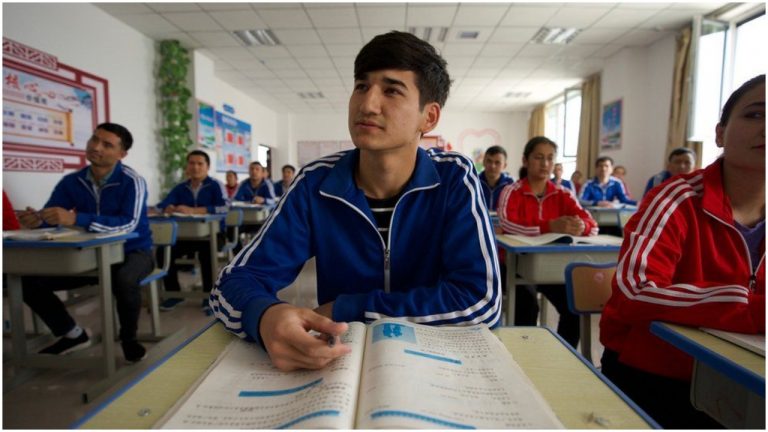
Even as China continues to reject the allegations of ongoing human rights abuses in the Xinjiang region, the alleged atrocities against the Uyghur Muslims continues. In a recent revelation, it has now been revealed that the Chinese authorities have removed the Uyghur language instruction from educational institutions in the region.

According to a Radio Free Asia (RFA) report, the Keplin county in northwest China’s Xinjiang Uyghur Autonomous Region (XUAR) no longer provides education in Uyghur language to students. Xinjian province is the home to Uyghur population, and the national laws guarantee minorities the right to bilingual education.

In an audio recording accessed by RFA’s Uyghur Service this week, a person claiming to be an Uyghur man from Kelpin county was reportedly heard making phone calls to the Bureau of Education in his hometown to ask for information about how to place the children of his neighbours, who he claims are detained in an internment camp, in school.

Instruction to be carried out in ‘national language’ or ‘Mandarin Chinese’ only

Continuing, the man who identified himself as an employee of the Kelpin Bureau of Education says that the caller could bring the two children, reportedly aged five and seven, to the bureau offices. As the caller asked to clarify which language the children would study in, the bureau employee said that instruction in Kelpin would be carried out in the “national language,” or Mandarin Chinese only.

When the caller asked if it is possible to choose the medium of instruction to be Uyghur, the Bureau employee responded by saying, “The national language is the standard now.”

After receiving the audio recording, the RFA has now received similar calls from Kelpin County No. 1 Intermediate School. One of the administrators confirmed to RFA that “schools in Kelpin no longer offer Uyghur language instruction”.

“Speaking Uyghur language is not allowed [on school grounds],” the administrator said stating, “Normally, it’s not even OK for us (staff) to speak to one another in Uyghur.”

Persecution of Uyghur Muslims in China

According to a 2017 report by the head of the Institute of Sociology at the Xinjiang Academy of Social Sciences, the increasing Muslim population in Xinjiang contributed to increased political risk, poverty, and extremism. One of the reasons cited behind their high birth rates was the Islamic belief that the foetus was a gift from God.

However, experts are of the view that it is a strategy of the Communist Party of China (CCP) to strip Uighurs of their religious and ethnic identity and assimilate them into the dominant Han Chinese ethnicity. While Uighur Muslims are often subjected to re-educational programs, forced labour, and digital surveillance, their children are indoctrinated in orphanages.

Reportedly, Uyghur Muslims have been the subject of a massive crackdown since 2017. They were held up in prisons for praying, traveling abroad, or even using social media under the pretext of containing ‘ religious extremism’. According to researcher Zenz, two counties and townships have directed authorities to leave no ‘blind spots’, contain illegal births, and decrease fertility levels.

However, China has rejected allegations of cracking down on Uyghur Muslims by sending them to mass detention camps and interfering in their religious activities. The Communist Party of China has denied that it is engaged in human rights abuses against the Uyghurs in Xinjiang even as several reports highlight brutal crackdown on the ethnic community.

Recently, a commission of the United States Congress, in a new report, said that China has possibly carried out “genocide” against Uyghurs and other minority Muslims in its western region of Xinjiang.
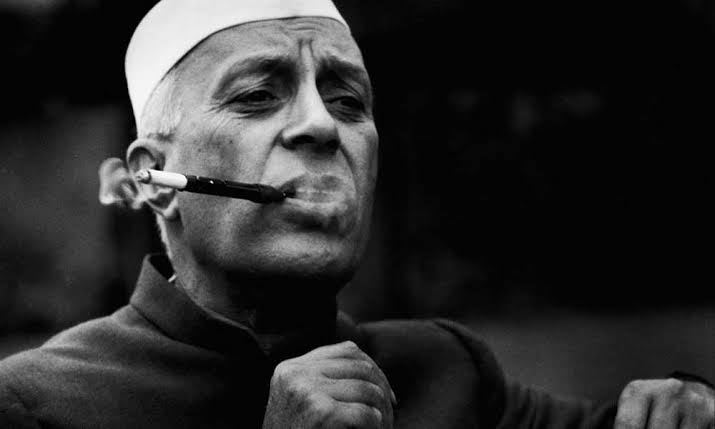
Union Budget 1959: When PM Nehru reduced the defence expenditure by Rs 25 crores and China attacked India three years later

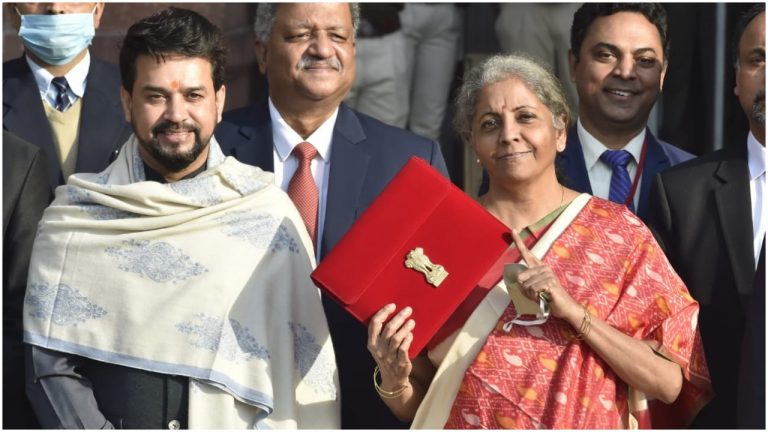
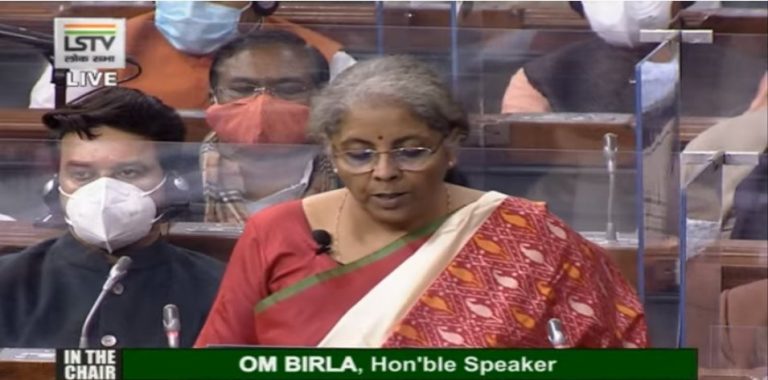
On the day when Finance Minister Nirmala Sitharaman presented the second annual budget since the Modi government’s relection to the Centre in 2019 General elections, former Congress president Rahul Gandhi put forth a laundry list of demands that he wanted to be included in Budget 2021. 

The Gandhi scion took to Twitter to convey what he wants to see in this year’s Budget. The senior Congress leader tweeted that the budget must include support for MSMEs, farmers and workers to generate employment. He also added that the budget must place focus on increasing health expenditure to save lives and enhancing defence expenditure to safeguard borders. 

It was hard to miss that Gandhi’s demand to raise Defence expenditure was made in the context of the ongoing standoff between the Indian and Chinese forces along the Line of Actual(LAC) in eastern Ladakh. 

While the Wayanad MP pompously demanded a hike in the country’s defence budget, it is opportune time to revisit the times when the former Prime Minister of the country and Rahul Gandhi’s great grandfather, Jawaharlal Nehru, trimmed down the defence budget in the face of rising Chinese aggression. 

Nehru could be attributed to more Himalayan blunders than one can shake a stick at. From gifting the UNSC seat to China to the vexed issue of Jammu and Kashmir, the 1962 debacle, the partition of the country and many more, Nehru has been squarely blamed for these colossal mistakes. 

Nehru govt slashed 1959 defence budget by Rs 25 crores

However, one of the less talked-about blunders that Nehru presided over was the pruning down of the 1959 Union budget when tensions with China were flaring. Three years later the catastrophic Indo-Sino war took place where the Chinese forces caught their Indian counterpart off-guard, resulting in a humiliating Indian defeat. 

The Union Budget 1959 saw a significant reduction in the defence expenditure. The budget had the defence expenditure cut back by Rs 25 crores, and a deficit of Rs 82 crores in the central budget. 

The scaling down of the defence expenditure was the first in a series of disastrous decisions taken by the then Prime Minister Jawaharlal Nehru and which culminated into India’s defeat in the Indo-Sino war in 1962. Not only did India lose the war, several thousand square kilometres of what now lies in Aksai Chin was captured by China. 

Shockingly, the then government, led by Jawaharlal Nehru, was warned of a possible attack by China, almost two and a half years before the first wave of Chinese troops overran the border in 1962, but Nehru and the then defence minister Krishna Menon, did not feel the need to take professional military advice, and the result was that India suffered its worst-ever defeat during the Indo-China conflict in 1962.

The Army had flagged about a possible attack from the Chinese. Jawaharlal Nehru, however, viewed the army with suspicion. He did not, ever, pay attention to his army’s submissions and did little to strengthen or bolster the army. There have also been reports that Nehru and his defence minister VK Krishna Menon had then insidiously conspired to discredit General Thimayya (Chief of Army Staff from 1957 to 1961, who ahead of the 1962 Indo-China War), setting in motion a chain of events that contributed to India’s defeat in the Himalayas.

In fact, even before 1959, Nehru wanted to disband the Army. A biography of Major General AA “Jick” Rudra of the Indian Army by Major General DK “Monty” Palit says that shortly after independence, Nehru had said how India does not need a ‘defence plan’. “Our policy is ahimsa (non-violence). We foresee no military threats. Scrap the army! The police are good enough to meet our security needs,” Nehru had reportedly said.

Retired Air Marshal pins the blame of defeat on Nehru

Last year, a video of Air Marshal Denzil Keelor (Retd.), a war-hero of the 1965 India-Pakistan war, had gone viral on various social media platforms, where the retired Air Marshal shared his personal account on how the lapses committed by Jawaharlal Nehru resulted in India facing an embarrassing defeat at the hands of China in the 1962 India-China war.

In the video, Air Marshal Denzil Keelor (Retd.) could be heard speaking about the 1962 India-China war, saying that India lost the war to China because of Jawaharlal Nehru’s failure. He said how Nehru relied on diplomacy and ignored the armed forces, because of which India lost. Keelor had stated that at the time of the war, Indian Army’s soldiers did not even have proper woollen clothing to face the weather and the difficult terrain of the Himalayas.

It is pertinent to note that after presiding over such a colossal blunder, Nehru attempted to gloss over his mistakes and downplay the loss of territory. Dismissing the lands occupied by China as inhospitable and uninhabited, Nehru reportedly said, “In those barren land and mountains of Ladakh and Arunachal, not even a blade of grass grows.”

Relief for senior citizens, ease in filing of IT returns: Here’s all the Indirect and Direct tax proposals in Budget 2021

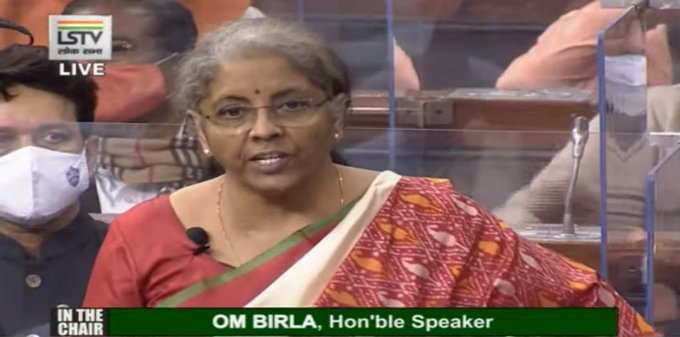
Finance Minister Nirmala Sitharaman presented the Union Budget 2021-22 on Monday. The Union Budget-2021 assumes greater significance as it comes amidst the novel coronavirus pandemic, which has led to massive economic disruption across the world.

In her speech, FM Sitharaman announced that India’s fiscal deficit is set to jump to 9.5 per cent of Gross Domestic Product in 2020-21 as per Revised Estimates. This is higher than the 3.5 per cent of GDP that was projected in the Budget Estimates last year.

Considering the circumstances, the tax provisions in the Union Budget 2021 acquires special significance. Citizens every year look forward to the announcements on taxes during every budget speech and this year was no different.

Here are the government’s direct and indirect tax proposals announced in this year’s budget:

Direct tax proposals:

  1. For senior citizens above 75 years who only have an interest and pension income are exempt from filing income tax.
  2. Banks and agencies will deduct the necessary income tax directly.
  3. Reopening of assessments reduced to 3 years from 6 years other than cases of serious tax evasion. In serious tax evasion cases of concealment of 50 lakh or more in a year, reopening can be done up to 10 years as at present.
  4. Tax audit limit increased from Rs 5 crore to Rs 10 crore.
  5. Budget Proposes to increase the threshold for tax audit to Rs 10 cr as against Rs 5 cr for those transacting 95% digitally.
  6. Advance tax liability on dividend income shall arrive only after the declaration of payment of dividends.
  7. Startups get one more year of the tax holiday. Capital Gain exemption for investment in Start-ups gets increased by one more year.
  8. Propose to constitute a dispute resolution committee for small taxpayers. Anyone with a taxable income of up to Rs 50 lakh, disputed income of up to Rs 10 lakh eligible to approach dispute resolution committee.
  9. Govt to extend eligibility of erstwhile tax sop on home loan up to the year 2022.
  10. Finance Minister Sitharaman proposes policies to make it easy for foreign investors to invest in India’s infrastructure projects.
  11. Propose to make dividend payments to REIT (estate investment trusts) and Invit’s (Infrastructure investment trusts) exempt from TDS.
  12. To further ease filing of IT returns, details of capital gains and interest from banks, post offices, etc will be pre-filled.
  13. Details of capital gains from listed securities, dividend income, and interest income to also be pre-filled in tax forms.
  14. To extend the eligibility of provision for an additional deduction of Rs 1.5 lakh for loans taken to purchase affordable housing by one more year.
  15. To ensure employees’ contribution to retirement schemes is done on time, late payment of such contributions by employers will not be allowed.

Indirect Tax proposals

  1. Reducing customs duty uniformly to 7.5% on semi, flat and products of non-alloy, alloy and stainless steel.
  2. Exempting duty on steel scrap till March 2022.
  3. To provide relief to copper recyclers, reducing duty on copper scrap from 5% to 2.5%.
  4. To rationalise customs duty gold and silver Raising customs duty on some auto parts to 15%.
  5. To raise customs duty on cotton from 0% to 10%, on raw silk and silk yarn from 10% to 15%.
  6. Agri Infrastructure Development Cess on a small number of items, to not put additional burden on consumers on most items.

Punjab: Hindu Temple attacked in Phillaur, gunmen shoot priest, girl

On January 31, a Hindu temple priest identified as Sant Gyan Muni was attacked by unknown assailants in Phillaur, Punjab. A 16-year-old girl who came to his rescue was also shot during the incident. As per a report in Jagbani, two assailants had opened fire on the priest. A girl identified as Simran came to his rescue, but she was shot too. They were rushed to the DMC hospital in critical condition. The incident took place in Bhar Singh Pura village of Phillaur during the early morning hours.

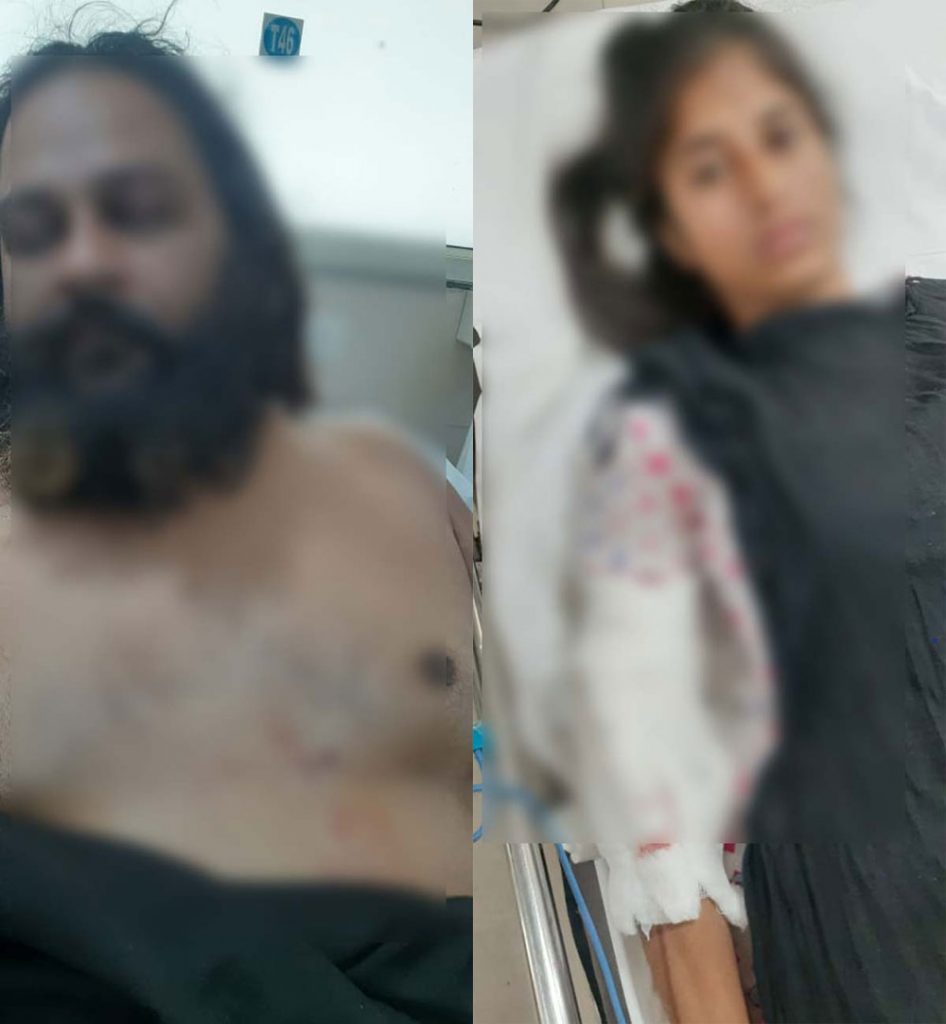
Sant Gyan Muni and Simran (Images: Jagbani)

Reports suggest that there was a group of devotees in the temple at the time of the incident. The shooting caused a stampede among the devotees. The assailants reached to the place where the priest was sitting and started shooting at him. Simran rushed to his rescue, but the assailants shot her two. The priest got shot thrice while Simran suffered two bullet injuries. Both of them are getting treatment at Civil Hospital Jalandhar in critical condition. As of now, it is unclear why assailants attacked the priest.

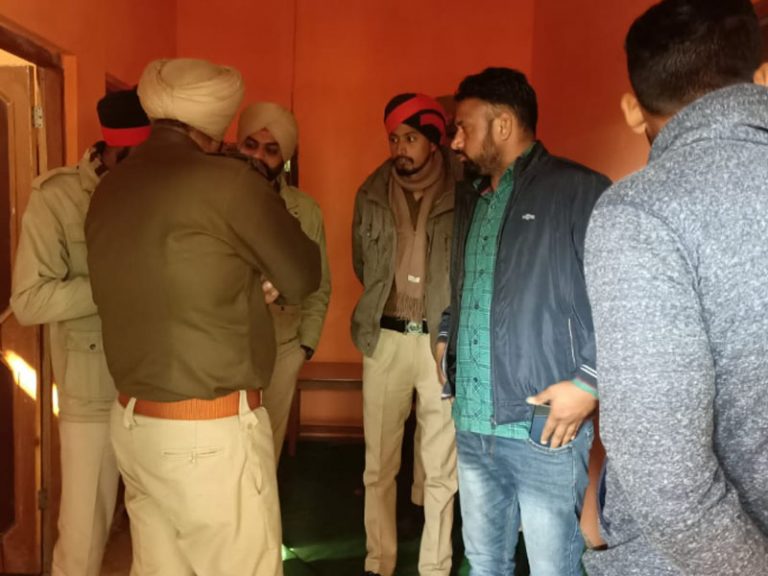
Superintendent of Police Suhail Kasir Mir and SHO Sanjeev Kapoor visited the spot for investigation with a police party. Sant Gyan Muni had established the temple a few years ago. Some reports have suggested that there was some dispute over the establishment of the temple. SHO Kapoor said, “An FIR has been lodged against two persons under Sections 307 and 34 of the Indian Penal Code and Sections 25, 27 and 54 of the Arms Act. The victims are serious and are receiving treatment. The search for shooters is on.”

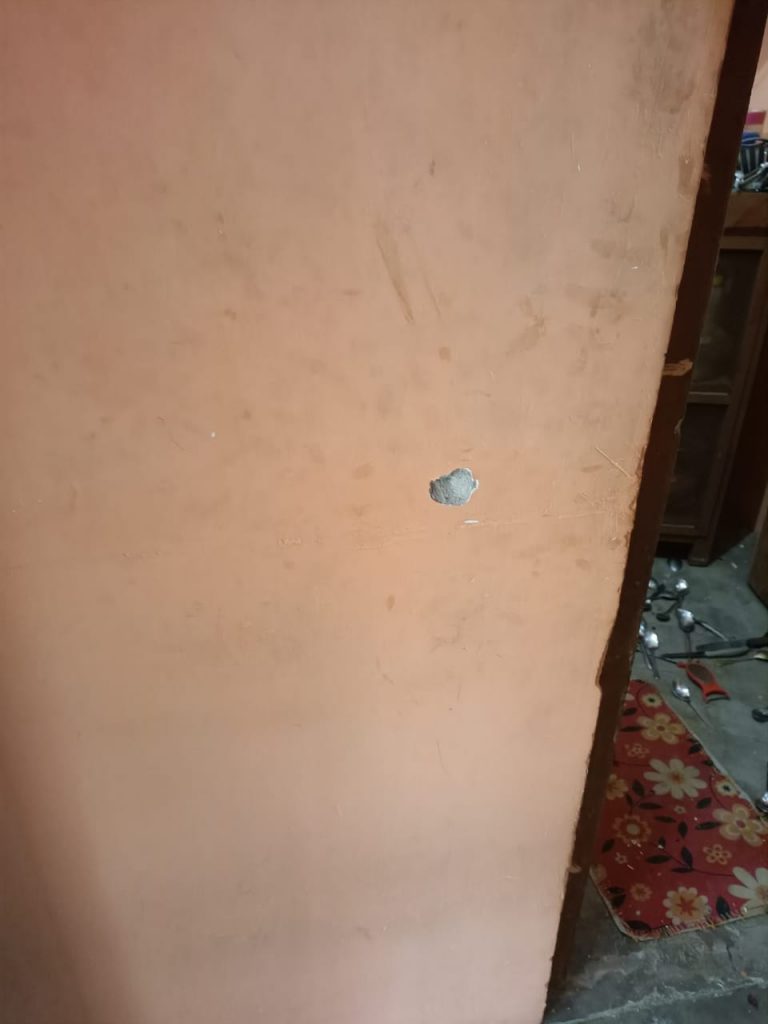
Bullet hole on the wall inside temple (Image: Jagbani)

Notably, village Bhar Singh Pura recently gained headlines because of Khalistan Tiger Force Chief Hardeep Singh Nijjar, who was born in this village. In 2020, he was designated as a terrorist by the Indian government along with Gurparwant Singh Pannu of Sikhs for Justice. In September 2020, NIA had attached his properties in Bhar Singh Pura village under section 51A of UAPA.

Central university in Leh, more tribal schools: Here’s what FM Nirmala Sitharaman announced in Budget 2021 for education sector

Union Finance Minister Nirmala Sitharaman presented the 2021-22 Union Budget in the Parliament today. During her speech, Sitharaman announced initiatives which are expected to provide a big thrust to the education sector. She proposed to quantitatively strengthen 15,000 schools under the National Education Policy and develop more than 100 new Sanik schools.

“100 new Sainik schools will be set up in partnership with NGOs, private schools, and states. We would be introducing the legislation this year to implement the setting-up of Higher Education Commission of India”, said the FM.

The Finance Minister further said that there are other ‘umbrella’ structures to be created for higher education. The government also proposed to form a new higher educational panel and International partnership for skill training.

The Union Government also announced a central university in Leh, in order to ensure easier access to higher education in Ladakh and more schools in tribal areas. The Union Budget 2021 announced Rs 50,000 crore in the Budget for National Research Foundation for the period of five years. This will focus on national priorities such as digital payments and national language translation mission that would translate.

The idea is to promote research and development and spur innovation in the country, said the Union Finance Minister, furthering that the national language mission would translate governance-related documents available online to major Indian languages. 

This is Finance Minister Sitharaman’s third budget under the National Democratic Alliance (NDA) government led by Prime Minister Narendra Modi. In a significant departure from the tradition, this year’s Budget is unique as it was presented paperless.

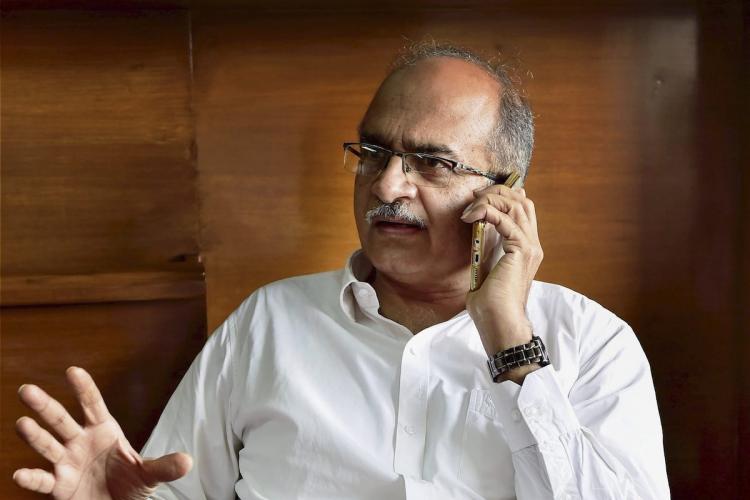
Prashant Bhushan slammed after he claims Covid-19 is ‘dying naturally’, wants vaccine money to be used for farmers’ MSP

‘PIL Activist’ Prashant Bhushan appears to have lost control of his mental faculties that at some point of time enabled him to think critically. He has now advocated that financial resources allocated towards Covid-19 vaccines in Union Budget 2021 ought to be relocated to migrant workers and farmers because Covid-19 was “naturally dying down” in the country.

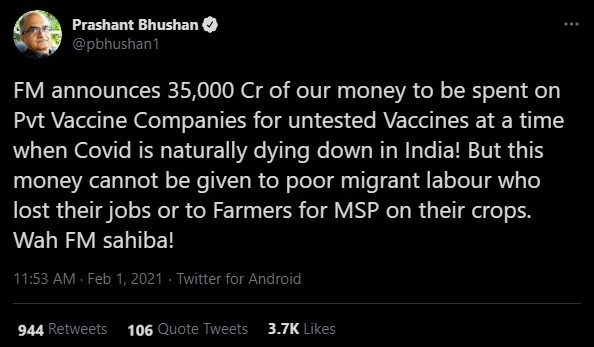
The controversial activist said, “FM announces 35,000 Cr of our money to be spent on Pvt Vaccine Companies for untested Vaccines at a time when Covid is naturally dying down in India! But this money cannot be given to poor migrant labour who lost their jobs or to Farmers for MSP on their crops. Wah FM sahiba!”

Prashant Bhushan
The PIL Activist speaks

His absurd comment has drawn sharp reactions on social media from people who were not too happy with the line of argumentation Prashant Bhushan had adopted.

Someone said ‘Tajinder Bagga was right’, although we are not quite sure what he meant by that.

While it is true that Covid-19 cases have seen a sharp decline in recent months, advocating that money for vaccines be relocated to MSP for farmers and migrant labourers is no less than stupidity. Sufficient resources have already been allocated towards farmers and other welfare schemes in the Union Budget 2021.

Criticizing Finance Minister Nirmala Sitharaman for allocating financial resources to Covid-19 vaccines appears to be the height of absurdity.

Budget 2021: Govt plans to raise Rs 1.75 trillion through disinvestment, LIC IPO announced

Finance Minister Nirmala Sitharaman presented the Union Budget 2021-22 on Monday. In her budget speech, Sitharaman announced that the government plans to raise Rs 1.75 trillion through its ambitious disinvestment proposal.

As per the finance minister, BPCL, BEML, IDBI, CCI, Air India, Concor, Nischal Ispat, Pawan Hans will be disinvested in the current fiscal year. Two banks and one general insurance company to be taken up for sale as well.

For start ups, we are allowing 1% companies to grow without any restriction on their paid-up capital. Other than IDBI we plan to take up 2 more banks for disinvestment. LIC IPO will come in 2022. All divestments announced so far, including Air India, BPCL, CONCOR, Pawan Hans, to be completed by 2022,” she said.

The big, bold move of disinvesting LIC through IPO

Besides, Sitharaman also proposed to bring an Initial Public Offering(IPO) of the Life Insurance Corporation(LIC) in FY22. The finance minister added that she would be bringing the requisite amendments in this session itself for putting in motion the IPO of LIC.

The disinvestment of LIC through initial public offering is pegged as a big, bold move that would serve to deepen the Indian stock markets. On an average, LIC invests Rs 55,000 crore to Rs 65,000 crore in stock markets every year and is therefore the largest investor in the Indian stock markets.

LIC is India’s largest financial institution, and when listed on stock markets, it could easily emerge as the country’s top listed company in terms of market valuation, surpassing existent leaders Reliance Industries Ltd and Tata Consultancy Services.

This is because of the insurer’s financials. On a capital base of Rs 5 crore, LIC last reported a valuation surplus — or profit — of Rs 48,436 crore for FY2018, and assets under management of Rs 31.11 lakh crores.

Massive boost to agriculture: FM Sitharaman announces outlay of Rs 16.5 lakh crore, Rs 75,000 crore allocated for farmers

As the Indian economy recovers from the blow from the COVID pandemic, Union Finance Minister Nirmala Sitharaman presented the annual budget for FY 21-22 in the Parliament on Monday.

The FY22 Budget was based on 6 pillars, said Finance Minister Nirmala Sitharaman listing the following as main pillars of Budget 2021 – health and wellbeing, physical and financial capital and infrastructure, inclusive growth, human capital, research & development and lastly minimum government and maximum governance.

Announcing several measures for the agricultural sector, the Finance Minister assured that the Modi government is committed to farmers’ welfare.

FM Nirmala Sitharaman announced in her Union Budget for 2021-22 said that agriculture credit has been enhanced to Rs 16.5 lakh crores.

“MSP has gone through a sea change. Over Rs. 75,000 crore paid to wheat farmers in 2020-21, 43.36 lakh benefited from this,” FM Sitharaman added pointing out how Modi government has increased allocation for public procurement over the last few years. The Finance Minister also said that the amount paid to paddy farmers Rs 1.72 lakh crore in 2020-21.

The Modi government has also increased Rural infrastructure fund to Rs 40,000 cr. Micro-irrigation corpus doubled to Rs 10,000 crores, and Agriculture infra funds will be made available to APMCs.

Sitharaman spoke about thrust provided to the farm sector by various measures on credit, market reforms and food processing under the Aatmanirbhar Bharat announcements. An increase in area under irrigation, adoption of usage of hybrid and improved seeds, variety replacement ratio and augmentation in seed testing facilities will also help address low productivity concerns in the agriculture sector, the FM noted. Adequate storage and remunerative markets for agricultural produce will be the main focus of post-production management.

These announcements made by the Finance Minister comes at a time when the farmers from Punjab are protesting against the three farm laws passed by the Modi government. Recently, the tractor rally carried out by the protestors turned violent when the rioting mob broke police barricades and attacked cops with swords and tractors. The holy Sikh flag was also unfurled at Red Fort after desecrating the national monument.

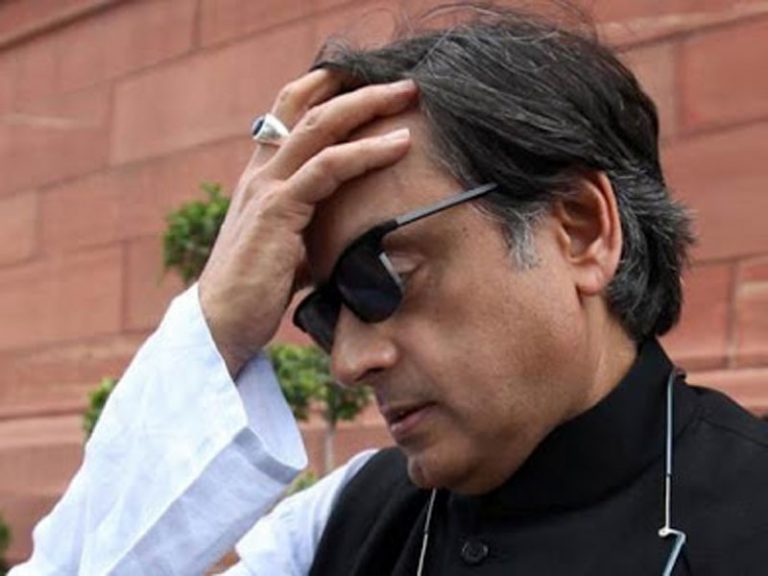
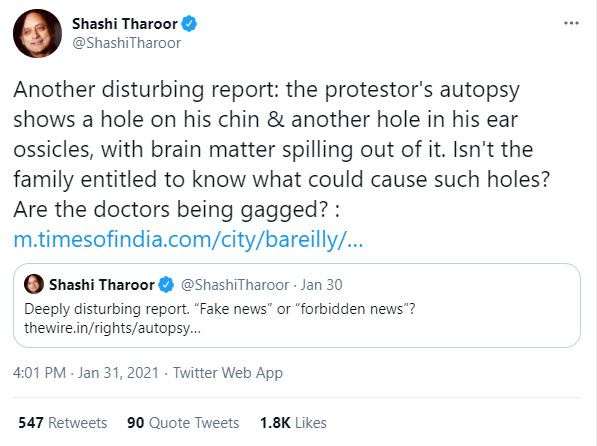
Shashi Tharoor continues to cast aspersions on rioter Navreet’s autopsy report despite multiple FIRs over fake news

Congress leader Shashi Tharoor has been booked by three state police, Uttar Pradesh, Madhya Pradesh and Delhi, for peddling fake news. However, series of FIRs did not stop Tharoor from casting aspersions on rioter Navreet’s autopsy report. On 31 January, Tharoor tweeted that Navreet’s autopsy report allegedly showed a hole in his chin and another hole in his ear ossicles. He further questioned if the doctors are being gagged.

Screenshot of the tweet alleging Navreet was killed by bullet

Tharoor was quoting a report done by The Wire in the first tweet that resulted in FIRs against The Wire Editor Siddharth Varadarajan. In the second tweet, he had mentioned a report by the Times of India that alleged bullet injury.

In fact, the TOI report cites CMO Manoj Shukla who said that the wounds mentioned could be due to the accelerated collision with the floor. Also, rioter Navreet died after the tractor he was driving to break police barricades turned turtle. The report further repeats the same comment by Navreet’s parents who claimed that ‘one of the doctors’ who conducted the autopsy found the bullet injury visible.

The doctors, however, have denied having talked to anyone in the media or otherwise.

FIRs against Shashi Tharoor

After Tharoor and Rajdeep Sardesai, and other left-leaning liberals claimed that the rioter Navreet died due to bullet injury on Republic Day, Uttar Pradesh Police registered an FIR against him under section 154 of CrPC. The FIR named Congress MP Shashi Tharoor, India Today journalist Rajdeep Sardesai, National Herald’s Senior consulting editor Mrinal Pandey, Quami Awaz editor Zafar Agha, Caravan magazine’s editor and founder Paresh Nath, Caravan editor Anant Nath and its executive editor Vinod K Jose, and one unnamed person.

Delhi Police has registered FIR at the IP Estate police station under Indian Penal Code (IPC) Sections 120B (criminal conspiracy), 153 (provocation to cause riot), 504 (intentional insult to provoke breach of peace) and 505-1b (intent to cause fear to the public) against Tharoor and Sardesai. The FIR also included journalists Paresh Nath, Anant Nath, Vinod K Jose, Mrinal Pande, and Zafar Agha.

The Madhya Pradesh Police, too, had filed an FIR against Tharoor and six others for fake news on the rioter’s death who died after his tractor turned turtle.

Railways and Urban Infrastructure gets a boost in the Union Budget -2021: Read details

Finance Minister Nirmala Sitharaman on Monday presented the Union Budget 2021-22 in Parliament. Sitharaman said the budget for 2021-22 rests on six pillars – Health and Wellbeing, Physical infrastructure, inclusive growth, human capital, Research & Development, and lastly, minimum government and maximum governance.

FM Sitharaman announced several provisions for the development of Indian Railways and Urban infrastructure in her budget speech.

Finance Minister Nirmala Sitharaman announced that the government will spend Rs 1.1 Lakh crore for railways the fiscal year. Out of the total outlay, Rs 1.07 lakh crore will be spent on capital expenditure, the Finance Minister said in her budget.

The Finance Minister added that Indian Railways will monetize dedicated freight corridor assets after commissioning. Indian railways have prepared National Rail Plan for India 2030, said Finance Minister Sitharaman.

The FM announced that Eastern Freight Corridor will be taken up this year through PPP mode. Further, three future dedicated freight corridors – East Coast, East-west, North-south are scheduled to be completed, said Finance Minister. These will have an automatic system on high-density rail routes to avoid collisions, she said adding that 100% electrification of broad-gauge rail routes will be done by December 2023.

Roads, Highways and Urban Infrastructure

In her budget, the Finance Minister announced that an outlay of Rs 1.18 Lakh crore for the Ministry of Road transport and highways to further augment road infrastructure. FM Sitharaman said more than 13,000 km of roads awarded under Bharat Mala project.

“Around 3,800 km have been constructed in Bharatmala so far and 8,500 km to be awarded by March 2022. Will complete an additional 11,000 km of NH corridor by March 2022. More economic corridors are being planned – 3,500 km of NH works are ongoing in Tamil Nadu, investment of Rs 1.03 lakh crore 1,100 km of national highway works in Kerala, investment of Rs 65,000 crore 675 km of highway works in West Bengal, cost of Rs 25,000 crore,” FM Sitharaman said.

Finance Minister also announced a sharp increase in capital expenditure at 5.54 lakh crore, from Rs 4.39 lakh crore in 2021.

“NHAI has sponsored one InVit to attract investors. Thus 5 operational roads with Rs 5,000 crore value being transferred to NHAI InVit. NHAI operational roll roads are to be monetized,” FM Minister said.