In a stride toward self-reliance in defence manufacturing, the Defence Metallurgical Research Laboratory (DMRL) in Hyderabad under DRDO has transferred three cutting-edge materials technologies to leading industry partners. In a ceremony held at DMRL on 30 August 2025, Dr. Samir V. Kamat, Secretary, Department of Defence R&D and Chairman, DRDO, handed over the Licensing Agreements for Transfer of Technology (LAToT) documents, marking a significant leap in strategic materials and manufacturing capabilities.
The three defence technologies transferred are:
High-Strength Radomes to BHEL, Jagdishpur
The first technology, manufacturing of high-strength radomes, has been transferred to BHEL, Jagdishpur. Radomes are protective covers for radar and missile sensors that must endure extreme aerodynamic pressures while remaining transparent to electromagnetic signals. The new radomes provide higher strength and reliability, ensuring robust protection of missile guidance systems during flight.
DMR-1700 Steel Sheets and Plates to JSPL, Angul
The second technology involves DMR-1700 steel sheets and plates, licensed to JSPL (Jindal Steel and Power Limited) in Angul. This material has ultra-high strength combined with excellent fracture toughness at room temperature, making it well-suited for armoured vehicles, load-bearing structures, and critical defence hardware. It provides enhanced durability under demanding operational conditions.
DMR 249A HSLA Steel Plates to SAIL
The third transferred technology is DMR 249A HSLA (High-Strength Low-Alloy) steel plates, licensed to Bhilai Steel Plant (SAIL). Specially designed for naval use, these plates meet stringent metallurgical and dimensional requirements essential for shipbuilding. They offer a combination of strength, toughness, and weldability that ensures the integrity of naval structures in harsh marine environments.
Strategic Significance and Collaboration
In his address, Dr. Kamat lauded the dedication fuelling these successful transfers, emphasizing that they embody DMRL’s commitment to bridging research with industrial application. He highlighted that such collaborations accelerate innovation deployment, strengthen India’s defence supply chain, and foster technology-driven self-reliance.
Present at the event were key dignitaries including Dr. R.V. Hara Prasad, Director General (Naval Systems & Materials); Dr. Manu Korulla, Director General (Resource and Management); and Dr. R. Balamuralikrishnan, Director of DMRL.
The ceremony also featured a Memorandum of Understanding (MoU) signed between DMRL and the Aircraft Accident Investigation Bureau (AAIB) under the Ministry of Civil Aviation. The MoU aims to utilise DMRL’s technical capabilities to support AAIB’s accident investigation activities, further expanding the lab’s collaborative footprint.
Conclusion
This transfer of three advanced materials technologies, high-strength radomes, DMR-1700 steel sheets and plates, and DMR 249A HSLA steel plates, marks a pivotal advancement in India’s indigenous defence capabilities. By entrusting industry partners like BHEL, JSPL, and BSP to scale and manufacture these technologies, DRDO is catalysing rapid deployment of strategic assets across defence platforms. Coupled with enhanced institutional collaboration exemplified by the MoU with AAIB, the event underscores DMRL’s multidisciplinary strength and its central role in driving innovation and national resilience.
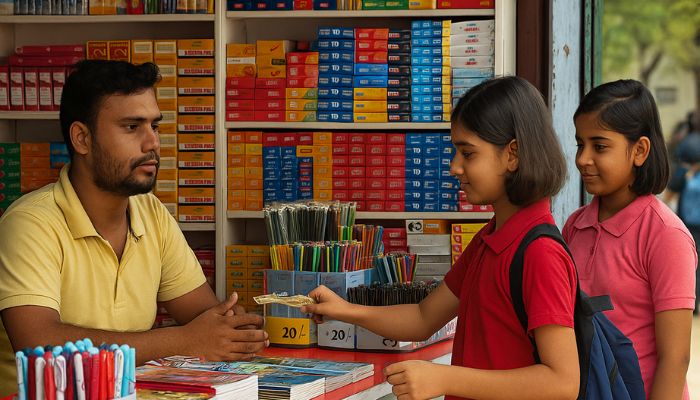
The GST Council on Wednesday, 3rd September, announced a big relief for students and parents by making several stationery items completely tax-free. Union Finance Minister Nirmala Sitharaman said that the decision will directly benefit families by reducing the cost of education-related essentials.
With this change, many items that are part of every student’s daily routine will now come at a lower price. Maps, atlases, wall maps, topographical plans, and globes, which earlier attracted 12% GST, will now be exempt from any tax.
The same applies to pencil sharpeners, ordinary pencils, mechanical pencils, crayons, pastels, drawing charcoals, tailor’s chalk, and all kinds of notebooks such as exercise books, graph books, and laboratory notebooks. Earlier, all of these fell under the 12% tax slab.
Erasers, which were earlier taxed at 5%, have also been made tax-free. This move means that whether it is basic stationery like pencils and erasers or more specialised items like maps and globes, parents will now pay less for their children’s education needs.
Explaining the decision after the 56th GST Council meeting, Finance Minister Nirmala Sitharaman said the reforms were taken keeping the “common man” in mind.
“Everyday items used by students have been carefully reviewed, and in most cases, the tax burden has been completely removed. This will help families, especially in rural and semi-urban areas, where these costs add up significantly,” she added.
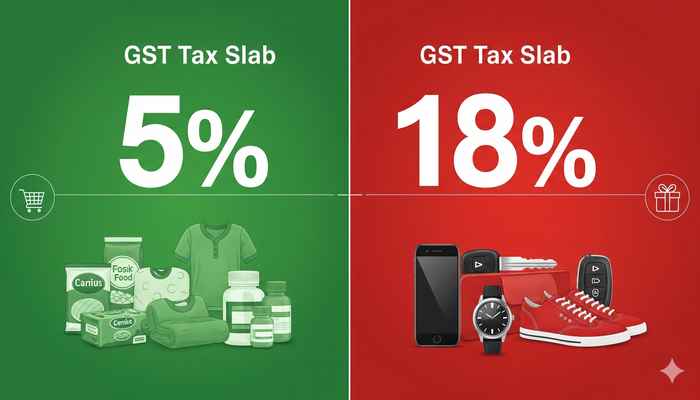
The broader tax reform also simplifies the GST structure by introducing a two-rate system, 5% and 18%, while keeping a 40% slab for sin and luxury goods. But the biggest takeaway for education is that essential study material will now be completely exempt.
The new rates will come into effect from 22nd September, the first day of Navaratri. For millions of students across India, this move is expected to make education more affordable and reduce the financial burden on households.
In a move intended to take some burden off the common man’s pocket, the central government has slashed indirect taxes on food items and everyday items. The decision was taken in the 56th meeting of the Goods and Services Tax (GST) Council held on Wednesday (3rd September).
In its 10-hour-long meeting chaired by Union Finance Minister Nirmala Sitharaman, the GST Council unanimously revised the existing four-tier tax structure of 5%, 12%, 18% and 28% and removed the tax categories of 12% and 28%.
The new indirect tax system will have only two tax slabs of 5% and 18%, effective from 22nd September, the first day of Navaratri. The reduction in indirect taxes is aimed at leaving more money in the hands of the middle class to enhance their spending capacity, which in turn would boost domestic consumption.
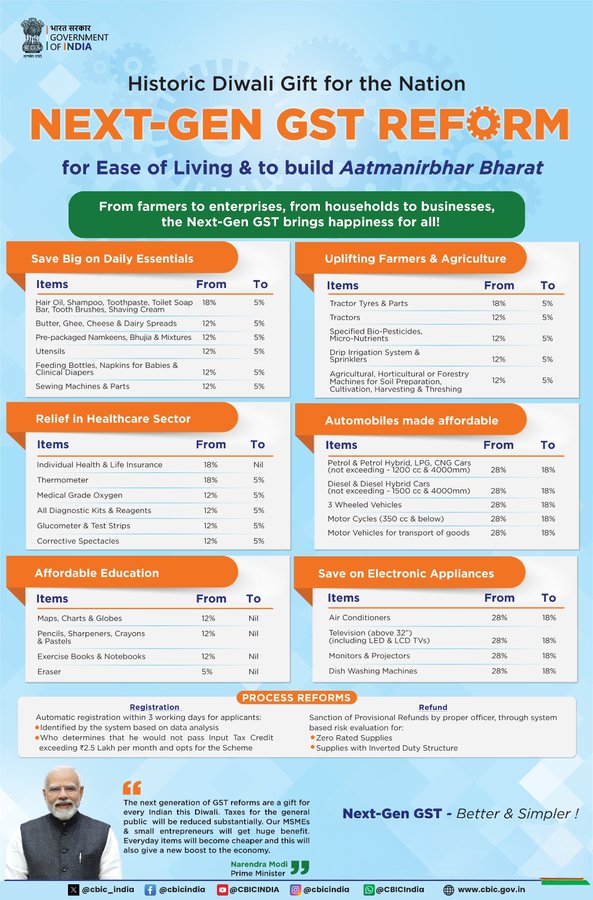
The centre described the tax reduction as a ‘Historic Diwali Gift for the Nation” as the decision comes ahead of the festive season. “These reforms have been carried out with a focus on the common man. Every tax on the common man’s daily use items has gone through a rigorous review, and in most cases, the rates have come down drastically… Labour-intensive industries have been given good support. Farmers and the agriculture sector, as well as the health sector, will benefit,” said the Union Finance Minister.
Image via X/nsitharamanoffc
Here is a look at how the GST reforms will provide relief to the middle class with reduced or nil taxes on essential items.
Reduced tax on food items
Under the GST reforms, the prices of food items and everyday essentials will be reduced significantly. While GST taxes on some items have been reduced, some items have been completely exempted from the tax. For example, ready-made frozen parathas, chapatis, khakhra, pizza bread, and paneer will not be taxed.
GST rates on kitchen items like jam, fruit jellies, sauces, pre-packed namkeens and bhujia have been slashed from earlier 12-18% to 5%. Besides, food items like pasta, biscuits, chocolate, cornflakes, cocoa products, dried fruits, nuts, and dates will attract 5% tax. While zero GST rates will apply to ultra-high-temperature (UHT) milk or milk having a long shelf life, 5% GST will apply to both plant-based milk drinks and soya milk drinks.
Home electrical appliances will become cheaper
The GST reforms have been announced before the peak festive season, when the middle class spends on consumer durables to avail discounts. Under the revised tax regime, products like ACs, large-screen TVs, refrigerators and washing machines will have an 18% tax as compared to the earlier 28%.
Zero taxes on insurance and stationery items
While earlier, individual health and life insurance premiums attracted an 18% tax, after the implementation of the reforms, there will be no tax on them. This move will not only make health insurance premiums more affordable but will also attract first-time customers. Additionally, educational items like maps, charts, globes, exercise books and notebooks, which were earlier taxed at 12%, will now be exempt from any taxes.
‘Sin goods’ to attract higher taxes
While significant relief has been granted regarding a large number of everyday items under the GST reforms, certain items have been brought under the tax slab of 40%. ‘Sin Goods’ like tobacco, pan masala, gutkha, cigarettes, carbonated drinks, caffeinated beverages, coal, lignite, peatonline, gambling, SUVs, and luxury or harmful items have been subjected to enhanced taxes under the new tax regime.
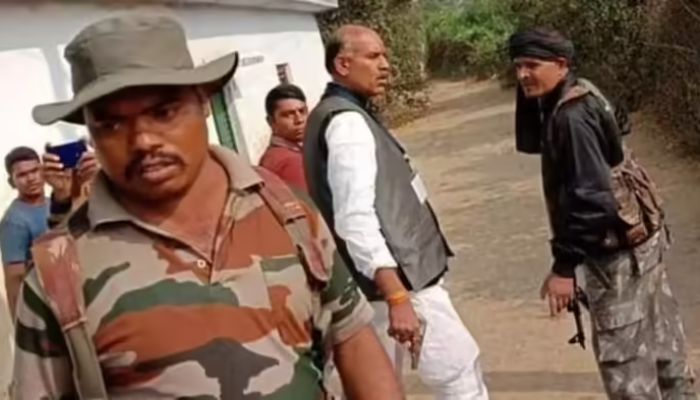
On Wednesday (3rd September), Congress leader Krishna Nand Tripathi attacked a police constable posted in the security team of former Jharkhand minister.
According to media reports, the Congress leader slapped and abused the constable during a traffic jam in Latehar district of Jharkahnd. The incident has sparked outrage among the police force, with a case now registered against the leader.
Constable Ravindra Rikhiyashan filed a complaint against the leader. He works in Tripathi’s security detail. He said that the former minister lost his cool when his car got stuck in traffic around 1:30 pm on Wednesday, 3rd September, during the Karam puja.
According to the FIR, Tripathi asked the constable to get down and clear the road, but when the situation did not move quickly, he began shouting.
“As we tried to manage the situation, Neta ji arrived and began hurling abuses,” Rikhiyashan narrated his ordeal. Tripathi also slapped him and called him unfit for the job.
The constable later approached police and filed a complaint. A zero FIR was registered at Daltonganj Nagar police station and will now be transferred to Latehar for further investigation.
Jyoti Lal Rajwar, the officer-in-charge of Daltonganj Town police station, said that sections of the Bharatiya Nyaya Sanhita have been invoked.
Tripathi, who has served as Rural Development, Labour, Employment & Training, and Panchayati Raj minister in Jharkhand, has denied the allegations.
He said he did not assault or abuse anyone and claimed that the FIR was filed “out of revenge.”
The leader further said, “I only asked my bodyguards to be more alert, got the passage cleared, and then left for the Circuit House. I did not assault or abuse anyone. Everything is visible in the CCTV. When they (the bodyguards) refused to move the vehicle, and I managed to get it cleared within a minute, they felt insulted. That is why they registered the FIR.”
Meanwhile, the Latehar Police Men’s Association strongly condemned the incident. In a letter to the state DGP, the association called it an attack on the dignity of uniformed personnel.
Association president, Karan Singh, wrote that “If a leader feels a bodyguard is unfit, he must report it to senior officers, not assault him. The CCTV footage has clear evidence of the incident.”
The Union Cabinet chaired by Prime Minister Narendra Modi on Wednesday approved a ₹1,500 crore Incentive Scheme to develop recycling capacity in the country for the separation and production of critical minerals from secondary sources.
This scheme is part of the National Critical Mineral Mission (NCMM), which is aimed at building the domestic capacity of and supply chain resilience in critical minerals. The critical mineral value chain comprising exploration, auction and mine operationalisation, and acquisition of foreign assets, has a gestation period before they could supply critical minerals to Indian industry. Therefore, a prudent way to ensure supply chain sustainability in the near term is through the recycling of secondary sources.
The Scheme will have a tenure of six years from FY 2025-26 to FY 2030-31. Eligible feedstock is e-waste, Lithium Ion Battery (LIB) scrap, and scrap other than e-waste & LIB scrap e.g. catalytic convertors in end-of-life vehicles.
Expected beneficiaries will be both large, established recyclers, as well as small, new recyclers, including start-ups, for whom one-third of the scheme outlay has been earmarked.
The Scheme will be applicable to investments in new units as well as expansion of capacity / modernization and diversification of existing units. The Scheme will provide incentive for the recycling value chain which is involved in actual extraction of critical minerals, and not the value chain involved in only black mass production.
The incentives under the Scheme will comprise 20% Capex subsidy on plant & machinery, equipment and associated utilities for starting production within specified timeframe, beyond which reduced subsidy applicable, and Opex subsidy, which will be an incentive on incremental sales over the base year (FY 2025-26) viz.
40% of eligible Opex subsidy in the 2nd year and balance 60% in the 5th year from FY 2026-27 to FY 2030-31 on achievement of specified threshold incremental sales. In order to ensure greater number of beneficiaries, total incentive (Capex plus Opex subsidy) per entity will be subject to an overall ceiling of ₹50 crore for large entities and ₹25 crore for small entities, within which there will be a ceiling for Opex subsidy of ₹10 crore and ₹5 crore respectively.
In terms of key outcomes, the Scheme incentives are expected to develop at least 270 kilo ton of annual recycling capacity resulting in around 40 kilo ton annual critical mineral production, bringing in about ₹8,000 crore of investment and creating close to 70,000 direct and indirect jobs. Several rounds of consultations with industry and other stakeholders have been held through dedicated meetings, seminar sessions, etc. before formulating the Scheme.
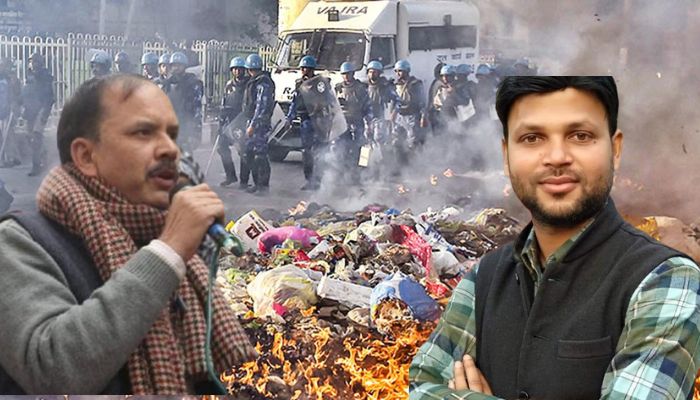
On Tuesday, 2nd September, the Delhi High Court dismissed the bail pleas of Shifa-ur-Rehman, president of Jamia Millia Islamia’s Alumni Association (AAJMI), and Meeran Haider, a PhD scholar from Jamia and youth leader of the RJD, both facing charges in the larger conspiracy case related to the Delhi anti-Hindu riots of 2020.
A division bench of Justice Navin Chawla and Justice Shalinder Kaur passed the order. While rejecting the bail, the Court said the allegations against the two were far too serious to be overlooked at this stage, especially their role in handling funds, organising protests, and their close links with the masterminds of the conspiracy.
Charges against Shifa-ur-Rehman
The prosecution has accused Shifa-ur-Rehman of misusing his position as president of AAJMI to raise funds for the riots. Investigators claim that around ₹8.90 lakh was pumped into protest sites through him, and fake bills were generated in the name of AAJMI to hide the actual expenditure.
The police also said that Rehman distributed money to bring women and children into protest sites, hoping that their presence would deter police action. These bills were recovered from the AAJMI office on 28th April, 2020, at Rehman’s instance, revealing that AAJMI had received around Rs 7–8 lakh in cash.
Rejecting his plea that he was the sole earning member of a large family, the Court said the evidence of his alleged involvement was too serious.
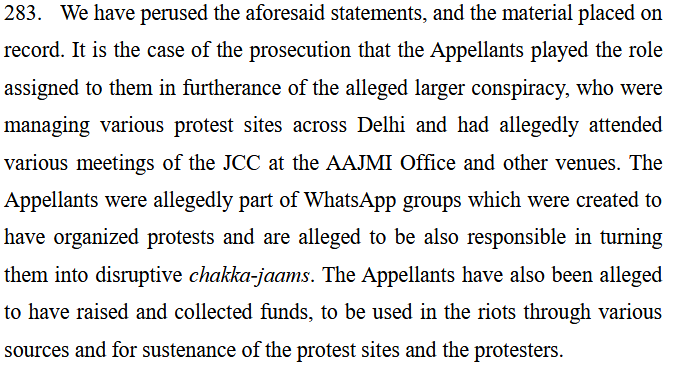
The bench observed, “We have perused the aforesaid statements, and the material placed on record. It is the case of the prosecution that the Appellants played the role assigned to them in furtherance of the alleged larger conspiracy, who were managing various protest sites across Delhi and had allegedly attended various meetings of the JCC at the AAJMI Office and other venues.”
Image source: Delhi High Court
The Court also took note of the prosecution’s submission that the money was meant to support riots and sustain protests against CAA and NRC, pointing to fake bills that were raised to adjust these funds.
Meeran Haider spent ₹2.33 lakhs on riots and protest sites: Delhi HC
Meeran Haider, also arrested in connection with the conspiracy, was accused of raising and spending large sums of money on managing protest sites. According to the prosecution, Haider allegedly gave money to AAJMI, where several meetings of the Jamia Coordination Committee (JCC) were held.
Quoting the judgment, the bench said:
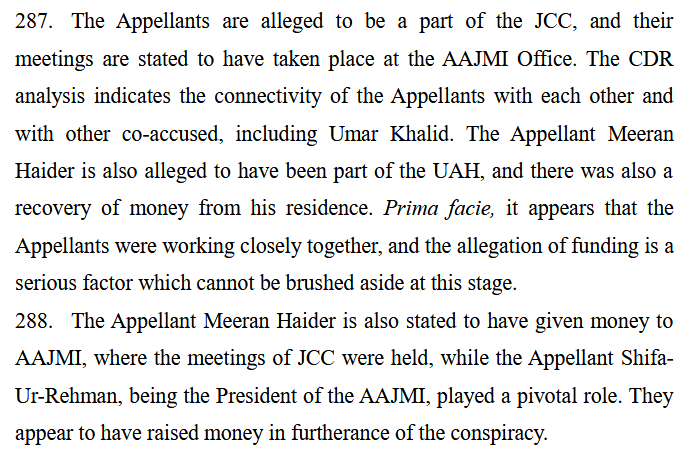
“The Appellant Meeran Haider is also accused to spent ₹2.33 lakhs on riots and protest sites. He is also stated to have given money to AAJMI, where the meetings of JCC were held, while the Appellant Shifa-ur-Rehman, being the President of the AAJMI, played a pivotal role. They appear to have raised money in furtherance of the conspiracy.”
Image source: Delhi High Court
The Court noted that Haider, in addition to financing the protests, had delivered inflammatory speeches at the behest of Umar Khalid, one of the main accused in the case.
Defence arguments rejected
Both accused had argued for bail on humanitarian and legal grounds. Rehman’s counsel told the Court that he was the sole breadwinner for his elderly mother, disabled brother, two unmarried sisters, wife, and two children. His prolonged incarceration, they said, was causing severe hardship for the family.
As per the Court’s Judgement, the defence also insisted that the case against them did not meet the legal threshold for a “terrorist act” or “conspiracy” under UAPA, pointing out that no weapons were recovered, charges were not yet framed, and that others facing similar allegations, such as Asif Iqbal Tanha, Devangana Kalita, and Natasha Narwal, had already been granted bail.
But the High Court was unconvinced. It said that the roles of Rehman and Haider were not on par with the co-accused, as they were among the fundraisers in the conspiracy.
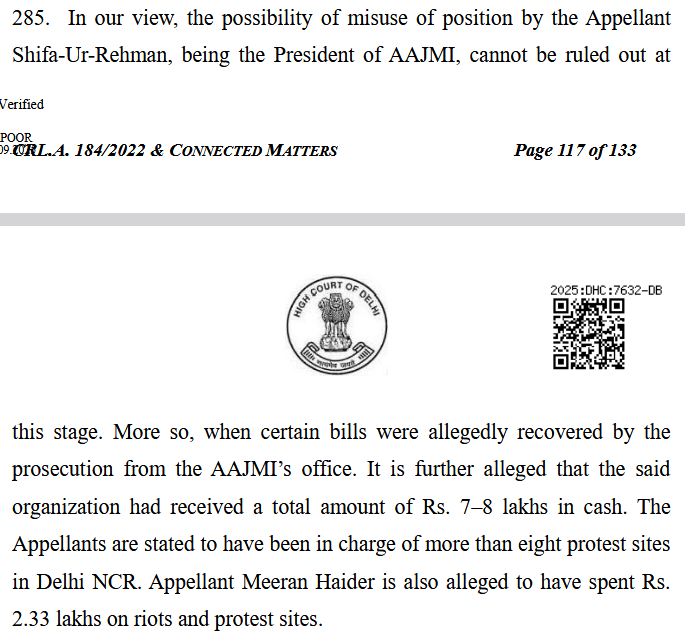
Rejecting these submissions, the Court observed, “In our view, the possibility of misuse of position by the Appellant Shifa-ur-Rehman, being the President of AAJMI, cannot be ruled out at this stage. More so, when certain bills were allegedly recovered by the prosecution from the AAJMI’s office. It is further alleged that the said organisation had received a total amount of Rs. 7–8 lakhs in cash. The Appellants are stated to have been in charge of more than eight protest sites in Delhi NCR. Appellant Meeran Haider is also alleged to have spent Rs. 2.33 lakhs on riots and protest sites.”
Image source: Delhi High Court
Court added that, prima facie, Rehman and co-accused Meeran Haider appeared to be working closely together, and the allegations of funding were a serious factor that could not be brushed aside at this stage.
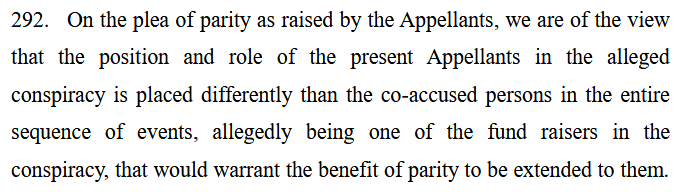
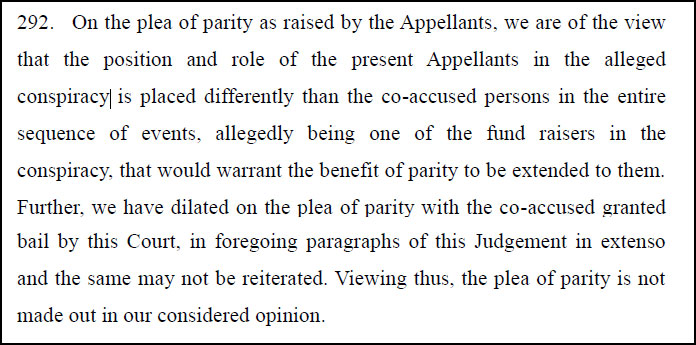
On the plea of parity, the Bench said, “We are of the view that the position and role of the present Appellants in the alleged conspiracy is placed differently than the co-accused persons in the entire sequence of events, allegedly being among the fundraisers in the conspiracy.”
Image source: Delhi High Court
Background of the case
The 2020 anti-Hindu Delhi Riots, occurred in Northeast Delhi from 23rd to 26th February, leaving 53 dead and over 200 injured. The Islamists mobs attacked local Hindus on the pretext of protest against the Citizenship Amendment Act (CAA). These riots were not spontaneous but a culmination of a pre-planned conspiracy A Delhi Police Head Constable and an Intelligence Bureau Constable were killed in the riots.
Delhi Police’s Special Cell had registered FIR 59 of 2020, naming several individuals. Both the accused have been charged under stringent provisions of the Unlawful Activities (Prevention) Act (UAPA) as well as sections of the Indian Penal Code relating to criminal conspiracy, promoting enmity, rioting, and murder.
Apart from Rehman and Haider, the case includes almost 17 accused people, including Umar Khalid, Sharjeel Imam, Tahir Hussain, Khalid Saifi, Ishrat Jahan, and Gulfisha Fatima.
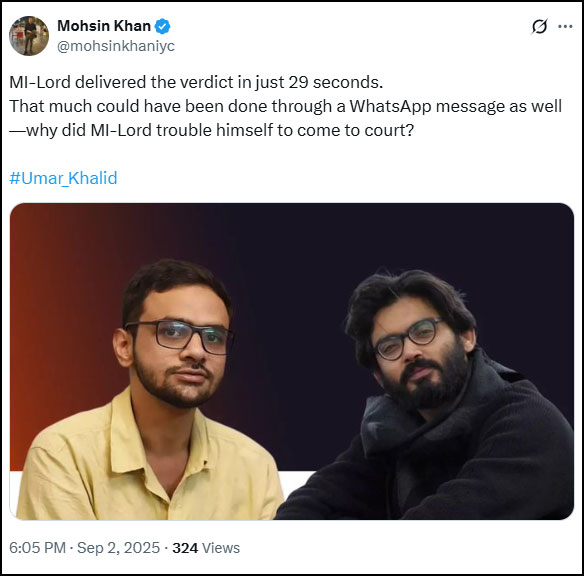
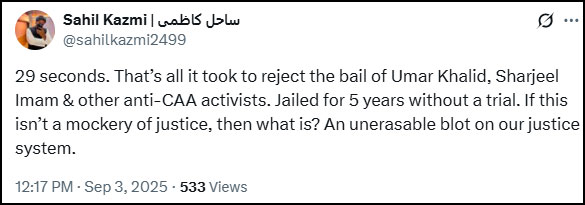
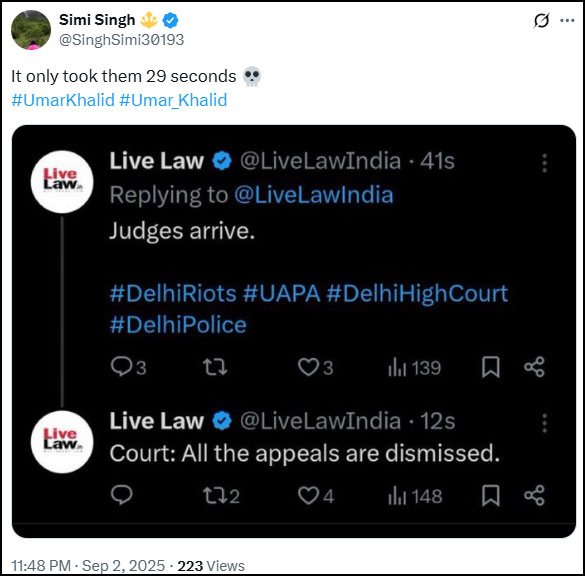
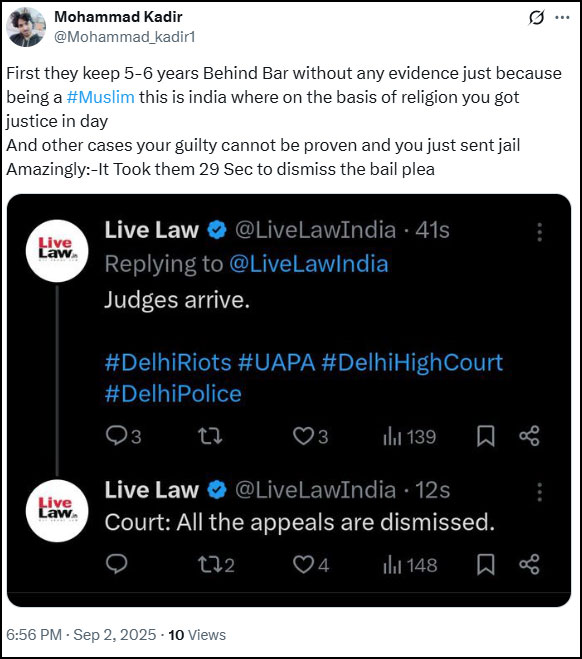
On 2nd September, the Delhi High Court dismissed the bail pleas of Umar Khalid, Sharjeel Imam and seven others accused in the 2020 anti-Hindu Delhi riots larger conspiracy case. Soon after, a narrative spread on X (formerly Twitter) that the court took only 29 seconds to deliver the verdict. This claim, however, is misleading and ignores the judicial process.
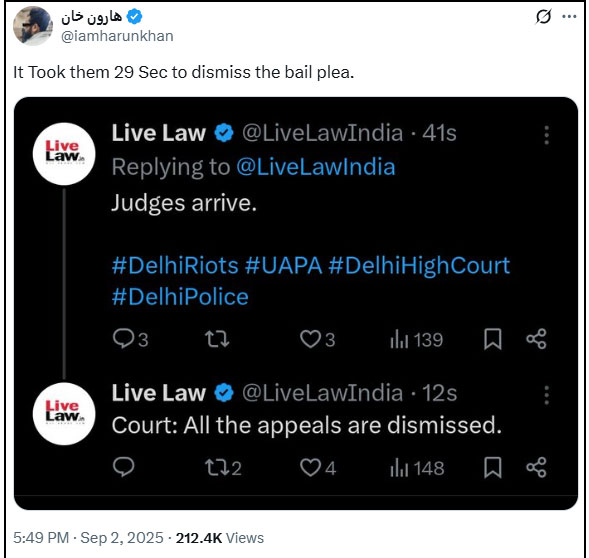
One of the first to float such a claim was Harun Khan who goes by the handle @iamharunkhan on X. In a post, he claimed, “It Took them 29 Sec to dismiss the bail plea”. To support his claim, he used a screenshot of the posts by Live Law’s real-time updates. His post clocked over 2 lakh views and was amplified widely.
Source: X
Another user, who appeared to be connected to the Indian Youth Congress, claimed, “MI-Lord delivered the verdict in just 29 seconds. That much could have been done through a WhatsApp message as well—why did MI-Lord trouble himself to come to court?”
Source: X
Another user, Sahil Kazmi, claimed, “29 seconds. That’s all it took to reject the bail of Umar Khalid, Sharjeel Imam & other anti-CAA activists. Jailed for 5 years without a trial. If this isn’t a mockery of justice, then what is?”
Source: X
In another post, Simi Singh claimed, “It only took them 29 seconds.”
Source: X
Similarly, Mohammad Kadir, while adding a communal angle, said Muslims were jailed without evidence and added, “It Took them 29 Sec to dismiss the bail plea.”
Source: X
These posts together created the viral impression that the court mechanically read out its order in half a minute.
Why the claim is wrong
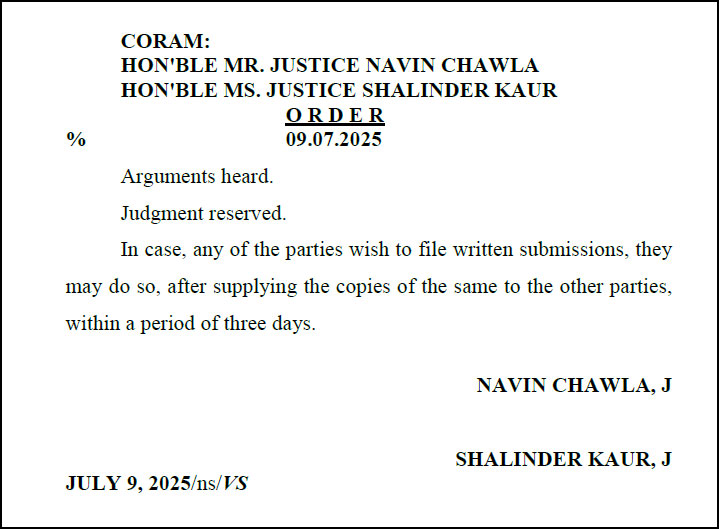
The claim is factually incorrect. For those who are unaware, the Delhi High Court reserved its order on 9th July 2025 after extensive hearings. The pronouncement came nearly two months later, on 2nd September 2025. Far from being a “29-second” process, the judgment is a 133-page detailed order.
9th July order. Source: Delhi High Court
In this order, the Division Bench of Justice Naveen Chawla and Justice Shalinder Kaur discussed the submissions made by the accused, the counter-arguments of the prosecution, and placed its observations on the parity argument, the scope of Section 43D(5) of the UAPA, and related jurisprudence. While the Court did not go into the merits of the case, it recorded the rival contentions and analysed them before dismissing the appeals.
The few seconds that Live Law reported between “Judges arrive” and “All appeals dismissed” was the oral pronouncement, not the judicial reasoning. Pronouncements are often brief in open court, with the detailed order already authored and signed.
A mockery of facts, not of justice
Those claiming “29 seconds” are either ignorant of court procedure or are wilfully misleading. The bail rejection was not a casual decision but the outcome of a reserved judgment running over 100 pages. To equate the brief courtroom pronouncement with the entire judicial process is disingenuous and undermines public understanding of how courts function. The real mockery lies in such false claims that spread like wildfire, thanks to posts by some social media users who post anything to get famous, irrespective of whether they are right or wrong.
On 2nd September, the Delhi High Court dismissed the bail pleas of nine accused in the anti-Hindu Delhi Riots 2020 larger conspiracy case including Umar Khalid, Sharjeel Imam, Athar Khan, Khalid Saifi, Mohd Saleem Khan, Shifa-ur-Rehman, Meeran Haider, Gulfisha Fatima, and Shadab Ahmed.
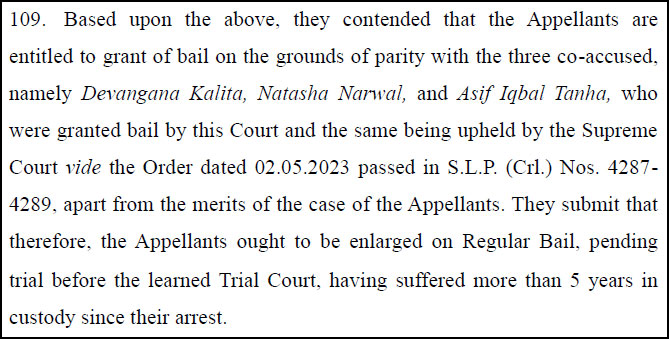
While several grounds were urged, one common thread ran through the submissions of all nine appellants was the plea of parity. The argument was straightforward on the surface that if co-accused such as Devangana Kalita, Natasha Narwal, and Asif Iqbal Tanha were given bail by the Delhi High Court in 2021, and if the Supreme Court had not disturbed those bail orders, then the same principle should extend to the present appellants.
During the argument, the defence stressed that some of the co-accused who had already been released were themselves alleged to have attended conspiratorial meetings. The defence argued that they were present at the protest sites where violence later erupted. If such allegations did not stop the Court from granting them bail, then, by parity of reasoning, the appellants, who in some cases were not even named in FIRs, should also be enlarged on bail.
In the words of the defence, the appellants were “entitled to grant of bail on the grounds of parity with the three co-accused, namely Devangana Kalita, Natasha Narwal, and Asif Iqbal Tanha”.
Understanding the plea of parity
The plea of parity is a claim that an accused person should be granted bail on the same footing as a co-accused who has already been released. The underlying principle is one of consistency and fairness. In case two or more accused are similarly placed in terms of role, allegations and evidence, then they should be treated alike. However, parity is not automatic. Courts have repeatedly held that it requires a careful comparison of the role attributed to the applicant with that of the co-accused already enlarged on bail. If the roles are not alike, or if the applicant is found to have played a more serious or distinct part in the alleged offence, then the plea of parity fails.
Umar Khalid’s parity plea examined
During the arguments, Umar Khalid’s counsel placed three changes in circumstances before the Court. The defence used the Supreme Court’s ruling in Vernon, the parity claim based on bail granted to co-accused, and his prolonged incarceration of more than five years. Each of these was countered by the prosecution, and the Court dealt with them one by one.
The defence argued that the bail of Kalita, Narwal and Tanha formed a strong precedent. They argued that these three had been alleged to have attended conspiratorial meetings and participated in protest sites that later turned violent. However, the High Court considered their role not sufficient to deny bail. By that measure, Khalid, who was not named in the FIR concerning the North-East Delhi Riots, was on a stronger footing. His counsel claimed, “The appellants are entitled to grant of bail on the grounds of parity.”
Source: Delhi High Court
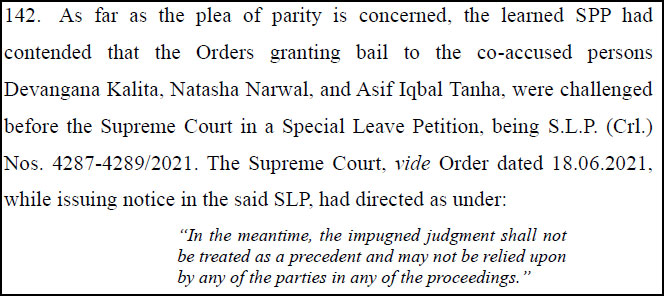
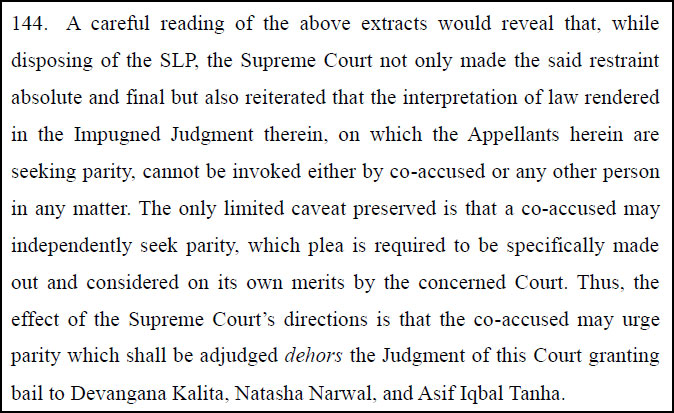
However, the Additional Solicitor General pointed out that the Supreme Court on 18th June 2021 restrained parties from treating those bail orders as precedent. The interim order, which was made final on 2nd May 2023, clarified that “the impugned judgment shall not be treated as a precedent and may not be relied upon by any of the parties in any of the proceedings”. At best, a co-accused could make an independent plea of parity, but that plea had to be established afresh on the facts of each case. Thus, in law, Khalid could not mechanically rely on the earlier bail orders.
Source: Delhi High Court
The Court agreed with this reading. It held that, “the interpretation of law rendered in the Impugned Judgment therein, on which the Appellants herein are seeking parity, cannot be invoked either by co-accused or any other person in any matter”. The only caveat was that parity could be considered if, on merits, the roles were alike.
Source: Delhi High Court
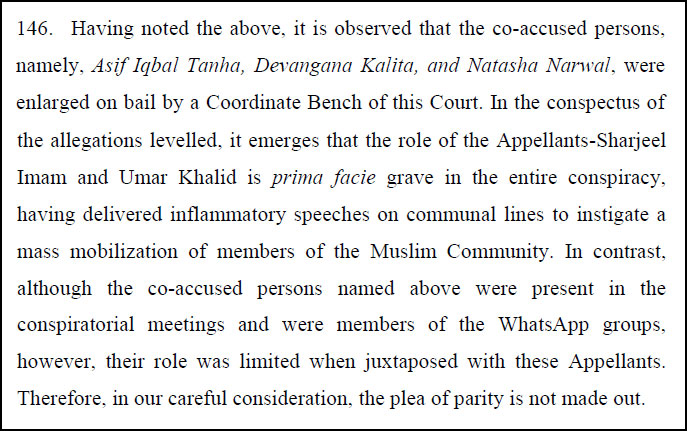
However, the Bench found the case otherwise. The Court said, “In the conspectus of the allegations levelled, it emerges that the role of the Appellants–Sharjeel Imam and Umar Khalid is prima facie grave in the entire conspiracy, having delivered inflammatory speeches on communal lines to instigate a mass mobilisation”. Hence, despite Narwal, Kalita and Tanha getting bail despite attending meetings and protests, Khalid’s role was distinct and more serious.
Source: Delhi High Court
The defence placed two arguments other than parity. First was the Supreme Court’s Vernon judgment where the Court was not convinced that Vernon changed the balance in Khalid’s favour, noting instead that the allegations of a deep-rooted conspiracy and his speeches continued to stand on record and could not be neutralised by general principles.
Furthermore, the defence used the prolonged incarceration argument. However, the prosecution pointed out that “more than 3,000 pages of chargesheet, an additional 30,000 pages of electronic evidence, four supplementary chargesheets and 58 witnesses”. This meant the pace of trial was naturally slower. The Court accepted the argument and remarked that a “hurried trial would also be detrimental to the rights of both the Appellants and the State”.
Sharjeel Imam’s parity plea examined
In the case of Sharjeel Imam, the defence placed the parity plea at the forefront of his case. The counsel also stressed that three of the co-accused, Kalita, Narwal and Tanha, had been granted bail. He also pointed out that Sharjeel’s name was not in the FIR concerning the riots in North-East Delhi.
The prosecution again argued that those three getting bail could not be treated as a precedent, as stated by the Supreme Court of India in May 2023. At best, the Court could consider a parity plea afresh, but it had to be based on the independent facts of the appellant’s role.
The Court accepted this limitation in law and clarified that while a co-accused may independently urge parity, the High Court’s earlier bail orders could not be invoked to support that claim. Parity had to be tested on the record of each accused’s role. When it came to Sharjeel Imam, the Bench found his position to be markedly different from that of the co-accused who had secured bail. In its words, “the role of the Appellants–Sharjeel Imam and Umar Khalid is prima facie grave in the entire conspiracy, having delivered inflammatory speeches on communal lines to instigate a mass mobilisation.”
On the issue of delay in trial, Imam too claimed prolonged incarceration. Here again the prosecution replied that the size of the conspiracy, the number of accused, and the massive body of evidence, 3,000 pages of chargesheet and 30,000 pages of electronic evidence, explained the slow pace. The Court sided with the State, saying the trial was at the stage of arguments on charge and that “a hurried trial would also be detrimental to the rights of both the Appellants and the State”.
The parity pleas of the remaining accused
For the other appellants too, parity with Kalita, Narwal and Tanha was the primary line of defence. Counsels for each of them pointed out that the High Court had earlier considered allegations against those three, that they attended meetings, participated in protest planning, and were members of the WhatsApp group Delhi Protest Support Group (DPSG), and still found them fit for bail.
The defence therefore contended that their clients were either on par with or in fact better placed than those already released. For instance, it was argued that some of the present appellants were not even part of the DPSG group, or had no direct role attributed to them at protest sites, yet continued to languish in custody when those with more visible roles had secured bail.
Answering in the same tone as for Khalid and Imam, the prosecution pointed towards the restraint order by the Supreme Court which foreclosed the use of the earlier bail orders as precedent, and said parity had to be proved afresh on facts.
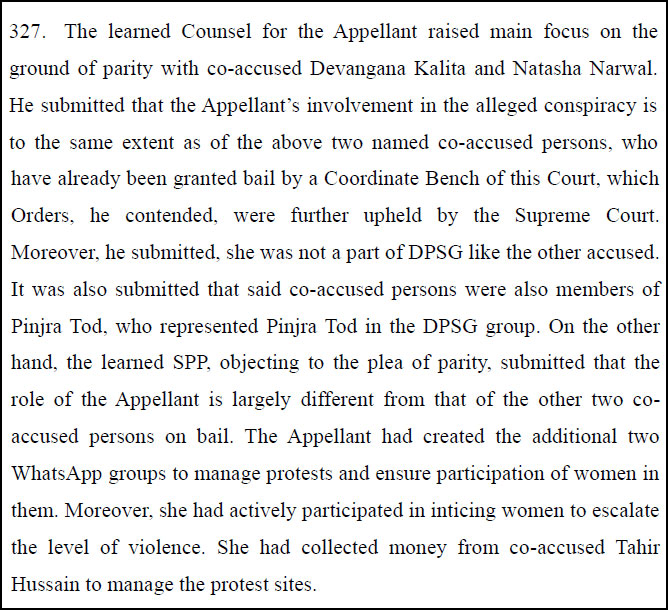
It was emphasised that the roles of the present appellants were qualitatively different and, in some cases, graver. The Special Public Prosecutor highlighted, for example, that Gulfisha Fatima had “created the additional two WhatsApp groups to manage protests and ensure participation of women in them” and had “collected money from co-accused Tahir Hussain to manage the protest sites”.
Source: Delhi High Court
This, according to the State, marked her role as distinct from Kalita and Narwal, despite her membership of Pinjra Tod. Similarly, other appellants were alleged to have engaged in fundraising or mobilisation that went beyond the limited organisational roles of those already bailed.
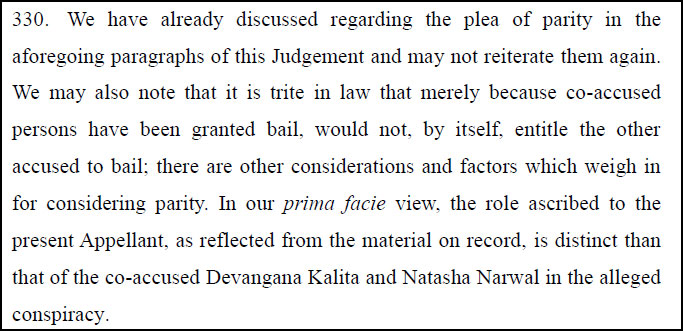
Accepting the prosecution argument, the Court made clear that parity could not be invoked mechanically, “merely because co-accused persons have been granted bail, would not, by itself, entitle the other accused to bail; there are other considerations and factors which weigh in for considering parity”.
Source: Delhi High Court
Notably, in its order, the Court was categorical that “the position and role of the present Appellants in the alleged conspiracy is placed differently than the co-accused persons in the entire sequence of events, allegedly being one of the fund raisers in the conspiracy, that would warrant the benefit of parity to be extended to them… the plea of parity is not made out in our considered opinion.” By grouping them in this way, the Court effectively rejected the parity claims of Athar Khan, Khalid Saifi, Mohd. Saleem Khan, Shifa-ur-Rehman, Meeran Haider and Shadab Ahmed, just as it had done with Khalid, Imam and Fatima.
Source: Delhi High Court
Conclusion
The parity plea was central to all nine bail appeals, but the High Court rejected it on both legal and factual grounds. Legally, the Court pointed to the Supreme Court’s orders of 18th June 2021 and 2nd May 2023, which barred reliance on the bail of Devangana Kalita, Natasha Narwal and Asif Iqbal Tanha as precedent. The top court had made clear that those rulings could not be invoked by any other party, though a co-accused might still plead parity if independently established. Factually, the Bench found that the appellants’ roles were “distinct and graver.”
While Kalita, Narwal and Tanha were said to have played limited roles, Umar Khalid and Sharjeel Imam were accused of delivering inflammatory speeches, and Gulfisha Fatima of organising women’s participation and collecting funds. The Court stressed that bail jurisprudence demands individual assessment, not numerical comparison, and concluded that the parity plea was the main reason for dismissal.
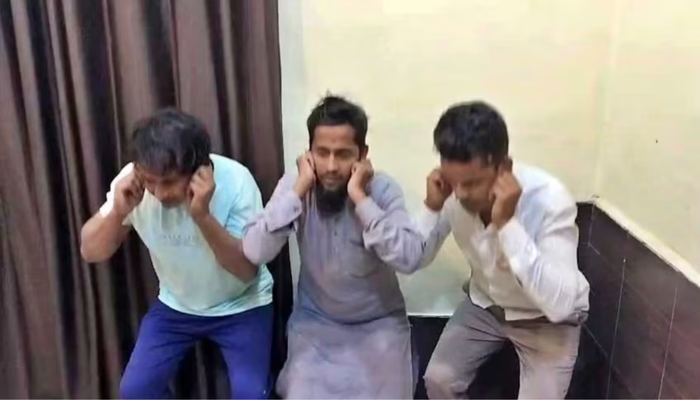
In the case of the kidnapping and religious conversion of a 12-year-old Hindu girl by some Muslims in the Konia area of Adampur police station in Varanasi, Uttar Pradesh, the police have nabbed three more accused on Tuesday (2nd September), taking the total number of arrests to five.
The arrestees have been identified as Mohammed Haseen, who is a Maulvi from Jalalipura, Mursaleen, and Aabid Sultan alias Raju. Earlier, on Monday (1st September), a minor Muslim boy, Nihal, to whom the girl was reportedly married after conversion, and the boy’s mother were arrested by the police.
As per reports, the minor girl was rescued by the police on Monday night. According to DCP (Kashi Zone), Gaurav Bansal, Maulvi Mohammed Haseen had performed the Nikah of the minor Hindu girl to Nihal after converting her to Islam in a mosque. Mursaleen mediated the Nikah ceremony, and Abid Sultan, who is the cousin of Haseen, was the witness. It was revealed during the questioning that the Maulvi took ₹600 from Nihal’s mother for performing the Nikah. The money was distributed between the Maulvi, Mursaleen, and Abid Sultan.
The case exposes a grim reality of police apathy and inaction. The victim was kidnapped three months ago. When her father confronted the culprits and asked them to release his daughter, they called him a Kafir and threatened to kill him and send him to Jahannum. Her father ran from pillar to post to get his daughter released, but the local police paid no attention to his plight. He was turned away from the local police station without any help or hearing.
Finally, he wrote to the Commissioner of Police, Mohit Aggarwal, and requested legal action against the culprits and the rescue of his daughter. The Commissioner of Police issued immediate directions for the registration of the FIR. Subsequently, a case was filed by the police and the minor Muslim boy and his mother were arrested.
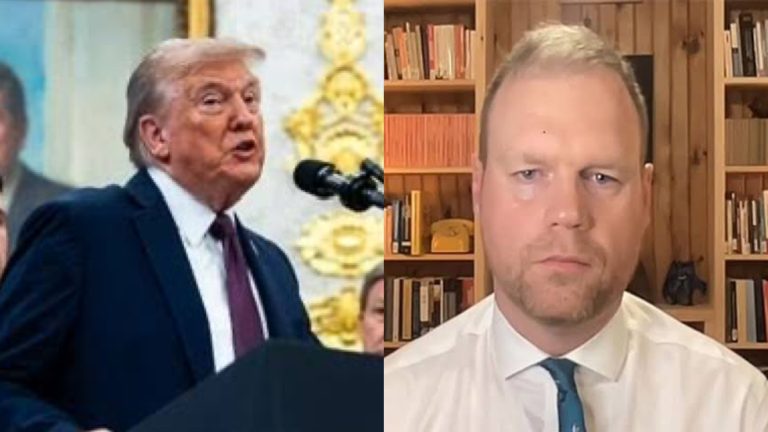
A leading American academic has urged former US President Donald Trump to immediately reverse his steep tariff policy on India, cut duties to zero, and even “apologise” to New Delhi, warning that the measures threaten Washington’s most important partnership of the 21st century.
Edward Price, adjunct professor at New York University, told ANI that India today holds a “deciding vote” in shaping global geopolitics. He argued that Trump’s approach was undermining US strategic interests at a time when Washington is locked in confrontation with China and grappling with Russia over Ukraine.
#WATCH | New York | NYU professor and Independent Analyst, Edward Price says, "I consider the partnership between India and the US as the most crucial 21st century partnership. This partnership will decide what happens between China and Russia. India has the deciding vote in the… pic.twitter.com/ASGbOCnisG
“I consider the India-US partnership the most crucial 21st-century partnership. This will determine the balance between China and Russia. I can’t for the life of me understand why the US President, while facing China and Russia, imposes 50% tariffs on India,” Price said.
Calling the policy “counterproductive,” Price urged: “We need to remove the 50% tariff on India, bring it to zero, and apologise.”
Praise for Modi’s global balancing act
Price also praised Prime Minister Narendra Modi’s strategic handling of power rivalries, noting that New Delhi has carefully signalled its options without fully siding with either Beijing or Moscow.
“PM Modi is being pretty smart. He’s reminding the Americans, and people like me, that India has options. But he has not fully embraced China and Russia. For instance, he skipped attending the military parade,” Price observed.
He stressed that India’s foreign policy remains fundamentally independent. “India is a sovereign civilisation state. It makes its own choices. There’s no way India will permanently plant its feet on one side or the other,” he added.
Trump’s tariff offensive
The Trump administration has slapped one of the world’s highest effective tariff regimes on India: a 25% reciprocal duty on Indian exports combined with another 25% levy linked to New Delhi’s purchase of Russian crude. Trump has accused India of “fueling Russia’s deadly attacks on Ukraine” while resisting tougher sanctions on Moscow himself.
On Truth Social, Trump described the trade relationship as a “one-sided disaster,” claiming, “They sell us massive amounts of goods, their biggest client, but we sell them very little.”
But Price cautioned that such rhetoric risks alienating India at a historic juncture. “India has the deciding vote in the 21st century. Alienating it now makes no sense,” he warned, underscoring that cooperation between the world’s two largest democracies will be pivotal in shaping the global order.