Home Blog Page 12

Undercover operation shows “independent journalists” agreeing to make propaganda material for the Samajwadi Party for a few thousand rupees

The opposition’s protest against the Chief Election Commissioner and the Modi government over the SIR of the electoral roll has been making headlines for all the wrong reasons. Barely a day has passed since Congress leader Rahul Gandhi, his security staff and supporters targeted a pregnant Oneindia journalist. Now, a sting operation has exposed the truth about the so-called “independent journalists” covering the demonstration.

Fact-checker Vishal Maheshwari, through a series of social media posts, revealed how these alleged journalists, who flock to the agitation under the guise of impartial reporting to actually promote the opposition’s agenda, have readily agreed to disseminate propaganda material for the Samajwadi Party in return for a certain amount ahead of the Uttar Pradesh assembly election.

Maheshwari stated, “These journalists openly give protesters a platform, take their side during confrontations, and even obstruct police action. Their conduct during protests is there for everyone to see. I decided to put some of these self-proclaimed independent journalists to the test. Using a fake email ID, I approached several of them with a proposal to create Instagram videos for the SP ahead of the 2027 UP elections.”

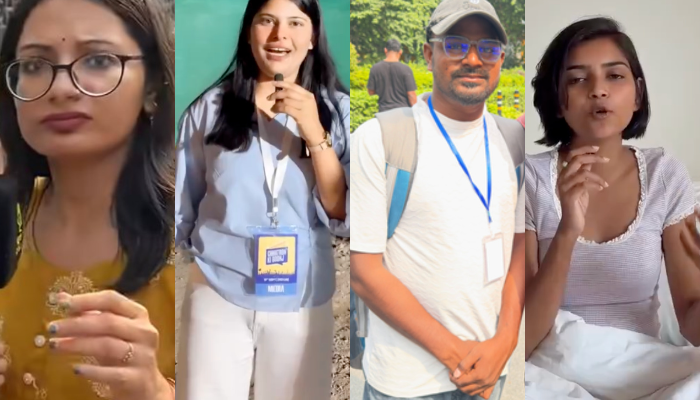
He informed, “They responded with work samples and quoted their prices for producing political content.” Mamata Singh of News Capsule, who has more than 300K followers on Instagram, forwarded her work samples and asked for Rs 40,000 for a single reel in the exchange, which transpired on 8th October via email.

Priya Singh, also affiliated with News Capsule like her counterparts, has been a consistent voice for the Congress-led I.N.D.I. Alliance campaign, similar to her colleagues. She shared her details and demanded Rs 30,000 to Rs 35,000 for each Instagram reel and Rs 25,000 to Rs 30,000 for a “bulk package” for Akhilesh Yadav’s party. She then added that further deliverables might be addressed in accordance with stated needs.

Singh even expressed her enthusiasm “to explore” the opportunity and was evidently eager to grab the proposal. She also has more than 250K followers on Instagram.

Shivani Gautam, who recently attacked the Bharatiya Janata Party (BJP) for allegedly attempting to run a paid campaign through her videos and portrayed herself as a champion of “independent journalism,” swiftly accepted an opportunity to create propaganda content for the SP. She agreed to submit “her rate card and work samples” once the project parameters were clarified. She attempted to promote alarming rhetoric regarding a potential “civil war” and repeated unfounded accusations of alleged electoral fraud.

Notably, Gautam was also seen arguing with police officers as they tried to perform their duties. She also has almost 95K followers on Instagram.

Zaish Malik, with 205K followers on Instagram and another familiar face in this agitation, attached links to his “independent ground reporting,” which incorporated Urdu poetry as a sample for disseminating SP propaganda. According to him, his charges are highly tailored to align with campaign requirements. He requested a meeting or phone call to negotiate the financial terms following a comprehensive project brief, insisting on discussing specifics before finalising payment arrangements in the October 11th email.

Prisha Yadav, another part of this “independent journalists” team, who also likes to target on-duty personnel, sought Rs 13,000 for one reel, Rs 50,000 for five reels, and the amount reached Rs 85,000 for ten reels. However, she also wrote that the amount might be subject to change after the final briefing and other requirements are finalised, along with putting links to her “viral videos” in the email.

Manish Rajput, identified as one of the individuals who labelled Aaj Tak journalists as “Godi media,” quoted a rate of Rs 15,000 per reel while offering a discounted price for bulk orders. He also urged for promotions through his Facebook account and expressed interest in a long-term partnership, which he proposed discussing via WhatsApp. He has 191K followers on Instagram.

Notably, Manish was also photographed alongside Shyam Meera Singh, a vocal Rahul Gandhi supporter and key figure within the opposition ecosystem.

Govind Gurjar, who also characterises other journalists as “Godi media,” asserted his engagement with opposition protests in the capital. Yet rather than declining the propaganda proposition, he proceeded to submit his work sample and phone number in the 12th October email, suggesting communication via WhatsApp or direct call. His Instagram account has 103K followers.

Vandana Meena, who has been “covering” the current opposition demonstration and receives media passes from the Congress party to attend Rahul Gandhi’s events and then talk about the colour of his shirts as well as fawn over him, also wanted to participate in the SP’s propaganda campaign. The price structure outlined Rs 15,000 per reel, Rs 75,000 for five reels, Rs 140,000 for ten reels, Rs 2,50,000 for twenty reels, and a monthly package of twelve reels at Rs 1,60,000. She has 122K followers on Instagram.

Anil Kumar, who is also known as Milan Sar, boasts 517K Instagram followers and maintains a consistent presence at Rahul Gandhi programs such as “Chhatron Ki Goonj” also demanded Rs 50,000 for Instagram reels, Rs 40,000 for Facebook reels, and Rs 20,000 for each YouTube Short video.

The person operating the “Khota Sikka” account, a Rahul Gandhi supporter, disclosed his payment structure for various propaganda services. According to him, he will take Rs 25,000 for Instagram reels and Rs 30,000 for Facebook content. He also demanded Rs 50,000 to produce a political song for the Samajwadi Party. He reported maintaining a substantial digital presence, with 108,000 YouTube subscribers, 180,000 Instagram followers and 150,000 Facebook followers.

Neha Sharma, host of “That’s Her Podcast,” who advances the opposition’s agenda by posing as an “independent journalist”, especially during the present agitation, stated an amount of Rs 35,000 per Instagram reel for up to seven monthly uploads, Rs 30,000 per reel for seven to twelve uploads each month, and Rs 25,000 per reel for thirteen to seventeen monthly uploads.

Additionally, Sharma proposed a monthly retainer exceeding Rs 5 lakh for unlimited reels and Rs 50,000 daily for on-ground reporting assignments. She sent links pertaining to her similar “collaboration” schemes and indicated that she charged Rs 30,000 per reel.

Sharma further mentioned that she would require complete compensation for work conducted beyond the NCR region, encompassing travel expenses, meals, and lodging. She has 156K Instagram followers and 203K subscribers on her YouTube channel.

Vishal Kadyan, a frequent attendee at Rahul Gandhi events with 195,000 Instagram followers, likewise expressed interest in joining the propaganda initiative and requested to discuss the price and the package on a call.

Conclusion

The so-called “independent journalist” promoted by the opposition and its ecosystem to advance its agenda and criticise the government and police has been thoroughly discredited by the aforementioned emails. These individuals were assigned to cover the protests as part of a deliberate campaign designed to attack the centre while masquerading as neutral or unbiased voices, contrary to the truth. In fact, they are quite willing to abandon their “independent” status and turn into a propaganda mouthpiece for money. This has also exposed the reality of their coverage of the opposition’s agitation and the credibility of their claims against the BJP.

Congress-led opposition targets Richa Parashar after she calls out Rahul Gandhi: Read how the hypocrite ecosystem rushes to his defence, tries to discredit the journalist

A three-month pregnant Oneindia journalist, Richa Parashar, was pushed, shoved and dragged by Rahul Gandhi and his security personnel during an Indian National Congress-led protest on the premises of the Supreme Court on the evening of October 12th (Monday). She stated that instead of receiving assistance, his supporters further targeted her and dismissed her ordeal, as she was left shocked following the distressing experience.

Parashar asserted having sustained injuries across various parts of her body. However, the opposition ecosystem, which readily seizes any opportunity to criticise the Modi government and authorities over women’s safety and protection, not only dismissed the incident and cleared the Gandhi scion of responsibility but also redirected the blame toward Parashar’s employers for assigning her to cover the protest.

In a bizarre display of insensitivity and deflection, Congress leader Renuka Chowdhury rejected the accusations, ridiculed the journalist, and attributed the allegations to a script orchestrated by the Bharatiya Janata Party (BJP). She stated, “Where do these allegations come from? Whoever the BJP’s scriptwriters are, they should look for another job,” adding that the incident was a “worn-out” tactic of the saffron party.

She then questioned Parashar’s credibility as a journalist and even cast doubt on her pregnancy, asking, “Who exactly is this journalist? Is she really a journalist? Is she even pregnant? Whenever the BJP intervenes in an issue, even the truth begins to be questioned. So, all this is just drama,” announcing the Leader of the Opposition as a champion of women’s rights and blaming the BJP for using women for its political agenda.

While the Rajya Sabha MP demonstrated a stunning lack of concern or empathy toward a woman, other members of the ecosystem were similarly focused on defending Rahul Gandhi and attributing blame to virtually everything except the actual perpetrators. The Wire’s propagandist Rohini Singh took aim at Parashar’s media outlet for sending her “to cover a massive, overcrowded protest march.” She remarked, “What kind of employer puts an employee in such a potentially dangerous situation?”

Sakshi Joshi, another member of this group, first wrote that Parashar was not at the location for the agitation, insinuating that she had engineered the incident rather than the Congress leader or his supporters. She subsequently proceeded to attack the journalist and downplayed her suffering.

Joshi commented that “knowing she was pregnant, if she didn’t even have an idea how protests are, and the crowd can hurt her, then I don’t have anything more to say to it.” She alleged that journalists are regularly picked up and detained during such demonstrations, further trivialising both the event and Parashar’s grievance.

Congress spokesperson, Dr Pooja Tripathi, saw it as a window to appease her party superiors in the party. She claimed that Pawan Khera, who has completely disregarded the latest incident, told her to prioritise her health and refrain from travelling to Delhi for a significant program due to her pregnancy.

The entire cabal, spanning from its online trolls to its members, was unified in its aggressive effort to divert attention from Rahul Gandhi. Hence, an infamous Congress troll, Amock, also wanted Oneindia management to be penalised for the instance rather than those truly at fault.

Roshan Rai, another Congress supporter, alleged that the incident was a “gimmick” plotted at BJP headquarters to discredit Rahul Gandhi, but was “foiled.” According to him, Parashar was not documenting the protests but intentionally arrived at the crowded location. He then alleged that she instructed the cameraman to fall and take her down with him.

Rai added that she immediately contacted BJP leaders afterwards as a paid campaign commenced, which included liberals who were also given a “handsome” figure. He then declared that “no amount of tricks will work” and “vote thieves will be brought to justice.”

When hypocrisy reaches staggering proportions

The entire Congress ecosystem has made a consistent effort to shield Rahul Gandhi from accountability for his actions, much as it has done through his multiple political debacles. However, these very people lose no time in jumping the gun against the state, police, administration and, specifically, the Modi government in relation to women, often before the facts have even emerged.

However, these self-proclaimed flag-bearers of feminism, including Rahul Gandhi, who attack the centre one day and vow to smash patriarchy the next, have left no stone unturned in maligning the woman, raising doubts about her profession and even ridiculing her pain. Their outrage, it seems, comes with a political filter. The demand for answers applies to their opponents, while their own leaders are entitled to protection at any cost.

For them, the political ideology determines whose complaint deserves to be heard and whose dignity can be sacrificed as their lofty promises of standing up for women ring hollow. However, the hypocrisy does not end there. These same people lose no time in crying police brutality and state repression, even over non-issues, when their interests are involved.

An image of a woman with a child inside a police vehicle recently went viral online. The incident is linked to the supposed student agitation in Mumbai, and the demonstrators were apprehended from a Congress office. Obviously, it incited immediate anger and was circulated with dramatic remarks like “how dead must your soul be for this to not fill you with rage?” The state was portrayed as a villain that had unleashed its might against a woman carrying an infant.

This group, however, has displayed an entirely different attitude towards Parashar because the incident pertained to Rahul Gandhi. Their alleged empathy readily turns into hostility when the person could threaten their political narrative. Otherwise, they would have scrutinised the Lok Sabha MP for showing off his power against a defenceless female journalist, and that too without any provocation.

Or they would have asked similar questions to the woman about bringing a baby into the midst of a protest. However, this series of questions and implications was reserved solely for Parashar, who was apparently expected to put her life on hold simply because she was pregnant.

These self-styled progressives and liberals expect her and her employers to treat a natural process as a disability, as though it should confine a woman to the sidelines and prevent her from going about her everyday life. They have transformed pregnancy into a taboo that should restrict a woman’s choices, rather than an organic or biological phase that does not strip her of her agency or right to work.

This is precisely what exposes their concern for women as selective and performative, which is swiftly withdrawn from those who do not fit into their political spectrum.

Furthermore, this coterie routinely presses Gen Z and even Gen Alpha to take to the streets against the government, presenting it as an assertion of their democratic rights. Of course, the moment authorities act in response to violence or unrest, the protestors are pronounced as victims and the state is denigrated.

Yet, no one seems interested in probing where the parents or guardians are when youngsters are drawn into large, volatile gatherings that, by this ecosystem’s own admission, are potentially dangerous. More importantly, they are pushed to the forefront where violence and vandalism can erupt, with the rhetoric of the “right to protest” used to gloss over unlawful conduct.

Those who are not even old enough to vote are encouraged to become the foot soldiers of political chaos and are “advised” to partake in illegal activities, which could jeopardise their future and career prospects. They are used as the poster child to project a picture of widespread anti-government sentiment.

The Cockroach Janta Party (CJP) has offered a prime example of how Gen Z can be drawn into political campaigns to advance a partisan agenda. The vile abuses and insults hurled at Prime Minister Narendra Modi were also brushed aside, with demands for no action against them.

Hence, if Parashar should be mindful of the risks tied to covering a protest, why does the same principle not apply to others? Surely, this cabal cannot claim the freedom to act in blissful ignorance while placing the entire burden of awareness and responsibility on one woman or their opponents.

Do only they have the privilege of this obnoxious liberty, while a pregnant woman cannot perform her professional duties in their idea of democracy? These genuine inquiries evaporate in the face of political gain.

Conclusion

A woman’s misery is being turned into mockery, with political conspiracies invoked to shield Rahul Gandhi after his objectionable act. The people who sermonise about empathy, gender equality, women’s safety and whatnot have wasted no time in attacking Parashar. Their concerns about women are mere political tools, championed and discarded in line with their convenience. The episode lays bare their hypocrisy and shows how little their commitments mean in light of their political loyalties and benefits.

How Non-NDA state governments are derailing the PM Surya Ghar rooftop solar scheme

India’s renewable energy progress has been remarkable, yet the adoption of small-scale rooftop solar faces significant hurdles despite the launch of the PM Surya Ghar: Muft Bijli Yojana in February 2024. The central scheme aims to solarise one crore households by March 2027 and add 30 Gigawatts (GW) to the national grid. However, achieving this target appears increasingly difficult due to a sharp political and administrative divide.

The initiative is designed to transform households into independent power producers, offering up to ₹78,000 in central subsidies for a 3 kW solar system. The scheme relies on bidirectional net metering, which tracks surplus power sent to the grid and adjusts consumer billing accordingly, effectively turning the massive state grid into a free battery.

A look at the data highlights an undeniable administrative divergence between ruling dispensations in various states. In NDA-ruled states, administrative alignment with the central mandate is unequivocal. Gujarat remains the undisputed national leader by enabling rapid DISCOM approvals and dense vendor networks, while Uttar Pradesh has recorded over 8.58 lakh installations yielding 2.88 GW of capacity. Even geographically complex states like Assam have aggressively outpaced larger states through proactive DISCOM integration. Crucially, NDA states provide generous top-up subsidies stacked onto central funds—such as up to ₹30,000 in Uttar Pradesh, ₹45,000 in Assam, and additional support in Gujarat, Rajasthan, and Uttarakhand. These incentives effectively bridge upfront capital costs to build permanent, 25-year power-generating household assets without burdening future state budgets.

Conversely, non-NDA-ruled states have actively or passively derailed adoption through chronic administrative bottlenecks and bureaucratic apathy. In West Bengal, the previous administration stalled the central scheme in favour of its own parallel Aloshree initiative, creating confusing procedural layers. In Tamil Nadu, thousands of consumer applications languish amid severe net-metering delays, portal glitches, and systemic staffing gaps at the state DISCOM.

Compounding these administrative roadblocks is the aggressive rollout of state-sponsored electoral freebies in states like Karnataka, Punjab, and Telangana. Under Karnataka’s Gruha Jyoti scheme, which provides up to 200 units of free grid electricity monthly, consumers have zero economic rationale to invest ₹50,000 to ₹80,000 out-of-pocket for solar panels. State leaders have openly acknowledged that free grid power disincentivises solar uptake. Subsidising recurring consumption directly drains state exchequers and deepens DISCOM insolvency without fixing core grid weaknesses. For India to achieve 500 GW of non-fossil capacity by 2030, the policy priority must shift from populist consumption subsidies to durable, decentralised power generation.

Read the full article on Chapter 1 Magazine.

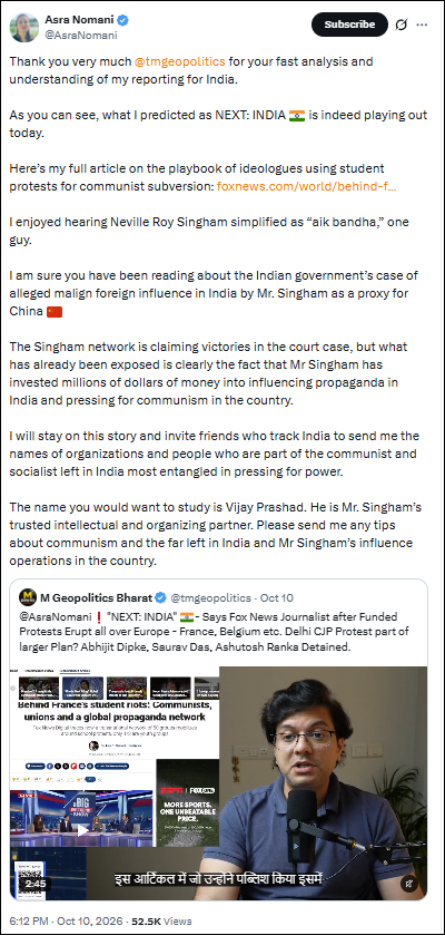
Not students or youth, but the Neville Roy Singham-backed Red-Green alliance is the central actor in French protests; read why Fox News editor Asra Nomani warned India of a similar Islamo-leftist playbook amid protests against CEC Gyanesh Kumar 

France has been on a boil for weeks now. The protests, which began in the Paris region over education standards and school funding, turned violent after being co-opted and amplified by a red-green alliance of far-left or Communist groups and Islamist or pro-Palestinian networks. Senior investigations editor at Fox News Digital, journalist Asra Nomani, has in a recent article contended that the ‘student protests’ in France have been hijacked by communist groups and pro-Palestine networks, with transnational funding and propaganda links involving Shanghai-based Chinese Communist Party (CCP) stooge Neville Roy Singham.  

As the CJP launched its protest against CEC Gyanesh Kumar in New Delhi over the Special Intensive Revision (SIR) of the electoral rolls on 10th October, Asra Nomani warned India about the Communist-Islamist playbook being executed in India after it wreaked havoc in France. 

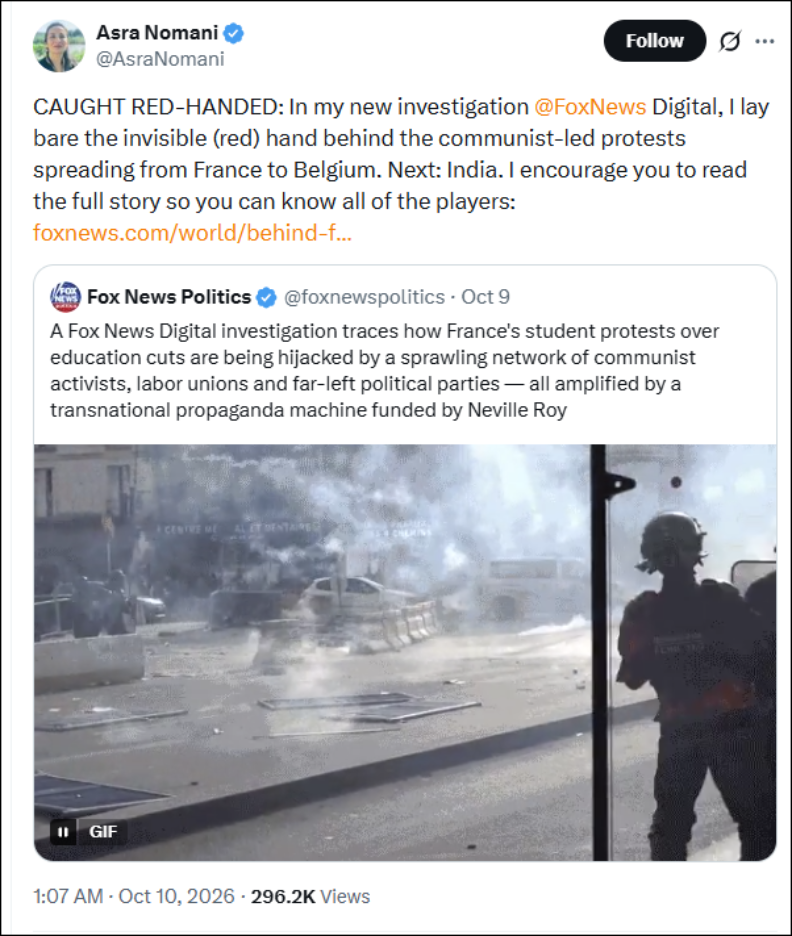
“CAUGHT RED-HANDED: In my new investigation @FoxNews Digital, I lay bare the invisible (red) hand behind the communist-led protests spreading from France to Belgium. Next: India…” Nomani wrote on X. 

Of 50 organisations involved in protests, 35 are adult-led Communist or Islamist groups: Student protests, Islamo-leftist battleground and the Neville Roy Singham link 

French student protests began in late September 2026 over genuine education grievances, including teacher shortages, overcrowded classrooms, dilapidated infrastructure, underfunding, and other related issues. The initial protests involved school blockades, strikes and marches by thousands.  

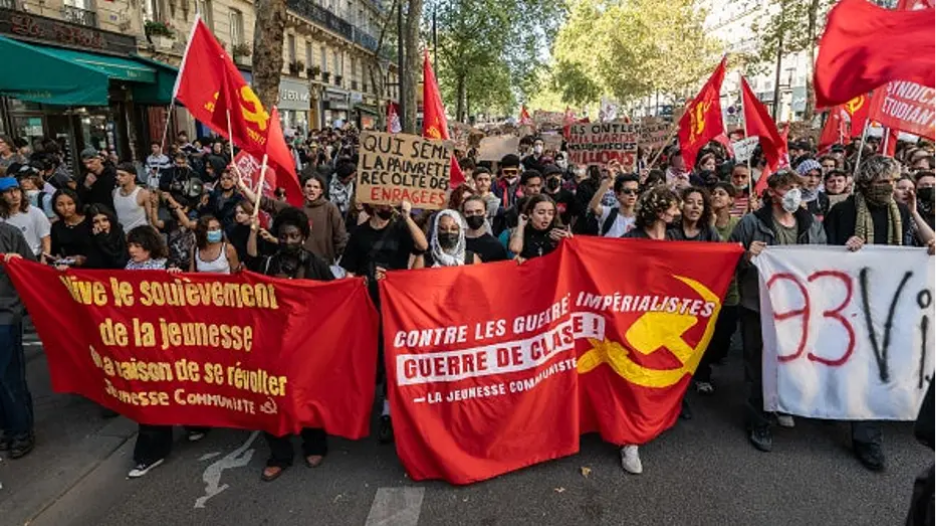
However, as communist unions carrying red flags with hammer-and-sickle signs, and Keffiyeh-donning Islamists started participating in the protests, the situation soon escalated into vandalism, fires at schools, clashes with law enforcement personnel, thousands of arrests and numerous police injuries.  

Asra Nomani’s investigation into the entities involved in the French ‘student protests’ tracked over 50 organisations involved in organising, backing, and amplifying the protests. 

Alarmingly, out of the 50 organisations actively partaking in the ongoing protests, only 15, about one-third, were student or youth groups. The majority, 35 groups, were adult-led: around 12 labour unions, 8 communist or socialist groups, 4 political parties, including La France Insoumise and the French Communist Party, leftist civil or human rights groups, and one Palestinian advocacy group. 

These Communist and Islamist organisations include, as per Fox News investigation, the Confédération générale du travail, or General Confederation of Labour; Force Ouvrière, or Workers’ Force; and Union nationale des syndicats autonomes, or National Union of Autonomous Trade Unions. The CFDT Public Education, Training and Research; CGT Éduc’action; the National Federation of Education, Culture and Vocational Training–Workers’ Force; SUD Éducation; and Syndicat National des Enseignements de Second Degré, the National Union of Secondary Education, affiliated with the Unitary Trade Union Federation. 

Source: Guy Smallman/Getty Images

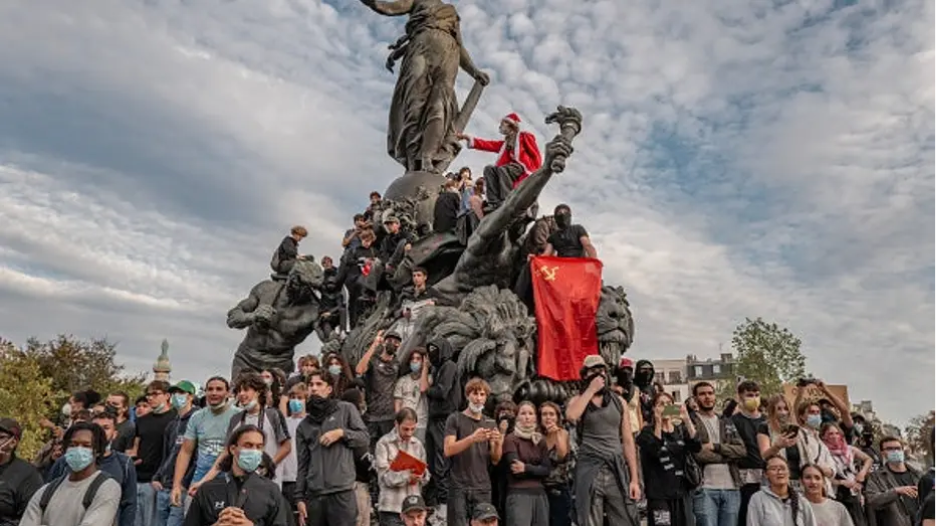
On the ground in Paris and other protest-hit areas, hammer-and-sickle flags appeared alongside Palestinian flags and Keffiyehs. Far-left political leaders also joined protesters, and pro-Palestine ‘activists’ mixed into the actions.  

Recently, while French authorities were grappling with rioting mobs, far-left environmental group, Les Soulèvements de la Terre, or “Earth Uprisings,” declared, “Glory to the rebellious high school students.” It also called for an “antifascist uprising”. 

Foreign support is also being solicited, with a climate crusader turned activist-on-demand, who has in recent months reinvented herself as a ‘Free Palestine’ activist, also extending support to the ongoing protests in France. 

Experts are of the view that an “unholy” red-green alliance is active in France and has turned school demands into a broader anti-system, anti-Israel, anti-capitalist confrontation.  

While Leftists/Communists and Islamists have nothing in common ideologically as such, they share hatred for Jews, Christians, and Hindus, as well as political leaders and parties that do not believe in appeasing and accommodating Islamists and Islamism in the name of secularism. 

Islamo-leftist groups hijack grievances; Islamist media allies like Al Jazeera handle the amplification and narrative game 

This is a part of the known pattern of Islamist and Leftist/Communist radical groups hijacking real issues and protests, resort to violence, push their own ideological-political agenda, while Islamo-leftist media outlets like Qatari stated-owned Al Jazeera and its sister AJ+ amplify and glorify the violent protests, while whitewashing their crimes. 

Islamo-leftists exploit liberal democratic institutions to gain ground, aided by foreign funding.  

“From France to the United States, the United Kingdom, Brazil, Greece and India, adults with deep pockets are tapping France’s school protests and turning a domestic education dispute into a platform for broader political and ideological confrontation,” the Fox News report reads. 

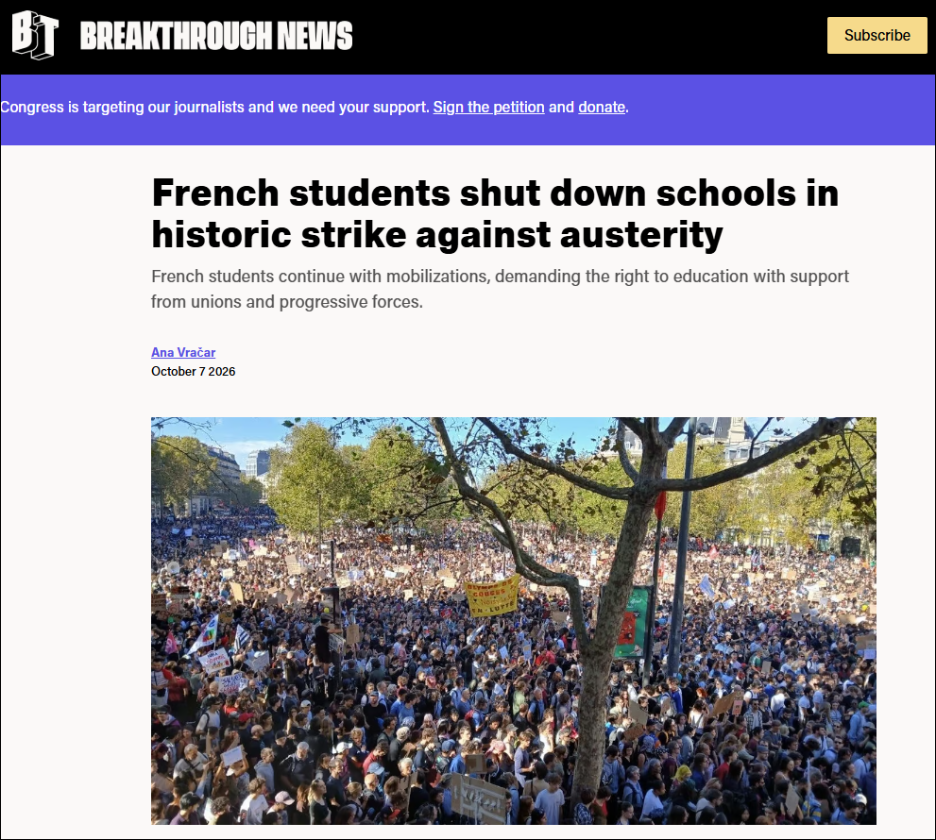
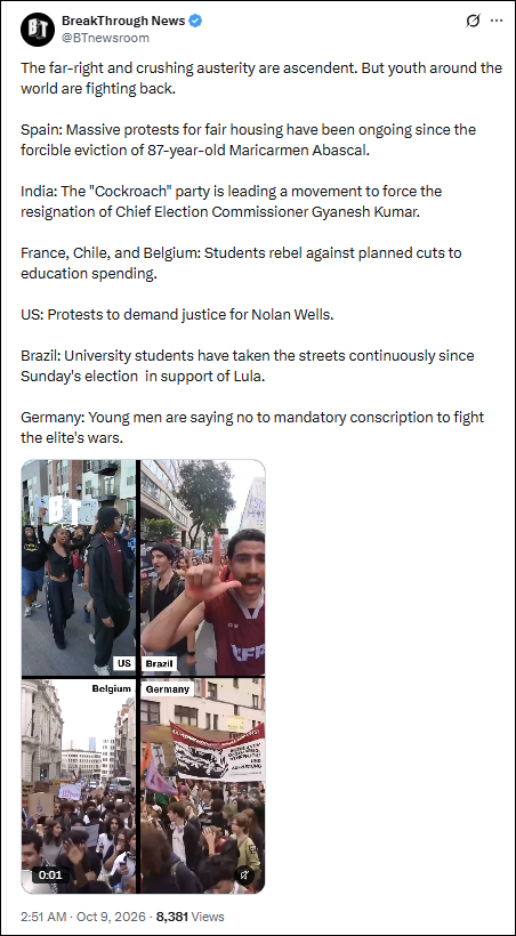
Besides Al Jazeera, the notorious pro-Hamas propaganda outlet, a New York City-based pro-Communist rag, BreakThrough News, is actively amplifying violent protests in France by Islamists and Communists while framing them as ‘student protests’.  BreakThrough News and the broader propaganda network packaged the French protests as part of a global “youth rising up” struggle and laid the groundwork for similar actions elsewhere, including India. 

Interestingly, BreakThrough News is funded by Neville Roy Singham, the US-born tech tycoon who sold his IT consulting firm Thoughtworks for about $785 million in 2017 before relocating to Shanghai. 

Roy Singham helms the pro-China information laundering network “House of Singham”.  This network is a sophisticated “information laundering” or “narrative laundering” machinery that modifies raw activism into polished propaganda, which is then amplified by the Roy-Singham-funded network to sow discord in the US, France and other democracies while burnishing China’s image as a ‘benevolent’ counterweight to ‘imperialism’, particularly American imperialism. The left-wing activism in Cuba and violent protests in France perfectly exemplify this.  

In a nutshell, the Islamo-leftist cabal thrives on anarchy and exploits real grievances in target countries, co-opts and magnifies them into ‘revolution’ against supposed ‘fascism’ or ‘fascist government ‘, which is intended for or carries the potential for securing a violent regime change. 

The House of Singham pro-China/Communism propaganda network 

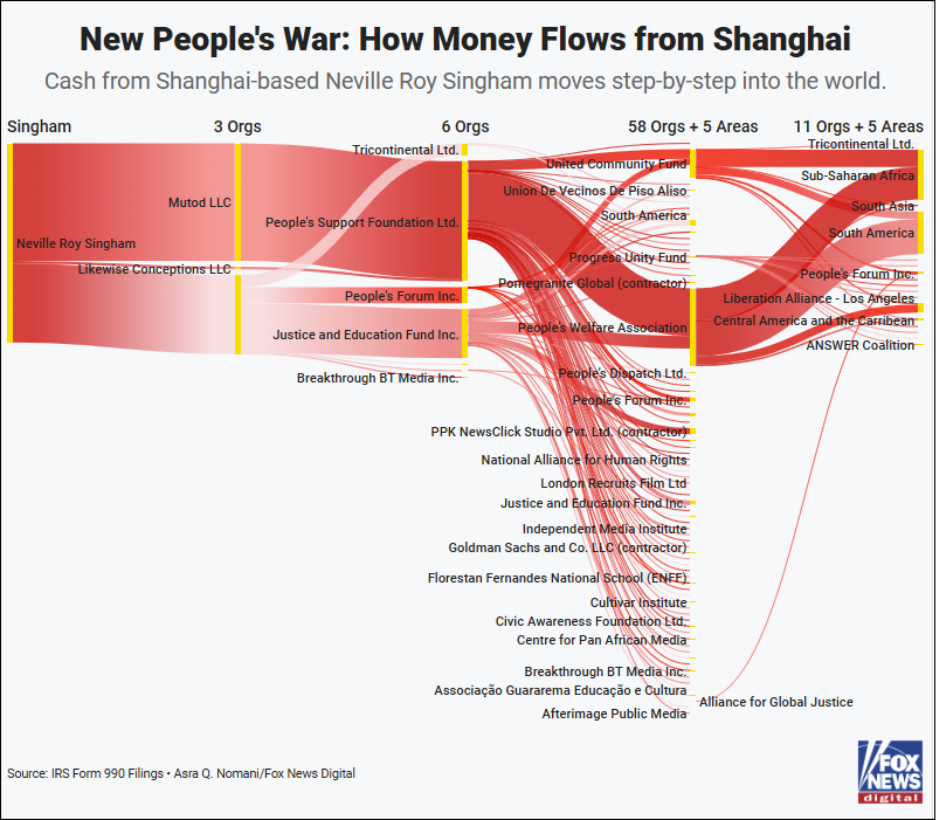
It was reported earlier that Neville Roy Singham has funnelled over $278 million directly into his pro-China propaganda network since 2017, with total money flows exceeding $591 million across 223 transactions spanning five continents through the year 2025. The massive amount was pumped into over a thousand interconnected organisations, of which around 200 are directly involved in generating and propagating pro-China and anti-America messaging at the behest of the CCP. 

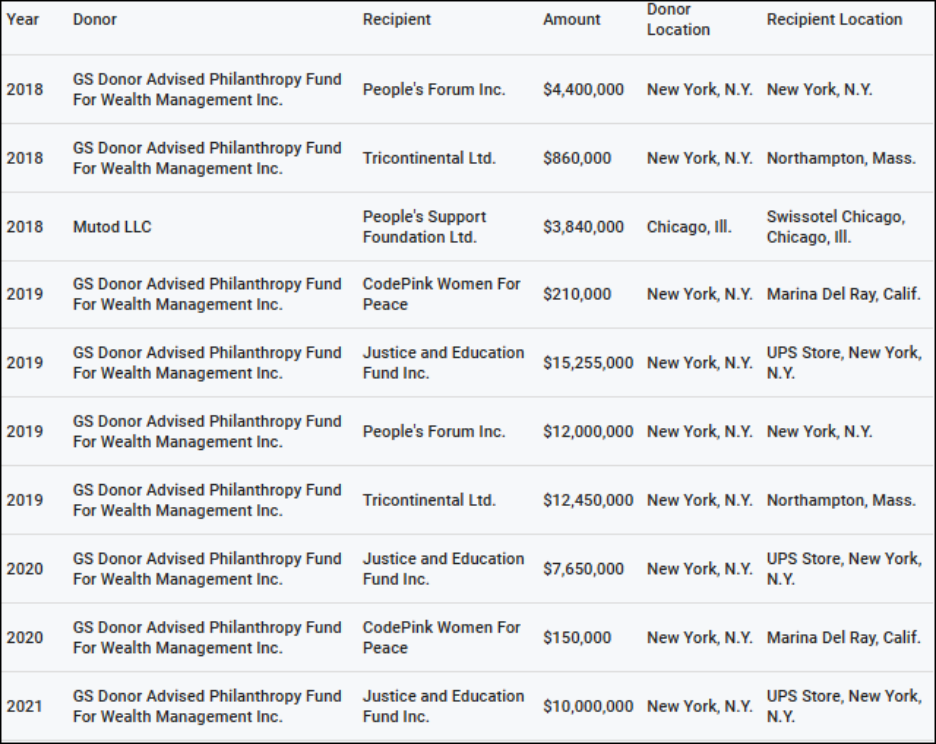
Neville Roy Singham is alleged to have first established a system to funnel tax-exempt dollars via two shell entities and a donor-advised fund with links to Goldman Sachs, “GS Donor Advised Philanthropy Fund for Wealth Management Inc.” Goldman Sachs philanthropy arm “terminated” Singham’s donor-advised fund in February 2024. 

The House of Singham pro-China propaganda and activism network traces its origins to Neville Roy Singham’s wedding to Jodie Evans, the co-founder of CodePink Women for Peace, in Jamaica in 2017. The wedding event was attended by more than 80 core leaders, including Vijay Prashad of “TriContinental: Institute for Social Research”. Vijay Prashad, a Marxist journalist, later populated other boards within the network across shell-like entities, including Mutod LLC and Likewise Conceptions LLC. Fox News investigation finds that many of these organisations are registered at generic locations like hotels or UPS stores, apparently to obscure flows. 

Eleven US non-profits are serving as a hub, redistributing funds, coordinating protests, generating media content, political education, and “Liberation Centres” that are similar to the infamous 20th-century Chinese leader Mao Zedong’s “united front” strategy of embedding ‘revolutionary’ actors in superficially independent social, media, labour, cultural, and educational groups to erode the targeted country’s state legitimacy from within. 

From three organisations, GS Donors Advised Philanthropy Fund for Wealth Management Inc., and the two apparent shell companies, Roy Singham pumped $278 million into six nonprofits. 

These nonprofit organisations include People’s Forum, which received $22.4 million; People’s Support Foundation, which received $167.5 million from Singham-linked sources; and Justice and Education Fund, which received $68.7 million. BreakThrough BT Media, CodePink, which is co-founded by Singham’s wife Jodie Evans, and Tricontinental Ltd, which has Marxist ‘journalist’ Vijay Prashad as its Director. 

Experts like Adam Sohn of the Network Contagion Research Institute and co-founder of Narravance opine that this structure enables an information laundering operation and a narrative laundering operation that is selling China’s propaganda to the world while sowing discord in America. The Fox News report cites the grassroots-looking protests, be it against ICE enforcement, the US offensive against Iran, the abduction of Venezuelan leader Nicholas Maduro, or in support of the Communist regime in Cuba, are all filmed, packaged into videos and commentary by House of Singham-linked media outlets like BreakThrough News, and recirculated to form a chimaera of organic global ‘resistance’. 

Now, the same playbook is being executed in France, Brazil, India and other targeted countries. 

BreakThrough News: Roy Singham network’s most potent Islamo-leftist propaganda tool 

BreakThroughNews.org was registered online in December 2019. In March 2020, “Breakthrough / BT Media Inc.” was registered in Delaware as a new company. It secured IRS 501(c)(3) nonprofit status in June 2020 as Breakthrough BT Media Inc. Neville Roy Singham donated  $1.1 million to BreakThrough BT Media Inc. in the name of ‘public service and medical/public services. While the outfit claims to be unbiased, it is a part of the International People’s Media Network, which regularly pushes pro-China propaganda. 

BreakThrough News produces and amplifies pro-Palestine, anti-Israel, pro-Venezuela/Maduro, pro-Cuba, and other such content, which are always aligned with China’s foreign policy interests. At present the propaganda outlet has devoted its resources to peddling glorifying Islamo-leftist anarchists in France and India. 

In addition to amplification and glorification of Islamo-leftist anarchy, ‘journalists’ linked to Roy Singham network actively participate in protests and extract high-impact content.  

In the US, the House of Singham has created a direct pipeline from American tax-exempt dollars to Chinese propaganda factories. Earlier this year, Fox News Digital reported that three US nonprofit organisations within the Roy Singham-led network sent $9.1 million across seven payments since 2021 to Shanghai Maku Cultural Communications Co., Ltd., which is a pro-CCP propaganda factory registered at Neville Roy Singham’s luxury building address and generating online content based on the CCP’s narratives. 

Hasan Piker and Indian Alliance Paris and The People’s Forum: From France or India, Islamo-Leftist anarchists are inciting violent ‘revolution’ 

In addition to organised media machinery, the red-green alliance is also backing individuals who have earned notoriety for peddling Jihadist propaganda, spewing antisemitic venom and dehumanising non-Muslim religious groups.  

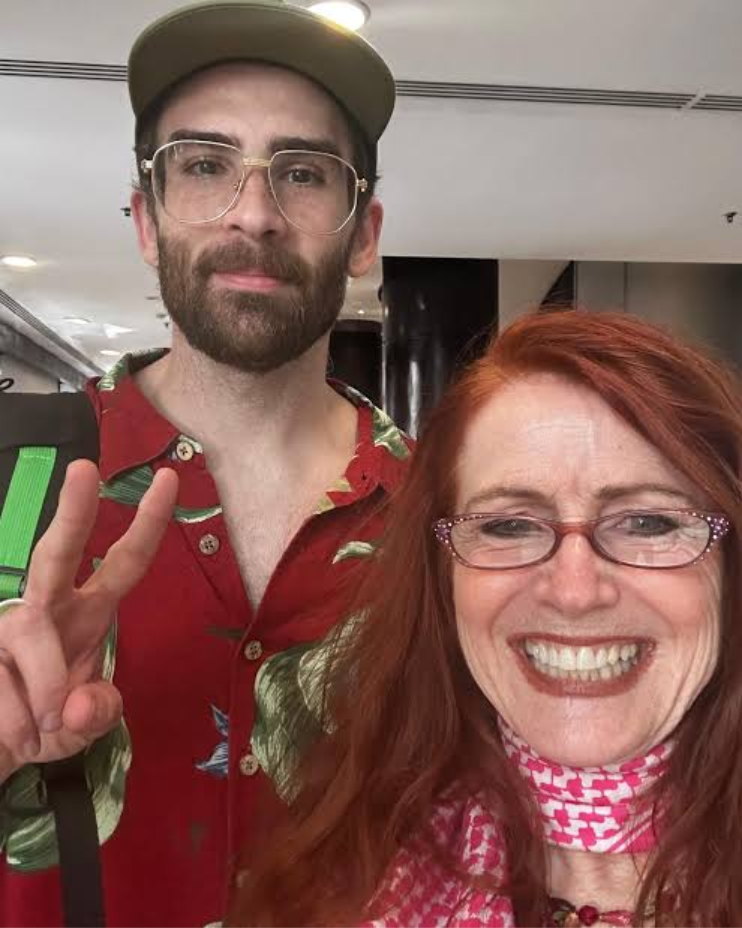
One such individual is Hasan Piker, who had openly amplified pro-Pakistan lies during the May 2025 India-Pakistan conflict. Piker is involved in pushing a favourable narrative about the violent Communist-Islamist rioters in France. He had, earlier this year, visited Cuba to support the communist government, and was photographed with Neville Roy Singham’s wife Jodie Evans. 

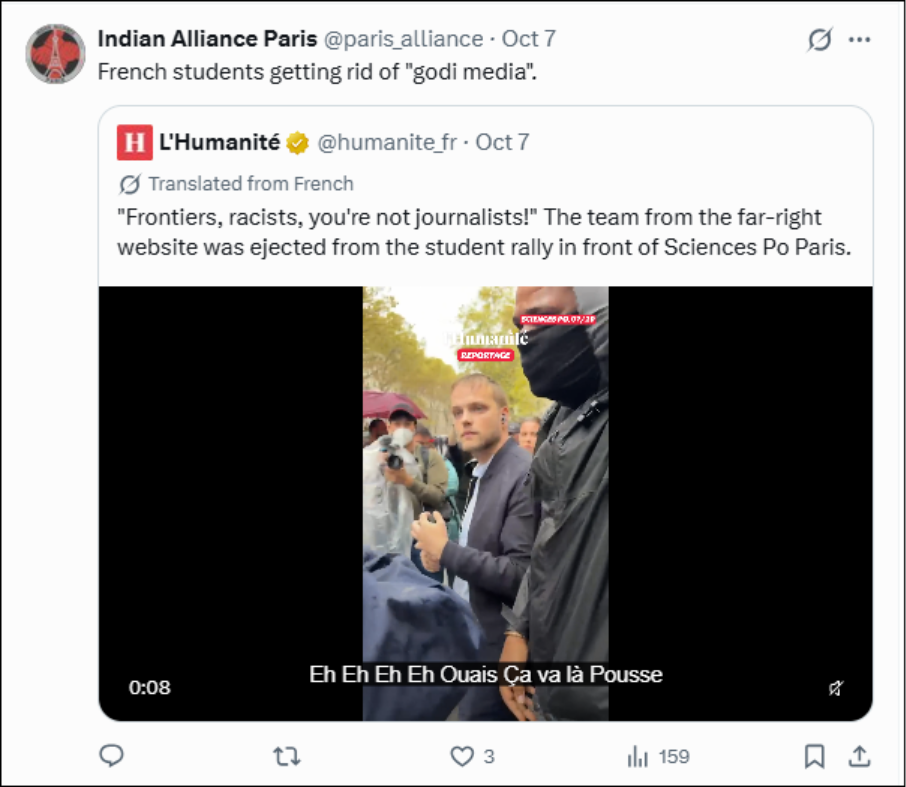
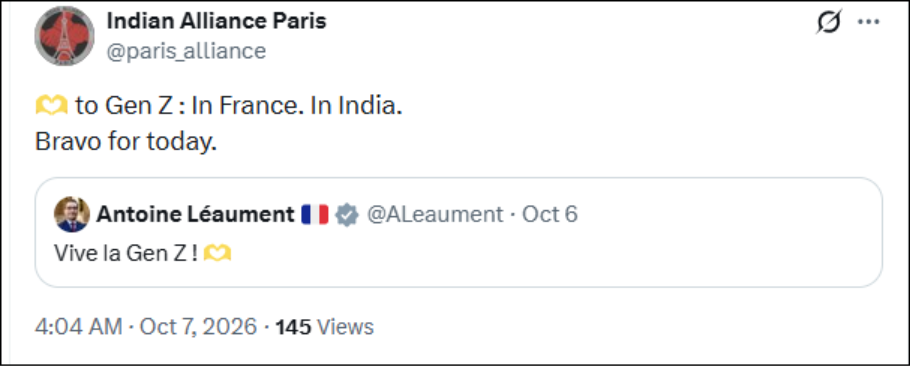
An interesting name highlighted in the Fox News report is that of the Indian Alliance Paris. This France-based outfit comprising students, researchers etc., themselves as committed to a “democratic and egalitarian” India. However, a deeper analysis of their activities reveals their true leftist agenda. In January 2023, the IAP co-sponsored an event in Manhattan which opposed the expansion of the NATO, with Roy Singham-backed The People’s Forum as its venue. 

Unsurprisingly, both the Indian Alliance Paris and The People’s Forum are supporting and amplifying both the Islamo-leftist protests in France and the Cockroach Janta Party-led protests against Chief Election Commissioner Gyanesh Kumar in India. 

Notably, The People’s Forum which, like several other Roy Singham-funded propaganda factories, has been one of the major instigators of anti-Israel protests in the US since October 2023. CodePink, co-founder and Neville Roy Singham’s wife, Jodie Evans, donated over $20.4 million to the organisation between 2017 and 2022. However, People’s Forum’s propaganda peddling activities are not confined to the US alone; rather, it extends to India as well. The outlet has been pushing anti-India narratives since 2019. 

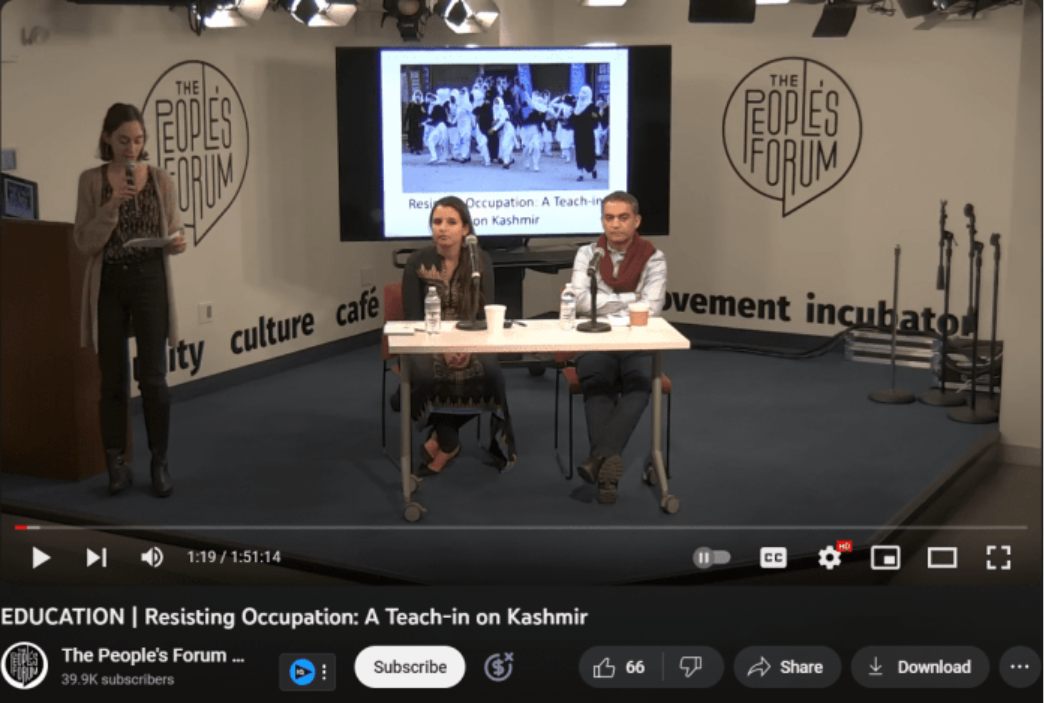
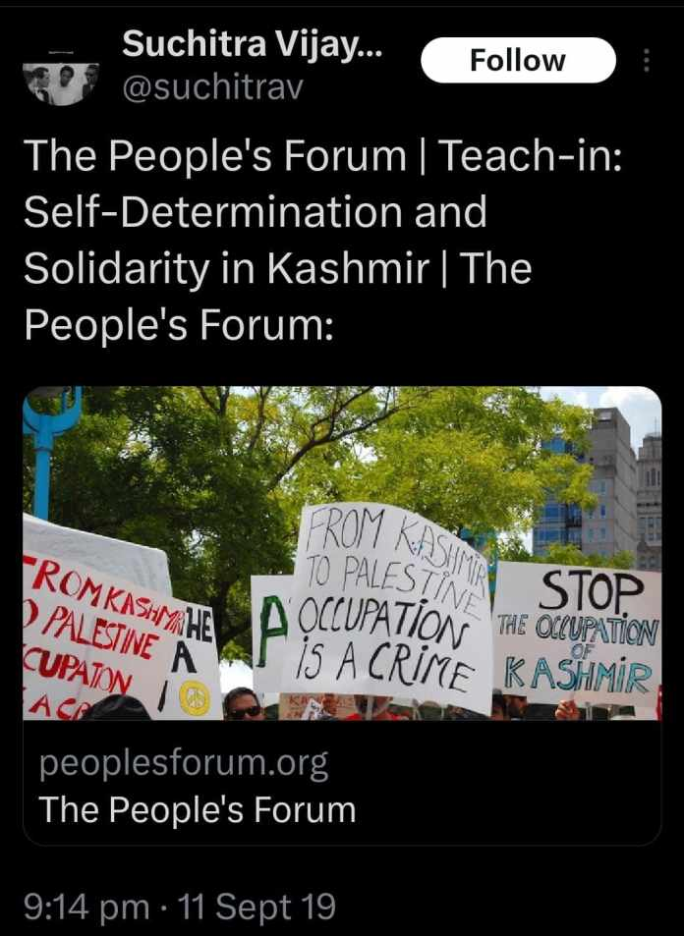
Over the years, ‘The People’s Forum’ has been organising teach-in sessions, seminars and movie screenings to disseminate a distorted idea of Jammu and Kashmir to its global audience. 

Previously, the pro-China propaganda outlet has called for the secession of the integral part of Jammu and Kashmir and extended support to extremist elements, calling for ‘Azadi.‘ On March 18, 2019, the organisation conducted a 1 hour 50 minute 50-minute-long session, presenting India as an ‘occupying’ force in Jammu and Kashmir. The Forum calls the integral part of the Indian territory “Indian occupied”, even as the only portion of Jammu and Kashmir that is actually illegally occupied is— the Pakistan-occupied-Jammu and Kashmir. 

The outfit also has a history of platforming rabid India-haters and Pakistan’s ISI-linked elements to push anti-India narratives. One such is Hafsa Kanjwal, who had earlier downplayed the Pulwama terror attack in an opinion piece in The Washington Post. 

Back in 2019, Kanjwal appeared at a People’s Forum hosted seminar as an instructor. Kanjwal has maintained close ties with convicted ISI agent Ghulam Nabi Fai through her organisation ‘Stand With Kashmir (SWK)’. She is an Assistant Professor at Lafayette College and featured prominently in several events of ‘The People’s Forum.’ 

In September 2019, the Neville Roy Singham-funded organisation conducted another ‘teach-in session’ dubbed ‘Self-Determination and Solidarity in Kashmir.’ The anti-India event was sponsored by the likes of ‘Codepink’, founded by Neville Roy Singham’s wife, Jodie Evans. 

In March 2023, Hafsa Kanjwal was invited by ‘The People’s Forum’ to promote his book ‘Hostile Homelands: The New Alliance between India and Israel.’ 

In the run-up to the 2019 Lok Sabha elections, The People’s Forum conducted a seminar by a Communist Party-affiliated Student Federation of India (SFI) leader, V Srinivasa Rao. 

The event titled ‘Make the land proud: India’s Peasant Struggles and the 2019 Election’ hoped to capitalise on the growing resentment of farmers towards the Modi government and impact the outcome of the polls. 

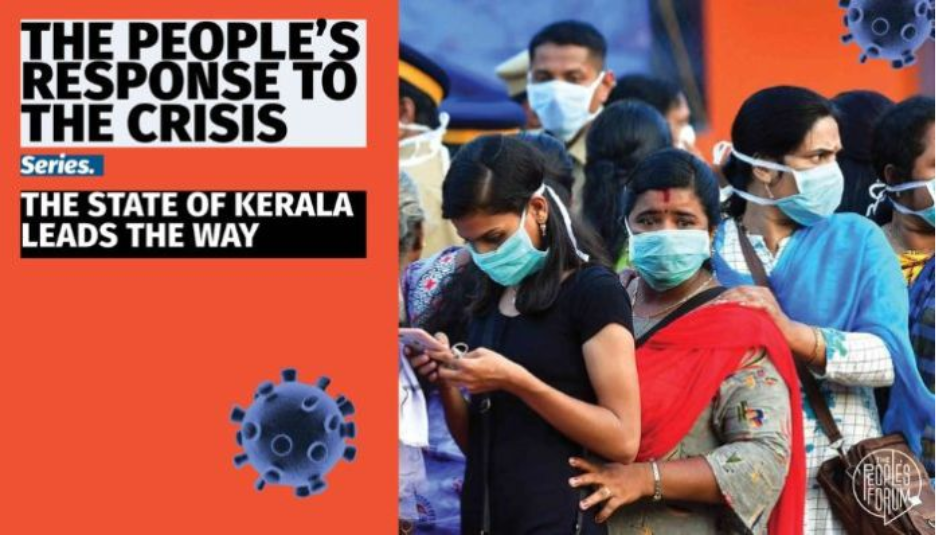
The pro-China and pro-Communist propaganda organisation funded by Neville Roy Singham also has a record of disseminating the myth of the ‘Kerala Model’ in one of its events since the government in Kerala was a Communist one. 

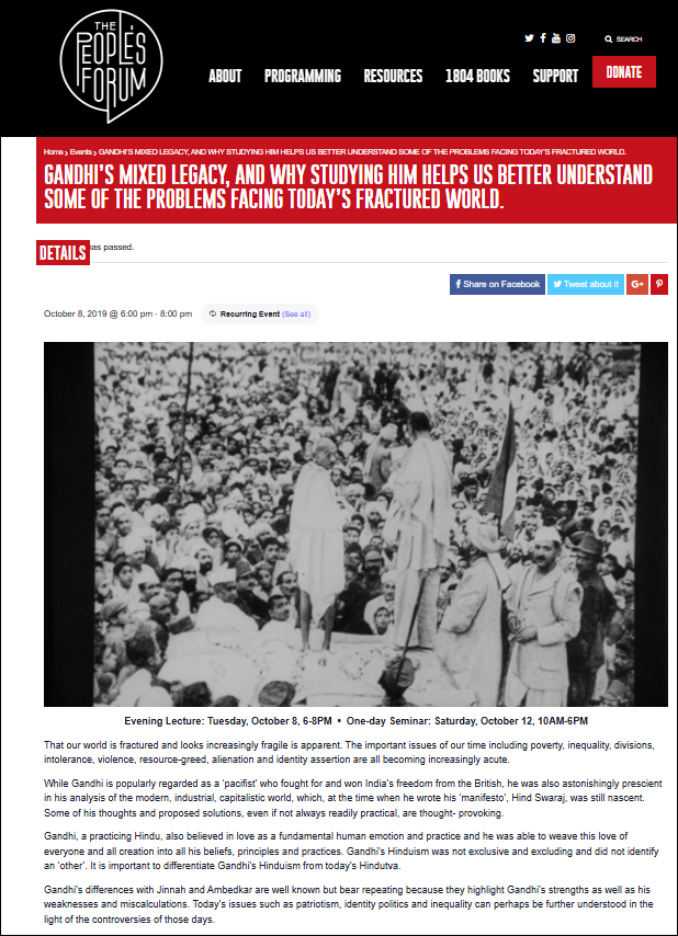
in October 2019, the Neville Roy Singham-financed organisation held a seminar on Mohandas Karamchand Gandhi and launched an attack on Hinduism under the pretext of condemning ‘Hindutva’. 

This event was co-sponsored by a group backed by Hungarian-American philanthropist infamous for  anti-India and anti-Hindu activities in addition to orchestrating ‘colour revolutions’ in various counties, Hindus for Human Rights (HfHR). 

Earlier, HfHR was also seen endorsing the Hinduphobic event titled, ‘Dismantling Global Hindutva’ conference. As per OSINT handle ‘Disinfo Lab’, HfHR was formed in the year 2019 by the Indian American Muslim Council (IAMC) and the Organisation for Minorities of India (OFMI). 

Sunita Vishwanath, the co-founder of ‘Hindus for Human Rights’ had also tried to create hysteria and panic among Indian Muslims about the National Register of Citizens (NRC) in 2019.  

As SFI, AISA and other leftist groups lead anti-CEC protests, why Asra Nomani’s warning to India against the “red” threat must not be ignored 

In an X post published on 10th October, Fox News Digital’s Asra Nomani said that the Communist subversion playbook is playing in India now. She highlighted the NewsClick episode and the name Vijay Prashad, the trusted confidante of Neville Roy Singham. 

For years, Chinese-linked influence operations, be it media outlets, politicians, dubious NGOs, etc, have been shaping narratives against the Modi government with the ultimate aim of regime change. 

China’s interference in electoral politics in foreign countries is best exemplified by the NewsClick scandal. The pro-China propaganda portal first made headlines when it came under the radar of the Enforcement Directorate in 2021. The portal was reportedly accused of fraudulently receiving foreign funds amounting to around Rs. 38 crores.  

In 2023, the Delhi Police Special Cell filed an FIR and later an extensive chargesheet under the Unlawful Activities (Prevention) Act (UAPA) against NewsClick founder Prabir Purkayastha, HR head Amit Chakraborty, among others. 

The same Neville Roy Singham, who ran a pro-China information laundering network in the US, has also expanded his tentacles to India. Roy Singham’s Justice and Education Fund donated $10.5 million to Delhi-based pro-China propaganda outlet, NewsClick. 

One of the most prominent members of Roy Singham’s evil empire is Vijay Prashad. He has contributed several propaganda anti-India articles to NewsClick. Prashad is the nephew of Brinda Karat, a CPI(M) leader and wife of Prakash Karat, also a senior CPI(M) leader, whose email exchanges with Neville Roy Singham earlier revealed their close ties in the NewsClick Chinese funding scandal. 

Vijay Prashad has also been a council member of the Progressive International, an international organisation that mobilises leftist activists and groups globally. OpIndia earlier highlighted how this outfit persistently publishes propaganda articles and statements peddling the insidious Muslim victimhood narrative to slander the Modi government. It regularly platforms notorious anti-Hindu and Islamist apologists like Harsh Mander and has Islamo-leftist cheerleaders like Jayati Ghosh and former Labour MP Jeremy Corbyn as its council members. 

Roy Singham’s propaganda network has a connection with pro-Hamas Tides Foundation. Tides Foundation is notorious for funding several anti-Hindu, anti-India organisations and elements. The Foundation gave grants to Hindus for Human Rights (HfHR), which has links to Islamists and Khalistanis, and was formed in 2019 by two Islamist advocacy groups, the Indian American Muslim Council (IAMC) athe nd Organisation for Minorities of India (OFMI). 

Tides also funded AMAN Public Charitable Trust (AMAN). This trust is connected to the NewsClick-China funding scandal, where it is alleged that Chinese entities funded NewsClick to disrupt Indian sovereignty. 

Among Indians introduced by Neville Roy Singham to his larger team, who worked with Tricontinental, one of the nonprofits that the New York Times said was involved in pushing Chinese talking points, were Prabir Purkayastha, Srujana, Prasanth, and Vijay Prashad.  

Prashad also has close ties with Urban Naxal P Sainath, whose propaganda portal PARI recently removed references to Singham after his connection with the Chinese propaganda arm had come to light. 

OpIndia has regularly called out Newsclick’s anti-Hindu propaganda. Moreover, Newsclick has also faced scrutiny for its alleged connections with the Chinese Communist Party (CCP). In 2023, an investigation by the New York Times uncovered an ecosystem of activist organisations, non-profits, shell corporations, and their intimate ties to China and Chinese propaganda, with Neville Roy Singham at its helm. A Delhi Police chargesheet filed in 2024 called the Chinese state the “ultimate paymaster”, with funds routed to stoke anti-India narratives, especially regarding Kashmir, and farmers’ protests. The case is ongoing in the court. 

Back in 2021, OpIndia conducted a detailed investigation into the links of NewsClick and uncovered how it was linked to several individuals who regularly spew venom against India, from Urban Naxals to those like Teesta Setalvad, Abhisar Sharma and several others.  

That investigation by OpIndia can be read here. 

There are many Roy Singham network-backed pro-China propaganda factories actively peddling anti-India and anti-government narratives. OpIndia has reported about such entities, including People’s Dispatch, TriContinental, People’s Forum, among others. 

From Kashmiri separatism, anti-Hindu tropes, glorification of Kerala’s ‘communist’ model, to Muslim victimhood, and propaganda maligning India’s global image, these CCP asset Roy Singham-backed entities are dedicated to weaponising issues, nonprofit laws, digital media, and every other resource at hand to undermine rival states, influence policy decisions, weaken India, and deliver a geopolitical edge to China. 

In February this year, the Enforcement Directorate fined NewsClick and its founder-editor Prabir Purkayastha Rs 184 crore under the Foreign Exchange Management Act (FEMA) for violating foreign funding regulations. 

The NewsClick founder faced allegations of conspiring with Chinese Communist Party (CCP) member Neville Roy Singham to defame the Indian government and its efforts to contain the spread of COVID-19 and cast aspersions about the efficacy of Indian vaccine ‘Covaxin’ developed by Bharat Biotech. 

NewsClick has been accused of having obtained funds from China to provoke disturbances in India, especially amid the anti-CAA (Citizenship Amendment Act) protests to topple the Modi government, and has links to anti-India voices like Gautam Navlakha. 

Its founder faced allegations of having ties to LeT (Lashkar-e-Taiba) terrorists, giving money to anti-Hindu 2020 Delhi riots accused Sharjeel Imam and Naxals in Delhi Police’s chargesheet. 

Coming back to the ongoing protests against CEC Gyanesh Kumar and the Fox News reporter’s warning that the next target for communist subversion is India, Asra Nomani’s concerns are rooted in reality of the ongoing protests. 

While the Congress party, and the broader INDI bloc has catch up with the Cockroach Janta Party-led protests against CEC Kumar, it is mainly the communist-leftist student groups like the Student Federation of India (SFI), All-India Students’ Association (AISA), and their leaders like Neha Bora, who are leading the ground protests. 

On 10th October, Delhi Police detained more than 400 goons of the Students’ Federation of India (SFI), along with members of other student organisations and lawyers after they toppled police barricades during a march in central Delhi and injured two police personnel.  

Unlike the July protest, the authorities in New Delhi were better prepared this time, although some incidents of violence against police personnel have been reported. And yet, only the visuals of police detaining unruly protestors made their way to reports of Indian and international media. 

Be it Al Jazeera, BreakThrough media, or various Islamo-leftist foreign media outlets and their Indian allies, all of them are collectively weaving a ‘police brutalising innocent protestors’ narrative.  

In fact, OpIndia has factchecked Al Jazeera for peddling blatant lies about the modifications in the process of appointing the Chief Election Commissioner. A whole propaganda machinery has been activated to glorify protest leaders like Neha Bora through interviews and profiles, and the SIR exercise is being portrayed as ‘mass disenfranchisement engineering’ to ensure electoral wins for the BJP even there is no credible evidence for the same.  

The whole anti-CEC agitation rests on an apocryphal and alarmist narrative merely because the Opposition parties are unable to digest electoral defeats. The opposition’s EVM hacking, VVPAT tampering, and Rahul Gandhi’s ‘vote chori’ bogey could not sow distrust in the minds of the Indian people against the Election Commission, its integrity and the transparency of the electoral process. Thus, the anti-BJP cabal has chosen SIR as the trigger and CEC Gyanesh Kumar as their scapegoat.   

As leftist and supportive political parties have joined for the supposed ‘greater purpose’ of saving democracy by ousting the BJP government, which they believe has come to power ‘fraudulently’, there is a high possibility that violence is the next and final chapter of this playbook.  One excuse or justification, and this whole protest will escalate into full-fledged anarchy. This possibility cannot be ignored since the Opposition has long been itching for a violent Nepal and Bangladesh-like GenZ ‘revolution’ and now is issuing “Yeh Sarkar Jayegi” [This government will be ousted] threats. 

Why did Sensex surge 1,100 points? Sitharaman’s tax remarks, IT earnings and rupee recovery explain Dalal Street’s dramatic rebound

Dalal Street finally had something to cheer about on Tuesday as Indian equity markets staged a powerful comeback, reversing losses and adding approximately Rs 4 lakh crore to investors’ wealth.

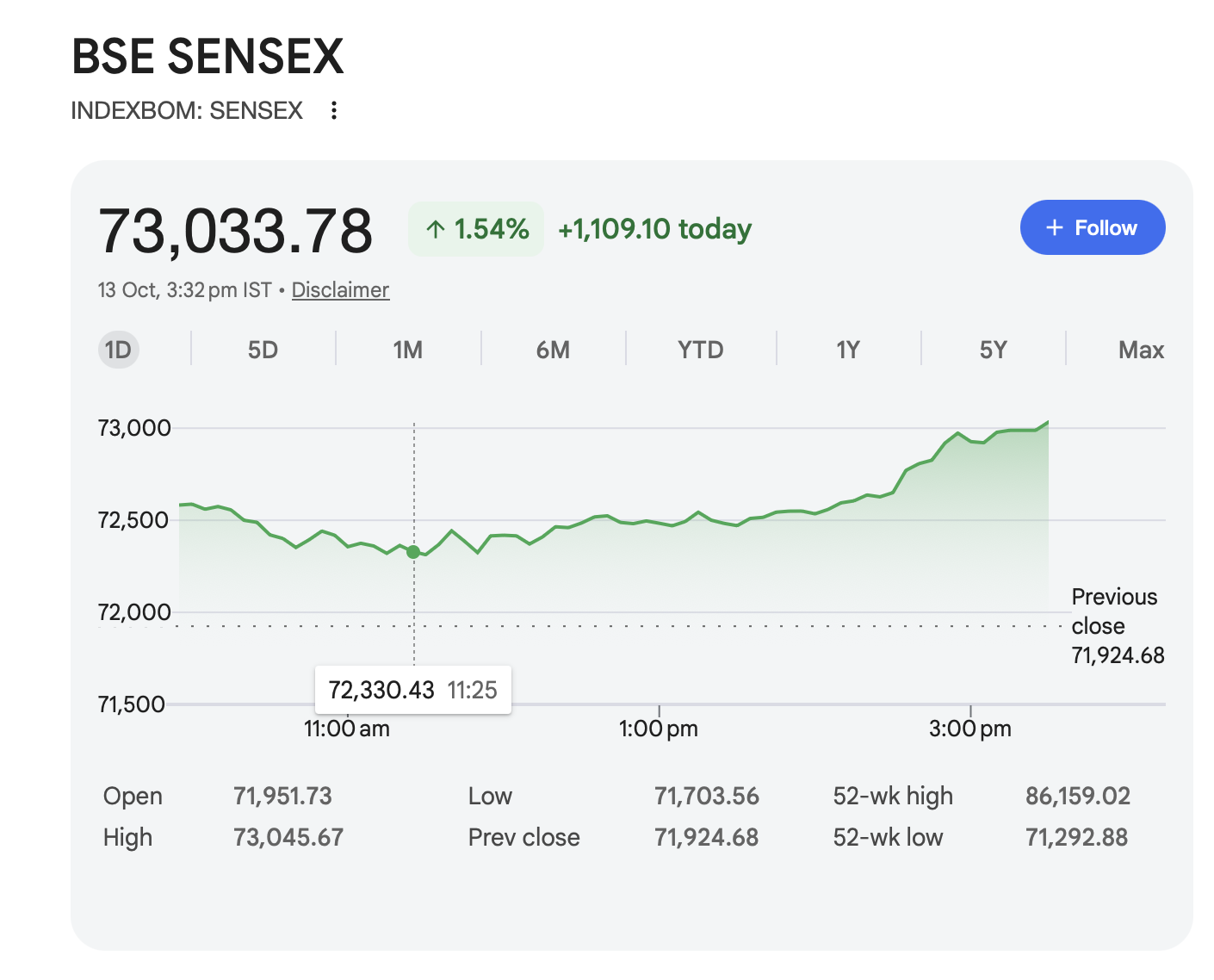
The BSE Sensex jumped 1,109.10 points, or 1.54%, to close at 73,033.78, while the NSE Nifty 50 advanced 358.60 points, or 1.60%, to settle at 22,721.95.

The rally came against a backdrop of persistent concerns over foreign investor outflows, elevated crude oil prices and uncertainty surrounding the global economy. Yet, a combination of encouraging corporate earnings and renewed hopes of a more accommodating approach to equity taxation helped change the mood on Dalal Street.

The immediate trigger was the strong performance of IT stocks following HCLTech’s quarterly results. Finance Minister Nirmala Sitharaman’s remarks on the debate surrounding long-term capital gains (LTCG) tax and securities transaction tax (STT) provided an additional boost, while the recovering rupee and softer crude prices offered further support.

But how much of Tuesday’s rally reflected an improvement in corporate fundamentals, and how much was driven by expectations?

1. Sitharaman’s tax remarks revive hopes of relief ahead of Budget 2027

One of the most significant developments on Tuesday came from Finance Minister Nirmala Sitharaman, who acknowledged the ongoing debate surrounding LTCG tax, STT and the taxation of different asset classes.

Speaking at the Bloomberg New Economy Forum in New Delhi, the Finance Minister said investors in India and abroad had been commenting on capital gains taxation and the transaction tax imposed on securities markets.

She described the debate as healthy and said she would be keen to hear the arguments.

Her remarks attracted attention because investors have been demanding a reassessment of the tax burden on equity investments.

The government raised LTCG tax on eligible listed equity investments from 10% to 12.5% in the July 2024 Union Budget, while increasing the annual exemption threshold from Rs 1 lakh to Rs 1.25 lakh. Budget 2026 subsequently increased STT on equity derivatives.

Investors argue that these levies increase the cost of participating in India’s capital markets, particularly when foreign investors are already reassessing their exposure to Indian equities.

Sitharaman’s comments therefore raised hopes that the government might be more receptive to these concerns during consultations ahead of the Union Budget scheduled for February 1, 2027.

The market reaction was particularly encouraging for capital-market-related stocks, as investors began pricing in the possibility of a more favourable policy environment.

However, there is a crucial distinction between the Finance Minister acknowledging an issue and the government committing to resolve it.

Sitharaman announced no tax cut, promised no exemption and did not confirm that any particular proposal was under consideration. Tuesday’s rally reflected expectations of a possible policy review, not an actual change in taxation.

2. IT stocks lead the charge as HCLTech delivers strong earnings

If the Finance Minister’s remarks provided a policy catalyst, IT earnings supplied the rally’s strongest immediate fundamental trigger.

HCLTech shares jumped 8.28% after the company reported a consolidated net profit of Rs 5,132 crore for the July–September quarter of FY27, representing year-on-year growth of approximately 21.2%.

The results helped revive confidence in a sector that has faced sustained concerns over slowing growth, moderating client spending and the potential disruption of conventional outsourcing by artificial intelligence.

The buying quickly spread across the sector.

Tata Consultancy Services rose 6.59%, Tech Mahindra gained 4.90%, and Infosys advanced 4.44%. The Nifty IT index surged approximately 5.2%, recording its strongest session in more than 17 months, according to Reuters. <Cite refs={[“turn120305news9”]}/>

The rally is significant because IT stocks have been among the market’s more troubled segments this year.

Investors have questioned whether generative AI and increasingly capable automated systems could undermine traditional software services, reduce demand for labour-intensive outsourcing and place pressure on the industry’s established business model.

HCLTech’s results offered a counterpoint to this pessimism. Stronger profitability and developments in AI-related business gave investors reasons to reconsider the sector’s near-term earnings prospects.

However, the rally should not be interpreted as proof that the industry’s structural challenges have disappeared.

Arun Malhotra, fund manager at CapGrow Capital, offered a more cautious interpretation of the gains.

According to Malhotra, the rally in IT stocks did not represent a structural reversal for the sector. Instead, better-than-expected earnings from TCS and HCLTech had created an opportunity for value buying.

That observation is important. After a period of substantial weakness, even a relatively modest improvement in earnings expectations can trigger aggressive buying as investors look for undervalued opportunities.

The latest results may have improved sentiment, but the sector will need sustained revenue growth, healthy deal pipelines and resilient margins to establish a durable recovery.

3. Rupee recovery and RBI measures ease currency concerns

The Indian rupee’s recovery provided another supportive factor.

The currency strengthened for a third consecutive session, with the RBI’s measures aimed at easing dollar demand and curbing excessive positioning in the foreign exchange market contributing to the improvement.

A weaker rupee can increase the cost of imported commodities, intensify inflationary pressure and reduce the dollar-denominated returns foreign investors receive when converting their Indian equity investments.

A recovering currency can help ease these concerns and improve confidence in the domestic financial environment.

The benefits, however, are not uniform across sectors. A stronger rupee can reduce the domestic-currency value of overseas earnings for export-oriented companies, including IT service providers.

Tuesday’s simultaneous rally in the rupee and IT stocks indicates that investors were more focused on earnings performance and improving sentiment than on this potential headwind.

4. Lower crude prices offer relief, but the oil threat remains

Brent crude declined approximately 1.65% to around $104.89 per barrel on Tuesday, offering some relief to a market concerned about India’s vulnerability to high energy prices.

India imports a substantial share of its crude oil requirements. Expensive oil increases the import bill, puts pressure on the rupee and can raise costs for businesses across multiple sectors.

Lower crude prices can consequently improve the outlook for inflation, corporate margins and the external balance.

However, oil prices remained above $100 per barrel amid tensions in the Middle East.

Malhotra warned that the broader market outlook remained hostage to global macroeconomic conditions, with geopolitical uncertainty and elevated oil prices likely to constrain a sustained recovery.

His assessment offers a useful counterweight to the enthusiasm generated by Tuesday’s rally. A single session of lower oil prices does not remove the risks posed by an extended period of expensive energy imports.

5. IMF’s growth projection reinforces confidence in India

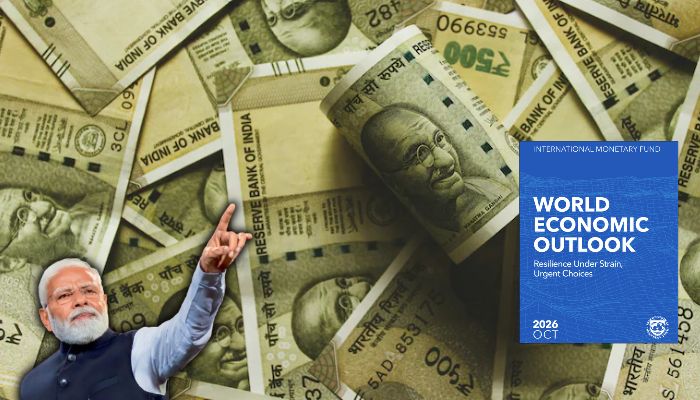
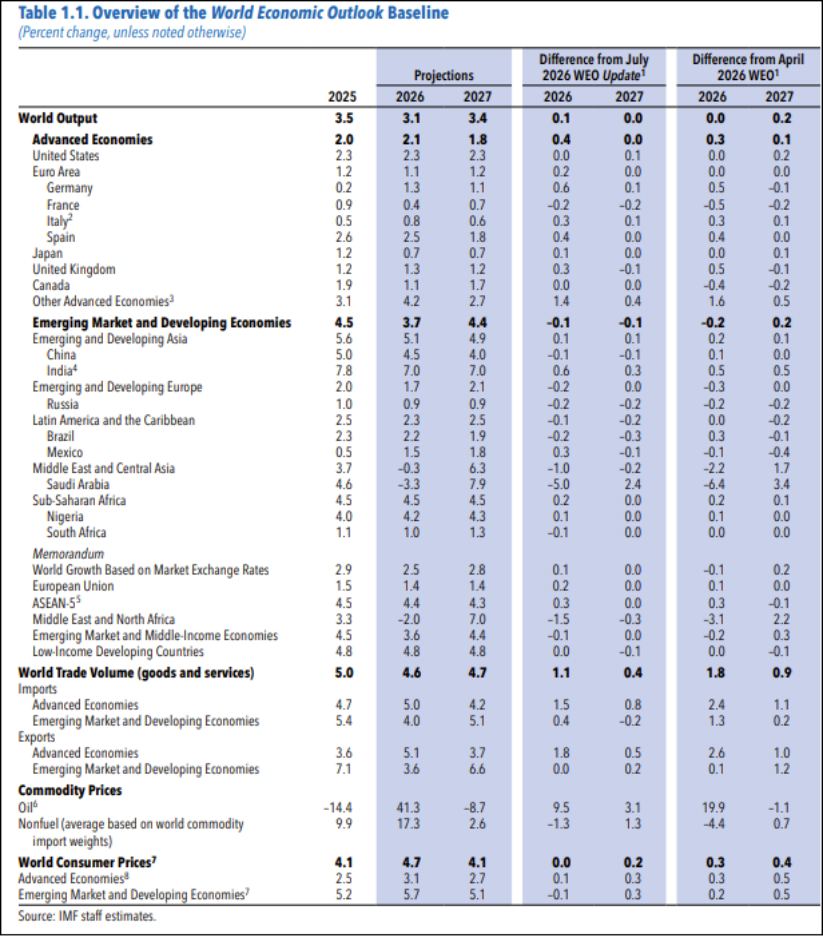
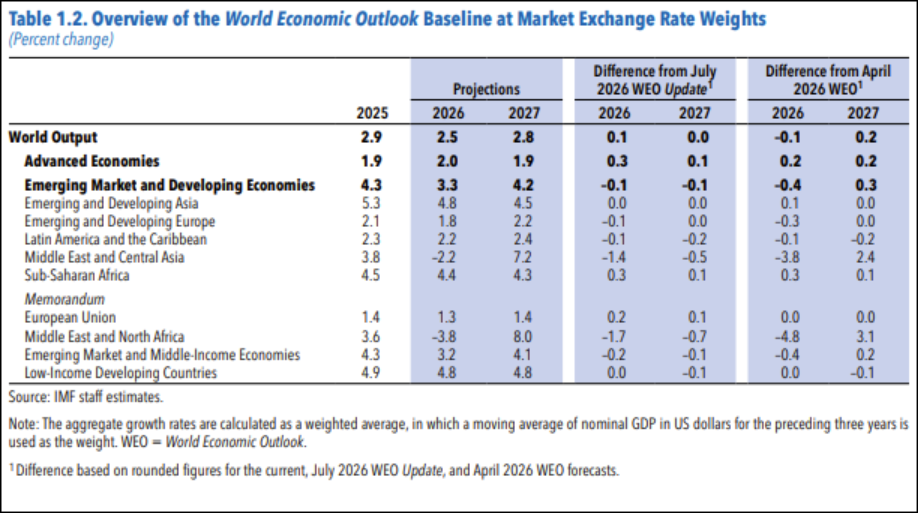
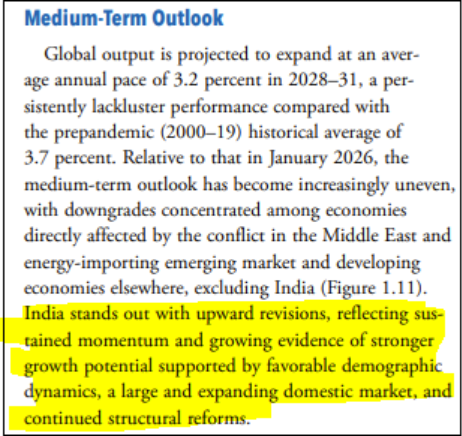
The International Monetary Fund’s projection of 7% growth for India provided another favourable backdrop for investor sentiment.

The assessment reinforced India’s position as the fastest-growing major economy, supported by domestic demand and economic activity.

Strong economic growth can support consumption, investment, credit demand and corporate earnings. It also strengthens the longer-term investment case for Indian equities.

Yet, economic growth and stock-market performance are not interchangeable. Investors must also consider valuations, the pace of earnings growth, foreign capital flows and global risk appetite.

The IMF’s assessment therefore supported the broader narrative around India’s economic resilience, but it was not, by itself, sufficient to explain a 1,100-point rise in the Sensex.

6. Market observers see earnings-led buying, not a universal recovery

The participation of banking, financial services, consumer and automobile stocks helped lift the benchmark indices. Gains were recorded in HUL, Titan, Bajaj Finserv, SBI, HDFC Bank, Mahindra & Mahindra and ICICI Bank.

However, market observers cautioned against treating the advance as an indiscriminate recovery across the entire market.

Hariselvan Radhakrishnan, founder and CEO of HST Wealth, said earnings-led buying in technology stocks, easing US Treasury yields and improving domestic sentiment outweighed concerns about elevated crude prices.

He also highlighted an important feature of the session: the Sensex and Nifty outperformed Bank Nifty, while participation across the broader market remained uneven. The advance was driven largely by large-cap technology companies and other heavyweight stocks, rather than an equally strong recovery across all segments.

Vinod Nair, head of research at Geojit Investments, similarly attributed the market’s advance to stronger-than-expected technology earnings, currency stability and easing bond yields, which also helped bring financial stocks into focus.

These observations suggest that Tuesday’s rally was supported by identifiable catalysts, rather than simply a broad return of risk appetite.

For investors, the distinction matters. A rally led by companies delivering better earnings can have a stronger fundamental basis than one driven entirely by speculation. But when gains are concentrated in a few heavyweight stocks, the broader market may remain vulnerable.

What happens next?

Three developments will determine whether Tuesday’s rebound can develop into a more durable recovery.

First, Budget 2027. Investors will be watching for concrete proposals on LTCG tax and STT. Until the government announces a decision, any anticipated relief remains speculative.

Second, the earnings season. HCLTech’s results have encouraged buyers to revisit IT stocks, but the sector’s recovery will depend on whether other companies deliver comparable results and provide reassuring guidance.

Third, global conditions. Crude oil prices, geopolitical tensions, the rupee and foreign investor flows will remain critical variables. A renewed surge in oil or further deterioration in global risk appetite could undermine the recovery.

The market’s next move will therefore depend on whether the positive developments behind Tuesday’s rally persist beyond a single trading session.

A relief rally, but the jury is still out

The Sensex’s 1,109-point surge reflected the combined impact of strong IT earnings, a recovering rupee, lower crude prices, encouraging growth projections and renewed hopes of a review of equity taxation.

Sitharaman’s remarks gave investors a reason to anticipate a potentially more accommodating policy approach, while HCLTech’s results supplied a tangible earnings catalyst.

But the rally should not be mistaken for confirmation that Indian equities have overcome their underlying challenges.

As market observers have pointed out, value buying after strong results is not the same as a structural recovery. Nor does the Finance Minister’s willingness to hear arguments amount to a commitment to reduce taxes.

Dalal Street has found reasons to cheer, but the sustainability of the gains will depend on corporate earnings, global economic conditions and the government’s eventual policy decisions.

For now, the rally signals a change in sentiment. Whether it marks a genuine turning point for the market remains to be seen.

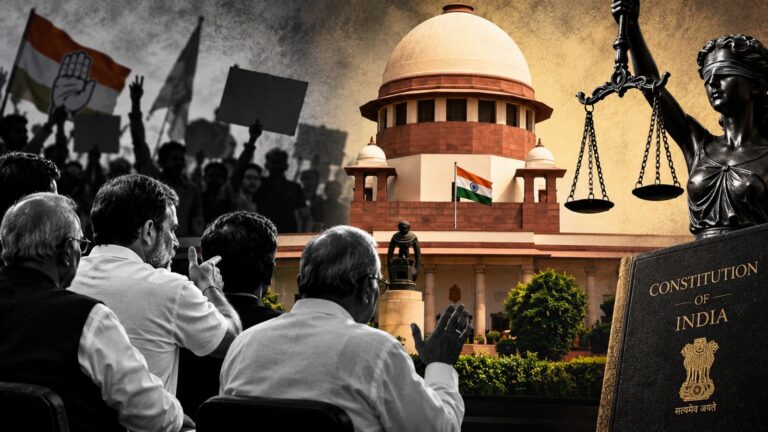
The Supreme Court is not Congress’s political darbar: Why the Opposition’s CJI outreach raises a red flag

Democratic discourse operates at the intersection of dissent and democratic governance. While dissent ensures a check on the government of the day, seamless governance is an inviolable mandate by the people to the ruling dispensation. Hence, a delicate balance between the two is a must. This necessitates the inviolable sanctity of institutions of the state to ensure coherence and harmony in everyday life of the national public sphere.

In this backdrop, the incident of opposition led protest turning into an unwarranted attack on the sanctity of the Supreme Court in general and the Chief Justice of India in particular warrants public attention. 

In a thriving democracy, the right to peaceful dissent is a citizen’s most potent constitutional asset. In India, the rights to free expression and assembly are not only inherent, but they are also explicitly guaranteed under Articles 19(1)(a) and 19(1)(b) of the Constitution. Furthermore, the right to move the Supreme Court for their enforcement is itself a fundamental right under Article 32, a provision Dr B.R. Ambedkar famously revered as the “heart and soul of the Constitution.” The Supreme Court, therefore, is duty-bound to uphold these liberties whenever approached.

Yet, the manner in which this right is presently being wielded, and the mechanisms sought for its enforcement, triggers a profound institutional alarm.

On October 10, 2026, the Leaders of the Opposition in both the Rajya Sabha and the Lok Sabha wrote to the Chief Justice of India (CJI) seeking a private audience. Their stated objective was to “apprise him of the situation” regarding the alleged “created chaos” stemming from nationwide protests demanding the resignation of the Chief Election Commissioner (CEC). This move was remarkably unfortunate, particularly because a Member of Parliament from the opposition INDI alliance had already brought these exact grievances before the Supreme Court. The Court had treated the matter with such urgency that it convened a special bench on a Sunday to hear it.

The opposition’s letters to the CJI are highly unfortunate on two distinct fronts. First, they strike at the very foundation of the separation of powers. “It has been the desire of this country from long past that there should be separation of the judiciary from the executive,” Dr Ambedkar reminded the Constituent Assembly, a desire codified in Article 50 of the Constitution. While historically framed against executive overreach, this principle applies with equal force to all political branches of the State. When prominent political figures seek a private chamber meeting with the head of the judiciary to discuss a volatile, live political dispute, the boundary line Dr Ambedkar so meticulously drew is dangerously blurred.

Second, these letters constitute a direct interference with the administration of justice. Regardless of their stated intent, they function as an attempt to privately influence the adjudication of proceedings already pending before the Supreme Court.

Nor can these letters be dismissed as an isolated lapse in judgment. On the eve of the Court’s hearing, one of India’s most revered senior advocates, who is representing petitioners in these very protest matters, made the categorical unfortunate public declaration that he does not “have much hope in the Supreme Court of India.” Thereafter, a state unit of the opposition party utilised its official X handle to post a contemptuous demand for the CJI’s resignation. Though the post was subsequently and hastily deleted, it exposed the impact of the insensitive and highly irresponsible conduct of the opposition’s political machinery. 

If the leaders of the opposition harbour genuine constitutional grievances regarding the CEC or the State’s response to the protests, the Constitution provides them with two appropriate arenas: the floor of Parliament and the Supreme Court, which is already seized of the matter. Neither of these forums requires, or permits, a private session with the Chief Justice.

India has always fiercely guarded the independence of its judiciary. That collective resolve is etched into our history through the nation’s enduring reverence for Justices J.M. Shelat, K.S. Hegde, and A.N. Grover, who were superseded in 1973, and Justice H.R. Khanna, superseded in 1977. Each of these judicial titans paid the ultimate professional price for delivering judgments that upheld the Constitution against the overwhelming pressure of a powerful executive. In an ironic way, unlike in the 1970s, it is the prime opposition party today that is trying to coerce the judiciary into committing itself to its partisan agenda. 

Today, a new environment is being engineered to influence judicial outcomes, this time by bringing the heavy, blunt force of popular opinion and political theatre to bear upon the judiciary. This effort is indisputably not about securing independent adjudication; it is about pressuring the most sacrosanct institution in our republic to conform to a specific political will.

We must not shy away from saying an uncomfortable truth, i.e., coercion of the judiciary is no more acceptable when it emanates from the streets than when it emanates from the government. The judicial independence that this nation so fiercely defended in 1973 and 1977 must now be defended against pressure of a different, more populist kind, and the Supreme Court must be left to decide the matter as Dr Ambedkar intended, on the record, in open court, and free from influence from any quarter, including the streets of our Bharat.

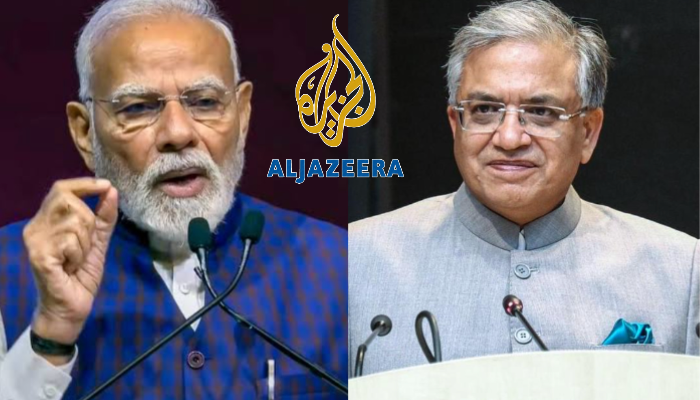
Al Jazeera targets Modi govt and CEC Gyanesh Kumar over his appointment and SIR: Here’s what the facts reveal and the Qatari outlet’s anti-India track record

Al Jazeera has long been infamous for its fact-deficient reporting on India, driven by propaganda that spreads misinformation and stokes tensions, especially during critical times in the country.

In its latest move, the Qatari-funded platform has cast aspersions not only on the Chief Election Commissioner and Other Election Commissioners (Appointment, Conditions of Service and Term of Office) Act 2023, but also on the appointment of Chief Election Commissioner Gyanesh Kumar on 12th October (Monday).

Al Jazeera has claimed Kumar was made the “election chief in 2025 under a law that gave the prime minister’s government greater influence over the appointment process, replacing the chief justice on the selection panel with a cabinet minister.”

The media house stated that Kumar is being pressed to resign over purported manipulation of voter lists. It then invoked The Indian Express report to allege that there are conflicts within the Election Commission of India (ECI), adding that “two of his deputies repeatedly raised concerns about voter-roll revisions and election procedures.” However, Kumar has dismissed the charges.

First and foremost, the President held the authority to appoint the Chief Election Commissioner and Election Commissioners before the 2023 Act. The sole recorded procedure involved the Law Ministry presenting a list of candidates to the Prime Minister, who then recommended one of them for the post to the President.

Notably, no selection panel or committee existed, and the opposition played no part in this procedure until the Act was introduced. On the other hand, heated disputes had regularly surfaced between the Congress-led governments and the electoral body as it repeatedly tried to undermine the latter’s authority through domineering tactics. Hence, the Modi government has brought transparency and inclusivity to the process.

Secondly, the development followed a Supreme Court order which stated, “We declare that the appointment of the chief election commissioner and the election commissioners shall be made on the recommendations made by a three-member committee comprising the prime minister, the leader of the opposition of the Lok Sabha and, in case no leader of the opposition is available, the leader of the largest opposition party in the Lok Sabha in terms of numerical strength and the chief justice of India.”

The apex court, however, conveyed that the Chief Justice of India’s participation would remain valid until Parliament passes relevant law in relation to the matter. The Modi government has merely adhered to the established directives.

Additionally, the Election Commission convened a press conference, which included Gyanesh Kumar and the two other election commissioners, where they announced that all decisions made by the electoral body have been “unanimous” and highlighted that the Supervision Intensive Revision (SIR) of the electoral roll was supported by the Supreme Court.

They further reaffirmed that the letter to the cabinet secretary concerned the work of an individual on deputation to the Election Commission rather than any policy problem, further refuting allegations of internal disagreements. Furthermore, it outlined how grievances over the voter lists are being addressed and also extended timelines for New Delhi and Maharashtra.

The Supreme Court has also refused to issue an immediate suspension order for Gyanesh Kumar in response to accusations that important SIR decisions were made unilaterally.

Most importantly, it has consistently upheld the program, even clarifying that it has not disapproved Form 6 used following the SIR in Bihar. The court had also expressed satisfaction with the Election Commission regarding its implementation, underscoring its significance in strengthening the democratic exercise.

It is abundantly clear that usual suspects such as Al Jazeera have joined the opposition’s chorus against the Election Commission and the Modi government, amplifying the baseless accusations, but the facts directly contradict the claims being disseminated by this ecosystem.

Al Jazeera’s long history of misleading narratives on India

Predictably, Al Jazeera, an integral part of the global Islamo-leftist network, has maintained a consistent record of utterly biased reporting on India. It engaged in a systematic campaign to undermine India’s global reputation by depicting it as a “third world nation” overextending its geopolitical influence during the consequential BRICS summit last month.

The media company, before targeting India’s diplomacy, had hit out at its democracy by raising questions about the West Bengal assembly election, characterising the outcome as a triumph of “hegemonic power” instead of the collective voice of the people, which transpired through the constitutional exercise.

The blatant Muslim appeasement of former chief minister Mamata Banerjee was likewise ignored, and the saffron party was attacked for alleged polarisation and Hindu majoritarianism. Al Jazeera made a brazen move to diminish the credibility of the elected government, while simultaneously ridiculing the will of the voters.

Moreover, the platform has persistently taken a Hinduphobic and anti-India position repeatedly. During the “I Love Muhammad” controversy, it resorted to showcasing Muslims as victims and held the entire country accountable instead of covering the violence committed by their preferred community.

Al Jazeera completely ignored the fact that Muslim youths intentionally desecrated Hindu religious posters during their Barawafaat procession in Uttar Pradesh and then ensued to create unrest in various parts of the nation after authorities took action against the accused, while conveniently focusing criticism on the state’s intervention to prevent further violence and chaos.

The outlet similarly justified the bloodthirsty Muslim mobs in Murshidabad that compelled numerous Hindus, including women and children, to abandon their homes for their safety, declaring the rioting as a result of “religious discrimination” and attacked Prime Minister Narendra Modi for the mayhem.

Hargobind Das and his son Chandan Das were lynched to death by the Islamists amidst the rampage as Hindu houses and businesses were destroyed, as death and rape threats were issued to the community members.

Al Jazeera released a propaganda documentary in 2023, after which an interim stay was placed on its telecast, broadcast or release by the Allahabad High Court in response to a petition. The hit job fundamentally asserted that the Muslim community in India is experiencing state-sanctioned discrimination and persecution.

While the media house was completely dedicated to demonising India and Hindus, it was simultaneously involved in whitewashing the heinous actions of its religious and ideological brethren in Bangladesh. It reframed communal violence as merely “politically-motivated” rather than acknowledging it as genuine hatred towards the minority community.

Al Jazeera chose to condemn Indian media for reporting these occurrences, arguing that such coverage of anti-Hindu violence constituted an Islamophobic and alarmist approach, wanting the victims to endure the brutality and pain in silence.

Unsurprisingly, the news agency has also served as an agent for Pakistani interests, which was especially apparent during “Operation Sindoor.” The media house’s correspondent Kamal Hyder cited Pakistani military sources to announce that Indian Air Force pilot Squadron Leader Shivani Singh was captured by the Pakistan Army after they shot down the Rafale fighter jet.

However, Pakistani forces had to clarify that no Indian pilots were in custody and dismissed these unfounded stories as unverified social media discourse.

Al Jazeera: The mouthpiece of Hamas

The jiahdi platform possesses not merely an extensive history of animosity directed toward India and Hindu populations, but equally toward Israel. Israel Defence Forces in 2024 exposed how its journalists were moonlighting as terrorists associated with Hamas and other such entities, based on intelligence information and documents uncovered in Gaza.

The IDF highlighted that this verified “the military affiliation of six Al Jazeera journalists in Gaza with Hamas and the Islamic Jihad terrorist organisations, including personnel tables, lists of terrorist training courses, phone directories, and salary documents for terrorists. These documents serve as proof of the integration of Hamas terrorists within the Qatari Al Jazeera media network.”

The Jewish government also terminated the media group’s operations following a unanimous cabinet decision, as the entity was deemed a threat to national security that same year. The outlet was termed a “mouthpiece of Hamas” by Prime Minister Benjamin Netanyahu. He mentioned, “Al Jazeera’s journalists have harmed Israeli security and incited against IDF soldiers,” while communicating the development.

He shared similar sentiments a few months earlier, remarking that Al Jazeera not only provoked against the Israeli soldiers but also “harmed its security and actively participated in the 7th October massacre.” He added, “It is time to remove the shofar of Hamas from our country. The terrorist channel Al Jazeera will no longer broadcast from Israel,” while passing a law to temporarily ban the channel.

Noa Argamani, an Israeli citizen who was abducted along with her boyfriend during the Hamas-led October 2023 assault, was discovered at the residence of an Al Jazeera journalist. According to reports, Abdullah Al-Jamal, a journalist for Al Jazeera, was holding her at a civilian residence.

He was a staff writer for the United States publication The Palestine Chronicle and previously worked for Al Jazeera. He and his family members were killed in the rescue effort.

The Al Jalaa Building, which contained offices for Al Jazeera and other international media houses, was revealed to be utilised by Hamas, prompting its demolition. In the ultimate irony, the outlet had been awarded by Hamas for its purportedly “impartial coverage” during the conflict.

The prominent radical origins of Al Jazeera also include recognised connections with the Muslim Brotherhood and have broadcast messages from its late leader, Yusuf al-Qaradawi. Interestingly, a substantial rift appeared between Saudi Arabia, the United Arab Emirates, Egypt, and Qatar as a consequence of its endorsement of Hamas and the Muslim Brotherhood.

Saudi Arabia had demanded the shutdown of Al-Jazeera and its affiliates, accusing Qatar of using its propaganda arm to fund jihadi groups and foster terrorism.

Conclusion

Al Jazeera has an extensive history of glorifying terrorism, antagonism toward Hindus and anti-India propaganda. Therefore, the deceptive posts regarding Gyanesh Kumar and the Modi government are a continuation of a proactive pattern. This media house acts as an extension of an Islamist regime with ties to the Muslim Brotherhood and relentlessly advances its agenda under the guise of endorsing democratic principles and minority rights, in a glaring hypocrisy hiding its true motivation behind the posturing.

Thus, it is perfectly natural for Al Jazeera to take part in this smear campaign along with the opposition, with propaganda taking centre stage while facts are pushed aside.

Who is Parvinder Singh Jhota? Punjab anti-drug activist shot dead by a chemist for exposing drug sales

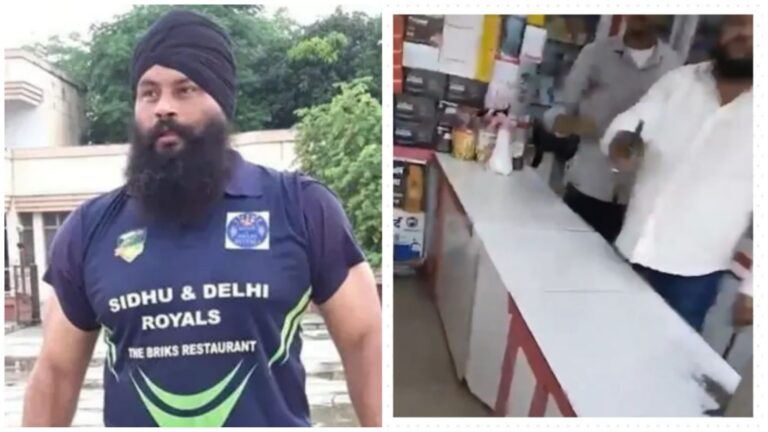
Parvinder Singh Jhota, an anti-drug activist known for exposing the illegal sale of intoxicating medicines through chemist shops, was shot dead in broad daylight on Tuesday, October 13, after confronting a medical store owner in Mansa, Punjab. The confrontation unfolded during a live broadcast on Jhota’s Facebook account.

Jhota had spent several years campaigning against drug abuse and highlighting the sale of addictive substances through medical stores. His interventions, frequently recorded and shared on social media, brought him considerable attention in Mansa and neighbouring areas.

His killing has now raised serious questions about the safety of those who challenge suspected drug supply networks, the enforcement of laws regulating the sale of addictive medicines, and the effectiveness of the Punjab government’s anti-drug campaign.

In his first statement after the killing, Jhota’s father levelled serious allegations against the state government and the ruling Aam Aadmi Party’s Mansa MLA, Vijay Singla.

“Drug addicts killed my son with the backing of the Punjab government and Mansa AAP MLA Vijay Singla,” he said.

Who was Parvinder Singh Jhota?

Jhota was known in Mansa and surrounding areas for his campaign against drug abuse and the unauthorised sale of intoxicating substances through medical stores. He built a following by confronting individuals he suspected of facilitating the drug trade, recording these encounters and sharing the videos on social media.

According to reports, Jhota had more than 24,000 followers on Facebook. His videos of interventions at medical stores circulated widely, helping him draw attention to irregularities in the sale of addictive medicines.

His activism involved direct confrontations rather than being limited to public meetings or online appeals. He would question shopkeepers about suspected sales, seek evidence of transactions and attempt to document alleged violations.

This approach brought him into conflict with people he accused of selling intoxicating substances. The confrontation that ultimately cost him his life was the latest and most tragic episode in his campaign.

Jhota’s activism had also attracted controversy. While he presented himself as a campaigner against the drug menace, his confrontational methods had previously resulted in police action.

The 2023 controversy that brought him into the spotlight

Jhota first came into wider public attention in 2023 following a dispute involving a medical store owner.

On July 12, 2023, a confrontation reportedly broke out between Jhota, his supporters and a shopkeeper. Following the incident, police registered cases against Jhota and some of his associates.

He was arrested in July 2023 on allegations including assault, trespassing and rioting. He was released approximately two months later.

The episode highlighted the contentious nature of his activism. Jhota’s stated campaign against the alleged sale of addictive substances brought him into confrontations with shopkeepers, while his own methods became the subject of police cases.

Nevertheless, he continued to be associated with anti-drug interventions in Mansa and nearby areas, using social media to publicise confrontations and allegations of illegal sales.

The final confrontation captured on Facebook Live

On October 13, Jhota confronted a medical store owner in Mansa, accusing him of selling drugs.

An elderly man was standing alongside the activist and reportedly claimed to have purchased the substances from the shop. Jhota questioned the shopkeeper during a Facebook Live session and demanded that he show CCTV footage.

Jhota also claimed that they had a recording relating to the alleged transaction.

The argument escalated as the shopkeeper, who was seen holding a pistol in the video, questioned the elderly man about whether he had obtained drugs from the store.

Jhota continued challenging the shopkeeper and instructed his associates to call the police and gather more people. During the confrontation, he repeatedly told the shopkeeper, “Maar mujhe, maar mujhe” — “Kill me, kill me”.

The argument continued for approximately four minutes before the shopkeeper allegedly opened fire, killing Jhota. His mobile phone fell to the ground, bringing the live recording to an end.

The accused shop owner was on the run after the shooting.

The recording captured the fatal confrontation, bringing widespread attention to the killing. The allegation that the shopkeeper had been selling addictive substances remains separate from the criminal investigation into the shooting.

Punjab’s drug crisis and the questions over enforcement

Jhota’s killing has renewed scrutiny of Punjab’s efforts to tackle drug abuse and the alleged illegal distribution of addictive pharmaceutical substances.

The sale of medicines is regulated, and preventing the unlawful distribution of controlled or prescription drugs requires effective inspections, enforcement of licensing conditions and coordination between drug-control officials and the police.

The incident raises questions about whether suspected illegal sales at medical stores are being adequately investigated and whether enforcement agencies are identifying and prosecuting those responsible for unlawful distribution.

Opposition leaders have criticised the Bhagwant Mann government over the killing and its flagship anti-drug campaign, Yudh Nashian Virudh.

Punjab BJP president Sunil Jakhar said the murder had exposed shortcomings in the government’s anti-drug campaign and questioned whether preventing the illegal sale of medicines was the responsibility of drug inspectors.

Congress leader Amarinder Singh Raja Warring described the killing as a consequence of what he called failures in law and order and the government’s anti-drug programme. He also alleged that Jhota’s initiatives against the drug menace had not received support from the AAP government.

Shiromani Akali Dal leader Bikram Singh Majithia questioned the administration over the alleged growth of pharmaceutical drug abuse and the steps taken to curb illicit supplies. He also raised questions about the accountability of drug inspectors.

The central question for the authorities remains whether existing enforcement mechanisms are adequately preventing the illegal distribution of addictive medicines and responding to complaints about suspected violations.

A killing that puts Punjab’s anti-drug campaign under scrutiny

Parvinder Singh Jhota’s death has turned an activist’s confrontation with a medical store owner into a larger debate about Punjab’s drug problem, law enforcement and political accountability.

Jhota had become a recognisable local figure through his efforts to expose the alleged illegal sale of intoxicating substances. His activism was not without controversy: he had been arrested in 2023 in connection with allegations including assault, trespassing and rioting. Those allegations form part of his public record but do not resolve the circumstances surrounding his killing.

His father’s first statement has now added another dimension to the case by alleging that drug addicts killed his son with the backing of the Punjab government and Mansa AAP MLA Vijay Singla.

The immediate responsibility of the authorities is to apprehend the accused, establish the motive for the shooting and determine whether anyone else was involved. The investigation must also address the family’s allegations through evidence rather than political assertions.

For Punjab, the broader challenge goes beyond announcing anti-drug campaigns. It requires effective action against illicit supply chains, accountability for regulatory failures and the consistent enforcement of laws governing the sale of addictive substances.

Jhota’s killing has made those questions more urgent. Whether the investigation establishes any wider links or not, the circumstances of his death demand a thorough examination of the alleged drug sales that triggered the confrontation and the violence that followed.

‘Stronger than expected momentum’: IMF elevates India’s FY27 GDP growth forecast to 7%; here’s what its World Economic Outlook report says about India 

The International Monetary Fund (IMF), on 13th October, stated that India remains among the fastest-growing major economies, with the FY27 GDP growth rate projection raised by 0.6 percentage points to 7.0%. The IMF report comes right after the Reserve Bank of India (RBI) raised the GDP growth estimate to 7.1% for the current financial year. 

“India’s growth remained robust, underpinned by domestic demand and services, despite higher oil prices. China’s second-quarter performance was weaker than expected, at 4.3 percent year over year,” the IMF report titled World Economic Outlook states. 

Meanwhile, the IMF has also raised India’s FY28 growth forecast by 0.3 percentage points to 7%. The IMF highlighted robust domestic demand and services activity in India despite elevated oil prices due to the West Asia crisis. 

The IMF stated that global growth is projected to decelerate from 3.5% in 2025 to 3.1% in 2026 before recovering to 3.4% in 2027, unchanged from that in April for 2026 and revised upward by 0.2 percentage point for 2027. 

 “But the stable aggregate masks large cross-country offsetting movements and a greater concentration of global growth: 32 economies now account for 95 percent of global growth, compared with 54 economies in April, while downward revisions have,” the IMF report states. 

India’s stable 7% growth reflects stronger-than-expected momentum 

The IMF report forecasted that growth in emerging and developing economies is set to slow from 4.5% in 2025 to 3.7% in 2026. However, the IMF projects recovery to 4.4% in 2027. 

“The outlook is heterogeneous, reflecting differences in commodity dependence, geographic exposure to the Middle East conflict, remittances and tourism receipts, financial conditions, policy frameworks, and position in the global technology value chain. Those directly impacted by the war drive the V-shaped pattern, whereas other regions are expected to follow a more even growth path,” the IMF report states. 

The IMF report says that India remaining among the fastest-growing major economies reflects “stronger-than-expected” momentum, backed by “resilient domestic demand and robust services activity.” 

IMF says global output is set to expand at an average annual pace of 3/2%, with a mid-term outlook that is uneven for countries affected by the Middle East conflict, except India 

It is pertinent to note that mid-term outlook refers to an assessment of macroeconomic trends, growth rates, inflation, and financial markets over an intermediate time frame, typically spanning 1 to 3 years. 

Regarding the mid-term outlook, the IMF report makes a comparison between the pre-pandemic numbers and its forecast for 2028 to 2031. The IMF described the projected global output expansion at an average annual pace of 3.2% as a “persistently lacklustre performance.” 

India, however, remains an exception with upward revisions, which reflect sustained momentum and evidence of stronger growth potential. 

“Global output is projected to expand at an average annual pace of 3.2 percent in 2028–31, a persistently lackluster performance compared with the pre-pandemic (2000–19) historical average of 3.7 percent. Relative to that in January 2026, the medium-term outlook has become increasingly uneven, with downgrades concentrated among economies directly affected by the conflict in the Middle East and energy-importing emerging market and developing economies elsewhere, excluding India,” the IMF report states. 

Regarding India, the report says, “India stands out with upward revisions, reflecting sustained momentum and growing evidence of stronger growth potential supported by favorable demographic dynamics, a large and expanding domestic market, and continued structural reforms.” 

IMF hails India-EU and India-UK trade deals 

Besides, the IMF also hailed the European Union’s trade agreements with India and the India-UK Free Trade Agreement, stating that these new regional and bilateral trade agreements could “lower tariffs and non-tariff barriers on traded goods and services among participating economies, facilitate adjustments to recent trade policy changes, and strengthen supply-chain resilience”. 

Notably, in September this year, the IMF  backed India’s latest economic data, stating the country’s economy remains resilient despite the global energy price shock. The IMF’s comments come after India reported real GDP growth of 7.8% in the April-June quarter of FY27, a figure that was higher than both the Reserve Bank of India’s earlier estimate of 7% and the expectations of several observers.

Last month, JPMorgan Chase CEO Jamie Dimon said that India’s economy could triple over the next decade. He said that India’s economic growth could lead to a much larger corporate and research ecosystem over the next 10 years.

While detractors of the Modi government have been engaged in casting aspersions on the GDP growth rate by the RBI, international forums like the IMF have consistently stated that India’s economic growth numbers.

The court is playing with fire: Delhi HC questions police over Nadeem Khan’s ‘detention’ ahead of violent CJP protests, ignoring his role in the 2020 Delhi riots

On the 12th of October 2026, after 48 hours of violence by various CJP mobs and on the day Congress was coordinating a massive protest with violent undercurrents, Nadeem Khan approached the Delhi High Court claiming that his detention on the 29th of September ahead of the violent CJP protests was ‘illegal’. He also pleaded with the court to rule against the restrictions put in place by the Delhi Police around Jantar Mantar. The media characterises Nadeem Khan as “Association for Protection of Civil Rights (APCR) National Secretary and human rights activist”. They, however, hide the most important element of his Curriculum Vitae – Nadeem Khan was one of the key conspirators of the Delhi anti-Hindu riots of 2020.

The petition by Nadeem Khan alleged that he was detained for several hours on the 29th of September 2026 and prevented from attention the CJP protest on the same day. Represented by lawyer Shahrukh Alam, he also challenged the restrictions around Jantar Mantar and the imposition of Section 163 BNSS in Delhi. Khan alleged that the police visited Nadeem Khan’s office, which is inside the Jamaat-e-Islami Hind compound, and detained him from 9:30 AM to 4:30 PM on 29th September. The Police contended that he was not detained, but the police were merely ensuring he did not attend the protest, for which no permission was granted, making it an illegal protest. He further claimed that on the 2nd of October, he was going to tend to his ailing mother when the police called him and questioned him about his travel. “They did not detain me, but there has been constant surveillance”, he said.

The court then shot back, “How can you enter the house of this man… Where is your cause to confine him?”

According to Bar and Bench, the court said, “Where is your response? Why is the petition served on you? How can you enter the house of this man? You had the right to conduct the duty; how can you do it in such a way? Where is your cause to confine him? Denying permission is within your rights. Please show us in law”.

At this point, the police asked for time to file a formal response to the petition and took on record that the police will not call Nadeem Khan to ask about his whereabouts.

Who is Nadeem Khan – associated with United Against Hate

Nadeem Khan is a 49-year-old self-proclaimed “activist”, who exclusively focuses on rallying for imagined Muslim victimhood. He is the National Secretary ofthe  Association for Protection of Civil Rights (APCR) and Founder of UAH (United Against Hate).

APCR is an organisation which claims to work for an egalitarian society; however, it focuses, just like Nadeem Khan, on imagined Muslim victimhood almost exclusively. United Against Hate is an organisation which is harder to track. It has no website and only scattered news reports that mention it. From what has been gathered, it was started by those like Khalid Saifi (an accused in the Delhi anti-Hindu riots) and Nadeem Khan somewhere in 2017 to launch a campaign against “lynching of Muslims”. A 2019 HuffPo article mentions http://www.unitedagainsthate.in as their website; however, it is not accessible anymore.

Essentially, United Against Hate started as an off-and-on campaign. In a 2019 interview, Khalid Saifi said, “There was a spurt of lynchings across the Hindi belt and the Opposition political parties were not ready to do anything about it. We decided we had to help these poor people who have nobody to turn to. We started in July 2017 in Delhi. Now, there is a core group of 17 members in Delhi. We meet often and discuss what we need to do and how we should go about it. We then inform our 25 extended groups, which are spread across Uttar Pradesh, Bihar, Maharashtra and Kerala. In Delhi alone, we have eight groups working with us”.

In the same interview, he also said, “Among our members we have six PhD scholars. Umar Khalid and Anirbhan Bhattacharya from Delhi’s Jawaharlal Nehru University are our members. Umar is one of our founding members”.

United Against Hate, co-founded by Khalid Saifi, Nadeem Khan and Umar Khalid, has attracted the usual anarchists over the years – many of them were intimately involved in the Delhi anti-Hindu riots of 2020 – including Khalid Saifi (a named accused), Nadeem Khan (whose footprints were all over but was not made an accused), Umar Khalid – one of the key conspirators, Prashant Bhushan (who hosted the first conspiracy meeting), Yogendra Yadav (a constant mentor and present at conspiracy meetings) and more.

Yogendra Yadav along with Umar Khalid at a United Against Hate rally

In 2018, for example, United Against Hate led by Nadeem Khan released a fact-finding report on the Kasganj violence in Uttar Pradesh, where a Hindu boy, Chandan Gupta, was brutally murdered by a Muslim mob. While addressing the press conference, Banojyotsna Lahiri (Umar Khalid’s girlfriend), who was part of the fact-finding team, raised several doubts over police investigations and narrated how the local administration is selectively targeting the Muslim community. Jamaat-e-Islami General Secretary addressing the press conference claimed, “This is an attack not only on a few persons, a community or area, but it is an attack on the very idea of India, its root, brotherhood and secularism.”

Nadeem Khan, Rakhi Sehgal, journalist Arfa Khanum and Amit Sengupta also addressed the gathering. Retired IG of UP Police SR Darapuri, Adv. Asad Hayat, journalists Amit Sengupta, Hasanul Banna, Aleemullah Khan, Rakhi Sehgal, Mohit Pandey, Nadeem Khan, Khalid Saifi and Shariq Hussain were part of the fact-finding team.

While in 2018, United Against Hate, led by Nadeem Khan, Khalid Saifi and Umar Khali,d branded the Kasganj violence as an attack by Hindus against the Muslim community, in 2025, the NIA court convicted 28 Muslims who brutally murdered Chandan Gupta during the Tiranga Yatra in Kasganj. Chandan Gupta was murdered by the Muslim mob because he refused to chant Pakistan Zindabad. This was the same mob that Nadeem Khan had defended.

In 2024, the same Nadeem Khan was booked by police for hatching a criminal conspiracy to instigate hate and violence. In 2024, Nadeem Khan, under the banner of United Against Hate,e had constituted an exhibition where he made communally charged speeches and also essentially displayed Muslim victimhood w, with fake news being his guiding light. During the exhibition, an almost hit list was displayed of individuals and organisations he claimed “targeted Muslims” – OpIndia was on the hit list as well.

The First Information Report stated, “The video also shows photographs of some politicians and media personalities… on multiple display boards, whom the person accuses of spreading hatred.” “After this, the person mentions incidents from different parts of the country, portraying a particular community as victims and trying to disrupt communal harmony in the country,” it further added.

Following the undemocratic ouster of Sheikh Hasina as Prime Minister of Bangladesh, the national secretary of APCR had fantasised about the overthrow of the elected BJP government at the hands of Islamists.

“Congratulations to the people of Bangladesh. The dictators who win elections in a fraudulent manner face such an end. This will happen here (in India) soon,” he posted on Facebook on 5th August 2024.

In July 2024, OpIndia had debunked a malicious report, published by APCR, claiming that incidents of anti-Muslim crimes have increased in India following the 2024 Lok Sabha Election results. The outrageous claims made in the report were amplified by other media houses, es including Free Press Journal, Clarion, and Muslim Mirror.

We exposed discrepancies and glaring inconsistencies in the narrative peddled by Nadeem Khan’s organisation about the deaths of Aurangzeb, Salman Wohra, Maulana Sahabuddin, Irshad Alam, Javed, Firoz Qureshi and others.

Nadeem Khan – a close aide of Umar Khalid and Sharjeel Imam and his role in the anti-Hindu Delhi Riots

This, of course, is only the tip of the iceberg when it comes to capturing who Nadeem Khan is. The depth of his hate was fully manifested during the Delhi anti-Hindu riots. While he was not a named accused, his presence and involvement were recorded by the Delhi Police in their Conspiracy chargesheet – from mobilisation to execution – Nadeem Khan was almost omnipresent.

From the 5th of December 2019, Sharjeel Imam, Umar Khalid and a few others had started hatching the conspiracy. First, communally charged pamphlets were printed by Sharjeel Imam, along with Arshad Warsi (who is now arrested for being an ISIS terrorist) and distributed in the thousands in and around mosques in Delhi. They formed a group called Muslim Students of JNU to coordinate protests and pamphlet distribution as well.

In the pamphlets that were printed and distributed at mosques around Delhi, the protest call by United Against Hate at Jantar Mantar was supported by MSJ. In both these groups – UAH and MSOJ – the same people were involved: Umar Khalid, Sharjeel Imam, Nadeem Khan and Khalid Saifi.

At the UAH rally, Umar Khalid introduced Sharjeel Imam to Yogender Yadav, and it was here that Yadav asked Umar Khalid and Sharjeel Imam to use social media for large-scale indoctrination and mobilisation of Muslims against CAA – including Chakka Jam.

On the 8th of December 2019, a meeting was called at 6/6 Jungpura to plan for Chakka Jam against CAA. This is considered the first official conspiracy meeting to plan the violence. It was at this meeting that another group was planned, called the CAB Team. The core members of the team were Yogender Yadav, Umar Khalid, Sharjeel Imam, Nadeem Khan, and Parvez Alam. They were all present at the meeting, which was held at 6/6 Jungpura – the premises of Prashant Bhushan.

After this meeting, on the 10th of December, the Citizenship Amendment Bill (CAB) was passed in the Parliament, and the conspiracy simply started gathering steam. On the 10th, the CAB Team protested at Jantar Mantar, and it was Nadeem Khan who had asked Sharjeel Imam to visit the Aligarh Muslim University (AMU). After the meeting at Jantar Mantar, a meeting was called at Teflas Dhaba, JN, U to decide further course of action as per conspiratorial directions given at Jantar Mantar.

On the 11th, as per the instructions of Nadeem Khan, Sharjeel Imam visited AMU to mobilise Muslim students for violence.

On the 13th of December, violence broke out after the mobilisation by Sharjeel Imam, Umar Khalid and several others accused in the conspiracy. While the violence was raging, on the 15th, Nadeem Khan and Umar Khalid visited Jamia. As soon as Umar Khalid and Nadeem Khan visited Jamia, violence broke out at JamiGate 4, 7,,7 and 8, in which 35 police personnel and 95 Public persons were injured, and 02 police booths were burnt)

Shaheen Bagh bloomed thereafter. The violence raged on throughout December. On the 24th of December, a protest was held at Jantar Mantar yet again, which was attended by many organisations, Umar Khalid, Yogendra Yadav, and Nadeem Khan. The organisations also included UAH.

It was during this protest at Jantar Mantar that Nadeem Khan, Yogendra Yadav and Rahul Roy decided that a group should be created where all organisations could be united for better mobilisation. This was meant to start several other protest sites like that of Shaheen Bagh – for mobilisation of Muslims, Chakka Jam and violence. Merely 48 hours later, a meeting was held at ISI Lodhi Road attended by Harsh Mandar, Yogender Yadav, Umar Khalid, Nadeem Khan, Khalid Saifi, Sahil, Rahul Roy, Saba Dewan, Amrita Johri and others. All the conspirators present, including Nadeem Khan, decided to form the DPSG group – a group where the violence during the Delhi Riots was orchestrated. In this meeting, which included Nadeem Khan, it was also decided that multiple protest sites would be organised in Muslim-dominated areas and that women would be used as shields during the protest and the violence.

By January, several protest sites had come up, and the conspiracy was well underway. So far, Nadeem Khan was involved in every stage of the conspiracy. On the 13th of January, Nadeem Khan had sent Asif Iqbal Tanha and Saiful Islam to meet Sharjeel Imam in Jamia. During this meeting, Sharjeel Imam shared a contact list of lawyers who could ensure that the protest sites were not evacuated by the police.

Nadeem Khan was essentially a close aide of Umar Khalid and a mentor of Sharjeel Imam. It was Nadeem Khan who raised and sustained the protest site at Khureji, as evidenced by the WhatsApp chat between Sharjeel Imam and Nadeem Khan, included in the Chargesheet filed in the conspiracy case.

Days before the violence, on the night of 22nd February 2020, DPSG members also organised a conspiratorial meeting of JCC members at Jamia University wherein conspirators exhorted Jamia students to reach Jafrabad Chakka-Jaam site and other protest sites of North-East to escalate protest sites to move and occupy nearby highways for disruptive Chakka-Jaam for engineering violent riots. In this meeting, Asif Iqbal Tanha informed that he had received directions from the DPSG members Umar Khalid and Nadeem Khan that all must reach the North-East protest sites and create Chakka-Jaam and orchestrate riots. He also informed Jamia students’ members that they all should flee from the rioting sites before firing and bombing in North East Delhi. 

One of the protected witnesses, Bond, explained the role of Nadeem Khan in the conspiracy to orchestrate Chakka Jam and the subsequent violence. Bond, in his statement,t said:

“On 22.02.2020, Chakka-Jamam was done at Jafrabad. On the same day at about 10 PM, JCC called an urgent meeting at the CC office, which was attended by Safoora, Saiful Islam, Asif Tanha, AAZMI office bearers,s among others. I was also present in the meeting. In that meeting, Safoora said that in North-East, Chakka-Jaam has to be started at other sites like Hauzrani. Asif said that he has received instructions from Umar Khalid and Nadeem Khan that they have to go to protest sites and start riots by Chakka-Jaam. Only then will the government take back the bill; Saiful also said he has received the same instructions from Umar and Nadeem Khan and also said that when shots are fired, and a bomb is set off during riots,s then leave well within time. After this, 20/25 members of the JCC left for protest sites.

Right after this, on the 23rd of February, the Delhi anti-Hindu riots were sparked, leading to several Hindus being brutally murdered. The ruthlessness of Nadeem Khan is clear from the fact that after the first day of violence, there is evidence to suggest that it was Nadeem Khan who had expressed his displeasure at the scale of the violence and wanted more carnage.

On the night of 23rd February, the first day of violence, another midnight conspiracy meeting was held by some of the other conspirators. In that meeting, Athar Khan, another accused, said that Nadeem Khan was unhappy with the scale of the violence and wanted more carnage.

Athar (DPSG member) informed that Nadeem Khan was annoyed as he was not getting the desired scale of violence in riots due to CCTVs. Nadeem Khan had instructed CCTVs cameras should be covered and destroyed. Athar then informed that he had tasked Salim Khan and Salim Munna to break the CCTV Cameras. DPSG member Shadab also informed that he would also get it done through his team.

Protected witness Radium corroborated these details in his statement.

It is, therefore, evident that Nadeem Khan was at the core of the conspiracy, along with Sharjeel Imam and Umar Khalid, behind the Delhi anti-Hindu riots. As evidenced by the statement of protected witnesses, Nadeem was perhaps one of the most ruthless conspirators since he was on record stating that the violence of 23rd February was not brutal enough. His displeasure was also noted by a protected witness, who said that he had then proceeded to break/cover CCTV cameras so the desired scale of violence could be achieved.

Court upset about Nadeem Khan’s detention ahead of violent CJP protest: Naivete or ignorance.

The Delhi anti-Hindu Riots were one of the most carefully planned episodes of violence in modern India. The conspiracy started right from the 5th of December 2019, culminating in rampant violence starting from the 23rd of February 2020. In the ensuing 4-day period of violence, several lives were claimed. For example, Tahir Hussain, a former AAP councillor, was convicted for the murder of Ankit Sharma, an IB official. He was brutally murdered and stabbed tens of times because Tahir Hussain, an integral part of the conspiracy, wanted to teach “kafirs a lesson”.

Sharjeel Ima,m who was involved in the conspiracy in multiple ways, also delivered several communal speeches. In one, he instigated Muslims by saying that if they wanted, they could cut off the Chicken’s Neck permanently. Umar Khalid, besides instigating speeches at Amravati and other locations, carefully orchestrated the protest sites and violence.

The court was enraged. “Where is your cause to confine him?, the bench asked.

This question is riddled either with ignorance or shameful naivete.

Nadeem Khan, as evidenced above, was a core member of the team of people conspiring to burn Delhi. Is the court of the measured opinion that someone with a history of instigating violent protests would attend the already violent CJP protest in good faith?

The police’s job is not only to restore law and order, but also to ensure that law and order is not breached in the first place. The police’s job is as much to stop the riot before the first stone is cast, as it is to arrest those who have cast the stone.

Way back in 1829, Sir Robert Peel, who founded London’s Metropolitan Police, made a simple point. Police efficiency is measured by the absence of crime and disorder, not by how much visible action you take against it. Our own Kautilya said much the same thing centuries earlier, putting spies and vigilance at the heart of statecraft.

So what does real preventive policing look like? It’s not glamorous.

It is the beat constable who knows every lane in his area and notices when outsiders start turning up. It is the intelligence unit that tracks WhatsApp forwards and social media handles spreading fake videos to whip up a crowd. It is securing a procession route in advance, deploying forces at known flashpoints, checking rooftops before the yatra passes, not after and ensuring that when intelligence of violence exists, bad characters who can pour fuel on the raging fire are stopped from joining the circus.

Good policing is also about acting on the small stuff. When hate speech goes unpunished and minor clashes are brushed aside to “avoid escalation,” the troublemakers get the message loud and clear: the state is scared of them.

That impunity is what eventually explodes into a riot.

By questioning the police,e which is actively trying to prevent violence by detaining elements like Nadeem Khan, the court is serving impunity on a silver platter to elements who would ensure that every protest escalates into a riot.

The court must realise that police officers on the ground often know exactly who the troublemakers are. What they don’t always have is the freedom to act. When the instigator has a vote bank behind him, the officer who arrests him may find himself transferred overnight. Meanwhile, the selective outrage brigade is ready to brand any firm action as “targeting” a community.

In this case, it is not the politics that has become a foundation for police dysfunction, but, I daresay, the Judiciary.

The police in this case have the political go-ahead to deal with bad characters and rioters as they deem fit. What they are truly scared of is activists and lawyers for rent approaching the courts and the courts, in their ignorance and/or naivete, questioning the policing methods because they need to keep up the appearances of being the epitome of ‘fairness’. More than politicians today, it is the Judiciary which is fearful of being branded “biased” not only for following the law, but also plain logic.

In the case of Nadeem Khan, pure logic should have driven the Judiciary – he has done it before,efore so he may do it again. It is the police’s job to ensure that those with a violent and problematic history are monitored and kept in check when there is a potential law and order situation. That it makes the judiciary uncomfortable is not and should not be the problem of the police officer, tasked with maintaining law and order.

If one is to be extremely kind, one could assume that the Bench was either ignorant about Nadeem Khan’s history or was naive to believe that this partileopardeapord has mastered the art of changing his spots. Neither of these scenarios inspires hope. What it does inspire is fear – fear that the Judiciary, in its ignorance or naivete, is playing with fire – a fire that might engulf us all.