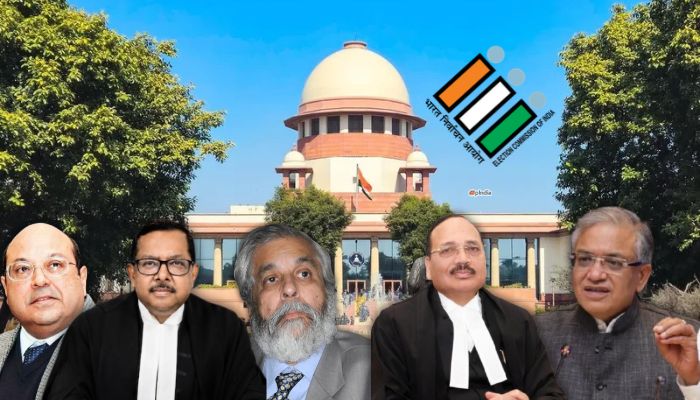
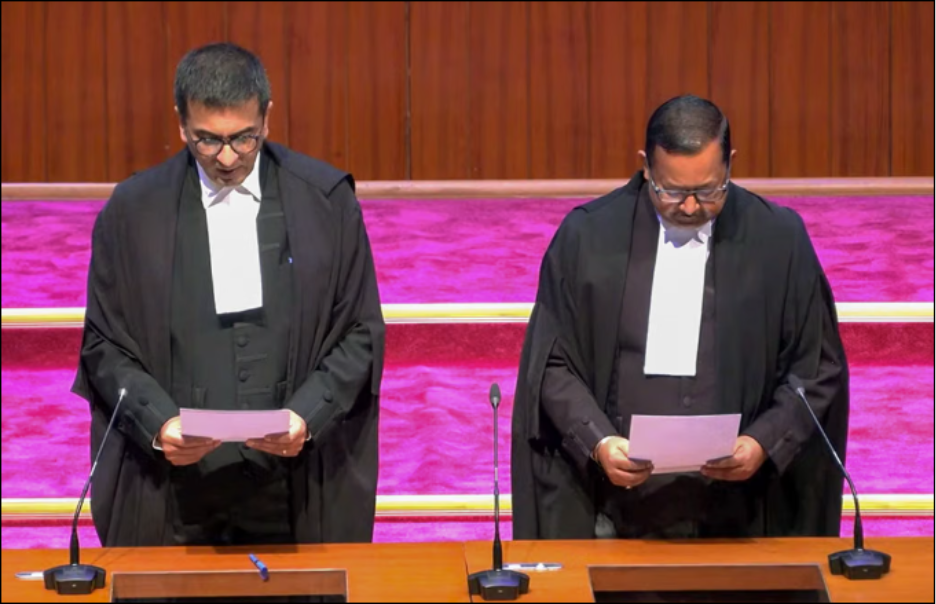
The Supreme Court on Monday (October 5, 2026) refused to pass an ex parte order of suspension against the Chief Election Commissioner (CEC) Gyanesh Kumar during the hearing of a petition that specifically sought the suspension of the CEC. A bench of Chief Justice of India Surya Kant, Justice Joymalya Bagchi, and Justice V Mohana turned down the petitioner’s request for the suspension of Kumar and refused to pass an interim order without hearing the respondents, including the CEC.
The Bench went on to issue notice to the Union of India, the Election Commission of India, CEC Gyanesh Kumar, Election Commissioners Dr Sukhbir Singh Sindhu, Dr Vivek Joshi, Dy Election Commissioner Maneesh Garg IAS, and DG(IT) Seema Khanna on the petition. The petition was filed by Advocate Rakesh Kumar through Senior Advocate Vikas Singh.
#WATCH | Delhi: Petitioner Advocate Rakesh Kumar says, "There were so many irregularities, and the entire country was in turmoil over this issue… Regarding this, we filed a petition; today, our lawyer, Vikas Singh, raised the matter and sought an interim order. He argued that the CEC should be suspended until the hearing concludes, noting that the other two Election Commissioners constitute a majority and could carry on the work, since two out of three is a majority. However, the Chief Justice stated that the court would issue notices and examine the matter. He directed that the relevant documents and electronic records be secured to prevent any tampering, and scheduled the hearing for next week to consider the issue further… Notices have been issued to the Union of India and the Chief Election Commissioner; in fact, all 7 respondents have been served notices, and the hearing is set for next week…"
During the hearing of the petition, Senior Advocate Vikas Singh tried to press the apex court to order the suspension of CEC Gyanesh Kumar, without first giving him the opportunity to be heard. Singh tried to hold the Supreme Court at ransom with the threat that the entire country would burn down if the court did not pass the interim order immediately.
“We are dealing with a grave situation which can undermine the very basis of our democracy. The elections were conducted with the ECI having some respect. But today we are having a situation where the CEC is acting in a manner which is completely contrary to the statutory framework,” the senior advocate claimed. “The Court has to pass some interim orders, otherwise the country will burn,” he said, threatening the Supreme Court.
“Some interim measures are needed as every citizen was now feeling unsafe about their voting rights,” Singh asserted. The senior advocate threatened the top court of the country, attempting to pressure it into passing an order bypassing the procedure.
Singh alleged that the electoral roll prepared after the SIR was vitiated as certain decisions regarding the electoral roll were taken by the CEC unilaterally. However, the Supreme Court refused to give in to the pressure tactics and questioned Singh as to how it could reach the conclusion that all decisions were taken unilaterally without first hearing the CEC.
“If records show some decision was not unanimous, etc., we will injunct those decisions and say they are ultra vires. Can we ex parte come to the decision that all decisions were unilateral? We expect them to respond in a clear, transparent manner,” Justice Bagchi said. CJI Surya Kant told Singh that it cannot pass an order solely based on newspaper reports.
A bunch of petitions have been filed before the Supreme Court alleging that several decisions were taken by CEC Kumar unanimously, despite the other two election commissioners raising at least 14 objections between October 2025 and August 2026.
The petitions have been filed amid the growing chaos manufactured by the Opposition alleging irregularities in the SIR exercise undertaken by the Election Commission. While the Opposition parties have been organising demonstrations to mount pressure on the government and the CEC, some of the anti-government elements have been trying to use the judiciary to get their whimsical demands met. The threat to burn down the country shows how certain people opposed to the government have been desperately trying to pressure the courts to pass favourable orders, which can be used to corner the government.
Ever since the Election Commission made an announcement to undertake a Special Intensive Revision (SIR) exercise across several states, the opposition parties have been casting aspersions on the process. They vehemently opposed the exercise using countrywide protests and petitions before courts. The SIR exercise is intended to update the electoral rolls and eliminate bogus and invalid voters from the voter list. The SIR process led to a large number of ineligible voters, including illegal immigrants, being deleted from the electoral roll, which hurt the voter base of certain opposition parties.
Some of the opposition politicians and so-called civil rights activists even tried to halt the SIR process by challenging it before the Supreme Court. However, the apex court refused to stop the exercise, holding that it was a routine electoral exercise which the Election Commission was constitutionally empowered to undertake.
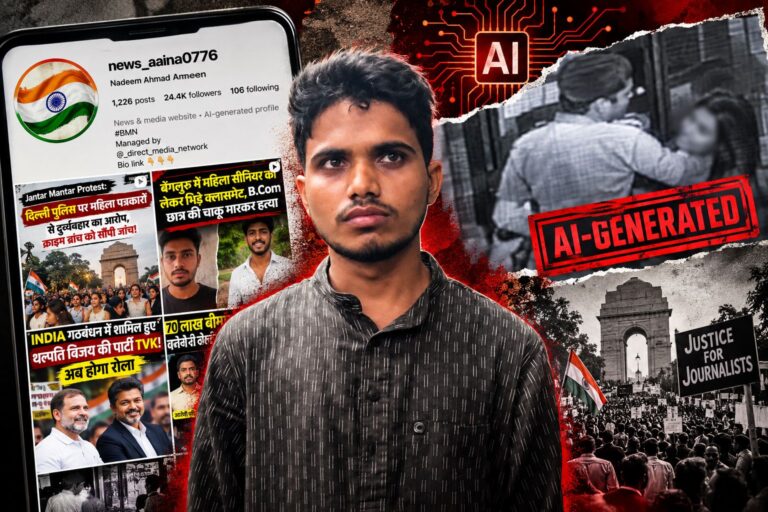
The Delhi Police have arrested 24-year-old Nadeem Ahmad, who used artificial intelligence tools to create and circulate a fabricated video portraying a Delhi Police officer sexually assaulting a woman during the protests at Jantar Mantar. The video was presented as CCTV footage from the protest site and circulated on social media, where it was used to amplify allegations against the police.
According to Delhi Police, the video was not genuine CCTV footage but an AI-generated fabrication. Investigators traced its circulation to an Instagram channel operated by Nadeem, who claimed during interrogation that he was an independent journalist.
Team of Cyber Police station, @DCPNewDelhi arrested one self claimed independent journalist for circulating a fabricated video falsely portraying Sh. Vivek Bhagat, ACP, Delhi Police in bad light.
The accused person circulated the incriminating video reel through one Instagram account as authentic. The mobile phone used for its circulation was also recovered.
@LtGovDelhi
#DPUpdates
#HelloDelhiPolice
Police have now seized his phone and are examining his digital activities, funding sources and possible associates to determine whether the episode was an isolated act or part of a larger conspiracy.
Who is Nadeem Ahmad Ameen?
Nadeem Ahmad, identified by police as the son of Farukh Ahmad and a resident of Palwal, Haryana, appears to have built an online identity around the social-media page ‘news_aaina’.
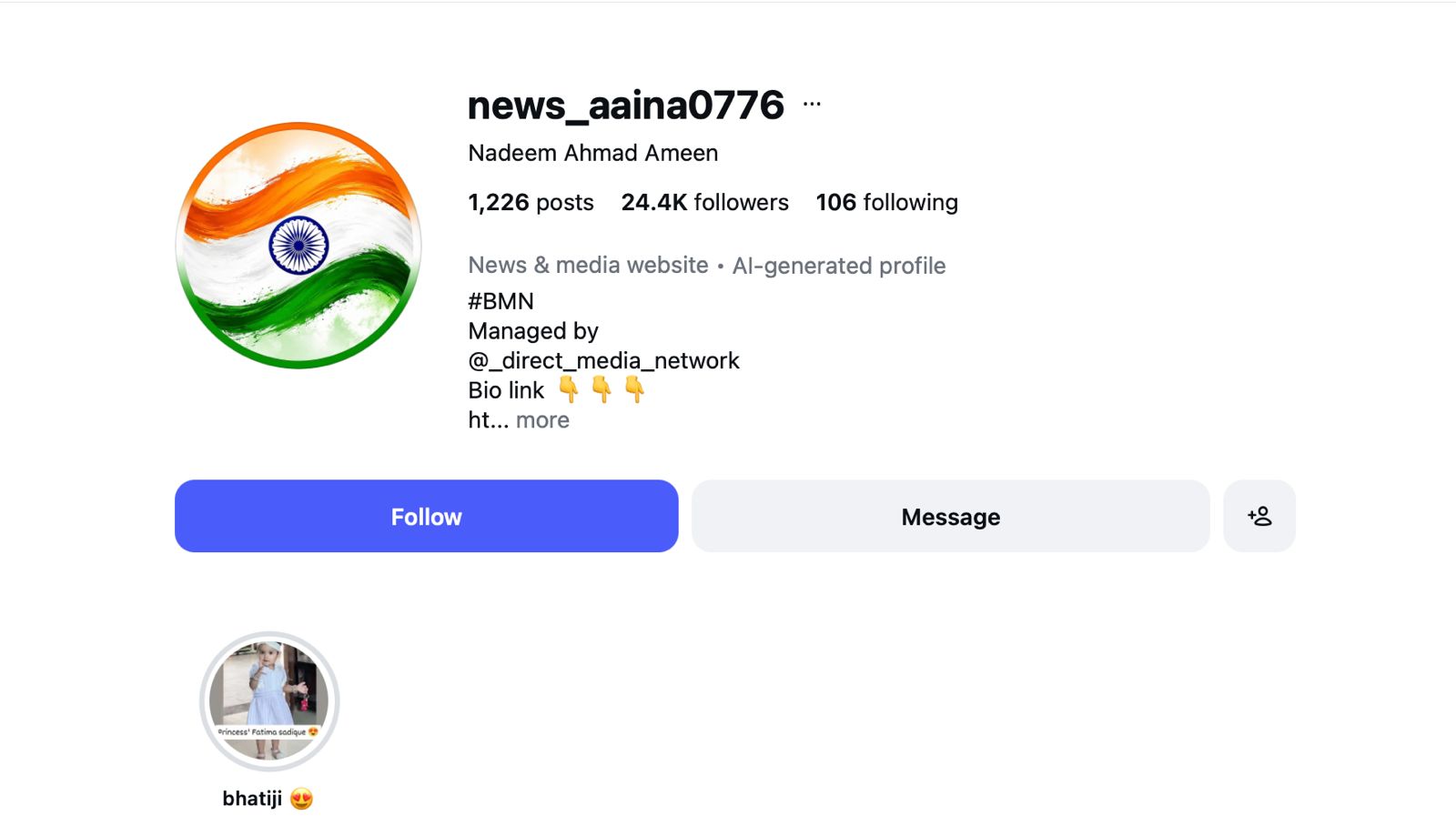
His Instagram account, @news_aaina0776, had more than 24,000 followers and 1,226 posts at the time of his arrest. The account describes itself as a “News & media website” and explicitly labels itself an “AI-generated profile”, while also stating that it is managed by @_direct_media_network.
Instagram profile of Nadeem Ahmad Ameen
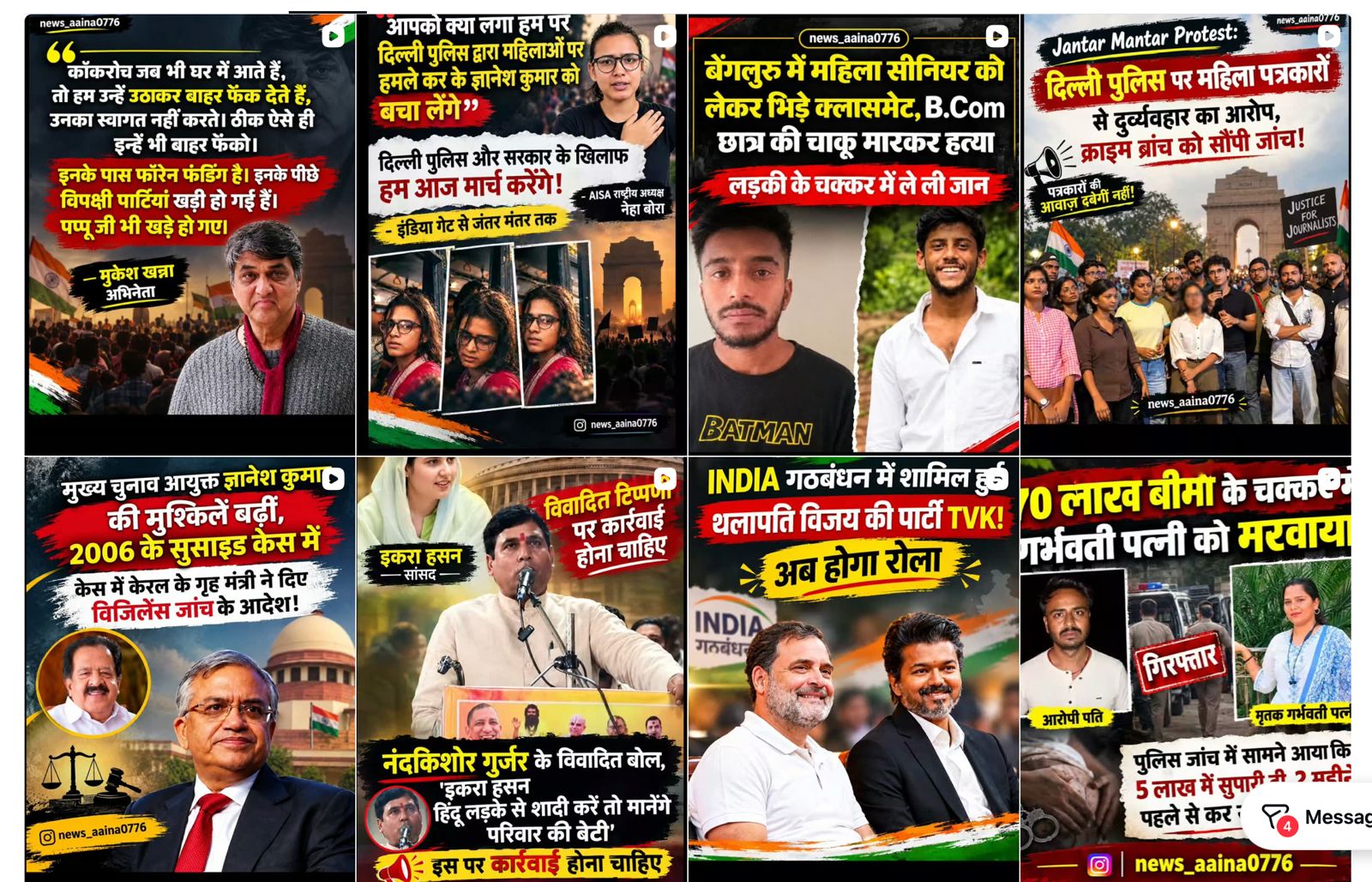
A cursory look at the account shows that AI-generated visuals formed a significant part of its content strategy. The page frequently used stylised AI imagery and videos to present or comment on political and current-affairs developments. A substantial portion of the content appears sympathetic towards the Congress, the CJP and other opposition parties, while several posts are sharply critical of the government and law-enforcement agencies.
Instagram account operated by Nadeem Ahmad
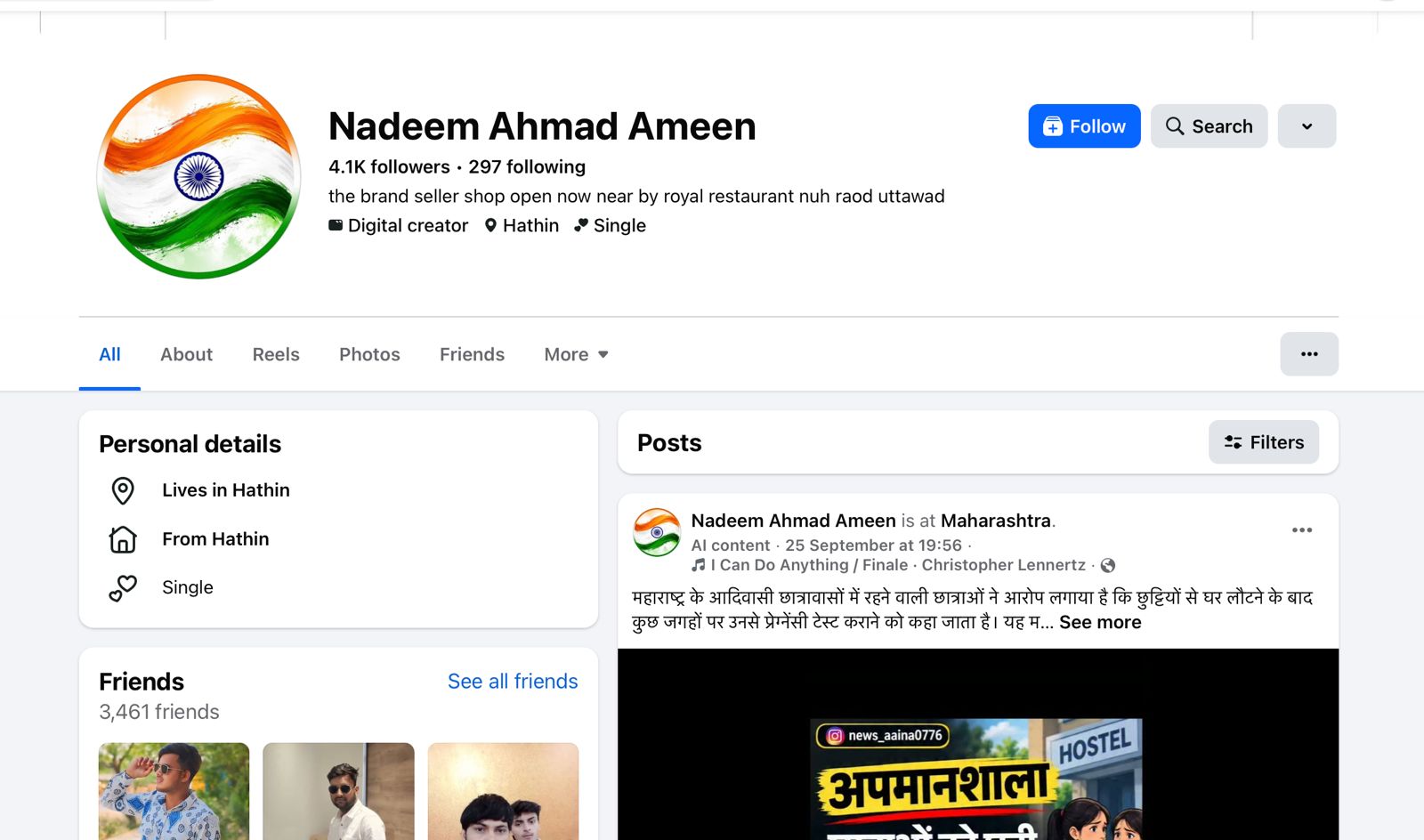
His Facebook profile provides another glimpse into his online persona. The profile identifies him as being from and living in Hathin and lists him as a digital creator, with over four thousand followers. His Facebook activity also includes AI-generated visuals dealing with political and social issues, often accompanied by highly charged messaging and provocative commentary against the government.
Facebook page of Nadeem Ahmad Ameen
Some of the posts visible on his Facebook and Instagram pages employ provocative imagery and language portraying the government and its institutions as oppressive, while others use AI-generated scenarios to comment on ongoing political controversies. The nature and extent of this content are now relevant to the Delhi Police investigation, particularly given the allegation that AI tools were deliberately used to manufacture material capable of inflaming tensions.
From social-media creator to accused in fabricated CCTV case
The Delhi Police said the controversy began when reels started circulating on Instagram and Facebook claiming to show CCTV footage from the CJP protest at Jantar Mantar.
The footage purportedly showed a man in police uniform misbehaving with women. It was further claimed that the man was a senior Delhi Police officer. The footage was accompanied by the identification of the alleged officer, potentially exposing him to public anger and retaliation.
The Cyber Police Station of New Delhi district registered an FIR after taking cognisance of the videos.
Technical analysis eventually led investigators to the Instagram channel news_aaina, following which police identified its alleged handler as Nadeem Ahmad, a resident of Palwal.
Police arrested him on October 5.
According to Additional Deputy Commissioner of Police (New Delhi) Manjeet, Nadeem admitted during questioning that he possessed several AI tools and had used them to fabricate the purported CCTV footage.
The sequence established by investigators is that the video was created on October 3 and began circulating on October 4, coinciding with protests at Jantar Mantar.
What did Nadeem tell police?
Police said Nadeem described himself as an independent journalist when questioned.
During interrogation, he said that he had studied up to Class 10 at a madrasa in Saket, Delhi, but had failed his Class 10 examination.
More significantly, police said he admitted creating the fabricated video using AI tools.
According to the police account, Nadeem said the purpose was to tarnish the image of the Delhi Police, turn protesters against the force, create unrest and potentially provoke violence. Police are now investigating his alleged sources of funding and identifying people who may have assisted him.
The authorities are also examining whether his activities during the CJP protest were part of a broader, pre-planned effort to inflame the situation and trigger riots.
His mobile phone has been seized for forensic examination.
The controversy involving ACP Vivek Bhagat
The AI-generated video emerged against the backdrop of a controversy that began on October 3, when Rosy, a worker associated with the CJP who had presented herself as an independent journalist, accused Delhi Police ACP Vivek Bhagat of sexually harassing her while she was covering the detention of a protester.
The allegations quickly spread across social media, accompanied by purported photographs and CCTV visuals allegedly showing Bhagat molesting her.
Delhi Police subsequently fact-checked one of the key visuals and said that the purported CCTV image was AI-generated/manipulated and fake.
“FACT CHECK: The post contains AI-generated/manipulated visuals. The CCTV footage image is fake,” Delhi Police said in a post on X, warning users against circulating the material and cautioning that legal action could follow against those responsible for spreading it.
The official Delhi Police X account also rejected social-media claims that female protesters had been subjected to physical assault.
“These allegations are baseless and misleading. Female protesters are handled by female staff and are treated with dignity and due regard,” the police said.
The police’s fact-check subsequently became central to the investigation into the origin and circulation of the fabricated footage.
ACP Bhagat gets Additional DCP charge
Amid the controversy, Delhi Police ACP Vivek Bhagat has been assigned the current duty charge of Additional Deputy Commissioner of Police.
Bhagat is among 12 DANIPS officers included in the Delhi Government’s Home Department administrative order. He was previously serving as SDPO, Connaught Place, in New Delhi district.
The timing of the development is notable as it comes a day after Delhi Police debunked the viral visual that had been used to portray Bhagat as a perpetrator of molestation.
However, the administrative order does not constitute a finding on the allegations against Bhagat. The current duty charge is an interim administrative arrangement and does not by itself confer the regular seniority, pay or other benefits attached to the Additional DCP post.
Why the case is significant
The case comes amid an already charged controversy surrounding allegations of harassment of women journalists during protests against Chief Election Commissioner Gyanesh Kumar.
An assistant commissioner of police, Vivek Bhagat, had faced allegations concerning the treatment of a woman journalist during the protests. The controversy subsequently intensified, with complaints by women journalists and demands for action against police personnel.
Against this backdrop, the circulation of purported CCTV footage showing a police officer sexually assaulting a woman had the potential to dramatically escalate public anger.
The Delhi Police now assert that the footage was deliberately fabricated using AI and circulated as genuine evidence.
That makes the Nadeem case significant beyond the individual allegations against him. It highlights how generative AI can be used to manufacture apparently credible “evidence” during an already volatile political confrontation, and how such fabricated material can potentially influence public opinion before its authenticity is established.
Nadeem has been produced before a court and remanded to police custody for further investigation. The allegations against him remain subject to the outcome of the investigation and judicial proceedings.
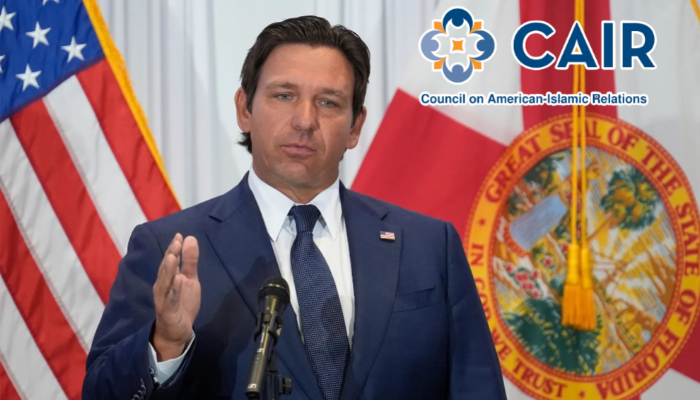
On 29th September (Tuesday), the Council on American-Islamic Relations (CAIR), the Muslim Brotherhood and Antifa have been named domestic terrorist groups by Florida Governor Ron DeSantis and the state cabinet. The decision expanded Florida’s state framework to include over 90 entities that the federal government of the United States has previously classified as foreign terrorist organisations. The new designations are expected to go into force on 5th November.
“You look at some of these, you know, CAIR was an unindicted co-conspirator in the largest terror financing trial in American history. And so there’s a lot of financial arteries that go into these movements, and we want to make sure we’re doing everything we can in Florida to be able to put the kibosh on that. And so that has been official,” DeSantis mentioned, highlighting the motivation behind the action.
The Florida Department of Law Enforcement (FDLE) invoked CAIR’s inclusion in the 2008 Holy Land Foundation trial in Texas as one of the US-Muslim Brotherhood’s Palestine Committee’s (PALCOM) “organisational structures designed around PALCOM’s goals,” in the documents delivered to the governor and the three cabinet members.
CAIR and over 200 other organisations were named as “unindicted co-conspirators” in the 2007 case of US v. Holy Land Foundation (HLF) for Relief & Development.
Mousa Mohammed Abu Marzook, who is regarded as a co-founder of Hamas, is among the founding members of CAIR who “have connections with Hamas leadership,” based on documents submitted to the governor and cabinet. They informed that Ghassan Elashi, a co-founder of CAIR-Texas who was found guilty of working with and providing material support to terrorists with special designations, “also has ties to Hamas.”
The submission conveyed that “current CAIR members have connections with an alleged member of the Palestinian Islamic Jihad.” They further pointed out that CAIR’s connections to the Muslim Brotherhood and fears about encouraging extremism led to the same action against it in 2014 where United Arab Emirates designated the group as a terrorist organsiation in 2014.
According to the paperwork, the UAE maintained that designation when it was contested because CAIR honoured Sami Al-Arian, a former lecturer at the University of South Florida who was convicted in a US court in 2005. He conspired to donate money, products, or services to the Palestinian Islamic Jihad, an organisation that has been classified as a terrorist group.
The implications
The legislature voted 80-25 in the House and 25-11 in the Senate to adopt the proposal. It is going to prohibit courts from upholding provisions of foreign or religious law that infringe upon rights protected by the Florida or US constitutions.
The statute has provisions pertaining to specific educational benefits. Students are unlikely to be eligible for some public institutional subsidies if they support recognised domestic or foreign terrorist organisations. It mandates the Florida College System to expel those who promote terrorist groups.
The law has also established criminal offences under certain conditions, such as receiving military training from a domestic terrorist organisation, deliberately becoming a member and operating under its direction or control with the necessary intent, or intentionally supplying material support or resources to it.
This includes acts that can be fairly construed as a real threat of violence, interfering with the educational process or violating the rights of others. It is likewise forbidden for public universities and colleges to use state or federal funding to fund initiatives or on-campus events that support a recognised terrorist organisation.
“Supporting these groups is a felony. Your tax dollars will not fund them. No contracts, no foothold on our campuses. Students who promote them are expelled. The Free State of Florida will not launder terrorism through our schools. We will name these groups, cut off the money, and hold those who bankroll them accountable,” affirmed Florida Attorney General James Uthmeier.
The framework would also limit government contracts and financing for these organisations. According to Florida officials, the framework’s goal is to stop terrorist groups from using state institutions and public resources. CAIR has dismissed the charges and filed a lawsuit challenging the decision alongside alleged civil rights organisations.
The background
The development took place months after the governor’s attempt to introduce a new law was contested in court due to a lack of implementation of the laws necessary to make such a move. In December, DeSantis issued an executive order classifying the group as a terrorist organisation. The FDLE was directed to “undertake all lawful measures to prevent unlawful activities” by these organisations, including the Muslim Brotherhood.
Executive agencies were required by the order to prohibit “any person known to have provided material support or resources to such organisation” from obtaining “any contract, employment, funds or other benefit or privilege” from “any state executive agency, any state entity regulated by such agency, or any county or municipality in the state.”
CAIR Florida promptly rushed to federal court and convinced a judge to grant a temporary injunction preventing the designation, claiming First Amendment concerns.
DeSantis then proceeded on a different route, and in February the Legislature passed a bill (HB 1471) which was signed into law by him. It gave the state’s head of domestic security, who is defined as the head of the FDLE, the authority to recommend groups deemed to be either domestic or foreign terrorist organisations to the governor and cabinet, which would be approved or rejected by a majority vote.
The statute took effect on 1st July. The governor and then-FDLE Commissioner Mark Glass declared that he had proposed labelling CAIR, the Muslim Brotherhood and Antifa as domestic terrorist organisations during a press conference. A few hours later, CAIR and CAIR-Florida brought a lawsuit in the US District Court for the Northern District of Florida against DeSantis and other authorities. They demanded a ruling to mark the action as unconstitutional.
Promotion of jihad, rampant Hinduphobia, links to terror groups: CAIR’s disturbing history
CAIR, along with similar organisations including Indian American Muslim Council (IAMC), has been at the forefront of disseminating Hinduphobia and anti-India propaganda both in India and the West. They were an active part of the campaign against the Rashtriya Swayamsevak Sangh (RSS) and its leader Mohan Bhagwat to prevent his entry into the US.
CAIR previously backed the problematic “Dismantling Global Hindutva” conference, demonstrating its profound animosity toward the Hindu community. Furthermore, the organisation did not even spare Hindu kids and conspired to implicate two innocent high school students in a fabricated Quran burning incident in 2023, which severely endangered the safety and well-being of these young men and their families.
CAIR also extended its support to another anti-Hindu personality and alleged journalist, Rana Ayyub, based on her dubious report. It attacked Rohit Shetty’s “Sooryavanshi” in 2022, directing theatres to refrain from screening it, asserting that the movie peddles “disgusting and dangerous” anti-Muslim propaganda rooted in the “fascist Hindutva movement.”
Ibrahim Hooper of CAIR also tried to wrongly accuse “Hindutva” and “Islamophobia” in India following the assault of a Muslim couple by a mob of the same religion, exemplifying their persistent agenda against the religion and the nation.
On the other hand, the organisation advocated for the release of Aafia Siddiqui, a Pakistani national currently incarcerated for 86 years following her assault on US Army and Federal Bureau of Investigation (FBI) personnel in Afghanistan.
However, it took offence at the display of the names of the Pakistan-sponsored Lashkar-e-Taiba (LeT) terrorists and scenes from the deadly 26/11 terror attack that were on a mobile billboard truck in New Jersey. CAIR protested that the airing of 26/11 footage was “messages of hate” and added that the vehicle’s movement was “deliberate and well-coordinated.”
Meanwhile, officials associated with CAIR have publicly demonstrated antisemitism and promoted dreaded outfits such as the Islamic State of Iraq and Syria (ISIS). Last year, Noora Shalash, its Kentucky-based official, assaulted Jewish individuals within a Midtown Manhattan facility, declaring, “I demand jihad, I want ISIS to kill all of you.”
Afterwards, CAIR International asserted that her affiliation with the organisation had ceased more than five years ago but shared a post identifying her as its official. The upload was made less than 5 years ago.
In another such episode, one of CAIR’s board of directors, Ibrahim R. Mossallam, declared Hamas terrorists as “brave people” after the October 2023 attack on Israel and added that the media was “heavily politicised and skewed to show a non-occupying narrative of Palestine.” He was “removed from service” as a United Airlines pilot after the comment was flagged by a group called “StopAntisemitism.”
Moreover, Ahmed Rehab, executive director of CAIR-Chicago, conceptualised a “MyJihad” drive in 2012 to sanitise and whitewash jihad, after which New York City’s Department of Education (DOE) was discovered promoting the same under the guise of combating anti-Muslim prejudice. The 2024 campaign termed jihad exclusively as “struggle” and “effort,” rather than as a reference to Islamic holy war.
IAMC, George Soros, and more: CAIR’s ties to the global ecosystem hostile to India and Hindus
CAIR has maintained a close relationship with IAMC and Hindus for Human Rights, alongside similar groups with documented ties to terrorist and radical groups and ties to George Soros, the prominent anti-India regime-change advocate.
These entities have consistently engaged in a coordinated, intensive effort to damage India’s international reputation, target Hindus and undermine the democratically elected Modi government. They have orchestrated initiatives to oppose Prime Minister Narendra Modi’s visit to the US, mirroring their coordinated plan against Bhagwat. They even pushed former President Joe Biden to cancel the state dinner with him.
These organisations have actively supported and funded Islamist leaders. CAIR presented $100,000 to New Yorkers for Lower Costs, the largest Parliamentary Action Committee (PAC) endorsing current New York City mayor Zohran Mamdani during his election campaign.
Notably, he has characterised PM Modi as a “fascist,” lied about the 2002 Gujarat riots and made inflammatory anti-Hindu and antisemitic statements, including defending the divisive slogan “Globalise the Intifada.”
IMAC, a Jamaat-e-Islami front masquerading as an advocacy group, similarly gave a platform to another rabid anti-India voice, Ilhan Omar, to promote her sinister agenda and argue that a genocide is occurring in the country against minorities, particularly Muslims. Omar, an openly pro-Pakistan politician who lauds Islamic regimes and trivialised the 9/11 attack, has repeatedly made such baseless accusations targeting India and the Modi government.
IMAC is known to be a part of a large jihadi network that includes extremist and terrorist organisations. The Islamic Circle of North America (ICNA), a Western branch of Pakistan’s Jamaat-e-Islami, was led by its founder, Shaik Ubaid and member Abdul Malik Mujahid. According to reports, ICNA is allied with Lashkar-e-Taiba (LeT).
IAMC’s executive director Rasheed Ahmed earlier held the same position at the Jamaat-affiliated Islamic Medical Association of North America (IMANA), which has Zahid Mahmood, a former member of the Pakistani Navy, as its head of operations.
IMANA was charged with embezzling funds from a Covid-19 fundraising campaign it sponsored in the name of assisting India. It also has relationships with former Pakistani Navy and Army officers, alongside ties with terrorist groups such as LeT and Hizbul Mujahideen.
In a blatant display of Hinduphobia, Rasheed had stated that Hindu leaders in India were intoxicated by “cow urine” to recover from the coronavirus. IAMC Advocacy Director Ajit Sahi made a similar derogatory remark on social media and wrote, “Sacred cows make the tastiest hamburger.”
This ecosystem has also tried to demonise the Indian American Hindus and their religion. The Religious Nationalisms Project (TRNP) of the New York State Council of Churches (NYCOC) announced a series of interfaith seminars scheduled for November 20–23 in the Bay Area of North Carolina. IAMC co-organised the events, headlined “The Weaponisation of Hinduism in Northern Carolina and India and the Relationships to Global Religious Nationalisms,” for this vile purpose.
A Ram Mandir Janmabhoomi Temple float that was scheduled to be included in the India Day Parade to commemorate India’s 78th Independence Day was also opposed by IAMC, HfHR, and other anti-Hindu groups in 2024.
Predictably, this coterie was aggressively blaming the Hindu community following the violence in Leicester, which was unleashed by Islamists. A report titled “Better Together: Understanding the 2022 Violence in Leicester” was published by the George Soros-funded School of Oriental and African Studies (SOAS) to first conveniently absolve the Muslims of any wrongdoing before focusing on Hindus, Hindutva, and the Bharatiya Janata Party (BJP) and charging them with the unrest.
CAIR and Congress
It’s interesting to note that when Rahul Gandhi, the Leader of the Opposition in the Lok Sabha and a veteran of the Indian National Congress, visited the US in June 2023, he was spotted in a meeting with Sunita Vishwanath at the Hudson Institute. She is the co-founder of George Soros-backed HfHR, which hosts events for organisations like the ICNA and CAIR.
Just wow!! Sunita Vishwanath, a Soros proxy, who works for one of the most anti-India orgs in the US that co-hosts events with radical orgs like ICNA and CAIR is part of @RahulGandhi’s inner circle.
Is he just ignorant or is the future of India this bleak that the leader of the Opposition has been compromised to this degree? @sampitroda
HfHR was founded in 2019 by IAMC and the Organisation for Minorities of India (OFMI), after which the three formed another outfit, called the Alliance for Justice and Accountability (AJA), which led agitation against the 2019 visit of PM Modi to Houston.
HfHR is recognised for perpetuating the false narrative of “Hindu Vs Hindutva” and supporting the “Dismantling Global Hindutva” event. It also objected to a resolution passed by the US House of Representatives denouncing anti-Hindu prejudice following the attack on a temple, branding it an act of “Hindu supremacy.”
It is noteworthy that CAIR has been an integral part of this cabal, which has ties to jihadi and terrorist groups and has pursued a sustained agenda of vilifying India and targeting the Hindu community.
In 2026, India successfully secured fertiliser supplies through a smart mix of diplomacy, trade deals and smart domestic production enhancement, but the real test begins when those supplies have to reach millions of farmers during the narrow Rabi 2026–27 sowing window. The season is particularly important for wheat, with the government targeting 121 million tonnes of production. Uttar Pradesh, Madhya Pradesh, Punjab, Haryana and Rajasthan together account for roughly three-quarters of India’s wheat output, making developments in these states critical to national food security.
Irrigation is another challenge when it comes to the Rabi season. Wheat generally requires four to six irrigations, with the first, at the crucial Crown Root Initiation stage, needed within roughly 21–25 days of sowing. The 2026 monsoon was under stress; reservoir levels in parts of northern India were below the previous year’s levels. Punjab and Haryana face particularly serious groundwater depletion; most of Punjab’s 153 development blocks are classified as over-exploited. Canal systems have their own difficulties, ranging from inadequate reservoir releases to siltation and failure to deliver sufficient water to tail-end villages.
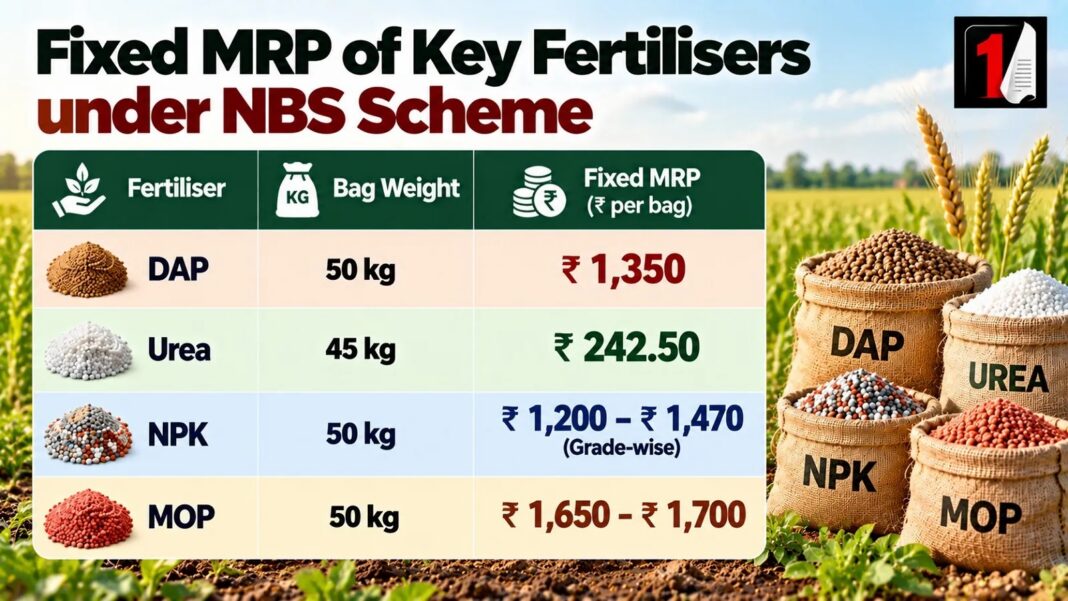
The third pressure point is DAP fertiliser distribution. India remains heavily dependent on international markets for phosphatic fertilisers and their raw materials, importing an estimated 80–90% of its phosphoric acid and finished DAP requirements. International DAP prices remained elevated in 2026, while geopolitical disruptions added further uncertainty. Yet Indian farmers continue to receive a 50-kg DAP bag at a controlled price of ₹1,350, with the government absorbing much of the difference through subsidies and additional financial support. The Centre says overall fertiliser availability is sufficient and uses the Integrated Fertiliser Management System to track movement from factories and ports to districts and retailers.
However, there is a crucial distinction between national availability and local accessibility. Aggregate figures can show a comfortable surplus while a farmer in a particular district still spends hours queuing outside a cooperative society. Fertiliser consignments can be delayed by railway-rake and logistical constraints, while cooperatives may receive only part of their requirement at a time. Private dealers can compound the problem through black-marketing or “tagging”, that is, forcing farmers buying DAP to purchase additional products, effectively raising the cost beyond the official MRP.
MRP of key fertilisers
These pressures differ across India’s wheat belt. Uttar Pradesh faces enormous distribution challenges simply because of its size, alongside late paddy harvesting in Purvanchal and limited irrigation in Bundelkhand. Punjab combines intensive fertiliser use with severe groundwater depletion and dependence on electricity-powered tube wells. Haryana struggles with canal water reaching tail-end districts and reports of malpractice among private fertiliser sellers. Madhya Pradesh experiences sudden spikes in DAP demand when wheat and gram are planted immediately after soybean harvesting. Rajasthan faces double pressure because mustard sowing begins before wheat, and both crops require phosphatic fertiliser, while parts of the state must balance irrigation and drinking-water requirements.
India, therefore, needs more than just additional fertiliser stocks. Balanced nutrient use could reduce excessive dependence on DAP and urea. Soil Health Cards, alternatives such as NPK, Single Super Phosphate, Nano DAP and organic phosphate sources, and reforms to the fertiliser subsidy system could improve efficiency. Better public tracking of district-level fertiliser stocks could also allow farmers to know where supplies are actually available. Meanwhile, zero-tillage technologies such as the Happy Seeder could conserve soil moisture and reduce irrigation requirements.
Ultimately, Rabi 2026 season is going to be a test of India’s entire agricultural supply chain. Securing fertiliser from Russia, Saudi Arabia, Morocco or elsewhere is an important geopolitical achievement, but food security is ultimately decided at the farm gate. A surplus recorded in Delhi means little if DAP reaches a village after the sowing window, seed is unavailable when the field is ready, or irrigation fails during the crop’s critical growth stage. India’s Rabi success will hence depend on converting national-level preparedness into last-mile delivery: getting the right seed, the right nutrients and the right amount of water to the farmer at precisely the right time.
Read about the complex arithmetic and challenges of Rabi season and how India is preparing to meet them in this detailed article in Chapter One Magazine.
What if the biggest mistake we are making about India’s youth is not misunderstanding what they are saying, but giving them the wrong name?
Today, whenever a group of young people gathers at a protest site, raises slogans outside a university, or expresses anger on social media, a familiar phrase quickly appears in public discourse: “Gen Z has spoken.” A local grievance becomes a generational revolt. A few hundred young people become representatives of millions. A particular style of protest is presented as the defining character of an entire generation.
But can the character of a civilisation of more than a billion people really be explained by the year in which its young people were born? Can a demographic label created in a very different social and cultural environment tell us what an Indian youth believes, values or hopes to become?
This is not merely a question of terminology. It is a question of how we see ourselves.
The term “Gen Z” may be useful as a broad demographic description. But the moment it begins to be treated as a complete description of Indian youth, we enter troubled territory. An Indian youth is not merely a person born within a particular set of calendar years. He or she is also a child of a family, a product of a culture, a bearer of memory, a participant in society and, potentially, a trustee of the civilisation that preceded them.
A demographic label cannot explain a civilisation
The familiar sequence of Generation X, Millennials, Generation Z and Generation Alpha emerged from modern Western demographic and social research. These categories were developed to describe broad changes in populations, consumption patterns, social behaviour and attitudes across particular periods. Even the naming of Generation Alpha was a relatively recent exercise in classification rather than the discovery of some eternal law of human behaviour.
There is nothing inherently wrong with such classifications when they are used for what they are: broad demographic shorthand. The problem begins when a demographic category is turned into a psychological identity and then projected onto an entire civilisation.
India is not merely another market in which people happen to belong to different age groups. It has a social structure in which generations have traditionally existed in continuity with one another. This is why the language of generational conflict often feels strangely inadequate in the Indian context.
In India, generations are not meant to replace one another
The Indian family was never designed as a collection of isolated age groups. The grandfather carries memory. The parent carries responsibility. The young carry energy and new possibilities. These roles overlap, change and influence one another.
The child may teach the grandfather how to use a smartphone. The grandfather may teach the child the story behind a verse from the Gita. One generation brings technological confidence. Another brings lived experience. One knows how to navigate the newest digital world. Another knows why a particular tradition exists in the first place. This is not a hierarchy of generations. It is a circulation of knowledge.
Even where urbanisation has changed the physical structure of Indian households, the emotional and cultural relationship between generations has not simply disappeared. To understand Indian youth only through the year in which they were born is therefore to miss something fundamental. An Indian individual has traditionally been understood not in isolation, but through relationships, responsibilities and duties.
That is why the Indian youth cannot be reduced to a four-character label.
The India beyond the protest site
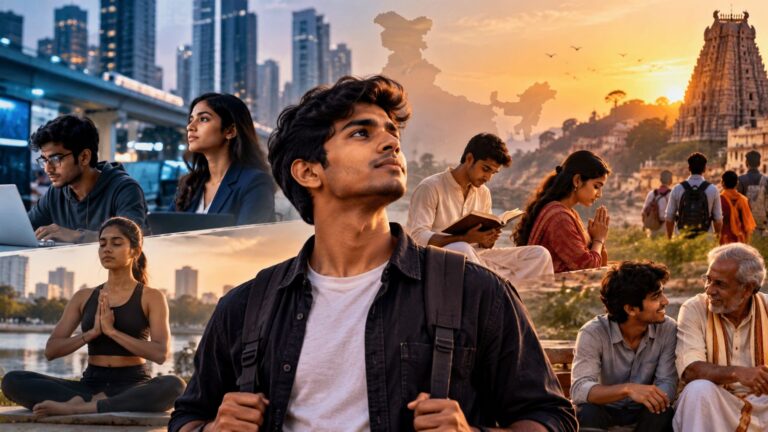
There is another India that rarely receives the same attention. It is the young person waking up before sunrise to train for a marathon, the young woman practising yoga after work, the student preparing for an examination while also reading the Bhagavad Gita, the young professional travelling to a pilgrimage centre, or the young Indian learning Sanskrit, classical music or traditional art while working in technology.
It is also the youth choosing discipline over addiction, fitness over excess and meditation over constant distraction. This India exists quietly, without always producing a headline.
Across the country, many young Indians are rediscovering pilgrimage, yoga, meditation, traditional practices and spiritual literature. This is not necessarily a rejection of modernity. For many, it is an attempt to find balance within modernity.
A young Indian can build software, work in artificial intelligence, run a business or participate in the global economy and still bow before his elders, participate in family rituals and seek the blessings of his ancestors. Modernity and tradition need not be enemies. Perhaps this is precisely what our borrowed categories fail to capture.
Rights matter. But what about duty?
There is another dimension to the discussion that is often missing. Young people today are increasingly conscious of their rights. That awareness is not a problem. A healthy society requires citizens who know their rights and are willing to question institutions when something is wrong.
But Indian thought has never treated rights as the whole of human existence. Alongside rights stands kartavya, duty.
The Bhagavad Gita does not teach Arjuna merely to ask what he is entitled to receive from life. It asks him to recognise what he is required to do. This distinction is important. A society cannot remain healthy if every conversation begins with “What are my rights?” and ends there.
What is my responsibility towards my family? What is my responsibility towards society? What do I owe my nation? What do I owe to truth? What do I owe to my own potential? These questions are not anti-modern. They are what prevent freedom from becoming irresponsibility.
A young person has every right to question authority. But questioning authority does not remove the responsibility to distinguish truth from falsehood. The right to protest does not automatically legitimise violence. Freedom of expression does not eliminate the need for restraint. And disagreement with an institution does not require contempt for the entire social order.
The deeper Indian idea is not obedience without thought. It is freedom guided by viveka.
The Indian tradition has never been afraid of questions
There is an irony in the claim that returning to Indian tradition makes young people less questioning. The opposite is closer to the truth.
The Indian intellectual tradition is full of questions. The Upanishads are full of seekers asking difficult questions. Teachers are questioned. Answers are examined. Ideas are challenged. Philosophical schools debate one another.
Shastrartha was not a performance of agreement. It was a disciplined search for truth through dialogue and intellectual contestation. India’s tradition does not ask the young to stop questioning. It asks them to develop the capacity to question intelligently.
That distinction has become particularly important in the age of the smartphone. A young person today can access more information in a few minutes than earlier generations could encounter in months. But access to information is not the same as access to wisdom.
The real question is not whether our youth have information. It is whether they have the viveka to decide what deserves to be believed.
When the smartphone becomes louder than the mind
There is a simple question worth asking: do we use our smartphones, or have our smartphones begun to use us?
The digital world rewards speed. Anger travels faster than reflection. Outrage attracts more attention than nuance. A short video can create an impression before a person has had time to understand the facts behind it.
This does not mean that every online movement is artificial or every protest is manufactured. Genuine grievances exist, and genuine young people do speak out. But the digital environment can magnify a particular emotion until it appears to represent an entire generation.
That is why caution is necessary before declaring that “Gen Z has spoken.” Perhaps a few people have spoken. Perhaps a particular group has spoken. Perhaps an important grievance has been raised. But a civilisation of more than a billion people cannot be understood through a trending video.
The louder voice is not necessarily the deeper voice.
The real crisis may be one of direction
The greatest challenge before Indian youth may not be anger. It may be direction. A young person can be technologically sophisticated and still be internally confused. He can have thousands of followers and no sense of purpose. He can be connected to the entire world and disconnected from himself.
This is where the spiritual dimension becomes relevant. Dharma is not merely a religious label. At a deeper level, it is about that which sustains and gives right direction to life. Swadharma asks a person to understand his own responsibility and place in the larger order. Sadhana creates discipline, viveka creates discernment, and seva takes the individual beyond the narrow boundaries of the self.
These are not ideas belonging only to another age. They address precisely the problems of distraction, comparison, anxiety and purposelessness that modern youth encounter. The answer to a distracted mind is not necessarily more information. Sometimes it is silence, sometimes discipline, sometimes service, and sometimes a return to the question: What am I here to become?
So, what should we call Indian youth?
Perhaps we should stop trying so hard to give India’s youth a borrowed identity. The question should not be, “What does Gen Z want?” The more important question is, “What does India’s rising generation want to become?”
Do we want a generation defined by its consumption habits, online vocabulary and ability to generate outrage? Or do we want a generation that can combine technological ability with civilisational confidence? A generation that can enter the world’s finest laboratories without feeling ashamed of its temples, build global businesses without losing its connection with family, question its elders without despising them, demand its rights while remembering its duties, and use the smartphone without allowing the smartphone to dictate its mind?
That is a very different vision of youth.
India does not need to reject modernity to remain rooted. Nor does it need to abandon its roots to become modern. Its civilisational strength has always been its ability to absorb, question, adapt and renew without losing its essential identity. Our youth can do the same.
Perhaps, therefore, the time has come to look beyond borrowed alphabets. The Indian youth is not simply a demographic cohort waiting to be named. It is the next link in a civilisationalchain. Its true identity will not be decided by the year in which it was born, the slogans it shouts, or the trends it follows. It will be decided by the values it chooses to live by.
The future of India will not merely belong to a “Gen Z”. It will belong to a generation that can unite Sadhana with Srijan, Viveka with Vikas, and individual aspiration with Rashtrabodh.
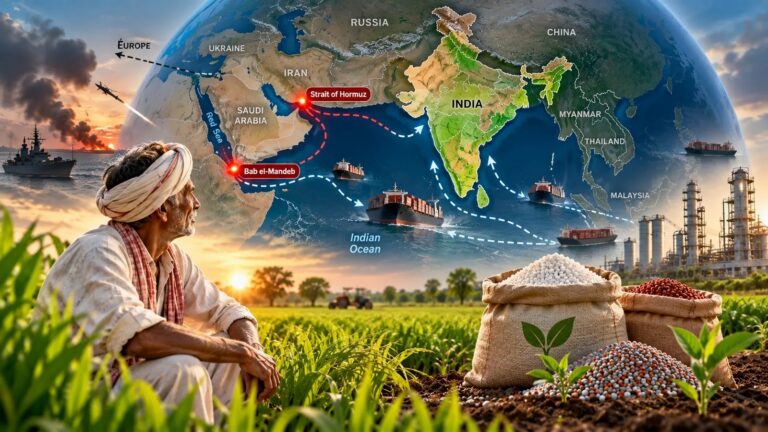
Amid escalating geopolitical friction in the world and the war in the Middle East, global agricultural supply chains faced severe structural vulnerability in recent months. Crises in essential nutrient manufacturing hubs and key shipping routes threatened to trigger acute price shocks and food inflation across global markets. Yet, despite heavy import dependency for vital fertilisers like Diammonium Phosphate (DAP), Muriate of Potash (MOP), and natural gas feedstocks, Indian agricultural productivity and distribution of fertilisers remained remarkably steady.
India imports roughly a third of its urea, a substantial share of its DAP and virtually all of its potash. When geopolitical crises simultaneously disrupted imports from Russia, the Red Sea and the Persian Gulf, the consequences could have travelled all the way from distant battlefields to Indian farms and ultimately to household food prices. It did not happen.
The crisis emerged from several directions. Houthi attacks on commercial shipping in the Red Sea forced vessels to avoid the Suez route and travel around the Cape of Good Hope, adding thousands of kilometres and weeks to voyages while raising freight and insurance costs. Meanwhile, the US-Israel war against Iran disrupted commercial shipping through the Strait of Hormuz, through which major supplies of ammonia and finished fertilisers from the Gulf must pass. Russia presented another challenge. As one of the world’s largest fertiliser exporters, it is an important source of potash, urea and phosphatic fertilisers, but Western sanctions following the Ukraine war complicated payments, shipping and insurance.
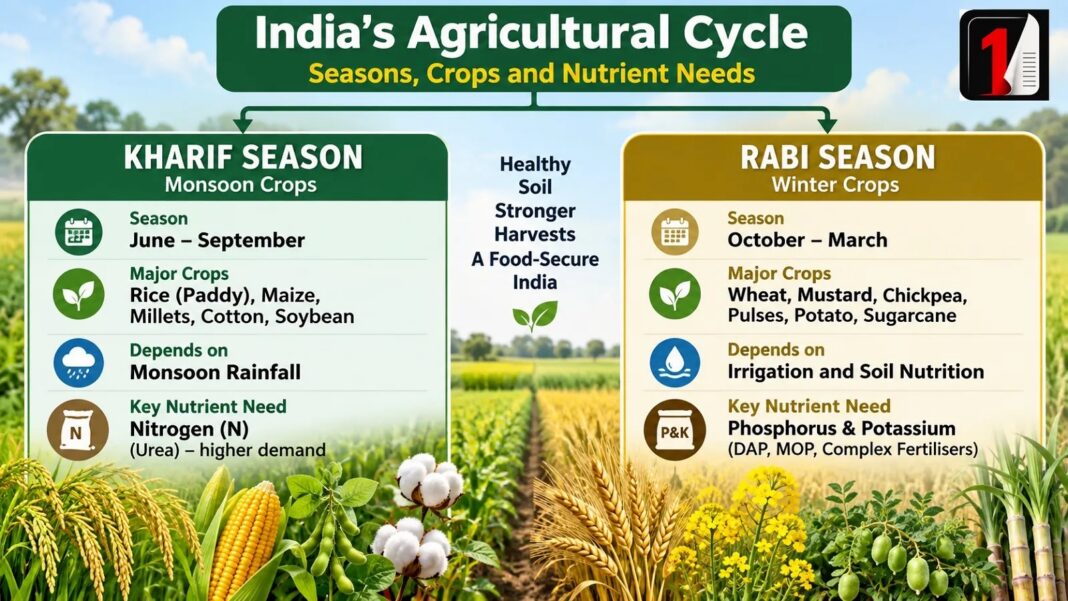
The vulnerability is particularly significant because India’s Kharif and Rabi seasons have different fertiliser requirements. Paddy-heavy Kharif agriculture depends heavily on nitrogen supplied through urea. Domestic production and government buffer stocks, assisted by favourable monsoon conditions, helped India negotiate the recent Kharif season without severe shortages. Rabi is more complicated. Wheat, mustard, chickpea and other winter crops require phosphorus and potassium at the beginning of sowing, making supplies of DAP, MOP and NPK particularly important. India’s dependence on imported potash and DAP consequently makes disruptions during the narrow Rabi sowing window potentially serious.
India’s resilience was not an accident of geography, but the result of calibrated, pragmatic diplomacy coupled with decisive policy intervention by the government. While Western nations struggled with soaring fertiliser tariffs and supply bottlenecks, India engaged in multi-channel trade negotiations. By securing long-term supply pacts with key global producers across Russia, the Middle East, North Africa, and South America, India effectively insulated its domestic agrarian economy from global market turbulence.
At the heart of this strategy was a balance between global engagement and internal stabilisation. On the international front, Indian sovereign trading entities and private consortia negotiated fixed-rate import contracts, bypassing speculative spot-market price surges. On the domestic front, the central government expanded the Nutrient Based Subsidy (NBS) mechanism, absorbing international price hikes to ensure that local farmers received fertilisers at affordable, capped rates during crucial Kharif and Rabi sowing seasons.
Furthermore, this multi-front strategy was bolstered by accelerating domestic production capabilities. Reopening dormant fertiliser units in places like Sindri, Gorakhpur, Talcher, Ramagundam, etc and expanding Nano Urea adoption reduced foreign exchange pressure while laying the groundwork for self-reliance. This combination of dynamic international trade and robust domestic safety nets prevented severe crop yield drop-offs, keeping grain reserves healthy and domestic food inflation under control.
The lessons from this period underscore a broader shift in geopolitical strategy: food security and nutrient supply chains are now as critical to national sovereignty as energy grid resilience and maritime defense. India’s proactive model offers a blueprint for navigating supply shocks in an increasingly unpredictable multipolar world.
The detailed article explaining how India rose with remarkable strategic planning and execution to meet the global supply challenge and ensure enough fertilisers for its massive domestic needs can be read here in Chapter One Magazine.
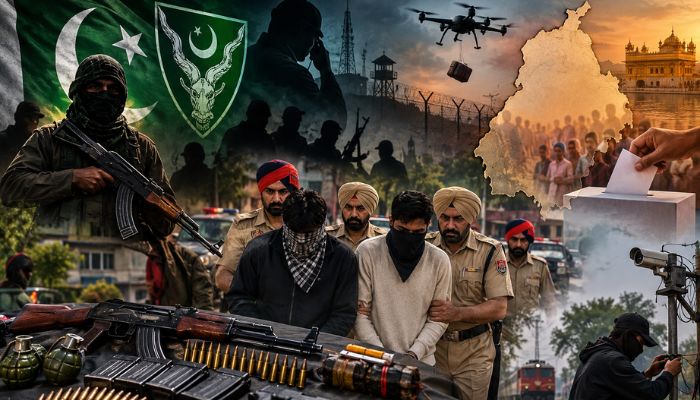
Ahead of the 2027 assembly election in Punjab, homegrown terrorists and sleeper cells in the state, with the help of Pakistan-sponsored criminals and terror networks, are trying to create fear and unrest.
A series of police operations in 2026 has highlighted how foreign-based handlers are using local operatives to move weapons, explosives and other material into Punjab. Investigations have also pointed to the use of social media for contacting recruits, spreading anti-India and anti-police messages and giving instructions.
The latest case has once again brought the focus on Pakistan-linked terror networks operating in Punjab.
Pakistan-linked terror module busted in Amritsar
Amritsar Rural Police have busted a Pakistan-linked terror module and arrested a 28-year-old man, recovering a large quantity of weapons and ammunition from him. The accused has been identified as Navjot Singh, alias Cheema, a resident of Sarai Manthan Khan.
Police recovered an AK-47 rifle, two hand grenades, nine live cartridges, a magazine, a mobile phone and a motorcycle from his possession. Navjot works as a truck driver and had earlier been involved in drug-related activities, according to the police.
The investigation has found links to a Pakistan-based handler connected with the Inter-Services Intelligence (ISI) and another handler based in the Middle East. Inspector General of Police (Border Range) Gurpreet Singh Bhullar said the weapons and explosives were brought into Indian territory through drones.
Police said Navjot had been instructed to take the weapons to a location in a neighbouring district. He was then supposed to meet another person through a cut-out arrangement. Further instructions, including the exact delivery point, were to be given to him later.
For carrying out the task, Navjot had been promised up to Rs 50,000. However, police said he had not received any payment before his arrest.
The police have not disclosed the intended target or the exact place where the weapons were to be delivered. Officials said the investigation is continuing and more people linked to the network are being traced.
The operation was carried out by the Amritsar Rural Police team under the Punjab government’s zero-tolerance policy towards terrorism, organised crime and gang-related activities. The operation was led by Amritsar Rural SSP Kanwalpreet Singh Chahal and his team.
Bhullar said the recovery was an important preventive action as the weapons could have been used to carry out a serious crime.
A pattern of Pakistan terror-linked cases in Punjab in 2026
The Amritsar case is not an isolated incident. Several similar cases have been reported in Punjab during the year 2026 alone, with police repeatedly finding links to Pakistan, ISI handlers and foreign-based operatives.
In these cases, investigators have recovered assault rifles, foreign-made pistols, hand grenades, explosives and petrol bombs. Some modules were also found using social media to communicate with handlers, recruit people and plan attacks.
ISI-linked arms smuggling and radicalisation module
In another major operation, Amritsar Rural Police busted an ISI-sponsored terror and cross-border arms smuggling module and arrested two people. The operation led to the recovery of an AK-47 rifle, two magazines and 36 live cartridges. Three sophisticated Glock 9mm pistols were also seized.
Punjab DGP Gaurav Yadav described the action as an important step in the fight against terror networks and cross-border arms smuggling.
The initial investigation found that the accused were in contact with foreign-based handlers through social media. Police said these handlers were operating from across the border and had links with Pakistan’s intelligence agency, the Inter-Services Intelligence or ISI.
The police also said the network was involved in radicalisation activities. The accused were using online platforms to spread anti-India and anti-police messages and influence vulnerable people.
An FIR was registered at Gharinda police station in Amritsar Rural. Investigators are examining the digital devices and social media accounts of the accused to identify their contacts and find other members of the network.
Grenades with Pakistan markings and plans to target police
In another case, the Counter Intelligence Wing of Punjab Police busted an ISI-backed terror module being run by Pakistan Intelligence Operatives, or PIOs.
Three people, Sarabjit Singh of Tarn Taran, Bikramjit Singh of Amritsar and Amandeep Singh of Amritsar were arrested. Police recovered two Argus hand grenades and a foreign-made Glock pistol.
A key detail in the case was that the recovered grenades carried markings of the Pakistan Ordnance Factory, or POF, pointing to their cross-border connection.
According to DGP Gaurav Yadav, the group was involved in plans to target police establishments in several states. The accused were in contact with Pakistan Intelligence Operatives through social media.
During the investigation, police found that Bikramjit Singh was the main operative and primary contact of the foreign handlers. He was working from the DSA of Gujarat. The information was shared with the Gujarat Anti-Terrorism Squad, which helped in his arrest.
Police said the group was planning grenade attacks on police establishments in Punjab and other states on the instructions of ISI handlers.
A case was registered at the State Special Operations Cell police station in Amritsar under the Explosive Substances (Amendment) Act, Arms Act and the IPC.
Four hand grenades recovered in ISI-backed module
On April 16, Punjab Police busted another terror module linked to Pakistan’s ISI and arrested one person.
The operation was jointly carried out by the State Special Operations Cells of Amritsar and Mohali along with the Counter Intelligence Wing. Four hand grenades, two foreign-made pistols and ammunition were recovered.
DGP Gaurav Yadav said the accused was working on the instructions of foreign-based handlers. Police also found links between the accused and a terror module connected with a recent grenade attack in Chandigarh.
An FIR was registered at the State Special Operation Cell police station in Amritsar. The investigation was launched to trace other members of the network and establish their links with foreign handlers.
BKI module busted in Jalandhar, IED recovered
Counter Intelligence Jalandhar, working with Jalandhar Rural Police, also busted a Pakistan-sponsored Babbar Khalsa International (BKI) terror module.
The operation led to the arrest of Satbir Singh, a resident of Padiana village in Adampur, Jalandhar. Police recovered an improvised explosive device, or IED, containing 1.3 kilograms of high explosives, shrapnel and ball bearings. His black Platina motorcycle was also seized.
Police said Satbir had collected the explosive consignment on the instructions of foreign-based handlers. Acting on information, Counter Intelligence teams set up a checkpoint at Dhandaur village and stopped his motorcycle. The IED was found inside a bag during the search.
The recovery raised concerns because the explosive device contained material that could cause serious damage and disrupt public peace.
The investigation is now focused on identifying the foreign handlers and local support network connected to the BKI module.
An FIR was registered at Patara police station in Jalandhar Rural under the Bharatiya Nyaya Sanhita, Explosives Substances Act and Arms Act.
Two Pakistan-backed modules linked to surveillance and petrol bombs
Punjab Police also claimed to have busted two Pakistan-backed, ISI-linked terror modules and arrested nine suspects, including four juveniles.
According to police, one of the groups was involved in surveillance. Its members were installing cameras near railway tracks and sending live footage across the border.
The second group was preparing petrol bomb attacks. Police recovered four petrol bombs and three pistols during the investigation.
Officials said Pakistan-based handlers were providing support, training and material to the members for attacks targeting security personnel and establishments. Investigators also found links between some suspects and people who had visited the Jantar Mantar protest site in Delhi.
Police said the suspects were arrested during an intelligence-based operation before they could carry out their plans.
Authorities also pointed to the use of petrol bombs as a new method being adopted by terror networks because they can be prepared using materials that are easily available.
Shahzad Bhatti terror network: Punjab and beyond
In recent months, the police and security agencies have arrested numerous individuals allegedly working for the terror network of ISI proxy and gangster Shahzad Bhatti.
The ISI-backed Shahzad Bhatti Network is actively involved in recruitment, online radicalisation, reconnaissance, logistics, espionage, illegal procurement of arms, establishment of sleeper cells and facilitation of terrorist activities across different parts of India.
Intelligence inputs indicate that the anti-India terror network operates via Pakistan-based handlers using encrypted communication channels and maintains association with several front organisations involving Khalistani separatists, including the Khalistan Armed Force, Punjab Sovereignty Alliance, Khalistan Liberation Army, Sher-e-Punjab Brigade, United Sikh Brotherhood, Sikh Tigers of Khalistan and Tehrik-e-Taliban Hindustan.
The newly created TTH had claimed responsibility for two targeted killings of Punjab Police personnel in February and May this year. One of the early tasks assigned by TTH to an Indian operative named Sohail was painting “TTH” graffiti across Delhi and Faridabad. Sohail was later arrested by the Delhi Police Special Cell.
The ISI proxy has weaponised social media to recruit ‘operatives’ in India. The Pakistani handlers allegedly scan social media profiles to identify unemployed or vulnerable youth, lure them with money, and begin with small assignments. Gradually, the handlers assign violent tasks to the operatives, including firing at clubs, throwing grenades, targeting police personnel, and filming terror acts.
An alarming aspect of Bhatti’s network is that he is not recruiting only Muslims but also Sikhs, and even Hindus, through the ISI-style brainwashing and other tactics.
In July, the Bikaner Police arrested a man named Anil Kumar over allegations of him providing Indian SIM cards to Pakistani gangster Shahzad Bhatti’s gang members. The action comes after the investigating agency came to know that a WhatsApp account had been operating in Pakistan using an Indian mobile phone number belonging to the 18-year-old arrestee.
On 17th July, Anil Kumar, a resident of Godu village in the Bajju Police Station area, shared the one-time password (OTP) required to activate the SIM card with Shahzad Bhatti’s associates. Initially, the Rajasthan ATS detained Kumar and interrogated him. Thereafter, the ATS handed him over to the police, who arrested him on 19th July.
In a 2024-25 case in the Mahajan Field Firing Range espionage case (2024–25), a canteen operator, an e-Mitra operator, and a railway employee were arrested for leaking information related to Army activities and maintaining contact with Pakistani female operatives.
In November 2025, a grenade attack took place on the Sirsa Women Police Station in Haryana. The National Investigation Agency linked the incident to the Bhatti gang.
In April 2026, Delhi Police Special Cell uncovered a plot involving shootings, grenade attacks and planned murders in Delhi NCR. The police arrested two men working at the behest of Bhatti, Rajveer and Vivek Banjara from Madhya Pradesh. The duo had procured weapons and cartridges on the instructions of Shahzad Bhatti.
The name of the Shahzad Bhatti Network also emerged in the arrest of a man named Vikrant Kashyap from the Jhajhra area in Uttarakhand. Kashyap was reported to have been in contact with Bhatti and his associates through Instagram and WhatsApp.
In February 2026, Chinese-made pistols and ammunition were allegedly dropped by a drone near the Khajuwala border. The probe into the case uncovered an active cross-border smuggling network.
In late July 2026, the Assam Police Special Task Force (STF) arrested three suspected members of the Shahzad Bhatti Network. The arrested suspects were identified as Akramul Islam, aged 26, a resident of Beparipara in Dhubri district; Aminur Rahman, aged 22, of Dhupiri in Panbari, Chirang district; and Abdul Hussain, aged 54, of Dabandia in Kalgachia, Barpeta district.
On 5th October 2026, the Supreme Court refused to pass an ex parte order of suspension against the Chief Election Commissioner (CEC) Gyanesh Kumar during the hearing of a petition that sought the suspension of the CEC. Despite the petitioner, Advocate Vikas Singh, threatening that if an interim order is not passed, “the country will burn”, the Supreme Court bench comprising CJI Surya Kant, Justice Joymalya Bagchi, and Justice V Mohana refused to issue such an order without hearing from the CEC and other respondents. Timing suggests that, before the petitioner, an apparent bid to influence the Supreme Court’s decision on CEC Gyanesh Kumar and SIR was made by former apex court judge Rohinton Nariman and sitting judge Justice Ujjal Bhuyan at non-judicial forums.
‘No court can condone it’: SC judge Ujjal Bhuyan passes his own verdict on SIR, declares it ‘intrinsically arbitrary’
On 4th October, Justice Ujjal Bhuyan delivered the valedictory address at the 19th NALSAR-Justice B.R. Sawhne Memorial Moot Court Competition in Hyderabad.
During his address, Justice Bhuyan said that any process that ‘disenfranchises’ “millions of Indian citizens, making them ‘second-class’ citizens in their own country” by denying them the vote is “intrinsically arbitrary.”
Bhuyan invoked Article 14, which guarantees the right to equality, and Article 326, which provides for universal adult suffrage.
Justice Bhuyan said, “No amount of whataboutery can justify it. It strikes at the very heart of the Constitution, and I would go to the extent of saying that it is a negation of the constitutional order which we have adopted under the Constitution of India.”
The Supreme Court judge went as far as to claim that “no authority can do it; no court can condone it”.
Justice Bhuyan insinuated that other than the case of dead voters, names from electoral rolls should not be struck down and that such deletions would amount to arbitrary disenfranchisement.
However, Article 326 of the Indian Constitution provides for adult suffrage subject to disqualifications under law. Similarly, the Representation of the People Act and Election Commission rules have long authorised revision, including deletion after notice in defined cases.
Interestingly, Justice Bhuyan’s apparent bias against CJI Surya Kant reflects in the fact that, in the same speech, he said about SIR that ‘no court can condone it’, knowing that the Supreme Court bench is set to hear several petitions linked to SIR and CEC Gyanesh Kumar, and he also lauded NALSAR University students as “brilliant, bold, and brave” for opposing the proposed participation of CJI Surya Kant as the chief guest at the university’s convocation a few weeks back.
Justice Ujjal Bhuyan, who is also the son of a lifetime Communist leader Suchendra Nath Bhuyan, became an advocate in 1991 and has seen at least five SIRs taking place during his legal career. These SIR exercises saw large-scale voter deletions. It is amusing that despite previous SIRs weeding out dead, duplicate, and illegal voters in large numbers, somehow this is the only time Justice Bhuyan has said that ‘taking away voting rights of millions of citizens is unjustifiable, and no court can condone it’.
This ‘no court can condone it’ is not a vague or trivial statement; rather, these remarks, along with their timing, hold immense significance. If the Supreme Court goes on to decide in favour of the SIR and finds that CEC Gyanesh did not abuse his powers in any form, the morality and integrity of the Supreme Court bench hearing SIR-related matters will be questioned.
It was seen how CJI Surya Kant and Justice Joymalya Baghc were vehemently criticised for not stopping the SIR process in West Bengal and Bihar as per the whims of the anti-BJP political parties and extended leftist coterie. In fact, the SIR rulings will become the proof of either the ‘biasedness’ or ‘unbiasedness’ of the current CJI and the Supreme Court bench hearing relevant petitions. If the court decides in favour of the SIR and CEC Gyanesh Kumar post examination of all presented facts and arguments, the bench itself will be declared ‘compromised’ and claims will be made that the judges were securing their post-retirement future.
Chief Justice of India Surya Kant and Justice Joymalya Bagchi, the judges that made sure the illegal SIR process goes through without any trouble in Bengal and Bihar, must quietly sit this one out.
Even if they choose to do something, they can continue doing it. No one cares. The Supreme Court has been complicit in ensuring that Gen Z’s voting rights are stolen and state elections too. By ensuring that important petitions are not heard and decided in time, like the Maharashtra government toppling, parties being broken up, Delhi constitutional crisis case, the BJP had the last laugh. It’s a big blot on our judiciary.
And so, this Supreme Court Bench may do whatever they want to but it will hold absolutely ZERO CREDIBILITY in people’s eyes.
The accountability will be decided by the people of India, the young generation. The Court can do whatever it wants to do tomorrow or whenever.
@Cockroachisback
Justice Bhuyan is known for his controversial political commentaries that many opine are in violation of judicial discipline since he is a sitting Supreme Court judge.
In July 2025, Bhuyan delivered a speech at the 4th Memorial Lecture of Justice G.P. Singh at the National Law Institute University (NLIU), Bhopal, wherein he raised ‘concerns’ about civil liberties, the supposed criminalisation of protests, and the functioning of the judiciary.
“The right to express one’s views and to demonstrate peacefully are fundamental freedoms of the citizens. Debate and dissent are the essence of democracy. Unfortunately, even normal activities are being criminalised”, he said.
The timing of Justice Bhuyan’s remarks was impeccable. The speech came on 25th July, five days after the violent Cockroach Janta Party (CJP) protests and the day Education Minister Dharmendra Pradhan was forced to resign.
In March 2026, he criticised the arrest and three months’ jail for some Muslim youths over hosting an Iftar party on a boat in the sacred Ganga River, eating chicken biryani and throwing chewed bones into the waters.
From criticising the UP government’s ‘bulldozer justice’ to deprecating judges taking up political roles post-retirement, Bhuyan has been quite blatant about his ideological biases. It, however, is interesting that Justice Bhuyan has turned on his politically aligned ‘activist’ mode even before retirement.
Rohinton Nariman, known for his anti-Hindu and anti-BJP biases, peddles an alarmist and apocryphal narrative on SIR
Days before Justice Bhuyan, former Supreme Court judge Justice Rohinton Nariman, notorious for his anti-Hindu and anti-BJP moorings, claimed that the right to vote, “the heart of our Constitution, the heart of our democracy,” is “at great peril”.
Casting aspersions on the integrity of the Election Commission, CEC Gyanesh Kumar and the SIR, Nariman said, ” You cannot have an election commission which functions or malfunctions like this.”
The retired Supreme Court judge even claimed that 90 lakh voters were “disenfranchised” during the SIR exercise in West Bengal.
Rohinton Nariman also called the current law, placing the Election Commissioner appointments largely in the hands of the Central government of the day, a “red flag”. He further urged the Supreme Court to decide the challenge to the Chief Election Commissioner and Other Election Commissioners Act quickly.
It is interesting that Nariman never raised alarms over the process of appointing Election Commissioners, including the CEC, when ECs or CECs were appointed at least 31 times unilaterally by the Central governments, most led by the Congress party, before the 2023 Anoop Baranwal judgement.
More than his judgments, ex-judge Rohinton Nariman is known for his anti-Hindu and politically charged remarks. In September 2025, Nariman delivereda speech at an event in Keralam, wherein he needlessly referenced bovine animals that are considered sacred by Hindus, while criticising former CJI Chandrachud for turning to faith during the momentous Ram Mandir verdict.
“Whether with divine or bovine intervention or any other kind of intervention, if a judge delivers a judgment, he is violating his oath to the Constitution. You (judges) have to live only by your oath to the Constitution and the laws. And when you live by your oath to the Constitution and the laws, you certainly bring in your own morality. That’s about as far as it goes,” Justice Nariman said.
While addressing an Ahmadi Foundation event in December 2024, Nariman criticized the 5-judge bench that delivered the Ayodhya Ram Janmabhoomi verdict in 2019 and said that the verdict was nothing but a ‘mockery of justice’ that violated the basic principle of secularism. He even mocked Hindus as “hydra heads” for exercising their constitutional right to seek legal remedies regarding the illegal encroachment and/or Islamic repurposing of their ancient temples by Muslims.
Rohinton Nariman advocated stringent implementation of the controversial Places of Worship Act, so that no more lawsuits seeking reclamation of their temples could be filed. Nariman’s remarks suggested that to uphold ‘secularism’ Hindus should have abandoned their claim and remained silent.
BJP-hating ex-SC judge turned ‘activist’ Madan Lokur now eyeing to run parallel judiciary with ‘independent commission’ on SIR
Beyond manipulative rhetoric, some former Supreme Court judges with their ideological biases are turning into judge, jury, and executioner over the SIR.
OpIndia reportedhow ahead of the Supreme Court heard the plea seeking suspension order against CEC Gyanesh Kumar, an ‘independent commission’ was announced on 2nd October, to inquire into the validity and impact of the SIR. The so-called ‘commission’ has been formed by a newly formed private lawyers’ body called the Lawyers Association for Constitution (LAFC) and comprises retired judges.
The five-member panel will be headed by Retired Supreme Court judge Justice Madan Bhimarao Lokur and will comprise former judges Justice AK Patnaik (former judge, Supreme Court), Justice Badar Darrez Ahmad (former Chief Justice, J&K HC), Justice Rekha Sharma (former judge, Delhi High Court) and Justice Anjana Prakash (former judge, Patna High Court). The commission will be assisted by the likes of senior lawyers Kapil Sibal, Prashant Bhushan, CU Singh, PC Sen, Raju Ramachandran, Rebecca M. John, Warisha Farasat, and Vrinda Grover.
Notably, Justice Lokur is known for his strong ideological biases against the BJP. Justice Lokur had criticised the abrogation of Article 370 by the Modi government, which was upheld by the Supreme Court itself.
Lokur also voiced his objections to the Unlawful Activities Prevention Act (UAPA), which empowers the government to effectively deal with anti-national activities.
He was part of the infamous rebel group of four judges who held an unprecedented press conference in 2018, with allegations, including the government’s lack of response to the Memorandum of Procedure (MoP) governing the appointment of judges. Justice Lokur was also on the Constitutional Bench that, in 2015, struck down the National Judicial Appointment Commission (NJAC), introduced by the Modi government to replace the controversial Collegium system for the appointment of judges.
Given his antagonistic stance against the Modi government, Lokur has had warm and cordial relations with Pakistani judges. In January 2019, the former apex court judge attended the swearing-in ceremony of the former Chief Justice of the Supreme Court of Pakistan, Asif Saeed Khosa, who is also said to be a close friend of his. Before this, he had also taken part in the swearing-in ceremony of former Pakistan Chief Justice Tassaduq Hussain Jillani, when he took the oath as the Chief Justice of the Supreme Court.
Lokur is also a senior member of a US State Department-funded NGO, Commonwealth Human Rights Initiative (CHRI), which issued a statement against the detention of illegal immigrants under the NRC.
From delivering statements in support of AAP leader Arvind Kejriwal and Congress leader Priyanka Gandhi Vadra, to casting aspersions on the acquittal of former BJP MP Brij Bhushan Sharan Singh by a Delhi Court in a sexual harassment case, Lokur has made his been vocal about his ideological-political biases. Perhaps his induction in a farcical leftist-concocted ‘inquiry commission’ on SIR is a reward for his anti-BJP shenanigans.
From former CEC, IAS officer, political parties to now Supreme Court judges: Are forces opposed to the BJP giving ammo to the Opposition and influencing the judiciary against CEC Gyanesh Kumar?
Over the last few years, the Congress party and the extended I.N.D.I. Alliance levelled EVM hacking, VVPAT tampering, voter name deletions, and ‘vote chori’ to sow distrust in the minds of common people against the Election Commission. They attempted to establish a mendacious narrative that the Election Commission and the BJP are in cahoots to rig Lok Sabha and various state elections.
When nothing worked, the Opposition, and its supportive media and activist ecosystem began targeting the Special Intensive Revision (SIR). They resorted to fearmongering and labelled SIR as a backdoor NRC. Although SIR stirred things a bit, the Opposition began attacking Chief Election Commissioner Gyanesh Kumar, since calling the entire Election Commission ‘compromised’ was backfiring, especially when Opposition parties were gladly accepting the mandates in states where they won. Portraying the person at the top as corrupt and compromised is easier and more convincing; thus, the Opposition, joined by its unofficial B-Team Cockroach Janta Party and leftist media cabal, started making a villain out of CEC Gyanesh Kumar.
Long ‘investigative’ articles were published painting CEC Kumar as an authoritarian, twisting facts to allege conspiracy while the anti-BJP foot soldiers hit the streets with ‘Gyanesh Kumar Isteefa Do’ placards. Simultaneously, petitions have been filed before the Supreme Court seeking suspension of CEC Kumar and invalidation of the SIR.
Meanwhile, former Keralam Chief Secretary Jiji Thomson, who is known for being close to the Congress party, claimed in late September that back in 2016, now CEC Gyanesh Kumar had asked him to contest the 2019 elections on a BJP ticket, although he did not offer any proof to back his claim. Thomson’s remarks were widely amplified by top Congress leadership to sharpen attacks on CEC Kumar.
Driven by a political vendetta, on 4th October, the Congress government in Keralam has ordered a fresh Vigilance and Anti-Corruption Bureau (VACB) probe into a 2006 suicide case linked to Chief Election Commissioner Gyanesh Kumar, who was serving as the state’s Public Works Department (PWD) secretary at the time. The fact that the issue involved multiple officials of that era, not just Gyanesh Kumar, was conveniently swept under the rug when the CPI(M) was in power. Now, with political alignments shifting and CEC Gyanesh Kumar already at the centre of controversy, both CPI(M) and Congress, despite claiming to be political rivals, have joined hands to bring the matter back into focus and hound CEC Kumar.
While the propaganda, protests, and politics around SIR are not new, former Chief Election Commissioner S.Y. Quraishi casting aspersions on SIR and CEC Gyanesh Kumar, supreme court judges, both retired and sitting, delivering speeches attacking CEC Kumar and the SIR indicate a concerted effort to influence not only public opinion but also the judiciary.
It must not be forgotten that back in September 2023, the then CJI DY Chandrachud had admitted that media trials affect the administration of justice. “Administration of justice is affected by ‘media trials’. Need to decide at which stage (of investigation) details should be disclosed. This is a very important issue because it involves the interests of the victim and accused,” he said.
It is apparent that dominant public discourse on any issue, particularly those of national significance like SIR and Chief Election Commissioner’s impartiality and integrity, might influence court rulings, particularly when even Supreme Court judges are involved in politically charged issues and biased statements.
Gujarat’s politics had been quiet for some time. Former Chief Minister Shankarsinh Vaghela has now thrown a stone into that still water, stirring up the state’s caste politics with a controversial remark about three communities– Brahmins, Patels and Vanias. His remarks have triggered a backlash, with reactions pouring in across the media and social media. Vaghela, however, has refused to apologise. He says he said what he meant to say and that those criticising him have simply failed to understand his point.
On October 2, Shankersinh was in Sagbara in Narmada district to address a gathering of the tribal community. Congress leaders were also present. During his speech, he said reservation was given to the tribal community as compensation for what it had suffered for decades and that it was their right. He also accused the BJP government of being opposed to reservation.
Vaghela then said that anyone opposed to reservation should take up the job of carrying out manual scavenging, and that he was ready to pay them ₹50,000. It was while making this remark that he named Brahmins, Patels and Vanias.
The backlash followed quickly. Members of these communities came out against him. Vaghela offered a clarification but refused to apologise. And Gujarat was once again talking about caste politics.
It would be difficult to dismiss Vaghela’s remarks as a slip of the tongue. He knew what he was saying. He meant exactly what can be heard in the video. The timing of the statement is important too.
Just two or three days before the video surfaced, reports emerged that Vaghela could return to the Congress. Such claims have been made several times since he left the party in 2017. This time, however, there was confirmation from both sides.
Vaghela said he had repeatedly stated in public that he was willing to work for the Congress to defeat the BJP. Congress leaders also confirmed that they had met him and said the matter would now be discussed with the party high command.
This is where Vaghela’s remarks acquire a larger political context.
Vaghela knows Gujarat’s political arithmetic. The communities he named have largely been part of the BJP’s core General Category support base. At the same time, the BJP has been strengthening its position in the tribal belt.
If the BJP’s support among tribal voters is to be disrupted, creating a sharper political divide between these communities and the BJP is one possible route. Caste mobilisation can serve that purpose.
Gujarat has seen what happens when caste becomes the dominant political language.
Go back a decade. The last time the Congress came close to power in Gujarat was in the 2017 assembly elections. Two years earlier, the Patidar reservation agitation had erupted, followed by protests by other communities against the government. Gujarat was going through a period of political unrest, and caste politics had overshadowed almost every other issue.
The impact was visible in the 2017 Assembly election. The Congress reached 77 seats, while the BJP retained power with a very narrow margin. The majority mark was 91. BJP got 99 seats.
But then the BJP corrected its mistakes, while the Congress continued to weaken. By 2022, the picture had changed dramatically. The BJP won 156 seats out of 182, and the Congress was reduced to just 17.
Now, with the 2027 Assembly election approaching, the opposition ecosystem has to reckon with a basic political reality: the BJP remains deeply entrenched in Gujarat.
There can be dissatisfaction on some issues with the government, as there is with any government that has been in power for a long time. But dissatisfaction alone does not automatically translate into a desire for an alternative. For many voters in Gujarat, the BJP still carries the credibility of having delivered on a substantial part of its development agenda. There is also a perception that, whatever the problem, the BJP is more capable of finding a solution than the alternatives currently available. And then there is Narendra Modi, whose political connection with Gujarat remains a factor that cannot be ignored.
This is not merely an argument based on political perception. Gujarat’s election results tell the same story. The BJP won 156 of 182 Assembly seats in 2022, its biggest-ever tally in the state. In the 2024 Lok Sabha election, it won 25 of Gujarat’s 26 seats, with the Congress taking Banaskantha.
That is the challenge facing the opposition. It cannot simply wait for dissatisfaction with the BJP to turn into a vote against it. It needs to create a political alternative strong enough to overcome the BJP’s organisational strength, its record in government and the Modi factor. It is this frustration that makes caste politics tempting again.
There have also been attempts to create an atmosphere of unrest in Gujarat in the guise of agitations. The Aam Aadmi Party, which has been increasingly focusing on the Patidar community, tried to organise a Kisan Mahapanchayat in Botad, a part of Saurashtra where Patidars have a significant presence. The gathering was held without police permission, and when the police arrived to stop it, stones were thrown at them. The Congress later attempted to organise a farmers’ rally in Gandhinagar, but failed to generate much momentum.
There is a political value in keeping a state in a constant state of agitation– every grievance becomes a confrontation, communities begin to mobilise separately, ly and governance itself becomes part of the conflict. That was the broader atmosphere Gujarat witnessed between 2015 and 2017.
Then there is the wider YouTube media ecosystem. Look at its coverage and one thing stands out: caste politics is repeatedly being pushed to the forefront.
The larger political objective is to recreate, in some form, the atmosphere of 2015, when caste mobilisation overshadowed issues such as development and the economy, communities became divided, and elections increasingly revolved around caste.
The Congress has used this political route before. When there are fewer conventional issues on which to challenge the BJP, caste becomes an obvious political instrument. Rahul Gandhi’s repeated ‘Jitni abadi, utna haq’ argument is one example.
The same conversation has now begun in Gujarat as well, and attempts in this direction have been visible for some time.
There is, however, another reason why Vaghela’s timing may not be ideal for him and the Congress.
In January, a major controversy erupted over a regulation published by the University Grants Commission (UGC). It triggered considerable debate on social media, which eventually led to the discussion around changes to the reservation system. For a while, there appeared to be some discontent among sections of the General Category towards the BJP. But Shankersinh’s statement has changed the scenario.
He may not have made the statement as a Congress leader, but his proximity to the party is clear. Congress leaders were present at the gathering, and none have so far publicly condemned his remarks. Politically, therefore, the statement will inevitably be viewed through the Congress lens. That creates another hurdle for Vaghela’s proposed return to Congress.
There will likely be more attempts to bring caste to the centre of Gujarat’s politics as 2027 approaches. The 2022 election showed that the opposition has struggled to take on the BJP effectively on most other issues. Caste, therefore, remains the easiest political terrain on which to try.
Bollywood actor Sanjay Dutt has landed at the centre of a major controversy after comments he made on Shekhar Suman’s chat show, Shekhar Tonite, went viral. During a special Gandhi Jayanti episode of the show, Dutt made a remark stating that he “can’t feel” the same peace in the country anymore and expressed hope that the “good old days” would return soon.
These remarks immediately triggered severe criticism and a heavy backlash across social media platforms, drawing attention back to the actor’s past, including his conviction for illegally possessing an AK-56 rifle and a 9mm pistol in a case linked to the 1993 Mumbai serial blasts.
Dhurandhar Actor #SanjayDutt states he doesn’t feel PEACE in India Anymore 👀 https://t.co/7c5zQ0P24F
Facing intense heat online, Sanjay Dutt took to X on Sunday, 4th October, to clear the air and offer a formal clarification. He stressed that his comments should be looked at strictly within the context of the conversation they were part of, emphasising that he never intended to hurt the sentiments of any person, community, or institution.
I would like to clarify that it was never my intention to hurt, offend, or disrespect the sentiments of any individual, community, or institution.
My remarks were made in the context of a scripted conversation intended to be light-hearted and humorous. The spirit behind them was similar to the humour and satire seen in films like Munna Bhai, particularly the concept of ‘Gandhigiri,’ which was intended to convey a message of love, warmth, togetherness, and goodwill. Unfortunately, my words were interpreted outside of that intended context.
According to the actor, the discussion on Shekhar Tonite was entirely scripted and designed to be light-hearted and humorous rather than a serious statement directed at anyone. He even connected his comments to the warmth, love, and goodwill associated with his iconic Munna Bhai films. Referring to the philosophy of ‘Gandhigiri’, Dutt explained that the spirit behind his words was meant to mirror the humour and satire used in his movies to promote peace.
The illusion of reality: Scripted entertainment and creative liberty
This entire episode brings to light a broader conversation about how modern reality shows, even chat shows, operate behind the scenes. Even though these programs are packaged, marketed, and presented to audiences as “reality-driven” or spontaneous, a significant portion of them is carefully scripted and pre-planned.
In the quest for TRPs, shock value, and entertainment, lines are written to spark instant reactions, sometimes pushing boundaries without considering the long-term impact. This culture has led to a point where people and creators sometimes write or say anything in the name of entertainment, leaving public figures tangled in controversies.
Pro-Congress ‘comedian’ Rajeev Nigam and his role in Shekhar Suman’s show
The controversy took a sharp turn when Sanjay Dutt effectively placed the responsibility on the show’s scriptwriter, shifting focus directly behind the scenes. This brought a heavily controversial name into the spotlight: Rajeev Nigam. Nigam has a long, established association with Shekhar Suman, having written for Suman’s earlier shows as well as Shekhar Tonite.
A May 2026 post by Nigam explicitly quoted him confirming that he writes for Suman’s show, and available episode credits for Shekhar Tonite have consistently listed Rajeev Nigam among the official episode writers before he left Suman’s organisation in July.
Shekhar suman is back… जिन लोगों को लगता था कि वो मेरे सोशल मीडिया को बैन करके सुकून पा लेंगे, उनके लिए कलम से अब कमान संभाल ली है अब और धारदार तरह से मुकाबला होगा https://t.co/EUJ1608aj4
Nigam immediately jumped into the fray to defend Dutt and lash out at critics. Sharing Dutt’s video on his X account, Nigam wrote in Hindi, which translates to: “When Sanjay Baba spoke his heart out, the andhbhakts got restless… Baba, don’t say sorry to these Andhbhakts.”
संजू बाबा @duttsanjay ने मन की बात बोली तो अंधभक्त तिलमिला उठे… बाबा इन अंधभक्तों को sorry नहीं बोलने का..शुक्रिया शेखर जी @shekharsuman7 one of the best episode👍 https://t.co/z11H7OhapG
In another post on the controversy, Nigam appeared to be downplaying Dutt’s controversial statement and wrote, “Baba, whatever was said from the heart was said. You are carefree, why worry about these crickets (Jhingur)?”
अरे बाबा जो दिल से बोल दिया बोल दिया, आप तो बिंदास हो, इन झींगुरो का क्या टेंशन लेने का.. पूरा देश आपके साथ है @duttsanjay और ये एक शो था @shekharsuman7 जी भी हर मर्यादा का पालन करते हुए ही अपना शो करते है.. आप दोनों कमाल हो यही बिन्दासियत तो चाहिए love u both 👍
Nigam is no stranger to controversy and is widely known for his polarising tweets, particularly his relentless and bitter anti-Modi rants. His social media timeline is filled with politically charged and aggressive statements targeting the BJP government.
In one of his politically controversial posts, he shared an image posing with a picture of PM Modi and labelled him an “Illegal Prime Minister.”
In another post featuring PM Modi playing a frame drum, Nigam mocked him, writing, “Now he is only left fit to play the hand drum, and he has realised this too.”
अब ये खंजरी बजाने लायक ही बचे है इन्हे भी पता हो चुका है https://t.co/3zmElNd3gs
His online rants also extend to political protests and national events. Nigam also joined a Mumbai CJP protest on 2nd October, demanding the resignation of Chief Election Commissioner Gyanesh Kumar over alleged irregularities in SIR electoral rolls, sharing a video from the site with the caption, “Vote chor, Gaddi chor.”
In another anti-Modi rant, the comedian shared a post writing, “How shamelessly they claim 140 crore people as their own, and the moment an opportunity arises, they label millions of these same people as traitors, anti-nationals, Pakistani, tukde-tukde, urban Naxals, or opponents anything at all.”
कितनी बेशर्मी से ये 140 करोड़ जनता को अपना बना देते है
और मौका पड़ते ही इन्ही में से करोड़ों लोगों को गद्दार, देशद्रोही, पाकिस्तानी, टुकड़े टुकड़े, अर्बन नक्सल, विरोधी कुछ भी बता देते है
Similarly, sharing a video of Deepotsav on PM Modi’s birthday, he targeted the leadership by writing, “People remember the looters, dishonest people, traitors, and those who celebrate by betraying the country for a long time.”
In yet another harsh attack on the Prime Minister, the pro-Congress comedian wrote, “He was illiterate anyway, and now he is blind too; he doesn’t see all this… Actually, he has come to ruin the nation in the name of nationalism… One day he will leave the country broken and shattered.”
वो अनपढ़ तो था ही अंधा भी है, उसे ये सब नहीं दिखता है.. दरअसल वो राष्ट्रवाद के नाम पे राष्ट्र को तहस नहस करवाने आया है… एक दिन टूटा फूटा राष्ट्र छोड़कर निकल लेगा.. https://t.co/nFdrR1wTCN
There is nothing unusual about comedians making political jokes. Political satire has always been part of comedy, and comedians have the freedom to criticise governments and political leaders. The problem begins when serious political claims are presented as jokes and then defended only by saying that it was “just comedy” after a backlash.
Nigam’s own social media posts show how easily comedy and political campaigning can overlap. His posts are not simply jokes about everyday politics; several directly target Modi, the BJP and the government in strong language.
The same question now arises around Shekhar Suman. We do not know exactly how much of the Sanjay Dutt segment was written beforehand and how much came from the actor himself. Dutt has only clarified that the conversation was scripted and humorous.
When individuals like Rajeev Nigam routinely use public platforms to write anti-national and deeply abusive content all in the name of comedy and entertainment, it blurs the line between satire and malice. Shekhar Suman has employed individuals who are openly and aggressively political commentators, stretching political critique to the extent of functioning as abusive trolls, with Rajeev Nigam being a prime example of this. And if comedians and writers can put extreme political statements into a script in the name of entertainment, the audience is justified in asking whether they are watching a chat show, a comedy show, or a show based on a particular political message.