The sudden death of a 28-year-old laboratory worker in the Siberian region of Russia prompted the authorities to quarantine about 200 people as a precautionary measure. The laboratory worker, identified as Darya Shipilova, worked at the Irkutsk Anti-Plague Institute in Siberia’s Irkutsk region. Her death triggered suspicions of an outbreak of pneumonic plague, which led the authorities to place around 200 people who came into contact with her under observation.
As per reports, Rospotrebnadzor, Russia’s national public health and consumer protection agency, did not confirm the cause of her death but said that she died of “pneumonia of unknown aetiology”. The agency added that no microorganisms linked to her professional work were found on her body and added that “the sanitary and epidemiological situation in the Irkutsk region, the cities of Irkutsk and Shelekhov is stable”. Rospotrebnadzor has not yet confirmed a plague in the region.
Shipilova fell ill following a field expedition with colleagues in Buryatia, close to Russia’s eastern border with Mongolia. She was admitted to a hospital on September 29, 2026, and was diagnosed with severe pneumonia. She was subsequently placed on a ventilator as her condition deteriorated. However, she passed away two days later. Following her death, three hospitals in the region were placed under secure measures.
Mayor of Shelekhov municipal district bordering Mongolia, Maksim Modin, said that the inpatient facility where the researcher was treated has also been closed for quarantine. Some reports said that she caught the disease after she broke a test tube containing live bacteria at the laboratory. However, the claims were dismissed by Mikhail Favorov, a senior Russian epidemiologist, who said that people working at an anti-plague institute wear protective suits. Therefore, she could not have caught the infection even if the broken test tube reports are to be believed.
After the incident, authorities cancelled all scheduled public events in Irkutsk. Besides, a criminal investigation has been launched into any potential health and safety violations. Officials have said that no evidence of a wider outbreak has emerged so far; however, additional precautionary measures have been introduced around Shelekhov, near the research centre. Personnel working in an industrial aluminium facility in the area have been asked to wear masks.
The State Department issued a statement saying that it, along with theCentress for Disease Control and other agencies, was closely monitoring the situation. However, it did not issue any confirmation regarding the situation. “We encourage Russian authorities to share accurate information quickly and openly,” the department said in the statement.
Irkutsk region Governor Igor Kobzev appealed to people not to panic amid plague suspicions. Kobzev held an emergency meeting with regional authorities and Rospotrebnadzor chief Anna Popova to coordinate emergency containment measures.
“All identified contact persons have been placed under medical observation. As of today, the contacts show no signs of illness, and their laboratory test results are negative,” Kobzev reportedly said.
What is a pneumonic plague?
Pneumonic plague is one of three types of plague caused by the bacterium Yersinia pestis. It is the rarest, most severe, and most contagious form of plague caused by the bacterium. It spreads through breathing in airborne droplets from another person.
There are two types of the Pneumonic infection: Primary and Secondary. Primary Pneumonic Plague occurs when a person directly inhales infectious airborne droplets from an infected human or animal. Secondary Pneumonic Plague develops when an untreated case of bubonic or septicemic plague spreads through the bloodstream into the lungs.
According to the US Centres for Disease Control and Prevention, symptoms of Pneumonic plague can include fever, headache, weakness, shortness of breath, chest pain, and coughing. In severe cases, patients can cough up bloody or watery mucus. Its symptoms can take 1 to 3 days to appear. It can be cured with antibiotics if detected early.
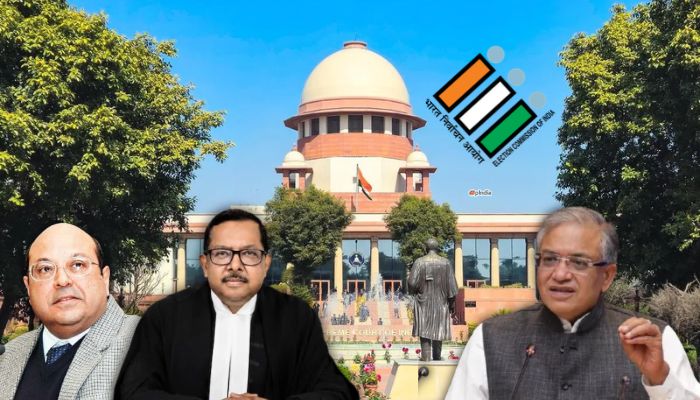
The Special Intensive Revision (SIR) of electoral rolls across the country has somehow rattled not only the Opposition parties, their unofficial media and activist B-teams, but also a few retired and sitting judges. Sitting Supreme Court judge Justice Ujjal Bhuyan and ex-judge Justice Rohinton Nariman amplified an alarmist narrative around the SIR.
The speeches of these judges landed just days before the Supreme Court hearing on 5th October, on pleas questioning Chief Election Commissioner Gyanesh Kumar’s functioning and seeking to invalidate the SIR.
Rohinton Nariman misrepresents data to claim ‘voters’ right to vote in peril
On 27th September 2026, the Hinduphobic former judge Rohinton Nariman delivered a speech titled “The Constitution and the Common Man” at Rajkot’s Rajkumar College. Nariman claimed that the right to vote, “the heart of our Constitution, the heart of our democracy,” is “at great peril”
Casting aspersions on the integrity of the Election Commission, Nariman said, “You cannot have an election commission which functions or malfunctions like this.”
Speaking about the SIR in West Bengal, Nariman claimed that 90 lakh voters were “disenfranchised”.
“In the West Bengal election, 90 lakh voters, an astounding figure, were disenfranchised. Now, 90 lakh voters getting disenfranchised didn’t somehow move the Supreme Court enough to stay this so that these 90 lakh voters were out when the Bengal election took place,” Nariman said.
He added that of those ‘disenfranchised’, “some 22 lakh voters actually filed appeals; the others have all seemed to have accepted. There must be poor people… who don’t have the wherewithal or the access to justice.”
Rohinton Nariman further claimed that of these 22 lakh voters, “some one lakh voter appeals” were decided, “93% [were] in favour of the voter. So can you imagine, this was a completely illegal knocking out of the common man… in order that a government obtains what it wants. And in West Bengal, we saw it oust the Government of the day and bring in the Government of the Centre. Now, these are very, very disturbing things that are happening in our country today.”
“Very, very disturbing things happening in our country.
90 lakh voters were disenfranchised in WB polls, this was completely illegal.”
– Rohinton Fali Nariman, former SC judge & Solicitor General of India on voter deletion in WB polls https://t.co/UP1QQ0z2II
Amidst the political attacks on CEC Gyanesh Kumar, Rohinton Nariman also called the current law placing the Election Commissioner appointments largely in the hands of the Central government of the day a “red flag”. He further urged the Supreme Court to decide the challenge to the Chief Election Commissioner and Other Election Commissioners Act quickly.
Nariman also cited the dubious Indian Express report which claimed that two Election Commissioners had objected to decisions taken by the Chief Election Commissioner, followed by what he called a “patch-up.”
Nariman gives an alarmist spin to West Bengal SIR data
While politically useful to attack the CEC and the BJP, Nariman’s claim that 90 lakh voters were outrightly “disenfranchised” is wrong. Mere initial removal from the electoral roll during SIR does not automatically mean 90 lakh voters were disenfranchised.
Deleted voters were not singled out based on their caste, religion, gender, or political leanings. Electoral rolls contain the dead, duplicates, migrants, and persons otherwise ineligible for inclusion. This is precisely why Special Intensive “Revision” is conducted.
The SIR provides for the restoration of draft deletions through claims and objections before tribunals. In fact, the distinction between draft deletion and final exclusion after the prescribed process is not a minor technicality but central to the objective of conducting SIR.
The Election Commission informed the Supreme Court earlier that the judicial officer in the West Bengal SIR adjudication ordered the deletion of 27.16 lakh names, and of these, 22.21 lakh deleted voters filed appeals seeking restoration.
The fact that 93% of roughly 1.2 lakh decided appeals succeeded does not establish that 90 lakh deletions were “completely illegal” or that SIR is a threat to electoral democracy.
Nariman relied on extrapolation from a fraction of the cases to allege that citizens were knocked out “in order that a government obtains what it wants”.
There is no evidence that there is any electoral conspiracy behind 90 lakh initial deletions or eventual restoration of thousands of names, to manipulate electoral rolls in the favour of the BJP that emerged victorious in the state assembly elections in May this year.
The West Bengal SIR process operated under Supreme Court directions that created the appellate tribunals. Apparently, Nariman’s chagrin is that the BJP won Bengal elections.
This must not be forgotten: West Bengal recorded a voter turnout of more than 93%. How is it that a state supposedly devastated by mass ‘disenfranchisement’ went on to record the highest electoral turnout in the state since independence?
In the 20 Assembly seats that recorded the highest voter deletions, TMC won 13, BJP won 6, and one seat was won by Congress. If the SIR or voter deletions were systematically designed to damage the TMC and benefit the BJP, then how did TMC dominate the highest-deletion constituencies? Clearly, data debunks ‘ECI did partisan engineering’ claims.
Electoral outcomes vary because of local candidate strength, caste and communal equations, anti-incumbency, organisational machinery, turnout behaviour, and regional political trends. Blaming SIR as the sole driver of the defeat of anti-BJP leaders or political parties is nothing but political rhetoric.
Justice Ujjal Bhuyan invokes Article 326 and Article 14 to cast aspersions on the motive of the SIR
While former judge Rohinton Nariman peddling an alarmist and conspiratorial narrative around the SIR is understood given his ideological biases against the BJP, a sitting Supreme Court judge, Justice Ujjal Bhuyan portraying voter deletions post SIR as “intrinsically arbitrary” is outrageous.
On 4th October, Justice Ujjal Bhuyan delivered the valedictory address at the 19th NALSAR-Justice B.R. Sawhne Memorial Moot Court Competition in Hyderabad.
During his address, Justice Bhuyan said that any process that ‘disenfranchises’ “millions of Indian citizens, making them ‘second-class’ citizens in their own country” by denying them the vote is “intrinsically arbitrary.”
Without explicitly naming the SIR exercise, Bhuyan invoked Article 14, which guarantees the right to equality, and Article 326, which provides for universal adult suffrage.
Justice Bhuyan said, “No amount of whataboutery can justify it. It strikes at the very heart of the Constitution, and I would go to the extent of saying that it is a negation of the constitutional order which we have adopted under the Constitution of India.”
ODD. The SC speaking through one bench and contradicting itself through another Judge?
SC Judge Justice Ujjal Bhuyan says any "process" that “disenfranchises millions” is “intrinsically arbitrary” and strikes at the heart of the Constitution.
CONTRADICTION!
WHAT IS “INTRINSICALLY ARBITRARY” ABOUT A "PROCESS" THAT THE SUPREME COURT ITSELF HAS ALREADY CLEARED?
The SC has upheld SIR, recognising the ECI’s power to undertake electoral-roll revision, subject to safeguards.
If the "process" is "ARBITRARY" then mass exclusion IS NOT AUTOMATICALLY EQUAL TO disenfranchisement. IS IT?
Bhuyan went as far as to assert that “no authority can do it; no court can condone it”.
He further said that the Indian Constitution does not provide for two classes of citizens: citizens with voting rights and citizens without voting rights.
“Except in the case of a dead voter, the name of a voter once enlisted in the electoral roll cannot be deleted without notice and hearing,” Justice Bhuyan said.
He also claimed that detaching the right to vote from citizenship is like “taking out the soul from the body.”
Justice Bhuyan linked universal adult suffrage to the basic structure.
Justice Bhuyan insinuated that other than the case of dead voters, names from electoral rolls should not be struck down and that such deletions would amount to arbitrary disenfranchisement.
However, Article 326 of the Indian Constitution provides for adult suffrage subject to disqualifications under law. Similarly, the Representation of the People Act and Election Commission rules have long authorised revision, including deletion after notice in defined cases.
Contrary to the ‘intrinsically arbitrary disenfranchisement’ framing, the ECI has informed the Supreme Court earlier that the voter names were not removed without the prescribed process.
While the question of whether logical discrepancy flags meet the standard remains sub judice, labelling large-scale revision itself as “negation of the constitutional order” regardless of grounds or remedies goes beyond what Articles 14 and 326 state.
Lakhs of voter deletions in SIR have not happened for the first time
Reports suggest that around 13 crore voter names were deleted from electoral rolls across the country after SIR in various states and UTs. While 13 crore in itself is not a small number, the sheer size of the ‘deleted’ number of names does not automatically mean eligible voters were illegally disenfranchised en masse, as Justices Rohinton Nariman and Ujjal Bhuyan are insinuating.
In fact, during the SIR exercise in 2004, in Andhra Pradesh alone, 93.4 lakh voters were deleted, bringing down the state’s voting-eligible population from 70% to 63%.
Back then, the Election Commission’s legal counsel for S.K. Mendiretta had said that, among other factors, the fact that SIR was not conducted in Andhra Pradesh for many years. In addition, he said that people moved as voters to the new place without getting their names removed from the previous roll.
Similar issues have been flagged by the ECI during the recent SIR exercise, which has been held across the country after 21 years. Yet, in 2004, nobody declared SIR a threat to democracy or cast doubts on the integrity of the then CEC.
In fact, just recently, Keralam Congress leaders Mathew Kuzhalnadan and Shashi Tharoor boasted that the SIR exercise helped the UDF win the Assembly elections, as thousands of bogus voters were weeded out.
“Of course, the SIR process also removed a lot of fake voters, which, in some constituencies at least, were managed by the CPI(M). So that also helped us,” Kuzhalnadan said as his party won 99 of the 140 seats in Keralam.
“…in Kerala, I suspect the Congress benefited from the deletions because the CPIM was long a past master of double, triple, quadruple enrollment… That used to happen. So they were eliminated by the SIR…” Tharoor said in May this year.
While SIR removing fake voters from electoral rolls helped Congress-led UDF sweep Keralam elections, nobody then alleged that the ECI or CEC Gyanesh Kumar ‘manipulated’ electoral rolls in Congress’s favour or that there was a conspiracy. Apparently, the chagrin is not SIR or voter deletions, but the victories of the BJP in states where incumbent governments are led by non-NDA parties.
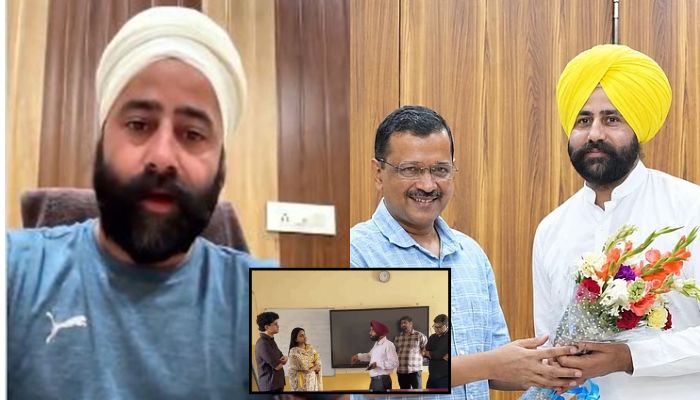
The Aam Aadmi Party (AAP) has suspended its own MLA Sukhveer Singh Maiserkhana after he publicly flagged the shortage of teachers in Punjab’s government schools, including the School of Eminence where his two children study. The MLA, who represents the Maur constituency in Bathinda, had accused the AAP leadership and the Punjab government of failing to address the shortage despite repeatedly raising the issue with the party.
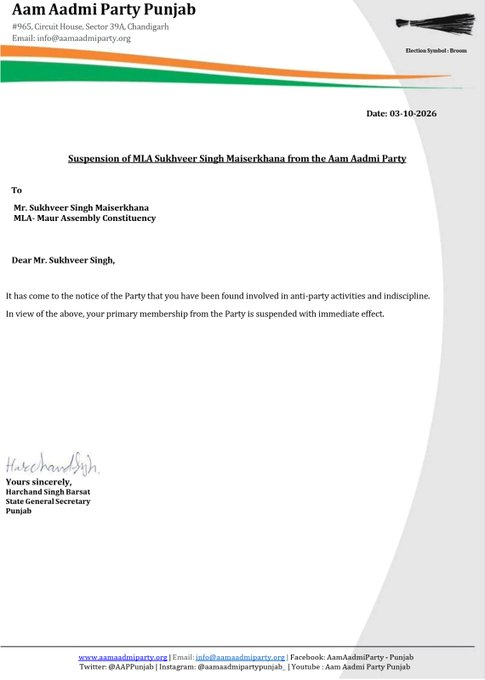
Aam Aadmi Party (AAP) has suspended Maur Assembly Constituency MLA Sukhveer Singh Maiserkhana from the party’s primary membership https://t.co/R8RDQYFZAV
Maiserkhana went live on Facebook on Saturday, 3rd October, and expressed his frustration over the lack of action. He said he had repeatedly asked the government to fill vacant teacher posts, but his complaints had not been resolved. He also challenged the AAP government’s claims about improvements in the state’s education system, saying that the reality at the ground level was different. “I am going live after feeling sad. I kept demanding the filling of teacher posts, but it has not been done yet,” the MLA said.
AAP MLA Sukhveer Singh Maiserkhana exposed his own govt:
• Teacher shortage in his Maur constituency
• Repeated complaints ignored
• CM Bhagwant Mann allegedly refused to meet him
• Claimed AAP MLAs are being sidelined & humiIiated
What happened next? AAP SUSPENDED him for “anti-party activities.”
https://t.co/T7aEiDlv5k
The issue became more personal for Maiserkhana because his own son studies at a government School of Eminence. According to the MLA, the school is also facing a shortage of teachers. He said that among the ruling party’s MLAs, he was the only one whose children studied in a government school.
The MLA also revealed that he had approached the party leadership several times but failed to get the matter resolved. He said he was told that Chief Minister Bhagwant Mann had called him, but said that the Chief Minister did not meet him. “But he did not meet me,” Maiserkhana claimed. “How long will I tolerate? What did I do wrong to the party?”
He further said that he was aware that he might not receive a party ticket for the upcoming elections, but maintained that he would continue raising issues affecting people. “I know I will not get the ticket, but I will continue to fight for the people,” he said.
Maiserkhana also expressed fear that an FIR could be registered against him. He said the school principal had even told his son to ask his father to help ensure that the school had enough teachers. “My fight is for schools. If nothing is done in schools, then what will one do with such education?” the MLA asked.
The AAP, however, did not accept the allegations as a criticism of the government that could be debated within the party. Instead, it suspended Maiserkhana with immediate effect.
AAP Punjab general secretary Harchand Singh Barsat said in the suspension letter that the MLA had been involved in “anti-party activities and indiscipline”. The letter stated that his “primary membership from the party is suspended with immediate effect”.
Teachers have been protesting over recruitment, pay and regularisation
The controversy comes at a time when the administration was simultaneously grappling with mounting unrest among educators on the ground in Punjab. Around 180 Elementary Teacher Training (ETT) teachers, accompanied by their family members, staged protests outside the residence of AAP leader Manish Sisodia in Sector 39, Chandigarh on 21st September. This followed an earlier demonstration on 22nd August, outside the residence of Punjab Finance Minister Harpal Singh Cheema, which had ended in police detentions.
Government school teachers protest outside Punjab Finance Minister Harpal Singh Cheema’s residence, demand equal pay scales. https://t.co/adSO5V01Sq
The ETT teachers and their family members have been raising demands related to recruitment, reinstatement, regularisation, pay scales and service benefits.
The dispute involving the 180 ETT teachers goes back to their recruitment in 2016 under the previous SAD-BJP government. The teachers were later dismissed over alleged irregularities and deficiencies in the recruitment process. They were subsequently reinstated following a court order.
The teachers now want the government to take action against those they hold responsible for the problems in the recruitment process. According to the protesters, a later IAS report attributed the recruitment problems to an error by a clerk in the Education Department. The teachers have alleged that the clerk manipulated the process to favour certain candidates and have demanded his suspension and action against those responsible.
The protesters have also accused the present AAP government of protecting the departmental official.
The teachers have also been demanding pay parity with other teachers recruited during the same period. They allege that they are covered under the Central 7th Pay Commission scales while other teachers recruited in the same batch receive Punjab government pay scales. According to them, this has created a substantial difference in salaries and other service benefits.
One teacher said that around 12,700 teachers are working in government schools in pre-primary, LKG, nursery and primary classes. The protesters say the AAP government had promised before coming to power that temporary and contractual employees would be regularised. They allege that after the government came to power, their remuneration was increased only to a limited extent, while the government described the move as effective regularisation.
The teachers, however, argue that the decision did not provide them with the same benefits and service conditions as regular government employees.
“We are demanding the suspension of the Education Department clerk who orchestrated such a massive scam to accommodate his own people. We are fighting for our rights,” one protester said.
The agitation has also drawn attacks from opposition parties. Shiromani Akali Dal (SAD) president Sukhbir Singh Badal accused the AAP government of turning its back on teachers and alleged that those demanding regularisation and fair pay were being met with police action instead of solutions.
BJP leader Tarun Chugh also criticised the government, saying that police action was being used against teachers seeking regularisation, fair pay and dignity.
Visuals from previous protests showed teachers being removed by police and taken away in buses. Protesters have also revealed that turbans were dislodged and women protesters’ dupattas were pulled during the police action.
Shame on AAP!
TO SAVE EDUCATION SYSTEM OF PUNJAB AAP MUST GO!
Teachers in Punjab are protesting against CM Bhagwant Mann since yesterday!
For teachers in Punjab:
– No salaries
– No appointmemt
Rather than listening to them , CM Bhagwant Mann and Super CM Kejriwal ordered women teachers to be beaten up by lathis!
Where is " B team of Kejriwal"!
— Pradeep Bhandari(प्रदीप भंडारी)🇮🇳 (@pradip103) October 3, 2026
CJP’s Punjab school PR and the ground reality
Recently, a team led by Cockroach Janta Party’s co-convenor, Saurav Das, visited a few selected institutions in Punjab, including a government School of Eminence, a senior secondary school, and a primary school in Ludhiana, as part of their so-called “School Thik Karo” campaign. After visiting AAP-ruled Punjab, instead of highlighting the ground realities, the team appeared to focus on PR of the state’s government schools, suggesting that everything was functioning perfectly.
Their focus was limited to a tiny fraction of the state’s educational landscape, specifically visiting institutions like Ludhiana’s School of Eminence, which represents only a single exemplary showcase out of roughly 19,000 government schools across the state.
The cherry-picking of premier facilities by CJP’s Saurav Das obscures the harsh ground-level realities faced by everyday students and teachers. The severe shortage of teaching staff across regular schools, the grievances of protesting educators, and the suspension of its own MLA after he flagged the issue, despite his own child studying in an understaffed government school, highlight a deep chasm between political narratives and the actual state of public education in Punjab.
In a major breakthrough, India has successfully demonstrated its first free‑space Quantum Key Distribution (QKD) link at a scale of 5.56 km. QNu Labs collaborated with Bhaskaracharya National Institute for Space Applications and Geo‑informatics (BISAG‑N) and IIT Gandhinagar to achieve this remarkable feat during the field test on the night of 27-28 September 2026 between the BISAG and IIT Gandhinagar sites.
Using QNu’s Pointing, Acquisition and Tracking (PAT) system and its Armos QKD device, the link held a stable Quantum Bit Error Rate (QBER) below 5% and generated secure keys at 230–260 bits per second.
Those keys were fed into BISAG‑N’s post‑quantum cryptography-enabled Vedic Kavach platform, enabling successful end‑to‑end encryption and decryption of test messages, the Ministry of Electronics stated.
The setup couples a hardware quantum channel, Armos over free-space optics, with a software post-quantum layer, so security can continue despite a temporary drop in the optical link.
What a free-space Quantum Key Distribution linkmeans
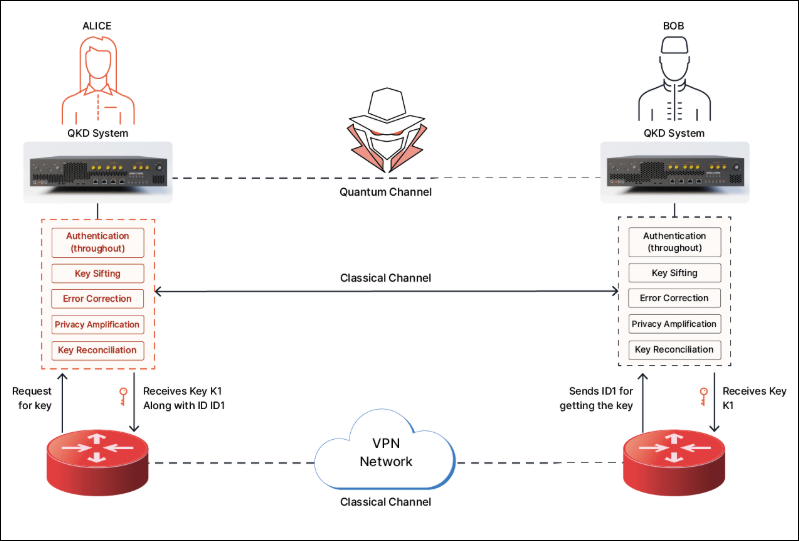
Quantum Key Distribution (QKD) allows two parties to share secret encryption keys whose security rests on quantum mechanics rather than computational hardness.
Under typical prepare-and-measure protocols like BB84, single photons are encoded in polarisation or phase. Attempts to copy or measure them disturb the quantum state; the consequent surge in error rate or Quantum Bit Error Rate (QBER) reveals the eavesdropper. After a clean key is distilled, it is normally utilised with conventional symmetric encryption like Advanced Encryption Standard for the actual data.
In current times, most operational QKD travels via optical fibre. Free-space QKD transmits the same quantum signals as a narrow optical beam through the open atmosphere, removing the need for a fibre span but introducing alignment, turbulence, absorption, and background-light problems.
Source: QNu Labs website
The transmitter and receiver are locked by the PAT system to ensure that the faint photon stream remains coupled.
The timing of QNu’s QKD trial is interesting. The trial was conducted at night, when solar background is lowest, which is a significant practical constraint for atmospheric links.
It is notable that the reported key rate is the rate at which usable secret key material is produced and not the speed of the encrypted messages themselves.
Standard error-correction and privacy-amplification steps can still extract a secure key if the QBER is below 5%.
From fibre QKD to free-space QKD: Why it matters
In India, Fibre Quantum Key Distribution (QKD) is already being demonstrated over long terrestrial distances, including a reported 1,000 km quantum-secure network earlier in 2026 under the National Quantum Mission. It was free-space QKD that remained a missing piece for links that cannot be cabled, including building-to-building urban hops, mobile nodes, and most strategically significant ground-to-satellite and inter-satellite segments.
For intercontinental quantum-secure key exchange, satellite QKD is the practical route given fibre loss restricts trusted-node or pure quantum links to a few hundred kilometers sans repeaters.
China’s Micius satellite and similar European programmes have already demonstrated space-to-ground QKD; India’s National Quantum Mission ambitiously targets secure quantum communications over 2,000 km, including satellite segments.
A stable multi-kilometre atmospheric link with indigenous hardware and tracking is an essential engineering stepping stone toward the coveted ground stations and terminals.
The dual-layer design, which includes QKD keys, post-quantum cryptography, and quantum random numbers, also indicates a realistic security posture, wherein QKD identifies eavesdropping on the key-exchange channel, while post-quantum algorithms shield against future large-scale quantum computers that could break today’s public-key systems (RSA, elliptic-curve) through Shor’s algorithm.
Notably, Shor’s algorithm is a quantum computer program that detects the prime factors of a large number in polynomial time.
The following are the areas where QKD is applicable
Transition to unconditionally secure symmetric key generation
Data Centre (DC) to Data Recovery (DR) Data Transfers
Quantum security for critical infrastructure
5G backhaul using QKD Network
End-to-End Encryption
How the Modi government is facilitating India’s rise in quantum technologies
The Modi government at the Centre has, over the years, taken serious measures to scale up research and development concerning quantum technology.
In the Budget 2020 speech, Finance Minister Nirmala Sitharaman made a significant announcement for Indian science, stating that, over the next five years, she proposed spending ₹8,000 crore on a National Mission on Quantum Technologies and Applications.
In 2019, India initiated QuEST (Quantum-Enabled Science & Technology), with an investment of Rs 80 crore (around $11 million) over the next 3 years to develop quantum technology.
In April 2023, the Central government approved the National Quantum Mission (NQM) with a budget of Rs 6003.65 crore. The mission will span from 2023–24 to 2030–31.
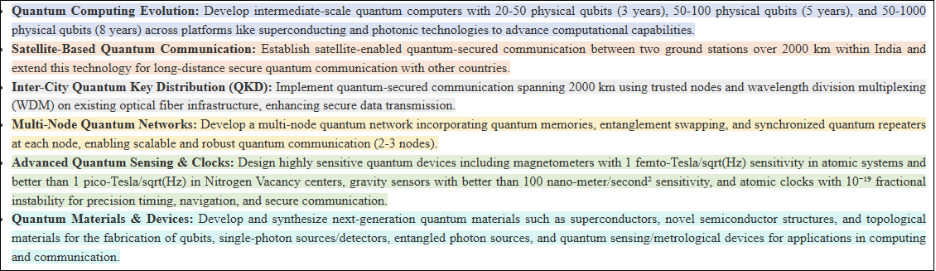
The MQM aims at developing intermediate scale quantum computers with 50-1000 physical qubits in 8 years in various platforms like superconducting and photonic technology. Satellite-based secure quantum communications between ground stations over a range of 2000 kilometres within India, long-distance secure quantum communications with other countries, inter-city quantum key distribution over 2000 km, as well as a multi-node Quantum network with quantum memories are also some of the deliverables of the Mission.
Its key objectives also include development of magnetometers with high sensitivity in atomic systems and Atomic Clocks for precision timing, communications, and navigation. It will also support the design and synthesis of quantum materials such as superconductors, novel semiconductor structures, and topological materials for fabrication of quantum devices. Single-photon sources/detectors and entangled photon sources will also be developed for quantum communications, sensing, and metrological applications.
Development of the following are NQM’s core objectives:
Quantum Computing Evolution
Satellite-Based Quantum Communication
Inter-City Quantum Key Distribution (QKD)
Multi-Node Quantum Networks
Advanced Quantum Sensing & Clocks
Quantum Materials & Devices
In addition to NQM, the Modi government also announced plans to set up four Theintic Hubs (T-Hofbs) in top academic and National R&D institutes on the domains of QuantumComputing, Quantum Communication, Quantum Sensing & Metrology and Quantum Materials & Devices.
In November 2025, one of the startups supported under the NQM of the Department of Science and Technology (DST) successfully demonstrated India’s first extensive Quantum Key Distribution (QKD) network, spanning over 500 kilometers and deployed over existing optical fiber infrastructure.
Interestingly, this breakthrough was also achieved by QNu Labs with the Indian Army and its Southern Command contributing significantly to the capability demonstration.
Development of Quantum Technologies in the Indian military domain
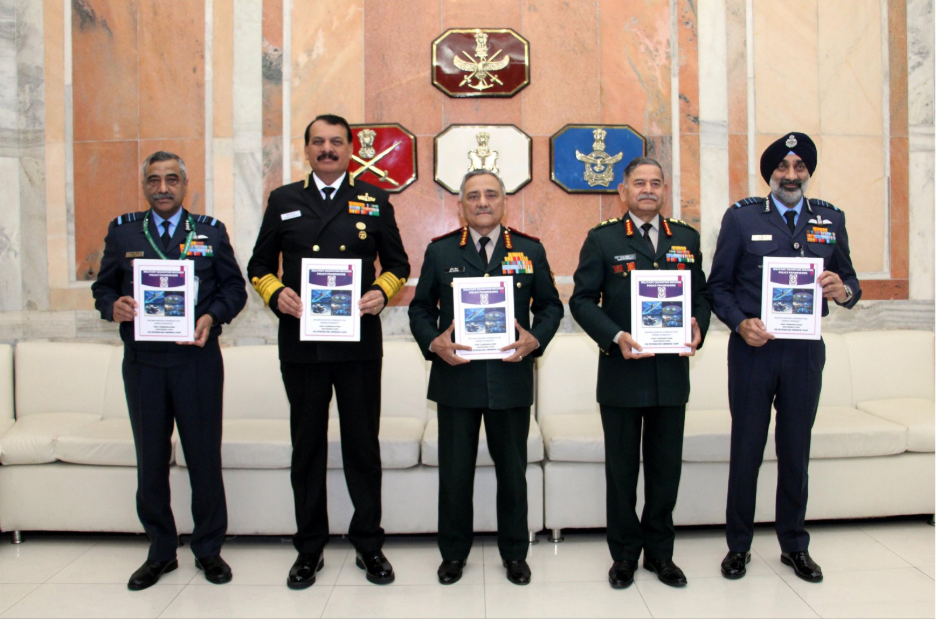
To advance the development of Quantum technologies in the Indian military domain, India’s then Chief of Defence Staff Anil Chauhan released the Military Quantum Mission Policy Framework on 22nd January 2026. This framework document includes the policy and the roadmap to implement Quantum Technologies in the Armed Forces.
The MQMPF aims to integrate the four pillars of Quantum technologies, Quantum Communication, Quantum Computing, Quantum Sensing & Metrology and Quantum Materials and Devices – into the Tri-Services to empower to prepare for the future battlefield and to achieve technological dominance in the rapidly evolving world.
Before this, in March 2025, the Indian Army and Navy procured indigenously developed QKD solutions and announced quantum-safe communication capabilities.
In July 2026, the Defence Research and Development Organisation (DRDO) announced the successful conclusion of military field trials for a scalable, fibre-based QKD system in collaboration with the Bengaluru-based startup Taqbit Labs.
Moreover, the DRDO has backed a Young Scientists’ Laboratory for Quantum Technologies, which has focused on system- and prototype-level demonstration projects across multiple quantum application fields, which include superconducting quantum computing, atomic magnetometers under sensing, and quantum random number generators under communication.
Conclusion
Previous international experiences demonstrate that pivoting from a few-kilometre night-time trial to operational satellite QKD demands larger apertures, better adaptive optics, higher-efficiency detectors, and extensive link-budget validation. Overall, while it is true that India has a long way to go in the arena of Quantum technologies, the country is headed in the right direction.
On Sunday, 4th October, the Congress government in Keralam has ordered a fresh Vigilance and Anti-Corruption Bureau (VACB) probe into a 2006 case linked to Chief Election Commissioner Gyanesh Kumar, who was serving as the state’s Public Works Department (PWD) secretary at the time. Keralam Home Minister Ramesh Chennithala directed Vigilance Director Manoj Abraham to conduct a detailed inquiry into allegations of irregularities and possible external influence in the earlier investigation. The move comes amid a wider political controversy surrounding Kumar and after a complaint by Congress leader Malayinkeezhu Venugopal.
Keralam Home Minister Chennithala orders Vigilance probe against Gyanesh Kumar over 2006 case https://t.co/SQMfqaUVcw
Congress government revives 2006 case against Gyanesh Kumar
The Congress-led UDF government’s decision comes after senior CPI(M) leader and former Kerala Finance Minister T M Thomas Isaac revived unfounded allegations surrounding Kumar’s tenure as PWD secretary nearly two decades ago. Isaac recently recalled the controversy in a social media post, bringing back into focus the suicide of Malaysian civil engineer Lee See Been, who was associated with the PATI-BEL consortium working on a major road project in Kerala.
The case is connected to the Kerala State Transport Project (KSTP), under which PATI-BEL was involved in upgrading the MC Road between Angamaly and Thiruvananthapuram. Lee, who was the chief project manager associated with the consortium, died by suicide in Malaysia in 2006 after returning from Kerala. Reports from the time suggest that his suicide notes referred to difficulties involving government officials, corruption allegations and delays in payments.
Gynaesh Kumar was the PwD secretary at that time but his name was not mentioned. Senior Indian Union Muslim League leader M K Muneer, the PWD minister from 2001 to 2006, stated, “It was being said that the engineer had left behind a suicide note. Nobody had seen it and what it contained. We do not know what he had written.”
The Kerala Home Department has now sought the files related to the preliminary Vigilance inquiry conducted in 2006. The fresh investigation will examine not only the original allegations but also claims that the earlier inquiry was derailed or discontinued because of external pressure. Chennithala said the allegation of outside influence was serious enough to require a detailed examination.
“I am convinced that a detailed Vigilance inquiry is essential,” Chennithala said after examining Venugopal’s complaint. He added that he had discussed the matter with Chief Minister V D Satheesan before directing the Vigilance Director to take lawful action.
The Home Department has already called for all files concerning the original 2006 VACB preliminary inquiry, with the minister stressing that allegations of external influence back then are serious and require deep scrutiny.
CPI (M) Thomas Isaac revives decades-old allegations
This fresh probe started after CPI(M) leader and former Kerala Finance Minister T.M. Thomas Isaac revived long-standing allegations of corruption and controversy surrounding Gyanesh Kumar’s stint as the PWD secretary. Taking to social media, Isaac shared a Facebook post claiming that Kumar’s name had allegedly appeared in the suicide note of a Malaysian company official connected to a major road construction contract in Kerala.
This renewed push by the opposition leader directly triggered the media reports and subsequent action by the ruling Congress government in Kerala. The Home Department noted that the fresh probe was specifically initiated following claims that the preliminary investigation conducted way back in 2006 was derailed or suppressed due to external pressure and political interference.
The hypocrisy of a long-silent opposition
What makes this sudden revival fascinating is the glaring political convenience behind it. The CPI(M) leader who is now aggressively pushing this two-decade-old case, T.M. Thomas Isaac, was himself serving as the Finance Minister of Kerala when the incident originally took place in 2006. Back then, his own party was ruling the state, and Isaac held immense power and authority to order a thorough probe into the matter.
Yet, during his tenure in power, he did nothing and completely ignored the issue. He chose to stay silent while his party was at the helm, and only now, nearly twenty years later, has he recalled the case for political benefits. The ruling Congress party in Kerala jumped into action and announced the probe following an Indian Express report that put CEC Gyanesh Kumar right at the centre of the controversy, creating a charged environment where old controversies are being weaponised.
Inside the 2006 KSTP case: Financial squeeze and tragic suicide
The 2006 KSTP suicide case was largely the result of administrative failures and financial withholding by the government of the day. The case stems from the tragic suicide of Lee See Been, the former Chief Project Manager of PATI-BEL, an Indo-Malaysian joint venture tasked with executing the Kerala State Transport Project (KSTP) for reconstructing the Main Central (MC) Road. The consortium held a contract worth ₹215 crore to upgrade a 127-kilometre stretch. While work was supposed to finish by December 2005, delays pushed the deadline to May 2006. When the project remained incomplete, the then ruling LDF government withheld bills totalling ₹17 crore, leaving the contractors unable to clear dues worth ₹12.5 crore to various agencies.
Lee fell into deep depression after the government withheld funds and the company refused to pay compensation for the administration’s failure to acquire and hand over land on time. Distressed, Lee returned to his hometown of Kuala Lumpur, where he was tragically found hanging beneath an iron bridge near a lake at Subang Ria Park. Reports indicated his suicide note mentioned rampant corruption and high-ranking officials demanding bribes. There is no proof that name of Gyanesh Kumar was mentioned. Lee had previously told colleagues about pressure from top bureaucrats.
Thomas Isaac’s own legal troubles in the Masala Bond case
While Dr T.M. Thomas Isaac tries to point fingers at past officials, he is currently battling serious legal and financial allegations of his own. The Enforcement Directorate (ED) has heavily implicated him in the infamous KIIFB Masala Bond case. In a show-cause notice issued under the Foreign Exchange Management Act (FEMA), the ED accused top Kerala figures, including Chief Minister Pinarayi Vijayan and former Finance Minister Thomas Isaac, of forex violations amounting to a staggering ₹466 crore.
The federal agency noted that Vijayan chaired meetings that approved purchasing land from foreign-borrowed funds against RBI rules, while Isaac was directly involved in executive committee meetings that diverted bond proceeds for land acquisition.
Despite the gravity of these charges, Isaac has dismissed the federal action completely. Defending himself, Thomas Isaac remarked, “This is nonsense. We never used the fund for purchasing land. Land acquisition for KIIFB projects was conducted strictly in accordance with norms. The ED notice is part of an election stunt.” Nevertheless, his attempts to dodge accountability, including skipping multiple ED summons and approaching the Kerala High Court, highlight the deep irony of him raising questions about past administrative integrity.
So-called political rivals join hands to revive an old controversy involving Gyanesh Kumar
Ultimately, the sudden resurrection of this decades-old case reveals a classic tale of political posturing and convenience. So-called political rivals are ganging up and bringing up an incident from twenty years ago involving CEC Gyanesh Kumar purely for short-term political benefits. When Thomas Isaac actually held supreme financial power in the state during his party’s tenure, he completely ignored the case and chose not to open any investigation, recognising that it pointed toward systemic failures and major corruption happening right under his government’s watch.
The fact that the issue involved multiple officials of that era, not just Gyanesh Kumar, was conveniently swept under the rug when the CPI(M) was in power. Now, with political alignments shifting and CEC Gyanesh Kumar already at the centre of controversy, both parties, despite claiming to be political rivals, have joined hands to bring the matter back into focus. Leaders from both sides are using the historical controversy as a convenient tool to settle scores, while disregarding their own past inaction and legal controversies.
Apple has removed Bitchat, the offline messaging application developed by Twitter (now X) co-founder Jack Dorsey, from the India App Store following a request from the Ministry of Electronics and Information Technology (MeitY). Dorsey announced the removal in a post on X on Saturday, 3rd October.
“Government of India officially removes Bitchat from the App Store,” Dorsey wrote, sharing a screenshot of a notice from Apple’s App Review team.
According to the notice, Apple said the application would be removed from the India App Store “per demand from the Ministry of Electronics and Information Technology (MeitY)” because it contained content that was illegal in India and did not meet Apple’s App Review Guidelines.
The notice said apps available in a country must follow the laws applicable in that country. It also said developers are responsible for understanding and complying with the local laws.
The removal was carried out under Section 69(A) of the Information Technology Act, 2000, according to Dorsey’s post. Apple also said the developer could approach MeitY for information about the removal and the legal requirements involved.
BitChat has not been removed from App Stores in other territories selected by the developer. Apple also said its TestFlight version would not be available for testing in India and that public TestFlight links would no longer work in the country.
CJP supporters link Bitchat removal to protests
The removal has triggered a strong reaction from supporters of the Cockroach Janta Party (CJP), who have connected the government action with the protests which took place at Jantar Mantar in New Delhi.
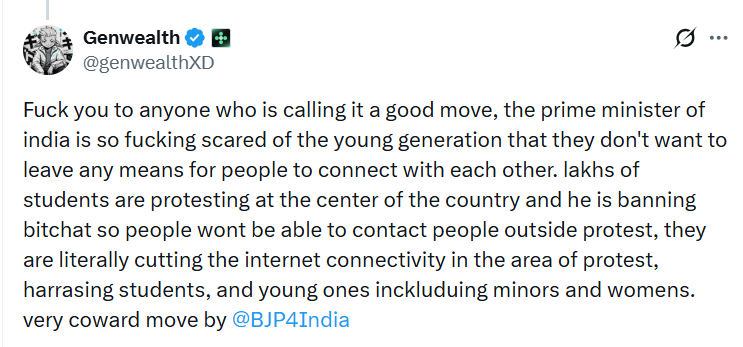
A CJP supporter criticised the move and accused the government of trying to prevent protesters from communicating with people outside the protest area.
“Fu*k you to anyone who is calling it a good move. The Prime Minister of India is so fucking scared of the young generation that they don’t want to leave any means for people to connect with each other. Lakhs of students are protesting at the centre of the country, and he is banning BitChat so people won’t be able to contact people outside the protest; they are literally cutting the internet connectivity in the area of protest, harassing students and young ones, including minors and women. Very cowardly move,” the X user wrote.
Meanwhile, Congress leader Priyank Kharge wrote, “Bitchat access removed in India after Centre’s demand. First, the Narendra Modi government shuts down the internet around Jantar Mantar. Then, when protesters turn to an offline Bluetooth messaging app, the Modi government moves against that too. When citizens keep finding ways to communicate, the government keeps finding ways to silence them. Democracy cannot not run on shutdowns, secrecy and censorship.”
Bitchat access removed in India after Centre’s demand.
First, the Narendra Modi government shuts down the internet around Jantar Mantar.
Then, when protesters turn to an offline Bluetooth messaging app, the Modi government moves against that too.
When citizens keep finding ways to communicate, the government keeps finding ways to silence them.
Democracy cannot not run on shutdowns, secrecy and censorship.
— Priyank Kharge / ಪ್ರಿಯಾಂಕ್ ಖರ್ಗೆ (@PriyankKharge) October 4, 2026
The reaction is linked to Bitchat, which was used by protesters when mobile networks stopped working during the CJP protests. BitChat’s ability to work without the internet. Because the application communicates through Bluetooth, it can continue to function even when mobile internet services are restricted.
Bitchat use during CJP protests
The Bitchat app was used at the Cockroach Janta Party protests at Jantar Mantar in New Delhi, where mobile internet has been suspended multiple times in recent days along with the reported deployment of signal jammers. When mobile networks stopped working after the CJP protests turned violent, the protestors switched to the Bluetooth mesh application to stay connected. This made the blocking of internet services useless, as protest organisers were still able to broadcast messages using the app.
The government had ordered GitHub to remove BitChat in July
On July 23, 2026, the Indian Cybercrime Coordination Centre (I4C), under the Ministry of Home Affairs, directed GitHub to remove and disable access to three repositories linked to BitChat within three hours. The repositories contained the app’s main source code, its Android application, and release files.
The order was issued after Bitchat was found to be used during the CJP protests at Jantar Mantar, where temporary internet restrictions had been imposed.
The July notice was issued under Section 79(3)(b) of the Information Technology Act, 2000, read with Rule 3(1)(d) of the Information Technology (Intermediary Guidelines and Digital Media Ethics Code) Rules, 2021. The government warned that failure to comply could result in GitHub losing its safe-harbour protection and facing possible criminal prosecution.
At the time, Dorsey had said on X that the Government of India did not like technologies such as BitChat and wanted the application taken down.
The I4C said the app’s ability to function during network restrictions created a risk of misuse by anti-national elements, terrorist organisations, organised criminal groups and cybercriminals seeking to avoid lawful detection and continue communication despite restrictions.
The notice also cited concerns over unlawful assemblies, violent protests, misinformation, radicalisation and criminal conspiracies. It said the app’s decentralised design could make lawful interception, identification and investigation difficult because there was no central service provider from which agencies could obtain subscriber information or communication records.
The notice referred to Sections 43, 84B and 84C of the IT Act, along with Section 61 read with Sections 196 and 197.
How does Bitchat work?
BitChat is a free and open-source decentralised messaging application developed by Jack Dorsey. Unlike regular messaging apps, it does not depend on mobile networks, Wi-Fi, the internet, or a central server.
The app uses Bluetooth Low Energy (BLE) to connect nearby smartphones. Users do not need 4G or 5G connectivity to send messages.
Its system works like a chain. A phone sends a message to nearby phones running Bitchat, and those devices can pass the message to other nearby users. In a crowded area, several phones can therefore form a Bluetooth mesh network and extend communication across a larger gathering.
The app is designed for situations where mobile networks or internet services may not be available. Its ability to continue communication without internet access is also why it has been used during large protests and other gatherings where connectivity is restricted.
Government cites security concerns
The government’s action against Bitchat has been based on security and law-enforcement concerns over its decentralised design and ability to work during internet restrictions.
The July I4C notice said such platforms could be misused to coordinate unlawful assemblies, violent protests and other criminal activities, while also making it harder for agencies to identify users or obtain communication records.
The government’s stated position is that the action against the Bitchat messaging application was taken for security and law-enforcement reasons, and not to suppress dissent or simply prevent people from communicating. The focus, according to the notices, was on preventing the technology from being used to bypass lawful restrictions and evade detection during situations involving public disorder, riots, terrorism, organised crime ,or other security concerns.
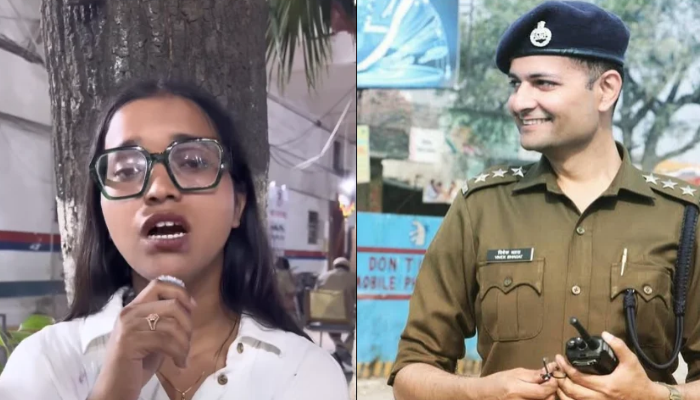
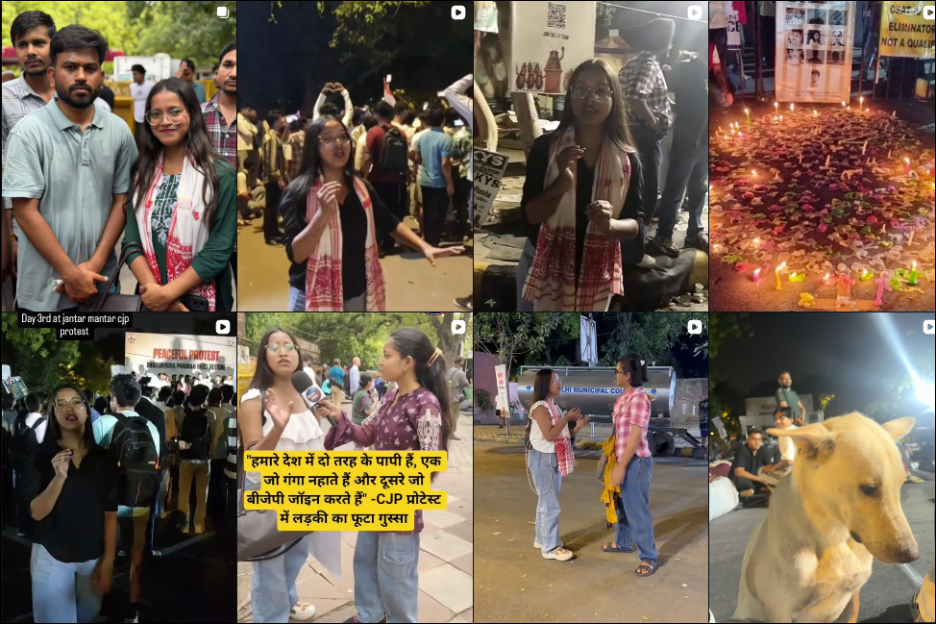
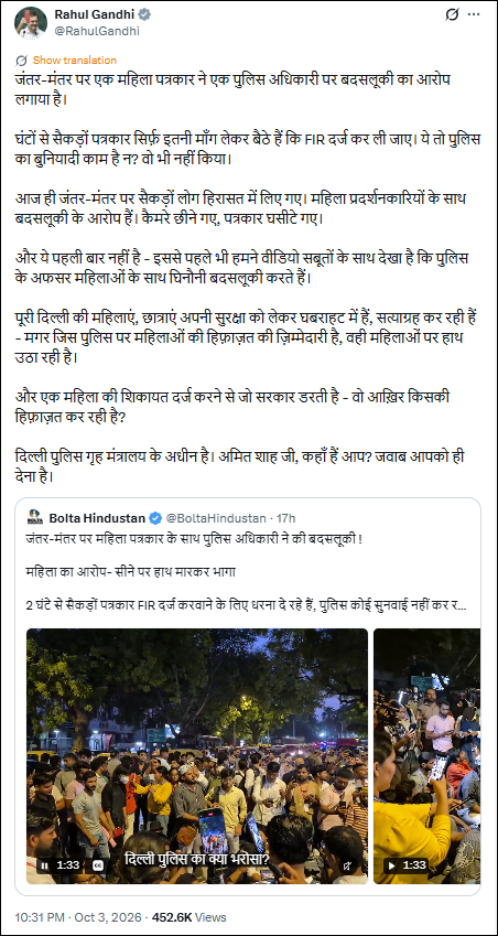
Sexual harassment allegations have been levelled at an ongoing protest at Delhi’s Jantar Mantar to seek the resignation of Chief Election Commissioner Gyanesh Kumar over the Special Intensive Revision (SIR) of electoral rolls. Rosy, an Instagram influencer and Cockroach Janta Party (CJP) supporter masquerading as an ‘independent journalist’, has accused Delhi Police ACP Vivek Bhagat of molesting her while she was covering the detention of AISA activist Neha Bora on 3rd October.
CJP worker posing as independent journalist Rosy accuses ACP Vivek Bhagat of sexual assault
Rosy, the CJP supporter posing as an ‘independent journalist’, claimed in a video recorded outside the police station that she was filming the detention of leftist activist Neha Bora when ACP Vivek Bhagat “groped” her, hit her on the chest and “squeezed her breast” before pushing her.
In the video, Rosy claimed that on 3rd October she had already spent over three hours at Parliament Street police station without an FIR being registered.
Sharing Rosy’s video on X, CJP founder Abhijeet Dipke said that ACP Vivek Bhagat “must be arrested immediately!”
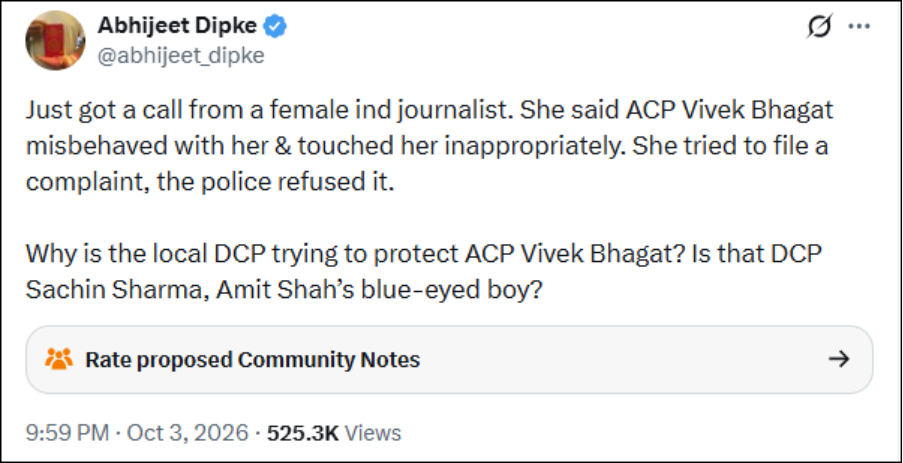
In another X post published on 3rd October, Dipke described ACP Bhagat as “Amit Shah’s blue-eyed boy”.
“Just got a call from a female ind journalist. She said ACP Vivek Bhagat misbehaved with her & touched her inappropriately. She tried to file a complaint, the police refused it. Why is the local DCP trying to protect ACP Vivek Bhagat? Is that DCP Sachin Sharma, Amit Shah’s blue-eyed boy?” Dipke wrote.
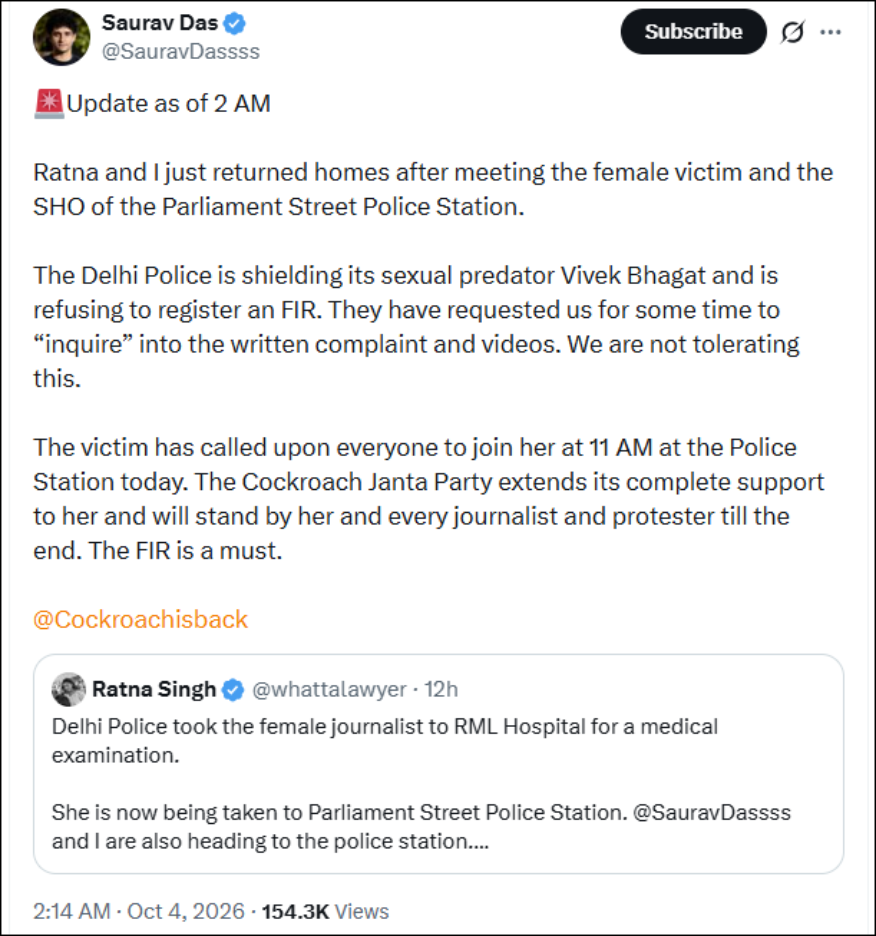
Meanwhile, CJP co-convenor Saurav Das labelled ACP Vivek Bhagat as an outright “sexual predator” and claimed that the Delhi Police were reluctant to register an FIR against Bhagat.
“Ratna and I just returned homes after meeting the female victim and the SHO of the Parliament Street Police Station. The Delhi Police is shielding its sexual predator Vivek Bhagat and is refusing to register an FIR. They have requested us for some time to “inquire” into the written complaint and videos. We are not tolerating this. The victim has called upon everyone to join her at 11 AM at the Police Station today. The Cockroach Janta Party extends its complete support to her and will stand by her and every journalist and protester till the end. The FIR is a must,” he wrote.
Press Club of India issues statement backing CJP supporter Rosy who pretended to be an ‘independent journalist’, seeks action against Delhi Police officials
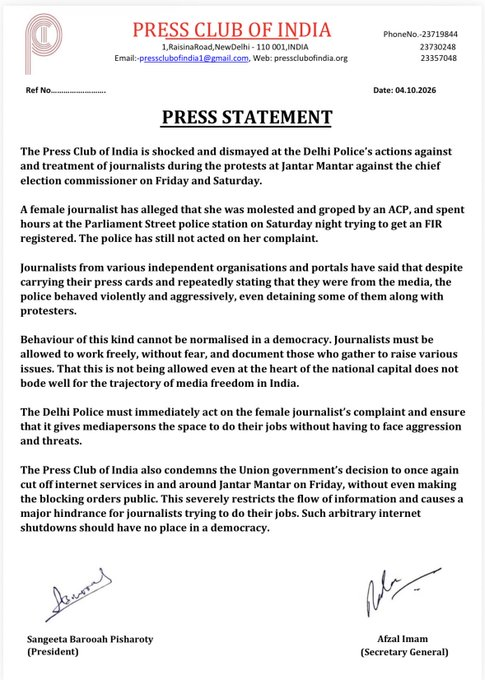
On 4th October, the Press Club of India jumped in support of CJP supporter Rosy. The PCI called her an ‘independent journalist’ and urged the Delhi Police to act on the complaints lodged by female journalists who were allegedly molested during the protest.
“The Press Club of India is shocked and dismayed at the Delhi Police’s actions against and treatment of journalists during the protests at Jantar Mantar against the chief election commissioner on Friday and Saturday. A female journalist has alleged that she was molested and groped by an ACP, and spent hours at the Parliament Street police station on Saturday night trying to get an FIR registered. The police has still not acted on her complaint,” it stated.
“Journalists from various independent organisations and portals have said that despite carrying their press cards and repeatedly stating that they were from the media, the police behaved violently and aggressively, even detaining some of them along with protesters…The Delhi Police must immediately act on the female journalist’s complaint and ensure that it gives media persons the space to do their jobs without having to face aggression and threats,” the PCI added.
Delhi Police says it has received three complaints, and the Crime Branch will conduct an impartial enquiry
In an X post published on Sunday morning, the Delhi Police confirmed that it has received sexual harassment complaints from three female journalists. The police added that these complaints have been transferred to the Crime Branch to ensure an impartial investigation.
“On 03-10-26, during the protest in New Delhi area, while being in law and order situation, allegations of sexual harassment were made by three female journalists against police officers. New Delhi District has received their complaints and the same are transferred to Crime Branch for fair and impartial enquiry,” the Delhi Police stated.
Although Rosy’s allegations against ACP Vivek Bhagat remain subject to police investigation, netizens are raising questions over the contrast between her claims and the videos related to the incident.
So far, several videos related to the confrontation between Rosy, the protestors, and the police officials, including ACP Vivek Bhagat, have surfaced online.
None of the videos shared online so far show ACP Bhagat touching Rosy or any other female protestor inappropriately.
In fact, some videos show the protestors pushing and heckling on-duty female cops. When the police asked her and other protestors to move back, it was only when they refused to comply that the police had to move them back. However, despite the videos, which have emerged online so far, not showing any act of molestation or sexual harassment, Rosy began complaining that ACP Vivek Bhagat squeezed her breast.
Another video shows the protestors, including Rosy, pushing female cops.
Calling out the CJP supporter masquerading as an independent journalist, one X user wrote, “The girl is pushing the Female cops on duty. They provoke people to the limits and when they gets pushed back.. They put serious allegations against you.. That’s their way of Working!! No proofs, Just Shout and Suspend ACP, DCPs.”
The girl is pushing the Female cops on duty.
They provoke people to the limits and when they gets pushed back..
They put serious allegations against you..
That’s their way of Working!! No proofs, Just Shout and Suspend ACP, DCPs. https://t.co/fwNOCUbiuV
There are many unanswered questions about this entire episode. Was Rosy holding a valid government press card? Why is she claiming to be an unaffiliated independent journalist when her social media presence indicates that she is linked with the CJP and is an anti-BJP influencer? Is pushing and heckling female cops allowed in the name of ‘protest’ or just because someone has a ‘press card’, a camera, and a mic?
A major question is also that despite several videos with multiple camera angles related to the confrontation between Rosy, protestors, and the police surfacing online, why is it that none of them show ACP Vivek Bhagat groping Rosy or corroborate her claims?
With a press card, the ‘media’ title and the ‘independent journalist’ label become a shield and simultaneously a weapon to dominate, push and shove the on-duty police officials, level apparently coordinated or retaliatory allegations, and emerge as a ‘hero’ among the ideological echo chambers?
ACP Vivek Bhagat was nearly mob lynched during the CJP protests in July
It must be recalled that several CJP supporters were identifying police officials who were on duty during the violent CJP agitation in July this year. ACP Vivek Bhagat has been on the radar of the so-called ‘student protestors’ since then.
In fact, ACP Vivek Bhagat was nearly lynched by a mob of CJP supporters during the July protest. The videos of the incident showed CJP supporters gheraoing and assaulting ACP Vivek Bhagat while two men shielded him from further blows.
They will do anything to create a fake emotional narrative to bring charged up zombies on the roads.
There are 100s of cameras during altercations, please bring proof to validate your claims.
Btw, these people tried to lynch ACP Bhagat in the past also, look at this report. https://t.co/3EUNBm4dWu
#WATCH | Delhi: ACP Vivek Bhagat says, "Yesterday, I was on duty in sector one zone one which includes the main Jantar Mantar area. I was on duty during the day and I had evening shift as well, so during the evening shift, I was going to report from Regal building which is Connaught Place, via Sansad Marg, at the red light of Tolstoy and Sansad Marg. I had a staff of five or six who were walking ahead and with me was an ACP probationer Rohit and my operator Navneet. So as we were walking ahead, we realized that water bottles were being thrown at the staff in front and hooting and anti-social slogans were being raised against the police. So as soon as our police staff moved back and forth a little there, some of them moved forward to save their lives and one of them was overpowered by the crowd. Blood was coming out of his head. His entire face was covered in blood, so I tried to intervene to rescue him from there. We even brought him a meter or two forward, but the crowd was so huge and violent. They even overpowered me. The crowd was so violent. Police officers were specifically targeted, isolating them and attacking them…"
Rosy is an active CJP worker, not an independent journalist
Contrary to the claims made by Rosy, CJP leaders, and the extended Leftist cabal that she is an ‘independent journalist’ who was simply covering the Jantar Mantar protests, Rosy is an active CJP supporter and worker.
Rosy is an Instagram influencer, with over 61,000 followers. Rosy’s Instagram is replete with posts amplifying Leftist and pro-CJP propaganda.
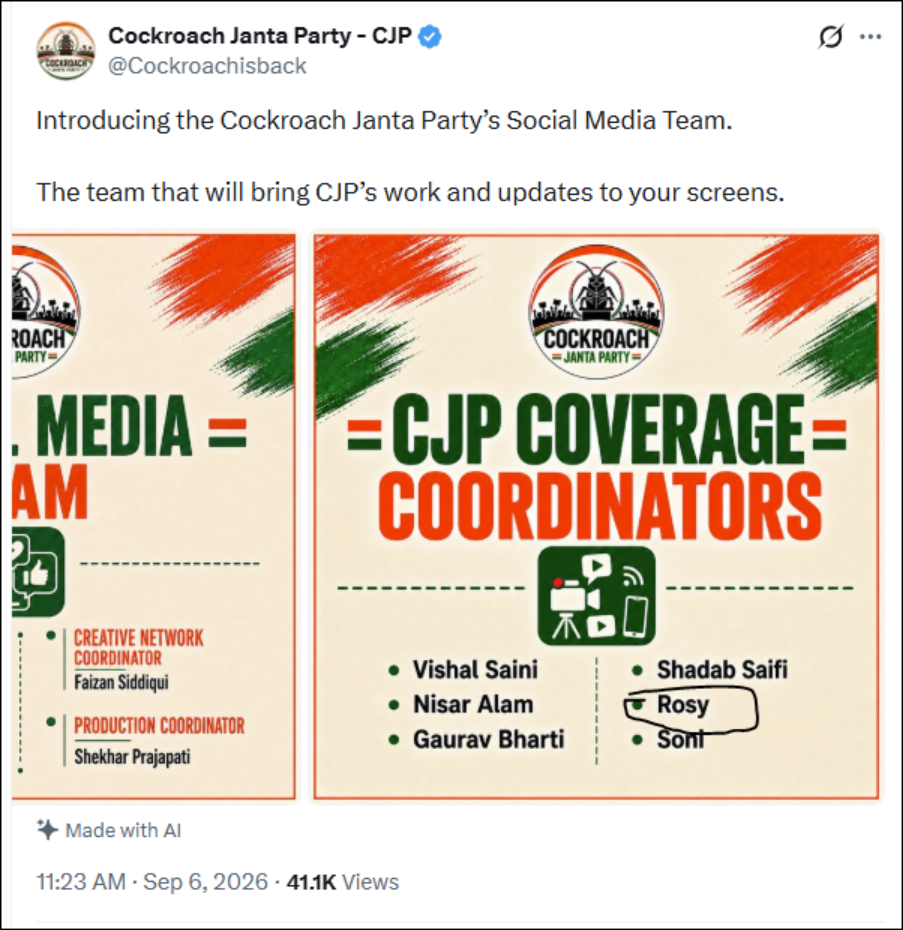
In an X post published on 6th September, the CJP introduced its social media team. Rosy was among the CJP’s coverage coordinators, clearly indicating that she is neither independent nor a journalist; rather, she is a pro-CJP vlogger or influencer at best.
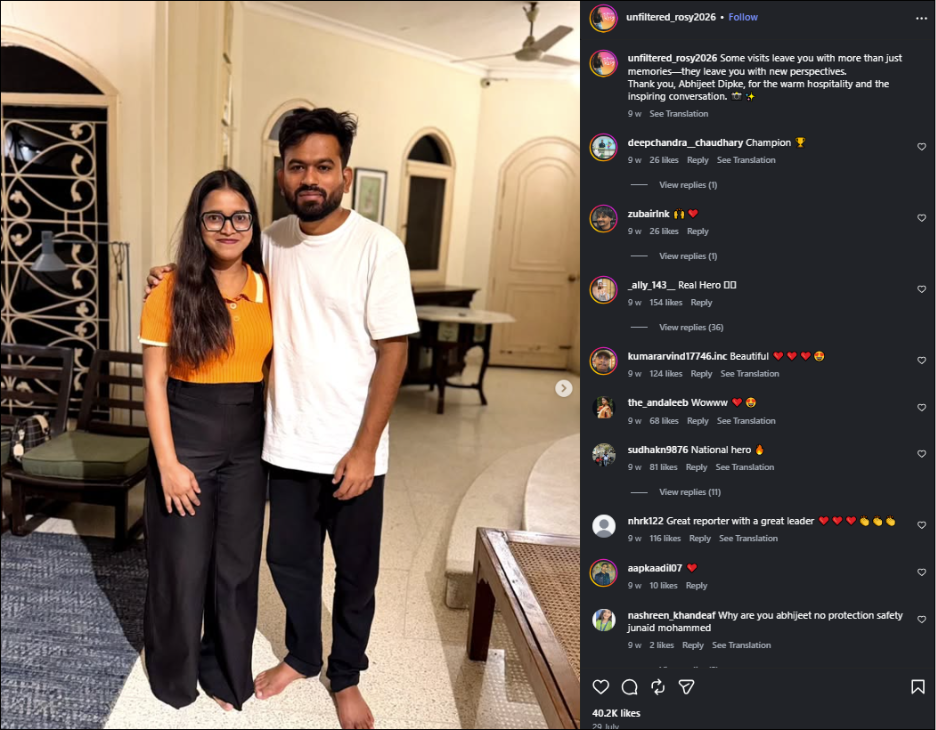
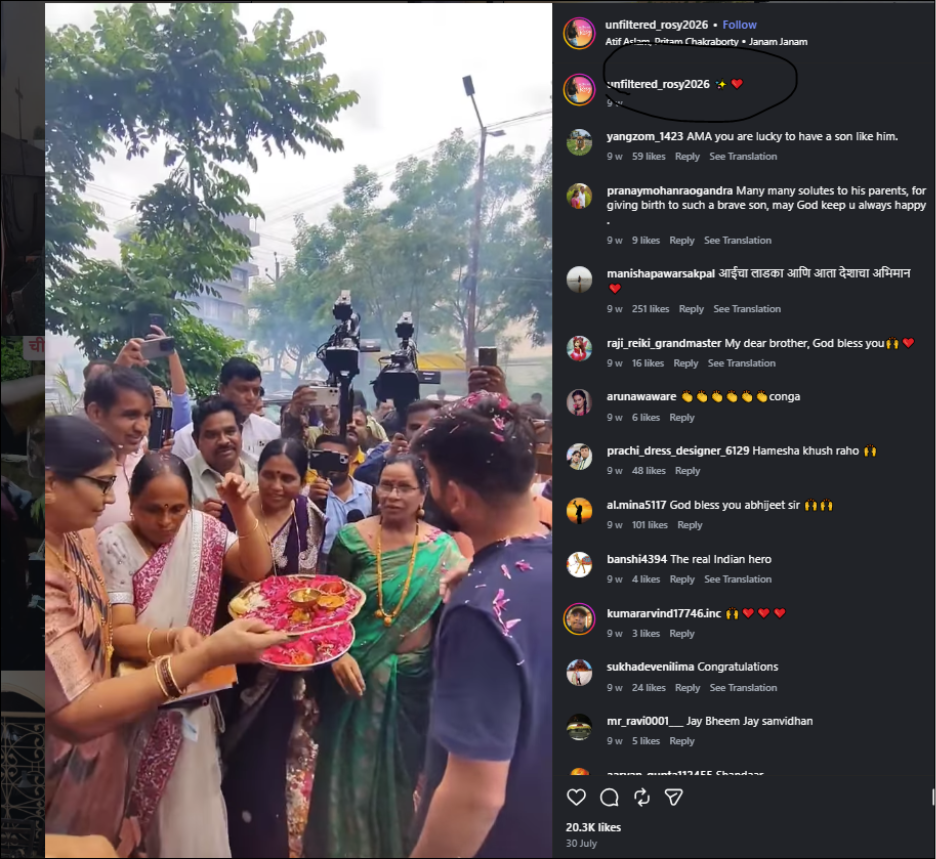
Days after the July protest by the CJP ended, Rosy had shared a glimpse of her fan moment with CJP founder Abhijeet Dipke.
In a post published on 29th July, she wrote, “Some visits leave you with more than just memories—they leave you with new perspectives. Thank you, Abhijeet Dipke, for the warm hospitality and the inspiring conversation.”
Rosy was actively peddling pro-CJP propaganda during the June-July protests over the NEET paper leak issue.
The so-called ‘independent journalist’ was celebrating Abhijeet Dipke’s return to his hometown in late July.
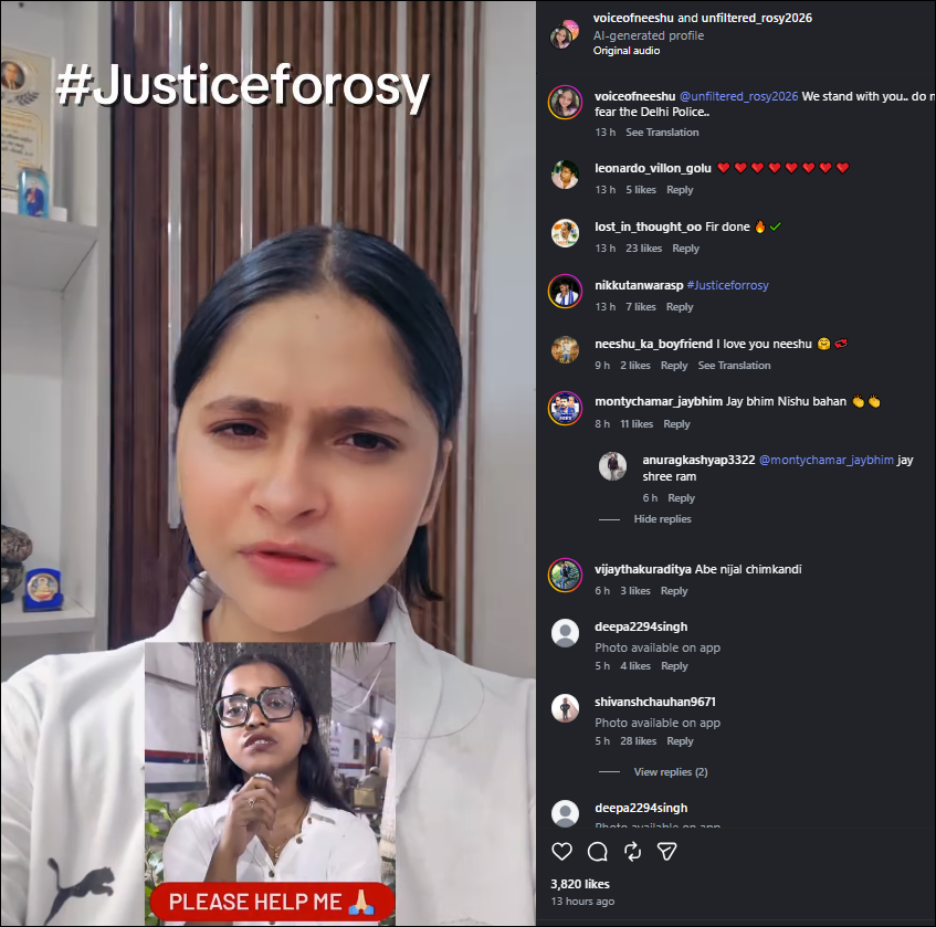
Rosy had also extended support to Nishu Azad, the self-declared social justice warrior who received backlash for her highly derogatory commentaries and social media posts against Hindu deities. She had even justified Nishu Azad’s offensive remarks against Hindu deities.
Unsurprisingly, Nishu Azad has now come out in Rosy’s support.
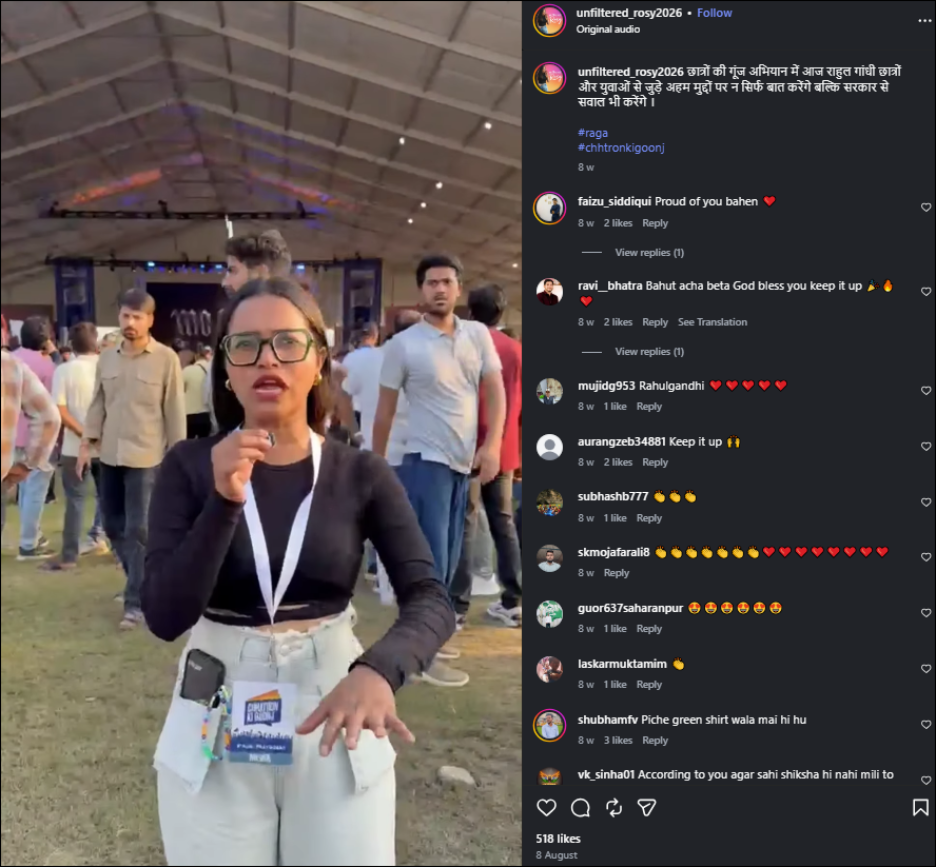
Interestingly, Rosy also attended Congress leader Rahul Gandhi’s ‘Chhatron ki Goonj’ event earlier this year.
No wonder, Congress MP Rahul Gandhi has extended support to ‘Mahila patrakar’ Rosy.
Rosy’s social media presence and her content are all about anti-BJP propaganda and pushing CJP narratives. While she claims to be an ‘independent journalist’ who exposes ‘Godi media’, Rosy’s content indicates that she is a leftist propagandist influencer.
•Meet so called independent journalist Rosey.
•She is a die hard CJP supporter.
•She was sent by CJP to Jantar Mantar in Delhi to target the Delhi Police.
•Now she is accusing ACP Vivek Bhagat of molestation without any evidence.
CJP’s plan to defame Delhi Police was successful.
Ever since the CJP protest began in June this year, dozens of ‘independent journalists’ have popped up. These, however, are online influencers who either have been anti-BJP or have turned to such propaganda in pursuit of clout. The modus operandi of anti-BJP influencers is to support the CJP and anti-BJP elements in their videos, sit in the protests themselves, and pose as ‘journalists’ to cover those very same protests. These ‘independent journalists’ are, in reality, paid PR machinery dedicated to leftist and anti-BJP entities and individuals.
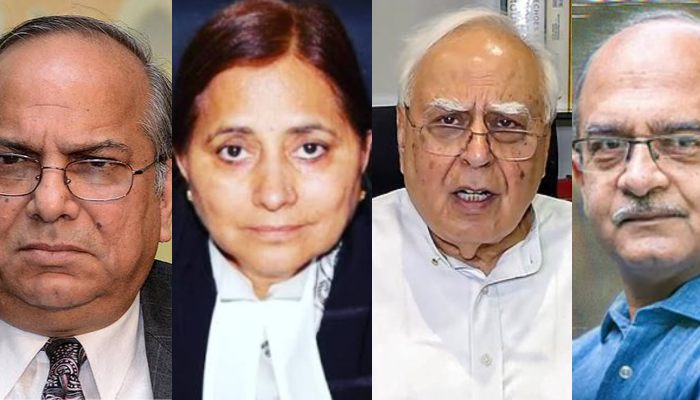
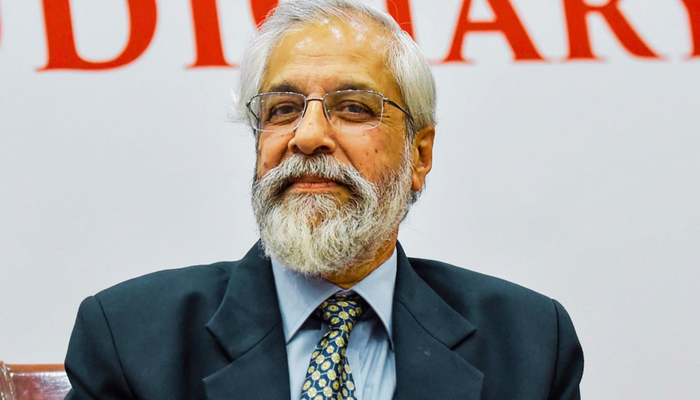
On 2nd October (Friday), an “independent commission” of former judges was announced to look into the validity and impact of the Special Intensive Revision (SIR) exercise conducted by the Election Commission of India (ECI). Retired Supreme Court judge Madan Bhimarao Lokur is going to head the five-member panel alongside former judges AK Patnaik (Supreme Court), Rekha Sharma (Delhi High Court), Anjana Prakash (Patna High Court) and Badar Durrez Ahmed (ex-Chief Justice, Jammu and Kashmir High Court).
It is created by a body of private lawyers called the Lawyers Association for Constitution (LAFC). Senior lawyers Kapil Sibal, Prashant Bhushan, CU Singh, PC Sen, Raju Ramachandran, Rebecca M. John, Warisha Farasat, and Vrinda Grover will assist the commission.
Former Supreme Court judge AK Patnaik
OpIndia has already reported on Lokur, who will be joined by former Supreme Court judge AK Patnaik. The latter was appointed to the apex court in 2009 and served for five years. Notably, he was a part of the two-member bench that acquitted all six defendants in the 2002 Akshardham temple attack in Ahmedabad.
The Prevention of Terrorism Act (POTA) court convicted and sentenced them, but the apex court released them in 2014 for lack of evidence. One accused who had been absconding was later arrested by the Anti-Terror Squad (ATS) in Jammu and Kashmir in 2019.
30 pilgrims, one police officer, and a commando were killed during the attack. Another commando suffered severe injuries and eventually passed away in the hospital after fighting for his life for two years.
Furthermore, Patnaik was also a member of the two-member bench which overturned the death sentences awarded to Aftab Ansari and Jamulludin Nasir, the masterminds of the American Centre attack in Kolkata in 2002. Both the trial court and the Calcutta High Court found them guilty of the terror strike and sentenced them to death.
However, the Supreme Court refused to equate this case with the 26/11 Mumbai terror attack convict Ajmal Kasab or the Parliament attack perpetrator Afzal Guru, both of whom were granted the death sentence and killed and changed the punishment to life sentences in 2014. 5 people were killed, while nearly 20 were injured, including cops and guards, during the assault.
Additionally, Patnaik has backed the Central Bureau of Investigation (CBI) Director Alok Verma, who was removed from his position due to corruption allegations by a high-powered committee that included Prime Minister Narendra Modi and Congressman Mallikarjun Kharge.
The Central Vigilance Commission (CVC) investigated the complaint against Verma and delivered a report in January 2019. Patnaik argued, “The high-powered committee should not have taken a hasty decision. There should have been more deliberation,” at the time.
Former Delhi High Court judge Rekha Sharma
Justice Rekha Sharma, another member of the panel, was appointed as an Additional Judge of the Delhi High Court in February 2005. She was elevated as a permanent judge the following year and retired in July 2011. She has often been seen on the propaganda website “The Wire,” using the platform to attack former Chief Justices of India Ranjan Gogoi and Dhananjaya Yeshwant Chandrachud over the Ayodhya Ram Mandir judgment.
In October 2024, Sharma reported being “dumbfounded” by Chandrachud’s statement that he had sought God’s help during the crucial Ram Janmabhoomi case, in an interview with Karan Thapar.
She claimed that it cast a question mark over the judgment and undermined its credibility. She further tried to twist his words and declared it a “conflict of interest,” mocking that the deity was a petitioner in the case and then offered a solution to the issue.
Sharma alleged that Chandrachud’s remark “surely brought down the halo around the Supreme Court” and that the verdict “has crossed all levels.” Referring to him as a “disappointment,” she contended that the office of the CJI had been “damaged.”
She even added, “If judges turn to God, why do we have courts at all? Go to priests. They have better communication with God,” remarking that Chandrachud had committed a “terrible mistake.”
Sharma also objected to his invitation to PM Modi to his residence for Ganpati puja, performing the aarti in his presence and allowing the meeting to be filmed and broadcast. She then asserted that any post-retirement appointment for him would appear “suspicious” and cast aspersions on his rulings. She also claimed that Chandrachud had effectively acknowledged that he was the author of the Ayodhya judgment due to his remark.
A few months earlier, in July, she had similarly cast aspersions on Ranjan Gogoi, who headed the five-judge Constitution Bench that delivered the landmark Ram Mandir judgement. The charges were made during a speech at a seminar which The Wire and LiveLaw had organised along with the Campaign for Judicial Accountability and Reforms (CAJR).
Sharma stated that the issue is not confined to the roster of judges, but “who assigns the case and who decides the matter,” in a clear reference to bench-fixing.
She claimed that there were three advantages to it, stating, “Number one, the master of the roster can constitute a bench of his own choice and himself preside over it even in a very personal matter. Number two, by intelligently making use of that power, he can assure himself even after his retirement, a cosy job like a seat in Rajya Sabha or governorship in some state. Number three, by intelligently using his power, he can equally benefit his very worthy and dearest colleagues too,” in an indirect attack on Gogoi.
Sharma also spoke in favour of Bhima Koregaon violence accused Stan Swamy and anti-Hindu Delhi riots accused Umar Khalid, arguing that their incarceration violated Article 21 of the Constitution. She has shared similarly sympathetic sentiments about GN Saibaba. She has also called for the Unlawful Activities (Prevention) Act (UAPA) to be struck down in her columns.
On the other hand, Sharma has been a harsh detractor of former Bharatiya Janata Party (BJP) spokesperson Nupur Sharma, praising the Supreme Court for holding her responsible for the unrest on the streets rather than the Islamists.
She has also written in support of Aam Aadmi Party leaders Arvind Kejriwal and Manish Sisodia, who were jailed in connection with corruption and money-laundering allegations linked to Delhi’s now-scrapped excise policy.
Former Patna High Court judge Anjana Prakash
Justice Anjana Prakash, who has also been included in the panel, was appointed as a judge of the Patna High Court in June 2009 and retired in July 2016. She wrote a piece for The Wire titled, “Justice in India Requires Inspiration from the Tricolour, Not Temple Dhwajas,” expressing her displeasure with the Aydhya judgement, protesting about a simple photograph of the five-judge panel, claiming that they were “celebrating.”
“For the first question which comes to mind when looking at that photograph is this – What was there to celebrate about? Was it a personal victory for the five judges as final arbiters of a long-pending dispute? Surely for a judge, every order is a celebration of her or his judicial acumen. So the Ayodhya judgment – no matter how politically important for some – should have been seen as just another judgment,” she wrote for The Wire.
Prakash even had an issue with the orange kurta, which she labelled “as a colour chosen to promote the interests of a dominant political party,” adding that his choice might have been “deliberately or accidentally.”
Furthermore, she lashed out at the judiciary for jailing Kannada actor Chetan Kumar, whose OCI (Overseas Citizenship of India) card was revoked by the Union government for indulging in anti-national activities and for derogating judges. Interestingly, she has also been a regular contributor to The Wire, where she has been given a platform to express her views.
Prakash also served on a Citizens Inquiry Committee into the 2020 Delhi unrest, which blamed the media for covering the “controversial Citizenship Amendment Act” in a prejudicial manner and creating suspicion against the Muslim community.
“The unbalanced (read biased) non-application of provisions of the Indian Penal Code (IPC) against powerful hate offenders on the one hand (these include the notorious Kapil Mishra, Ragini Tiwari and Yati Narsinghanand among others) and failure to prosecute was matched by the unfair and selective application of the dreaded UA(P)A against young protesters, concludes the report. The absence of setting up an independent Commission of Inquiry has also been commented upon,” their alleged finding stated.
Kapil Sibal, Prashant Bhushan, Vrinda Grover and more: The lawyers assisting the commission
Lawyers, including Kapil Sibal, Prashant Bhushan and Vrinda Grover, who are likewise part of the opposition ecosystem, are also set to assist the aforementioned judges.
Kapil Sibal:Kapil Sibal, a former Congressman, was recently caught while he attempted bench-fixing for his client Umar Khalid. He has also supported allowing infiltrators into the country and even approached the Supreme Court against the Assam government over action taken against him. He has also described the CAA as unconstitutional.
Moreover, Sibal donated Rs 5 lakh to Tarun Tejpal to help Tehelka launch its print edition. He has also described Justice Yashwant Varma, who was embroiled in the infamous cash-at-home scandal, as the best judge.
Prashant Bhushan: Former AAP leader and an ardent supporter of Umar Khalid, Prashant Bhushan has also been involved in a relentless campaign against the Election Commission of India. Notably, his name has also surfaced in connection with the anti-Hindu riots in Delhi, while he was also associated with pro-Hidma protests which took place in support of the slain Naxalite in the national capital in November last year. Bhushan has also advocated for illegal Rohingyas, even attacking CJI Surya Kant for allegedly failing to protect them.
CU Singh: Advocate CU Singh is another member of this group, has declared that the Delhi riots conspiracy and Bhima Koregaon charges are “hollow and will crash,” adding that the judges are also aware of it. He alleged that there was a dearth of credible evidence in these cases.
Singh has also regularly written for The Wire, including a column in which he blamed the organisers for attacks on religious processions. He has also dismissed the concept of “love jihad” outright while attacking laws enacted by BJP governments to address the issue. He even accused the Supreme Court of acting as a”mute spectator” during the COVID-19 pandemic.
PC Sen: The next lawyer on the list, PC Sen, has been against the abrogation of Article 370, tying it to supposed anti-majoritarianism.
Raju Ramachandran: Raju Ramachandran, also named to assist the judges on the panel, writes for The Wire and has been a vocal opponent of the abrogation of Article 370. In one of his columns, he also questioned the judiciary over the demolition of the disputed structure in Ayodhya.
Furthermore, the lawyer was independently appointed by the Supreme Court as Amicus Curiae to examine the Special Investigation Team (SIT) reports concerning the complaint filed by Zakia Jafri in the 2002 Gujarat riots case. However, he differed with the SIT’s recommendation to close the case and instead recommended that then Gujarat Chief Minister Narendra Modi be put on trial.
Rebecca M. John: Advocate Rebecca M. John, another part of this clique, is also against UAPA. She represented accused Vernon Gonsalves and Arun Ferreira in the Bhima Koregaon case. She also represented Kanhiya Kumar when he was booked for sedition in 2016.
Notably, the action was taken after anti-India slogans were raised on the Jawaharlal Nehru University campus and an event was held to mark the executions of terrorists Afzal Guru and Maqbool Bhat
Warisha Farasat: Warisha Farasat, who is also set to aid the panel, attacked the Centre over the Foreign Contribution Regulation Act (FCRA) rules in 2019, claiming that the alleged NGO “Lawyers Collective,” founded by Indira Jaising and Anand Grover, was being targeted. The NGO was found to be violating the FCRA rules, after which the CBI initiated raids.
Vrinda Grover: Vrinda Grover, another Umar Khalid supporter known for representing the likes of Rana Ayyub and Alt News co-founder Mohammad Zubair, is the next lawyer on the list. She has faced allegations of proximity to the former West Bengal Chief Minister after she stopped representing the family of the RG Kar Medical College rape and murder victim.
Grover has also opposed the UAPA and the Armed Forces (Special Powers) Act (AFSPA), charging that it offered unbridled power to the Indian Army in Jammu and Kashmir. She claimed that they were committing human rights violations in the valley with “absolute impunity.”
She previously represented former Delhi University professor SAR Geelani, one of the main accused in the 2001 Parliament attack case, who was initially sentenced to death but later acquitted due to lack of evidence.
P.V. Dinesh enters the picture
Interestingly, another senior lawyer, P.V. Dinesh, who co-founded LiveLaw with MA Rashid, presented the newly launched LAFC website to the audience. He has also attacked the government over restrictions on internet access in Jammu and Kashmir implemented to prevent any untoward incident during the abrogation of Article 370. He was also the Delhi State President of the All India Lawyers Union (AILU), a left-leaning group and is deeply connected to the Communist Party of India (Marxist).
LiveLaw has already been caught distorting or misrepresenting facts. Last March, it portrayed Muslim rioters as innocent men who had allegedly been falsely implicated by the police in a report related to the Delhi unrest.
LiveLaw also misrepresented a hearing involving UAPA accused Sharjeel Imam, referring to him as a “student activist.” However, the hearing was neither a bail hearing nor related to the larger conspiracy case concerning the Delhi riots. Instead, it pertained to a 2020 plea filed by Imam after his arrest over seditious speeches.
A similar episode unfolded in one of its reports concerning the Gyanvapi case. “The report of LawLive is not correct with regard to today’s hearing before the Allahabad High Court. Many aspects and observations by the court have been missed. Also, the submissions made by me have not been reported, and incomplete reporting has been done,” advocate Vishnu Shankar Jain wrote on social media.
LiveLaw also pushed a pro-hijab narrative while trying to discredit the Karnataka High Court’s verdict. The managing editor of the platform, Manu Sebastian, even wanted foreign interference in the matter.
Furthermore, the media coordinator of LAFC, Subhash Chandran, is reported to be an active Marxist leader.
2. Subhash Chandran is an active Marxist leader, not some independent person. pic.twitter.com/tW76kbat9U
What is Lawyers Association For Constitution (LAFC)
The “independent commission” has been constituted by the Lawyers Association for Constitution, which is a private body of lawyers, claiming to be “non-partisan, secular, and non-casteist.”
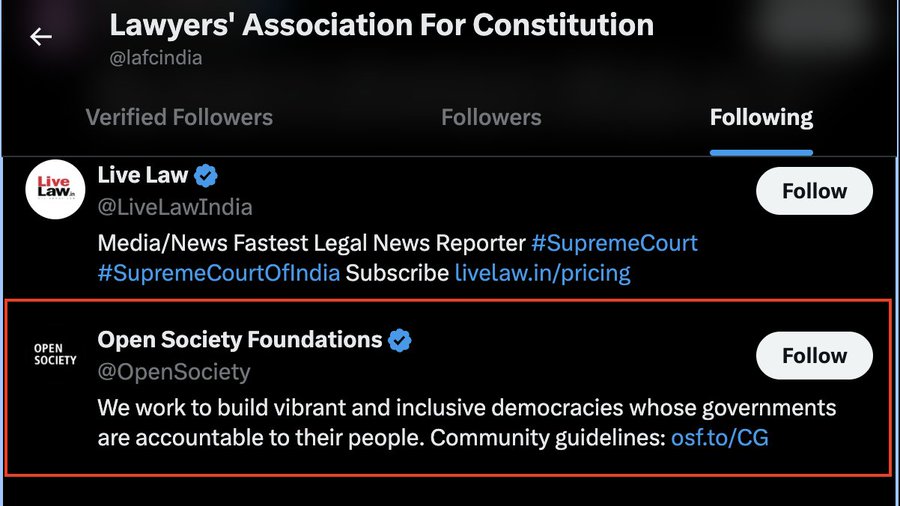
It is even more interesting that LAFC was found to be following the “Open Society Foundations” of anti-India regime-change enthusiast George Soros on X, but was removed as soon as it was exposed.
The association was officially launched on August 15, 2026, at Kerala House, New Delhi, and its membership is open to advocates and law students who subscribe to its objectives. Lokur attended the launch of the association.
An ‘independent commission’ was announced on Friday (October 2, 2026) to inquire into the validity and impact of the Special Intensive Revision (SIR) exercise conducted by the Election Commission of India (ECI). The Independent Commission of Former Judges on the Special Intensive Revision of Electoral Rolls is constituted by a private lawyers’ body called the Lawyers Association for Constitution (LAFC) and comprises retired judges.
The five-member panel will be headed by Retired Supreme Court judge Justice Madan Bhimarao Lokur and will comprise former judges Justice AK Patnaik (former judge, Supreme Court), Justice Badar Darrez Ahmad (former Chief Justice, J&K HC), Justice Rekha Sharma (former judge, Delhi High Court) and Justice Anjana Prakash (former judge, Patna High Court). The commission will be assisted by the likes of senior lawyers Kapil Sibal, Prashant Bhushan, CU Singh, PC Sen, Raju Ramachandran, Rebecca M. John, Warisha Farasat, and Vrinda Grover.
LAFC announces an Independent Commission of Former Supreme Court & High Court Judges to examine the Special Intensive Revision (SIR) of electoral rolls.
Chaired by Justice Madan B. Lokur, the Commission will undertake public hearings, legal research and scrutiny. pic.twitter.com/p6J0AXpyeC
— Lawyers' Association For Constitution (@lafcindia) October 2, 2026
The Commission has been tasked to conduct an ‘independent inquiry’ to find out if the SIR exercise was undertaken by the Election Commission in a fair manner. The full panel of the commission will be travelling across the country, hearing testimony of citizens allegedly affected by the SIR exercise and collecting data on the additions or deletions in the electoral rolls, as stated in the press release of the LAFC.
Apart from the intriguing composition of the commission, the timing of its formation is also interesting. The commission comes at a time when the Opposition and mainstream media portals like the Indian Express are trying hard to push a narrative to cast aspersions on the Election Commission by alleging irregularities in the SIR exercise and connivance with the BJP government. What adds to the suspicion is that the head of the commission, retired Justice Lokur, is known for being at odds with the current BJP government.
Criticised abrogation of Article 370 and the UAPA law
Justice Lokur had criticised the abrogation of Article 370 by the Modi government, which was upheld by the Supreme Court itself. He also voiced his objections to the Unlawful Activities Prevention Act (UAPA), which empowers the government to effectively deal with anti-national activities.
He was part of the infamous rebel group of four judges who held an unprecedented press conference in 2018, with allegations, including the government’s lack of response to the Memorandum of Procedure (MoP) governing the appointment of judges. Justice Lokur was also on the Constitutional Bench that, in 2015, struck down the National Judicial Appointment Commission (NJAC), introduced by the Modi government to replace the controversial Collegium system for the appointment of judges.
Friends with Pakistani Judges
While Justice Lokur has been critical of the government at home, he has had warm and cordial relations with Pakistani judges. In January 2019, the former apex court judge attended the swearing-in ceremony of the former Chief Justice of the Supreme Court of Pakistan, Asif Saeed Khosa, who is also said to be a close friend of his. This was not the only time that the former judge attended the swearing-in ceremony of a judge in Pakistan. Years before this, he had also taken part in the swearing-in ceremony of former Pakistan Chief Justice Tassaduq Hussain Jillani, when he took the oath as the Chief Justice of the Supreme Court.
Member of a foreign-funded NGO, opposed NRC detentions
The former Supreme Court judge is also a senior member of an NGO funded by the US State Department. He is an Executive Committee member of the Commonwealth Human Rights Initiative (CHRI). As a CHRI member, he signed a statement along with other so-called ’eminent citizens’ against the detention of illegal immigrants under the National Register of Citizens (NRC) framework and the setting up of detention centres.
CHRI monitors the ‘human rights situation’ across the Commonwealth through its International Advocacy and Programming (IAP) unit, which explains Justice Lokur’s stance against detentions and detention centres under the NRC framework. Pertinently, the Ministry of Home Affairs (MHA) suspended the Foreign Contribution (Regulation) Act (FCRA) license of the CHRI in June 2021. Subsequently, in April 2022, the MHA completely canceled the FCRA license of the NGO due to violations and failure to submit required reports.
Notably, Justice Lokur is the first Indian judge to be appointed as a judge in a foreign country’s court. He was appointed as a member of the non-resident panel of judges at the Supreme Court of Fiji.
Conducted the Pegasus snoopgate investigation against the Centre
Furthermore, Justice Lokur was part of a two-member commission constituted by the Mamata Banerjee government in West Bengal in July 2021 to investigate the Pegasus ‘snoopgate’ scandal. The Pegasus snoopgate scandal involved allegations that the BJP government used military-grade spyware purchased from Israel’s NSO Group for surveillance of journalists, opposition politicians, activists, and constitutional authorities.
Defends opposition politicians, targets former BJP leaders
Justice Lokur’s criticism of the ruling BJP government need not be mistaken for a neutral and non-partisan stance, as a former judge. His political leanings were exposed when he defended Aam Aadmi Party (AAP) national convenor and former Delhi CM Arvind Kejriwal’s refusal to resign and to continue to work from jail after being arrested by the Enforcement Directorate (ED) and the Central Bureau of Investigation (CBI) in 2024 over corruption and money laundering allegations linked to Delhi’s scrapped excise policy.
The retired judge admitted that Kejriwal’s refusal to resign as the CM post his arrest amounted to a violation of constitutional morality. However, he supported him, saying that so many people have violated constitutional morality and so Kejriwal doing the same would make no difference. This was like a judge letting a thief off the hook, citing other instances of theft.
Not just that, Justice Lokur tried to portray Congress leader Priyanka Gandhi Vadra’s temporary detention by Uttar Pradesh police after Lakhimpur Kheri violence to prevent a law and order situation as an illegal arrest. Priyanka had gone to visit Lakhimpur Kheri to score political points on the incident in which four BJP workers were killed. She was temporarily detained by the police to maintain law and order in the area.
On the other hand, the former judge cast aspersions on the acquittal of former BJP MP Brij Bhushan Sharan Singh by a Delhi Court in a case concerning sexual harassment allegations against him. Justice Lokur criticised the Delhi Police for the handling of the case against Brij Bhushan and said that the Supreme Court should have monitored the investigation in the case.
Attributed malice to the government for ex-judge Justice Muralidhar’s transfer
Justice Lokur attributed malicious intentions to the central government for the transfer of former judge Justice S Muralidhar from Delhi High Court to the Punjab & Haryana High Court, alleging that this was done as a result of a certain judgment that the latter had delivered.
Later again, he accused the BJP government of influencing the Collegium’s decision, which led to Justice Muralidhar not being elevated to the top court. Justice Lokur blamed the government for not acting on the recommendation of the Collegium, which was later recalled, to appoint Justice Muralidhar as the Chief Justice of the Madras High Court. Official Collegium records showed that the recommendation was made in September 2022 and was recalled in April 2023, considering Justice Muralidhar was due to retire four months later, in August 2024.
Justice Lokur later questioned the opacity in the appointments of judges by the Collegium. It is interesting to note that he was the one to oppose the NJAC, which offered a more transparent substitute for the Collegium system that he accused of acting under government pressure.
Notably, in November 2018, a Delhi High Court bench including Justice Muralidhar had ordered the release of Gautam Navlakha and 4 other urban naxals in a controversial verdict. The urban naxals were arrested in connection with the Bhima Koregaon violence. Justice Muralidhar directed the urban naxals to be released despite the police pointing out that they were involved in a conspiracy to assassinate Prime Minister Narendra Modi.
His biased report on anti-Hindu Delhi riots and call for more Judicial activism
Justice Lokur headed a committee, which released a report on the 2020 anti-Hindu Delhi riots suggesting that the riots were a premeditated act of violence by the Hindu community against the Muslim community. The report pushed an anti-Hindu narrative by cherry-picking facts and distorting the truth.
Justice Lokur has been an advocate of activism by the judiciary. And perhaps, it is because of his passion for activism by judges that he has now decided to sit in judgment as the head of a Kangaroo court on a routine electoral exercise, which was upheld by the Supreme Court. The above-mentioned information leaves little doubt as to the political leanings of Justice Lokur.
The commission is made up of a group of people who have been publicly and fiercely condemning the SIR exercise undertaken by the Election Commission. This raises the question whether the findings of the commission will be free from bias. The commission is, at best, like a private court, with no constitutional backing to conduct the inquiry. Given the interesting composition of its panel, it is not difficult to guess its findings.
What is Lawyers Association For Constitution (LAFC)?
The ‘independent commission’ has been constituted by the Lawyers Association for Constitution, which is a private lawyers’ body, claiming to be “non-partisan, secular, and non-casteist”. The association was officially launched on August 15, 2026, at Kerala House, New Delhi, and its membership is open to advocates and law students who subscribe to its objectives. Former Justice Lokur attended the launch of the association.
The global Islamo-leftist cabal has repeatedly trumped up conspiracy theories in its attempt to target India, Hindus and Hindu organisations. Three years ago, a similar effort unfolded in September 2023, when the Indian American Muslim Council (IAMC) and the Chicago chapter of the Council on American-Islamic Relations (CAIR) tried to frame two Hindu high school students over an alleged Quran-burning incident in Illinois, United States.
These groups were also joined by other Islamist organisations, including the Islamic Centre of Naperville (ICN) and the Council of Islamic Organisations of Greater Chicago (CIOGC). The campaign did not stop there. Liberal leaders also joined the chorus, seemingly desperate to be among the first to condemn the “Islamophobic” act without waiting for the facts of the matter to emerge fully.
Furthermore, these grave accusations were levelled despite being aware of the dangerous repercussions that even a mere hint of blasphemy, whether true or fabricated, could have on a person’s life and safety, as well as on those around them. However, the most concerning aspect of this episode was that the malicious agenda was directed at innocent Hindu youngsters, with the potential to jeopardise their safety and leave a lasting impact on their future.
The troubling targeting of vulnerable students in a broader propaganda against Hindus
On 3rd October 2023, IAMC released an official statement and shared “its deep concern over a recently discovered video depicting a Naperville high school student engaged in the reprehensible act of burning a copy of the Quran. This hateful act appears to be influenced by local Hindu supremacist groups with connections to extremist Hindu nationalist organisations in India.”
The release, which was replete with falsehoods and propaganda, not only declared the student guilty but went a step further by insisting that he had already made a confession. Predictably, it also sought to link the purported incident to Hindu outfits in an evident attempt to discredit and defame them.
“The video, recorded in June, only recently surfaced on social media, showing the student holding a lighter to a copy of the Quran, fanning it to make the flames spread, and then hurling it to the ground,” it added.
IAMC then doubled down on its lies and wrote, “The student has confessed to the hateful action and claimed that his reasoning for doing so was because (the Quran) said to kill all non-Muslims and it slandered other religions,” referring to it as an anti-Muslim myth which the young man reportedly saw on social media.
In an apparent try to bolster its otherwise groundless charges, IAMC portrayed him as influenced by “Hindu supremacist” ideology, pointing to CAIR’s claim that he had posted a comment opposing the construction of a new mosque in Naperville in 2021.
“Furthermore, the language used by the student to justify his actions closely resembles the rhetoric of Hindu extremists in India, frequently disseminated on social media platforms such as Instagram, Twitter, WhatsApp, and Facebook. Similar language has also been used by prominent Hindu far-right groups in the United States, including the claim that Muslims are ‘barbaric’ invaders of India on the website of the Vishwa Hindu Parishad of America (VHPA), which is an offshoot of the India-based militant group Vishwa Hindu Parishad,” the release read.
IAMC continued to construct its narrative against the student despite the complete lack of any merit, while simultaneously targeting Hindu organisations and denying atrocities perpetrated by Islamic marauders in India. The release was just another exercise to showcase Muslims as perpetual victims and Hindus as the villains, using rhetoric that has no basis in reality.
On 10th October, CAIR-Chicago followed suit and published their statement to add to the propaganda, supposedly “warning of a troubling connection to the Islamophobic and extremist RSS (Rashtriya Swayamsevak Sangh) Hindutva movement that has been internationally condemned for its anti-minority ideology and human rights abuses.”
Ahmed Rehab, executive director of CAIR-Chicago, dubbed the incident as not an “isolated arbitrary act” but argued that it was “part of a larger trend of Hindutva-inspired Islamophobia playing out in Naperville and other communities, and it is high time it is confronted. It is a stark reminder of the impact of ideological extremism quietly imported into America and the need to address it urgently.” The statement also mentioned that the student “commented twice in opposition to the mosque.”
The calculated plan of these radicals was to accuse a Hindu student and then use the propaganda to attack Hindu organisations and the wider community, amplified through repeated references to “Hindutva” and “right-wing” rhetoric. However, their long-drawn effort was short-lived, as the truth soon emerged and exposed the hollowness of their charges.
The truth eventually finds its voice
Notably, local leader Nag Jaiswal soon punctured the propaganda on 14th October as he highlighted that the student’s testimony, along with the video footage, confirmed that the allegations were false. He also clarified that the students had willingly shared the footage with the CIOGC and ICN imams after they requested it, simply to verify its authenticity.
Jaiswal reiterated, “They vehemently denied that the burned book is Quran.” He was part of a “fact-finding exercise which was held in good faith between parents of the Waubonsie Valley High School students accused of burning Quran and representatives of Islamic Organisations namely: ICN Naperville, CIOGC and CAIR.”
Jaiswal was invited there by the terrified parents who had contacted him on 27th September. He remarked, “The parents and students were visibly disturbed and hadn’t slept throughout due to fear and anxiety.” He disclosed that this was the first meeting which included all sides, and it happened after several follow-ups.
Alleged Quran Burning Incident in Naperville – Truth alone Triumphs – “Satyameva Jayate” – Firsthand Report by Nag Jaiswal, Naperville ILhttps://t.co/2nTlFxEvWZ
On Sunday, October 7th, a fact-finding exercise was held in good faith between parents of the Waubonsie Valley High…
Jaiswal revealed, “The CIOGC President moderated the meeting. CAIR were represented by their attorney and operations manager. Parents and accused students were without any legal representation.”
He further emphasised that there was no factual basis for the accusation. “The entire episode is speculative, based on hearsay. Students at the graduation party could have spread the rumour. At this time, no one is sure how it happened without anyone having a video.”
Jaiswal also shed light on the background of the occurrence and conveyed, “On a random summer afternoon (the week after July 4th), two kids decided to burst firecrackers in an open field in South Naperville. After bursting firecrackers, they burned random trash, including a book. They took some pictures, a few videos and went home thereafter. The entire incident was never discussed except once during a graduation party at the end of July.”
He also pointed to the real-life consequences of such propaganda and unveiled that the student “was bullied and pressured by a mob of 40 high school students on 26th September at 8 am when he stepped out of his school bus to admit he burned the holy book. He was surprised and in shock.”
Jaiswal mentioned the student was left confused as to how an unrelated book-burning incident had suddenly been turned into such an allegation, particularly when no clip of the incident had been circulating until that moment. They clarified that they had neither uploaded the video nor shared it with anyone, either publicly or privately. Similarly, no comments were made about the book or the incident as well.
He expressed, “It is very unfortunate to see press releases, blogs, news articles with extreme reactions from the public, religious organisations, political organisations, and community leaders. Press statements linking Hindu religion with hate crimes without any formal investigation are very disturbing. One-sided reactions of a political party are resulting in Hinduphobia.”
The Hindu American Foundation also reacted to the issue, outlining that the story which was advanced on social media by CAIR & IAMC turned out to be “fake news.” It stated, “The book was not a Quran & there was no intention to target Muslims. It is unacceptable that a family’s life was endangered over false charges & these national groups must apologise.”
#Update: #Naperville, IL alleged Quran burning amplified on SM by CAIR & IAMC was #fake news. Book was not a Quran & there was no intention to target Muslims.
Obviously, neither the instigators nor those who joined the bandwagon ever issued an apology for the immense distress, agony, fear and trauma inflicted upon the students and their families.
In November, Jaiswal conveyed that he had a meeting with an ICN member and “voiced my serious concern on how the school mishandled the events on 26th September & put the lives of two kids at risk.”
He also slammed the leaders who repeated and endorsed the unsubstantiated allegations through their tweets and public statements, questioning, “These are elected officials representing a large electorate in IL US District 11 and Naperville City. Why would they do that?”
Last evening I had a spirited impromptu conversation with a member of ICN. I voiced my serious concern on how the school mishandled the events on September 26 & put two kids lives at risk. It’s extremely worrisome when elected officials @RepBillFoster@bennynaperville issued…
“All the allegations are supposedly based on the school principal’s statements per ICN. Why did he reach out to an external religious organisation & distribute confidential content of a student,” he wrote, highlighting the violation of privacy.
Conclusion
It is hardly surprising that IAMC and CAIR have been behind such a sinister move to brand innocent Hindu students with such a grave allegation and potentially place their lives and safety at risk. These organisations have been actively involved in promoting hostility towards Hinduism and India, and recently had outbursts over RSS chief Mohan Bhagwat‘s visit to the United States.
The groups have also been infamous for their ties with extremist and jihadi groups, including Jamaat-e-Islami, while regularly providing a platform to figures known for their deeply Hinduphobic and anti-India views. Hence, without overstating the matter, this episode is yet another addition to their growing record of targeting all things Indian and Hindu.