Home Blog Page 1397

‘Mother, I am leaving, I might not be able to return now’: Story of Karsevak Bhagwan Singh who died for Ram Mandir

The holy city of Ayodhya is preparing for the historic return of Shri Ram as the consecration ceremony of Ram Mandir is set to take place on 22nd January 2024 in the presence of Prime Minister Narendra Modi and distinguished guests. Amidst the happiness over the “return of the king”, after a centuries-long wait, the Hindu community remembers all the Karsevaks who sacrificed their lives for the Ramjanmabhoomi from the era of Mughals to Mulayam. Among countless such known and unknown martyrs was Bhagwan Singh Jat, a resident of Aligarh, Uttar Pradesh. OpIndia reached out to Bhagwan Singh’s family for more information on their present condition.

On 2 November 1990, the day then-Chief Minister Mulayam Singh Yadav declared that “even a bird cannot fly in Ayodhya,” Bhagwan Singh arrived near Ramjanmbhoomi. Singh was killed by a bullet fired by police acting on government orders. Bhagwan Singh was born in the Aligarh district village of Nagla Balram. His family currently resides in Aligarh’s Aturra village. Farming has traditionally been the family’s primary source of income. Bhagwan Singh had two brothers namely Vijay Pal Singh and Nepal Singh. Vijaypal Singh also died four years ago. He has two sons, one of whom is a farmer and the other is preparing to join the police force after the CM Yogi Adityanath government announced a police recruitment drive.

Bhagwan Singh was postponing marriage to focus on the spread of Dharma

OpIndia spoke with Hariom Singh, the late Bhagwan Singh Jat’s nephew. He stated that his uncle was only 24 years old when he sacrificed his life. He had attended RSS shakhas since he was a child. Bhagwan Singh went to Mathura to continue his education after finishing his initial studies in Aligarh. He continued to propagate Hindutva here as well. Bhagwan Singh never married. When his family members urged him to think about getting married, he used to avoid the discussion. 

Bhagwan Singh attended RSS shakhas since childhood (Image: OpIndia Hindi)

“I am leaving Maa, I may not be able to return home”

Hariom Singh went on to say that when his uncle Bhagwan Singh heard that Ram devotees were gathering in Ayodhya for Kar Seva, he couldn’t stop himself. Bhagwan Singh travelled from Mathura to Aligarh before heading to Ayodhya. “Mother, I am leaving,” he said as he touched his mother’s feet. Now I may not be able to come back ” Hariom Singh said that his grandmother Shishkaur Devi did not comprehend why her son was talking about going to Ayodhya at that time. They assumed Bhagwan Singh was just going to Mathura or elsewhere nearby.

Furthermore, Hariom Singh told OpIndia that his uncle had left the house on October 28, 1990. There was police security all around at the time. The distance between Aligarh and Ayodhya is approximately 500 kilometres. On Mulayam Singh’s orders, the police patrolled the footpaths in rural areas, in addition to the rail and bus routes. Only those who visited Ayodhya or worshipped Ram were detained and tortured before being imprisoned. Despite this, according to Hariom Singh, his uncle Bhagwan Singh surpassed all the barriers placed by the Mulayam government and arrived in Ayodhya.

Hariom Singh told us that his uncle was killed in the Ayodhya Kar Sevak massacre on 2 November 1990. The bullet is said to have struck Bhagwan Singh in the chest. His death occurred somewhere near Ramjanmabhoomi. Bhagwan Singh’s family learned about his sacrifice after 2 November from other kar sevaks in the group.

Elderly parents searched for several days but could not find Bhagwan Singh’s dead body

While speaking to OpIndia, Hariom Singh grew emotional. After a brief silence, he said that as soon as he learned of Bhagwan Singh’s death, his elderly grandparents left for Ayodhya. Due to the restrictions, they had difficulty reaching Ayodhya at first, but once there, finding the corpse of their son was like finding a needle in a haystack. Hariom’s grandfather, Jawahar Singh Jat, and his elderly wife looked for his Bhagwan Singh’s body for several days but their efforts went in vain. Even the government and administration officials refused to assist the elderly couple while they wandered the streets and river banks of Ayodhya. Eventually, both returned to Aligarh empty-handed and with a heart full of sorrow.

Even today, Bhagwan Singh’s mother tears up over the pain of not getting to see her son one last time

Hariom Singh suspects his uncle’s body was thrown into the Saryu River by police officers deployed in Ayodhya back then. Bhagwan Singh’s supreme sacrifice rendered his father, Jawahar Singh, extremely devastated. Lost in his profound grief, Jawahar Singh passed away after some time. Shishkaur Devi, Bhagwan Singh’s 92-year-old mother, is still alive. Hariom Singh told us that his grandmother still sheds tears because she will never see her martyred son again. However, Hariom Singh’s entire family is pleased with the construction of Lord Ram’s temple in Ayodhya. According to this family, Bhagwan Singh’s sacrifice was worthwhile as eventually, his dream is taking the shape of reality. 

“We are proud of his sacrifice, and are ready to lay down our lives as well”

Bhagwan Singh’s sacrifice is honoured with a memorial in Aligarh as a small statue of Bhagwan Singh is installed in his hometown of Nagla Balram by his family on their land.  Hariom Singh expressed hope that a symbol of his uncle’s memory would be included in the newly constructed Lord Ram temple. This memory, according to Hariom Singh, will inspire countless people to fight for Dharma. Hariom Singh also stated that he is proud of his uncle’s sacrifice and that if necessary, he is willing to give his life in the name of Lord Ram.

Bhagwan Singh’s memorial in his village

Hariom Singh has two brothers.  His father Nepal Singh is a farmer. Nepal Singh’s elder son works in the Uttar Pradesh Police Department and is currently posted in Ghaziabad. Hariom Singh, on the other hand, holds multiple degrees. Along with his younger brother, he is preparing for teacher recruitment. Hariom Singh also wants the current government to pay attention to the families of other martyrs who died in the Ram Janmabhoomi movement alongside him. Hariom also wishes for the families of the martyrs to be provided assistance for the darshan of Ram Janmabhoomi.

Indians cancel their trips to Maldives following Maldivian ministers abuse India and PM Modi, trends like #BoycottMaldives pick up steam

0

A large number of Indians have reportedly cancelled their trips to the Maldives after some Maldivian politicians including Ministers made crass and Hinduphobic commentary on Indians and insulting barbs at Prime Minister Narendra Modi for his Lakshadweep visit. The recent diplomatic row started when jittery Maldivian social media users and politicians made deplorable comments about PM Modi’s Lakshadweep visit. 

It is important to note that while Indian social media users asserted that PM Modi’s Lakshadweep visit was a development push to boost tourism in the region. Several users also argued that Lakshadweep could potentially replace Maldives as a tourist option for Indians. However, PM Modi didn’t mention Maldives at all. 

Yet, fearing a hit to its tourism sector on which the Maldivian economy has a substantive dependence, Maldivian users and politicians indulged in racial attacks leading to a massive outrage among Indians. 

Hashtags like #BoycottMaldives are trending on Indian social media platforms. Taking to X, several social media users have claimed that they have cancelled their planned visit to the Island nation in the Indian Ocean citing the Maldivian Minister’s uncalled-for remarks on Indians and the Indians, including some of them sharing screenshots of their scheduled tickets. 

A Twitter user asserted, “I had planned a vacation to Maldives in February, I’m going to cancel the same and visit a place domestically. Will not let my money go to someone who hates my country.” 

Another user claimed, “I went to the Maldives few months back and with the things going around . I wish I hadn’t gone…I gifted my Niece her honeymoon package and I have now asked my agent to cancel. Yes am losing 50k in process but it’s worth it.” 

Some users also shared screenshots reflecting the schedule of their planned trip to the Island nation.

According to an Independent content creator and YouTuber Abhi, around 8000+ hotel bookings and 2000+ flights have been cancelled, however the numbers could not be verified independetendtly.

Notably, Mariyam Shiuna, Deputy Minister of Youth Empowerment, Information, and Arts – who has now been suspended by the Maldivian government for her comments on PM Modi – recently made insulting remarks against PM Modi, referring to him as a ‘clown’ and a ‘puppet of Israel’ while responding to PM Modi’s visit to Lakshadweep Islands. 

In the post which was later deleted, Shiuna wrote, “What a clown. The puppet of Israel Mr Narendra diver with a life jacket #VisitMaldives.” 

The post was deleted after backlash on X (formerly Twitter) where Indian social media users slammed the Maldives government officials, including Shiuna, for their crass remarks against the Indian Prime Minister for sharing pictures of his visit from the Lakshadweep Island. It is worth noting that PM Modi did not mention the Maldives anywhere in his tweets. In yet another post, Shiuna tweeted that the Maldives does not need the Indian Military’s presence in the region.

Similarly, on 5th January, Zahid Rameez, a Council member of the ruling Progressive Party of Maldives (PPM) took to the microblogging site X to mock Indians. The PPM member’s highly racist remark against Indians came in response to a post by popular X user Mr Sinha, where he shared pictures of PM Narendra Modi’s recent visit to Lakshadweep. Indian netizens slammed the leader for making racial commentary. 

In response to Mr Sinha’s post, Zahid Rameez wrote on 5th January, “The move is great. However, the idea of competing with us is delusional. How can they provide the service we offer? How can they be so clean? The permanent smell in the rooms will be the biggest downfall.”

It is important to note that several Maldivian Politicians including former Maldives President Mohamed Nasheed had called out their colleagues and condemned their act. Condemning the derogatory language used by some of the country’s officials against PM Narendra Modi, Former President Nasheed said that the language used by the minister Mariyam Shiuna was “appalling” and said India is a “key ally” for the security and prosperity of Maldives.

“Fake News”: Maldivian Minister Hassan Zihan denies reports of suspension, local media clarifies that third minister suspended for anti-India comments is Mahzoom Majid

Maldivian Deputy Minister Hassan Zihan has denied reports that he was one of the three ministers suspended for hate comments against India and PM Modi. Quoting a local media tweet, Hassan Zihan on Sunday tweeted ‘fake news’.

He was quoting a tweet by local media outlet Adhadhu, which reported that deputy youth ministers Mariyam Shiuna, Malsha Shareef, and Hassan Zihan were suspended over social media posts, making mocking references to Prime Minister Modi.

Following his recent visit to Lakshadweep, citing a top government source, Adhadhu reported that three deputy ministers were suspended for making disparaging statements against PM Modi. However, the media house later updated the report to say that the third minister suspended was Mahzoom Majid.

Earlier in the day, most Indian media houses also reported that the three suspended ministers included Hassan Zihan. It seems there was some confusion over the name, as not just Indian, but some Maldivian news outlets also reported the same. But now it has been confirmed that the third minister to be suspended is Mahzoom Majid, along with Maryam Shiuna and Malsha Shareef.

Notably, Mahzoom Majid deactivated his X (Twitter) account after his suspension. Maryam Shiuna and Malsha Shareef and have deleted their offensive tweets.

The three ministers were suspended for their unprovoked abusive messages towards India, Indians and PM Narendra Modi. It all started following PM Modi’s recent visit to Lakshadweep.

On 4th January, PM Narendra Modi shared some pictures of his recent visit to Lakshadweep as he exhorted people to explore the scenic island in what could be seen as a push to his ‘vocal for local’ slogan, and an effort to give a boost to tourism in the island.

Following PM Modi’s tweet posting stunning vistas from the Lakshadweep Islands, several social media users in India called for Indians to visit the place over foreign destinations, including the Maldives, which shares similar geographical characteristics as the Lakshadweep Islands.

That touched off bitter reactions from Maldivian counterparts, including governmental functionaries and prominent citizens, many of whom resorted to making churlish remarks against India, Indians, and the Indian PM.

Some of them crossed all limits and made highly objectionable remarks, threatening diplomatic tension between the two neighbours. Other sensible leaders of the island nation quickly condemned such attacks and urged the govt to take action to prevent any escalation. India also reacted strongly to the remarks. As a result, the Maldives govt issued a statement distancing itself from the comments. Later, it was reported the three ministers have been suspended.

Calling Lakshadweep smelly is racist and uninformed, shame on you for being so crass and vulgarly racist: Kangana Ranaut responds to racist comments by Maldives leader

A member of the Progressive Party of Maldives Senate Zahid Rameez stirred a major controversy on social media after he made fun of Indian Prime Minister Narendra Modi’s recent trip to Lakshadweep. Afterwards, many people including government ministers from the island nation were rattled by the latter’s visit to the tropical archipelago and made shockingly racist and disparaging remarks about Indians without any provocation.

Social media users, including well-known figures from Bollywood and sports, spoke against the blatant bigotry. Popular actress Kangana Ranaut in one such statement called out the stereotypical racism directed towards Indians. In reference to the faith practised by the majority of people in Laksdweep, she shared that Zahid Rameez has a “Muslim phobia” despite sharing the same religion as them. She pointed out, “Lakshadweep consists of 98 per cent of the Muslim population. This prominent public figure from the Maldives calling them smelly and lowly is rather racist and uninformed.”

The celebrity highlighted, “Lakshadweep’s entire population is hardly 60 thousand people which means it’s almost untouched, unexplored and unexploited natural island. For most people tourism is not just filthy luxury, it is rather an exploration of nature, alignment with the source and above all experiencing and enjoying the raw, untouched beauty of virgin beaches. Shame on you for being so crass and vulgarly racist.”

Zahid Rameez termed the concept of Laskdweep tourism as “delusional” while drawing an unflattering comparison with the Maldives. He asked, “How can they provide the service we offer? How can they be so clean? The permanent smell in the rooms will be the biggest downfall.” The statement triggered a lot of angry reactions from the netizens.

Meanwhile, the Maldives government suspended three of its ministers Mariyam Shiuna, Malsha Shareef and Mahzoom Majid for their insulting remarks on India’s Prime Minister. “All government officials responsible for the comments have been suspended from their post effective immediately,” informed Maldives government spokesperson Ibrahim Khaleel.

The Maldivian government clarified its position over Mariyam Shiuna’s words regarding Prime Minister Narendra Modi’s Lakshwadeep visit in a statement released earlier on 7th January. Following an unexpected spike in cancellations of Indian tourists, the government declared that it would not hold back from taking legal action against anybody who expresses such “derogatory remarks.” Deputy Minister of Youth Empowerment, Information and Arts Mariyam Shiuna recently labelled PM Modi as a “clown” and a “puppet of Israel” after he uploaded images from his trip to the Lakshadweep Islands. However, she deleted it after a massive uproar.

Mohamed Nasheed, the former president of the Maldives also denounced the demeaning comments made about Prime Minister Narendra Modi by certain leaders in his nation. He further requested that the administration of Mohamed Muizzu, the current president disassociate itself from these assertions and assure India that they do not represent government policy.

Notably, On 4th January, Prime Minister Narendra Modi travelled to Lakshadweep and posted photos of himself snorkelling and exploring the archipelago. After the photos went viral, many people commented that the location was better than the Maldives for tourists and made comparisons between them. Political figures in the Maldives responded by ridiculing the visit and uttering disrespectful statements about him, the country and Indians. Indian internet users responded strongly to this and the hashtag “#BoycottMaldives”  started trending on social media.

Attack on ED: WB Governor asks authorities to arrest TMC leader Shahjahan Sheikh, investigate possible links to terrorists

0

On 6th January, the Governor of West Bengal, CV Ananda Bose, instructed authorities to arrest the Trinamool Congress leader Shahjahan Sheikh in the case related to the attack on Enforcement Directorate officials. The WB Governor expressed concern over the matter and said the TMC leader might have “crossed the border”. Reports suggest that he has instructed the authorities to immediately arrest Sheikh and investigate his alleged connections with terrorists.

The statement from Raj Bhavan read, “On receipt of a complaint in the Peace Room of Raj Bhavan that Sahajahan Sheikh is supported by some political leaders with the connivance of some police officers, Hon’ble Governor instructed the Police chief to arrest the culprit forthwith and report compliance.” The Governor further emphasised the need to track down Sheikh’s location and take necessary action.

The statement further noted that the complaint received by Raj Bhavan pointed out that Sheikh “may have crossed the border” and “may have liaison with the terrorists” that should be investigated immediately.

Notably, the Bharatiya Janata Party (BJP) in Bengal also alleged that there might be involvement of cross-border elements and Rohingyas in the mob attack on ED officials. In a statement, BJP’s state president, Sukanta Majumdar, said, “We have been alleging that cross-border elements and Rohingyas were involved in Friday’s attack on ED officials. We support what the governor has said. If Sahajahan is arrested, it will unveil a big nexus between those involved in corruption and terror.”

Following the Governor’s instructions, TMC criticised him for the remarks. TMC spokesperson Kunal Ghosh said, “We don’t know what is the basis of his remarks. According to the Constitution, the governor works in consultation with the state government. So how can he make such remarks without any concrete report or evidence? He is not here to run a parallel government.”

ED officials booked by WB police

On 6th January, West Bengal police registered an FIR against Enforcement Directorate officials who were attacked during a raid at the house of Trinamool Congress leader Shahjahan Sheikh in North 24 Parganas. The raid was being conducted by the central agency in connection to a ration distribution scam.

The FIR was registered under Sections 441, 379, and 354 of the Indian Penal Code (IPC) based on the complaint filed by the caretaker of Shahjahan’s house. Reports suggest that the FIR was registered against them for attempting to “break in without warrant”.

Mob of 800-1000 attacked with intention to kill, said ED

In a statement, the Enforcement Directorate (ED) said that its team, along with CRPF and journalists, was attacked, and their vehicles were targeted in Sandeshkhali of North 24 Parganas district in West Bengal. In its statement, the probe agency said that a violent mob comprising 800-1000 people attacked the ED team with CRPF to cause death. It added that the attackers were carrying sticks and stones. The probe agency added that the mob is suspected to be instigated by TMC leader Shahjahan Sheikh and his associates. It further informed that three of its officials had been injured in the mob attack and admitted to hospital for treatment. In addition to injuring the on-duty ED officials, the violent mob also stole their laptops, mobile phones, wallets, cash and other belongings.

Public Distribution System Scam

On 26th October, ED raided the residence of West Bengal Minister Jyoti Priya Mallick in Kolkata in connection to a corruption case related to ration distribution. Mallick is a senior TMC leader serving as the forest minister of Bengal. Previously, he held the food minister portfolio. In response to the raid, CM Mamata Banerjee strongly criticised the central agency and accused the BJP-led government at the centre of using such actions as part of a “broader strategy” ahead of the 2024 Lok Sabha elections.

Mob attacks Bihar police team and allows wanted criminal Mohammed Sham Kareem to escape, officials seen folding hands to save themselves

On 6th January, Gaya DIU officials of Bihar Police went to arrest a wanted criminal identified as Mohammed Sham Kareem from Fida Hussain Road in Jehanabad. When they stopped the criminal, an agitated mob attacked them and rescued the criminal from police custody. One of the persons who were involved in the mob was arrested later by Nagar Thana Police. Kareem is wanted in several cases of theft and dacoit, and he has been absconding for the last year. One police official reportedly got injured during the confrontation.

Nagar Thana Chief Inspector Nikhil Kumar said they have initiated an inquiry into the matter. Reports suggest that the police had triangulated Kareem’s location based on cell towers at Fida Hussain Road. The accused had come to attend a family function. The DIU officials reached the area in civilian clothes. Somehow, the local police could not go to the DIU officials, which led to a confrontation between DIU officials and the mob. Though the local police controlled the situation, Kareem managed to escape by then.

Videos of the incident were shared on social media. Reports suggest that the police officials who were in civil uniform were seen folding hands to save themselves from the mob.

Jahanabad SDPO said that the mob allegedly got confused as the police officials were in civil clothes and attacked them. During the confrontation, the criminal managed to escape.

Maldives suspends 3 ministers including Mariyam Shiuna who mocked PM Modi as ‘clown’ and ‘Israeli puppet’

Amid outrage on social media over the derogatory remarks made by Mariyam Shiuna about Indian Prime Minister Narendra Modi, the Mohamed Muizzu-led-Maldives government has suspended her from the position of Deputy Minister of Youth Empowerment, Information and Arts on Sunday (7th January).

As per a report by Atoll Times, the government has also suspended Ministers Malsha Shareef and Mahzoom Majid . Earlier in the day, the Indian government raised strong objections with the Maldivian government against the remarks made by Mariyam Shiuna.

Following the backlash, the Government of Maldives issued a token statement of condemnation. It read, “The Government of Maldives is aware of derogatory remarks on social media platforms against foreign leaders and high-ranking individuals. These opinions are personal and do not represent the views of the Government of Maldives…Moreover, the relevant authorities of the Government will not hesitate to take action against those who make such derogatory remarks.”

The background of the controversy

On 4th January, PM Narendra Modi shared some pictures of his recent visit to Lakshadweep as he exhorted people to explore the scenic island in what could be seen as a push to his ‘vocal for local’ slogan, and an effort to give a boost to tourism in the island.

Following PM Modi’s tweet posting stunning vistas from the Lakshadweep Islands, several social media users in India called for Indians to visit the place over foreign destinations, including the Maldives, which shares similar geographical characteristics as the Lakshadweep Islands.

That touched off bitter reactions from Maldivian counterparts, including governmental functionaries and prominent citizens, many of whom resorted to making churlish remarks against India, Indians, and the Indian PM.

Screengrab of the tweet by Mariyam Shiuna

Mariyam Shiuna, Deputy Minister of Youth Empowerment, Information and Arts, recently made insulting remarks against PM Modi, referring to him as a ‘clown’ and a ‘puppet of Israel’ after he posted pictures from his visit to Lakshadweep Islands.

“What a clown. The puppet of Israel Mr Narendra diver with a life jacket #VisitMaldives,” Shiuna tweeted. The post was deleted after backlash on X, formerly known as Twitter, where Indian social media users slammed the Maldives government officials, including Shiuna, for their crass remarks against the Indian Prime Minister.

It is worth noting that PM Modi did not mention the Maldives anywhere in his tweets.

Hindu boy and his Muslim cousin sister brutally assaulted in Belagavi by Muslim goons who assumed them to be lovers, 8 arrested

In a shocking case of moral policing, a Hindu boy and his Muslim sister were brutally assaulted by a group of Muslim youths on Saturday (6th January), in Belagavi, Karnataka. The cousins, residents of Yamnapur on the outskirts of Belagavi city, were at the Fort Lake premises. They had come to register for the Yuva Nidhi scheme. A lunch break at the cyber centre in Belagavi led them to wait at the lake, where the assault occurred.

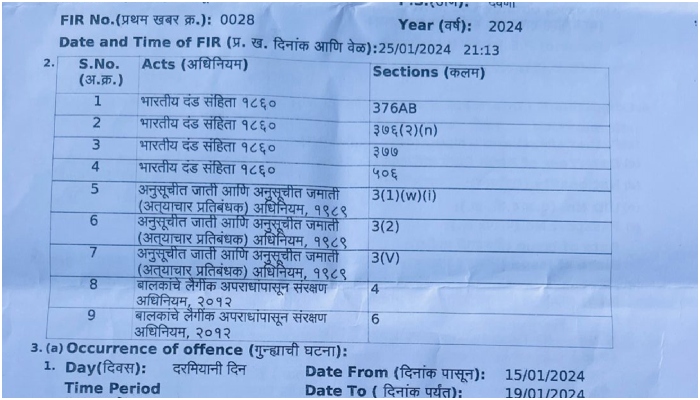
This boy is identified as Sachin Lamani (age 18) and his cousin is identified as Muskan Patel (age 22). Sachin Lamani is a Dalit Hindu. His aunt, father’s sister, married a Muslim man, and therefore his cousin is Muslim. The police have registered a case under the SC/ST Atrocities Act.

The victims, who were mistaken for a couple by the attackers, were targeted due to their different religious identities. The brother and sister, in an attempt to clarify their relationship, faced violence when the group refused to believe they were cousins. “A group of accused rushed towards us and attacked us. They asked us who you are and how you are related to each other and dragged us to a nearby room,” the boy recounted.

He added, “They asked why a Hindu and a Muslim were sitting together. I told them she wasn’t a Muslim but my own aunt’s daughter. They took both of our phones. They snatched away Rs 7,000.”

He further said, “When we went to apply for the scheme, they asked us to come after an hour as it was lunchtime. So, we went to sit by Killa Lake. The miscreants were drunk when they came to us. They took a rod and thrashed us.”

The attackers, armed with pipes and rods, beat the siblings mercilessly for hours, causing severe injuries. The assailants also tried to strangulate Sachin by his neck. During the assault, the boy contacted the police by calling 112. Acting swiftly, the Belagavi city police traced their location and rescued them. Both victims are now receiving critical care in the Intensive Care Unit of the district hospital.

City Police Commissioner SN Sidram informed, “We have arrested eight people in connection with the case on Sunday. An FIR has been registered against 17 people. The investigation is on.”

This incident has sparked outrage and concern over the rise of moral policing incidents in the city, particularly those driven by religious biases. The swift action by the police in arresting the primary suspects has been noted, but the incident raises significant questions about the safety of citizens in public spaces.

If writer of your calibre cannot understand, your art form is FALSE: Official social media account of movie Animal responds to Javed Akhtar’s criticism

Animal movie has gained widespread popularity and minted massive amounts at the box office, however, not without its share of detractors. Now, the makers of the venture have responded firmly to the harsh statement made by veteran lyricist Javed Akhtar. The official social media account of the film called out the hypocrisy of Akhtar and mentioned that the scenes that are being deemed controversial would have gained acceptance among the critics if they were performed by females instead of males.

It charged that if a writer of Javed Akhtar’s calibre cannot comprehend a lover’s treachery between the male and female protagonists then everything about his art is blatantly false and added, “Let love be free from the politics of gender. Let’s just call them lovers. Lover cheated and lied. Lover said lick my shoe. Period,” referring to the movie sequences.

Notably, Javed Akhtar stated that the economic success of movies featuring objectionable themes is a “dangerous” trend, seemingly aiming at Sandeep Reddy Vanga’s multilingual project Animal. He spoke out against the status of cinema at the start of this week at the 9th Ajanta Ellora International Film Festival in Chhatrapati Sambhajinagar. However, he never directly took the movie’s name.

The 78-year-old Javed Akhtar mentioned, “The image of a hero should be created with an awareness of what is right and how it should be. Today’s writers need to think because confusion has increased among them. The reason for this is that society is in confusion. Society does not decide what is right and what is wrong, but it is reflected in cinema. There was a time when the poor were good and the rich were bad. But today, we only have one thought in our head, ‘Kaun Banega Crorepati.’ So we can’t make the rich look bad now since we ourselves want to be rich.”

Akhtar added, “I believe it’s a testing time for the young filmmakers today as to what kind of characters they want to create that the society will applaud. For instance, if there’s a film in which a man asks a woman to lick his shoe or if a man says it’s okay to slap a woman, and if the film is a super duper hit, then that’s very dangerous,” discussing the volatile exchange between Ranbir Kapoor and Tripti Dimri’s characters in Animal.

Javed Akhtar noted, ‘Nowadays, I feel that more responsibility is on the audiences than filmmakers. The audiences have to decide what movies they like and what they don’t like. It is entirely up to the audience to decide what to reject. The ball is currently in the audience’s court. Even today, there are as many filmmakers making good movies. The fate of cinema depends on how long you stand with them.”

With around Rs 900 crore in global revenue, filmmaker Sandeep Reddy Vanga’s Animal, featuring Ranbir Kapoor, Anil Kapoor, Bobby Deol, Rashmika Mandanna and Tripti Dimri among others became one of the biggest Indian hits of 2023 despite criticism. There is a lot of excitement among fans for the OTT release of the film and rumours in the media say that Netflix will air it no later than end of this month.

The making of Shri Ram Mandir and the dawn of India’s civilisational renaissance

On January 22, 2024, India will witness a historic event that marks a significant milestone in its civilisational history – the consecration ceremony of the Shri Ram Mandir at Ayodhya. This event, unfolding after five centuries of persistent struggle and devotion, symbolises not just the spiritual awakening but also the realisation of a collective aspiration of millions. The Ram Mandir, a beacon of faith and perseverance, is set to redefine India’s cultural and spiritual landscape.

Historical Background

The story of the Ram Mandir is a saga of devotion, struggle, sacrifice, and resilience that stretches back over 492 years. The temple believed to have been demolished by the Mughal tyrant Babar in 1528, has been at the centre of a historical and spiritual quest for centuries. This quest, deeply embedded in the hearts of millions, has seen countless devotees laying down their lives for the cause.

The Legal Battle and Archaeological Evidence

The legal battle for the Ram Mandir, tracing back to 1855, intensified with the discovery of Lord Ram idols inside the disputed structure in 1949. This led to a series of legal proceedings and the movement gaining momentum in the late 1980s. The late 1980s saw the movement gather unprecedented momentum thanks to the efforts of Vishwa Hindu Parishad and the Ram Rath Yatra of Lal Krishna Advani culminating in a yet intense series of legal proceedings. On 9th November 1989, Kameshwar Chaupal of Bihar played a pivotal role in the historic foundation stone-laying ceremony by placing the inaugural stone at the site.

The disputed structure at the Shri Ram Janmabhoomi site was built by Mughal tyrant Babar. Image Source: Outlook India

Groundbreaking Archaeological Evidence for Ram Mandir

In a significant turn of events, the Allahabad High Court ordered a Ground Penetrating Radar (GPR) survey in 2003. This advanced survey, using radar waves for sub-surface imaging, revealed the existence of a structure beneath the Babri Mosque. To validate these findings, the High Court commissioned an excavation by the Archaeological Survey of India (ASI). The ASI’s report confirmed the remnants of a North Indian-style temple beneath the disputed site, adding a crucial archaeological dimension to the legal case.

The Allahabad High Court Verdict

In September 2010, the Lucknow Bench of the Allahabad High Court addressed the long-standing dispute over the Ayodhya site. This crucial judgment acknowledged the demolition of the original temple, a significant point in the historical and legal narrative of the Ram Mandir. In an attempt to resolve the complex web of civil suits tied to the land, the court proposed a three-way division of the contested site. This unprecedented decision aimed to allocate separate sections to the three main parties involved in the dispute.

A pictorial representation of the Allahabad High Court’s verdict. Image Source: IAS Parliament

Despite the court’s efforts to provide a balanced resolution, the verdict did not receive unanimous acceptance. Each party involved, holding firm to their respective claims and religious convictions, found the judgment unsatisfactory. This unanimous discontent led to a swift progression of appeals to the Supreme Court, seeking a more conclusive and acceptable solution to this centuries-old conflict.

Mediation Efforts

In a bid to resolve the dispute amicably, the Supreme Court, in March 2019, proposed mediation, forming a committee including Retired Supreme Court Justice Kalifulla, Senior Advocate of Madras High Court Sriram Panchu and spiritual Guru of Art of Living Sri Sri Ravi Shankar. However, by July, it became clear that mediation would not yield the desired outcome.

The mediation panel proposed by the Supreme Court. Image Source: Newsmobile

The Supreme Court verdict

On 6th August 2019, the Supreme Court embarked on a definitive phase in the Ayodhya case, initiating daily hearings. Presided over by the Chief Justice, a five-judge bench meticulously reviewed the appeals. This judicial endeavour, spanning 40 days and encompassing 170 hours of arguments, concluded on 16th October 2019. Among the many legal luminaries who contributed to this cause, the unmatched dedication of father-son duo Hari Shankar Jain and Vishnu Shankar Jain stands out. They have also been instrumental in other significant legal battles related to Hindu, Jain, and Buddhist holy sites.

Vishnu Shankar Jain
Left: Vishnu Shankar Jain Right: Hari Shankar Jain Image (Image Source: Hindustan Times)

The pivotal moment arrived on 9th November 2019. The Supreme Court’s full bench, in a unanimous decision, affirmed the 1993 acquisition of the disputed 14,000 acres, including its surroundings, as the legitimate property of Lord Ram. This landmark verdict paved the way for the construction of the Ram Mandir, as the court directed the government to establish a dedicated trust. This trust was tasked with overseeing the temple’s development on the entire 70-acre land, thereby bringing a historic resolution to the centuries-old dispute.

Formation of the trust and foundation stone laying ceremony

This decision led to the formation of the ‘Shri Ram Janmabhoomi Tirth Kshetra’ trust on 5th February 2020, to oversee the temple’s construction. The Bhoomi Pujan, held on 5th August 2020, saw dignitaries like Prime Minister Narendra Modi and RSS Chief Dr Mohan Bhagwat lay the foundation stone, marking the beginning of a new era. Sacred waters and soil from the country’s holy rivers and pilgrimage sites were dedicated to the ceremony.

Prime Minister Narendra Modi laid the foundation stone of Shri Ram Mandir. Image Source: Hindustan Times

Architectural and Structural Details of the Ram Mandir

The Ram Mandir, a marvel of traditional Indian architecture, stands as a testament to the timeless Nagar style. With its grand dimensions, the temple spans a length of 380 feet from east to west, a width of 250 feet, and reaches a majestic height of 161 feet. This awe-inspiring structure is spread across three levels, each floor standing 20 feet tall. The temple’s robust design is supported by a total of 392 intricately carved pillars and is accessible through 44 ornate doors, blending strength with splendour.

At the heart of the temple, in the basement sanctum sanctorum, is the revered idol of Shri Ram Lalla, depicting the childhood form of Lord Shri Ram. Rising above, on the first floor, the temple will house a Shri Ram Darbar, a sacred space dedicated to Lord Ram and his divine assembly. Surrounding these central areas are five distinct Mandaps or Halls – the Nritya Mandap, Rang Mandap, Sabha Mandap, and areas designated for Prarthna (prayer) and Kirtan (devotional song), each reflecting a unique aspect of the temple’s spiritual and cultural significance.

In addition to its spiritual grandeur, the temple is designed with inclusivity in mind. Visitors will enter from the east, ascending a series of 32 stairs leading through the Singh Dwar, a gateway that symbolizes strength and valour. Recognizing the needs of differently-abled and elderly devotees, the temple’s design includes ramps and lifts, ensuring accessibility for all. The entire structure is encircled by a formidable rectangular compound wall, extending 732 meters in length and 14 feet in width, which not only adds to the temple’s magnificence but also provides a sense of serenity and containment.

More About the Shri Ram Mandir

The Shri Ram Mandir, a symbol of India’s rich spiritual and cultural heritage, extends its reverence beyond the main temple structure, encompassing a series of auxiliary temples and significant elements. At each of the four corners of the expansive compound, devotees can find temples dedicated to a pantheon of revered deities: Lord Surya, Goddess Bhagwati, Lord Ganesha, and Lord Shiva. These temples not only enhance the spiritual ambience but also represent the inclusive nature of Hindu worship.

Adding to the sanctity of the site, the northern and southern arms of the temple complex host two more significant temples. In the north lies a temple dedicated to Maa Annapurna, symbolising nourishment and sustenance, while the southern arm is graced by a temple honouring Lord Hanuman, epitomizing devotion and strength. Near the temple complex, the historic Sita Well (Sita koop), dating back to ancient times, serves as a reminder of the enduring legacy of the Ramayana.

The temple complex also plans to house temples dedicated to a host of revered figures from the Ramayana and Hindu mythology. These include temples for Sage Valmiki, Sage Vashishtha, Sage Vishwamitra, Sage Agastya, King Nishad, Mata Shabari, and Ahilya, the wife of Sage Gautama. Each of these temples will not only offer spaces for worship but also serve as a testament to the diverse characters that enrich the epic of Ramayana.

In the southwestern part of the complex, an ancient temple of Lord Shiva has been meticulously restored on Navratna Kuber Tila, accompanied by an installation of Jatayu, symbolizing devotion and sacrifice. Remarkably, the entire temple complex adheres to ancient Vedic construction principles, with no iron used in the main temple and no concrete on the ground, preserving the sanctity and traditional authenticity of the structure. Below ground, the sanctum sanctorum boasts a 14-meter-thick layer of roller-compacted concrete (RCC), skillfully crafted to resemble artificial rock, ensuring both the stability and the aesthetic integrity of this monumental structure.

A 21-foot-high granite plinth, constructed for moisture protection, reinforces the temple’s resilience. The temple complex is not just a spiritual haven but also a model of modern amenities and environmental consciousness. It includes a sewage treatment plant, a water treatment facility, and an independent power station to ensure sustainability and self-sufficiency. A Pilgrims Facility Centre is equipped to handle the belongings of 25,000 pilgrims, offering lockers and medical facilities.

Additional conveniences like bathing areas, washrooms, washbasins, and open taps are provided in the Block facilities for the comfort of visitors. Emphasizing environmental and water conservation, 70% of the 70-acre area is dedicated to green spaces, showcasing a harmonious blend of tradition and contemporary ecological awareness.

Conclusion

The Shri Ram Mandir, with its intricate design, spiritual depth, and homage to various deities and sages, stands not just as a temple but as a complex embodying the vast tapestry of Hindu mythology and spiritual practice. This architectural masterpiece, with its harmonious blend of spiritual symbolism, cultural heritage, and inclusive design, stands not just as a place of worship, but as a beacon of India’s ancient architectural prowess and its enduring spiritual ethos.

As India awaits the temple’s consecration, there’s a palpable sense of anticipation and pride. This temple is not just a structure of faith but a symbol of India’s resilience and devotion. It stands as a testament to India’s ability to reclaim and celebrate its ancient civilisational identity, potentially heralding a new era where India re-embraces its role as ‘Vishwaguru.’