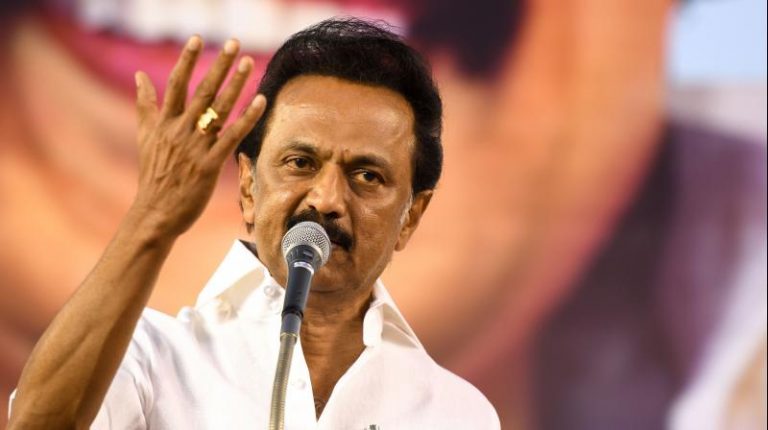
Tamil Nadu CM MK Stalin has written to PM Modi asking to drop the Neutrino Observatory Project planned at Theni, citing ‘environmental concerns’. DMK chief Stalin has written the letter asking the PM to intervene and drop the Neutrino Observatory Project claiming that it may damage the local ecosystem and tiger movement in the area.
Tamil Nadu Chief Minister MK Stalin writes a letter to Prime Minister Narendra Modi, urging an intervention in advising the concerned authorities to drop the India-based Neutrino Observatory (INO) project in Theni, Tamil Nadu. pic.twitter.com/b8akRa9PFN
In his letter, MK Stalin has written that the proposed project site at Pottipuram village in the Theni district of Tamil Nadu falls within the Mathikettan-Periyar tiger corridor as mapped by the National Tiger Conservation Authority and if the project is carried out, it may ‘destroy’ the genetic flow of the corridor.
Stalin’s letter further stated that the State Environmental Impact Assessment Authority had in 2017 pointed out the following:
The tunnel works will involve the blasting of the hard rock with powerful explosives, and will also remove large quantities of rocks from the mountain.
The tunnel will be at the depth of over 1000 m from the top of the mountain, so it may create tremendous pressure, risking rockburst and roof collapse.
The project site is close to the Western Ghats, so it may impact the biodiversity of the area.
The project site constitutes a significant water catchment area for the Sambal and Kotakudi rivers
Stalin stated that a ministerial delegation from the state had met Union Minister Piyush Goyal in this regard in September 2021, conveying the above-mentioned concerns and requesting the central government to drop the project.
Stalin asked the PM to intervene in the matter and drop the Neutrino Observatory project.
What is the Neutrino Observatory Project (INO)
Neutrinos are fundamental particles included in the lepton family. The TIFR website says they come in three flavours, one associated with electrons and the others with their heavier cousins the muon and the Tau. Tata Institute of Fundamental research is one of the lead partners in the project.
As per the official website of the project, more than 50 scientists from about 15 Institutes and Universities in India have come together to form the National Neutrino Collaboration group (NNCG). Scientists have theorised that neutrinos are not massless as they were thought to be, and research on this field may lead to major breakthroughs in particle physics, astrology and cosmology.
The observatory and its laboratories are planned to study the atmospheric neutrinos produced by interactions of cosmic rays in the Earth’s atmosphere. The INO project is a multi-institutional effort. The planned underground laboratory will be under a rock cover of approx. 1200 m for Non-accelerator based high energy and nuclear physics research, as per the site.
The project is jointly funded by the Department of Atomic Energy and the Department of Science and Technology of the government of India.
Proposed in 2005, marred by delays and politics
The project was conceptualised back in 2005. The site at Theni district was identified back in 2009. In 2015, the central government had approved a 1500 crore fund for the project. But the project has been a non-starter, as per reports. In 2015, MDMK leader Vaiko had filed a petition in Madras HC against this project. Stalin, after coming to power, had met PM Modi and had requested to shift the project elsewhere.
A number of scientists, mathematicians and Nobel laureates have asked the TN government to not hinder the project, asserting that the project will place the state of Tamil Nadu on the global map for advanced scientific research.
On March 14, filmmaker Vivek Agnihotri shared a photograph on Twitter where a group of people were seen holding the Indian National Flag at a theatre in Washington DC where they went to see the film Kashmir Files. In the photograph, the son of late Judge Neelkanth Ganjoo was standing holding the flag with a broad smile on his face.
From Washington DC. The gentleman (4th from left) is swargiya Judge Neelkanth Ganjoo’s son. Indian judiciary & system never punished the terrorists who killed him in broad daylight. #TheKashmirFiles is a small step in bringing justice to Judge Ganjoo’s sacrifice. #RightToJusticepic.twitter.com/VnHXCOZ7WV
— Vivek Ranjan Agnihotri (@vivekagnihotri) March 14, 2022
Agnihotri, while mentioning him and Judge Ganjoo in the tweet, said, “From Washington DC. The gentleman (4th from left) is swargiya Judge Neelkanth Ganjoo’s son. Indian judiciary & system never punished the terrorists who killed him in broad daylight. #TheKashmirFiles is a small step in bringing justice to Judge Ganjoo’s sacrifice.”
The murder of Judge Neelkanth Ganjoo
On November 4, 1989, three Jammu Kashmir Liberation Front (JKLF) terrorists shot High Court Judge Neelkanth Ganjoo in broad daylight when he was in Hari Singh Street market near the high court in Srinagar. Judge Ganjoo was brutally murdered for his involvement in the Amar Chand murder trial. As a sessions court judge, he had given death sentence to the terrorist Maqbool Bhat in August 1968.
On the fateful day, the retired judge had gone to Jammu & Kashmir Bank’s branch located on Hari Singh Street Market in Srinagar. The terrorists fired several shots from close range, and he died on the spot. After his murder, an announcement was made on Radio Kashmir, “Unknown assailants gunned down a former Sessions Judge in Maharaj Bazaar, Srinagar.” The death of Judge Ganjoo was the second murder of a prominent Kashmiri Pandit within a few weeks. Earlier, Bharatiya Janata Party leader Tika Lal Taploo was murdered in September. Tika Lal Taploo was the first causality of the so-called ‘Azad Kashmir’ movement that finally led to the exodus of the Kashmiri Pandits from the valley.
Who was Maqbool Bhat?
Maqbool Bhat was a Kashmiri terrorist who co-founded National Liberation Front (NFL). It was a military wing linked to ‘Azad Kashmir Plebiscite Front’. NFL was a precursor to the Jammu Kashmir Liberation Front, a banned terrorist organization Unlawful Activities Prevention Act (UAPA). Bhat carried out terrorist operations in Jammu and Kashmir. He was tried and convicted for the death of two officials. Bhat was hanged to death on February 11, 1984, in Tihar Jail, Delhi.
Bhat was born on February 18, 1938, in the present-day Kupwara district. During his college days, he was associated with Mirza Afzal Beg’s Plebiscite Front. In August 1958, following the arrest of Shiekh Abdullah (father of Farooq Abdullah), Bhat left for Pakistan, where he joined Peshawar University and did MA in Urdu Literature. In 1965 he joined Azad Kashmir Plebiscite Front as publicity secretary.
With an oath to ‘liberate’ Kashmir, he, along with Amanullah Khan, established an underground armed wing of AKPF and called it National Liberation Front (NFL). He was responsible for the overall coordination of the group.
Bhat’s terror outfit was accused of kidnapping and killing CID officer Amar Chand in the valley and Indian diplomat Ravindra Mahatre in the United Kingdom. He was also accused of being involved in the hijacking of an Indian Airlines plane named Ganga. The hijackers had demanded the release of 36 NFL terrorists and took the plane to Lahore. However, the passengers were released, and no demands were fulfilled.
Bhat was tried for sabotage and murder. He was convicted and awarded death sentence in September 1968 by then-Session Court Judge Neelkanth Ganjoo. After his multiple petitions were rejected, Bhat was hanged to death on February 11, 1984.
Congress and its allied ecosystem has been really rattled with the commercial and critical success of the latest Vivek Agnihotri film, The Kashmir Files. Leftists, with whom Congress has firmly aligned itself in the 21st century, have out-rightly denied Kashmiri Hindu genocide or tried to justify it for years.
Kerala Congress official Twitter account went on a long rant blaming BJP for the Kashmiri Hindu genocide and exodus, while at the same time denying that there was any targeting of Hindus. Now journalists loyal to Congress have gone a step ahead, with one Piyush Babele blaming Lal Krishna Advani’s Rath Yatra which was part of the Ram Janmabhoomi movement for this genocide.
In a series of incoherent tweets, Babele claimed that LK Advani’s Rath Yatra created an atmosphere against Muslims in India, which resulted in hatred against Kashmiri Hindus in the valley.
कश्मीर फाइल्स जिसे देखनी हो देखे और जिसे ना देखनी हो ना देखे। लेकिन यह तथ्य ध्यान में रखें कि अगर भाजपा नेता लालकृष्ण आडवाणी ने रथयात्रा न निकाली होती और पूरे भारत में मुसलमानों के खिलाफ माहौल नहीं बनाया होता तो कश्मीर में भी कश्मीरी पंडितों के खिलाफ माहौल नहीं बनता। 1/3
However, there is one teeny tiny problem with this argument, LK Advani started his Rath Yatra 8 months after the genocide in Kashmir. While the Rath Yatra started in September 1990, the Kashmiri Hindu genocide took place in January 1990. Now unless LK Advani had Dr Strange’s time stone and was able to manipulate space-time continuum, it is hard to imagine how he could have influenced January’s events in September.
The alleged journalist tried to defend his stupid remark by later saying that Advani had started creating “Anti-Muslim atmosphere” much before his Rath Yatra. However, it looked like a stubborn refusal to accept a mistake after getting caught with one’s hand inside the cookie jar.
This is not the first time someone has mixed up chronology while trying to give a clean chit to terror unleashed by Islamists on Hindus specifically because of their religion. ‘Activist’ Arundhati Roy had once very famously claimed that on 27 February 2002, the Karsevaks who were burnt alive by the Islamic mob in Godhra were returning after ‘demolishing’ the disputed structure in Ayodhya often referred to as Babri Masjid.
The disputed structure was demolished full 10 years prior the the carnage. Not just that, she had even said that ‘train caught fire’ and that ‘nobody knows who set fire to the train’. You can read our detailed report on the Godhra carnage which lists out Nanavati Mehta Commission report on eyewitness statement and other details, here.
Meanwhile, even though Congress and their aligned journalists are seething over the film, The Kashmir Files continues to make new records on the box office and set is to be a mega success.
Sunil Jakhar, a senior Congress leader from Punjab, on Monday took a dig at the party for the appointment of Charanjit Singh Channi as the chief minister of the state. Channi was appointed Punjab CM months ahead of the all-important Punjab assembly polls following the removal of Captain Amarinder Singh from the CM post.
Taking to social media website Twitter, Jakhar said that Channi had been a liability for the party, adding that it was him and not the top brass that pulled the party down in the assembly elections held earlier last month. Jakhar also mentioned that it was a certain ‘Pbi’ lady at the Congress Working Committee meeting who proposed Channi as the chief minister in the first place. He took a sarcastic jibe at the Congress party for not declaring Channi as a ‘National Treasure’.
“An asset – r u joking ? Thank God he [Channi] wasn’t declared a ‘National Treasure’ at CWC by the ‘Pbi’ lady who proposed him as CM in first place. May be an asset for her but for the party he has been only a liability. Not the top brass,but his own greed pulled him and the party down,” Jakhar tweeted.
An asset – r u joking ?
Thank God he wasn’t declared a ‘National Treasure' at CWC by the 'Pbi' lady who proposed him as CM in first place
May be an asset for her but for the party he has been only a liability. Not the top brass,but his own greed pulled him and the party down pic.twitter.com/Lnf6vJgRzF
Jakhar also attached two images in his tweet—the first one about the Enforcement Directorate seizing Rs 10 crores from Channi’s nephew—and the second one about Congress leaders in Punjab blaming the top brass for pulling CM Channi down.
Congress suffers a humiliating defeat in Punjab assembly elections 2022
The Congress party suffered a humiliating defeat in the Punjab assembly polls. Out of the 117 seats, it managed to win a meagre 18 seats, with CM Channi losing from both the sides he contested. He lost to AAP’s Labh Singh Ugoke in Bhadaur, Chamkaur Sahib he was defeated by AAP candidate Charanjit Singh.
Another Congress stalwart, Navjot Singh Sidhu, also suffered an embarrassing defeat in the assembly elections. Aam Aadmi Party emerged victorious in the Punjab Assembly polls as it swept the state, racking up a staggering 92 seats out of a total of 117 assembly seats.
On Saturday (March 12), several female Muslim students at the Shree Varshney College in Aligarh in Uttar Pradesh claimed that they were barred from attending classes for wearing hijab.
As per a report in The Times of India, a ‘hijabi’ student of BA 1st Year alleged that the college staff refused her entry into the college premises. “Now, I am returning home,” she told the news organisation.
One student of BSc Final Year claimed that the college authorities asked her to first remove her burqa, followed by the hijab. “I fail to understand why they have a problem with our hijab. I am not prepared to go anywhere without a hijab and the college is not allowing us to enter the campus anymore,” she remarked.
Another Muslim student, now in her 3rd year, further alleged that the administration had no issues with hijab during her 1st and 2nd year of college. Reportedly, the college administration has issued a notice on Saturday, urging students to adhere to the ‘prescribed uniforms’.
While speaking about the matter, college proctor Anil Varshney said that the dress code is explicitly mentioned in the college prospectus. “We only want students to follow rules and regulations of the college,” he added.
One senior college official anonymously told The Times of India that the college administration is only following directions and the dress code will be implemented with more seriousness from now onwards.
Shree Varshney College in Aligarh was established in 1947 and affiliated with BR Ambedkar University. reportedly, there are 7000 students studying in the college, out of which 60% of them are said to be women. There are about 250 Muslim students in the college.
Opindia spoke to Shree Varshney College administration
OpIndia reached out to Beena Upadhyay, the administrative officer of Shree Varshney College, to learn more about the case.
While speaking about the development, she informed, “Students are allowed entry into our college as per the dress code. But if a girl insists that she wants to cover her hair/head, then, she can wear only white-colour headscarves. Any other form of the headcover is not allowed.”
On being asked whether the dress code has been a long-held practice in the college, she emphasised, “Yes absolutely. I have been working at this college for 15 years now and the dress code has been around since then.”
“The entry of any student in hijab/burqa is not allowed in our college. If a student comes dressed in burqa and hijab from home, they are required to remove the attire after entering the college premises. While returning home, they can wear hijab or burqa again. But, they have to wear college uniform within its premises,” the college administrative officer further added.
Karnataka hijab controversy
Last month, some Muslim students from the PU College in Karnataka filed a petition in the High Court to allow them to attend classes wearing Hijab. They were denied entry into classes because the college management stated that the hijab is not part of the uniform and it cannot be allowed in classes. Since then, the ‘students’ have been protesting while wearing burqas.
The Muslim students had started wearing hijab and burqa to their school, college in defiance of the uniform rules since December 2021 after coming in touch with the Campus Front of India (CFI), the student wing of the Islamist outfit Popular Front of India (PFI) in October 2021. The students had admitted being in consultation with the CFI.
Subsequently, the lawyers representing the Muslim students had cited Sharia in the secular court to make a point on hijab, claiming that it is an essential religious practice that is mandatory for Muslim women and not really a ‘choice’.
Film ‘The Kashmir Files’ has already become a massive hit since the very first day of its release on March 11. Initially released with a limited screen count of around 600, Sunday saw a massive increase in the number of screens which showcased the film to up to 2000 nationwide. Such is the response that in Karnataka’s Bhatkal, people have even started protesting with a demand to screen the film in movie theatres.
On Sunday, Bhatkal, a town in Uttara Kannada district of Northern Karnataka witnessed outrage over the limited screening of The Kashmir Files in the local cinemas. Protestors alleged that the screening of ‘The Kashmir Files’ was halted at around 2:30 PM in the Pushpanjali theatre, to make way for Prabhas-starrer Telugu flick Radhe Shyam. Soon, Hindu activists who were eager to watch ‘The Kashmir Files’ which records the tragedy and pain of the Kashmir Hindu genocide in 1990 demanded that the screening should be reinstated.
After much protest, the screening supervisor intervened at the venue and promised to schedule a special show at 8:45 PM. Talking about the incident, Srikanth Naik, a former soldier, said, “This is a film made for patriots. We all desire to see the true story of Kashmiri Pandits who have been covered by our own people in our own history,”
#TheKashmirFiles shows PHENOMENAL GROWTH… Grows 325.35% on Day 3 [vis-à-vis Day 1], NEW RECORD… Metros + mass belt, multiplexes + single screens, the *opening weekend biz* is TERRIFIC across the board… Fri 3.55 cr, Sat 8.50 cr, Sun 15.10 cr. Total: ₹ 27.15 cr. #India biz. pic.twitter.com/FsKN36sDCp
Despite all odds, including the initial limited screen release, Vivek Agnihotri’s ‘The Kashmir Files’ has turned out a massive hit among the masses. With a very good opening on Friday (March 11) with Rs 3.55 crores, the film rose to make Rs. 8.5 crore on Saturday and Rs 15 crore on Day 3, Sunday. With a collective weekend of around Rs. 27.15 Cr, the film has emerged as the first choice among cinemagoers beating Gangubai Kathiawadi, Radhe Shyam and Batman.
Looking at the brevity of the subject and the audience’s response, various state governments in India including Karnataka, Gujarat, Madhya Pradesh and Haryana have declared the film tax-free.
Kudos to @vivekagnihotri for #TheKashmirFiles, a blood-curdling, poignant & honest narrative of the exodus of Kashmiri Pandits from their home land.
To lend our support to the movie & encourage our people to watch it, we will make the movie tax-free in Karnataka.
Directed by Filmmaker Vivek Agnihotri, the film stars Anupam Kher, Mithun Chakraborty, Pallavi Joshi, Darshan Kumar, Bhasha Sumbli and Chinmay Mandlekar in lead roles.
Many argue that recording History is a work of grey. Nuances combined with interpretations collectively make the arena more of an imperative exercise in negotiating time. While doing so, all of this has to be done with facts – and facts only, argued Sanjeev Sanyal in the debate, stating that it is essential to re-write our history. The Economist, historian and author was part of the debate held at St. Xavier’s college in Kolkata with the house in a motion arguing that it is necessary to re-narrate our History.
Speaking in favour of a need to re-write our history, alongside Sanyal, were Scientist Anand Ranganathan, Desh Ratan Nigam, Lawyer at the Supreme Court of India and Lalitha Kumaramangalam, Former Chairperson of the National Commission for Women. Speaking against the motion were a bunch of Congress loyalists and leaders including Mani Shankar Iyer, Manish Tiwari, Sanjay Jha and Jawahar Sircar, Rajyasabha MP from the TMC who tried hard to uphold their integrity towards the Nehruvian-Marxist Intellectual Ecosystem. At the end, when the moderator asked to waive their mobile flashlight to record their support for either of the panels, lights glittered over voices asking to re-write our history unequivocally.
Panel speaking for the motion
Sanjeev Sanyal started his premise by arguing that the history written in our school textbooks, is not our history at all, but that of the invaders. It is the history that our Colonial masters wanted to tell us, he stated. “Have you ever wondered, whenever there is a battle in our textbooks, the Indians lose it always? The three battles of Panipat, The battle of Buxar and that of Plassey every time the Indians lose. Surely, there must have been some battles that we won, for we are here for the last 5000 years,” he asks.
Here is the full recording of the Fr. Joris Memorial Nihil Ultra Debate in Kolkata this evening on the topic: “It is necessary to re-narrate our History?” Spoke for the motion. We won with with a big margin; it was not much of a contest in the end. https://t.co/Gv0OE8tIM0
“The problem lies, Sanyal pointed out, “in repeating the same history for 75 years even after our colonial masters left us.” Illustrating the examples of Raja Prithu who defeated Bakhtiyar Khilji in Assam to Marthanda Varma from Travancore whose army was the only one to defeat a major European power like the Dutch, Sanyal highlighted how little we know about leaders from our own soil. He argued that a space must be carved for these lesser-known characters in Indian History.
It was now for Desh Ratan Nigam to address the house, who stepped on the podium confessing that ‘History met him’ in the dark corridors of the college asking to be re-narrated and not ‘repeated’. Quoting late nationalist historian RC Majumdar, he argued, “The history of India is not the story of how she underwent foreign invasions, it is about how she resisted and eventually triumphed over them. In a true sense, the work must be the story of the people inhabiting a country, it must be a record of their life from ages. The central purpose of history must be unfolded to inspire the inhabitants to develop their collective will,” Nigam argued that such history is still yet to be written.
Nigam argued that before you narrate a history, it is important to be recorded in facts correctly and truthfully. He argued that the concept of law and constitution weren’t given to us by the colonialists but years ago in our spiritual texts including the Upanishads and the Vishnu Purana.
Bringing in Feminine perspective to the debate, Lalitha Kumarmangalam, the ex-national spokesperson of the BJP made it clear that she was not on the dais as a politician, but as an Indian woman whose representation in the current versions of history has been abysmal. She argued that throughout her left-liberal schooling, the historical studies did not include much literature on Indian women. “Indian history has always revered women, beyond politics and religion. However today, it is not doing justice to Indian women,”
She asked, “How many of us know the names of 15 women in the constituent assembly. Why don’t we know that democracy existed in India more than 3,000 years ago?” Arguing that Indian queens do not have the space they deserve in historical narratives, she referred to tribal queen Durgawati who married a king of her wish and ruled his kingdom 20 years after he died. Before the house, she posed, “Don’t you think we as Indian women deserve as a right to be mentioned in our history?” while quoting many examples of women warriors from Indian history.
It was time for noted Scientist and commentator Anand Ranganathan to make his arguments in favour of the motion. Starting off on a lighter vein by taking a dig at his opponents, Ranganathan said the Panel is comprised of four people of which one is suspended in animation by the Congress (Sircar), the other is suspended by the Congress (Jha), the third one who wants to be suspended by the Congress (Tiwari) and the last who doesn’t remember whether he was suspended or not (Aiyar).
As I remarked in my opening yesterday: what a wonderful bunch these three make – the first is suspended by the Congress, the second is itching to be suspended by the Congress, and the third is so drunk he can’t remember if he has or hasn’t been suspended by the Congress. WDTT https://t.co/0mIWjGalP9
Dr Anand Ranganathan said that such emphasis on history amuses him. “You see, as a scientist, the time scale that interests me is not 100 or 500 years or 1000 years but 1 billion or 10 billion years. And on that time frame, I am not Indian, but a descendant of an Ethiopian. I am not a creation by design but a conspiracy hatched by light, thunder, water, ammonia, hydrogen and methane combined.”
“Nothing really matters if our ancestors were brilliant or not, whether our culture is ancient or not, whether our religions are better or not. We are but a bunch of inconsequential cells,” he argued. “Yet History still matters,” argued Ranganathan, “because like Science it has to be built on truthful observation of facts and the understanding of it helps us survive. Nations weaken not because of their past but rather how they are taught it.”
He further argued that we have been taught to forget the historical injustices inflicted upon us – be it from Babarpur to Bakhtiyarpur, from Somnath to Kashi Vishwanath, from Allahabad to Aurangabad. These injustices have been deliberately made visible to lionise the debasement of existing cultures, argued Ranganathan.
Arguments against the motion
After a diversity of views from the non-left on the matter, Congress Veteran Mani Shankar Aiyar refuted the fact the history so told until now was not that of the colonial masters. He remarked that it was Savarkar who championed the two-nation theory, which was refuted by Dr Ranganathan by stating that it was Sir Syed Ahmed and not Savarkar who drafted the idea of a two-nation theory. He argued that while foreign invaders like Mahmud of Ghazni attacked Somnath, it is also true that many resident Indians were also attacking each other.
Quoting Romila Thapar, Aiyar asserted that Somnath in Gujarat was an ‘object of treasury’, he argued that Somnath was on Ghazni’s agenda only because of his exercises in loot in politics, and not because of religious bigotry.
Congress leader Manish Tiwari asked over what it meant to re-narrating History. “This endeavour of trying to open a quarrel with the past is a path which is laden with pain. Just because today there is a dispensation which holds a certain view of History, it does not give them the right to try to obfuscate history in order to set a narrative that serves their political predilections of the day,”
RS MP Jawahar Sircar argued that the present dispensation has not changed history because they do not have facts at their disposal. “You have changed the face of India from a liberal, plural, democratic society to a graveyard of democracy,” Sircar made a snide at ‘Hindu history’ calling it a conspiracy of silence. He commented that Alexender’s invasion in India was not mentioned in the contemporary Matsya Purana and Vishnu Purana of that time,”
It was now time for suspended Congress spokesperson Sanjay Jha to say that we are insulting our history by even discussing this topic. He argued that certain portions from the current mainstream version of history can be debated over or questioned, but there are always ‘two-sides’ to any proposition.
The audience decided
The 28th Father Joris Memorial Nihil Ultra Trophy National Debate which took place on Saturday this week resulted in the churning of ideas in the arena of understanding history, culture and politics. Needless to say, the audience tilted in favour of the motion arguing that history does need to be re-narrated and needs to be liberated from the Nehruvian-Marxist biases. The debate in a sense has recorded the mood of the nation, trying to assert its cultural identities in every sphere including the intellectual one.
A social media post, claiming that a newly appointed police spokesperson in Uganda attacked a journalist with a catapult, has been doing the rounds of the internet.
In a tweet on Saturday (March 12), a user (_@Sir_CharlesR) alleged, “Newly appointed Uganda police spokesman hits news reporter with a catapult for asking irrelevant question.”
At the time of writing, the post had 22.7K likes and was retweeted 8,265 times.
viral tweet claiming Ugandan cop using slingshot on journalist
Another Twitter user (@AdvoBarryRoux) claimed, “Newly appointed Uganda police spokesman hits News reporter with a catapult for asking irrelevant question.”
Newly appointed Uganda police spokesman hits News reporter with a caterpult for asking irrelevant question. pic.twitter.com/1IByYsvnjs
— Man’s NOT Barry Roux (@AdvoBarryRoux) March 13, 2022
Similar claims were made by one Ayesha Ali Bhutta on Sunday (March 13).
*Hint Hint*
“Newly appointed Uganda police spokesman hits News reporter with a caterpult for asking irrelevant question.” pic.twitter.com/X4nhCAJPPn
A popular Kenyan lawyer by the name of Ahmednasir Abdullahi took potshots at the Uganda police, based on the viral social media posts. While reiterating the same allegation that a Ugandan spokesperson hit a journalist with a weapon, he had tweeted, “Our neighbours.”
The Official Twitter handle of the Uganda Police Force (@PoliceUg) labelled his claims as ‘fake news.’ Abdullahi was thus forced to delete his tweet. “Great…will delete it…great that you are proactive!…and pass my regards,” he posted in another tweet.
Screengrab of the tweet by Uganda Police Force
The man, who is seen in the viral photograph with a catapult, is Ugandan police force spokesperson Fred Enaga. And the image has been taken from the video of a press briefing, which was conducted in April last year.
Fred Enaga was seen cautioning the public about the emergence of gangs who targeted civilians with catapults. “You do like this and you target somebody. So you can see how dangerous this thing is,” the police spokesperson said while pulling the catapult.
“They are very dangerous because they are capable of firing metallic and credible projectiles or metallic bearings,” he had warned.
“Uganda police is investigation about a criminal gang trading terror activities using catapults to destabilize the country. While addressing the media in the weekly brief, the spokesperson of police Fred Enanga says some suspects are already apprehended as police is tracing for the rest,” reported Uganda Broadcasting Corporation (UBC).
Thus, an attempt by the Ugandan police force to raise public awareness about the rise of a criminal gang last year was misrepresented as an attack on a journalist by a ‘new’ police spokesperson or asking ‘irrelavent question’. As such, the viral post about Fred Enaga using slingshot on a journalist is both old and misleading.
The Kashmir Files, a film by filmmaker Vivek Agnihotri on the genocide of Kashmiri Pandits leading to their exodus from the valley in 1990, has successfully attracted the masses to the theatres. The film has brought the truth and suffering of the Kashmiri Hindus into the limelight. One of the most shocking incidents during that period was the brutal rape and murder of Girija Tickoo, a Kashmiri Pandit, who was gang-raped and cut into half using a mechanical saw while she was still alive.
Girija’s family has finally opened up about the incident after staying silent for over three decades. Her niece, Sidhi Raina, shared a heartfelt post on Instagram where she talked about how her family still waits for justice and urged everyone to watch the movie. While explaining what happened to Girija, she said that the film shows the horrifying nights her family and every Kashmiri Pandit family went through.
She wrote, “My father’s sister, Girija Tickoo, was a librarian at a University who had gone to collect her paycheck, on her way back the bus she was travelling from was stopped and what happened next still leaves me in shivers, tears, and nausea. My bua was then thrown into a taxi, with five men (one of them being her colleague), who tortured her, raped her, and then brutally murdered her by cutting her alive with a carpenter saw. Imagine being the brother who had to recognize his Babli, who wasn’t at fault in this gruesome battle of total hypocrisy.”
Raina said she had never heard anyone speaking about the incident. “My father tells me every brother lived in such shame and anger that nothing had been done to receive justice for my Babli Bua,” she added. Urging everyone to watch the movie, Raina said, “This is my plea to ALL of you to watch the Kashmir Files and take your friends and family with you.”
The case of Girija Tickoo
Girija Tickoo was a Kashmiri Hindu from Bandipora. She worked as a laboratory assistant in a university in Kashmir Valley. In the aftermath of the ‘Azadi Movement’ by the terrorists of the Jammu Kashmir Liberation Front headed by Yasin Malik, Tickoo had fled with her family and settled in Jammu. One day, she received a call from someone who claimed the situation was better in the valley and she could come back to collect her salary. She was assured of safety, and the person alleged the area was safe to travel to.
In June 1990, Girija came to the valley to collect her salary and met her local Muslim colleague at her home. She was not aware that Jihadi terrorists were tracking her movement. Girija was kidnapped from her colleague’s home and was taken to an unknown location. Everyone, including her colleague and people in the locality, watched her being taken silently.
After a few days of the kidnapping, her dead body was found on the roadside in horrible condition. The autopsy revealed she was brutally gang-raped and horribly tortured. Girija was cut into two pieces using a mechanical saw while she was still alive, right from the middle of her body.
Her family still awaits justice, just like the hundreds and thousands of other Kashmiri Pandits whose suffering has been deemed as ‘propaganda’ by the ‘liberal’ section of the media and society.
Former Indian cricketer Venkatesh Prasad has hit out at the Congress party for normalising the genocide of Kashmiri Pandits and trying to weave false propaganda against the atrocities committed on the Hindu community.
“When one feels, they have hit rock-bottom and can only rise from here, they invent ways to hit newer lows. A pity they choose to hurt the sentiments of Kashmiri Pandits again. Kashmir Files is an eye-opener and probably just the tip of the iceberg,” the former Indian cricketer slammed the Congress party in response to a tweet over its attempts to whitewash the genocide committed against the Kashmir Pandit community in Kashmir.
The former cricketer accused the Congress party of hitting a new low by choosing to hurt the sentiments of Kashmiri Pandits again.
The response by Venkatesh Prasad came after the Kerala Congress had posted a series of tweets to deny the genocide of Kashmiri Hindus and absolve the acts of Jihadi terrorists in Kashmir in the 1990s. Defending the movie, the fast-bowler said that the film was just an eye-opener and perhaps just the tip of the iceberg.
The tweet by the Congress party had come as a response to the overwhelming public response to the movie ‘The Kashmir Files’, which brings the brutal and tragic account of the Kashmiri Pandit genocide to the big screen.
Amidst the success of the movie, the Congress party sparked fresh controversy by trying to build a false narrative against the genocide of Kashmiri Pandits by propagating lies about the atrocities committed against them. Shortly after the CWC meeting in New Delhi, Congress Kerala shared a series of posts blaming Governor Jagmohan and RSS for the Kashmiri Pandit exodus.
In a series of tweets, the Kerala Congress claimed that Pandits left the valley en masse under the direction of Governor Jagmohan, who was an “RSS man”, and the ‘migration’ started under the BJP-supported VP Singh government.
The Congress party also said that Pandits’ migration started the very next month of BJP-supported VP Singh’s government coming to power in December 1989, and the grand old party also accused BJP of doing nothing but supporting VP Singh till November 1990.
Absolving the crimes of Islamic terrorists, the Congress party further claimed that is not just the Pandits who are victims of terrorism, adding that over 1,00,000 Kashmiri Muslims were killed in Jammu in the 1948 communal riots, but there were no retaliatory killings of Pandits.
The Congress party also claimed that the UPA govt built 5,242 tenements for Pandits in Jammu and provided one-time assistance of Rs.5 lakh to each family in addition to student scholarships, assistance to farmers & welfare schemes worth Rs.1,168.4 crores.
Hitting out that BJP, Kerala Congress went ahead to say that BJP did not bring the Pandits back to Kashmir or resettle them despite being in power for two terms at the centre and one term in Kashmir.
The shocking tweets by the Congress party have received widespread condemnation across the country, with people accusing them of turning into sympathisers of terrorism and enabler of genocide against Hindus in the country. Despite the outrage, the Congress party has neither deleted the deplorable tweets nor apologised for the same.