Home Blog Page 433

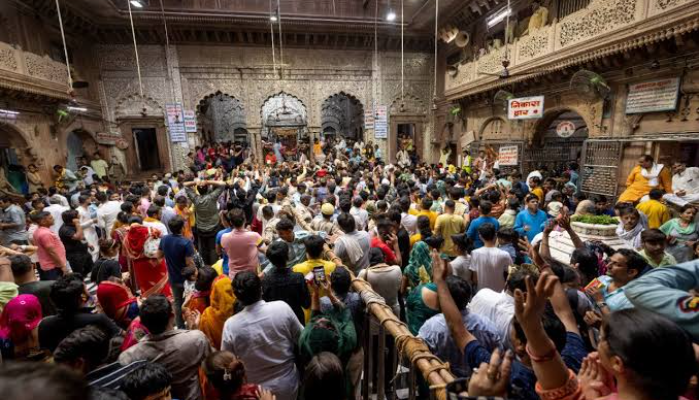
Banke Bihari Temple in Vrindavan refuses to boycott Muslims vendors amid protests against Pahalgam terror attack, says ‘Not Practical’

The prominent Banke Bihari Temple in Vrindavan has rejected calls from Hindu organizations opposing the Pahalgam terror incident for a boycott of Muslims who provide services at the revered place, reported the Times of India. It is one of the most popular pilgrimage destinations in Uttar Pradesh and even across India.

The demand followed calls by demonstrators in Vrindavan and Mathura for Hindu visitors and retailers “not to trade with the minority community”. Additionally, Muslim store owners were asked to “write proprietors’ names on business establishments.

Stores owned by Muslims have been identified according to Nagendra Maharaj, a member of the Kashi Vidvat Parishad, an organization that has called for the de-linking of Muslims from the temple’s affairs. He said, “We’ve asked them to write their names on shops and Hindu shopkeepers to avoid working with them and not to employ people from that community.”

“It is not practical. Muslims, particularly artisans and weavers, have deep-rooted contributions here. They’ve played a major role in weaving the dresses of Banke Bihari for decades. Many of them have a strong belief in Banke Bihari and visit the temple too,” Gyanendra Kishore Goswami, priest of the temple responded to the demand, on 28th April.

Goswami also serves on the management committee for the temple. He added, “Also, in Vrindavan, some of the crowns and bangles for the deity are made by them (Muslims).” The majority of the locals allegedly agreed with his assertions.

He further conveyed, “Yes, those terrorists (in Pahalgam) should be punished severely and we’re totally with govt. But in Vrindavan, Hindus and Muslims live together in peace and harmony.”

Authorities at the Banke Bihari temple had also turned down a proposal a month back that called for a ban on garments made for Lord Krishna by Muslim weavers. There were “no changes to the selection process for the deity’s attire,” according to the temple authorities at the time. The sanctity and purity of the “poshaks” (clothes) offered to the lord were their top priorities, per the priest. He had stated that the temple had nothing against taking them from the Muslim community if they believed in the deity.

Pahalgam Terror Attack

26 innocent Hindu tourists were shot dead and numerous others injured by terrorists in the Baisarann valley of Pahalgam. They were told to provide their names, identity cards, and religious affiliations, and were even instructed to recite verses from the Quran to verify their faith. Additionally, their trousers were taken off and pulled down to further confirm their identity. People confirmed to be non-Muslims were executed without mercy.

Fifteen local Kashmiri overground workers (OGWs) and terror associates have been identified through electronic surveillance as primary suspects who may have assisted the Pakistani attackers responsible for the Pahalgam massacre. Citing opposition to the Indian government’s policies that encourage non-Kashmiris to reside in the valley, The Resistance Front (TRF), a known proxy of the Pakistan-based Lashkar-e-Taiba, first hurried to claim credit for the massacre. However, they quickly withdrew their statement, alleging a purported breakdown in communication.

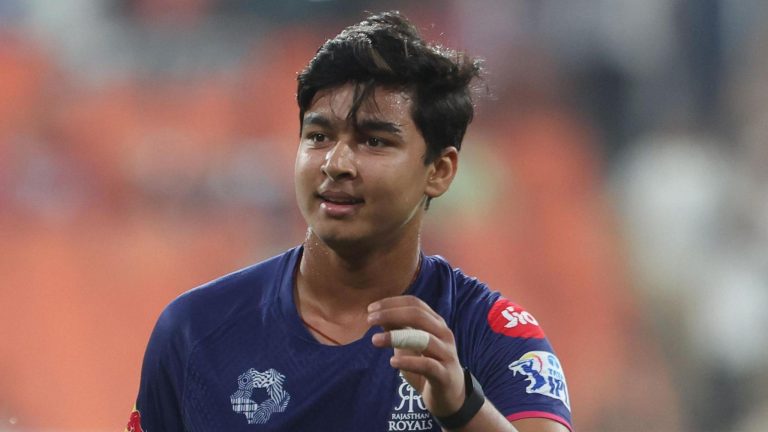
IPL: 14-year-old Vaibhav Suryavanshi gets honoured by Bihar CM Nitish Kumar after his mind-boggling century, gets reward of Rs 10 lakhs

0

Bihar Chief Minister Nitish Kumar announced a prize money of Rs 10 lakh for the 14-year-old rising sensation Vaibhav Suyravanshi following his record-breaking ton against Gujarat Titans on Monday at the Sawai Mansingh Stadium.

Suryavanshi left an everlasting impression in the history of the T20 format with his grand spectacle at the Sawai Mansingh Stadium. The 14-year-old, who has recently taken baby steps in his career, toyed with GT’s bowling unit, boasting 694 international caps.

At 14 years and 32 days, the boy wonder, who hails from Bihar, became the youngest player to score a century in T20 cricket and the second-fastest to hit a ton in the cash-rich league’s history after Chris Gayle’s 30-ball heroic effort against Pune Warriors in 2013. It took a searing yorker from Prasidh Krishna to put an end to Suryavanshi’s relentless onslaught.

Nitish congratulated Suryavanshi for his impeccable performance during Rajasthan’s resounding 8-wicket triumph, and on Tuesday announced a prize of Rs 10 lakh from the state government.

“Congratulations and best wishes to Vaibhav Suryavanshi of Bihar, who became the youngest player (14 years) to score a century in the history of IPL. He has become a new hope for Indian cricket as a result of his hard work and talent. Everyone is proud of him. I met Mr Vaibhav Suryavanshi and his father in 2024, and at that time, I wished him a bright future. After his brilliant performance in IPL, I also congratulated him over the phone. Vaibhav Suryavanshi, a young cricketer from Bihar, will also be given a prize money of Rs 10 lakh by the state government. I wish that Vaibhav creates new records for the Indian team in the future and brings glory to the country,” Nitish wrote on X.

Union Minister Chirag Paswan also hailed the 14-year-old for his memorable performance and told reporters, “On behalf of the party, I wish him all the best. He is a young talent and has made such a beautiful start at such a young age. His future is very bright.”

(This news report is published from a syndicated feed. Except for the headline, the content has not been written or edited by OpIndia staff)

‘Nothing wrong in using Pegasus for national security purposes’: Supreme Court refuses to make expert committee’s report public

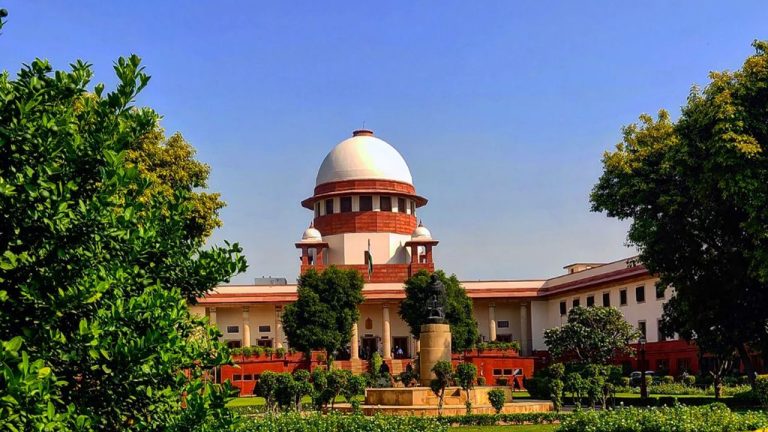
In a significant observation during a hearing on Tuesday, the Supreme Court of India remarked that the use of spyware by the country for national security purposes is not inherently problematic. However, the Bench emphasized that allegations of such technology being misused against private individuals will be carefully examined.

The Bench comprising Justices Surya Kant and N Kotiswar Singh was hearing a batch of petitions related to the alleged use of Pegasus spyware by the Indian government to surveil journalists, activists, politicians, and others. “To have a spyware, nothing wrong… we cannot compromise and sacrifice the security of the nation,” the Court stated. At the same time, it clarified that individuals’ right to privacy under the Constitution must be protected.

In response to arguments from Senior Advocate Kapil Sibal and others, the Court maintained that while those who suspect they were targeted by Pegasus can seek clarity, the full expert committee report on the matter would not be made public due to national security concerns. “Yes, individual apprehension must be addressed, but it cannot be made a document for discussion on the streets,” the Bench said.

The expert committee, appointed by the Supreme Court and led by former Justice RV Raveendran, submitted its findings in 2022. It examined 29 mobile devices and found no conclusive evidence of Pegasus in any, though traces of other malware were detected in five. Importantly, the committee noted that the Government of India did not assist in its investigation.

During Tuesday’s hearing, Sibal pointed to new evidence, including WhatsApp’s admission in a U.S. court of being targeted by Pegasus. Senior Advocate Shyam Divan argued that if the State had used spyware on its own citizens, it would be “worse” than previously imagined. Solicitor General Tushar Mehta dismissed the claims as being driven by other motives.

The Court reiterated that any report affecting the “security and sovereignty of the country” would remain confidential, but individuals could still request to know if they were affected.

The matter will next be heard on July 30.

Bhopal rape gang: Muslim men targeted Hindu girls, trapped, raped and blackmailed using videos, lawyers thrash accused at court

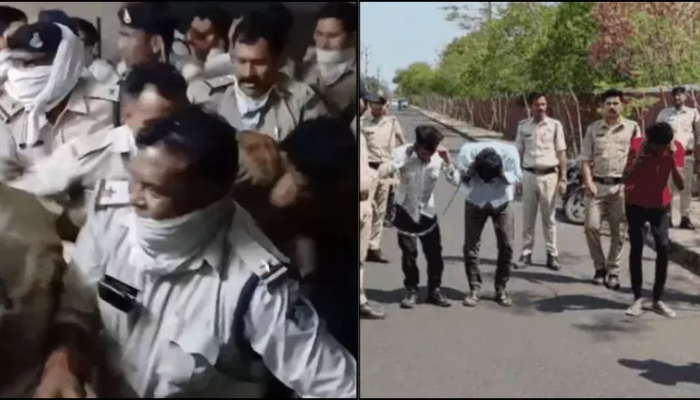
A Muslim gang that trapped and raped Hindu girls in Bhopal, Madhya Pradesh, was assaulted by attorneys. The Muslim gang’s boys were taken to court in saffron gamchas which infuriated the lawyers. The cops also organised a procession with the perpetrators before to their arrival. The accused preyed on Hindu girls. Two Muslim girls also used to assist the group, according to the case’s investigation. On the evening of 28th April, Farhan Khan, Ali Khan and Sahil Khan, members of the Muslim gang were taken to the court.

The proceedings regarding their case continued until 6 pm after which the police began to escort them back. During this process, the sight of the saffron gamcha worn by the accused provoked anger among the lawyers present at the court premises. The latter also raised slogans and began to thrash Farhan and Ali, however, the police managed to intervene and successfully extracted them. The court has placed two accused in remand.

While escorting them to the court, the cops made them walk the entire distance and perform sit-ups on the street. Hindu groups also attempted to assault the three individuals during their medical examination at the hospital, in Bhopal, but they managed to escape. Consequently, the police had to conduct their medical checkup twice. It has also been revealed that Ali attempted to flee from the police, resulting in a broken leg.

Currently, the police are conducting a probe into the Muslim girls associated with the boys from this Muslim gang. Authorities have identified two such individuals. These girls acted as intermediaries for the Muslim boys, facilitating friendships with Hindu girls. According to media reports, one of the girls has been employed at a cosmetics store. She would encourage Hindu girls who went to the shop to attend Sahil’s dance class.

She specifically targeted economically disadvantaged Hindu girls and urged them to engage in sexual relations with Sahil in exchange for waiving the class fees. It has come to attention that Muslim girls have forced Hindu victims to wear burqas, participate in fasting (Roza) and exerted pressure for marriage and conversion. The police are conducting an inquiry to uncover further details.

Background of the case

The Bhopal incident bears startling resemblance to the Beawar case, where a group of Muslims similarly targeted Hindu girls. In the present matter, an FIR was lodged on 18th April, revealing that Farhan Khan had targeted a female student enrolled in his college. Five official complaints have been registered in this matter, implicating twelve individuals. Subsequently, he sexually exploited her and began to intimidate her by recording the incidents on video.

Later, he pressed the victim into introducing her friends to Sahil and Ali. When she complied out of fear, Sahil and Ali summoned the other two girls to various locations, where they also sexually exploited them during the initial meeting and recorded the encounters. The three perpetrators then pressured the girls to convert to their religion and persistently urged them to marry. The accused regularly demanded money from the girls.

The investigation has uncovered the names of other individuals, such as Faizan, Mohammad Ali, Abrar Khan, Hamid, Arshad, and Siraj. A victim recounted being compelled to watch pornographic material, facing physical violence in the car if she did not obey. She was threatened with a knife against her neck. She was even pressured to embrace Islam and marry. The victims disclosed that they were raped after being made to ingest marijuana. The police are executing raids in several areas of Madhya Pradesh as well as Bengal and Bihar.

Bangladesh: Hindus continue to suffer as temple demolished, plans underway to replace 200 year old crematorium with ‘cattle market’

On Sunday (27th April), Hindus living in Uchakhila Union in Mymensingh district of Bangladesh staged a protest against the vandalism of an under-construction temple by Muslims and attempts to turn a 200-year-old crematorium into a ‘cattle market’.

According to reports, the Upazila Nirbahi Officer (UNO) of Ishwarganj upazila named Mohammed Ershadul Ahmed has been eyeing to demolish the Hindu temple and crematorium and build a cattle market instead.

While speaking about the matter, a local Hindu leader named Pintu Chowdhury informed that the crematorium in Uchakhila Union is 200 years old. He added that the construction of a temple was underway adjacent to the crematorium.

Chowdhury informed that the UNO ordered the demolition of the temple on Saturday (26th April) and has announced shifting of the crematorium to another site.

He emphasised, “The crematorium and the temple cannot be shifted…The followers of Sanatan Dharma are angry and hit the streets in protest today.”

Another local Hindu leader named Paresh Saha said that a ‘group’ had been threatening to evict Hindus from the place. He stated that the crematorium is being filled with sand to build a cattle market. “On Saturday, they demolished the pillars of the temple,” he pointed out.

The secretary of the Bangladesh Puja Udjapan Front, Bijoy Mitra Shuvo, said that no administrative action was taken to stop the demolition despite prior imitation by Hindus.

UNO Mohammed Ershadul Ahmed downplayed the entire incident by claiming the destruction of temple pillars happened ‘inadvertently.’

In the meantime, local Muslim groups such as the Ishwarganj Upazila branch of the Islamic Movement are pretending that nothing has happened. During a press conference on Monday (28th April), they claimed that there was no truth to the demolition of the temple and crematorium.

Attack on Hindus in Bangladesh since the ouster of Sheikh Hasina

OpIndia has been vetting and reporting cases of atrocities on Hindus since the ouster of Sheikh Hasina on 5th August 2024.

There have been at least 205 attacks on Hindu temples, shops and businesses within 3 days of the fall of Dhaka.

We previously exposed how Muslim students have forced as many as 60 Hindu teachers, professors and government officials to resign from their positions.

Human rights activist and exiled Bangladeshi blogger, Asad Noor, has recently revealed that the minority community is now being coerced into joining ‘Jamaat-e-Islami’.

On 6th September, a procession of Hindu devotees carrying the idol of Lord Ganesha came under attack in the Kadam Mubarak area in Chittagong city of Bangladesh.

Ahead of the Durga Puja celebrations, a radical Muslim man named Yasin Mia vandalised the idols of Goddess Durga and other Hindu deities in Gouripur town in the Mymensingh district of Bangladesh on 25th September.

In the latest series of attacks, idols of Goddess Durga and other Hindu deities were vandalised at the Rishipara Barwari Puja Mandap and the Manikadi Palpara Barwari Pujamandap on 28th September and 1st October respectively.

The attacks were carried out in Sujanagar upazila in Pabna district in Rajshahi Division of Bangladesh. While a total of 4 idols were defaced at the Rishipara Barwari Puja Mandap, another 5 Hindu idols were destroyed at the Manikadi Palpara Barwari Pujamandap.

On 3rd October, 7 idols of Hindu deities were destroyed at the Gopinath Jiur Akhara Durga Puja mandap in Kishoreganj, Dhaka Division, Bangladesh.

On 5th November, the Hindu community came under attack from police and law enforcement authorities in Hazari Goli in Chittagong city of Bangladesh.

On 29th November, a violent Muslim mob attacked Hindu minorities and vandalised 3 temples in Patharghata in  Chittagong district of Bangladesh.

The Hindu religious sites that the Muslims targeted included the Shantaneshwari Matri Temple, the Shoni Temple, and Shantaneshwari Kalibari Temple. The attack took place immediately after the conclusion of Jumma Namaz. 

On 30th November, a prominent Hindu journalist named Munni Saha was arrested by the police from Karwan Bazar in Dhaka city of Bangladesh.

A group of extremists attacked the Mahashmashan Kali Mata Mandir, vandalised 7 idols of deities and stole gold ornaments on 13th December 2024.

On 19th December, a Muslim man identified as Alal Uddin vandalised an idol at the Polashkanda Kali Temple and then attempted to create a fake alibi. The incident occurred in Haluaghat upazila in the Mymensingh district of Bangladesh.

Another 37-year-old Muslim man identified as Azharul vandalised several idols of deities in Haluaghat Upazila in the Mymensingh district of Bangladesh.

The recent arrest of Chinmoy Krishna Das Prabhu and his aides, attempts at banning Hindu organisation ISKCON and stiffling Hindu protests with cases of ‘sedition’ highlight systematic persecution under the interim government of Muhammad Yunus.

There have been multiple instances of attacks on Hindus under the pretext of ‘blasphemy.’ The recent cases of Hridoy Pal, Utsab Mandal, Partha Biswas Pintu, Akash Das, Pranta Talukder and Utsab Kumar Gian are shining examples of targeted persecution.

Pahalgam attack: Security forces confirm that terrorist Hashim Musa is a former Pakistan Army para commando

In a major revelation made in the Pahalgam terror attack, the security agencies have identified one of the terrorists involved in the attack as Hashim Musa, a Pakistani national and former para commando in the Pakistan Army. Hashim Musa has been working with the Pakistani Islamic terror outfit Lashkar-e-Taiba and was sent to Jammu and Kashmir to carry out terrorist attacks.

“It is possible that he was loaned by Pakistan special forces, like Special Service Group (SSG), to LeT,” an officer of the security establishment told TOI.

According to the authorities, Hashim Musa’s army background was confirmed during the questioning of 15 Kashmiri overground workers (OGWs). It is notable that these OGWs are being seen as key suspects in the Pahalgam attack probe for facilitating the Pakistani jihadis. They are accused of arranging logistics and helping in reconnaissance, hinting at the role of Pakistan’s ISI.

Other than the Pahalgam attack, Hashim Musa was also involved in the October 2024 terror attacks at Gagangir, Ganderbal, in which six non-locals and a doctor were killed, and at Buta Pathri, Baramulla, which left two army personnel & two army porters dead. In the Gagangir and Buta Pathri attacks, two local terrorists trained in Pakistan, Junaid Ahmad Bhat and Arbaaz Mir, were involved. The two jihadis, however, were killed in separate encounters by security forces in November and December 2024.

As the zipline operator chants ‘Allahu Akbar’ while Hindus are gunned down, the complicity of local Kashmiris in the Pahalgam massacre can no longer be denied

The valley of Kashmir, once romanticised as “Paradise on Earth,” has once again revealed its darker underbelly — not through whispers and accusations, but through cold, hard, horrifying evidence. A video, now viral across social media, shows a zipline operator in Pahalgam callously pushing a tourist into the jaws of death, while chanting “Allahu Akbar,” even as terrorists beneath opened fire on helpless visitors.

It is difficult to overstate the significance of what we witnessed in that clip. It shatters, beyond repair, the carefully cultivated liberal narrative of “Kashmiriyat” — the supposed culture of harmony and hospitality that Kashmir’s apologists dust off and present to the nation every time a terror attack stains the valley with blood.

In the video, the tourist — an innocent civilian who had come to soak in the famed Baisaran meadows — is hanging mid-air on the zipline, vulnerable and exposed. As gunfire erupts below, the natural instinct for any human being should have been to protect the person, to unhook him, to pull him back, to shield him from certain death. Instead, the zipline operator, a local Kashmiri, utters “Allahu Akbar” — a cry that, though sacred to many, has been appropriated by terrorists as a battle shout before bloodshed — and sends the tourist hurtling towards the carnage unfolding beneath.

This is no accident. It is not cowardice. It is complicity.

The tourist, identified as Rishi Bhatt, later recounted his suspicions against the zip line operator. He revealed that the operator did not utter the phrase when his family members took the ride earlier. He also mentioned that the terrorists were dressed like security personnel and that locals were among the first to flee the scene, offering no assistance to the victims.

For decades, a section of the Indian intelligentsia, media, and political establishment has laboured under the delusion — or perhaps the willful lie — that terrorism in Kashmir is the handiwork of a handful of “outsiders,” with the local population being mere helpless victims. The truth, however, has always been more sinister. Locals have been indispensable cogs in the machinery of terror: sheltering terrorists in their homes, providing logistics, conducting reconnaissance, helping transport weapons, and serving as eyes and ears for cross-border handlers.

Now, it seems, they have taken it a step further: actively pushing innocent tourists to the harm’s way.

What happened in Pahalgam is not an aberration; it is the logical culmination of years of indoctrination and radicalisation. For every terrorist who sneaks across the Line of Control, there are dozens of locals ready to embrace him, to feed him, to guide him, and — when the time comes — to help him slaughter civilians without remorse.

Sure, there are some locals like Syed Adil Hussain Shah who was martyred trying to snatch the weapons of terrorists and protecting the tourists. But let us not indulge in selective idealism: their numbers are tragically few, dwarfed by the overwhelming complicity or indifference displayed by the larger populace. Isolated examples of selflessness, while praiseworthy, cannot be used to whitewash the widespread and systemic support that terrorism enjoys among many local networks. The fact that terror attack took place over 200 kms away from the Line Of Control highlights the support the terrorists might have received from local population.

The myth of “Kashmiriyat” has been weaponised to silence critics, to paint any discussion about local complicity as bigotry. But the gruesome reality playing out again and again in the valley demands honesty. It demands that we discard the rose-tinted glasses and see Kashmir for what it has become: a region where a substantial portion of the population is either actively aiding terrorism or turning a blind eye to it.

Even those condemning the attack are doing so because it is affecting their daily livelihood. Why are Kashmiri leaders not talking about suspected local involvement in the scale of attack witnessed in Pahalgam on April 22? There is either chilling silence — the same silence that has accompanied thousands of terror attacks, bomb blasts, targeted killings, and pogroms over the decades or recriminations—blaming the Centre for security lapse, conveniently sweeping under the rug the fact that terror support from across the border and some level of complicity engineered the Pahalgam attack.

Every year, crores of taxpayer rupees are poured into the valley under the garb of “development,” “healing,” and “reconciliation.” And yet, time and again, when the bullets fly and the bombs explode, we find locals not standing with India, but with its enemies. Before the abrogation of Article 370, a large section of Kashmiri youth in sensitive regions took to stone pelting, often to disrupt army cordon and give a cover fire to help terrorists escape. With the Article 370 abrogated and a severe clampdown on terror finance, the anger against armed forces seems to have gradually diverted towards civilians and tourists.

The complicity of the local populace is the open secret that our liberal commentariat refuses to address. It is easier to blame Pakistan — and to be sure, Pakistan’s role in fomenting terror is undeniable — but cross-border infiltration would mean little without a willing support system on the ground. It is the locals who act as the extended arms of these handlers, making attacks like Pahalgam possible.

The incident at Pahalgam should be a wake-up call. India must recalibrate its approach towards Kashmir, shedding the illusions that have allowed this betrayal to continue unchecked. Security forces need to be empowered, intelligence networks must be more ruthless, and the web of local support to terrorism must be systematically dismantled.

Above all, the Indian public must reject the sickly-sweet sermons about “Kashmiriyat” and demand accountability. Sentimentality and imaginary constructs like ‘Kashmiryat’, designed to make us oblivious to the impending dangers has cost us too many lives already.

The face of the zipline operator sending a man to a carnage unfolding below, should be seared into the national consciousness. It is a reminder that not every local in the valley is innocent, and not every hand extended is meant to save.

Some hands, as we saw that day, are pushing us into darkness.

From Alexander using Jhelum River in 326 BC to dams and flooding in modern world: How rivers have been weaponised to win wars and gain tactical advantage

It was 326 BC. Alexander stood on the banks of the Jhelum River, known as Hydaspes at that time, and plotted a masterstroke against King Porus of Punjab. Porus was confident that the swollen river would shield him from attack as he waited on the opposite shore with war elephants.

However, under the cover of darkness and storm, Alexander’s troops moved upstream and forded the raging waters. Alexender kept sending troops slowly every night while projecting as if he was waiting for the river to cool down. They caught Porus’s army in a deadly fight at dawn one day. The young Macedonian conqueror snatched victory from Porus’s hands by turning the river into an unexpected ally and wrote his name into history. This little lesson of history shows that rivers have been weaponised to win wars and gain tactical advantages — and today’s times are no different.

The Indus Waters Treaty – Water as leverage in South Asia

Fast forward over two millennia, and the strategic use of rivers is still very much alive. In April 2025, India announced that it would suspend the Indus Waters Treaty (IWT) with Pakistan. It is a 63-year-old water-sharing pact which, interestingly, survived multiple wars between the arch-enemies, India and Pakistan.

The drastic move came after Pakistan-sponsored terrorist organisation Lashkar-e-Taiba’s offshoot, The Resistance Force (TRF), killed 27 innocent tourists in Pahalgam, Jammu and Kashmir. The terrorists associated with TRF questioned the tourists if they were Hindus or Muslims. They forced them to read the Kalma and checked if they were circumcised. If the victims failed in any test, they were shot dead by the terrorists, who left the women and killed only men. When one of the victim’s wives dared the terrorists to shoot her as well, one of the terrorists told her to “Tell Modi”.

Source: Leaflet

The devastating Pahalgam terrorist attack sent shockwaves across India. The Government of India, while accepting there was a security lapse, initiated several steps to counter-attack Pakistan on every front. India suspended visas issued to Pakistani nationals and started deporting Pakistanis living in India, even if they had come on medical visas. Only persecuted Pakistani Hindus were exempted. In one of the strongest moves, India suspended the IWT with Pakistan and hinted it might turn off the tap of the Indus basin rivers until Islamabad reins in cross-border terrorism.

Pakistan reacted with outrage and said that if India suspended the water supply, it would be an act of war. The hostile neighbour vowed to respond “with full force” if India choked the rivers. Pakistan is a downstream nation. It acutely depends on the Indus and its tributaries for agriculture, power, and drinking water.

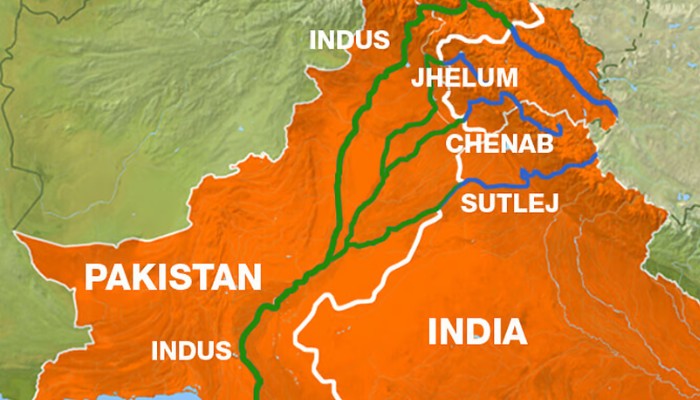
India, which is an upstream nation, possesses a natural hydrological high ground. The Indus’s headwaters and five major tributaries flow from the Himalayan mountains in India into Pakistan. In theory, India has the power to control how and when water flows across the border.

Pakistan is well aware of the situation and, interestingly, it was Pakistan which benefitted from the IWT that was signed in 1960. Under the treaty, the eastern rivers were allocated to India and the western rivers, including the Indus, Jhelum and Chenab, to Pakistan. India promised, under the treaty, that it would never restrict the water. However, as India has now suspended its participation, with negligible chances of retracting from the decision, New Delhi has indicated that this promise has been withdrawn. In simplest terms, it is a potent form of pressure short of armed conflict.

Notably, this is not the first time India has warned of suspending the treaty. In 2016, Pakistani terrorists affiliated with the Jaish-e-Mohammed terrorist outfit attacked an army base in Jammu and Kashmir’s Uri and killed 19 soldiers. Around 30 were injured. At that time, Prime Minister Narendra Modi, who was in his first term as the PM, warned that “blood and water cannot flow together,” implying the Indus pact could be scrapped if violence continued.

In 2019, after India abrogated Article 370 in Jammu and Kashmir, New Delhi came close to unilaterally walking away from the treaty. However, India held back at that time. This year, India has put the IWT actively on hold. Notably, India is yet to divert or stop Pakistan’s share of water. However, the message is clear: India has the power to choose the right time to stop the water, and Pakistan will have no power to do anything to stop New Delhi from doing it.

Indus waters have become a bargaining chip for India, which already has higher stakes in the Global South. India has friendly relations with most of the South Asian countries. Pakistan, on the other hand, is struggling financially. The hostile neighbour keeps begging Middle Eastern countries for funds to run the country and is currently under a lot of debt.

From electricity to basic food items like flour and tomatoes, everything is getting more expensive every day in the country. Still, Pakistan thinks it can afford a full-fledged war with India — that too when India has the power to control the water flow to over a majority of its agricultural fields. India’s upper hand in controlling the water flow is a clear example that rivers, like armies, can be marshalled for geopolitical advantage.

Ukraine – Flooding the frontlines of war

Water has proven to be a decisive force in 21st-century conflicts. When Russia launched its military attack on Ukraine in 2022, Kyiv weaponised rivers and dams to stall the Russians. In the early weeks of the war, Ukrainian engineers breached a Soviet-era dam on the Irpin River northwest of Kyiv. They deliberately flooded around 13,000 hectares of wetlands. Several villages, like Demydiv, were submerged, creating a swampy barrier that stopped advancing Russian tanks. Though dozens of homes and vast farmland were lost, the strategy saved Kyiv from the initial attack. Irpin was hailed as the “Hero River” that helped defend the city.

Source: Reuters

Interestingly, Russia later adopted similar tactics. In September 2022, retreating Russian forces launched a missile strike on a dam in Kryvyi Rih. It caused the Inhulets River to overflow and parts of the city were flooded. Water levels rose to 2.5 metres. Zelenskyy, who had used rivers to his advantage earlier, called Russia’s move a “vile act of terror”.

The Nova Kakhovka dam disaster

Ukraine’s strategy did not end well for the country. In June 2023, it reached a devastating peak. In the early hours of 6 June, an explosion ruptured the colossal Nova Kakhovka dam built on the Dnipro River in southern Ukraine. It was a 30-metre-tall and 3.2-kilometre-long dam. Following the rupture, the dam collapsed, unleashing a torrent that swept through tens of thousands of hectares of low-lying towns, villages and farmlands.

Source: CNN

Ukraine claimed that the dam collapse put the lives of 42,000 civilians in danger, leading to mass evacuation. Everything, including houses, bridges, and roads, was destroyed. Livestock drowned. Zelenskyy claimed that hundreds of thousands lost access to safe drinking water overnight. Around 500,000 hectares of prime farmland might turn into desert because of the disaster, experts said.

Ukraine accused Russia, which controlled the dam, of blowing it up to slow Ukrainian forces from counteroffensive across the Dnipro. Ukraine’s Foreign Minister, Dmytro Kuleba, called it a war crime of “ecocide”, citing long-term civilian and environmental damage. However, Russia categorically denied the accusations and blamed Ukraine instead. Regardless of the blame game from both sides, the result was catastrophic for Ukraine, turning the river into a weapon of mass disruption.

Turkey’s dam offensive on the Tigris–Euphrates

Not all water wars involve bombs and sabotage. Some are waged using concrete and control valves over decades. For example, Turkey used its position at the headwaters of the Tigris and Euphrates rivers to project power downstream. Its actions created chronic tensions with Iraq and Syria.

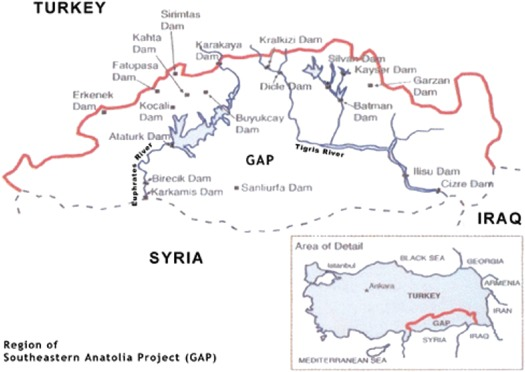
Turkey has built 22 dams and 19 hydroelectric plants across the Tigris-Euphrates basin under its ambitious Southeastern Anatolia Project (GAP). Initially, the aim was to boost irrigation and energy. However, with the vast number of dams and hydroelectric plants, Ankara now has a powerful grip over two rivers vital to its neighbouring countries.

Source: Researchgate

The impact of Turkey’s control has been dramatic over the years. Ankara has the power to throttle the water flow and cause severe shortages downstream without firing a bullet. Iraq relies heavily on the Tigris and Euphrates for at least 70% of its freshwater. In recent decades, it has seen river levels plunge dramatically because of Turkey’s actions.

There are other reasons why water levels have plunged, such as climate change and drought, but Iraqi officials primarily blame Turkish dams. Research has suggested that the combined discharge of the rivers into Iraq has dropped by 50%, mostly due to upstream diversions by Turkey.

Coming to Syria, 90% of the Euphrates’ volume originates from Turkey. While Ankara claims the projects were not intended to harm anyone, it has controlled the water flow, gaining undeniable leverage. Turkey’s dam network has quietly become a slow weapon of attrition, taming rivers that once nourished the cradle of civilisation into tools of modern geopolitics.

The Nile’s dam dispute – GERD and regional fallout

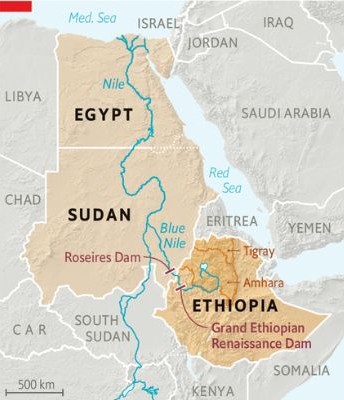
Similarly, Ethiopia’s Grand Ethiopian Renaissance Dam (GERD) has become a flashpoint of geopolitical altercations between Egypt and Sudan. GERD is located on the Blue Nile near the Sudanese border and is Africa’s largest dam. It symbolises Ethiopia’s aspirations. However, for Egypt, which lies 2,500 kilometres downstream, the dam poses an existential threat. The Nile is the source of 97% of Egypt’s freshwater. The uninterrupted flow is vital for its survival.

Source: ET

Diplomatic efforts around GERD have repeatedly failed. Ethiopia insists it has every right to harness the Blue Nile. In 2023, it completed another phase of reservoir filling while beginning electricity generation. Egypt tried to negotiate, involving the United States and the World Bank, to reach a compromise on how quickly Ethiopia should fill and operate the dam. However, the talks failed.

Egypt believes that a rapid or unilateral fill could drastically curtail its water supply, particularly during drought years. In late 2023, when another round of negotiations failed, Egypt warned it “reserves the right” to defend its national security if harmed by GERD.

Initially, Sudan was hopeful of benefits like flood regulation. However, as time passed, it started sharing concerns with Egypt about dam safety and sudden water release risks. So far, no conflict has erupted, but that does not mean GERD cannot become another weapon of mass disruption in the 21st century.

International law against the weaponisation of water

In theory, weaponising water or manipulating rivers has no place in modern warfare. International law prohibits it. Additional Protocol I of the Geneva Conventions (1977) forbids methods of war causing “widespread, long-term and severe damage” to the environment and bars attacks on dams or dykes if such attacks could unleash dangerous forces and harm civilians.

Destroying water infrastructure to drown cities or starve populations is categorised as a war crime under international humanitarian law. On paper, these rules exist. They should prevent deliberate floods and dam bombings. However, in practice, strategic interests often override legal obligations.

Major powers have frequently ignored these laws. Neither the United States nor many other key military powers ratified Protocol I’s provisions concerning dams. In 2019, Russia, which had previously signed the document, formally withdrew its recognition of those obligations before initiating military action against Ukraine.

Conclusion

While changing river flows, stopping water, or releasing sudden influxes into rivers can be deemed as indirect warfare, weaponising water remains a significant alternative for nations seeking strategic advantage. By redirecting rivers or destroying dams, states can cripple an enemy’s food supply and economy, leading to a collapse in morale.

The damage often unfolds slowly, masked as “natural” disasters. As seen from the Indus to the Dnipro, such water wars can haveserious impact. From Alexander’s stormy crossing of the Jhelum to modern dam collapses, history shows that whoever controls the water often controls the war.

From ‘Hindutva policies led to attack’ to ‘clean chit to Pakistan’ to ‘no religious profiling’, shocking reactions of Congress leaders and sympathisers to Pahalgam attack

In Jammu and Kashmir’s Pahalgam, 26 innocent Hindu tourists, were brutally killed by the Islamic terrorists belonging to The Resistance Force, a Pakistani terror outfit, Lashkar-e-Taiba’s offshoot. As seen in the testimonies of the survivors, the Pakistan-sponsored jihadis targeted Hindu tourists based on their religious identity, checked their IDs, demanded recitation of Kalma, and even coerced male tourists to take off their pants to check for circumcision to ensure only Kafirs are killed by them.

Yet, several Congress and opposition leaders have unleashed a rhetoric that essentially downplays the anti-Hindu nature of the attack. Out of nowhere, even in an act of violence against Hindus perpetrated by Islamic terrorists, these Muslim-appeasing political leaders have managed to paint Muslims as victims. Apparently, for Indian ‘secularists’, terrorism has no religion, but ‘fear’ among Muslim minorities skyrockets dramatically when people criticise Islamic terrorists for killing Hindus for being Hindus.

OpIndia has brought to its readers a compilation of all statements given by political leaders, which essentially deflect the anti-Hindu nature of the Pahalgam terror attack.

Congress leader Saifuddin Soz advocates for blindly accepting Pakistan’s denial of role in the Pahalgam attack

Former union minister and Congress leader Saifuddin Soz, on 28th April, said that if Pakistan denies its role in the Pahalgam terror attack, India should take its word. In his misplaced outpouring of sympathy, Soz went as far as to oppose the Indian government’s decision to put Pakistan’s “lifeline”, the Indus Water Treaty, in abeyance.

“For Pakistan the water is very important for irrigation and drinking purposes. If the river water cannot be diverted, the states of Punjab and Jammu and Kashmir will be totally submerged. The Indus Water Treaty has survived the wars between India and Pakistan. This water treaty is a lifeline for Pakistan. If Pakistan takes a stand that they are not involved in the Pahalgam attack, then we should accept Pakistan’s word,” Soz said.

Congress MLA Vijay Wadettiwar casts aspersions on the religious profiling of Hindu tourists

Maharashtra Congress MLA Vijay Wadettiwar also attempted to downplay the angle of ‘religious profiling’ and attempted to shift the blame of the terror attack elsewhere. “The government is saying that terrorists killed people after asking them (about their religion). Do terrorists have time for all this?” he cast aspersions on the victims’ testimonials.

“Some people say that this did not happen. Terrorists have no caste or religion. Catch those who are responsible and take action. This is the sentiment of the country,” Vijay Wadettiwar further mouthed platitudes to protect his vote bank.

Mani Shankar Aiyar gives clean chit to Pakistan, says these are ‘unresolved issues of partition’

Veteran Congress leader Mani Shankar Aiyar has pretty much given a clean chit to Pakistan for the attack. The Congress leader said that unresolved issues of partition are the reason for the terrorist attack.

Aiyar said, “Many people almost prevented partition, but it happened because there were differences in value systems and assessments of the nature of India’s nationhood and its civilisational inheritance between people like Gandhi and Pandit Nehru… and Jinnah and many other Muslims who did not agree with Jinnah. But the fact is, that Partition happened and till today, we are living with the consequences of that partition.”

‘Terrorists would not have asked religion’: Karnataka Congress minister R B Thimmapur

On Saturday (26th April), Karnataka Congress Minister R B Thimmapur courted controversy after he attempted to downplay the religious profiling of Hindu victims by Islamic terrorists during the Pahalgam terror attack. R B Thimmapur, who serves as the Excise Minister in the Congress-ruled State, alleged, “The perpetrators of the attack in Pahalgam would not have asked the name and the religion of victims.”

“I personally don’t think the assailants would have asked the name and religion of the tourists…It is just to add religious colour to cover up intelligence failure,” he brazened out. R B Thimmapur said this while interacting with the media in Bagalkot in Karnataka.

There undoubtedly has been a security lapse, but that does not negate the religious nature of the terror attack. Congress leader giving his ‘personal opinion’ discrediting the accounts of survivors, shows his desperation to use even a heinous crime against Hindus to appease the Muslim votebank.

Karnataka Congress leader M Lakshmana accuses Modi government of ‘politicising’, claims Muslims were also killed

Karnataka Pradesh Congress Committee leader M Lakshmana on 25th April, accused the Central government and the BJP of politicising the Pahalgam terror attack. Akin to the narrative being peddled by his fellow party leaders, Lakshmana claimed that the Central government is approaching the Pahalgam attack on religious lines.

He went on to claim that Muslims were also killed in the attack, insinuating that it was a ‘secular’ terror attack. While a Muslim man, Syed Hussain Shah, was also killed by the terrorists while trying to save tourists, he was collateral damage and was not confronted by the Jihadis the way Hindu tourists were.

Robert Vadra justifies the terror attack in Pahalgam, said ‘Hindutva policies’ made Muslims uncomfortable

Robert Vadra, a businessman and husband of Congress MP Priyanka Vadra, courted a controversy after he tried to rationalise the terror attack in Pahalgam, stating that it was the Hindutva policies of the current government that drove a wedge between the Hindus and Muslims and ultimately led to the attack.

“I feel terrible and my deepest condolences are for the people who have died in this terrorist act…In our country, we see that this government will talk about Hindutva, and the minorities feel uncomfortable and troubled…If you dissect this terrorist act that took place, if they (terrorists) are looking at people’s identity, why are they doing this? Because there’s a divide that has come about in our country with Hindus and Muslims…This will make these kinds of organisations feel that Hindus are causing a problem for all the Muslims,” Vadra said.

“Looking at identities and then killing somebody, that’s a message to the PM, because Muslims are feeling weakened. The minorities are feeling weakened…This has to be coming from the top that we feel secure and secular in our country, and we will not see this kind of act happening,” he added.

Jammu and Kashmir Congress leader Tariq Ahmed Karra bats for talks with Pakistan

Another Congress leader who went soft on Pakistan despite the hostile neighbour not only sponsoring cross-border Islamic terrorism but also repeatedly issuing nuclear threats against India, is JPCC leader Tariq Ahmed Karra. The Congress leader sympathised with Pakista,n saying that India should avoid a water war with Pakistan and initiate talks to resolve the dispute. He said that India and Pakistan “should keep their cool”.

Karnataka CM Siddaramiah says ‘there’s no need for war’, Pakistani media uses his statement to attack Indian government

After the Pahalgam attack, when journalists asked Karnataka Chief Minister and Congress leader Siddaramaiah how tough a stand India should take against Pakistan, he said, “There is no need for war with Pakistan. We are not in favour of war. We should take strict steps and strengthen our security.”

Predictably, Siddaramiah’s video statement went viral on Pakistani social media and was widely used by Pakistani media with claims that voices are being raised within India against the government of India. Although Siddaramiah issued a clarification amidst backlash, however, the damage was irrevocably done.

Congress issues warning to its leaders amidst outrage over toeing Pakistan’s narrative

While Congress is facing the blunt end of public ire, the party’s top leadership, including party president Mallikarjun Kharge and Rahul Gandhi, are reportedly upset with their own leaders for their outrageous remarks on the Pahalgam terror attack. The party leadership is reported to have told its leaders to toe the party line. The Congress earlier stated that it stands with the Indian government in whatever action it decides to take against Pakistan.

Congress General Secretary Jairam Ramesh, who has become habituated to publishing X posts and statements with ‘xyz leader’s statement does not reflect Congress’s views’, issued a clarification (read damage control) saying that statements made by individual leaders did not reflect the Congress party’s position.

Leaders from other parties joined Congress leaders in parroting Pakistan’s narrative

On 26th April, the Trinamool Congress leader Marjina Khatun attempted to shield the Islamic terrorists by shifting the blame on the BJP. While speaking to the media in West Bengal’s Malda, she alleged, “BJP carried out this attack to divert the public from the new Waqf law. BJP provides safe haven to terrorists. This was why there was no army personnel there”  

“The elections in Bihar are near. This is why the BJP is trying to create a communal environment,” Khatun resorted to peddling conspiracy theories to defend the Islamic terrorists. Marjina Khatun is the district council member and block President of the Trinamool Congress.

Notably, OpIndia had previously reported how the locals did not notify the security agencies, and the administration allowed tourist movement in the Baisaran area.

Sujata Deo,  the Rajya Sabha MP belonging to the Biju Janata Dal (BJD), whitewashed Islamic terror, saying that terrorists had no time to ask the religion of tourists before killing them, as if they coordinated with her about how they plan to go about killing Hindu tourists. As if discrediting the testimonies of the survivors of the Pahalgam attack, the BJD leader went on to claim that terrorism is never about religion.

“The number of people that died and the time it took to kill them, it is not at all possible to ask about religion or check religion in that time. This is all speculation. No terrorist ever asks for anyone’s religion. Terrorists are never connected to religion,” she said.

Diluting the anti-Hindu nature of the Pahalgam terror attack: Opposition playing with fire for political opportunism

It is pertinent to understand why calling the Pahalgam terror attack an act of Islamic terrorism is paramount. It is not that people are mindlessly blaming all Muslims; it is also not that non-Muslims, particularly Hindus, are somehow conspiring to slander the Muslim community. The fact is, the terrorism unleashed in Pahalgam on 22nd April 2025, was essentially rooted in the Islamist hatred for non-Muslims, especially the worst of the Kafirs—Hindus.

While India-Pakistan animosity is not devoid of geopolitical issues, the core problem is religious differences. India was partitioned on Islamic lines. Even after over seven decades of partition, the Pakistani Army chief Asim Munir finds the religious differences between Hindus and Muslims as a defining feature of India’s partition and Pakistan’s creation. Pakistani establishment’s hatred for India is rooted in their hatred for Hindus, along with hatred for other non-Muslim communities as well.

All the Pakistani terror outfits are armed jihadist groups driven by the Islamic theology of establishing Islamic supremacy over non-Muslims and their nations. Every terror attack, be it the Pahalgam, Pulwama, Pathankot, or 26/11 Mumbai attacks wherein Pakistani jihadi Ajmal Kasab wore a Kalava to peddle the ‘Hindu terror’ bogey, these attacks were not just attacks on India, the Islamic terrorists are not driven by regional or national hatred, their fuel, their sole motivation is hatred against Kafirs and their Dar-ul-harb. If this discussion comes across as hateful to you, then understand that the source of ‘hate’ lies in the ideology of the Islamic terrorists. Thus, it is essential to say that terrorism has a religion when religiosity is involved, when jihadis shoot down over a dozen Hindu tourists, a Christian for failing to recite Kalma, for not being a Muslim,  for simply existing, then it is Islamic terrorism. Terrorism cannot be ended until we, as a nation, as a civilisation, acknowledge the source of hatred that drives Jihadis to kill non-Muslims for not being Muslims, as well as killing Muslims for not being Muslim enough.

By downplaying the anti-Hindu nature of the Islamic terrorist attack in Pahalgam, Congress leaders or other political parties are not only mocking the victims of the attacks, discrediting victim testimonials, but also secularising Islamic terrorism and being useful idiots for Pakistan.  The survivors of the Pahalgam attack have confirmed that the Pakistan-backed Jihadis asked them to recite Kalma, checked for circumcision since Muslim men undergo circumcision, Hindus don’t, and shot them dead only after confirming their Hindu or non-Muslim identity.

Saying that Pahalgam attack, based on religious profiling, happened because Indian Muslims feel weakened because of Hindutva, as said by Robert Vadra, amounts to blaming Hindus for getting killed by Islamic terrorists. It also presents the entire incident as, Pakistan-backed Islamic terrorists were forced to carry out killings of Hindus because Indian Muslims were feeling weakened and terrified due to Hindutva. His rhetoric inverts cause and effect. Pahalgam attack was a jihadist attack orchestrated by a Pakistan-backed terror group with a clear anti-Hindu agenda. Vadra’s statement is literally legitimising terrorism by suggesting that violence against Hindus is a justified and rational response to the imaginary grievances of the Muslim community.

A Christian victim, Sushil Nathaniel, who was shot dead by Jihadis, was asked if he knew about Palestine, when the former said that he did not know Kalma since he is a Christian. If this is not Islamic religious terrorism, what is? Robert Vadra should elaborate on how many Muslims Sushil Nathaniel was oppressing in India that Pakistani terrorists had to come and kill him. This contention that calling the Pahalgam attack an anti-Hindu, anti-Kafir attack would terrify the entire Muslim community is wrong, although it should trigger introspection.

While criticising the government is not wrong, however, deflecting responsibility from the perpetrators and their religious-ideological drivers, and instead blaming India’s religious-political dynamics and government, shows that even the massacre of Hindus is just a political issue to target the government in power.

While politicians have their own agenda behind shielding Islamic terrorism, whitewashing Jihad against Kafirs and prioritising political opportunism over national interest, it is high time for Hindus and all non-Muslim communities to understand, terrorism is not a Kashmir specific problem, 26/11 Mumbai attacks, Sri Lanka Easter bombing, and many more, terror has always had one religion, and it kills those who do not follow that religion. No mollycoddling, no appeasement, no amount of pandering to Islamists, can change the Jihadist imperative to wage war on Kafirs, sanctioned by the religious beliefs of Islamic terrorists. By diluting the religious angle in the Pahalgam attack, ‘secular’ politicians are weakening the fight against Pakistan-backed Islamist terror and undermining national unity. Suppressing the uncomfortable truth out of fear of backlash, offending Indian Muslims or for any reason, only perpetuates division within the country while also emboldening the Islamic terrorists.


Pahalgam terror attack: Zip-line operator chants ‘Allahu Akbar’ thrice as terrorists start firing bullets, pushes a tourist for the ride regardless, watch new video

A new video has emerged that allegedly shows locals involved in the Pahalgam terror attack. In the video, a zip-line operator pushes a tourist, identified as Rishi Bhatt, to take the ride while nonchalantly chanting “Allahu Akbar,” all amid the sound of gunfire in the background.

The video was recorded by the tourist himself as he sought to capture a breath-taking zip-line experience in the vast expanse of Baisaran meadows, unbeknownst of the terror attack underway. As the tourist preps himself for the ride, one can hear bullets being fired in the background. At the precise moment, the zipline operator casts his eyes in the direction from where the bullets were fired and chants “Allahu Akbar”, pushing the tourist for the ride regardless instead of unhooking him and asking him to run for his life.

“Allahu Akbar”, the operator chants thrice as he pushes Bhatt for the ride. The sounds of bullets could be heard as Bhatt begins his zip-line ride, with some people seen running for cover and falling on the ground after receiving bullets.

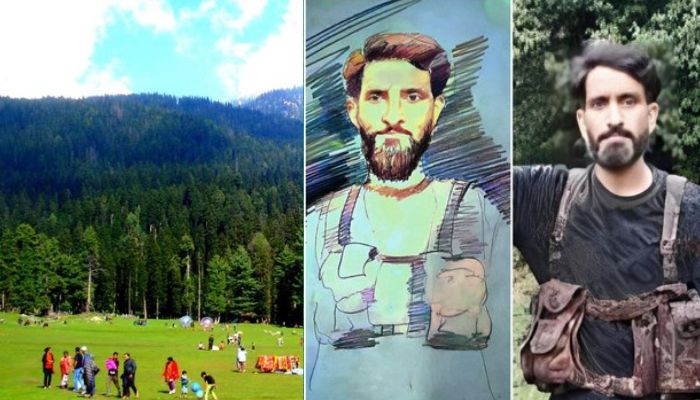
On April 22, 2025, tragedy struck the serene Baisaran Valley near Pahalgam, Anantnag district, when terror unfurled its darkest face. Five heavily armed militants, wielding M4 carbines and AK-47s, stormed an area popular with tourists, transforming a landscape of breathtaking beauty into a site of unspeakable horror. In a chilling display of brutality, the attackers reportedly forced victims to recite Islamic verses, coldly singling out non-Muslims before opening fire. Twenty-six lives were lost that day — including 25 Indian nationals, one Nepalese tourist, and a courageous local Muslim pony operator who tried to shield others — while more than 20 others were left injured and scarred forever.

The Resistance Front (TRF), a known proxy of the Pakistan-based Lashkar-e-Taiba, initially rushed to claim responsibility for the massacre, citing opposition to the Indian government’s policies encouraging non-Kashmiris to settle in the valley. However, in a twist that raised eyebrows, TRF hastily retracted its statement, blaming a supposed communication lapse. Investigations by Indian authorities unearthed damning digital evidence linking the attackers to operatives in Muzaffarabad and Karachi. As tensions soared, sketches of three suspects were made public and a nationwide bounty hunt was launched, sending a clear message that India would leave no stone unturned.

In the aftermath, India responded with decisive force. The government suspended the historic Indus Waters Treaty with Pakistan, closed land borders, and expelled Pakistani diplomats — bold moves that signaled a major diplomatic freeze. Pakistan, predictably, retaliated by halting visas for Indian nationals and sealing its airspace. Skirmishes flared along the volatile Line of Control, and global powers quickly condemned the attack, urging both nations to exercise restraint. Yet, amid the international appeals for peace, the blood spilled in Pahalgam served as a grim reminder of the fragile realities of the region, and of the steep price innocent people continue to pay.