Home Blog Page 480

‘Murtad’, ‘mocking Babri demolition’: Islamists attack actor Salman Khan for sporting a Ram Janmabhoomi edition luxury watch

Actor Salman Khan recently received Islamist backlash after he posted pictures for his upcoming movie, which is set to release this Eid.

“See you in theatres this Eid!” Salman Khan tweeted, sharing striking photos of himself rocking an orange watch while casually leaning on a car.

However, what truly stood out was the sleek gold-dial watch with an orange strap that he sported in the photos. 

The exclusive Ram Janmabhoomi watch comes with a staggering price tag of ₹34 lakhs. Previously seen on Abhishek Bachchan, this luxury timepiece is crafted by Jacob & Co. and is officially named the Epic X Ram Janmabhoomi Titanium Edition 2.

The Jacob & Co. timepiece seamlessly combines luxury with heritage, showcasing intricate engravings that honor the cultural and historical essence of Ram Janmabhoomi. Its dial features a finely crafted relief of the Ayodhya temple, while the bezel and face are adorned with sacred inscriptions of Hindu deities. With only 49 pieces available globally, this exclusive edition is now part of the actor’s collection.

Salman Khan’s Ram Janmabhoomi watch leaves Islamists red-faced

But no sooner did Salman share his pictures on X, a raft of Islamists descended on his Timeline, abusing and attacking him for sporting a Ram Janmabhoomi Titanium edition watch manufactured by Jacob and Company, the luxury jewelry and watch brand founded by Jacob Arabo, a Bukharian Jewish man who is often targeted by Islamists for his staunch support to Israel.

“Wearing a Zionist co Watch with Ram Janm Bhoomi edition mocking Muslims,” tweeted one of the Islamists, triggered by Salman’s pictures.

Yet another Islamist called Salman a “murtad”, an Islamic term for an apostate, for wearing a watch that celebrated Ram Janmabhoomi movement.

Another Islamist has called for a boycott of Salman Khan’s upcoming movie Sikandar, accusing the actor of “mocking the Babri demolition” and “anti-Muslim riots.” Ironically, the same individual, a vocal supporter of the Palestinian cause, failed to explain why the Ram Janmabhoomi movement—a reclamation effort similar to the one she endorses for Palestine—is unjust while the Palestinian struggle is legitimate.

Salman Khan’s Sikandar is a highly anticipated action thriller set to release on Eid 2025. Directed by A. R. Murugadoss and produced by Sajid Nadiadwala, the film promises a gripping storyline packed with high-octane action and drama. This marks Salman’s first collaboration with Murugadoss, known for his blockbuster films. Fans are eagerly awaiting the movie, which is expected to be a grand Eid spectacle.

Gujarat: Tribals are being converted, hundreds of churches come up but no mention in government records, Hindu activists of Tapi fear their existence will be erased

Dang and Tapi, two districts in the southeastern part of Gujarat, are deeply affected by the illegal conversion of unsuspecting tribals living in rural areas. Even though missionaries and churches have been active here for years and the conversion of Hindu tribals is happening at a rapid pace, this issue has not caught the attention of the mainstream media, nor has there been any discussion about it. That is the reason why such activities have found a wide field in the last few years. On the other hand, the issue is not getting the attention of the state government, and the local-level leaders are also facing questions. In this situation, the condition of the Hindu community is becoming difficult day by day.

Recently, Hindu saint Morari Bapu stirred up a debate across the state after he pledged to donate ₹1 lakh to every new school to curb religious conversions and also requested the state government ministers to pay attention to this serious issue. The ministers have assured to take strict action on this issue, but the situation on the ground, some statistics and the experiences of the locals indicate that if the government does not wake up or if awareness is not spread in the society, then very soon there will be such a change in the demography that it is even difficult to imagine and the seeds of it have already been planted. 

Leaders of Dev Birsa Sena, who have been active against religious conversions in Tapi for a long time, shed light on this entire nexus in a conversation with OpIndia. They have also accused local MLA Mohan Konkani, who is a leader of the Bharatiya Janata Party. Dev Birsa Sena leader Arvind Vasava says that in just a few years, about 1500 small and big churches have come up in Tapi, and most of them are illegal. Moreover, the number of people following the Christian faith here is increasing day by day, but government records do not show this. A war is being waged by Hindu organizations against this issue as well. They said that this vile activity will be controlled only if the converts are delisted.

Conversion is taking place through enticement, temptations and superstition

Arvind Vasava says that the entire Tapi-Songhar is a tribal area. However, 1500 churches have been set up there illegally. He has also claimed that Christian priests coming from different states organize various programs in this area, from public meetings to prayer meetings. His question is that legally, this entire area is a tribal area, no one has legally become a Christian there, yet, why are such programs being organized here?

Vasava alleged that the aim of various groups of missionaries is only to convert the naive tribals here to Christianity. They are converting the tribals to Christianity by giving various temptations, luring them and spreading superstition. No person has become a Christian legally. He says that despite the protection of tribal culture being provided by the Constitution, such a large number of churches have been built in tribal areas, and various programs are being organized.

MLA Konkani himself won the election on a tribal certificate- Dev Birsa Sena

Vasava further said, “Evidence is being repeatedly sought regarding religious conversions, MLA Konkani is also seeking evidence. But people who convert never do it in public. They do this privately in their discussions. But there are tribal communities in the entire South Gujarat, they are not Christians, so why were churches built in villages in districts like Tapi? What is the need for it in tribal areas? There are no legally registered Christians here.”

He further said, “We are tribals, so what is the need for Christian public meetings and big programs in our area? Why do Christian pastors, preachers and big people from different states come to hold meetings only here? There are no legitimate Christians here, so why come here? If there is a Christian in this area, show him a government record that he is a Christian. The country runs based on the Constitution, so if you follow another faith, then mention that in the government record too.”

He further alleged that the people converted to Christianity by missionaries are referred to as tribal Hindus in government books. They are also giving up all tribal culture, traditions and festivals. He said that even during the collection of contributions for tribal festivals, these converted Christians refuse. He sighed and said, “In this way, in the next second or third generation, both we and our culture will be extinct, our very existence will be erased.”

Moreover, he has accused MLA Mohan Konkani of patronizing Christian missionaries. Vasava claims that Konkani is a tribal in the government records and has become an MLA based on a Scheduled Tribe certificate. But currently, he follows the Christian faith. He alleged that Konkani openly encourages Christian missionaries by going to their programs.

MLA Konkani was the chief guest at a public event of Christians

This entire controversy has come to light due to a viral video of MLA Konkani. In the video, Konkani was seen giving a speech as the chief guest and speaker at a public program of the Christian sect. In this video, he was telling the people present there to bring other people to the Christian program as well. Dev Birsa Sena said that the MLA has openly encouraged missionaries in the public meeting and has asked them to bring other people there.

Regarding this incident, Vasava said, “The Konkani MLA himself does not convert people, but he encourages them and creates an atmosphere. There is a village called Haripura next to his village, where a church has been built on a hill and roads and lights have also been provided there. For whose glory is all this happening? In the public meeting of Konkani Christians, they say that if you bring other people here too, then that will encourage conversions.”

Vasava further said, “The video of MLA Mohan Konkani has gone viral, in which he is speaking in a clear Christian language and style. He is a devout Christian, and seeing that, many tribals are also moving towards him. In the Konkani video, words like Jesus Prabhu and Mother Mary are also mentioned. All this needs to be stopped soon, otherwise in 10 years the tribal existence will end in South Gujarat.”

Vasava further said that a big program of Christians has been going on in the Tapi district for three days now. He said, “We have spoken to the Mamlatdar, Collector and all the officials about this and submitted a complaint. We have also told the responsible persons of the BJP, and also contacted the office of Minister of State for Home Harsh Sanghvi. However, the program is going on openly. My society is being destroyed, and the administration is silent.”

Christians illegally occupy the tribal Kuldevi hills by removing the Hindu temple

Arvind Vasava also talked about a Hindu temple located on a hill in Niana Bandharpada village of Songadh taluka. He said that Gidhamadi Aya Dungar was the place of the tribal goddess Mata, and Hindus used to worship there. But over time, due to the rapidly growing population of Christians in this area, the movement of people on this hill gradually decreased and after that, Christian missionaries built their place there called ‘Mary Mata’s Temple’.

Arvind Vasava has said that today, tribals are not even allowed to enter that hill. Tribals cannot even see or worship their clan goddess. Christians have completely taken over the place. He claims that when tribals gather in large numbers to go to the temple for worship, they are expelled. Along with this, he gave the example of Haripura, near the village of MLA Konkani, he said that an illegal church has been built on the hill of Haripura, and it is claimed that it has a direct connection with Konkani.

What do tribal activists expect from the government?

Arvid Vasava of Dev Birsa Sena has urged the government, through OpIndia to stop the efforts of religious conversion in South Gujarat and to remove the illegal structures. He further requests that the government cooperate and listen to them to keep their culture alive. He said, “So that the culture of our tribals, our tradition, our language and our existence survive, you all should cooperate with us and stop such illegal activities at any cost. Today, there are many villages where only 10 tribals are left. The rest have abandoned the tradition of their forefathers and the Kuldevi.”

He said, “The people here have also joined hands with foreign forces to destroy tribal culture. Our only demand from the government is that our culture, customs and the legacy of our ancestors should survive, and our existence should continue. We make a clear appeal to the government to come to our side, help us…We don’t want anything.”

What did MLA Konkani say in the viral video?

BJP MLA Mohan Konkani went to address the Vanvasi community in a large gathering organized by the Christian community. The language used by Mohan Konkani in the viral video is alleged to be similar to that of a Christian pastor. He says at the beginning of his address, “In the name of the Lord Jesus Christ, I greet everyone with my love and thank God the Father for allowing me to speak.” He further mentions the word ‘John’ in his address and says, “John (who came before the birth of Jesus Christ, or was sent for the work of Jesus) wrote in the first chapter, “To all who received him and followed him, to them he gave the right to become children of God (Jesus Christ).”

Furthermore, he quotes the New Testament (the Christian Bible that came into existence after the Jewish Old Testament) and says that it says, “Come to me, all of you. I will give you rest. God has come here to do miraculous things, and he has accepted you people.” Finally, he also says, “This program is going to last for two more days, and you people have come, but now bring others too.”

What does MLA Konkani have to say?

Regarding this entire controversy, MLA Mohan Konkani told OpIndia that he is not encouraging any such conversion and if he is, then evidence should be presented and action should be taken. On being asked about going to a Christian meeting and telling the tribals, “You too come and bring others with you,” he said that as a public representative, he has to go to such programs and speak well there. He was asked, since there are no tribals legally in the Tapi area, why do the country’s biggest pastors and Christian preachers come there to hold meetings?

He replied that everyone in the country is free and can hold a meeting anywhere. If the police had permitted it, it would be more appropriate to ask the police about it. He also claimed that no application was given to him regarding this dispute. He was further questioned about the locals’ allegation that he was promoting Christian conversions in Andarkhan. In response, he said that even if it is happening in Andarkhan, evidence should be provided and action should be taken. Further, when we mentioned the Dev Birsa Sena, he said that he does not know of any such army.

Along with this, we gave voice to the local people and said, “Local people say that since the work is done secretly, there is no evidence. But a lot is coming to light even without proof. Your speech in the Christian meeting is also proof of this, in which you ask other tribals to come to the meeting.” Apart from this, the local people also raise the question that if nothing like this happens in Tapi, then why have about 1500 churches been built there and why are all Christian meetings held there? However, during the entire discussion, the MLA only talked about evidence, and instead of clearly denying his involvement, he talked about gathering evidence and taking action.

The sword of conversion looming over the tribals of South Gujarat

However, secretly Christian conversion programs and campaigns have been going on in South Gujarat and especially in Tapi-Dang for a long time. But after the statement made by Morari Bapu, a public discussion has started. Morari Bapu said that most of the teachers in this area are Christians, and they are converting tribal children to Christianity. After this statement, MLA Mohan Konkani refuted Bapu’s statement, and a few days later, he addressed a huge program of the Christian community. Since then, his video has been going viral, and the issue of conversion has gained momentum.

But the reality is that even before these incidents, Christian conversion was taking place on a large scale in the Tapi-Dang area. In December 2022, a Hindu temple was removed from Zarali village of Nana Bandharpada in Songadh, Tapi, creating a controversy. However, after the intervention of the police, Hindus got the right to worship, but they are still unable to go there. Local Hindus allege that they are being threatened by Christians and have been prevented from worshipping.

In the year 2022, 5 members of a family from Tapi were arrested. It was alleged that they had converted Hindu tribals to Christianity by misleading them. Apart from that, in July 2023, Bible readings were conducted on the occasion of Guru Purnima in a government school in Songarh, Tapi. After this incident, local Hindu organizations strongly protested and accused the school of promoting conversion. Apart from that, Christian pastors also visit Nijar, Tapi frequently, and the locals also oppose it.

Not only Tapi or Dang, but also in Navsari in South Gujarat, two Christian teacher couples were recently arrested. They were publicly insulting Hinduism and misleading people to spread Christianity. After their video went viral, the police also took action. Apart from that, in Dharampur-Kaprada of Valsad, there are allegations that big crosses and Christian settlements are being set up on hills and conversions are being done.

Apart from this, churches have been built in many Hindu societies and areas in Surat without any reason, and the Christian community goes there to pray. Ravi Nayak, a tribal activist associated with a social organization in Navsari, told OpIndia that a large-scale religious conversion campaign is going on in the rural areas of Navsari as well.

These are just a few cases that have come to light. Countless cases may have been suppressed somewhere, which may not have received coverage. Hindu organization activists say that if this issue is not addressed at the earliest, serious consequences can arise.


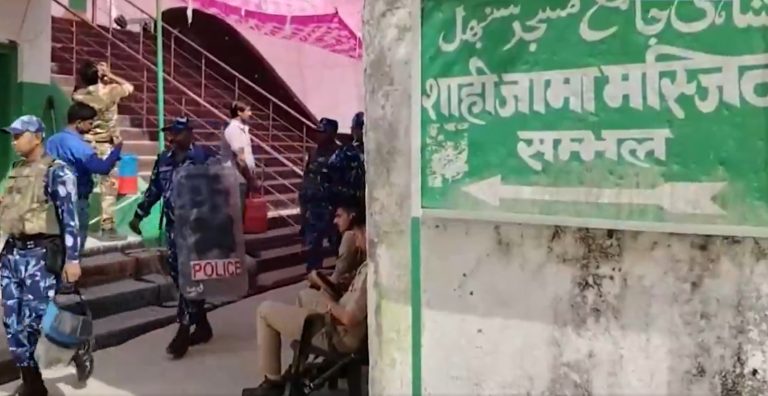
Sambhal: Police enforce ‘no Alvida Namaz on Roads’ order strictly, conduct flag march outside Jama Masjid

0

The Sambhal administration has issued instructions to ensure that ‘Alvida Namaz’ is offered only at Eidgahs and mosques and not on roads.

Stringent security measures have been taken to ensure that law and order are maintained during the festivities.

Rapid Action Force and Sambhal Police conducted a flag march outside the Jama Masjid to avoid any disruption during the last Friday of Ramzan.

Sambhal District Magistrate Rajender Pensiya added that adequate forces have been deployed to ensure a peaceful celebration.

Speaking with ANI, DM Rajender Pensiya said “All the people have assured us that they will extend their support…Orders have been issued not to offer namaz on the roads…Adequate force have been deployed. “

Sambhal ASP Shrish Chandra informed that the police are monitoring the situation with Drone surveillance and CCTVs

“The Police force has been deployed in Sambhal ahead of the Alvida ki Namaz today. The Namaz will be conducted peacefully… Drone surveillance is done along with monitoring through CCTV… No one will offer namaz on roads; this has been directed,” he told ANI.

Meanwhile, the Gautam Buddha Nagar Police have implemented section 163 of Bharatiya Nagarik Suraksha Sanhita (BNSS) throughout the district from March 28 to March 31, in the view of Alvida Jumma (the last Friday of Ramzan), Cheti Chand festival and Eid-ul-Fitr celebrations.

Prayagraj Police have also taken precautionary steps to avoid any disruption. ACP Ajay Pal Sarma said that meeting of peace committees have been held in all police station areas and the district.

“The police personnel have been briefed and sensitised regarding the upcoming festivals. Meetings of Peace Committees have been held in all police station areas and the district. An appeal has been made to the citizens for their cooperation. All preparations for the movement of devotees and traffic have been made at all the temples. SC orders and govt guidelines will be followed to conduct Namaz prayers,” Ajay Pal Sharma said.


(This news report is published from a syndicated feed. Except for the headline, the content has not been written or edited by OpIndia staff)

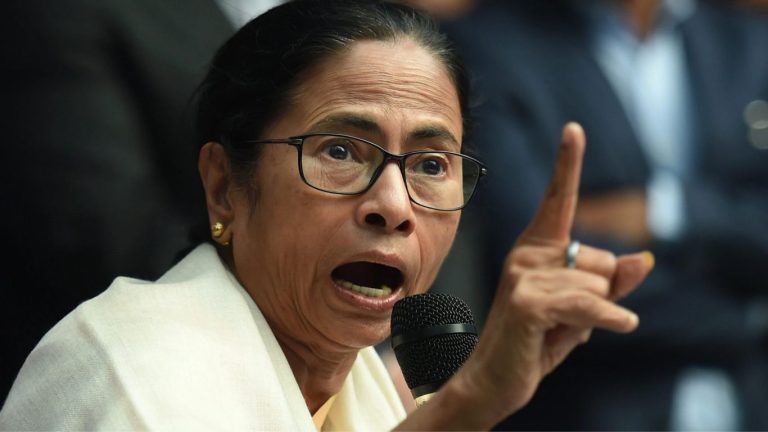
Leftist SFI protesters heckle West Bengal CM Mamata Banerjee during her address in London, she tells protesters to go back to Bengal and strengthen their party instead

0

During her address at the Kellogg College, Oxford University in London yesterday (27th March), West Bengal Chief Minister Mamata Banerjee was heckled by members of the Student Federation of India (SFI, student wing of the CPI(M). The SFI members protested and raised placards during her speech on ‘Social Development- Girl Child and Women Empowerment in West Bengal’.

Struggling to maintain calm as the protesters bombarded her with questions and slogans, Banerjee responded, “Don’t do politics here, this is not a platform for politics. Go to my state and do politics with me”. The protesters raised several issues, including the lack of industrialization in West Bengal, the RG Kar College rape case, and the Jadavpur University incident.

“Speak a little louder, I cannot hear you. I will listen to everything you have to say. Do you know that this case is pending? The responsibility of investigating this case is now in the hands of the Central government, the case is no longer in our hands,” Banerjee said on the RG Kar case.

Addressing the protesters as ‘brother’, Banerjee asked them not to do politics. “Don’t lie. I have sympathy for you. But instead of making this a platform for politics, go to Bengal and tell your party to strengthen itself so that they can fight with us,” she said.  “Don’t disrespect your institution by insulting me. I have come here as a representative of the country. Don’t insult your country,” she added.

When the protesters asked her about the lack of industrialisation in West Bengal, Banerjee said, “That is wrong. Tata Cognizant…Please realise…they have already started Tata Cognizant…they have set up their industry in Kharagpur”.

Some of the placards highlighted the issue of pre-poll violence in West Bengal and the killing of Hindus. A few of the protesters were also heard asking about the killings of Hindus in her state. However, Banerjee kept dodging the questions and kept expressing gratitude for being invited to the institution. Calling herself a ‘Royal Bengal Tiger’, she said that she did not care for anyone. “You have encouraged me to come back here again and again. Remember, Didi does not care about anyone. Didi walks like a Royal Bengal Tiger. If you can catch me, catch me!” she said.

Later on, the All India Trinamool Congress posted on X praising Banerjee for her courage in front of protesters. “She doesn’t flinch. She doesn’t falter. The more you heckle, the fiercer she roars. Smt. @MamataOfficial is a Royal Bengal Tiger! ” read the post.

A statement was issued by the SFI later taking the responsibility for the protests. “SFI-UK held a demonstration in Kellogg College, Oxford against Mamata Banerjee’s speech. We opposed her blatant lies by asking her for evidence of the social development she claims to pioneer. Instead of allowing us to peacefully express our opinions, the police were called…In support of the students and working masses of West Bengal, SFI-UK raised its voice in opposition to Mamata Banerjee and the TMC’s corrupt, undemocratic rule,” the statement read.

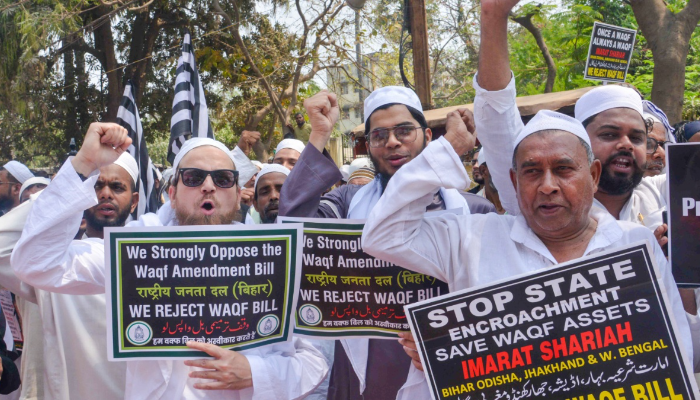
AIMPLB calls on Muslims to wear black bands in protest against Waqf Amendment Bill on Ramzan’s final Friday

The All India Muslim Personal Law Board (AIMPLB) has directed nationwide Muslims to wear black armbands during Ramzan’s final Friday prayers (Alvida Jumma Namaz) on 28th March to oppose the Waqf Amendment Bill 2024. The official letter was released on 27th March. It read, “Alhamdulillah, the strong protests by Muslims at Jantar Mantar in Delhi and Dharna Sthal in Patna have at least caused a stir among BJP’s (Bharatiya Janata Party) allied parties. Now, a massive protest is also scheduled to take place in Vijayawada on March 29, 2025.”

The board referred to the bill as “a sinister conspiracy aimed at depriving Muslims of their mosques, eidgahs, madrasas, dargahs, khanqahs, graveyards and charitable institutions.” It even threatened that if the bill is passed, the same would be seized from their authority. “Therefore, it is the responsibility of every Muslim in the country to strongly oppose this bill. The All India Muslim Personal Law Board appeals to all Muslims to wear a black armband while coming to the mosque on Jumu’atul Wida as a silent and peaceful expression of grief and protest,” the letter urged. It was signed by AIMPLB’s president Maulana Khalid Saifullah Rahmani and its general secretary Maulana Muhammad Fazlur Rahim Mujaddidi.

The action followed a call for protests in Patna, Bihar and Vijayawada in Andhra Pradesh, by the board which has prominent Muslim clerics, academics and professionals. AIMPLB office-bearers and members, including Hyderabad Lok Sabha MP and All India Majlis-e-Ittehadul Muslimeen chief (AIMIM) Asaduddin Owaisi joined in a demonstration at Jantar Mantar and criticised the bill.

The 31-member AIMPLB Action Committee has decided to resist the bill through every constitutional, legal and democratic method possible. According to a statement released by the board, major rallies are planned in Hyderabad, Mumbai, Kolkata, Bengaluru, Malerkotla (Punjab) and Ranchi. The Tamil Nadu assembly already adopted a motion rejecting  the bill as chief minister MK Stalin alleged that it discriminates against Muslims.

The AIMPLB’s announcement came after the submission of the Waqf (Amendment) Bill report by the joint committee of Parliament. The proposed law has not yet been listed, but there is speculation that it could be introduced for passage in Parliament during the current Budget Session.

The bill’s 31-member group recommended a number of changes to the draft legislation following several hearings and sessions. On 30th January, the 655-page report was delivered to Om Birla, Speaker of the Lok Sabha. It has also been presented in the upper house in February.

With a vote of 15-11 in favor, the joint committee approved the report that included modifications recommended by the ruling BJP. The 1995 Waqf Act, which regulates Waqf holdings, has repeatedly come under fire for unauthorized occupations including government and private properties and even temple lands, corruption and poor property management.

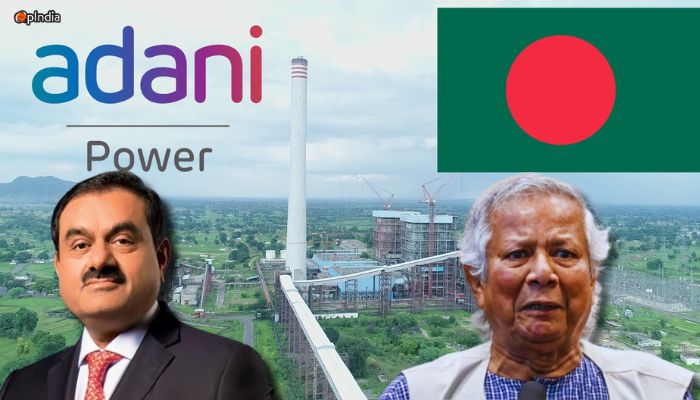
After Adani Group threatened to cut power supply to Bangladesh over non-payment of dues, Bangladesh begins payment, power supply increased

Months after halting power supply to unrest-hit Bangladesh over non-payment of dues, Adani Power resumed electricity supply to the neighbouring country. Both the units of Adani Power’s plants in Godda increased supply earlier this month after Bangladesh began clearing dues. 

On 27th March, Rezaul Karim, chairman of Bangladesh Power Development Board, informed about the power supply resumption and said, “We’re making regular payments to Adani and receiving power as per our requirements.”

Reports say that Adani Power is receiving $80- 90 million regularly from Bangladesh. This amount also covers payment for current consumption. The dues are estimated at around $820-830 million, which is expected to be paid in the coming months. As per a Times of India report, Bangladesh Power Development Board had provided guarantees to assure Adani’s lenders and help reduce the cash crunch of the company.

In February this year, the interim government in Bangladesh, led by Muhammad Yunus, requested that Adani Power resume ‘full supply’ from its plant in Jharkhand.

The Indian conglomerate runs a 1600-megawatt plant (2 units of 800-megawatt capacity) in Jharkhand and supplies power exclusively to Bangladesh as per a contract signed with former Prime Minister Sheikh Hasina in 2017.

Adani Power shut down one unit of its $2 billion plant on 1st November last year. Bangladesh Power Development Board (BPDB) requested the Indian conglomerate to restore a ‘full supply’ of power, adding that it is paying $85 million a month to clear pending dues.

BPDB Chairman Mohammed Rezaul Karim said that Adani Power couldn’t synchronise the 2nd unit of its plant on 10th February .”We are trying to pay more, and our intention is to reduce the overdue. Now there is no big issue with Adani,” he added.

In December last year, a payment dispute arose when an Adani Power official said that BPDB owed it $900 million while the latter’s Chairman alleged that it only owed $650 million to the Indian conglomerate. The dispute is over the calculation of power tariffs.

As missionary school in Shimla withdraws Eid circular after protests, read how such orders are enforced on Hindu students during the Muslim festival

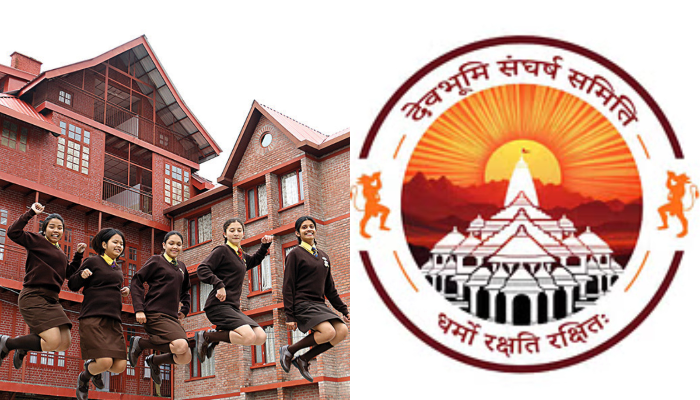
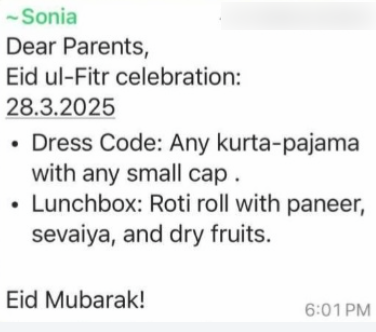
The Islamic festival of Eid-ul-Fitr is going to fall on 31st March-1st April. However, Auckland House School, which is a well-known private English-medium institution located in Shimla of Himachal Pradesh, sparked outrage over Eid celebrations. The objection arose after the school circulated a notice asking primary students to wear kurta-pyjama and a small cap, and to bring sevaiyan, paneer and dry fruits on 28th March in preparation for a pre-Eid event.

Notably, Auckland House School is a Christian institution that “aims at providing a sound education based on Christian principles and inculcating values through the life and teachings of Jesus,” according to their official website.

Image via himbumail.com

AP Singh, the leader of the Vishva Hindu Parishad (VHP), lambasted the school administration and described the move as a “blatant example of shallow secularism.” He wondered why, in the name of secularism, a Christian missionary school was making its students wear religious outfits and engage in religious rites. “Celebrating festivals is fine, but dictating dress codes for religious events is not acceptable. Auckland House School must realize it is not a madrasa. If this is secularism, then let them also issue similar orders for Hindu festivals like Ram Navami or Krishna Janmashtami,” he challenged.

As the dispute intensified, the Dev Bhoomi Sangarsh Samiti, a Hindu organization, expressed its dissent and threatened to stage a protest outside the educational institution and take legal action against it. On 24th March, the school ultimately rescinded its decision in light of the mounting opposition. On the other hand, Rohit Thakur, the minister of education denied these allegations, stating that the matter is being unduly intensified to disrupt societal harmony.

“This issue is being exaggerated only to provoke communal sentiments. The matter will be investigated. However, the message from the school administration was issued solely with the intent of maintaining communal harmony,” he conveyed while talking to ANI. “Today itself, I became aware of this matter through media reports. We will confirm the details, as the school being named is a well-established, reputed convent institution here. Himachal Pradesh is known for its communal harmony and goodwill, and we will ensure that this remains intact,” he further claimed.

The minister held social media responsible for exacerbating these issues. “There are certain individuals in society who unnecessarily attempt to create rifts. These matters must be put to rest. I have gathered information about the entire case because, in today’s era of social media, it does not take long for such issues to escalate. We stand in favor of strengthening communal harmony. Our social fabric must remain intact, with respect for all religions. That is what we will strive to uphold,” he added. 

Auckland House School cries foul, releases statement

Meanwhile, the school at the heart of the row stated that the decision was allegedly revoked because “safety and well-being of our children is our highest priority.” It claimed, “The planned Eid-ul-Fitr celebrations for classes nursery to 2 was a part of their efforts to help young students appreciate India’s cultural diversity, just as we celebrate Holi, Diwali and Christmas. It was intended purely as a cultural learning experience, with no religious rituals and enforcement and participation was entirely voluntary,” in a fresh communique to the parents.

It further added that the school has chosen to cancel the event to maintain harmony and protect the environment in the wake of the recent misinformation and concerns about possible disruption and students are expected to attend class in their regular uniforms.

It also issued a detailed statement rejecting the claims and urging for responsible conduct online. The school also highlighted its enduring practice of celebrating cultural and religious festivals. It asserted that participation is always optional and that there is no religious ceremony or instruction involved, while claiming to promote empathy, understanding and respect among kids from all backgrounds.

“We strongly condemn attempts to misrepresent these celebrations as religious propaganda. Such actions only serve to harm social harmony and misguide the public. We are particularly concerned that these posts have disclosed information meant strictly for internal circulation, thereby violating privacy, endangering individuals, and breaching the norms of responsible digital conduct. This constitutes misuse of restricted information,” it mentioned in an official statement on social media.

“We respectfully urge all individuals and platforms to immediately remove such posts and stop compromising institutional and individual safety. Auckland House School remains firmly committed to the values enshrined in the Constitution and the ideals of unity in diversity. We call upon all right-thinking members of society to stand against such divisive and unethical actions, and to support an education grounded in mutual respect, dignity, and truth,” it stated.

Islamists, Communists play victim card over the issue

Predictably, the liberal-Islamist ecosystem seized the opportunity to launch an attack on “Hindutva.” The Wire’s senior propagandist Arfa Khanum Sherwan whined over the issue and wrote, “This is how we say ‘Eid Mubarak’ in India,” insinuating religious intolerance in the country.

Communist Party of India (Marxist) veteran also blamed the Hindutva outfit for the development.

Saba Khan reiterated similar sentiments, attributing the cancellation of the school’s earlier circular on Eid to Hindutva groups.

Imposing Islamic practices, festivals on non-Muslim students

Just as individuals cannot be prevented from celebrating any festival, they also cannot be compelled to observe the same, including children. While the school circular might appear ordinary, it essentially mandated that students dress in a specific manner and take part in Eid celebrations. Certainly, even a fraction of this directive would have incited significant outcry among both Islamists and liberals, who are quick to decry oppression and saffronization at the slightest discomfort, yet remain silent when the same religious liberities are not afforded to members of the Hindu community.

It is noteworthy, this is not an isolated incident as students have been forced to follow Islamic practices including namaz and Muslim headscarfs by certain schools which resulted in severe backlash. A prominent incident was reported in 2023 from Madhya Pradesh’s Damoh, where Jain and Hindu schoolgirls were forced by the school administration to wear hijabs while Hindu symbols such as tilak and kalava were banned.

During 2023 Bakri Eid celebrations, Jnanasagara International School in Channarayapatna of Karnataka, came under fire for making Christian and Hindu pupils to recite passages from the Quran. Hindu activists protested when videos of the event went viral. The administration then claimed that although some Muslim students participated in namaz, others were not required to read Quranic versus.

In the same year, Bajrang Dal members demonstrated outside a private school in Dehradun, charging that non-Muslim students were pressured into celebrating Eid. After the demonstration, the school removed videos of the festivities from its social media accounts. This incident occurred after a similar protest at another Doon school, where Hindu groups complained that the administration was preventing students from playing Holi while pushing them to celebrate Eid.

An agitation by Hindu organizations in 2023 led to the suspension of the principal and two teachers of BLS International School in Hathras, Uttar Pradesh for asking students to perform namaz  during Eid celebrations inside the premises. The management claimed that kids sang as part of the celebration of Eid ul Fitr and World Heritage Day. However, action was taken and  an investigation was launched into the matter.

Saint Pius Missionary School in Khandwa of Madhya Pradesh faced backlash for planning a Kalma and Quran reading program during the assembly prior to Eid al-Adha, in 2023. The district education department opened an investigation after the Vishva Hindu Parishad (VHP) lodged a complaint. The Hindu group also received complaints from parents of the students regarding the same matter.

Last year, the discovery that students were being taught namaz caused a huge uproar in  Jamnagar and Vadodara of Gujarat. A staff worker was heard urging the youngsters to raise the “Ya Hussain, Ya Hussain” slogan in a video of the Sonalnagar Anganwadi in Jamnagar that went viral on social media. They were also told bout Eid and instructed on how to perform namaz. The children at Karnali Anganwadi, which is situated in Dabhoi of Vadodara reportedly offered namaz. One of the staff members there told them to do the Islmaic prayer and wrapped a handkerchief around their heads to celebrate Eid.

During an Eid event at Gyansthali Public School in Sirmaur in 2024, the institution’s administration told the nursery kids to wear hijabs and Islamic headgear. The Bajrang Dal and Vishva Hindu Parishad expressed their disapproval of the school’s conduct after which  he management acknowledged their error and promised to avoid it in the future.

An FIR (First Information Report) was filed against the principal of Nyaya Nagar Public School in Prayagraj in 2022 for offending religious sentiments because students were asked to post 20-second videos of themselves dressed in “Eid attire” and wishing one another a “Happy Eid” as part of the celebrations. Girls were to wear a salwar-kurta and dupatta whereas boys had to put on a kurta and cap. “Children are innocent and talking about giving more marks for wearing Eid outfits and making videos is an attempt to get them attracted towards a particular religion. This can be regarded as a step in the direction of religious conversion,” Vishva Hindu Parishad (VHP) leader Lal Mani Tiwari had voiced.

Conclusion

The aforementioend instances are just a glimpse of a much broader issue. It is rather astonishing that these diktats placed on non-Muslim, particularly Hindu students, are consistently presented as mechanisms for promoting national unity, peace, and brotherhood. However, one must question why similar outcomes cannot be realized during Hindu festivals. Additionally, how can the act of pushing something on individuals foster a sense of acceptance or tolerance towards that very imposition? More importantly, how the celebration of Hindu events and the country’s roots and culture, which are significantly more unifying than any festival is viewed as anti-minority or anti-Muslim.

Moreover, Hindu processions and festivals, including the recent Holi, regularly suffer assault from Muslim mobs. Hindus are not allowed to mark any religious event in peace while their children are expected to engage in Eid festivities at their educational institutions and it is portrayed as a grand act of promoting communal harmony and peace. Islamists and their lackeys who oppose the protests against Eid celebrations in schools often choose to either remain silent in implicit support, engage in whitewashing, or create misleading narratives when Hindu festivals are under attack.

It is quite reasonable to assert that individual choices, including those of young students, should be honored, as it is ultimately the decision of the parents regarding their child’s participation in any religious celebrations. It is not justifiable to require them to partake in festivals that do not correspond with their cultural or religious heritage under the pretense of secularism only to play victim card after the protests.

Kerala Congress uses fabricated history to defend Rahul Gandhi’s attack on merit: Here is how a 2011 article on FirstPost was filled with false claims and fake data

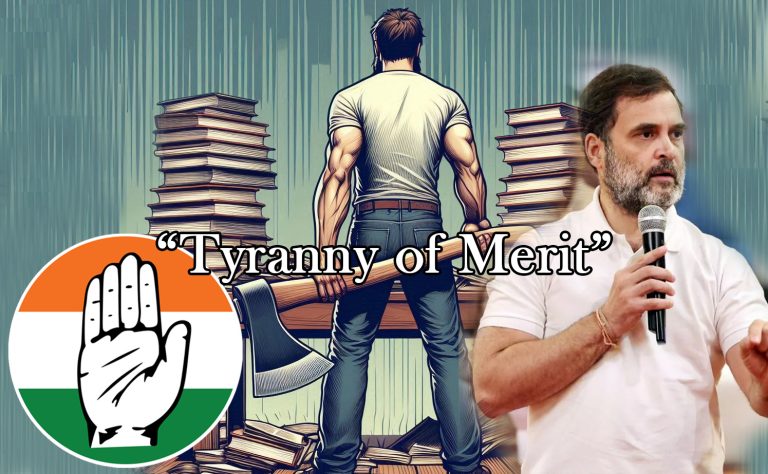
A few days ago, the official Congress Kerala handle shared an article on X titled The Tyranny of Merit. This piece sought to reinforce Rahul Gandhi’s argument that “merit is flawed.” Notably, last Thursday, Rahul Gandhi attacked merit in India as ‘unfair’ to the Scheduled Castes, Scheduled Tribes and Other Backward Castes. He also promoted ‘caste census’, meant to divide the Hindu community.

In a podcast with ‘economist’ Sukhadeo Thorat, Rahul Gandhi claimed, “I have had discussions with people about the caste census, where I am saying, look, all we are doing is exposing the truth. Nothing else. And they will say to me directly that no, one must not expose this truth.”

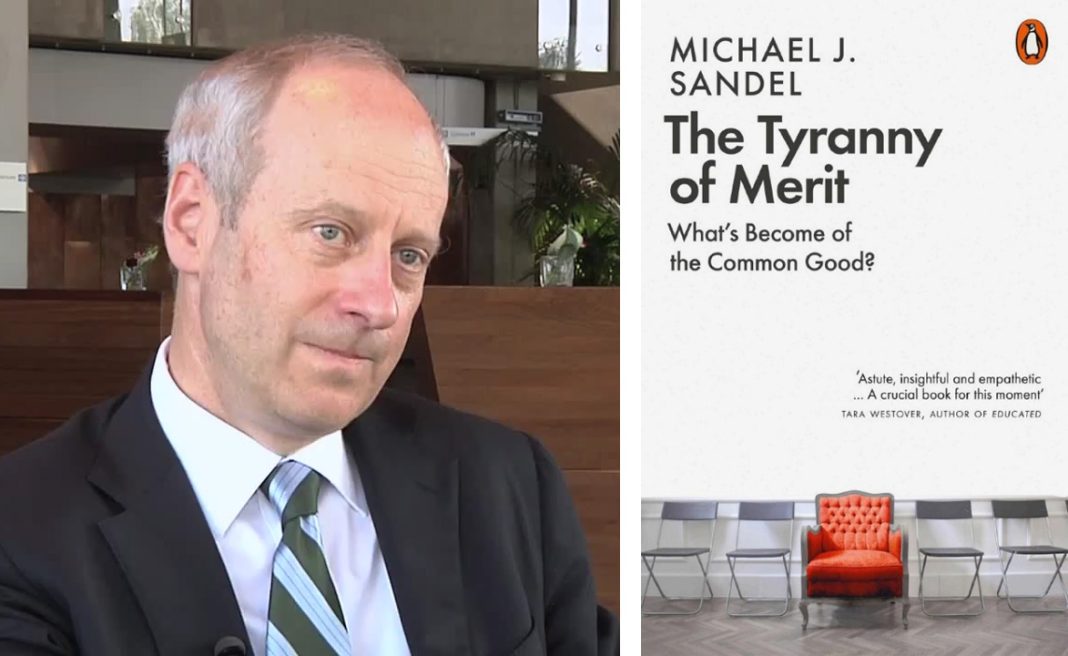
On 22 March, the Kerala Congress posted a long message titled ‘The Tyranny of Merit’ on X in support of Rahul Gandhi’s attack on merit, drawing upon the work of American philosopher Michael Sandel, who authored a book by the same name.

Michael Sandel and His Book “The Tyranny of Merit”

In an attempt to adapt this leftist-socialist American perspective to the Indian context, the Congress party referenced historical “facts” from a 2011 FirstPost article. The article alleged that when the British introduced the English education system in 1854, only a handful of students could pass and progress to the college level. Supposedly, a group of Tamil Brahmins petitioned the Governor-General to create a “Third Class” for their children, resulting in the lowering of the passing percentage from 45% to 33%. Furthermore, it claimed that India’s indigenous education system was inherently discriminatory, barring students from the so-called “depressed classes”.

However, a thorough analysis reveals that much of the information presented in this FirstPost article is either unverified or completely fabricated. It is startling that such claims—many of which have been debunked by scholars—were published by a reputed news portal and subsequently amplified by a national party.

Below is an examination of the misleading claims and the factual evidence that refutes them.

Claim 1: The Indigenous Education System Excluded Lower Caste Students

The article suggests that British surveys from the early 19th century (such as the Thomas Munro Survey of the Madras Presidency and Bombay Presidency survey) indicated that no students from the so-called “depressed classes” were included in indigenous education systems.

Fact: Contrary to this claim, British surveys reveal that a significant percentage of lower-caste students were enrolled in indigenous schools, including those from “depressed classes”.

Key British Surveys and Their Findings

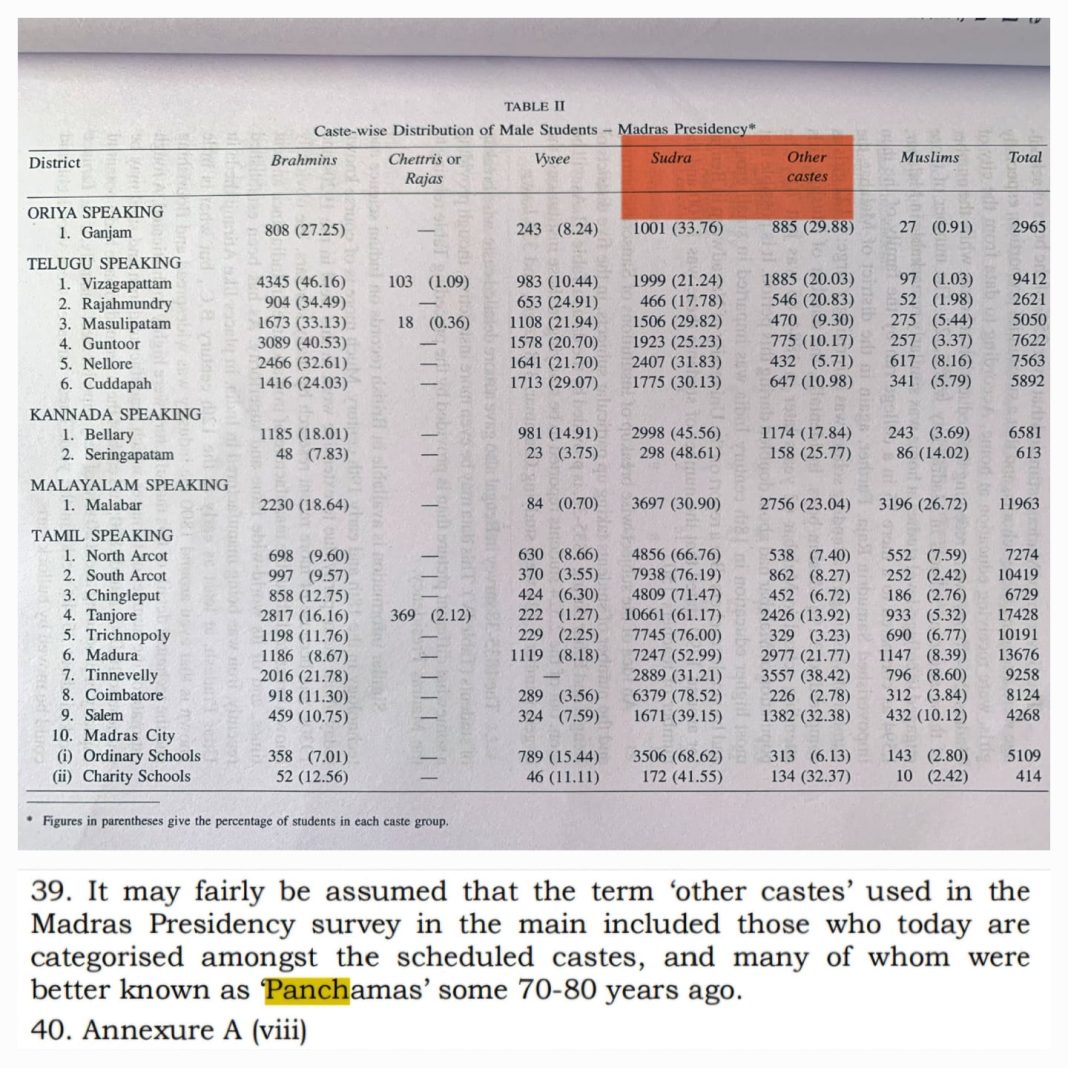
1. Thomas Munro Survey (Madras Presidency, 1822-26):

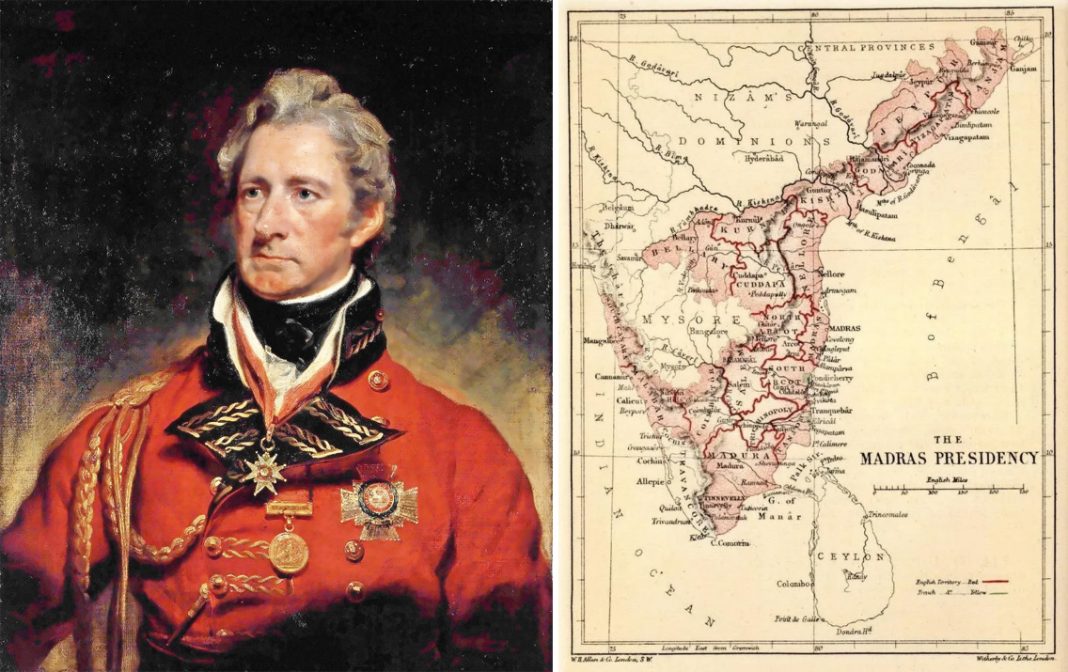
Ordered by Governor Thomas Munro, this survey was conducted across the districts of the Madras presidency to understand the indigenous education system and also to gather the caste-wise distribution of students in the schools.

Sir Thomas Munro (Governor of Madras Presidency), and Madras Presidency Map from British Empire

The students were categorized into four groups: Brahmins, Vaishyas, Shudras, and Other Castes (which also included the present-day Scheduled Castes). The data showed that nearly 64% of students belonged to the Shudra and Other Caste categories.

Caste-wise distribution of students in Madras Presidency (Munro Survey)

2. A.D. Campbell’s Report (Bellary, 1822-23):

Another official report, prepared by A.D. Campbell, the Collector of Bellary, showed that the so-called lower castes made up 66% of the indigenous student population. As per his report, in the district of Bellary, there were 533 schools with a student population of 6,338. The caste-wise distribution of the students (males) was as follows:

Other castes: 1,205 (18.8%)

Brahmin: 1,187 (18.6%)

Vaishya: 982 (15.3%)

Shudra: 3,024 (47.3%)

3. William Adam Reports (Bengal Presidency, 1836-38):

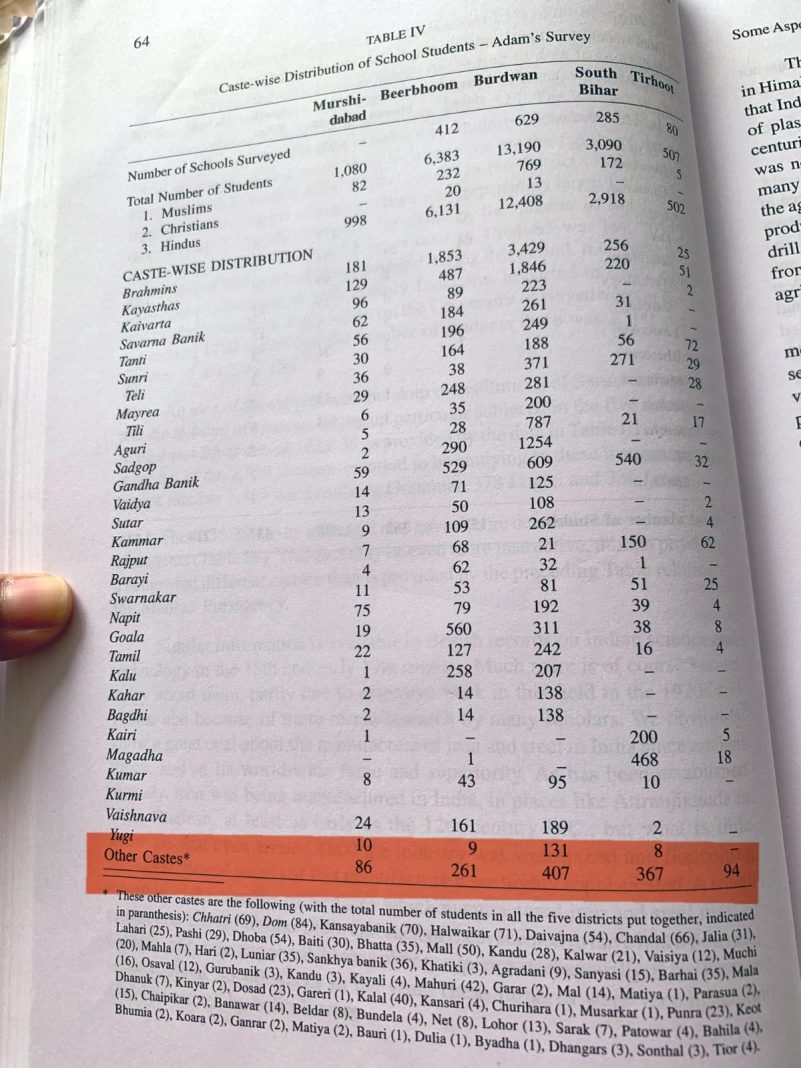
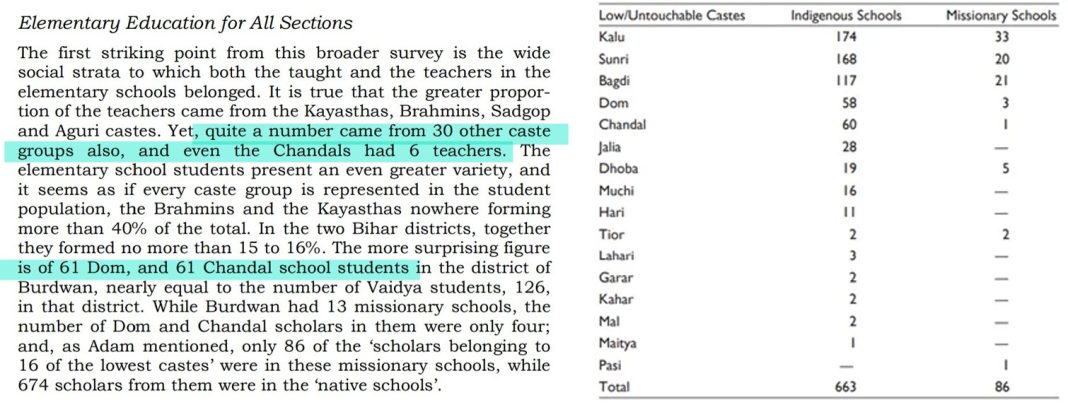
This survey, commissioned by then Governor-General of India, Lord William Bentinck, revealed that Brahmins and Kayasthas made up less than 40% of students in Bengal and only 15-16% in Bihar. The majority of students in both regions belonged to lower castes.

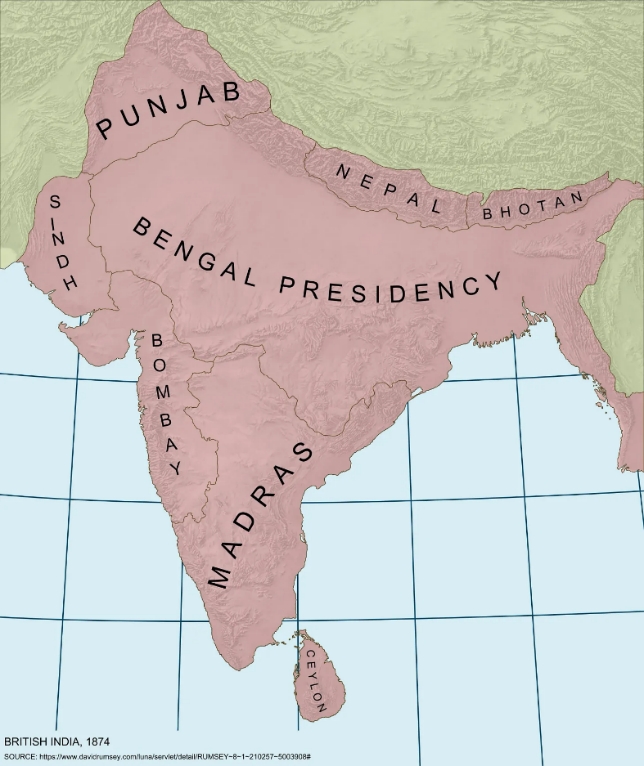
Bengal Presidency Map from The British Empire
Caste-wise distribution of school students in Bengal Presidency [Adam’s report, 1838]
*Other castes included castes considered lower than Shudras (current-day scheduled castes or Dalits)

Data from the Burdwan district highlighted a notable trend, there were 61 Dom and 61 Chandal school students (so-called depressed castes). Additionally, lower caste students were enrolled in significantly higher numbers in indigenous gurukuls compared to missionary schools. In Burdwan’s 13 missionary schools, only 86 Dalit students were recorded (including just 4 scholars from the Dom and Chandal castes), whereas 663 scholars from these same castes were studying in native (indigenous) schools.

Adams Report 1838: Burdwan district had teachers from Depressed Classes; Dalit caste students in schools in Missionary vs Indigenous schools

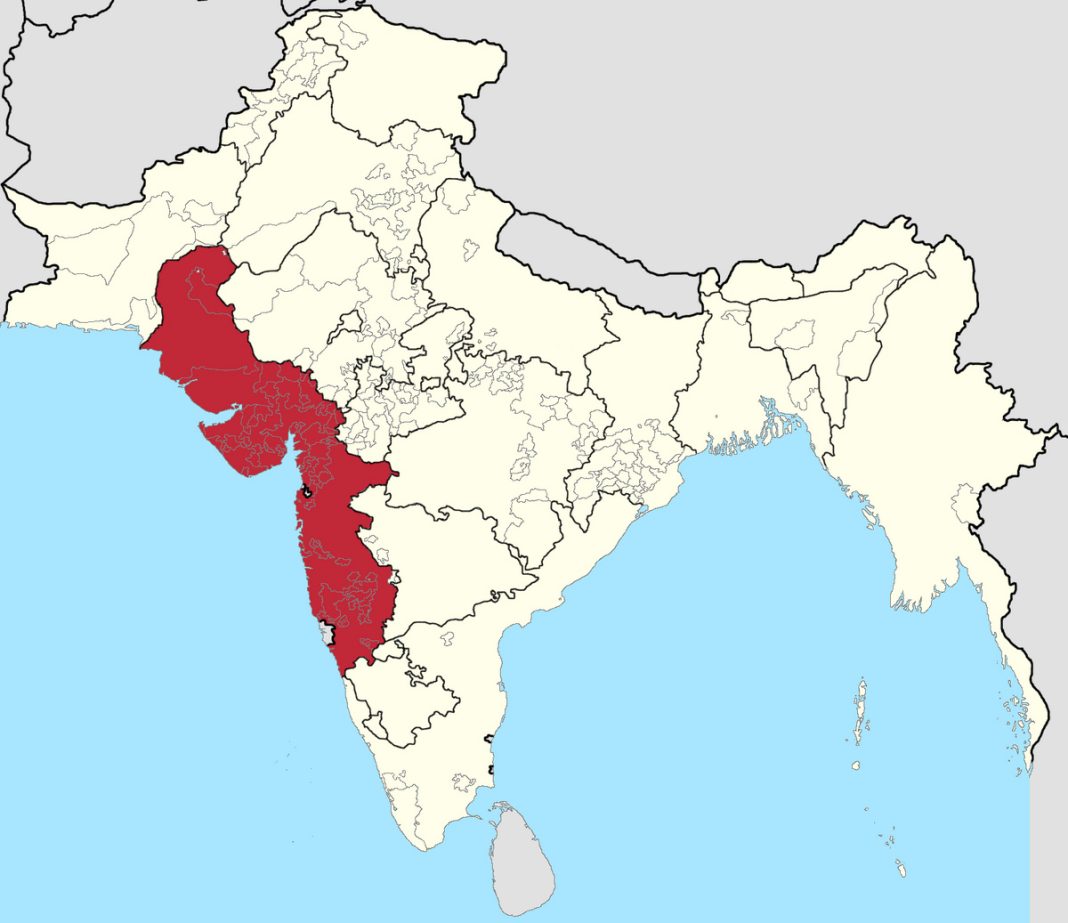
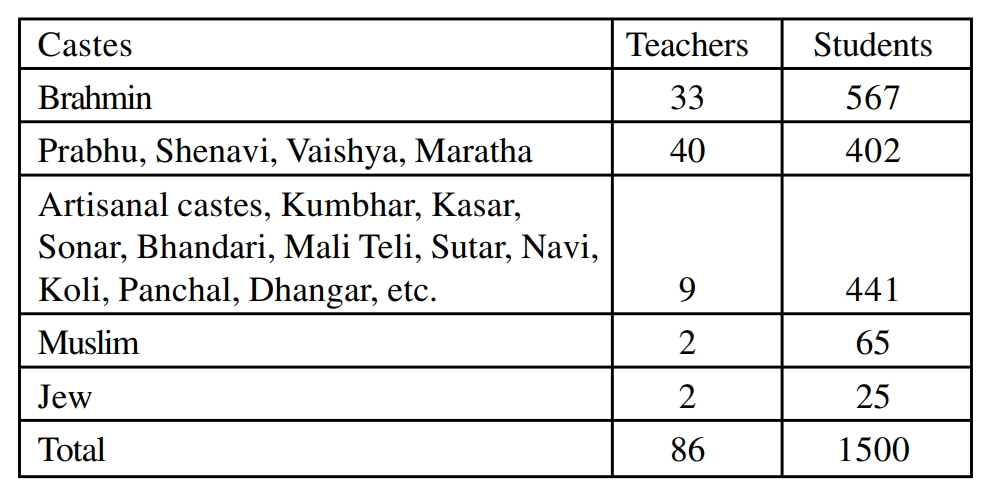
4. T.B. Jervis Survey (Bombay Presidency, 1824-25):

This survey documented a diverse student population, with many students and teachers from non-Brahmin artisanal backgrounds.

Bombay Presidency Map from the British Empire
Castes of Teachers and Students in Ratnagiri District [From a letter of T. B. Jervis to the secretary to the government, 1824]

Further Evidence of Indigenous Education Accessibility

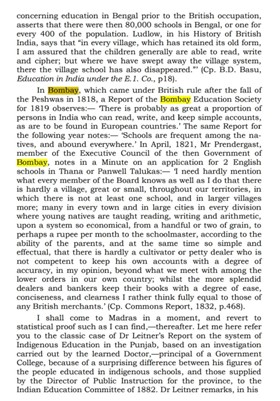
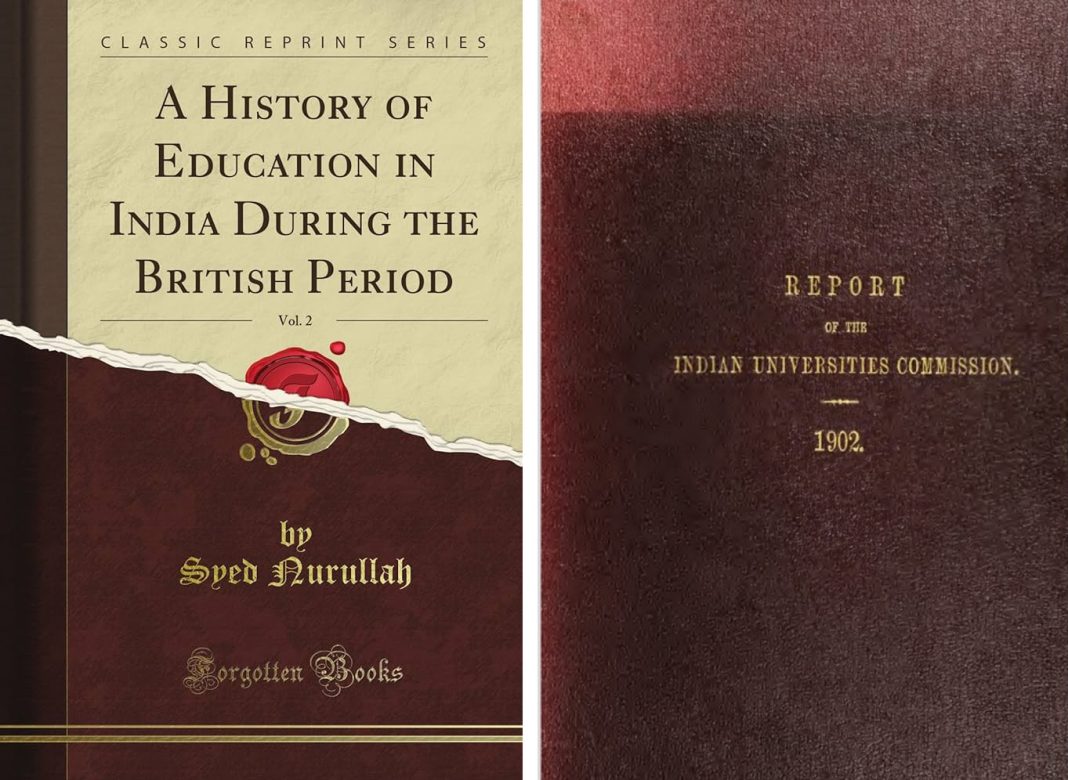
History of Education in India (1943) by Nurullah Syed

A report from the Bombay Education Society in 1819 observed that “Schools are frequent among natives and abound everywhere.” Supporting this observation, Mr. Prendergast, a member of the Executive Council of the Government of Bombay, noted:

“I need hardly mention that there is hardly a village in which there is not at least one school, and in larger villages, there are several. Many exist in every town, and in large cities, they can be found in every division, where young natives are taught reading, writing, and arithmetic. There is hardly a cultivator or petty dealer who is not competent to keep his own accounts with a degree of accuracy.”

These British reports confirm that indigenous education was widespread and accessible, particularly among lower castes. In fact, Adam’s report also highlighted that a few teachers came from the so-called depressed classes.

This data thoroughly debunks the author’s claim that indigenous schools were inaccessible to the lower strata of society.

Claim 2: Tamil Brahmins Petitioned for a “Third Class” to Lower Passing Standards

The article claims that when the British education system was introduced, it initially had only two divisions—First Class and Second Class—without a “Third Class” category. It further alleges that in the late 19th century, a group of Tamil Brahmins petitioned the British to create a “Third Class” for students who were unable to meet the 45% passing requirement.

Fact: No verifiable historical evidence supports this claim. The two sources cited by the article—History of Education in India during British Period (1943) by Nurullah Syed and the 1902 Indian Universities Commission Report—contain no mention of such an incident. Additionally, other contemporary reports, including the Hunter Commission Report (1882) and History of Education in the Madras Presidency, make no reference to this claim.

The two sources quoted in FirstPost Article

Evidence from historical records suggests that the “Third Class” designation was likely present from the early days of these institutions, aligning with British academic traditions, where classifications like First, Second, and Third Class were standard in universities. For example, the University of London—established before Indian universities in 1857—followed a similar grading structure, which later served as a model for institutions in Calcutta, Bombay, and Madras.

Moreover, the reduction of passing percentages under the Third Class category was likely an administrative adjustment rather than a formal commission recommendation, potentially implemented at the institutional level to accommodate educational disparities observed among Indian students in early university examinations.

Claim 3: The British Aimed to Educate All Classes, but Upper Castes Opposed It

The article argues that the British government sought to provide education to all social classes but faced resistance from upper-caste Hindus.

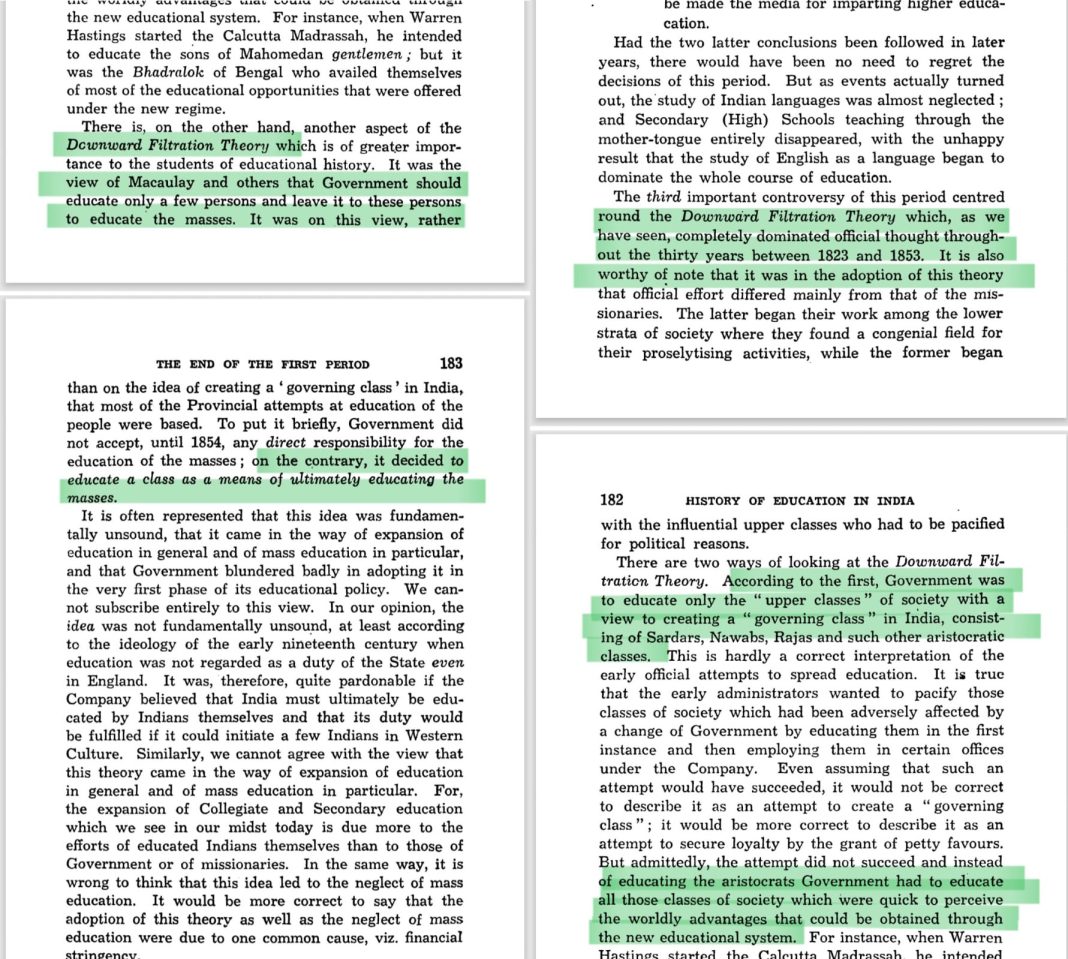
Fact: The British initially adopted a restrictive “downward filtration policy,” a concept advocated by Lord Macaulay. Under this policy, education was deliberately limited to upper-class Indians, with the expectation that they would disseminate knowledge to lower strata of society. Macaulay explicitly stated that he sought to create a class of Indians who were “Indian in blood and color, but English in taste, opinions, morals, and intellect.”

Source: History of Education in India (1943) by Nurullah Syed

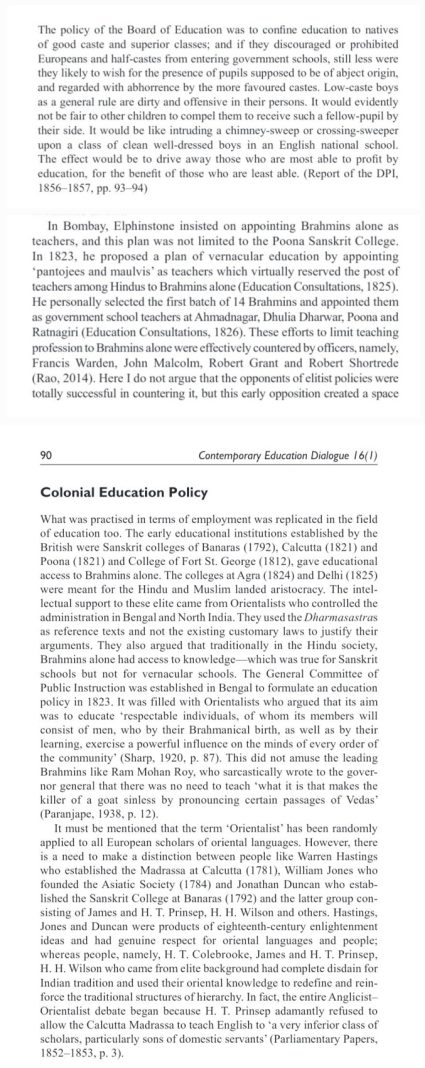
Early British educational institutions, such as the Sanskrit colleges in Calcutta, Banaras, and Poona (1790-1820), catered almost exclusively to Brahmins. British officials like M. Elphinstone, the Lieutenant-Governor of Bombay, insisted on recruiting only Brahmins as teachers and restricting college admissions to students from “respectable backgrounds.” Furthermore, members of Bengal’s General Committee of Public Instruction (1823) argued that that its aim should be to educate “respectable individuals, of whom its members will consist of men, who by their Brahmanical birth, as well as by their learning, exercise a powerful influence on the minds of every order of the community.” H. T. Prinsep, a member of this committee adamantly refused to allow the Calcutta Madrassa to teach English to “a very inferior class of scholars, particularly sons of domestic servants.”

Source: Rao, P. V. (2019). Colonial State as ‘New Manu’

Examining the Author’s Bias

A closer examination of the author Chandra Bhan Prasad and his posts on X reveals a consistent pattern of anti-Hindu and anti-Brahmin rhetoric. In his FirstPost article, he explicitly refers to the Hindu upper class as “immoral and shameless.”

His exact words from the article state:

“What is the point of discussing Aarakshan with the upper class which has morally fallen and has no sense of shame or guilt?”

Additionally, in various social media posts, he has used derogatory terms such as “mouth-born” and “Sulabh Shauchalaya” to mock Brahmins. This pattern of discourse raises concerns about the objectivity and credibility of his arguments.

Conclusion

Historical records clearly indicate that India’s indigenous education system was far more inclusive than the article suggests. The British, rather than Hindu upper castes, were responsible for restricting educational opportunities through the systematic dismantling of native institutions and the imposition of elitist education policies.

Furthermore, the author of the FirstPost article demonstrates a clear ideological bias, using inflammatory language against Hindu upper castes in both his writings and social media posts. This raises serious questions about his credibility and the motivations behind his claims.

The FirstPost article appears to be a deliberate propaganda piece designed to propagate an anti-upper caste, Hinduphobic narrative using misinformation and unverifiable claims. It is unfortunate that a reputed news portal published this article without verifying its sources, and even more concerning that a national party like Congress is using it as the basis for its anti-merit rhetoric.

West Bengal: Communal violence erupts in Malda, allegedly shops of Hindus selectively vandalised by mob

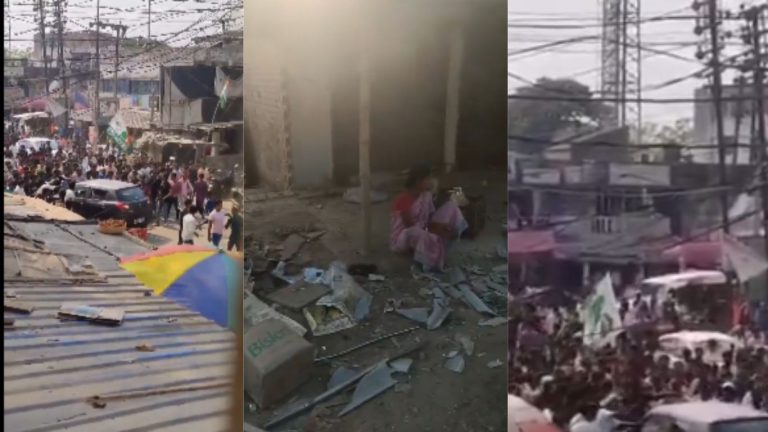
Videos of alleged communal violence in the Malda district of West Bengal are going viral on social media. The videos show a mob marching on the roads and vandalising public property. It has been claimed on social media that a Muslim mob is selectively targeting business establishments owned by Hindus in Mothabari in Malda.

The videos were shared by several oliticians, including BJP MLA Suvendu Adhikari and BJP MP Dr Sukanta Majumdar. Sharing the video on X, BJP MLA Suvendu Adhikari alleged that the shops of Hindus were being selectively targeted by certain miscreants at Mothabari. He urged the senior police officials to take strong action to prevent the attacks.

Speaking to the media, Adhikari said that targeted attacks are being carried out on the properties and shops belonging to Hindus in Mathabari since around 1 pm today (27th March).

Sharing the videos of the alleged communal attack on Hindus, the Union Minister of State for Education and Development of North Eastern Region, Dr Sukanta Majumdar, wrote, “Horrific scenes from Dakshin Malda’s Mothabari—Hindu homes & shops vandalized by a violent mob. And what do @MamataOfficial and her mute spectator @WBPolice do? SILENCE. This is the cost of her shameless appeasement politics—lawlessness, fear & injustice for Hindus!”

One of the videos shared by Majumdar shows a violent mob vandalising shops without any provocation and carrying Islamic flags. Another video shows vandalised property and houses.

BJP IT Cell head Amit Malviya also shared a video claiming to be related to the communal violence in Mothabari. Posting the video on X, Malviya wrote, “Communal violence erupts in Mothabari, Dakshin Malda—murderous Muslim mobs rampage through streets, attacking Hindu homes, shops, and cars without provocation. Meanwhile, West Bengal CM Mamata Banerjee prances around in London, indifferent to the ripping chaos back home”.

The authenticity of the videos could not be verified. Besides, no statement has been made by the West Bengal government or the state police officials regarding the incident.

Not an April Fools joke: Milk prices to increase by Rs 4 per litre in Karnataka from April 1

0

The Karnataka government on Thursday announced an increase in the selling price of Nandini milk and curd by Rs 4 per litre, effective from April 1. The decision was made during a Cabinet meeting held by Chief Minister Siddaramaiah.

The move aims to encourage dairy farming in the state, considering the cost of milk production and processing.

Following the meeting, Karnataka Minister for Animal Husbandry K Venkatesh made the announcement while speaking to reporters: “In a Karnataka Cabinet meeting chaired by Chief Minister Siddaramaiah, it was agreed to increase the selling price of Nandini milk and curd by Rs 4 per litre/kg in order to encourage dairy farming in the state, considering the cost of milk production and processing. Steps will be taken to ensure that the price revision amount reaches the milk producers of the state directly.”

“In addition, it has been informed to withdraw the price increase of Rs 2 for each 1 litre of Nandini milk with effect from 26th June 2024, and take steps for sale by adopting the current price revision of Rs 4 in 500 ml and one litre package as before,” he said.

On state Cabinet discussion on the rise in price of milk, Karnataka Minister HK Patil told reporters, “The decision will be made by KMF (Karnataka Cooperative Milk Producers’ Federation Limited) in consultation with the concerned ministers. The decision may be taken in a day or two. We have left it to KMF to decide, they will make a decision perhaps today.”

BJP Karnataka denounced the move in a social media post on X and termed the Congress government “anti-poor”

“Milk prices hiked by Rs4/-, and the cost of daily essentials is skyrocketing. Meanwhile, Karnataka Congress leaders are busy with honey-trap scandals. Farmers have been waiting for milk subsidies for years, but the government prioritises Waqf compound renovations instead. Congress isn’t just anti-farmer; they’re anti-poor!”

Vijayendra Yediyurappa, the BJP Karnataka president alleged on X that “The Congress government continues to impose price hikes on the common people of the state.”

He accused the government of increasing the price of milk for the second time after coming to power.

“The Congress government, which is struggling to manage the five blessings, has been continuously imposing the misfortune of price hike on the common man ever since it came to power. At a time when people are suffering from the heat of price hikes in drinking water, electricity bills, transportation, essential items, etc., this government seems to have entered the race to increase the price of milk for the second time after coming to power. The current decision to increase the price of milk by Rs 4 and cut into the pockets of the common man is nothing but daylight robbery.”

(This news report is published from a syndicated feed. Except for the headline, the content has not been written or edited by OpIndia staff)