Home Blog Page 5708

As the Delhi Election results trickle in, here is how the Delhi campaign only resulted in a win for Hindutva

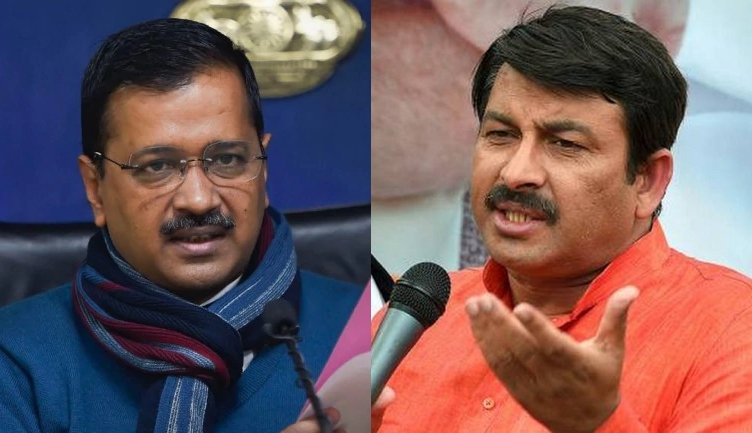
The Delhi Assembly Election results are trickling in and by the looks of it, it appears that Arvind Kejriwal is all set to retain his position as the Chief Minister of the national capital. While it is only natural that the secular camp is in a celebratory mood and the BJP will have to engage in significant introspection, there are certain truths about the whole affair that the secular camp will have to make peace with.

While it is only to be expected that the secular camp will trot around and call the results the rejection of BJP’s ‘divisive politics’, they would be coming to an extremely wrong conclusion. First and foremost, it is unlikely that the Delhi electorate rejected the BJP for fulfilling the promises it made in its manifesto for the Lok Sabha elections. Secondly, ‘Modi for PM, Kejriwal for CM’ was a popular theme among a significant section of the electorate. And thirdly, the Delhi results are a further indication of the fact that the electorate votes differently in national and assembly elections.

Most importantly, however, the campaigns by the two main parties in the elections, the BJP and the Aam Aadmi Party, only served as a resounding victory for Hindutva. The campaigns served as a further indication of the fact that the Overton Window of the country has shifted firmly on the side of Hindutva. It is a conclusion that can be drawn safely from the conduct of the incumbent Delhi Chief Minister Arvind Kejriwal himself.

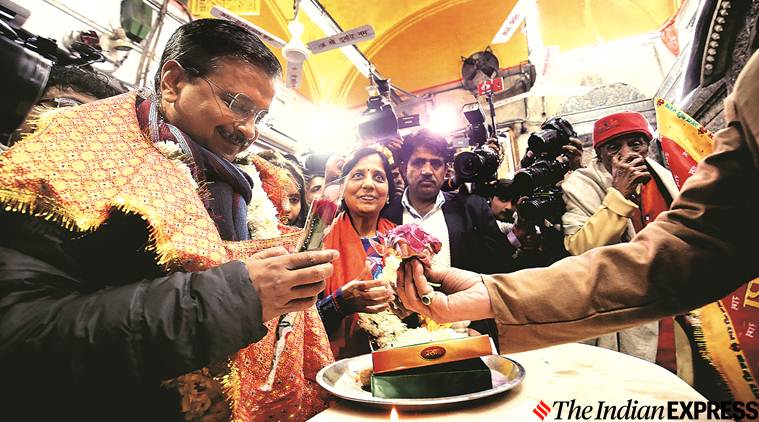
Ahead of the elections, Arvind Kejriwal went out of its way to establish his Hindu credentials. He could be seen chanting the Hanuman Chalisa on national television and telling everyone about his devotion towards RamBhakt Hanuman. It is a distant cry from the days when parties would run helter-skelter to establish their secular credo. At the same time, the AAP supremo made sure to stay clear from the Shaheen Bagh protests himself. Although Manish Sisodia himself did say that the party was with the anti-CAA protesters and Sanjay Singh’s links with the PFI emerged, Kejriwal made sure that the Delhiites saw him chanting the Hanuman Chalisa instead of hobnobbing with the Radical Muslims of Shaheen Bagh.

Read: Delhi Elections: A day before polling, Arvind Kejriwal invokes the Hindu card but misquotes Gita

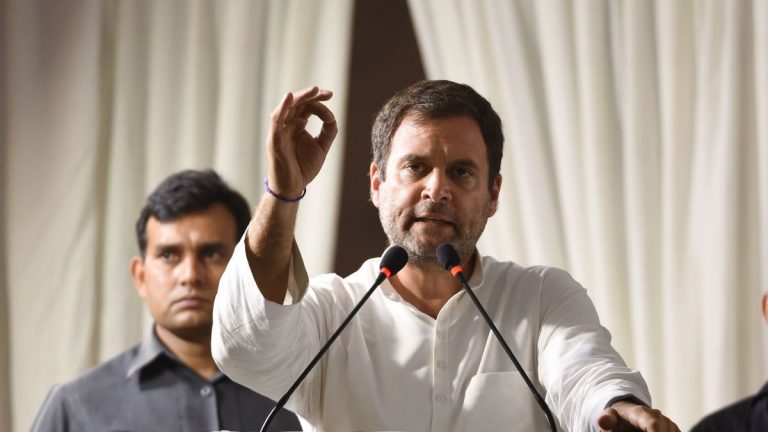
It is a far cry from 2016 when Rahul Gandhi himself rushed to JNU to lend his support to the now infamous ‘Tukde Tukde Gang’ of the University. It is for a reason that it is said, “Fools rush in where angels fear to tread.” Now, Arvind Kejriwal is certainly no angel but he is smart enough to recognize the sentiments of the electorate who he represents. One thing is clear, the politicians are now no longer trying to earn brownie points from the leftwing echo chambers but from the Hindu masses and that can only be a good thing.

In the past, when political parties feared to lose the support of the minority community, they are now scared of a backlash from Hindus. Kejriwal may not mean it but there’s a line that he recognizes he cannot cross. And with the passage of more and more time, the lines will be drawn in the sand quite clearly.

The AAP, by the end of its election campaign, was begging the Shaheen Bagh protesters to end their protests as it was benefitting the BJP. Sanjay Singh could be found in press conferences telling the anti-CAA protesters through the media that they should introspect upon their own protests and whether they were inadvertently helping the BJP electorally through their protests. Before long, the AAP was blaming the BJP for the Shaheen Bagh protests and blaming them for the inconvenience caused to the Delhi electorate.

Read: Shaheen Bagh: Children campaigning for AAP candidate Amanatullah Khan amidst Biryani feast

From the perspective of the BJP as well, it ran the most unapologetic and overtly Hindutvavadi campaign in a generation perhaps. One of the videos that it released for the polls, which caused a significant amount of angst among the secular camp, was Hindutva in a distilled capsule. Through its campaign for the Delhi elections, the BJP was able to raise issues and make significant arguments and further narratives in the domain of Hindutva that will certainly have a significant impact on the results of the Bengal elections in 2021 and the Uttar Pradesh elections a year after. That is, going forward, it can build upon the framework it has laid down in this election.

Furthermore, the results of the Delhi elections will have no impact on the direction the country is headed in. The campaigning and everything that has transpired in Delhi in the past few months has only further cemented the dominance of Hindutva discourse in the country. Hindutva has become so dominant that even the organizers of a Queer Pride Parade in Mumbai was forced to disassociate themselves from the slogans that were chanted in favour of Sharjeel Imam, the Shaheen Bagh mastermind. It’s the first time that something like this has happened. The results of the Delhi elections will not impact any of this at all.

Also, it is unlikely that the NDA government in the center will abandon its national agenda merely because of a defeat in a Union Territory with seven Lok Sabha seats. Thus, in terms of national policy, Hindutva will march on full steam ahead. Thus, the secular camp would like to believe that the Delhi results are a light at the end of a tunnel but it is more of a wish rather than objective reality.

Delhi assembly elections results: Congress leaders call for introspection as the party appears to draw a blank in Delhi

While India may not have been completely Congress-mukt yet, at least the national capital of the country appears to be on its path of Congress-free if the latest trends of the assembly elections result are to be believed. Congress’ lackadaisical elections strategy has once again reduced it to a mere spectator as it watches over the fiercely contested electoral battle between the BJP and the AAP.

Congress’ abject surrender and an impending ignominious defeat in the recently concluded Delhi assembly elections has caused many party office-bearers and senior post holders to openly come out and express their disappointment with the party’s anaemic poll strategy. If the trends hold, this would be the second consecutive term Congress would have zero representatives in the state assembly.

Read: Minutes before counting of votes, Congress veteran leader Digvijaya Singh raises the ‘EVMs are hacked’ bogey. Here is how he’s wrong

Delhi Mahila Congress President Sharmistha Mukherjee took to Twitter to concede party’s defeat in the Delhi assembly polls. A despondent Mukherjee tweeted that inordinate delay in decision making at the top, lack of a coherent strategy and unity at the state level, demotivated workers and no grassroots connect were among the many factors for party’s disappointing performance. Acknowledging defeat, Mukherjee called out for action now, saying that they had had enough of introspection.


Even as the counting is underway, senior Congress leaders seem to have resigned to the fact that their party has not fared well in the assembly elections in the national capital. Senior Congress leader Dr AM Singhvi too took to Twitter to suggest that Congress should home in on an alternative Sheila face and support him/her for the next 4 years to have any chances in the next assembly elections.


The party’s abysmal defeat comes on the heels of the major debacle the party witnessed last year in the General Lok Sabha elections, following which the then party president Rahul Gandhi assumed the responsibility of the poll drubbing and tendered his resignation. In his absence, Sonia Gandhi was elected as the interim party president but there are speculations rife that the leadership is mulling to reinstate Rahul Gandhi again as the party president.

Posters supporting radical Islamist Sharjeel Imam arrested under sedition charges appear at Jamia protest

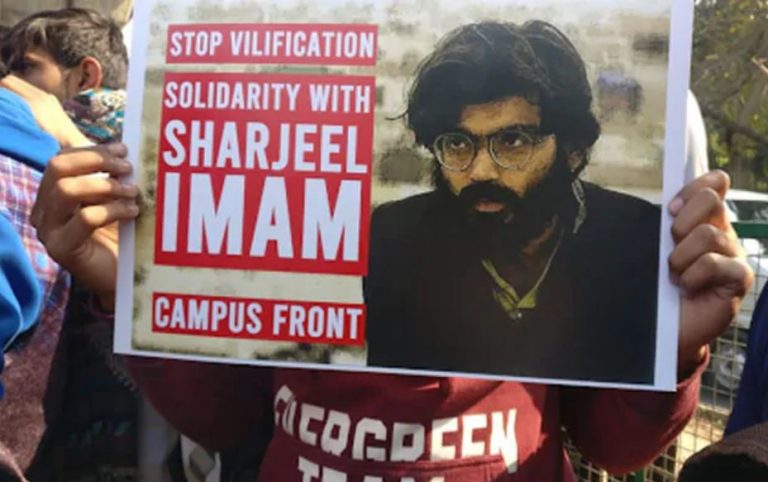
Posters reading ‘Stop Vilification’ and ‘Solidarity with Sharjeel Imam’ appear in support of the Shaheen Bagh mastermind Sharjeel Imam, who is currently in police custody under sedition charges, at the anti-CAA protest by students of Jamia Millia Islamia in New Delhi on February 10, Monday.

It may be recalled the former JNU student and a columnist with leftist propaganda website The Wire, Sharjeel Imam had been arrested by Delhi Police from Bihar’s Jehanabad, for his seditious statements inciting Muslims for a war against India.

“If we can organise 5 lakh people, it would be possible to permanently cut off Assam with rest of India…if not permanently, then at least for a few months… only then will the government hear our voice”, Imam had made a clarion call for Muslims to cut-off Assam from the rest of India.

The Delhi police interrogating radical Islamist Sharjeel Imam had made some shocking revelations. The police had said that investigations revealed that Sharjeel Imam had visited Shaheen Bagh on December 13 and 15 that is two days before and the day when the protest started at Delhi’s Shaheen Bagh area.

OpIndia in an exclusive expose on December 31st revealed that Sharjeel Imam was the mastermind of the Shaheen Bagh protests and had severely nefarious designs and Islamist bent of mind.

Earlier, reports had emerged that the police are looking into ShaheenBagh mastermind Sharjeel Imam’s links with radical Islamist outfit PFI and the Islamic Youth Federation. The PFI is suspected of funding violence in the recent spate of violence during the ongoing protests against the Citizenship Amendment Act. The Enforcement Directorate has claimed that the PFI has spent around Rs. 120 crores to fuel riots across the country.

In another major revelation, the Delhi Police has said that they have found evidence of foreign funding in the bank account of Shaheen Bagh mastermind Sharjeel Imam. However, the Delhi police are yet not clear on who was funding it.

The crime branch has found several objectionable items in the laptop and mobile phone recovered from Sharjeel. Reportedly, his laptop had contained controversial posters pertaining to anti-CAA protests, written in Urdu and English. The same posters were distributed among students and mosques ahead of the anti-CAA riots that had occurred in Delhi in December.

Crime Branch officials had said that Sharjeel Imam is highly radicalized and wants to turn India into an Islamic state and had said that he was not remorseful.

Delhi elections: AAP candidate Abdul Rehman wins Muslim dominated Seelampur seat which saw unprecedented violence during anti-CAA riots

The first result of Delhi assembly elections 2020 is out with AAP candidate Abdul Rehman securing his victory from Muslim dominated Seelampur constituency. Rehman defeated BJP candidate Kaushal Kumar Mishra. 

In the run-up to the Delhi Assembly polls, Muslim-dominated areas of Seelampur had seen unprecedented violence led by Muslim mobs to protest against the Citizenship Amendment Act.

Delhi was the epicentre of the anti-CAA riots, which later spread to different parts of the country. The Muslim mob in Delhi’s Seelampur had unleashed the violence against public infrastructure and pelted stones at the police injuring many of them. The violent protestors had even attacked school buses in Delhi’s Seelampur area.

On the eve of the Delhi assembly elections, the mosques in the riot-hit Seelampur and Okhla have urged Muslims to vote in large numbers on Saturday, reported Hindustan Times. These are the very areas where Muslim mobs had gone on a rampage and caused riots as a result of their opposition to CAA. It is also worthy to note that Congress and AAP leaders were booked for the anti-CAA riots in these areas by Muslim mobs.

As per the trends, the Aam Aadmi Party is currently leading in 55 seats, while BJP is leading in 15 seats in the 70-seat Delhi assembly elections. The majority mark is at 36.

Delhi Elections 2020: Voters have been voting differently in state and general elections, for quite some time, and in many states

The Delhi Assembly Election results are pouring in and trends suggest that the Aam Aadmi Party is well on its way to forming a government in Delhi for the third consecutive time. The secular camp is treating these results as some sort of a national referendum on the BJP’s ‘divisive politics’ but in reality, it is a little more complicated than that and calls for a certain bit of nuance.

Only nine months ago, Delhi had voted overwhelmingly in favour of the BJP in the Lok Sabha elections. The party had managed to secure a monstrous 56.58% of the votes. Thus, to conclude that vast sections of the electorate had a drastic change of heart in a matter of nine months is a bit too simplistic. It also needs to be remembered that this is not the first time that it has happened.

In 2015 as well, the Aam Aadmi Party had stormed to power winning 67 of the 70 seats, merely months after Delhi had given 7 out of 7 seats to the BJP in the Lok Sabha elections. The AAP secured a vote-share of 54.3% in the Assembly Elections in 2015 while the BJP had managed to win 46.40% of the votes in 2014 general elections. In the 2019 Lok Sabha elections, the AAP had secured only 18% of the votes, coming in third place behind the Congress. And yet, less than a year later, the AAP is again sweeping the assembly polls.

Thus, if anyone tries to interpret the Delhi results of 2020 as a rejection of BJP’s ‘divisive politics’, then they are making a massive mistake. Quite clearly, the marked difference here is not of ideology but of the nature of elections. At the national level, the Delhi electorate prefers Narendra Modi while as Chief Minister, Kejriwal is more popular among the people of Delhi. It is quite clear that Delhi is voting differently in Assembly and General Elections. Thus, to interpret the results as a rejection of Hindutva is just wrong and way off target.

More importantly, Delhi is not the only place where people have voted differently. Rajasthan, Madhya Pradesh, Jharkhand, Chhattisgarh, Haryana, in all these states, people have voted differently than in Lok Sabha Elections. In Rajasthan, the Congress party formed its government in the state after winning a hundred seats on its own with a vote share of 39.3%. Six months later, the BJP won 25 of the 26 states in Rajasthan with the one remaining seat won by its alliance partner. The vote share of BJP which was 38.8% in the Assembly Elections six months prior jumped to 58.47% in the Lok Sabha Elections.

In the Madhya Pradesh Assembly elections of 2018, the BJP managed to secure 41% of the votes, a higher vote share than the Congress, but it wasn’t enough for them to win reelection. The Congress with its 40.9% vote share managed to win 114 seats, five more than the BJP and consequently formed the government. Six months later, the BJP managed to increase its vote share by 17% and won 27 of the 28 Lok Sabha seats in the state. The vote share of the Congress was far behind at 34.5%.

The difference was even starker in Chhattisgarh. In the Assembly elections in 2018, the BJP’s vote share was reduced to 33% while the Congress managed to win 43% of the votes and 68 of the 90 seats. In the General Elections six months later, the BJP won 50.70% of the votes and 9 out of the 11 seats while the Congress with its 40.91% vote share could win only 2.

In Jharkhand, while the BJP managed to win 11 of the 14 seats in the 2019 Lok Sabha elections, it failed to retain power in Assembly Elections later in the year. In Haryana, while the BJP managed to form its government in the state, it won only 40 of the 90 seats with its vote share of 36.49%. In the General Elections earlier in the year, the BJP had secured a vote share of 58.02% of the votes and had won all the 10 seats.

Read: Diary of a Delhi Liberal: Do not underestimate us, comrades will make sure Modi and Shah lose their deposits in next elections

Thus, quite clearly, the electorate voting differently in national and state elections is a recurrent theme. Even in Narendra Modi’s home turf, Gujarat, this theme was prevalent. In the 2017 Assembly Elections in the state, although the party managed to win 49.1% of the votes, it had secured only 99 seats while the Congress won 81. However, in the General Elections one and a half years later, the BJP secured 62.2% of the vote share and repeated a whitewash of the state, just as in 2014, winning all 26 seats. A similar trend was observed in Odisha and Andhra Pradesh as well.

Thus, if anyone infers that the Delhi election results are a rejection of the BJP’s Hindutva agenda at the centre, then it is simply wrong and the inference goes against observable data. If people interpret the results as a rejection of BJP’s ‘divisive agenda’, then it is just wishful thinking. It should also be remembered that even in 2013 when the Modi Wave was gaining steam, the BJP had not managed to secure a majority on its own in Delhi even though it did emerge as the single largest party with 31 seats.

Delhi elections live: AAP, BJP leading 10 seats each with less than 3,000 votes margin, AAP’s Manish Sisodia and BJP’s Tajinder Bagga trailing

1:00 PM

As per the current leads, the Aam Aadmi Party is leading in 57 seats while BJP is leading in 13 seats. The Congress party is yet to open its account.

Delhi Deputy CM Manish Sisodia continues to trail behind BJP’s Ravinder Singh Negi by a margin of 1,173 votes. Meanwhile, Hari Nagar BJP candidate Tajinder Pal Bagga also trails by 800 votes to AAP candidate. Kalkalji AAP candidate Atishi leads by a slender margin of 163 votes.

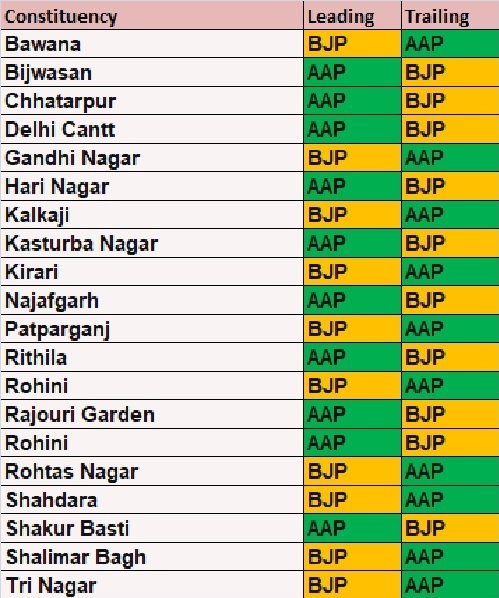
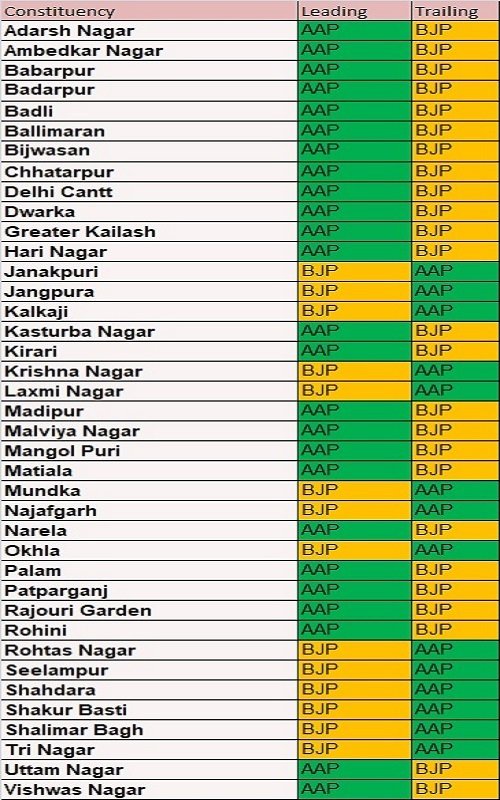
There are 20 seats where leads are less than 3000 votes. BJP and AAP both are leading in 10 seats each. Here is the list of constituencies where leads are less than 3000 votes.

Less than 3,000 margin as of 1 PM

Meanwhile, the first result of Delhi assembly elections 2020 is out with AAP candidate Abdul Rehman securing his victory from Muslim dominated Seelampur constituency. Rehman defeated BJP candidate Kaushal Kumar Mishra.

In the run-up to the Delhi Assembly polls, Muslim-dominated areas of Seelampur had seen unprecedented violence led by Muslim mobs to protest against the Citizenship Amendment Act.

11:45 AM

Deputy Chief Minister Manish Sisodia is now trailing by 1500 votes from Patparganj constituency. BJP’s Kapil Mishra is trailing in Model Town with a margin of 4,500 votes as per official EC website.

Former AAP MLA and Congress’ Chandni Chowk candidate Alka Lamba is also trailing.

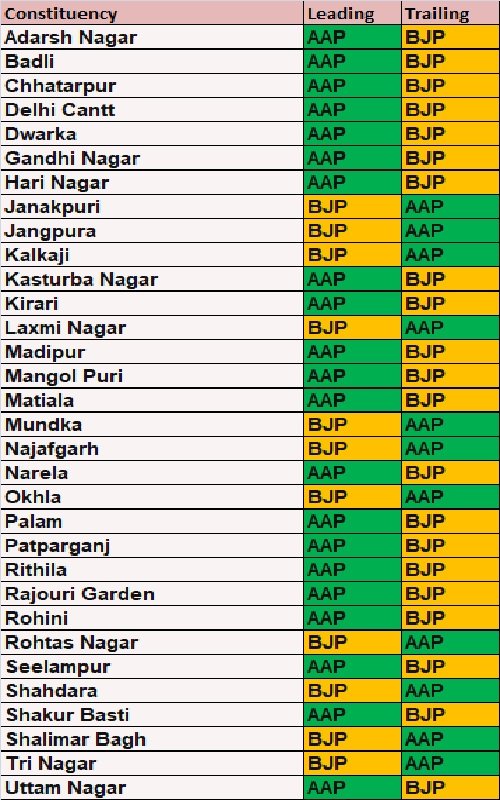
There are 32 seats where leads are less than 3000 votes. Aam Aadmi Party is leading in 21 seats while BJP candidates are leading in 11 seats where leads are less than 3000 votes.

Latest figures of less than 3,000 votes margin

BJP continues to lead in Okhla

11:30 AM

In early trends, Aam Aadmi Party is leading on 48 seats, while the BJP is leading on 22. Congress is yet to open its account.

However, there is a tight contest between AAP and BJP in nearly 39 seats where leads are less than 3000 votes.

Here are the seats where leads less than 3000 votes. AAP is leading 25 seats and BJP is leading in 14 seats. The total seats where leads less than 3000 votes are 39 seats.

Delhi assembly seats less than 3000 votes.

The exit poll results for Delhi Assembly elections have predicted a clean sweep for Arvind Kejriwal-led Aam Aadmi Party (AAP) in Delhi. If AAP wins Delhi polls 2020 then Arvind Kejriwal would become the chief minister of the national capital for the third term. The majority mark in the 70-member assembly stands at 36.

US President Donald Trump and First Lady Melania to visit India from Feb 24-25

Donald Trump, The President of The United States is set to visit India between February 24 and 25. The White House has announced it officially.


The Office of the Press Secretary stated, “The President and The First Lady will travel to New Delhi and Ahmedabad, which is in Prime Minister Modi’s home state of Gujarat and played such an important role in Mahatma Gandhi’s life and leadership of the Indian independence movement.”

The White House reiterated that the trip will strengthen the strategic partnership between the two countries and highlight the strong bond between the people of India and the States.

In anticipation of the event, the President’s security team has landed in India last week. When the two world leaders met on the sidelines of the UN General Assembly, no deals were signed. A limited trade deal may be signed during the visit by President Trump.

As per reports, a $1.86 billion missile defence system deal is being worked upon, apart from a 2.6 Billion USD 24 MH-60 Seahawk helicopters made by Lockheed Martin is also on the cards.

Read: Watch: ‘Mandir Wahi Banayenge’ chants echoed through the ‘Howdy, Modi!’ event in Houston

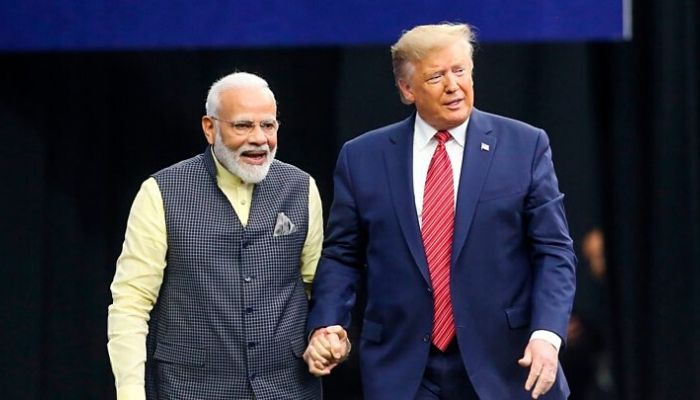
This will be the first trip of American President Donald Trump to India. He will be also be accompanied by the First Lady Melania Trump. Last year, PM Modi had visited the US and they had attended a massive ‘Howdy, Modi’ event organised in Houston together.

Delhi Elections: Congress’s Vikaspuri candidate Mukesh Sharma accepts defeat even before early trends trickle in

In a major embarrassment to Congress party, Congress candidate from Vikaspuri Mukesh Sharma on Tuesday accepted his defeat even before the early trends started pouring in ahead of the results for the February 8 Delhi polls.

Taking to Twitter, Mukesh Sharma, a four-time MLA said, “I accept my defeat, and thank all the voters and Congress workers of Vikaspuri constituency. I hope that there will be a holistic development of the area. I will continue to fight for the development of Delhi, Vikaspuri and Uttam Nagar constituencies in future also.”


Vikaspuri is a suburban assembly seat that comes under the West Delhi Lok Sabha constituency. The counting of votes is underway. The constituency has around 3,25,246 eligible voters.

Mukesh Sharma’s rivals are Mahendra Yadav from the Aam Aadmi Party and Sanjay Singh of the BJP. Mahendra Yadav had won the seat in 2015 and 2013.

In early trends, Aam Aadmi Party is leading on 46 seats, while the BJP is leading on 23. Congress is yet to open its account.

BJP’s candidate from Harinagar constituency Tajinder Pal Singh Bagga is leading, according to initial trends. Meanwhile, AAP’s riot-accused Amanatullah Khan from Okhla constituency is trailing. Okhla has been the hotbed of anti-CAA riots in the national capital.

Prominent candidates in the fray, CM Arvind Kejriwal from New Delhi, his deputy Manish Sisodia from Patparganj, Kalkaji candidate Atishi and Raghav Chadha from Rajendar Nagar of the AAP are all leading.

The exit poll results for Delhi Assembly elections have predicted a clean sweep for Arvind Kejriwal-led Aam Aadmi Party (AAP) in Delhi. If AAP wins Delhi polls 2020 then Arvind Kejriwal would become the chief minister of the national capital for the third term. The majority mark in the 70-member assembly stands at 36.

Delhi Election Results: Here is all you need to know about 7 important Muslim dominated constituencies

The Delhi election results are finally out today. After the end of a highly polarized campaign, the fate of the contesting parties will be known by the end of the day. The fight is expected to be a bipolar contest between the BJP and the Aam Aadmi Party with the Congress nowhere in the picture. One of the most important factors in any highly contested election is the Muslim vote. And the Delhi elections are no different. In this report, we shall focus on those constituencies where the fate of the parties is decided by the Muslim vote.

1. Okhla

Since 1993, the Muslim-majority Okhla constituency has never been won by a non-Muslim. It is the same constituency that had elected Amanatullah Khan from the AAP as their representative in 2015. The AAP leader was recently spotted leading riots in the national capital against the Citizenship Amendment Act and was also booked by Delhi police. He contested from the same seat again this year.

Okhla is also the most controversial constituency in terms of anti-CAA riots recently. Shaheen Bagh, where Islamists have laid siege is also a part of the Okhla constituency. At Shaheen Bagh, 2 infants have died due to the protests and the harsh weather conditions and several hate-filled, anti-Hindu slogans like ‘Jinnah Wali Azadi’ have also been raised. The mastermind of Shaheen Bagh protests, Sharjeel Imam, is in police custody after he made seditious statements like trying to cut away Assam from the rest of India. In fact, Sharjeel Imam was seen making provocative statements at a separate event with AAP’s Amanatullah Khan standing right beside him.

Interestingly, even Batla House forms a part of Okhla constituency.

The Okhla Constituency has about 65% Muslim votes as per a report in India TV news.

The BJP has fielded Braham Singh from the constituency. He was the BJP’s candidate in 2015 as well but had secured just over 23% of the votes last time. The Congress, meanwhile, has fielded Parvez Hashmi who has won the seat four times in the past. Shaheen Bagh, which has featured prominently in these election campaigns, lies in this constituency and so does Jamia.

Profile of Okhla:

Constituency Name: Okhla
Constituency Number: 54
District Name: South East Delhi
Total Electors: 2,73,543
Female Electors: 1,07,124
Male Electors: 1,66,394
Third Gender: 25
Reserved: No
Percentage of Muslim voters: Over 40%

AAP’s Amanatullah Khan has won.

2. Seelampur

Seelampur is another constituency that had witnessed massive riots following the passage of the Citizenship Amendment Act in both the houses of the Parliament. It is another constituency that has never been won by a non-Muslim. The Congress party has won this seat four times in the past and the Aam Aadmi Party won it in 2015.

In 2020, the Congress party has fielded a strong candidate. Mateen Ahmed who had held the seat from 1993 to 2015 before losing it to Mohammad Ishraque from the AAP is the Congress party’s candidate this time around. The BJP has fielded Kaushal Mishra this time around. The only way the BJP could win this seat is in the case of a Muslim vote split between the Congress and the AAP.

Seelampur is an Assembly seat in the North-East district of Delhi and a Muslim dominated neighbourhood. The area was set up in the Emergency-era to rehabilitate Muslims rendered homeless after their homes were demolished in the north and central Delhi.

In the run-up to the Delhi Assembly polls, Muslim-dominated areas of Seelampur saw unprecedented violence led by Muslim mobs to protest against the Citizenship Amendment Act.

Delhi was the epicentre of the anti-CAA riots, which later spread to different parts of the country. The Muslim mob in Delhi’s Seelampur had unleashed the violence against public infrastructure and pelted stones at the police injuring many of them. The violent protestors had even attacked school buses in Delhi’s Seelampur area.

There have been serious allegations against Delhi Chief Minister Arvind Kejriwal-led AAP for instigating riots in Delhi by inciting Muslim mobs against the Modi government ahead of the Delhi assembly elections under the guise of protesting against the Citizenship Amendment Act, which has nothing to do with Indian Muslims.

Shockingly, Aam Aadmi Party led by Arvind Kejriwal has given tickets to people who are associated with instigating riots in Delhi during the anti-CAA riots. AAP has fielded Abdul Rehman to contest from New Delhi’s Seelampur constituency in upcoming elections. Rehman along with ex-Congress MLA Mateen Ahmed has been named in an FIR by Delhi Police for ‘provoking the crowd’ to join the protests.

Profile of Seelampur:

Constituency number: 65
Total electors: 85350
Male: 1,55,735
Female: 70,385
Others: 0
Voter turnout in last Assembly Election: 71.51 %
Polling stations: 150
Percentage of Muslim population: Over 35%

AAP candidate Abdul Rehman has won.

3. Matia Mahal

This Assembly Constituency, too, has never been won by a non-Muslim and is another of the Muslim dominated constituency of Delhi. Shoaib Iqbal had held the seat from 1993 to 2015 before conceding it to Asif Ahmed Khan of the Aam Aadmi Party. This time around, Shoaib Iqbal is contesting from the AAP while the Congress has fielded Mirza Javed Ali. The BJP’s candidate for the seat is Ravindra Gupta.

Muslim voters are likely to play a decisive role in determining the result in this constituency, where they reportedly form around 40 percent of the electorate.

Matia Mahal is home to Ajmeri Gate, Chandni Mahal, Chawri Bazar, Chitli Qabar, Delhi Gate, Hauz Qazi, Lal Kuan, Sita Ram Bazar, Suiwalan and Turkman Gate.

It is pertinent to note that Hauz Qazi forms a part of Matia Mahal constituency. In Hauz Qazi, in July 2019, the Hindu community came under siege by a Muslim mob. Their temple was vandalised and for several days, communal tensions prevailed. The locals had also claimed that while vandalising the temple, the Muslim mob had urinated on the idols and the AAP MLA from the area did nothing to help the Hindus and was, in fact, favouring the Muslim mob.

Profile of Matia Mahal:

Constituency Name: Matia Mahal
Constituency Number: 21
District Name: Central Delhi
Total Electors: 1,15,944
Female Electors: 54,214
Male Electors: 61,720
Third Gender: 10
Reserved: No
Percentage of Muslim population: Over 40%

Aam Aadmi Party’s Shoaib Iqbal has won.

4. Ballimaran

No non-Muslim has ever won this Assembly Constituency. Haroon Yusuf from the Congress party held the seat from 1993 to 2015 while the Aam Aadmi Party’s Imran Hussain succeeded in snatching the constituency away from the Congress. Hussain had won almost 60% of the votes last time around while BJP’s Shyam Lal Morwal had managed only 24.29% vote share. In 2020, the Congress has again fielded Haroon Yusuf while the BJP has gone with Lata Sodhi. The AAP has chosen to field the incumbent from the seat, Imran Hussain.

The Dalit-Muslim combination could prove to be decisive in Ballimaran. Together, they form nearly 3/5th of the total electorate in the constituency. The constituency has areas such as Ahata Kale Sahib, Amarpuri, Bagichi Allauddin, Bagichi Raghunath, Bara Dari Sher Afgan, Bara Hindu Rao, Baradari Sher Afgan, Basti Bagrian, Basti Harphool Singh, Basti Julahan, Bazar Ballimaran, Bazar Chandni Chowk, Bazar Lal Kuan, Chamelian Road, Chawri Bazar, Chinyot Basti, Dharam Pura, Faizal Road, Farash Khana, Gali Shyamji, Haveli Hissamuddin Haider, Hoshiar Singh Marg and Jogiwara. The Muslim-dominated constituency has a gender ratio of 817, which is below the city average of 824.

Profile of Ballimaran:

Constituency Name: Ballimaran
Constituency Number: 22
District Name: Central Delhi
Total Electors: 1,40,776
Female Electors: 61,992
Male Electors: 78,777
Third Gender: 7
Reserved: No
Percentage of Muslim population: Well over 50-70%

AAP’s Imran Hussain has won.

5. Mustafabad

The BJP had won this seat in 2015 with its candidate Jagdish Pradhan securing 35.33% of the votes. The Muslim vote had split between the Congress and the AAP, paving the way for BJP’s victory. AAP had secured 30.13% of the votes while the Congress had managed 31.68%. The Congress party’s Hasan Ahmed had won this seat in 2008 and 2013. The Constituency had come into existence in 2008 after a delimitation exercise.

The AAP has fielded Haji Yunus and the Congress party has fielded Ahmed’s son and head of its minority wing, Ali Mehndi, from the seat. The BJP has fielded the incumbent from the seat, Jagdish Pradhan.

Rithala, Shahdara, Seemapuri, Babarpur and Mustafabad — have Muslim population between 30 percent and 40 percent. Over the last seven years, AAP has successfully weaned away Muslim voters, who have long been considered a traditional Congress vote bank.

In 2015, when AAP had swept the Delhi elections winning 67 seats and giving away only three to BJP, Mustafabad was the only Muslim-dominated seat that was won by BJP.

Mustafabad profile:

Constituency number: 69
Total electors: 2,33,426
Male: 1,29,496
Female: 1,03,923
Others: 7
Voter turnout in last Assembly Election: 70.65 percent
Polling stations: 192
District: North East Delhi
Muslim population: 30-40%

AAP’s Haji Yunus has won.

6. Babarpur

Babarpur has a significant Muslim population, between 30 to 40 percent. However, the BJP has won it four times in the past. The seat is currently held by Delhi Cabinet Minister Gopal Rai. He had defeated BJP’s Naresh Gaur by a margin of almost 36,000 votes. This year, it’s again a contest between Rai and Gaur while the Congress party has chosen to field Anveeksha Tripathi Jain.

It is pertinent to note that in June last year, a Delhi court framed charges of rioting, unlawful assembly, murder, the disappearance of evidence, mischief, dacoity, murder and conspiracy against 12 persons accused in the 1984 anti-Sikh riots case in the Babarpur area in northeast Delhi, where seven persons died.

Babarpur profile:

Constituency number: 67
Total electors: 1,92,358
Male: 1,05,238
Female: 87,092
Transgender: 28
Voter turnout in last Assembly Election: 66.99 percent
Polling stations: 153
Muslim population: Almost 40%

AAP’s Gopal Rai has won.

7. Chandni Chowk

The Assembly Constituency has a Muslim population of over 40 percent. The seat was won by Alka Lamba in 2015 for the Aam Aadmi Party who is now contesting from the Congress party. Meanwhile, Parlad Singh Sawhney, who had won the seat as a Congress candidate four times, contested the elections as the AAP candidate in 2020. The BJP has given its ticket to Suman Kumar Gupta.

Dariba Kalan, Fateh Puri, Jama Masjid, Kashmere Gate, Chandni Chowk, Khyber Pass, Lal Quila and Yamuna Bridge are some of the areas located in the constituency. The trader community, located across markets like Khari Baoli, Darya Ganj, Faiz Bazar, Kinari Bazar, Nai Sarak and Naya Bazar, is also a key electoral factor in this constituency.

Constituency Name: Chandni Chowk
Constituency Number: 20
District Name: Central Delhi
Total Electors: 1,13,784
Female Electors: 51,055
Male Electors: 62,723
Third Gender: 6
Reserved: No
Percentage Muslim population: Over 40%

AAP’s Parlad Singh Sawhney has won.

Bengal: VHP’s mass wedding ceremonies for poor tribals under attack, Mamata Banerjee terms them ‘conversion attempt’

Mass marriages conducted by Vishwa Hindu Parishad leaders were booked under non-bailable sections of the Indian Penal Code(IPC) after Mamata Banerjee’s administration alleged that the event is an ‘attempt of converting’ the followers of Sari/Sarna religion into Hindus.

As per a report in Hindustan Times, in Malda district, the top leaders of Vishwa Hindu Parishad were booked under sections of the Indian Penal Code(IPC), and Schedule castes and Schedule tribes Prevention of Atrocities Act, 1989 with the allegations that the mass marriage ceremony they had organised recently was to ‘convert’ the tribals into Hinduism.

As per the HT report, another such mass marriage ceremony has been stopped by the police and state administration in Alipurduar. The ceremony was scheduled for Monday, February 10. A day before the ceremony, the police had interrogated the organizers for hours. The police had also stopped the vehicles of organizers and seized microphones, dismantled the pandals erected on the venue.

The Inspector in-charge of the Alipurdaur police station Rabin Thapa said, “The event was not allowed because the organizers had not taken permission either from the office of the sub-divisional officer or from the police”.

Another police officer alleged that the action was taken after the police found a leaflet of the ceremony which mentioned that the marriages will be organized as per Hindu rituals.

The event was conducted by Shri Hari Satang Samiti in association with Alipurdaur Ganabibaho Samiti, both RSS linked organisations which have been organising such mass marriage ceremonies for poor tribals for years.

Alipurdaur Ganabibaho Samiti’s Ratan Tarafdar has stated, “We have been conducting similar events for several years. Each time, we only informed the administration in writing about the event and even received the administration’s assistance. Never did the question of obtaining written permission arise”. VHP, Banwasi Kalyan Ashram and other Sangh Parivar organisations too, regularly organise mass marriage ceremonies for poor tribal and rural people.

The VHP has mentioned that they have been following due tribal customs and social rituals in their mass marriage ceremonies. A report in Organiser stated that due permission for the Malda event was obtained from local administration and despite over 100 police officials being present, the event was attacked and vandalised by JDP worker who injured many tribal people and also damaged their belongings.

The VHP has alleged the collusion of Christian missionaries and communist leaders in attacking a tribal mass marriage ceremony and has asked for a detailed probe, failing which, they have claimed to launch a state-wide protest.

It is being speculated that the state government’s wrath on the mass marriage events has come after February 2 when some activists of a local political outfit called Jharkhand Disom Party had vandalised the mass marriage venue in Malda.

Chief Minister Mamata Banerjee too had joined in to vilify the mass marriage events. While speaking in a public meeting in Nadia district, she had said, “Three days ago, in Malda district, tribal women were being converted in the name of marriage. I thank my administration that they acted. One VHP person has been arrested and the rest are evading the police. They are shameless. The government will arrange for a fund for the marriage of tribal people from poor economic backgrounds”.

The Bharatiya Adivasi Ekta Manch, JDP and some other tribal outfits have been campaigning for a separate religion code for Sarna followers. They have also been reportedly urging the state’s schedule tribe population to list Sarna as their religion in the 2021 census.

Meanwhile, RSS’s South Bengal unit secretary Jisnu Basu hit back at Mamata Banerjee saying “I also smell a conspiracy. Are all of the state’s tribal people followers of Sarna religion, according to the census of 2011? Aren’t there tribal people who consider themselves as Hindus? In that case, is there a concerted effort to reduce the number of Hindus?”

As per the HT report, Sari and Sarna are included as ‘other religious practices’ in the census. In the 2011 census, 942,297 people in West Bengal, or 1.03 per cent of the state’s population, had registered themselves as followers of other religious practices, while the state’s ST population stood at 5.8 per cent.