Home Blog Page 959

Narendra Modi likely to take oath as Prime Minister of India for the third time on 8th June, NDA partners to submit letters of support

Senior BJP leader Narendra Modi is likely to be sworn in as the Prime Minister of India for a third consecutive term on 8th June, as widely reported by media citing sources. With this, Modi will become the second leader in India’s independent history to retain power for a third term after former Prime Minister Jawaharlal Nehru.

According to the sources, as the Telugu Desam Party (TDP) and the Janata Dal-United (JDU), the potential “kingmakers” have given the green signal, the formation of the Bharatiya Janata Party (BJP)-led National Democratic Alliance (NDA) government and the swearing-in ceremony of PM Modi is likely to take place on June 8. Both parties are expected to submit formal letters of support to the BJP during a meeting of the alliance.

With key allies in the form of TDP and JD(U), the pre-poll National Democratic Alliance (NDA) won 292 Lok Sabha seats which is 20 more than the coveted halfway mark required to form the government at the centre. BJP has become the single largest party and won 240 Lok Sabha seats while its major allies TDP and JDU have won 16 and 12 seats respectively. 

The Election Commission of India has announced the results for all 543 seats in the country. As per the results, INDI Alliance has 234, against 292 won by NDA. There are 17 others, including 7 independents, who are not part of any of the two alliances.

Notably, amidst efforts by the leaders of the I.N.D.I. alliance to bring NDA partners TDP and JDU on their side, both NDA allies have extended support to their pre-poll ally. On the contrary, there are reports that key I.N.D.I. Alliance leader Uddhav Thackeray would skip the opposition bloc meeting. However, Sanjay Raut will represent his party in the meeting.

TDP chief N Chandrababu Naidu addressed media persons in Vijayawada, Andhra Pradesh ahead of a crucial NDA meeting in New Delhi to be held later in the evening. Responding to a media query, the TDP Chief reiterated his support for the NDA. Yesterday, he quoted PM Modi’s tweet and said that the mandate reflected that people reposed trust in their alliance (NDA).

Today, he told media, “You always want news. I am experienced and I have seen several political changes in this country. We are in NDA, I’m going to the NDA meeting. In course of time, we will report it.”

Likewise, JD(U) spokesperson KC Tyagi categorically rejected options of going back to the opposition bloc and noted that Nitish Kumar is heading for the NDA meeting in New Delhi. In the meeting, JDU will also submit the letter to pledge support to NDA and make Narendra Modi the prime minister of the country. 

He said, “NDA meeting is taking place in Delhi…Nitish Kumar is participating in the meeting. JD(U) will also submit the letter pledging support to NDA as well as to make Narendra Modi the PM. There is no question of going back (to I.N.D.I. alliance)…”

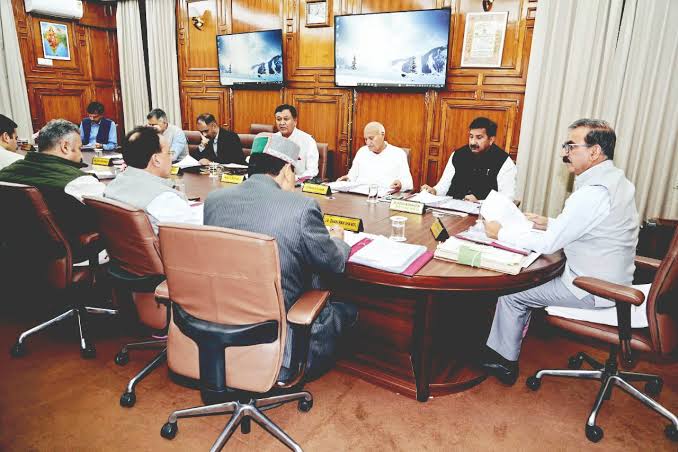
Earlier in the day, the incumbent Prime Minister Narendra Modi chaired a meeting of the Union cabinet meeting in the national capital, a day after the results of the 2024 Lok Sabha elections were announced. 

Union Ministers Amit Shah, Nitin Gadkari, Rajnath Singh, and other cabinet ministers participated in the meeting that began this morning at Prime Minister Narendra Modi’s residence at 7 Lok Kalyan Marg here. The Union Cabinet recommended the dissolution of the 17th Lok Sabha, whose term ends on June 16. 

Meanwhile, both the Bharatiya Janata Party-led NDA and the Opposition I.N.D.I.A. bloc are set to hold meetings on Wednesday (5th June) to chalk out strategies for future courses of political action. The NDA leaders are scheduled to meet later today, at Prime Minister Modi’s residence at 3:30 p.m. 

Taking to X, Congress president Mallikarjun Kharge announced that leaders of the I.N.D.I.A. bloc will meet around 6 pm in the national capital. 

As per the results of the Lok Sabha elections, the Election Commission of India has declared results for 542 of the 543 Lok Sabha constituencies, with the BJP winning 240 seats and the Congress 99. The BJP victory tally was much lower than its 2019 tally of 303 and the 282 seats it had won in 2014. The Congress, on the other hand, registered a strong growth, winning 99 seats compared to 52 that it had won in 2019 and 44 seats in 2014.

The INDIA bloc crossed the 230 mark, posing stiff competition, and defying all predictions from exit polls.

Prime Minister Narendra Modi has secured a third term, but the BJP will need to rely on the support of other parties in his coalition, including JD (U) chief Nitish Kumar and TDP’s chief Chandrababu Naidu.

‘Gave enough representation to Muslims but didn’t get adequate support’: Mayawati blames lack of Muslim support for BSP’s debacle in LS polls

On Wednesday (5th June), Bahujan Samaj Party (BSP) Supremo Mayawati blamed the lack of support from the Muslim community for the party’s debacle in Uttar Pradesh in the recently concluded Lok Sabha elections 2024. Notably, results for 543 Lok Sabha seats were announced on 4th June in which BSP failed to open its account in the state or across the nation. In a press release on Wednesday, the BSP Supremo expressed disappointment over the lack of support from the Muslim community and stated that despite giving enough representation to them, the party didn’t get adequate support in return. She added that from now onwards, BSP will only give them representation after “thinking properly” so that the party “won’t suffer such losses”. 

“We gave enough representation to Muslims in this Lok Sabha election as well as in previous elections but we did not get adequate support and they couldn’t understand us well. Therefore from now onwards, we will only give them opportunity after thinking properly so that the party won’t suffer such loss,” Mayawati was quoted saying by news agency ANI.

She, however, expressed gratitude to the Dalit community, especially those hailing from her caste community for casting the majority of their votes in favour of the BSP. 

In the press release, she also expressed concerns about the stretched duration of the electoral exercise, especially due to the intense summer heat which reportedly led to a drop in voter enthusiasm and voter turnout. She asserted that the elections should have been conducted in a few lesser phases to avoid hardships to the voters, lakhs of government employees, security personnel, and officials employed in the election process. 

She added that they had maintained that if the elections were conducted in a free and fair manner, the election results would definitely be positive and shocking. She stressed that now that the results are before the public, they have to think about the country’s democracy, constitution, and national interest and decide what impact the election results will have on their lives and how peaceful and prosperous their future will be.

She said, “Apart from this, the entire country’s eyes were fixed on UP in this election and the results that came out here are also in front of the public. Our party will take this seriously and analyze it thoroughly at every level and will take whatever steps are necessary in the interest of the party and the movement because B.S.P. apart from being a political party, it is also a movement for people’s self-respect. That is why our response will also be purely dedicated to the democracy of the country and the sanctity and strength of the teachings of the most revered Baba Saheb Dr. Bhimrao Ambedkar, so that the interests of crores of poor, exploited, Dalits, tribals, backward people and Muslims and other religious minorities of the country are protected.” 

She further asserted, “And now I have to say that our missionary religion is to work hard with full dedication, devotion, and honesty, following the paths shown by the most revered Baba Saheb Dr. Bhimrao Ambedkar.” 

She concluded by saying, “..Also, the Muslim community, a special part of the Bahujan Samaj Party, which despite giving proper representation in the last several elections and this time also in the Lok Sabha general elections, is not in favour of B.S.P. If they are not able to understand it properly, then in such a situation, they will be given a chance by the party in the elections only after a lot of thinking. So that the party does not suffer such a huge loss in the future as it did this time.”

In Uttar Pradesh, Samajwadi Party won 37 Lok Sabha seats and became the single largest party in the state while the BJP won 33 seats. Congress has won 6 seats whereas BJP’s allies Apna Dal and RJD won 1 and 2 seats respectively. While BSP failed to open its account, Azad Samaj Party head Chandrashekhar Azad won from Nagina.  

Union cabinet recommends dissolution of the 17th Lok Sabha, both NDA and INDI Alliance to hold strategy meetings in Delhi today

0

Prime Minister Narendra Modi chaired a meeting of the Union cabinet meeting in the national capital, a day after results of the 2024 Lok Sabha elections were announced. 

Union Ministers Amit Shah, Nitin Gadkari, Rajnath Singh, and other cabinet ministers participated in the meeting that began this morning at Prime Minister Narendra Modi’s residence at 7 Lok Kalyan Marg here.

The Union Cabinet recommended the dissolution of the 17th Lok Sabha, whose term ends on June 16.

Meanwhile, both the Bharatiya Janata Party-led NDA and the Opposition INDIA bloc are set to hold meetings on Wednesday to chalk out strategies for future courses of political action.

The NDA leaders are scheduled to meet later today, at Prime Minister Modi’s residence at 3:30 p.m. Congress president Mallikarjun Kharge announced on his social media platform X that leaders of the INDIA bloc will meet around 6 pm here in the national capital.

Having witnessed a favourable outcome in the LS polls, the leaders of the INDIA bloc will strategize their next move.

As per the results of the Lok Sabha elections, the Election Commission of India has declared results for 542 of the 543 Lok Sabha constituencies, with the BJP winning 240 seats and the Congress 99.

The BJP victory tally was much lower than its 2019 tally of 303 and the 282 seats it had won in 2014. The Congress, on the other hand, registered a strong growth, winning 99 seats compared to 52 that it had won in 2019 and the 44 seats in 2014.

The INDIA bloc crossed the 230 mark, posing stiff competition, and defying all predictions from exit polls.

Prime Minister Narendra Modi has secured a third term, but the BJP will need to rely on the support of other parties in his coalition – JD (U) chief Nitish Kumar and TDP’s chief Chandrababu Naidu.

The BJP fell 32 seats short of the 272 majority mark after votes polled in the 2024 Lok Sabha elections were counted. For the first time, since the Bharatiya Janata Party swept to power in 2014, it did not secure a majority on its own.

Meanwhile, PM Modi has staked the claim to form the government. Prime Minister Narendra Modi thanked the people for the mandate and said BJP-led NDA will form its third successive government and that it is the victory of the resolve of Viksit Bharat, of ‘Sabka Sath Sabka Vikas’ and of the strong faith of people in India’s Constitution.

“On this sacred day, it is confirmed that NDA is forming the government for the third time. We are grateful to the people, they reposed full faith on the BJP, NDA. This is the victory of the world’s largest democracy, it is a victory of strong faith on India’s Constitution, it is the victory of the resolve of Viksit Bharat. It is the victory of ‘Sabka Sath Sabka Vikas’,” he said in his address at the BJP headquarters on Tuesday.


(This news report is published from a syndicated feed. Except for the headline, the content has not been written or edited by OpIndia staff)

“Focus on Hindutva voters, distance from neo-Hindutvawadis pushing leftist stereotypes”: Advocate J Sai Deepak makes several suggestions to BJP after election results

The NDA has returned to power with lower-than-expected seats in the Lok Sabha elections, the results of which were announced yesterday. Unlike the last two terms of the Modi govt, BJP is short of majority mark, and the NDA total is also less than 300, triggering a heated debate on ‘what went wrong’, even though the alliance will remain in power. The alliance performance was mostly impacted by unexpected results in Uttar Pradesh and Maharashtra, and analysts have started analysing the reason for the same. Senior Supreme Court Advocate and author J Sai Deepak also analysed the poll results, sharing some interesting insights and suggestions for the Bhartiya Janata Party.

Taking to X on Wednesday, J Sai Deepak said, “I don’t have the resources or the first-hand knowledge to distill the reasons for the outcome. With this caveat, I will air a few general expectations which, in my view, are legitimate and reasonable. Whether they led to the outcome or not is for stakeholders to decide.”

Delving into his “expectations”, he said that the BJP should focus on the issues of its core “Hindutva voters” including the tax-paying and law-abiding middle class and advised to maintain a distance from neo-Hindutvawadis pushing leftist stereotypes in the name of Veer Savarkar. “Macro Hindu symbolism aside, it would help to pay close attention to the core Hindutva vote base on critical issues which impact its lives, dignity & future. The current numbers were perhaps made possible by this Hindutva core which votes out of loyalty to Dharma,” Deepak said.

“This core Hindutva base is mostly comprised of the middle class, tax-paying, law-abiding Hindu who slogs personally, & bats for Hindutva despite the constant stacking of “social justice initiatives” in all forms & shapes against him/her. Clearly, it helps to keep them on your side. In the interest of making their law-abiding lives liveable in an increasingly hostile environment, it would help to keep at a distance the newly-minted alleged Hindutvawadi social justice warriors who push Leftist anti-Dharmic stereotypes under the garb of Hindutva using Savarkar,” the Supreme Court lawyer continued.

Further, he suggested that attacks on traditional institutions significant to Hindutva should stop. “It is possible to deliver social equity without pushing received stereotypes or constantly attacking traditional institutions that the Hindutva core holds dear. Surely there are ways of lifting people up without trashing tradition. Unless the goal of some is to destroy it,” he said.

Sai Deepak also said that the Hindu temples should be freed from the State’s control. “Bridge the First & Second points by freeing Temples from State Control. Preserve tradition & recover the assets of Temples to educate & uplift those struggling for resources *regardless* of caste. Empower the Hindu society instead of rendering it subservient to the State. For those who disagree with tradition (“orthodoxy”), the freedom of conscience guaranteed under the Constitution enables setting up of new institutions where they are free to subscribe to or deviate from tradition in accordance with the dictates of their conscience.,” he said.

Moreover, the Supreme Court lawyer suggested that Hindu religious sites (Kshetra) should not be seen as infrastructure projects and their natural setting should be respected. “Respect Kshetras, their sanctity & their natural setting. They can certainly do with better cleanliness & organisation, but they are *not* infrastructure projects & must be approached with some respect for the Kshetra, its prakriti and the prakriti it is located in,” he said.

“Respect prakriti even in this important quest for development, especially in sensitive regions such as Himachal Pradesh and Uttarakhand. Unrestrained tourism & development which is not sensitive to the ecology of a place have consequences for the local *and* others,” he added.

J Sai Deepak also emphasised the importance of investing in humanities and steps to be taken in the field of education and culture which are crucial for decolonisation. “Please understand the need to invest in humanities, especially in history. Decolonisation is an empty rhetoric if it is not followed up with concrete steps in the realms of education & culture because they are battlegrounds of the present to engineer a future. The political and civilisational consequences of fabricated weaponised history have played itself out on the streets and elsewhere over the last decade to the detriment of the Hindu society and Bharat. Therefore, decolonising humanities is equally a political imperative,” he said.

The “India That Is Bharat” author also stressed the need to effectively tackle illegal migration. “Tackle illegal migration with an iron hand. Parts of Bharat are being taken over and the lives of Bharatiyas being made miserable, including on the economic front through loss of employment at every level to illegal migrants. Law and order is the first casualty. The Delimitation game has its limits in containing & dealing with illegal migration. After a point, even that can’t hold fort because of demographic inversion. Viewed from every perspective, illegal migration poses perhaps the biggest threat to Bharat’s integrity,” he emphasised.

Sai Deepak stressed the need to bring a National Register of Citizens (NRC) and a fresh census to get a clear picture of where India’s demography stands. “Bharat badly needs an NRC and a new census to understand where we stand demographically. Without this data, we are practically flying blind under the mistaken assumption that pure economic growth is the silver bullet to all our problems. It is necessary but *not* sufficient,” he said.

Lastly, J Sai Deepak said “We typically understand the value of a parliamentary majority and what could have been achieved with it *after* letting go of it. Let’s hope we are ready with a clearer vision for 2029 or earlier. Jai Shri Ram.”

Complacent candidates, disgruntled caste groups, and more: What went wrong for the BJP in Uttar Pradesh

Lok Sabha elections are over, the BJP-led NDA has won the majority for the third time in a row. Despite this, the election results have emerged as a shocker for the BJP-NDA. The most shocking results for the BJP came from the most reliant state—Uttar Pradesh, where the BJP won 62 out of 80 seats last time and has now been reduced to just 33 seats. The significant drop in BJP’s seats warrants an analysis of what went wrong for the BJP despite its development works, construction of Ram Mandir in Ayodhya and so on.

Caste dynamics and alliances

Despite Prime Minister Narendra Modi’s best efforts in a decade of his government, the INDI Alliance successfully re-mainstreamed caste-based politics, especially in Uttar Pradesh. The BJP faced significant challenges from the caste-based mobilization of the opposition, particularly the INDI alliance, which included the Samajwadi Party (SP) and the Congress. This alliance effectively capitalized on the caste equations in the state, which has a history of influencing electoral outcomes. The Samajwadi Party, with its strong Yadav and Muslim support base, and the Congress, trying to regain lost ground, managed to consolidate votes against the BJP. It took three parties who have literally no admiration for each other to come together to oppose the BJP effectively. It is interesting to recall how Akhilesh Yadav called its ally Congress a “chalu” party and appealed to people not to vote for Congress.

Conspicuously, the Samajwadi Party’s policy of polarisation of Muslim and Dalit votes overshadowed BJP’s development-based campaign. Muslim votes have traditionally gone against the BJP in Uttar Pradesh, and with SP and Congress cementing their alliance, the Muslim vote consolidated even more in seats where they are dominant. Moreover, as Mayawati’s Bahujan Samaj Party (BSP), which once dominated the Dalit votes, has now nearly vanished, its vote bank shifted to the SP-Congress alliance. It is pertinent to note here that Uttar Pradesh has a 20% Muslim population and 20% Dalit population.

Political analyst Preetam Srivastava rightly said “The way BSP’s core voters got scattered, it is very clear that Dalits this time voted for the INDI alliance.”

The Samajwadi Party successfully managed to encash its M-Y [Muslim-Yadav] vote bank. BJP also failed to address the resentment of Rajputs who were complaining of underrepresentation and neglect by the government.

The Rajputs, who make up approximately 10% of the population in western Uttar Pradesh, are dissatisfied with the lack of Lok Sabha seats for their leaders. The BJP fielded only one Rajput candidate in the eight constituencies that voted in the first round, Kunwar Sarvesh Singh, who died the day after the election. In the remaining eight constituencies, the BJP had no Rajput candidates. The Rajputs have expressed their anger, convening a large mahapanchayat in Saharanpur in April this year. To no surprise, Congress’s Imran Masood defeated BJP candidate Raghav Lakhanpal in Saharanpur.

Source: ECI website

Besides, Rajputs, Dalit voters also turned against the BJP. There was a rumour that the Modi government in its possible third term would “change” the constitution, effectively reducing reservations. This rumour stemmed from Karnataka BJP leader Anant Hegde’s remarks that BJP would change the constitution. He apologised later. However, the damage was done and opposition leaders used this to build a narrative that the BJP if managed to get a thumping majority, would use it to end reservations.

Overconfidence of BJP candidates and complacency of BJP workers

Several BJP candidates have heavily paid the price of their overconfidence, and negligence of voters. BJP leaders in the state relied more on Prime Minister Modi’s charisma than their groundwork. In many areas in Uttar Pradesh, even those who voted for BJP were of the opinion, “Modi ke naam pe vote de rahe, nahi toh inko kaun jaanta hai” [We are giving vote in Modi’s name, otherwise, who even knows these people (BJP candidate)]. The overconfidence of several BJP leaders was at its peak during these elections, so much so that they did not even step out of their residences and try to connect with voters.

Similarly, BJP workers also remained complacent forgetting that merely saying “Aayega toh Modi hi” or “Abki baar 400 paar” does not win seats but a rigorous campaign does. While many BJP candidates were ensconced in their houses, Samajwadi Party and Congress gained ground. BJP needs to introspect into how will people connect with their leaders if they do not work for them, or visit localities, and villages in their constituency. Why will people vote for someone who has zero interest in understanding and addressing their grievances?

The BJP’s decision of heavily relying on the charisma of national leaders like Prime Minister Narendra Modi and Chief Minister Yogi Adityanath did not resonate as effectively this time. The opposition’s focused and localised campaign strategy, highlighting specific regional issues and addressing the concerns of various communities, proved to be more effective in garnering votes​.

Resentment among youths and students

The short-term Agniveer scheme and the repeated incidents of exam paper leaks contributed to youth and student dissatisfaction. Over 48 lakh candidates who had enrolled for police jobs were surprised when the exam was called off due to a paper leak.

Why even Ram Mandir could not help the BJP: The Curious Case of Ayodhya

In January this year, Prime Minister Narendra Modi inaugurated the Ram Mandir in Ayodhya. This was a historic moment as Hindus reclaimed the birthplace of Lord Ram after 500 years of continued struggle and sacrifice. While Ayodhya witnessed a significant transformation from being perennially neglected to becoming a tourist hub, with Increased economic activity in the area. Despite this, BJP candidate Lallu Singh lost the Faizabad seat to Samajwadi Party candidate Awadhesh Prasad by a margin of 54,567 votes.

Lallu Singh’s defeat shocked the BJP supporters not just in Uttar Pradesh but across the country with many questioning, what do the people of Ayodhya want that even Ram Mandir could not consolidate the Hindu vote?

Source: ECI website

BJP’s loss in Faizabad that includes Ayodhya: What went wrong

There are many factors contributing to BJP’s defeat in Faizabad. One of the key factors was resentment among people who were reportedly not given adequate compensation for their properties that were taken by the government for various infra projects. It is worth recalling that after PM Modi laid the foundation of Ram Mandir on 5th August 2020, he announced plans for the construction of Ayodhya Dham Airport, railway station, two km long elevated road to the Janmabhoomi temple complex and the development and 84 kosi parikrama marg etc.

For these infrastructure projects including the widening of roads, the administration demolished several houses and shops belonging to local residents. Nearly 450 shops and 20 temples were demolished in the process by 2022. It was alleged that affected people were given scant compensation after land acquisition and some affected families had to face a lot of hurdles to get compensation. Despite the state government’s efforts and distribution of over Rs 100 crore compensation, this resentment could not be curbed.

Besides, BJP’s Lallu Singh ensured his own defeat when he talked about changing the constitution. In April this year, Lallu Singh while addressing a public meeting in Milkipur said that the NDA would need a two-thirds majority to “change or make a new constitution”. “A government formed with 272 seats cannot amend the Constitution. For that, or even if a new Constitution is to be made, there is a need of over two-thirds majority..” Singh said. He later said that it was a “slip of tongue” adding that by changing he only meant “constitutional amendments”.

The damage, however, was done. Singh’s remarks spectacularly backfired for the BJP in an already polarised scenario and helped the opponents in their fear-mongering that the BJP would remove or change to constitution using its brute majority.

Absence of RSS, ground level Karyakartas basically ‘sat this one out’

The overconfidence was not limited to just BJP candidates but also reflected in the conduct of BJP’s high command. In May this year, BJP national president JP Nadda said that the party has become stronger and now runs itself. “Initially, we would have been less capable, smaller and needed the RSS. Today, we have grown and we are capable. The BJP runs itself,” Nadda said adding that RSS is the “ideological front”. This indicated that BJP does not need RSS on the political front, however, the Lok Sabha election results suggest that the BJP should reconsider its position on RSS’s involvement in election campaigning.

In the ru up to the elections, there were reports that many RSS members, who had earlier participated in ground level awareness programs, and even worked actively to get voters to go out and vote, chose to sit this election out. There were also reports of RSS cadre facing neglect and indifference from some senior party leaders.

Conclusion

Poor candidate selection, weak campaign, complacency of BJP leaders and workers, absence of RSS, controversial statements by BJP leaders alongside the opposition’s consolidation of Muslim, Dalit and Yadav votes coupled with the vote of those upset with BJP contributed to the party’s dismal performance in Uttar Pradesh.

The BJP needs deep introspection and some major overhaul structurally and mentally, before the 2027 assembly elections in India’s largest and most populated state.

Ancient Vitthala Murti discovered in Pandharpur’s temple, Vijayanagara Ujjivana Trust demands its consecration in Hampi Temple

Vijayanagara Ujjivana Charitable Trust took to X on June 3 to announce the discovery of the ancient Vitthala Murti in Maharashtra’s Pandharpur town.

The trust said that the four-armed form of Vitthala sporting a Sri Vaishnava-style tilak appeared in a secret chamber of the Pandharpur temple just when the trust started demanding the reconsecration of the temples in Hampi. Saying so, Vijayanagara Ujjivana Charitable Trust urged PMO and Maharashtra and Karnataka CMOs to ensure its consecration in Hampi.

Vitthala, also known as Vithoba and Panduranga, is a Hindu god and a form of the god Vishnu in his avatar as Krishna. Vitthala is primarily worshipped in the Indian states of Maharashtra and Karnataka.

“We express our great joy on discovery of ancient Vitthala in Pandharpur. It corroborates the legend about Vijaya Vitthala being shifted to Pandharpur during the destruction of Vijayanagara. We request @PMOIndia, @cmomaharashtra & @cmofkarnataka to ensure its consecration in Hampi,” wrote Vijayanagara Ujjivana Charitable Trust in a post on X informing about the discovery of the ancient idol of Lord Vitthala.

“Just when we have started insisting on reconsecration of our temples in Hampi, the deity of the grandest and largest of the temples in Hampi has mercifully revealed Himself to us. It is a testament to the fact that Paramatma is always ready to listen to our sincere prayers. It also shows that even in the darkest pages of our history, we may find acts of great devotion and valour,” the press release read.

The trust thanked Maratha sardars for their efforts to protect the Vitthala of Purandaradasa and linked the development to the reconsecration of Ramlalla at the Ayodhya Janmabhoomi Mandir.

It asked the state governments of Maharashtra and Karnataka, as well as the Union Government, to return the murti to Hampi and re-consecrate it in the local temple.

The trust has been advocating that we should reconsecrate gods at the temples to worship them, rather than maintaining our temples as lifeless monuments.

“Let the Hindus of the world witness the homecoming of Vitthala of Vijayanagara… The restoration of worship in this temple shall herald the beginning of another Dharmic renaissance,” Vijayanagara Ujjivana Charitable Trust added in its press note on the discovery of the ancient idol.

Notably, two huge Venkatesh idols, each measuring roughly three to three and a half feet tall, have been found at the famous Vitthal temple in Pandharpur, Maharashtra. Ancient coins and what are thought to be divine footwear have also been discovered, along with a number of other idols of all sizes. Additionally, a goddess idol has been discovered.

Archaeology department excavations started on the night of May 31 after the basement was found during routine temple work. The department is currently conducting an investigation into the site in an attempt to find additional artefacts and assess their significance.

Bengaluru Rural seat: BJP’s CN Manjunath defeats Congress sitting MP DK Suresh who called for a ‘separate country of South Indian states’

On 4th June, the Election Commission of India announced the results of the Lok Sabha Elections 2024. Bharatiya Janata Party’s Dr CN Manjunath defeated Congress’s DK Suresh by 2,69,647 from the Bengaluru Rural Lok Sabha seat in Karnataka. As per ECI’s data, Manjunath secured 10,79,002 votes against DK Suresh’s 8,09,355 votes. All other candidates contesting for the seat lost their deposits.

58-year-old DK Suresh is the brother of the Deputy Chief Minister of Karnataka and state party chief DK Shivakumar. Ramanagara, which comes under Bengaluru Rural constituency is often considered to be their turf.

66-year-old Dr Manjunath was fielded against DK Suresh by the BJP. Notably, Dr Manjunath is a famous cardiologist and son-in-law of former Prime Minister and JD(S) supremo HD Deve Gowda.

Source: ECI

The constituency they contested from have voters from diverse backgrounds. There are voters from the IT industry in Electronics City, industrial townships in Bidadi, Rajarajeshwarinagar’s apartment complexes and rural areas where agriculture is a notable source of income for the residents.

In 2019, DK Suresh was the only Congress candidate to win the Lok Sabha election in Karnataka. He also won 2013 by-polls and 2014 polls as well. Though his family actively campaigned for him visiting door-to-door seeking votes for him, the final result went against him.

On the other hand, Dr CN Manjunath has served as the head of the state-owned Sri Sri Jayadeva Institute of Cardiovascular Sciences and Research for 18 years. He retired from the service in January 2024. This was Manjunath’s first election. In an interview with Money Control, Dr Manjunath said he decided to contest from Bengaluru Rural at the request of the BJP high command.

Interestingly, he mentioned that in every village he visited during campaigning, there were 10-15 patients who had received treatment from Sri Jayadeva Institute of Cardiovascular Sciences and Research. His being a doctor from such a pristine institute where treatment is affordable helped him gain votes.

DK Suresh called for seperate country of South Indian states

In February this year, when Finance Minister Nirmala Sitharaman presented the Interim Budget for 2024, there was a negative campaign from Cogress and some I.N.D.I. Alliance leaders. While reacting to the budget, Congress leader DK Suresh accused the centre of not releasing funds to South Indian states. He also went on to say that in future, South Indian states may demand a separate country for themselves and become a separate nation.

Khalistanis winning in Punjab, Kashmiri separatist in Baramulla: The 3 victories that may look good for ‘democracy’ but concerning for national security

On 4th June, results for Lok Sabha Elections 2024 were announced. Two seats from Punjab and one from Jammu and Kashmir sent shockwaves across the nation as three separatist leaders won these seats. Amritpal Singh from Khadoor Sahib (Punjab), Sarabjeet Singh Khalsa from Faridkot (Punjab) and Abdul Rashid Sheikh from Baramullah (Jammu and Kashmir) stood victorious in the General Elections. Two of the three are currently lodged in jail. While on the surface, their victory as independent candidates might appear as a celebration of democracy showing that the electorate can make diverse choices, when we look at the deeper context, it is concerning for national security.

The victory in Baramulla: A separatist’s win

In Baramulla, independent candidate Abdul Rashid Sheikh secured 4,72,481 votes which amounted to a 45.7% vote share. He comfortably defeated Omar Abdullah, former chief minister of J&K and leader of Jammu & Kashmir National Conference who managed to secure only 2,68,339 votes that amounted to 25.95% vote share. It is notable that Sheikh, a separatist leader, is currently lodged in Tihar under the Unlawful Activities (Prevention) Act (UAPA).       

Source: ECI

Popularly known as Engineer Rashid, he is the founder of the Jammu and Kashmir Awami Ittehad Party. Earlier, he contested Assembly Elections in 2008 and 2014 and stood victorious. He also contested the 2019 Lok Sabha elections but could not win. Before joining politics, he was a construction engineer, hence the name Engineer Rashid. In 2019, he was arrested by the National Investigation Agency on the charges of terror funding activities becoming the first recognised leader to be arrested under UAPA.

Rashid represents a faction that has challenged the sovereignty of India in the region for decades. His victory is proof that there is a long way for the Indian government to win the hearts of the people of Jammu and Kashmir and get rid of the separatist sentiments in the region.

Faridkot chose a Khalistani leader, son of man who assassinated Indira Gandhi

In Faridkot, Sarabjeet Singh Khalsa contested as an independent candidate. He is son of Beant Singh, one of former Prime Minister Indira Gandhi’s assasins. Sarabjeet secured 2,98,062 votes translating to a 29.38% vote share. He defeated Aam Aadmi Party’s Karamjit Singh Anmol who received 2,28,009 votes translating to 22.48% vote share. Sarabjeet’s family is known for its pro-Khalistani sentiments and has advocated for a separate Sikh state. His victory is a stark reminder that the undercurrents of the Khalistani movement persist in the state of Punjab posing a serious threat to India’s unity and integrity.

Source: ECI

Khadoor Sahib’s verdict exposed widespread Khalistani sentiments in Punjab

In Khadoor Sahib, pro-Khalistani separatist leader Amritpal Singh won by a significant margin. Amritpal Singh is currently lodged in Dibrugarh Jail after being arrested by central agencies under National Security Act (NSA). Amritpal secured 4,04,430 votes which translated to 38.62% vote share. He defeated Indian National Congress’s Kulbur Singh Zira who secured 2,07,310 votes which translated to a 19.8% vote share. Amritpal Singh gained popularity in Punjab after taking over the late Deep Sidhu’s organisation Waris Punjab De. Sidhu was also a pro-Khalistani leader. Notably, Amritpal was seen as Bhindranwale 2.0 by pro-Khalistani elements in Punjab.

Source: ECI

In 2023, Central agencies and Punjab Police launched a manhunt against Amritpal Singh for his pro-Khalistani and anti-India activities. The hunt began in March 2023 but he managed to stay on the run for over a month and was arrested at the end of April 2023. Amritpal Singh, who donned attire similar to Khalistani terrorist Jarnail Singh Bhindranwale during his march across Punjab, gave an impression that his movement was against drugs in the state, which is a serious problem. By the time he was arrested, Amritpal already had a weapon training centre and gained lakhs of followers which was visible in the election results. A Khalistani leader securing over 4 lakh votes is not a good sign for national security.

Access to sensitive parliamentary documents

Being parliamentarians all three of them are going to have access to sensitive documents related to the central government that the general public cannot access. Such information can be used to manipulate the sentiments of the public in the long run. There is evidence that some parliamentarians have shared their passwords with unauthorised personnel, take the example of Mahua Moitra who was expelled from Lok Sabha in December last year. Even with multiple layers of security, such access to documents can be dangerous.

Democracy at a crossroads

The success of independent, diverse candidates across party and ideology in a democratic setup is a testament to the fair electoral process. However, such victories of separatist leaders raise red flags and have potential threats to national security. These leaders’ separatist and pro-Khalistani ideologies could embolden similar movements, destabilising the regional and national equilibrium.

These victories should be seen as a wake-up call for the nation. While the democratic process must be upheld, it is imperative to address the underlying issues that allow separatist and extremist ideologies to flourish. The victories of Abdul Rashid Sheikh, Sarabjeet Singh Khalsa, and Amritpal Singh serve as a stark reminder that democracy, while a pillar of freedom, can also be a double-edged sword if not accompanied by vigilant safeguards for national security.

AIMIM’s Imtiyaz Jaleel, who demanded hanging of BJP’s Nupur Sharma, loses Aurangabad to Eknath Shinde’s Shiv Sena by over 1 lakh votes

Tuesday, June 4, saw the announcement of the eagerly anticipated results of the 2024 Lok Sabha election. The results shattered the hopes of many big players like All India Majlis-E-Ittehadul Muslimeen’s (AIMIM) Imtiyaz Jaleel Syed. Syed lost the Aurangabad seat in Maharashtra to Eknath Shinde’s Shiv Sena’s Bhumare Sandipanrao Asaram.

Bhumare Sandipanrao Asaram secured a resounding victory by defeating All India Majlis-E-Ittehadul Muslimeen’s (AIMIM) Imtiyaz Jaleel Syed by a margin of 134650 votes.

The central Maharashtra constituency went to polls in the fourth phase on May 13. The voter turnout was 63.03%.

AIMIM MP and former NDTV journalist Imtiyaz Jaleel demands that Nupur Sharma be hanged

Interestingly, Imtiyaz Jaleel Syed is the same AIMIM leader who had demanded the death penalty for former BJP spokesperson Nupur Sharma in 2022 after she got pulled into the ‘controversy’ over alleged ‘blasphemy’.

All India Majlis e Ittehadul Muslimeen (AIMIM) MP Imtiyaz Jaleel had said that Islam is a religion of peace and they demand that Nupur Sharma should be hanged. Jaleel made this statement while addressing the media after a protest of enraged Islamists in front of the office of the divisional commissioner of Aurangabad in Maharashtra on 10th June 2022.

In the last week of May 2022, during a news debate, BJP’s Nupur Sharma asked what if she made offensive remarks about Islam the way people were making offensive remarks about Shivling and Hinduism. Soon after, Alt News co-founder Mohammed Zubair shared her video with a commentary on Prophet Mohammad to encourage trolls to attack her. Zubair’s post acted as fodder for the domestic and foreign Islamists who began baying for Nupur Sharma’s blood.

While Islamists continued to hound and threaten the ex-BJP spokesperson Nupur Sharma and her family since the time, such irresponsible remarks made by politicians like Imtiyaz Jaleel had only gone on to intensify the intimidation campaign that was launched against the former BJP spokesperson.

Multiple death and beheading threats had come her way. Many FIRs were also filed against her in different states of India. Despite her suspension from the BJP over her alleged ‘blasphemy’ and subsequent apology, Islamists continued to target her with threats. There are multiple bounties on her head as well ranging from Rs 20 lakhs to 1 Crore.

Jammu and Kashmir: Fire breaks out in the 106-years-old Shiv Temple also known as Rani Ka Temple in Gulmarg

On Wednesday, June 5, the ancient Shiv Temple in Jammu and Kashmir’s Gulmarg caught fire. Social media has been replete with images of the temple also famously known as Rani Ka Temple or Mohineshwar Shivalaya, engulfed in fire.

“Devastating fire engulfed the historic MahaRani temple in Gulmarg overnight, reducing it to ashes,” posted journalist Aditya Raj Kaul as he shared before and after pictures of the historic temple.

Rani Temple or Mohineshwar Shivalaya, is popular as the spot where the famous Bollywood song “Jai Jai Shiv Shankar” of the movie Aap Ki Kasam starring Rajesh Khanna and Mumtaz was shot.

The Maharani Temple was built by Mohini Bai Sisodia, wife of Maharaja Hari Singh in 1915. This temple belongs to the Dogra Kings of Jammu and Kashmir. It is one of the temples controlled by the Dharmarth Trust and is managed by the erstwhile royal family.

The Maharani temple, which lies in the centre of Gulmarg, is an illustration of how different religions may coexist, with a Muslim priest conducting ceremonies there.

The Shiv Temple in Gulmarg

In 2021, the Indian Army, with the help of locals, renovated the 106-year-old Shiva Mandir in Gulmarg, Kashmir.

The Muslim temple caretaker, Ghulam Mohammad Sheikh, spoke on the occasion and remarked that the Shiva temple is a testament to Kashmir’s strong tradition and pluralistic culture. He also urged the people of Gulmarg to carry on performing community duty in the true spirit of Kashmiriyat and without regard to one’s religious background.

It is important to note that large-scale, illegal constructions have left Gulmarg damaged during the past few years. A number of restaurants had also appeared close to the temple.