

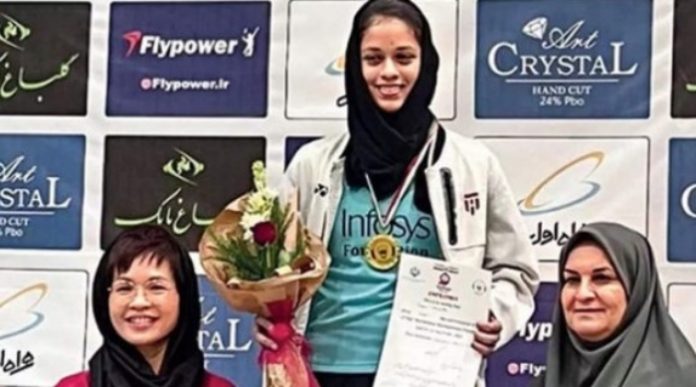
On Sunday, February, 6, a young budding Indian badminton player Tanya Hemanth of Karnataka clinched the women’s singles title at the Iran Fajr International Challenge badminton tournament in Tehran. During the award ceremony, however, the 19-year-old player was pictured wearing a hijab. According to TOI, the organisers of the event had in Iran, reportedly forced the Indian player to wear a hijab before collecting her award.
Bengaluru shuttler Tanya Hemanth asked to wear headscarf for medal ceremony in Tehran
— TOI Sports (@toisports) February 6, 2023
READ: https://t.co/NdJkcyuY6X #TanyaHemanth #Badminton pic.twitter.com/NI7ky6yz3O
According to the TOI report, organisers directed players that hijabs were mandatory, despite the fact that no such requirement for the podium dress code was mentioned in the badminton tournament prospectus.
“The prospectus talked about the clothing rules in the Badminton World Federation’s competition regulations, which is mostly common in tournaments around the world. While we knew that headscarves were a must when women stepped out in Tehran, there was no particular mention about their use during the tournament,” TOI quoted a source as saying.
Interestingly, the report also stated that male spectators were not permitted during women’s games, regardless of whether the male member was the player’s father or coach.
In fact, a board with ‘no men allowed’ written was hung at the entrance.
The tournament, however, featured mixed doubles matches for the first time in its history. “The women’s schedule was in the morning and the men’s in the afternoon. Only female spectators were allowed to watch the women’s matches. Also, match officials were all women in women’s matches. Male parents who accompanied their daughters to this meet didn’t get to watch a single match. It was only during mixed doubles that men and women players were seen together on the court,” the source was further quoted as saying by TOI.
It is worth emphasising that women in Iran are forced to wear a hijab, which covers the head and neck and hides the hair, under Islamic law, which has been in place since the 1979 revolution. While Iranian women battle to be emancipated from the restrictions of headscarves, the hijab is used to further the Islamic agenda across the world.
Notably, the Iranian authorities, in June 2022, detained several teenage girls and others for not donning hijabs at a skateboarding competition in Shiraz, a city in southern Iran.
Last year, Iran witnessed severe nationwide anti-hijab protests which were triggered by the death of 22-year-old Mahsa Amini in the custody of Tehran’s Morality Police.
Mahsa Amini, 22, was detained by the ‘morality police’ in Tehran for failing to comply with the country’s required hijab requirements. Amini, who was on a pleasure trip to Tehran, had not ‘properly covered’ her hair in the hijab. She was detained by police and then assaulted in the police vehicle while being driven to a detention centre for a “re-education class” for failing to wear the country’s mandated head covering.
Post her death, many women including schoolgirls, took to the streets and burnt their hijabs. Women everywhere chopped their hair in protest. Women posted images of themselves removing their hijabs to protest Islamic laws that forbid them from exposing their hair in public.
In retaliation, the so-called “morality police” arrested several women, with allegations that certain authorities have asked that public transportation personnel, as well as staff in government offices, and banks overlook so-called “bad-hijab” ladies. “Morality police” have been observing medical facilities and educational institutions in numerous Iranian cities to make sure women are covering their heads.


