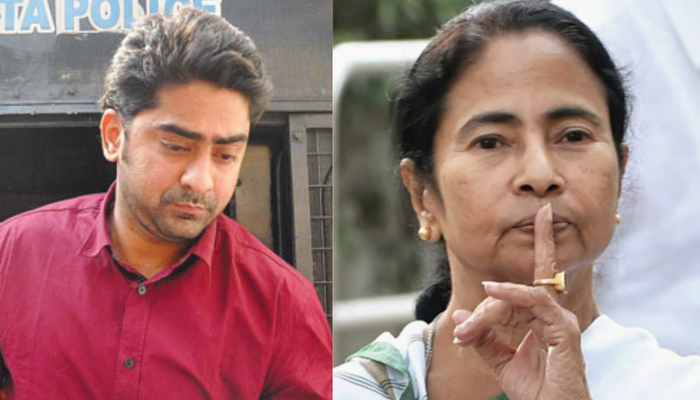
Park Street gangrape convict, Naser Khan, has been accused of molesting and attacking a woman at a five-star hotel in Kolkata. The incident happened on Sunday (26th October) around 4:15 am in the Hyatt Regency at Bidhannagar. An FIR was filed at Bidhannagar South Police Station against Naser Khan and his nephew Junaid Khan on the charges of voluntarily causing hurt, criminal force and assault and solitary confinement of the Bharatiya Nyay Sanhita.
According to the complaint filed by the victim, she was hanging out with her husband, brother and some friends at the Play Boy club inside the Hyatt Regency. The accused arrived and picked a fight with them, attacked them with beer bottles and tried to touch her inappropriately. “When my brother tried to protect (me), they started throwing glass bottles at us. We tried to run away from the hotel to safety, but Junaid Khan called around 20 boys and started attacking us,” the victim reportedly stated in the complaint.
“I called 100, dialled the number to get instant help, but they blocked all the doors. A few boys started pushing me and touching me in a very bad way in my private area. I have attached the medical report, and you can find all the attacking videos on the CCTV of the restaurant club,” she added. The police have not made any arrests so far.
Vicitm kept hiding for about half an hour and was rescused by the police
The victim said that she had kept hiding in the club’s liquor room for about half an hour after the accused sexually assaulted and attacked her. She said that she was rescued by the police from the liquor room. The police have not made any arrests in the case so far.
Who is Naser Khan
Businessman Naser Khan was among the five people convicted of gangraping a 40-year-old Anglo-Indian woman, Suzette Jordan, inside a moving car in the posh Park Street area of Kolkata in 2013. The woman, mother of two daughters, was abducted by the accused in a car in front of a nightclub in February 2012, and was gangraped for hours inside the moving car before being dumped near a road crossing, a couple of kilometres from where she was picked. Naser Khan, who was given a 10-year sentence, was released from jail in 2012, a little over a year before his sentence was to end, on the grounds of “good behaviour”.
Rampant cases of sexual violence in West Bengal and victim blaming of CM Mamata Banerjee
Cases of sexual violence against women have been on the rise in West Bengal despite the state having a woman Chief Minister. The situation is exacerbated by the callous attitude displayed by CM Mamata Banerjee and the TMC politicians towards the victims of such incidents. Instead of ensuring accountability and adopting measures to curb sexual violence against women in the state, the woman Chief Minister either blames the victims or dismisses the incidents as a conspiracy against her government.
Recently, CM Mamata Banerjee put the blame on the victim of sexual violence in a gangrape case that happened in West Bengal’s Durgapur. A second-year MBBS student from Odisha was gang-raped by Apu Bauri, Firdos Sekh, Sekh Reajuddin and two others in a jungle area on Friday (10th October) night in West Bengal’s Durgapur. Ironically, while expressing shock over the incident, CM Mamata Banerjee blamed the victim for the rape. She said that women should not be allowed to go outside college at night and that women should protect themselves. This was not the first time the Chief Minister downplayed a heinous offence like rape. Similar insensitivity was displayed by CM Mamata Banerjee, after the 2012 Park Street gangrape incident, which she dismissed as a concocted incident and a conspiracy to malign his government. Such insensitivity and the lack of accountability displayed by the Chief Minister emboldens the criminals and adds to the plight of the victims.
In another recent case, which happened a month before the Durgapur gangrape case, a young woman was raped by a Trinamool Congress (TMC) worker and his aide in Haridevpur locality of Kolkata after the accused invited her to celebrate her birthday. The accused kept the victim locked in a room the entire night and took turns to rape her. This was preceded by another gangrape case in July this year, where a 24-year-old female student was gang-raped inside the South Calcutta Law College, Kasba, in the South 24 Parganas district of West Bengal, by three men. The horrifying incident happened less than a year after the gruesome RG Kar Medical College rape and murder case, in which a 31-year-old postgraduate trainee doctor was brutally raped and killed while on duty inside the medical college.
In 2013, during a debate in the West Bengal legislative assembly about the rising cases of rapes in the State, the CM had insinuated that it was due to an increase in the population of the State. She had also blamed modernisation, an increase in shopping malls and multiplexes, for rising rape cases. Even during the 2024 Sandeshkhali unrest, Mamata Banerjee attempted to downplay the harassment and sexual exploitation of women at the hands of Trinamool Congress goons by calling it a “minor incident”.
NCRB data exposes an alarming state of women’s safety in the TMC-ruled state
The grim situation regarding women’s safety in West Bengal was exposed by the National Crime Records Bureau (NCRB) report for the year 2023. The “Crime in India” report of the NCRB revealed that West Bengal recorded 34,691 cases of crimes against women under the Indian Penal Code (IPC) and Special and Local Laws (SLL). While this marks a marginal decline from 34,738 cases in 2022, the number is one of the highest in the country. The statistics translates to a crime rate of 71.3 cases per lakh female population.
The NCRB data also shows that West Bengal alone accounted for 27.5% of all acid attacks in the country in the year 2023. In 2022, West Bengal recorded 48 acid attacks with 52 victims, out of 202 cases nationwide. In this crime category, the TMC-ruled state is leading the country since 2018. In addition to that, the recorded 7 cases of murder with rape/gangrape, 350 dowry deaths and 419 incidents of abetment to suicide of women in 2023.
The “abroad dream” of many Indians is turning into a nightmare. While many Indians are adopting illegal routes to build a dream life in abroad, their desperation is being exploited by criminals. A case of the kidnapping of four Gujaratis who were going to Australia from Gujarat via Delhi has come to the fore.
The four Indians were taken hostage in Iran’s capital Tehran while they were taking illegal route to Australia. The kidnappers sent a video of the hostages to the agent who sent them to Australia and their families, demanding a ransom of crores of rupees. As the matter came to light, BJP MLA from Mansa Jayanti Patel wrote a letter to Union Home Minister Amit Shah, seeking help. It has now been reported that all four Gujaratis have been released and have reached India.
On 19th October, Priya Chauhan, Ajay Chaudhary, Anil Chaudhary and Nikhil Chaudhary of Bapupura village in Mansa left for Australia. They were taken from Delhi to Thailand, from there to Dubai and from there to Iran’s capital Tehran via Emirates Airlines. After reaching Iran, they were put in a taxi and taken to an unknown location.
From thereon, they were taken hostage and brutally tortured. Two videos of the kidnapped Indian nationals surfaced online. In a video, it was revealed that two youths were being stripped naked and beaten. In addition to these two videos, the kidnappers also shared a photo of a couple, in which their hands and mouths were tied. Based on this video and photo, a ransom of ₹2 crore was demanded from the families of the victims.
It was only after the BJP MLA and the Union Home Ministry swung into action that the kidnapped Indian nationals could be rescued and brought back to India.
Dunki route, kidnappings for ransom: The saga of desperation and deception
This, however, is not a first case of Indian nationals getting kidnapped while attempting to illegally reach a foreign country. In July 2023, a similar case was reported wherein a Gujarati couple, Dr Pankaj and Nisha Patel, who were taking a “Donkey route” to the United States of America were kidnapped in Iran by a person named Wasim. The couple was tortured and the kidnappers demanded a Rs 10 lakh ransom from their agent.
In September 2024, a 26-year-old man named Himanshu from Kerala was kidnapped in a similar fashion in Iran. It was only after his family paid Rs 20 lakh ransom that the youth was released. Himanshu came in contact with an agent named Aman Rathi from Haryana’s Karnal. Rathi lured Himanshu with a promise to obtaining him a work visa in Australia.
Himanshu was then taken to Noida and given a 15-day training course. Following this, he was sent to Jakarta in Indonesia. Three weeks later, he returned to Delhi only to be sent to Iran. Himanshu was kidnapped after reaching Chabahar. The Indian national was assaulted and tortured by Pakistani human traffickers, who demanded Rs 1 crore. After negotiations, Rs 20 lakh was agreed upon and was paid by Himanshu’s family to secure his release.
In June this year, three Indians identified as Husanpreet Singh from Sangrur, Jaspal Singh from SBS Nagar, and Amritpal Singh from Hoshiarpur disappeared shortly after reaching Tehran. agent from Hoshiarpur had promised to route them to Australia for employment opportunities via Dubai and Iran, assuring temporary shelter in Tehran. However, the family members said that the men were kidnapped on arrival, with abductors demanding Rs 1 crore ransom and sharing a disturbing video showing the captives tied with yellow ropes and bleeding. Last contact with the missing Indians was made on 11th May. The Indian trio could be rescued after Indian government intervened and Iranian police swung into action.
In a recent case, a Punjabi family were kidnapped by a cross-border gang masquerading as immigration agents. On 4th October 2025, Dharminder Singh, his wife Sandeep Kaur, and their 12-year-old son returned home after giving Rs 80 lakh ransom including jewellery to secure their release.
The family from Punjab’s Rahon came in contact with an agent who told them that they could settle in Canada via Iran if not directly from India.
“The agent said we did not need to worry and pay them after reaching Canada, and that he would take care of expenses until then,” said Dharminder (43), a farmer who takes land on contract. “The total cost is Rs 26 lakh for the entire family, but payment only after reaching Canada,” Dharminder Singh quoted the agent as saying.
On 25th September, the Singh family flew from Chandigarh to Kolkata to Dubai and then to Tehran. They waited at the Imam Khomenei International Airport for the taxi driver sent by their agent. He arrived and drove the Indian nationals to a remote location. Later, they took the passports and mobile phones of the Indian family. The victim family found out that they were kidnapped by a gang connected to the underworld operating out of Pakistan. The Pakistani gang demanded a ransom of Rs1.5 crore.
The Singh family had to arrange Rs 80 lakh, give jewellery and sell land to secure their release from the captivity of the Pakistani gang.
It is essential to note that there has been a surge in cases wherein fraudulent agents lure desperate people with overseas employment, lucrative careers, and better lives in Australia, Canada and US promises. Besides being kidnapped by human traffickers, other ransom-seeking gangs, many desperate Indians ready to adopt illegal means to reach their ‘dream destination’, are being targeted by fraudulent agents within the country.
Recently, Punjab Police busted an illegal immigration racket and rescued five youths from Libya. The modus operandi in this case was no different: Lure desperate people with promises of better life and opportunities abroad, convince them to take illegal route, kidnap and torture them on the pretext of sending them to their desired country and then demand ransom.
Legitimate dreams but illegitimate routes are landing desperate Indians into the quagmire of deception, betrayal, torture, financial loss and most importantly, the risk of losing their lives. The cases discussed above are just the tip of the iceberg, many such incidents also go unreported.
At the heart of this menace is the “Dunki route”. Dunki is a term in Punjabi which means to jump from one place to another. Over time, it has come to describe the illegal route taken by people who want to enter another country without proper documents.
Many agents lure Indians to send them abroad through the Dunki route. Those who choose the path of Dunki, their passport and visa are first made. The agents who work the often illegal routes take money and get a visa for a European nation or a country in Latin America.
On most occasions it is a tourist visa. With this, the people of Dunki route are evacuated from India. They are made to travel in Nepal, Dubai and any other country for a few days and a complete story of their journey. Many want to reach America or Canada or Australia to seek asylum. Besides, the agents who work the often-illegal routes take money and get a visa for a European nation or a country in Latin America. The cost often ranges from Rs 25-50 lakh per person along with the risk of being caught and arrested by law enforcement agencies, kidnapped and forced into criminal activities or modern-day slavery and of being killed.
Similar criminal syndicates operate in Myanmar and other countries. Thousands of Indians are duped of fake job advertisements and promises of call centre and data entry type jobs in Southeast Asia, paying Rs 1-3 lakh upfront. There have been many cases wherein Indians lured into this trap had their passports seized, and were confined to guarded “scam farms”. Not only Indians but people of other nationalities have also been forced into working at these scam farms to run online frauds like investment scams or dubious crypto schemes.
Refusal to comply results in torture, starvation or organ trafficking threats. The victims are given daily quotas or targets and failing to achieve which means they have to endure beatings and other forms of physical and mental torment. In the recent past, India rescued hundreds of its nationals from Cambodia and Thailand.
As OpIndia reported back in December 2023, in addition to being a centre for the trafficking of crystal methamphetamine, the northern Shan State in Myanmar is also home to numerous other illicit operations in outposts along the Chinese border.
Last July, eight Indian nationals, who were engaged in work at a scam centre in Hpa Lu of Myawaddy, were saved and handed over to the relevant Myanmar police and immigration authorities.
It was reported that several kidnapped Indian nationals were being forced by an armed group to commit online fraud. Their families complained to the Ministry of External Affairs, seeking intervention for their release.
A group operating in Myawaddy, pressured over 300 Indians, including at least 60 from Tamil Nadu, into participating in cybercrime activities. These victims were subjected to threats, torture and compelled them to work more than 15 hours daily. They further stated that when they refused to take part in unlawful activities, they faced physical violence and electric shocks.
There is a vicious cycle wherein the utopian dream of living abroad and an incurable desperation to realise this dream makes many Indians easy prey to predators, who turn their hopes into horror. The vulnerabilities and willingness to traverse any lengths to reach US, Canada, Australia or any European country are drawing Indian nationals into the trap of kidnapping-for-ransom gangs, job and online scams, and modern bondage.
People should do extensive research on agents, ask for recommendations, and refrain from paying any money until they have clear, validated contracts. Additionally, raising awareness about these scams is crucial, and anyone who suspects they or someone they know might be a victim should report it to authorities immediately. In order to put an end to this menace, the government must also step up crackdowns, launch awareness programs, and push allied nations to increase cooperation. Indian people also need to stop chasing mirages and adopting illegal means for the same.
On 28th October, Mahagathbandhan, the alliance between RJD, Congress and others, launched its manifesto in Patna for the upcoming Bihar Assembly Elections. The manifesto reads like a wish list drafted without a calculator. At the core of it lies a promise that every family in Bihar will have one member employed in a government job. Though a superficial timeline of 20 months has been given, the alliance has not promised to give jobs to all in 20 months.
Patna, Bihar: Mahagathbandhan releases its manifesto for the Bihar Assembly elections pic.twitter.com/w41vP59E6u
According to the 2023 caste survey, there are around 2.7 crore families in Bihar. Even if the alliance were to fulfil half of that, the number would be staggering. At this point, there are around 20 lakh people in government jobs in Bihar. Creating an additional 2.5 crore positions, even at the minimum pay scale of Rs 18,000 per month, would require a monthly outlay of Rs 45,000 crore and an annual expenditure exceeding Rs 5.5 lakh crore. This single pledge alone nearly doubles Bihar’s total 2025-26 budget size of Rs 3.16 lakh crore.
Cash allowances that bleed the exchequer
Another populist pitch promises Rs 2,000 and Rs 3,000 monthly allowances for every unemployed graduate and postgraduate, respectively. If half of Bihar’s graduates were to rely on this income support, the government would need around Rs 900 crore per month or Rs 10,000 crore annually. Again, this would be additional to the already inflated job promise.
Health insurance that duplicates existing national schemes
The manifesto also offers Rs 25 lakh health insurance coverage for 94 lakh poor and lower-middle-class families. Though the Centre already provides Rs 5 lakh cover under the Ayushman Bharat scheme, this announcement was made by Mahagathbandhan. A rough calculation based on national claim data suggests that even with modest usage, say 47% of eligible families claiming Rs 12,000 each per year, the state’s burden could exceed Rs 5,000 crore annually.
Free power, costly politics
The promise of 200 free electricity units per household adds another major strain. Assuming only the 94 lakh poor families avail of it, and with the state’s lowest domestic tariff being Rs 7.42 per unit, Bihar would spend about Rs 1,400 crore every month and Rs 16,000 crore every year. Combined with the jobs, stipends, and insurance plans, the state’s projected financial liability crosses Rs 5.8 lakh crore, almost twice its current budget.
Karnataka and Himachal show what follows
Similar experiments have recently turned states like Karnataka and Himachal Pradesh into fiscal cautionary tales. The CAG’s 2023-24 report found that Karnataka’s Congress government’s five “guarantee” schemes increased spending by Rs 36,538 crore, about 15% of total expenditure, while revenue rose barely 2%. The fiscal deficit ballooned to Rs 65,522 crore, forcing the government to borrow Rs 63,000 crore from markets. Himachal, too, is now slashing salaries and withdrawing freebies after facing a budgetary crunch.
Bihar’s economy can’t afford romantic socialism
If implemented, the Mahagathbandhan’s manifesto would leave Bihar financially crippled before any of its promises materialise. Borrowing to fund recurrent expenses could push the state into a debt trap, discourage private investment, and repeat the fiscal chaos witnessed in Congress-ruled states. Grand alliances may survive on grander rhetoric, but Bihar’s finances cannot.
Ultimately, these pledges may win applause at rallies, but not in the treasury. The manifesto may be politically loud, yet economically, it is dead on arrival.
India is getting ready for its big digital leap that is 6G. The country’s vision for this future technology is simple, yet powerful. It should be affordable, sustainable, and available to everyone. The idea behind 6G Vision is to make India a global leader in communication technology and not just a user of it. The Government of India has brought together industry experts, researchers, and universities to work hand in hand so that the 6G Vision can become a reality by 2030, embedded in the roadmap of Viksit Bharat, a developed India, by 2047.
?The Government of India is steering the nation’s transition towards next-generation connectivity through a series of strategic initiatives aimed at advancing 6G technologies
6G is the next-generation mobile network technology that will take over from 5G in the coming years. The wireless technology promises lightning-fast internet that is capable of transferring information in just one microsecond, which will be 1,000 times faster than 5G.
?#6G aims to send and receive information in just one microsecond, that’s 1,000 times faster than the response time of 5G. This means instant connections with almost zero lag, which will be useful for things like remote medical surgeries, smart robotics, and real-time gaming…
It means there will be no delays, no buffering, and no waiting. 6G technology will provide much-needed connectivity in sectors including medicine, driverless vehicles, gaming, virtual reality, and more. What makes 6G truly revolutionary is how it will work with artificial intelligence to manage where and how data is stored or processed. In simple terms, the network will think for itself, making it smarter, quicker, and more efficient than anything seen before.
India’s 6G vision and mission
India took a major step in this direction in March 2023 when it released the Bharat 6G Vision document. It sets the goal of making India a global leader in 6G research, design, and deployment by 2030. The focus is clear, technology must reach every citizen, whether in cities or remote villages. To make that happen, the government has funded research across over a hundred institutions, created dedicated 6G testbeds, and approved several innovation projects. These steps mark India’s shift from being a consumer of telecom technology to becoming a creator and exporter of it.
The 6G mission has a two-phase timeline. The first phase, which started in 2023 and will end by 2025, focuses on research, IP creation, and early 6G standardisation groundwork. It also includes proof-of-concept trials, testing platforms, and pre-standardisation work. In the second phase, running from 2026 until its launch in 2030, the development of globally viable 6G concepts and use cases, testbeds for commercialisation, and regulatory, ethical, and public awareness frameworks will be explored.
The Bharat 6G Alliance
The Government of India has launched the Bharat 6G Alliance to bring industry experts, telecom operators, universities, and research centres together under one umbrella. The aim of the Alliance is to build Made-in-India 6G technologies that can compete with the best in the world. The Alliance is also working with international partners including NextG Alliance in the US, 6G IA in Europe, and the 6G Flagship programme in Finland along with similar initiatives in other countries. These global tie-ups are helping India exchange ideas, set common standards, and develop secure, reliable systems for the future.
Leading global 6G alliances came together at the International Bharat6G Symposium 2025, held alongside India Mobile Congress, for shaping 6G as a global public good.
Participating organisations include Bharat 6G, 6G-IA, ATIS’ Next G Alliance, XGMF, 6G Forum, UK TIN, UK Federated… pic.twitter.com/qcFhhaEzB6
During the India Mobile Congress 2025, the International 6G Symposium became a turning point in showcasing India’s growing strength in telecom innovation. The spotlight was on India’s homegrown 4G stack, a proud symbol of self-reliance and the foundation for 6G development. The government has ambitious plans, it expects the telecom sector to add nearly USD 1.2 trillion to India’s GDP by 2035 and aims to secure at least 10 per cent of global 6G patents. The satellite communication market is also expected to triple by 2033, making India a strong player in space-linked communication networks. The broader goal is to ensure that India moves from being a follower to a trendsetter in the global 6G revolution.
From vision to reality, India is not just participating in the 6G revolution, we are co-leading it. ??
At the International 6G Symposium during #IMC2025, underscored Bharat’s bold journey, from indigenous stacks & AI-native networks to cutting-edge research and global… pic.twitter.com/0tmXZWMINs
There are several government initiatives in place that are already helping India get ready for the 6G era. There are over government-established 5G labs in universities to encourage students and start-ups to collaborate on telecom innovations.
These labs give young engineers the tools to experiment, test ideas, and build the base for 6G. Another major initiative is the Telecom Technology Development Fund, which was launched in 2022. It supports Indian research and start-ups in the field. So far, the government has approved over 100 projects worth Rs 310 crore, focusing on improving connectivity in rural areas and creating India’s own telecom solutions.
A Technology Innovation Hub at IIIT Bangalore is also leading research into futuristic communication systems like reconfigurable intelligent surfaces and O-RAN Massive MIMO, technologies that will power the 5G-Advanced and 6G era. Together, these initiatives reflect a clear direction: India wants to build a secure, inclusive, and future-ready digital ecosystem that benefits everyone, not just a few.
India’s 6G journey is more than just a technological upgrade. It’s about self-belief, innovation, and global collaboration. From setting up research hubs and alliances to forging international partnerships, every step reflects India’s determination to lead, not follow. The Bharat 6G Vision is a promise, a promise that the future of communication will be made in India and shared with the world.
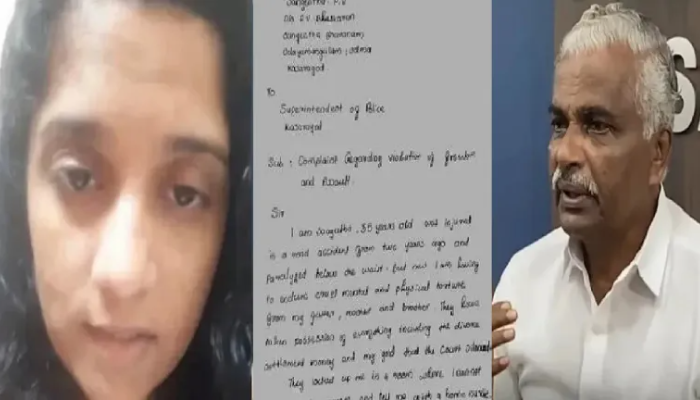
On 25th October, the daughter of a Communist Party of India (Marxist) leader PV Bhaskaran disclosed that her father had imprisoned her in their home and was torturing her severely. 35-year-old PV Sangeeta (Sangeetha) revealed that her turmoil commenced when she declared her intention to wed a Muslim man named Rasheed (Rashid). Her father PV Bhaskaran is the Uduma Area Committee member of the CPM in Kasaragod.
“You can practice communism outside the house. It has no place inside our family. If you won’t obey, then I will kill you. I know the ways to come out of jail unscathed,” she recounted how her father threatened her.
Sangeeta has been reportedly suffering at home, especially after she was disabled below the waist in an accident. According to her, she is under house arrest and has not been allowed to receive medical care. She added that her father tried to compel her to end her life and take over her portion of the family’s assets. She even charged that her father and brother seized her alimony amount.
A road accident in September 2023 left Sangeetha, a divorced mother of a teenage boy, without the ability to move her legs.
Sangeeta mentioned that she has been even denied access to quality medical treatment and her desire for an interfaith union only added to the torment. The woman further accused that she was urged to “go and die” and repeatedly hit on the head.
Sangeeta asserted that Bhaskaran even told her that he had the influence to avoid any legal repercussions and threatened to murder her if she disobeyed him. “You will never walk again in this life. You will perish in bed,” he warned.
Sangeeta had previously petitioned the court for habeas corpus with a friend’s assistance. She was living with her parents, according to the police report, therefore it was rejected. She charged that when the police realised her father’s political clout, they did not listen to her complaints, despite her attempts to explain that she was under house arrest.
She later approched District Collector and the District Superintendent of Police regarding her ordeal. According to Sangeeta’s complaint, her family had stolen her divorce settlement and gold and planned to “put her into a coma” in order to collect her insurance money. She earlier communicated her ordeal publicly through a secret phone.
However, Bhaskaran refuted the allegations and countered that Rasheed is already married and in only interested in her daughter’s properties which are valued at Rs 1.5 crore. He further insisted that the man affections for her were not sincere. Police records also stated that the latter was already married with two kids and his wife launched a complaint against him for neglecting them. Bhaskaran added that even she accused Rasheed of seeking Sangeeta’s money.
The blatant denial of a startling truth and the glaring hypocrisy
Notably, Bhaskaran earlier rejected the movie “The Kerala Story” as a propaganda from the “Sangh Parivar.” Chief Minister Pinarayi Vijayan also mocked the project as a disinformation. Furthermore, leaders of Congress-led United Democratic Front (UDF) and ruling CPM-led Left Democratic Front (LDF) have repeatedly claimed that “love jihad” is a Hindutva lie.
However, significant number of girls fell into this trap and even found themselves in Islamic State of Iraq and the Levant (ISIS) controlled territories. The case of Nimisha alias Fathima along with her three friends is a shocking example of this ugly truth. The left party was likewise at the forefront of supporting Akhila Ashokan who became Hadita under the influence of her roommate and subsequently married a member of the outlawed Popular Front of India (PFI).
Now, despite Bhaskaran’s assertions in the media, his daughter has exposed that they do not follow what they preach to others. Leaders of the CPM are opposed to communism infiltrating their households, yet they endorse the same even as it continues to destroy the lives of multiple non-Muslim girls, especially from the Hindu community in Kerala.
Moreover, the perverse justification of secularism which disregards the legitimate concerns of the Hindu community to appease extremist elements, is also touted as a sign of the high literacy in the state which transcends the limitations of religion, caste or community. However, the stark reality is that Kerala has gradually turned into a hotbed of Islamism. From being the nucleus of radical PFI to contributing the maximum number of jihadists to ISIS from India, the state has been in the news for more negative reasons than positive.
The state has also gained infamy due to the brutal murders of leaders from the Bharatiya Janata Party (BJP) and members of the Rashtriya Swayamsevak Sangh (RSS). The left, in any case, possesses a violent history of targeting its opponents and those who do not conform to its ideology, particularly Hindus. The party recently attempted to attract Hindus for votes through the Ayyappa Summit, however, their contentious relationship with the community unveiled their intentions.
Their favorable disposition towards Muslims and Hindu hostility has been brought to light on numerous occasions in public. Nevertheless, it seems they are rather displeased as the chickens have finally come home to roost.
Now, already displaying the marks of its double standards, specifically regarding “love jihad,” a matter that has been regularly raised not only by Hindus but also by Christians including the Church in Kerala, this latest development has once again highlighted how the Left leaders religiously adhere to a different set of rules for themselves while presenting a different facade to the public.
Furthermore, the bolstering of his legal authority alongside the inaction of the authorities, further illustrated the communist administration’s supposed “commitment” to uphold justice as well as law and order.
Each similar case is derided, mocked and branded as bogus by these same leaders but start to sing a different tune when it pertains to their own. Bhaskaran who criticized “The Kerala Files,” wants his daughter to leave their liberal and leftist ideology, which they not only espouse but take pride in, at the threshold of their residence and not tie the knot with a Muslim man, serves as another example of their sinister duality.
The collapse of the Left’s moral grandstanding
The Left’s moral grandstanding, built on a façade of equality, secularism, and justice, is now crumbling under the weight of its own contradictions. For decades, Kerala’s Left elite positioned themselves as the moral arbiters of society, preaching tolerance, women’s rights, social justice, and emancipation, so on and so forth. Yet, when ideology meets reality, their so-called progressivism vanishes behind the iron doors of their own homes.
The same leaders who sermonize about women’s rights and religious harmony are now being exposed as patriarchs who control their daughters, manipulate institutions, and exploit their political power for personal ends. Their “secularism” has reduced itself to selective outrage, quick to demonize the majority community, but silent or dismissive when confronted with Islamist aggression or intra-party corruption.
This duplicity is not an isolated aberration but a pattern, a systemic rot within Kerala’s Left establishment that has long hidden behind intellectual posturing and media complicity. Sangeeta’s suffering has pierced through that veneer, revealing a movement that no longer represents the oppressed, but protects the powerful.
The collapse of the Left’s moral authority in Kerala is now complete not because its critics said so, but because its own leaders have lived out the very hypocrisy they once accused others of.
In a recent interview published by Politics Home on 27th October, Wikipedia co-founder Jimmy Wales warned of a “political showdown” with the UK government over the Online Safety Act. He criticised the legislation as “poorly thought-out” and claimed that it would threaten the openness of the internet by forcing platforms to identify users and age-gate access. He argued that Wikipedia did not “cave into” the Turkish or the Chinese governments’ similar demands.
Yet, in the same conversation, Wales unapologetically defended Wikipedia’s own internal censorship, that is the blacklisting of sources he has personally deemed unreliable in the past. He insisted that “the idea that we should take sites that routinely publish crazy conspiracy theories and nonsense just doesn’t make any sense.”
While he called the publications blacklisted by Wikipedia to have a history of “conspiracy theories and nonsense”, in reality, a majority of the Right-leaning publications have been banned or deprecated by Wikipedia, which means they cannot be used as sources for articles on the online, user-generated ‘encyclopaedia’.
The contradiction is obvious. While Wales rejected government regulation of speech, he fully endorsed Wikipedia’s ideological policing of information. The issue is not whether Wikipedia can have quality control, which every platform should have, but whether that control has been weaponised to promote one ideology worldwide while excluding another.
Wales went on to claim that the blacklist and deprecated sources system is merely about “quality”, not politics. He said, “That’s not about the political stance of the Daily Mail – it’s about the quality of the publication.” He defended the deprecation of mainstream publications such as The Sun and The Daily Mail while acknowledging that conservative outlets like Breitbart News and The Heritage Foundation are blacklisted altogether.
However, what it actually means in practice is that entire ideological ecosystems are erased. Wales admitted that removing the blacklist was out of the question. He brushed off criticism that Wikipedia has a left-wing bias and claimed he is a “centrist”. His dismissal was wrapped in the convenient label of “centrist moderation”, the same rhetorical fig leaf that big-tech companies often use to justify their bias while pretending neutrality.
By calling dissenting media “crazy conspiracy sites”, Wales implied that no conservative publication deserves equal footing in the knowledge ecosystem. That framing alone destroys Wikipedia’s long-claimed neutrality.
From Al Jazeera to OpIndia – how selective reliability shapes the narrative
In September 2024, OpIndia released a dossier on Wikipedia in which it had already been demonstrated that systemic bias was in place years before Wales’s recent comments. It showed that Wikipedia’s content is skewed not through overt editorial orders but through the classification of “reliable” and “unreliable” sources.
For example, left-leaning and globalist outlets such as Al Jazeera, BBC, The Guardian and The Wire are marked “reliable”, while right-of-centre or nationalist publications such as OpIndia, Swarajya and Republic are blacklisted or “deprecated”.
This classification becomes self-sustaining. Once a “reliable” source is approved, even its fake news is whitewashed as an honest mistake. Take The Wire, for example. The Wire published a series of fake news reports based on made-up information on a so-called app “Tek Fog” and, in another article, claimed that the BJP had some way to censor content on social media platforms under Meta. Both claims backfired when it accused Meta and experts stepped in.
The dossier cited multiple instances where The Wire’s provably false reports were protected from criticism because the counter-evidence came from blacklisted outlets.
In another example, when a retired naval officer publicly accused The Wire of misquoting him in an article that downplayed India’s naval achievements, his statement could not be added to The Wire’s Wikipedia page. The reason? His own clarification on Twitter was considered a “self-source”, and OpIndia, which reported his rebuttal, was blacklisted. As a result, The Wire’s misreport stood uncontested, a perfect illustration of how Wikipedia’s Neutral Point of View collapses when neutrality itself is defined by ideology.
In yet another glaring example, the dossier noted that even when official police handles declared The Wire’s stories false, Wikipedia editors refused to cite them and argued that a “secondary reliable source” must verify the police’s statement. Since all those secondary sources, including OpIndia, Republic and Swarajya, were blacklisted, the truth was systematically buried.
The logic becomes even more absurd as Wikipedia excuses anti-India fake reporting by Al Jazeera as being reported under the “fog of war”, while, on the other hand, verified statements published by OpIndia are dismissed as unreliable by default.
The dossier evidence – how bias was institutionalised through blacklists
The OpIndia dossier on Wikipedia exposed in detail how the blacklisting process itself became a mechanism to institutionalise bias. It documented repeated attempts by Wikipedia editors to block additions that would expose fake news by Left-leaning media, particularly The Wire. When one editor tried to cite an FIR filed against The Wire for spreading false information that incited violence in the Northeast, another senior editor dismissed it, saying “FIRs are very normal.”
The dossier observed that while Wikipedia prominently listed FIRs against publications it disliked, it either omitted or softened those involving “reliable” Left-aligned sources. Such double standards ensured that conservative or nationalist platforms were branded permanently untrustworthy, while ideological allies were protected through procedural excuses.
This was not simply random editorial behaviour. It was a pattern designed to preserve the illusion of neutrality while filtering reality through a curated set of acceptable voices. Wales’s new defence of this system confirms that it was never rogue volunteerism but an approved doctrine.
Meet Newslinger – the paid administrator who built Wikipedia’s bias engine
One of the dossier’s most revealing sections identified an editor known as Newslinger, who is a Wikimedia administrator. He actively campaigned to deprecate non-Left sources and block factual corrections. According to the dossier, the Wikimedia Foundation itself funded Newslinger under its WikiCred programme, which offered grants of up to $10,000 to projects claiming to “strengthen reliability in the information ecosystem.”
Newslinger’s project, titled ‘Sourceror: The Wikipedia community’s platform against disinformation’, proposed building a browser extension and API that used Wikipedia’s perennial sources list, its blacklist, to label websites across the internet. His own description of the grant said the tool would display icons showing whether a website was considered “reliable” by Wikipedia, effectively extending Wikipedia’s ideological censorship beyond its pages.
He boasted that the Sourceror Bot would scrape and update this list automatically, while another feature would allow editors to remove citations of “unreliable” sources in a couple of clicks. In essence, a paid Wikipedia administrator created a systematic method for deleting dissenting references while tagging ideological allies as authoritative, all with the financial approval of the Wikimedia Foundation.
Wikimedia’s grant proves the bias was sanctioned from the top
This is where Jimmy Wales’s latest comments become crucial. When he says, “the idea that we should take sites that routinely publish crazy conspiracy theories and nonsense just doesn’t make any sense,” he is echoing precisely the worldview that Newslinger was paid to codify.
The grant was not an isolated clerical oversight. It was institutional endorsement. By vetting, approving and funding a project that explicitly weaponised the “reliability list”, Wikimedia signalled agreement with the editorial judgements that underpin it. Therefore, Wikipedia’s ideological skew is not the accidental outcome of volunteer bias but a policy designed, sponsored and justified from the top.
When Wales defends the blacklist, he is defending the very product of that grant money. His remarks confirm what the dossier had warned years earlier, that Wikipedia’s bias was sanctioned and crafted from the top, not the work of a few rogue editors.
Why this censorship model is dangerous for truth and democracy
The danger here extends beyond one platform. Wikipedia remains the default reference point for journalists, students and even AI models that draw on its data. When such a platform blacklists entire schools of thought, it does not merely filter facts, it rewires public understanding.
A student searching for coverage of Indian politics will find The Wire, Scroll and BBC quoted liberally, while OpIndia and Swarajya are absent altogether. This absence becomes a form of erasure. A fake narrative repeated by “reliable” sources is treated as fact, while a truthful correction from a blacklisted outlet is memory-holed.
When neutrality becomes propaganda – the need for ideological transparency
Jimmy Wales once said Wikipedia’s mission was to “make the sum of all human knowledge available to everyone.” Today, that mission appears conditional, as knowledge is welcome only if it conforms to one side of the political spectrum. The very guideline that demands “Neutral Point of View” has been hollowed out, because neutrality now depends entirely on which sources are allowed into the conversation.
As the OpIndia dossier concluded, “If the pool of reliable sources itself is tainted with ideological bias, the ‘Neutral Point of View’ merely remains a requirement where all versions of the Left are prominently added.”
The launch of Elon Musk’s Grokipedia, positioned as an AI-driven alternative to Wikipedia, has arrived at a telling moment. While Wales warns about government censorship, his own platform has long been a blueprint for soft authoritarianism disguised as moderation. If Grokipedia indeed continues to allow multiple ideological references without blacklisting dissent, it could expose how fragile Wikipedia’s self-proclaimed neutrality really is.
What Wikipedia needs is not another lecture on trust from its founder but a reckoning with its own internal censorship. Transparency must begin with acknowledging that neutrality cannot exist when one side of the truth is banned at the source.
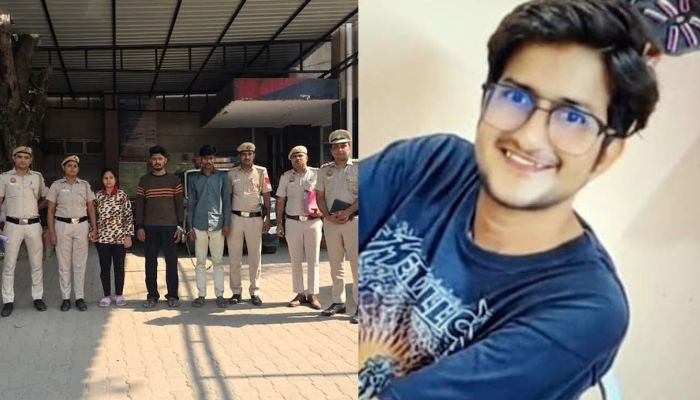
In Delhi, the charred body of a 32-year-old UPSC aspirant named Ram Kesh Meena was recovered after a fire in north Delhi’s Timarpur on 6th October. Three weeks later, the police have arrested three people, including the deceased’s live-in partner. The police suspects that what was initially passed off as a death in a fire incident was in reality, a well-planned murder.
The Delhi Police said that the deceased victim’s live-in partner Amrita Chauhan allegedly plotted his murder by involving her ex-boyfriend Sumit Kashyap and a common friend and SSC/CGL aspirant named Sandeep Kumar. The chilling conspiracy was hatched after Ram Kesh Meena, originally from Rajasthan, refused to delete the private and obscene pictures and videos; he had allegedly recorded of his live-in partner.
During interrogation, Amrita Chauhan, a forensics student told the police that the deceased victim had stored her obscene pictures and videos on a hard disk. She claimed that despite her repeated requests to delete the private videos, Meena did not do so. Chauhan added that one of the main motives of killing Meena was to get the hard disk.
The motive behind Ram Kesh Meena’s murder
Ravindra Yadav, Special Commissioner of Police, Law and Order said that the police have recovered the hard disk and found private videos of not only accused Amrita Chauhan but of around 15 other women as well and were stored without their consent. Chauhan claimed that she feared that Ram Kesh would upload her private videos on the internet.
How Sumit and Sandeep attempted to pass off Ram Kesh’s murder as a cylinder blast accident
On 5th October, Sumit and Sandeep beat up Ram Kesh and choked him to death. Subsequently, the duo poured oil, ghee and wine on the body to fuel the fire. After this, Sumit brough a cylinder from the kitchen and kept it near Ram Kesh’s head. He turned the knob on so that the gas filled the room. By this time, the accused duo had found the deceased victim’s laptop, the hard disk and other stuff.
Following this, Sumit used a lighter to ignite fire and locked the main door. The cylinder exploded after the accused duo left the building.
According to Special Commissioner Yadav, the police initially suspected a blast caused by a gas leak. “The front panel of the air conditioner was damaged, so we also considered that the air conditioner had exploded. But when we discussed the case, the story did not add up. Things did not fall into place. So, we decided to conduct an in-depth probe,” Yadav said.
The accused trio turned to YouTube, social media and crime shows to ensure that they make no mistakes and get caught by the police.
While the accused persons invested deep thought and planning in killing Ram Kesh Meena without getting caught, the CCTV footage of their entry and exit from the building where Ram Kesh was murdered a night after, exposed their plot.
During the scanning of the CCTV footage of the building and nearby area, the police noticed that two people with their faces covered entered the building on 4th October (the night prior to Meena’s murder). Soon after, one of them left the building. Later, a woman and a man left the building. This woman was identified by the police as Ram Kesh Meena’s live-in partner Amrita Chauhan.
As a murder angle emerged, the police conducted several raids to nab Sumit, Sandeep and Amrita. On 18th October, the police arrested Amrita Chauhan, who during questioning, identified her ex-boyfriend Sumit and common friend Sandeep. Both of them were arrested on 21st and 23rd October respectively.
When asked by the police if she employed her forensics knowledge to cover up her live-in partner’s murder since she is a Bsc Forensic Science student, accused Amrita Chauhan responded in affirmative. She also revealed that she discussed with Sumit, who worked at a cooking gas cylinder distribution agency, on how to carry out the murder and cover up in such a way that no clues are left. Sumit helped Amrita understand how much time the cylinder would take to explode.
The accused trio managed to pull off the technical aspect of their murder plan; however, they forgot to factor in the CCTV. This proved to be detrimental for them and the police caught them within weeks.
Amrita Chauhan’s family disowned her
Amrita Chauhan, who met Ram Kesh Meena in May this year was reportedly ‘disowned’ by her family in over a year before the murder. In newspaper advertisement published on 8th July 2024, Chauhan’s father Rajveer Singh and mother Kamini stated that they have severed their ties with their daughter over her “inappropriate conduct”. They also expelled her daughter from their property. This newspaper advertisement is reported to have been submitted in the court now in Ram Kesh Meena murder case.
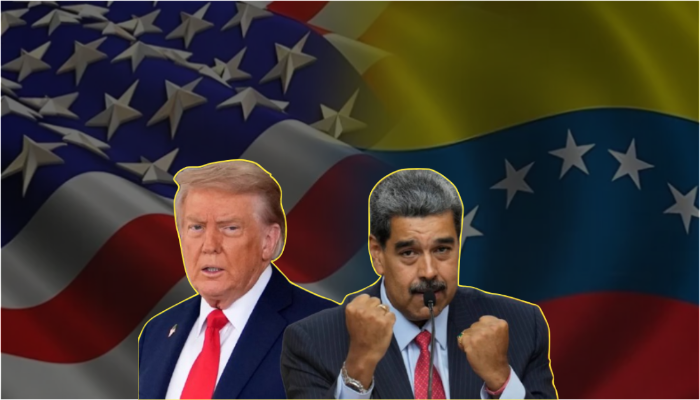
The “man of peace,” the mediator who claimed to have facilitated 8 or 9 ceasefire agreements between conflicting nations, including India and Pakistan, and the “self-declared foremost contender for this year’s Nobel Peace Prize,” United States President Donald Trump has veered away from the peaceful course he claimed to espouse globally, in relation to Venezuela.
Trump had vowed that military obligations that had previously dragged the country into exhausting and protracted wars distant from its own borders would cease under a “Make America great again” (Maga) foreign policy. Likewise, it was also central to his popular “America First” agenda.
However, now the White House has adopted a belligerent stance contrary to Trump’s purported “president of peace” persona and violated his promises as a massive militarisation directed against the autocratic regime of Nicolas Maduro in Venezuela is taking shape. The military buildup in the Caribbean Sea marked the largest deployment there in decades and served as a testament to how Trump has once more reneged on his crucial commitment to his voters.
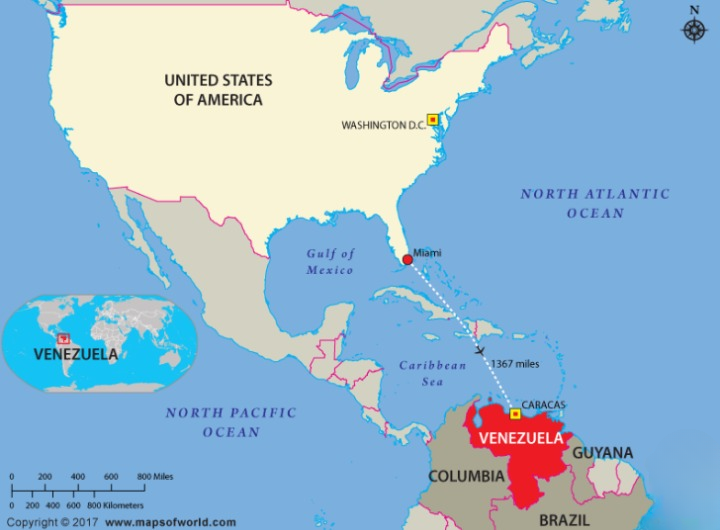
Image via World Map
The US Navy has been assembling a force of warships, fighter jets, bombers, military personnel, drones and spy planes in the Caribbean Sea for the past two months. Long-range bomber planes B-52s conducted “bomber attack demonstrations” near the Venezuelan coast. Moreover, Trump has declared, boastfully, that he has permitted the CIA’s (Central Intelligence Agency) operations in Venezuela.
Trump claims “operation against narcotics”
The United States claimed to commence a war on drugs in Venezuela and Trump has given the CIA authorisation to carry out clandestine operations within the nation. “I authorised for two reasons really. Number one, they have emptied their prisons into the United States of America. They came in through the border. They came in because we had an open border and the other thing are drugs,” he asserted.
The US has conveyed that it killed dozens of people in attacks on small Venezuelan vessels with “narcotics” and “narco-terrorists,” but did not offer any proof or information about the individuals on board.
At least 10 vessels have been struck by US forces since 2nd September and 8 of which have taken place in the Caribbean, taking the lives of at least 43 people.
Donald Trump's targeting of drug cartels in South America is being stepped up as American warships head closer to Venezuela.
A destroyer, the USS Gravely, is now docked in the Caribbean at Trinidad and Tobago and the aircraft carrier USS Gerald R. Ford is also cruising towards… pic.twitter.com/OTliXBrTF3
The Republican leader announced, “no war, yes peace” while addressing the nation. He then expressed belief that the military had effectively managed the drug operations at sea, however, he is now contemplating land operations, during his White House speech. Active negotiations with Maduro were halted by his administration in recent weeks.
Venezuela does not produce cocaine, according to the United Nations Office on Drugs and Crime (UNODC) and was not included in the four pages of a March annual report from the US Drug Enforcement Administration (DEA) that focused on cocaine trafficking.
However, the Trump administration continued to insist that some drug trafficking does pass through Venezuela, citing Maduro’s 2020 indictment on federal charges of conspiracy to import cocaine and narco-terrorism. An official disclosed that “the president hasn’t ruled out diplomacy” and “there are plans on the table that the president is considering” with regard to operations against targets inside the South American nation, reported CNN.
Trump claimed that he could keep attacking suspected drug traffickers overseas without a formal declaration of war being passed by Congress. “I’m not going to necessarily ask for a declaration of war. I think we’re just going to kill people that are bringing drugs into our country. Okay? We’re going to kill them, you know, they’re going to be like, dead,” he conveyed in his quintessential style.
JUST IN: President Trump fires back after reporter asks him why he doesn't get approval from Congress for taking out narco-terrorists.
Reporter: Why not just ask for a declaration of war?
Trump: I think we're just going to kill people that are bringing drugs into our country.… pic.twitter.com/N1owgnvt6V
Pentagon press secretary Sean Parnell also reiterated that the Gerald R Ford strike group and its affiliated air wing’s action was intended to “dismantle Transnational Criminal Organisations and counter narco-terrorism.” The USS Gerald R. Ford has space for up to 90 aircraft and attack helicopters. The biggest aircraft carrier in the world is moving closer to Venezuela.
STATEMENT:
In support of the President’s directive to dismantle Transnational Criminal Organizations (TCOs) and counter narco-terrorism in defense of the Homeland, the Secretary of War has directed the Gerald R. Ford Carrier Strike Group and embarked carrier air wing to the U.S.…
The entire Trump administration has followed the same narrative, holding Venezuela responsible for the crime and drug problems in the United States.
Maduro retorts “war fabricated by the US”
On the other hand, amid appeals for a diplomatic solution, Maduro has accused the US of manufacturing “a new eternal war” which his country will avoid. He outlined, “They promised they would never again get involved in a war,” and emphasised, “They are fabricating an extravagant narrative, a vulgar, criminal and totally fake one. Venezuela is a country that does not produce cocaine leaves.”
“No to regime change, which reminds us so much of the endless, failed wars in Afghanistan, Iraq, Libya, and so on,” he even poked fun at the US later and added, “No to CIA-orchestrated coups.” Maduro has declared that he will be mobilising the police, military, and citizen militia to protect the oil-rich nation.
“We are conducting an exercise that began 72 hours ago, a coastal defence exercise to protect ourselves not only from large-scale military threats but also to protect ourselves from drug trafficking, terrorist threats and covert operations that aim to destabilise the country internally,” highlighted Venezuela’s Defence Minister Vladimir Padrino Lopez.
“CIA is present not only in Venezuela but everywhere in the world. They may deploy countless CIA-affiliated units in covert operations from any part of the nation, but any attempt will fail,” he warned.
Foreign Minister Yvan Gil noted that Venezuela “rejects the warmongering and extravagant statements of the president of the United States.” He stressed, “We view with extreme alarm the use of the CIA, as well as the military deployments announced in the Caribbean, which amount to a policy of aggression, threat, and harassment against Venezuela.”
The US assaults on Venezuelan vessels were also slammed as unlawful, violent, and amount to murder. Maduro even initiated legal action to cancel opposition leader Leopoldo Lopez’s passport and revoke his citizenship, accusing him of promoting an invasion.
Lopez who has been living in exile in Spain since 2020, has openly stated that he endorse US actions in the Caribbean. “According to the Constitution, no Venezuelan born in Venezuela can have their nationality revoked,” he responded, dismissing the move and reaffirmed his support for US military operations and their presence in the nation.
Maduro quiere quitarme la nacionalidad por decir lo que pensamos y queremos todos los venezolanos: libertad.
El narco dictador Nicolás Maduro ha solicitado al Tribunal Supremo la revocación de mi nacionalidad venezolana, convirtiéndome en el primer ciudadano nacido en Venezuela…
A gas deal with Trinidad and Tobago was also suspended by Maduro, who alleged that Prime Minister Kamla Persad-Bissessar was converting her nation into a “aircraft carrier of the American empire against Venezuela.”
Tensions escalate between US and Venezuela
Washington had been using a fleet of eight US Navy ships, ten F-35 fighter jets, and a nuclear-powered submarine for its anti-drug operations since August but Caracas repeatedly charged that these actions are part of a larger plot to topple the Venezuelan government.
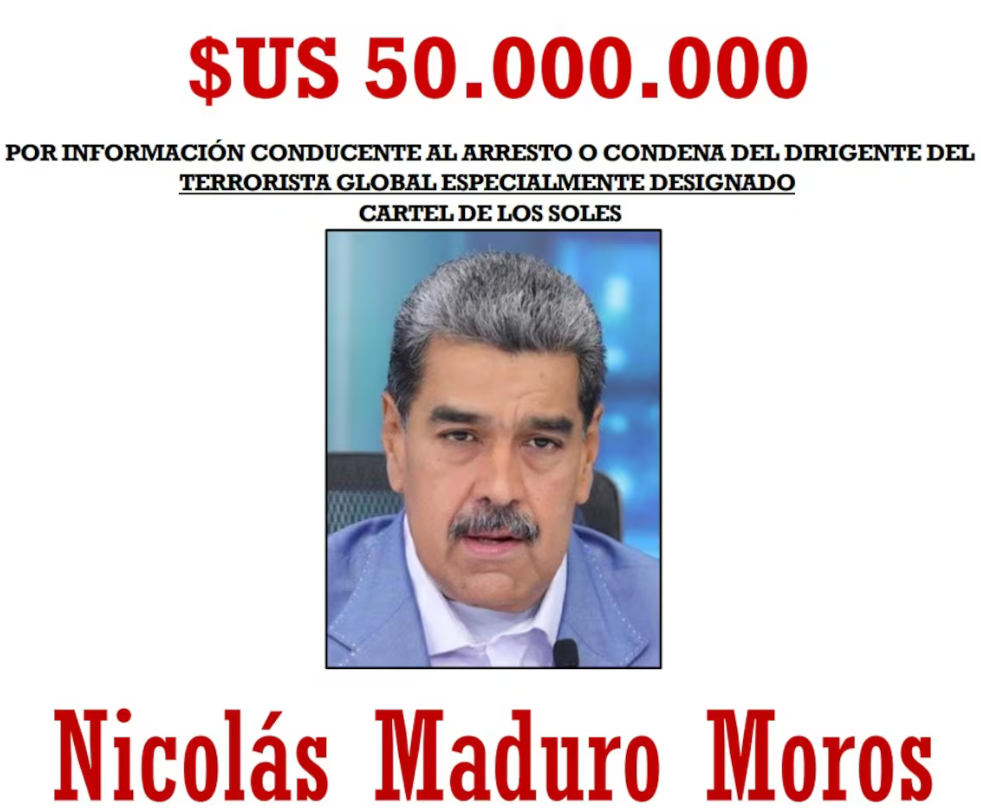
According to US officials, Maduro is leader of the drug-trafficker “Cartel of the Suns.” Maduro refutes the allegations. The United States even increased its reward for information that leads to his arrest to $50 million to encourage members of his inner circle to turn him in, without any positive outcome.
Reward poster for information leading to the arrest of Nicolás Maduro. (Source: english.elpais.com)
Nonetheless, Trump’s “bellicose” rhetoric was rejected by Venezuela which also charged that he was attempting “to legitimise regime change with the ultimate goal of appropriating Venezuela’s petroleum resources.” The actions were described as “a grave violation of the UN charter” and the country even took the matter to the United Nations (UN) Security Council.
The Venezuelan leader’s refusal to comply with demands to relinquish power freely and persistent counters of the officials that they were not involved in drug trafficking previously led to frustration on the American side, resulting in the snapping of diplomatic relations between the two parties.
Marco Rubio’s role amid the United States, Venezuela hostilities
Maduro and other top officials made a number of concessions to try to defuse the impasse with Washington, including ceding a significant stake in Venezuela’s oil sector. Even some sanctions on Venezuelan oil had been lifted by the Trump administration, allowing Chevron, a major American multinational energy company, to restart production and boost Venezuelan shipments.
Secretary of State Marco Rubio’s push for a firm stance, however, instead caused long-standing tensions to exacerbate. “Trump had, in many conversations, meetings with different people emphasized that he really only cared about oil but Rubio was able to drum up this narco-terrorist rhetoric and get Trump to pivot completely,” mentioned a US businessman, according to a report in The Guardian.
Rubio was reportedly able to convince Trump with the help of White House deputy chief of staff Stephen Miller and chief of staff Susie Wiles. He accomplished this by also taking advantage of the administration’s categorisation of the transnational gang “Tren de Aragua” which originated in Venezuela, as a “foreign terrorist organisation” that had infiltrated the United States and reportedly contributed to the surge of undocumented migrants escaping Maduro’s rule.
The group was also implicated in collusion with the “Cartel de los Soles,” a secretive organisation of Venezuelan military leaders that the US believes is headed by Maduro and is in charge of smuggling drugs into the United States, according to a White House declaration last March.
War against drug cartels or a regime change operation in a oil rich nation?
The goal of the Trump administration’s Venezuela policy which was formulated by Rubio and CIA director John Ratcliffe seemed to set on removing Maduro from office. He has held power since 2013, including when he was re-elected in polls tainted by fraud allegations.
Rubio has already voiced his desire to throw him out of his position. He already termed Maduro a “horrible dictator” on Fox News and responded, “We’re going to work on that policy,” when asked if he was calling for his ouster.
More importantly, Washington has long been interested in taking down Maduro. Trump spearheaded “maximum pressure” campaign during his first term in office to unseat his government.
Furthermore, CIA has historically collaborated with Latin American governments on intelligence sharing and security issues. This has made it possible for the agency to pursue drug cartels through working together with Mexican officials. Over the course of its lengthy history in Latin America, it has conducted a wide range of activities, from direct paramilitary participation to intelligence collection and support functions that need little to no physical presence.
However, CIA has no authority to conduct direct lethal actions under those authorisations. Hence, the recent permission stoked concerns that the US was attempting to spark a military takeover against Maduro.
“A build-up this size can only suggest there’s a strategic military goal,” pointed out Dr Carlos Solar while talking to Sky News. He is an expert on Latin American security at the RUSI defence thinktank. He observed that the scale of military strategy in the Venezuelan region is “unproportionate” to the challenge of combating drug trafficking.
According to Solar, the CIA’s intervention is also “not surprising” because the US regularly employs its surveillance capabilities in nations that are considered antagonistic. “With the chances of a military conflict looming, having the most intelligence capable on the ground would be reasonable,” he outlined.
Senator Rand Paul (Republican-Kentucky) also voiced similar reservations on Fox News Sunday and outlined, “So far, they have alleged that these people are drug dealers. No one’s said their name, no one’s said what evidence, no one’s said whether they’re armed, and we’ve had no evidence presented.”
Rand Paul on Trump's strikes on boats: "I would call them extrajudicial killings. This is akin to what China does, what Iran does with drug dealers — they summarily execute people without presenting evidence to the public. So it's wrong." pic.twitter.com/NPCIt9kzgT
Many strikes have occurred on ships that travel a route that transports cocaine and marijuana to West Africa and Europe. However, Paul stated that rather than the military, drug smuggling and associated crimes have “usually been something we do through law enforcement” and referred to fatalities as “extrajudicial killings.”
The campaign now appeared to be expanded by the administration. On 28th October, US Marines targeted vessels off the Pacific coast of South America after launching several assaults off the Caribbean coast. “They’ll be coming in by land a little bit more because they’re not coming in by boat anymore and we will hit them very hard when they come in by land. They haven’t experienced that yet. But now we’re totally prepared to do that,” Trump declared.
Does US seek control of Venezuelan oil in the name of attacking drug cartels
The Trump administration is reiterating the Monroe doctrine, which was developed in the 19th century and saw the US assert Latin America as its exclusive sphere of influence, according to Angelo Rivero Santos. He is a professor of Latin American studies at Georgetown University and a former diplomat in Venezuela’s embassy in Washington.
“It’s not only Venezuela. When you look at their statements on the Panama canal, at the impositions of tariffs on Brazil, the latest spat with the Colombian government, not to mention the military presence in the Caribbean, you see a return of the Monroe Doctrine,” Santos was quoted by the Guardian article.
He further contended that one goal was to appoint more Trump-friendly administrations in the area, akin to those of Daniel Noboa of Ecuador, Javier Milei of Argentina and Nayib Bukele of El Salvador.
Notably, Trump was heard lamenting the failure of the US to take control of Venezuela. “How about we are buying oil from Venezuela? When I left it was ready to collapse. We would have taken it over. We would have gotten all that oil. It would have been right next door,” Trump stated before his 2024 re-election. The world’s largest oil reserves are found in Venezuela.
I have been also telling you that our invasion into Venezuela is Regime Change Operation to get at their oil.
Trump’s dispute with Venezuela regarding drugs also appeared to be based on rather tenuous grounds. Cocaine is mostly produced in Colombia, Peru and Bolivia. According to its own government, Venezuela is taking tough measures to combat the trafficking of cocaine. According to a 2025 report by the US Drug Enforcement Administration, Colombia accounts for 84% of all cocaine seizures in the US.
Other nations were listed in the report, however Venezuela was left out. Cocaine generated in South America does pass via Venezuela but the majority of it is sent to Europe with barely any travelling to the United States. Mexico and the Pacific Ocean provide the majority of the cocaine supplied in the country.
Similarly, nearly all fentanyl that enters the United States originates in Mexico. 94% of the narcotic that is captured in the country is stopped at the southern border, per US Customs and Border Protection.
While the Pacific Ocean is the site of the current action, the Caribbean where the first seven strikes were conducted is not a key sea route for drug trafficking.
Likewise, people in Latin America view the CIA with great distrust due to its past undercover operations, efforts to overthrow governments and backing for previous right-wing military dictatorships. According to Ned Price, the deputy to the US ambassador to the UN and a former senior analyst at the CIA and senior counsel at the State Department, the agency’s covert operations can take “many forms.”
Massive military fortification by the United States
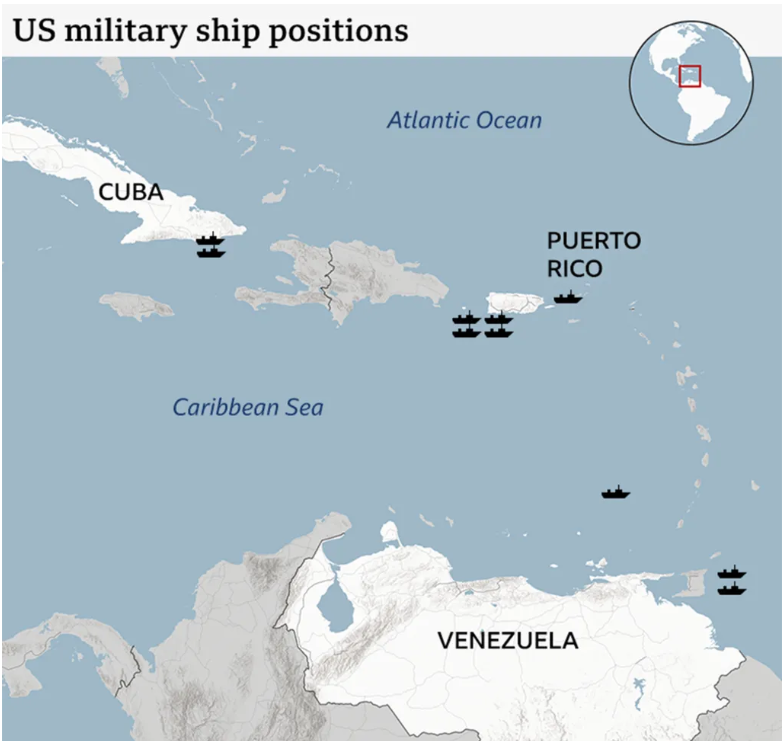
The US military deployment has been changing and as of 23rd October, there were ten US military warships in the area, including oil tankers for refuelling ships at sea, guided missile destroyers and amphibious assault ships, according to BBC. There were at least 10,000 troops in the area, excluding personnel stationed at facilities in Puerto Rico alongside a Marine contingent on amphibious assault ships.
Image via BBC
Reuters reported that more aircrafts have been seen at US facilities in Puerto Rico, including F-35 fighter jets and MQ-9 reaper drones which have been utilized to conduct surveillance and attacks in Afghanistan, Syria, Libya and Mali.
A task force had been sent out by the Navy and Marine Corps off the coast of Venezuela. More than 4,500 sailors and Marines work there as a forward presence for Naval operations. The group consists of reconnaissance planes, an attack submarine, a Special Operations ship and guided missile destroyers.
The MV Ocean Trader, a civilian vessel transformed into a floating base for Special Operations, has also been deployed by the Pentagon. Special Operations forces in the region can use the ship as a command centre and barracks. The 160th Special Operations Aviation Regiment is also stationed there. It is a top-tier helicopter unit that supports the most hazardous missions in the globe.
This month, it was discovered that the “Little Bird” helicopters that this unit usually uses were operating fewer than 90 miles off the Venezuelan coast, based on The Washington Post. The helicopters were participating in training exercises that could be used to prepare for an extended confrontation, including potential operations inside Venezuela, a US official unveiled to The Post. A carrier strike group had already been ordered to the area comprising of USS Gerald R Ford by the Pentagon.
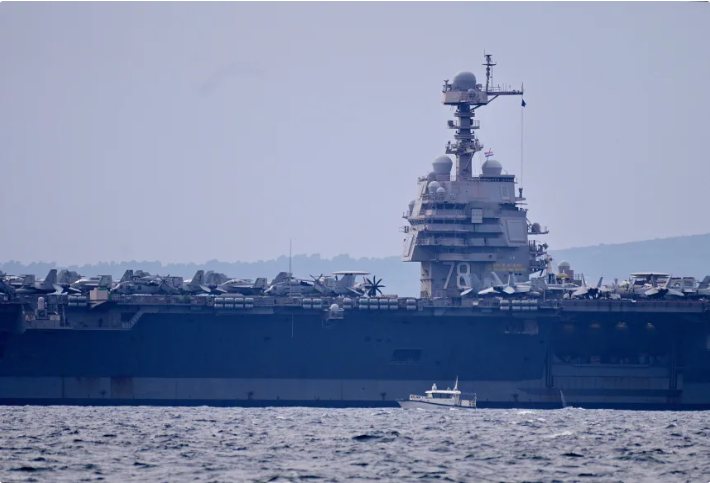
USS Gerald R Ford (Source: CNN)
Additionally, plane tracking platforms have shown flights of P-8 Poseidon espionage planes and B1 bombers. The United States has committed 8% of its entire naval fleet to the Caribbean deployment. As Dr Solar earlier implied, the magnitude of this deployment reflects a far more substantial motive than merely attacking drug cartels.
Conclusion
The US is notorious for launching wars to establish “democracies” in nations that are abundant in natural resources and energy. The CIA is also recognised for its regime change operations around the globe, including in Ukraine and allegedly even in Bangladesh. They have attacked nations on totally fake grounds before (Iraq), and have a history of destroying entire countries and levelling civilian facilities to ground just to topple an unfavourable leader (Libya). Though a war on Venezuela would appear as an extreme measure in current global situations, it won’t be unprecedented. The USA has done such wars plenty of times.
The Peace talks in Istanbul between Pakistan and Afghanistan have completely fallen apart, edging the two neighbours in a period of uncertainty and ‘Open War’. After three days of negotiations, the two sides failed to reach any agreement, and the talks ended with no outcome.
Now, both countries are blaming each other for the failure. Turkish and Qatari officials, who were also hosting the negotiations and seeking a compromise (serving as mediators), are said to be still negotiating for a breakthrough, but for now, the talks are stuck.
The border conflict that led to the meeting
These talks were an emergency measure because the two countries were in the middle of a serious, war-like situation just a few weeks ago.
It began on October 9, when cross-border air raids were carried out by Pakistan into Afghanistan. Pakistan claimed that it was attacking camps of the Tehreek-e-Taliban Pakistan (TTP), an organisation that had killed hundreds of Pakistani troops.
The Afghan Taliban’s response was fast and powerful. They launched a massive “counteroffensive” all along the border. According to reports, the fighting was incredibly heavy. The Taliban claimed they killed 58 Pakistani soldiers and destroyed 20 security outposts over a single weekend.
The violence got out of control to the point that even other countries, including Saudi Arabia and Qatar, had to step in. They managed to get both sides to agree to an “immediate ceasefire” on October 19. The first round of talks was held in Doha, and this meeting in Istanbul was supposed to be the final step to make the peace last.
What went wrong during the meetings
Even though the talks in Doha seemed positive, the Istanbul session collapsed on some issues that both sides refused to compromise on.
Pakistan has a Big Demand as they want “written guarantees” that the Afghan Taliban would stop the TTP. But sources say they went even further. The Pakistani team asked the Afghan side to agree that Pakistan has the “right to carry out attacks on Afghan soil” whenever the TTP attacks them.
On the other hand, the Afghan Taliban had a major demand of their own. They informed Pakistan that it has to cease granting permission to American drones to cross its airspace to fly into Afghanistan.
Both demands were rejected
The Afghan delegation, consisting of senior members such as Anas Haqqani and Suhail Shaheen, argued that the TTP is an “old and internal” problem for Pakistan, not theirs. They assured no one would use Afghan territory to attack another nation, but they would not agree to Pakistan’s authority to initiate attacks.
On the drone issue, Pakistan’s delegation reportedly admitted for the first time that they have an agreement with a “foreign country”, meaning the U.S., for drone strikes and that they “cannot” break that agreement.
Mediators flummoxed by Pakistan’s strange behaviour
The Turkish and Qatari mediators were reportedly left totally shocked and confused by the Pakistani team’s strange behaviour.
Sources said the Afghan delegation was trying hard to have constructive talks and find a real solution. But it seemed the Pakistani team, reportedly headed by a senior general from the ISI, Pakistan’s intelligence agency, didn’t have the same intention.
There seemed to be no coordination within the Pakistani team. Insiders said that just when they were getting close to an agreement, the Pakistani delegation suddenly backed out, leaving the mediators surprised.
Warning of open war
As the negotiations were unsuccessful, the situation is dangerous. Even before the talks collapsed, Pakistan’s Defence Minister, Khawaja Asif, gave a strong warning. He stated that if the negotiations fail, there is another option on the table that is open confrontation or open war with Afghanistan.
The Pakistani delegation in Istanbul said the same thing: with no security agreement, Pakistan will “continue to target terrorists inside or outside” its borders.
While all this was going on, U.S. President Donald Trump also tweeted regarding the clashes, stating, “I heard that Pakistan and Afghanistan have started up, but I will solve it very quickly.”
Inside account of Pakistan’s erratic conduct during the Istanbul peace talks
As per Jawad Sarga, eyewitnesses and reliable third party sources present a damning picture of the Istanbul talks. The Pakistani delegation behaved erratically, at times rude and uncoordinated, leaving Turkish and Qatari mediators astonished. Insiders say the Pakistani team repeatedly derailed the meeting with crude language and off topic interventions, even as the Afghan side, led by senior figures, tried to pursue a constructive settlement.
په ترکیه کې د مذاکراتو له ماحول څخه: عبدالخبیر مجروح د مؤثقو منابعو په حواله ویل کیږي چې په ترکیه کې د پاکستان او افغانستان اړخ ترمنځ د مذاکراتو جریان بې له کومې پایلې پای ته ورسید. هغه څه چې ډیر جالب وو دا وو چې پاکستاني پلاوي له مذاکراتو سره بلدیت نه درلود، بې منطقه خبرې یې… pic.twitter.com/kR8G9i2RzS
Key demands from Islamabad shocked other participants. Pakistan asked Kabul to summon and control groups that operate from Afghan soil and to give written guarantees that these groups would not attack Pakistan. Islamabad then went further, seeking the right to strike inside Afghanistan whenever it deemed necessary. The Afghan response was blunt, noting that such groups are Pakistan’s nationals and fighters, and asking how Kabul could be expected to summon and police foreign insurgents on Pakistan’s behalf.
The talks also turned on the drone issue. Afghanistan sought assurances that Pakistan would not permit foreign drones to use its airspace to strike Afghan territory. Pakistan initially signalled agreement, but after a phone call during the session, the Pakistani side reversed its position, claiming it could not prevent US drone overflights. According to sources, Pakistan’s negotiating team even suggested it could not guarantee action against Isis related activity originating from its soil, prompting further alarm among mediators.
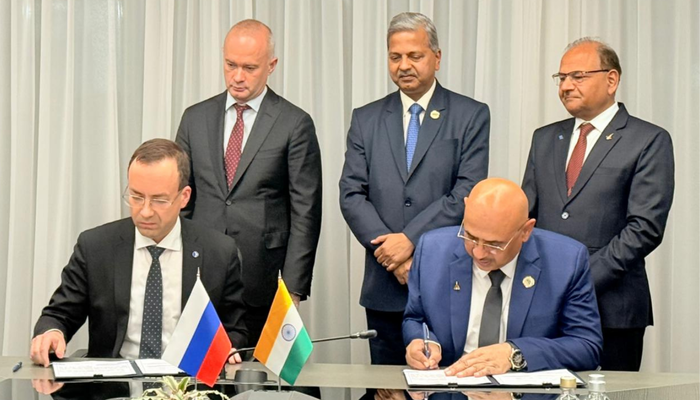
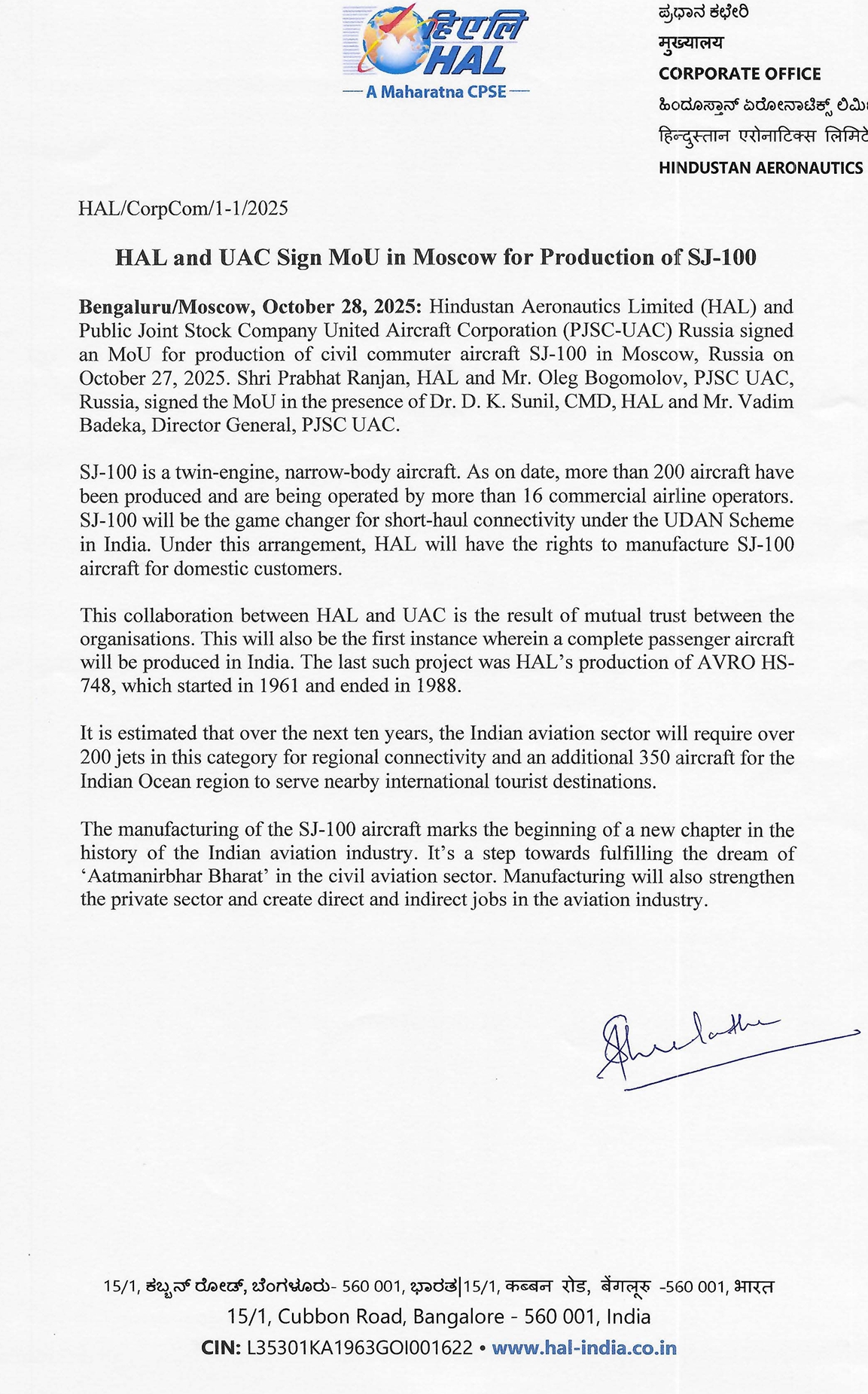
In a significant move towards enhancing India’s self-reliance in the aviation sector, Hindustan Aeronautics Limited (HAL) signed an MoU with Russia’s Public Joint Stock Company United Aircraft Corporation on Monday (27th October) for the production of SJ-100 civil commuter aircraft. Under the agreement, HAL will have the right to manufacture the aircraft for domestic use.
“This will also be the first instance wherein a complete passenger aircraft will be produced in India. The last such project was HAL’s production of AVRO HS-748, which started in 1961 and ended in 1988,” said HAL in its statement.
HAL and Public Joint Stock Company United Aircraft Corporation (PJSC-UAC) Russia signed an MoU for production of civil commuter aircraft SJ-100 in Moscow, Russia on October 27, 2025. Shri Prabhat Ranjan, HAL & Mr. Oleg Bogomolov, PJSC UAC, Russia, signed the MoU in the presence… pic.twitter.com/McN8WQjeSl
The SJ-100 is a twin-engine, narrow-body aircraft which is currently operational with over 16 commercial airlines. According to HAL, the civil jet will be a “game-changer for the short-haul connectivity”. The move is set to cater to the Indian aviation sector’s estimated requirement over the next 10 years of over 200 jets in the category to boost regional connectivity, and for another 350 jets for the Indian Ocean region to connect to nearby international tourist destinations.
“The manufacturing of the SJ-100 aircraft marks the beginning of a new chapter in the history of the Indian aviation industry. It’s a step towards fulfilling the dream of ‘Aatmanirbhar Bharat’ in the civil aviation sector. Manufacturing will also strengthen the private sector and create direct and indirect jobs in the aviation industry,” added the HAL statement.
Image via X/@sougat18
Features of the Russian SJ-100 commercial aircraft
Aircraft suitable for domestic flights: The SJ-100 is a small commercial aircraft manufactured from Russian components and does not rely on the West for material or technology. The aircraft, also known as SuperJet 100, was originally built 10 years ago in 2000. The aircraft made its maiden commercial flight in May 2008 and its first commercial flight in April 2011. The jet with 46–49 t (45–48 long tons) maximum take-off mass (MTOW) can carry 87 to 98 passengers. The jet has two variants: a basic one with standard engines and the other, which is modified to compete with the Airbus A220 and Embraer E-jet series.
Redesignable cabin configuration: The arrangement of seats in the cabin of the SJ-100 follows a 2-3 configuration and can be redesigned to meet the requirements of the airlines. The aircraft is best suited for point-to-point routes on domestic and international airlines. It’s an all-weather aircraft and can operate in all climate zones with temperatures ranging from -55 °C to +45 °C, and has a flight range of 3530 km. The aircraft was built with the intention of facilitating Russians in travelling long distances within the country. The SJ-100 incorporates advanced technology found in bigger and newer aircraft designs.
Fly-by-wire (FBW) control system: It is fitted with a Fly-by-wire (FBW) control system, which replaces manual flight controls with an electronic interface, thereby helping reduce the workload on the pilot. The FBW control system provides a full flight envelope system, which prevents the aircraft from exceeding its operational limits.
Autoland system, CAT IIIA: It is also equipped with an autoland system, CAT IIIA, which helps the aircraft land automatically in extremely low visibility conditions.
Advanced navigation and landing modes: The SJ-100 makes use of P-RNAV, LNAV, and VNAV navigation and landing modes, which provide it with greater light and route accuracy, with the use of satellite and ground-based technology.
How the HAL-UAC collaboration is significant for India
For an industry dominated by the American (Boeing) and European (Airbus) aircraft manufacturers, the agreement could be a game-changer for India’s manufacturing sector. It could provide a much-needed impetus for India’s goal of ‘Atmanirbhar Bharat’ by eliminating the country’s reliance on foreign players and developing its manufacturing capacity. The HAL-UAC collaboration will provide India with an opportunity to delve deeper into the know-how of aircraft manufacturing and also develop the capacity for the maintenance and repair of aircraft. Once India develops its capacity in civil aviation manufacturing and establishes itself as an aerospace hub, the country can grow from being an importer to an exporter of aircraft.
India has largely been importing full-assembled commercial aircraft for decades. The collaboration will enable India to manufacture a full passenger aircraft, entirely on Indian soil. This, in turn, will not only help the economy but will also contribute in generating employment, creating value-chain jobs and vendor networks, and enhancing supply-chain growth.
Manufacturing aircraft within the country could also significantly bring down the cost of air travel, thus helping achieve the objectives of the UDAN (Ude Desh ka Aam Nagrik) Scheme, which aims to make air travel affordable and accessible. The objectives of the scheme include connecting Tier-2 and Tier-3 cities with metropolitan cities by linking unserved or underserved airports in smaller cities with major airports. The government has, so far, developed a network of more than 150 airports across the country. One major challenge before the government has been the deployment of suitable small and mid-sized aircraft for operating on domestic routes, while keeping the travel fare affordable. The indigenous manufacturing of the SJ-100 aircraft could help address this challenge.
India deepens ties with Russia as Trump tariffs pushes Delhi toward strategic autonomy
The recent Memorandum of Understanding between Hindustan Aeronautics Limited (HAL) and Russia’s United Aircraft Corporation (UAC) for joint production of the SJ-100 civil aircraft marks yet another milestone in India’s deepening partnership with Moscow, a relationship that has only strengthened in the face of growing friction with Washington. The backdrop to this cooperation lies in the unilateral decision by former U.S. President Donald Trump to impose punitive tariffs on India, ostensibly over its continued purchase of discounted Russian oil.
The move was widely seen in New Delhi as hypocritical, given that several European nations, and even the US itself, continued to procure Russian crude and raw materials vital for their energy and strategic industries. For India, which has long championed energy sovereignty and strategic autonomy, Trump’s tariff pressure was a reminder of why overdependence on western nations is strategically risky.
In response, India appears to have doubled down on its multi-vector foreign policy, choosing diversification and self-reliance over coercive alignment. The HAL–UAC agreement follows a series of Indo-Russian collaborations across critical sectors, from defence engines and BrahMos co-development talks to long-term crude and coal supply contracts.
These deals underscore a clear intent: to ensure technology transfer, indigenous manufacturing, and long-term supply security while signalling to Washington that New Delhi will not subordinate its strategic choices to American pressure. Ironically, while the West preaches “rules-based order,” its selective sanctions and protectionist tariffs have only accelerated India’s quest for multipolar partnerships, with Russia emerging once again as a reliable collaborator in both defence and civilian industries.