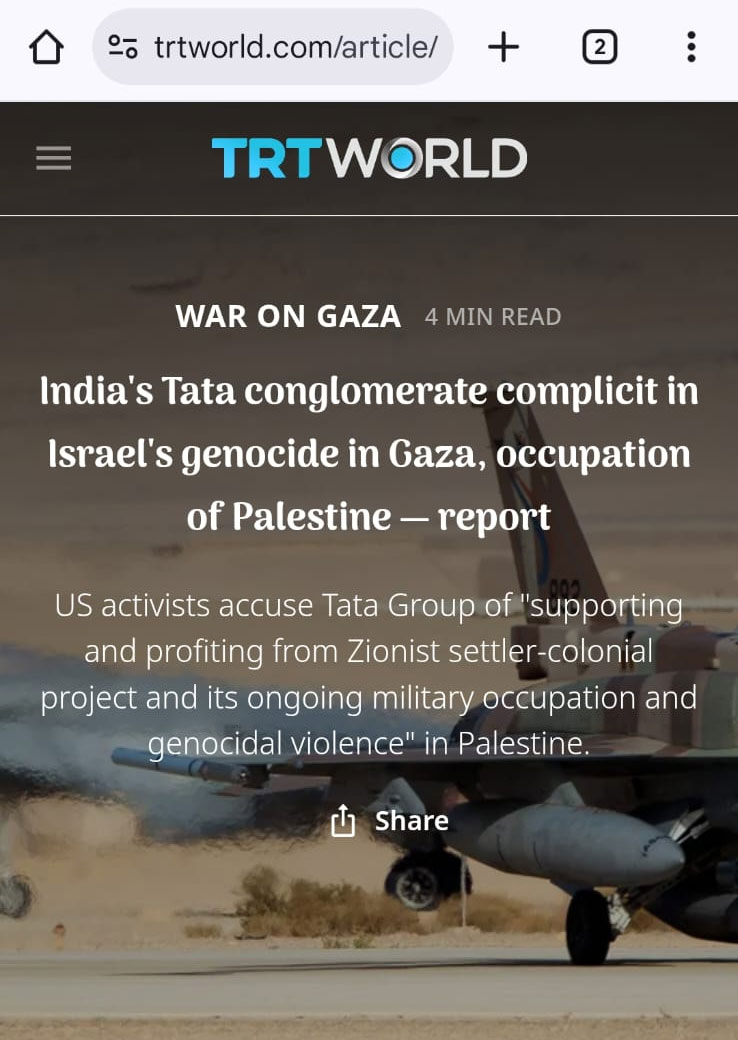
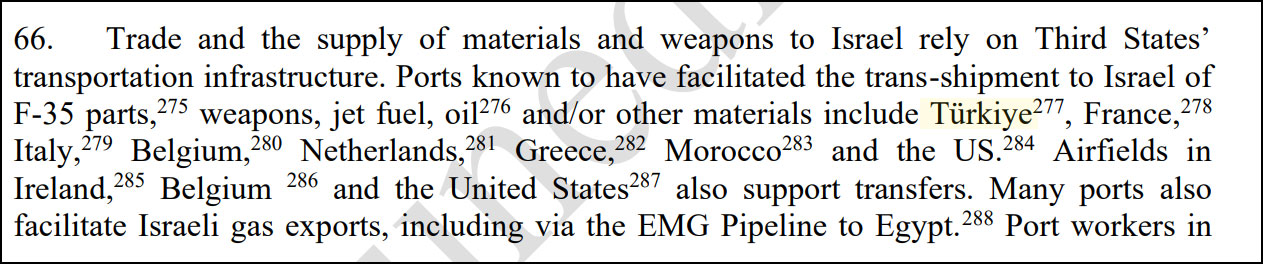
On 24th October (local time), Turkish state broadcaster TRT targeted India’s Tata Group, claiming that the conglomerate is “at the heart of the India-Israel military alliance”. In doing so, TRT quoted a UN report that, interestingly, categorically mentions Türkiye as one of the ports known to have facilitated the trans-shipment of F-35 parts, weapons, jet fuel, oil, and other materials to Israel. The contradiction is glaring, while TRT paints India as complicit, it conveniently ignores that its own country has been named in the same UN document that it used in its report against India, which is based on a report by a US-based South Asian political collective called South Asian Left Activist Movement (SALAM).
Indian conglomerate Tata is complicit in and profits from Israeli occupation of Palestine and genocide in Gaza, new report released by US activists alleges ? https://t.co/SWAocdmslapic.twitter.com/fv6kf6DGRk
TRT singled Tata Group for having military ties with Israel
The report that TRT published was based on the findings of a US-based South Asian political collective called ‘SALAM’. In its report, TRT accused Tata Group of being “a key enabler of Israel’s system of control over Palestinians” while citing SALAM’s claims that Tata provided “the hardware of genocide and the machinery of daily oppression.” The report further claimed that Tata’s subsidiaries are deeply embedded in Israel’s military-industrial network, which includes manufacturing fuselages for Apache helicopters and providing digital infrastructure for Israel’s government and financial systems.
Source: TRT World
The Turkish state broadcaster positioned Tata’s collaboration with Israeli firms as part of a broader “occupation economy” and extended its role beyond defence to cloud computing and surveillance technologies. It even framed Tata’s sponsorship of the New York City Marathon as “sportswashing”, designed to distract from its alleged complicity.
What SALAM’s report claimed
SALAM has released a 50-page document titled “Architects of Occupation: The Tata Group, Indian Capital, and the India-Israel Alliance”, in which the group claimed that Tata Advanced Systems Ltd (TASL) produces parts for F-16 fighter jets and Apache helicopters, both of which are used by Israel’s Air Force. It also claimed that Tata has ties with Israel Aerospace Industries in the production of Barak-8 missile systems and that Tata Motors’ subsidiaries contribute to light armoured vehicles used by Israeli patrols in the West Bank.
On the digital front, SALAM linked Tata Consultancy Services (TCS) to Israel’s “Project Nimbus” cloud initiative and claimed that TCS helped sustain surveillance infrastructure. The report further attempted to link Tata’s economic ventures to ideological affinities and suggested that the India-Israel partnership is rooted in “shared leanings between Zionism and Hindutva.” The narrative of SALAM is clear that it views business cooperation through a political lens by framing India’s growing defence partnership with Israel as morally compromised.
UN report mentioned Türkiye as one of the ports supporting Israel
While attacking Tata Group, TRT quoted the UN Special Rapporteur’s advance unedited version as well, stating that India was among the 26 states that exported arms and ammunition to Israel between October 2023 and October 2025.
However, while quoting the UN report, TRT conveniently skipped the fact that it also explicitly mentioned Türkiye as one of the “ports known to have facilitated trans-shipment to Israel of F-35 parts, weapons, jet fuel, oil and/or other materials”. This statement placed Türkiye, TRT’s home state, within the logistical network that enables the movement of defence supplies to Israel, the very network it accused India of empowering.
Source: United Nations
Even if TRT’s moral outrage is considered genuine, it must extend to its own ports, which, according to the UN, are directly involved in the flow of military and energy supplies to Israel. The broadcaster’s silence on this fact raises questions about intent — whether the report was meant to expose the so-called global complicity, or whether it was written merely to target India for political optics.
The hypocrisy play
TRT selectively framed Tata, which appears less about journalistic investigation and more about preserving national optics. It projected India as the face of Israel’s so-called “occupation economy” and attempted to redirect global attention from Türkiye’s own complicity mentioned in the UN report. The broadcaster’s omission makes one thing clear: it is easy to moralise from a distance while ignoring facts that sit close to home.
The India-Israel relationship has always been pragmatic and transparent. New Delhi has maintained neutrality on the Palestine issue and continued humanitarian aid to Gaza through UNRWA. On the other hand, New Delhi has deepened strategic defence and technological ties with Jerusalem, primarily to enhance self-reliance and counter terrorism. Unlike Türkiye, India has never masked its position under contradictory posturing.
Conclusion
TRT’s report, which is based on SALAM’s highly ideological publication, weaponised selective outrage to vilify India. While doing so, it bypassed inconvenient UN findings that implicated Türkiye. If transparency and accountability were the goals that TRT aimed for, the Turkish state media failed miserably. Until it addresses its own country’s role in the arms and energy routes to Israel, TRT should refrain from lecturing others on “occupation economies”. And even if TRT someday does so, it has no right to lecture any country or business house, including India and Tata, on how to do business.
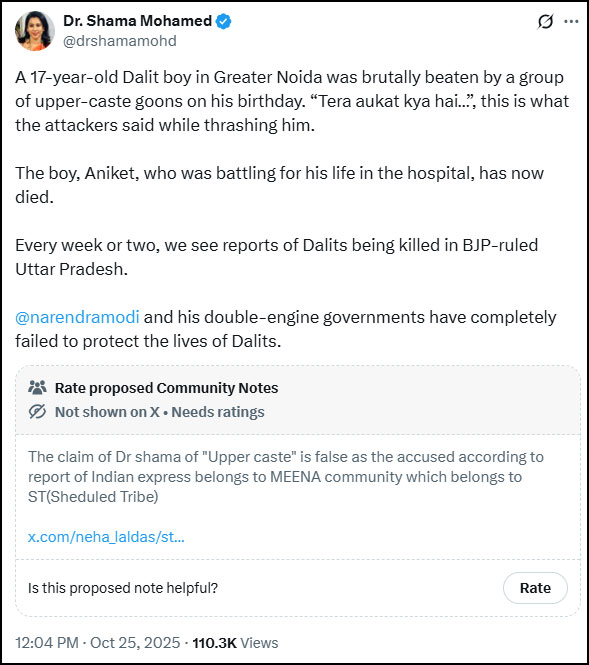
On 25th October, National Spokesperson of the Indian National Congress, Dr Shama Mohamed, claimed on social media platform X that “upper-caste goons” brutally beat up a 17-year-old Dalit boy, Aniket, in Greater Noida, Uttar Pradesh, on his birthday. The victim succumbed to his injuries at the hospital while receiving treatment on 24th October. She wrote, “Every week or two, we see reports of Dalits being killed in BJP-ruled Uttar Pradesh. Narendra Modi and his double-engine governments have completely failed to protect the lives of Dalits.”
Source: X
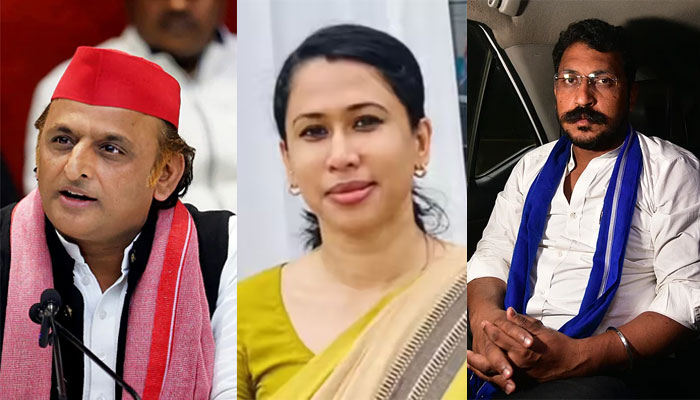
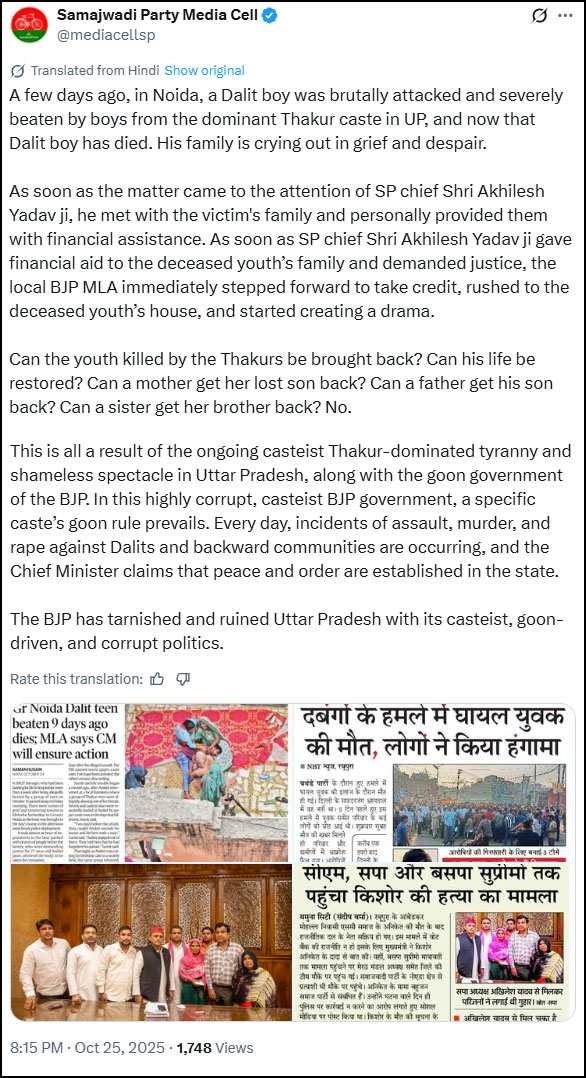
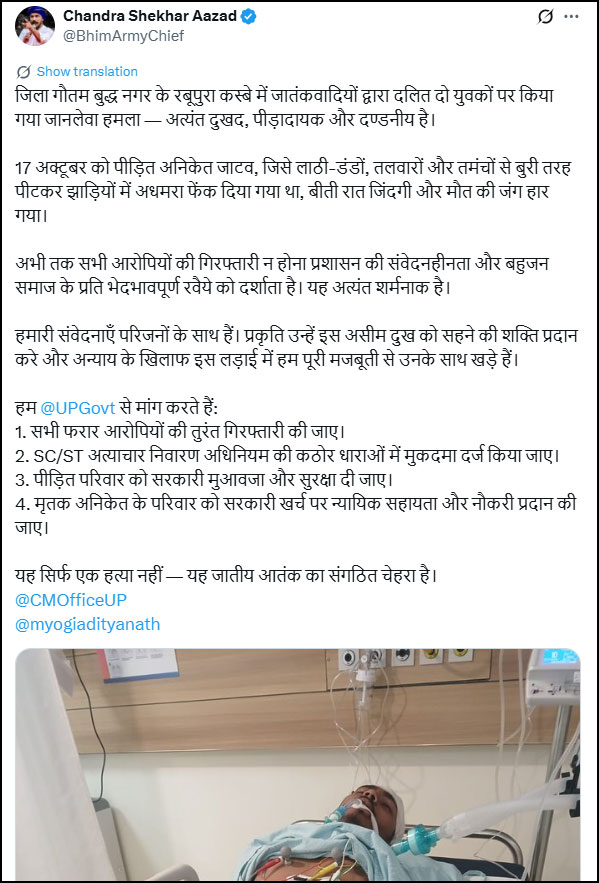
Congress was not the only one to push the “Dalit vs Upper Caste” narrative in the matter. While the Samajwadi Party’s media cell claimed the accused were from the “Thakur” community, Bhim Army chief used the term “dabang” to run a similar narrative.
In a post on X, the Samajwadi Party’s media cell wrote, “A few days ago, in Noida, a Dalit boy was brutally attacked and severely beaten by boys from the dominant Thakur caste in UP, and now that Dalit boy has died. His family is crying out in grief and despair.” Interestingly, the screenshots of news reports shared in the post did not mention “Thakur”.
Source: X
Bhim Army chief Chandra Shekhar Azad called them “Jatankwadi”.
Source: X
While Shama Mohamed and others claimed the “upper-caste goons” or “Thakurs” assaulted Aniket, in reality, the accused belong to the Meena community, which is categorised as a Scheduled Tribe, not “upper caste.”
What the FIR says
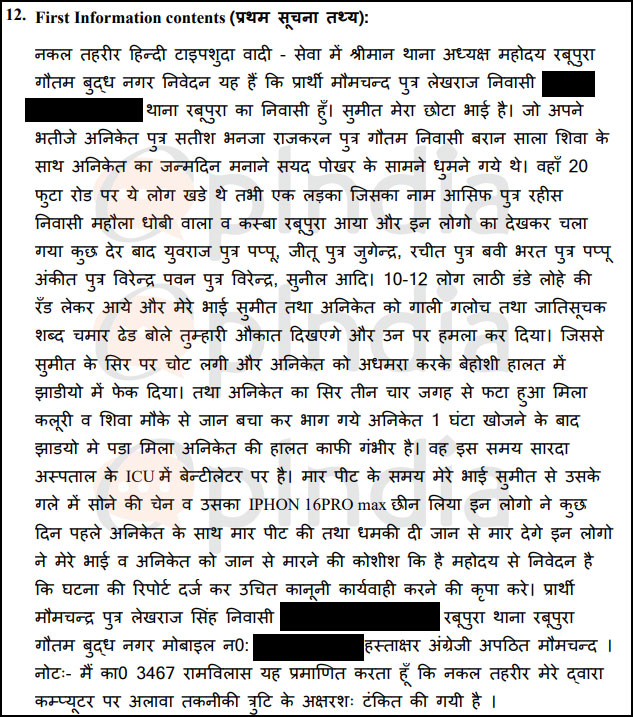
OpIndia accessed the FIR registered in the matter. The FIR was registered on 17th October, two days after the incident, based on the complaint of the victim’s uncle, Momchand, under Sections 191(2), 190, 115(2), 352, 109 and 309(4) of the Bharatiya Nyaya Sanhita (BNS) and Sections 3(1)(d) and 3(1)(dh) of the SC/ST (Prevention of Atrocities) Act. As the victim has died, Section 103(2) of the BNS (murder) has been added.
The FIR is registered against seven named accused and 10–12 unidentified individuals. The names of the accused, according to the complaint, are Yuvraj, Jeetu, Rachit, Bharat, Anjit, Pawan and Sunit. All of the accused are residents of the same locality and belong to the Meena community, however, the FIR does not explicitly mention it. The accused’s caste details were revealed by the police in a statement.
According to the complainant, his younger brother Sumit had gone with his nephew Aniket and his friends Rajkaran and Shiva to celebrate Aniket’s birthday near Syed Pokar. They were standing on the 20-foot road when a boy named Asif came, saw them and left without saying anything.
Source: UP Police
A short while later, Yuvraj, the main accused, Jeetu, Rachit, Bharat, Ankit, Pawan, Sunit and 10–12 others arrived carrying sticks and iron rods. They began hurling abuses and casteist slurs at his brother and Aniket. They called them “Chamar” and “Dhed” and said, “We will show you your place”, before attacking them.
Sumit sustained injuries to his head and Aniket was brutally beaten. Both of them were thrown into nearby bushes. Aniket was unconscious at that time. Shiva and one other person present managed to escape from the attack and saved their lives. Later, they searched for Aniket for an hour and found him lying unconscious in the bushes.
Later, when Aniket and Sumit were rushed to the hospital, it was found that Aniket had deep head wounds at three to four places. Aniket was admitted to the hospital in critical condition.
During the assault, the accused reportedly snatched a gold chain from Sumit and took his iPhone. The complainant mentioned that the accused had beaten up Aniket a few days back as well and threatened to kill him.
Sumit was discharged from the hospital two days after the incident. However, Aniket continued to fight for his life. On 24th October, Aniket succumbed to his injuries at the hospital.
Several individuals arrested by the police
On 19th October, police arrested Yuvraj Meena and Jitu Meera, two days after the FIR was registered. Four teams were formed to apprehend the remaining accused. Rachit and Ankit were arrested later on 24th October. Further search for the remaining accused is underway.
According to the police, 17-year-old Aniket Jatav was beaten up on 15th October and he died on 24th October. The accused belonged to the Meena community, the police confirmed.
“We had earlier arrested two accused on 19th October, Yuvraj Meena and Jitu Meena, who were residents of the same area, and sent them to jail. Four teams have been formed to quickly arrest the remaining accused,” the Noida Police said in a statement.
Speaking to the media, Assistant Commissioner of Police, Greater Noida 4, Sarthak Sengar, said that the victims and accused had previous altercations and the reason for the same is still unclear. He said, “They were young boys and it was not the first time that they had arguments.”
— POLICE COMMISSIONERATE GAUTAM BUDDH NAGAR (@noidapolice) October 25, 2025
ACP Sengar added that following the altercation, the victim was admitted to the hospital with severe injuries and was recovering. However, on 23rd October, his health deteriorated and he succumbed to the injuries on the morning of 24th October.
Political response to the incident
Following the incident, Bharatiya Janata Party (BJP) MLA from Jewar, Dhirendra Singh, visited the family. He also briefed Chief Minister Yogi Adityanath about the incident. When Dhirendra Singh went to meet the family, CM Yogi talked to them over the phone and assured justice.
रबूपुरा के अनिकेत प्रकरण में दोषियों पर सख्त कार्रवाई होगी। मेरी सांत्वना पीड़ित परिवार के साथ हैं। मौके पर पीड़ित के घर जाकर परिवार को ढांढस बंधाया और प्रदेश के माननीय मुख्यमंत्री श्री @myogiadityanath जी से फ़ोन पर वार्ता भी कराई। #MLAJewarpic.twitter.com/jqeMoukvrW
Local BSP and Samajwadi Party leaders also met the family and promised their support.
The accused were not from the upper caste, as propagated by opposition parties
While political parties and activists rushed to frame the incident as another “Dalit versus upper caste” crime, police records and statements reveal a different reality. The accused in the case belong to the Meena community, which falls under the Scheduled Tribe category, not an upper-caste group as claimed by Congress, the Samajwadi Party and the Bhim Army. The narrative pushed online therefore appears to be politically motivated and factually incorrect, aimed at fuelling caste-based outrage rather than reflecting the facts of the case.
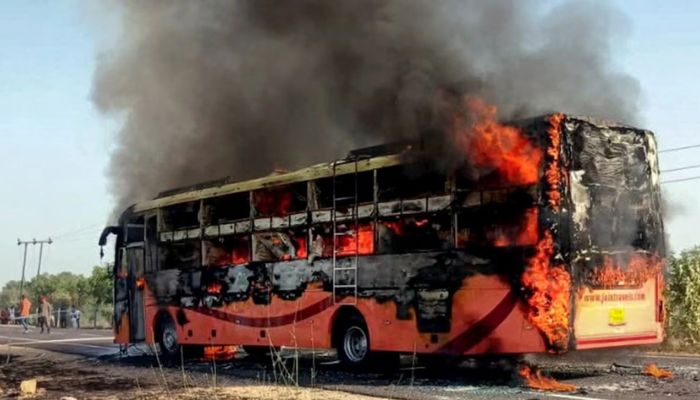
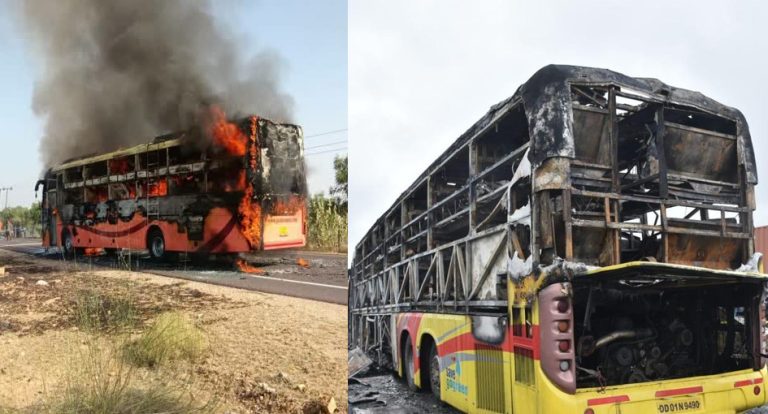
The bus fire near Jaisalmer on October 14, which tragically killed 26 people, was caused by a short circuit in the air conditioning, an official forensic (FSL) report has confirmed. The bus was on its way from Jaisalmer to Jodhpur and had only travelled about 10 kilometres when the fire started. The investigation has completely ruled out any kind of bomb, explosion, or firecrackers. Instead, it points to a “gross negligence” by the people who owned and built the bus.
How the fire spread so fast
Jaisalmer’s SP (Superintendent of Police), Abhishek Shivhare, explained exactly what the report found. The fire started from a short circuit in the AC’s faulty wiring, which was on the roof and connected to the engine. This caused the air conditioning pipes to fill with thick, poisonous smoke and carbon monoxide gas, which then spread everywhere inside the bus.
Before the bus was completely engulfed in fire, passengers were having trouble breathing. They started to suffocate and couldn’t move quickly to get out. In a panic, passengers started breaking the glass windows to escape. But authorities explained that this actually worsened the situation.
The fresh oxygen from outside rushed in and “snowballed” the fire, turning the whole bus into an inferno that burned completely in just 5 to 7 minutes.
Rumours about explosives are false
The police were very clear that rumours about firecrackers or explosives are baseless. The FSL report conclusively proves there wasn’t even a trace of any explosive material. They did find some unburnt firecrackers near the main door and about 35 potash guns (the kind farmers use to scare animals) in the back storage area, but none of them had anything to do with the fire. The bus’s diesel tank and tyres were also completely safe, proving the fire started from a technical fault.
A preventable tragedy built on greed
This whole tragedy could have been prevented. The investigation found several irregularities that were likely done just to make unethical gains. The AC wiring was installed unsafely, and the materials used to build the bus body were not fire-resistant, meaning they burned very easily.
Worst of all, the bus was missing the most basic safety gear. There was no fire extinguisher and no emergency hammers to break the windows. Most shockingly, investigators found that a seat had been placed right at the emergency exit, making it completely useless. Officials said timely inspection and proper technical fitting would have stopped this from ever happening.
The government seizes 66 buses from the owner’s factory
The Rajasthan government took several actions after the fire. The Transport Department seized all 66 bus chassis from the owner’s (Manish Jain’s) factory, Jainam Coach Crafts Workshop, and is now preparing to cancel their fraudulent registrations. They also launched a 10-day state-wide campaign, inspecting 2,000 buses, which resulted in 398 buses being seized and 1,089 being fined for safety violations.
The investigation showed that the owner, who also runs Jain Travels, made several low-quality, dangerous changes to the bus that burned. The bus was illegally modified with an AC unit after being registered as a non-AC vehicle, which overloaded the wiring and caused the fire.
Furthermore, the owner violated safety standards by installing an emergency gate that was completely blocked by placing two seats in front of it. The bus’s size was also illegally extended just to add more seats and sleeper berths.
RTO officers and builders colluded in registration fraud
According to a report by Bhaskar, the investigation revealed a clear collusion between RTO (Regional Transport Office) officers and bus coach builders who were processing fraudulent registrations for these unsafe buses. RTO officials were approving buses that weren’t even finished. At the Jainam workshop, officers found that 26 buses had been registered before their bodies were even built. This fraud was widespread, with these paper registrations filed not only in Rajasthan but also in Arunachal Pradesh, Bihar, Nagaland, and Assam.
The report highlights how deep the collusion was, noting that in Rajasthan, “an RTO inspector verified three of the five buses before their bodies were built,” acting as if they were complete, and one of those buses was even fully registered in RTO regions like Jodhpur, Chittorgarh, Sikar, and Bikaner.
Three people arrested
Because of this gross failure to follow safety rules, police have now arrested three people. The Special Investigation Team (SIT) set up by the government has arrested the bus driver, the bus owner, and Manish Jain, the owner of the factory that built the bus body. The investigation is still proceeding as more details come in.
On Friday (24th October), The Washington Post attempted to tarnish the reputation of the Adani Group and target the Modi government by making unsubstantiated claims of crony capitalism.
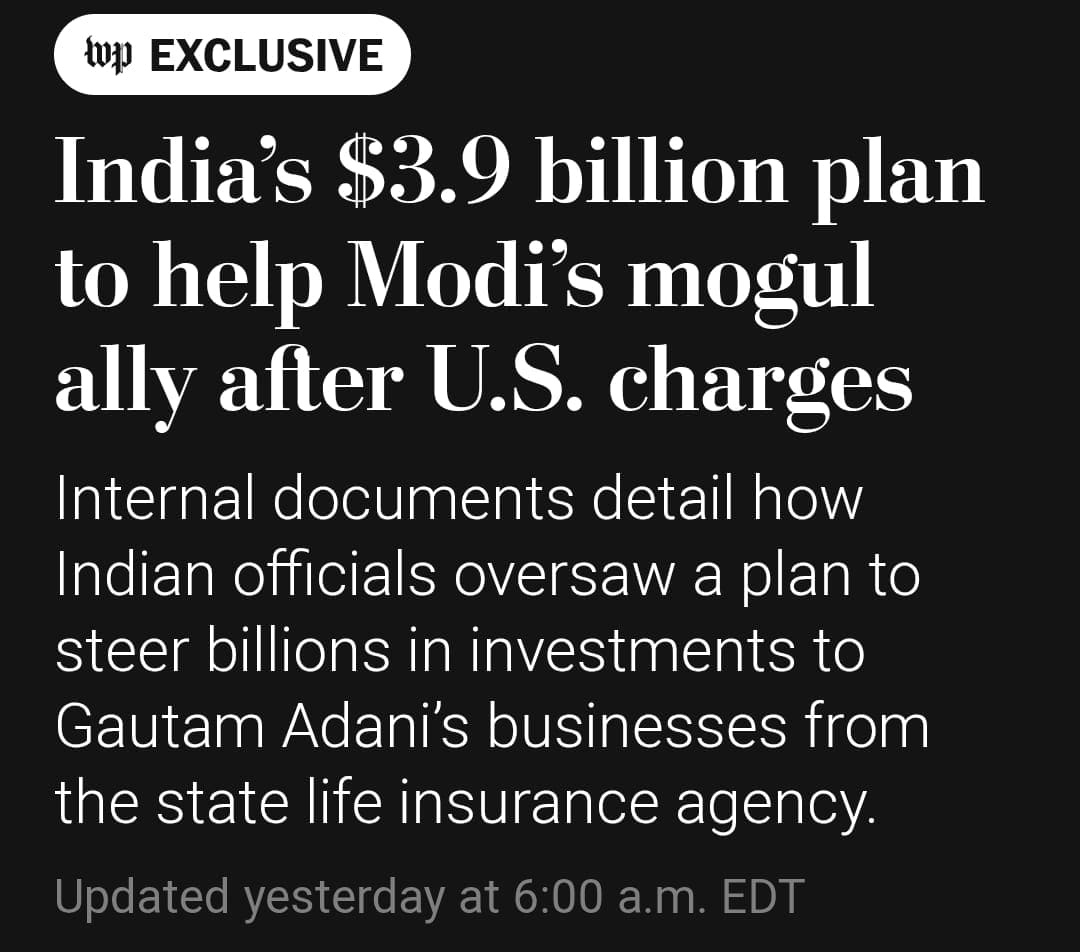
A hit-piece to this effect titled ‘India’s $3.9 billion plan to help Modi’s mogul ally after U.S. charges’ was published by the American leftist newspaper.
The Washington Post claimed to have accessed ‘internal documents’ exclusively, which somehow suggests that the Modi govt and its officials somehow ‘coerced’ the Life Insurance Corporation of India (LIC) to invest ₹5000 crores in the Indian conglomerate.
It alleged, “Internal documents obtained exclusively by The Washington Post detail how Indian officials drafted and pushed through a proposal in May to steer roughly $3.9 billion in investments to Adani’s businesses from the Life Insurance Corporation of India, or LIC — a state-owned entity primarily responsible for providing life insurance to poor and rural families.“
Screengrab of the propaganda piece in the Washington Post
While the Washington Post tried to pass off the news as some exclusive information, the investment by LIC was acknowledged by none other than the Adani Group itself in a press release in May this year.
“Adani Ports and Special Economic Zone Ltd (APSEZ), India’s largest integrated transport utility, has successfully raised INR 5,000 crore through a 15-year Non-Convertible Debenture (NCD). Backed by APSEZ’s strong financials and a ‘AAA/Stable’ domestic credit rating, the issue locked in a competitive coupon rate of 7.75% p.a. and was fully subscribed by LIC. The debentures will be listed on the BSE,” the Indian conglomerate had said.
For the unversed, NCD is a fixed-income instrument which companies use to raise funds without allowing the option of converting to equity shares. In the particular LIC-Adani deal, the insurance entity will receive regular interest payments at 7.75% pa. The principal amount of ₹5000 crores will also be returned to it on maturity, i.e. in the year 2040.
Given the nature of LIC, the investment in Adani Ports and Special Economic Zone Limited will provide it with a predictable income stream with low risk (given the AAA/ Stable domestic credit rating).
At the same time, it is important to point out that the Indian public sector life insurance company has invested heavily in several private companies.
For instance, LIC’s top holdings include Reliance Industries (₹1.38 lakh crore), ITC Ltd (₹82,342 crore), HDFC Bank, TCS, IDBI Bank, ICICI Bank, Bharti Airtel, SBI, L&T, and Infosys.
As such, it is not unusual for LIC to invest in Adani Ports and Special Economic Zone Ltd (APSEZ), either and that too an amount of ₹5000 crores.
But this did not stop ‘The Washington Post’ from alleging that the Modi government was somehow directing taxpayer money to bail out an Indian conglomerate ‘reeling under debt.’
The non-existent ‘internal documents’ referred to by The Washington Post apparently suggest that the Indian Department of Financial Services (DFS) warned LIC against investment in Adani Group.
The American newspaper alleged, “The DFS documents acknowledged that the proposed investment strategy came with risks. “Adani’s securities are sensitive to controversies…causing short-term price fluctuations,” one document said.“
It quoted an ‘independent expert’ named Hemindra Hazari in its report to cast aspersions on the motives of the Indian government and the integrity of LIC and the Adani Group.
Having said that, The Washington Post had to grudingly accept that the investments were made through transparent investment rationales, compliance with Indian regulators, exercising due diligence and ensuring economic benefits.
It also referred to the now-debunked Hindenburg report to further peddle unproven claims of ‘crony capitalism’ against the Indian conglomerate.
LIC rubbishes claims made by The Washington Post
In a statement released on Saturday (25th October), the Life Insurance Corporation of India pointed out, “The allegations leveled by the Washington Post that the investment decisions of LIC are influenced by external factors are false, baseless, and far from truth.”
The public sector insurance company also rubbished claims about the existence of any such internal document, which was the only foundation of the article by the American newspaper.
“No such document or plan as alleged in the article has ever been prepared by LIC, which creates a roadmap for infusing funds by LIC into Adani group of companies. The investment decisions are taken by LIC independently as per Board approved policies after detailed due diligence,” LIC emphasised.
It further pointed out that the Department of Financial Services (DFS) or any other entity does not have any role in its decision-making process.
“LIC has ensured highest standards of due diligence and all its investment decisions have been undertaken in compliance with extant policies, provisions in the Acts and regulatory guidelines, in the best interest of all its stakeholders,” it concluded.
Adani Group denies accusations of crony capitalism
The Adani Group has also categorically denied accusations of crony capitalism made by The Washington Post in its article.
“We categorically deny involvement in any alleged government plans to direct LIC funds…LIC invests across multiple corporate groups — and suggesting preferential treatment for Adani is misleading. Moreover, LIC has earned returns from its exposure to our portfolio. Assertions of undue political favour are unfounded…Our growth predates Mr Modi’s national leadership,” it added.
‘Journalists’ behind the dubious report targeting Adani and Modi govt
One of the ‘journalists’ behind the hit-piece happened to be Pranshu Verma.
OpIndia had reported in December 2023 how he was soliciting information about the Indian OSINT (Open Source Intelligence) handle ‘Disinfo Lab’ from American political commentator Jack Posobiec.
Pranshu Verma, who has been working with The Washington Post since February 2022, hoped to deter Jack Posobiec from sharing informative posts of ‘Disinfo Lab.’
In January 2023, he romanticised an Islamist named Raqib Hameed Naik in an article titled ‘Tracking rising religious hatred in India, from half a world away.’ A vicious fake news peddler, Raqib Hameed Naik is the founder of anti-Hindu disinformation outlet ‘Hindutva Watch.’
Screengrab of the article by Pranshu Verma
He is also infamous for denying the Hindu genocide, perpetrated by radical Islamists in the Kashmir Valley, in the early 1990s. Naik had also mocked the Hindu ‘Shivling’ found inside the Gyanvapi mosque in Kashi
In his article in January 2023, Pranshu Verma relied on a database provided by ‘DOTO’ to allege that ‘religious hatred’ is on the rise in India.
Coincidentally, ‘Disinfo Lab’ had previously exposed the fabrications of DOTO, following which the latter first revised and then deleted the database.
Another ‘journalist’ who co-authored the article happens to Ravi Nair, a columnist at the leftist propaganda portal ‘The Wire.’
In September this year, a Delhi court ordered him to remove unsubstantiated and defamatory content (based on the lies of Hindenburg Research), which he published to tarnish the reputation of businessman Gautam Adani.
Earlier in February 2025, Ravi Nair peddled lies about the Adani Group in the British newspaper ‘The Guardian.’
Out of desperation to target the Modi government, the ‘journalist’ made a fool out of himself by comparing the Indian rupee with the currency of Afghanistan.
Bhakt Mandali and their media should ask Rishi Sunak whether he eats beef or not ?
OpIndia had earlier pointedout how an Australian NGO-backed portal, ‘Adani Watch’, retweets almost all misleading articles by Ravi Nair. The ‘journalist’ is known for deriding Hindu sentiments and using Hinduphobic tropes regularly.
He had earlier amplified lies about the Statue of Unity and called for its demolition.
Ravi Nair had been the front-runner in spreading lies about the Rafale Deal and thwarting India’s defence procurement, albeit unsuccessfullly.
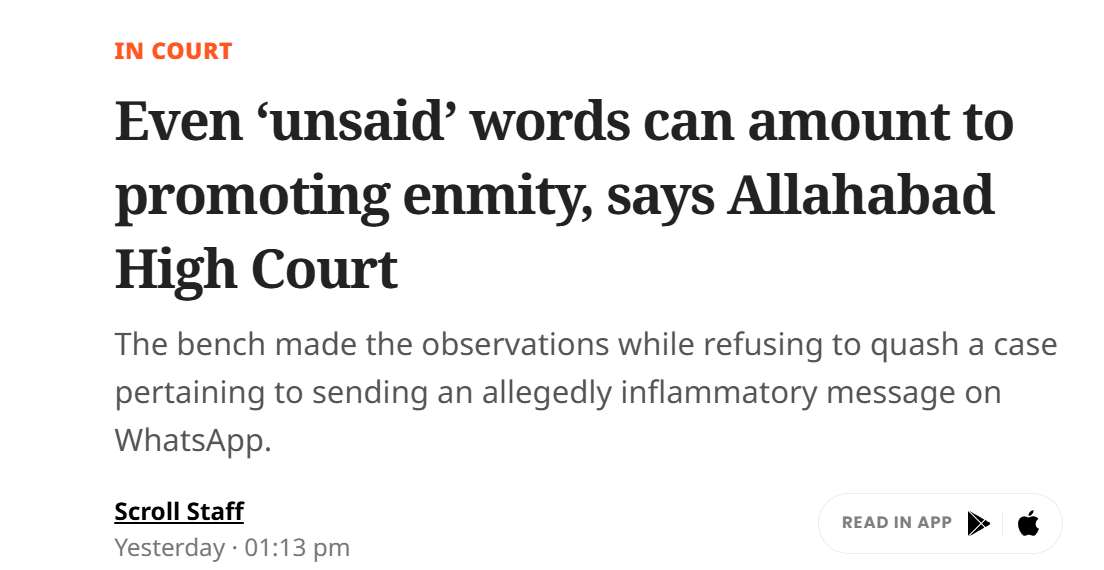
In a clear display of bias against the Allahabad High Court, some media outlets published misleading headlines about a recent order of the High Court, which dismissed the petition of a person charged with disturbing communal harmony, seeking the quashing of an FIR against him.
Reporting about the High Court order, Live Law published a report with the headline “Unsaid Words Can Also ‘Promote Enmity’ Under BNS: Allahabad High Court On ‘Subtle’ Religious Undertones In WhatsApp Message”. A plain reading of the headline suggests that the High Court made out an offence where there was none.
Similarly, The Scroll also emphasised the words “Even ‘unsaid’ words can amount to promoting enmity” in the headline of its report on the Allahabad High Court order, insinuating that the High Court wrongly inferred an offence while no act was committed to constitute the offence.
Another media portal, Law Chakra, also used a similar language regarding the High Court order. Its headline read, “Even Unsaid Words Can Spark Communal Tension: Allahabad High Court”.
The abovementioned reports relate to a judgment of the Allahabad High Court dated 23rd October, passed by a division bench of Justices JJ Munir and Pramod Kumar Srivastava. The verdict was passed by the judges after the hearing of a petition filed by an individual booked under Sections 299 and 353(3) of the Bharatiya Nyay Sanhita, 2023. The petitioner, Afaq Ahmad, sought the quashing of the FIR filed against him for circulating inflammatory WhatsApp messages after his brother was arrested in a religious conversion case.
“The petitioner, making this arrest of his brother in the case crime last mentioned, a foundation for disturbing communal peace and outraging religious feelings of a class of citizens of India, maliciously sent an inflammatory message to individuals on their mobile phones,” the High Court stated in its order. Explaining the intent of the inflammatory messages shared by the petitioner, the High Court said that in the message, the petitioner alleged that his brother was implicated in a false case because he belonged to a particular religious community.
“The words of the post quoted in the FIR may not speak per se about religion, but definitely convey an underlying and subtle message that his brother has been targeted in a false case, because of his belonging to a particular religious community. These unsaid words in the message prima facie would outrage religious feelings of a class of citizens hailing from a particular community, who would think that they are being targeted because of belonging to a particular religious community,” the court stated.
While the media outlets selectively picked the words used by the High Court, the entire statement of the court reads as, “Quite apart, and, even if one were to think that no religious feelings of a class of citizens or community have been outraged, per se by the WhatsApp message, it is certainly a message, which, by its unsaid words, is likely to create or promote feelings of enmity, hatred and ill-will between religious communities, where members of a particular community, in the first instance, could think that they are being targeted by members of another religious community by abusing the process of law”. It is clear from the statement of the High Court that the inflammatory message sent out by the petitioner attempted to promote feelings of enmity, hatred and ill-will between religious communities in an indirect manner, without using express words. Notably, the petitioner sent the message to multiple persons to expand its reach.
Maintaining that a prima facie case was made out against the petitioner, the High Court rejected his request for quashing the FIR against him. “In the totality of circumstances, we are of the opinion that this is a matter which requires investigation and cannot be scuttled at an incipient stage, foreclosing probe that must be carried to its logical conclusion,” the High Court noted.
It is evident from reading the High Court’s order in its entirety that the media portals attempted to attribute a malicious intent to the High Court in its decision on the petition. While the High Court explained how the petitioner tried to disrupt religious harmony through his inflammatory message in an indirect manner, the media portals cleverly focused on a set of words to raise suspicion about the intent of the High Court.
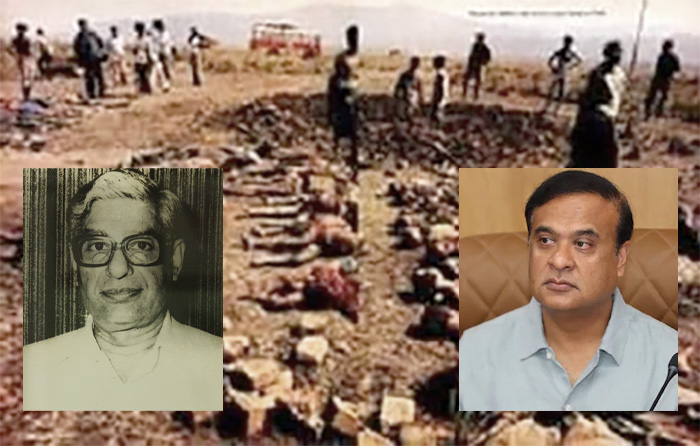
On 23rd October 2025, Assam Chief Minister Himanta Biswa Sarma announced that his government will table the 1985 Tiwari Commission report on the 1983 Nellie Massacre in state assembly during the upcoming winter session. This would be the first time that real truth of Nellie Massacre will come out after around four decades.
In a press conference on Thursday, CM Sarma said, “In 1983, a massacre occurred in Nellie. At that time, the state government formed a commission called the Tiwari Commission. However, until today, the commission’s report has not been presented in the legislative assembly. In the upcoming November 25th session of the legislative assembly, we have officially decided to present the Tiwari Commission report, which was formed in the context of the 1983 Nellie massacre.”
“Since this is a part of Assam’s history later studied and presented by scientists, historians and social scientists in different ways, making the report available will at least allow people to access accurate information about what happened at that time…” he added.
In 1985 the Tiwari Commission submitted its findings to the then government on the 1983 Nellie Massacre.
Today the Assam Cabinet has decided to place this report on the floor of the Assam Assembly, so its facts can be made available to the public. pic.twitter.com/MW3rbttV8a
Nellie Massacre of 1983 and why it took over 40 years to bring out the truth
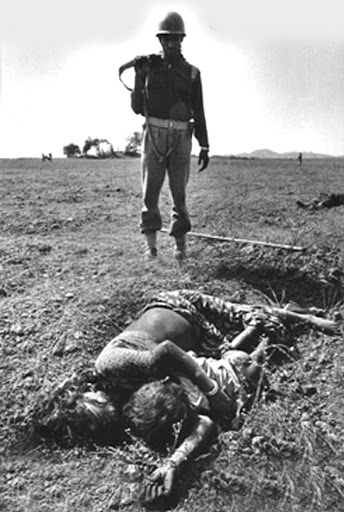
The Nellie massacre took place on 18th February 1983 in and around Nellie area in central Assam during the height of the Assam Movement or the Anti-Foreigners Agitation. Between 2,000 to 3,000 lives were lost when the villages occupied by Bengali Muslims were attacked by hundreds of indigenous people from nearby areas. Armed with machets, spears and sticks, the mob comprising people belonging to local communities burnt houses and blocked roads killing anyone who tried to escape. Most of the casualties were women and children.
While the official figures put the death toll at 1,819 including 1,327 women and 253 children, human rights groups and scholars estimate that the actual figures were way higher. The local police are alleged to have failed to protect the victims and the situation came under control only after the CRPF arrived.
Notably, twelve out of the fourteen Lok Sabha seats in Assam were vacant since 1980, the year after the anti-foreigner agitation in Assam began. The assembly was likewise dissolved in 1982. Elections had to be held, and on 6th January 1983, it was announced that there voting would take place for the assembly and Lok Sabha seats in four phases.
The election, however, was boycotted by the Assam movement supporters with many political parties not partaking in the elections. Despite this, the elections took place amidst violence and chaos. Eventually, Congress (I) won and formed a government under the leadership of Hiteswar Saikia.
The violence in Nellie erupted during the height of state assembly elections in Assam, which took place amid the Assam agitation, a movement led by the All-Assam Students Union (AASU) demanding detection and deportation of illegal immigrants from Bangladesh and deletion of their names from voter lists. They feared that an unchecked influx of Bangladeshis would alter the demographic composition of the state.
On 18th February 1983, the attacks began in Nellie which now comes under Nagaon district, when tensions peaked amidst the Assam Agitation. Within hours on that day, mobs comprising people from the indigenous Tiwa community, local Bodos and others stormed 14 villages housing Bengali-speaking Muslims around Nellie. During this massacre, the state was under President’s rule.
It is also alleged that Assam police perssonnel misled CRPF troops away from the massacre site, allowing the killing to go on. However, this claim remains unverified, which could be one of the major findings in the report.
The violence erupted on the day of voting Assam’s state assembly elections. These elections were pushed forward by the Prime Minister Indira Gandhi-led Congress government in Centre. The Congress-led central government decided to proceed with the state elections without addressing the demands of AASU and All Assam Gana Sangram Parishad (AAGSP) for a revised electoral roll which could have weeded out illegal voters including undocumented Bangladeshi immigrants. It is said that the elections were conducted in a haste even as demands for revision of electoral roll were raging.
Post the massacre, in another agitation-filled election, Congress government came to power in 1984, where mostly the Bengali-majority areas voted.
After the Nellie massacre left thousands of people dead, the Congress government in the state headed by Hiteswar Saikia established the Tiwari Commission headed by IAS officer Tribhubhan Prasad Tiwari to investigate the causes that led to the violence, identify culprits, and recommend actions. The commisson submitted a 600-page report in 1984 to then Chief Minister Hiteswar Saikia. However, the report was never tabled in the assembly or made public. Reports say that only three classified copies were retained in government archives.
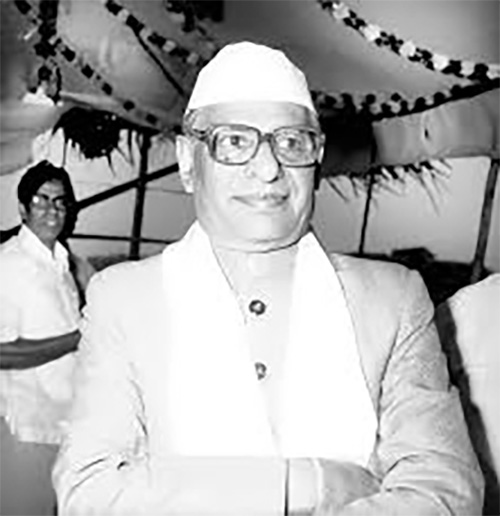
Tribhubhan Prasad Tiwari
As a precondition to the signing of the Assam Accord, the Congress (I) government was dissolved prematurely. Riding on the sympathy wave after Indira Gnadhi’s assassination, her son Rajiv Gandhi became Prime Minister. He signed the Assam Accord in 1985 where 1 January 1966 became the base year for detecting foreigners and 24th March 1971 was decided as the cut-off date for detecting illegal foreigners and removing them from the electoral rolls.
Ram Pradhan, the Union Home Secretary who negotiated the Assam Accord with AASU said that Rajiv Gandhi did not pursue the Assam Accord because “it would have impacted Congress’ (Muslim) votebank”.
About the survey to identify illegals, Ram Pradhan said,“This was a part of the accord, but they realised that the survey would seriously impair the votebank of the Congress”.
Following the Assam Accord which was signed a year after Indira Gandhi’s assassination in 194, state assembly elections were held and the leaders of Anti-Foreigners Movement won a majority and Asom Gana Parishad (AGP) formed government with Prafulla Kumar Mahanta becoming the youngest Chief Minister of the state.
Interestingly, the BJP government recognised the 885 AASU members who died during the Assam Anti-Foreigners Movement as “martyrs”. The Congress government, the Asom Gana Parishad (AGP) government and the BJP government under Sarbananda Sonowal also gave them financial compensations.
Coming back to the Nellie Massacre and the Tiwari Commission report, although the commission reportedly submitted its report in 1984, the Hiteswar Saikia led Congress government in the state decided to not make it public. Since then, it has never been made public until now, as subsequent governments also followed the same policy of keeping it confidential.
It remained unclear why the report was not made public in the last four decades with many accusing Congress of a deliberate cover up, AGP and the BJP of nonchalance in bringing out the truth.
However, now, Chief Minister Himanta Biswa Sarma has revealed the main reason why the report was never made public. According to him, the report was not made public because its veracity could not be confirmed. The CM stated that the copies of the 600-page Tiwari Commission report which were available with the Assam government did not have the signature of the retired IAS officer Tribhuvan Prasad Tiwari who headed the commission, due to which there has been second guessing of questions that would be raised on whether the report was authentic or not.
Tribhuvan Prasad Tiwari, who later become the governor of Puduchery, died in 2015 at the age of 93 years, making it even more difficult to confirm the authenticity of the report. However, Himanta Biswa Sarma government talked to other officers who worked under the commission, and they have confirmed that the copy of the report available with the govrernment is genuine.
“We have interviewed different clerks from that time and did forensic tests and found that it is genuine. The previous government was fearing taking a courageous step on this. Some government or the other should present it, it is a chapter of our history,” CM Sarma said.
More than 600 FIRs were filed, chargesheets were filed following probe in around 300 cases, however, most of the cases were eventually dismissed. In the early 2000s, a few cases were filed in the Guwahati High Court to seek better compensation for families of the victim of Nellie massacre, however, these cases too were dismissed.
The Assam Accord of 1985 ended the Anti-Foreigners agitation, however, neither the complete truth of the Nellie Massacre came out nor the menace of illegal immigration of Bangladeshis and Rohingyas in Assam has ended. However, Chief Minister Himanta Biswa Sarma is ensuring that neither the truth of past injustices go untold nor the issue of deliberate attempts at altering Assam’s demography go unaddressed.
If you walk down the streets in Bihar’s West Champaran district in the evening, you feel the serenity of a village. But about three decades ago, this area was known as “Mini Chambal”. Dacoits ruled the region, and for locals, leaving home after 5 pm amounted to inviting death. Kidnapping, robbery, murder, and massacre were a daily occurrence. The situation worsened during Lalu Yadav’s Jungle Raj.
Seeing the shattered law and order situation in the area and the locals being left to fend for themselves, Badri Narayan Pandey, displayed immense courage and formed a self-defence group comprising locals called the ‘Village Defence Force’. The self-defence group not only liberated Champaran from dacoits but also became an example of self-defence across the country. From the Salwa Judum in Chhattisgarh to the Village Defence Force in Jammu and Kashmir, Pandey’s story continues to inspire many.
In conversation with OpIndia, Badri Narayan Pandey narrated how it all began. Let’s first start by understanding the dark period when Bihar was a victim of Jungle Raj. From 1990 to 2005, under the governments of Lalu Prasad Yadav and Rabri Devi, the crime rate skyrocketed. The statistics were shocking. According to a report, there were more than 32,000 kidnappings, 18,000 murders, and 59 major massacres during the dreaded period. In 1997, the Patna High Court had termed the period as “Jungle Raj”.
The era of Jungle Raj in Bihar and of Mini Chambal
The 1990s were a dark period for Bihar. Lalu Prasad Yadav was in power at the time, and the term “Jungle Raj” had become commonplace in Bihar. The Bagaha region of West Champaran, known as “Mini Chambal,” had become a hotbed of dacoit terror. People were afraid to leave their homes after 5 p.m. Kidnapping, robbery, murder, and rape had become routine. Schools and colleges were closed, traders avoided going to markets, and farmers feared visiting their fields. The threat of dacoits in this region was so prevalent that people were not safe even in their own homes.
One of the most harrowing examples of peak criminal activities during the Jungle Raj was the Narkatia massacre of December 14, 1994. In the horrifying incident, dacoits brutally killed 15 villagers in Narkatia Bhuarwa village, in Ramnagar block. More than a dozen villages were brutally murdered by the dacoits in a single night. The victims were Gauri Shankar Mahato, Jai Ram Mahato, Ramvilas Mahato, Vishram Mahato, Dharamraj Mahato, Bhikhari Mahato, Chhedi Mahato, Roshan Mahato, Rogahi Mahato, Narsingh Mahato, Bhubaneshwar Mahato, Rudal Mahato, Baliram Mahato, Sadakat Miyan, and Pandu Munda.
The massacre spread terror throughout the region. Gangs of notorious dacoits like Radha Yadav, Ramchandra Mallah, Alauddin Miyan, Chumman Yadav, Rajendra Chaudhary, Kishori Nunian, Patthar Chauhan, and Nema Yadav had become synonymous with terror in the area.
Jungle Raj meant a free pass to criminals under Lalu Yadav’s rule
During the rule of Lalu Prasad Yadav and Rabri Devi, the nexus between crime and politics was at its peak in Bihar. In West Champaran, dacoits held such sway that they held their own courts, where politicians came to pay obeisance to ensure their electoral victory. Dacoit leaders like Bhagad Yadav, Lachhan Yadav, Bansi Yadav, Harihar Yadav, Lalu Yadav, and Suresh God not only blatantly committed crimes but also interfered in local politics. The police and administration had no power or control. Due to the government’s failure to maintain law and order, ordinary people were left helpless. Children were unable to attend school, and parents constantly prayed for their children’s safety.
Even the judges were not safe, and some of them were shot dead by dacoits. The District Judge of the West Champaran district referred to the area as ‘Mini Chambal’. In 1986, the police launched ‘Operation Black Panther’ to wipe out dacoits but failed to curb the menace. Seeing the government and the police fail, the locals mustered courage and decided to fight the terror on their own.
Badri Narayan Pandey started the village defence team
In the terror-ridden environment of West Champaran, an ordinary man, Badri Narayan Pandey, was determined to free society from the dacoits. A retired clerk from the Army Medical Corps, Pandey had witnessed the terror of dacoits in his village, Siswa-Basantpur. People wouldn’t open their doors before 8 a.m. in the morning and would not step out of their homes as soon as the sun set. Pandey resolved to change this situation.
On July 27, 1990, he founded the Gram Raksha Dal (village defence team), which included people of all ages and castes in the village. Pandey initially gathered a few villagers to form a “Shaheedi Jattha” (martyr squad) and collected all their licensed weapons. They swore an oath to sacrifice their lives to protect the village. This group began patrolling the village. Checkpoints were set up in every village, where no one was allowed to enter without identification and verification. During the day, people received weapons training and remained awake at night to perform duties. Women and children also participated in the search missions.
Abhayanand and G. Krishnaiah received support
In this campaign, Pandey was supported by the then Superintendent of Police, Abhayanand, and District Magistrate, G. Krishnaiah. Abhayanand recognised Pandey’s efforts and provided moral and logistical support. G. Krishnaiah, too, prioritised the safety of the villagers, without caring for his own job. Both officers participated in Gram Raksha Dal meetings and encouraged them. However, in 1994, G. Krishnaiah, then serving as District Magistrate in Gopalganj, Lalu Yadav’s home district, was assassinated. His murder sent shockwaves throughout Bihar, but it failed to dampen the spirits of the Gram Raksha Dal.
The Gram Raksha Dal operated like a disciplined army
The Gram Raksha Dal operated in a military style to fight the dacoits. They identified the dacoits’ informants and associates. They tried to reform some, and those who refused were expelled from the village or punished. Pandey infiltrated the dacoits’ gangs and won over their associates, luring them into the mainstream and assuring their families’ safety. They also spied on the dacoits and gathered complete knowledge of their weapons and ammunition stock. Gram Raksha Dal waited for the dacoits to run out of ammunition before launching their retaliatory attack and killing or capturing the dacoits.
This armed struggle lasted from 1990 to 2002. During this period, the Gram Raksha Dal seized weapons such as machine guns and handed them over to the government. At one point, they possessed 16,000 weapons, including 9,500 licensed ones. The organisation established units in over 375 villages, covering over 60% of West Champaran. The dacoits were driven into the forests of the Someshwar Hills. The courage of the villagers forced them to surrender or flee.
Narkatia massacre and the Village Defence Party’s response
Following the Narkatia massacre, when dacoits demanded rice, goats, and women from villagers and killed 15 when they refused, the Gram Raksha Dal took a unique action. They formed a kilometre-long human chain, including women and children. The solidarity demonstrated by villagers shattered the morale of the dacoits. In another case where dacoits kidnapped 16 children, the Gram Raksha Dal acted swiftly and rescued them.
There was also political opposition, the RJD was wary of the Gram Raksha Dal
The ruling Rashtriya Janata Dal (RJD) was alarmed by the growing strength of the Gram Raksha Dal. They feared that Badri Narayan Pandey would challenge their power by forming his own political party. Voices were raised against the Gram Raksha Dal in the Assembly and Lok Sabha, but the then Assembly Speaker criticised the government, stating that the local people were compelled to defend themselves after the elected government failed to protect them. This support further emboldened the Gram Raksha Dal.
By 2002, dacoits had been completely eliminated from West Champaran. Dacoits surrendered, and peace returned to areas like Bagaha. The success of the Gram Raksha Dal inspired movements like the Salwa Judum in Chhattisgarh. Even today, organisations like the Gram Raksha Dal are deployed by the government to fight terrorism in Jammu and Kashmir.
SN Subbarao became the inspiration for Badri Pandey
Badri Pandey’s source of inspiration came from his participation in the Youth Project in Bengaluru, where, under the leadership of S.N. Subbarao, young people were encouraged to engage in social work. Pandey applied this inspiration to his village, uniting the community to fight against dacoits. Under his leadership, the Gram Raksha Dal not only defeated the dacoits but also created a new atmosphere of discipline and unity in the community.
Today’s West Champaran is moving towards freedom from crime.
After Nitish Kumar’s government came to power in 2005, crime in Bihar was significantly curbed. Once a stronghold of dacoits, the Gobarahiya police station area of West Champaran is now crime-free. In the past five years, there have been almost no cases of murder, robbery, snatching, or harassment of women. In villages, individuals referred to as ‘Gumasta’ help in the resolution of disputes at the local level, thus reducing the burden on the police system.
Listen to Badri Narayan Pandey narrate how Champaran slipped into the darkness of robbery and plunder, and how he freed Champaran from the terror of dacoits by establishing ‘Gram Raksha Dal Shaheed Jatha’ in 1990.
The story of Badri Narayan Pandey and his Gram Raksha Dal is a story of a community’s triumph in the face of Bihar’s Jungle Raj. Emerging from the horrific events like the Narkatiya massacre, West Champaran set an example of peace and security. Pandey’s courage, the support of officials like Abhayanand and G. Krishnaiah, and the solidarity of the villagers transformed “Mini Chambal” into a crime-free zone. This story is an inspiration not only for Bihar but for the entire country: if a community unites, no challenge is impossible.
In the early hours of October 23, 2025, a horrifying accident took place on National Highway 44 near Kurnool in Andhra Pradesh. A private sleeper bus traveling from Hyderabad to Bengaluru collided with a motorcycle, sparking a massive fire that claimed at least 25 lives. Charred bodies were pulled from the wreckage, and survivors described a frantic scramble for escape as flames engulfed the vehicle in minutes.
Just nine days earlier, on October 14, another similar tragedy struck near Jaisalmer in Rajasthan. A bus travelling from Jaisalmer to Jodhpur burst into flames, killing 22 passengers, many of whom were trapped inside due to a jammed emergency door. Both these incidents took place in just one month, and several such accidents of large number of causalities in bus fires have taken place in recent times.
While buses, like any other vehicles, do meet with accidents, it has been observed that casualty numbers are unusually high in case of night service luxury and sleeper buses, compared to day service buses. Common wisdom says that when fire starts in a bus, it will be immediately spotted, the vehicle will be stopped and the passengers will come out quickly. In fact, that is what happens with buses that run in the day, even though daytime buses carry more passengers as they often take standing passengers, but things get complicated with night service buses.
One of the obvious reason is the time, during the day, most people in a bus are awake, and therefore they are able to spot fire as soon as it starts, enabling fast evacuation. In contrast, as most passengers remain asleep in night service buses, it is often too late when the fire is spotted, resulting in higher number of deaths and injuries. However, that is not the only reason. There are some very important differences between luxury sleeper buses and the basis buses that run for shorter distances during the day, and these factors contribute to such higher casualties.
Fewer Escape Routes, Tight Spaces
The interiors of basic day-service buses often feel open and more spacious, while the sleeper and luxury buses feel like cramped in the inside, even though they are actually often taller and longer. In a standard day bus, there are two main doors for passengers, one at the front and one at the rear, apart from emergency exit doors. Standard non-luxury buses also have sliding windows, which can be easily opened, and can be used to evacuate in case of fire or other accidents. These buses are built for short daytime trips, therefore they have basic seats, making it simpler to stand and move.
But on the other hand, sleeper and luxury buses are designed for comfort, as they are made for longer overnight journeys. One big compromise in these buses is the lack of the back passenger door. These buses have just one passenger door at the front. They includea or two emergency exits in the back, but they are not easily accessible. In the Jaisalmer fire, that single emergency door was jammed, trapping dozens inside.
These buses also have fixed, sealed windows, meant to keep out dust and noise, and offer better climate control. However, in case of accidents, they become walls of glass. The glass needs to be broken in case of an emergency, but without something hard to hit them with, it is nearly impossible to break them with bare hands.
The openable windows in basic also play a vital role in letting the fume and smoke go out, allowing people to survive long enough to escape. In contrast, the closed nature of luxury buses traps smoke and fume, and people pass out quickly due to lack of oxygen, and then are engulfed in flames.
Another design difference is width of aisles. Luxury buses have wider recliner seats and bed bunks, leaving a narrow walkway. That space is wider in basic buses, as they feature standard seats. In case of a fire, this narrow aisle, and the lack of a backdoor, means there is a long queue to reach the front quickly. In a closed cabin filled with fume and smoke, people can’t survive long enough to cover that distance. The problem gets even more complicated for sleeper buses, as people in upper bunks need to come down evacuate, and they often can’t do it in time.
Luxury and sleeper buses are also darker inside compared to general buses, due to curtains and tinted windows, presence of sleeper bunks, and bigger seats. This makes evacuation a bigger challenge for the passengers.
Inaccessible emergency exits
Luxury buses comprise one or two emergency exits, and such exits on the right side become vital if the main door on the left side gets blocked or jammed. But these emergency exit doors are often located behind seats, and are hard to reach even in normal circumstances. Moreover, such emergency doors are often hidden behind curtains, and are not properly marked, making them difficult to locate.
As the emergency exits are not regularly opened, they often get jammed, and become difficult or impossible to open when it is needed. Unlike airlines, bus operators don’t have protocols requiring regular test to confirm that everything is working perfectly. Therefore, they find about a jammed emergency exit only in case of an emergency.
For most buses, the rear windshield is meant to be broken in case of an emergency. But the buses don’t carry hammer or such tools to break the glass. In most cases, it is the outsiders who are able to break the glass using rocks or bricks, as passengers often don’t have such hard objects.
Flammable Interiors: Curtains, Fabrics, and Fast-Spreading Fires
Luxury doesn’t always mean safer; it often means more fuel for the flames. Luxury and Sleeper buses are decked out with thick curtains to block light for sleeping, plush upholstery on seats, and thick foam mattresses on bunks for a “hotel-on-wheels” feel. These materials are often highly flammable and release toxic smoke when they burn, filling the cabin in seconds.
A spark in a sleeper bus can turn those cozy touches into a roaring blaze. Worse, the smoke isn’t just thick, it’s poisonous too. Burning plastics and foams produce cyanide-like gases that cause disorientation and unconsciousness. In day buses, open windows might vent some of it out, but sealed sleeper cabins trap it all inside.
In contrast, basic day buses stick to simpler vinyl seats and metal frames with fewer flammable soft furnishings, which means less fuel for a bad fire.
Customized Builds: Hidden Risks from Aftermarket Tweaks
There is another big difference, most basic buses today are fully built by the company in factories. They can be operated just after driving out of the dealerships, just like cars. They follow strict designs with tested wiring, fuel lines, and fire safety features baked in from the start.
On the other hand, most luxury and sleeper buses that operate in India are not factory built. They are actually custom-made coaches built on chassis bought from automobile dealerships. Bus operators purchase the basic chassis and then take it to a ‘body building workshops’ where the coach is built, including everything from the body to seats and bunks, and all other amenities.
This means drilling holes for AC units, adding bunk frames, and rerouting wires without proper checks. Faulty electrical work is a top fire starter, like short circuits from overloaded inverters, loose connections under seats, or sparks from modified exhausts. These modification to the chassis can weaken the structure too. A custom door might not seal right, or added weight could make the bus unstable, tilting it during a collision and blocking exits. Buses fully built in factories avoid this by sticking to proven blueprints.
Even though now automobile companies like Tata Motors, Ashok Leyland, Volvo, Bharat Benz etc offer fully built luxury buses, many operators still prefer the custom-built route.
Notably, till a couple of decades ago, all buses in India were such coaches made by local garages on chassis bought from companies. At that time, companies like Tata and Ashok Leyland didn’t offer fully built buses or trucks, they only sold chassis. In fact, for many decades they didn’t even make dedicated bus chassis, all of them were same truck chassis. Bus operators needed to purchase such truck chassis and get a bus coach or a truck bed built on them. This is the reason why bus journeys were not comfortable in the past, their suspension was not made for carrying people.
After opening up of the automobile sector and entry of foreign companies, automobile companies started to offer factory-built buses and trucks. Now companies like Tata Motors, Ashok Leyland, Volvo, Bharat Benz etc offer fully built luxury buses too, apart from bare chassis for buses and trucks. But despite this availability, many operators still prefer the custom-built route.
Such bus building work is done in workshops located in almost every part of the country. As this is an unorganised sector with no strict quality control, safety and quality of such custom-built buses remains a question, even though they look more luxurious and swankier. They feature additional lights and other electrical systems, putting more load on the electrical lines.
Such customised buses are also relatively taller, to fit double-decker bunks and more luggage space. If a bus tilts suddenly, reaching emergency exits or windows becomes difficult for passengers.
Countries like China banned double-decker sleepers years ago for these risks, but India still allows them with minimal checks.
These issues related to luxury sleeper buses point to one thing, there is requirement for drastic changes to their design and regulation. Instead of checking just the documents, the authorities need to check whether the buses comply with safety norms.
Regular safety audits for such buses, ensuring use of fire-proof materials by law, and heavy penalty on unauthorised modifications are required, bans on overcrowding. Rules must mandate easily breakable windows and better emergency exits, wider aisles, and mandatory installation of fire detection and fighting systems.
The Korean Peninsula is once again the most closely watched flashpoint in the world as the leaders of the Asia-Pacific Economic Cooperation (APEC) meet in the ancient city of Gyeongju, South Korea, from October 31 to November 1. Trade, supply networks, and technology appear to be on the agenda. But just underneath it is a complex network of signalling, counter-signaling, and low-key risk-reduction, much of which is intended to allow for high-level optics and, maybe, little steps back from the edge.
After a pause of several months, North Korea resumed short-range missile testing. South Korea, meanwhile, is subtly changing its border arrangements. The situation is delicate because China’s leader Xi Jinping and US President Donald Trump are both scheduled to visit Gyeongju soon. China’s persistent presence, South Korea’s composed response, and North Korea’s military pressure have left the regional balance precarious.
A SUMMIT WITH HEAVY WEATHER
Let’s start with the fundamentals. In order to safeguard Gyeongju and surrounding venues for the APEC Leaders’ Meeting, South Korea has intensified a vast security operation that includes anti-drone jammers, helicopters, armored vehicles, and over 18,000 troops. The goal is to fortify the perimeter while maintaining the appearance of a well-run host economy that can bring adversaries together without any problems. The dates and venue are sealed. The guest list, significantly, includes both Trump and Xi. Because it is the first opportunity in years for the leaders of the two biggest economies in the world to exchange messages in Korea’s neighborhood.
Pyongyang’s reaction has been predictable and exact. The first of the missile launches in months occurred on October 22, when a series of short-range ballistic missiles headed east. Days prior to the leaders’ arrival, North Korea announced its veto over quiet, reminding all sides that any negotiations must go on Kim Jong Un’s terms. This timing is a typical example of pre-summit pressure. Analysts have warned of more attempts to shape headlines and extract leverage, and independent outlets and wire services have agreed on this assessment. The goal is to occupy APEC’s peripheries rather than to undermine it.
SEOUL’S SILENT EDITS TO THE DEMILITARIZED ZONE STAGE
It’s easy to overlook, but equally significant, what South Korea has done. The new government shut down the banks of loudspeakers that were broadcasting K-pop and propaganda throughout the Demilitarized Zone (DMZ) in late June. Despite Pyongyang’s animosity, the action was intended as a “goodwill” de-escalation and reversed the previous year’s approach. That choice was in line with a larger initiative to lessen “trip-wires,” which frequently lead to tit-for-tat escalations.
A recurrent issue that Pyongyang views as a security danger and a degrading affront to human dignity, Seoul has also increased enforcement against activist organizations who use balloons to carry USB sticks and pamphlets into the North. To prevent launches, police have been called in, “risk zones” have been marked along the border, and other authorized routes have been mentioned. Once more, removing the hair-trigger events that may escalate in minutes, exactly the kind of tensions a host country wants to eliminate weeks before a global summit is the goal, not caving in to the North’s demands.
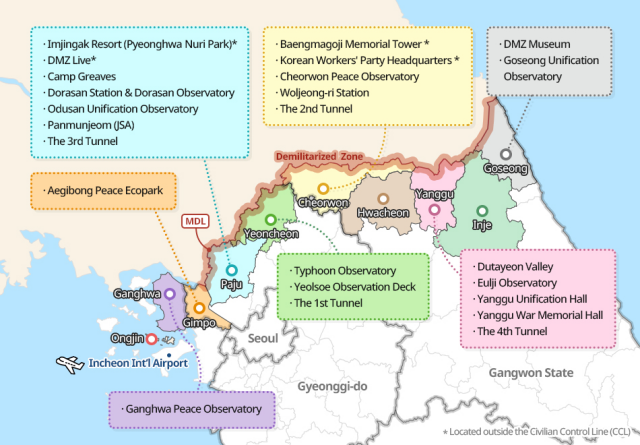
The most significant change occurred in the Joint Security Area (JSA) within the DMZ, the congested collection of sky-blue structures in Panmunjom where Trump and Kim had a brief encounter on the border in 2019. During the APEC timeframe, from late October to early November, Seoul’s Unification Ministry has canceled field excursions to Panmunjom. For the same time frame, the United Nations Command, which is in charge of the southern portion of the JSA, has put a halt to its own visitation program. This is considered standard security cooperation. If choreography at the border is needed quickly, it unofficially clears the schedule. The stage has been swept whether or not a handshake occurs.
THE SHATTERED DÉTENTE AND ITS RELEVANCE TODAY
The significance of these changes may be understood by keeping in mind that the 2018 inter-Korean military agreement, which was the finest attempt in years to reduce hazards along the border, has long ago fallen apart. Following a bleak 2024, South Korea terminated portions of the agreement and resumed the activities that the treaty had restricted. Pyongyang subsequently said that it was no longer obligated by the agreement and promised to resume the military actions that had been paused. A re-militarized border was the end outcome. Seoul has hinted at the possibility of reestablishing the deal in some capacity in 2025, but the North has not provided the reciprocal measures that would be necessary. This creates a void that can only be partially filled by tactical solutions like restricting leaflets or suppressing speakers.
HUMANITARIAN THREADS: FAMILY REUNIONS AND POLITICAL SIGNALING
President Lee Jae Myung has highlighted a humanitarian road amid the missile theater and high security. He openly asked Pyongyang to think about resuming reunions for families who have been separated since the 1950–53 conflict at the beginning of October. This is one of the few morally significant problems that does not directly relate to nuclear negotiating. When they do happen, these reunions are short, painfully formal, and quite popular in the South. Most importantly, they provide North Korea with a gesture that it can accept without compromising its deterrence. Seoul’s message is clear: this is low-hanging fruit if Pyongyang seeks a minor victory that enhances the mood at the summit and softens South Korean public sentiment.
UNDER THE RADAR
When you combine these elements, a pattern becomes apparent. The speaker switch-off, the balloon crackdown, and the tour freeze at the JSA are all minor script changes. During leaders’ week, each lessens the likelihood of an incident that would cause everyone to cancel the picture opportunities or, worse, set off an escalating cycle. If the principals desire it, Seoul is essentially opening the way for political drama to take place. Although Washington officials have floated the possibility of a Trump-Kim meeting, reliable reports indicate that no official agreements are in place, and previous attempts at outreach were met with a lack of interest. The network of signals supports a realistic assessment: a DMZ ‘HELLO’ is still feasible under extreme circumstances, but it is unlikely. The more likely scenario is that Pyongyang pushes provocations to the limit without overthrowing the set, South Korea demonstrates competence and hospitality, and Trump meets Xi.
Map of the DMZ between North and South Korea, image via Visit Korea
BEIJING’S SHADOW AND THE RUSSIA VARIABLE
China’s involvement is crucial as the North Korea’s political backer and economic lifeline, not as a mediator who can bring about disarmament. Kim and Xi have officially promised “deeper ties” in recent weeks, and their foreign ministries met to denounce “hegemonism,” a diplomatic jargon that often refers to Washington. Mainstream think tank analysts point out that stability and leverage, not mediation for its own sake, are China’s top priorities. In that regard, Xi’s presence in Korea focuses attention, Beijing has the option to lower the temperature if it so chooses, or it may let the pressure cook, say, in order to maintain influence over Seoul and Washington. Since there is no indication that Beijing will request that Pyongyang divorce its increasing military ties with Moscow, the default assumption from serious analysis is that China will exert mild pressure on Kim at most.
The largest structural shift since Trump’s initial DMZ tour is this closeness to Russia. This isn’t conjecture. According to many intelligence-supported reports and assessments of war debris, Russia had deployed North Korean short-range ballistic missiles in Ukraine by early 2025, and Pyongyang’s assistance had grown from shells to rockets to personnel. Open-source catalogs have identified the components, friendly nations have sanctioned facilitators, and Kyiv and Washington have made proof public. While Seoul’s defense minister recently issued a warning about probable Russian technological inputs into North Korea’s submarine programs, South Korean briefings and Reuters’ in-depth research indicate a growing pipeline of military collaboration. In summary, Kim is less motivated to make hasty concessions from the United States or South Korea, especially on his nuclear deterrence, because he has more outside backing and a wider range of allies than he had during the 2018–2019 talks.
MARKETS ARE READING THE TEA LEAVES
The rumor cycle has already been noted by Korean equities markets, which have a tendency to lead geopolitical narratives. In response to speculation about potential Trump-Kim optics, the “inter-Korean” basket, consumer, construction, transport, and logistics names that often pop on peace signals, has witnessed rash, rumor driven actions. This is a sentiment barometer, not a prediction machine. In effect, traders are pricing in a higher likelihood of headline level de-escalation, which may lower volatility but would not change fundamentals, and a smaller likelihood of a DMZ cameo.
HOW TO READ THE SIGNALING
The best approach to interpret the upcoming two weeks is to view restraint and pressure as complimentary strategies. The goal of North Korea’s testing is to strengthen its negotiating position and maintain the nuclear status quo. Silencing speakers, restricting pamphlets, and halting JSA visits are all examples of South Korea’s calm restraint, which lowers friction and maintains a path for optics that may, if only momentarily, temper the mood. China, on the other hand, is in an ideal position, close enough to Pyongyang to influence the atmosphere, but far enough away to avoid responsibility for the outcome. Furthermore, Kim may play for time, extract military and economic value, and wait for better conditions before considering anything that appears to be a restraint thanks to Russia’s growing support for North Korea.
THE BOTTOM LINE: CALIBERATED THEATER
The most likely scenario for APEC’s opening is a well-balanced theater that avoids a crisis and highlights South Korea’s capacity as both the host and a middle power. There will be strict upfront security. The main concerns of supply chains, tariffs, and chips will probably remain parked at “frameworks” and “working groups” when Trump and Xi meet and exchange jabs shrouded in diplomatic jargon. Pyongyang will keep showcasing its capabilities without resorting to a red-line reaction. Every rumor of a border cameo will cause the markets to fluctuate. Seoul will also record little victories, such as a clean summit, a few technical deliverables, and, with luck, a humanitarian foundation that it can grow into something more.
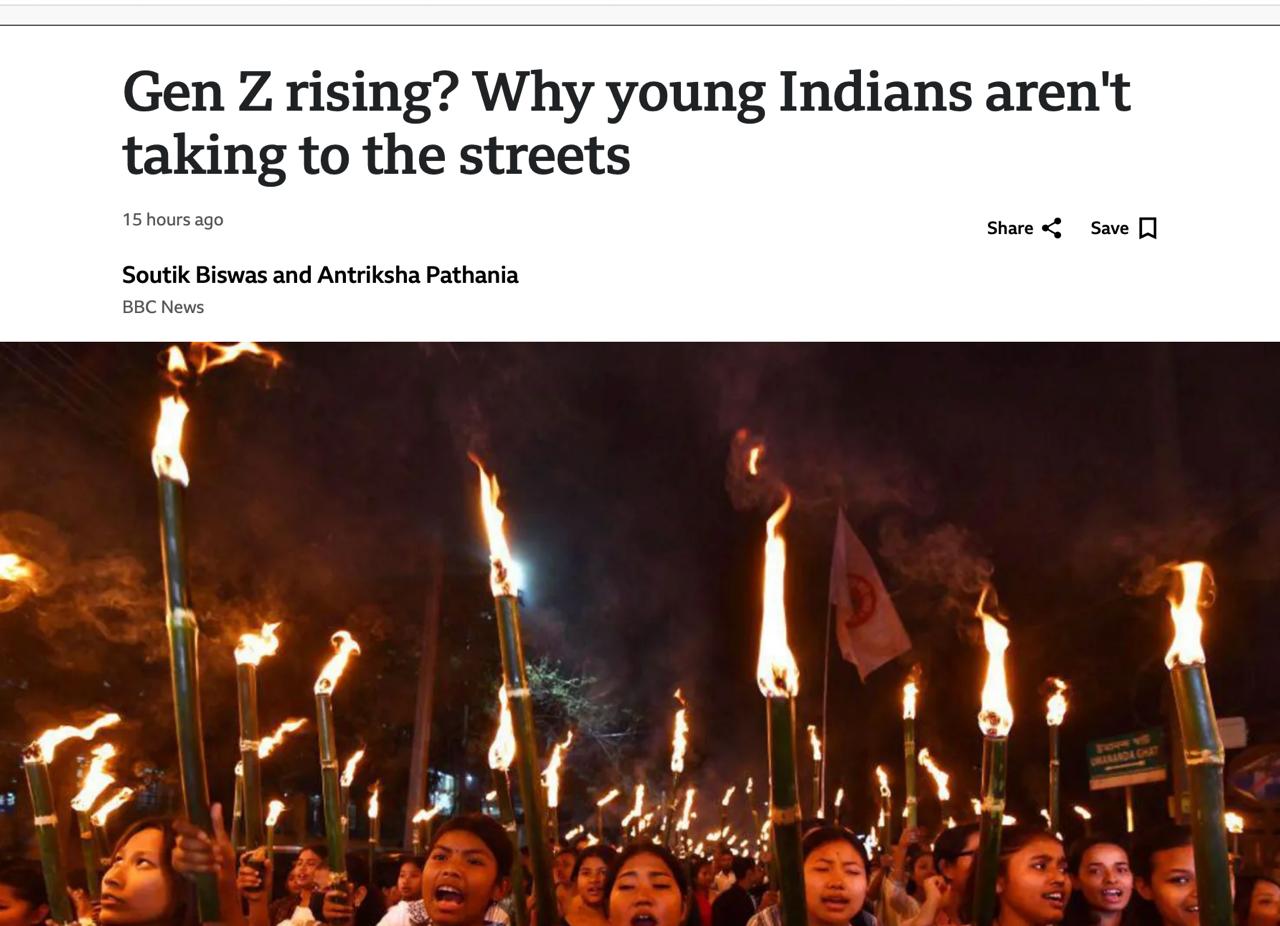
Every few months, BBC India publishes a piece that blurs the line between journalism and psychological warfare. Recently, it published an essay titled “Gen Z rising? Why young Indians aren’t taking to the streets”, the latest addition to this tradition of subtle sabotage.
At first glance, the article poses a harmless sociological question: why is India’s Gen Z, despite being vast, restless, and hyper-connected, not staging revolutions like their peers in Nepal or Bangladesh? Scratch the surface, and the essay reads less like an analysis and more like an incitement, an open call for Indian youth to “rise up” in rebel and imitate the chaos unfolding across the border.
For a platform that insists on its neutrality, the BBC’s romanticisation of violent uprisings is striking. Its tone suggests disappointment, not relief, that Indian students haven’t yet taken to arson, vandalism, and regime change. And this isn’t merely a colonial hangover yearning to see a former subject in disarray for moral sermonising from afar, it’s something far more deliberate, ideological, and deeply political.
A masterclass in subtle agitation
The structure of the BBC’s essay is textbook propaganda. It begins by admiring Asia’s “restless” Gen Z, those brave young souls who “brought down governments in 48 hours” as if the collapse of institutions were a badge of progress.
Then comes the inevitable comparison: India’s youth are “fragmented”, “afraid”, and “detached”. The implication is clear: they are failing their generational duty by not rioting.
The framing is psychological, not analytical. Words like “fear of being branded anti-national” and “government demonising protest” are planted to stir guilt, not introspection. This is not journalism seeking to understand why Indian youth are calm. It is agitation disguised as analysis, a suggestion that calmness equals cowardice and restraint equals repression.
The Nepal Template: BBC’s new obsession
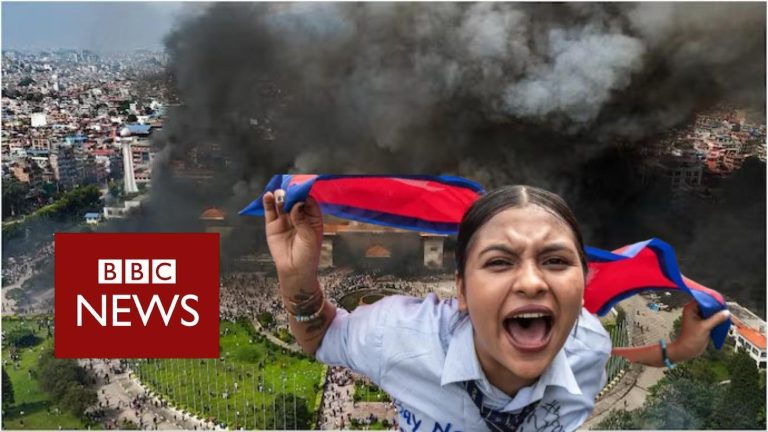
The piece finds its inspiration in neighbouring Nepal, where a supposed “Gen Z revolution” toppled the KP Oli government in September 2025. BBC describes it with almost cinematic flair as if watching a historic moment of youthful heroism.
But behind the glamour lies a gruesome truth. The Nepal uprising left nearly 20 dead, homes of former prime ministers burnt, ministers assaulted, and heritage sites like the Singha Durbar complex vandalised. The army had to impose curfew, and the country now teeters on military rule.
BBC, however, cherry-picks this chaos as a success story, a “template” India’s youth should supposedly emulate. What the article doesn’t tell you is that even Nepali protestors themselves distanced themselves from the violence, insisting that infiltrators had hijacked their movement.
But why would the BBC mention that? Because the purpose is not to inform. The purpose is to seed an idea that India’s “restless” Gen Z should follow the “heroic” footsteps of Nepal’s rioters.
Selective amnesia: When protests turn bloody
Notice how the BBC recalls India’s past street movements from the Anna Hazare agitation to the CAA protests with nostalgia, as though they were the golden age of dissent. Yet, when it comes to the blood, destruction, and communal fractures those protests left behind, the BBC goes conveniently silent.
In the CAA protests, mobs burnt public property, blocked roads, and in Delhi, communal violence erupted, leaving over 50 people dead. The “student leaders” the BBC now romanticises were not Gandhian satyagrahis but radical organisers accused of fomenting riots.
By portraying such movements as “noble” while lamenting today’s absence of similar uprisings, the BBC is essentially mourning the loss of chaos. It misses the era when India could be portrayed as “unstable” and “oppressive”, headlines that sell better in London newsrooms than “India growing at 8%.”
The ‘anti-national’ smokescreen
A key rhetorical device in the article is the term “anti-national.” According to the BBC’s framing, the fear of being labelled anti-national has paralysed young Indians from taking to the streets. It’s a clever trick, equating national pride with authoritarianism and dissent with heroism.
But the reality is that Indians have simply matured. They’ve seen how “activism” can be weaponised by vested interests. From Shaheen Bagh’s organised blockades to foreign-funded NGOs masquerading as student movements, Gen Z is not silent because it is scared; it is silent because it has grown wiser.
They’ve realised that burning buses doesn’t create jobs, pelting stones doesn’t fix corruption, and toppling governments doesn’t guarantee a better tomorrow. India’s Gen Z is building startups, writing code, making films, and exploring the world, not wasting its energy on political theatre staged by external puppeteers.
The Ghost of 2019: BBC’s nostalgia for street anarchy
When the BBC invokes Umar Khalid’s incarceration and Jamia clashes, it’s not as an academic reference; it’s an emotional trigger. It wants to rekindle the memory of “brutal state suppression” and reframe 2019 as unfinished business.
The subtext is unmistakable: “You saw what happened to your seniors. Don’t you want to fight back?” This is not journalism, it’s emotional manipulation.
The BBC pretends to mourn the “loss of university protest culture” but what it’s really mourning is the Modi government’s success in restoring campus discipline and stopping educational institutions from being hijacked by political outfits.
India’s campuses have evolved from battlegrounds of ideological indoctrination to hubs of innovation. That transformation, of course, is intolerable to the BBC, which prefers its Indian youth angry, aimless, and anti-establishment.
Fragmented or free? BBC’s doublethink
Throughout the article, the BBC presents India’s diversity as a weakness, stating that the country’s youth cannot unite because they’re divided by caste, language, and region. But the same diversity is celebrated as “vibrant multiculturalism” when convenient.
In Nepal or Bangladesh, homogeneity makes mass mobilisation easy. But in India, decentralisation is the soul of democracy. The BBC calls this “fragmentation.” Indians call it federalism.
BBC’s yearning for a “unified national youth uprising” betrays its colonial mindset, an obsession with singularity, uniformity, and chaos that can be broadcast as crisis.
The West’s problem: India’s stability
The BBC’s disappointment is not with India’s youth, it’s with India’s stability. Nepal, Bangladesh, and Sri Lanka are useful examples for Western media precisely because they remain unstable enough to be studied as “exotic democracies.” But India, with its 370 million Gen Z citizens and yet an unbroken constitutional order, spoils that narrative.
Every election, including 2024, proves that young Indians are not disillusioned but discerning. The BJP continues to command strong youth support, not through coercion, but through performance, infrastructure, welfare, nationalism, and digital empowermentThis is why BBC’s claim that youth “avoid politics” rings hollow.
Young Indians have simply migrated from street activism to digital and electoral activism where their voice matters more and their protest doesn’t get hijacked by professional anarchists.
BBC’s hidden despair: The Modi factor
At the heart of the BBC’s lament is not sociology but politics. The Western establishment, led by outlets like BBC, The Guardian, and The New York Times, has never forgiven Narendra Modi for two things: First, for unapologetically asserting India’s Hindu civilisational identity; and second, for doing so democratically, through the ballot, not the bullet.
When Modi consecrated the Ram Mandir at Ayodhya, it wasn’t merely a religious ceremony; it was a civilisational correction. It signalled to the world that India will no longer apologise for its faith, nor define secularism as the absence of Hindu identity. For the BBC’s worldview, this was blasphemy.
It thrives on binaries: majority equals oppressor, nationalism equals fascism, stability equals authoritarianism. So when India’s youth reject these binaries and choose progress over protest, the BBC’s ideological ecosystem panics.
The Western media’s revolt fetish
There’s something disturbingly voyeuristic about how Western outlets cover uprisings in the Global South. They cheer revolutions from afar, then disappear when the rubble sets in.
From the Arab Spring to the Sri Lankan protests, Western media lionised “youth-led revolts” only to move on when those countries slid into instability, hyperinflation, or civil conflict. Now they’re looking for a new playground, and India, with its vast youth population, is the ultimate prize.
That’s why the BBC’s essay reads less like journalism and more like a recruitment poster: “Look at your neighbours. Don’t you want to be like them?”
But Indians are no longer gullible. They’ve seen how these “leaderless” movements end, not in democracy, but in disarray.
The real Gen Z revolution: Silent, digital, and decisive
India’s Gen Z doesn’t need to storm the streets to make history. Their revolution is quieter but deeper in startups, civic tech, digital governance, and a renewed pride in identity. They’re coding the next Aadhaar, not chanting slogans on the streets of Delhi. They’re earning in dollars from Tier-3 towns, not burning tyres on highways.
This is the new face of Indian dissent, constructive, not destructive. And that’s precisely what unnerves the BBC, a generation that cannot be radicalised, only inspired.
Why the BBC wants India to bleed
When the BBC writes that India’s Gen Z is “watchful but not rebellious,” it’s not a compliment. It’s a lament. What it truly wants is footage of broken glass, tear gas, and tricolour-tinted turmoil that can once again depict India as a land of unrest.
Because for the BBC, a peaceful, confident, and self-assured India under Modi is the ultimate nightmare. It cannot process a Hindu-majority democracy that thrives without apologising for its faith, that dismantles the street veto, and that refuses to bow to Western moral lecturing.
The same BBC that glorified arson in Kathmandu would call it “democratic expression” in Delhi, until, of course, the fires spread too close to its own embassies.
Rahul Gandhi and the BBC Connection
Interestingly, BBC’s provocation hasn’t echoed in isolation. Within days of the Nepal uprising that toppled KP Oli’s government, Rahul Gandhi suddenly discovered his newfound love for India’s Gen Z, timing that can only be described as politically convenient.
On X, Gandhi proclaimed that ‘Gen Z will save the Constitution and stop voter fraud,’ followed by his party’s bizarre attempt at a “Gen Z anthem”, a rap song romanticising rage and rebellion, branding it as the “voice of young India.”
It’s not difficult to see the perfect symmetry between BBC’s lament and Congress’s latest gimmick. The British broadcaster frames Indian youth as subdued victims of fear; Rahul Gandhi steps in to “awaken” them with slogans, songs, and curated outrage. One lays the intellectual groundwork, the other provides the political script.
This synchronisation isn’t accidental; it’s ecosystemic. Both share the same premise: that India’s youth must rebel, not reform; destroy, not debate. The BBC writes the narrative; the Congress amplifies it, hoping a spark on social media will ignite on the streets.
India’s calm is its reassurance in its current leadership
But so far, the Indian youth has reposed its faith in democracy and its current leadership. But it is not just trust, it is so much more than that.
The genius of India’s democracy is not in its noise, but in its restraint. For a billion people to coexist, argue, and vote without burning down their capital is not a weakness. It’s civilisation.
The BBC may crave another Shaheen Bagh, but India has moved on. The Modi government has redefined the idea of participation from street revolts to digital empowerment, from protests to policy engagement. And India’s youth, far from being “suppressed,” are simply too busy building the nation BBC loves to doubt.
So, no, Gen Z is not “failing” its destiny. It’s fulfilling it in silence. And that silence, for the BBC, is deafening.