Home Blog Page 383

Minnesota: Two men face prison sentence for human smuggling after an Indian couple and their 2 children die on the US-Canada border

Two men are set to face prison sentence in Minnesota on 28th May on charges of human smuggling for their roles in what prosecutors described as an international conspiracy, reported Associated Press. The development transpired more than three years after a family of four from India froze to death while attempting to enter the United States along a remote portion of the Canadian border in a blizzard.

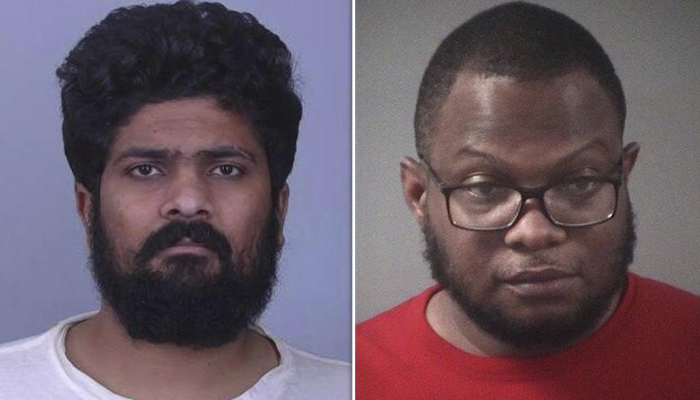
Harshkumar Ramanlal Patel, the ringleader has been recommended by federal prosecutors to serve roughly 20 years in prison while Steve Anthony Shand, the driver who was supposed to pick up the family to spend nearly 11 years behind bars. US District Judge John Tunheim, who wrote last month that “this was not a close case,” rejected to overturn the guilty verdicts and will now decide the prison terms.

The two men were prosecuted and found guilty on four charges each last November in the city of Fergus Falls in northwest Minnesota, where Tunheim would deliver the penalties at the federal courthouse.

During the trial, prosecutors stated that Shand, a Florida-based US citizen and Patel, an Indian national who they asserted went by the alias “Dirty Harry,” were involved in a complex illegal arrangement that transported dozens of individuals from India to Canada on student visas before smuggling them across the US border.

McBride remarked, “Mr. Patel has never shown an ounce of remorse. Even today, he continues to deny he is the ‘Dirty Harry’ that worked with Mr. Shand on this smuggling venture – despite substantial evidence to the contrary and counsel for his co-defendant identifying him as such at trial.”

“Even as this family wandered through the blizzard at 1:00 am, searching for Mr. Shand’s van, he was focused on one thing, which he texted Mr. Patel: ‘We not losing any money.’ Worse, when Customs and Border Patrol arrested Mr. Shand sitting in a mostly unoccupied 15-passenger van, he denied others were out in the snow, leaving them to freeze without aid,” McBride added.

For his crimes, prosecutors sought a sentence of 19 years and 7 months for Patel, which is at the highest end of the range suggested by federal sentencing guidelines. They requested a prison term of 10 years and 10 months for Shand, which falls within the range of his individual guidelines.

Patel’s lawyers failed to submit a recommended sentence by 27th May, claiming that there was not enough evidence. For his intended appeal, however, they did ask for a government-funded lawyer. Patel has been incarcerated since his February 2024 arrest at Chicago’s O’Hare International Airport where he declared in the application that he did not have assets and income.

While Shand awaits punishment, he has been at large. His attorney argued that the government’s proposed sentence was “unduly punitive” and only asked for 27 months. Shand has “a level of culpability,” according to his lawyer, federal counsel Aaron Morrison but he maintained that his role was limited and that he was only a taxi driver who needed money to feed his wife and six kids.

Background of the case

The prosecutors mentioned that the victims, 39-year-old Jagdish Patel, his wife, Vaishaliben in her mid-30s, their 3-year-old son Dharmik and 11-year-old daughter Vihangi, froze to death. The family was from the village of Dingucha in Gujarat. According to local news accounts, the couple worked as teachers in school. On 19th January 2022, the Royal Canadian Mounted Police discovered their bodies just north of the Manitoba-Minnesola boundary.

According to prosecutor Michael McBride, the father passed away while attempting to use a frozen glove to protect his son’s face from a “blistering wind.” According to him, their mother “died slumped against a chain-link fence she must have thought salvation lay behind.” Vihangi was dressed in “ill-fitting boots and gloves.” The wind chill that morning was -36 degrees Fahrenheit (-38 degrees Celsius), according to a local weather station.

Only two of their group reached Shand’s vehicle which was stranded in the snow on the Minnesota side while the other seven people made it through the foot crossing. One survivor had to be airlifted to a hospital due to severe cold and frostbite. Another survivor disclosed that prior to coming to Canada, he had never seen snow. The person informed the jury that the smugglers were the ones who handed them the substandard winter attire.

Indian Coast Guard races to prevent oil spill near Kerala: A breakdown of what happened and efforts undertaken to ward off grave ecological threat

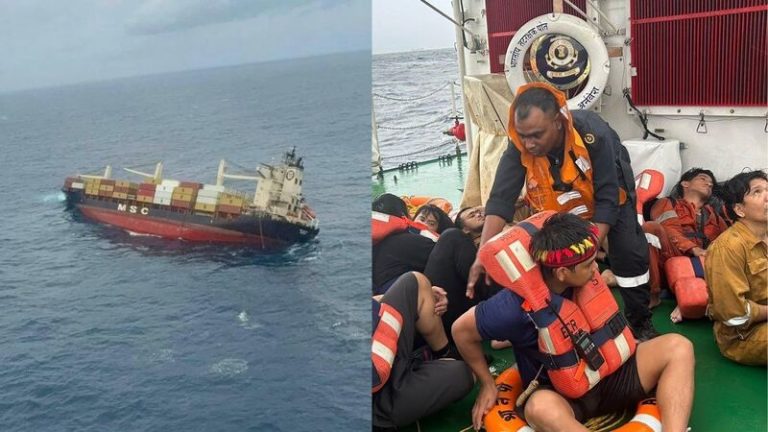
The Indian Coast Guard (ICG) has ramped up its efforts to deal with a potential ecological threat that may arise due to the sinking of a cargo ship off the Kerala coast in the India Ocean. A Liberian cargo ship, MSC ELSA 3, bound for Kochi capsized near Alappuzha off Kerala coast in the early hours of Sunday (25th May) causing the concerns of oil spill reaching the shores of Kerala and Tamil Nadu.

The cargo ship was carrying 640 containers out of which 12 containers had calcium carbide and 13 containers had other hazardous substances. In addition to that, the ship was carrying 84.44 metric tonnes of diesel and 367.1 metric tonnes of furnace oil. In a swift and timely response, the ICG rescued all the 24 crew members onboard within hours of the sinking of the cargo ship with the help of INS Sujata. The ICG activated its comprehensive pollution response in coordination with the state administration to deal with the all possible outcomes of the incident.

ICG’s swift response to protect the fragile marine ecology

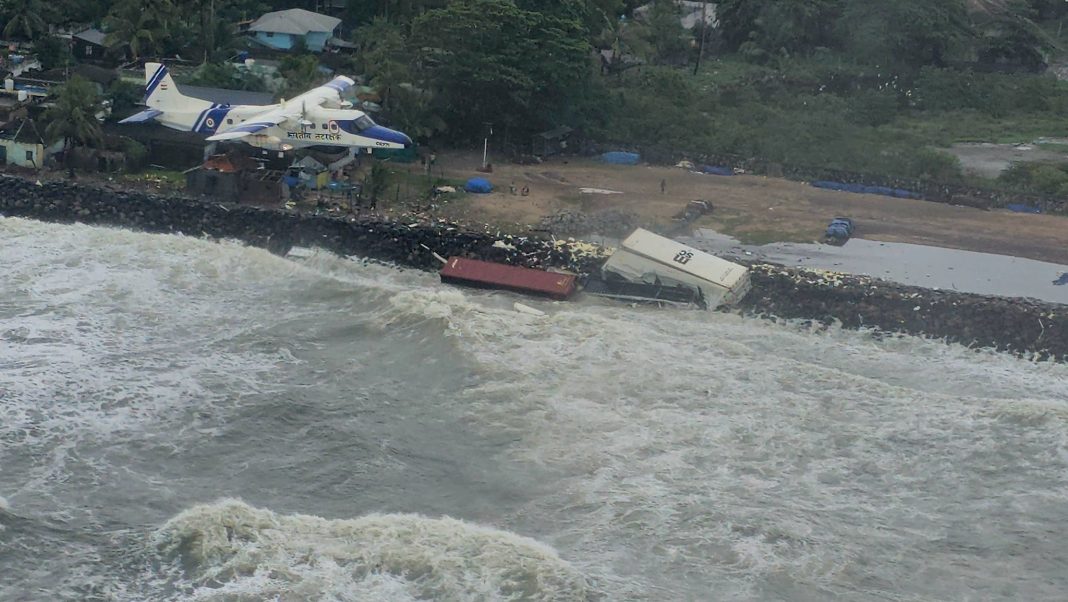
Even though no oil spill is reported to have reached the Indian coast so far, the ICG has deployed its three offshore patrol vessels, namely Vikram, Saksham and Samarth and a Dornier aircraft as part of its pollution response to deal with any possible environmental situation. “Efforts are currently underway to respond to the oil spill with the assistance of multiple ICG assets. The situation regarding the oil spill is currently managed and under close observation by the Indian Coast Guard. As of 1330 hr today, no oil has made its way to the shores of Kerala state, ” Defence PRO Kochi posted on X on Wednesday (28th May).

The ICG vessels are monitoring the Indian coastal waters to detect an oil spill using infrafred cameras. To contain the spread of the oil spill which is reported to be moving at a speed of 3 km per hour, the vessels are using oil dispersant. The Dornier aircraft, equipped with advanced oil spill mapping technology, is undertaking the aerial assessment of the oil spill. Additionally, a special pollution control vessel, Samudra Prahari, is en route from Mumbai to further strengthen the pollution control response.

Image via X/ICG

More than 30 containers from the sunken cargo ship washed ashore on Monday (26th May). None of the containers carried any hazardous substances but more vessels detached from the sunken cargo ship, some of which my contain harmful substances, are expected to reach the shores in coming days. For this, the locals have been warned by the authorities to avoid any contact with these containers.


Image via X/ICG

“These containers did not contain anything harmful. More containers may wash ashore in the coming days. We have warned the people not to go near the containers. Customs, as well as the representatives of the shipping firm, will be handling the containers,” said Sekhar Kuriakose, member secretary of Kerala State Disaster Management Authority (KSDMA).


Image via X/ICG

The Kerala government has directed the Factories and Boilers Department and the State Pollution Control Board each to keep on standby two Rapid Response Teams (RRTs) for southern, central and northern districts of Kerala to deal with an oil spill situation.

Tamil Nadu takes preventive measures

While Tamil Nadu’s coastline is not facing an immediate threat, the state government is taking preventive measures to ward off any potential danger. The state has activated its newly formulated contingency plan to deal with the possible oil spill situation. The Tamil Nadu State Oil Spill Disaster Contingency Plan formalised in August last year has representatives from the State Disaster Management Authority, Tamil Nadu Pollution Control Board, Fisheries Department, and Indian Coast Guard in its multidisciplinary committee.

Harmful effects of oil spill on marine ecology

Oil spills prove to be extremely harmful and sometimes lethal for marine life including plants and animals. Oil containing toxic compounds can contaminate crucial marine habitats like coral reefs, mangroves and salt marshes and thus adversely affect the marine ecosystem. Oil spills can have long-term harmful effects, including changes in biodiversity and disturbed food chains. Locals economies linked with marine ecosystem also suffer as a result.

UP: Afzal Hussain lure a Hindu girl under false pretenses, sexually exploits her and threatens her with ‘Sar Tan Se Juda’ fate for refusing to convert to Islam

In the Mirganj area of Uttar Pradesh’s Bareilly district, a Muslim youth named Afzal Hussain trapped a Hindu girl in his love trap by hiding his identity. He introduced himself as ‘Guddu’ and tied a sacred thread (Kalaava) in his hand. The accused visited Hindu temples and pretended to worship so that the girl would trust him.

After entrapping the victim in his lies, the accused sexually exploited the girl for several days. Later, when the girl came to know that he was a Muslim, she tried to distance herself. Following this, the accused Afzal Hussain, started pressuring the girl to convert to Islam and marry him.  

Reports say that Afzal was earlier arrested in this case. His parents apologised to the girl and got him released from jail, but as soon as he came out, Afzal again started threatening the girl to convert to Islam or he would do her ‘Sar tan se juda’ (beheading).

After this, the girl has again filed a case against Afzal, alleging ‘love jihad’ in the Mirganj police station. At present, the accused Afzal Hussain is absconding and the police is investigating the case further.

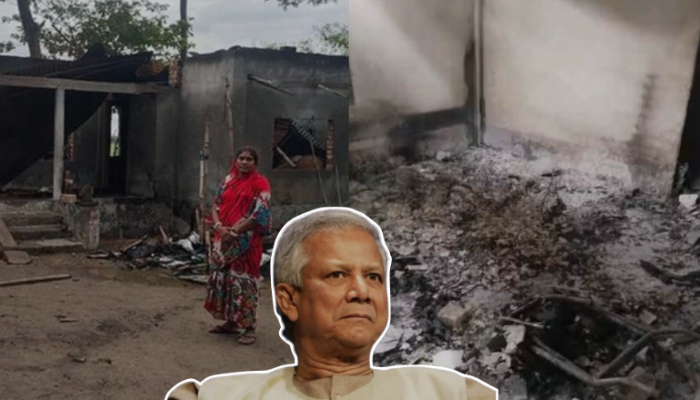
Md Yunus of Bangladesh confirms OpIndia report of Hindu houses burned by Islamists, but uses twisted logic of Leftist media to claim ‘it was not communal’: Read why his claims are false

Bangladesh has been engulfed in communal violence aimed at the minority community, particularly Hindus, since the removal of former Prime Minister Sheikh Hasina from office on 5th August last year. The ruling political forces of Bangladesh have been tacitly supporting the Muslim mobs while shamelessly denying the incidents and even blaming New Delhi and the Indian media of spreading propaganda.

On 22nd May, another violent act was perpetrated against the marginalized community when a Muslim crowd executed arson attacks on Hindu residences in Dahar Mashihati village, located in the Abhaynagar upazila of Jessore district in Bangladesh. Predictably, the regime of Muhammad Yunus jumped to downplay the communal nature of the crime.

Yunus defiantly denies charges of anti-Hindu violence

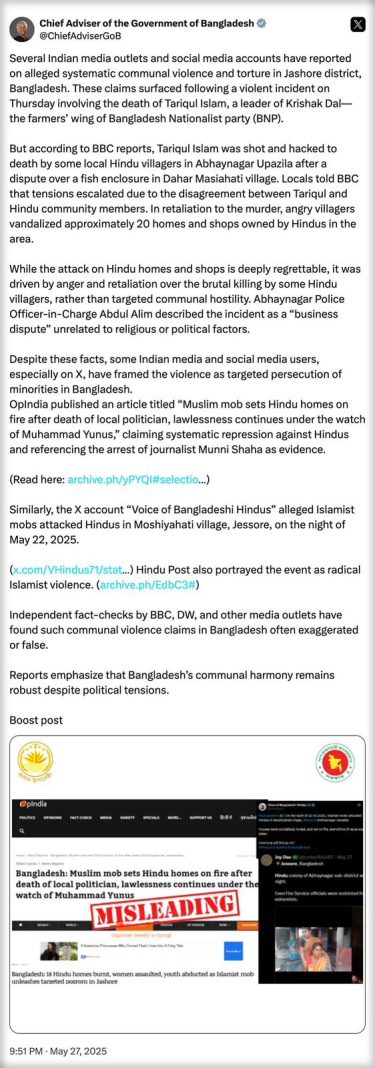
The official account of Yunus, Chief Adviser of the Government of Bangladesh stated multiple Indian media outlets and social media accounts have covered the alleged systematic torture and communal violence in Bangladesh’s Jashore area. It attributed the killing of Tariqul Islam, a leader of the farmers wing Krishak Dal, of the Bangladesh Nationalist party (BNP), to the anti-Hindu riots.

It added, “But according to BBC (British Broadcasting Corporation) reports, Tariqul Islam was shot and hacked to death by some local Hindu villagers in Abhaynagar Upazila after a dispute over a fish enclosure in Dahar Masiahati village. Locals told BBC that tensions escalated due to the disagreement between Tariqul and Hindu community members. In retaliation to the murder, angry villagers vandalized approximately 20 homes and shops owned by Hindus in the area.”

Notice the text here, so desperate is Yunus to blame Hindus that when he mentions the murder of local politician Tariqul Islam, he specifies ‘Hindu villagers’. But when the houses of an entire Hindu community in the village are burned down by Muslims, the perpetrators become ‘angry villagers’ retaliating.

Yunus quoted the notorious media outlet BBC, which has a history of trivialising anti-Hindu violence. Referring to the instance as “deeply regrettable,” he asserted that it was motivated by anger and revenge due to the violent murder committed by some Hindu villagers, rather than a result of deliberate communal animosity. “Abhaynagar Police Officer-in-Charge Abdul Alim described the incident as a ‘business dispute’ unrelated to religious or political factors,” he remarked.

Screengrab of the whole tweet

It is noteworthy that he acknowledged the specific targeting of Hindus by Muslims, however, he attempted to portray the communal violence as a “retaliation.” He charged, “Despite these facts, some Indian media and social media users, especially on X, have framed the violence as targeted persecution of minorities in Bangladesh.”

Yunus blames OpIndia, others for covering the brutal burning of Hindu houses, tries to claim it was ‘not communal violence’

Yunus subsequently criticized OpIndia for merely presenting the facts. “OpIndia published an article titled ‘Muslim mob sets Hindu homes on fire after death of local politician, lawlessness continues under the watch of Muhammad Yunus,’ claiming systematic repression against Hindus and referencing the arrest of journalist Munni Shaha as evidence,” he accused.

Interestingly, he did not refute the contents of the report, instead, he condemned it for highlighting the anti-Hindu attacks in Bangladesh, as it exposed the shortcomings of his government. He then called out to others who reported on the occurrence.

“Similarly, the X account ‘Voice of Bangladeshi Hindus’ alleged Islamist mobs attacked Hindus in Moshiyahati village, Jessore, on the night of 22nd May,” Yunus wrote and added, “Hindu Post also portrayed the event as radical Islamist violence.” He additionally shared archived links of the reports and tweet.

“Independent fact-checks by BBC, DW, and other media outlets have found such communal violence claims in Bangladesh often exaggerated or false. Reports emphasize that Bangladesh’s communal harmony remains robust despite political tensions,” Yunus stated and then ended the statement with a hilarious, “Boost post.”

What did OpIndia report

OpIndia reported on the incident that had already been carried by the Bangladeshi daily “Prothom Alo.” It clearly mentioned that the incident transpired shortly after the murder of Tariqul Islam, a 50-year-old leader of the Krishak Dal, which stemmed from a dispute over the ownership of a fish enclosure. Islam was both shot and hacked to death.

More than 20 Hindu homes in the village of Dahar Mashihati were then set on fire by a group of Muslim radicals. They burned 2 stores and vandalized 4 others. The targeted attacks resulted in over 10 injuries. A land piece whose lease had expired was the subject of an ongoing dispute between Tariqul Islam and a man named Piltu Biswas. They both wanted the plot. The leader of the Krishak Dal planned to construct an enclosure and farm fish. A Muslim mob ambushed Hindu homes in the village after his murder and burned their homes and businesses.

A journalist from Prothom Alo discovered that every Hindu home and its possessions had been reduced to ashes when he visited the village of Dahar Mashihati. Six vehicles, five bikes and one van, were destroyed in the arson attack, according to the journalist. He added that out of concern for their safety, every male in the houses had left the area as their women stayed behind. The Matua community comprised the majority of the victims.

One survivor informed Prothom Alo that their home was initially attacked by a group of four to five fanatics. Afterwards, more than 150 individuals joined the assailants. According to the victim, they set their homes on fire, stole everything and damaged the property. 25-year-old Sagar Biswas was also kidnapped by the Muslims but was later rescued. It took two hours of the carnage before the police, army officers and fire department personnel arrived.

OpIndia clearly cited the report published by Prothom Alo and simply conveyed what transpired during the incident. In addition, OpIndia also noted other similar events where Hindus have been targeted by Muslim radicals in the country in the past several months. Nevertheless, Yunus, rather than confronting the facts that he was aware were true, opted once more to minimize the regular attacks on Hindus by extremists under his government, as he attempted to shield them instead of addressing the sensitive issue.

Leftist media and its tendency to protect Islamists: How anti-Hindu violence is whitewashed in Bangladesh

Yunus intentionally mentioned Leftist media sources like BBC and DW, as he is cognizant of their inclination to protect Islamists and underplay their heinous acts, especially towards the Hindus. They have consistently been whitewashing similar incidents since the onset of bloodshed and violence against the dwindling Hindu community in Bangladesh.

The left uses a variety of strategies and instruments in their standard propaganda to gloss over the crimes of Islamists. The first is outward denial, which involves censoring and suppressing any information that contradicts their carefully constructed narrative in which Muslims must be the only victims. However, this hasn’t been effective as everyone now has the ability to create and share content owing to the internet, particularly social media.

The methods of dilution have become crucial since denial has proved difficult. Ironically, the “fact-check” tool has been the most crucial. As facts began to surface, “fact-checkers” came into existence. This requires the propagandists to locate or even plot a few claims or bits of information that can be deemed fictitious or untrue. This sows doubts in people’s minds, leading them to believe that the matter is a hoax. This is precisely what motivates certain types of “fact-checkers.”

Their another favored strategy for minimizing the gravity of such occurrences is to hide behind the ludicrous claim, “It was political, not religious,” even though all evidence suggests otherwise. When denial of atrocities and dilutions through fact-checks and verbose whitewashing do not seem to be effective, this narrative has been used in the case of the ongoing massacre of Hindus in Bangladesh.

Downplaying anti-Hindu violence

Mughal emperor Aurangzeb has been portrayed as a just ruler using this argument by ‘scholars’ such as Audrey Truschke who have authored theses to demonstrate that the destruction of temples under his rule was a political statement rather than an overt act of religious intolerance. Likewise, the Pakistan-sponsored jihad in Jammu and Kashmir is described as a political problem.

The genocide of Kashmiri Hindus is represented as a political issue instead of a stark manifestation of religious hatred. It is important to note that both Pakistan and the terrorists have declared that this is a religious war and they aim to establish Islamic rule in the valley, however, the Left-liberal media persists in spreading their falsehoods.

Similarly, Bangladesh, where Hindus have been subjected to continuous assaults and torture by Muslims, is no exception for media outlets like BBC, Scroll and others. They utilize the same strategies to protect their preferred demographic and refuse to accept the true root of the problem to serve their agenda. Their main focus is to create a misleading narrative rather than simply reporting facts.

The same has unfolded in the Dahar Mashihati hamlet of Bangladesh while Yunus is leveraging their media allies to negate the communal nature of the crime, a strategy he and his government have employed for numerous months as Hindus continue to endure suffering in his administration.

The sword of resignation on Yunus

On one hand, Yunus is occupied with downplaying anti-Hindu violence while on the other hand, there are reports of his potential resignation in the upcoming days. He is currently in a tight spot due to the mounting dissatisfaction with the interim government in all spheres of society. His sinister desire to remain the de facto leader of Bangladesh has come to light as a result of his inability to hold a “free and fair” election to date.

Yunus told the media through his sources that he is upset about “recent developments” and want to resign in a final effort to save his reputation. He is also playing the blame game, inciting public panic and even threatening resignation in a desperate attempt to hold onto his position. Yunus also tried to incite anti-Indian sentiment in the nation to divert attention from his incapacity and his failure to bring democracy and electoral reforms back to Bangladesh.

“The chief adviser stated that the country is in a major crisis due to Indian hegemony. He believes that the entire nation needs to remain united in response. He started the discussion by saying that we are in a deep crisis. By crisis, he meant the conspiracy of Indian hegemony,” Mahmudur Rahman Manna, one of his aides alleged.

Chhattisgarh: Badshah Khan raped Hindu woman, forced abortions and beef eating, religious coercion for over 10 years

Durg police in Chhattisgarh have arrested 28-year-old Badshah Khan following a complaint by a 26-year-old Hindu woman from Bhilai. The woman has accused him of raping her over a period of 10 years. In her complaint, she alleged that Khan coerced her to convert to Islam, forced her to eat cow meat, and subjected her to repeated physical assault and humiliation. He has been sent to judicial custody and further investigation is underway.

Assault began when she was a minor

According to the complaint filed at Bhilai Nagar police station, the woman met khan in January 2016 when she was just 17. She said that Khan called her to his house and raped her. He continued to sexually exploit the victim till February 2024 on the pretext of marriage.

During that period, the victim became pregnant three times. The first two pregnancies were forcibly terminated. When she refused to abord the child during third pregnancy, Khan allegedly made her sign a paper written in Urdu claiming they were husband and wife. The victim said that despite the so-called signatures done, no formal marriage or nikah took place.

Forced to convert and consume beef

The woman further said that Khan and his family began forcing her to convert to Islam. She was made to eat cow meat and was stopped from performing Hindu rituals and going to temples. She was also pressured to read the Kalma and offer namaz. Whenever she resisted, she was beaten up. She further added that Khan and his family regularly beat her, and sometimes it was so severe that she was confined to bed for several days. When her son turned five, his circumcision was done without her consent.

Exploitation under the pretext of stardom

The victim accused Khan of running a studio from where he lured girls with false promises of making them heroines. She also accused Khan of taking her photographs and posting them on social media with the caption “Enjoy Full Night. Book Now” along with her phone number, which resulted in obscene phone calls. She accused Khan of forcing her into physical relationships with other men as well.

Silence broken after betrayal

Despite years of abuse, the victim said she remained silent, believing the accused would marry her. However, she discovered that he was having an affair with another girl. When she confronted him, she was again assaulted. She then decided to report the matter and approached the police seeking justice. The victim has demanded the death penalty for Badshah, stating it would deter such crimes.

Immediate police action

Following her complaint, police immediately swung into action and registered an FIR against Badshah Khan under several sections of the Bharatiya Nyaya Sanhita and the POCSO Act, as the abuse began when she was a minor. Inspector Prashant Mishra confirmed the arrest and stated that the accused has been sent to judicial custody.

CSP Satya Prakash Tiwari confirmed that the survivor was sexually and physically exploited for a period ranging between eight to ten years. He assured that strict legal action is being pursued. Durg police spokesperson Padmashree Tanwar added that investigations are ongoing to verify additional allegations made by the complainant, including the exploitation of other girls under the guise of acting opportunities at the Chhattisgarh Studio.

Himachal govt faces outrage over HPPCL chief engineer’s death, CBI takes over case, top officers sent on leave: All you need to know

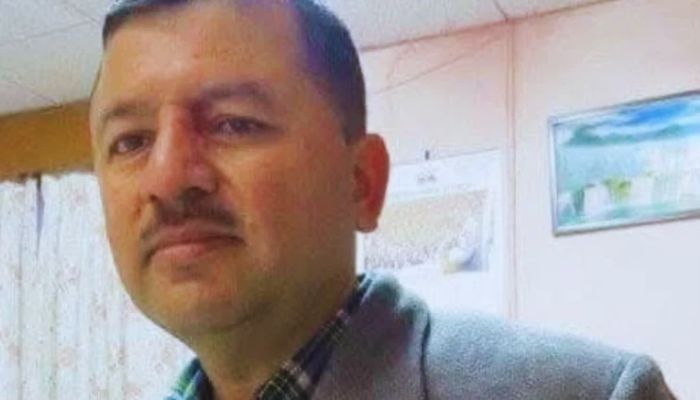
In the Congress-ruled Himachal Pradesh, the mysterious death of Vimal Negi, the General Manager and Chief Engineer at the Himachal Pradesh Power Corporation (HPPCL), has stirred a massive controversy.

Vimal Negi had gone missing on March 10, and his body was recovered ten days later. His family and colleagues had earlier raised concerns about pressure at the workplace.

The family of Vimal Negi had suspected foul play and had demanded a CBI inquiry, alleging that senior officials protected by the state government were involved in his demise. Vimal Negi’s wife, Kiran Negi, had recently written a letter to the Chief Minister of Himachal Pradesh demanding that the case be immediately handed over to the Central Bureau of Investigation (CBI).

The Himachal Pradesh High Court recently ordered a CBI probe into the mysterious death of HPPCL engineer Vimal Negi.

In her letter, Kiran Negi made a heartfelt appeal to the Chief Minister. “This matter should be handed over to the CBI at the earliest, and justice must be ensured in my husband’s death by following the directions of the High Court,” she wrote.

Notably, the CBI has taken over the investigation into the Vimal Negi death case and registered an FIR under relevant sections. The central probe agency filed an FIR against unknown people at the Special Crime Branch office in Delhi under sections 108 (abetment to suicide) and 3 (5) (involvement of many people in crime) of the Bharatiya Nyaya Sanhita. The FIR’s summary also mentions the name of Desh Raj, suspended director (electrical) of HPPCL and of the managing director.

Welcoming High Court’s decision to handover the Vimal Negi death case probe to th CBI, Himachal Pradesh Leader of Opposition (LoP) Jairam Thakur said, “Since the start, we had been demanding a CBI inquiry into this case. His family has also demanded one, even though the chief minister earlier said that his family had not demanded it. Now, the CBI inquiry is happening because his family went to the high court, and the court ordered in their favour.”

Vimal Negi, an engineer with the Himachal Pradesh Power Corporation Limited, had joined the corporation on 15th June 2024. Just two weeks later, on 1st July 2024, he was reportedly under stress and receiving medical treatment for anxiety.

The deceased engineer’s wife, Kiran Negi, has alleged that Vimal Negi’s seniors used harassed him over the last six months. Kiran Negi’s demand of a CBI investigation in the case was denied by the state government, however, now the matter has been handed over the CBI after High Court order.

Meanwhile, LoP and BJP leader Jairam Thakur demanded the resignation of Chief Minister Sukhvinder Singh Sukhu and the arrest of officials responsible for the death of Vimal Negi.

“The family wanted a CBI probe into it as the officials responsible for pressurising Vimal Negi had government protection. We had raised it in the Assembly as the session was in progress. Chief Minister Sukhu falsely claimed that the family was not demanding any such probe and instead accused us of politicising the issue. But we were suspecting massive corruption, and it is now being proven. They wanted to destroy the evidence,” Thakur said.

Shoddy investigation in Vimal Negi death case sparks outrage

Vimal Negi had gone missing on 10th March 2025, and his body was recovered ten days later. His family and colleagues had earlier raised concerns about pressure at the workplace. After days of protest and search efforts led by IG Gyaneshwar Thakur, his body was finally recovered leading to widespread outrage and demands for justice.

However, the Special Investigation Team (SIT), constituted by the state police, failed to provide any clarity about his whereabouts between 10th and 14th March, raising serious questions about the credibility of the investigation.

On 8th April 2025, the Additional Chief Secretary (Home), Omkar Chand Sharma, had submitted a 66-page fact-finding inquiry report to the state government. Sharma refused to review the report on the request of the Secretary, Power, to include the rebuttal of the three officers, who faced allegations.

The conflicting affidavits submitted by DGP Verma and the Shimla Superintendent of Police had also raised a question mark on a fair probe by the SIT.

Himachal government orders major bureaucratic reshuffle amidst mounting criticism

Resorting to face-saving measures, the Congress government in Himachal Pradesh, has sent three senior officials, Additional Chief Secretary (Home) Omkar Chand Sharma, Director General of Police (DGP) Atul Verma, and Superintendent of Police (Shimla) Sanjeev Kumar Gandhi on leave. The move, confirmed by Secretary to the Chief Minister Rakesh Kanwar, marks a sweeping disciplinary response and has triggered a bureaucratic reshuffle in the state.

“This is to confirm that ACS Home, DGP and SP Shimla have been directed to proceed on leave,” Rakesh Kanwar said on Tuesday evening, following a high-level meeting chaired by Chief Minister Sukhvinder Singh Sukhu. The meeting, which lasted over two-and-a-half hours, was attended by Chief Secretary Prabodh Saxena, Principal Secretary (Law) Sharad Kumar Lagwal, Advocate General Anup Kumar Rattan, Secretary (Personnel) M Sudha Devi apart from Rakesh Kanwar.

The action came amidst mounting criticism over the handling of the investigation into Vimal Negi’s suspicious death.

The action against officials have been taken following apparent indiscipline, allegations and counter allegations during the inquiry and investigations. Allegations of administrative negligence, procedural lapses, and internal conflict within the police hierarchy had drawn sharp public and legal scrutiny. SP Sanjeev Gandhi had accused DGP Atul Verma of interference, allegations he reiterated both in court and to the press.

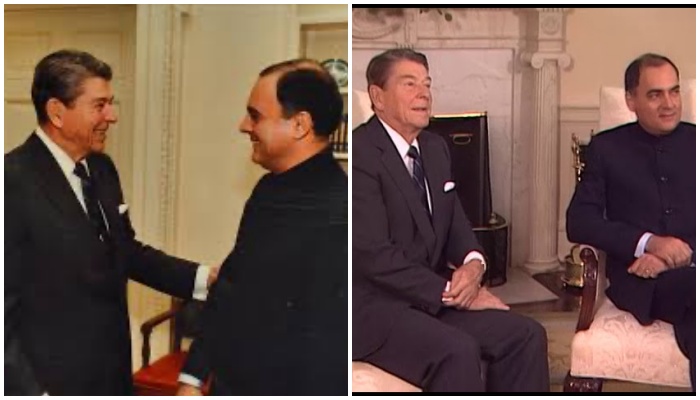
‘Rajiv Gandhi sought US interference, asked Ronald Reagan to help in talks with Pakistan’: BJP MP Nishikant Dubey reveals 1987 letter

Bharatiya Janata Party (BJP) MP Nishikant Dubey on Wednesday claimed that Former Prime Minister Rajiv Gandhi had written a letter to then United States (US) President Ronald Reagan to help in negotiating with Pakistan.

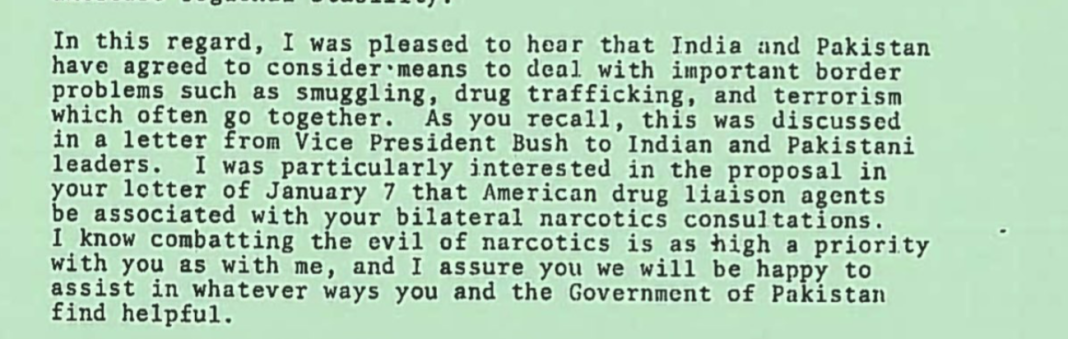
Sharing a purported letter written by a US president to the Indian Prime Minister on X, Dubey stated that it was decided under the 1972 Shimla Agreement that any dispute between India and Pakistan would be negotiated only between the two countries and there would be no mediator.

“It is not easy to be Gandhi. This letter is in reply to a letter written by US President Ronald Reagan to the then Indian Prime Minister Rajiv Gandhi. When it was decided under the 1972 Shimla Agreement that any dispute between India and Pakistan would be negotiated only between the two countries and there would be no mediator, why did the then Indian Prime Minister Rajiv Gandhi ask for US President Reagan’s help in negotiating with Pakistan?” he questioned on X.

This revelation adds a new layer to the ongoing political debate over third-party involvement in India-Pakistan relations, especially in the wake of recent escalations triggered by the Pahalgam terror attack and India’s retaliatory Operation Sindoor.

The letter, delivered to Rajiv Gandhi on March 25, 1987 by the US Ambassador to India, states that Gandhi sought US experts to be present in a bilateral discussion between India and Pakistan pertaining to cross border narcotics smuggling. Reagan had expressed that he would be glad to provide any support sought by the governments of India and Pakistan.

On Tuesday, BJP MP Nishikant Dubey shared a purportedly declassified 1971 US intelligence cable regarding former Prime Minister Indira Gandhi’s decision to accept a UN ceasefire proposal during the Bangladesh Liberation War, in response to the Opposition’s demand for clarification from the Union Government on the US’s involvement in the recent understanding on the cessation of hostilities between India and Pakistan.

He further interrogated whether India prioritised the creation of Bangladesh over reclaiming Pakistan-occupied Kashmir (PoK) and securing assets like the Kartarpur Gurdwara.

“Indira Gandhi, the Iron Lady. Under American pressure, India itself stopped the 1971 war despite opposition from the then Defence Minister Jagjivan Ram and Army Chief Sam Manekshaw. Babu Jagjivan Ram wanted that the war should be stopped only after our part of Kashmir, which Pakistan forcefully occupies, is back, but the fear of the Iron Lady and the terror of China could not do this. Was the priority for India to take back its land and the Kartarpur Gurdwara, or to create Bangladesh?” Dubey stated on X.

Earlier, Congress leader Jairam Ramesh took a dig at External Affairs Minister S Jaishankar, saying that he had been “silent” on US Secretary of State Marco Rubio’s remarks about “US mediation” and “neutral site” for India-Pakistan talks.

However, India refuted the claims made by the US President, reiterating its policy that India and Pakistan bilaterally address any matter related to the Union territory of Jammu and Kashmir.

(With inputs from ANI)

Did the Railway Minister lie? The truth about regenerative braking explained that Congress supporters failed to understand

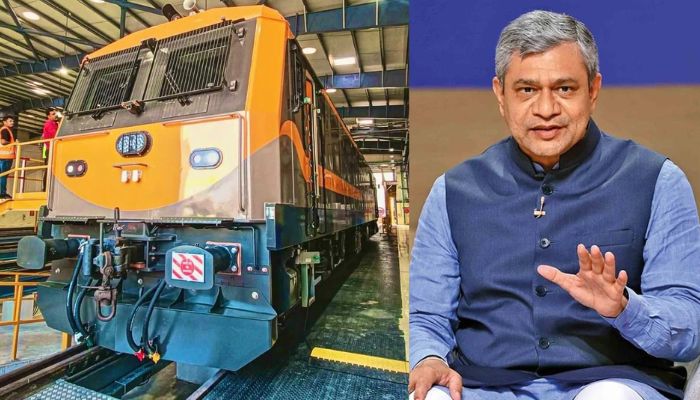
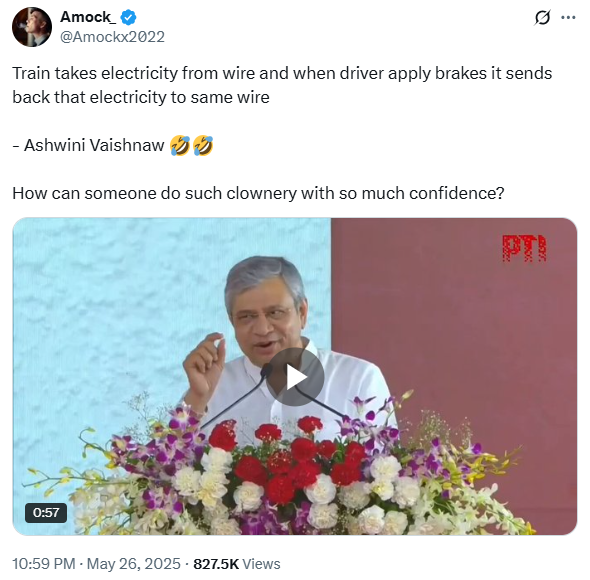
On 26th May, several Congress supporters mocked the Minister of Railways, Ashwini Vaishnaw, claiming he lied about electricity being generated via the braking system of the locomotive engine and transferred back to transmission lines. Vaishnaw, who was talking about regenerative braking in recently launched locomotive engines, was mocked by Congress supporters without understanding the technology.

In a post on X, Amock wrote, “Train takes electricity from wire and when driver apply brakes it sends back that electricity to same wire, Ashwini Vaishnaw. How can someone do such clownery with so much confidence?”

Source: X

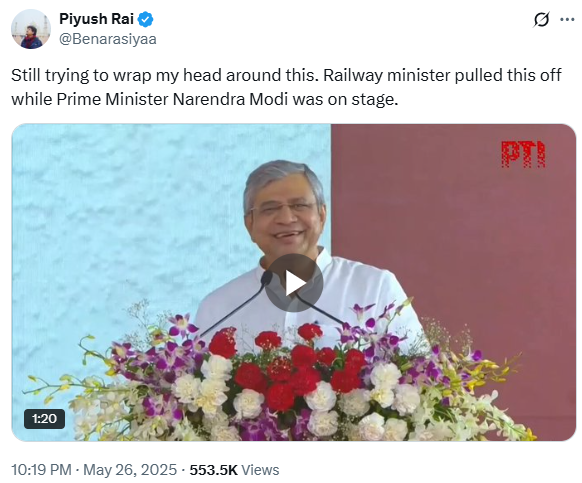
Journalist Piyush Rai, who was also unaware of the technology, by choice or by default, wrote, “Still trying to wrap my head around this. Railway minister pulled this off while Prime Minister Narendra Modi was on stage.”

Source: X

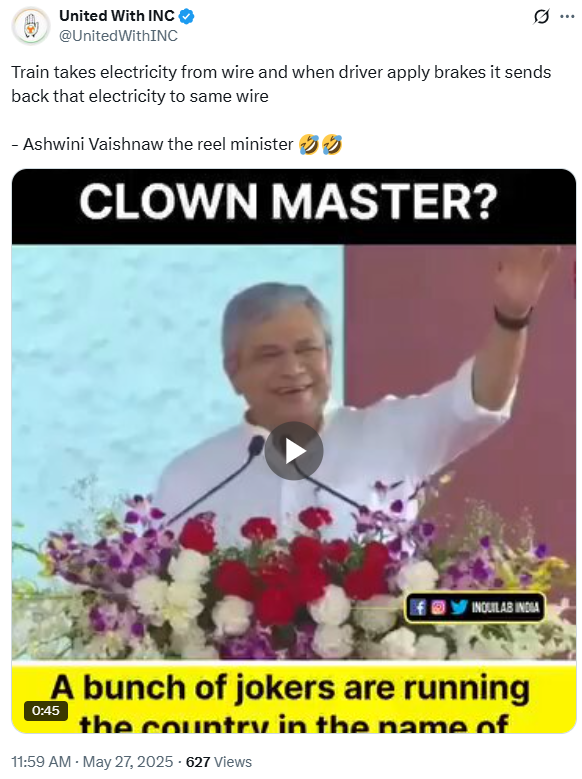
Another handle, “United with INC”, clearly a Congress supporter, wrote, “Train takes electricity from wire and when driver apply brakes it sends back that electricity to same wire – Ashwini Vaishnaw the reel minister.”

Source: X

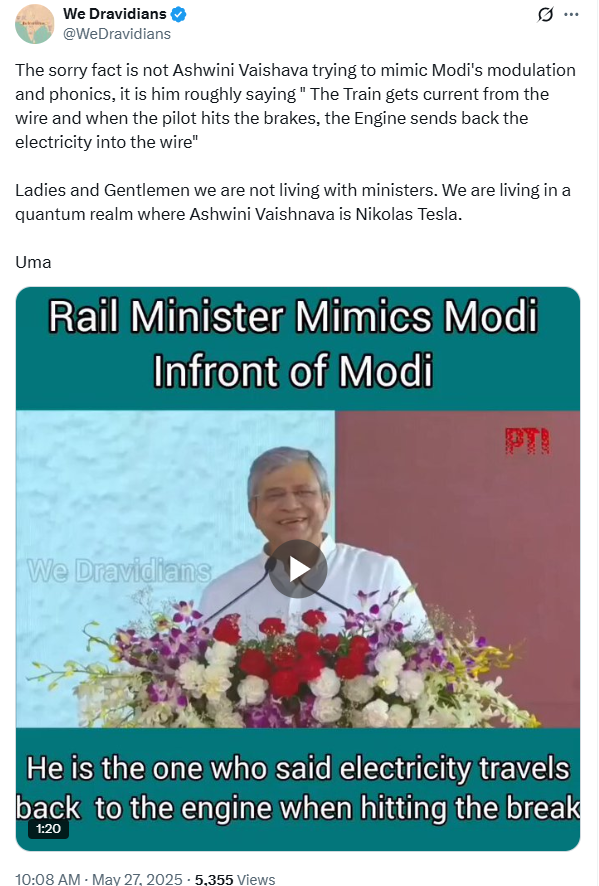
Controversial X handle We Dravidians wrote, “The sorry fact is not Ashwini Vaishava trying to mimic Modi’s modulation and phonics, it is him roughly saying ‘The Train gets current from the wire and when the pilot hits the brakes, the Engine sends back the electricity into the wire.’ Ladies and Gentlemen, we are not living with ministers. We are living in a quantum realm where Ashwini Vaishnava is Nikolas Tesla.” Not to forget, the We Dravidians handle is managed by the people who live in the great South India, where technology is apparently in the blood.

Source: X

What Ashwini Vaishnaw said

Speaking at the inauguration of the electric engine factory in Dahod, Railway Minister Ashwini Vaishnaw highlighted how the plant symbolises modern engineering and Prime Minister Narendra Modi’s vision. He explained that the new locomotives are more than just engines — they are “moving computer centres” with no noise, no vibration, and even have air-conditioned cabins and onboard toilets. He also remarked that these engines draw electricity from overhead wires while running and send power back to the same wires through regenerative braking when brakes are applied.

He said, “When the train runs, it draws electricity from the overhead wire. When the brakes are applied, the engine turns into a generator and sends electricity back to the overhead wire. This is the marvel of modern technology.”

India launches D-9 locomotive with regenerative braking, eyes exports

Notably, India has unveiled its first 9000 horsepower (HP) electric locomotive equipped with regenerative braking technology. It marks a major milestone in railway innovation. The engine was dedicated to the nation by PM Modi and has been built in Dahod, Gujarat. The codename of the engine, D9, is short for Dahod-9000.

Manufactured at a Rs 21,405 crore facility, the unit is expected to produce 1,200 locomotives over the next decade, each capable of hauling up to 4,600 tonnes at an average speed of 75 km/h. Indian Railways is eyeing on exporting these engines as well.

What is regenerative braking?

Regenerative braking is a mature and effective technology that transforms a train’s kinetic energy into electrical energy during deceleration. In a conventional dynamic braking system, the energy is typically wasted as heat. However, in the case of regenerative braking, the energy reverses the current in the electric motors, converting them into generators as the train slows down.

The electricity produced is then fed back into the power distribution system, where it can be used to power other trains or station facilities, provided simultaneous demand exists.

This technology is particularly effective in electric trains operating on AC systems, where it can be implemented with minimal additional cost. DC-powered systems face challenges such as low voltage levels and limited ability to return power to the grid, though upgrades can improve their efficiency. Regenerative braking offers significant energy savings, up to 30% in dense urban metro systems and 8–17% in full-stop commuter trains. Freight trains benefit less, recovering only around 5% of energy due to their braking reliance on mechanical systems.

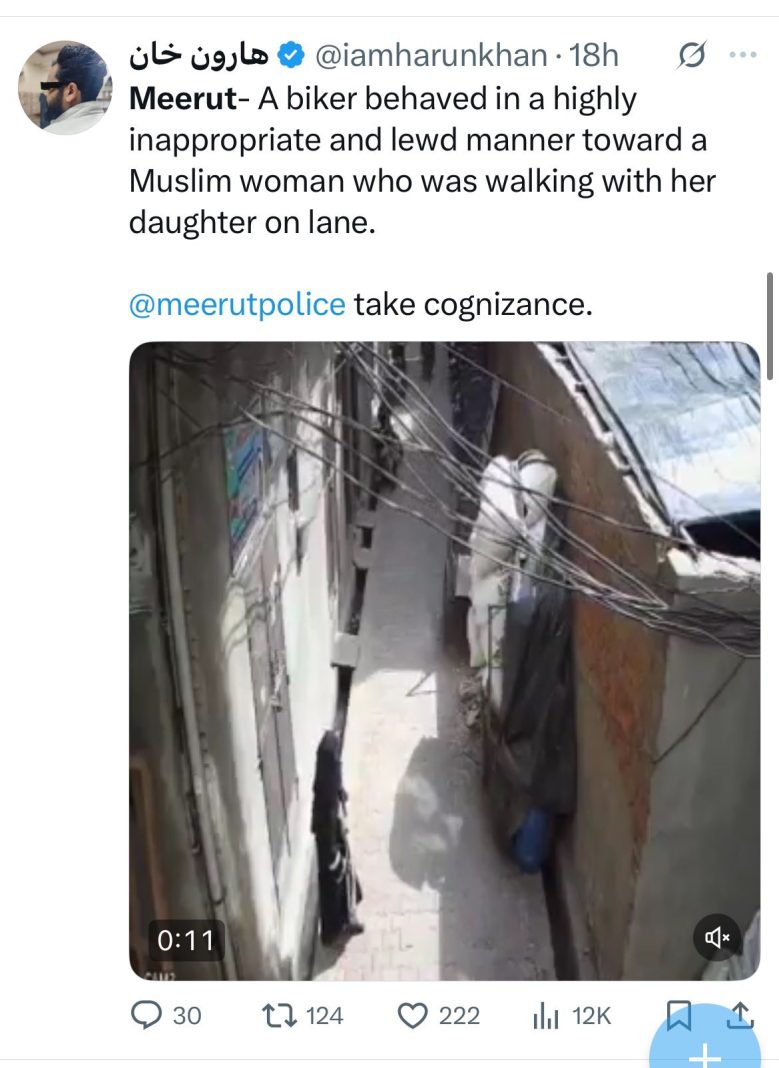
Narrative collapses: Islamists go silent after Meerut Police arrests Mohammad Suhail for molesting a burqa-clad woman

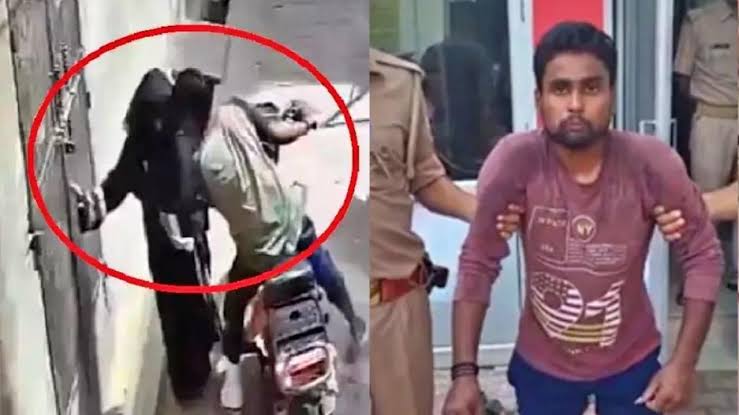
In a grim yet telling reflection of how online propaganda distorts reality, a disturbing video from Meerut recently went viral, showing a burqa-clad woman being molested in broad daylight. Instead of treating the woman’s ordeal with the sensitivity and solidarity it deserved, certain Islamist handles on X (formerly Twitter) wasted no time in amplifying the clip—not to demand justice, but to craft a narrative. One that falsely suggested a systemic targeting of Muslims in India.

The playbook was familiar: highlight the victim’s religious identity, omit crucial context, and weaponize suffering to stir communal unrest and push a political agenda. “A biker behaved in a highly inappropriate and lewd manner toward a Muslim woman who was walking with her daughter on lane,” read one viral post.

Without waiting for facts, these social media operatives painted the incident as yet another proof of the fictional “genocide” they constantly allege against Indian Muslims. That the woman was targeted for being a Muslim was the underlying message a section of social media users tried to imply.

But the narrative came crashing down once Meerut Police arrested the accused—a man named Mohammad Suhail. Far from being a representative of any so-called ‘majority aggression,’ Suhail is himself a Muslim. This key fact blew a gaping hole in the carefully crafted disinformation campaign.

Yet, unsurprisingly, the same propagandists who had passionately tweeted the video and communalised the issue suddenly fell silent. No retractions. No apologies. No outrage over Suhail’s crime. The victim, it seemed, was only useful as long as she could be exploited as a pawn in their ideological chess game. Some of the shameless social media users defended themselves claiming they never “communalized” the incident. However, going by their history, it is appeared little more than a shoddy attempt at trying to play safe after their propaganda was exposed.

This episode exposes a larger, disturbing pattern: a section of Islamists and their fellow users on social media are less interested in justice and more focused on political opportunism. They routinely hijack genuine cases of suffering—not to advocate for victims, but to score points against the Indian state, the Hindu majority, and Prime Minister Narendra Modi’s government. Such exploitation of vulnerable individuals, particularly Muslim women, undercuts real efforts toward communal harmony and justice.

Ironically, in their rush to blame Hindu society, these online propagandists end up shielding the actual perpetrators if they share the same religious identity as the victim. Their concern is selective, their activism performative, and their silence when facts don’t align with their agenda—deafening.

What happened in Meerut is tragic and reprehensible. The victim deserves justice, and Suhail, regardless of his religion, must face the full force of the law. But the manipulation of this incident to push communal hatred reveals the true face of those masquerading as ‘human rights defenders’ on X. In their zeal to malign India, they end up trivializing the trauma of the very people they claim to protect.

Justice cannot be communal. Nor can it be selective. And truth, no matter how inconvenient, must always come first.

The ‘Black Tiger’ who saved countless Indian lives: Read the extraordinary life story of India’s greatest ever spy, Ravinder Kaushik aka Pakistani Major Nabi Ahmed Shakir

In the past few weeks, several Indians who turned against their country and became spies for Pakistan have been caught by security agencies. The arrest of YouTuber Jyoti Malhotra, Devender Singh, Gazala and Yameen Mohammad, among others, reminded many of the betrayal India faced at the hands of disgraced diplomat Madhuri Gupta. All these cases are a reminder of how betrayal sometimes wears a very familiar face. However, this moment also calls for reflection on the opposite. It is time to remember those who crossed the same borders not to sell the country, but to serve it.

While some Indians handed secrets to Pakistan in exchange for money, imaginary love and what not, there was one man who lived inside Pakistan as their own for years and sent their secrets back to India, saving countless Indian lives. His name was Ravinder Kaushik. Known to the intelligence community as the “Black Tiger”, he did not just infiltrate, he transformed.

Kaushik became one of them. He learned to speak their language. He married a Pakistani girl. He even rose to the rank of a Major in their Army. While living an extremely risky life where his cover could have been blown at any moment, Kaushik sent India information that saved lives and foiled multiple enemy operations.

Ravinder Kaushik never asked for medals and did not expect a grand welcome home, he did not even expect public recognition of his services. He only wanted to serve his country, which he did silently and relentlessly.

It is very easy to name and shame those who betray their country. However, the names of those who served the nation are often forgotten with time. It is necessary to name and remember those heroes who gave up everything, even their names, for the country.

Ravinder Kaushik was not a character from a thriller, but a real life superhero. He was India’s real life invisible shield and his story must be told repeatedly. No matter how many times you have heard his name or read about him, Kaushik’s story must live forever, not for justice, but for memory.

The making of a spy – from theatre to the shadows

Sometimes, destiny does not arrive with drums beating loudly but walks into a college auditorium and sits quietly in the audience. In the case of Ravinder Kaushik, destiny watched him, a young man pretending to be a soldier on stage, very carefully.

Kaushik was born on 11th April 1952 in Sri Ganganagar, Rajasthan. He grew up in a family where patriotism was not just a slogan, it was a habit. His father was an Air Force officer who lived through wars. When Kaushik was young, he listened, learned and dreamt of serving the country, just like his father.

It was not the battlefield that gave him the opportunity, but a college stage. He was studying commerce at SD Bihani PG College. However, he was more interested in theatre. Kaushik was not just an actor. He lived his roles, even though it was just a college theatre group. One day, he played an Indian officer captured by the Chinese who chooses death over betrayal. In the audience, there were students and among them were R&AW officials, disguised, while scouting for talent with a certain kind of courage.

They had found the zeal, attitude and patriotism in Ravinder Kaushik. After the performance, they quietly approached Kaushik. There was no drama, no cloak and dagger theatrics while recruiting him. It was a simple offer: serve your country, but you will never be seen again. Live as someone else. Die as someone else. And take every truth with you.

Kaushik did not blink an eye and said yes. In 1973, he left for Delhi and told his family that he had landed a job. In reality, he joined the Research and Analysis Wing, India’s foreign intelligence agency. For the next two years, Kaushik underwent intense and transformative training. He learned Urdu, studied Pakistan’s geography and culture. He practised Islamic rituals and even underwent circumcision. His original identity was slowly and systematically wiped out, not only from the system but from his personality itself.

By 1975, Ravinder Kaushik no longer existed on paper. He walked out of the training as Nabi Ahmed Shakir, a Muslim from Islamabad. By this time, Kaushik was fully equipped to blend into a world that would never suspect he was anything else.

What Kaushik was about to do had never been done before, and what he achieved became a legend which cannot be repeated.

Living the lie – from Karachi University to Pakistan Army

Kaushik, who was now Nabi Ahmed Shakir, arrived in Pakistan in 1975. Though from the outside he was a Muslim man from Islamabad, on the inside he was still Ravinder Kaushik, a patriotic Indian who was there to live behind the curtains and serve his country.

His first stop was Karachi University. He enrolled for an LLB. It was not just about education but about gaining credibility. He built a life that could withstand scrutiny. He debated, wrote exams and blended into the rhythms of Pakistani student life. Kaushik was a perfect student throughout, and no one doubted him. He even developed a new personality, one that would soon find its way into the Pakistani Army.

Once Kaushik’s degree was complete in Pakistan, he set his sights on Pakistan’s military. Initially, R&AW was not in favour of him joining the Army, as the risks were high. A background check, a wrong paper, a minor slip could unravel everything, making him the prime target of ruthless Pakistani military personnel. However, Kaushik believed that real access meant real risk.

He prepared for the entrance exam for the Military Accounts Department and cleared it on the first attempt. The boy who once played a soldier on stage in India was now a commissioned officer in the Pakistan Army.

From this position, Kaushik began the real mission. He sent crucial information to India. The information mattered because it was not just whispers or rumours but hardcore intelligence. From troop movements to officer transfers, ammunition dispatches and everything, Kaushik gathered intel and informed his bosses in India. He wrote reports using invisible ink, passed them to intermediaries in Kuwait or Dubai, and from there, the information travelled to New Delhi.

Kaushik lived in the non internet era. There were no email transmissions. The information took days, sometimes weeks, to reach India. Every dispatch from Kaushik was an act of faith.

Kaushik wanted a foolproof life and background. To deepen his cover, he married a local woman named Amanat, daughter of a tailor in his unit. They had a son, Areeb. Neither mother nor child ever knew the man in their home had once answered to the name Ravinder.

Kaushik maintained his appearances at work, at home and in society. He was sociable, devout, loyal to his unit. A trusted officer and a loving husband. However, all that was just a cover. In reality, he was a spy from India.

The Black Tiger who roared for India

Between 1979 and 1983, India had something that intelligence agencies can only dream of, a Major in the enemy’s Army working for them. And not just working, delivering game changing intel.

Kaushik had access to crucial and secret information which gave India a strategic edge. His reports helped prevent infiltration, foil covert operations and save thousands of lives. His intelligence reportedly stopped Pakistani operations that could have killed 20,000 Indian soldiers.

He was not doing this for fame. He could not be known. He did it because he believed someone had to, and someone noticed.

Indira Gandhi was the Prime Minister at that time. She was briefed on his contributions. She was the one who gave him a name that would live on in R&AW circles, the “Black Tiger”. It was not a codename. It was a title of honour.

Kaushik remained committed, meticulous and careful. His communication routes were painfully slow but secure. He ensured the information that was being passed on had all the accurate details and reached India ahead of time. He adapted so well that even senior ISI officers casually conversed with him without any suspicion.

Publicly, he never came back to India. One of the trips he made to India was for his brother’s wedding. He came through carefully orchestrated detours via the Gulf under the cover of an Umrah trip to Saudi Arabia. Even then, he maintained the Dubai businessman façade and bought gifts for his family in Pakistan.

By 1981, Kaushik had already spent six years in Pakistan. He had a wife, a son and a reputation. All that resulted in a desk full of secrets valuable for India. However, Kaushik knew that time was not his friend. Every new success brought him closer to exposure, and when the betrayal came, it did not come from Pakistan, it came from within.

Betrayed – the mission that exposed Black Tiger

Kaushik knew he was playing with fire. It was not his mistake that exposed him, but a miscalculation by R&AW that led to the exposure. In 1983, the agency decided to send another operative into Pakistan, Inyat Masih. His task was to deliver a special message to Kaushik. The move was risky, as Kaushik had already spent eight years in the field. There was no need for direct contact, as it could have led to his exposure. However, the decision was made.

Masih managed to cross over but was soon apprehended by Pakistan’s counter intelligence agencies. He was tortured relentlessly. Interrogations were brutal, leaving no room for human endurance, and he eventually broke.

Under pressure, Masih revealed everything, the network, his purpose, and most devastatingly, the identity of Major Nabi Ahmed Shakir as a R&AW agent named Ravinder Kaushik. ISI was in shock. They decided to verify the claim and set up a trap. They allowed Masih to reconnect with Kaushik and arrange a meeting.

Kaushik was unaware of what had transpired. He walked straight into the ambush. Kaushik was supposed to meet Masih in a park, but Pakistani officials were waiting for him instead. India’s most valuable undercover agent was arrested not because of enemies, but because someone decided to play with his life by sending Masih to deliver a message.

Kaushik was taken to Sialkot, where the interrogation began. He was tortured for long hours without a break. He had no rights. However, Kaushik did not reveal anything. Even under the harshest pressure, he did not betray his motherland. He said nothing. Kaushik never confirmed his identity. He did not disclose any further names. He did not leak a single operational detail. He chose pain over compromise and silence over survival.

Two years of darkness – Sialkot’s interrogation chambers

The two years Kaushik spent in the Sialkot interrogation centre were not imprisonment, but attempts to completely disintegrate Kaushik’s resolve. Pakistanis used every tactic, physical, psychological and emotional. They did not let him sleep. He was forced to lie down on ice cold surfaces and left in solitary confinement. The aim was to dehumanise his life, but Kaushik did not speak.

He endured the pain not as a soldier in uniform, but as a lone agent with no backup, no headlines, no guarantees. Later, in letters he managed to send to his family, he described some of what he had gone through. He never sensationalised. But the pain was undeniable. It was not just the body that suffered, it was the realisation that his mission had ended not in success or honour, but in total erasure.

The case against him went on for years, and in 1985 he was sentenced to death by hanging. However, his sentence was commuted to life imprisonment by the Pakistan Supreme Court. It was a verdict meant to continue the suffering, not offer reprieve. He was shifted from Sialkot to Kot Lakhpat Jail, and then to Mianwali, where he would remain for the rest of his life.

Even in prison, Kaushik managed to send occasional letters back to India. In one of them, he asked, “Kya Bharat jaise bade desh ke liye Qurbani dene waalon ko yahi milta hai?” (Is this what those who sacrifice for a great nation like India receive?)

He did not ask for fame. He did not demand extraction. He simply hoped that his story would not be buried in silence.

Letters from exile – when the Black Tiger wrote home

After spending years in jail, he found his last form of resistance, writing. He began sending letters to his family cautiously and quietly. These were not dramatic declarations of heroism. They were raw, reflective and painfully human.

It was because of those letters that his family learned the truth. Until then, they believed that Kaushik was working in Dubai. His carefully maintained cover had convinced even his parents. The reality came crashing down with a few lines written in a prisoner’s handwriting.

His father, a retired Air Force officer, was shattered by the revelation and could not handle the emotional blow. He passed away soon after. His mother started knocking on every possible door in New Delhi with the hope that someone would listen. She was not asking for rewards or media attention, but seeking only one thing, acknowledgement.

The government offered a token pension of Rs 500, which was later raised to Rs 2,000 per month. However, the family never received formal recognition of Kaushik’s service. His name remained unspoken in official records, even as his sacrifice became a quiet legend in intelligence circles.

Yet Kaushik never showed bitterness in his words. He spoke of pain, of loneliness, of the unending echo of forgotten promises. But he never expressed regret. He did, however, leave behind a sentence that still echoes today, “Had I been an American, I would have been out of this jail in three days.” It was not a complaint, but a mirror held up to the nation he had once protected from its greatest adversary while .

Death in silence – the final chapter of a patriot

In November 2001, after 18 years of imprisonment, Ravinder Kaushik passed away inside Pakistan’s Mianwali Jail. He had battled pulmonary tuberculosis and heart disease for months, with little medical aid. There was no last minute appeal or high profile campaign for him. There was no diplomatic push to bring back India’s son. He died as he had lived for India, in silence.

Kaushik’s body was buried in Multan, far from the land of his birth. There was no tricolour on him. There was no ceremony. Even the name on the headstone was not his. There was no official communication from the Indian side to the family. No acknowledgement. No obituary. The man who had risked everything, from his beliefs to his blood, was allowed to disappear into history with barely a whisper.

His family mourned privately. His mother kept his memory alive through press interviews, letters and appeals. But the world moved on. Even now, his name rarely makes it into textbooks or Republic Day mentions. There are no streets named after him, no national memorials, no military plaques.

But he is remembered in popular culture and intelligence circles. Kaushik has never been seen as a victim or a martyr. He is India’s Black Tiger, a man who walked into the enemy’s heart and roared, not for recognition, but for duty.

Legacy of valour – remembering a forgotten warrior

History remembers names. However, some names, as it seems, were never meant to be remembered, only whispered. Ravinder Kaushik is one of those names. However, he deserves more. Kaushik did not carry any medals. He did not feature in parades. But from the dusty lanes of Sri Ganganagar to the darkest cells of Mianwali, he lived a life of service that few can even fathom. His journey was not just across borders, it was across identities, beliefs and silence.

Even today, his story finds itself scattered. Films like Ek Tha Tiger and Romeo Akbar Walter draw from his legacy, but no filmmaker officially credits him. His family has received no state honour. His grave lies unmarked, far from the land he gave everything for.

But perhaps recognition is not always about headlines. Perhaps it begins with telling the story, again and again, until every Indian knows the name Ravinder Kaushik. Until we, as a nation, make peace not just with his service, but with our silence.

He was not forgotten because he failed, He never asked to be remembered. He was forgotten because we Indians failed.

But now, it is time we teach his name alongside our military legends. It is time we not only honour those who serve in the uniform, but also those who serve from the shadows. It is time we say it clearly, without hesitation, that Ravinder Kaushik was India’s Black Tiger, a true patriot, an unsung warrior and the bravest spy this country ever produced.

Let the silence end here.