Home Blog Page 4467

Sachin Vaze ran ‘extortion shop’ inside CIU office at Police Commissioner’s headquarters, collected lakhs from restaurant owners: Report

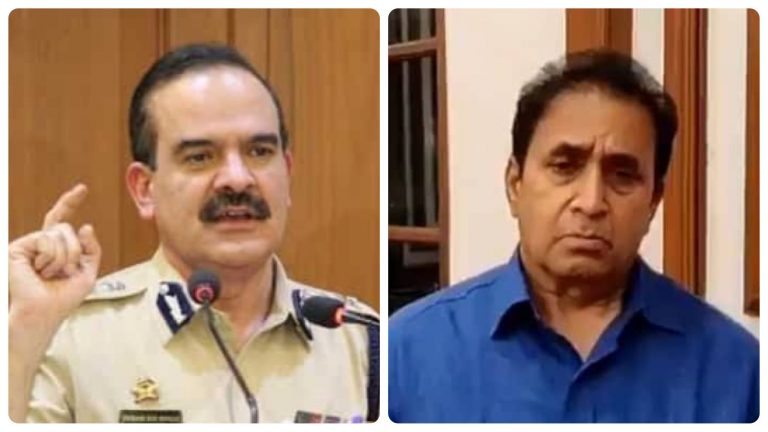
Recently, former Mumbai Police Commissioner Param Bir Singh had written a letter to the CM, accusing the Home Minister Anil Deshmukh of ordering Sachin Vaze to extort money from restaurants and bars in Mumbai to the tunes of at least 100 crores a month.

A report published in Mid-Day cites sources in the Indian Hotel and Restaurant Association(AHAR) to corroborate that the suspended police officer had indeed started collecting money. Sources in AHAR have stated that Vaze had been collecting money from restaurant and bar owners two months before the date cited in Parambir Singh’s letter.

As per one of the hotel owners cited in the Mid-Day report, Vaze was running his shop of extorting money from the hoteliers at the CIU office inside the compound of the Commissioner of Police office in Crawford Market. The hotelier said Vaze would call entrepreneurs from the Food and Beverage business and persuade them to pay monthly amounts in return for an assurance that SSB officials would not conduct any raids at their establishments. Reportedly, he also assured hoteliers that they would stay out of ‘other legal troubles’ if they keep paying him regularly.

It is notable here that Sachin Vaze, the controversial cop who was under suspension since 2004, was reinstated by the Maha government in 2020, citing the requirement of police officials due to the pandemic. Vaze was assigned to head the Crime Intelligence Unit. The circumstances of Vaze’s reinstatement and assignment of high-profile cases are also under scrutiny. Vaze had joined Shiv Sena after his suspension from the police force.

Another hotelier cited in the Mid-day report too admitted that Sachin Vaze had been extorting money from restaurant owners. The hotelier also alleged that it is hard to believe that senior officials were not privy to what Sachin Vaze was up to.

“We got Waze’s horror service in the name of protection from the SSB raids. This happened soon after businesses resumed after the lockdown. It is hard to believe that Waze would be involved in such acts without keeping high-ranking officials in the loop,” said the hotelier, the owner of a well-known restaurant in Bandra.

Vaze in connivance with SSB was extorting money from hoteliers since December 2020

As per Singh’s letter, Vaze had met Deshmukh at the latter’s residence, ‘Dyaneshwar’ in February end. Singh’s letter included a chat with SSB ASP Sanjay Patil in which the former Mumbai Police CP had asked if Vaze told him for what purpose he was called by the Home Minister. Patil replied, “The purpose of the meeting was, he told me that, there are 1750 establishments in Mumbai, he should collect Rs. 3 lakh per establishment for him also, which will be around 40 to 50 cr.”

Sources quoted by Mid-day claim that the word ‘also’ mean that a racket was already in place and Sachin Vaze was asked to procure money for Anil Deshmukh over and above that. While the meeting between Vaze and Deshmukh had allegedly taken place in February, the hotel owners claimed that Vaze was in cahoot with the Social Service Branch(SSB) officers and had been demanding and collecting money from business owners since December 2020 and had threatened them with legal troubles if they fail to comply.

Category-wise collection was in place: Hoteliers

The report also mentioned that businesses were categorised into three groups to seek money from them. One of the bar owners who was allegedly being extorted by Sachin Vaze said that the now-suspended police officer had allegedly listed bars into three categories: A, B and C.

“The A category was supposed to shell out Rs 2 lakh a month, B had to pay Rs 1.5 lakh while C had to pay Rs 1 lakh, he said. The NIA had seized a currency-counting machine and over Rs 5 lakh in cash from a Mercedes Vaze used. He must have needed the machine to count the cash he collected,” said a bar owner.

The hoteliers and bar owners also stated that those who refused to pay the amount had to face raids from SSB that supervises dance bars and hotels. They further added that SSB filed cases against restaurant and bar owners after carrying out raids. According to the sources, the last raid was carried out in February after which everybody had agreed to the pay the money.

A senior member of AHAR reportedly told Mid-day that some of the hotel and bar owners in Ghatkopar, Borivali, and Worli had been collecting money from the nearby hotel owners and sending it to Vaze at the CIU office.

Ex-top cop Param Bir Singh accuses Maha Home Minister Anil Deshmukh of ordering Vaze to extort money from business owners

The arrest of Sachin Vaze has kicked up a massive political storm, engulfing in its wake the former Mumbai Police Commissioner Param Bir Singh and now the Maharashtra Home Minister Anil Deshmukh.

Former Mumbai Police Commissioner Param Bir Singh had written a letter to Maharashtra Chief Minister Uddhav Thackeray on Saturday alleging that the state Home Minister Anil Deshmukh had asked controversial cop Sachin Vaze to collect Rs. 100 crore every month from bars, restaurants and other establishments.

The letter by Param Bir Singh raised several questions regarding the whole Antilia bomb scare case and the death of Mansukh Hiren. Sachin Vaze is currently under arrest for his involvement in the matter. The Ministry of Home Affairs had earlier transferred the Mansukh Hiren death case to the NIA.

Param Bir Singh had been transferred and posted as DG Home Guard after the explosive revelations in the Antilia bomb scare case.

Maharashtra Home Minister Anil Deshmukh has rubbished the allegations, accusing the former Mumbai Police Commissioner of hatching a conspiracy against the Maha Vikas Aghadi government to ‘save himself’.
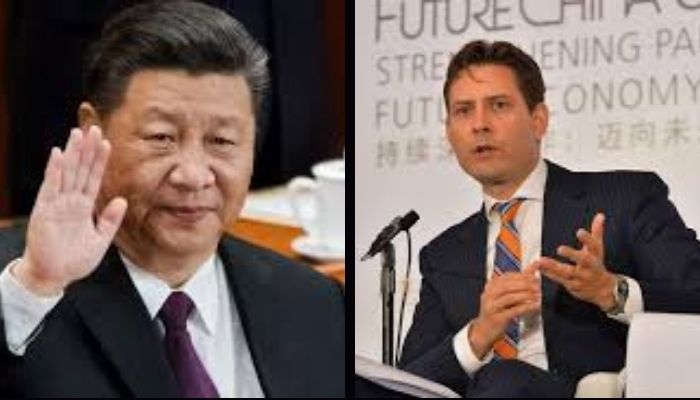
China holds closed-door trials for Canadian ex-diplomat Michael Kovrig, denies diplomatic access

In a major development, China has begun the trial against former Canadian diplomat Michael Kovrig in an espionage case in a closed courtroom in Beijing. The development comes days after the United States raised the issue during its bilateral talks with the Communist regime.

Kovrig has been held in China since December 2018, after Canadian police detained the Chief Financial Officer (CFO) of Huwaei Meng Wanzhou. While speaking about the trial, Jim Nickel of the Candian Embassy in China said, “We’ve requested access to Michael Kovrig’s hearing repeatedly but that access is being denied. Now we see that the court process itself is not transparent. We’re very troubled by this.”

On Monday, around 28 diplomats from 26 countries stood outside the Beijing No. 2 Intermediate Court to show solidarity with ex-diplomat Michael Kovrig. The countries included the United States, Germany, United Kingdom, Netherlands and so on. The diplomats took off their masks, posed for a photo outside the Court premises and yelled the name of their respective countries. Earlier in February this year, a total of 50 countries signed a declaration calling out China for ‘arbitrary detention’ of foreigners for political motives.

William Kelin, who serves as the charge d’affaires of the U.S. embassy in China, said that President Joe Biden and State Secretary Antony Blinken will treat Kovrig’s case as if he was a US citizen. Besides him, a Canadian businessman by the name of Michael Spavor has also been held in China.

The trial of Michale Spavor also took place behind closed doors

Spavor’s trial took place in Dandong on Friday, again behind a closed courtroom. Diplomats were also barred from entering the courtroom. China has, however, justified the move, calling it a case of ‘national security. Given that China has a 99% conviction rate, their conviction is highly likely. Experts believe that both Canadian citizens will be released, following a diplomatic agreement between China and Canada.

Wife of Michael Kovrig speaks out

Given that China has a 99% conviction rate, his trial was dubbed ‘completely ‘unacceptable’, ‘non-transparent’ and ‘hostage diplomacy’ by the Canadian government. While speaking on the development, Michael Kovrig’s wife Vina Nadjibulla emphasised, “Michael and Michael Spavor are innocent Canadians caught up in a bigger geopolitical dispute. Their detention is profoundly unjust and our focus must remain on securing their freedom.

Justin Trudeau reluctant to term China’s treatment of Uyghur Muslims as genocide

Canada’s Conservative Party had called for the House of Commons to declare that the Chinese government was committing genocide against the Uyghur Muslims in Xinjiang after the Canadian Prime Minister showed reluctance to term the Chinese atrocities on Uyghurs as ‘genocide’. After speaking to fellow G7 leaders, Trudeau had suggested that the best approach would be to seek broad consensus among Western allies on Chinese human rights issues.

Some classified documents disclosed in December last year had revealed Trudeau’s dangerous China policy as the documents showed that Canada had invited the Chinese Army for cold-weather combat training despite opposition from the USA. It was also revealed that Trudeau was upset with the Canadian Armed Forces for cancelling the training after China kidnapped Canadian citizens Michael Sapvor and Michael Kovrig.

Uttar Pradesh: Moradabad’s Tahir was found building mazaar in Sundarlal’s land, claimed ‘pir baba ordered in dream’

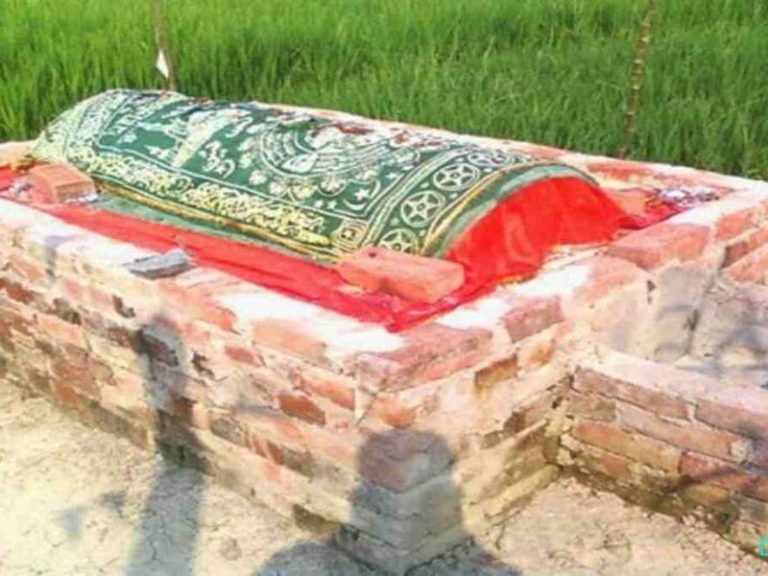
A strange case has come to light in Imartpur Udho village of Mainather District, Uttar Pradesh, where a Muslim man was stopped by the police from building a mazaar of a Pir in someone else’s field. As per the Police, on March 21, they got a complaint from one Sunderlal that a Muslim man identified as Mureed Tahir was building a Pir mazaar in his field.

Tahir was ordered by Pir to build Mazaar in a dream

According to Ramveer Singh, the Station in-charge of Mainather Police Station, the land where the mazaar was being built by Mureed Tahir belongs to a man named Sunderlal. As two communities were involved in the case that could have led to communal tension in the region, the Police rushed to the spot and stopped the construction work. They arrested Tahir and initiated a probe against him.

On questioning, Tahir claimed that he was forcefully encroaching Sunderlal’s land because a “Pir Baba came to his dream and ordered him to build a mazaar” in Sunderlal’s fields. The next morning he reached in the fields located between Imartpur Paudhon and Madhupuri to start the construction of the mazaar.

Land grabbing on the pretext of religious structures is not new

There have been several cases of land grabbing on the pretext of religious structures in the past. Recently, a case came to light where Muslims grabbed land used by Hindus for religious practices and converted it into a cemetery in West Bengal.

In Uttar Pradesh, the Yogi government has ordered the removal of illegal religious structures built by encroaching lands on the sides of the roads. The order was passed based on the judgment by the High Court. The administration has started removing such buildings in the state.

Psephologist Pradeep Bhandari granted relief by Sessions Court after Mumbai police seek to cancel his anticipatory bail: Details

On Sunday (March 21), psephologist Pradeep Bhandari informed on Twitter that a Sessions Court has rejected the petition filed by Mumbai Police, wherein it sought to cancel his anticipatory bail. The case was lodged against him by the cops for allegedly ‘obstructing public servants’ during the demolition of actress Kangana Ranaut’s bungalow in September last year.

As per reports, the petition was rejected by the Court on Thursday (March 18). Bandari, the former Consulting Editor of Republic TV, was booked by the Khar police for allegedly disobeying the order of a public servant, and using criminal force to obstruct the public servant from discharging his duty. The cops had registered the case under relevant Sections of the Indian Penal Code (IPC) and the Bombay Police Act.

After Pradeep Bhandari had moved the Court seeking relief from arrest, the Mumbai police filed an application claiming that he had not appeared before the police, despite summons. The cops had alleged that he did not provide his phone number and changed his address. The Mumbai police sought the rejection of his anticipatory bail plea. The charges levelled by the police were rejected by Bandari’s lawyers before the Court. In his defence, he said that he was a resident of Indore and has not received any summon. Moreover, he contended that the police had seized his mobile phone.

The Sessions Court then asked Pradeep Bhandari to appear before the Khar Police for interrogation every Saturday. Earlier in March, the police told the court that he had not been attending his summons to the police station. His advocate Shyam Kalyankar submitted before the Court that the psephologist had already visited the police station 16 times until them. The Sessions Court had then directed the police to conclude its probe, and submit its report before it. It had also asked Bhandari to attend the police station on two additional specific dates.

Pradeep Bhandari takes potshots at ‘chai biscuit journalists’

In a tweet on Sunday, Pradeep Bhandari informed, “Friends, The Honorable Court has dismissed the petition of Mumbai Police to cancel my anticipatory bail. In another case, the Court has set aside the Chapter Case that the State of MH had filed against me. I thank the Honorable Court for upholding justice.”

He added, “I thank people of India for supporting me in this legal fight. I also thank Arnab, Senior advocate Abod Ponda, Niranjan Mundargi, advocate Shyam who helped me in the fight.” Pradeep Bhandari also took potshots at ‘chai biscuit journalists’ for lying and conspiring against him. “Truth has exposed you, Anil Deshmukh (Maharashtra Home Minister),” emphasised the former Consulting Editor of Republic TV.

Pradeep Bhandari assaulted, detained by Mumbai police

In October last year, Pradeep Bhandari was encircled physically by the Mumbai Police and detained illegally, Republic TV has reported. It was alleged that Bhandari was assaulted as well and he was being provided no access to lawyers. It was further alleged that the phone of Pradeep Bhandari was taken away and it was demanded that he unlocked it.

A complaint against Bhandari was registered at the Khar police station under Articles 188 (Disobedience to order duly promulgated by public servant), 353 (Assault or criminal force to deter public servant from discharge of his duty) of IPC and 37(1), 135 of the Bombay Police Act, and he has been asked to appear for the investigation of the said crime.

Delhi: Four from Muslim girl’s family arrested for attacking and rampaging Dalit locality over her interfaith marriage

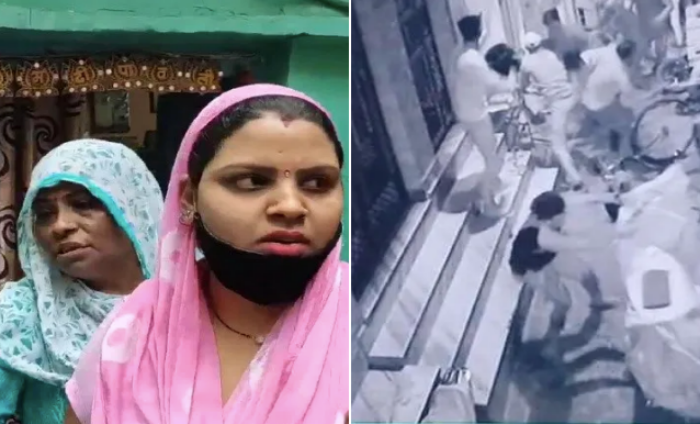
On March 21, Delhi Police arrested four men identified as Farman, Shahrukh, Hasan Ali and Raza Ahmed for allegedly attacking the Dalit colony in Sarai Kale Khan and causing a rampage in the aftermath of an interfaith marriage. As per the reports, on March 20, a large group of people from a particular community entered the Dalit locality and went on a rampage with sticks and swords. The incident took place after a Muslim girl decided to marry a Dalit man.

CCTV footage of the Muslim mob attacking the Dalit family had gone viral on social media. TOI journalist Raj Shekhar Jha has informed that Farman’s sister had married a Dalit man named Sumit recently and as a result, Farman had got his friends to attack Sumit’s family.

The couple had married in secret, but the women’s family had fixed her marriage with someone else. The woman then went to the Police station for help and registered her statement. The family of the Hindu man reportedly left the area to live with relatives. When the Muslim girl’s family came to know about the marriage, they attacked the Dalit community.

‘We will play Holi with the blood of Hindus’: Mob threatens residents of Dalit colony

As per Falana Dikhana’s ground report, the mob allegedly threatened the residents of the Dalit community that they will play Holi with their blood. FD posted several videos on social media in which the locals expressed their anger over the Police’s inaction. One of the residents said that the mob allegedly threatened them that as a retaliation of the Muslim-Dalit wedding, they would abduct girls from the Dalit community.

‘They attacked with swords and batons’: Victim family

In her statement, the sister of the Dalit man who married the Muslim girl said that the Police had asked them to leave as they were expecting communal tension. While they were away, the Muslim mob attacked the residents with batons and swords. “They damaged everything, including vehicles,” she said.

‘They molested women’: Alleged residents

The residents of the Dalit colony alleged that the mob entered houses and molested women while attacking the colony. “The Police is not arresting anyone. They are just standing and watching them roam around freely,” one of the angry residents claimed. “They pulled our hair and tore away our clothes. They did not even spare young girls,” alleged residents.

Muslim mob allegedly used casteist slurs

The sister of the Dalit man said that the members of the girl’s family allegedly used casteist slurs.

She said that while threatening them of consequences, the attackers said, “You clean lavatories. We will not let our sister to stay with bhan*is. Under no circumstances a girl from the Muslim community will be allowed to live with sewage cleaners.”

Maharashtra ATS Chief who declared Mansukh Hiren’s death case ‘solved’ is Shiv Sena leader’s son in law

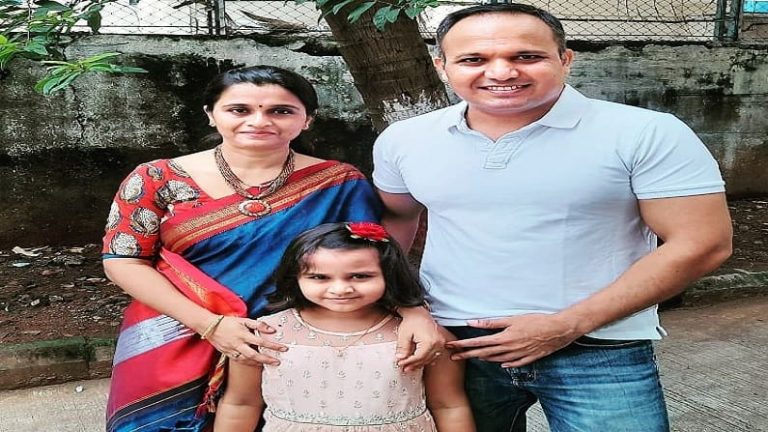
A day after Mansukh Hiren’s death case was transferred to NIA, Shivdeep Lande DIG of ATS declared the case was solved. TV9 reported that Shivdeep is the husband of Shiv Sena leader Vijay Shivtare’s daughter, Mamta Shivtare. Shivtare has served as Minister of State for Water Resources and Water Conservation in the government of Maharashtra. He lost to Congress’ Sanjay Jagtap in 2019 Assembly polls.

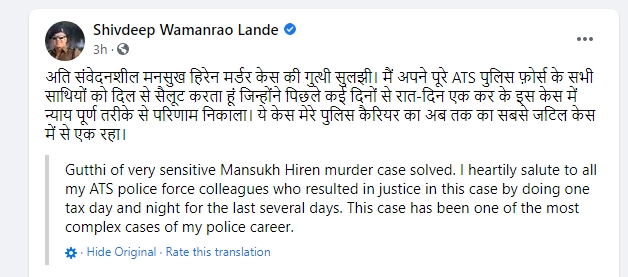
Shivdeep Wamanrao Lande, the Deputy Inspector General of Police (D.I.G.) for the ATS, posted a message on Facebook today, saying that the puzzle of the very sensitive Mansukh Hiren murder case has been solved.

Screenshot of the post with machine translation by Facebook

The post did not divulge much information on how the case was solved. Shivdeep Lande congratulated all his ATS police force colleagues who worked day and night for several days, which resulted in justice in the case. The post also read that this case was one of the most complex cases of his police career.

Who is Shivdeep Lande

Born in Maharashtra’s Ankola, Lande’s father was reportedly a farmer. He studied engineering and also prepared for UPSC. He became an IPS in Bihar cadre and his first posting was in Bihar’s Munger district. He was posted in Naxal affected Jamalpur area. He had earned himself quite a name in Patna and was nicknamed ‘Robinhood’.

He gained prominence in 2015 when he caught a cop red-handed while accepting bribe. In a filmy style, he had appeared wearing red dupatta. He was also called ‘Singham’ and ‘dabang’ in Bihar. Lande had distributed his personal mobile numbers to college girls so that they can reach out to him in case they were being harassed on streets. Turns out, he himself would land up to teach a lesson to street harassers and help the girls.

And now, within just hours after the NIA takes over the investigation in Mansukh Hiren’s death, Lande has ‘solved’ the case. The announcement was made via a social media post.

According to reports, the accused Naresh Dhare, a cricket bookie who was arrested yesterday in connection with Mansukh Hiren’s death case, had provided five fake sim cards to Sachin Vaze and suspended Mumbai Police constable Vinayak Shinde.

In another report by Times Now, it was revealed that Mansukh Hiren was in touch with the accused through these fake sims. It is said that Mansukh received a WhatsApp call on the 4th of March (the day he went missing) from Ahmedabad which happens to be bookie’s location. Reverse tracing Mansukh Hiren’s whereabouts, the reports suggests that the former cop Shinde was close to Mansukh Hiren’s location in Godbunder busting the alleged nexus. Maharashtra ATS has 11 suspects under scanner which comprises of bookies with a notorious past and suspended former police employees who were close to Sachin Vaze.

Even though Maharashtra ATS has declared the case as solved, we will have to wait and watch what new turn the case takes with NIA taking over the investigation.

Mansukh Hiren case transferred to NIA

Even though ATS has continued to probe the Mansukh Hiren death case and made the two arrests today, the case has been transferred to the National Investigation Agency. Yesterday, the union home ministry had issued orders to the NIA to take over the case from the ATS. It is not known when the ATS will formally hand over the case to NIA.

Mansukh Hiren was found dead in Kalwa Creek in Mumbai on 5th March, just days after his Scorpio car laden with explosive gelatine sticks was found outside the residence of Mukesh Ambani on 25th February. Although initially Mumbai police tried to say that Hiren had committed suicide, soon it had become clear that it was a murder related to the explosive case. Earlier Hiren had lodged a complaint that his car was stolen.

By now it has revealed that the car was planted by Mumbai Police API Sachin Vaze, who knew Mansukh Hiren and had used the Scorpio car for several months earlier. He had kept the car at his residence before he had planted it near Antilia. To cover his traces, he had taken the CCTV footage from his building and destroyed them. The number plate of the Scorpio was found from a Mercedes he was using, and an Innova car that had trailed the Scorpio was found in Mumbai Police Commissioner’s office, which was parked there by Vaze. Apart from that, NIA has also recovered two more cars, one Land Cruiser Prado and another Mercedes.

Priyanka Chopra reveals how a filmmaker wanted her to ‘strip to underwear’ and how she was racially bullied as a teenager

Actress Priyanka Chopra in a shocking revelation on Oprah Winfrey Show said that a filmmaker had once asked her to ‘strip to underwear’ for a ‘sultry’ dance sequence. She, however, did not name the film director. Priyanka said that she was scared and she had already decided to quit the film industry. Chopra said she regrets to this day that she did not stand up to this filmmaker.

Describing the incident, Chopra said that she was standing next to this filmmaker and he was sitting on his chair. “Listen, people are going to come into the movies to watch her when she shows her panties. So it needs to be really short, so I can see her panties. You know those people sitting in the front? They should be able to see her panties,” Chopra said that the filmmaker had said about her. Priyanka Chopra said that she was just 18-19 years old and had only shot for that movie for two days.

“My regret with that incident is that I never said anything to that filmmaker. I was so scared. I was new in the entertainment business and girls are always told that ‘you don’t want to get a reputation of being hard to work with’,” she said to Oprah. “I never stood up to him and said, ‘What you did was wrong’ because I was scared but the only way, I knew how to deal with it was just to step away from it and have grace under fire. And that’s what I did,” Priyanka revealed.

Priyanka Chopra on Christianity, Islam and Hinduism influencing her upbringing

Chopra in her interview with Oprah Winfrey said that she has had Christianity, Islam and Hinduism influence her upbringing. “In India, it is hard not to with the swirling number of religions that live within the country. I grew up in a convent school, so I was aware of Christianity. My dad used to sing in a mosque, I was aware of Islam. I grew up in a Hindu family. Spirituality is such a large part of India that you cannot ignore it, but also my family believed in having higher power, having a sense of faith,” the actress had said.

Priyanka Chopra bullied in school, faced racism

Chopra further revealed that at 16, when she was in Boston, US, she was racially harassed and bullied in school. She said that as a teenager, she was targeted for being a brown girl. “When I was made to feel like, did my clothes smelled funny when I walked by hallway or did people smell curry or little things like that at 16 are so detrimental to a sense of self-worth, your sense of self. It’s just about being mean, trying to hurt someone,” she said.

Priyanka’s mother ‘manifested’ Nick Jonas

Priyanka Chopra further said that her mother actually dreamt a man for her and manifested it, leading to meeting Nick Jonas and falling in love with him. Chopra said that she had not taken Jonas seriously when he started to text her initially. “I was 35, I was like, ‘I want to get married, I want to have kids. He’s in his 20s, I don’t if that’s something he’d want to do’. I did that to myself for a while, till I actually went out with him,” she said. But love has a way to find itself. Chopra married Jonas in December 2018.

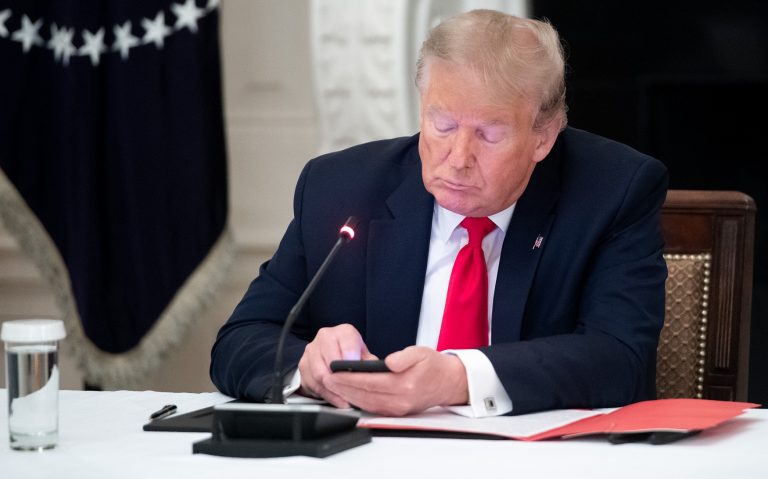
Donald Trump to launch his own social media platform after being banned by Twitter, Facebook and others, says aide: Details

Donald Trump will launch his own social media platform after being banned from Twitter, Facebook and most other platforms, his aide Jason Miller has revealed. Miller said on Sunday during an appearance on Fox News “Media Buzz” said that Trump would be “returning to social media in two or three months” with “his own platform” to “completely redefine the game.”

Donald Trump was banned on social media platforms after the storming of Capitol Hill on the 6th of January in a move that attracted widespread criticism from leaders worldwide for what was considered Big Tech censorship.

Twitter’s reasons for the ban included the “use of the words “American Patriots” to describe some of his supporters is also being interpreted as support for those committing violent acts at the US Capitol” and the “mention of his supporters having a “GIANT VOICE long into the future” and that “They will not be disrespected or treated unfairly in any way, shape or form!!!” is being interpreted as further indication that President Trump does not plan to facilitate an “orderly transition” and instead that he plans to continue to support, empower, and shield those who believe he won the election.”

The former US President has also hinted that he will run for the Presidency in 2024. At the same time, Twitter has said that his ban will not be revoked even if he decides to run for White House again.

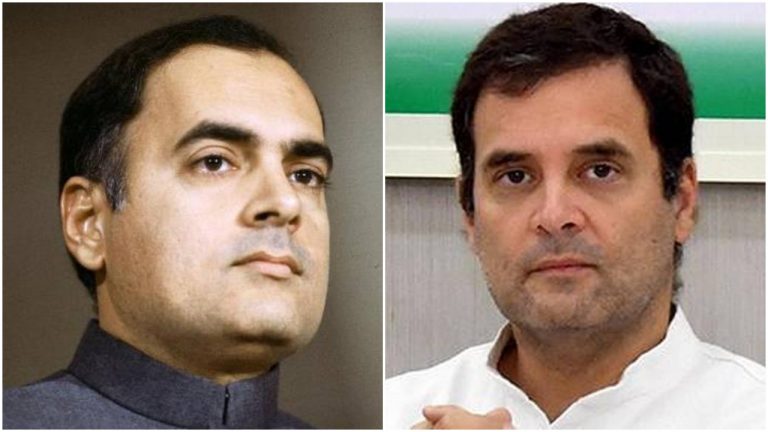
As Rahul Gandhi goes on an anti-corporate tirade, know how his father Rajiv Gandhi initiated the idea of privatisation in India

Rahul Gandhi, the face of the country’s oldest political party, seems to be waging war against India’s private sector. Ever since the Modi government announced its plans to privatise some of the country’s non-critical sectors, Rahul Gandhi has not left any chance to accuse Prime Minister Modi of ‘selling’ the country’s assets to his ‘friends’.

From accusing India’s wealth generators and big business establishment of stealing from the public to making hysterical claims of government working on behalf of a select few, Rahul Gandhi has launched a full-scale attack on Modi government’s economic policies, especially on its disinvestment strategy and privatisation.

Is Privatisation really bad, as Rahul Gandhi suggests? To understand the intricacies, one should really know what exactly Privatisation means. Let’s try and understand India’s story of privatisation and how the Congress party was itself the pioneers of the neo-liberal economic policies and idea of privatisation.

What is Privatisation?

Privatisation refers to allowing private sector participation in the management and ownership of Public Sector Enterprises. In simple terms, Privatisation implies the process of transferring ownership of a business, enterprise, public service or public property from the public sector or a government to the private sector, which are usually profit-driven.

In India, Privatisation as a trend began in the late 1980s, however, it gained prominence in the early 1990s. The idea behind privatising state assets’ was to reform the loss-making and inefficient public sector enterprises. One of the main arguments favouring the privatisation of publicly owned operations is that it increases efficiency and brings accountability resulting from private ownership and business practices. 

Today, Privatisation has not just become a common economic policy tool around the globe but also has become a norm.

The story of Privatisation in India

Soon after the independence, India also adopted a very conservative economic model that almost isolated the country from the outside world. As time went by, Indian planners recognized the need to integrate with the global economy and the necessity of private investment to achieve the nation’s development goals. In later years, India repositioned itself as a mixed economy, allowing both the private and public sectors to participate in India’s growth story. Grabbing the opportunity, the private sector thrived while the public sector was affected by unsustainable inefficiencies and incompetence by the 1990s. 

With the fall of the Soviet Union, the idea of state-controlled production and management of resources took a back seat. Many developing countries like India and post-socialist countries initiated steps to dilute their role in running enterprises and gradually opened up private sector participation in sectors that barred them from investing earlier.

Following the industrial policy of 1991, India began to liberalise its economy by initiating LPG reforms – Liberalisation, Globalisation and Privatisation. Various governments adopted disinvestment, strategic sale of minority shares to private partners and selling of loss-making units to the private sector to not only bring efficiency in the administrations of PSEs but also limit the losses of government-owned enterprises, that were once glorified as the ‘Temples of Modern India’ by Jawaharlal Nehru.

As India adopted neo-liberal economic policies, the government understood that it cannot be in the business of running the business and began to disinvest its shares to private entities. Some of the chronic loss-making units were either sold or closed by settling legitimate dues and compensation of its workers. Subsequent governments also took the route of strategic disinvestment of the PSEs, through which the majority shares held by the government were sold to a strategic private entity.

Often, the government has taken the disinvestment route rather than full-scale privatisation to limit their holding in the public sector enterprises. The governments have transferred minority shareholding to the general public while maintaining a 51% shareholding. The sale of a minority stake to the private sector has enabled the government to bring in competitive and efficient private sector business practices in these otherwise loss-making government enterprises.

Congress government role in Privatisation:

During the Nehruvian era, the Congress party was very much fearful of the idea of allowing the private sector to flourish. The private sector was treated with suspicion, and their growth was scuttled, thanks to the draconian ‘License Raj’ system. The private sector was at the mercy of the government and did not have any incentives to invest. Indira Gandhi continued her father’s economic policy, only to push Indian industries further into deep trouble. In fact, Indira Gandhi did more harm to India’s entrepreneurial spirit than any others in independent India.

However, with each passing decade, Indian economic policies began to undergo limited changes, and more liberal economic policies crept in. The idea of privatisation got impetus during the Rajiv Gandhi era. The infamous ‘License Raj’ was slowly dismantled by the Rajiv Gandhi government, which opened up some sectors for private participation.

It was Rajiv Gandhi who started the disinvestment of PSUs through minority stake sales. During his rule, there was a focus on deregulation and privatisation in a few sectors, such as telecom. By allowing the private sector to manufacture some of the telecom infrastructure and equipment, he initiated the much-needed reforms into such sectors that required systemic changes.

However, it was PV Narasimha Rao who took the bold gamble and altered the face of India’s industrial setup forever. Under the leadership of PV Narasimha Rao and his finance minister Manmohan Singh, the Congress government introduced the New Industrial Policy of 1991 that contained several reform measures for the public sector.

Forced by the balance of payment crisis, Prime Minister Narsimha Rao launched a raft of economic reforms that opened up most of the sectors to private participation. The Congress government led by PV Narasimha Rao ushered reforms that pulled India back after it had run out of money in 1991. Some of the reforms they took were to sell loss-making public entities to the private sector, inviting private participation in PSEs, and undertook the strategic sale of public assets. Some of these reform measures included privatisation to a low degree.

Later, former Prime Minister Atal Bihari Vajpayee and former PM Manmohan Singh took up the mantle and really brought privatisation to the forefront. Several loss-making PSEs were either closed or sold to private entities in the next decade. Under Manmohan Singh, the UPA government aggressively pushed neoliberal economic policies that helped India shed its socialist outlook.

In India, gladly, Privatisation is considered as a path towards prosperity. Over the decades, privatisation has enhanced the efficiency of the public sector enterprises and brought in major changes in the management of the business in the country. Today, the Private sector is largely considered a boon rather than a bane.

Is Privatisation bad for India?

The debate between the supremacy of the private and public sectors has been going on for a long time now and expected to continue even in the future. However, the success of privatisation in India, especially in critical sectors such as infrastructure, transportation, telecoms, basic industries of cement, steel, electricity etc., has evoked positive sentiments towards privatisation in the country lately.

The opening of strategic sectors to private investment, added with disinvestment policies implemented by the various government in the past, has brought efficiency in resource utilisation and effective public service delivery. The private players have brought in their rich experience and effective managerial skills, along with required technical know-how, into India’s enterprises.

Unfortunately, the political rhetoric against the idea of privatisation has caused more damage rather than the process itself. It is rather sad that the Congress party, which initiated most of the much-needed reforms to revive the Indian economy, has been cursing the very same idea it cherished a few decades back.

Instead of seeking credit for the liberalising India’s industrial regime, the Congress party and its leadership, especially Rahul Gandhi, are now dissing the ides of privatisation to achieve a short term political goal. Perhaps, Rahul Gandhi’s selective amnesia makes him ignore that his father Rajiv Gandhi initiated the idea of privatisation.

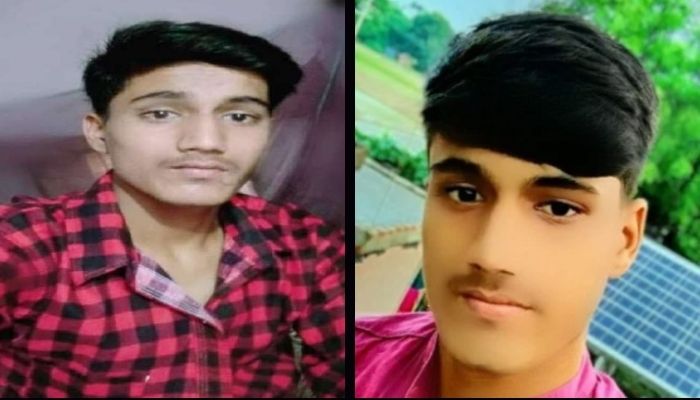
Uttar Pradesh: Anurag Pandey thrashed, poisoned to death by Nasir and 3 others over an old dispute

On Wednesday (March 17), a 15-year-old teenager named Anurag Pandey was thrashed and poisoned to death by a group of men in Domariaganj in the Siddharthnagar district of Uttar Pradesh.

As per reports, the victim’s father Rashtrapati Pandey has lodged a complaint with the Bhawaniganj police against the accused. He informed the police that his son went out to pick up goods on Wednesday. However, on reaching Budh Vihar, which is located south of Paraspur village, Anurag Pandey was stopped by a group of people. The accused have been identified as Nasir, Saddam, Shadab and Akhtar.

Owing to an earlier dispute, they surrounded the victim from all sides and began assaulting him. After thrashing the 15-year-old boy, the accused force-fed him a poisonous substance. On returning home, the victim narrated the ordeal to his father and named the accused. Soon after, his condition deteriorated and he was taken to a hospital for treatment.

Anurag Pandey dies in Gorakhpur

When his health further worsened, Anurag Pandey was taken to Domariaganj Primary Health Center the following day. He was then referred to the district hospital. Following one and a half hours of treatment, the victim was admitted to the Baba Raghav Das Medical College in Gorakhpur. On Friday (March 19), the victim succumbed to his injuries in Gorakhpur. The post-mortem of the dead body was conducted in Gorakhpur as well.

He was cremated in the presence of Sub-divisional Magistrate (SDM) Tribhuvan, CEO Umesh Sharma, police chiefs and local legislator Raghavendra Pratap Singh. Anurag was a student of Class 11 at the Maulana Azad Inter College. The family is now mourning the untimely death of the 15-year-old and the outgoing Panchayat Head Dilip Pandey came to pacify them.

Police deployment intensified in the area, case registered

The police informed that a case has been registered under relevant sections, on the basis of the complaint of Rashtrapati Pandey. The incident has created an atmosphere of fear and anger among the villagers in the area. Inspector KD Singh of Domariaganj police station and Ravindra Kumar Singh, the in-charge of Bhawaniganj police station, has been directed to monitor the situation. Police deployment has been increased, keeping in mind the sensitive nature of the case. The grieving family was pacified by Panchayat Head Dilip Pandey aka Chhote