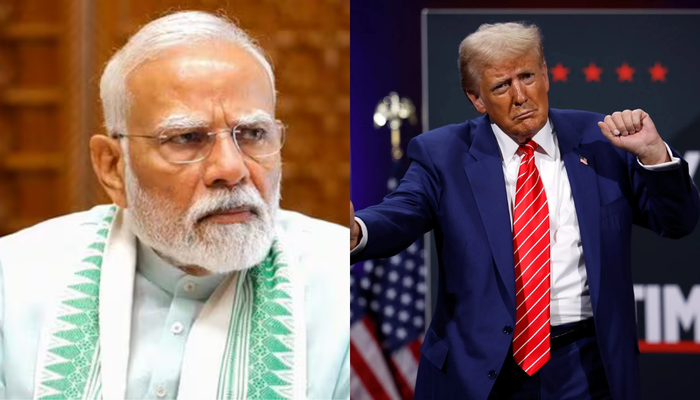
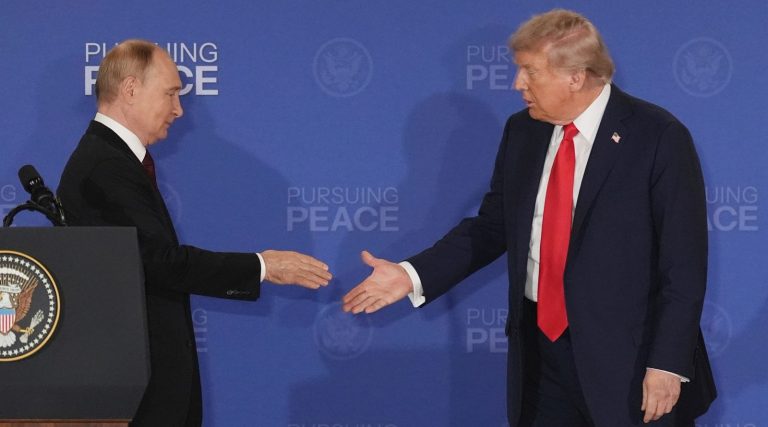
After a failed meeting with the Russian President Vladimir Putin in Alaska on 15th August to resolve Russia-Ukraine war, US President Donald Trump is back to taking undue credit for brokering a ceasefire between India and Pakistan.
Speaking to Fox News’ Sean Hannity, following his meeting with Putin, Trump reiterated his claim that he mediated a ceasefire between India and Pakistan during their military conflict. “Take a look at India and Pakistan. They were shooting down airplanes already. And that would have been maybe nuclear. I would have said it was going to go nuclear. And I was able to get it done,” Trump bragged.
When Hannity asked why he was getting involved in all these conflicts across the world, Trump justified his interference, saying that his main objective was to save lives. “Number one, to save lives in all cases, because wars are wars. When you see what would have happened with Cambodia as an example, now, I’m not involved, but I was involved in negotiating a trade deal. And I said, You guys are going to be fighting Thailand, Cambodia, so many different,” Trump rambled.
Trump also claimed that he played a key role in ending conflicts between Thailand and Cambodia, Iran and Israel, Rwanda and the Democratic Republic of Congo, Serbia and Kosovo, and Egypt and Ethiopia, saying this justified a Nobel Peace Prize for him. Apparently, Trump is trying to portray himself as some sort of global peacemaker to lay claim to the Nobel Peace Prize.
The self-bragging style of the US President is not new to the world. He has a reputation for being a loudmouth who exaggerates things and makes sweeping statements, none of which suits the high office he holds. Upholding his reputation, he recently described his meeting with the Russian President as “extremely productive” even though he could not get Russia to agree to a ceasefire with Ukraine, which was supposedly the main objective of the meeting.
India has unequivocally denied the US role in the ceasefire with Pakistan
Ever since a ceasefire understanding was reached between India and Pakistan at the request of the latter, following India’s Operation Sindoor in May this year, Trump has been going on with his boastful tirade about brokering peace between the two countries. The US President did not stop repeating his false claim, despite the Indian government’s clear statement that the ceasefire understanding between the two countries was a bilateral act.
A ceasefire understanding was reached between India and Pakistan on May 10, 2025, after India inflicted heavy damages on Pakistan in the aftermath of the April 22 Pahalgam terror attack, in which Pakistan-backed terrorists killed 26 Hindu tourists after identifying their religion. India launched a retaliatory military action after the terror attack and destroyed the terror launchpads located inside Pakistan and the PoJK. India’s military action against terrorists rattled Pakistan, and it launched drone and missile attacks on India, which led to a military conflict between India and Pakistan. After suffering heavy losses due to India’s strong military response, Pakistan requested a ceasefire.
However, right after a ceasefire was reached bilaterally between India and Pakistan, the US President jumped in to take the credit for it. In an unstatesmanlike manner, Trump made an official statement taking the credit for the ceasefire, even before an official statement could be made by the Indian government.
Trump took a U-turn on his false statement about brokering a ceasefire between India and Pakistan after Indian Prime Minister Narendra Modi clearly told him in a phone call that he had no role to play in the ceasefire. He admitted that the two countries agreed to the ceasefire bilaterally. However, later on, Trump again went back to reiterating his lie that he mediated the ceasefire, displaying his desperation to boost his contendership for the Nobel Peace Prize.
This became evident after Pakistan’s Field Marshal Asim Munir nominated Trump for the Nobel Peace Prize following a luncheon with the US President in June this year. Whether Trump will be able to get the Nobel Peace Prize after all his desperate attempts to be seen as a global peacemaker remains to be seen, but looking at his trade and foreign policy in his second term, he seems to be emerging as a global bully.
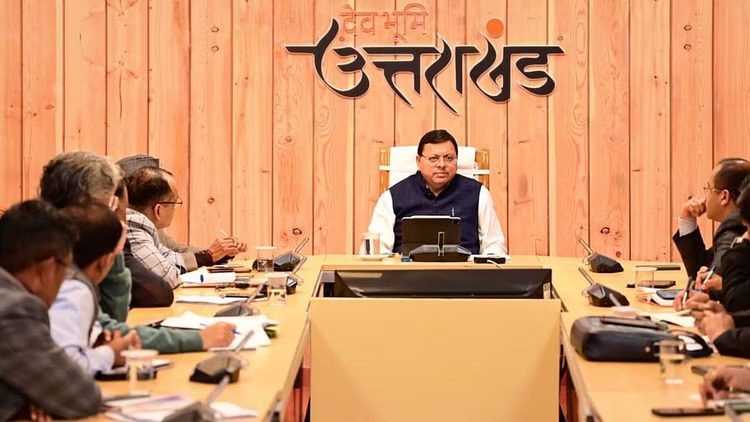
The Uttarakhand Cabinet has cleared the way for a landmark piece of legislation that will alter the framework for minority education in the state. The Uttarakhand Minority Educational Institutions Bill, 2025, is set to be tabled in the Assembly session beginning on 19th August, and is being described as the first of its kind in the country.
Extending recognition beyond one community
So far, the status of minority educational institutions in Uttarakhand has been limited exclusively to the Muslim community. The proposed Bill seeks to extend the same benefits to other recognised minorities, including Sikhs, Christians, Jains, Buddhists and Parsis. Once passed, this will also open the door for teaching Gurmukhi and Pali in state-recognised minority schools.
The new framework will replace earlier provisions. The Uttarakhand Madrasa Education Board Act, 2016, and the 2019 rules governing recognition of Arabic and Persian madrasas will be repealed from 1st July 2026.
Establishing a new authority
A key feature of the Bill is the creation of the “Uttarakhand State Authority for Minority Education.” This body will be responsible for granting recognition to minority institutions. Recognition will be mandatory, and schools set up by any of the minority communities will need approval from the Authority to operate under minority status.
The Authority is also tasked with ensuring quality education and fair student assessments, in line with the standards of the Uttarakhand Board of School Education.
Safeguarding rights with accountability
The government has underlined that the Act does not curtail the right of minorities to establish and manage their own institutions. Instead, it places conditions to ensure accountability. Schools must be legally registered under the Societies Act, Trust Act or Companies Act, and their land, assets and accounts must be in the institution’s name.
Recognition may be withdrawn in cases of financial mismanagement, lack of transparency, or activities deemed harmful to religious and social harmony.
A first for the country
With these provisions, Uttarakhand becomes the first state to introduce a law aimed at regulating minority educational institutions through a uniform and transparent process. The Bill not only expands the benefits previously restricted to one community but also sets a precedent by balancing institutional autonomy with quality benchmarks and state oversight.
The government has projected the move as one that strengthens educational diversity while upholding constitutional rights of minorities, and ensures that excellence and transparency remain central to the sector.
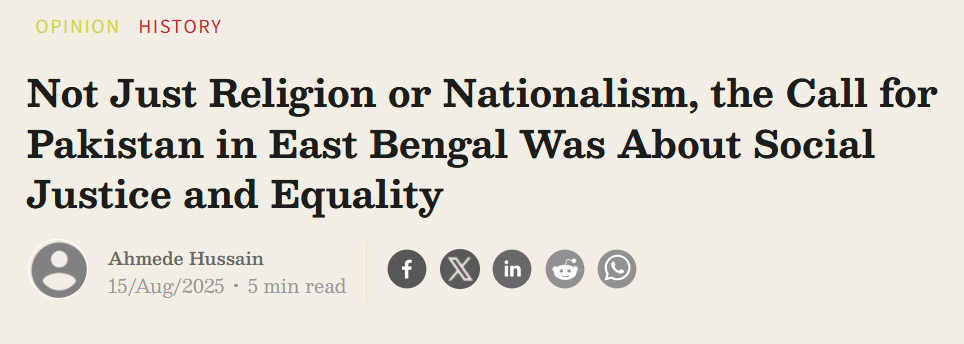
On Friday (15th August), The Wire published an article by a Bangladeshi writer Ahmede Hussain that attempts to reframe the Pakistan Movement.
According to this narrative, the demand for Pakistan was not rooted in religious separatism but was supposedly a “class struggle” of peasants and oppressed groups against zamindars and colonial exploitation.
The piece further claims that Islam in Bengal functioned as a vehicle for equality, and therefore, the Partition of India should be seen less as a communal project and more as a pursuit of social justice.
Screengrab of the article in The Wire
At first glance, this framing may look like a sophisticated attempt to add nuance to history. But on closer inspection, it is a deeply flawed exercise in whitewashing. What masquerades as intellectual reinterpretation is an ideological project: to erase Hindu suffering and justify Islamic bigotry under the fashionable language of Marxism and “social justice.”
The dangerous outcome of such narratives is that they rehabilitate the very justifications once used to legitimise massacres like the Moplah riots of 1921, Direct Action Day, and the Noakhali genocide.
The Pakistan movement: Religion, not class, was the driving force
The Wire article insists that the Pakistan Movement in East Bengal was essentially a peasant uprising, where Islam merely served as a symbol of unity against class oppression. This framing deliberately downplays the explicitly religious character of the demand for Pakistan.
The reality is starkly different. Muhammad Ali Jinnah’s “Two-Nation Theory” was not a manifesto of class revolution; it was an unambiguous declaration that Hindus and Muslims could not live together as one nation.
The Muslim League did not mobilise the poor under the red flag of socialism but under the green banner of Islam. Its speeches, resolutions, and campaigns were saturated with religious appeals, not with the vocabulary of economic redistribution.
If the problem had truly been zamindari oppression, the natural solution would have been land reforms or socialist policies, not the carving out of an Islamic state. That the result was Pakistan, an explicitly religious homeland for Muslims, demolishes the myth that this was ever about class struggle. It was communal mobilisation, pure and simple.
Erasing the blood of Partition: Direct Action Day and Noakhali
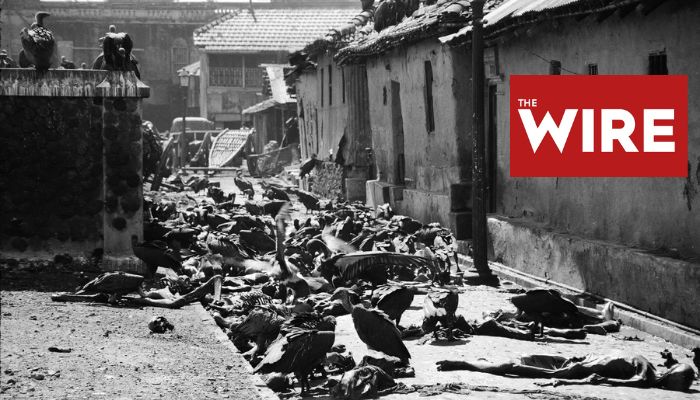
A glaring omission in this revisionist framing is the deliberate forgetting of the horrific communal violence that preceded Partition. On Direct Action Day, 16th August, 1946, Jinnah called for a massive demonstration of Muslim strength. What followed in Calcutta was not a peasant uprising but an orchestrated massacre. For three days, the city turned into a slaughterhouse.
The scale of brutality defied human comprehension. Conservative estimates put the death toll at 4,000, though many sources suggest figures closer to 10,000. Over 100,000 Hindus were rendered homeless within three days. The violence was characterised by unprecedented sadism. Hindu women were gang-raped in front of their families before being murdered, children were butchered, and bodies were mutilated beyond recognition.
Eye-witness Philip Talbot described the horrific scenes-“bodies grotesquely bloated in the tropical heat, slashed bodies, bodies bludgeoned to death, bodies piled on push carts, bodies caught in drains, bodies stacked high in vacant lots”.
This was not a cry for land reforms; it was a naked display of Islamist terror designed to frighten Hindus into submission. The targets were not merely communal, but they were civilizational targets. Hindu temples were desecrated and destroyed, religious symbols defiled, and sacred texts burned. The attackers deliberately sought to erase the Hindu presence from Calcutta, considering the city as the future capital of East Pakistan.
Just two months later, on 10th October, 1946, the Noakhali genocide in East Bengal unfolded with chilling precision. More than 5,000 Hindus, mostly men and boys, were killed, and many times that number were forcibly converted to Islam. Hindus were forced to eat beef and recite the Islamic verses (kalma).
Thousands of Hindu women were raped, many in front of their children and husbands, and taken into captivity to be used as sex slaves. The systematic and gruesome attacks on the Hindu minority led to a sharp decline in their population.
What is shocking is that the Noakhali Hindu Genocide is referred to as “riots” whereas all indicators show that it was a full-fledged Genocide
The Moplah massacre: A century of whitewashing
On 25th September 1921, a horrifying massacre took place in Tuvvur, a village in Malappuram, Kerala. What began in August as part of the Khilafat movement, a campaign linked to the Ottoman Caliphate in Turkey and supported by Mahatma Gandhi, turned into brutal violence against Hindus.
In Tuvvur alone, 50 Hindus were killed and their bodies were dumped into a well. Over the next four months, before the killings could be stopped, more than 2,500 Hindus were slaughtered, often by beheading. Their bodies were thrown into wells simply because they refused to convert to Islam.
Around one lakh Hindus had to leave their homes and villages, becoming refugees overnight. Thousands of families were forced to convert under the threat of death. Even EMS Namboothiripad, who later became Kerala’s first Chief Minister, had to flee from his ancestral home to save his life.
Yet, successive governments and intellectuals deliberately renamed this horror as a “class struggle” or even a “freedom struggle.” Gandhi, Annie Besant, and Ambedkar documented the atrocities, yet the narrative of “agrarian revolt” persisted in academic and political circles. To this day, the Kerala government glorifies the perpetrators by listing them as “freedom fighters.”
The Indian Council of Historical Research (ICHR) has clarified that the Moplah uprising was no freedom struggle but a jihadist attempt to establish an Islamic caliphate. Still, the habit of cloaking Islamic violence in Marxist vocabulary persists.
Moplah Massacre was not a peasant revolt
The true meaning of Suhadah (martyr) was recaptioned in Islam, when their cause of war was purely religion, and in that name brutally killed, raped and robbed enormous non-Islamic people. According to them, Islamic martyrs, who die during this so-called rebellion, cross the heaven’s gate on horses caparisoned with precious stones, welcomed by ‘Houries’ (Virgin angels) and other fantasies. For an illiterate Eranadan Moplah, these promises of after life were more welcoming than the mundane earthly life he lived.
The Freedom movements in India demanded every man and women to join hands towards a common cause. It was Mahatma Gandhi’s idea to combine the Khilafat movement with the Swaraj movement, thinking this will initiate the Muslims who were staying away to participate in our struggle for freedom. Little he knew about the fates of Hindus, when thousands were sacrificed and killed in the name of Islam. The Indian freedom fighters dreamt about a free country, but the Khilafatites, dreamt about a free Islamic country.
This was the beginning of 1921 Mappila Jihad. “Nara-e-Takbir, Allahu Akbar”, these slogans did not resonate with nationalist vigour or peasantry strength. Neither did they carry the Swaraj Flag (designed by Pingali Venkayya) nor the Khilafat flag (two intersecting circles). Instead, the rioters marched with the black ‘Banner of Eagle’ also known as rāyat al-`uqāb, the historical flag flown by Muhammad in Islamic tradition, an eschatological symbol in Shi’a Islam, heralding the arrival of the Mahdi, and a symbol used in Islamism and Jihadism.
They attacked using iron rods. The police bayonets were no match to their rising numbers. Nine mobs were killed in the police firing. When the crowd withdrew, the British captured Kunjikhadar, Secretary of Thanur Khilafat Committee and 40 other Mappilas.
The wheels of the British administration were immobile for a while, and the fundamentalists were up in arms. They raided and plundered police stations, treasuries, courts, and other government offices. These religious disturbances soon spread to the nearby areas of Malappuram like wildfire.
Social justice as a weapon against Sanatanis
The pattern is unmistakable. Whenever Hindus are victims of Islamic violence, the atrocity is rebranded through the vocabulary of “social justice.” When Hindus are massacred, the explanation shifts: it was not jihad, it was “class struggle.” It was not communal violence; it was “anti-colonial resistance.” The victims are erased, and the perpetrators are recast as revolutionaries.
This is a cynical exploitation of social justice language. Instead of genuinely addressing caste inequalities or peasant exploitation, the terms are weaponised to justify Islamic aggression. The Moplahs were excused because their Hindu victims were landlords.
The Pakistan Movement is reframed because Hindus were “upper-caste oppressors.” But the truth is that thousands of poor Hindu peasants, artisans, and Dalits were among those slaughtered or forcibly converted. Their suffering is erased under the alibi of a “larger struggle.”
This is not just distortion; it is a second violence. The victims lose not only their lives and homes but also the dignity of their memory.
The betrayal of partition: No social justice in Pakistan
Even if one entertains the argument that the Partition was a social revolution, the outcome exposes the lie. Did Pakistan deliver equality for the oppressed?
The answer is a resounding no. Pakistan quickly evolved into a feudal-military state dominated by elites. Land reforms failed, peasants remained impoverished, and minorities, particularly Hindus, were persecuted more than ever. Far from liberation, Pakistan became a nightmare for both its minorities and its poor.
Thus, the claim that the Pakistan Movement was about social justice collapses not only in its origins but also in its consequences.
The danger of such historical revisionism is not confined to the past. By whitewashing Islamic violence under the garb of social justice, media platforms like The Wire enable the same ideological justifications that continue to put Hindu communities at risk.
The religious hatred that fuels the violence is erased. The message is clear: Hindu lives do not matter on their terms; they only matter if their deaths can be repurposed into someone else’s narrative of struggle.
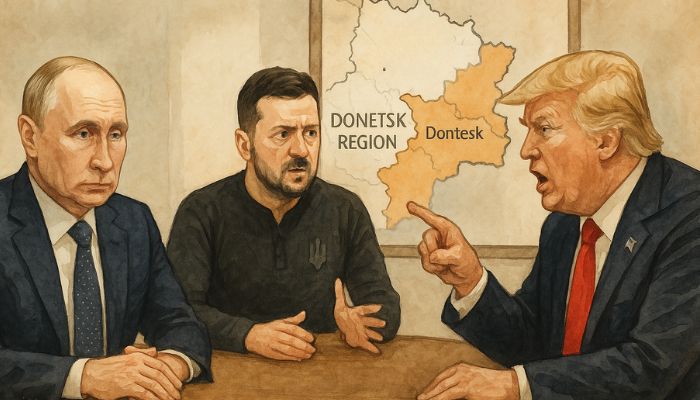
On 15th August (local time) Russian President Vladimir Putin reportedly told United States President Donald Trump that Moscow would end its war only if Ukraine surrendered the eastern Donetsk region. According to a Financial Times report, Putin made the demand during his meeting with the former US president in Alaska. He suggested that ceding Donetsk would allow Russia to freeze the frontline, particularly in the southern Kherson and Zaporizhzhia regions. Notably, Russian troops have already brought most parts of the territory under their control.
Trump relays message to Zelensky and Europe
A day later, the message was conveyed to Ukrainian President Volodymyr Zelensky and European leaders during a joint call by Trump. He pushed for a full peace agreement rather than a limited ceasefire. Following the discussion with leaders including German Chancellor Friedrich Merz and French President Emmanuel Macron, Trump wrote on the social media platform Truth Social, “The best way to end the horrific war between Russia and Ukraine is to go directly to a Peace Agreement, which would end the war, and not a mere Ceasefire Agreement, which often times do not hold up.” He added that if progress was made, a further meeting with Putin would be scheduled.
Why Donetsk is central to the conflict
Donetsk has been the centre point of the conflict between Russia and Ukraine since 2014. Russia already controls around 70% of the region. Ukraine, on the other hand, maintains a heavily fortified western belt of cities critical to its eastern defences. Complete control of Donetsk would be the most significant prize for Russia since the full-scale war between Russia and Ukraine began. It would cement its fastest territorial gains since late 2023. On the contrary, losing Donetsk would compromise the stability of the entire eastern front for Kyiv.
Zelensky stands firm
Media reports quoted unnamed sources close to President Zelensky saying that he has refused to concede Donetsk. However, he is reportedly prepared to discuss broader territorial matters with Trump when the two leaders meet in Washington on 18th August. Reports also suggested he could consider a three-way meeting involving Putin. However, the Kremlin has categorically denied any such arrangement, saying it was never on the table in Anchorage, Alaska.
European unease grows
Trump’s earlier hints at possible land swaps have unsettled European capitals. Many leaders were reassured when Trump warned Putin of “severe consequences” if Moscow refused to halt the war. However, the Alaska talks delivered no results on a ceasefire. Instead, they provided Putin with an opportunity to project himself on the world stage. The meeting was marked by a red-carpet reception and light-hearted exchanges with Trump before the formal discussions began between the two leaders.
Why Putin wants all of Donetsk
Putin’s demand for complete control over Donetsk revealed a desire to achieve diplomatically what Russian forces have been struggling to accomplish militarily. Ukraine has established a 31-mile-long fortress belt of cities and defences in Donetsk since 2014. Russian troops have repeatedly encountered strong resistance along that fortress line. According to the Institute for the Study of War, breaking through could take several years under current conditions.
In the prolonged battle for the region, Russia has committed significant equipment and manpower over the past 17 months. Despite the challenges, Russia has gradually advanced closer to the city. If Russia secures Donetsk through negotiations, it would be positioned to threaten Kharkiv and Dnipropetrovsk next. That would force Ukraine to hastily build new, but weaker, defensive lines. Controlling Donetsk would strengthen Russia’s strategic position in the region, raising concerns among Western leaders.
Putin-Trump Alaska talks failed
The Alaska summit ended without any breakthrough on the Russia-Ukraine war, despite Trump claiming it was “extremely productive.” His threats of sanctions contrasted with the red-carpet welcome accorded to Putin, while the absence of Ukraine from the talks drew sharp criticism. The meeting, expected to produce at least a ceasefire roadmap, instead highlighted the gulf between appearances and outcomes, with Trump shifting the responsibility for peace squarely onto Zelensky and European nations.
Nature’s fury does not seem to end in the state of Jammu and Kashmir, as another deadly cloudburst claimed the lives of four more people in the Kathua district. This is the second incident of a cloudburst within a week in Jammu and Kashmir.
As per reports, the cloudburst happened on the intervening night of Saturday (16th August) and Sunday (17th August). It struck the Jod Ghati village of Rajbagh, which caused heavy damage to land and property and snapped the connectivity to the village.
According to officials, many houses were buried under the debris and floodwater in the village. The Jammu-Pathankot National Highway is also reported to have sustained some damage. A joint team of police and the State Disaster Response Force (SDRF) was immediately rushed to the village to undertake rescue operations. The team officials reportedly said that landslides occurred in Bagard and Changda villages in the Kathua police station area and Dilwan-Hutli in the Lakhanpur police station area. However, no major damage has been reported in the areas.
The valley has been witnessing torrential rains, which have led to an alarming increase in the water level of several water bodies, including the Ujh River, which is flowing close to the danger mark. The local administration, which is closely monitoring the situation on the ground, has urged people to stay away from water bodies.
After the incident, Union MoS, Science and Technology and Earth Sciences, Dr Jitendra Singh, expressed condolences on the casualties. He spoke to SSP Kathua Shobhit Saxena and took stock of the situation. The Minister said that the civil administration, military and paramilitary forces are carrying out the rescue operations.
Spoken to SSP Kathua Sh Shobhit Saxena after receiving information about a cloud burst in the Janglote area.
4 Casualties reported. In addition, damage has occurred to Railway track, National Highway while Police Station Kathua has been affected.
Earlier this week, on 14th August, a huge cloudburst struck the Chositi area in the Kishtwar district in J&K, leaving 60 people dead and hundreds missing. Hundreds of people are still feared buried under the rubble as flash floods hit the region around the Machail Mata Yatra route and the Mata Chandi shrine.
As the so-called mass burial at Dharmasthala in Karnataka is turning out to be a big hoax, politics have heated up on the issue in the state. After excavations by the SIT formed by the state government didn’t find any remains of woman allegedly buried after rape and murder, BJP has started demanding action against defaming the temple, while the ruling Congress has accused BJP of playing politics, while also assuring action against false complaints.
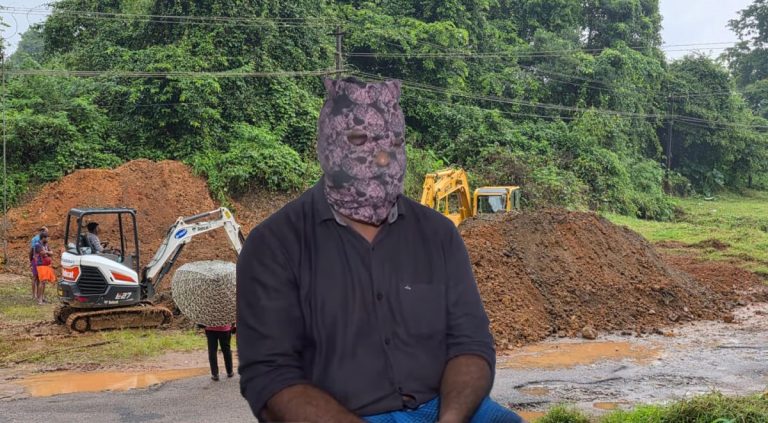
However, one thing is clear, there was no mass-burial of young women and minor girls after alleged rape and murder at Dharmasthala, as alleged by an unknown ‘masked man’.
The case started after the unknown man claimed that he was former sanitation worker employed by the Lord Manjunatha shrine in Dharmasthala, and that he was forced to bury dead bodies of women and minor girls in Dharmasthala. He lodged a complaint with the police on 3rd June with some ‘evidence’, and a week later, he appeared before a court covered head to toe to conceal his identity, to testify to the allegations made in his complaint. He submitted some skeletal remains he claimed to have exhumed from one of the burial sites.
The ’masked man’ had alleged that he was forced to burry a large number of young women and minor girls after they were allegedly killed at Dharmasthala between 1995 and 2014. Following this, another complaint was filed by a woman whose daughter had gone missing while on a trip to the pilgrimage town of Dharmasthala.
Given the seriousness of the allegations, the Karnataka government ordered the formation of an SIT to probe the case on 19 July. The ‘masked man’ gave the SIT the locations of 13 ‘burial sites’, and the SIT started excavating at those places.
And as the SIT excavated one after another site, the entire case started to fall apart, as nothing was found at those places. The skull that the man had submitted at the court turned up to belong to a man. The skull was examined at two hospitals, and both tests confirmed that it belonged to a man who died 30 years ago.
Few bone fragments were found at only one place, which belong to a man. Some ID cards found at another place also belonged to a man who died of illness.
After the excavations failed to find anything, the SIT started using ground penetrating radar on the demand of the ‘masked man’, but there was no success. As per reports, the SIT has dug 17 sites, and bone fragments have been found at only 1 site, spot number 6. As per forensic doctors, those skeletal remains are of a male.
The ‘masked man’ claimed that 60-100 bodies were buried at site number 13 at the depth of 16 feet. The SIT used Ground Penetrating Radar, which detected nothing. When the site was excavated, nothing was found.
The behaviour of the ‘masked man’ has grown more suspicious gradually. When the SIT team was digging site 11 as shown by the witness, he suddenly ‘remembered’ that the actual site is some distance away. He led the team to a spot around 150 metres way, where as many as 81 bones lying on the ground, not buried.
However, as per experts, prima facie these bones also came from a male body. Male garments and a red saree hanging from a tree was found, indicating it to be suicide case. Nothing was found when they dug the place.
After finding nothing despite digging 17 sites, the SIT has decided not to excavate all the sites mentioned by the man. They will dig few more sites where he alleged mass burials. A site mentioned by another complainant, who said he witnessed the burial of a 13-year-old girl, will also be examined.
The SIT has already filed FIR of unnatural deaths for skeletal remains found at two places, and are probing the cases, along with the case of missing girl Ananya Bhat as per her mother’s complaint.
The twist in the case has led to protests by devotees demanding action against the ‘masked man’ and others who supported his allegations for defaming Dharmasthala. As a result, the state government has promised action for propaganda.
Karnataka Deputy Chief Minister D K Shivakumar on Friday said that the conspiracy to tarnish Dharmasthala’s image will come to light through the ongoing investigation. He also said that strict action would be taken if the allegations of “mass burial” in Dharmasthala are found to be false. He also accused BJP of using the case for political purposes, questioning why the party was silent when the allegations were first emerged. “The BJP did not say a word when the ‘maskman’ lodged a complaint, but now they are trying to play politics over it. They think that Hinduism is their private property and they need Dharmasthala only for political gains,” he said.
Notably, BJP held a massive rally on Saturday to the Dharmasthala temple, demanding action against conspirators. The party said that there is a massive false propaganda to defame the temple using the ‘mass burial’ allegations.
BJP leader SR Vishwanath said the party didn’t said anything in the beginning because they assumed that there might be some truth in his allegations. But now that the excavations have found no mass burials, the party has decided to “stand in support of Dharmasthala kshetra against false propaganda,” he said.
The ‘masked man’ is currently under witness protection. In an interview with India Today, he claimed that no bodies were recovered because earth had moved due to natural reasons or infrastructure work.
The Alaska summit between Russian President Vladimir Putin and US President Donald Trump was meant to be a diplomatic spectacle, an event where Trump could once again project himself as a dealmaker and visionary leader trying to end the Ukraine war. Instead, what emerged from the joint press conference was a revelation that shredded America’s carefully cultivated moral grandstanding.
Putin, through his translator, calmly revealed that US-Russia bilateral trade had expanded by over 20 per cent in the past few months, even Trump kept claiming the US has been pressuring Moscow to end its war in its Ukraine.
While Trump scolds the world about trading with Russia & funding its war in Ukraine, Putin says, “Since the US new administration came to power, US-Russia bilateral trade has grown by 20%.” pic.twitter.com/eb9GDyE5kN
The disclosure was nothing short of explosive. It exposed the duplicity of Washington’s Ukraine narrative, which has relentlessly pressured nations across the globe to wind down economic ties with Moscow in the name of “standing with Kyiv.” While the United States demands sacrifices from allies, it quietly deepens its own commercial engagement with the very country it brands as an international pariah. Notwithstanding the fact that the US quietly imports billions worth of Russian uranium and fertilizers to safeguard its own industries.
The tariff hammer falls on India
The timing of Putin’s disclosure could not have been more damning. Just days earlier, on August 6, Trump had imposed an additional 25 per cent tariff on Indian goods, raising the cumulative duty to 50 per cent. The move was explicitly framed as “punishment” for India’s refusal to halt imports of Russian oil. Trump did not mince his words.
“India has not been a good trading partner… we settled on 25 per cent… but I think I’m going to raise that substantially over the next 24 hours because they’re buying Russian oil,” he thundered while signing the executive order. The document spelt out his grievance with characteristic bluntness: “I find the Government of India is currently, directly or indirectly, importing Russian Federation oil… in my judgment I determine it necessary to impose an ad valorem duty on imports of articles from India…”
For New Delhi, the penalty was not merely an economic setback. It was a reminder of Washington’s overbearing expectations, its readiness to weaponise trade for geopolitical ends, and its disdain for the sovereign right of nations to pursue affordable energy security.
America’s Russian trade lifeline
Yet, while Trump was wielding tariffs like a cudgel against India, the United States was quietly securing its own energy and commodity needs from Moscow. Washington’s imports of uranium, essential for powering America’s nuclear energy sector, continue to run into billions of dollars annually. Likewise, Russian chemical fertilisers remain a staple for US agriculture, feeding the vast farm belt that forms Trump’s political base.
These are not minor transactions that slipped through the cracks. They are deliberate, calculated purchases that reflect America’s prioritisation of its own economic interests over the lofty rhetoric of isolating Russia. In other words, when it comes to the health of American industries and voters’ pocketbooks, the moral sermons about Ukraine suddenly fade into irrelevance.
This is the crux of the hypocrisy. The US government simultaneously demands that India abandon Russian oil, despite the obvious economic pain such a move entails, while ensuring that its own strategic sectors remain cushioned through steady imports from Moscow. Intriguingly, Trump has refrained from imposing tariffs on China, the largest importer of Russian oil, as well as European countries dependent on Russian energy.
Trump’s Nobel Prize obsession
Layered onto this economic duplicity is Trump’s personal obsession with legacy. Multiple reports and his own public statements point to his unhealthy fixation on being awarded a Nobel Peace Prize. He views the end of the Ukraine war not through the lens of global stability or humanitarian relief, but as a potential ticket to international recognition.
This explains his contradictory behaviour. On one hand, he has ramped up economic coercion against allies to create an illusion of toughness against Russia. On the other hand, he has allowed US-Russia trade to expand so that Washington retains leverage over Moscow and preserves a potential opening for negotiations. For Trump, the war is less about Ukraine’s sovereignty and more about scripting a personal triumph he can immortalise in history books, a dangerous narcissism masquerading as diplomacy.
The burden on India
India finds itself in the crosshairs of this American duplicity. As a nation of 1.4 billion people, with rising energy demands and developmental challenges, India cannot afford to turn its back on affordable Russian oil. Moscow offers competitive prices, reliable supply chains, and flexible payment mechanisms at a time when global energy markets remain volatile.
By penalising India for pursuing its national interest, Washington is not just alienating a vital partner but also undermining the very principle of a multipolar world order. Trump’s tariffs effectively amount to economic arm-twisting: fall in line with US diktats or pay the price. This is not the behaviour of an ally. It is the behaviour of a hegemon using trade as a weapon of control.
The façade of moral high ground
The larger problem lies in the narrative that the United States has sold to the world. Washington has consistently positioned itself as the moral leader of a coalition resisting Russian aggression in Ukraine. It has invoked the language of democracy, human rights, and the “rules-based international order.” Yet, its own conduct betrays these very principles.
If the war in Ukraine is truly an existential battle between freedom and tyranny, then why does the United States continue to import Russian commodities critical to its economy? Why is it acceptable for Washington to deepen its trade ties with Moscow while condemning others for doing the same? The answer is simple: because America’s foreign policy is not guided by moral consistency but by raw self-interest.
Lessons for the Global South
For India and much of the Global South, the Alaska summit should serve as a clarifying moment. It demonstrates that America’s call for unity against Russia is less about principles and more about maintaining US dominance. Allies are expected to bear the cost of sanctions, higher energy prices, and economic dislocation, while America quietly insulates itself from these very hardships.
This is why nations from Asia to Africa to Latin America have resisted Washington’s pressure campaigns. They see through the hypocrisy. They recognise that sovereignty means choosing partnerships based on national interest, not bending to the whims of a superpower obsessed with controlling global trade flows.
The naked truth
Putin’s revelation in Alaska was not just a diplomatic jab. It was an unmasking of America’s double game. Trump may continue to sermonise about principles, democracy, and peace prizes, but his actions reveal an administration willing to punish allies while privileging itself.
For India, the path forward lies in recognising that Washington’s friendship comes with strings attached, often economic, always self-serving. For the wider world, it is a reminder that American exceptionalism is built on selective morality, where rules apply only to others, never to itself.
The Ukraine war may eventually end. Whether Trump wins his coveted Nobel or not remains to be seen. But one truth has already been laid bare: America’s greatest export is not democracy or freedom. It is hypocrisy, packaged as high principle, enforced with economic might.
The Alaska summit may not have delivered the outcomes Washington hoped for, but it laid bare a stark truth: Ukraine’s sovereignty was never Trump’s real concern. For him, it is merely a bargaining chip to strong-arm other nations into submission. And when they refuse to submit to bend like India did, he has no other option but to “double” the tariffs.
The National Council of Educational Research and Training (NCERT) has released a special module on Partition Horrors Remembrance Day, which is observed on 14th August each year, for Classes 6 to 12.
NCERT is an autonomous body under the Education Ministry, which prepares the national curriculum framework and publishes textbooks that are used by CBSE students from Classes 1 to 12.
In the newly released module [pdf], NCERT highlighted how political Islam and its ideology were the driving force behind Partition. It highlighted the persecution of Hindus, the use of violence by Muslim League, responsibility of the Congress party and how most Muslims who voted for Pakistan stayed back in India.
Political Islam at the forefront of Partition, most Muslims did not leave for Pakistan
The module pointed out that most Muslims did not leave for Pakistan, which was created for them.
“Even though a separate country was created for Muslims, about 3.5 crores Muslims did not shift and continued to stay in India. Pakistan was demanded and created as a homeland for all Indian Muslims.”
It stated that the Muslim League won 73 out of 78 seats reserved for Muslims in the March 1946 elections, and yet the majority of those voters did not migrate to Pakistan.
The module made it clear in no uncertain terms that the ‘sentiment’ that led to the creation of Pakistan persists in India.
On Page 6 of the module, NCERT emphasised the fundamental cause of Partition and the divisive nature of the ideology of political Islam.
It referenced the speech of ‘Muslim League’ leader Muhammad Ali Jinnah of 22nd March 1940, wherein he propagated his 2-nation theory.
The module stated, “…Muslim leaders called themselves as fundamentally separate from Hindus. The root of this lay in the ideology of political Islam, which denies the possibility of any permanent or equal relationship with non- Muslims. This principle has been consistently applied in various parts of the world for centuries and can still be seen today.“
NCERT questioned the failure of the Indian leaders to reflect on the ideology of religious separatism and claims of special privileges for the Muslim community. (Page 11 of the module)
On Part 12 of the module, the NCERT underlined how Indian leaders ignored the harsh realities of Hindu-Muslim relations and conveniently blamed the British.
“They blamed the British rulers for every problem, including communalism. It was an exaggerated narrative. Had they remained grounded in history, they might have drawn very different conclusions and curtailed Muslim League’s communal politics from the start,” it concluded.
Pakistan – An exporter of terrorism that has support of ‘powerful nations’
NCERT, in its newly released module (Page 5) underlined the jihadist terrorism of Pakistan, which it unleashes on India with the hopes of inflicting ‘a thousand cuts.’
It pointed out that ‘some powerful nations’ continue to arm Pakistan and support it militarily, despite its track record on terrorism.
The module read, “Pakistan has waged three wars to annex Kashmir and, after losing them, adopted a policy of exporting jihadist terrorism to inflict “a thousand cuts” on India from within. This has claimed thousands of lives, both civilian and military.
It further noted”…Some powerful nations regularly use Pakistan to exert pressure on India. Several countries continue to arm and support Pakistan militarily and strategically. As a result, India has had to spend heavily on defense.“
Congress was one of the factors behind Partition: NCERT
The NCERT stated that the Congress party was one of the 3 actors, besides Jinnah and Mountbatten, which was responsible for the Partition of India.
It noted that the British government wanted to keep India as one and several Viceroys had conceded that Partition was not going to solve the ‘Hindu-Muslim problem.’
“All those who agreed to the abrupt timeline for Partition and transfer of power were responsible for it,” read Page 9 of the module.
It pointed out that most leaders, both within the Congress and the Muslim League, could not believe that the idea of an independent Muslim country was possible.
Page 10 of the module said, “Since it had long been the known position of the British government that it was against Partition, Congress leaders underestimated Jinnah.”
It added, “But in 1947, for the first time, Indian leaders themselves willingly handed over a vast part of the country permanently outside the national fold—along with tens of crores of its citizens— without even their consent. This was a unique event in human history, when a nation’s own leaders, without a war, peacefully and in closed meetings, suddenly severed crores of their people from the country!
Persecution of Hindus and use of violence to facilitate Partition
On Page 4, the module noted,”A large number of families were forced to convert into Islam.”
It highlighted how Jammu and Kashmir started losing its social character and how the position of Kashmiri Pandits began weakening in the aftermath of Partition.
“In later decades, this decline worsened with the additional export of terrorism to the region,” the module stated.
NCERT added how Muhammad Ali Jinnah directed his followers to use violence and arms to enforce the idea of Pakistan during the Direct Action Day on 16th August 1946. (Page 7 of the module).
Muslims oversaw creation of Pakistan, many stayed back despite voting for the Muslim League
During the provincial elections in 1946, Muslims voted overwhelmingly for Muslim League which had stirred up religious passions with its demand for a separate Islamic State at the time.
The Muslim League asserted that Hindus and Muslims cannot co-exist in the same country and thus, Muslims should have a country of their own carved out of India itself, post-independence.
In total, 87% of seats were won by the Muslim League in India in 1946. A closer look at the numbers shows how the demand for a separate Islamic State bolstered the political demand for a separate state.
The table below shows a comparison between the seats won by the Muslim League in 1937 and 1946. As one can see, the number of states that were won by the Muslim League of Jinnah went up manyfold in 1946.
In every state, the rise in the popularity of the Muslim League was substantial. In states like Bihar, for example, from zero seats in 1937, the Muslim League won a whopping 34 seats out of 40 seats.
In Madras, the increase was from 9 to all 29 seats. The pattern holds across all states, or provinces, as they were called during that period. It is to be remembered that though the two-nation theory itself existed for much longer, a formal political demand was made for a separate state for Muslims in 1940.
It was in 1940 that Jinnah formally announced the demand in Lahore that the Muslim League formally recommitted itself to creating an independent Muslim state, including Sindh, Punjab, Baluchistan, the North-West Frontier Province and Bengal, that would be “wholly autonomous and sovereign”.
The resolution guaranteed protection for non-Muslim religions. The Lahore Resolution moved by the sitting Chief Minister of Bengal A. K. Fazlul Huq was adopted on 23 March 1940, and its principles formed the foundation for Pakistan’s first constitution.
Source: University of Chicago
The formalisation of the demand in 1940 led to a huge surge in the Muslim population supporting the Muslim League and by extension, supporting the demand for a separate Islamic State called Pakistan, which would be carved out of India.
It is thus intriguing when several apologists claim that most Muslims stayed back in India out of choice and that most Muslims at the time did not want a separate Islamic state.
There can be no denying that there was opposition even from the Muslims at the time to the idea of a separate state, however, political statements and what counts during voting are two rather separate concepts.
If Muslims wanted a separate Islamic State and voted overwhelmingly in its favour, why did so many Muslims stay back?
The obvious argument that is presented, sans facts, to counter the overwhelming support for the creation of Pakistan is that if most Muslims at the time supported the two-nation theory, then why did so many Muslims stay back?
And if they indeed did stay back, it only means that they rejected the two-nation theory. After partition, several leaders were in support of the full exchange of population, including leaders like BR Ambedkar.
In his book on Partition, Ambedkar clearly outlines how and why he was in favour of a full population exchange between India and Pakistan, which would essentially mean that all Hindus and other religious factions other than Muslims would come back to India and all Muslims from India would go to Pakistan.
In fact, he had even written a basic framework on how the issues arising out of full population exchange could be dealt with.
Sardar Patel had, even after the partition spoken extensively about how Muslims had helped create Pakistan. His famous quote from his speech in Kolkata, 1948, bears testament to the fact. He had said, “Most of the Muslims who have stayed back in Hindustan, helped in creating Pakistan.
Now, I don’t understand what has changed in one night that they are asking us not to doubt their loyalty”.
Further, one has to remember that the demand for full population exchange was supported by several stalwarts at the time.
A report in Sunday Guardian says, “Dr Mookerjee, accompanied by Rajkumari Amrit Kaur, went to plead with Gandhi for agreeing to Jinnah’s proposal for an exchange of population, the old man’s flat reply was that partition was on a territorial basis and not on religious grounds. Hence, no question of exchanging Hindus from Pakistan with Muslims from India. This was when the division was exclusively on the criterion of religion, Hindu and Muslim”.
When India was being partitioned in 1947, many seculars were afraid that the fate of how the two countries would turn out to be. Seculars back then had the misconception that their so-called secular and progressive ideas would be valued once they moved to Pakistan after partition.
But ever since the formation of Pakistan on August 14, 1947, no secular and progressive idea or individual has been able to survive in the country. The Hindus, who chose Pakistan over India, were brutally killed in front of their houses for being ‘Kafirs’. And, the handful of Muslims who supported progressive ideas were either forced to leave Pakistan or were left to die in isolation. After leaving the country, all these Momin Hazrats came back to India, and to date, their descendants are propagating their Islamic ideologies while singing the famous lines of Iqbal’s poem, which read as-
ऐ आबरुए गंगा – अब तक है याद हमको – उतरा तेरे किनारे – जब काफिला हमारा
Be it Pakistan’s first law minister or the writer of Pakistan’s first national anthem, here is an account of how these so-called progressive people got the taste of Islamic ideology. They faced public humiliation, were mob lynched, and had to flee from the so-called ‘good’ Pakistan to the so-called ‘bad’ India to save their lives.
The first name to appear in this series is that of economist Professor Nrij Narain. He was a supporter of Mohammad Ali Jinnah’s ‘Two-Nation Theory‘. Narain described Pakistan as a country with a better economic model and better prospects than India. However, his belief could not save his life. Narain was killed right in front of his house in Lahore by a bloodthirsty Islamic mob, who called him a ‘Kafir’on the day Pakistan was formed.
Brij Narain’s friend, Jogendra Nath Mandal, met a similar fate. Mandal, along with Jinnah, proposed a theory which said that since Muslims, along with Dalits, are a minority in India, they would, despite becoming a majority in Pakistan, protect the rights of Dalits. This is similar to the ‘Jai Bheem, Jai Meem’ narrative pushed by AIMIM leader Asaduddin Owaisi.
Jinnah appointed Jogendra Nath Mandal as the first Law Minister of Pakistan. But, after the death of Jinnah, Mandal’s tenure as the Minister of Law and Labour was cut short as he was forced to leave Pakistan and come back to India in 1950, after personally facing and witnessing discrimination against Dalits by the Muslim majority.
The progressive people at that time voiced their support for the creation of a country, which was being formed solely in the name of Islam. Poet Sahir Ludhianvi, music maestro Bade Ghulam Ali Khan and the outspoken author of Urdu literature Saadat Hasan Manto all initially chose to stay in Quaid-e-Azam’s Pakistan. But it did not take them long to realise their mistake. After living there for a while, they realised that they had chosen hell instead of heaven. Describing the situation in Pakistan, Bade Ghulam Ali Khan, who came back to India, remarked that only Muslims can live in that country.
Sahir Ludhianvi, who used to promote the Communist ideology through an Urdu magazine called ‘Savera’, feared that he would be arrested and eventually killed on the allegations of writing provocative and seditious articles against the Pakistani government. Gripped by the fear that he would be beheaded someday while walking down the streets of Pakistan, Ludhianvi hid himself under a Burqa and discreetly returned to India overnight. Ironically, after coming to India, Ludhianvi spent the rest of his life under the protection of a Hindu named Prakash Pandit.
Urdu author Saadat Hasan Manto, who left India for Pakistan, faced legal cases for his writings like ‘Thanda Gosht’. He faced persecution at the hands of an Islamic regime. He was pushed into destitution by the cutting of his income sources; as a result, he went into depression. The fire of Islamic ideology not only roasted his Thanda Gosht but also charred his desire to live. Within a few years of the formation of the ‘ideal’ country of Pakistan, he died of liver cirrhosis due to alcohol addiction.
Sajjad Zaheer, a founding member of the Communist Party of India, also chose Pakistan. He went to the Islamic country and formed the Communist Party of Pakistan. But he was arrested in the Rawalpindi Conspiracy case and was tortured in jail. After being released from jail in 1955, he came straight back to India.
There are dozens of such names, like Javed Akhtar’s father-in-law, Kaifi Azmi, and Qurratul Ain Hyder, who supported Pakistan at the time of partition. But when they moved to Pakistan, they were forced to flee from there. There were many such names in the Muslim League at the time of partition who gathered votes for the party, which was at the core of the formation of Pakistan. And yet, they stayed back in India after the formation of Pakistan to finish their half-achieved target of converting India into Dar-ul-Islam. These people became supporters of the Communist ideology and disguised their real intentions under the garb of ‘social work’.
Even today, there are people in India whose eyes eagerly keep searching for a messiah on the other side of the border. Some of these people are tormented by the worry of the future of their progeny, while others believe that India, under a Hindutva regime, has become the Pakistan or Taliban of Hindus.
Here is an appeal to the torchbearers of secularism in India, that they should read the history of the famous secular personalities who lived during the time of partition and keep their faces in their minds till the end of time to remember what happened to them in Pakistan.
They should remember that the idea of Pakistan is not a mere thought or imagination. It is a savage mob of religious fanatics gathered by misleading and deceiving people in the name of a heavenly book. Not to forget that whoever fell in love with the idea of this savage mob was eventually torn into pieces and fed upon by the same bloodthirsty mob.
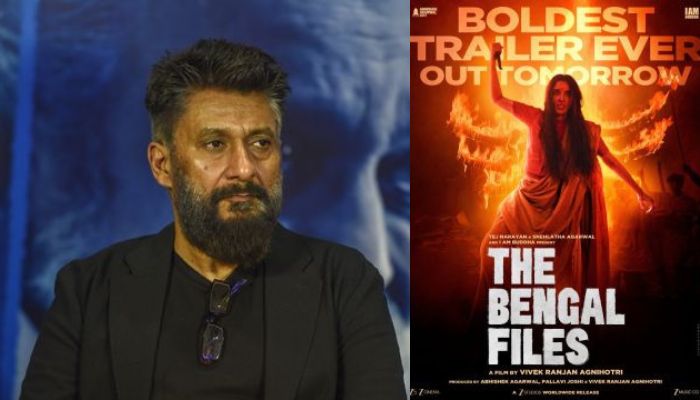
The controversy around filmmaker Vivek Agnihotri’s upcoming movie The Bengal Files is getting bigger, with the Trinamool Congress (TMC) openly attacking the director and his work. On Saturday, 16th August, the trailer launch of the film, which was supposed to take place at a five-star hotel in Kolkata, was stopped at the last moment, sparking a political storm.
TMC calls film “Propaganda”
TMC leader Kunal Ghosh strongly criticised Agnihotri, “Vivek Agnihotri is doing drama. In the name of films, he is doing politically motivated propaganda and trying to divide people. Why has he not made ‘Gujarat Files’ and shown what happened to Bilkis? Why have ‘UP Files’ or ‘MP Files’ or even ‘Manipur Files’ not been made? He has come to Bengal to malign Bengal; he should be thrown out of Bengal, but because there is democracy here, he is still here.”
He also hit back at Agnihotri for invoking the name of legendary filmmaker Satyajit Ray. “How dare he take Satyajit Ray’s name? This is Ray’s land, and Agnihotri is trying to use it to create hatred. He should instead make a film showing Bengal’s development, which is a model for the entire country,” Ghosh added.
Trailer launch cancelled at the last moment
Amid these political statements, the situation turned chaotic at the planned trailer launch of The Bengal Files. The event was set to take place at a luxury hotel in Kolkata in the afternoon of Saturday, 16th August. But just before the screening, the hotel cancelled it at the last minutes.
According to media reports, Agnihotri said that heavy police presence was seen at the hotel, with officers deployed both inside and outside. He also claimed that the laptop meant for the trailer screening was seized by the police and that wires at the venue were deliberately cut to prevent the event.
“All the screens had been set up, tests were completed last night. And suddenly, at the last minute, they said the screening cannot happen. There is clearly political pressure. If this is not dictatorship or fascism, then what is it? Law and order in this state has completely failed,” Agnihotri told reporters.
He further said that permissions for the event were already taken, and asked why it was allowed to continue till the morning but stopped right before the launch. “This is happening in the land of Satyajit Ray, where filmmakers are not allowed to screen their work. The ruling party has filed several FIRs against me already. I got relief from the Calcutta High Court, and if needed, I will move the Supreme Court,” the director added.
Pallavi Joshi: ‘Not even in Kashmir did this happen’
Actor and co-producer Pallavi Joshi, who is also featured in the film, was disappointed. “I didn’t like the way this happened.” Is there freedom of expression in this state? As filmmakers, we are not being allowed to show what we have made. What is the government so afraid of? Such a thing didn’t happen even in Kashmir. Is the situation in Bengal worse than Kashmir now?” she asked.
Producer Abhishek Agarwal also voiced concern, saying, “During The Kashmir Files, nothing like this happened. But for The Bengal Files, the trailer was stopped midway.”
Police say no permission granted
Police sources, however, gave a different version. According to them, Agnihotri had sent an email seeking police permission for the trailer launch, but no approval was given. Despite that, the event was organised at the hotel, which was then stopped.
BJP slams Mamata government
The incident also triggered a sharp response from the BJP. Union Minister Sukanta Majumdar called the cancellation “shameful” and accused the Mamata Banerjee-led government of “dictatorial tactics.”
He posted on social media, saying, “In the land of Satyajit Ray, Bengal has witnessed a disgraceful episode. First, a theatre chain cancelled the event under political pressure, and when Agnihotri tried to do it at a hotel, even that was sabotaged. Wires were cut, police were deployed, and the entire team was insulted.”
In the land of the legendary filmmaker Satyajit Ray, West Bengal has once again witnessed a shameful episode that shatters every limit of democratic decency. Words are simply inadequate to condemn what has just taken place.
Majumdar added, “This is nothing but jungle-raj and anarchy. What is Mamata Banerjee so afraid of? The people of Bengal can see the truth now.”
The Bengal Files is written and directed by Vivek Agnihotri, who earlier made The Kashmir Files that created nationwide debate in 2022. The film stars Mithun Chakraborty, Anupam Kher, Darshan Kumar, and Pallavi Joshi. It is set to release on 5th September this year.