In a landmark move that underscores India’s push for self-reliance in key industrial sectors, Adani Enterprises Limited (AEL) has announced a strategic partnership with MetTube, a subsidiary of the Metdist Group, to jointly manufacture high-performance copper tubes for critical sectors like HVAC, renewable energy, and smart infrastructure.
As part of the agreement signed on July 24, 2025, Adani Enterprises will divest 50% of its stake in Kutch Copper Tubes Limited (KCTL) to MetTube. Simultaneously, AEL will acquire a 50% stake in MetTube Copper India Pvt. Ltd., MetTube’s wholly owned Indian subsidiary that runs a cutting-edge facility near Ahmedabad. This dual investment model establishes an equal ownership and governance structure between the two companies, fostering a truly collaborative ecosystem.
The partnership is aimed at significantly reducing India’s dependency on imported copper tubes, crucial components used in air conditioning, refrigeration, plumbing, and energy applications. As urbanisation, climate-responsive infrastructure, and green energy projects drive demand, this alliance is poised to deliver scale, speed, and sustainability.
Jeet Adani, Whole Time Director, Adani Group, emphasized the strategic nature of the partnership:
“By combining Adani’s operational excellence with MetTube’s deep copper expertise, we are not just building a business—we are building capability for India.”
Apurv Bagri, Chairman of Metdist Group, echoed the sentiment:
“With this alliance, we bring world-class copper tube technology to India, fully aligned with the ‘Make in India’ mission and growing demand for climate-friendly infrastructure.”
Adani’s copper ecosystem already includes a 0.5 MTPA copper refinery at Mundra and a greenfield copper tube facility under KCTL. MetTube adds to this its 50+ years of legacy in global copper manufacturing, technical prowess, and a strong customer base across HVAC and refrigeration sectors.
The newly formed partnership is expected to fuel innovation in copper tube design—especially inner grooved tubes that enhance energy efficiency in cooling systems, supporting India’s broader goals of energy conservation and industrial self-reliance.
By leveraging mutual strengths and focusing on sustainability and quality, the Adani-MetTube alliance signals a bold new chapter for India’s copper manufacturing industry, positioning the country as not just a consumer, but a global supplier of high-performance copper tubes.
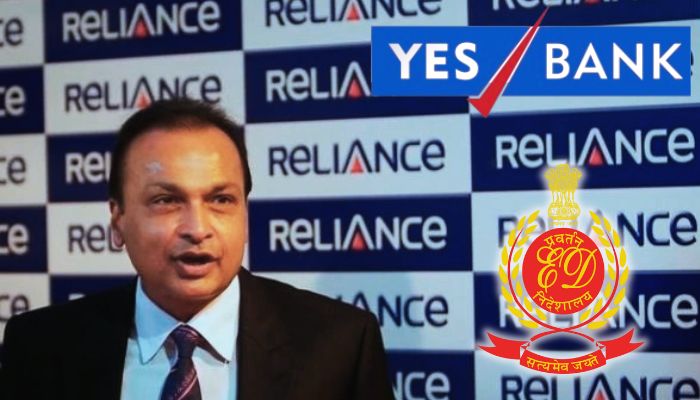
On 24th July 2025, the Enforcement Directorate launched a massive search operation at 35 premises, 50 companies and over 25 persons allegedly linked to money laundering case against Reliance Anil Ambani Group (RAAGA) Companies.
Mumbai, Maharashtra (Update): Enforcement Directorate is conducting search operations at multiple locations linked to businessman Anil Ambani. Since 7 AM, ED officials from Delhi and Mumbai have been carrying out raids, including at the Reliance office, where the main gate has… https://t.co/ls8DV6xsvlpic.twitter.com/Vud56vOmGd
The move followed an investigation launched by the ED under the offence of alleged money laundering by RAAGA companies subsequent to recording of an FIR by the Central Bureau of Investigation (CBI).
As per the officials, other agencies and institutions have also shared information with ED, such as, the National Housing Bank, SEBI, National Financial Reporting Authority (NFRA) and Bank of Baroda.
“Preliminary investigation by ED has revealed well-planned and thought after scheme to divert and siphon off public money by cheating banks, shareholders, investors and other public institutions. The offence of bribing bank officials including, promoter of Yes Banks Limited is also under scanner,” officials, privy to the development said.
Dramatic increased in corporate loans, illegal loan diversion, and “calculated scheme” to defraud banks, investors, and shareholders: What the preliminary investigation by ED revealed about the quid pro quo nexus
Preliminary investigation reveals illegal loan diversion of around Rs 3,000 crores from Yes Bank (period 2017 to 2019). ED said it has found that just before the loan was granted, the Yes Bank promoters received money in their concerns.
“ED has found gross violations in Yes Bank loan approvals to RAAGA companies, such as, Credit Approval Memorandums (CAMs) were back-dated, Investments were proposed without any due diligence and credit analysis in violation of Banks Credit Policy inter alia,” said the Officials.
In violation of the loan terms, the officials said, these loans were further diverted to many group companies and shell companies.
“Some red flags found by ED include- loans given to entities with weak financials, no proper documentation of loans, no due diligence, borrowers have common addresses, and common directors etc., diversion of loans to promoter group entities, ever greening of GPC loans, loans onward lent on same date, loans disbursed on same date as date of application, loans disbursed prior to sanction, Misrepresentation of financials,” the officials said.
Furthermore, the probe agency informed that “Securities and Exchange Board of India (SEBI) is also learnt to have shared its findings with ED in the case of RHFL.”
“Dramatic increase in corporate loans by RHFL, from Rs 3,742.60 crore in Financial Year 2017-18 to Rs 8,670.80 crore in Financial Year 2018-19 is also under ED lens. Issues of irregular and expedited approvals, process deviations many other illegalities have been found,” the probe agency said.
Amidst raids and fraud accusations, Reliance says “no impact” on business or stakeholders
Meanwhile, the Reliance Anil Ambani Group is reported to have said that the ongoing raids and investigation will have no impact on the business operations, financial performance, shareholders, employees, or any other stakeholders” of Reliance Power and Reliance Infrastructure.
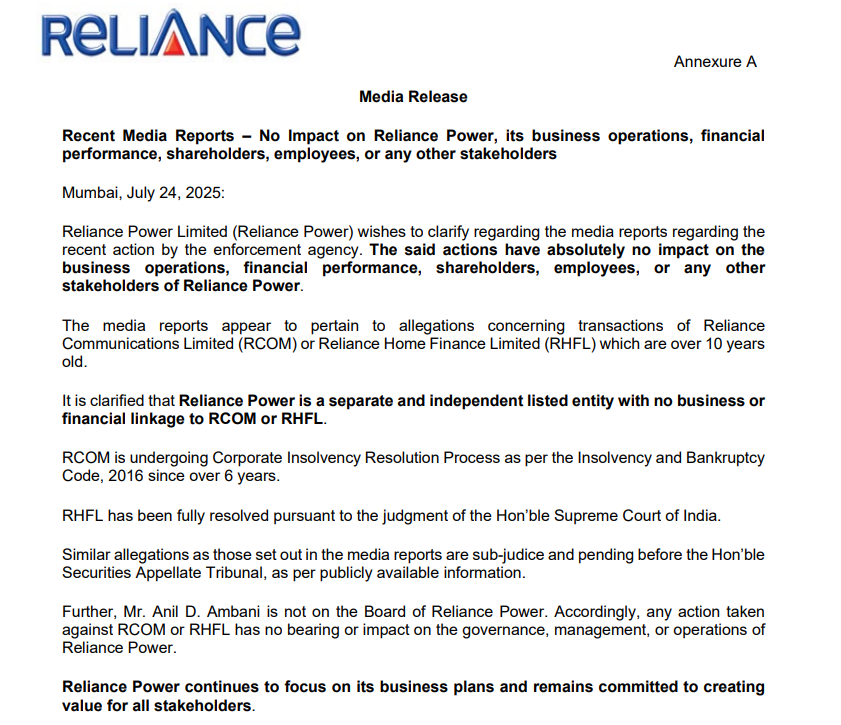
“No Impact on Reliance Power, its business operations, financial performance, shareholders, employees, or any other stakeholders,” Reliance Power asserted in its statement.
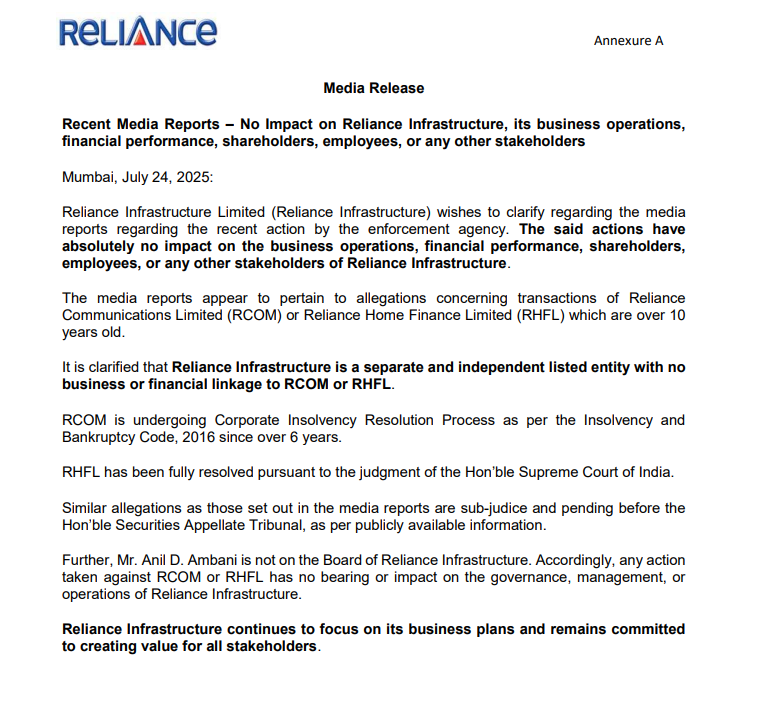
“No Impact on Reliance Infrastructure, its business operations, financial performance, shareholders, employees, or any other stakeholders,” Reliance Infrastructure said in its statement.
“The media reports appear to pertain to allegations concerning transactions of Reliance Communications Limited (RCOM) or Reliance Home Finance Limited (RHFL) which are over 10 years old,” the statements, with language largely similar, read.
Reliance Power is a separate and independent listed entity with no business or financial linkage to RCOM or RHFL, it further noted.
RCOM is undergoing Corporate Insolvency Resolution Process as per the Insolvency and Bankruptcy Code, 2016 since over 6 years. RHFL has been fully resolved pursuant to the judgment of the Supreme Court of India.
“Similar allegations as those set out in the media reports are sub-judice and pending before the Hon’ble Securities Appellate Tribunal, as per publicly available information,” the statements read.
“Further, Mr. Anil D. Ambani is not on the Board of Reliance Power. Accordingly, any action taken against RCOM or RHFL has no bearing or impact on the governance, management, or operations of Reliance Power continue to focus its business plans and remains committed to creating value for all stakeholders,” the Reliance Power statement concluded.
Impact of ED raids on Reliance Power and Reliance Infrastructure
Following the ED raids at premises linked to Reliance Anil Ambani Group (RAAGA) companies, the shares of Reliance Power and Reliance Infrastructure slumped by 5 per cent each in intraday trade on 24th July 2025.
As per reports, the shares of Reliance Power and Reliance Infrastructure were locked in a 5 per cent lower circuit at ₹360.05 and ₹59.70, respectively, on the Bombay Stock Exchange.
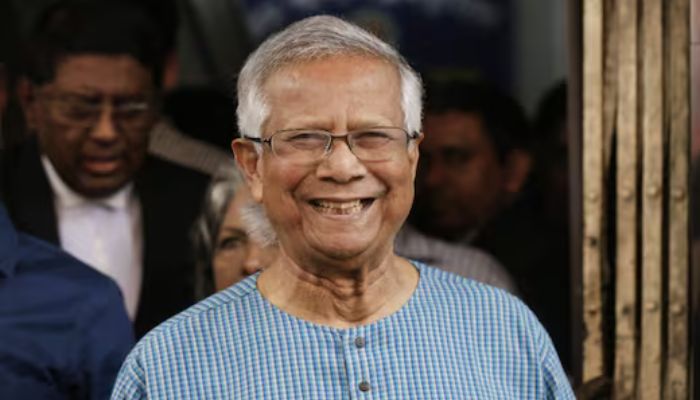
On Wednesday (23rd July), the Muhammad Yunus regime in Bangladesh issued an ordinance eliminating the right of employees to protest against the government.
The ordinance amended the Government Service Act of 2018. According to reports, if a government employee henceforth goes on a strike, then he/she can be dismissed from service with ‘compulsory retirement’.
Besides the looming threat of forced dismissal from service, government employees could also be demoted to a lower rank or pay grade for agitating against the government.
Muhammad Yunus, who was once critical of Sheikh Hasina for her alleged ‘undemocratic ways’ of running Bangladesh, is now silencing government employees and stopping them from against his regime.
The new Ordinance is a step in the direction to plunge Bangladesh into authoritarianism.
Muhammad Yunus stiffles criticism of his regime by students and educational institutions
The Directorate of Secondary & Higher Education in Bangladesh issued a notice [pdf] on 2nd January this year.
It stated clearly that steps would be taken against students and educational institutions alike for ‘engaging in propaganda’ and ‘peddling misinformation’ against the incumbent interim government led by Muhammad Yunus.
The Directorate Of Secondary & Higher Education added that all concerned authorities should remain ‘alert and active’ and ensure that students are ‘not motivated’ by misinformation, propaganda and rumours about the Yunus regime.
It further highlighted that steps should be taken to prevent students from ‘engaging in provocative activities.’
The Directorate Of Secondary & Higher Education emphasised, “In such a situation, it is requested to inform the higher authorities for taking action against any educational institution or any student involved in the issue of misinformation, propaganda and rumours.”
While in theory the notice might be interpreted as a step towards stopping the spread of ‘misinformation’, it is in fact a ploy to silence critics and intimidate students (who spearheaded the movement against the erstwhile Sheikh Hasina government).
Dissent against Bangladesh’s interim government could easily be labelled a ‘work of propaganda’. Students, critical of Muhammad Yunus, would be targeted as engaging in rumour-mongering.
Give the free hand to educational institutions to act against such students, they will be intimidated and coerced into silence.
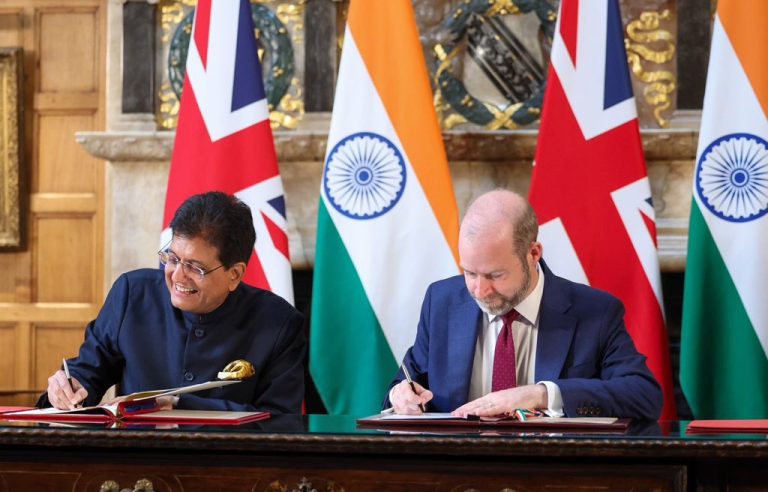
In a significant move, India and the United Kingdom signed a Free Trade Agreement (FTA) on Thursday, July 24. Officially titled India-UK Comprehensive Economic and Trade Agreement (CETA), the agreement was signed during the Prime minister Narendra Modi’s official visit to London. The step marks India’s first major bilateral trade deal with a developed economy in over a decade. After the approvals of the UK parliament and India’s Union Cabinet, it is expected the trade deal will come into force within a year.
The agreement was signed by Union Commerce Minister Piyush Goyal and the UK’s Secretary of state for Business and trade, Jonathan Reynolds. The decision was followed by the bilateral ties between PM Modi and the British counterpart Keir Starmer in London.
In a post on X, Goyal congratulated Modi, Starmer, and the people of both nations on the mutual deal with the India-UK Comprehensive Economic and Trade Agreement (CETA). He stated that this accord will unlock the duty-free access for about 99% of Indian exports, which will open the gate for $23 billion in opportunities for labour-intensive sectors, marking a new era for inclusive and gender-equitable growth.
Congratulations to Prime Minister @NarendraModi ji, UK Prime Minister @Keir_Starmer, and the people of India & the United Kingdom on the signing of the landmark India-UK Comprehensive Economic and Trade Agreement (CETA).
Workers and labourers like artisans, weavers, daily wage labourers who work in different verticals like textiles, leather, footwear, gems & jewellery, toys, and marine products will step into a new phase of prosperity. The FTA will mark a historic leap for women with the help of improved access to finance and deeper integration into the global value chain. For people working in village looms to tech labs, this agreement will benefit all.
Goyal added that it is also a win-win for farmers who can have access to duty-free export 95% of their agricultural products, while fisherfolk gain from Zero Duty on 99% of marine exports, boosting their incomes. India’s plantation sector is also expected to benefit greatly, including tea and coffee. Duty-free access on instant coffee will help Indian exporters compete better with European suppliers.
In the manufacturing sector, it will also have a transformative impact on multiple sectors like engineering goods, electronics, pharma, chemicals, food processing, and plastics. The agreement will ensure the Indian customers get high quality goods at competitive prices.
Notably, Engineering goods form the largest category under the FTA, with 1,659 tariff lines and a 17%t share. This includes machinery, equipment, and components.
The UK has signed a trade deal with India – the largest agreement Britain has signed since leaving the European Union.
India’s electronics exports, including smartphones, optical fiber cables, and inverters, are expected to increase with zero-duty access. Software and IT-enabled Services businesses will also benefit from the FTA.
Moreover, the IT services and education will gain easier access to the UK’s high-value markets. The three-year exemption from social security payments in the UK under the Double Contribution Convention marks a major step forward for Indian professionals and their employers. This will especially benefit chefs, yoga teachers, musicians, and business travellers, helping India move closer to becoming a global talent hub.
The India-UK Free Trade Agreement will give Indian startups better access to UK customers, investors, and innovation centres, boosting their global reach. This agreement supports the goals of ‘Make in India’ and ‘Vocal for Local’ by creating jobs, strengthening communities, and enhancing India’s position in global trade. It signals a fresh chapter in economic cooperation and deepens our trade partnership with the UK.
Additionally, there will be some tariff changes and concessions on goods and services agreed upon by both countries. Import duties on Scotch whisky and gin will drop from 150% to 75% immediately, and to 40% over the next 10 years. Tariffs on UK-manufactured cars, which currently exceed 100%, will be cut to 10% under a quota-based system. India will reduce or eliminate tariffs on products like cosmetics, salmon, chocolates, biscuits, and medical devices.
Air India is back in trouble, this time due to grave safety concerns of crew fatigue and inadequate training of staff. India’s aviation regulator, the Directorate General of Civil Aviation (DGCA), has threatened to take serious action against the airline after it found several violations, as seen by Reuters in a report.
The airline has been accused of non-compliance with safety regulations on multiple occasions this year, as well as last year, in four government notifications issued on 23rd July. The notifications came close to a week after one of Air India’s Boeing 787 Dreamliner aircraft crashed in Ahmedabad, killing 260 passengers, the world’s worst air disaster in the last decade.
The airline had disclosed on its last report. But although the revelation was voluntary, the DGCA was upset. It stated that the issues are no new development and that it has been warning the airline for many years. The notices indicate a series of 29 infractions ranging from not providing proper rest to pilots, to failing to meet simulator training requirements to taking international flights with a sparse number of cabin crew.
In one instance, Air India’s pilots received no special training before a flight to a high-altitude airport, which could be risky if mishandled.
“Despite repeated warning and enforcement action of non-compliance in the past, systemic issues related to compliance monitoring, crew planning, and training governance remain unresolved,” said one of the notices.
The airline responded by saying the notices were about safety issues it had disclosed on its own over the past year. “We remain committed to the safety of our crew and passengers,” the airline said in a statement.
Air India has come under severe scrutiny since the crash at Ahmedabad. A Preliminary report by AAIB on the accident showed some disturbing facts from within the cockpit.
This new warning by the DGCA only serves to enhance the mounting fears regarding how seriously Air India is approaching safety, not only for its passengers, but for its crew.
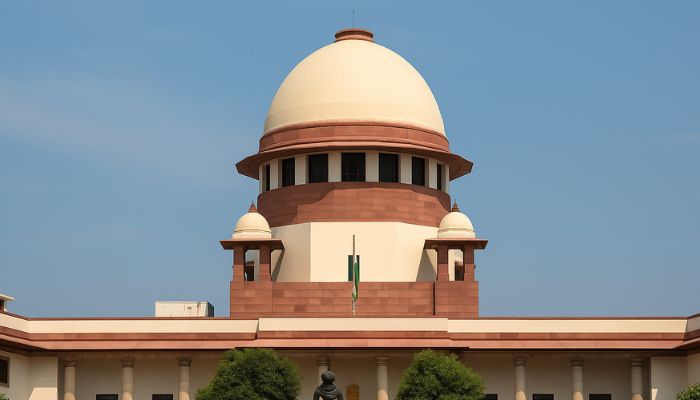
On 22nd July, in a landmark ruling that aimed at protecting families from the abuse of criminal law in matrimonial disputes, the Supreme Court of India upheld and enforced the Allahabad High Court’s 2022 guidelines on arrests under Section 498A of the Indian Penal Code (IPC). The apex court, while deciding the case of Shivangi Bansal vs Sahib Bansal, approved a mandatory two-month “cooling-off” period before any arrest can be made under the said provision.
The judgment was authored by a two-judge bench comprising Chief Justice of India B R Gavai and Justice Augustine George Masih. The bench invoked Article 142 of the Constitution to dissolve the marriage between the parties and quashed all civil and criminal proceedings filed against each other. The bench also made a scathing comment on how the misuse of Section 498A can destroy the very sanctity of marriage.
OpIndia accessed both Supreme Court and the Allahabad High Court judgments.
Background of the case – 7 years and 25 cases
The parties, Shivangi and Sahib Bansal, got married in December 2015. They got separated in October 2018. Following the separation, around 25 cases were filed across Delhi and Uttar Pradesh, ranging from FIRs under Sections 498A, 406, 376, and 307 IPC to domestic violence, custody, defamation, and tax notices. While both parties alleged harassment, the husband spent 109 days in jail and his father 103 days due to complaints filed by the wife.
In the court, the couple finally agreed to settle all disputes amicably. As per the terms of the settlement, Shivangi will retain custody of their daughter, forego alimony and child maintenance, and transfer disputed land to the husband. The Supreme Court directed both parties to withdraw all existing litigation and barred them from filing further cases related to the matter.
Furthermore, the wife, who is serving as an IPS officer, has been ordered to issue an unconditional apology, both in print and on social media, for the trauma caused to her husband’s family.
SC confirms no arrest for 2 months in 498A cases
At the heart of the judgment, the Supreme Court endorsed the Allahabad High Court’s guidelines from the 13th June 2022 judgment. The guidelines were framed by Justice Rahul Chaturvedi to prevent the automatic arrests of husbands and in-laws in dowry-related cases without prior scrutiny. The apex court ruled that these directions must now be followed across the country and circulated to all District Judges and Police Chiefs by the Registrar General of the Allahabad High Court within a month.
A detailed look at the Allahabad HC’s guidelines
In the June 2022 judgment, the Allahabad High Court had highlighted the growing trend of false and exaggerated complaints under Section 498A IPC and called for a structured approach to prevent misuse while preserving the rights of genuine victims.
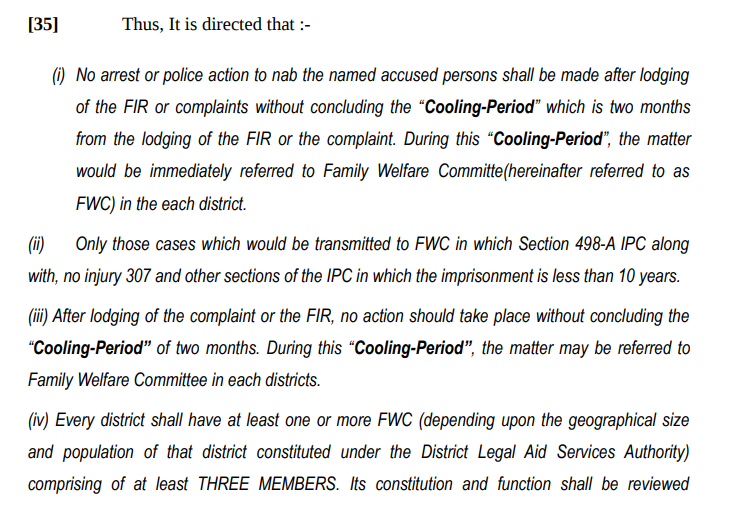
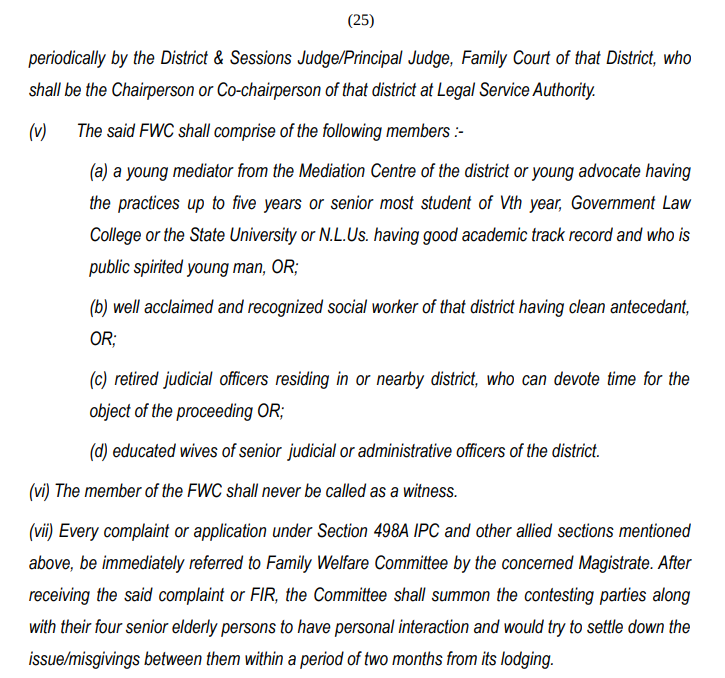
The court issued a blanket restriction on arrests for a minimum of two months after the FIR is registered. During this time, the complaint must be forwarded to a specially constituted Family Welfare Committee (FWC) in each district. These committees will be set up under the District Legal Services Authority and must consist of at least three members including retired judicial officers, trained mediators and social workers or legal professionals. Notably, any of the members cannot have any connection to the parties involved.
Source: Allahabad High Court
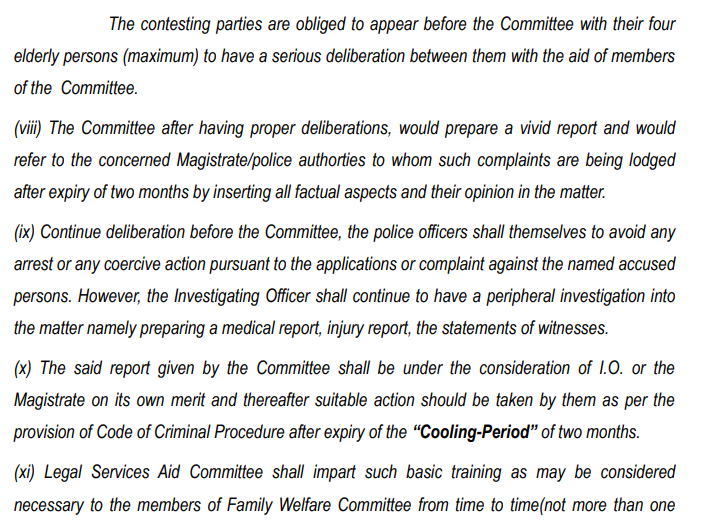
The FWCs are expected to engage with both parties and four elder members from each side. They will then submit a report within two months. Their findings are not to be used as evidence but will guide the Magistrate and police in deciding if coercive action is warranted. The police must refrain from making any arrest before receiving the report. Furthermore, the Magistrate has been directed to defer any proceedings under Section 498A IPC until the report is available.
Source: Allahabad High Court
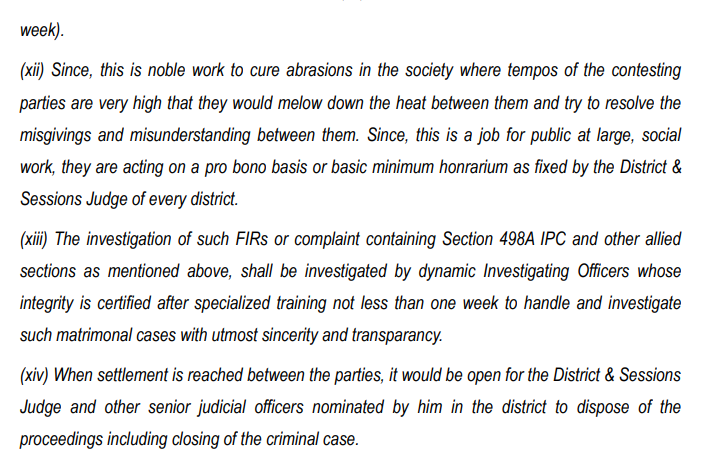
In addition, all investigating officers handling such cases are to be specially trained in matrimonial dispute resolution and are expected to act with “utmost sincerity and transparency”.
Source: Allahabad High Court
Where a settlement is achieved, the matter may be closed at the district court level, and necessary support including logistics and coordination may be facilitated by the District Legal Services Authority.
Source: Allahabad High Court
Most importantly, these safeguards only apply to cases involving Section 498A IPC or related non-heinous offences where the maximum punishment does not exceed 10 years. These safeguards will not involve cases under Sections like 307 or where grievous injury is reported.
Settlement terms and constitutional powers invoked
In the judgment, the apex court invoked its powers under Article 142 of the Constitution to dissolve the marriage between the parties. Custody of the minor daughter was granted to the mother. The father received supervised visitation rights. The court permitted him to meet the child on the first Sunday of every month at her school, and during half of the vacation period, provided no obstruction was created by either side.
The court has ordered the wife, who is serving in the IPS, to bear all expenses of the child and waived her claim to any maintenance or alimony. The Supreme Court also quashed a prior order directing the husband to pay ₹1.5 lakh per month in child maintenance.
A piece of land in Aligarh owned by the wife’s mother was agreed to be transferred to the husband by way of gift. Though litigation over the property is pending, the court recorded that the husband would assume all future responsibilities, costs, and legal proceedings relating to it. The parties also agreed to de-link from each other’s personal and professional lives, with a binding undertaking not to interfere in any future matter, directly or indirectly.
The court also ordered the wife and her parents to tender an unconditional apology to the husband and the family. The apology must be published in one English and one Hindi national newspaper. Furthermore, it has to be shared across all major social media platforms. The apex court clarified that this apology was not an admission of liability and could not be used against her in any future forum. The court provided a fixed format to the wife to be published in papers and social media.
The court quashed all criminal and civil proceedings between parties and restrained them from filing any further cases in future directly or through proxies. Social media posts, interviews and statements by either side must be deleted, and both parties were directed to refrain from making disparaging public remarks going forward.
Finally, the court issued a stern direction prohibiting the wife from misusing her official position as an IPS officer or utilising the influence of her colleagues or superiors against the husband or his family. Any breach of the agreed conditions would amount to contempt of court.
Observations on the misuse of matrimonial laws
The apex court took note of the impact of false criminal cases, observing that prolonged litigation causes deep emotional trauma and destroys the possibility of amicable reconciliation. It observed that arrest and harassment under Section 498A, without proper scrutiny, can “evaporate the traditional fragrance of our age-old institution of marriage.”
Though the judgment provides recourse for aggrieved families, the court made it clear that it does not dilute the legal remedies available to genuine victims of dowry harassment or domestic abuse. The emphasis is on procedural fairness, not denial of justice.
A major multi-state conversion gang affiliated with a Pakistani terror outfits was busted after two girls from Agra fell into its trap. The First Information Report (FIR) filed by their father uncovered the international syndicate. 13 individuals including the mastermind had been apprehended across 6 states. They were receiving financial support from multiple countries such as America, London, Canada, Qatar and the United Arab Emirates (UAE).
The bewildered father recently narrated his horrific experience to the Dainik Bhaskar. “My 33-year-old daughter, Deepali, was preparing to pursue a PhD in 2021 when she encountered Saima, a resident of Udhampur, who was also known as Khushboo. After meeting her Deepali’s behaviour began to change and told me to stop performing puja-paath,” he revealed.
He felt suspicious and tried to communicate her concerns but she limited her interactions with him. “She started to isolate herself in the room with her younger sister, Khushi, throughout the day. She would discuss another religion (Islam) with her. A few days later, Khushi also started to be influenced by her and on 24th March both of them left our home,” the man unveield.
The missing girls were located in Bengal and returned to their families. It was later disclosed that Deepali changed her name to “Amina” and Khushi took on the name “Zoya.” The father stated, “Had the police not traveled to Kolkata, the daughters would have been married.” The police successfully rescued the two girls from Kolkata who had been reported missing from the Sadar area of Agra and brought them back to their family.
He conveyed, “Deepali was preparing for her PhD in Agra when her friend Saima lured her to her home under the guise of taking her to Kashmir. She manipulated my daughter who started to say odd things upen her return. She developed a sense of aversion towards Hindu traditions.”
“Whenever there was a puja at home, she would refrain from participating. She would spend all day with her younger sister Khushi. Additionally, she began to share the advantages of performing namaz and wearing a hijab,” he added. The two sisters shared a room. Over time, her words and mindset began to influence his younger daughter. They pair conspired to run away from home and suddenly disappeared in March. Afterward, the authorities filed a kidnapping report on his complaint on 4th March.
What did the authorities disclose
A senior officer from Uttar Pradesh Anti-Terror Squad (ATS), who is part of the investigation, informed, “On 24th March, the family members had left their home and exploiting situation, Deepali traveled to Delhi with Khushi. She met Mohammad Ibrahim there and he sent both girls to Bihar and then Kolkata.
Deepali and Khushi resided in a Muslim neighborhood in Kolkata. There they met Ayesha who manipulated them to the extent that they consented to become Mujahida (female jihadi). The sisters embraced Islam through a cleric and adopted new names. The police examined their mobile phones and found out that they were in communication with Abdul Rehman.
He would engage in daily conversations with them via chat and encouragd them to convert other females. During their questioning, the cops uncovered a photograph on their social media profile in which one of them was seen holding an AK-47.
Agra Police Commissioner Deepak Kumar also informed the media about the names and former identities of the accused. Goa native Ayesha was previously known as SB Krishna and her spouse, Ali Hasan from Kolkata, was formerly Shekhar Roy. He was employed at the Kolkata court and served as a legal advisor for gang members.
Abu Rehman from Dehradun was once Rupendra Baghel while Mohammad Ali from Jaipur was a Hindu named Piyush Singh Panwar. Likewise, Mustafa of Delhi was Manoj and Mohammad Ibrahim from Kolkata was Reet Banik. All accused were interrogated individually, revealing that this gang operated in states such as Uttar Pradesh, Delhi, Uttarakhand, Rajasthan, Bengal and Goa.
Abdul Rehman and his links with Zakir Naik
Abdul Rehman who converted in 1990 operated a channel titled “The Sunnah” where he produced podcast videos focused on Islamic literature and individuals associated with the Muslim faith. The channel features 1000 uploaded videos and garnered approximately 1.7 lakh subscribers. The Agra Police have discovered large quantity of literature pertaining to conversion at his house.
It included books authored by Zakir Naik and Kaleem Siddiqui regarding conversion. Abdul Rehman himself authored several books on Islam, including “Islam aur Bahujan Sama,” “Terrorism aur Islam” and “Returning Your Trust.” The authorities are probing if has any ties to fugitive Islamist Zakir Naik.
He was associated with Maulana Kaleem Siddiqui of Muzaffarnagar and took control of his gang after he and his campanions were incarcerated, last year. The former was known as “Rehman Chacha” among the members.
The arrested individuals had diverse roles within the network including fundraising, channeling funds, offering legal advice for conversion, obtaining new phones and SIM cards, luring Hindu girls into love traps and drafting legal documents for religious conversion. A secret operation led to their capture by 11 teams of 45 officers.
This gang utilized funds from abroad to recruit young people, especially girls, by enticing them with job offers in Gulf countries. They provided financial support, housing and valuable items to perpetrate their agenda. On 23rd July, UP ATS arrested two more members of the gang in Delhi. Abdullah and Abdul Rahim, sons of Abdul Rahman were involved in supporting his activities. Significant intelligence leads have been discovered on their devices.
After the initial inquiry, the police reported that the gang which is involved in “love jihad” and the radicalization of young Hindu women and men. It operates similarly to Islamic State of Iraq and Syria. There are indications that it has ties to Pakistani terrorist organizations as well. Gang leader Abdul Rehman also known as Mahendra Pal Jadoun and SB Krishna alias Ayesha have converted hundreds of individuals thus far. The two were Hindus before embracing Islam.
Notably, Maulana (Muslim cleric) Kaleem Siddiqui who is already behind bars in a similar case, is the original mind behind the group which also has ties to Popular Front of India (PFI) and Social Democratic Party of India (SDPI).
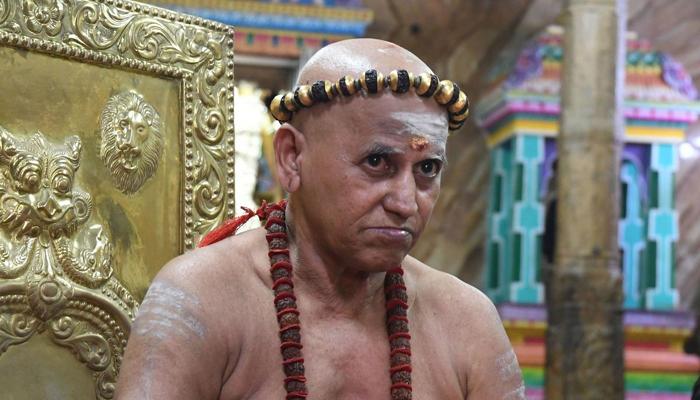
The DMK government in Tamil Nadu has been accused of using the police department to harass certain leaders. The poloce department recently appealed to the Madras High Court to cancel the anticipatory bail granted by the Chennai Principal District and Sessions Court to Madurai Adheenam Harihara Gnanasambanda Desigar. The advanced bail cancellation pleas were approached before Justice M. Nirmal Kumar on Wednesday, July 23, but the hearing could not be taken up shortage of time.
Tamil Nadu BJP says police department has petitioned court to cancel the anticipatory bail granted to Madurai Aadheenam only to torment the pontiff.
Inspector of Police B. Padmakumari said in the affidavit filed in support of the plea that due to the ‘non-cooperation’ of the pontiff with the investigation, the authorities urged for the cancellation of the anticipatory bail granted to him by the session court.
The FIR was registered under Sections 192 (wantonly giving provocation with intent to cause rioting), 196(1)(a) (promoting enmity between different groups on grounds of religion), 353(1)(b) (statements conducing to public mischief) and 353(2) (making false statements in order to create communal enmity) of the Bharatiya Nyaya Sanhita (BNS) on June 24.
Following this, the police called the pontiff for an inquiry on June 30. However, he asked for 20 days time giving old age and poor health condition. This led to summoning him on July 5 but this time he sought to appear through video call. His plea was soon rejected as the Bharatiya Nagrik Suraksha Sanhita (BNSS) does not permit such a facility for police inquiry.
What does the TN BJP say
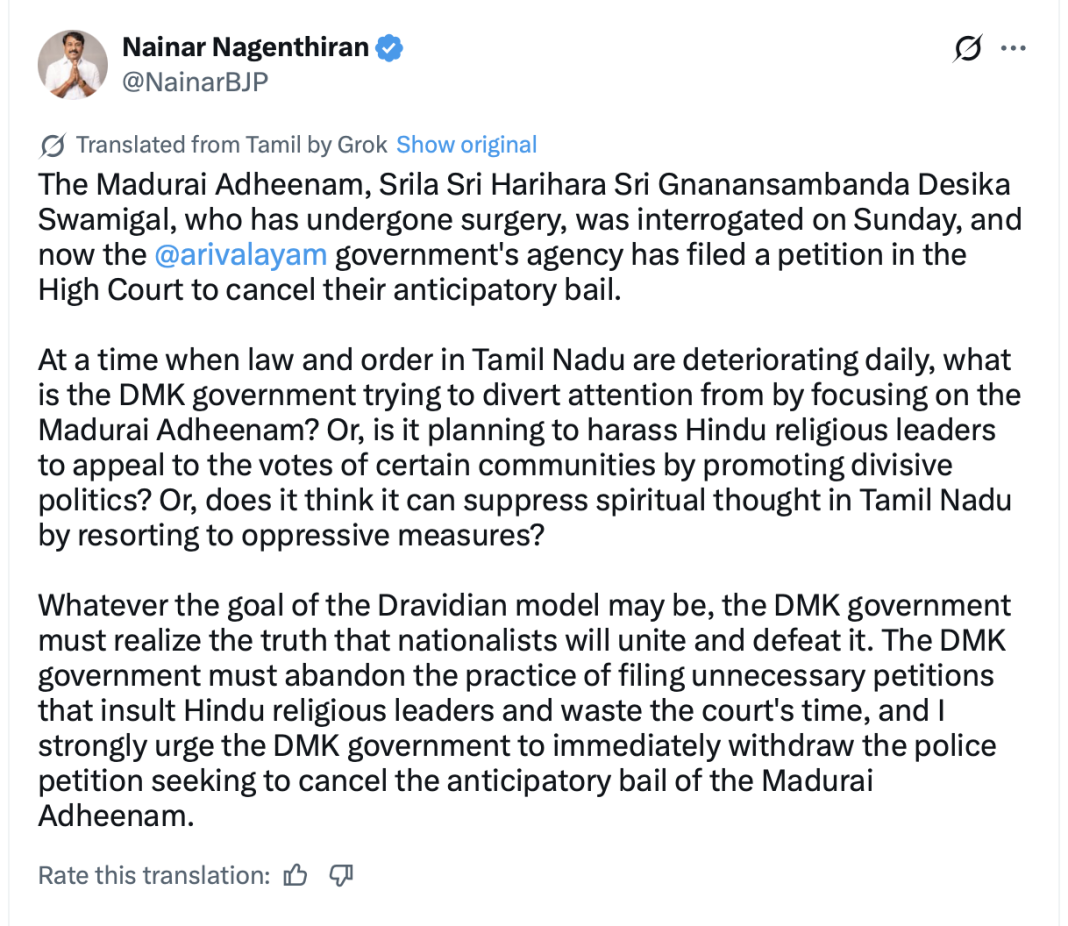
BJP president Nainar Nagenthiran, in response to the petition filed by the police department against the cancellation of the anticipatory bail granted to the Madurai Aadheenam, questioned “what issue the DMK regime wished to divert by focusing on the pontiff”?
In the social media post, he said, Or, does the DMK regime plan to garner the votes of some particular communities by causing agony to Hindu pontiffs by taking forward divisive politics? Or, does the DMK government attempt to block spiritual thought in Tamil Nadu by taking up authoritarianism?” “Whatever may be the idea of the Dravidian model government, nationalists would come together to shatter it, and the DMK government must realise this truth.”
Screenshot from X
He further urged the state government to withdraw its petition in court. “The DMK government must give up the practice of insulting Hindu religious leaders and the court’s time by filing such petitions in the court.”
Former BJP state president K Annamalai called the action of the state ‘strongly condemnable’.
The BJP leader further highlights the deteriorating condition of the law and order situation across the state of Tamil Nadu by noting that the pending case of the sexual assault of a child where no arrests have been done yet. “The offender of the crime is yet to be arrested. He stated, the police have no time to question the kidney thieving gang. The police department itself faces a situation of a lack of security due to the DMK persons. “When this is the situation, the DMK regime is enacting drama to satisfy some in the name of secularism by coming up with flimsy reasons to target the pontiff,” he said.
What was the case?
Madurai Adheenam alleged that while en route to a Saiva Siddhanta conference, his car was hit by another vehicle near the Ulundurpet-Salem roundabout, which then fled the scene. At a subsequent press conference, he claimed it was a conspiracy to murder him and suggested a possible link to Pakistan. He also stated that the occupants of the other vehicle wore traditional Muslim caps and had beards. His comments quickly went viral on social media.
However, CCTV footage and the police investigation indicated that Adheenam’s vehicle was overspeeding, and the other car had actually stopped after the collision. Disturbed by these remarks, Chennai-based advocate Rajendran lodged a complaint with the cybercrime police, arguing that such statements could fuel communal tensions. A case was registered, prompting Adheenam to seek anticipatory bail.
On Saturday, the Chennai Principal Sessions Court granted conditional anticipatory bail to the Madurai Adheenam, observing that while his claim of a murder attempt involving Pakistan appeared exaggerated, it did not prima facie amount to hate speech. Judge S. Karthikeyan noted that the Adheenam’s comments lacked a clear intent to incite communal hatred. He also pointed out that the controversy largely stemmed from persistent questioning by media personnel. The court instructed the Chennai Crime Branch to release the Adheenam on bail if arrested or upon his appearance, adding that due to his age above 60, he should not be required to attend any inquiry outside his place of residence.
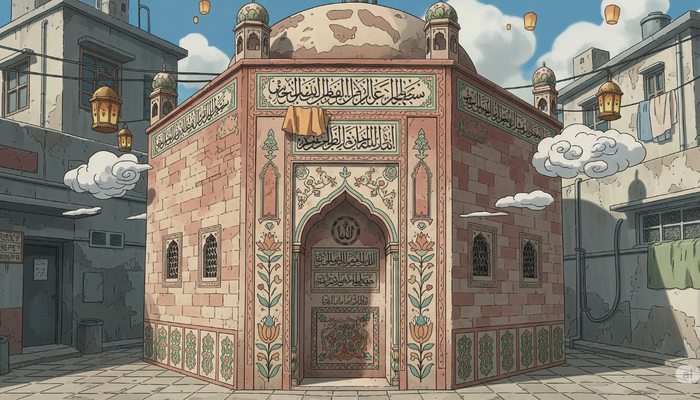
The Bombay High Court dismissed an interim application filed by Gazi Salauddin Rehmatulla Hoole, alias Pardeshi Baba Trust, which challenged an earlier order of the court directing the demolition of an illegal Dargah in Thane, Maharashtra. The High Court on April 30, 2025, had ordered the demolition of the Dargah, which expanded across 17,610 sq. ft from mere 160 sq. ft., sans the approval of the municipal corporation.
While dismissing the petition, a bench of justices Ajay Gadkari and Kamal Khata said, “We are unable to accept that a mob fury and the mere footfalls of people on a particular piece of land based on an assertion that this is a Dargah can prove that it is a legal structure. This is a classic case of a usurpation of the land, and such a method and for such a usurpation, the Court cannot grant its imprimatur.”
The Supreme Court directed the Trust to avail appropriate legal remedy
The application was filed in pursuance of a Supreme Court order, dated July 17, 2025, that directed the Trust to avail an appropriate legal remedy by approaching the High Court and seeking a recall of its earlier judgment. The Apex Court granted a seven-days status quo on the Dargah, allowing the Trust time to approach the High Court. The Trust had contended before the Supreme Court that the decision of the High Court was flawed because it did not take into consideration the fact that a civil suit filed with respect to the Dargah was dismissed in April 2025. It argued that only 3,600 sq. ft. of the construction was disputed and not the entire 17,610 sq. ft.
A party coming to court must come with clean hands: HC
In the present interim application before the High Court, the applicants claimed that the Dargah existed on the site even before 1982. However, the High Court, in its judgment dated July 9, 2025, rejected the applicants’ claim and said that the land was usurped by the Trust. “In our view, the Applicants have neither paid any consideration for the acquisition of the land nor have they taken any permission for constructing the structure. It is clearly a usurpation of rights based on a mere Notice publication by the Assistant Charity Commissioner. We find no merit in the contention that, by virtue of a Public Notice by the Assistant Charity Commissioner, one can claim ownership of structures and lands and thereby preempt the rightful owners from claiming the right to their property or objecting to illegal constructions being done on their property,” the High Court said.
Slamming the Trustees, the High Court said that the they did not take any permission for any construction at all. “A party coming to a Court must come with clean hands. He must state and produce all facts and documents on record to prove his ownership as well as the permissions taken for the construction of a structure,” the court said.
“Admittedly, there is no permission taken by the Applicants for even a single square foot of construction. Admittedly, the so-called structure has been increased to a humongous structure of more than 20,000 sq. ft. Such a party, in our view, cannot claim any equities. The claim of a structure being a Dargah must be proved by the Applicants in appropriate proceedings before the jurisdictional Civil Court. There is nothing produced to prove that this was a Dargah prior to their being registered as a charitable institution and being the owner of this structure,” the court added.
Applicant must independently prove ownership: HC
Regarding the civil suit relied on by the applicants, the High Court said that the a mere dismissal of a suit filed against the Defendant (current applicant ) does not confirm any right of the Defendant on the structure or the land. “The Applicant must independently prove the right to the structure as well as the land to in order that the Court would direct protection of the structure,” the court said.
The High Court noted that the Joint Civil Judge Senior Division, Thane, held in the suit that the Trust encroached upon the land in question. “The Judgment also clearly shows that the Defendants (current applicant) have failed to prove their title to the suit land either by a conveyance or by adverse possession,” the High Court said. “Interestingly, the Judgment observed that the contention of the Applicants was that the present Writ Petition was regarding a different property and not the same as Dargah. Therefore, the Applicants has himself admitted that the Dargah pointed out in the Government Gazette of the year 1982 is on a different property and not on the property for which the Writ Petition was filed and Orders were passed,” the court added.
The judges also took notice of the fact that the Trustees were granted ample time by the municipal corporation to respond to demolition notices but the they failed to appear for the hearing. The court pointed out that the argument of the Trustees was that a public notice issued by the Charity Commissioner, through which they claimed the ownership of the structure as Darga, was not objected to by anyone. But the Trustees could not produce any evidence to show that they possessed the structure.
“In view of the aforesaid, the structure deserves to be demolished at the earliest and in any event within a period of two weeks from the date of the uploading of this order on the official website of the Bombay High Court,” the court ordered.
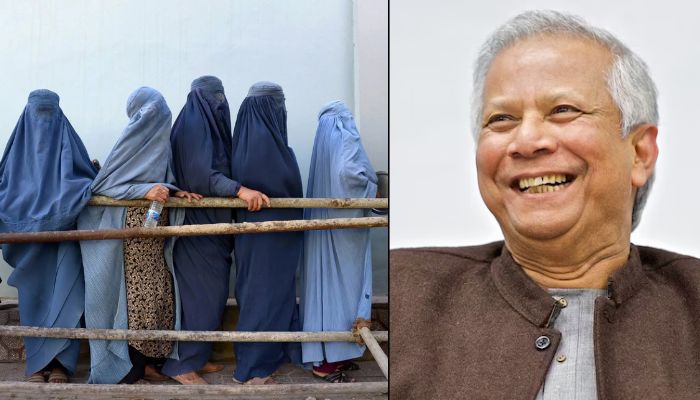
Bangladesh is gradually descending into the jaws of Islamism under the watch of ‘chief advisor’ to the interim government, Muhammad Yunus. The situation is so grim that comparisons are being made with the Taliban rule, and genuine fears are being expressed about the country turning into Afghanistan.
On 21st July this year, the ‘Bangladesh Bank’ gave a Talibani farman (diktat) barring female employees from wearing ‘short dresses’, ‘short sleeves’ and ‘leggings’. The directive by the Central Bank of Bangladesh also recommended that women wear headscarves and hijab.
‘Bangladesh Bank’ also warned of disciplinary actions against employees who refuse to adhere to the new guidelines. Within less than a year of the fall of Sheikh Hasina, the Central Bank of Bangladesh has resorted to imposing restrictions on the clothing of women.
The outrageous directive has drawn flak from women groups. Fauzia Moslem, who serves as the President of the Bangladesh Mahila Parishad pointed out, “I’ve never seen such a directive before. But considering everything happening now, it’s not hard to guess why this guideline was introduced.”
“A certain cultural sphere is being shaped, and this directive reflects that effort,” she added. After the Talibani farman of the ‘Bangladesh Bank’ caused a social media stir, the directive was withdrawn on Thursday (24th July).
“When this internal matter came to the notice of the governor, who is currently abroad, through the media, he expressed his anger and instructed that the matter be withdrawn immediately. Hopefully, this circular will not reduce anyone’s freedom of dress code in the office,” the Central Bank of Bangladesh said in a press conference.
New found love for Taliban and plans to turn Bangladesh into Afghanistan
This diktat by ‘Bangladesh Bank’ bore an uncanny resemblance to the orders by the Taliban regime in Afghanistan, restricting women from wearing clothes of their choice.
While the situation in Bangladesh does not look as grim as Afghanistan for now, the new found love for Taliban lays the foundation for more restrictions on women in the upcoming days.
Islamists had previously unleashed havoc on university teachers in Bangladesh by labelling them as ‘anti-hijab.’ The day is not far when women and girls in Bangladesh will be arrested for showing their face in public as is the case in Taliban-ruled Afghanistan.
Earlier this month, an Islamic outfit named ‘Jamaat-Char Monai’ announced its plans to turn Bangladesh into a Sharia-compliant nation like Afghanistan. It also vowed to follow the model implemented by the Taliban regime.
The organisation’s leader Mufti Syed Muhammad Faizul Karim declared, “If govt is formed by winning the national election, the Islamic Movement Bangladesh will introduce Sharia law in the country.”
“The current governance system of Afghanistan will be followed. If we come to power, Hindus will also get rights in Sharia law that we will introduce,” he added.
Declining respect and freedom for women in Bangladeshi society
In April this year, Muslims belonging to the radical outfit ‘Hefazat-e-Islam’ hung the effigy of a woman, stripped and defiled it with shoes to demand the abolishment of the Women Affairs Reform Commission in Bangladesh.
The incident occurred at the campus of the University of Dhaka near the iconic ‘Anti Terrorism Raju Memorial’ sculpture.
In a deleted video shared by Khoborer Kagoj, Muslims were seen assaulting an effigy of a woman, defiling and kicking it and thrashing it with shoes to display their angst. The effigy of the woman was draped in a saree (the kind that Hindu women wear) with its hands tied behind.
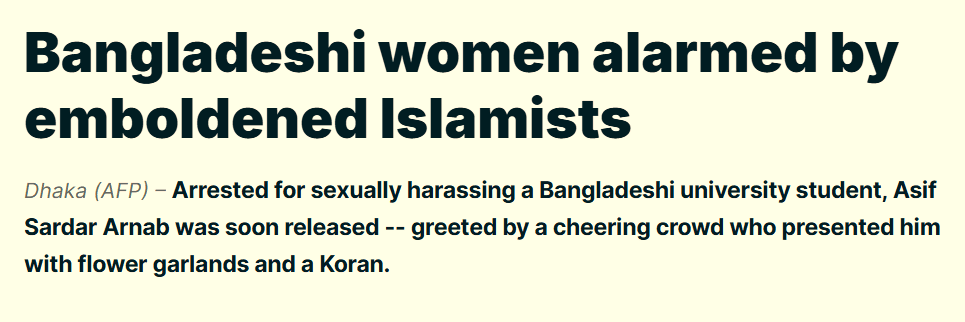
In March 2025, a librarian at Dhaka University, identified as Asif Sardar Arnab, sexually harassed a female student. Although he was initially arrested, Asif was quickly released on bail.
He was cheered and greeted with garlands by a radical Muslim mob, aligned with his behaviour. In the meantime, the victim had been subjected to violent threats for speaking out against the accused.
Asif sexually harassed the female student, claiming that her dress did not ‘sufficiently cover’ her breasts. His action was praised by Muslims for enforcing Islamic morality.
Screengrab of the report
In January this year, a Muslim mob laid siege to the Tilakpur High School in Joypurhat district of Bangladesh. The extremists, comprising madrassa students, carried out vandalism to protest against a friendly football match between two women’s teams.
The match was scheduled to take place on 29th January at the playground of the Tilakpur High School between the Joypurhat and Rangpur women’s football teams.
In visuals that have surfaced on social media, the Muslim mob could be seen vandalising the tin fence of the school. Prior to carrying out the attack, they gathered outside the Tilakpur railway station and gave provocative speeches.
Muslims carry out vandalism, destroy tin fence of Tilakpur High School
The mob demanded the cancellation of the women’s football match, alleging non-observance of purdah. Thereafter, the extremists made their way to the Tilakpur High School and unleashed mayhem.
A radical Muslim declared, “I want to warn those who want to earn money by exposing our women. Be careful. Stop all women’s games in the future. If you don’t stop, then we will show our resistance.”
OpIndia had previously reported on the alarming rise of rape cases in Bangladesh under the watch of Muhammad Yunus. In the meantime, Islamists who committed heinous crimes against women were freed by the top court of the country.
Muhammad Yunus tired to appease Islamic extremists
Bangladesh witnessed a drastic rise in Islamism after Yunus came to power. He first revoked the ban on the radical Islamist outfit ‘Jamaat-e-Islami.’
Thereafter, he released the leader of the radical outfit ‘Ansarullah Bangla Team (ABT)’ Muhammad Jasimuddin Rahmani.
At the same time, Muhammad Yunus downplayed the targeted attacks on the Hindu community by violent Muslim mobs. He has gone on record from lamenting about attacks on Hindus to saying that the claims of atrocities are ‘exaggerated‘.
In that way, the controversial US asset was able to placate Islamic extremists. Given that Awami Legaue was against Islamism, the interim government first banned its student wing ‘Chhatra League,’ and then the parent party.
Under the watch of Muhammad Yunus, Bangladesh saw a drastic rise in vigilante Muslim mobs, which unleashed violence under the pretext of protecting the tenets of Islam.
These mobs were largely unorganised and called themselves ‘Tawhidi Janata (meaning Revolutionary People).’ They came under the spotlight over acts of vandalism and harassment of people.
The Yunus regime introduced new textbooks for primary and secondary students, which falsely claimed that the first declaration of independence of Bangladesh was made by Ziaur Rehman (a favourite icon of Muslim hardliners in Bangladesh).
The interim government also appointed a Hizb ut-Tahrir terrorist named Mohammad Azaz as the administrator for the Dhaka North City Corporation (DNCC).
The situation had become so grim that Bangladeshi ambassador to Morocco Mohammad Harun Al Rashid was forced to slam the Muhammad Yunus-led interim government in a scathing Facebook post in March 2025.