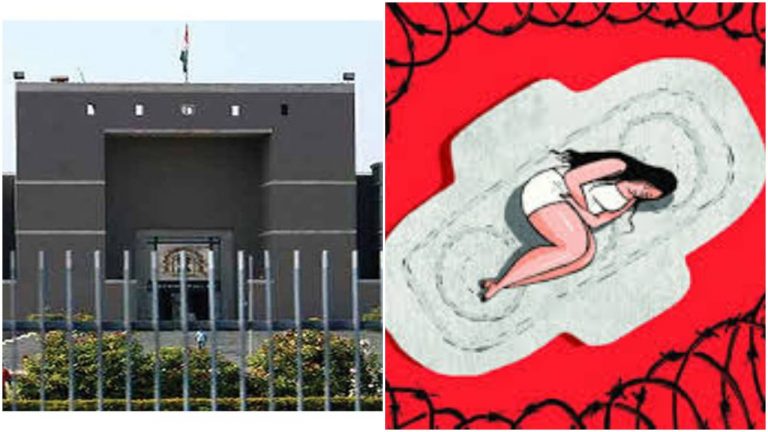
In an order that could bust the stigma around the menstrual cycle, which continues to lead to exclusion and discrimination of women in society, the Gujarat High Court has offered guidelines to the state government to break the taboo around menstrual health for women and girls that persists in many parts of the country. The court also directed to undertake concrete action to end this discrimination at all places, be it private or public, religious or educational.
The court specified that all religions (excluding Sikhism) refer to a menstruating woman as “ritually unclean” and asked the government in the state to concrete steps to break this taboo and create awareness to bust the myths that surround menstruation in society.
Proposing to prohibit the social exclusion of women on the basis of their menstrual status, the two-judge bench of Justice J B Pardiwala and Justice Ilesh J Vora issued a nine-point guideline to the state government in which it asked the latter to spread awareness among various strata of citizens, including health workers, adolescents, parents and other such stakeholders, regarding the social exclusion of women based on their menstrual status.
The HC proposed that this awareness can be created through various mediums like putting up posters at public places, including it in the school curriculum, using audiovisual mediums like radio, entertainment or news channels, short films etc.
Observing that “such taboos about menstruation present in many societies impact on girls’ and women’s emotional state, mentality and lifestyle and most importantly”, the court asked the govt to devise strategies to educate and create awareness among the adolescent girls related to menstrual health and hygiene.
The Gujarat High Court also proposed for sensitization of health workers, Accredited Social Health Activists (ASHA) and Anganwadi Workers pertaining to the biological process involved in menstruation biology. The court said that this would help them to “further disseminate this knowledge in the community and mobilize social support against busting menstruation-related myths.”
“The State Government should prohibit all educational institutions, hostels and living spaces for women-studying working and others, private or public, by whatever name called, from following social exclusion of women on the basis of their menstrual status in any manner…The State Government should undertake surprise checks, create an appropriate mechanism and to take such other actions, steps as may be necessary to ensure its compliance including the imposition of an appropriate penalty against the erring institution,” the HC noted.
The bench headed by Justice J B Pardiwala also asked the state government to allocate necessary funds for the implementation of the directions.
The plea before the Gujarat High court
The court made these observations while hearing a PIL filed by Nirjhari Mukul Sinha seeking direction for a law to specifically deal with the exclusionary practice against women on the basis of their menstrual status.
The petition was filed in the aftermath of an incident that occurred in the month of February where 68 girls in a hostel of Shree Sahjanand Girls Institute in Bhuj town of Kutch were paraded through the college into the restroom and forced to remove their undergarments to prove that they were not menstruating.
The bench issued notice to the state and union governments as well as Sahajanand Girls Institute and Nar Narayan Dev Sansthan in Ahmedabad (the Swaminarayan sect of Bhuj that runs the college). The bench has also sought the opinion of the state and central government on the court’s proposed set of guidelines asking both to respond by March 30.
The investigating team probing the alleged murder of Mansukh Hiren believe that his killers were hoping that the dead body would not be found for a couple of days. However, due to low tide, the body surfaced in the creek.
46-year-old Mansukh Hiren’s allegedly stolen vehicle was found outside the house of business tycoon Mukesh Ambani’s residence Antilia on February 26. Hiren was found dead in a Kalwa creek near Reti Bandar in Thane on March 5. A case was registered on March 8 by the Maharashtra Anti-Terrorist Squad under sections of murder and criminal conspiracy.
When Hiren’s body was found, initially, the police speculated that it was a case of suicide. However, they found that his face mask was intact and several handkerchiefs stuffed in his mouth that raised suspicions. The Indian Express quoted a police officer investigating the case saying that it is unlike that a person would commit suicide with the mask on to save himself from Covid-19.
It is possible Mansukh Hiren was killed first and then thrown in the water
Police believe that there were more than one killers. They stuffed his mouth with pieces of cloth to prevent water from entering his body so that it does not surface quickly. The police said that they are certain that Hiren was killed first, and then his body was thrown in the creek.
The officer said that when water enters a dead body, it becomes bloated and rises up to the surface. “We suspect the mask and handkerchiefs were put in to prevent water from entering the body. This would ensure that the body did not emerge and take a few more days for it to be discovered,” the officer added.
However, the body surfaced as the alleged killers could not factor in the low tide while throwing it in the creek. The officer said that during low tide, the body got stuck and was spotted. “It does not appear that it came floating from somewhere far,” the officer added.
Killers tried to throw police offtrack
Hiren was using two mobile phones. The police believe that the killers used these phones to throw the police off track. When police tracked the movement of these mobile phones, they found that the phones were switched on and off 30 minutes apart on the night Hiren got missing. One of the phones was switched on and off in Vasai-Vihar. The second phone was switched on and off at Tungareshwar.
Vasai-Vihar is around 40 KM away from Naupada in Thane, where Mansukh Hiren lived and had his car décor business. Tungareshwar is located 10 KM further away from the location. On the other hand, Kalwa creek is just 5 KM from Thane. Police believe that the killers switched on and off his phones on far locations to create false location indicators for Hiren. The officer said that it would have given an impression that Hiren had gone to those spots. “In reality we suspect, he was murdered by then, and his body had already been dumped into the creek,” he added.
Hiren had left his shop after receiving a call
During the investigation, the police found that Hiren had left his shop on March 4 after receiving a call from someone who identified himself as Tawde from Crime Branch. When Hiren did not return home late, his family members tried to call him, but his mobile phones were switched off.
His son filed a mission person’s complaint at Naupada Police station in Thane. On March 8, the National Investigation Agency took over the terror scare case outside Ambani residence from ATS. The death of Hiren and Vehicle theft case will be handled by ATS.
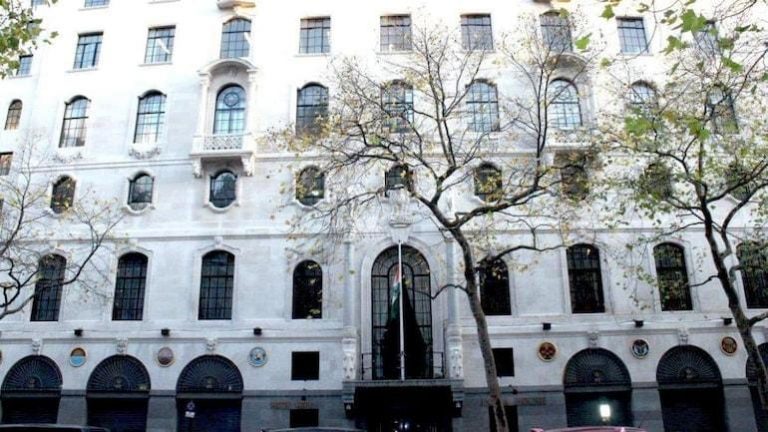
The Indian High Commission in London has issued a strong statement against British Parliamentarians over comments made regarding a petition on an India-related issue. The statement by the High Commission comes a day after the British MPs made adverse comments against India over press freedom, freedom of speech and domestic values.
High Commission of India would normally refrain from commenting on an internal discussion involving a small group of Parliamentarians in a limited quorum. However, when aspersions are cast on India by anyone, there's need to set record straight: High Commission of India in London pic.twitter.com/4YNKZmLVBC
The Indian High Commission said in its statement, “We regret that rather than a balanced debate, false assertions – without substantiation of facts – were made, casting aspersions on the largest functioning democracy in the world and its institutions.”
“All issues raised are the remit of well-established independent democratic institutions in India for addressing the same. It is also a matter of concern that, once again, comments were made to mislead the British Indian community, raising doubts about treatment of minorities in India, alleged human rights violations in ‘Kashmir’ etc.,” the statement said.
Befittingly, the statement said, “High Commission of India would normally refrain from commenting on an internal discussion involving a small group of H’ble Parliamentarians in a limited quorum. However, when aspersions are cast on India by anyone, irrespective of their claims of friendship and love for India or domestic political compulsions, there is a need to set the record straight.”
Since the ‘farmers protests’ gained global attention due to a campaign by Khalistanis, certain politicians abroad have chosen to interfere in the internal matters of India motivated by their own political concerns. Far-Left politicians in western countries, especially the United Kingdom, USA and Canada have regularly made misleading comments to secure their own political future.
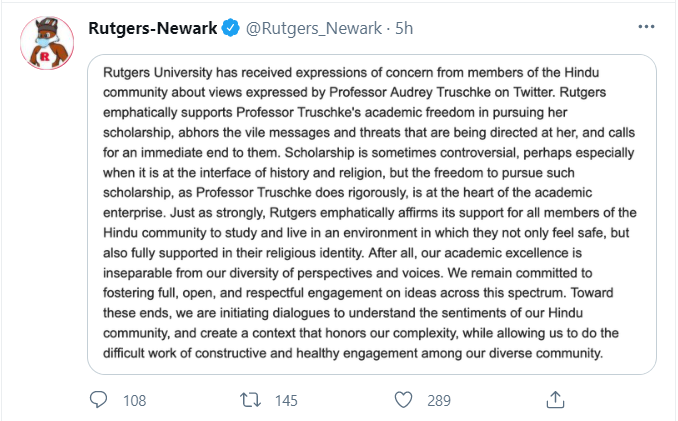
Days after a group of students initiated a petition asking Rutgers-Newark University to take strong action against controversial ‘historian’ and Professor Audrey Truschke for demonising Hinduism, the institution has instead decided to whitewash her vile and bigoted anti-Hindu remarks as ‘academic freedom’. The petition was shared on Twitter by the ‘Hindu on Campus’ group.
The petition accuses Truschke of portraying all Hindus as “lustful and sex obsessed” and ‘cow piss drinkers’. The petition also says that she has whitewashed the genocide of Hindus by Mughal king Aurangzeb.
In a statement released on Tuesday, the university said, “Rutgers emphatically supports Professor Truschke, academic freedom in pursuing her scholarship, abhors the vile messages end threats that are being directed at her, and calls for an immediate end to them.” To further justify its support for the controversial historian, Rutgers cited the significance of ‘academic freedom’ in scholarship.
“Scholarship is sometimes controversial, perhaps especially when it is at the interface of history and religion, but the freedom to pursue such scholarship, as Professor Truschke does rigorously, is at the heart of the academic enterprise,” the university said. Instead of cracking down on the anti-Hindu Professor, Rutgers chose to give a consolation prize to the Hindu community.
Statement released by Rutgers-Newark
It said, “Just as strongly, Rutgers empathetically affirms its support for all member of the Hindu community to study and live in an environment in which they not only feel safe but also fully supported in their religious identity.” Far from condemning the controversial historian for her Hinduphobic remarks, Rutgers extended its full support to Audrey Truscke through shrewd monkey-balancing.
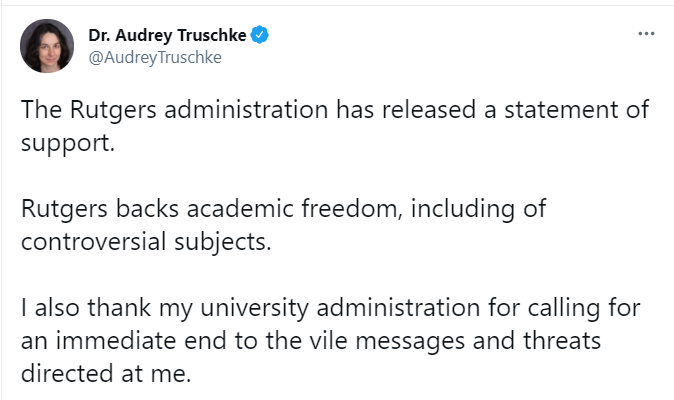
The university concluded, “Toward these ends, we are initiating dialogues to understand the sentiments of our Hindu community and create a context that honours our complexity, while allowing us to do the difficult work of constructive and healthy engagement among our diverse community.” Following the support from her own Institute, Audrey Truschke thanked the university administration for backing ‘academic freedom’.
Screengrab of Audrey Truschke’s tweet
“The Rutgers administration has released a statement of support. Rutgers backs academic freedom, including of controversial subjects. I also thank my university administration for calling an immediate end to the vile messages and threats directed at me,” the ‘historian’ emphasised.
Audrey Truschke denies Hindu genocide, Rutgers hails it as ‘academic freedom’
In its petition, the group of Hindu students, studying at Rutgers-Newark pointed, out that Audrey Truschke tired to trivialise and downplay the Hindu genocide, committed by the Mughal tyrant Aurangzeb. She had claimed that “such numbers are often exaggerated as there was really no way of knowing how many people existed in India at that time; and that people of that time made up numbers!”
This is despite the fact several trust-worthy sources estimate that a total of 4.6 million Hindus were murdered and enslaved by Aurangzeb alone. The petition emphasised, “Prof. Truschke, who claims to be a responsible historian conveniently decided to whitewash such horrific statistics. In other instances, Prof. Truschke has defended the Mughal King by saying that he protected more Hindu temples than he destroyed and that he increased Hindu participation at the elite levels of the Mughal state.”
Audrey Truschke’s anti-Hindu stance is not new. In 2018, the ’eminent’ historian had falsely claimed that Lord Ram was called a ‘misogynist pig’ by Goddess Sita during ‘Agnipariksha’. By sidelining with Truschke, the Rutgers university not only endorsed the vicious lies peddled by the so-called historian but also cast aspersions about the Hindu genocide committed during the rule of Aurangzeb.
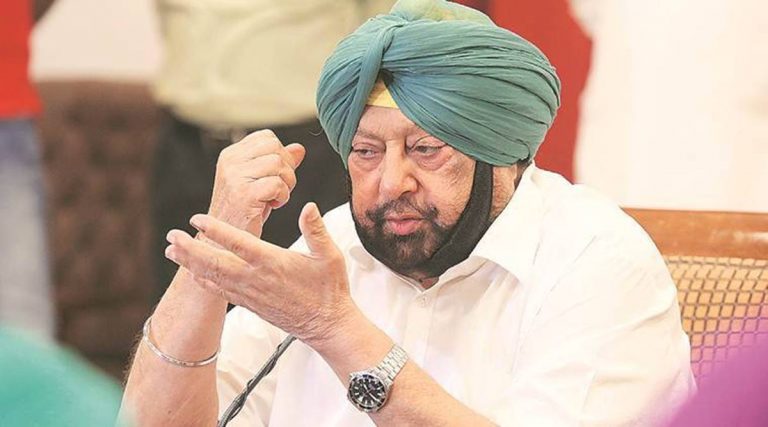
Punjab chief minister Captain Amarinder Singh on Monday confirmed long-held suspicions that he is more concerned with the interests of the middlemen in the state than that of the farmers when he termed the centre’s move on direct payment to farmers for crop procurement as “another provocation” that would aggravate the ongoing crisis over the farm laws.
Singh alleged that the ‘indifferent attitude’ of the government of India would not help in resolving the imbroglio. He asserted that the Centre’s attempts to seek land records for making e-payments to the farmers directly in their bank accounts from the Food Corporation of India(FCI) would only serve to worsen the current situation.
Punjab CM contended that instead of amicably solving the issue, the Centre was needlessly fuelling further angst among the farmers by asking for land records to make e-payments.
Significantly, the FCI has written to the state government seeking land records to make direct payments to farmers for crop procurement.
It is worth noting that Punjab CM’s criticism over the central government’s move to make e-payments to the farmers is rooted in the threat that direct payments pose for the longstanding system that is in place in Punjab since 1967 where farmers get paid through ‘Arhtiyas’ (commission agents). The centre’s move could hamper the “excellent relations” that the farmers share with the Arhtiyas, on whom they depend for financial support in times of adversity, he said.
How can the farmers depend on big corporate houses to bail them out of their financial crisis, the Punjab CM asked.
Essentially, the Punjab chief minister is worried about the interests of the middlemen, instead of the farmers, who would directly get their payment in their bank accounts from the government and will not have to rely on the arhtiyas for their money.
Punjab Arhtiya Association calls for a strike to oppose the centre’s move for direct online payments to farmers
Interestingly, after the FCI sought land records of farmers from the Director of the Food, Civil Supplies and Consumer Affairs Department in order to make direct online MSP payment to farmers’ bank accounts, the Punjab Arhtiya Association last week announced that they would go on a strike to oppose the move.
The association also held that arhtiyas would stop procurement of wheat from next month as a mark of protest. The association claims that the centre is targeting them for extending their support to the ‘farmers’ protests.
The President of the Punjab Arhtiya Association, Ravinder Cheema, had said last week that they are calling a meeting of arhtiyas to decide on what programmes to undertake as a part of the strike starting this week. He also alleged that the Punjab government has a role in it as it is not giving in writing to the Centre that as per the state APMC act, the farmers have the option to get payment directly in their own accounts or through cheques, which are provided by the arhtiyas.
“We will also carry out a dharna against the state government at Chandigarh if it has not made it clear to the Centre that its own APMC Act gives choice to the farmers for the payment mode,” Cheema said.
India is one of the few countries leading the global battle against the deadly coronavirus that first emerged in the central Chinese city of Wuhan in December 2019 and has so far affected more than 117 million people across the world and caused over 2.59 million deaths.
No sooner did the coronavirus sweep the world, Indian organisations, in collaboration with foreign institutes, initiated efforts to develop a vaccine that could stop its relentless march. Pune-based Serum Institute of India won the license of manufacturing Oxford’s AstraZeneca COVID-19 vaccine. Another Hyderabad-based organisation, Bharat Biotech, indigenously developed another vaccine to tame the rampaging pandemic.
Earlier in January 2021, almost 14 months since COVID-19 emerged, the Indian drug regulatory body approved the emergency use of the two COVID-19 vaccines made in India. Days later, India commenced the first phase of its ambitious vaccination drive which included 3 crore healthcare workers and the front line workers.
On March 1, almost a month and a half after its first phase of vaccination drive, India entered the second phase of the drive when people above the age 60 and select people above the age of 45 who are suffering from underlying illnesses were eligible to get the vaccination at thousands of government and private vaccination centres across the country.
The vaccination drive has been a runaway success, with glowing reviews pouring in from across the country about the way the government has handled the immunisation campaign. Beneficiaries are to register themselves at the CoWIN platform or Aarogya Setu app to schedule their vaccine appointment. Private hospitals were allowed to charge up to Rs 250 per dose of the COVID-19 vaccine while the jabs were free of cost at the government centres.
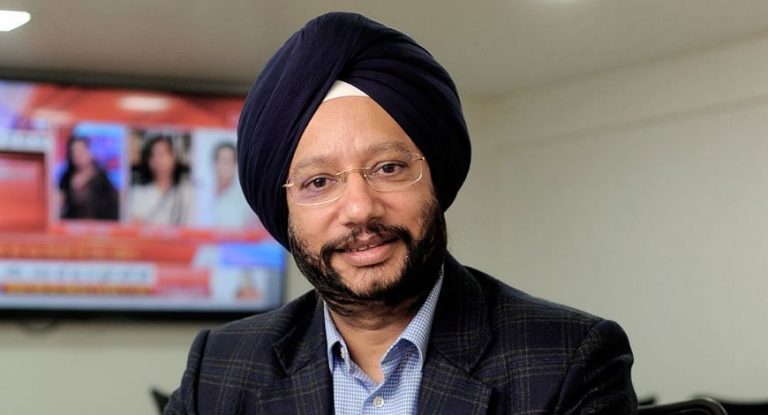
However, some inveterate detractors, consumed by the anti-government hatred and perturbed by the success of the vaccination drive, tried to undermine the vaccination drive by nitpicking about the nominal price charged for the vaccine. One such individual was ex-CEO and Editor-in-chief of Rajya Sabha TV Gurudeep Singh Sappal.
In a post uploaded on popular microblogging website Twitter, Sappal drew a ludicrous comparison between the vaccination drive for COVID-19 with immunisation programme run for other diseases such as Smallpox, BCG, Polio, DPT, Measles and OPV.
As Covid vaccination progresses, let remember once again that entire India had:
Was done as a duty, without propaganda & without high petrol taxes!
— Gurdeep Singh Sappal (@gurdeepsappal) March 7, 2021
“As Covid vaccination progresses, let remember once again that entire India had: Smallpox vaccine free, BCG free, DPT free, OPV free, Measles vaccine free, Polio vaccine free. This was done even when India was poorer. Was done as a duty, without propaganda & without high petrol taxes!” Sappal tweeted.
Sappal draws an absurd parallel between vaccinations of dwindling diseases with that of a raging global pandemic
Besides accusing the Centre of using the COVID-19 vaccination for propaganda purposes, Sappal insinuates that the immunisation programme for the coronavirus pandemic should have been free of cost just like the government had undertaken vaccination campaigns for Smallpox, Measles, DPT, Polio and others.
For starters, it is profoundly foolish to compare the vaccination programs carried out for diseases that are on the ebb across the world with an immunisation drive launched to curb a raging global pandemic. Moreover, when free vaccination programs for the above-mentioned diseases were launched in India, most parts of the world had already gotten rid of those maladies. They were not rampaging ailments ready to engulf the entire world as is the case with COVID-19. In fact, they were dwindling infections prevalent largely among the developing nations.
In most cases, only after the developed world had administered the vaccines to all of its citizens and had completely eliminated the diseases, the surplus doses of the vaccines were doled out to developing nations under various programmes undertaken by global health organisations such as the World Health Organisation.
In essence, vaccines that came for free or at subsidised rates were distributed by the governments free of cost to end the epidemic that was defeated in most parts of the world. In any case, the Centre is offering the vaccines for free at the government centres. Only private hospitals and centres are charging a token amount of Rs 250 to get the vaccine jab. If the centre is to bankroll the vaccination drive at private centres, it is only going to put a burden on the government treasury, which is under tremendous pressure due to the coronavirus-induced lockdown.
And if the government had financed the immunisation campaign at private centres, Sappal would have perhaps cribbed about the growing fiscal deficit that the decision would have caused. There is no rhyme or reason to his criticism. The tweet by Sappal was nothing but a prejudiced rant, made by a Congress loyalist who is still finding it hard to come to terms with the fact that a non-Congress regime at the helm at the Centre.
Further, carrying out mass immunisation against a new disease which has been declared a pandemic and carrying out immunisation programmes against diseases for years are two different things. While smallpox, polio were eradicated because of vaccination, the vaccination drives also took years for us to achieve the goal. For fighting COVID, the scalability has to be increased on war-footing. Comparing the vaccination drives of other diseases with Chinese coronavirus is like comparing apples to oranges.
Sappal’s tirade against paid vaccination drives smacks off his socialist bias
Furthermore, the diatribe against paid vaccination drive by Sappal reeks of socialism as he suggests the government to subsidise free vaccines given at private vaccination centres. After the economic implications endured by the central government due to the coronavirus-induced lockdown, Sappal wants the government to pay for the vaccines as well, even when the price of a single dose is as low as Rs 250 and which are already free of cost at the government centres and government hospitals.
For decades, socialism in the country has been glorified while profit-making, especially in a noble profession like medical is viewed with great disapproval. For India to keep up with the demands of the twenty-first century, the nation should stop romanticising the idea of socialism that has been the undoing of most of the socialist countries in the world. If India wants its doctors and medical institutes to be amongst the foremost in the world, they should be encouraged to strive for excellence and profits.
For more than seventy years, India has dabbled with the idea of socialism, which has only exacerbated its inherent problems instead of solving them. The Narendra Modi government has shed this romanticism with socialism and has conveyed in no uncertain terms that profit-making and capitalism are not evils as vilified by the previous regimes. Instead, they are a sine qua non to India’s transformation into a developed nation.
To compare vaccination for an active global pandemic with a heavily subsidised immunisation programme for dwindling afflictions is akin to comparing apples with oranges. The vaccine for COVID-19 was developed a few months after the virus was detected. It took an incredible amount of financial resources as well as medical prowess to develop an efficacious vaccine to combat a galloping pandemic.
Indian doctors, medical institutes, research organisations and hospitals, both public and private, need to be credited for this spectacular achievement. Unlike in the past, when the country lacked the skills and resources to pioneer vaccines on its own and had to rely on the largesse of the developed world, the Indian doctors and scientists in 2020 demonstrated their superior skills and talent by being amongst the frontrunners to develop the COVID-19 vaccines.
So, if the government has allowed private hospitals and vaccination centres to charge a nominal price for the COVID-19 jabs, there is nothing wrong with it, and whiners can whine as much as they want. Sappal, on the other hand, should find better ways to criticise the vaccination drive that has so far been successful and not let his pathological hatred for the Modi government overpower his good senses.
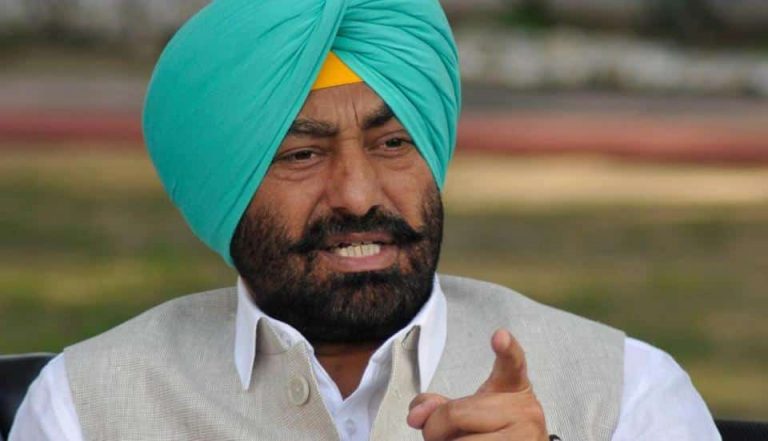
In a major crackdown against money laundering, the Enforcement Directorate (ED) has conducted raids on the properties of former Aam Aadmi Party (AAP) leader and incumbent Punjab MLA Sukhpal Singh Khaira under the Prevention of Money Laundering Act (PMLA).
As per reports, the PMLA case is linked to narcotics trafficking and fake passports. The ED officials are looking at bank transactions and property papers of khaira too.
As per reports, the searches were conducted at five locations in Punjab, two locations in Delhi and one location in Chandigarh. ED officials arrived at Sukhpal Singh Khaira’s house in Sector-5 Chandigarh on Tuesday morning and searched his property. His ancestral house in Kapurthala was also raided. His son, Mahitab Singh who lives in Chandigarh, was at his ancestral village.
On spotting the vehicles of ED officials, Mahitab took out his car and left. Meanwhile, Khaira has pleaded innocence and said that he has no role in the money laundering case. The Enforcement Directorate had also interrogated his cousin brother cum treasurer, Kulbir Singh.
Enforcement Directorate conducts raids on properties linked to Punjab AAP MLA Sukhpal Singh Khaira at five locations in Punjab, one in Chandigarh, and two in Delhi, in connection with money laundering and fake passport racket cases.
Khaira was the Leader of the Opposition in the Punjab Assembly during his stint with the AAP. In 2019, he started his own Punjab Ekta party and won 2 seats in the State Assembly. He has also been a vocal critic of the new farm laws that have been enacted by the Union Government to help farmers get a fair price for their produce. Khaira’s lawyer has now alleged that he is being targeted for being a ‘supporter of farmers’.
In a report presented in the Rajya Sabha on Monday, the Department of Biotechnology (DBT) said that the estimated manufacturing capacity of the country with respect to ‘Covishield’ is 70-100 million doses per month and with respect to ‘Covaxin’ is 150 million doses per year. The department presented the information in response to an inquiry of the Parliamentary Standing Committee on Science and Technology, Environment, Forests and Climate Change regarding the status of current vaccine production capacity of the country with respect to the two approved vaccines. The Parliamentary Standing Committee also inquired as to when these vaccines would be made available to non-priority population.
“The inactivated vaccine candidate, COVAXIN, developed jointly by Bharat Biotech and the Indian Council of Medical Research (ICMR), has a planned production capacity of 150 million doses per year”, the department of Biotechnology told the panel. “The estimated manufacturing capacity of the non-replicating viral vector vaccine, COVISHIELD, by the Serum Institute of India Pvt Ltd, is about 70-100 million doses per month”, the department added. Thirty other Covid-19 vaccines are reportedly at different stages of trial.
The Standing Committee also urged the dept to explore possibility of finding cure for certain diseases
The Parliamentary Standing Committee reportedly urged the department to explore the possibility of developing cure for certain rare diseases for which Indian is mostly dependent on imports and patients end up spending large sums of money on excise/import duty for procuring the cure.
India providing vaccines to countries across the globe
India has earned applause from the world for providing Covid-19 vaccines to various countries including economically weaker countries. India had sent vaccines to over 60 nations presenting an example of international cooperation during crisis. Representatives of several countries that have received the India-made Covid-19 vaccines including some Caribbean countries have poured praises on Prime Minister Narendra Modi for India’s generous gesture. The Chief of the World Health Organisation (WHO), Dr. Tedros Adhanom Ghebreyesus also thanked PM Modi for enabling vaccination in several countries.
The Government of India has started the process to identify Rohingyas living in Jammu and deport them back to Myanmar. As per a ground report by Hindi daily Dainik Bhaskar, over 150 Rohingyas were detained and sent to a holding centre of Hiranagar Jail. So far, the Government has identified over 6,000 Rohingyas living in the region. It is possible that the process will be completed in phases. Those who are shifted to the holding centre will face investigation and sent back to their country after the consent of the Ministry of Home Affairs and External Affairs.
Rohingya issue was raised by BJP during elections
During elections, BJP has raised the issue of Rohingyas on several occasions. Rohingyas are deemed as a major problem in election-bound states West Bengal and Assam. Thus, the action taken by the Government in Jammu is being linked to the election in these states.
Rohingyas have been named in criminal and terrorist activities
As per the Government’s report, over 13,600 foreign nationals are living illegally in Jammu and Kashmir. Among these illegal migrants, Rohingyas and Bangladeshis have the highest number. The majority of the Rohingyas are staying in Jammu, especially in Bailey Charana and Samba region. In the last few years, Rohingyas have been named in several criminal and terrorist activities.
In 2018, it was alleged that Rohingyas had an active role in the Sunjwan Terror Attack on the military base in which six soldiers and one civilian died. Three terrorists were neutralized. At that time, Jammu and Kashmir Assembly speaker Kavinder Gupta hinted their possible role in the attack and said that they are a security threat to the nation. In 2019, Home Minister Amit Shah had said that India would never accept Rohingyas.
Videos of Rohingyas surfaced on social media
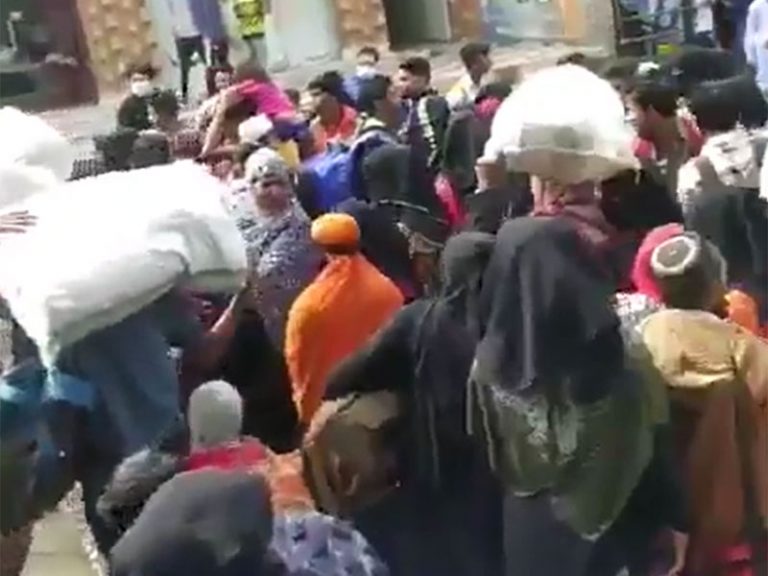
After the Government started the process of identifying Rohingyas in Jammu and detained 155 of them, several videos surfaced in which Rohingyas were allegedly seen leaving their houses.
In one of the video, one Rohingya said that he came to India around 15 years ago. He would prefer to go back to Myanmar rather than facing detention and probe initiated by the Indian government.
The local residents of Jammu are happy that the Rohingyas are being identified, and the process of sending them back to their country has started. BJP spokesperson of Jammu and Kashmir, Dr Tahir Chaudhary from the Bathindi region is quoted in the Dainik Bhaskar report. He said that it is a welcoming step. He said he was happy not because of his association with BJP but due to the fact that no one wants illegal immigrants living in their area.
Updesh Andotra, a social worker, said that a large number of Rohingyas and Bangladeshis are living in Samba and Kathua regions in Jammu. He also expressed his pleasure over the action taken by the Government. He said that people from other parts of the country are welcome to come and work in Jammu, but there is no place for people living illegally in the country.
Rajesh Kumar said, “I am a resident of Bathindi. I have seen that these people are involved in drug trafficking, theft and similar crimes.” He also thanked Government for the initiating the process. The residents of the region said that majority of the Rohingyas work here as labourers, and they are not criminals. However, it is essential to investigate who had brought them and settled them in the region, so far away from Myanmar border.
Abdullah asks Centre to sympathise with Rohingyas
National Conference president Farooq Abdullah expressed his displeasure over the process initiated by the Government. He claimed that the Indian Government had signed a charter of United Nations related to refugees, which it should follow. However, in reality, India has not agreed to the 1951 UN Refugee Convention and the 1967 Protocol to that Convention. It is up to India which refugees it wants to accept or reject.
PDP spokesperson Firdous Tak also urged the Government to be cautious. He said, “The issue of Rohingyas should be seen in the context of a humanitarian crisis rather than taking it as an issue of religious belief. The administration must act cautiously while keeping in mind the sufferings and trauma these refugees have faced back in their own country, forcing them to flee for a safe refuge in India.
The history of Rohingya migration in Jammu and Kashmir
The Rohingyas of Myanmar started to migrate to Jammu and Kashmir around 20 years ago in 2002. At that time, the PDP-Congress government was in power. The cycle of bringing more Rohingyas into the region continued for years, and every year the number increased. During the 2014 Lok Sabha elections and 2015 Jammu and Kashmir elections, Bharatiya Janata Party had added the issue of Rohingyas in their manifesto.
Identifying Rohingyas in the local population is a challenge
In 2017, Union Minister Rajnath Singh had said that the process of identifying Rohingyas had been started in Jammu and Kashmir. A survey was done by the Jammu and Kashmir government led by the BJP-PDP alliance in 2017-18 to identify Rohingyas. Now, as the Government has started the process to identify and send Rohingyas to temporary centres, it is believed that identifying every Rohingya in the local population is going to be challenging.
As of now, the Government has a record of only 6,000 Rohingyas in Jammu. However, several reports suggest that the number can be much more than 13,000. One of the reasons for difficulty in identifying them is that some of them have managed to procure Indian identity cards. The Government has so far identified the majority of Rohingyas in urban regions, but a large number of Rohingyas have already migrated to the surrounding districts where it will be difficult to identify them.
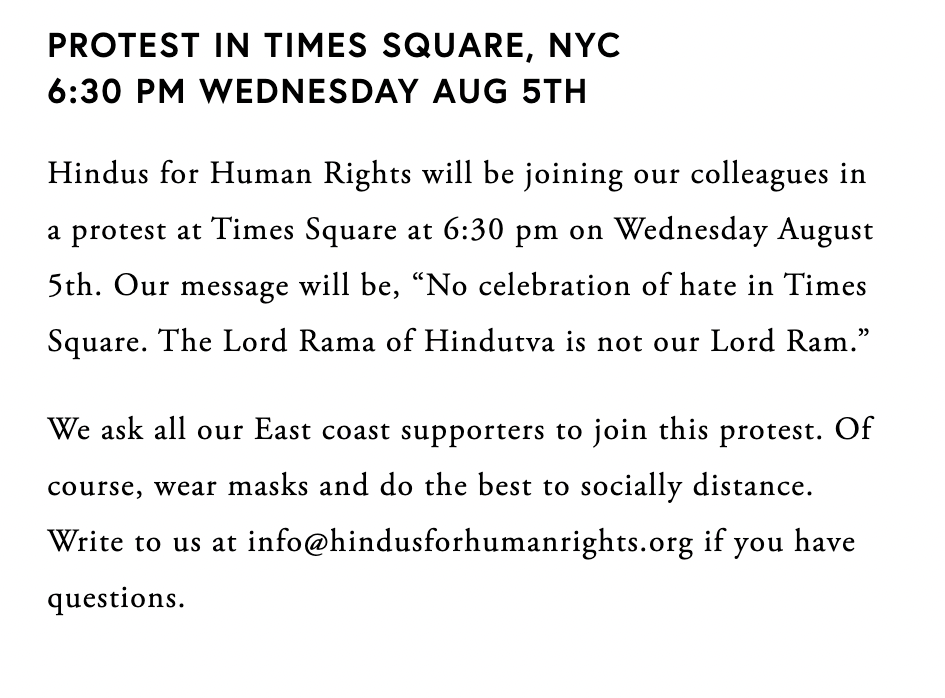
On 5th August 2020, Prime Minister Narendra Modi performed the bhoomi pujan ceremony for the Bhavya Ram Mandir at Ayodhya. On 9th November 2019, the Supreme Court of India gave a verdict in favour of Ram Lalla virajman, thereby paving way for the construction of the Ram Mandir.
Subsequently, the ‘liberals’ and Muslims, who were quite visibly upset at the Supreme Court verdict, claimed that the new Ram Mandir will be a symbol of hate.
Ram Mandir being described as ‘symbol of hate’
In fact, many even vowed to demolish the under construction temple and rebuild the ‘mosque’ there.
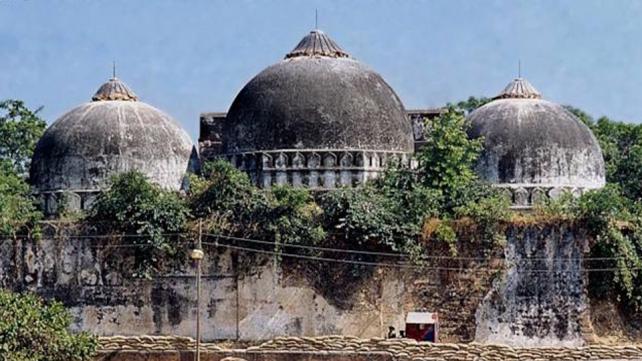
However, to call Ram Mandir a symbol of hate is as preposterous as claiming that the demolition of the disputed structure called Babri Masjid led to Indian Muslims ‘asserting’ their religious identity and subsequently to radical Islam.
On December 6, 1992, Ram bhakts brought down the disputed structure called Babri Masjid in Ayodhya, birth place of Lord Ram. The moment was culmination of decades long struggle of reclaiming the place where the temple once stood and was destroyed by the barbaric Mughal invaders.
Many people believe that this one incident ‘ruined’ the ‘secular fabric’ of the nation. That before the demolition of disputed structure, the Hindus and Muslims lives in peace and harmony where neither went out of their way to assert their religious identity. But, after the demolition, Muslims in India felt the need to wear their identity on their sleeves. More and more women started wearing burqas and the Muslimness became a major identifier. Many even blame the event for sowing seeds of radical Islam on the Babri demolition.
However, truth is far from reality.
And we do not even need to go as far back as the partition of India after the Independence. When Muslim hardliners carved out a chunk of India into a separate Islamic country. And let us also not talk about how millions of Bengali Hindus were slaughtered. Or in 1921 Moplah Massacre in Kerala where thousands of Hindus were killed just for being Hindus.
It started somewhere in the late 70s and 80s with Saudi Arabia started the international propagation of Salafism and Wahhabism. Funded by petroleum exports, this was world’s largest propaganda campaign. Hundreds of Islamic colleges, Islamic centres, mosques, madarsas were built in countries with Muslim as well as non-Muslim majority. Millions of copies of the Quran were printed and distributed worldwide.
In around 70s and 80s, many Indians, especially Muslims went to Saudi Arabia and other Gulf countries for work. They would return as ‘purer’ version of Islamic belief. With the monies, bigger mosques and madarsas were built in India, including in rural parts.
The Muslims in India had now started identifying themselves as Muslims and wanted to know and embrace their religion unadulterated.
A research paper ‘Stoking the Flames: Intra-Muslim Rivalries in India and the Saudi Connection’ states that the Saudis began to aggressively promote Islam in the world including India after the 1979 Iranian Revolution. Author Yoginder Sikand says that this promotion of Islam was rigidly and narrowly defined and was primarily concerned with ‘correct’ ritual and belief and was viciously sectarian. It also branded Shias and Sufis as ‘enemies’ of Islam.
The research paper also states that Saudi Arabia funded various Islamic organisations in India like Ahl-i-Hadith, Jama’at-i Islami and Deobadis.
This was followed by the reversal of Shah Bano judgement by the Rajiv Gandhi government. In 1986, the Indian state headed by Rajiv Gandhi set a dangerous precedent of catapulting to Muslim hardliners. The Mohd. Ahmad Khan vs. Shah Bano Begum & Others case and the subsequent legislation passed by the Rajiv Gandhi government in 1986 is often remembered as one of the most important moment in India’s political history.
In April 1978, 62-year-old Muslim woman Shah Bano filed a petition demanding maintenance from her divorced husband Mohammed Ahmad Khan, a renowned lawyer in Indore, Madhya Pradesh. Her husband divorced her by uttering triple talaq and stated that he was not obliged to pay her any maintenance as she is not his wife under Islamic law.
The two were married in 1932 and had five children. Shah Bano was forced by her husband to move out of the house where he lived with his second wife. Shah Bano moved court and claimed maintenance for herself and her five children under Section 123 of the Code of Criminal Procedure, 1973.
In August 1979, Shah Bano won the maintenance case in the local court, which ordered Khan to provide her with the maintenance of Rs 25 per month. Khan contested the same claiming that as per the Muslim personal law, he was only required to pay the maintenance during the iddat period after divorce.
Years later, Shah Bano filed another plea seeking for revised maintenance in Madhya Pradesh High Court. In April 1985, in a historic judgment, the Supreme Court ruled in favour of Shah Bano and upheld the decision by the High Court stating that she was entitled to be paid for maintenance by her husband.
This led to massive controversy, especially political one wherein claims were made that the judiciary overreached in the case attached to Muslim personal law. The historic judgement that laid ground for equal rights of Muslim women in matters of marriage and divorce did not go down quite well amongst the Muslim community.
To pacify the Muslim hardliners, the newly formed Rajiv Gandhi government passed Muslim Women (Protection on Divorce Act) in 1986 which essentially overturned the Supreme Court’s verdict in the Shah Bano case. The Act diluted the Supreme Court judgment and allowed maintenance to a divorced woman only during the period of iddat, or till 90 days after the divorce.
This move by Rajiv Gandhi government set the bar quite high for Muslim appeasement in Indian political landscape.
The reversal of Shah Bano judgement showed how the religious identity of Muslims was non-negotiable.
Radical preacher Zakir Naik, who is believed to have instigated and inspired Islamic terror attacks in India and neighbouring countries like Sri Lanka, founded his institute, “Islamic Research Foundation” in 1991. Naik believes and propagates that Islam is the best religion ‘because Quran says so’. He also has various other problematic views and believes in Islamic supremacy.
In 2016, his NGO Islamic Research Foundation was banned under anti-terror laws. It was believed that the NGO had links with ‘Peace TV’, an Islamic channel of the radical preacher Zakir Naik, which is accused of promoting terrorism. Naik has regularly made provocative speeches on this channel. The channel, too, is banned in India.
And Zakir Naik became a radical Islamic preacher before 6th December 1992.
You know what else happened before 6th December 1992? 19th January 1990 when lakhs of Kashmiri Hindus were forced out of their homes by radical Muslims and Islamic terrorists. Mosques in Kashmir openly called for killing of Kashmiri Hindus. Mosques in Kashmir issued declarations that the Kashmiri Pandits were Kafirs; Kashmiri Pandits were left with only 3 options — to leave Kashmir, convert to Islam or to be killed.
Over the years there has been a systematic effort to whitewash this exodus. From blaming Hindus for being raped, murdered and driven away by Islamic terrorists to claiming that they left on their own because of some conspiracy to paint Kashmiri Muslims as the victims, the ‘liberals’ have tried all tricks in the books to whitewash the crimes of Islamists. A journalist even went on to report once that the Kashmiri Pandit genocide and exodus happened because there was an economic parity between the Valley’s Hindus and Muslims – almost giving context to the murderous rage that the Islamic terrorists went into.
The seeds of Islamic radicalisation and terrorism were sowed much before the demolition of Babri Masjid. But ‘liberals’ just found it convenient to blame the Hindus. To borrow the essence from what former PM Dr Manmohan Singh once said, the right to assert religious identity also lies with Muslims.