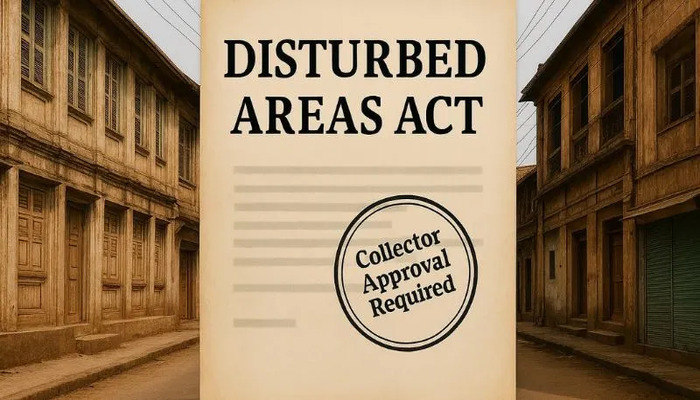
Protests erupted in the Gayatrinagar society of the Gorwa area in the Vadodara district of Gujarat on Friday (13th February) after two houses in a Hindu-majority society were sold to non-Hindus in violation of the Disturbed Areas Act 1991.
Members of local Hindu organisations and Sangharsh Samiti raised slogans and took out a protest march to the office of the District Magistrate. They submitted a memorandum demanding the implementation of the Act. According to the protesters, two residential properties in the society, which has a Hindu majority, were transferred to non-Hindu persons. The owners initially said that the houses were rented out, but the locals suspected that a sale had been made with respect to the properties.
The memorandum sought an enquiry into whether the transactions carried out in violation of the Disturbed Areas Act and demanded appropriate legal action. The residents said that they had approached the Municipal Commissioner before, but no action was taken.
What is the Disturbed Areas Act?
The Gujarat Prohibition of Transfer of Immovable Property and Provision for Protection of Tenants from Eviction from Premises in Disturbed Areas Act, 1991, commonly known as the Disturbed Areas Act, was introduced by the Gujarat government to prevent the polarisation of the population in communally sensitive areas.
Under the law, the seller and the buyer of a property are required to obtain the permission of the District Magistrate before effecting the sale of the property. The District Magistrate then investigates whether the sale is being made under duress or inducement. If the District Magistrate is not satisfied with the circumstances of the sale, he can deny permission for it.
Why was it introduced?
A trend was witnessed in several areas of Gujarat wherein people from the Muslim community purchased residential properties at high prices in Hindu-majority areas and settled there. Gradually, frequent clashes started erupting in such areas, forcing the Hindu residents to migrate. This trend led to demographic changes in the areas.
During the 1980s, several incidents of communal violence happened in Gujarat. Communal riots broke out in cities like Ahmedabad, Vadodara, Kheda, Bharuch, and Surat, severely affecting the Hindu population of the areas. Hindus were forced to sell their houses at petty prices and migrate to safer areas. It was at this time that the need to take some preventive measures was felt.
Consequently, the Gujarat government introduced the Disturbed Areas Act in 1986. The law prohibited the transfer of property in disturbed areas, both to protect Hindus from this problem and to counter the threat of demographic change. The law initially had some loopholes, and therefore, it was repealed and re-enacted as the Gujarat Disturbed Areas Act, 1991. The new act empowered the state government to declare some areas as ‘disturbed’.
Later in 2019, some major changes were introduced to the law, which were approved by the President of India in 2020. Following the amendments, the powers of the District Magistrate were broadened under the law. The District Magistrate was now empowered to investigate factors such as polarisation or unfair grouping, and demographic changes in relation to the sale of a property.
The law was stayed by the Gujarat High Court in January 2021, after several Islamic organisations, including the Jamiat Ulema-e-Hind, filed a petition against it. In 2023, the state government decided to withdraw the 2019 amendments to the law. Currently, the 1991 law is in effect.
When is an area declared as ‘disturbed’
According to Section 3 of the Act, the state government declares an area a ‘disturbed area’ based on a report from the District Magistrate and the police. The official notification under the Act is issued by the state government itself. Factors like a tense situation, riots, violence, or long-standing communal imbalance are taken into consideration in declaring an area as ‘disturbed’.
Following the 2002 riots, several areas in Gujarat (notably Juhapura, Sarkhej, and Gomtipur in Ahmedabad) were declared disturbed areas to prevent further divisions and the sale of property under threat or pressure. The notification is valid for 5 years after publication in the state gazette. The implementation of the Act in an area can be extended depending on the situation.
Any transfers of property in a disturbed area without the approval of the District Magistrate are invalid as per the Act. Before the sale of a property, the District Magistrate examines the applications and affidavits of the seller and the buyer, along with police reports, statements from neighbours, and Revenue Department documents.
Grounds added after the amendment, such as “impairment of demographic balance” and “unfair grouping,” are not applicable due to the High Court’s stay order. Therefore, the District Magistrate cannot cancel any transfer on these grounds and can only make decisions based on the 1991 criteria. State government rehabilitation schemes are exempted from this law, allowing for the transfer of property to new settlements and other procedures for those displaced by violence.
Areas where the Act is currently in effect
The Disturbed Areas Act is in effect in several districts of Gujarat. The list of areas is updated periodically by the state government. Several areas in Ahmedabad, Vadodara, Surat, Bharuch, Panchmahal, Anand, Narmada, Godhra, Bhavnagar, Amreli, and other cities have been covered under the Act.
Most areas in Ahmedabad city, such as Juhapura, Meghaninagar, Odhav, Gomtipur, Danilimda, and Sarkhej-Jamalpur-Kankaria, fall under the Disturbed Currents Act. Recently, new areas like Vastrapur, Thaltej, and Bodakdev in the western region of Ahmedabad were added to the Act through a public notification. The Act is also implemented in several areas in districts like Surat, Vadodara, and Anand. Recently, the implementation of the Act in Anand city and some areas of Anand district was extended for 5 years.
The entire procedure under the law is supervised by government officials, including the District Magistrate, the Police Commissioner/SP, and the Revenue Department. Areas to be covered under the law are notified by the state government. At present, around 1000 areas in Gujarat are notified under the law. All the property transactions in the notified areas are subject to the District Magistrate’s approval.
Why has Jamaat-e-Islami’s victory on over 60 seats in the recent Bangladesh parliamentary elections (February 2026) become a cause for concern for India? This is an important question because Jamaat secured most seats primarily in areas bordering India, where the Hindu population is 10-13%.
This was the first national election in Bangladesh since the fall of Sheikh Hasina’s government in August 2024. The Bangladesh Nationalist Party (BNP) swept the election with a huge majority, but Jamaat-e-Islami surprised everyone by emerging as the second largest party.
Key points from the Bangladesh election results
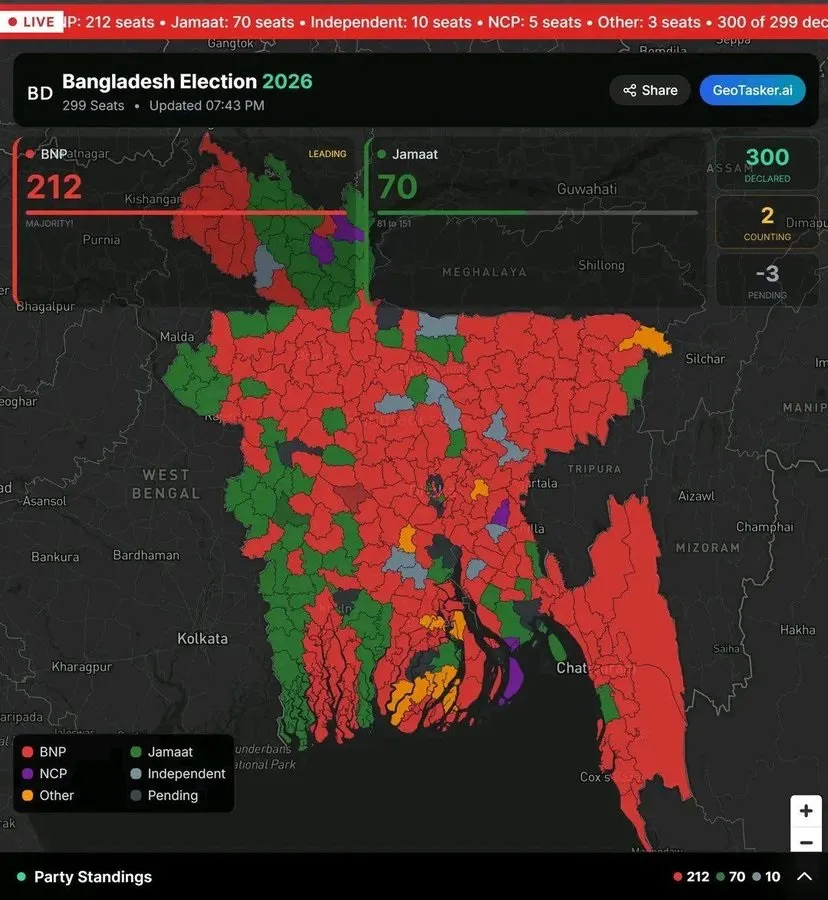
The February 2026 elections were held for 299-300 seats (some reports state 299, some state 300) in the Bangladesh Parliament (Jatiya Sangsad). The election results were as follows:
The BNP and its alliance won 212 seats, ensuring the formation of a government led by Tarique Rahman.
Jamaat-e-Islami alone won 68 seats, and its 11-party alliance totalled 77. This was the biggest success in Jamaat’s history (it had never previously received more than 12% of the vote).
The National Citizens Party (NCP), which emerged from the 2024 student movement and is led by young activists who ousted Hasina, fared poorly, winning only six seats. This clearly indicates that the nation comprehensively rejected the agitators. The public chose the less radical BNP over the more radical Jamaat-NCP alliance.
Sheikh Hasina’s supporters and agitating forces were rejected by the public. The six seats of the NCP demonstrate that the country desired change, not fundamentalism. Urban areas, the educated class, and women largely rejected Jamaat, particularly due to its conservative stance on women’s rights, but Jamaat’s influence appears to be increasing in rural and border areas.
Major Hindu-populated zones and Jamaat victory
The Hindu population in Bangladesh is 7.95–8% of the total population (approximately 13 million according to the 2022 census), but it is higher in some divisions.
These three divisions are the only areas where Hindus constitute more than 10% of the population. In other divisions, the number is lower.
In Sylhet, the Jamaat won very few seats. This region borders Northeast India (Assam, Meghalaya, and Tripura). Hindu-Muslim relations here were relatively good, and anti-India sentiment was low. Therefore, the Jamaat’s influence was limited here.
Jamaat’s influence was significantly high in Rangpur and Khulna. Jamaat won seats in Rangpur (such as Rangpur-1, 2, 3, 5, 6), Gaibanda and Joypurhat, while in Khulna’s Satkhira district, it won all four seats. Furthermore, Jamaat performed well in several other districts in this region, particularly those connected to West Bengal in India, such as Jalpaiguri, Malda, Murshidabad, Nadia, and 24 Parganas.
The Jamaat’s victory in these areas is concerning because the Hindu population is relatively high here. Historically, the Jamaat supported Pakistan in the 1971 war, and therefore, is considered pro-Pakistan and anti-India. Jamaat’s role (along with the Rajakars) in the 1971 violence, where Hindus were persecuted, is well known.
Jamaat and its allies’ seats are in green. Photo courtesy: X_Epatrakaar
Why is there concern for India?
Indication of anti-Hindu voting patterns: In these border areas, where Hindus constitute 11% or more, Muslim voters appear to be united in voting for the extremist Jamaat. This could be a sign of polarisation against Hindus. Since 1971, many Muslim families have migrated from India and settled in these areas. Anti-Hindu sentiments persist among these families. Jamaat’s victory suggests that extremist forces are gaining strength in the areas.
Anti-India Campaign: During the elections, Jamaat ran a campaign against India’s Border Security Force (BSF). It capitalised on the local Muslims’ anti-India sentiments, their resentment regarding India’s stringent anti-infiltration stand, and instances of violence along the Indo-Bangladesh border. This electoral win of Jamaat will embolden extremists in areas bordering West Bengal. India fears this could increase unrest along the border, leading to smuggling, infiltration, or terrorist activities. In such a situation, India will need greater caution.
Historical Enmity: The Jamaat supported Pakistan in the 1971 Bangladesh Liberation War and maintained ties with Pakistan. The Jamaat has always been cautious in its relations with India. Although some Jamaat leaders spoke about working with India before the elections, anti-India sentiment remained strong in the rural areas adjacent to West Bengal. The anti-India sentiment proved advantageous for the Jamaat in the elections.
Border Security and Regional Stability: India’s security agencies are on alert due to Jamaat’s strong presence in areas like Rangpur-Khulna, lying along the 4,096-km border. Trade and water sharing (issues like the Teesta) could be affected.
What does the public mandate say?
The BNP’s victory at the national level demonstrates that the Bangladeshi people did not give preference to fundamentalism. The Jamaat was rejected in urban areas. Women and youth of Bangladesh opposed its conservative views on women’s rights. However, in rural and border areas, the Jamaat’s “anti-Hindu and anti-India” card worked.
This election marks the beginning of a new Bangladesh, but Jamaat’s victory in the border areas raises questions about the safety of Hindu minorities and India-Bangladesh relations. India must remain vigilant, as the BNP will try to improve relations with the government, but opposition forces like Jamaat could exert pressure.
(This article is a translation of the original article published on OpIndian Hindi.)
In recent years, it has been observed that there has been a trend where failed politicians in the West have turned to Modi-baiting and attacking India, either to pander to certain electorates, to give their failing political careers a boost, or to side with ideological groups that survive on the back of anti-India narratives. Rather than participating in constructive global discourse, these individuals appear to take up on developments in India and offer one-sided or exaggerated reports, often without any grasp of the reality on the ground.
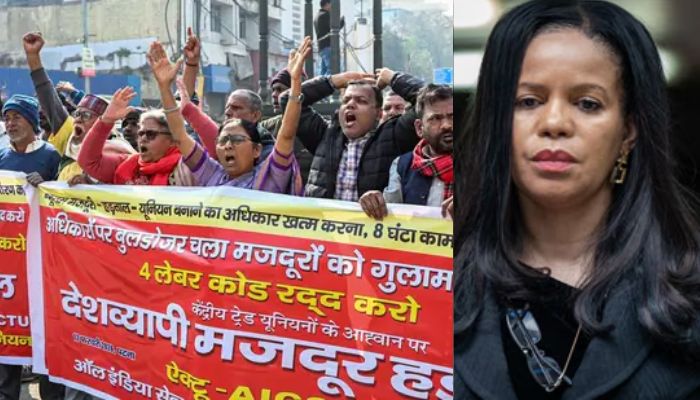
The latest example of this is former Leicester MP Claudia Webbe, who recently took to X to offer her views on what she termed a “300 million” workers’ strike in India on Thursday, 12th February. In her post, she accused the Modi government of authoritarianism and alleged that the Western media’s silence on the matter amounted to complicity.
What happened on 12th February
On Thursday, 12th February, trade unions and farmer organisations called for a nationwide strike, or Bharat Bandh. Workers in coal, refineries, factories, banking, and transport sectors took part in the strike as a result of a call from central trade unions such as CITU, AITUC, AICCTU, and HMS.
Farmer bodies such as the Samyukta Kisan Sabha (SKM) and the All India Agricultural Workers Union (AIAWA) also joined the strike. Demonstrations took place in various states, with protesters assembling at the district headquarters and villages to express their opposition to the interim India-US bilateral trade agreement and labour codes.
Sharing a protest video on X sourced from People’s Dispatch and Webbe wrote: “300 million workers just shut down India. The largest strike in human history, and most of the Western media barely whispered it. That silence is complicity in Modi’s war on workers’ rights. India’s general strike is the future that the billionaires and ruling class fear most.”
300 million workers just shut down India.
The largest strike in human history, and most of the Western media barely whispered it. That silence is complicity in Modi’s war on workers’ rights.
India’s general strike is the future that the billionaires and ruling class fears most pic.twitter.com/5vh5eRrVfR
In simple terms, Webbe was suggesting that India witnessed the biggest strike in history, that Western media deliberately ignored it to shield the Modi government, and that the protest represented a people’s uprising against corporate interests and authoritarian rule.
The reality behind the “300 million” claim
However, the claim of “300 million” participants is exaggerated. Such inflated numbers are often repeated by pro-anarchist groups, ideological publications, and political actors looking to project a sense of crisis. India has a population of over 1.4 billion people.
In a country of this scale, even large mobilisations can happen without paralysing the nation. Calling every protest “unprecedented” or proof of systemic collapse is misleading.
Apparently, 300 million (30 crore) workers in India went on strike and the country didn't come to a stand-still but a Brit sitting 1000's of kms away is telling the world she knows India more than the Indians. https://t.co/NDAaz5ERCz
— Stop Hindu Hate Advocacy Network (SHHAN) (@HinduHate) February 14, 2026
Protests, even large ones, are not signs of democratic failure. They are part of democracy. India regularly witnesses demonstrations by trade unions, farmers, students and political groups. Government offices function, markets operate, and daily life continues in most parts of the country. To present a strike as evidence of authoritarian breakdown ignores how democratic systems actually work.
The claim of Western Media “silence”
Webbe’s accusation that Western media silence equals complicity is also questionable. Since Prime Minister Narendra Modi came to power, Western media outlets have often published strongly critical pieces about his government. From coverage of citizenship laws to economic reforms and even India’s handling of COVID-19, global outlets have rarely hesitated to question or criticise New Delhi.
The Western media is known to single India out for negative coverage, even when the country adopts policies similar to those of other nations. This was especially visible during India’s COVID-19 lockdown. UK-based The Guardian ran a headline on 4th April, 2020, reading, “‘I just want to go home’: the desperate millions hit by Modi’s brutal lockdown.” The word “brutal” stood out.
At the same time, when discussing lockdowns in the United States and Australia, the tone was noticeably different. An opinion piece urged then US President Donald Trump to impose a full shutdown to combat the pandemic. Regarding Australia, the paper matter-of-factly reported the shutdown as a necessary step. In the UK’s own case, the lockdown was described as a “necessary hardship.”
The contrast was stark. While hardships in the UK were “necessary,” similar hardships in India were framed as “brutal.” The selective language suggested a motivated narrative. Despite facing the same global crisis, India was portrayed more negatively.
Given this history, the claim that Western media would ignore an opportunity to criticise the Modi government seems implausible. If there had been genuine nationwide paralysis, it would likely have been amplified widely.
Did the strike paralyse India?
Multiple reports from states across India suggested that normal life was largely unaffected. In Jharkhand, markets remained open and vehicles operated normally. In Chhattisgarh, while banks and some mining activities saw disruption, transport and shops continued as usual. In Tamil Nadu, rail and road services functioned despite protests. Even in Kerala, critics described the shutdown as limited in scope.
A mixed response was reported in Odisha, Kerala, Goa, Madhya Pradesh and Punjab. While union members staged demonstrations, there was no nationwide paralysis. Daily life in most cities and towns went on without major disruption.
If the strike had indeed shut down India in the way claimed, it would have dominated global headlines. The relative lack of dramatic coverage suggests that social media narratives may have amplified the scale beyond reality.
The billionaire rhetoric
Webbe’s closing line about “billionaires and the ruling class” fearing the strike reflects a familiar ideological trope. Demonising wealth creators and business leaders is a classic strand of communist rhetoric. While inequality debates are legitimate, framing economic reform as a battle between oppressed masses and evil billionaires simplifies complex policy discussions into emotional slogans.
India’s economic growth, infrastructure expansion and digital transformation over the past decade have involved partnerships between government and private enterprise. Painting this as a sinister alliance ignores the millions lifted out of poverty and the expansion of social welfare schemes.
Celebrity interventions and propaganda
This is not the first time global personalities have commented on Indian domestic matters. During the farm law protests of 2021, celebrities like Rihanna and Mia Khalifa tweeted in support of protesters.
Their sudden interest in complex agricultural reforms raised eyebrows. Critics argued that such interventions were less about genuine concern for Indian farmers and more about amplifying a particular narrative internationally.
Eventually, the farm laws were repealed, but many economists maintain that reforms were necessary for long-term agricultural modernisation. The episode showed how international voices can sometimes amplify half-understood issues.
The India-US trade deal angle
Notably, the 12th February so-called protest was also majorly linked to concerns over the interim India-US trade framework. Some groups claimed that the agreement would harm Indian farmers by opening markets to American agricultural products.
However, opposition claims that India has already signed a deal reducing farm tariffs to zero are false. What exists is a framework for negotiations toward a broader Bilateral Trade Agreement. No final pact has been signed.
The joint statement mentions reducing or eliminating tariffs on select industrial goods and certain agricultural items like Dried Distillers’ Grains, red sorghum, tree nuts, processed fruits, soybean oil, wine and spirits. These are largely products India already imports to meet domestic demand gaps. Major staple crops such as rice and wheat are not part of the agreement.
India already imports significant agricultural goods, including edible oils and pulses, due to domestic shortages. In fact, India is the world’s largest producer and importer of pulses. Imports worth billions of dollars annually help maintain food security.
In return, the United States has reduced punitive tariffs on Indian goods and opened greater access for pharmaceuticals, gems, diamonds and other sectors. Claims that India has surrendered its agricultural sovereignty are misleading.
Conclusion
The larger picture shows how narratives can be shaped for political ends. Washed-up politicians abroad and ideological actors at home sometimes amplify exaggerated claims to paint India in a negative light. Protests are a part of democracy, not proof of collapse. Trade negotiations are complex, not conspiracies.
Ultimately, Communist Party members and affiliated groups against economic reforms follow a familiar pattern. Just as they resisted the farm laws, they now oppose trade agreements and labour reforms. Development, reform and global engagement often face ideological resistance, but portraying them as authoritarian assaults may say more about political agendas than about India’s reality.
The election in Bangladesh is over. Hopefully by now, conspirators sitting in Washington, London, Beijing and Islamabad have learned their lesson. The people of Bangladesh have largely rejected Jamaat-e-Islami, an offshoot of the Muslim Brotherhood and a loyal lapdog of the United States, China and Pakistan.
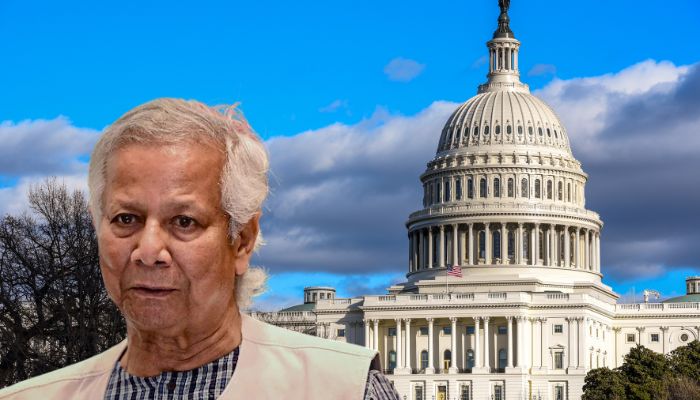
Following the meticulously designed regime change plot of 2024, Washington, Beijing and Islamabad succeeded in turning Bangladesh into their subservient country through their mercenaries, with Muhammad Yunus as the head of the illegitimate interim regime.
Since then, at the overt and covert backing of those nations, Bangladesh is witnessing the terrifying rise of religious extremism, terrorism, jihadism and mob violence. It not only destroyed the country’s economy and education system, but also turned the youths into mere zombies who indulged in destructive acts without thinking about the consequences and even their own futures.
Due to such rampant anarchy and chaos, Bangladesh’s global image was greatly tarnished, and most nations began seeing the country with grave suspicion. Bangladesh earned a similar bad name to Pakistan, leading to the rejection of visas for its citizens, especially students and the younger generation. Females in the country have been facing numerous forms of intimidation and threats from the religious extremists and jihadists. There was a growing fear among them of becoming an object of disrespect and isolation, as it happens in Pakistan and other Muslim nations.
Muhammad Yunus could not hold onto power indefinitely
People may ask – with almost univocal support and patronisation of the US and Britain, as well as consistent support from China and Pakistan, why Muhammad Yunus opted for holding the election on 12th February, when he had sufficient power? Why did he not opt for remaining in power indefinitely by proclaiming himself as the Supreme Leader and turning the country into a Caliphate?
The answer to this question is simple. For Muhammad Yunus, it became a “mission impossible” to remain in power when the Bangladesh Nationalist Party (BNP), which has a massive size of supporters, and a solid vote bank of 35-40 percent began repeatedly pressing the Yunus regime to hold the elections. Muhammad Yunus and his Islamist-jihadist cabal clearly realised that they could not delay holding the elections for an indefinite period.
It was evident that BNP would hit street and mobilise the masses and garner open or silent support from Awami League and other leftist-secularist forces, including the Hindus. And in that case, Yunus would face a pathetic fall and would potentially face trial for committing a series of crimes that would result in capital punishment for him and the members of his vicious nexus.
The failure of the US deep State
Meanwhile, Yunus also realised that his masters in the US in particular have seriously miscalculated the power of Bangali. This is despite Washington’s vantage point, its blend of military power, economic leverage, intelligence networks, and ideological messaging. Again and again, American doctrine has not merely failed but backfired. We have previously witnessed it in countries such as Vietnam, Iran, Afghanistan, Pakistan, Venezuela, Egypt, and now in Bangladesh.
For policymakers in the US Deep State as well as Pakistani Inter-Service Intelligence (ISI), they have appeared to view Bangladesh through an ideological lens rather than a geopolitical and populist one. By undermining the power of Bangalis and treating Jamaat-e-Islami Bangladesh (JIB) – a party with ideological roots linked to the Muslim Brotherhood – as a potential strategic partner, Washington and Islamabad committed a series of political blunders.
And finally, the disastrous Bangladesh plot of Pakistani ISI and its Western masters had to bite the dust. On February 12, Bangladesh did not merely vote – it resisted. For months, an unsettling narrative was building inside the country. Political instability following the 2024 upheaval had created space for ideological adventurism. International actors were watching closely. Islamist organisations were reorganising. And technocratic figures with limited grassroots legitimacy were being projected as acceptable transitional authorities.
The ghost of 1971 still shapes Bangladesh
Many in Bangladesh feared the country was being quietly steered toward an experiment: a hybrid arrangement where globalist technocracy would coexist with political Islam, with Jamaat-e-Islami positioned as a pivotal force. The electorate dismantled that experiment.
The decisive rejection of Jamaat-e-Islami and the strong mandate for the Bangladesh Nationalist Party (BNP) was not accidental. It was a calculated message from a population that understands its history and recognises ideological danger when it sees it.
To understand the electoral result of 12th February 2026, one must understand 1971. Bangladesh was born out of resistance to Pakistan’s ideological and political domination and Rawalpindi’s repeated attempts to erase the very Bangali values and secularism. The Liberation War was not merely a territorial struggle – it was a revolt against religious majoritarian authoritarianism imposed from West Pakistan.
Jamaat-e-Islami carries that historical baggage. Its political lineage and wartime role remain deeply controversial. For many Bangladeshis, Jamaat is not just another party; it symbolises a worldview that once opposed the country’s very independence. This memory matters.
Bangladesh may be a Muslim-majority, but its identity is linguistic, cultural, and pluralistic. Bengali Islam evolved through Sufi traditions, syncretic practices, and a strong literary heritage. It was never meant to mirror the ideological rigidity seen in Pakistan. February 12 was, in many ways, a reaffirmation of that identity.
The illusion of Islamist momentum
Over the past eighteen months, Bangladesh witnessed sporadic mob violence, aggressive street mobilisations, attacks on Hindus and growing pressure from hardline clerical networks. Social media amplified religious outrage campaigns. Women reported increased intimidation in educational institutions. Minority communities quietly expressed concern about shrinking space.
These developments created a perception – both domestically and abroad – that Islamist forces were gaining unstoppable momentum. But perception does not equal numbers. Electorally, Jamaat’s support rarely crosses single digits. It is vocal, organised, and ideologically committed – but it does not represent mainstream Bangladeshi sentiment. The February 12 outcome exposed the gap between street noise and ballot strength.
Muhammad Yunus enjoys global esteem for pioneering microfinance. His Nobel Prize recognition made him a global icon of development economics. But political legitimacy in Bangladesh cannot be outsourced from Western applause. But behind this façade, Yunus has successfully hidden his real identity of a notoriously Islamist and India-hating individual. Moreover, his notoriously cruel mind was also wrapped through well-orchestrated multi-million-dollar propaganda in the global media.
Technocratic stature does not substitute for grassroots mobilization. Bangladesh’s electorate historically rallies behind leaders with organizational depth, patronage networks, and mass emotional connect – figures such as Sheikh Hasina or Tarique Rahman. Political success here requires structure, not symbolism. The idea that a globally admired technocrat could serve as a neutral stabilizing force while ideological actors consolidated power behind the scenes was always politically fragile. February 12 exposed that fragility.
The geopolitical undercurrent
Bangladesh is not an isolated political laboratory. It sits at the strategic crossroads of South and Southeast Asia. Almost entirely surrounded by India, with Myanmar to the east and the Bay of Bengal opening toward critical maritime routes, it occupies a pivotal location. For India, Bangladesh is not a distant neighbor – it is an unavoidable neighbor – a frontline state. Border security, counterterrorism coordination, transit routes to the Northeast, and protection of minorities are directly linked to Dhaka’s internal stability. Any ideological radicalization in Bangladesh would immediately spill across borders.
For decades, Islamabad’s strategic doctrine has sought leverage in eastern India through instability in Bangladesh. The shadow of Pakistan’s Inter-Services Intelligence continues to loom over regional security calculations. If Islamist forces had gained decisive political power in Dhaka, it would have created fertile ground for renewed proxy dynamics in the region. February 12 reduced that risk – at least temporarily.
Why political Islam failed to break through
The rejection of Jamaat is not simply a partisan shift. It reflects structural realities:
1. Cultural nationalism remains strong: Bangladesh’s identity is deeply rooted in the Bengali language and heritage. Cultural festivals, literature, and music are not peripheral – they are central to national consciousness.
2. Economic aspirations trump ideology: The country’s young population prioritizes employment, education, and global mobility. Hardline religious governance models threaten economic integration and foreign investment.
3. Women’s participation is a social pillar: Bangladesh’s garment industry, educational expansion, and microfinance networks rely heavily on female participation. Any regression toward restrictive social codes would destabilize core economic sectors.
4. Historical suspicion of Pakistan-linked ideology: Political narratives that appear to echo Islamabad’s past dominance trigger instinctive resistance.
These factors collectively explain why Islamist momentum, despite vocal activism, did not translate into electoral dominance.
The risk of “Jamaatization” of BNP government
However, the story does not end with the ballot. Rumors have circulated regarding Pakistani ISI’s efforts to insert Jamaat-aligned individuals into broader governing structures through coalition bargaining. Even a limited presence in sensitive ministries could gradually normalise ideological hardline positions within state machinery. Such a development would be strategically dangerous.
A government perceived as drifting toward clerical influence would face immediate credibility challenges – domestically and internationally. Investor confidence could weaken. Minority communities would grow anxious. India’s security establishment would recalibrate risk assessments. The electorate’s message on February 12 was clear: no ideological overreach. Ignoring that message would be politically reckless.
Lessons for external power brokers
Major powers often assume they can calibrate outcomes in smaller states through diplomatic signaling, financial leverage, and institutional endorsement. Bangladesh defies that assumption. Its political culture is volatile, emotional, and fiercely nationalistic. Attempts to engineer outcomes without respecting grassroots dynamics tend to backfire. The February 12 mandate should serve as a cautionary note: sovereignty is not negotiable currency in Dhaka. A strategic window for stability
For India, the outcome of February 12 elections offers an opportunity. A stable Bangladesh governed by a party with broad popular backing strengthens eastern regional security. Connectivity projects, counter-radicalisation efforts, and economic integration can proceed with greater confidence. But vigilance remains necessary.
Pakistani ISI and Islamist networks rarely disappear; they recalibrate. Ideological infrastructure built over decades does not dissolve overnight. Civil society institutions, security agencies, and political leadership must remain alert to gradual infiltration tactics.
The future of Muhammad Yunus
Now, in the wake of the February 12 elections, Muhammad Yunus finds himself at a precipice he can no longer ignore. His ambitions to cling to power in an increasingly hostile political landscape have mostly evaporated, leaving him vulnerable to the very tides he wanted to manipulate.
The electoral resounding rejection of his regime signifies a clear mandate against his leadership, and the Bangladesh Nationalist Party (BNP) is likely to offer him a safe exit to avoid further instability. It is plausible that Yunus, recognising the dwindling support and looming consequences of his failed plans, may ultimately seek refuge in a Western country, where he hopes to escape the repercussions of his actions and preserve his legacy—if one can still be salvaged. With Yunus ageing, the window for his political revival is all but closed.
Meanwhile, the Islamist forces that once rallied around him are likely to abandon their fading leader, turning their attention to grooming a more charismatic figurehead for their next notorious mission. This shift signals a potential recalibration of their strategies, as they seek to reestablish their foothold in the increasingly complex political terrain of Bangladesh. Such developments not only highlight Yunus’s diminishing relevance but also foreshadow the continuing challenges to Bangladesh’s sovereignty and identity from those who wish to impose their agendas. Regardless, the calculated retreat of Yunus would not only mark the end of his political aspirations but also serve as a stark warning to those who underestimate the resilience and agency of the Bangladeshi people.
February 12 was not merely a routine election. It was a stress test of Bangladesh’s ideological direction. Faced with competing pulls – political Islam, technocratic internationalism, and geopolitical maneuvering – voters chose continuity over experimentation. They chose sovereignty over dependency. They chose cultural identity over imported ideological frameworks. For those who believed Bangladesh could be quietly redirected toward a clerical future, the result was a sobering reminder. Bangladesh may be small in geography, but it is not small in political memory. The people remember 1971. They remember ideological domination. And when they sense history attempting to repeat itself – they respond. On February 12, they did. And the message traveled far beyond Dhaka.
In the North Campus of the Delhi University, a pro-UGC protest took a disturbing turn on 13th February. A journalist, Ruchi Tiwari, associated with the YouTube channel ‘Breaking Opinion’, was mercilessly assaulted by the caste activists, including Leftist elements. The incident took place at the Arts Faculty when the Brahmin woman had gone to cover the protests by SC-ST-OBC activists.
On 13th February, a protest was organised by left-wing student groups like the Students’ Federation of India (SFI), All India Students’ Association (AISA), and the newly formed All India Forum for Equity. The protestors demanded the implementation of the University Grants Commission (2026) “Promotion of Equity in Higher Educational Institutions” regulations stayed by the Supreme Court. The caste discrimination-related guidelines have caused significant outrage over the 2026 regulation, which ruled out the general castes as victims of caste-based violence by restricting the category of victims to SCs, STs, and OBCs.
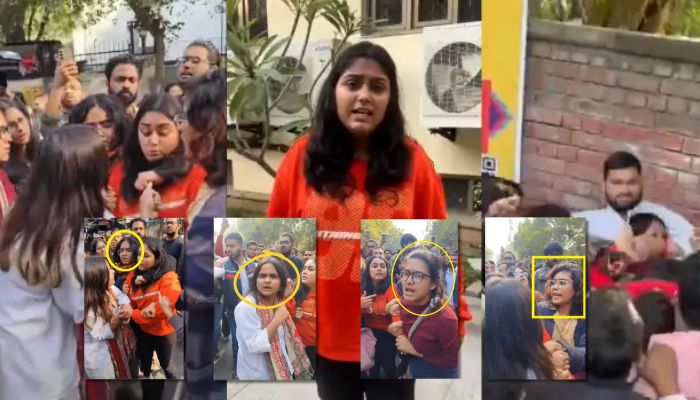
Amidst the tensions among student groups in the Delhi University, YouTuber Ruchi Tiwari had arrived on campus to cover the pro-UGC protests. However, she was soon surrounded and cornered by a pro-UGC mob comprising 50-100 men and women. It has been alleged that upon learning her surname “Tiwari”, a common Brahmin identifier, several among the mob shouted phrases like “Yeh Brahmin hai, isko pakdo” (She is a Brahmin, catch her). A man can be heard saying in a video, “mar isko pata chalega” (beat her she will learn a lesson). Another voice was saying repeatedly ‘Koi bol na dena yahan pe, kaat ke phenk denge” (Don’t say a word yere, else would cut and through you). Someone said the protests were peaceful when she appeared.
Several videos capturing the horror have emerged on social media, which show Ruchi Tiwari being surrounded, grabbed, beaten, and nearly disrobed by a large group of men and women.
Ruchi Tiwari recounts how the pro-UGC mob hounded her for being a Brahmin
In a video, Ruchi Tiwari narrated the incident, stating that while she was speaking with a reporter at the protest site, a large group of men and women suddenly confronted her. The caste activists claimed that she was the same woman who was present at Jantar Mantar yesterday, and proceeded to assault her.
#WATCH | Delhi: Ruchi Tiwari, the woman journalist who was seen being attacked during a pro-UGC protest at Delhi University yesterday, says, "…Video is everywhere, people can judge by themselves as to who provoked whom…I am a journalist, who was there to cover the protest.… pic.twitter.com/t5pT3PtNP2
“They held my hands, held my neck, pulled my hair, and tried to strangle me,” Tiwari said. She added that when her coworkers tried to intervene, the mob of men and women assaulted them too, and falsely accused them of touching the women protestors inappropriately.
After Ruchi Tiwari escaped from the attackers and went to the road searching for her friends, she was again surrounded and assaulted. She said that there was a large group of 100-150 protestors, and many of them, including several women, assaulted her, tore her clothes, while others were making videos.
“They attacked me only because I am a Brahmin”, Tiwari stated. She added that the mob said, ‘She is Brahmin, catch her, tear her clothes, undress her.’ Ruchi Tiwari asked whether it is feminism where no single person came forward to protect her when she was being assaulted. She added that while attempts were being made to tear her clothes and undress her, several men in the mob were making videos.
ABVP comes out in Ruchi Tiwari’s support
Amidst the outrage over a female journalist getting mobbed and harassed for her Brahmin caste, the Akhil Bhartiya Vidyarthi Parishad (ABVP) has extended support to Ruchi Tiwari. ABVP Delhi State Secretary Sarthak Sharma condemned the attack by leftist student groups.
“I would like to make a few things clear. The Left was protesting and a woman journalist, with a YouTube channel, was present there. She was covering the protest during which she asked them a few questions. Perhaps they didn’t like those questions, or they didn’t like the woman journalist, and they indulged in a flight…The videos show that even their male cadre was slapping her, that the crowd was gathering around her, and they were dragging her away. They have been exposed that how they misbehave with women. I have not met with the journalist so far, but I have come to know that she has filed a Police complaint. SFI, AISA and other Left student organisations have lost their relevance…So, they want to stay in the news by making false accusations. But the students of DU are intelligent enough…” Sharma told ANI.
#WATCH | A woman journalist was seen being attacked during a pro-UGC protest in Delhi University yesterday.
ABVP Delhi State Secretary Sarthak Sharma says, "I would like to make a few things clear. The Left was protesting and a woman journalist, with a YouTube channel, was… pic.twitter.com/BqmKo88sGz
Left- and right-wing student groups clash, and both parties file police complaints
Clashes erupted between leftist and right-wing student organisations on Friday after several YouTubers, including Ruchi Tiwari, were allegedly assaulted by the protestors. The tensions escalated at around 1 pm, as pro-UGC leftist protestors clashed with right-wing students who arrived at the spot after hearing of the disturbance.
While the right-wing student groups stated that journalist Ruchi Tiwari was assaulted, molested and subjected to caste-based insults by the left student group members, the latter denied the allegation, claiming that no caste-related questions were asked.
Moreover, AISA has claimed that its DU Secretary and student, Anjali, was assaulted by YouTuber Ruchi Shandilya and some ABVP workers.
“AISU DU Secretary and student, Anjali, was assaulted by a YouTuber named Ruchi Shandilya, and the ABVP workers attacked the students while they were protesting at the Arts Faculty, DU, demanding the UGC Regulations to eliminate caste discrimination from campuses in India …AISA activists had gone to register an FIR against the attackers. As they did so, more than 50 ABVP members surrounded the police station, broke windows and chanted slogans against these students… ” AISA claimed.
Meanwhile, both parties have filed complaints against each other at the Maurice Nagar Police Station. The police have confirmed that they have received complaints from both the clashing parties, adding that an investigation into the allegations made by both complainants is underway.
All India Forum for Equity: The outfit behind pro-UGC protests
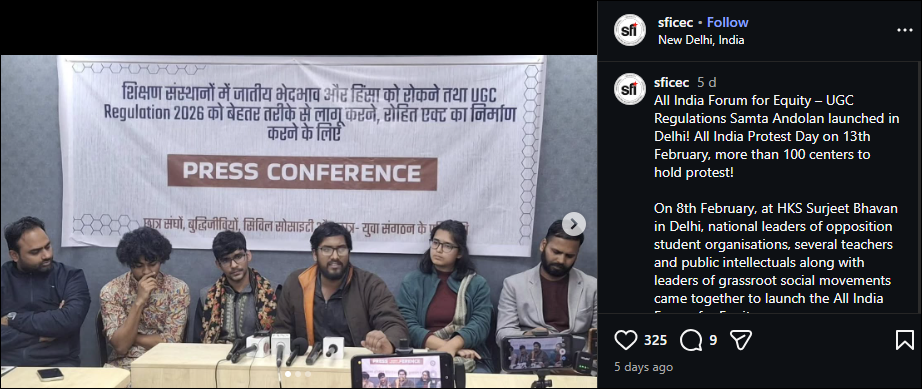
The pro-UGC regulations protest was organised by “All India Forum for Equity”, this outfit was formed on 8th February 2026, for what they describe as “UGC Regulations Samta Andolan”. The Forum was launched at Delhi’s HKS Surjeet Bhavan, in attendance of representatives from various leftist student organisations, including the SFI.
UGC रेगुलेशन समता आंदोलन : कैंपस में जातीय भेदभाव के खिलाफ और मज़बूत UGC रेगुलेशन के लिए –
अधिकार रैली 13 फरवरी, 1:30 बजे DU आर्ट्स फैकल्टी
वक्ता: राजेंद्र पाल गौतम, पूर्व मंत्री, दिल्ली सरकार डॉ जितेंद्र मीणा, प्रोफेसर डीयू डॉ आभा देव हबीब, प्रोफेसर डीयू डॉ उमा गुप्ता,… pic.twitter.com/X7BS1RMSjQ
Among the constituent members of this forum are Urban Naxals like Dr Jitendra Meena, Dr Laxman Yadav, Mahesh Chaudhary, Bhanwar Meghvanshi, JNUSU, AISA, SFI, NSUI, AISF, MSF, RYA, DSF, ASA, AIOBCSA, CRJD, Collective India, BAPSA, Samajik Nyay Andolan Bihar, Rihaai Manch, Social Justice Army, FTII Students Union President, OBC Arakshan Sangharh Samiti, JAYS, BPVM, Gondwana Student Union and others.
Women who grabbed Ruchi Tiwari as seen in the video also participated in pro-naxal protests in November 2025
Ironically, the so-called ‘equity’ protests devolved into anti-Brahmin violence; however, given the involvement of those glorifying Naxalite terrorists in the assault, such violence is not entirely surprising.
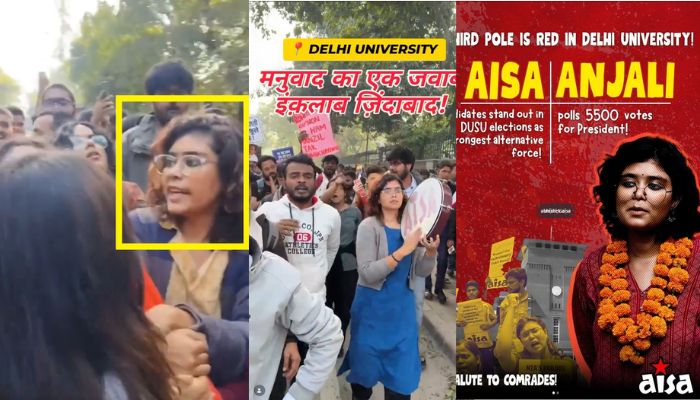
As seen in the viral videos of the Friday incident, among the girls who surrounded and grabbed Ruchi Tiwari was Gurkirat Kaur, the president of the radical left student group Bhagat Singh Chhatra Ekta Manch (bsCEM).
Previously, Gurkirat had openly glorified the Radical Students’ Union (RSU), a banned student outfit, through which Maoists used to recruit terrorists who were then deployed to fight against the Indian Armed Forces. In fact, Basavaraju, the top Maoist leader and General Secretary of the outlawed CPI (Maoist), was also an RSU product.
"RSU has given so many revolutionaries to the movement, the State still shakes with fear. Even with the name of RSU. Even with the thought of students again coming together and bringing that revolutionary politics."
“RSU has given so many revolutionaries to the movement, the State still shakes with fear, even with the name of RSU, even with the thought of students again coming together and bringing that revolutionary politics,” she said.
This is Gurkirat, the president of the left-wing organization bsCEM (Bhagat Singh Chhatra Ekta Manch).
Last year, members of this group raised the slogan on the streets of Delhi, ‘kitne Hidma maroge, har ghar se Hidma niklega.' Gurkirat was also arrested in connection with the… https://t.co/5E8e9b3p9lpic.twitter.com/bf8acwypRw
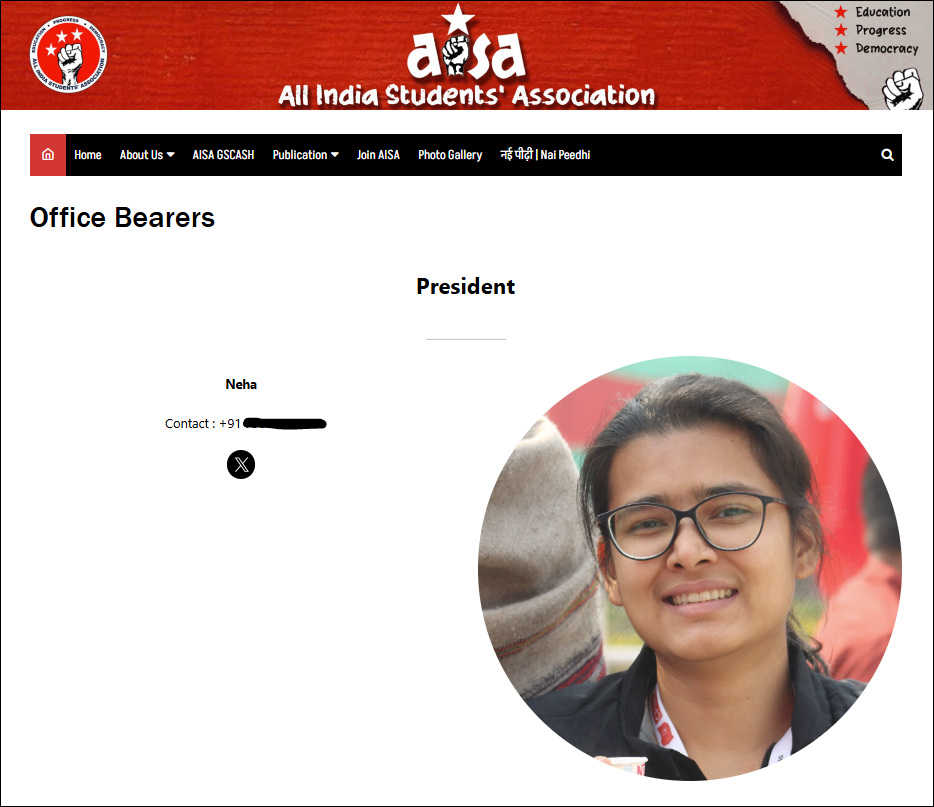
In addition to the videos, several eyewitness accounts place Gurkirat prominently in the protesting mob, alongside Neha, who holds the post of ‘president’ in AISA.
Another one was Anjali from AISA, who recently lost the presidential election.
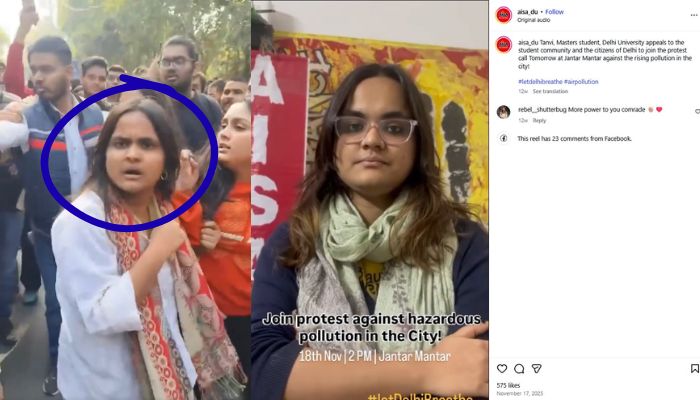
In the videos, a girl was allegedly seen pulling Ruchi Tiwari’s hair. She has reportedly been identified as Tanvi, a Master’s student from DU.
Notably, all these girls have also participated in the pro-Naxal protests in November 2025 under the pretext of anti-pollution agitation. The demonstration, involving mostly Delhi University students linked to Leftist groups like Bhagat Singh Chhatra Ekta Manch (BSCEM) and so-called environmental collective ‘Himkhand’, escalated when participants started raising slogans hailing slain Maoist commander Madvi Hidma and used chilli and pepper spray on police, injuring several personnel.
The radical leftist participants of this protest had raised “Comrade Hidma Amar Rahe” and “Har Ghar Se Hidma Niklega” slogans. When the police tried to intervene, the protesters not only attacked police personnel but also used pepper spray on them, causing injuries to the eyes and face.
As a result, two FIRs were registered against 22 protesters, of whom 16 were arrested. Fifteen were sent to judicial remand by Patiala House Court on Monday, while one was sent to a juvenile safe house after claiming to be a minor. Furthermore, Section 197 of Bharatiya Nyaya Sanhita (BNS) was added to the FIRs, which deals with acts, statements or communications that threaten India’s sovereignty, unity, integrity or security.
In December 2025, a Delhi court granted bail to Gurkirat Kaur, Ravjot Kaur, Kranti alias Priyanshu, Aiyashah Wafiya, Abhinash Satapathy and Ilakliya. After getting bail in the pro-Naxal protests case, bsCEM’s Gurkirat has now participated in pro-UGC protests and allegedly joined the leftist that harassed Ruchi Tiwari.
Notably, in 2024, bsCEM vandalised the walls of DU with graffiti prior to the Lok Sabha elections, telling people to abstain from the polls. The bsCEM members proclaimed, “Ek hi raasta Naxalbari” (the only way is Naxalbari), the place which sparked the inception of red terror in India. In addition, the radical left outfit has also been peddling anti-Brahmin hatred.
Days after Disha Wadekar, lawyer representing petitioners in UGC case said caste discrimination/harassment against ‘upper castes’ can never happen, pro-UGC mob proves her wrong
Earlier this month, Disha Wadekar, the lawyer representing petitioners in the UGC case, said in several interviews that if caste-based discrimination guidelines are made caste-neutral, then “What is the point of that provision of discrimination?”
“Now everyone is pointing out that there is a separate definition of caste discrimination. Section 3(C) defines caste discrimination as caste-based discrimination, based on caste or race against Scheduled Castes, Scheduled Tribes, and OBCs. The caste-based discrimination definition that everyone has a problem with, who should it include? If that should be a caste-neutral definition is what the question is, then are you saying that alongside SC, ST, and OBCs, caste-based discrimination definition should also include other categories, and it should be caste neutral, then what is the point of that provision of discrimination then? Then there is no discrimination, right? That actually means that there is no discrimination,” she told The Telegraph India.
In another interview, Wadekar claimed that she does not suggest that upper-caste students do not experience harassment or victimisation at all, but cases are “typically individual-specific and not rooted in ascriptive group identity.”
This came even as there have been incidents of on-campus anti-Brahmin and Baniya sloganeering, painting of college walls with genocidal slogans like “Brahmin-Baniyas, we are coming for you. We will avenge”, “Go back to Shakha”, “Brahmins Leave the Campus”, “Brahmin Bharat Chhodo”, “Now there will be blood” as well as incidents of the forced cutting of Janeu of Brahmin students, etc.
While these incidents are enough to prove that Wadekar’s contention was divorced from reality, the alleged harassment and assault against Ruchi Tiwari by a radical leftist student mob due to her Brahmin caste prove her wrong, again.
The irony is undeniable. Disha Wadekar, along with advocates Prasanna S. and Indira Jaising, drafted the 10 suggestions to be included in the UGC Bill, including the caste discrimination-related point. Wadekar’s whole argument behind excluding upper castes or general category caste groups from caste discrimination definition is rooted in the belief that Brahmins, Thakurs or other GCs can never face discrimination based on their caste, Ruchi Tiwari’s alleged caste-driven harassment contradicts this framing.
Tiwari’s harassment was based on her ascriptive Brahmin identity; it was not an ‘individual-specific’ case. Contrary to the assertion of Wadekar, the Ruchi Tiwari incident proves that upper castes can and do face targeted, group-based caste hostility and violence, not only in campus settings but also otherwise as well. The possibility of the occurrence of such incidents surges when leftist mobs and self-proclaimed ‘equity’ champions feel emboldened to unleash casteist slurs and violence against general category individuals and then conveniently deny it, saying that ‘upper caste’ folks can never face caste-based harassment.
The Indian Institutes of Technology (IIT) Patna’s English Professor Dr. Priyanka Tripathi, who was recently called out for abusing the Hindu faith and fundamentals to push her agenda has again drawn attention with another of her provocative research paper, “Gendered and Casteist Body: Cast(e)ing and Castigating the Female Body in select Bollywood Films,” which was also written by Bidisha Pal and Partha Bhattacharjee.
Hindu society normalises the act of r@pe claims a research paper.
Tripathi has persisted in her reference to malevolent anti-Hindu individuals to substantiate her dubious argument in this piece as well, citing Hinduphobic Suraj Yengde, who is notorious for his connections to Khalistani elements.
The trio further denigrated the Hindu society by invoking a similar figure, Meena Kandasamy, quoting, “For a man, the woman is the Dalit of the house (qt. in Zecchini 62). Women are frequently viewed as the vulnerable gender, regardless of caste, class, and status. Patriarchy confines women within a limited gendered framework that compels them into an objectified mode of existence,” and argued that womanhood is essentially linked to “Dalithood.”
This paper, which used Shekhar Kapur’s Bandit Queen (1994) and Article 15 of Anubhav Sinha, who is another member of the leftist cabal, did not even hesitate to address the sensitive topic of rape with its distorted caste perspective.
The writers not only blatantly neglected the substantial efforts made to advance the Dalit community in India, including through reservations but even drew astounding parallels between their situation and the apartheid in South Africa.
“Apartheid was a resultant condition of racial segregation and economic and political discrimination against non-white citizens of South Africa. Dalits in India are also victims of the politics of segregation. There is hidden apartheid within mainstream Indian society which precipitates that very idea of segregation. This is nothing but a kind of physical apartheid which owes its origin to the hierarchical ladder of the caste system. However, Dalit women face separate identity politics and existential crises due to their reduction as ‘impure’ bodies,” they insisted.
The authors, however, swiftly arrived at their real objective which was to denounce Hinduism and they did this with great audacity by declaring that rape is a regular phenomenon in the patriarchal Hindu society. “The act of rape is normalised within the patriarchal ‘norms’ of Hindu society and is associated with the inevitable outcome of staunch orthodoxy. Jean Chapman (2014) argues that Brahmanical Hinduism normalises subtleties of misogynistic activities and this leads him into saying that rape is not random. It is structured,” the paper alleged.
“The spectacle of cinema depicts a sustained form of Savarna patriarchy in the act of public rape,” it shockingly read while referring to Bandit Queen, while further vilifying the upper caste community.
Interestingly, the obnoxious claims presented in the paper seemingly do not require any empirical data or facts and those who concoct such theories under the guise of research apparently do not encounter any repercussions either.
Dr Priyanka Tripathi has a contentious history
OpIndia previously disclosed how Tripathi has repeatedly belittled the Hindu religion or misused it to promote her sinister agenda throughout the years, ranging from making offensive associations between Shakti and lesbianism to charging that women are viewed as inferior to men in Hinduism while simultaneously criticising the “Hindu patriarchal society” to validate her deranged viewpoints.
Moreover, she has been discovered to have strong connections with the United Kingdom’s publishing company “Taylor & Francis,” which has relentlessly criticised India, Hindutva, Citizenship Amendment Act (CAA) and has even gone so far as to make a mockery of Indian democracy.
Tripathi’s ideology, work and ties are deeply rooted in Hindumisia and such a person has been given the important role of teaching the Indian top minds in a distinguished institution of the country. The significantly more alarming issue is that there are numerous others in educational establishments whose minds have been tainted by Hindu animosity.
It is unnecessary to even mention what they must be instilling in the future generations in the name of education as well as the degree of bias they exhibit towards their students based on caste or religion. Furthermore, their objective is not to elevate the issues of genuinely downtrodden communities but rather to exploit them as a prop to attack Hindus and propagate their narrative.
Thus, this is clearly not the first instance in which the Hindu religion has been ridiculed, derided and misused for personal agendas within academia nor will it be the last. Tripathi and others like her represent the decay prevalent in the Indian education system and they will continue to proliferate in the absence of stringent measures for rectification or course correction, both by the institutions and the government, but even more so by the community whose faith is transformed into a joke or a punching bag by these individuals.
A social media controversy has erupted between self-proclaimed Ambedkarite anti-caste activist Lakhshya Lakey and criminal lawyer Tulip Sharma. A cyber complaint has been filed by Sharma, who is also an Instagram content creator, against Lakhshya Lakey, accusing him of harassment, caste-based abuse towards Brahmins, and sending derogatory messages.
Lakhshya Lakey is a graduate from IIM Indore and a TEDx speaker, who runs an Instagram page and a YouTube channel with the name “Lakhshya Speaks”. Lakey boasts around 553k followers on Instagram and over 14k subscribers on YouTube.
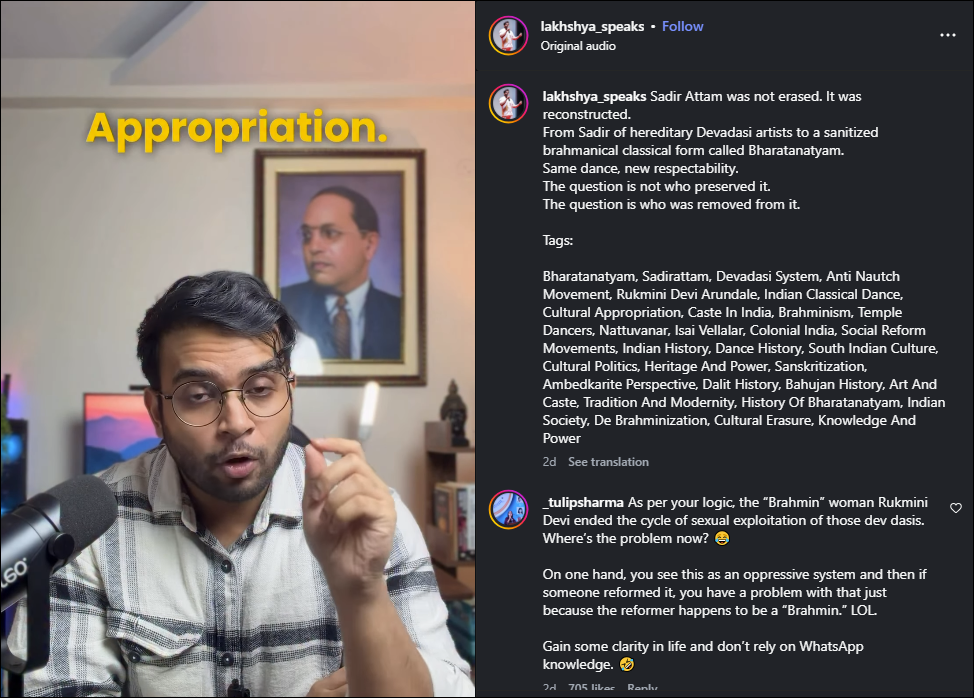
Failed to counter questions by Tulip Sharma on his claims about Bharatnatyam and Devadasis, Lakhshya Lakey resorted to anti-Brahmin abuse: What Tulip Sharma said
On 12th February, Tulip Sharma uploaded a video on her Instagram handle @_tulipsharma, in which she narrated that while Lakhshya Lakey has been hating on the Brahmin community on social media for a while under the pretext of anti-caste activism, he resorted to throwing anti-Brahmin casteist abuse at her after she posted comments criticising his video on Bharatnatyam and Devadasis.
“Let us expose a social media influencer called the ‘Lakhshya Speaks’. This man is known to spread hate towards the Brahmin community on the internet, and I have no problem with that since you have your freedom to expression, and if you spread hate, then it’s not a new thing on the net. But the problem arises when you can’t take dissenting opinions. He is the kind of influencer who will dm you and will speak rubbish if you try to post a dissenting comment on his post,” Sharma said.
An Instagram influencer Tulip Sharma exposed the rot behind so-called Ambedkarite activism after being harassed by Lakhshya Lakey, @lakhshya_speaks
Lakshya is widely known online for his obsessive hatred toward Brahmins, constantly pushing anti-Brahmin narratives under the… pic.twitter.com/hD3ormIk2P
It all began after Lakhshya Lakey uploaded a video on his Instagram page on 11th February, wherein he claimed that the Bharatnatyam dance was ‘appropriated’ by Brahmins. In the video, Lakey claimed that Bharatnatyam is a Brahminical cultural appropriation, and that the original dance form was Sadir Attam or Dasi Attam performed by Devadasis. He further claimed that a Tamil Brahmin woman named Rukmini Devi separated the ‘sexual/erotic’ element of the original dance form, whitewashed it, but in the process, alienated the cultural roots of Sadir Attam from what became Bharatnatyam.
In response to this, Sharma commented, “As per your logic, the “Brahmin” woman Rukmini Devi ended the cycle of sexual exploitation of those dev dasis. Where’s the problem now? On one hand, you see this as an oppressive system and then if someone reformed it, you have a problem with that just because the reformer happens to be a “Brahmin.” LOL. Gain some clarity in life and don’t rely on WhatsApp knowledge.”
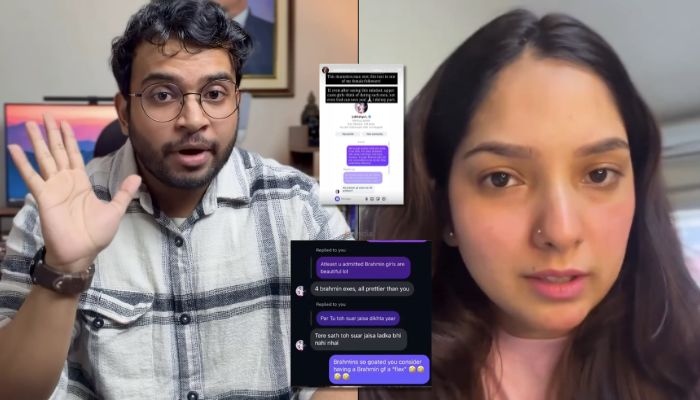
However, instead of sticking to the subject and countering Sharma’s argument with facts, the lawyer said that Lakey slid into her DM and hurled caste-based abuses against her. To back her claims, Sharma attached screenshots and screen recordings of her conversation with Lakey.
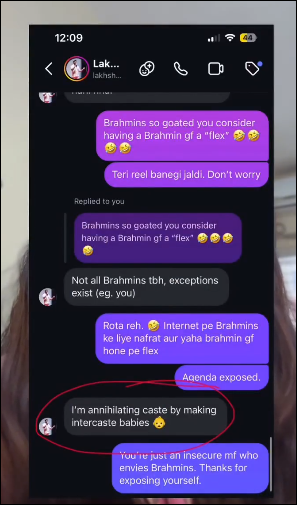
Tulip Sharma informed that while the topic was not even about Brahmin girls, Laskhshya Lakey boasted of having dated many Brahmin girls. “The topic was not even about Brahmin girls but Lakhshya Lakey went on to flex about all of his exes being Brahmins, using the girls of a specific community to win an argument. The topic about the entire community shows how big of a casteist he is,” Sharma said.
Further exposing Lakey’s casteist mindset objectifying Brahmin girls, Sharma informed that he claimed to be ‘annihilating’ caste by “making intercaste babies”.
Source: Tulip Sharma’s video
“His entire profession is grounded on hurling abuses to Brahmins and then he goes on to flex about his Brahmin exes. He even went on further to say he is annihilating caste by making intercaste babies,” Sharma said in the video and shared the screenshot of their conversation as well.
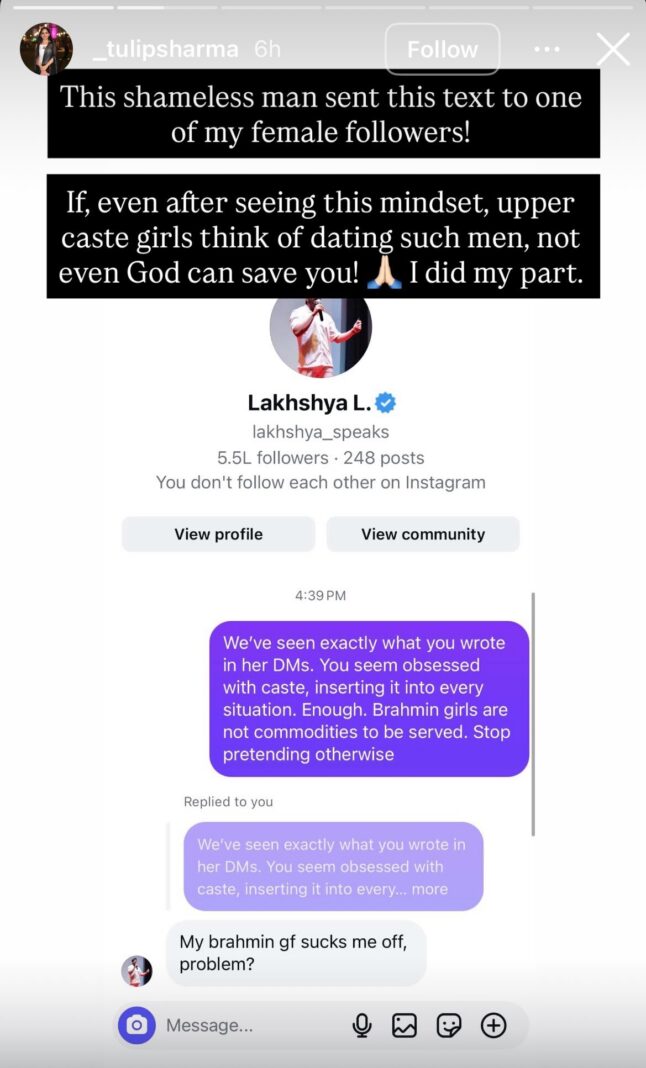
While in one of his videos, Lakhshya Lakey claimed that he is not “brave enough to date outside his SC/ST community”, he replied, “Brahmin gf sucks me off, problem?” to the DM of a female follower of Tulip Sharma, who criticised him for his casteist and misogynistic messages to Sharma.
Tulip Sharma’s Instagram story.
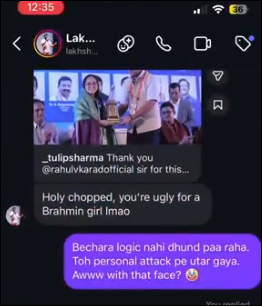
As per the many publicly shared screenshots, Lakhshya Lakey wrote to Tulip Sharma in her DM, “Holy chopped, you’re ugly for a Brahmin girl.” In another such message to Sharma, he wrote, “My girlfriend is way prettier than you. You don’t even look like you have a boyfriend”.
In a similar message sent to Sharma, Lakey wrote, “4 Brahmin exes, all prettier than you”.
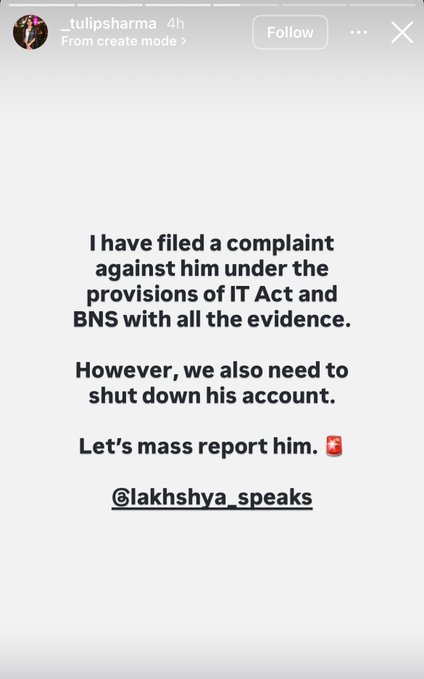
Meanwhile, Sharma informed her followers on Instagram that she has filed a cyber complaint against Lakhshya Lakey under the provisions of the IT Act and relevant BNS sections.
Amidst the backlash, Lakhshya Lakey claimed that the screenshots shared by Tulip Sharma exposing the casteist and derogatory messages he sent to her are fake. He claimed that attempts are being made to falsely implicate him in a bogus case.
In another video, Lakey reiterated his claim that all the screenshots of his chat with Sharma are fake. The Ambedkarite caste activist played the victim card and equated himself to Rohith Vemula.
Lakey claimed that such tactics were used with Rohith Vemula as well. It was quite audacious of Lakey to equate himself with Rohith Vemula and claim that narratives were peddled against his caste, even as in reality, the Telangana Police’s closure report in the Vemula case stated that he did not belong to the SC caste group.
‘Pure vegetarian Brahmins are bad’, ‘Brahmins rejected Chhatrapati Shivaji Maharaj’ and more of Lakhshya Lakey’s shenanigans
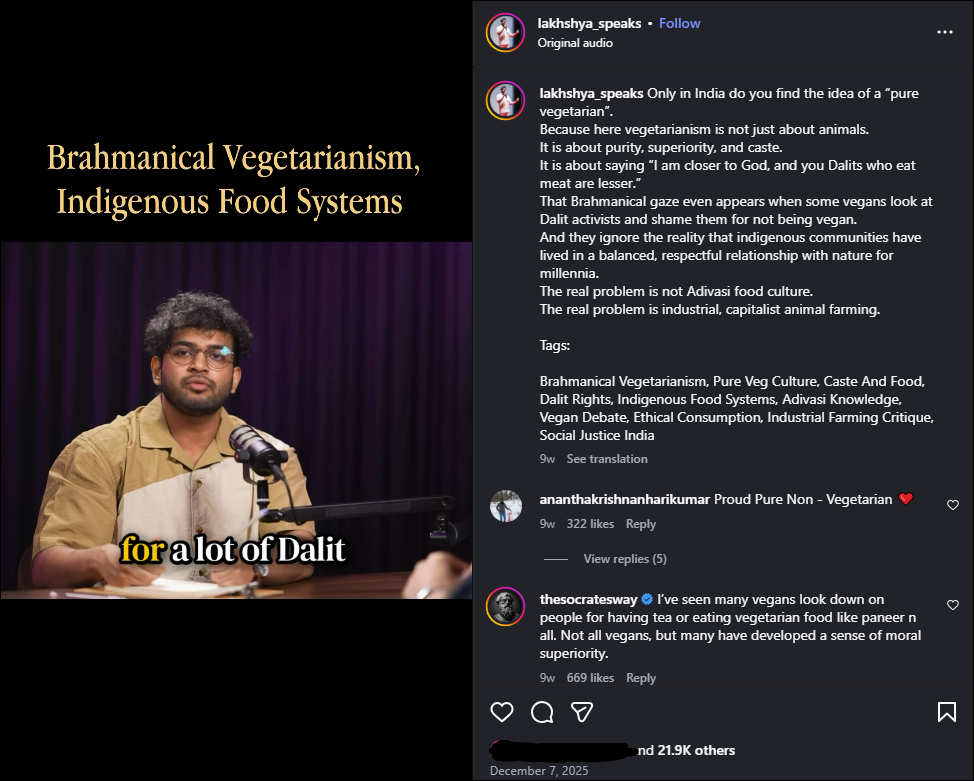
As is the case with most anti-caste ‘activists’, Lakhshya Lakey has also indulged in Brahmin-bashing in the name of opposing caste supremacism. In one of his videos, he claimed that while other countries have vegetarians, India has ‘pure vegetarians’. Attacking Brahmins for their religious beliefs associated with vegetarianism, he said, “Only in India do you find the idea of a ‘pure vegetarian. Because here vegetarianism is not just about animals. It is about purity, superiority, and caste. It is about saying, “I am closer to God, and you Dalits who eat meat are lesser.” That Brahmanical gaze even appears when some vegans look at Dalit activists and shame them for not being vegan.”
While Lakey peddled the narrative that the term ‘pure’ in pure vegetarianism implies caste superiority or higher closeness to God, it in reality, simply implies the strictness in adherence to vegetarianism.
In July 2025, Lakey appeared in a podcast wherein he claimed that Brahmins discriminated against Maratha warrior king Chhatrapati Shivaji Maharaj. He claimed that Brahmins refused to crown Chhatrapati Shivaji Maharaj due to his caste and that he had to call priests from Banaras to perform his coronation.
This claim is a part of the anti-Brahmin narrative concocted by the radical ‘anti-caste’ activists. However, in reality, the local Brahmins did not refuse to crown Shivaji Maharaj due to their bias against his caste, but because they did not know how to conduct Aindreya Rajabhishek; thus, Gagabhatt, a Brahmin, was called from Banaras. It is essential to note that Gagabhatt was also a Marathi Brahmin, as his family hailed from Paithan in modern-day Maharashtra. The dispute pertaining to Chhatrapati Shivaji Maharaj’s coronation was over the rites to be conducted as per Vedic customs against Tantrik rituals.
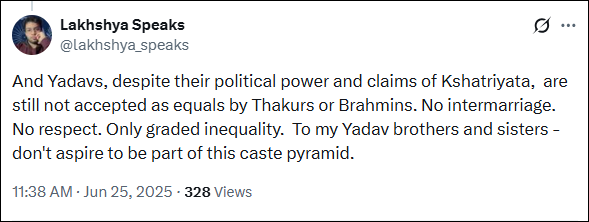
In one of his X posts, Lakshya incited Yadavs to abandon Hinduism because somehow Brahmins and Thakurs are not establishing marital relations with them. “And Yadavs, despite their political power and claims of Kshatriyata, are still not accepted as equals by Thakurs or Brahmins. No intermarriage. No respect. Only graded inequality. To my Yadav brothers and sisters – don’t aspire to be part of this caste pyramid,” he wrote.
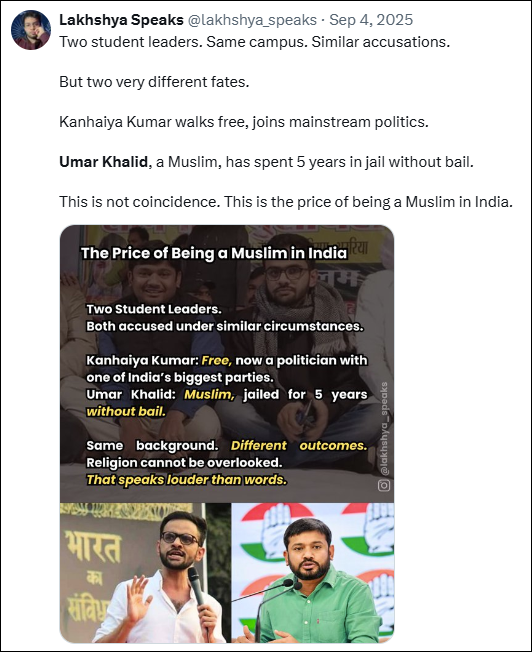
Unsurprisingly, Lakhshya Lakey is a fanboy of the 2020 anti-Hindu Delhi Riots accused mastermind Umar Khalid. He peddled the Muslim victimhood bogey and compared how Kanhaiya Kumar became a politician, while Umar Khalid is languishing in jail just because he is a Muslim.
In a post lamenting Khalid’s prolonged incarceration, Lakey wrote, “Two student leaders. Same campus. Similar accusations. But two very different fates. Kanhaiya Kumar walks free, joins mainstream politics. Umar Khalid, a Muslim, has spent 5 years in jail without bail. This is not ca oincidence. This is the price of being a Muslim in India.”
Interestingly, while Lakey suggested that Umar Khalid is ‘paying the price of being a Muslim’, Khalid has maintained that he is an atheist.
Contrary to the false narrative peddled by Islamo-leftists to garner support and sympathy for Umar Khalid, OpIndia has reported earlier that out of the 14 adjournments in 2023 and 2024, 7 delays and adjournments were sought by Umar Khalid himself. It therefore becomes evident that the withdrawal was certainly not because of the famed “delay” in hearing. While the Islamo-leftist ecosystem continues to cry ‘injustice’, it is the alleged failed forum shopping attempts of the accused’s lawyer that have Khalid rotting in jail for so long.
In fact, former Chief Justice of India, DY Chandrachud, had also said earlier this year that the real problem lies in the mindset of some lawyers and political groups who want their cases heard only by certain judges. Highlighting what OpIndia has reported multiple times, the former CJI said that court records showed that Khalid’s legal team, led by Sibal, had sought at least seven adjournments before finally withdrawing the bail plea in February 2024, citing “a change in circumstances.”
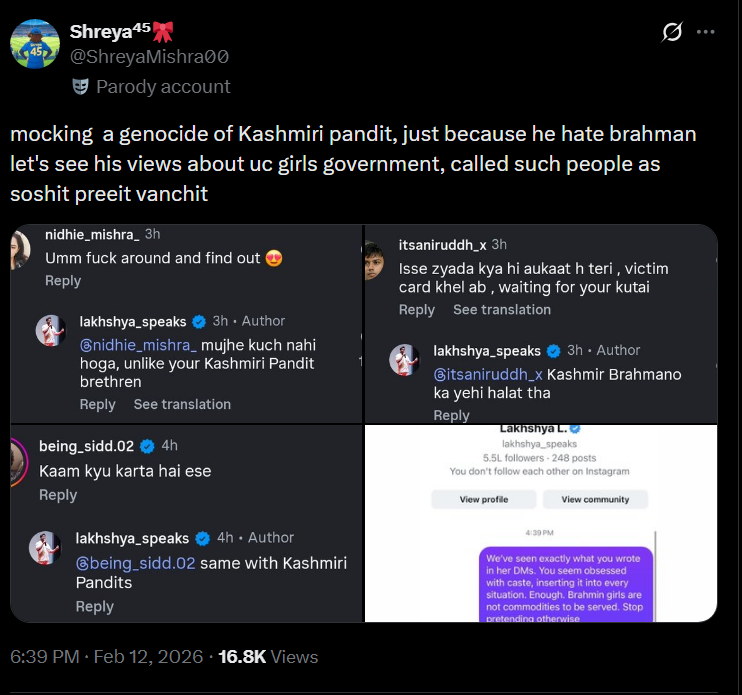
As per the screenshots shared by several social media users, Lakhshya Lakey also has mocked Kashmiri Pandits who were subjected to mass killings and exodus in the early 1990s by Islamic terrorists. In reply to a comment, Lakey wrote, “Kashmir Brahmano ka yehi halat tha.” In another one he wrote, “Mujhe kuch nahi hoga, unlike your Kashmiri Pandit brethren.”
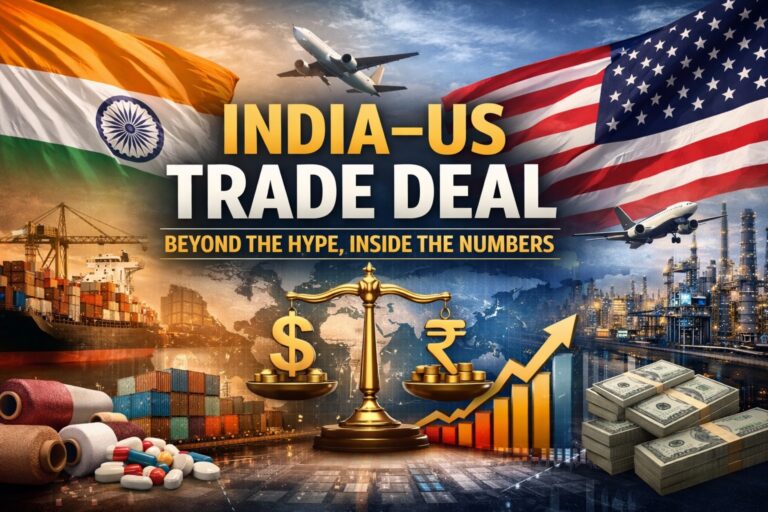
For the past few days, the interim India–US trade framework outlined in a joint statement has been portrayed as everything from a strategic ‘surrender’ to an economic sellout by the Opposition. Critics argue that India has been forced to commit to buying $500 billion worth of American goods, that Indian industry has been ‘exposed’ to risks, and that the government secretly bartered away leverage under duress.
Even in Parliament, Rahul Gandhi and other opposition parties cried about how India’s interests have been ‘sold out’. In the midst of political fury and prime-time drama, the framework has been reduced to slogans rather than figures. However, when the rhetoric is removed and the facts are analysed, these statements disintegrate rapidly.
A detailed assessment by SBI Research, grounded in tariffs, trade flows, sectoral impacts and macroeconomic consequences, paints a considerably more realistic picture of what India gained, what it gave up, and why the balance is decisively in India’s favour. The SBI research report tells a different story from the one being shouted by television or social media platforms.
What was actually agreedupon in the joint statement
Despite the claims, there is no full-fledged India-US trade agreement in place as of yet. What exists instead is an interim trade framework outlined in a joint statement, a limited understanding reached during ongoing trade talks, ahead of negotiations on a larger and more detailed bilateral trade agreement. Its scope is limited, specific, and clearly defined. At the centre of the interim trade framework is a reciprocal US tax of 18% on Indian goods, a significant reduction from the 50% tariff regime that had severely harmed export competitiveness. This reset places India among the lowest-tariffed Asian exporters to the United States, restoring parity with, and in some circumstances outperforming, regional counterparts.
The often-repeated assertion that India has committed to purchasing $500 billion worth of American goods is false. The joint statement contains the phrase “India intends to purchase” over a five-year period, which indicates business aspiration rather than a legally enforceable commitment. The interim framework contains no penalties, binding timelines, or procurement mandates.
Moreover, with a trade deal in place, bilateral trade is going to increase manyfold. The increase in purchases of US goods is going to be a natural outcome of increased bilateral trade, because exports are going to increase too.
Why the 18% tariff is a strategic win
The significance of the 18 per cent reciprocal tariff lies not in the number itself, but in where India stands in comparison to its competitors. Under the revised interim trade framework, India’s tariff rate is lower than or comparable to the major Asian exporters such as Vietnam (20%), Bangladesh (19%), and Indonesia (19%). In a market as price-sensitive as the United States, this tight band is important. Even a one or two percentage-point difference can determine sourcing contracts in textiles, electronics, footwear, and engineering goods. More notably, the revised tariff restores export competitiveness, which had been artificially depressed during the previous 50% system. Tariffs distorted relative prices, not inefficiency or cost overruns, causing Indian exporters to lose market share. The reset corrects the distortion and returns Indian goods to a level market footing.
Finally, the 18% conclusion indicates that India avoided being assigned to a punitive tariff category intended for politically or strategically marginal partners. Instead, it bargained its way into the mainstream trading bracket, maintaining bargaining power for future discussions while immediately enhancing export viability.
Export upside: Where India gains real money
If the debate is to move beyond rhetoric, it must move toward arithmetic. The real question is simple: where does the money flow?
Core export sectors
The tariff reset directly benefits sectors that already anchor India’s export basket to the United States. Electronics and electrical machinery account for nearly half of India’s exports in that category to the US. Pharmaceuticals, particularly generics, derive over a third of their global export revenue from the American market. Textiles and apparel, including both knitted and non-knitted segments, send roughly 30–45 per cent of their output to the US. Gems and jewellery, chemicals, engineering goods and seafood similarly maintain deep exposure to US demand. Under the earlier 50 per cent tariff regime, these sectors were operating under artificial price suppression. With tariffs reset to 18 per cent under the interim framework, they regain pricing competitiveness without requiring structural cost reductions. This is not about discovering new sectors; it is about unlocking suppressed capacity in sectors that already exist at scale.
The demand–supply gap
The larger opportunity is in size. The United States imports over $3 trillion worth of goods each year. India now supplies only about 3% of that market. The disparity between US demand and Indian supply in major areas is in the trillions. According to the SBI research report, Indian exports of the top 15 product categories alone could expand by nearly $97 billion annually under the revised tariff regime; including the broader export basket, the potential comfortably crosses $100 billion per year. Even partial realisation of this upside would significantly alter India’s external trade profile. This is not speculative optimism, but it is arithmetic based on existing demand patterns.
Trade surplus expansion
India’s trade surplus with the US stood at roughly $40.9 billion in FY25 and about $26 billion in FY26 (April–December). If the current interim trade framework progresses toward a broader bilateral agreement, it suggests that the surplus could exceed $90 billion annually if export expansion materialises alongside increased imports. In other words, even after accounting for higher imports from the US, the balance tilts decisively toward India. The surplus does not shrink, but it expands.
Farmers & Agri exports: The quiet winner
Trade arguments frequently assume that farmers will suffer collateral damage. The data suggests otherwise. India already has an agricultural trade surplus of almost $1.3 billion with the US. Under the revised tariff framework, over 75% of India’s agricultural exports to the US will be subject to zero reciprocal tariffs. Rice, in which India accounts for nearly a fifth of US imports, stands to benefit from improved pricing positioning. Tariff reductions support the export of spices, tea, and coffee by strengthening plantations. The fisheries sector, which had previously been under pressure from rising tariffs, has regained competitive access to a valuable market. Rather than undermining rural export chains, it boosts them by providing greater access to a premium consumption market. For agricultural exporters, scalability in the US market means bigger margins and greater resilience.
What India conceded and what it hasn’t
India agreed to reduce or eliminate tariffs on selected US industrial and agricultural products within the scope of interim trade framework. This includes categories such as energy imports, certain agricultural commodities like almonds and soybean oil, and industrial goods, including aircraft and advanced machinery. Increased imports from the US, particularly in energy, aviation and technology, are expected over time.
These are calculated trade-offs designed to balance negotiations and secure tariff relief on the export side. There is no binding obligation to purchase $500 billion worth of American goods. The language reflects intent, not enforceable procurement mandates. There is no blanket acceptance of free cross-border data flows.
Why the Bangladesh comparison is overhyped
The comparison with Bangladesh’s trade arrangement has generated more anxiety than evidence. India faces an 18 per cent tariff, while Bangladesh faces a 19 per cent tariff. The difference is marginal. Bangladesh does receive conditional zero-tariff access for certain textile categories, but this is tied to sourcing US cotton and man-made fibres inputs that are generally costlier than regional alternatives. Moreover, India’s textile exporters have secured zero-duty access to the European Union under a separate arrangement, opening a market far larger than the incremental US textile differential. The competitive equation remains broadly intact. Alarmism does not alter cost structures.
Macro impact: GDP, Forex, Credit Flow
At the macro level, the projections are measurable. SBI Research estimates that the net impact of export expansion under the interim trade framework could add roughly 1.1% to GDP. Reduced import duties on select US goods may yield approximately $3 billion in annual foreign-exchange savings. Export growth also has strong spillover effects. Historical correlation suggests that a 1% increase in exports leads to roughly a 1.28 per cent increase in export credit. As export volumes rise, credit flows to manufacturing sectors tend to strengthen, reinforcing job creation and industrial capacity. In this case, trade policy links directly to domestic credit expansion and production momentum.
Conclusion: From noise to numbers
Without political gimmicks, the interim trade framework presents a simple equation: enhanced tariff parity, increased export potential, expanding trade surplus, and preserved regulatory autonomy. Crucially, this framework does not constitute a signed trade agreement. It reflects the current state of negotiations as articulated in a joint statement, with several elements still subject to further discussion, clarification, and formalisation.
It does not indicate ideological affiliation with Washington. It symbolises the transactional advantage gained through negotiation. The outcome increases surplus, protects sovereignty, and broadens strategic alternatives in a changing global trade scenario. The real test now lies ahead. Much will depend on how negotiations evolve, what additional details emerge, and whether exporters, manufacturers, and policymakers are able to translate provisional tariff relief into a durable market share. In trade, as in economics, outcomes are ultimately measured in numbers, not narratives.
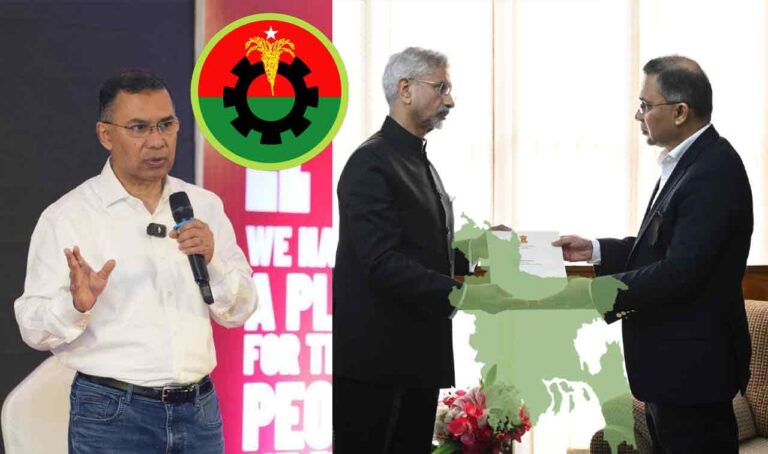
After one and a half years of the interim government led by Chief Advisor Muhammad Yunus, Bangladesh will finally have a democratically elected government. Bangladesh Nationalist Party is set to form the government after a decisive win at the national elections held on 12 February 2026. Former PM Khaled Zia’s son, Tarique Rahma,n will become the prime minister, who returned to Bangladesh just weeks before the election after a long exile in the UK.
With results for 297 out of 299 seats declared, the Bangladesh Nationalist Party (BNP) has secured a sweeping landslide, clinching a two-thirds majority in the 300-seat Jatiya Sangsad. As per the latest numbers, BNP and its allies are winning over 210 seats, while the main opposition, the Jamaat-e-Islami-led 11-party alliance, is set to manage around 70 seats.
BNP chairman Tarique Rahman, who returned from 17 years in UK exile in December 2025, won both seats he contested (Dhaka-17 and Bogura-6) and is now set to be sworn in as the next Prime Minister, likely as early as this weekend. The BNP has already called for nationwide prayers of gratitude instead of victory celebrations, signalling a return to power after two decades in the opposition.
The election results are important for neighbouring India, as it is closely tied to India’s security. A chorus of scepticism is already rising in India over the results. People are cautioning that India has reasons to worry with BNP in power, given the party’s anti-India history. When Khaleda Zia was the prime minister of Bangladesh, the country had become a safe haven for separatist forces in North-Eastern India, most notably the ULFA. It is alleged that during BNP’s 2001-2006 stint in power, the party turned a blind eye to massive arms hauls destined for India. The party also presided over a coalition that tolerated anti-India rhetoric and violence against minorities.
BNP ruling Bangladesh was a low point in bilateral ties with India, marked by border skirmishes, smuggling, and a tilt toward Pakistan. The ties improved significantly after the Awami League won the elections and Sheikh Hasina became the prime minister. Indian separatist groups were evicted, forcing them to move to Myanmar and other places in the region. Bilateral trade also thrived under the Hasina government.
Therefore, it is correct that BNP forming the Bangladesh government is not very good news for India; however, it is the best outcome of the results from India’s perspective. There were only two possible outcomes of these elections, and the actual outcome is definitely much better.
The Awami League, India’s most reliable partner for over a decade, was banned from the polls. The contest was between just two fronts: the BNP and a Jamaat-e-Islami-led 11-party alliance. The latter is a coalition heavy on Islamists, Jamaat itself, Bangladesh Khelafat Majlis, Khelafat Majlis, Bangladesh Khilafat Andolan, Nizam-e-Islam Party, and student radicals rebranded as the National Citizen Party, among others. Many of the parties in the alliance have Islamic ideologies with goals of establishing an Islamic state run according to Sharia.
Jamaat opposed Bangladesh’s very creation in 1971, aligning with Pakistan’s genocidal campaign. It has long been an advocate of radical ideology, with roots in the vision of Sharia supremacy and a soft spot for Islamabad. The organisation was banned and was not allowed to contest elections, which were revoked after the fall of the Hasina govt.
A Jamaat-led government would have been a strategic nightmare for India. It would have meant a Dhaka tilting hard toward Pakistan and China, spreading terror networks to India through the porous border, escalating attacks on Hindus and other minorities, disputes over water-sharing and other issues, and a general “India Out” hysteria. Under Jamaat, the Bay of Bengal would tilt further into Beijing’s grasp, with Pakistan gaining a proxy entry to the region.
Radical Islam on India’s eastern front, fuelled by the same forces that run Pakistan and destabilised Afghanistan and Myanmar, would export instability straight into West Bengal, Assam, and the entire country.
The BNP, for all its flaws, is different. It is a nationalist party, not theocratic. The party, with its experience in governance, is expected to be pragmatic enough to recognise that Bangladesh’s economy cannot thrive in isolation from India.
In short, BNP’s win may not be positive for India, but Jamaat’s loss is a big positive from the Indian point of view.
Moreover, Tarique Rahman has given some encouraging signals. His “Bangladesh First” policy emphasises equidistance from big powers, but not direct hostility. In recent weeks, he has spoken of “mutual respect” and economic partnerships, a far cry from openly anti-India campaigns during the Yunus-led interim government.
Another important fact is New Delhi’s diplomacy and proactive action, as the government didn’t sit idle during the turmoil in Bangladesh. After Tarique returned from 17 years in UK exile in December 2025, India quickly moved ahead to connect with him. External Affairs Minister S. Jaishankar visited Dhaka to offer condolences on Khaleda Zia’s death. The minister met Tarirque during the visit and delivered a personal letter from Prime Minister Modi.
On arrival in Dhaka, met with Mr Tarique Rahman @trahmanbnp, Acting Chairman of BNP and son of former PM of Bangladesh Begum Khaleda Zia.
Handed over to him a personal letter from Prime Minister @narendramodi.
India gave a clear signal, while we have sheltered Sheikh Hasina, we are ready to work with the new govt in Bangladesh. And after it became clear that BNP would win the elections, PM Narendra Modi didn’t delay in congratulating Tarique Rahman and BNP, he didn’t wait for the official results to be out.
Therefore, while BNP’s past makes it an unreliable partner for India, it is the new reality, and the much better outcome, as the alternative was an Islamist bloc that could have dragged Bangladesh into the Pakistan-China axis, escalating anti-India hostilities. Moreover, the National Citizen Party formed by students who threw out the Hasina government didn’t perform well in the elections. It was part of the coalition led the Jamaat, and contested in 30 seats, but won only 6. As NCP is openly anti-India, its dismal performance is positive for India.
Another important point is that Bangladeshi voters have given a clear mandate to the BNP with a massive majority, and the party is not dependent on any coalition partner. A stable BNP govt potentially means better border security with better coordination against smuggling and infiltration.
India-Bangladesh ties can now move ahead, with the resumption of talks on various issues, including Teesta waters, connectivity via the India-Bangladesh-Myanmar-Thailand highway, and bilateral trade. It can also be expected that Dhaka won’t become a full-fledged “string of pearls” outpost of China under the BNP.
However, the relations will still be linked to Sheikh Hasina’s shelter in India. If BNP presses on for her return, she has been sentenced to death by the International Crimes Tribunal of Bangladesh for ‘crimes against humanity’, the relationship will be complicated, and the ball will be in the Indian court. Before the elections, BNP, along with other parties, had urged India to hand her over to Bangladesh.
The new govt will have its plate full after taking the oath, and Sheikh Hasina will not be at the top of the priority list. As the Bangladeshi voters have accepted the referendum for the July Charter, the new government and the parliament will have to implement the charter in first 150 days. This includes the establishment of a new upper house and several other institutional changes that will require substantial changes to the constitution.
On 10th February (Tuesday), the Allahabad High Court declared that caste, which is conferred by birth, does not change in spite of intercaste marriage or religious conversion. Justice Anil Kumar was hearing a criminal case concerning atrocities under the Scheduled Castes and Scheduled Tribes (Prevention of Atrocities) Act. It concerned a SC woman who married a man outside the community.
Dinesh and eight other individuals had moved a criminal appeal against the order of the Special Judge under the SC/ST Act who had ordered them to stand trial for violations under Sections 323, 506, 452 and 354 of the Indian Penal Code (IPC) and Section 3(1)(R) of the SC/ST Act but the plea has been denied.
The woman accused these persons of attacking, abusing and hurling casteist slurs at her during a confrontation. She registered a criminal complaint against them and expressed that three persons including herself were wounded in the instance. The occurrence transpired in the Aligarh district of Uttar Pradesh.
The court noted that both the events detailed in the First Information Report (FIR) and specified in the complaint happened simultaneously on the same day. It emphasised, “The allegation in the complaint is that the informant was assaulted and abused by the appellants. The complainant has also stated that the appellants used casteist slurs during the altercation. Three persons, including the informant, were injured in the incident. Hence, the claim of the appellants that the present complaint was lodged as a counterblast is untenable. Therefore, this criminal appeal lacks merit and is liable to be dismissed.”
The court listens to arguments and pronounces its verdict
The plaintiffs contended that they had been wrongfully implicated and an FIR had been launched against the woman before the current complaint. They maintained that the injury reports are on file confirming that other members of their family had also been hurt.
They further argued that she is “a resident of West Bengal, where she belongs to the SC/ST community. She has now married a person belonging to the Jat community. However, she has concealed this fact and has claimed herself to be a woman belonging to the SC/ST community. Once she married a person belonging to the Jat community, she cannot claim herself to be a woman belonging to the SC/ST community.”
They then highlighted that a woman who marries someone from a different caste loses her original caste. She transforms into a member of her spouse’s caste. Therefore, it is unsustainable and subject to revocation to call them for the purported infractions as well as under the SC/ST Act.
“The existence of a cross-case does not constitute a ground to discard a complaint filed by the opposite party on a rival version. Hence, it cannot be said that the learned trial court has committed any illegality in summoning the appellants for the alleged offences,” the court observed.
Afterwards, it concluded, “So far as the contention that the informant has lost her caste after marrying a person belonging to the Jat community is concerned, the said contention has no force. Though a person may change religion, his or her caste remains the same despite conversion to another religion. Hence, marriage does not change a person’s caste. Therefore, the said contention is unsustainable. Accordingly, the appeal is dismissed.”
The order of special judge, SC/ST (Prevention of Atrocities) Act
On 27th July 2022, Special Judge Sanjeev Kumar Singh, presiding over the court of the SC/ST (Prevention of Atrocities) Act pronounced the verdict following a complaint lodged by Jyotirai Devi. She prayed that defendants, Dinesh, Mahendra, Satish, Lotan, Bharat Bhushan, Tikesh, Ajit, Subhash, Rinku, Rajesh Devi and Manju Devi should be summoned for trial and face punishment.
Jyotirai Devi claimed to be a SC and asserted that they are influential members of the Jat community. The court order read that she had contested the village chief’s election the previous year which led to animosity from the accused. It further reported that she was preparing food in her courtyard when some bricks fell into her space on 6th September 2021.
She objected but Dinesh and Mahendra entered the house brandishing sticks. Bharat Bhushan had a country-made pistol, Tikesh was equipped with an iron pipe, Ajit had a sickle and Subham as well as Rinku were holding bricks and sticks. Rajesh Devi had a brick in his hand and Manju Devi was also armed with a stick.
The complainant and her family members were assaulted and abused by them. The accused wanted to teach her a lesson because she had been quite vocal in the community and was attempting to establish herself as a leader. These individuals pushed her down while making these remarks and Dinesh grabbed her private parts.
Meanwhile, Mahendra, Satish, Rajesh Devi and Manju Devi battered Jyotirai Devi with sticks and bricks. Bharat Bhushan discharged a firearm at her family members with the intent to kill, resulting in them narrowly escaping harm but she endured injuries. On the other hand, Dharamveer and Sitaram from the neighbourhood heard the chaos and landed at the scene to try to help her. However, the accused issued threats to kill her as the two departed.
No action on the police complaint and the court’s decision
Jyotirai Devi attempted to file a report at the police station but it was not accepted. She subsequently submitted an application to the Senior Superintendent of Police (SSP) in Aligarh on 21st September 2021. Nevertheless. no action was taken.
The complainant had been examined in oral evidence in accordance with sections 200 and 202 of the Code of Criminal Procedure (CrPC). Photocopies of medical examination reports pertaining to her, Vishnu Kumar and Ramesh had been given to the SSP.
An application was previously put forward by the complainant under section 156 (3) CrPC in respect of which a report was summoned from the police station. It highlighted that Dinesh had registered an FIR under sections 147, 323, 308, 504 and 506 of the IPC against her husband Vishnu Kumar and 8 others in the Khair police station of the Aligarh district.
Jyotirai Devi’s statement outlined that the aforementioned medical analysis had also been provided. She stressed that all the opposing parties were responsible for the incident but the witness called by her, Vishnu Kumar who is her husband, did not state that Rajesh Devi Manju Devi were implicated in the crime. Hence, summoning the duo for trial was unwarranted.
However, the order added that a prima facie case had been lodged under sections 323, 506, 452 and 354 of the IPC and Section 3(1)(R) of the SC/ST Act which justified their presence for trial based on the examination of the proof associated with the complaint.
The court instructed Dinesh, Mahendra, Satish, Lotan, Bharat Bhushan, Tikesh, Ajit, Subhash and Rinku to stand trial under sections 323, 506, 452 and 354 of the Indian Penal Code along with section 3(1)(r) of the SC/ST Act and urged the complainant to submit the necessary defence within a week. It added that the accused must attend the hearing scheduled for 18th September 2022.
Lotan Singh’s FIR accuses Vishnu and his companions
On 7th September 2021, an FIR was initiated by Lotan Singh son of Bhagwan Sahay of Mathna hamlet with the officer-in-charge of the Khair Police Station. He conveyed that Vishnu and others had an issue with him because he did not support them through his vote during the election of village head (pradhan). OpIndia has a copy of the official complaint.
He stated, “Shyam Singh son of a moneylender Ramesh, Jugendra Singh son of Ramlal Vishnu and Sitaram, Mahendra Singh, Lal Singh alias Lalu who are sons of Yashveer along with Harikishan (Kalu) and Shyam Singh (Shyam) forcibly entered my residence armed with sticks and bricks and commenced to assault me at around 6:30 pm on 6th September.”
He mentioned that Dinesh son of Girraj and Satish son of Devdutt, rushed to intervene owing to the commotion, however, they were also thrashed by the attackers. “My sons, Bharat and Dinesh, endured a severe beating. They have sustained serious head injuries and I have also suffered wounds,” the complainant charged.
“The level of brutality has exceeded all bounds. I arrived at the police station in a critical state and since I was unable to file a report yesterday, I have come today,” he added, demanding strict action in the matter. The authorities invoked sections 147, 323, 308 and 452 of the IPC.
Judgement could open the door to the Dalit Christian reservation
The decision, although made to address a conflict between two sides, might lead to significant implications for the broader society. Its reference to the maintenance of SC/ST caste status for women even when they marry outside their community and the assertion that religion does not influence caste has the potential to open a Pandora’s box.
This could cause numerous people who have converted to Christianity and even other faiths to seek a stake in the reservations that are intended solely for SC/ST individuals affiliated with Indic religions like Hinduism and others.
Notably, the Supreme Court earlier clarified that an individual loses their caste immediately upon embracing Christianity and expressed, “In any case, upon conversion to Christianity, one loses her caste and cannot be identified by it.” The court further underscored the sensitivities linked to the reservation and the fundamental motive behind the action, pointing out that even entering the fold of Hinduism to gain caste benefits is a deception against the Constitution. It added that reservations are meant to rectify historical injustice and advance social justice.
Additionally, Indian courts have consistently maintained that the reservation is not for those who have left Hinduism and become Christians. Interestingly, the Allahabad High Court last year directed the district magistrates of the state to identify those who have converted yet continue to reap the benefits of SC status, deeming it a “fraud on the Constitution.”
On the other hand, the concept of caste does not exist in Christianity or any other religion. Nonetheless, there is a caste system within the Indian Christian community. Many Christians follow the same even though the Vatican and other religious organisations do not support it. These people adhere to the caste that they or their ancestors were a part of prior to their conversion. This is utilised as a foundation to often demand reservations for them.
However, it seems very outlandish to renounce the Hindu religion while retaining its fundamental aspects when embarking on a new spiritual journey. Furthermore, Christian missionaries have been known to target Hindus from lower castes in an effort to convert them by ensuring that there is “no place for discrimination” in their religion. Nonetheless, if the promise is revealed to be untrue, then they can easily do “ghar wapsi” and become a Hindu.
More importantly, considering them for reservation represents a grave injustice inflicted upon SC/ST Hindus who have not been swayed to abandon their faith in the name of bogus promises and hold a valid right to the reservations.
If the category is expanded to include Christians, it will result in fewer seats in jobs and educational institutions for bona fide members of the SC/ST community, as thousands of new candidates are going to compete for the opportunities reserved for the latter, making it more difficult for the already marginalised sections of the demographic to ascend the economic ladder.
Moreover, the government exclusively seizes donations from Hindu temples and sacred sites under the pretext of taxes. Therefore, reservations serve as a means to elevate the marginalised members of the Hindu community. Universalising reservations will also result in a loss of their real character and the purpose for which they were originally introduced. This situation will also be exploited by the vested interests groups and several will jump ship to switch religious allegiances as per convenience, thus defeating the whole purpose of the laws.
Hence, the remarks in the recent judgment of the Allahabad High Court could introduce several new challenges for a developing India and carry extensive outcomes, particularly in relation to the Hindu SC/ST community.