Home Blog Page 97

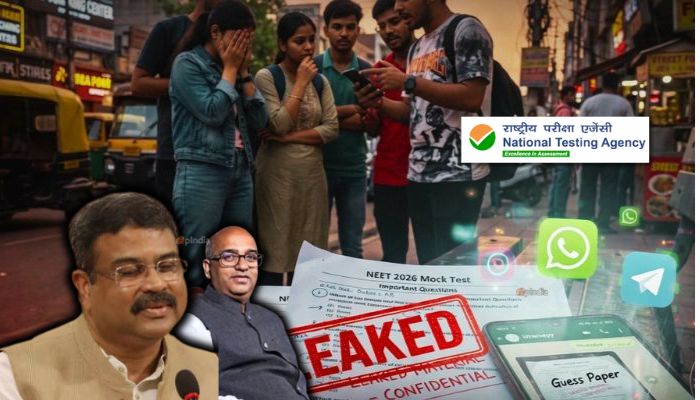
NEET UG 2026 paper leak: Tracing the journey that made the leak possible and Sikar coaching hub’s problematic past

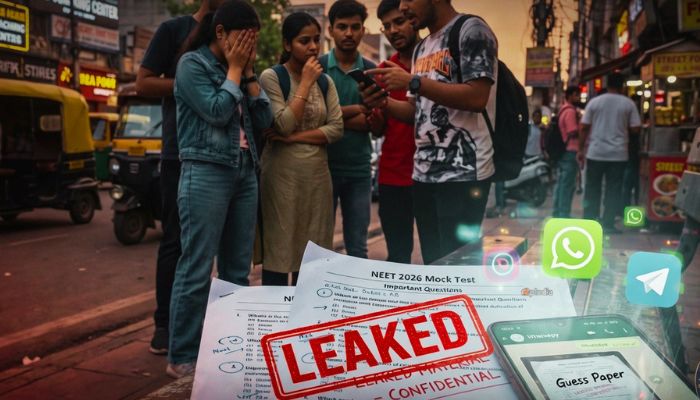
One layer after the other is being unearthed in the alleged NEET UG 2026 paper leak scandal. On 3rd May, over 22 lakh students appeared for the high-stakes exam conducted by the National Testing Agency (NTA). Despite the promises of conducting a leak-proof exam, NTA could not prevent a guess paper, similar to the actual paper, from making its way to WhatsApp and Telegram groups for sale days before the exam.

‘Private Mafia’ WhatsApp group, NEET ‘guess paper’ for sale and a trail that led investigators to the paper leak scandal

The scandal came to the fore after a handwritten guess paper closely matched a significant portion of the actual question paper, particularly the Chemistry and Biology sections. A handwritten note containing around 410 questions, with a 281-question set, circulated among students over WhatsApp, Telegram groups and coaching networks, particularly in Rajasthan’s Sikar, Uttarakhand’s Dehradun, and other coaching hubs.

Before the Central Bureau of Investigation (CBI) took over the probe into the alleged paper leak, the Rajasthan Police’s Special Operation Group (SOG) found striking similarities in the actual paper and the circulated guess paper, with around 120-140 questions, mainly Biology and Chemistry-related, matching exactly or very closely.

Around 135 questions from the guess paper are reported to have matched with the actual paper, accounting for around 600 marks out of 720. Each question in the NEET paper carries 4 marks.

The guess paper was circulated through a WhatsApp Group named “Private Mafia”. The Rajasthan SOG said that the group administrator charged around ₹5,000 for membership alone and instructed members not to share the guess paper. Nonetheless, the paper was widely circulated.

Preliminary investigation indicated that the alleged paper leak happened in Maharashtra’s Nashik; however, the state police later denied these claims. On Tuesday, Kirankumar Chauhan, Deputy Commissioner of Police, said that they received a request from the Rajasthan Police regarding a suspect involved in the NEET paper leak case. The Nashik Police acted on the request of the Rajasthan Police and took the accused into custody, and handed the accused over to the CBI.

The arrested accused has been identified as Shubham Khairnar. He was a medical student in Madhya Pradesh’s Bhopal and resided in Nashik. Khairnar obtained the NEET UG 2026 question paper from one of his associates in Pune. The accused received a hard copy, and from thereon, he circulated a soft copy through WhatsApp groups. The police are currently probing if the circulated question paper was a ‘guess paper’ or the actual question paper.

“Khairnar was a student of Bachelor of Ayurveda, Medicine and Surgery (BAMS) in Bhopal last year and stays in Nashik with his family. We received information from the Rajasthan SOG early Tuesday morning about taking him into custody. We apprehended him and brought him to the crime branch office. As per the preliminary inquiry, he was also a part of the (paper leak) syndicate. We are now transferring him to the CBI,” Kishor Kale, Deputy Commissioner of Police, Nashik City, said.

Meanwhile, Kirankumar Chauhan, Deputy Commissioner of Police, Nashik, revealed that Shubham Khainar changed his appearance to escape identification and arrest; however, the Crime Branch managed to trace him through technical analysis.

Khairnar is alleged to have bought the NEET UG 2026 question paper for Rs 10 lakh and sold it later for Rs 15 lakh. He disseminated the ‘guess paper’ to some people in Gurgaon/Gurugram, and from thereon, the paper reached students and career counsellors in Rajasthan, Uttarakhand, Jammu and Kashmir and other states.

“The accused had changed his appearance by cutting his hair, making identification difficult. However, based on technical analysis and police investigation, the Crime Branch team managed to trace and detain him.

In addition to Shubham Khairnar, an MBBS student from Rajasthan’s Shekhawati, who is studying in Kerala, also came under the radar of the investigators. He sent the guess paper to his friend in Sikar on 1st May, two days before the exam.  

From thereon, the guess paper went viral among aspirants and soon reached a PG operator, further spreading to students, career counsellors, and other candidates. An India Today report says that the PG operator is the father of the Kerala MBBS student and received the paper directly from him.

After the exams were over on 3rd May, the same PG operator in Sikar filed a police complaint at Udyog Nagar Police Station, alleging that a large number of students had received the problematic question bank. 

The police swung into action after the National Testing Agency verified a complaint letter the PG operator wrote to the agency. However, it soon emerged that the complaint whistleblower PG operator himself had received the guess paper identical to the actual question paper, and forwarded it to several students and counsellors. The PG operator reportedly asked a teacher at a coaching centre in Sikar to verify how many questions from the guess paper, actually appeared in the exam.

It turned out that all 90 questions in Biology and 45 in Chemistry in the actual NEET UG question paper were the exact same as those in the 281-question guess paper. For the Chemistry portion, even the sequence and framing of the questions in the actual question paper was aligned with the guess paper.

The authorities suspect that the PG operator might have filed the complaint to protect himself from police action if and when the scandal comes under investigation.

The Rajasthan SOG questioned over 150 NEET UG 2026 candidates and their parents. The police team prepared a list of 150 aspirants and 70 parents. This list has been handed over to the CBI.

According to Ajay Pal Lamba, the Rajasthan SOG Inspector General, those behind the paper leak planned to sell the actual question paper as ‘guess paper’. The officer said that the paper leak was carried out by an organised group. However, much like the Nashik City DCP, who rejected the reports that the paper leak originated from Maharashtra, Officer Lamba also denied Rajasthan being the epicentre of the leak.

“Questioning several persons has pointed to an organised group. All these suspicious persons are being questioned by the CBI now. It is wrong to say that Rajasthan is the epicentre; it reached the state via other states. Before Rajasthan, it had reached a person near Gurgaon. It did not originate in Rajasthan,” the Rajasthan SOG Inspector General said.

Notably, the leaked “guess paper” was sold for ₹30,000 to a price as high as ₹5 to ₹30 lakh in several networks. It has emerged that two brothers, Mangilal and Dinesh Biwal, from Rajasthan’s Jamwa Ramgarh, have allegedly purchased the NEET UG 2026 paper from a doctor in Gurugram for ₹30 lakh one week before the examination.

One of the brothers in this duo gave the purchased ‘guess paper’ to his son, preparing for the NEET exam in Sikar. He also sold the question paper to several people on 29th April, just four days before the exam. The paper was sold to a Sikar-based MBBS counselling agent, Rakesh Kumar Mandawaria. It was Mandawaria who sold the paper to the student from Sikar pursuing MBBS in Kerala for ₹30,000.

Amidst a massive outrage over the alleged paper leak, the National Testing Agency issued a statement on 12th May, saying that the NEET UG examination conducted on 3rd May stands cancelled, and a fresh date for reconducting the exam will be announced later. Despite claims of understanding the distress this entire fiasco is causing to NEET UG aspirants, the tone-deaf statements from the NTA are exacerbating frustration.

During a media interaction, NTA director Abhishek Singh ‘clarified’ that the entire question paper was never available on social media prior to the exam. “No, the entire paper was never available on Telegram or any other channel as far as we have verified the reports,” Singh said.

Singh even insinuated that a NEET UG 2026 exam paper leak did not even happen since the full question paper as is, was not circulated on WhatsApp and Telegram groups and sold.

“I don’t know how you define a leak But I will call it something which has happened, which has violated the 100% integrity of the examination and our commitment to a zero-error examination. In so far as the typical, traditional way of leak is concerned, no question paper in the form of a complete question paper has leaked anywhere,” Singh said.

“What has happened is that a guess paper in the form of a PDF was circulating on WhatsApp, and it had a few questions which were matching with the questions which were asked. When we verified whether this was in circulation before May 3, it was found that some of it was. So, given that a few questions were available to some people before the examination, it makes it unfair for the 22.79 lakh students who were preparing for this examination with their hard work,” the NTA chief continued.

The audacity to even say that the guess paper had “a few questions which were matching with the questions which were asked” is alarming. Nearly 135 questions from the guess paper reportedly matched with the actual paper, accounting for around 600 marks out of 720. 600 marks is not a mere passing score or the result of a ‘few questions’; it is a very strong score that can place an aspirant among the top 1–2% of candidates and unlock chances of an MBBS seat in government medical colleges.

Meanwhile, Education Minister Dharmendra Pradhan did not even care to take media questions about the NEET UG exam paper leak.

Plea filed in the Supreme Court to replace NTA and conduct NEET UG exam under judicial supervision

With one paper leak after the other, the students are losing their little remaining faith in the National Testing Agency. Now, the Federation of All India Medical Association (FAIMA) has filed a plea before the Supreme Court challenging what it describes as NTA’s “systemic failure”. The petition has sought the top court’s direction for the replacement or fundamental restructuring of the NTA and to conduct a fresh NEET-UG 2026 exam under judicial supervision.

The plea seeks the Central government to replace the NTA with a “more robust, technologically advanced, and autonomous body” for conducting NEET examinations.

Further, the petition sought the constitution of a High-Powered Monitoring Committee headed by a retired Supreme Court judge, along with a cybersecurity expert and a forensic scientist. The petitioner demanded that this committee should supervise the re-conduct of NEET UG 2026 exam until a new independent examination body is formally constituted by the Centre.

In addition, the plea moved by FAIMA also sought the Supreme Court’s directions for the digital locking of question papers and a shift to a Computer-Based Test (CBT) model to eliminate the physical chain-of-custody risks

Why Sikar? Is Rajasthan’s ‘mini-Kota’ a cheating hub?

Under Rajasthan’s Shekhawati region, Sikar has emerged as the main epicentre in this alleged NEET UG paper leak scandal, just as many previous leaks have been traced to coaching hubs. Emerging as “mini-Kota”, Sikar is a significant NEET/JEE coaching centre cluster, having hundreds of institutes, PGs, and hostels housing aspirants from across the country.

As mentioned above, the leaked ‘guess paper reached Sikar via Haryana’s Gurugram, and was widely circulated among aspirants, counsellors, and coaching networks there. Rakesh Mandawaria, the MBBS counsellor in Sikar was among the first ones to receive and sell the guess paper for ₹30,000. Mandawaria operated a counselling centre named SK Consultancy on Piprali Road in Sikar, opposite a coaching institute.

The raids conducted by Rajasthan SOG in Sikar, Churu, Jhunjhunu, and other areas indicate presence of an organized ecosystem that exploited the desperation of students to clear the medical entrance exam.

Sikar, however, has not made headlines for the first time in the context of NEET exams. The coaching hub made news after the declaration of the NEET UG 2024 exam results. It was found that of 50 exam centres that had the highest percentage of candidates scoring marks above 650, 37 centres were situated in the Sikar district alone.

Over 2000 students from Sikar are reported to have secured marks above 650 in NEET UG 2024 and 8 out of the 10 top-performing centres were located in Sikar. In fact, 149 students from Sikar scored more than 700 out of 720 marks, with one getting a perfect 720 out of 720 score.

This unusual clustering of top scorers in Sikar had raised suspicion, however, the authorities did not prioritise camping in the district to thoroughly probe the presence of networks involved in paper leaks.

The Sikar district is also reported to house coaching institutes that enjoy political influence and are allegedly funding local-level elections. Over the years, as Kota, India’s coaching capital, became chaotic and witnessed increased student suicides, Sikar gained ground as an alternative coaching hub.

One of the first coaching institutes in Sikar was opened in 1996, and since then, the district has grown into a massive coaching hub, attracting aspirants from Uttar Pradesh, Bihar, Delhi and other states. Sikar’s coaching hub owed its rapid rise to its marketing as a “less stressful” alternative to Kota, cheaper hostels, and personalised mentoring. In recent years, coaching giants like ALLEN and Physicswallah have established their centres in Sikar. Reports say that by 2023, Sikar coaching hub ascended from being an alternative to Kota to becoming a direct competitor.

However, with the expansion of the coaching centre cluster, allegations of malpractice also emerged. It is alleged that the cut-throat competition between coaching clusters to prove themselves as topper-generating machines has compelled these coaching networks to indulge in illegal and unethical practices like paper leak.

In 2015, Manoj Sharma, director of a coaching institute in Sikar, was arrested after allegations of the Army recruitment exam paper leak emerged. Several students had alleged that the question paper was circulated among students through WhatsApp groups and coaching network operators in Sikar.

Back in 2021, when the Rajasthan Eligibility Examination for Teachers (REET) paper leak case was reported in Rajasthan, the investigation zeroed in on coaching networks in Sikar. In 2023, the Enforcement Directorate (ED) raided Kalam Academy’s centres in Sikar and other neighbouring districts as part of its 2021 REET paper leak probe. The ED acted after Rajasthan Police SOG found that the 2021 REET paper leak was carried out by organised networks, with active involvement of middlemen, coaching-linked operators and financial transactions spanning crores of rupees.

Similar, pattern emerged during the 2024 NEET paper leak as well. However, the probe somehow did not gain much momentum.

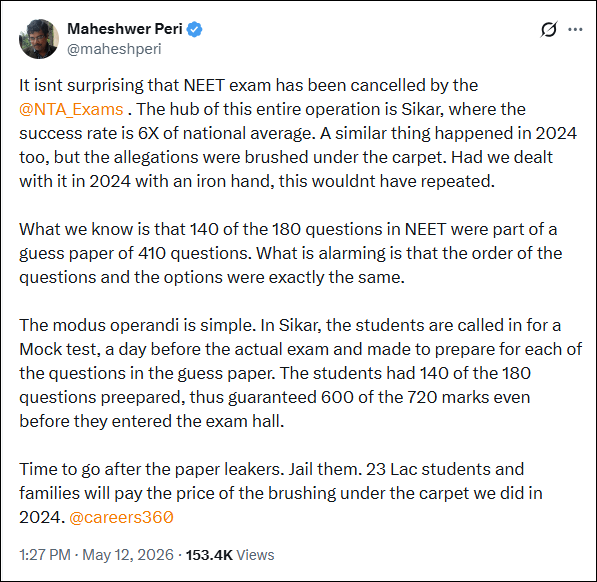
Entrepreneur-educationist Maheshwar Peri had raised alarms about the problematic activities of coaching networks in Sikar in 2024 as well. Now again, Peri has raised concerns over the allegedly suspiciously high success rate of Sikar’s coaching hub. Sikar has a success rate around 6 t 7% higher than the national average.

“… The hub of this entire operation is Sikar, where the success rate is 6 times the national average. A similar thing happened in 2024, too, but the allegations were brushed under the carpet. Had we dealt with it in 2024 with an iron hand, this wouldn’t have repeated,” Peri posted on X.

“The modus operandi is simple. In Sikar, the students are called in for a mock test a day before the actual exam and made to prepare for each of the questions on the guess paper. The students had 140 of the 180 questions prepared, thus guaranteeing 600 of the 720 marks even before they entered the exam hall,” he added.
Clearly, beyond the ‘academic excellence’ claims, Sikar’s coaching network has a documented history of irregularities in competitive exams. Discontinuing the past neglect, the authorities need to thoroughly investigate this town’s coaching cluster to prevent further paper leaks and consequent distress and devastation to lakhs of students.

Overall, there are many unanswered questions. Since NEET is a paper-and-pen examination, and the copies of the question paper are transported to more than 5000 exam centres across the country, the time gap is usually weeks before the exam. Despite there being a fear of paper leaks, why has no concrete solution been found by the NTA yet? Was there an insider involvement in the paper leak? Was the ‘guess paper’ procured during the printing process? The cancellation of the NEET UG exam indicates that the scandal is way bigger than it seems. Why has NTA not revealed the full extent of the rot? Is not the right time to pivot to the Computer-based test format? And most importantly, how long will this exam-paper leak-cancellation-reexam spiral go on?
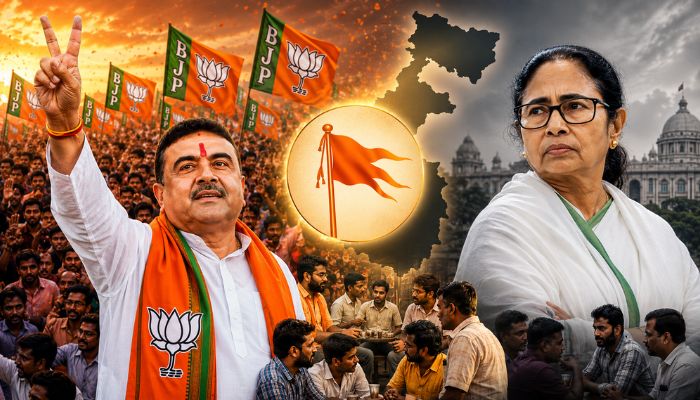
From tea stalls and beauty parlours to auto rides: How the RSS ran a ‘Whisper Campaign’ that helped BJP in defeating TMC in West Bengal

The BJP registered a massive victory in the 2026 Assembly elections, winning 206 out of 293 seats, while the ruling Mamata Banerjee-led Trinamool Congress (TMC) was reduced to just 81 seats. BJP leader Suvendu Adhikari took oath as the ninth Chief Minister of the state on 9th May, becoming the first Chief Minister from the Bharatiya Janata Party in Bengal’s history. 

One of the biggest political shocks came from Bhabanipur, where former Chief Minister Mamata Banerjee lost her seat. Just a decade ago, such a political outcome would have seemed impossible in Bengal.

The BJP’s rise in Bengal has been long and gradual. From having zero seats in 2011 to now forming the government in 2026, the party spent years building its organisation at the grassroots level. BJP leaders and workers repeatedly claimed that the people of Bengal were frustrated with the “jungle raj” of the TMC government. 

But behind this political rise was another organisation working almost invisibly on the ground, the Rashtriya Swayamsevak Sangh and its affiliates. While BJP leaders addressed massive rallies and dominated headlines, the RSS quietly built a deep social network across villages, towns and urban colonies that eventually helped unseat the TMC government.

A silent campaign that Bengal barely noticed 

Unlike traditional elections, where a visible wave can be sensed months in advance, Bengal’s political shift came through what many BJP and RSS workers describe as a “silent undercurrent”. There were no loud campaign slogans on every street corner for most of the year. Instead, the campaign operated through conversations at tea stalls, beauty parlours, grocery shops, auto-rickshaws and evening gatherings over tea and chanachur.

According to a report by India Today, an RSS functionary from Bengal said that the Sangh and BJP realised early that people were angry but hesitant to openly speak against the TMC due to fear and political pressure. According to him, the strategy was simple: go micro, not mega.

“For over a year, around 50,000 auto drivers in Kolkata silently campaigned for the BJP. They did not openly ask for votes. They would simply drop one or two lines during conversations with passengers about corruption, women’s safety or cut-money,” the RSS functionary said.

This became one of the defining features of the BJP-RSS campaign in Bengal. Instead of relying solely on giant political rallies, the focus shifted to ordinary people with daily contact with voters. Local tea sellers, grocery store owners, beauticians, temple volunteers and small businessmen became informal communicators of political messaging.

According to RSS workers, these “local influencers” were identified long before the elections. The Sangh believed that people trusted familiar faces from their neighbourhood more than political speeches from distant leaders.

Tea stalls, beauty parlours and whisper campaigns

One of the most unusual parts of the campaign was what RSS workers called the “whisper campaign”. Instead of holding loud political meetings everywhere, small groups of five to ten people would meet informally and discuss issues affecting Bengal. Those people would then carry the discussion into their families and neighbourhoods.

Hindu Jagaran Manch leader Sarnath Ghosh explained how the strategy worked. “We held whisper campaigns with small groups. Those ten people would then speak to a hundred others. Slowly, the message spread everywhere without noise,” he said.

According to Ghosh, social media also played a major role in amplifying these discussions. Videos related to violence, corruption, alleged atrocities against Hindus, the RG Kar rape-murder case, Sandeshkhali violence and syndicate extortion were widely circulated through WhatsApp groups and local networks.

“We asked people a simple question: Who will protect your safety, your family and your faith?” Ghosh reportedly said, while adding that Sangh affiliates themselves do not directly ask people to vote for any political party.

The RSS and BJP also focused heavily on informal door-to-door contact. BJP workers would visit homes in the evening for tea and snacks, often without openly discussing politics. The idea was to build familiarity and trust rather than pressure people for votes.

Bengal BJP spokesperson Bimal Sankar Nanda said that the party conducted nearly 2.5 lakh small and big meetings before the election. “This time, the focus was not on formal speeches. The focus was on direct human contact,” he explained.

Anger against TMC became BJP’s biggest strength

The BJP and RSS workers believed that Bengal already had a strong anti-incumbency mood. Their task was not to create anger, but to quietly organise and channel it.

Several incidents became central talking points during the campaign. The RG Kar rape-murder case created massive outrage over women’s safety. The Sandeshkhali violence and allegations of land grabbing angered rural voters. Complaints about syndicate culture, cut-money extortion and political violence also damaged the image of the TMC government in many areas.

RSS leaders repeatedly argued that ordinary Bengalis felt politically suffocated under the TMC’s rule. Jisnu Basu, the Purba Kshetra Prachar Pramukh of the RSS, claimed that many voters believed Bengal’s identity and security were under threat. “This election became an organic reaction against fear, criminalisation and political oppression,” he said.

According to RSS workers, many voters were especially angry after the devastating floods in Bengal in 2025. BJP and RSS campaigners frequently reminded voters that while many parts of Bengal were suffering during the floods, Mamata Banerjee was attending public events and carnivals in Kolkata.

An RSS worker from Tollygunge who runs a tea stall said such incidents deeply affected public sentiment. “People felt the government had become disconnected from common citizens,” he reportedly said.

RSS built the ground structure while BJP expanded organisationally 

The RSS campaign alone would not have been enough without the BJP simultaneously strengthening its organisational machinery across Bengal. After the BJP’s strong performance in the 2019 Lok Sabha elections, where it won 18 parliamentary seats, the party began aggressively expanding its grassroots structure. Ahead of the 2026 Assembly election, BJP leaders focused on booth-level management and local mobilisation.

Senior BJP leader Sunil Bansal, who started as an RSS pracharak, played a major role in reorganising the BJP structure in Bengal. Union minister Bhupender Yadav and Tripura leader Biplab Kumar Deb also spent long periods in Bengal helping the party strengthen its network.

The BJP identified nearly 44,000 booths and categorised them based on the party’s strength in each area. “Panna pramukhs” were assigned responsibility for maintaining contact with groups of 30 to 60 voters. These workers remained in constant touch with voters till polling day.

RSS volunteers also gave constant feedback to BJP leaders about local public sentiment and the opposition’s moves. BJP leaders admitted that this helped the party fine-tune its campaign strategy constituency by constituency.

West Bengal BJP spokesperson Bimal Sankar Nanda told India Today Digital that the party held nearly two lakh small meetings across Bengal before the election. During these interactions, people were encouraged to vote without fear and assured that central security forces would protect the polling process.

Hindutva politics and border concerns became major issues 

Another major factor in the election was the growing traction of Hindutva politics in Bengal. Issues like illegal immigration from Bangladesh, demographic changes in border districts and appeasement politics became central themes in the BJP’s campaign.

RSS affiliates repeatedly raised concerns about attacks on Hindus and religious polarisation. Through small meetings and local discussions, they framed the election as a fight for Bengal’s identity and security. The BJP also linked law-and-order concerns with border infiltration and illegal networks operating in parts of Bengal. These issues resonated strongly in border districts and among sections of urban Hindu voters.

In many constituencies, BJP candidates focused heavily on hyper-local campaigning. In Bankura, BJP candidate Niladri Shekhar Dana campaigned on an e-rickshaw while volunteers conducted door-to-door outreach from morning till night. 

Dana further said that a team of reveals a team of 100 volunteers was working tirelessly from 8 am to 9 pm, conducting door-to-door outreach efforts. He claims that a strong pro-BJP sentiment is sweeping the region, asserting that the ruling Trinamool Congress is on the verge of defeat. He lambasts the TMC using harsh descriptors such as ‘thief’ and ‘thug rule,’ accusing them of neglecting law and order and ignoring the public’s demands for change. 

In Birbhum, BJP leaders visited fish markets and villages, speaking directly to people about water shortages, corruption and unemployment. The slogan of “poriborton” slowly transformed from a campaign message into a wider public sentiment.

The fall of TMC’s stronghold

By the time polling concluded, the BJP and RSS workers believed that the political tide had already shifted beneath the surface. What looked like a normal election on the outside had actually become a massive social mobilisation at the ground level.

The RSS leadership publicly downplayed its role after the results, saying that Bengal’s people themselves had rejected the TMC government. But BJP leaders privately acknowledged that the Sangh’s grassroots work played a major role in converting public anger into electoral victory.

The BJP’s Bengal victory ultimately became a combination of organisational discipline, booth-level planning, ideological mobilisation and silent social outreach. Massive rallies by leaders like Prime Minister Narendra Modi and Home Minister Amit Shah gave energy to the campaign, but the real groundwork happened quietly inside neighbourhoods, tea stalls and homes across Bengal.

For years, the TMC appeared politically unbeatable in Bengal. But the RSS spent months building a near-invisible network of conversations, local influence and voter outreach that slowly chipped away at the ruling party’s dominance. When the results finally came on 4th May, that silent campaign had turned into one of the biggest political upsets in Bengal’s history.

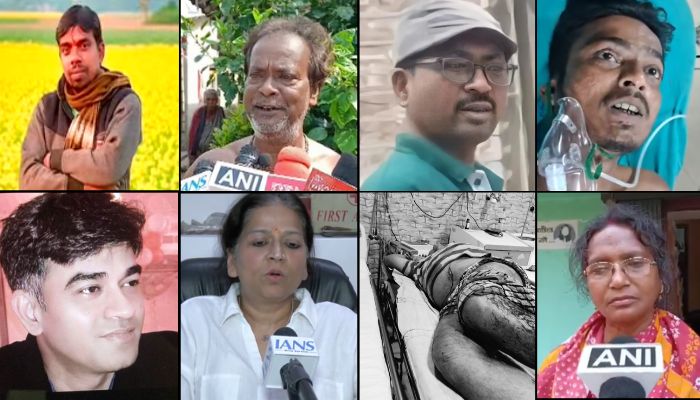
From lynchings to crude bomb attacks: A comprehensive account of violence carried out by Mamata’s TMC goons after the 2026 West Bengal election result

The Trinamool Congress, led by Mamata Banerjee, has been completely rattled after losing the 2026 Vidhan Sabha election. As a result, it has unleashed its hooligans to create chaos and conflict after the election results. While Mamata has refused to resign, her party thugs have resorted to killing BJP workers, destroying property and intimidating common people through violence. OpIndia has compiled multiple such incidents carried out by the TMC since 4th May 2026.

Jadhav Bor lynched in Howrah

On Monday night (4th May), a 45-year-old BJP worker named Jadhav Bor was beaten to death by TMC goons near his residence in the Udaynarayanpur area of Howrah. The incident happened shortly after celebrations began in the area following the BJP’s election victory.

According to his family members, Jadhav had stepped out to celebrate with colours along with other BJP karyakartas. Later in the evening, he returned home but soon went out again to bathe at a spot a short distance away.

It was during this time that a group of men reached there and attacked him. He was reportedly hit on the head with a rod, causing severe injuries. Hearing his screams, locals rushed to the spot, but the attackers fled. Jadhav was quickly taken to Udaynarayanpur State General Hospital, where doctors declared him dead.

Madhu Mandal beaten to death in New Town

On Tuesday (5th May), a BJP leader named Madhu Mandal was beaten to death by Trinamool Congress goons during a victory rally in Baliguri locality of New Town in West Bengal. His body was found lying in a patch of mud. So far, the local police have arrested a TMC leader named Kamal Mandal and his 4 aides in connection with the brutal murder.

BJP leader Piyush Kanodia, who won from Rajarhat New Town Assembly constituency, assured action against the killers of Madhu Mandal.

“I have just taken charge as an MLA, and it hasn’t even been four hours, and I am having to place a garland on my brother’s body. I have told the police that those who are responsible for this act should not be spared at all,” he remarked.

Personal assistant of Suvendu Adhikari murdered, driver in critical state

On Wednesday (6th May), the personal assistant of BJP leader Suvendu Adhikari, identified as Chandranath Rath, was shot dead in Madhyamgram in North 24 Parganas district of West Bengal. The incident occurred close to the victim’s residence. At the time of his killing, Rath was travelling in a black Scorpio SUV.

According to reports, the shooting was carried out by 2 bike-borne men. Rath sustained bullet injuries to his head, chest and abdomen. After being rushed to the hospital, he was declared dead on arrival. The car driver, Buddhadeb Bera, was also injured and currently remains in a critical condition. A Special Investigation Team (SIT) was constituted to investigate the targeted killing.

Rohit Roy shot at in Barashat

On Wednesday (6th May), BJP worker Rohit Roy was shot in the abdomen by TMC goons in Basirhat. At the time of the attack, the victim was putting BJP flags in his locality to celebrate his party’s victory in the elections.

Roy was confronted by a group of 8-10 TMC workers. Thereafter, 3 to 5 of them opened fire at him. The victim was rushed to the Basirhat State Hospital. Currently, he is in critical but stable condition.

House of BJP supporter vandalised in North 24 Parganas

On Monday night (4th May), the house of a BJP supporter named Madan Morol was vandalised by Trinamool Congress (TMC) goons. The incident occurred in the Amdanga Vidhan Sabha constituency, which falls in the North 24 Parganas district of West Bengal.

While speaking to the media, the victim informed, “We voted for the BJP, so yesterday late night, 40-50 Trinamool miscreants came and vandalised our house and beat us. After getting information from the police, the police and the central forces came to the spot. I am very scared.”

BJP worker stabbed in Baranagar

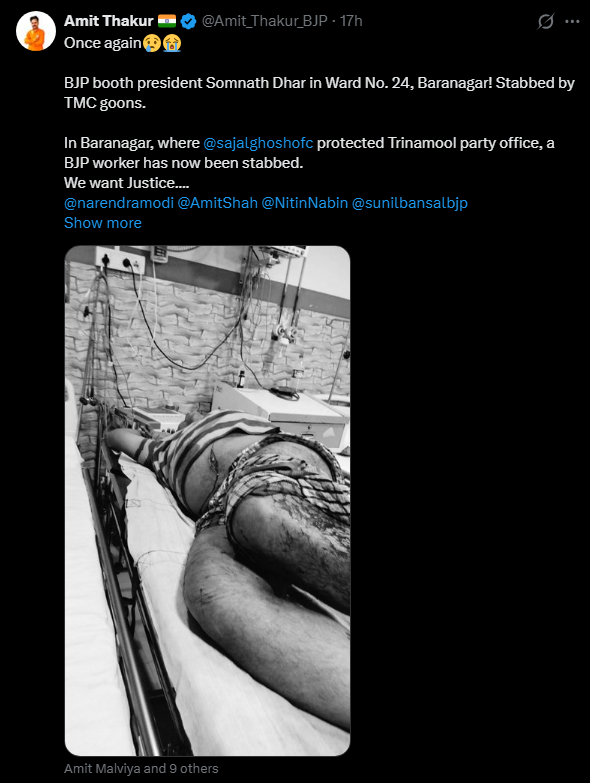
On Wednesday (6th May), a BJP leader identified as Somnath Dhar was brutally stabbed in Baranagar in the North 24 Parganas district of West Bengal. The victim, who worked as the booth President, as well as his family members, were seriously injured during the targeted attack.

According to reports, Dhar was attacked while he was standing in front of his house. He was thrown to the ground and attacked with sharp weapons. When his family members came to his rescue, they were also targeted. The victim was recovered in a bloodied state and rushed to the local hospital.

As per the family, the attack was carried out by Trinamool Congress (TMC) goons, namely, Ranjit Dhar and Subhankar Dhar. They said that the duo had been trying to occupy the ancestral residence of the BJP leader for a long time. The victim’s family stated that the TMC goons were angry after Dhar refused to give up his property.

Screengrab of the tweet by Amit Thakor

BJP worker killed in Dakshin Dinajpur

On Tuesday (5th May), a 66-year-old BJP worker named Jagadish Basak was attacked by Trinamool Congress goons in Gangarampur city in Dakshin Dinajpur district of West Bengal. His son, Jayant Basak, was also injured.

The victim’s only mistake was that his grandson burst firecrackers in front of his building to celebrate the victory of the BJP in the Vidhan Sabha election. The kid had also raised the slogan of ‘Jai Shri Ram.’ Thereafter, TMC goons came in droves and vandalised the gate of Jagadish Basak’s house. They also hit the victim on the head with an iron rod.

Jayant Basak was attacked in the neck with a sharp weapon. The father-son duo were later rushed to the hospital for immediate medical attention. While Jayant survived, his father, Jagadish Basak, succumbed to his injuries on Saturday (9th May). So far, 4 people have been arrested in connection with the case.

5 BJP workers injured in Panihati bomb attack

On Wednesday (6th May), crude bombs were hurled at BJP workers in the Panihati area in the North 24 Parganas district of West Bengal. Notably, BJP candidate Ratna Debnath, mother of RG Kar Hospital rape and murder victim, won the election from the Panihati constituency.

The incident took place near St Xavier’s Institution at Dutta Road of Ward No. 2 of Panihati Municipality. According to reports, a few members of the BJP were talking to locals when several bike-borne men arrived at the location.

Eyewitnesses said four people were on the bikes when three bombs were thrown one after another at the BJP workers before the attackers quickly escaped from the spot. A total of 5 BJP workers suffered serious injuries in the blast. The victims were rushed to R. G. Kar Medical College and Hospital, where they are currently undergoing treatment.

3 Police officers, 2 CRPF jawans attacked in Sandeshkhali

On Wednesday (6th May), a team of police officers and central forces, who were patrolling the Bamangheria area in Sandeshkhali, came under sudden attack.

The unidentified assailants opened fire and injured several personnel. The injured were identified as Bharat Purkait (Nazat Police Station Officer-in-Charge), Bhaswat Goswami (Rajbari Outpost officer), and a woman police officer. At the same time, 2 CRPF jawans were also injured in the firing.

All five injured personnel were immediately rescued and taken to Minakha Rural Hospital for initial treatment. Due to the seriousness of their injuries, they were later shifted to different government hospitals in Kolkata for better medical care.

Husband of TMC councillor leads attack on BJP minority wing leader

On Friday (7th May), Shamim Ahmed, the husband of a Trinamool Congress (TMC) councillor, led a violent attack on BJP workers and supporters in the Shibpur area of Howrah.

In visuals that have surfaced online, Ahmed could be seen leading a mob that hurled 7-15 crude bombs and fired 7-8 rounds of ammunition. His primary target was the residence of Manoj Khan, the BJP Minority Morcha President.

During the targeted attack, BJP leaders Munna Khan and Sikandar Khan were injured. Several party workers were injured during the incident and were rushed to the hospital. It must be mentioned that Shamim Ahmed was previously arrested by the National Investigation Agency (NIA) in connection with violence during a Ram Navami procession in Howrah.

TMC goons threaten petrol pump owner in Tollygunge

On Monday (4th May), an HPCL petrol pump owner in Kolkata’s Tollygunge, identified as Shalini Sen, narrated how a group of TMC goons created chaos at her petrol pump.

She informed, “Yesterday evening, when I had gone home, around 30–40 miscreants from the previous regime came to the petrol pump in an intoxicated state. They threatened my manager regarding the parking of a large fuel tanker, saying they would give only 10 minutes to remove it or they would create a disturbance. My manager called me and asked what to do…”

Shalini Sen also thanked Prime Minister Narendra Modi and Union Home Minister Amit Shah, saying that people in Bengal are finally getting an opportunity to breathe, live and work fearlessly.

Threats against CM Suvendu, calls targeting Hindus: Why Bangladesh’s radicals are panicking over BJP’s Bengal victory

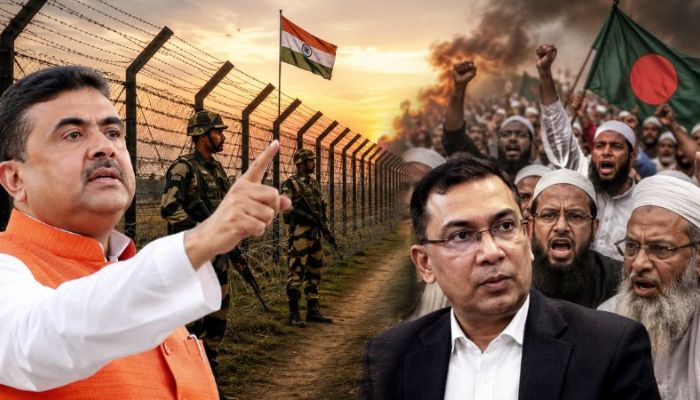
The formation of the Bharatiya Janata Party (BJP) government in West Bengal has clearly sparked panic in neighbouring Bangladesh. Street protests have erupted against the new Bengal government, while radical clerics are openly threatening to kill the state’s new Chief Minister, Suvendu Adhikari. Not only are radical clerics, but those holding important positions in the Bangladesh government are also distraught.

The reason behind this isn’t just a change of government and the replacement of one party with another, but rather the entire ideological shift that this change of power is bringing about in Bengal. India’s open border served as a gateway for Bangladeshi infiltrators. Mamata Banerjee opposed closing it, but the situation has changed. Suvendu Adhikari has prioritised fencing, and this crackdown is increasing the anxiety of extremists.

The Suvendu government gave land to the BSF for fencing, but the Mamata government blocked it

Upon assuming power in Bengal, Chief Minister Suvendu Adhikari made the security of the India-Bangladesh border a top priority in his very first cabinet decisions. The new government decided that the necessary land for fencing in areas along the India-Bangladesh border that had not yet been completed would be handed over to the BSF within 45 days.

Shubhendu Adhikari stated clearly that his government will not compromise on border security. This decision by the state government will prevent infiltration, cattle smuggling, and illegal networks that are conspiring to change the demographics of the border once the border fencing is complete.

This land was stuck during the tenure of Mamata Banerjee’s TMC government. The matter reached the Calcutta High Court, where the High Court reprimanded the then Mamata Banerjee government for not allocating the agreed-upon land to the BSF and also imposed a fine of ₹25,000 on a government official.

Bangladesh uneasy over fencing decision, Tariq Rahman’s advisor says

This decision by the Shubhendu government has increased anxiety in Bangladesh. According to media reports, Humayun Kabir, foreign affairs advisor of Bangladesh Prime Minister Tariq Rahman, commented on this decision, saying that Bangladesh cannot be intimidated by “barbed wire.” There have also been reports of the Bangladesh Border Guard (BGB) being put on alert.

That is, the decision which the new BJP government of West Bengal is linking to border security and national interest has increased the uneasiness of political and fundamentalist circles in Bangladesh.

Protests in Bangladesh and inflammatory statements by fundamentalists

Following the formation of the BJP government in Bengal, there has been unrest among Islamic fundamentalists in Bangladesh. These fundamentalists are taking to the streets to protest against the new Bengal government. Several clerics are also openly spewing venom against the BJP government and Hindus in Bengal.

In a viral video, a cleric associated with the radical Bangladeshi organisation Insaaf Kayamkari Chhatra Shramik Janata (Insaf Kayamkari Chhatra Shramik Janata) hurled Hindu hatred, calling for an attack on India with the help of Pakistan and Indian Muslims. “India will be attacked, Inshallah. We will call upon Pakistan. It will not even take 3 hours for us to capture India. These 26 provinces of India will be crushed, Insha-Allah. And the Muslims of India are enough,” the preacher threatened.

In the video, he named Prime Minister Narendra Modi, Defence Minister Rajnath Singh, Assam Chief Minister Himanta Biswa Sarma, Uttar Pradesh Chief Minister Yogi Adityanath, and Bengal Chief Minister Suvendu Adhikari and issued threats.

“If 40 crore (400 million) Muslims become angry, the Hindus of India will not be able to live. Suvendu, Modi, Rajnath Singh, Himanta and Yogi will have to apologise to Muslims,” he further remarked.

CM Suvendu Adhikari threatened to be buried at the border

Another video has surfaced in which a Bangladeshi Muslim man threatens to bury Bengal’s new Chief Minister, Suvendu Adhikari, at the border. This video is shared by a Facebook page called “The Daily Inquilab.” However, the police are investigating the authenticity of this video.

According to information being examined by investigators, the man seen in the viral video is said to be the father of an Islamist who was killed during the 2024 regime change operation in Bangladesh. In the clip, the man uses abusive and violent language against the West Bengal Chief Minister while speaking in Hindi. 

Meanwhile, Bangladeshi Maulana Inayatullah Abbasi says that if Muslims are not safe in Bengal, Hindus will not be safe in Bangladesh either. He is provoking the Tariq Rahman government in Bangladesh to threaten to break off trade relations with India.

The ground reality of ‘Poriborton’ in Bengal: Cross-border racketeering will now be stopped

Bangladesh’s frustration with the BJP’s growing political power and electoral success in West Bengal is clearly visible. Bengal shares a nearly 2,200-kilometre international border with Bangladesh, a portion of which was previously open. For years, this area had been a hub of illegal immigration, cattle smuggling, counterfeit currency networks, and radical activities.

Due to appeasement politics in West Bengal, Mamata Banerjee’s government did not take strict measures regarding border security. Vote-bank politics protected illegal immigrants, gradually affecting the demographics of many border districts. It even emerged that the illegal activities carried out by Bangladesh were facilitated by the “Mamata” government, steeped in appeasement politics.

As the BJP’s influence grows, anxiety is rising among those who relied on cross-border illicit trade and political patronage. The reactions of radical organisations in Bangladesh, as well as Islamic preachers and government officials, need to be seen in this context. They fear that if a stricter administrative system is implemented in Bengal, the illegal activities that have enjoyed protection until now may be curbed.

(This article is a translation of the original article published at OpIndia Hindi.)

NEET UG 2026 cancelled after paper leak scandal: Here’s how a handwritten ‘guess paper’ exposed the system

A fresh controversy has surrounded the recently held NEET UG 2026 exams. Just days after around 22.79 lakh students appeared for this high-stakes test for MBBS, BDS and other medical courses, it has emerged that the tight measures put up by the National Testing Agency (NTA) to prevent paper leak were just not enough, again. The scandal came to the fore after a handwritten guess paper closely matched a significant portion of the actual question paper, particularly the Chemistry and Biology sections.

The paper leak scandal triggered CBI investigations, outrage, and eventually the cancellation of the National Eligibility cum Entrance Test for the year 2026. The exams will now be reconducted on a date to be announced later by the NTA.

The ‘guess paper’ led to the NEET paper leak scandal

According to reports, a handwritten note containing around 410 questions, with a 281-question set, circulated among students over WhatsApp, Telegram groups and coaching networks, particularly in Rajasthan’s Sikar, Uttarakhand’s Dehradun, and other coaching hubs. The guess paper began to be circulated among NEET aspirants, days before the exam held on 3rd May.

After receiving a tip-off, the Rajasthan Police’s Special Operations Group (SOG) launched a probe and found striking similarities in the actual paper and the circulated guess paper, with around 120-140 questions, mainly Biology and Chemistry-related, matching exactly or very closely.

Some reports even say that 135 questions from the guess paper matched with the actual paper. These questions accounted for around 600 marks out of 720. Each question in the NEET paper carries 4 marks.

The alleged question bank is reportedly linked to a man from Rajasthan’s Churu, currently pursuing MBBS at a medical college in Kerala. He sent the guess paper to his friend in Sikar on 1st May, two days before the exam.  

From thereon, the guess paper went viral among aspirants and soon reached a PG operator, further spreading to students, career counsellors, and other candidates. After the exams were over on 3rd May, the same PG operator in Sikar filed a police complaint at Udyog Nagar Police Station, alleging that a large number of students had received the problematic question bank. 

The police swung into action; however, it soon emerged that the complaint PG operator himself had received the guess paper identical to the actual question paper, and forwarded it to several students and counsellors. The authorities suspect that the PG operator might have filed the complaint to protect himself from police action if and when the scandal comes under investigation.

The Rajasthan SOG is now focusing on exposing the entire network involved in the alleged paper leak.

While the investigators are describing the leaked note as a “guess paper” or an advanced test series, the extent of similarities between the actual paper and the ‘guess paper’ indicates malpractice that just could not have happened without the involvement of someone with insider access.

It has emerged that the leaked “guess paper” was sold for Rs 30,000 to a price as high as Rs 5 lakh in several networks.

So far, the police have arrested around 13 individuals, questioned several and are conducting searches to nab suspects. On Tuesday, Kiran Kumar Chavan, Deputy Commissioner of Police, Nashik City, said that they received a request from the Rajasthan Police regarding a suspect involved in the NEET paper leak case.

The Nashik Police acted on the request of the Rajasthan Police and took the accused into custody. The accused will be handed over to the Rajasthan Police soon.

Amidst a massive outrage over the alleged paper leak, the National Testing Agency issued a statement on 10th May, detailing the chain of events, from examination to reports of malpractice and the subsequent action by the NTA and law enforcement agencies.

Regarding the reports of malpractice, the NTA said, “On the late evening of 7 May 2026, four days after the examination, NTA received inputs concerning alleged malpractice activity around the examination. These inputs were escalated by NTA to central agencies on the morning of 8 May 2026 for independent verification and necessary action. The action subsequently undertaken by the law enforcement agencies, including the detentions reported in the media over recent days, is the result of their professional and timely work. NTA places on record its appreciation for the agencies leading this effort, and confirms that it is working closely with them in a fully supporting role, providing all examination-related data and technical assistance required.”

The Agency did not initially call it a case of paper leak, saying that the matter remains under investigation. “The matter is presently under investigation, and the facts will be established by the agencies in due course. NTA will not pre-judge the inquiry, nor characterise its likely outcome. Whatever the agencies determine, including findings that may require further action, will be examined transparently and disclosed in keeping with established procedure,” it said.

CBI takes over probe, NTA cancel NEET UG 2026 after paper leak, new date to be announced

Meanwhile, the Central government has handed over the probe into the matter to the Central Bureau of Investigation (CBI). The National Testing Agency (NTA) stated on 12th May, and said that the NEET UG examination conducted on 3rd May stands cancelled, and a fresh date for reconducting the exam will be announced later.

“Based on the inputs subsequently examined by NTA in coordination with the central agencies, and the investigative findings shared by the law enforcement agencies and to ensure that there is transparency in the system, the National Testing Agency, with the approval of the Government of India, has decided to cancel the NEET (UG) 2026 examination conducted on 3 May 2026, and to re-conduct the examination on dates that will be notified separately,” the NTA said, adding that the present examination process could not be allowed to stand.

Acknowledging the immense distress and inconvenience the cancellation and re-examination of NEET UG 2026 will cause to students and their families, the NTA said, “The registration data, candidature, and examination centres opted for in the May 2026 cycle will be carried forward to the re-conducted examination. No fresh registration will be required, and no additional examination fee will be levied. In addition, fees already paid will be refunded to the students, and the exam will be re-conducted using NTA’s internal resources.”

NEET paper leaks have become a recurring blot on India’s education and examination system. In 2024, confirmed paper leaks were reported in Bihar and Jharkhand, in addition to a ‘grace marks’ controversy that affected thousands of students. Back then, the CBI had investigated the matter, and eventually, it was ruled by the Supreme Court that the ‘leak’ was localised, and at the pan-India level, thus the results were allowed to stand.

Private coaching networks, the high-stakes nature of the exam, the vulnerability and desperation of students, and a system, despite its efforts and tall promises, fail to fully deliver, all collectively fuel paper leaks, pushing the educational future of thousands of students into jeopardy.

Price rise, fuel rationing, shutdowns, work from home and more: How India’s neighbours have been handling challenges brought by Iran-US war

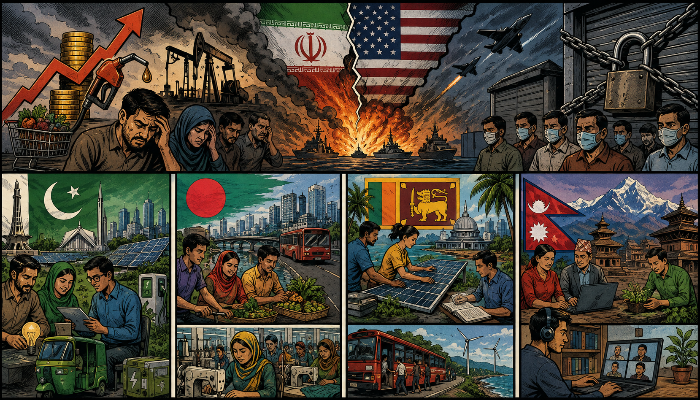
The intensification of conflict between the United States, Israel and Iran caused fuel prices to spike, underscoring the vulnerability of the energy sector to geopolitical shocks. Fears of protracted disruptions to shipments through the Strait of Hormuz, a crucial chokepoint for 25% of global oil flows, pushed Brent crude prices to multi-year highs in late April and early May, at over $100 per barrel.

Energy markets have been profoundly destabilised, resulting in inflation and a surge in energy costs around the world. However, India has proven to be an exception despite its own set of struggles owing to the war. It successfully maintained a steady energy supply with consistent prices without any major alterations, even as G20 states had to confront the fallout from the tensions in West Asia.

Likewise, India’s immediate and larger neighbourhood had to adopt to a range of policies to manage the growing energy challenge. Many countries shared plans to ration fuel and energy consumption as the dispute persists. Fuel shortages prevailed in nations including Maldives, Bangladesh, Nepal, Sri Lanka and Pakistan.

Additionally, they are relying on New Delhi for support. India is the fourth-largest refiner in the world and supplies fuels to Bangladesh, Nepal, Bhutan and Sri Lanka. The nation is viewed as a vital alternative during emergencies, from urgent shipments to continuous pleas for diesel and Liquefied Petroleum Gas (LPG). This emphasises India’s expanding position as a dependable partner for upholding stability throughout South Asia and the Indian Ocean.

Maldives looks at India for help

These countries depend on energy imports and tourism is a major source of income for Sri Lanka and the Maldives which witnessed a major decline. The number of tourists visiting the Maldives decreased by 20%, just weeks before a due $500 million debt repayment. The figure in the first 16 days of March was down by 21% compared to the same period last year. Meanwhile, Maldives hiked fuel prices and wanted to secure deliveries from India.

“The government of Maldives has reached out to us for supply of petroleum products both on short-term and long-term basis. The request is being examined keeping in mind our own availability and our own needs,” mentioned Ministry of External Affairs spokesperson Randhir Jaiswal.

Pakistan issues directives due to severe fuel shortage

On the other hand, Pakistan, which takes around 80% of its crude oil from the United Arab Emirates and Oman, where prices hit a record high because of the ongoing turmoil, faced a substantial rise in costs of fuel amid its role as a failed “mediator” between Washington and Tehran. The Islamic Republic also extended school holidays by 2 weeks, switched to online classes and mandated a four-day workweek for government offices.

All markets and commercial centers, with the exception of Sindh province, were ordered to shut at 8 pm. Weddings at private residences or commercial locations were not permitted after 10 pm. Public transit in Gilgit and Muzaffarabad was declared free for a month. Fuel allocations for government divisions were reduced by 50% for a period of two months.

It was communicated to offices that only 50% of the staff should be physically present. The initial Twenty20 cricket matches in the Pakistan Super League were played behind closed doors without any audience and its opening ceremony was cancelled.

“Prime Minister Shehbaz Sharif requested all of Pakistan to restrict their movements because of the fuel crisis. We closed schools and instituted work from home and increased the number of Eid holidays. We don’t know how long this war will last,” expressed Pakistan Cricket Board (PCB) chairman and the country’s interior minister, Mohsin Naqvi.

Bangladesh introduces strict measures

95% of Bangladesh’s gas and oil originate from West Asia. Hence, it had to assess its energy usage in light of the unrest. The country increased Ramzan holidays, shortened shop and office hours in an effort to save electricity. Banks were told to function from 9 am to 3 pm, and government and private offices from 9 pm to 4 pm.

Offices had been directed to reduce power consumption, which included eliminating overly bright lighting. There were also limitations on non-essential travel and on the amount of fuel and energy used in public offices.

The nation’s shopping malls were required to close at 6 o’clock in the evening but food establishments were expected to maintain their regular hours. Government entities had been advised to forgo purchasing computers and automobiles. Dhaka stopped production at fertiliser facilities and placed restrictions on fuel procurement. Bangladesh also outlawed decorative lighting at weddings until further notice.

The country also turned to India for assistance. “We have received requests from some neighbouring countries for energy exports, including diesel from Bangladesh. Domestic availability and production will be factored in before any decision is taken,” Jaiswal stated at the time. The Modi government had promised to send over 50,000 tonnes of diesel to Dhaka by April.

Sri Lanka’s economy continues to struggle amid the new hurdle

Sri Lanka, which continues to grapple with economic instability and is trying to prevent another collapse similar to 2022, also bore precarious circumstances stemming from the present distress. It proclaimed every Wednesday to be a “holiday” to preserve the fuel reserves, reinstate work-from-home options and formal programs were postponed.

The public institutions, universities and schools were covered under the four-day workweek. Moreover, Colombo implemented constraints on the quantity of fuel its residents could obtain. This move was last enforced in 2022, at the height of its bankruptcy.

Bus and train services were scaled back. Households and businesses had to confront greater electricity rates. The island nation drove the cost of power by up to 40% and that of fuel by a third. It also slapped a ban on the utilisation of billboards, neon signs and streetlights. The government also encouraged use of fewer air conditioning units.

A conversation happened between Prime Minister Narendra Modi and President Anura Kumara Dissanayake after which India shipped 38,000 metric tonnes of fuel (20,000 MT diesel and 18,000 MT petrol) to Sri Lanka.

Nepal announces various regulations to address the situation

Nepal similarly lowered its working week from 6 to 5 days in April in response to the violent face-off in the Middle East. Official spokesperson Sasmit Pokharel noted, “Given the present uncomfortable situation caused by fuel supply, the government and educational institutions remain closed for two days.” Government offices would run from Monday to Friday from 9 am to 5 pm. Furthermore, senior administrative personnel received a 50% slip in their fuel quota.

The Nepalese government added that it was going to examine possibilities (legal arrangements) to switch from petrol and diesel vehicles to electric models. The cost of aviation fuel more than doubled alongside a surge in the price of petrol and diesel. The landlocked Himalayan country started selling gas cylinders that were only partially filled due to the sensitive situation and frenzied buying. Nepal also asked India for larger provision of LPG.

The military junta declares strict directives for Myanmar

A comprehensive fuel rationing system for private vehicles was unveiled by the ruling junta in Myanmar. The National Defence and Security Council (NDSC) stated that the new rules, which went into effect on 7th March, were a reaction to “global political situations” and armed strife in the Middle East that had impeded the influx of oil.

According to the regime, even-numbered plates would be authorised to drive on even dates and odd-numbered plates on odd dates under an innovative “even-odd” licensing regime. Electric motorcycles and cars were exempt. Additionally, the NDSC threatened to penalise companies and people that hoarded fuel for resale at inflated prices.

All government staff were asked to work from home every Wednesday as gas and diesel prices ascended by 50%. Domestic flights were temporarily suspended due to massive scarcity of jet fuel.

The state of affairs just as serious in the wider neighbourhood surrounding India

Southeast Asia’s economy is heavily dependent on commerce and exports and the altercation between the Islamic regime and Trump administration triggered to grave implications for the area, especially with rising oil prices and hindrances in international trade. The continuing feud hurts the regional economies and renders matters more complicated for nations who have significant trade surpluses with the United States, such as Vietnam, Thailand, Malaysia, Indonesia and the Philippines.

These countries are predominantly reliant on fossil fuels from the Middle East and is consequently quite susceptible to supply chain failures. Fuel prices skyrocketed throughout Southeast Asia. The cost of gas and diesel rose by 50% in the Philippines, Laos, Vietnam and Cambodia.

The cost of jet fuel, a byproduct of crude oil, likewise soared. Thailand had a 50% reduction in tourist arrivals in March compared to the previous month. According to one estimate, up to 3 million fewer tourists could make it to the nation if the standoff lasts longer than 6 months, costing it an estimated US$4.5 billion in lost tourism earnings.

A national energy emergency was approved in the Philippines due to “the resulting imminent danger posed upon the availability and stability of the country’s energy supply.” The nation’s jeepney drivers were among those most adversely affected by the war. Prices climbed up and inflation took hold.

The high cost of fuel equally bothered farmers and fishermen. Bulacan had already seen the forced cessation of planting by many vegetable growers.

A looming danger to economies

Civil servants were directed to work from home one day a week in Malaysia, Indonesia and the Philippines. Laos government recommended ministries to cut back on travel, opt for electric vehicles, promote remote work and meetings as well as rotate employees to save on fuel in its emergency order. Laos’s predicament was exacerbated when Thailand stopped importing energy to its neighbours.

The school week in Laos was shortened from five to three days. Notably, “The Laotian Times” reported on 28th March that the Lao Statistics Bureau’s most recent data showed headline inflation increased to 9.7% in March from 6.2% in February and 5.1% in January. The war was feared to prompt another economic crisis in the country.

Vietnam also removed some fuel taxes until mid-April to offset outrageous fuel costs and ease the burden on people and companies. These prices diminished by about 20% as a result of the action, although they stood far higher than they were prior to the violent rivalry. Operational costs also shot up by almost 60% due to the dearth of diesel and LPG needed for factory equipment. Airlines in Vietnam clamped on flights on certain domestic routes to save jet fuel.

Indonesia vowed to sustain fuel subsidies for the remainder of the year and carried out fuel rations for private drivers to quell domestic chaos. It also had to slash its free school food program by one day per week due to higher government spending.

Malaysia temporarily dropped the monthly subsidised fuel allotment from 300 litres to 200 litres after its fuel subsidy cost quadrupled in March. Governments urged commuters to use public services rather than private vehicles and promoted energy efficiency in homes and workplaces.

Singapore underwent elevated electricity and inflation rates, with certain sectors of the economy being more vulnerable than others. The cost of aircraft fuels more than doubled. Public agencies received guidance to minimise their usage of electricity, particularly air conditioning, while the government launched support measures of approximately S$1 billion ($785 million) to stabilise the economy.

Conclusion

The hostilities in West Asia have brought about upheaval and trouble internationally with every country feeling the heat even though some regions have been better prepared to counter it than others via subsidies, fresh rules or other means. Nevertheless, the most alarming aspect is that the conflict does not appear to be nearing an end anytime soon.

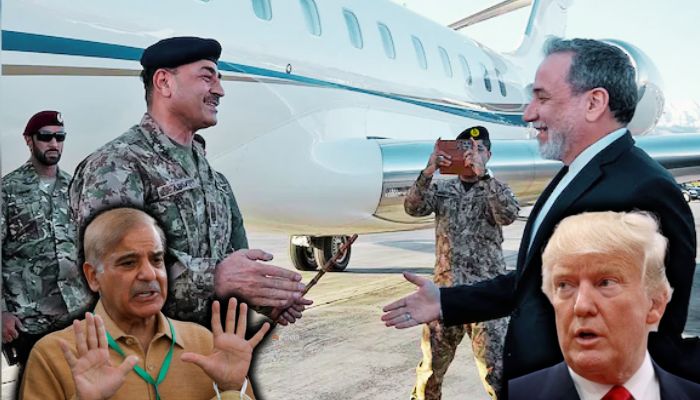
Islamabad’s double game exposed: ‘Mediator’ Pakistan allowed Iran to park military aircraft at Nur Khan Airbase to shield them from US attacks. Here’s what happened

Treachery, deception and double-dealing are the core characteristics of Pakistan. In a fresh demonstration of its true nature, Pakistan reportedly allowed Iranian military aircraft to park in its airbases while playing a ‘mediator’ between the warring nations of Iran and the US. A CBS News report has cited US officials privy to the matter, to say that Pakistan allowed Iranian military aircraft to be parked in its airfields to shield them from American attacks.

“Together, the movements reflected an apparent effort to insulate some of Iran’s remaining military and aviation assets from the expanding conflict, even as officials publicly served as brokers for de-escalation,” the CBS News report published on 11th May reads.

Interestingly, Iran moved its military aircraft, including an Iranian Air Force RC-130, a reconnaissance and intelligence-gathering variant of the Lockheed C-130 Hercules tactical transport aircraft, days after Trump announced a ceasefire in April this year.

The Iranian aircraft were parked at Pakistan’s Nur Khan Airbase, which was severely damaged during Operation Sindoor in May 2025.

‘No contingency arrangement’: Pakistan denies the presence of Iranian military aircraft at Nur Khan Airbase

Soon after the publication of the CBS News report raising questions over Pakistan’s neutrality as a ‘conduit’ between Iran and the US, an online backlash followed. Several netizens, particularly Americans, called out Pakistan for playing ‘peacemaker’ at the front while treacherously safeguarding Iranian military assets from behind.

Amidst mounting criticism, Pakistan’s Ministry of Foreign Affairs issued a statement on 12th May, “categorically” rejecting the CBS report, which cited US officials to claim that Islamabad allowed Tehran to move its military aircraft to Nur Khan Airbase to shield them from American strikes.

“Pakistan categorically rejects the CBS News report regarding the presence of Iranian aircraft at Nur Khan Airbase as misleading and sensationalised due to speculative narratives that appear aimed at undermining ongoing efforts for regional stability and peace,” the statement reads.

Pakistan claimed that several Iranian and American aircraft arrived in Pakistan during ‘peace’ talks held in Islamabad to facilitate the movement of diplomatic personnel, security and administrative staff.

While US officials cited by the CBS News report said that the movement of civilian and military assets to Pakistan was part of Iran’s attempt to insulate some of its remaining military and aviation assets from potential American and Israeli attacks, Islamabad claims that the Iranian aircraft parked in Pakistan has no links to any military contingency efforts.

“The Iranian aircraft currently parked in Pakistan arrived during the ceasefire period and bears no linkage whatsoever to any military contingency or preservation arrangement. Assertions suggesting otherwise are speculative, misleading, and entirely detached from the factual context,” it added.

Lindsay Graham seeks reevaluation of Pakistan’s role as a ‘mediator’ over news report about Islamabad granting refuge to Iranian military assets

U.S. Senator Lindsay Graham published a post on X and sought a “complete reevaluation” of Pakistan’s role as a mediator between Iran, the US and Israel.

“If this reporting is accurate, it would require a complete reevaluation of the role Pakistan is playing as mediator between Iran, the United States and other parties. Given some of the prior statements by Pakistani defence officials towards Israel, I would not be shocked if this were true,” Graham wrote.

Islamabad prioritised American interests during the Islamabad Talks on one hand, and provided refuge to Iranian military aircraft on the other: Pakistan is not a ‘peacemaker’ but a clout chaser.

Deceit comes naturally to Pakistan. No country knows this better than India, which has long been a victim of Pakistan’s two-facedness. On one hand, Pakistan granted refuge to Iranian military aircraft, though it denies involvement in any military contingency arrangement (no ‘mediator’ country would openly accept that), on the other, Islamabad always prioritised US President Donald Trump’s demands during peace talks.

This accusation came not from American media or any country hostile towards Pakistan, but from Dashtestan representative and spokesperson for Iran’s national security and foreign policy commission, Ebrahim Rezaei.

On 26th April, Rezaei wrote an X wherein he said that Pakistan lacks the necessary credibility to play a mediator between Iran and the US since it “always takes Trump’s interests into account and does not say a word against the Americans’ wishes.”

He said that Pakistan deliberately withheld the “truth” that the US had initially accepted Iran’s 10-point proposal that included cessation of Israeli hostilities in Lebanon and defreezing of Iranian assets, but backtracked later.

Rezaei posted, “Pakistan is a good friend and neighbour of ours, but it is not a suitable intermediary for negotiations and lacks the necessary credibility for mediation. They always take Trump’s interests into account and do not say a word against the Americans’ wishes. For example, they are unwilling to tell the world that America first accepted Pakistan’s proposal but then went back on its word. They do not say that the Americans had commitments regarding the issue of Lebanon or the blocked assets, but failed to fulfil them. A mediator must be impartial, not always leaning to one side.”

The American influence on the self-declared ‘impartial’ mediator,r Pakistan, was evident when a draft version of his ceasefire announcement post on X briefly appeared online, clearly marked with the line, “Draft – Pakistan’s PM Message on X,” just minutes before the final version was published on Tuesday, 7th April.

Minutes later, a fresh post without “Draft – Pakistan’s PM Message on X” was published on X. However, Pakistan’s impartiality and seriousness as a mediator had already come under question, followed by mockery from Americans, Iranians and the world alike.

Ever since the April 8 ceasefire, Pakistan has been boasting of securing a ‘diplomatic win’, a rare occasion when Islamabad received global attention not for Islamic terrorism but for ‘peace-making’.

In fact, Pakistan’s role in the mere routing of Iran and the US’s peace proposals was also mired in controversy in April this year. While US President Donald Trump announced a temporary ceasefire after receiving Iran’s 10-point proposal, American officials later clarified that key elements such as acceptance of uranium enrichment and inclusion of Lebanon were never agreed upon.

It was reported that the Farsi version of the 10-point ceasefire proposal Iran put forth contained the phrase “acceptance of uranium enrichment” for its nuclear program. This key point was reportedly missing in the English version of the document routed through Pakistan to the US.

The Farsi and English versions of Iran’s 10-point plan, widely reported in the media, made explicit mention of Lebanon, stating: “Cessation of hostilities across all fronts, including Israel’s conflict with Hezbollah in Lebanon as well as attacks on ‘Axis of Resistance’ allies.”

This was also mentioned by Pakistan’s Prime Minister Shehbaz Sharif in his post on X, as he wrote, “I am pleased to announce that the Islamic Republic of Iran and the United States of America, along with their allies, have agreed to an immediate ceasefire everywhere, including Lebanon and elsewhere, EFFECTIVE IMMEDIATELY.”

While Pakistan had announced that the ceasefire applies to Lebanon as well, the Israeli PMO refuted Pakistan’s claim.

Pakistan claims to be an impartial mediator, and yet it was seen how Pakistani Defence Minister Khwaja Asif posted a highly inflammatory X post against Israel, which is a party in the Iran war, ahead of the Islamabad talks.

 Asif referred to the country as “evil,” “curse for humanity”, and “cancerous” as well as lashed out at those who created it to “get rid of European Jews” to “burn in hell”.

“Israel is evil and a curse for humanity, while peace talks are underway in Islamabad, genocide is being committed in Lebanon. Innocent citizens are being killed by Israel, first in Gaza, then in Iran and now in Lebanon; bloodletting continues unabated. I hope and pray people who created this cancerous state on Palestinian land to get rid of European Jews, burn in hell,” he wrote.

He was forced to delete the post after the severe backlash. Israeli authorities had also strongly reacted against Khwaja Asif’s online vitriol. The Israeli PMO had directly raised questions over Pakistan’s role as a ‘neutral arbiter for peace’ when its top leader harbours such deep-rooted hatred for Israel.

Towards the end of April, Pakistan further showed its true colours and opened six trade routes to Iran, offering a major workaround to the naval blockade in the Strait of Hormuz ordered by Donald Trump. Ever since Trump announced a counterblockade of the Strait of Hormuz, US naval action in the Strait of Hormuz has choked Iran’s sea trade, targeting ships linked to Iranian ports and restricting both exports and imports. The blockade disrupted a key global shipping lane that usually carries around 20% of the world’s oil. 

Trump’s whole idea of a counterblockade was to dry out Iran’s revenues and stop oil exports. It was reported by Kpler that Iran exported around 1.84 million barrels of crude a day in March this year, which is about 100,000 barrels a day extra, compared to the last three months.

If, with Pakistan’s assistance, Iran can find alternate transit routes and bypass US-imposed disruptions, then the US’s counterblockade is as futile as Islamabad’s talks were. This is because if Iran continues to bring in revenues and sustain its distraught economy, why would it succumb to American demands?

If the context is ignored, what Pakistan did was a smart trade facilitation, as it managed to clear thousands of stranded containers and bolster the China-Pakistan Economic Corridor’s westward reach into Central Asia.

However, what sort of a mediator seeking quick and lasting peace between two warring nations exploits the crisis for its own benefit. Is Pakistan even a mediator when it is playing from both sides, giving refuge to Iranian military assets while pushing American demands in talks? Pakistan is not a mediator or peacemaker but a beneficiary of the Iran war. Islamabad has got an economic lifeline by securing billions of dollars in loans from Saudi Arabia amidst the looming threat of the resumption of the war in West Asia.

With such a mediator, it is not surprising that peace in West Asia remains fragile. It appears that Pakistan is trying to keep the ‘peace’ process alive while delivering nothing much. For Pakistan, mediation is not about securing a peace agreement between Iran and the US but about milking the opportunity to gain clout and make gains from both the warring nations, giving some concessions to each

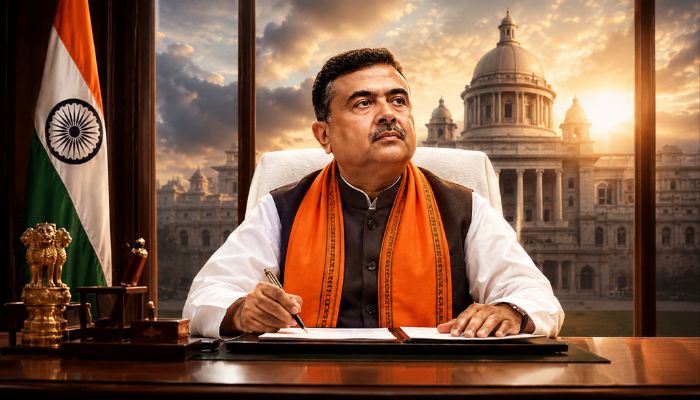
14 decisions Suvendu Adhikari took within 48 hours of becoming CM of Bengal: From no namaz in public, reopening 2021 post-poll violence cases and more

Suvendu Adhikari is the man of the moment. The heavyweight politician defeated the supreme leader of Trinamool Congress, Mamata Banerjee, not once but twice in her bastion. He led the BJP to victory in one of its last remaining frontiers and was rightfully crowned the Chief Minister of West Bengal on 9th May this year.

Suvendu Adhikari did not waste time and began fulfilling the promises he made to people during the elections. Within 48 hours of assuming office, he took more than a dozen decisions to undo the damage inflicted by the Trinamool Congress (TMC) regime in the State for the past 15 years.

Decision 1: Ban on street Namaz, restrictions on the use of loudspeakers and action against stone pelting

One of the first decisions taken by the Suvendu Adhikari government was to restrict namaz on the roadside and on the streets of Bengal. While speaking about the matter, BJP leader Arjun Singh informed, “The CM has given many orders during the Cabinet meeting. Namaz will not be allowed in the streets. Let them pray at mosques, but on the streets, it won’t be tolerated.”

He further pointed out that public Namaz in the Red Road area of Kolkata will no longer be allowed by the administration. “Such a thing won’t be seen. These are court orders,” Singh pointed out. During Mamata’s reign, Muslims would offer public prayers on Red Road, which is owned by the Ministry of Defence, causing the Army to delay its training schedule.

At the same time, the administration has restricted the use of loudspeakers. A government officer informed The Telegraph, “Use of loudspeakers must remain restricted within designated religious premises and comply with legal and court-mandated noise regulations.”

Besides, the new government has directed strong action against stone pelters. “Stone pelting won’t be allowed,” BJP leader Arjun Singh remarked.

Decision 2: Reopening of post-poll violence cases from the 2021 and 2023 elections

On Monday (11th May), West Bengal Chief Minister Suvendu Adhikari directed senior police officers to reopen cases of post-poll violence from the 2021 Vidhan Sabha election and the 2023 Panchayat election. The cases were previously closed by Mamata’s regime.

A police officer informed The Telegraph, “We were told to reopen all cases of violence reported after the elections of 2021 and 2023, which had been closed without any logical conclusion.”

The decision was taken during a meeting between the West Bengal Chief Minister and senior police officers, including the DIG, Additional Directors-General, Zonal Inspectors-General, Range Deputy Inspectors-General, Superintendents of Police, and others.

Decision 3: Ensuring justice for BJP workers killed by TMC goons

The new government is taking steps to fulfil the commitment it made to the families of 321 BJP workers, who were killed by Trinamool Congress (TMC) goons over the last 15 years.

While speaking about the matter, Suvendu Adhikari said, “Regarding the 321 individuals who lost their lives during our struggle: if their families desire, the government will initiate an investigation.”

Decision 4: Non-bailable cases against those involved in communal violence, police given free hand

According to journalist Kamalika Sengupta, Suvendu Adhikari has instructed the police to book criminals responsible for triggering communal violence in West Bengal under non-bailable offences.

Besides, the new Chief Minister has directed the police to function without fear and lodge cases against those involved in illegal activities. An official informed The Telegraph, “Political affiliations should not be considered. Assurance was given that this government would not be vindictive like the previous regime.”

Decision 5: Crackdown on cattle smuggling

The new BJP government in Bengal is taking steps to curb illegal cattle smuggling in the State, which has been a long-standing poll issue.

“Please ensure that there is no illegal transportation of cattle in the state. Proper checking should be done, and legal action should be initiated. Only legal and licensed cattle haats/markets will function. All illegal cattle haats be closed in your respective jurisdictions,” read a directive by Chief Secretary Dushyant Nariala.

Besides, the new government also directed action against illegal cattle markets that are operating in Dinajpur, Malda, Murshidabad, and North 24 Parganas districts.

Previously, Amit Shah had said that cattle smuggling would become impossible in India. On 8th May, he stated, “With the BJP governments in power in Assam, Tripura, and now in West Bengal, the borders will be secured, and cattle smuggling and infiltration would be impossible now in West Bengal.”

Decision 6: Crackdown on syndicates and illegal mining

The BJP government in Bengal has announced plans to curb ‘Syndicate Raj’ and illegal mining in the State. It was a pre-poll promise of the party.

According to reports, directives have been given to officials to destroy syndicate networks currently running at district and block levels by the TMC regime.

Undoubtedly, the Mamata regime allowed syndicates to thrive in multiple sectors. Many TMC leaders controlled the supply & distribution of materials.

Decision 7: BSF to get land for border fencing in 45 days

On Monday (11th May), Suvendu Adhikari announced that the government will hand over land to the Border Security Force (BSF) for fencing within 45 days. This marks a key step in preventing illegal immigration from Bangladesh and stopping further demographic change in Bengal.

Adhikari pointed out that the BSF would be given complete control of the land, which is required to fence the India-Bangladesh border.

“In our very first Cabinet meeting today, we have taken the decision to transfer the land to the BSF. The process begins today and will be completed within the next 45 days. Once this is accomplished, the BSF will complete the border fencing, and the issue of illegal infiltration will be resolved within a short period,” he told the media.

Decision 8: Removal of security cover of criminals

In a major development, the BJP government in Bengal directed the withdrawal of security cover of individuals with criminal antecedents. The inflated security cover of TMC leader Abhishek Banerjee will be reviewed after threat perception and his official position.

Decision 9: Rollout of central schemes

On Monday (11th May), Suvendu Adhikari informed that the central schemes, which the previous Mamata regime refused to implement in West Bengal, would officially be enforced now.

He announced the rollout of the Ayushman Bharat scheme and directed the Health Secretary and advisers to the CMO to complete the necessary agreement with the Union Health Ministry as soon as possible.

Other central schemes such as Beti Bachao Beti Padhao, Pradhan Mantri Jan Arogya Yojana, Pradhan Mantri Krishak Bima Yojana, PM SHRI, Vishwakarma Scheme, and Ujjwala Yojana will also be rolled out at the earliest. All DMs have been directed to expedite the implementation process.

Decision 10: BNS to be implemented

Suvendu Adhikari also announced the implementation of the Bharatiya Nyaya Sanhita (BNS), the new criminal code of India that replaced the colonial-era Indian Penal Code (IPC), in West Bengal.

It must be mentioned that Mamata’s regime delayed the adoption of the BNS by almost 2 years despite constitutional obligations.

Decision 11: TMC-appointed members removed from govt bodies

On Monday (11th May), the new BJP government in Bengal instructed all Departments to immediately end the services of TMC-appointed nominated members, directors, and Chairpersons of PSUs, Boards, organisations and non-statutory Boards under its control.

“The government has issued an order to take necessary action to immediately terminate the tenures of the nominated members, directors, or chairpersons of different boards, organisations, non-statutory bodies and public sector undertakings of the state government,” a senior official informed.

At the same time, the new government directed Departments to prevent re-employment and terminate the extension of tenures of officials beyond the age of 60 years.

Decision 12: IAS, IPS officers cleared for central training

Besides, Suvendu Adhikari also announced reforms in the State administrative services. IAS officers in West Bengal will henceforth participate in Central government training programmes, as is the case with other States.

“West Bengal government officials will participate in training programmes conducted by the Central government. The previous government had not allowed officials to participate in the scheme,” he emphasised.

Decision 13: Increasing the age limit for govt jobs

In a major relief to government job aspirants, the BJP government in West Bengal increased the upper age limit for applicants by 5 years (from 40 to 45). The move is expected to increase employment opportunities for the youth.

While speaking about the matter, Suvendu Adhikari said, “This five-year relaxation is our guarantee to those who were deprived of opportunities. Employment and transparent recruitment are our top priorities.”

He further added, “During the campaign, Union Home Minister Amit Shah had promised that the BJP would resolve the deadlock and provide opportunities to deprived candidates. Today, we have fulfilled that guarantee in our first hour.”

Decision 14: Carrying out the census

On Monday (11th May), Suvendu Adhikari informed that the Mamata regime failed to implement the census process, as directed by the Union Home Ministry in his directive dated 16th June 2025.

The new BJP government has enforced the administrative circular, which was deliberately kept pending for close to a year.

“A letter was sent by the ministry of home affairs on June 16, 2025, for carrying out the census as per the Government of India directive. The previous government kept sitting on the file; we are starting the census in West Bengal. This government does not function on ego; it functions on principles,” Suvendu Adhikari highlighted.

Conclusion

As the old proverb says, “Morning shows the day”, Suvendu Adhikari has clearly shown the people of Bengal that his intent is in the right place. Within just 2 days of assuming Office, he has announced 14 key decisions which will change the course of the State. The BJP leader has been elected for a period of 5 years by the people with a thumping majority. It is crystal clear that in the coming days, the new West Bengal CM will usher the State into an era of development and prosperity.

The Kolkata Trials: What Nuremberg-like trial against TMC and its masters would look like, the legal framework and the moral requirement

The night Kali danced

At midnight, she arrived. Thousands of people watched in quiet, broken only by tears, as she danced in the streets outside RG Kar Medical College in Kolkata while dressed in the resemblance of Maa Kali, the goddess of time, destruction, and righteous rage. The month was of August 2024. A few weeks prior, during a 36-hour shift, a 31-year-old doctor was raped and killed inside that hospital. She had gone to sleep in a room that was supposed to be safe. She never stepped out. That night, the woman who danced wasn’t giving a performance. She was delivering a verdict.

“Witch you’ll be reduced to ashes. Your reign will end.“

Through the streets, those words echoed. They were intended against a system that had determined, quietly and then openly, fifteen years ago, that certain lives in Bengal, specifically Hindu lives in Bengal, did not matter. That powerful men could exploit women as they pleased. That particular communities could be terrorised during election season while the police looked the other way because the police reported to the party, which had decided these people were not its people. Maa Kali performed a dance. Something, somehow, started to end.

What the Nuremberg Trials taught the world

The successful Allied powers accomplished something the world had never witnessed in October 1945 in the ruined city of Nuremberg. A government was placed on trial. Not only particular criminals. Not merely troops with triggers. The administrators who established the system, the ministers who signed the directives, and the bureaucrats who observed what was going on and decided to take part rather than decline all, were all put on trial.

Like all abusers of power, the Third Reich’s architects had thought that the truth would eventually be buried if they moved quickly enough, suppressed enough witnesses, and controlled enough institutions. Nuremberg proved otherwise. 

The Nuremberg Trials established a fundamental principle that should, ideally, never need to be reiterated, but it must be reiterated in every generation; that power does not equate to immunity, and accountability never ends. The portfolio of a minister does not shield you. The position of chief minister does not shield you. An election victory will not safeguard you. And an election loss does not absolve you. If you exploited the state’s apparatus to persecute, terrorise, rape, murder, or silence others, you will be held accountable. That answer may take years to come. But it arrives nonetheless.

Anywhere in the world, systematic, identity-based persecution takes place under the cover of a government which controls the police, the tribunals, and the narrative. Nuremberg’s lesson is applicable anywhere victims are intimidated and threatened, as the Hindu women of Sandeshkhali were, to keep quiet, to say that nothing happened, and attempts are made to systematically prove that they are lying. 

In the 2026 West Bengal Assembly election, Bengal witnessed the BJP secure an overwhelming majority with more than 200 seats, while the TMC, after fifteen years in power, was confined to about 80 seats. A democratic decision has been made. The balance of power has shifted. However, history reminds us that a democratic mandate does not deliver justice on its own. Power is transferred through elections, but it does not completely rejuvenate the dignity of victims who suffered because of it. Something more challenging is needed for that. 

For the first time, we are calling it ‘The Kolkata Trials.’ Not a catchphrase for politics. Not a call to action. Bengal owes its people a framework that is systematic, evidence-based, and ethical. Tailored for Bengal’s reality, based on the spirit of Nuremberg and posing the same queries as Nuremberg – Who issued the direction? The criminal was facilitated by whom? The witness was suppressed by whom? The state was weaponised by whom?

Fifteen years of the broken shield and a chronology of documented failure

In order to put an end to the bloodshed of Left Front government, the Trinamool Congress (TMC) was elected in 2011. Every billboard featured the term ‘paribortan,’ which means change. But nothing changed. The victims and targets of the violence were reorganised as a result. Partisan pamphlets were not used to compile the timeline that follows. It is derived from Supreme Court suo motu hearings, CBI charge sheets, NCRB reports, National Commission for Women findings, Calcutta High Court orders, and published news coverage from media sources, local and national. 

This, of course, is merely an indicative list. The atrocities are overwhelming. For example, during the 2021 post-poll violence itself, there are scores of cases that deserve individual attention, and there are several other instances of violence that haven’t been listed here for the sake of brevity. For example, the 2010 Deganga riots. It was a time when TMC was not in power in the state, but it won the seat in question. Its goons went on a rampage against the Hindus of the area and terrorised them for weeks. At the heart of the violence was a Hindu place of worship. What makes the case far more insidious is that the TMC leader, Haji Nurul Islam, who masterminded the violence against Hindus, was fielded again in 2024 by TMC. Given how TMC ruled on the basis of unbridled violence against Hindus and those who did not ideologically agree with them, it would not be a stretch to say that Nurul Islam had been rewarded for persecuting Hindus and the shocking violence his goons had unleashed. 

While we will be documenting the string of violence perpetrated by TMC over the years, the following list is merely a hint of the carnage unleashed by the criminal regime. 

Canning riots, 2013

In Canning, South 24 Parganas, violence between communities breaks out. Mobs target and destroy hundreds of Hindu owned businesses. Three years later, the cycle would repeat itself. Police complaints are made by families who had lost their means of living. The grievances were unanswered. The cycle of impunity, silence, and violence has already been formed.

Baduria-Basirhat riots, 2017

The location is North 24 Parganas, and families wake up to discover their homes on fire. Temples are vandalised. Under the TMC government, the 2017 violence in Baduria and Basirhat represented a significant communal flashpoint. The inability or unwillingness of the state machinery to defend its own inhabitants ultimately prompted the central government to deploy paramilitary forces. Hindu families had to flee their ancestral villages. They are informed, both informally and openly, that they are responsible for their situation.

Post poll massacre, 2021

This chapter is the darkest, most well-documented and irrefutable. Violence erupted around the state following the announcement of the 2021 West Bengal Legislative Assembly election results. According to the BJP, attacks by members of the ruling Trinamool Congress resulted in the deaths of at least six of its workers. TMC workers are accused of raping numerous women, including a little girl, because their families voted against them. The Supreme Court heard the story of a 60-year-old widow who was reportedly raped and her daughter-in-law physically assaulted by TMC workers.

Lynchings, crude bombings, and forced conversions were among the incidents that occurred between May and July of 2021. Families fled to Assam, homes were set on fire, and women were beaten. Victims claimed police had threatened them and refused to register complaints. In one known instance, Joy Prakash Yadav, a 28 year old BJP worker, was killed in a crude bombing in Bhatpara. One of the perpetrators was heard stating, ‘Forget police,’ prior to his murder. ‘You’re doing too much BJP.’ Forget the police. Just two words. Two phrases summed up the entire impunity architecture. Because they had spent years witnessing the authorities ignore them, these men had learned that they had nothing to fear from the law.

On July 2, 2021, TMC workers killed BJP worker Chandana Haldar in South 24 Parganas by beating her to death. According to her husband Gautam Haldar, they went to support a cousin who was being attacked. Together, they were attacked. His spouse passed away. 52 incidents of murder or unnatural death and 39 cases of rape and molestation were investigated by the CBI, which eventually filed 10 charge sheets for these crimes. At least 303 BJP workers who had left Bengal in 2021 had not yet returned home as of April 2022. 

Ram Navami clashes, 2023

Stone throwing and vandalism targeted Hindu religious processions in Howrah, Hooghly, and North Dinajpur. The trend of Hindu public religious expression being confronted with coordinated violence repeats again during the TMC years, which critics claimed demonstrated planned administrative indulgence rather than spontaneous communal violence.  

Sandeshkhali, 2024

Approximately 100 kilometres from Kolkata, Sandeshkhali is one of the Sundarbans’ thousand islands. It’s the type of village that doesn’t make headlines until something unusual occurs. An astonishing event took place. Officers from the Enforcement Directorate went to Sandeshkhali on January 5, 2024, to question Sheikh Shahjahan, the local TMC leader, about corruption. Three people were hurt when his followers attacked the ED officers. After that, Shahjahan ran away and was at large for 55 days.

The Sandeshkhali women started speaking throughout those fifty-five days. Their words were heartbreaking. Atrocities such as property confiscation, arbitrary imprisonment of male family members, and threats of future violence against women who dared to speak were documented by the National Commission for Women. On that tiny island, sexual assault, land grabs, and terror had become so prevalent that you had to live under them. State police stopped and returned opposition politicians who were trying to visit Sandeshkhali to meet victims. The case was brought before the Calcutta High Court. At first, the state government responded with denial, saying nothing took place, they’re lying, and the BJP is using them. The Sandeshkhali women were familiar with those words. They refused to back down.    

The RG Kar rape and murder, 2024

A 31-year-old postgraduate doctor working a 36-hour shift at RG Kar Medical College Hospital in Kolkata was brutally raped and murdered inside the hospital’s seminar room on August 9, 2024. She had endured all that the Indian medical system requires of its doctors, including years of laborious study, the rigorous nature of entrance exams, the hierarchy of hospitals, and the exhausting residency. She had decided to dedicate her life to curing people. She rested in a room that, in principle, was part of an institution that had pledged to protect her in its charter. She had been brutally raped before her murder, according to an autopsy. Additionally, it implied that she might have resisted the perpetrator and endured torture before being killed.

Unsatisfied with how the police handled the inquiry, the Calcutta High Court transferred the matter to the CBI on August 13, 2024. Additionally, they pointed out that if the state police carried out the inquiry, evidence might be destroyed. The matter was taken up suo motu by the Supreme Court on August 18. The three-judge panel slammed the college administration, the state government, and the Kolkata police for mishandling the case. The college principal, who had administrative protection and political connections, was fired. Then, to the surprise of even seasoned observers, he was temporarily reappointed to another esteemed institution. Outrage from the public compelled another change. The CBI later arrested him for financial irregularities and evidence tampering. 

Thousands of women from West Bengal marched on the streets at midnight on September 4th as part of the ‘Reclaim the Night‘ movement. In a nation where women are advised against leaving the house at night, it was a demonstration of rage and trauma, to reclaim spaces and streets that have been made unsafe for women for no fault of them.

The architecture of impunity

The Nuremberg prosecutors’ understanding that individual acts, no matter how horrible, remain individual crimes is what makes their work everlasting. The system that permits individual crimes is what turns them into crimes against humanity.

The system reveals the story itself.

This was how the system operated in Bengal. A man with ties to the TMC commits violent crimes against a woman, a political opponent and/or a Hindu family. The complaint is not registered by the state police, which answers to a home ministry under the control of the ruling party. If it registers it and moves at snail’s pace, or lodges a counter complaint against the victim after registering it. The accused man is still free, visible, and sometimes captured on camera at social gatherings. The victim receives the message, through the grinding silence of institutions that should have protected her, that ‘you do not matter enough for us to protect you.’

There is no guesswork here. It is the recorded ruling of multiple courts. It was said by the Calcutta High Court. It was said by the Supreme Court. Every time the CBI had to grab control of a case from state police, it was made clear by their investigation.

The extent and gravity of the incidents that occurred after 2021 prompted the Calcutta High Court to intervene and order investigations into several cases, raising serious questions about the state machinery’s capacity and willingness to guarantee citizens’ fair and equal protection. This statement, expressed in a court order, bears the significance of the entirety.  A court never uses words carelessly. When it refers to willingness, it means that this was a decision.

Impunity is a decision. Someone picked it somewhere. 

The legal architecture of The Kolkata Trials and can it be done?

A critic’s first query is always procedural: is it really possible to set up such a tribunal? If the Kolkata Trials are to have any significance, they cannot be a metaphor; hence, it is a reasonable question that requires a thoughtful response. There must be a way for them. This idea is not ruled out by the Indian Constitution’s framework. 

The Constitution’s Article 323-B specifically provides Parliament the authority to create tribunals to decide complaints and disputes pertaining to certain issues, amending that article and adding a further sub clause to include heinous crimes is what Parliament needs to do. 

Furthermore, the Supreme Court’s governing Articles (124 to 147) provide it an authority that most people never fully understand – the ability to form special benches, take suo motu cognisance of matters of serious public importance, and, most importantly, direct the establishment of investigative and quasi judicial structures when regular institutional mechanisms have clearly failed. This position of power has previously been exercised by the Supreme Court. The Special Investigation Team for the 2002 Gujarat riot cases was appointed using it. The anti-Sikh genocide investigations in 1984 made use of it. There is already a legal framework in place. 

Additionally, Parliament has an alternate path. In order to properly administer the legislation it has passed, Parliament may create more courts under Article 247. A Bengal Atrocities Tribunal with a defined jurisdiction could be established by a specific legislative act passed by a government with the mandate currently held nationally by the BJP. This tribunal would have the authority to look into, record, and prosecute acts of rape, violence, displacement, and institutional cover-up that occurred in West Bengal between 2011 and 2026. From the National Green Tribunal to the several commissions established under the Commissions of Inquiry Act of 1952, Indian legal history has established a pattern for time-bound, cause-specific tribunals.

Such a tribunal’s composition is just as important as its structure. It cannot be a political tool dressed in judicial garb, as it would make it identical to the exact system it aims to replace. A retired Supreme Court judge should serve as the tribunal’s presiding officer, with two retired High Court judges from states other than West Bengal on either side. This is a crucial safeguard because the Bengal judiciary has occasionally been seen as functioning under Nabanna’s long shadow. The women of Sandeshkhali and the families of the 2021 post-poll violence victims have already shown, at great personal cost, what happens when the state that is meant to protect witnesses is the same state that produced the accused. Therefore, it should include an independent prosecutor appointed through a transparent approach and a witness protection mechanism with real teeth.

Critics from any and all political camps have observed an increasingly frustrating pattern in Indian judicial activism; the court roars during public outcry and fades by the time the cameras leave. They need a tribunal with a defined mandate, a defined time frame, and the absolute support of both the executive and a Supreme Court order, a system that is immune to the whims of political weather and news cycles. Without that protection, the Kolkata Trials run the risk of turning into what far too many Indian commissions of inquiry have become: eloquently phrased written documents that collect dust in the hallways of establishments too complacent to take action on their contents.

It is worthwhile to draw one more parallel, which is the most structurally significant. Robert H. Jackson, an Associate Justice of the United States Supreme Court who left the bench to act as Chief Prosecutor, was the one who started the Nuremberg Trials, not a politician, a soldier, or a diplomat. Jackson felt that the finest practitioners of the law had an obligation to pursue justice in the arena, even in uncomfortable situations, rather than just interpreting it from a safe distance. He thought that in order to create a procedure that would withstand historical scrutiny, a judge who was knowledgeable about the fundamentals of the law was more qualified than a politician. 

What the Kolkata Trials must be

The term we’ve coined needs to be defined precisely because words overused become the very wrong they claim to resist.

The Kolkata trials are not revenge: The satisfaction of the wronged is what revenge is all about. Justice is about safeguarding the future. Even in their retrospective view, the Kolkata Trials must be forward-looking. Their goal is not to punish for the sake of punishing, but to prove, permanently and transparently, what happened and what accountability looks like when a state fails its people.

The Kolkata trials are not political persecution: Due process, legal counsel, and a case of innocence must be available to all accused individuals. It is imperative that the same institutions that were used as weapons during TMC administration not be used again under a different political banner. If that occurs, the Kolkata Trials should be criticised as just another chapter of impunity.

Who issued the directive prohibiting state police from assisting CBI investigations? Who made the decision to let a TMC leader who was charged with sexual assault be on the run for 55 days without an actual manhunt? When a college principal was being investigated for tampering with evidence in a rape murder case, who gave the go ahead for his administrative reappointment? These are the issues that extend beyond individual crime to what history refers to as complicity and what the law refers to as criminal conspiracy.

The Kolkata trials must begin with survivors: Not with the intentions of politicians and particularly with lawyers. It should start with Sandeshkhali’s women, the relatives of the 2021 deceased, and the parents of the RG Kar doctor. Their story is not evidence that can be manipulated. It serves as the cornerstone for any serious reckoning.

The democratic mandate and the moral mandate

In a state that had eluded it for decades, the Bharatiya Janata Party (BJP) won a majority on the day of the 2026 West Bengal Assembly Elections. After winning the elections in 2021, the TMC was reduced to about 80. A democratic decision of remarkable force resulted from fifteen years of dictatorship and fifteen years of the accumulated grievances detailed in this piece.

A political majority is not synonymous with justice. Power is transferred through elections. They do not, however, restore the dignity of people who suffered as a result of the transferred power. Something else is needed for it.

There will be a lot of pressure on Bengal’s new government to go forward and concentrate on infrastructure, development, the economy, and the future. These items are important. However, they cannot be constructed upon an unexamined past. A house that is constructed on unresolved grief will eventually crumble. Without a reckoning, the patterns that led to Sandeshkhali, RG Kar, and the 2021 post election violence will just wait for the next political storm to blow. This is why Bengal’s new chapter needs to start. Perhaps, it is this realisation that led to the newly sworn-in Chief Minister, Suvendu Adhikari, to order the re-opening of the 2021 post poll violence cases. While it is a welcome step, what is needed is a systematic approach to try TMC and its administrative system, including Mamata Banerjee and Abhishek Banerjee, for crimes against humanity itself. 

Vengeance is not the goal of the Kolkata Trials. They serve as a model for the only future worth constructing, one in which Bengali women know deep down that the state will be held accountable for its abandonment of them. One where a young, aspiring doctor can safely rest her head after a 36-hour shift and awaken to the profession she has chosen.

The goddess does not forget

She is not a soft deity, Maa Kali. She is shown wielding a sword and holding a decapitated head. On her husband’s, Lord Shiva’s, chest, she dances. She represents the end of things that have to end, the devastation that comes before creation, and the fire that needs to go out so the field may be replenished. She is the one who birthed Bengal. It is Bengal that reposed its faith in her, as their mother. That decision was wise.

The women who dressed like her outside RG Kar in August 2024 realised that time is on the side of the oppressed, something that the powerful inevitably forget. that each recorded act of violence adds to an existing debt. That the goddess, in which we include the essence, the past, and the combined voice of every woman who refused to remain silent, never forgets. She has patience, and she shows up eventually.

The Kolkata Trials will be an indication of her coming.  

Somnath was never just a temple: Meet the Acharyas and Kings who kept Shaivite civilisation alive after every invasion

Some places in India are far more than just religious sites. They become symbols of the country’s civilizational journey, cultural identity and spiritual continuity. The ancient Somnath temple at Prabhas Patan in Gujarat is one such place. For centuries, Somnath has stood not merely as a temple dedicated to Lord Shiva, but as a living symbol of faith, resistance, knowledge, devotion and cultural revival.

Recently, during the celebrations of the Somnath Pranpratishtha Amrit Mahotsav marking 75 years of the reconstruction of the temple in independent India, Prime Minister Narendra Modi spoke about the long and uninterrupted history of Somnath. He highlighted how saints, kings, scholars, warriors and devotees across different centuries protected and revived the temple whenever it faced destruction. His speech presented Somnath not only as a temple rebuilt many times, but as a continuing civilizational tradition that survived every challenge.

Somnath more than a temple

The story of Somnath is not limited to medieval invasions or political conflicts. Its roots go back to ancient India, when Prabhas emerged as an important centre of Shaivite philosophy and spiritual learning. Long before the attacks that later became famous in history books, Somnath had already developed into one of western India’s major centres of worship, penance and philosophical discussions.

Ancient sages and Acharyas transformed the region into a major centre of Shivaism. Over time, Somnath became connected with the Pashupata tradition, one of the oldest Shaivite sects in India. The temple complex was not just a place where devotees offered prayers. It also became a place where scholars debated philosophy, yogis practised penance, and spiritual teachers guided disciples.

This intellectual and spiritual atmosphere helped Somnath gain importance across India. Pilgrims, saints, traders and seekers travelled to Prabhas from different regions, turning it into a major cultural and spiritual hub.

Soma Sharma and the rise of Prabhas

Among the earliest names associated with the spiritual history of Somnath is Soma Sharma. According to Shaivite traditions, he is regarded as the 27th incarnation of Rudra and is remembered as one of the sages who laid the foundation of the Pashupata tradition at Prabhas.

Traditional narratives also mention that Soma Sharma established the earliest golden temple dedicated to Lord Shiva at Somnath. However, his importance goes far beyond temple construction. He played a major role in shaping the spiritual identity of Prabhas during a period when many religious traditions and schools of thought were developing in the Indian subcontinent.

The Shaivite philosophy, linked with Soma Sharma, later influenced western India deeply. Traditions connected to him also mention the “Som Siddhant,” which gave philosophical direction to Shaivite practices and spiritual discipline. Because of this, Prabhas gradually became known not just as a pilgrimage site but also as a centre of learning and meditation.

Lakulish and the Pashupata tradition

After Soma Sharma, one of the most important figures in the Shaivite history of western India was Lakulish. Born in Kayavarohan in present-day Gujarat, Lakulish is considered the 28th incarnation of Rudra and is regarded as the great teacher who gave organized form to the Pashupata sect.

The name Lakulish comes from the word “lakut,” meaning staff or rod. In sculptures and depictions, he is often shown seated in a yogic posture while holding a staff, symbolising penance, discipline and spiritual power.

According to tradition, Lakulish was born to Vishwaroop and Sudarshana. Several stories connected to his childhood and spiritual journey remain popular in Gujarat. Places like Kayavarohan, Devkhat Lake and Brahmashwar Shiva Temple continue to hold importance in his tradition.

Historians also find references to Lakulish through inscriptions. A Mathura inscription from around 380-381 AD mentions the tenth generation of his disciple Kusika. This has led many scholars to believe that Lakulish may have lived during the second century AD.

Lakulish’s teachings spread through his four major disciples: Kusika, Garga, Mitra and Kaurusha. Their followers carried the Pashupata tradition to different parts of western India. The Kausika branch became influential in Mewar, the Gargya branch in Gujarat, the Maitraka branch in Saurashtra and the Kaurusha branch in nearby regions.

Because of this expansion, places like Prabhas and Kayavarohan became major centres of Shaivite learning and worship.

Acharyas who kept the tradition alive

The growth of Somnath was not possible through royal support alone. Spiritual teachers and Pashupata Acharyas continuously strengthened the intellectual and religious traditions connected with the temple.

One such important figure mentioned by Prime Minister Modi was Bhava Brihaspati. Though not widely known among the general public today, he played a key role in establishing Somnath as both a centre of worship and a centre of knowledge.

In ancient India, temples often functioned like universities. Scholars discussed philosophy, grammar, scriptures, yoga and spiritual practices inside temple complexes. Somnath also followed this tradition. Teachers like Bhava Brihaspati ensured that the temple remained connected with learning and spiritual debate.

The Pashupata Acharyas were not just priests. They were philosophers, yogis, teachers and guides. Their presence ensured that Somnath remained spiritually alive even during politically difficult periods.

Royal patronage and ancient reconstruction

The continuity of Somnath was also protected by many rulers who supported the temple over centuries. One of the earliest rulers linked with its reconstruction was Chakravarti Maharaja Dharsen of the Maitraka dynasty.

His contribution is important because it shows that the history of Somnath is much older than medieval conflicts. During the Maitraka period, Valabhi became an important centre of education and culture in western India. Shaivite traditions also received royal support during this era.

Dharsen’s reconstruction helped restore the religious and cultural importance of Prabhas. In ancient India, temples were not only spiritual centres. They also supported trade, travel, education and social activities. Since Prabhas Patan was located close to important sea trade routes, Somnath gained influence far beyond Gujarat.

Mahmud Ghazni’s attack and the revival

One of the most discussed chapters in Somnath’s history is the attack by Mahmud of Ghazni in the 11th century. However, equally important is the story of how the temple and its traditions were revived afterwards.

After the destruction caused during Ghazni’s invasion, Gujarat faced a difficult political and religious situation. At that time, Solanki ruler Bhimdev I emerged as an important figure connected with the rebuilding and revival of Somnath.

Bhimdev I, was not only a political ruler but also someone who worked to preserve Gujarat’s cultural identity. Historical accounts mention that he supported reconstruction efforts and helped restore religious traditions linked to the temple.

The Solanki period later became one of Gujarat’s greatest cultural eras. Temple architecture, trade, water systems, sculpture and literature flourished during this time. Bhimdev’s role in reviving Somnath became part of that larger cultural renaissance.

The wider struggle against invasions

The history of Somnath is also connected with the larger resistance against invasions in northwestern India. Hindu Shahi rulers Jayapal and Anandpal are remembered for fighting Turkish and Ghaznavid forces for years.

Though they were not directly linked to the administration of Somnath, their battles represented a broader struggle to defend Indian kingdoms and traditions. Jayapal fought against Sabuktigin and later against Mahmud Ghazni. His son Anandpal continued that resistance.

Their inclusion in the larger narrative of Somnath shows that the temple’s story was not limited to Gujarat alone. Different rulers across the Indian subcontinent were fighting to protect political independence and cultural identity during that period.

Maharaja Bhoj and cultural pride

Another major ruler associated with Somnath’s revival is Maharaja Bhoj of Malwa. He is remembered not only as a powerful king but also as a scholar, poet, architect and patron of culture.

Historical traditions credit Bhoj with contributing to the rebuilding of Somnath. For rulers like him, temples represented much more than religious places. They symbolised the spiritual and cultural strength of a kingdom.

Bhoj’s support reflected the idea that preserving temples also meant preserving India’s knowledge traditions, arts and civilizational memory.

Solanki kings and Gujarat’s golden age

The Solanki dynasty played one of the biggest roles in keeping Somnath alive after repeated attacks and political turmoil.

Karnadev Solanki strengthened Gujarat politically and culturally during a time when the region was emerging as a major power in western India. Temple construction, urban development, water management and trade grew rapidly under the Solanki rule.

The Solankis saw temples as symbols of prosperity and pride. Their support helped restore Somnath’s position as a sacred and respected pilgrimage centre.

Later rulers like Siddharaj Jaisingh further expanded Gujarat’s cultural influence. Under him, educational institutions, lakes, temples and cities flourished. His reign is often described as one of Gujarat’s golden periods.

Siddharaj not only strengthened the kingdom militarily but also supported religious institutions that shaped Gujarat’s cultural identity. Somnath remained one of the most important symbols of that identity.

Kumarpal Solanki continued this tradition. Though often remembered for his association with Jain Acharya Hemchandra, Kumarpal also supported Shaivite traditions. During his period, temples, pilgrimage centres, and centres of learning received strong royal support.

Bhava Brihaspati is often mentioned alongside Kumarpal because of their shared role in strengthening Somnath’s religious and intellectual traditions.

Vaghela rulers and spiritual guardians

After the Solankis, the Vaghela dynasty emerged in Gujarat. Though the political situation became more difficult during this period, efforts to preserve Somnath’s traditions continued.

Visaldev Vaghela is remembered as one of the rulers who tried to protect Gujarat’s cultural and religious institutions. Prime Minister Modi also referred to Tripurantak, who is seen in Shaivite traditions as a protector of spiritual knowledge.

Their importance lies in the fact that Somnath survived not only because of military resistance, but also because people preserved its traditions, teachings and memories across generations.

Revival after Islamic invasions

Repeated invasions left Somnath damaged several times. There were periods when local devotees became afraid to openly visit the temple. Yet the tradition never completely disappeared.

The Chudasama rulers of Junagadh played a major role in reviving worship at Somnath during difficult times. Mahipal Chudasama and Ra’ Khengar are remembered for restoring religious practices and supporting temple traditions after destruction.

For these rulers, Somnath represented the pride and identity of Saurashtra. Even when political conditions were unstable, they ensured that worship and pilgrimage continued.

Ahilyabai Holkar’s contribution

Centuries later, Queen Ahilyabai Holkar emerged as one of the greatest patrons of Indian pilgrimage sites. Her name is associated with the restoration and revival of several major temples across India, including Kashi Vishwanath and Somnath.

At a time when many ancient pilgrimage centres were struggling because of political and economic instability, Ahilyabai worked to keep religious traditions alive. Her efforts helped ensure that Somnath remained connected with worship and devotion even during difficult periods.

The Gaekwads and Pilgrim Protection

The Gaekwad rulers of Baroda also contributed to protecting Somnath and supporting pilgrims. Though their role is not discussed as frequently, they helped preserve the pilgrimage tradition during a time when British influence was expanding in western India.

Maintaining old temple traditions during colonial rule was not always easy. Yet rulers like the Gaekwads helped ensure that Somnath continued to remain spiritually active.

Forgotten heroes of Somnath

The history of Somnath is not only about kings and saints. It is also about ordinary warriors and local heroes who sacrificed their lives for the temple.

Among the most remembered names in Saurashtra’s folk memory are Hamirji Gohil and Vegdaji Bhil. Stories about Hamirji are still sung in folk songs across the region. He is remembered as a young warrior who gave his life while defending Somnath.

Vegdaji Bhil is similarly remembered as a symbol of sacrifice and resistance. Their stories reflect how deeply Somnath was connected with the emotions and identity of local communities.

The modern reconstruction of Somnath

The modern chapter of Somnath began after India’s independence. Following the integration of Junagadh into India, Sardar Vallabhbhai Patel visited Prabhas Patan and declared that Somnath would be rebuilt.

This decision was seen not only as the reconstruction of a temple, but also as a symbol of cultural confidence in newly independent India.

K. M. Munshi played a major role in turning this vision into reality. Jam Saheb Digvijaysinhji of Nawanagar and many others also supported the reconstruction effort.

Finally, in 1951, the reconstructed temple was inaugurated in the presence of India’s first President, Rajendra Prasad. Despite opposition from Jawaharlal Nehru regarding the President’s participation, Rajendra Prasad attended the ceremony and described Somnath as a symbol of India’s cultural revival.

An unbroken civilizational journey

The story of Somnath stretches across centuries and connects sages, saints, rulers, warriors and ordinary devotees. From Soma Sharma and Lakulish to Bhava Brihaspati, from Bhimdev and Bhoj to Ahilyabai Holkar, from Hamirji Gohil to Sardar Patel, every generation added a chapter to the temple’s survival.

Somnath was attacked many times, but its traditions never disappeared. That continuity is what makes Somnath unique. The temple survived because it lived not only in stone structures, but also in the cultural memory of people.

Even today, Somnath stands as more than a pilgrimage site. It represents continuity, resilience and the civilizational confidence of India.