Home Blog Page 202

Only 69 Waqf properties registered on new UMEED portal while 8.72 lakh were shared on old WAMSI portal; Read why Muslim community is reluctant to disclose data on new portal

Only 69 makers for Waqf have provided the information regarding their properties on the Unified Waqf Management, Empowerment, Efficiency and Development (UMEED) portal which was initiated by the central government two months ago for the administration of Waqf properties.

All details pertaining to Waqf properties are expected to be uploaded onto this portal within six months of its inception. Although 8.72 lakh properties are recorded on the previous Waqf Management System of India (WAMSI) portal concerns are currently being expressed regarding the lag in uploading Waqf-related properties onto the new portal.

Only 663 initiated the data uploading process

Minority Affairs Minister Kiren Rijiju conveyed in a written reply in the Lok Sabha that, as of now, only 663 makers of Waqf have commenced the data uploading process with the highest number, 163 from Odisha, 102 from Uttarakhand and 69 from Andhra Pradesh.

Arunachal Pradesh, Nagaland, Mizoram, Sikkim, Goa, Ladakh, Lakshadweep, Chhattisgarh, and Nagaland have not yet started the procedure. Twenty-seven shared their information from Himachal Pradesh. Odisha accounted for eleven, Manipur for five, Andhra Pradesh for four, Rajasthan and Punjab for three, Uttarakhand for two, and Uttar Pradesh, Maharashtra, Madhya Pradesh, Telangana and Delhi for one each.

According to the data, 4 properties have been rejected so far, including 3 from Andhra Pradesh and 1 from Odisha. Additionally, it has been reported that not even a single submission has been approved to date.

How does the UMEED portal work

Kiren Rijiju inaugurated the UMEED portal in Delhi on 6th June. Over 9 lakh waqf properties are estimated to exist in India, according to data released by the ministry at the time.

The government highlighted that this website will function as a central digital platform for the real-time uploading, verification, and monitoring of Waqf properties. The government expressed hope that this initiative would enhance accountability and transparency in the management of Waqf properties nationwide.

As per the information provided, the platform features a three-tier verification system known as “Maker-Verifier-Approver.” A Mutawalli inputs the property details as the “Maker” which are then verified by Waqf Board officials and subsequently approved after the records are examined by the designated government authority.

“About 140 grievances/suggestions have been received from across the country as on July 28 and their resolutions have also been uploaded on the portal to help other boards to understand and handle the portal’s functioning effectively,” Rijiju mentioned.

The creation of Project Management Units (PMUs) at the district, Waqf board, state/Union Territories and central levels has also been recommended by the ministry in order to guarantee that all property details are posted on the portal.

8.72 lakh properties on the old portal

As of now, the specifics of all Waqf properties are accessible on WAMSI portal. According to the information, 32 Waqf Boards from different states and union territories oversee 8,72,985 immovable properties. These include more than 1.5 lakh graveyards, 1.4 lakh associated with agricultural land and 1.19 lakh mosques.

According to the portal, Uttar Pradesh Sunni Central Waqf Board has the highest number of properties totaling 2.17 lakh. The West Bengal Waqf Board and the Punjab Waqf Board have registered 80,922 and 75,965 properties, respectively.

Why are Waqf boards avoiding registering properties

There were multiple grievances regarding the misuse of Waqf properties and the unlawful occupation of numerous sites. Issues of corruption within the state Waqf Board also surfaced, prompting the Modi administration to initiate efforts to improve the management of Waqf. Hence, Waqf Amendment Act was introduced by the centre.

The UMEED portal was included to enhance the management of Waqf properties and ensure that accurate records pertaining to them are accessible to the government. Portals such as WAMSI which do not require extensive legal procedures for property registration have seen hundreds of thousands of properties registered.

Consequently, it appears that the boards are reluctant to register properties on the new portal. This has led to a number of questions being raised in relation to the situation.

There has been a controversy regarding the Waqf law, leading to nationwide protests. Questions arise about whether those affiliated with the Waqf Board believe that this law will be repealed, allowing them to evade disclosing information about the properties.

Furthermore, there have been charges of properties being forcibly designated as Waqf after being illegally occupied in various locations. Is it also possible that the boards lack documentation for a significant number of these properties and are now evading the disclosure of details concerning them?

India flagged 3,582 cases of violence against Hindus and other minorities in Bangladesh since 2021, 334 such incidents in Pakistan, MEA tells parliament

India has formally raised hundreds of cases of targeted violence against minorities in Pakistan and thousands more in Bangladesh over the past three years, the government told Parliament, underlining concerns about worsening sectarian and communal hostility in the neighbourhood.

Concerns raised with Pakistan

Minister of State for External Affairs Kirti Vardhan Singh informed the Rajya Sabha that New Delhi had raised at least 334 major incidents of violence against minorities with Islamabad since 2021. India has pressed Pakistan to fulfil its constitutional obligations towards minority citizens and curb sectarian violence, religious intolerance and prejudice. Singh added that India had also drawn attention to these issues at the United Nations Human Rights Council in Geneva.

International pressure on Pakistan has also mounted. In July, UN human rights experts issued a sharp rebuke, urging Islamabad to prevent extrajudicial killings, arbitrary arrests, and attacks on places of worship. The experts said minorities, particularly Ahmadis, faced “relentless attacks, killings and unending harassment” amid an environment of hostility and hate advocacy. They accused Pakistan of tacit complicity, arguing that impunity has emboldened perpetrators.

Mounting violence in Bangladesh

Singh further stated that at least 3,582 incidents of violence against Hindus and other minorities had been reported in Bangladesh since 2021. He said India has raised its concerns at the highest levels, urging Dhaka to ensure the safety and welfare of minorities.

Human Rights Watch has noted that Bangladesh’s interim government under Nobel laureate Mohammed Yunus is struggling to deliver on promised reforms a year after Sheikh Hasina’s fall. Reports highlight arbitrary detentions, politically motivated arrests, and persisting attacks on minorities, including a mob attack that damaged 14 Hindu homes in Rangpur in July. In the Chittagong Hill Tracts, targeted violence continues despite official commitments.

The watchdog pointed out that while Dhaka has ratified international conventions and set up reform commissions, accountability for past abuses remains slow, with entrenched resistance from security forces.

India’s position on protection of minorities

Singh stressed that India continues to remind neighbouring governments that it is their primary responsibility to safeguard the lives, liberty, and rights of all their citizens, including those from minority communities. He reiterated that New Delhi expects concrete action to ensure protection and dignity for vulnerable groups across the region.

Allahabad HC turns down protection for Muslim man in live-in relationship with Dalit Hindu woman, says petition filed to circumvent anti-conversion law

The Allahabad High Court on 29th July refused to grant protection from arrest to a Muslim man and a Hindu woman who claimed to have been living together in a live-in relationship. The interfaith couple had filed a writ petition in the Allahabad High Court seeking a direction for the quashing of an FIR filed against them and to prohibit the opposite parties from harassing and arresting them and their family members.

The FIR was filed by the Dalit woman’s father, who was opposed to his daughter’s relationship with Ikran Ahmad, invoking the provisions of the BNS and the SC/ST Act. The counsel appearing for the father apprised the court that the woman’s maternal grandmother was so disturbed due to societal pressure caused by the woman’s relationship with the Muslim man that she suffered a brain haemorrhage.

Petitioners alleged harassment by police

The petitioners stated before the court that they loved each other and had been living together. Though they did not inform the court about how long they had been living together, they claimed they intended to marry. They said that since they were both majors, they had the right to live with whoever they wanted. They alleged that the woman’s father and the police have been harassing them.

After hearing the arguments of both sides, a bench of Justices Sangeeta Chandra and Brij Raj Singh refused to interfere in the case and dismissed the petition on the ground that a cognizable offence was made out in the FIR. The court stated that even though both the petitioners are adults, they can’t use the courts to rubber-stamp a private relationship without legal backing.

The court noted that as per the provisions of the Uttar Pradesh Prohibition of Unlawful Conversion of Religion Act, 2021, interfait couples must go through a legal process to live together. The bench said that the couple was trying to circumvent the law by using the litigation.

The High Court called out the petitioners for trying to outwit the court and said, “This writ petition appears to be a circuitous way to get the seal and signature of the High Court upon their conduct without any verification of their age and other necessary aspects required to be done by the appropriate authority. Therefore, we cannot allow the petitioners to raise disputed questions of fact under Writ jurisdiction as it would be a wrong assumption of such extraordinary jurisdiction,”

The High Court also referred to Islamic jurisprudence and the Quran and highlighted that premarital and extramarital sexual relations are forbidden under Islam and are punishable too. “The punishment for such offence according to Quran (chapter 24) is hundred lashes for the unmarried male and female who commit fornication together with the punishment prescribed by the ‘Sunnah’ for the married male and female that is stoning to death,” the bench said.

Live-in relationships being misused by interfaith couples to bypass the anti-conversion law: HC

After examining several relevant Supreme Court judgments, the High Court said that the decisions of the Apex Court must be read in the context of the specific facts presented before the court and do not amount to a blanket endorsement of live-in relationships, particularly when used to avoid statutory responsibilities. The judges also took note of the fact that the petitioners in the present case failed to meet the preliminary criteria of a live-in relationship, such as duration of cohabitation, shared finances, or societal acknowledgement.

The High Court highlighted that living together without marriage in the name of live-in relationships has become a way for interfaith couples to evade the implications of the Uttar Pradesh Prohibition of Unlawful Conversion of Religion Act, 2021. “After the enactment of the Uttar Pradesh Prohibition of Unlawful Conversion of Religion Act, 2021, the device of living together without marriage has been adopted to escape from the clutches of the law,” the court the High Court noted in its judgment accessed by OpIndia.

Indore: 27 madrasas, schools suspected of embezzling lakhs in name of minority scholarship, FIR against Rafiq, Shahnaz, and 3 others

A major scholarship scam had been uncovered in Indore of Madhya Pradesh concerning scholarships allocated to Muslim students. 27 madrasas and schools are suspected of involvement in the at least Rs 57 lakh scam and an FIR (First Information Report) has been filed against 5 individuals identified as Mohammad Rafiq Khan, Shabnam Shah, Shahnaz Khanam, Aftab Khan and Aftab.

The Crime Branch’s investigation has disclosed that the operators of these madrasas and schools were fraudulently obtaining scholarships amounting to lakhs of rupees by falsely representing dilapidated and vacant land as educational institutions.

According to Nai Dunia report, the Crime Branch has initiated a search for the perpetrators responsible for the fraud and a report regarding the case has been forwarded to the government.

The report cited DCP (Crime) Rajesh Kumar Tripathi who stated that during the police operation at the hideout of the suspect Aftab Khan, he managed to escape by turning off his mobile phone. He owned a school in Sabzi Mandi Khajrana called St. Xavier’s Convent and had received a scholarship exceeding Rs 7 lakhs. However, the team found nothing at the location upon their arrival to probe the school.

After a complaint, Inspector Madhav Singh Bhadoria conducted an inquiry and submitted a case against the director of Care Well School Mohammad Rafiq Khan, the director of Madrasa Safia named Shabnam Shah, the director of Madrasa Usmania named Shahnaz Khanam, the director of St. Xavier’s Convent named Aftab Khan and the director of JR DRD Memorial School, also named Aftab.

Madhav Singh Bhadoria stated that fake students were first registered on the portal for the 9th and 10th grades and subsequently, the alleged institutions further took forward the bogus registration of the latter through their own login access. A total of 27 such institutions have been marked as suspicious in this investigation. The fraud is being examined, and measures will be implemented against these institutions if they are determined to be guilty.

Notably, the authorities had registered a case on 17th June, following a complaint from Anil Kumar Soni, Assistant Director of the Backward Classes and Minority Welfare Department and have been actively investigating the matter.

‘No complaints, zero appeals’: Chief Electoral Officers of various states slam Rahul Gandhi for ‘vote chori’ allegations, demand oath

In a dramatic turn of events following Congress leader Rahul Gandhi’s press conference earlier today, Chief Electoral Officers (CEOs) from multiple states have categorically dismissed his allegations of large-scale electoral fraud in the 2024 Lok Sabha elections.

Gandhi, who accused the Election Commission of complicity in “vote chori” (vote theft), now finds himself cornered by official rebuttals that not only discredit his claims but also challenge him to submit a sworn declaration under oath, as mandated by law.

State Chief Electoral Officers expose the hollow core of ‘vote chori’ claims

Senior electoral officials from Haryana, Maharashtra, and Karnataka have publicly released detailed letters addressed to Rahul Gandhi, outlining the transparent procedures followed in preparing the electoral rolls and pointing out the complete lack of any formal complaint or appeal from the Congress party regarding voter inclusion/exclusion at any level.

In all three states, the sequence is strikingly similar: The electoral rolls were shared transparently with Congress representatives, with the draft and final versions made available to them in 2024 and early 2025. However, the Congress party did not file any first-level appeals with the concerned District Magistrates, nor did it submit any second-level appeals to the Chief Electoral Officers. Despite making sweeping public allegations, the party has failed to present any list of allegedly fraudulent or excluded voters to substantiate its claims.

Haryana CEO’s Response: “Not a single appeal from INC”

The CEO of Haryana, in a letter dated August 7, flatly stated that the INC failed to file even a single first or second-level appeal regarding the electoral rolls. The officer noted that the rolls were shared with the INC in August and September 2024, and reminded Gandhi that questioning election results is a matter for the courts, not press conferences. Gandhi has now been asked to fill out a statutory Declaration/Oath identifying specific ineligible voters if he stands by his accusation.

Karnataka CEO: “Zero complaints from Congress”

In a similar letter, Karnataka’s Chief Electoral Officer confirmed that both draft and final rolls were shared in November 2024 and January 2025. Despite this, the Congress party did not raise any official objections. The letter categorically refutes the claim of electoral manipulation and calls on Gandhi to substantiate his accusations with sworn statements as required under Rule 20(3)(b) of the Registration of Electors Rules, 1960.

Maharashtra CEO: “Transparent rolls, no evidence”

The Maharashtra Election Office echoed these sentiments, stating that the rolls were transparently shared with the INC and no complaints were received post-publication. The CEO has demanded a formal affidavit under oath from Gandhi, identifying names, serial numbers, and parts of the electoral roll to proceed with any legal action.

Legal consequences loom for false claims

All three CEOs have attached the same official Declaration/Oath form, a legal document that Rahul Gandhi must fill out under penalty of law if he wishes to pursue his claims. The form warns that false declarations are punishable under Section 31 of the Representation of the People Act, 1950 and Section 227 of the Bharatiya Nyaya Sanhita, 2023.

This puts Rahul Gandhi in a tight spot: either produce concrete evidence under oath, risking criminal prosecution if proven false or accept that his claims were baseless political rhetoric.

Rahul Gandhi claims same voter is listed in 4 places in 3 states, a search of the number on voter’s portal shows something else

Rahul Gandhi on 7th August yet against levelled allegations of ‘vote theft’ against the Election Commission of India. In a press conference, he gave some examples of same voter appearing in voter list of multiple places, claiming it to be a big scam. However, his claims are not supported by publicly available data on Election Commission’s Voter’s Services Portal.

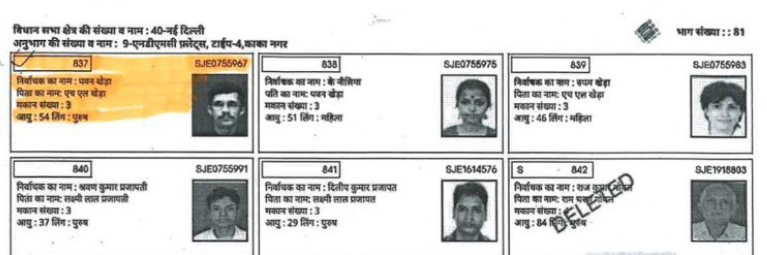
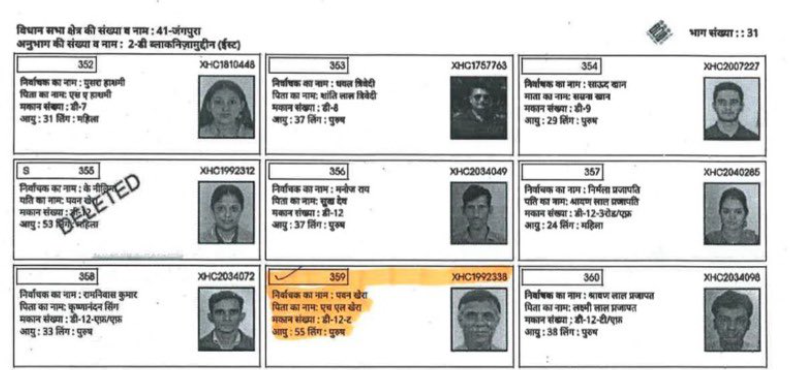
Rahul Gandhi had claimed that there is a voter named Aditya Srivastava who appears in as many as four polling booths. He had showed purported screenshots of the Voter’s Service Portal, which apparently shows that the voter with EPIC number FPP6437040 is listed in Uttar Pradesh, Maharashtra and two polling stations in the same constituency in Karnataka.

According the purported screenshot from the ECI’s website taken on 16th March, the name appears in Jogeshwari assembly constituency in Maharashtra, Lucknow East in Uttar Pradesh, and twice in Mahadevapura assembly constituency in Karnataka.

However, when searched with the number FPP6437040 on the portal, it appears only once under Karnataka, and does not appear under Maharashtra and Uttar Pradesh.

The name appears only once in Karnataka

When searched the number for Maharashtra and Uttar Pradesh, the portal shows “No Result Found”. It also shows that the entry only once under Karnataka, not twice.

The name does not appear in Maharashtra and Uttar Pradesh

The Chief Electoral Officers of Uttar Pradesh and Maharashtra have also confirmed the same, that the voter with that EPIC number is not listed in these two states.

The CEO of Uttar Pradesh issued a statement on X confirming that the number is only present under Mahadevapura assembly constituency in Karnataka, and it is not present in Lucknow East in Uttar Pradesh, as claimed by Rahul Gandhi.

This makes it clear that Congress used either fake or outdated data to make the false claim. Notably, it is possible for same voter with the same EPIC number to be listed in multiple places for some time. This happens when a voter migrates to a different constituency, and the name remains in the voter list in the earlier place till it is updated.

However, as electoral rolls are updated regularly, and specifically before elections, such duplicate entries are resolves. This is one of the reasons why the ECI is conducted the Special Intensive Revision in Bihar, with proposal the conduct the same all over India. While the Congress is alleging discrepancies in the voter list, the party is also opposing the SIR, a move to eliminate such issues.

5 times Congress leaders got exposed for undermining the voting system of India by creating fake Voter IDs and rigging elections

On the 7th of August 2025, Rahul Gandhi, the crowned prince of Congress, went on an unhinged rant yet again – blaming everything but himself for the abysmal electoral condition of his party. He claimed that the Election Commission of India (ECI) was colluding with the BJP to ensure BJP wins elections and Congress loses.

His arguments, based on the “research” done by his team, had no basis. His flight was imagination has been summarily debunked by OpIndia in this article.

There is, however, another important aspect of this story. While Rahul Gandhi has gone all guns blazing, and not for the first time, claiming that ECI and BJP are colluding to defeat him (despite his stellar politics that focuses mostly on incoherent rants and forging alliances with forces that are verifiably anti-India), there are several times when Congress workers have themselves been exposed for undermining the voting system in India and abusing the democratic process.

Following is an indicative list (which is in no way exhaustive) of some of the times Congress workers did what Rahul Gandhi is now blaming BJP for.

1. Congress created fake voter-IDs

In December 2024, former PCC General Secretary Bakka Judson revealed that Congress had created 8.5 lakh fake voter ID cards in Telangana in an attempt to win the local body elections.

Bakka had further said that such fake voter ID cards were not just created in Telangana but also in Kerala, saying that it was an act of sedition. In his statement, he said that Chief Minister A Revanth Reddy should be held responsible for undermining democracy.

He had said that he had filed a complaint with the Election Commission. He said that Congress first deleted 8.5 lakh voters aged between 18 and 35 from the voter list. Then, original voters’ photos were morphed and their phone numbers were also altered. Interestingly, the voter ID numbers would remain same, he alleged.

“This is not confined to Telangana, it is happening in Kerala, Karnataka and other places. Yet, the BJP is remaining calm over the issue,” Judson said, alleging that Deputy Chief Minister Mallu Bhatti Vikramarka’s wife Nandini was also involved in the issue. When a case was registered against a few individuals, she managed to get the accused released, he alleged.

2. Kirti Azad reveals that in Bihar, poll booths were looted for Congress leaders

In February 2019, Congress leader Kirti Azad made a startling revelation. He said that in Bihar, booth capturing was par for the course and several Congress leaders had benefitted.

He said: “Congeress party ke workers booth loota karte the Nagendra ji ke liye… us samay to booth loote jate the (Congress party workers used to loot booths for party leader Nagendra ji and others…this was prevalent in those days).”

“In those days booths were looted…Congress workers used to loot polling booths for Nagendra ji (former Congress leader),” Azad said.

He also accepted that his father and he also benefited from booth capturing. “Mere pitaji ke liye bhi booth loota jata tha.1999 main hamare liye bhi lootaus samay to electronic machine nahi thi (Booths were looted for my father as well. In 1999, for me also. EVMs had not been introduced back then,” he said.

3. Youth Congress leaders even rigged their organisational elections

In November 2023, Kerala Police summoned Youth Congress state president Rahul Mamkootathil regarding a case about the use of fake voter ID cards during the Youth Congress organizational elections. The issue arose after complaints were made to the Chief Electoral Officer, Sanjay M. Kaul, who asked the state police to investigate.

A special investigation team was formed, which led to the arrest of four Youth Congress workers—Abhi Vikram, Feny Ninan, Binil Binu, and Vikas Krishnan—from Pathanamthitta, who were close aides of Mamkootathil. The police took laptops, mobile phones, and 24 fake voter ID cards, claiming these were used to influence the election results.

The case was filed under sections of the Indian Penal Code for forgery and using forged documents. Political parties, including the BJP and CPI(M), voiced concerns about the possible misuse of fake IDs in general elections, leading to calls for a thorough probe and a petition for a CBI investigation. Mamkootathil denied the allegations, and the Congress party launched an internal inquiry.

4. Lokayukta finds Congress workers responsible for making fake Voter IDs

In August 2022, the Lokayukta found that former Congress MLA from Sultanpur, Majra Jai Kishan, had created fake voter IDs and recommended criminal proceedings.

The order was based on findings that Kishan had used his residential address to create fake voter identity cards for non-residents, some of whom he claimed were relatives. The Vigilance Department, with support from the Chief Secretary, pointed out that these actions harmed the integrity of the electoral process.

Delhi LG had then instructed the Delhi Police Commissioner to register an FIR against former Congress MLA Majra Jai Kishan. This issue first arose in 2013-14.

5. Congress leaders booked for thousands of fake Voter IDs

In 2018, right before the Karnataka elections, RR Nagar Congress MLA and 13 others were booked in a fake voter ID case. The Election Commission had ordered an inquiry after 10,000 fake voter IDs were found during a raid in an apartment located in the Raja Rajeshwari Nagar constituency of Bengaluru.

Karnataka’s Chief Electoral Officer Sanjiv Kumar said two trunk-loads of counterfoil strips, which appeared to be the acknowledgement slips of the form used to add names of voters, were also found. But the forms were not the same colour as those used by the Election Commission, he said. “After a surprise visit was paid to a flat in Jalahalli locality, nearly 9,746 voter ID cards were found. Five laptops and one printer was also found in the flat,” Kumar had said.

While the Congress blamed BJP for this scam, 2 days later, the Election Commission registered an FIR against the Congress MLA and 13 others in the case.

Rahul Gandhi in his press conference today spun fantastical tales through, what was in his mind, results of a “research” conducted by a group of Congress workers who arguably pretend to have lower IQ than Rahul Gandhi himself just to make him feel better about himself. However, history proves that rigging elections, creating fake Voter IDs, undermining the democratic process (remember Indira Gandhi?) and being dictatorial is what Congress does best.

Rahul Gandhi alleges electoral fraud in Karnataka: 10 points that thoroughly debunk his ‘vote chori’ claims

On Thursday, August 7, Congress leader Rahul Gandhi intensified his attacks on the Election Commission of India (ECI), levelling serious allegations of electoral malpractice and accusing the Commission of colluding with the ruling BJP to manipulate the 2024 Lok Sabha election results.

Speaking at a press conference in Delhi’s Indira Bhawan, Gandhi declared that a “criminal fraud” had been perpetrated against the Indian Constitution. Citing what he described as “clear evidence” of voter list tampering in Maharashtra and Karnataka, he alleged the EC had refused to provide machine-readable voter data to cover up large-scale manipulation.

Among his most pointed allegations was that the Maharashtra Assembly elections had been “stolen”. He also cited Bengaluru’s Mahadevapura Assembly segment as a hub of “vote chori,” claiming that over one lakh fake votes were cast there alone.

But a closer examination of these assertions reveals a patchwork of flawed logic, unverified assumptions, and stunning extrapolations. Below is a detailed point-by-point rebuttal of the key claims made by Gandhi, particularly around Karnataka’s Mahadevapura constituency.

1. Internal polls vs actual results: A misguided benchmark

Rahul Gandhi claimed that internal surveys conducted by the Congress party had projected wins in 16 of Karnataka’s 28 Lok Sabha seats, but the party ended up winning only 9. He used this discrepancy to allege “definite voter fraud,” once again pointing fingers at the Election Commission.

But this line of reasoning is deeply flawed. Internal polls are neither transparent nor independently verified, and often reflect the optimism of campaign teams more than ground realities. They are not binding predictors of public sentiment and cannot be held up as a benchmark for electoral legitimacy. In any democracy, it’s actual votes, not internal projections, that determine outcomes.

If internal polls were a foolproof benchmark for electoral outcomes, then by that logic, the BJP should have cried foul for not crossing the 400-seat mark it once projected. But it didn’t, because unlike the Congress, the BJP understands that internal surveys are not incontrovertible facts and respects the democratic mandate instead of insulting voters by floating absurd conspiracy theories.

If internal poll mismatches are grounds for alleging fraud, then any political loss becomes suspect, a precedent that undermines democratic principles.

2. The myth of “missing” anti-incumbency

Gandhi also questioned how the BJP, despite completing two terms at the Centre, managed to secure a third consecutive win. “Anti-incumbency hits every party in every democracy,” he said, suggesting that the absence of such sentiment pointed to manipulation.

This claim again rests on shaky logic. The absence of anti-incumbency is not proof of fraud. Voters re-elect governments when they perceive stability, delivery, and leadership, particularly in the absence of a compelling alternative. India has seen this before under leaders like Nehru and Indira Gandhi, just as Germany did under Angela Merkel.

What stood out most was Rahul Gandhi’s insinuation that every time anti-incumbency sentiment rises against the Modi government, a new ‘script’ is enacted. He cited Operation Sindoor, insinuating that the Pahalgam terror attack may have been a false-flag operation by the Indian state, eerily echoing the very narrative Pakistan uses to deflect from its role in harbouring Islamist terrorists.

Suggesting that consistent voter support is inherently suspicious only highlights the Congress’s struggle to regain public trust, something no conspiracy theory can fix.

3. Opinion polls and exit polls: Not the ultimate truth

Another argument Gandhi advanced was that the deviation between opinion polls, exit polls, and actual results indicated foul play. He cited the 2024 results in states like Haryana and Madhya Pradesh as evidence.

But opinion and exit polls are statistical projections based on limited samples, prone to error due to methodological differences and unpredictable voter behaviour. They are not final vote counts.

From Brexit to Trump’s 2016 win to multiple elections in Israel, global democracies have seen polls miss the mark, without descending into accusations of fraud. In fact, the exit polls have also been completely off the mark from actual reality when it concerns the BJP. In 2015 Bihar elections, almost all exit polls suggested a close contest, but eventually, the RJD-JDU-Congress alliance winning it comfortably, with the RJD emerging as the largest party. This outcome was a stark contrast to the intense tussle predicted by exit polls.

Even exit polls during the 2024 Lok Sabha elections predicted a lanslide victory for the BJP. As we know it, the polls were spectacularly wrong as the BJP manage to win only 240, a far cry from 330+ most exit polls were suggesting.

Therefore, to argue that discrepancies between polls and results constitute rigging is both alarmist and unfounded. Worse, it sets a dangerous precedent that undermines public trust in the very idea of elections.

4. Alleged voter fraud in Mahadevapura: Mistaking possible administrative overlaps for election manipulation

Gandhi zeroed in on Mahadevapura, one of eight Assembly segments under Bangalore Central Lok Sabha constituency, claiming that over 1 lakh votes out of 6.5 lakh were either duplicated or linked to fake addresses.

Rahul Gandhi voter fraud
Rahul Gandhi alleged voter fraud during his press conference

As an example, Rahul Gandhi cited the case of one Gurkirat Singh Dang, whose name allegedly appeared on voter rolls at four different booths. From this single instance, he extrapolated a sweeping claim of “thousands” of such cases, without presenting any independently verified evidence. What Gandhi fails to acknowledge, however, is the very real and common phenomenon of intra-city and inter-state migration, particularly in urban hubs like Bengaluru, where people frequently shift residences for work, education, or housing constraints.

In such cases, it’s not unusual for individuals to be enrolled at their new address without having formally applied for the removal of their names from earlier rolls. This administrative overlap can result in multiple entries, but it does not automatically mean that the person voted more than once, let alone that they were part of any coordinated fraud. To conflate registration anomalies with actual voting malpractice is not just misleading; it grossly misrepresents how electoral rolls evolve in dynamic urban settings.

Moreover, Gandhi also conveniently overlooked the fact that parties receive voter rolls well in advance and are free to raise objections during the verification phase. If such large-scale discrepancies truly existed, why weren’t they flagged before polling day?

5. Voter duplication: Systemic flaws, not partisan conspiracy

If Rahul Gandhi alleges that certain voters cast their votes twice, the critical question remains unanswered: whom did they vote for? There is absolutely no evidence to suggest that such voters exclusively supported the BJP. In fact, in a secret ballot system, it is impossible to determine the direction of any individual’s vote without breaching the very foundation of electoral privacy. For all we know, duplicate voters could have voted for the Congress or any other party. Yet, Gandhi conveniently assumes, without proof, that any such irregularity must have benefited the BJP, exposing the deeply partisan nature of his accusation.

Moreover, highlighting instances of individual malpractice does not automatically implicate the entire democratic process or justify branding an entire election as “fraudulent.” If some people have gamed the system, and that has happened across decades, under multiple governments, including those led by the Congress, it reflects a systemic loophole, not a partisan conspiracy. By projecting isolated cases as proof of a grand BJP-led conspiracy, Rahul Gandhi not only undermines institutions but also insults the intelligence of Indian voters who did not vote for his party.

6. Addresses missing point to clerical errors and bureaucratic flaws, not election rigging

Gandhi also claimed that many addresses in voter rolls were missing, unverifiable, or outright fake, labelling thousands of such entries as fraudulent.

This oversimplifies a more nuanced administrative reality. In urban constituencies like Mahadevapura, rapid migration, outdated address records, or digitisation errors are common. Incomplete fields showing “0” or “#” could be due to data formatting issues, manual input errors, or legacy record-keeping problems, not evidence of a voter fraud conspiracy.

Without physical verification of each individual case, such claims remain speculative at best. Mistaking clerical inconsistency for criminal intent is reckless and unfair to legitimate voters.

6. Missing Photos on electoral rolls: A flimsy foundation

Among Gandhi’s more startling assertions was the claim that around 4,000 voters were “fake” because their electoral roll entries lacked photographs.

Missing photos, while not ideal, are often the result of administrative lapses, not fraud. Voter databases in India are vast and periodically updated. Delays in image syncing or glitches during digitisation can result in such anomalies. Importantly, the absence of a photo on a public list doesn’t confirm that the individual voted, let alone that they were fake. In fact, Gandhi himself highlighted how some of the pictures in the electoral roll were too small to be clearly visible. It only underscores the technical glitch and clerical errors the electoral system faces, not a coordinated conspiracy to steal votes.

To equate missing photos with fake voting displays a fundamental misunderstanding of how the electoral database functions.

7. Misuse of Form 6: Misunderstood and misrepresented

Gandhi further alleged that Form 6, the application for voter registration, was misused by middle-aged and elderly voters, implying that only 18- to 22-year-olds should be using it. He pointed to a 70-year-old woman who applied twice and suggested she may have voted twice.

This betrays a misunderstanding of electoral procedure. Form 6 is for first-time registration, regardless of age. People may register later in life for numerous legitimate reasons: returning from abroad, acquiring new documents, or simply developing political awareness. Many middle-aged and senior citizens proudly voted for the first time in 2024, a sign of democratic inclusion, not fraud.

Claiming misuse based solely on age is not just factually incorrect but it betrays shocking level of ignorance, unbecoming of India’s Leader of Opposition.

8. ‘I’m a politician’: Rahul Gandhi when asked to take oath for ‘vote chori’ claim

A revealing moment unfolded during Rahul Gandhi’s press conference. When an attendee asked whether he was willing to take a formal oath to back his explosive ‘vote chori’ allegation, Gandhi skillfully dodged the question. Instead, he said,” I am a politician. every word I speak in public is under oath.” He then meandered into a vague defence, asserting that his claims were based on Election Commission data, and conveniently noted that the poll body hadn’t explicitly denied it.

Rahul Gandhi may insist he never lies to the people, but the Supreme Court’s verdict on the Rafale controversy tells a different story, one that exposes the Congress leader’s claims as misleading and devoid of truth. In fact, he was also called out for his lies on Maharashtra elections, something which he repeated earlier today. So his claim that he doesn’t lie to people don’t hold water.

Notably, the Karnataka Election Commission came down hard against the Congress leader for making unfounded claims of voter theft in his press conference. The poll body formally asked Rahul Gandhi to submit a signed declaration and furnish names of voters he alleges were fraudulently included in the electoral rolls as part of his “vote chori” (vote theft) claims.

The Commission emphasised that electoral rolls were prepared transparently and warned that any false declaration could attract legal consequences under both the BNS and the Representation of the People Act, 1950. The declaration, mandated under Rule 20(3)(b) of the Registration of Electors Rules, would be necessary to initiate any official proceedings.

9. Rahul Gandhi highlights duplication of voters but opposes SIR in Bihar

While Rahul Gandhi highlighted duplication and discrepancies in voter rolls during the press conference, particularly in constituencies like Mahadevapura, his track record reveals a contradictory stance. In Bihar, when the Election Commission launched the Systematic Investigation of the Electoral Roll (SIR) to weed out exactly such irregularities, it was Rahul Gandhi, his Congress party, and many other opposition parties had cried foul. Instead of welcoming a long-overdue clean-up of bloated and error-ridden rolls, the Congress accused the Election Commission of colluding with the BJP and manipulating the process, going so far as to challenge the initiative in court.

This duplicity exposes the political convenience behind Gandhi’s rhetoric. Voter list discrepancies are not new; they’ve been a systemic issue that likely persisted during Congress regimes as well. However, the current Election Commission has taken unprecedented steps to ensure transparency and accountability through processes like SIR. Ironically, Gandhi now opposes the very effort that seeks to solve the problem he claims to highlight.

As the BJP, along with several political commentators noted, Rahul Gandhi’s recent press conference was a roaring endorsement of the revision exercise underway in Bihar. But more importantly, his shifting stance raises a fundamental question: is the issue the duplication, or the fact that his narrative no longer controls the debate?

10. Conspiracy or convenient cover?

Rahul Gandhi’s sweeping claims of electoral fraud are built not on verified evidence but on unsubstantiated projections, anecdotal irregularities, and speculative logic. They rely on conflating administrative imperfections with malicious intent and on dismissing legitimate outcomes simply because they didn’t favour his party.

Rather than engaging in introspection about the Congress party’s electoral shortcomings, be it ineffective messaging, weak grassroots mobilisation, or a lack of public connect, Gandhi appears intent on discrediting institutions his own party once helped build. He repeated the same debunked claim that Maharashtra polls were rigged. There is a pattern to disinformation and propaganda that Rahul is disseminating, one that seeks to systematically undermine the legitimacy of the Modi government’s electoral victories against Congress.

Allegations of fraud in any democracy must be taken seriously. But they must also be backed by credible evidence, presented through appropriate legal and electoral channels, not post-facto press conferences laced with conjectures, suppositions, and unverified guesswork.

In the absence of such evidence, what remains is a troubling attempt to undermine public faith in India’s democratic process. And that, more than any Form 6 or voter roll discrepancy, is the real threat to the legitimacy of elections.

Congress’ past attempts at undermining EC’s credibility

In its repeated attempts to discredit the BJP’s electoral victories, the Congress party has actively tried to undermine the credibility of the Election Commission, most notably through baseless EVM hacking conspiracy theories. One such farcical episode occurred in 2019, when Congress backed a so-called “EVM hackathon” in London featuring an alleged ‘EVM expert’ Syed Shuja, who claimed via Skype, with his face covered, that BJP had hacked the 2014 general elections and multiple state polls. He even alleged that BJP leader Gopinath Munde was murdered for uncovering the tampering. No proof was offered, only sensational claims.

Senior Congress leader Kapil Sibal’s presence at the event raised eyebrows, especially as Shuja’s claims grew more absurd such as BJP’s IT cell allegedly using military frequencies to “ping” EVMs. Ironically, Shuja claimed the same EVMs delivered a fair outcome when Congress won in Rajasthan, MP, and Chhattisgarh. The Election Commission firmly rejected the allegations, stating that Indian EVMs are standalone devices with no communication capabilities and are produced under strict security.

This episode exposed Congress’s willingness to propagate wild conspiracy theories and cast aspersions on constitutional institutions when elections don’t go their way. Rather than accepting public verdicts, the party has shown a pattern of attempting to delegitimise the process itself, a dangerous precedent in any democracy.

Rahul Gandhi’s latest claims of “voter fraud” in Mahadevapura follow the same tired playbook: dramatic allegations, zero evidence, and a clear attempt to sow doubt in democratic institutions. Just like the EVM hacking drama, Gandhi’s insinuations rest on political convenience rather than verifiable facts. While he demands accountability from the Election Commission, he has also opposed genuine electoral reform efforts like the SIR process in Bihar, which seeks to clean up duplicate and erroneous voter entries. This selective outrage reveals the underlying strategy: if the Congress loses, the system must be broken.

Chapters on Field Marshal Sam Manekshaw, Brigadier Mohammad Usman and Major Somnath Sharma added to NCERT Urdu and English syllabus

Chapters on the lives and sacrifices of Field Marshal Sam Manekshaw, Brigadier Mohammad Usman, and Major Somnath Sharma have been added to the NCERT syllabus in this academic year, in Class VIII (Urdu), Class VII (Urdu), and Class VIII (English), respectively.

The newly introduced chapters aim to provide students with inspirational narratives of courage and duty. Field Marshal Sam Manekshaw, India’s first officer to be conferred the rank of Field Marshal, is remembered for his exceptional leadership and strategic acumen. Brigadier Mohammad Usman and Major Somnath Sharma, both recipients of the Mahavir Chakra and Param Vir Chakra respectively (posthumously), laid down their lives in service of the nation and remain symbols of supreme sacrifice.

As part of efforts to establish National War Memorial (NWM) as a prominent national landmark, Ministry of Defence has partnered with Ministry of Education and National Council of Educational Research and Training (NCERT) to integrate NWM and related references into the school curriculum.

Through these stories and their inclusion in the curriculum, students will not only gain insights into India’s military history but also absorb important life lessons on resilience, empathy, emotional intelligence, and the importance of contributing to nation-building.

Prime Minister Shri Narendra Modi dedicated the National War Memorial to the nation on 25 February 2019, located in the iconic Central Vista ‘C’ Hexagon, India Gate, New Delhi. The Memorial was established to inculcate a sense of patriotism, high moral values, sacrifice, national spirit, and belongingness among all citizens, while serving as a befitting tribute to our brave soldiers who made the supreme sacrifice for the nation.

As Rahul Gandhi goes on an ignorant rant about ‘fake votes’, a reminder of when Youth Congress workers were arrested by Kerala Police for using fake voter IDs

Congress leader Rahul Gandhi has been attacking the Election Commission of India (ECI), casting aspersions on the integrity of the poll body. However, on 7th August, the Gandhi scion crossed all limits and openly threatened the ECI officials with “consequences” if his party comes to power.

“Now, the Election Commission must provide us and the people of India with that information. Because if they don’t, there will be consequences. There will be consequences for every single polling officer involved in this, regardless of how senior or junior you are. One day, the opposition will come to power and then you’ll see what we do,” said Rahul Gandhi on Thursday, August 7.

This is not the first and possibly not the last time that Rahul Gandhi is raising suspicions about the ECI or the election process in state or general elections. He and his party often level such allegations after his party loses elections. In June 2025, Rahul Gandhi spread lies about the 2024 Maharashtra assembly elections after his party’s alliance lost, saying that the elections were rigged and were a “match fixing”.

However, before attacking the Election Commission and alleging EVM hacking, VVPAT tampering, illegally including additional votes in favour of the BJP, and what not, Rahul Gandhi should look within his own party.

Back in November 2023, three Youth Congress workers were arrested by Kerala Police for use of fake voter ID cards during the organisational polls. In this election, Youth Congress leader Rahul Mamkottathil won. He was later interrogated by the police. The police had seized laptops, mobile phones and fake election photo identification cards from the possession of the accused Youth Congress workers.

On the direction of Chief Electoral Officer of the state, a case was registered against Youth Congress workers identified as Abhi Vikram, Feny and Binil Binu. They were booked under multiple sections of the Indian Penal Code, including 468 (forgery for the purpose of cheating) and 471 (Using a forged document as genuine). The police had said that the accused had allegedly used a mobile application developed by Youth Congress leader Jaison, for creating the fake IDs.

In January 2024, Jaison, who served as a vice-president of the Youth Congress in East Eleri Mandalam in the northernmost district of Kasaragod, surrendered before the police. He was later granted bail by the court. The Youth Congress worker is a B. tech graduate in electronics.

“He is the one who developed the app with the support of a staff at the computer centre. The fake ID cards were made using this application,” the police said back then.

The police had recovered 24 fake voter ID cards during the raids, with some being in the name of Tamil film star Ajith. Back then, the Kerala BJP had said that top leadership of Congress’s Kerala unit, including KC Venugopal and V.D. Satheesan was aware of the fraud being committed by its workers.