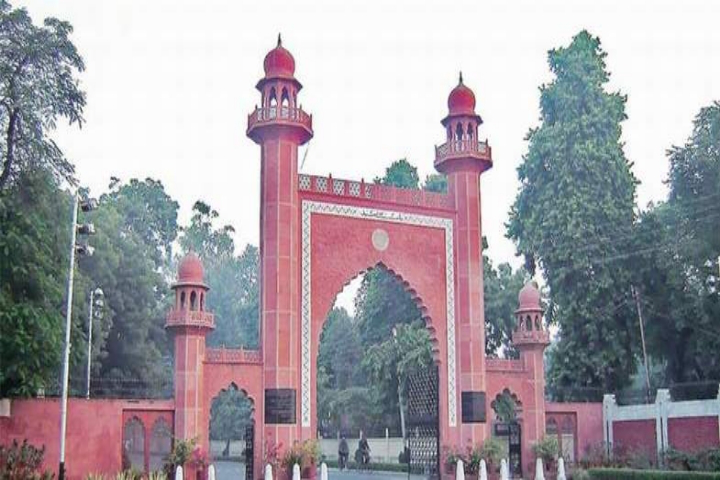
Amidst the second wave of the pandemic in the country, it has now been reported that 27 faculty members of the Aligarh Muslim University (AMU) have succumbed to Coronavirus infection.
As per reports, the varsity had lost 10 retired and 16 serving faculty members to the pandemic in the past 20 days till yesterday. On Saturday, Dean of Faculty of Law Prof Shakil Ahmed Samdani died at Jawaharlal Nehru Medical College Hospital where he was undergoing treatment for coronavirus, who became the 17th serving faculty member to die from Covid-19 or related complications.
Before that on Friday (May 7), two faculty members had lost their lives, including Prof Shadab Ahmad Khan (58) and Prof Rafiqul Zaman Khan (55). While Professor Shadab was the Chairman of the Department of Medicine, Professor Rafiqul served as the faculty in the Department of Computer Science. Even the Vice-Chancellor of AMU, Tariq Masoor, lost his 75-year-old brother Omar Farooq to Covid-19.
Earlier on Wednesday (May 5), a 56-year old Professor named Khalid Bin Yusuf died due to the pandemic. Professor Khalid was a renowned Sanskrit scholar and the first Muslim scholar to receive a doctorate degree in Rigveda. Besides, other serving faculty members such as Prof Mohd Ali Khan (60), Prof Qazi Mohd Jamshed (55), Prof Ghuf ran Ahmad (54), Prof Kr Sajid Ali Khan (63), Dr. Mohammad Irian (62), Dr. Aziz Faisal (40), Dr Jibraeil (51), Dr Mohammad Yusuf Ansari (46), Dr Mohd Furgan Sambhali (43), Prof Syed Irian Ahmad (62), Prof Maula Bakhsh Ansari (58), Prof Ehsanullah Fahad (50), Saeed Uzzaman (51) have died due to Coronavirus-related complications.
At the same time, around 10 retired faculty members have passed away. The list included 77-year-old Professor M Mubashir, who was the first alumnus of the varsity.
16 faculty members of AMU currently undergoing treatment for Coronavirus
Meanwhile, around 16 faculty members of Aligarh Muslim University are currently undergoing treatment for Covid-19 at the Jawaharlal Nehru Medical College (JNMC). While speaking about the matter, Vice-Chancellor Tariq Mansoor said, “I appeal to everyone to get vaccinated and follow all Covid-19 protocols.” He added that a void has been created in the varsity after their deaths.
Pahat Abrar, PR Department of AMU, noted, “This Covid has devastated families and taken away our eminent scholars. It is an epic loss for the nation.” Professor Shaheed Ali Siddiqui commented, “Virus has a tendency to mutate and if the numbers of positive cases have increased in the same pace, then the probability of the number of variants will be more which could be very dangerous. Hence, a large number of the population should get vaccinated for protection and cut off these variants.”
On Tuesday, BJP MP Tejasvi Surya and BJP MLAs exposed the illegal bed-allotment nexus between civic officials and private agents. The BJP leaders had alleged that some officials in Bruhat Bengaluru Mahanagara Palike (BBMP) had joined hands with the touts to book hospital beds in the name of people under home isolation while selling these beds to other patients in need at an exorbitant price.
Addressing a press conference, Surya had alleged that the war room personnel had been running a racket of false blocking the beds and creating artificial shortage despite having enough beds in the Bengaluru city. The BJP MP had alleged that the officials were allotting those beds to the people in exchange for money. He added that there was a nexus between BBMP officials, Aarogya Mitra hospitals and private agents who were indulging in the said crime.
IMPORTANT Addressing issues of irregularities and anomalies in BBMP bed booking for covid patients in Bengaluru along with Bommanahalli MLA Shri. Satish Reddy, Basavanagudi MLA Shri. Ravi Subramanya and Chickpet MLA Shri. Uday Garudachar. https://t.co/mzjjiQq7AP
Further, Surya had questioned the hiring process of 17 individuals in the Covid-19 war room and had questioned the agency that they belonged to about their qualifications. Some of the names he enquired about while confronting BBMP officials are Mansoor Ali, Tahir Ali Khan, Sadiq Pasha, Md Zayed, Alsai Saheer, Umer Khan, Salman Urif, Zameer Pasha, Zabiullah Khan, Sayed Hasnain, Sayed Shahid, Sayeed Shahbaz, Md Yunus, Syed Mohin and Syed Mukesh. The names of the 17 workers were presented to him by the BBMP officials, who had suspected them of carrying irregularities inside the BBMP war room during the allocation of beds to Covid-19 patients.
Following the massive allegations, the Bengaluru police had arrested one Congress party supporter named Nethravathy and her nephew for their involvement in the illegal allotment of beds to Covid-19 patients in Bengaluru in exchange for money. The police had suspected that the accused had contacts with the BBMP war room staff.
Congress, left-wing media outlets put out misinformation against BJP MP Tejasvi Surya
As the Congress party faced massive embarrassment in the state after one of its party supporters was arrested by the Bengaluru police in connection with the BBMP-bed scam, the grand-old party resorted to peddling misinformation on social media by posting morphed images to allege that the accused is actually linked with the BJP. They tried to claim that the accused woman Nethravathy is linked with Tejasvi Surya, who, in fact, was the first person to expose the nexus between private agents and BBMP officials in the allocation of beds to Covid-19 patients in the city.
The Congress party also alleged that Tejsavi Surya was communalising the matter by taking Muslim names, and demanded action against him and other BJP leaders who had accompanied him to the war room.
Augmenting the lies peddled by the Congress party, a few far-left media outlets began to carry out hit-jobs against the young MP by claiming that Tejasvi Surya had unnecessarily communalised the issue by taking out the names of 17 Muslim employees who were working at the BBMP war room in Bengaluru.
The News Minute, a news website that claims to report facts, gave a communal twist to the entire incident by not only sidestepping on the issue of massive irregularities in the process but also perhaps to hide the Congress links to the bed-allocation scam that was unearthed by the BJP MP. Following that, a series of media reports emerged that Tejasvi Surya had deliberately uttered the names of the employees working in the BBMP war room as they had belonged to the Muslim community.
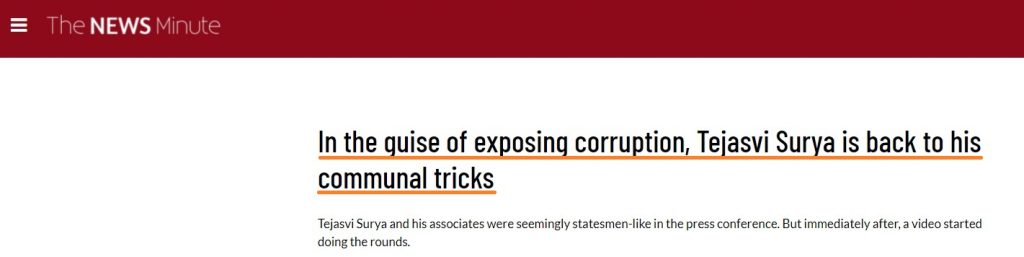
Here is a report by TNM accusing him of carrying ‘communal’ politics, instead of reporting on facts pertaining to the unearthing of BBMP scam.
Report by TNM dog whistling against Tejasvi Surya for unearthing a scam
Amidst all these development, the Bengaluru South MP had also clarified that the list consisting of the names of the 17 Muslim workers were not prepared by him, but was presented to him by the BBMP officials. Most importantly, the BBMP officials had already acted on some of the workers, incidentally all belonging to the Muslim community, for the irregularities in the bed allocation.
However, the media groups deliberately ignored the underlying issue, i.e., the irregularities within the BBMP regarding the illegal allocations of bed in exchange for money, rather in a classic attempt of targeting the whistle-blower, pounced on the BJP MP only because he had read the names of a few individuals who were suspended for their alleged involvement in the BBMP bed scam, and incidentally belonged to the same community.
TNM peddles misinformation, other media house latches onto it
Continuing its attack on Tejasvi Surya, the far-left news website ‘The News Minute’ published another report on Friday claiming that Tejasvi Surya had revisited the BBMP war room to ‘apologise’ to the 200-odd people working there. In the first report it had published, TNM had claimed that Tejasvi had allegedly “read out the names of 16 Muslim men who worked there, accusing them of being a part of a Covid-19 bed-blocking scam and due to this, scores of the 212 people who work in this war room have faced harassment, including sexual harassment”.
In its report, TNM claimed that the names and numbers of the employees working in the BBMP war room had allegedly got leaked, leading to sexual harassment against them. Incidentally, TNM blamed Tejasvi Surya for the leaks even though it was the Congress party and its media ecosystem who leaked the list of all the 200-odd employees working in the BBMP war room after the Tuesday incident to prove that it was not just Muslims who were working at the war room.
— Kavitha Reddy #WeThe49Percent (@KavithaReddy16) May 5, 2021
#BJP MP #TejasviSurya attempted to communalize the #BBMPBedScam issue by insinuating that Muslims are behind this scam. He purposely read out the names of 16 Muslim telecallers out of the 206 hired by #BBMP.
The names and numbers leaked by the Congress IT cell to target the BJP leader may have been accessed by some elements, who allegedly harassed some 200-odd people working at the BBMP war room. However, TNM reported that it was Tejasvi Surya who leaked the data leading to harassment.
Further, TNM published purported statements put out by Tejasvi Surya at the BBMP war room on Thursday, claiming that he had ‘apologised’ for leaks. Interestingly, the claims against Tejasvi Surya made by the TNM in their report is based on imaginary sources. There are neither concrete facts nor evidence to claim that Tejasvi had apologised to the employees for inspecting the BBMP war room.
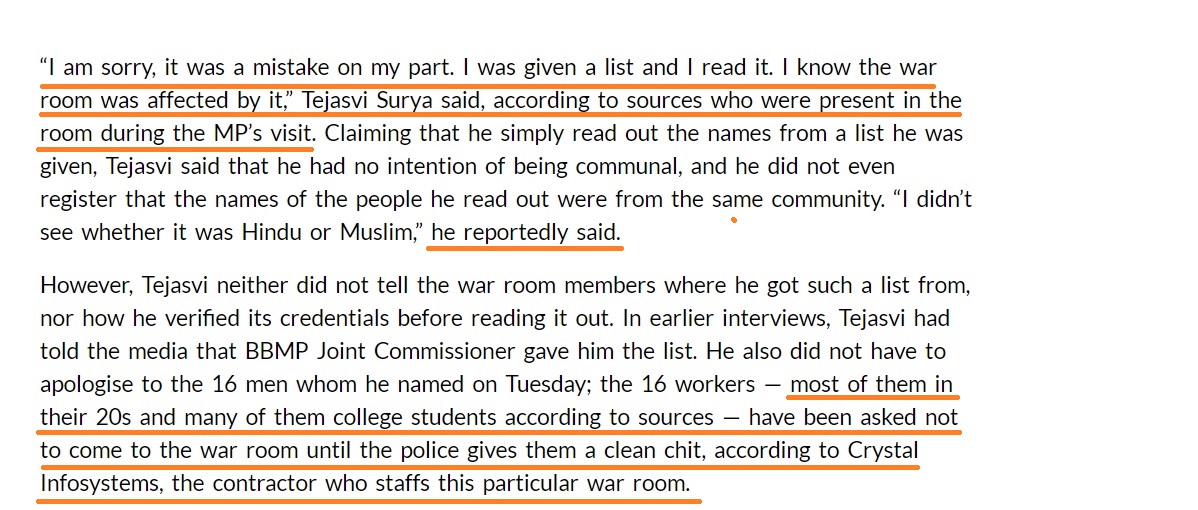
Here is the snapshot of the TNM’s first report that claims that Tejasvi had apologised for storming into the BBMP room:
Further, in its report, TNM claimed the people working in the war room faced constant harassment from strangers over the phone, with some even getting visits to their home address to demand hospital beds while confronting them about irregularities. “Several workers have had to disable their phone numbers because of the constant phone calls,” the TNM report claimed yet again by attributing to the so-called ‘sources’. However, TNM has not provided any evidence to back these claims.
Tejasvi Surya said he will teach a lesson to people who leaked numbers, says TNM
The report also quoted Tejasvi Surya as saying, “Even my number was leaked, and I, too, am facing threats. Don’t worry, this will all be over in a week. I am with you. I will teach a lesson to those who leaked your numbers. I want you to remember that a lot of good has happened through me.”
“I’m not casteist or communal. I am doing good for the people. I don’t have any bad intentions,” TNM quoted Tejasvi Surya as saying in its report citing the same sources yet again. But there is no clarity on who these ‘sources’ are.
From the looks of it, TNM, in their eagerness to target Tejasvi Surya, have invented quotes and imaginary sources to claim that Tejasvi Surya had apologised for his actions that led to unearthing a major scam in the city. However, their so-called ‘investigative’ report was soon picked up by various other media outlets to propagate misinformation regarding the entire incident.
Based on the reports published by The News Minute, several other media portals also published their reports claiming that Tejasvi Surya had apologised for his so-called communal actions inside the BBMP war room on Tuesday.
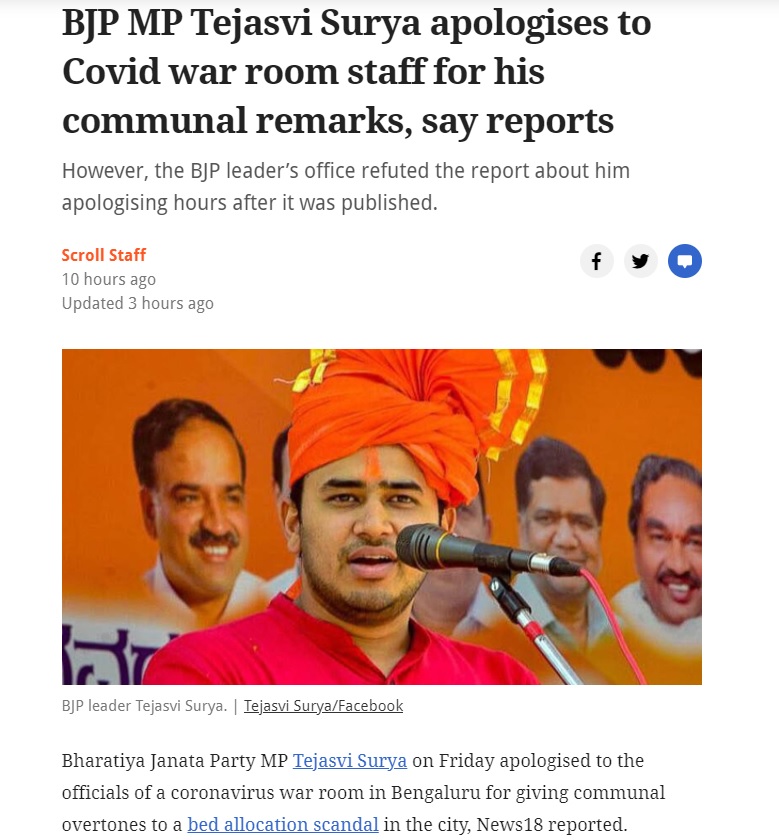
Another far-left website – Scroll, which has a history of peddling misinformation on social media, went a step ahead to declare that BJP MP Tejasvi Surya apologised to Covid war room staff for his alleged ‘communal’ remarks.
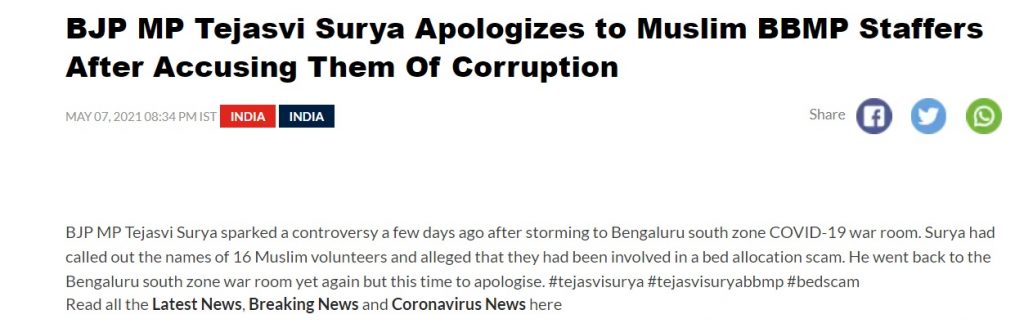
Another news website News18 added that BJP MP Tejasvi Surya apologises to Muslim BBMP staffers accusing them of corruption. However, in the entire report, they have failed to put out facts or evidence to back their claims.
As TNM published its ‘investigative’ report against Tejasvi Surya, the usual suspects in the social media platforms, joined by the Congress party and left-wing trolls, launched yet another round of attack against the BJYM President.
Tejasvi Surya rejects claims put out by TNM, calls it ‘fake news’
However, as soon as the news went viral, the office of Tejasvi Surya rejected the claims made by the TNM and other news portals regarding his so-called ‘apology’ for carrying out raids on the BBMP war room to expose the illegal bed allocation in exchange for money. Responding swiftly, the office of Tejasvi Surya termed the news reports published by TNM and as well as News18 as fake news.
— Office of Tejasvi Surya (@Offtejasvisurya) May 7, 2021
Several netizens demanded TNM and other media outlets to put out facts about the case after Tejasvi Surya’s office clarified that they had not issued any apology for the incident as claimed by the media outlets.
TNM quietly deletes statements attributed to Tejasvi Surya, rephrases his quotes
Hours later, the TNM, perhaps realising their mistake of inventing quotes, silently altered their original report. The edited report, though retained the same headline, however, had massive changes. The TNM quietly removed some of the quotes they had attributed to Tejasvi Surya that originally insinuated that he had indeed apologised for ‘communalising’ the entire incident.
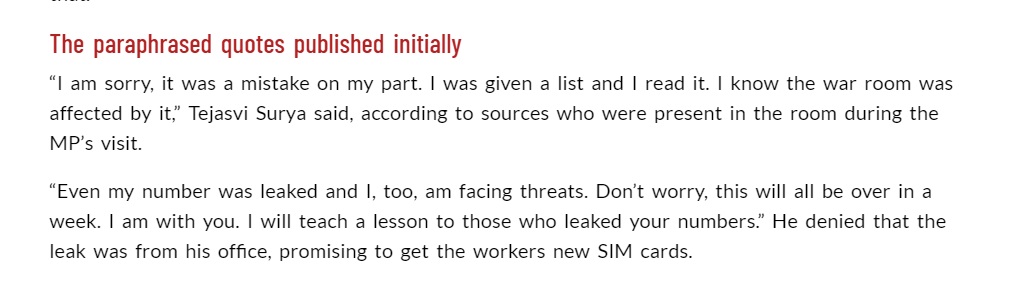
In the edited report, TNM rephrased some of the earlier invented quotes that were published by them earlier to depict that Tejasvi Surya had not only apologised for his actions but also sought vengeance for leaking his personal details.
Here are some of the quotes that were paraphrased by TNM after office of Tejasvi Surya challenged them:
The edited report by TNM.
The shocking unethical journalism of TNM, however, does not end there. The TNM that was aggressively pushing theories by inventing quotes saying Tejasvi Surya had regretted his alleged ‘communal’ act, however, retracted some of the quotes from its initial reports.
Some of the quotes that were retracted from the initial report are:
“I didn’t see whether the list was Hindu or Muslim”
“I’m not casteist or communal”.
The two above statements, allegedly made by Tejasvi Surya, were featured in TNM’s original report. For a reader, the above statements strike as if Tejasvi Surya had accepted that he had fuelled a ‘communal’ angle to the entire case and was apologising for the same. However, this is not true.
It seems that TNM invented some sources and quotes to depict Tejasvi Surya as ‘guilty’ in the entire incident. However, failing to back it up with concrete evidence, TNM has silently deleted the statements that were attributed to him in their earlier report.
After caught propagating lies, TNM has now given a clarification for the same, claiming that TNM had only accessed the recording of Tejasvi Surya’s interaction at the war room after they had published their first story. Also, TNM confesses that they had published their story on quotes from people who work in the war room.
Further, TNM also claimed that they have now edited the story to put out the exact words spoken by the MP. After carrying out a hitjob against Tejasvi Surya, The News Minute has now released a statement saying, “they had inadvertently added on the basis of sources, that said Tejasvi Surya insisted he wasn’t casteist or communal and they are removing as it was not found in the audio clip accessed by us”.
So, to put it simply, TNM initially published a report targeting Tejasvi Surya without any substantial evidence to back their claims. However, they based the entire narrative on imaginary sources and fake quotes attributing to him. When confronted, TNM has now silently deleted most of the references and rephrased the quotes that did the damage in the first place.
Social media users points discrepancy, TNM Editor admits they erred
As social media users pointed out the massive discrepancies in their report, Dhanya Rajendran, the Editor-in-Chief of TNM, put out a series of clarification to limit the damage. Admitting that they had erred in reporting facts, Dhanya Rajendran said that there was an issue when they had quoted saying Tejasvi Surya said “he isn’t ‘communal or casteist” as such statements were not in the audio they had accessed.
“Maybe it was there in a part of the speech we missed. However, if you didn’t say that, sorry for attributing it,” she said.
There is only one issue with the TNM story. We said Tejasvi Surya said he isn’t ‘communal or casteist’. In the 15 min audio, it is not there. Maybe it was there in a part of the speech we missed. However, if you didn’t say that, sorry for attributing it.
Dhanya Rajendran has also now shared a purported audio conversation, allegedly being attributed to Tejasvi Surya. Sharing audio of an obscure news network called India News Ahead, Dhanya Rajendran continued to defend her report saying that Tejasvi Surya had apologised to the BBMP war room staff for exposing the irregularities in the system.
Did Tejasvi Surya ‘apologise’ as claimed by TNM?
As we looked into the purported audio of Tejasvi Surya shared by Dhanya Rajendran, we could not find any apology issued by Tejasvi Surya or his team to the alleged workers of the BBMP war pertaining to his actions that led to the expose of a massive bed scam in the state and the subsequent arrests, suspensions of the accused in the case.
Here is the audio that has been shared by Dhanya Rajendran:
In the above audio, a person, who is being claimed by TNM as Tejasvi Surya, is heard clarifying on the alleged leaks of names of employees working in the BBMP war room and addressing the issues of their safety. OpIndia could not independently verify whether the audio is authentic or not. We could also not figure out whether the person in the audio is Tejasvi Surya or not as we could not contact him or his team.
“On behalf of you, we will write to Facebook regarding the leaks. As it has already been leaked, not just on Facebook, it is technically impractical to delete it,” the person in the audio, who according to Dhanya is Tejasvi Surya, can be heard saying.
Further, in the audio, the person can be heard saying, “People and patients from all communities, caste work and seek service here (BBMP war room). After the incident, people are falsely claiming that the entire incident was a conspiracy against Muslims. I want to remind you that I was given a list of employees by officials, whose name I read it out here. I had inquired about the selection process of these candidates. It is not my fault. I only request you to consider that Covid-19 does not discriminate on religion and urge you to work unitedly”.
No instance of apologising by person in the audio
In the entire audio shared by Dhanya Rajendran as a source to the accusations made against Tejasvi Surya, there is no instance of that person in the audio is apologising for his actions. Rather, he categorically says it is not his fault if BBMP officials give him a list that had only Muslim names. The tone and tenor of the person, who according to TNM is Tejasvi Surya, also suggests that the visit was more of a courtesy visit to address the grievances of the Covid war room staff and not to apologise for his earlier actions.
If at all the audio is authentic, it only goes on to show that Tejasvi Surya has displayed a statesmanship by returning to Covid-19 war room to address the grievances of the workers, who are being let down by some of the other staff who have now been caught for selling beds in exchange for money.
Analysing all the facts presented above, one can easily realise that TNM invented quotes and claimed that they had accessed some audio to claim that Tejasvi Surya had apologised for his actions on Tuesday. However, after realising their mistake, TNM seems to have quietly altered their report that had initially insinuated that Tejasvi Surya had allegedly regretted making statements that had ‘communal’ overtones.
Finally, by sharing a purported audio file to defend their report against Tejasvi Surya, Dhanya Rajendran has scored a self-goal as the evidence not only vindicates Tejasvi Surya’s stand (if at all one considers that the purported audio file is authentic) but also categorically proves that Tejasvi Surya has not issued any apology for his actions that resulted in the unearthing of a massive scam.
It is also not sure that whether TNM is relying on any other authentic audio/video of the interaction between Tejasvi Surya and BBMP war room staff to make such wild claims. Till now, they have not released any audio or substantial proof to back their claim.
Amusingly, as netizens have begun to ask questions to TNM and its Editor-in-Chief Dhanya Rajendran over their recent hit job, the journalist has now washed her hands off by claiming that she will not be talking about this anymore as she has ‘other work to do’.
Tejasvi told the war room that his number too was leaked, even his parents are being abused. All sides need to stop this. Focus on the pandemic. We will update copy with all the quotes. After that, no more tweets from me on this. I got other work to do.
One can only hope that TNM gives a detailed clarification on why they had to invent quotes to depict BJP MP Tejasvi Surya as a ‘guilty’ in the entire incident at a time when he has done a massive help to the society by unearthing a massive bed scam in the city that is fighting a deadly pandemic. Instead of reporting on the scam, TNM has indulged in unethical journalism to attack the whistle-blower to deny him his credit by giving a ‘communal’ spin to the entire incident.
We contacted The News Minute team regarding the large discrepancies in their reports. However, they have not responded to us till now. We will update the report with their response when it arrives.
Delhi BJP leader Tajinder Pal Singh Bagga has accused Delhi Government officials of deliberately engaging in the wastage of Oxygen in order to create an artificial oxygen crisis in the Union Territory. Bagga shared a video on Friday alleging that oxygen was being wasted at the Delhi Government run DDU Hospital.
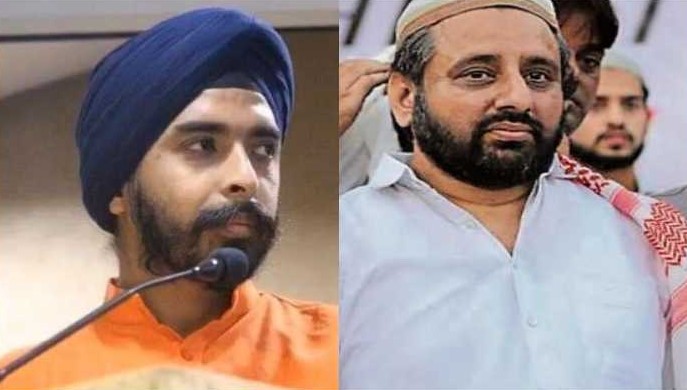
The allegations sparked a war of words between the Delhi BJP spokesperson and AAP MLA Amanatullah Khan.
ये दिल्ली सरकार का DDU अस्पताल है।यहां सुबह से आक्स्जिन को खोल के रख दिया जाता है ताकि आक्स्जिन को बर्बाद किया जाए और दिल्ली में आक्स्जिन की कमी को दिखाया जा सके, जैसे ही हमारे मण्डल अध्य्क्ष चेतन जी को इसकी जानकारी मिली उन्होंने वहां जाके इसका वीडियो बनाया, समय 6.40 PM pic.twitter.com/REZLa91pYS
— Tajinder Pal Singh Bagga (@TajinderBagga) May 7, 2021
Amanatullah Khan addressed him in a derogatory manner and accused Tajinder Bagga of spreading fake news. Khan said that Bagga should educate himself so that he can gain employment somewhere.
थोड़ा पढ़ लिख लेते छोटू @TajinderBagga तो कम से कम झूठी खबरें ना फैलाते। अभी भी वक़्त है पढ़ लिख लो, कम से कम अच्छा काम तो मिल जाएगा। https://t.co/RgHWAahCyT
— Amanatullah Khan AAP (@KhanAmanatullah) May 8, 2021
The war of words escalated then on. Tajinder Bagga said that the person accusing him of peddling fake news is someone who had called the Batla House Encounter fake and insulted Mohan Chand Sharma. He also called the MLA a ‘Madarsa-chhap, riotous Vidhayak’. Amanatullah Khan responded saying that he was peddling information learned from ‘WhatsApp University’ and that ‘Chhotu’ had grown up.
फर्ज़ी राष्ट्रवाद का दिखावा कर के, WhatsApp University का ज्ञान बाँट के अपने निक्मेपन पर पर्दा डालने की कोशिश कर रहे हो, बड़े चालाक हो गए हो छोटू @TajinderBagga पुलवामा,Oxygen Crisis, आत्मनिर्भर भारत और आर्थिक मंदी..इन पर भी बोलने की हिम्मत कर लेते। फर्ज़ी थे, फर्ज़ी ही रह गए। https://t.co/8tAbx8o0cS
— Amanatullah Khan AAP (@KhanAmanatullah) May 8, 2021
Tajinder Bagga shot back at the AAP MLA dubbing him ‘Mirzapur ke Lalit’ and said that the people of Delhi will conduct a ‘surgical strike’ on him and his ‘Oxygen thief’ friend Imran Hussain. AAP MLA Imran Hussain was ordered to appear before the Delhi High Court following allegations of oxygen hoarding against him.
सुन बे मिर्जापुर के ललित, बाटला हाउस में सर्जिकल स्ट्राइक किया दिल्ली पुलिस ने, पुलवामा के बाद सर्जिकल स्ट्राइक किया भारतीय सेना ने, और तेरे और ऑक्सीजन चोर इमरान पे जब दिल्ली की जनता सर्जिकल स्ट्राइक करेगी दिल्ली की जनता । https://t.co/PfRfdFh39F
— Tajinder Pal Singh Bagga (@TajinderBagga) May 8, 2021
The AAP Government has come under intense criticism for its mishandling of the Coronavirus crisis in the national capital. The Delhi Government has also refused the Center’s plea for an oxygen audit at the national capital.
While Delhi is denying an audit to determine the consumption of oxygen in the national capital, data has revealed that while the Delhi govt continues to demand more oxygen, its demand is four times the actual consumption of Mumbai, which has a similar number of active COVID cases.
With not more than a year left for the Assembly elections in Punjab, detractors within the state’s ruling Congress party led by ex-cabinet minister Navjot Singh Sidhu have decided to up their antes against CM Captain Amarinder Singh.
A couple of ministers and some MLAs led by Sidhu held a secret meeting on Friday to devise strategies to mount pressure on the CM to resolve the 2015 sacrilege case and the subsequent police firing cases of Kotkapura and initiate a clampdown on the alleged drug mafia, reported Indian Express. These two issues had been the main poll promises of Congress in the 2017 Assembly elections. Last month, the politician had demanded a new SIT probe in the sacrilege case.
The sacrilege cases refer to the desecration of the Guru Granth Sahib by miscreants in 2015 and the subsequent police firing on those protesting the desecration.
Now, Sidhu has been joined by the Cooperation and Jails Minister Sukhjinder Randhawa and Technical Education, Tourism and Cultural Affairs Minister Charanjit Channi. MLAs Partap Singh Bajwa’s brother Fateh Jung Singh Bajwa, along with Kushaldeep Singh Dhillon, Balwinder Laddi and Barindermeet Singh Pahra were also said to be present during the meeting.
According to reports, in all 38 MLAs and ministers have come together with the aim to “impress upon the party high command that people of Punjab were upset with the Congress government for not delivering justice in sacrilege case, bringing big fish to book in drugs issue and other issues”.
While Navjot Singh Sidhu and Punjab CM Captain Amarinder Singh have been at loggerheads for quite some time now, State Minister Sukhjinder Randhawa is said to be annoyed with the chief minister after he picked on him at a Cabinet meeting called to discuss the sacrilege case. Randhawa had written his resignation on a piece of paper during the meeting and handed it to Amarinder, which the latter tore.
What went wrong between Navjot Singh Sidhu and Captain Amarinder Singh
For the uninitited, things went sour between Captain Amarinder Singh and Navjot Singh Sidhu when despite Captain’s advise Navjot Singh Sidhu visited Pakistan on Pakistan PM Imran Khan’s invite for the Kartarpur groundbreaking ceremony. Captain had asked Sidhu to not visit Pakistan amidst the rising ceasefire violations by Pakistani soldiers along the border.
At that time, Navjot Singh Sidhu had quipped, “My captain is Rahul Gandhi and he is the captain of the Captain(Amarinder Singh). Sidhu in a video said that Rahul Gandhi also provided a special plane to facilitate Navjot Singh Sidhu’s Pakistan visit. The relation between Captain and Sidhu further strained when the latter’s picture with Khalistani terrorist Gopal Singh Chawla did the rounds on the Internet.
Meanwhile, speaking on the unease within the State Congress, a senior leader told the Indian Express, “The government has been soft peddling on the sacrilege case. The Chief Minister had promised to bring to book those involved in the sacrilege case and the police officers responsible for the police firing. The Akali Dal government lost power because of that issue. Amarinder had also promised to crack down on the mafia… We had targeted the Badals on both these issues… Now, how will our MLAs go to the people to seek votes if no action is taken on both these issues?”
Reports suggest that these miffed Congress leaders who attended the secret meeting have decided not to demand any positions or ministerial berths from the state government, instead, consolidate the party’s position in run up to the 2022 Assembly elections by getting all the poll promises fulfilled.
While the world is grappling with the Covid-19 pandemic, a 2015 research paper by Chinese scientists reveals nefarious plans to weaponise the SARS Coronavirus against the world, reportedThe Weekend Australian.
The leaked paper has been titled, “The Unnatural Origin of SARS and New Species of Man-Made Viruses as Genetic Bioweapons.” The Chinese scientists and public health officials predicted how ‘biological weapons’ would be used during World War III. It also pointed out how the SARS Coronaviruses could be used as ‘genetic weapons’ that can be ‘artificially manipulated’ into a human disease virus. The scientists also discussed how the same virus could then be weaponised in a ‘never seen before’ manner.
The shocking details of the research paper, published about 6 years ago, bear an uncanny resemblance with the ongoing global crisis caused due to the Coronavirus pandemic. Executive Director (Australian Strategic Policy Institute) Peter Jennings described the revelations in the document as a ‘smoking gun.’ He emphasised, “I think this is significant because it clearly shows that Chinese scientists were thinking about military application for different strains of the coronavirus and thinking about how it could be deployed.”
China was hesitant about an independent probe into Coronavirus origins
Furthermore, Jennings added, “It begins to firm up the possibility that what we have here is the accidental release of a pathogen for military use…If this was a case of transmission from a wet market it would be in China’s interest to co-operate … we’ve had the opposite of that.” The Executive Director of ASPI pointed out how the Chinese government has been unwilling to allow an independent investigation into the origins of Coronavirus.
Research paper had several PLA backed authors, was verified by a cybersecurity specialist
Interestingly, around 18 authors of the research paper include scientists and weapon experts associated with the People’s Liberation Army (PLA). The paper was verified by cybersecurity specialist Robert Potter, who concluded that the document was not fake. “We reached a high confidence conclusion that it was genuine … It’s not fake but it’s up to someone else to interpret how serious it is. It emerged in the last few years … they (China) will almost certainly try to remove it now it’s been covered.”
Robert Potter, however, expressed his skepticism over Chinese scientists discussing research areas that require progress. He said that it did not automatically imply that action has been taken by the Chinese regime on the findings of the paper. “It’s a really interesting article to show what their scientific researchers are thinking,” he concluded. It must be mentioned that a special team by the World Health Organisation (WHO) had travelled to China to discover the origins of the Coronavirus.
Scientists point out flaws in WHO investigation into Coronavirus origins
Days after a joint team of the World Health Organisation (WHO) and Chinese expert mission claimed that Coronavirus did not exist in China’s Wuhan province before December 2019, a group of scientists had written an open letter on March 4 to the UN body for ‘compromising the scientific validity of the investigation.’
As per the letter, a total of 26 signatories had demanded a ‘full and unrestricted probe’ into the origins of the Wuhan Coronavirus. The scientists lamented that the virus’s origin remains unknown even after a year of the outbreak of the pandemic. “We believe it essential that all hypotheses about the origins of the pandemic are thoroughly examined and full access to all necessary resources be provided without regard to political or other sensitivities,” they opined.
“Based on our analysis, and as confirmed by the global study convened by the World Health Organization (WHO) and Chinese authorities, there is as yet no evidence demonstrating a fully natural origin of this virus”, the scientists added. Further pointing out the problems, the letter said that they want to raise public awareness about the fact that half of the team comprised of Chinese citizens whose scientific independence might be limited in nature.
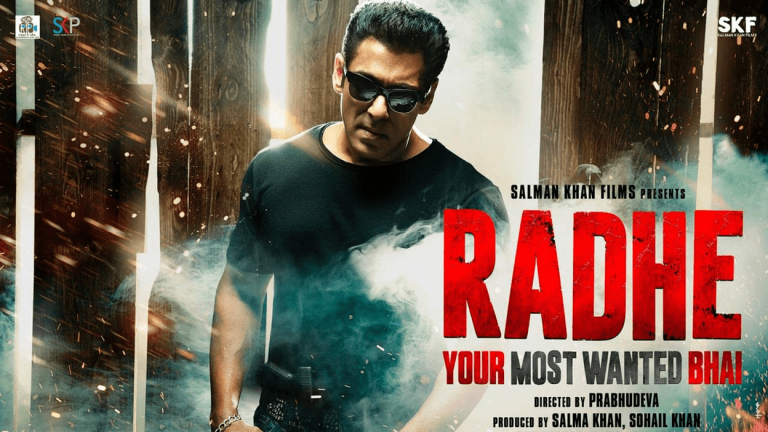
Salman Khan starrer ‘Radhe – Your Most Wanted Bhai’ is all set to release on digital platforms soon. According to reports, the CBFC gave the certification to the movie without any cuts, however, the makers themselves have chopped certain scenes from the movie, since they wanted to ensure it was fit for family viewing.
According to report in Bollywood Hungama, 21 modifications have been made to the movie after getting the CBFC certification.
Most notably, attributing this information to sources, Bollywood Hangama reported that a scene where a young boy was seen doing drugs was cut from the movie, though the CBFC had given it a go-ahead. Bollywood Hungama quotes a source saying, “Lead actor Salman Khan and the makers felt that the film is a family entertainer. Although it’s coming on digital as well, many are going to watch it with their families in their homes. So they probably must have thought that it’s better to remove a few shots which might make the target audience uncomfortable”.
It further reported that other than the shot of a young boy taking drugs, another scene where a boy was scene overdosing on drugs were cut out. Aside from that, 4 other scenes that showed a lot of violence was also cut.
Other than scenes of violence and young boys consuming drugs, a slogan from the movie was also changed. In one scene, ‘Swachch Maharashtra’ was reportedly changed to ‘Swachch Bharat’.
Before these modifications, the duration of Radhe – Your Most Wanted Bhai was 117 minutes and 55 seconds. After these cuts were implemented, the final run time now stands at 114 minutes and 24 seconds. In other words, 3 minutes 31 seconds of shots have been removed by the makers.
Bill Gates, the Microsoft co-founder, and his wife Melinda Gates announced on Tuesday that they are getting divorced. In identical tweets, the couple had said that they had made the decision to end their marriage of 27 years.
Soon after the announcement, parody profiles started popping up on Tinder pretending to be the tech mogul, reported The Sun.
Tinder is an online dating app that matches users to others based on geographic proximity. It works through a simple interface that allows users to swipe right to ‘like’ or left to ‘pass’ based on their photos, a small bio, and common interests. If two users both like each other, it’s a ‘match’ and they are then able to chat through the app.
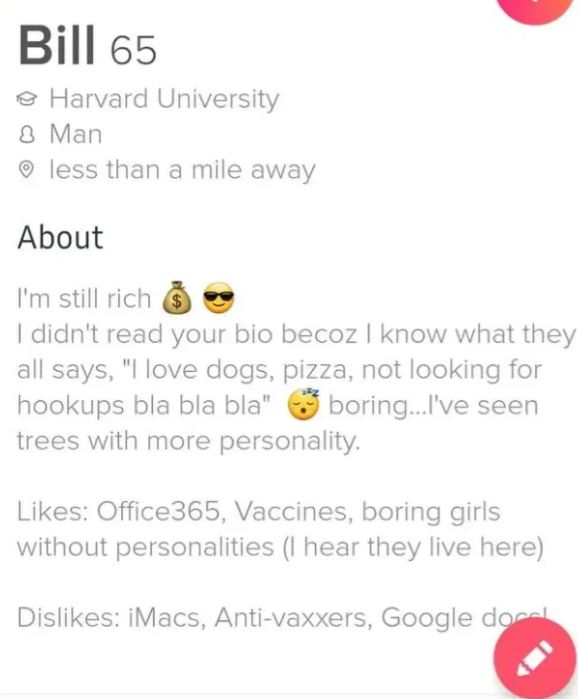
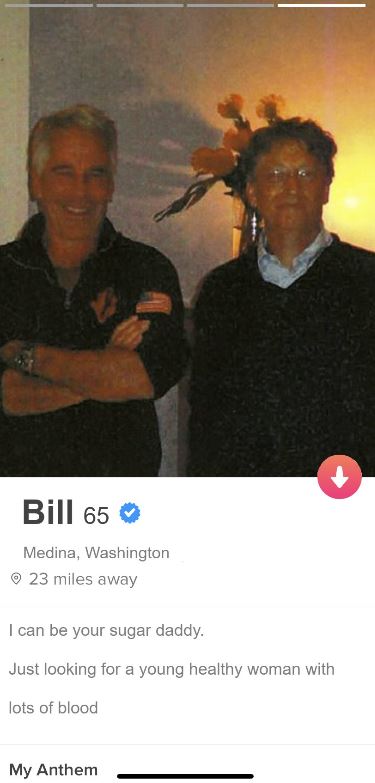
One fake profile lists Bill Gate’s job as a “multi-billionaire,” and has a bio that parodies the Bill and Melinda Gates Foundation’s vaccine initiative, reading: “I can give you an exclusive third dose.”
One of Bill Gate’s fake profile created on the Tinder app
Another spoof account’s bio read: “I’m still rich. I didn’t read your bio becoz I know what they all says, ‘I love dogs, pizza, not looking for hookups bla bla bla’ boring…I’ve seen trees with more personality.”
It states the billionaire’s likes as “Office365, Vaccines, boring girls without personalities (I hear they live here)” and dislikes as: “iMacs, Anti-vaxxers, Google docs”.
Another Bill Gate’s fake profile created on the Tinder app
Similar fake profiles appeared on Tinder
No sooner did these spoof profiles appear on the online dating app, Netizens unleashed a flood of memes to make light of the delicate situation where the couple has decided to part ways after being together for 27 years.
One social media user wrote that the online dating app would keep crashing every five minutes as everyone would be swiping right every time they see Bill Gates’ profile.
Bill gates signing up for tinder it will be down in 5 minutes everyone swiping right every time they see him pic.twitter.com/AFLwm81iPn
— JabulaniMacdonald⚡ (@Jabu_Macdonald) May 4, 2021
Some others jokingly contemplated changing their location or updating their profile to match it with the ‘newly single’ billionaire.
Changing my Tinder location so I can match w Bill Gates.
Listen I’m a happily married man but I’m about to redownload Tinder and see if I can find my way into the DMs of a certain recently divorced billionaire.
Bill Gates and Malinda Gates announce their divorce
On May 3 (Monday) the Microsoft co-founder took to social media to announce his divorce from his wife Malinda Gates. The couple Tweeted: “Over the last 27 years, we have raised three incredible children and built a foundation that works all over the world to enable all people to lead healthy, productive lives”.
“We continue to share a belief in that mission and will continue our work together at the foundation, but we no longer believe we can grow together as a couple in this next phase of our lives.”
“We ask for space and privacy for our family as we begin to navigate this new life,” the couple added.
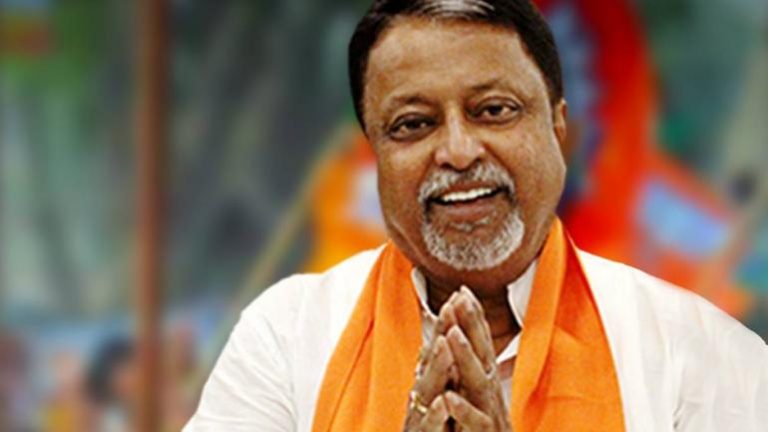
Bengal BJP leader Mukul Roy has dispelled rumours that he is moving back to the Trinamool Congress following the party’s defeat in the assembly elections. Mukul Roy said that he will “continue as a soldier of BJP to restore democracy in our state.”
My fight would continue as a soldier of BJP to restore democracy in our state. I would request everyone to put the concoctions and conjectures to rest. I am resolute in my political path.
There were rumours doing the rounds that Mukul Roy, who had earlier dumped TMC to join the BJP, will move back to Mamata Banerjee’s party after the defeat. However, he says that the “concoctions and conjectures” should be put to rest.
BIG BREAKING : Mukul Roy to resign from BJP today. He is expected to lead a mass exodus back into TMC. Was he the reason BJP performed so poorly in West Bengal ?
— The Political Commentator (@PoliticsMedi) May 8, 2021
Cryptic tweets had been making the rounds suggesting that “turncoats” may be on their way back to the Trinamool Congress.
Turncoats can always turn their coats again #justsaying
The BJP suffered a severe defeat in the West Bengal Assembly Elections with Mamata Banerjee winning 213 seats in the 294 seat assembly. Post-poll violence has erupted in the state ever since trends showed a TMC victory.
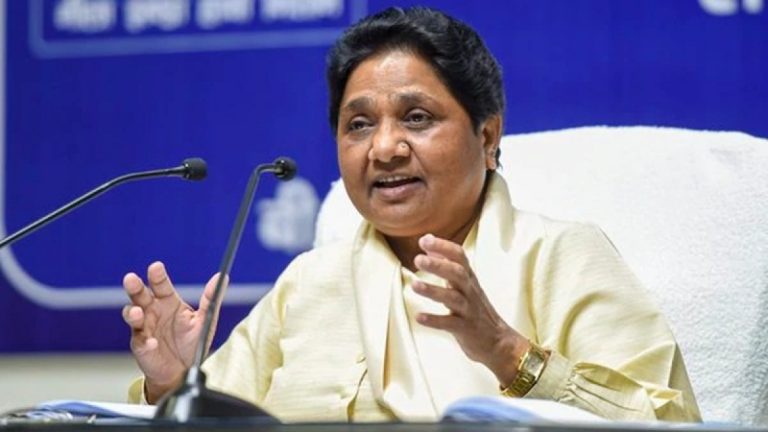
BSP supremo Mayawati has slammed Delhi Chief Minister Arvind Kejriwal over the migrant crisis at the national capital. She said that only folding hands before the public and pleading with them not to leave is a drama that has been seen earlier as well.
Mayawati said that the same drama is being seen in Maharashtra, Haryana and Punjab as well. She said that the events were extremely disheartening.
1. केवल हाथ जोड़कर दिल्ली के सीएम का यह कहना कि दिल्ली से लोग पलायन न करें, यही नाटक कोरोना के दौरान् पहले भी किया गया था। यह सब अब महाराष्ट्र, हरियाणा व पंजाब आदि राज्यों में भी देखने के लिए मिल रहा है। अब पंजाब में लुधियाना से भी लोग काफी पलायन कर रहे हैं, यह अति-दुःखद। 1/3
The BSP supremo said that if the governments of these states had inspired faith in them and worked to meet their necessities, then they would not have been forced to flee. She also said that the state governments were now engaging in drama to cover up their incompetence.
2. यदि यहाँ कि राज्य सरकारें इनमें विश्वास पैदा करके इनकी जरूरतों को समय से पूरा कर देतीं तो फिर ये लोग पलायन नहीं करते और अब यहाँ कि राज्य सरकारें इस मामले में अपनी कमियों को छिपाने हेतु किस्म-किस्म की नाटकबाजी कर रही हैं, यह किसी से छिपा नहीं है। 2/3
Mayawati also demanded free vaccines for the poor, Dalits and the Tribal communities. She also requested financial help for them.
3. साथ ही, पूरे देश में सर्वसमाज में से खासकर गरीबों, दलितों व आदिवासी समाज के लोगों को ‘‘फ्री‘‘ में वैक्सीन दी जानी चाहिये। इसके साथ-साथ, ऐसे समय में इनकी आर्थिक मदद भी जरूर की जानी चाहिये। बी.एस.पी. की केन्द्र व सभी राज्य सरकारों से भी पुनः यह माँग। 3/3
Delhi had witnessed a massive migrant crisis with the onset of lockdown in the state the previous month. Following the announcement of lockdown, a huge gathering of migrant workers were spotted at the Anand Vihar Bus Terminal. Such a crisis was witnessed in 2020 as well.
On Friday (May 7), the National Commission for Women (NCW) chief Rekha Sharma informed that several women in West Bengal have been facing rape threats and are wanting their daughters to abandon the State. The revelation comes days after an NCW team reached West Bengal to take cognisance of the Trinamool Congress-sponsored violence in the State.
As per reports, Rekha Sharma said that the rape threats to women and their willingness to leave the State altogether came at the backdrop of the police inaction and their failure in ensuring the protection of women. In a statement, she added that the women are fearful of a possible backlash if they file a complaint with the police.
While speaking about the matter, NCW said, “The team received information about many stranded victims, who left their homes because of violence, are currently forced to stay in a shelter home. The team was informed by the victims that they were physically assaulted and their homes were vandalised and set ablaze by TMC goons.”
NCW complaints about rape threats to women and police inaction
It further added, “The complainants told the team that they have been receiving rape and threat calls every day. The women also said that they are not being provided with any protection by the police or state authorities. The women said that they have left the elderly in their homes and are worried about their safety.” Moreover, the shelter homes, where people were forced to take refuge, had no medical facilities, clean drinking water, or healthy food.
“There is no effective rehabilitation scheme for women in distress and women are unaware of the welfare schemes launched for them by the central government. There is a need for conducting awareness programmes about schemes of central government at the district level,” NCW noted. It had also met West Bengal Governor Jagdeep Dhankar and sought detailed information of the registered FIRs from police officials and the district magistrates. NCW has also asked the cops to appear before them and submit their reports.
NCW demands police reforms, the inclusion of more women officers in services
The National Commission for Women pointed out that the police and the State authorities must be held accountable. It emphasised the need to increase women police officers, sensitisation, and training the police personnel. NCW stated that the State government officials prevented it from meeting the victims of violence, citing movement restrictions during the Coronavirus pandemic.
Mamata govt denies extension of stay to NCW chief
On Thursday (May 6), National Commission for Women chief Rekha Sharma announced that she had been refused a one-day extension of her West Bengal visit, which sought to help women affected by the post-election violence in the state. The official reason for this refusal was the recently introduced partial lockdown measures in the state.
The NCW chief had been on an official visit to Kolkata since May 5 in order to hear the grievances of women going through post-election violence. In order to better access the situation, the NCW chief had extended her visit for another day, however, this extension was quickly refused by the West Bengal TMC government.
“Yesterday I extended my visit to Kolkata for a day but State Gov. didn’t want me to, so they sent this message to me as if I was here for a pleasure trip,” wrote Rekha Sharma. “In this 2 days trip met many women, saw so much pain in their eyes, and recorded horrible stories,” the NCW chief added, giving a plausible explanation as to why she would extend her official visit.