Home Blog Page 4467

Donald Trump to launch his own social media platform after being banned by Twitter, Facebook and others, says aide: Details

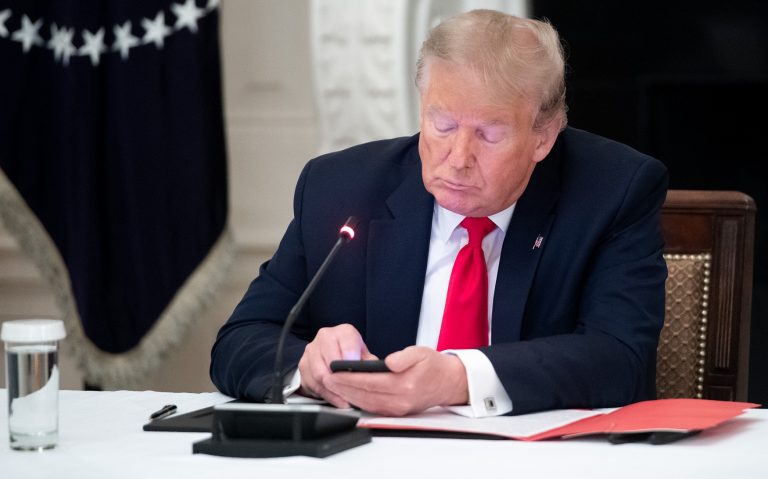
Donald Trump will launch his own social media platform after being banned from Twitter, Facebook and most other platforms, his aide Jason Miller has revealed. Miller said on Sunday during an appearance on Fox News “Media Buzz” said that Trump would be “returning to social media in two or three months” with “his own platform” to “completely redefine the game.”

Donald Trump was banned on social media platforms after the storming of Capitol Hill on the 6th of January in a move that attracted widespread criticism from leaders worldwide for what was considered Big Tech censorship.

Twitter’s reasons for the ban included the “use of the words “American Patriots” to describe some of his supporters is also being interpreted as support for those committing violent acts at the US Capitol” and the “mention of his supporters having a “GIANT VOICE long into the future” and that “They will not be disrespected or treated unfairly in any way, shape or form!!!” is being interpreted as further indication that President Trump does not plan to facilitate an “orderly transition” and instead that he plans to continue to support, empower, and shield those who believe he won the election.”

The former US President has also hinted that he will run for the Presidency in 2024. At the same time, Twitter has said that his ban will not be revoked even if he decides to run for White House again.

As Rahul Gandhi goes on an anti-corporate tirade, know how his father Rajiv Gandhi initiated the idea of privatisation in India

Rahul Gandhi, the face of the country’s oldest political party, seems to be waging war against India’s private sector. Ever since the Modi government announced its plans to privatise some of the country’s non-critical sectors, Rahul Gandhi has not left any chance to accuse Prime Minister Modi of ‘selling’ the country’s assets to his ‘friends’.

From accusing India’s wealth generators and big business establishment of stealing from the public to making hysterical claims of government working on behalf of a select few, Rahul Gandhi has launched a full-scale attack on Modi government’s economic policies, especially on its disinvestment strategy and privatisation.

Is Privatisation really bad, as Rahul Gandhi suggests? To understand the intricacies, one should really know what exactly Privatisation means. Let’s try and understand India’s story of privatisation and how the Congress party was itself the pioneers of the neo-liberal economic policies and idea of privatisation.

What is Privatisation?

Privatisation refers to allowing private sector participation in the management and ownership of Public Sector Enterprises. In simple terms, Privatisation implies the process of transferring ownership of a business, enterprise, public service or public property from the public sector or a government to the private sector, which are usually profit-driven.

In India, Privatisation as a trend began in the late 1980s, however, it gained prominence in the early 1990s. The idea behind privatising state assets’ was to reform the loss-making and inefficient public sector enterprises. One of the main arguments favouring the privatisation of publicly owned operations is that it increases efficiency and brings accountability resulting from private ownership and business practices. 

Today, Privatisation has not just become a common economic policy tool around the globe but also has become a norm.

The story of Privatisation in India

Soon after the independence, India also adopted a very conservative economic model that almost isolated the country from the outside world. As time went by, Indian planners recognized the need to integrate with the global economy and the necessity of private investment to achieve the nation’s development goals. In later years, India repositioned itself as a mixed economy, allowing both the private and public sectors to participate in India’s growth story. Grabbing the opportunity, the private sector thrived while the public sector was affected by unsustainable inefficiencies and incompetence by the 1990s. 

With the fall of the Soviet Union, the idea of state-controlled production and management of resources took a back seat. Many developing countries like India and post-socialist countries initiated steps to dilute their role in running enterprises and gradually opened up private sector participation in sectors that barred them from investing earlier.

Following the industrial policy of 1991, India began to liberalise its economy by initiating LPG reforms – Liberalisation, Globalisation and Privatisation. Various governments adopted disinvestment, strategic sale of minority shares to private partners and selling of loss-making units to the private sector to not only bring efficiency in the administrations of PSEs but also limit the losses of government-owned enterprises, that were once glorified as the ‘Temples of Modern India’ by Jawaharlal Nehru.

As India adopted neo-liberal economic policies, the government understood that it cannot be in the business of running the business and began to disinvest its shares to private entities. Some of the chronic loss-making units were either sold or closed by settling legitimate dues and compensation of its workers. Subsequent governments also took the route of strategic disinvestment of the PSEs, through which the majority shares held by the government were sold to a strategic private entity.

Often, the government has taken the disinvestment route rather than full-scale privatisation to limit their holding in the public sector enterprises. The governments have transferred minority shareholding to the general public while maintaining a 51% shareholding. The sale of a minority stake to the private sector has enabled the government to bring in competitive and efficient private sector business practices in these otherwise loss-making government enterprises.

Congress government role in Privatisation:

During the Nehruvian era, the Congress party was very much fearful of the idea of allowing the private sector to flourish. The private sector was treated with suspicion, and their growth was scuttled, thanks to the draconian ‘License Raj’ system. The private sector was at the mercy of the government and did not have any incentives to invest. Indira Gandhi continued her father’s economic policy, only to push Indian industries further into deep trouble. In fact, Indira Gandhi did more harm to India’s entrepreneurial spirit than any others in independent India.

However, with each passing decade, Indian economic policies began to undergo limited changes, and more liberal economic policies crept in. The idea of privatisation got impetus during the Rajiv Gandhi era. The infamous ‘License Raj’ was slowly dismantled by the Rajiv Gandhi government, which opened up some sectors for private participation.

It was Rajiv Gandhi who started the disinvestment of PSUs through minority stake sales. During his rule, there was a focus on deregulation and privatisation in a few sectors, such as telecom. By allowing the private sector to manufacture some of the telecom infrastructure and equipment, he initiated the much-needed reforms into such sectors that required systemic changes.

However, it was PV Narasimha Rao who took the bold gamble and altered the face of India’s industrial setup forever. Under the leadership of PV Narasimha Rao and his finance minister Manmohan Singh, the Congress government introduced the New Industrial Policy of 1991 that contained several reform measures for the public sector.

Forced by the balance of payment crisis, Prime Minister Narsimha Rao launched a raft of economic reforms that opened up most of the sectors to private participation. The Congress government led by PV Narasimha Rao ushered reforms that pulled India back after it had run out of money in 1991. Some of the reforms they took were to sell loss-making public entities to the private sector, inviting private participation in PSEs, and undertook the strategic sale of public assets. Some of these reform measures included privatisation to a low degree.

Later, former Prime Minister Atal Bihari Vajpayee and former PM Manmohan Singh took up the mantle and really brought privatisation to the forefront. Several loss-making PSEs were either closed or sold to private entities in the next decade. Under Manmohan Singh, the UPA government aggressively pushed neoliberal economic policies that helped India shed its socialist outlook.

In India, gladly, Privatisation is considered as a path towards prosperity. Over the decades, privatisation has enhanced the efficiency of the public sector enterprises and brought in major changes in the management of the business in the country. Today, the Private sector is largely considered a boon rather than a bane.

Is Privatisation bad for India?

The debate between the supremacy of the private and public sectors has been going on for a long time now and expected to continue even in the future. However, the success of privatisation in India, especially in critical sectors such as infrastructure, transportation, telecoms, basic industries of cement, steel, electricity etc., has evoked positive sentiments towards privatisation in the country lately.

The opening of strategic sectors to private investment, added with disinvestment policies implemented by the various government in the past, has brought efficiency in resource utilisation and effective public service delivery. The private players have brought in their rich experience and effective managerial skills, along with required technical know-how, into India’s enterprises.

Unfortunately, the political rhetoric against the idea of privatisation has caused more damage rather than the process itself. It is rather sad that the Congress party, which initiated most of the much-needed reforms to revive the Indian economy, has been cursing the very same idea it cherished a few decades back.

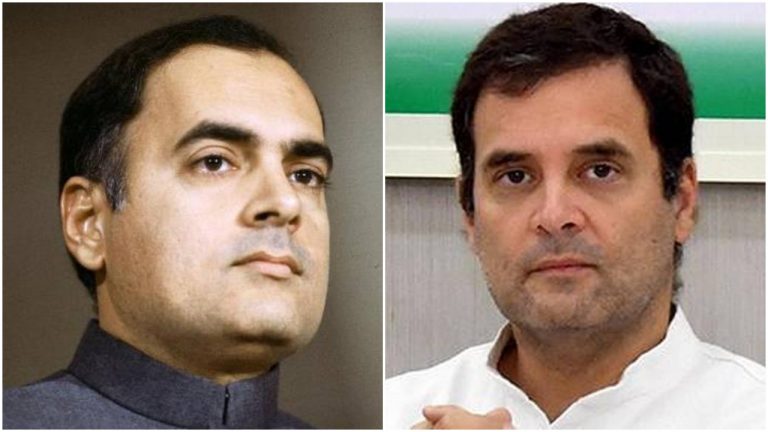
Instead of seeking credit for the liberalising India’s industrial regime, the Congress party and its leadership, especially Rahul Gandhi, are now dissing the ides of privatisation to achieve a short term political goal. Perhaps, Rahul Gandhi’s selective amnesia makes him ignore that his father Rajiv Gandhi initiated the idea of privatisation.


Uttar Pradesh: Anurag Pandey thrashed, poisoned to death by Nasir and 3 others over an old dispute

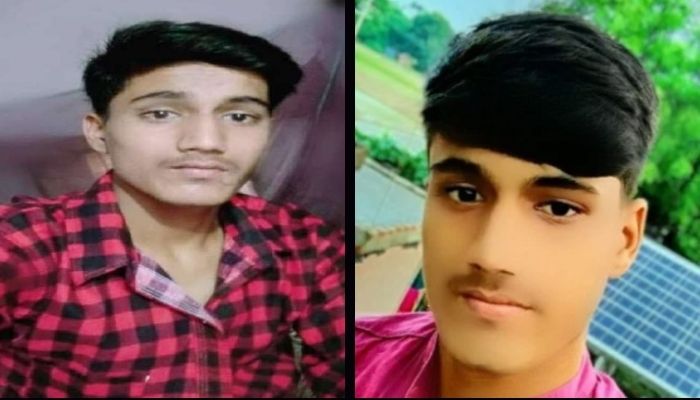
On Wednesday (March 17), a 15-year-old teenager named Anurag Pandey was thrashed and poisoned to death by a group of men in Domariaganj in the Siddharthnagar district of Uttar Pradesh.

As per reports, the victim’s father Rashtrapati Pandey has lodged a complaint with the Bhawaniganj police against the accused. He informed the police that his son went out to pick up goods on Wednesday. However, on reaching Budh Vihar, which is located south of Paraspur village, Anurag Pandey was stopped by a group of people. The accused have been identified as Nasir, Saddam, Shadab and Akhtar.

Owing to an earlier dispute, they surrounded the victim from all sides and began assaulting him. After thrashing the 15-year-old boy, the accused force-fed him a poisonous substance. On returning home, the victim narrated the ordeal to his father and named the accused. Soon after, his condition deteriorated and he was taken to a hospital for treatment.

Anurag Pandey dies in Gorakhpur

When his health further worsened, Anurag Pandey was taken to Domariaganj Primary Health Center the following day. He was then referred to the district hospital. Following one and a half hours of treatment, the victim was admitted to the Baba Raghav Das Medical College in Gorakhpur. On Friday (March 19), the victim succumbed to his injuries in Gorakhpur. The post-mortem of the dead body was conducted in Gorakhpur as well.

He was cremated in the presence of Sub-divisional Magistrate (SDM) Tribhuvan, CEO Umesh Sharma, police chiefs and local legislator Raghavendra Pratap Singh. Anurag was a student of Class 11 at the Maulana Azad Inter College. The family is now mourning the untimely death of the 15-year-old and the outgoing Panchayat Head Dilip Pandey came to pacify them.

Police deployment intensified in the area, case registered

The police informed that a case has been registered under relevant sections, on the basis of the complaint of Rashtrapati Pandey. The incident has created an atmosphere of fear and anger among the villagers in the area. Inspector KD Singh of Domariaganj police station and Ravindra Kumar Singh, the in-charge of Bhawaniganj police station, has been directed to monitor the situation. Police deployment has been increased, keeping in mind the sensitive nature of the case. The grieving family was pacified by Panchayat Head Dilip Pandey aka Chhote

American university shuts down Chinese govt-funded institute on campus

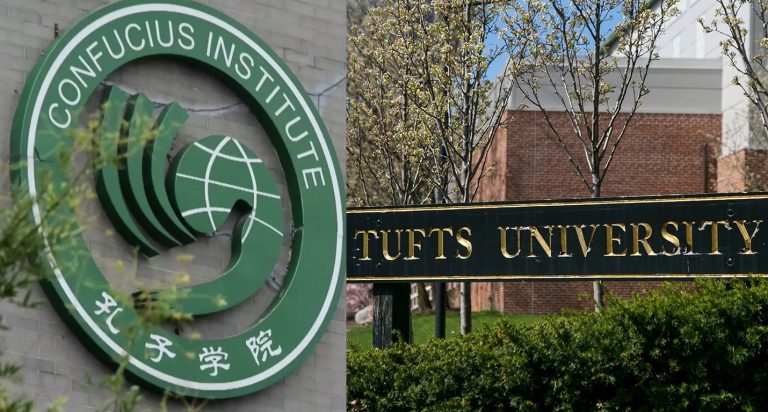
In a major development on Wednesday (March 17), Massachusetts-based Tufts University in the United States decided to shut down the contentious Confucius Institute from its campus.

As per reports, Tufts University has announced that it will not renew its contract with the Institute after it expires in September this year. The US university had earlier extended its contract in 2019 for a period of 2 years. The Confucius Institute, funded directly by the Communist regime in China (CCP), was started in Tufts in 2015. It was meant to ‘facilitate’ cultural exchange between China and the United States by offering a not-for-credit language programme in Mandarin.

Over the years, the ‘cultural centre’ has been accused of promoting censorship and undermining human rights. There are more than 50 centres of Confucius Institute across the United States. Besides the Chinese government, it receives funds from the host university as well. The staff members include visiting professors from China, who come to the US on a visa. At its peak, the Confucius Institute had over 70 centres in the country. But, as per reports, at least 10 have been shut down so far.

Protest at Tufts University against Confucius Institute

The Tibetan Association of Boston along with Students for Free Tibet in Boston staged 13-week long protests at the Tufts University. The demonstration was joined by a state representative, city councilors in Somerville and a School Committee member. The protest involved Uyghurs, Hong Kongers, Taiwanese, Tibetans and Uyghurs. Activist Tenzin Yangzom said, “We refused to accept that the Chinese government — the very regime that has driven us from homelands and is waging an unrelenting campaign of intimidation, persecution, and repression against our peoples — had a home at Tufts, and a presence in our own backyard.”

Tufts University committed to promoting ‘Chinese culture’ and language

US State Representative Seth Moulton opined, “Tufts University’s overdue decision to disband its Confucius Institute is the right one, and I hope it represents a sign that academia is finally waking up to the threat the Chinese Communist Party poses to colleges and our country.” In 2019, a probe by the US Senate had found that the Chinese government paid $158 million during a span of 13 years to establish over 100 centres of the Confucius Institute.

The administrators at Tufts university informed that they are focussed on improving their relationship with Beijing Normal University (BNU). It thanked the Confucius Institute for promoting Mandarin and ‘culture learning’ at the University and strengthening its ties with BNU. Interestingly, Tufts University also has a study abroad programme named ‘Tufts in Beijing’. “We remain committed to international engagement with our partners and are enthused by increased student interest in Chinese language and culture,” the University said.

Trump administration cautioned about threats by CCP

In September last year, the State Department had written to the governing boards of US universities cautioning them about the threats posed by the Chinese Communist Party. US State Secretary Mike Pompeo had said that he was hopeful that dozens of Chinese-government funded Confucius Institute cultural centres on US campuses will be shut down by year-end. The institutes are accused of working to recruit “spies and collaborators”.

The growing influence of Confucius Institute in British schools

The Confucius Institutes now exist in 29 British universities and 150 schools. While they claim to promote Chinese culture and language, the Mail reported that they curb free speech and peddle CCP propaganda. The Confucius International Education Group bought the Riddlesworth Hall Preparatory School, a school where Princess Diana studied, in 2015.

‘It encourages divorce’: Turkey quits European treaty on violence against women claiming ‘protecting traditional social fabric’ will protect women

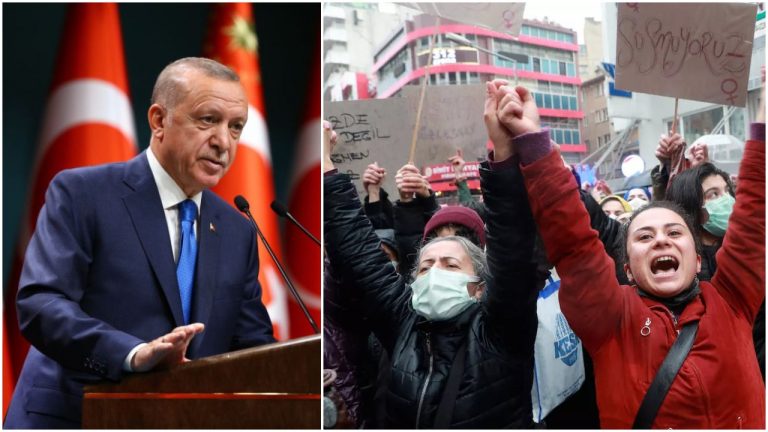
Turkish President Tayyip Erdogan’s decision to pull out of an internationally binding treaty that prevents violence against women has prompted massive protests in Turkey and has received condemnation from major powers. According to the reports, President Recep Tayyip Erdogan pulled Turkey out 2011 Istanbul Convention that pledged to prevent, prosecute and eliminate domestic violence and promote equality.

The 2011 Istanbul Convention, widely regarded as the gold standard in international efforts to protect women and girls from violence, was signed by 45 countries and the European Union. Turkey had signed it in 2011, but violence has surged in the country in recent years.

The treaty requires governments to adopt legislation criminalising domestic violence as well as marital rape and female genital mutilation.

The Turkish government has not provided any reason for the withdrawal. It announced the decision to pull from the treaty in the early hours on Saturday. However, the top government officials said the domestic law would protect women’s rights rather than an international treaty.

Why did Turkey withdraw?

Reportedly, the Turkish government decision to withdraw from the treaty comes at the backdrop of growing fundamentalism in the Islamic country. The move is being depicted as the latest victory for conservatives in Erdogan’s nationalist party and their allies in Turkey.

The Turkish government claims that the convention undermines family structures, encourages violence and divorce. Besides, the LGBT community uses the references in the treaty for demanding equal rights and broader acceptance in the society, which has caused a major worry for the Turkish conservative government.

The Istanbul Convention states that men and women have equal rights and obliges state authorities to take steps to prevent gender-based violence against women, protect victims and prosecute perpetrators.

“Preserving our traditional social fabric” will protect the dignity of Turkish women, Vice President Fuat Oktay said. “For this sublime purpose, there is no need to seek the remedy outside or to imitate others,” he added.

Protests erupt in Turkey, women’s group demand roll back in decision

Meanwhile, thousands are protesting in Turkey, demanding President Recep Tayyip Erdogan to reverse his decision to withdraw from the world’s first binding treaty to prevent and combat violence against women.

The overnight decision to annul from the ratification of the Istanbul Convention is a blow to women’s rights advocates, said women protestors who assembled on the streets of Istanbul on Saturday. Hundreds of women gathered in Istanbul to protest against the decision on Saturday.

Several women’s groups protested to keep the convention intact immediately. They called for protests across the country on Saturday under the slogan “Withdraw the decision, implement the treaty”. According to the protestors, their years-long struggle would not be erased in one night.

Turkey’s decision to pull out of the Istanbul treaty has also not gone well within the international community. The Council of Europe’s Secretary-General, Marija Pejčinović Burić, called the decision “devastating.”

“This move is a huge setback to these efforts and all the more deplorable because it compromises the protection of women in Turkey, across Europe and beyond,” she said.

A day after Mansukh Hiren death case transferred to NIA, DIG of ATS claims case has been solved without giving any details

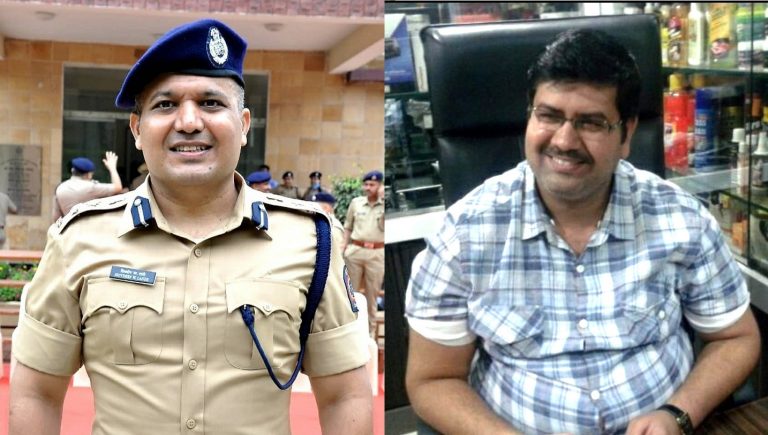
A day after the Union Home Minister handed over the Mansukh Hiren case to the National Investigation Agency (NIA), the Anti Terrorism Squad (ATS) of Maharashtra Police claimed that they have solved the case.

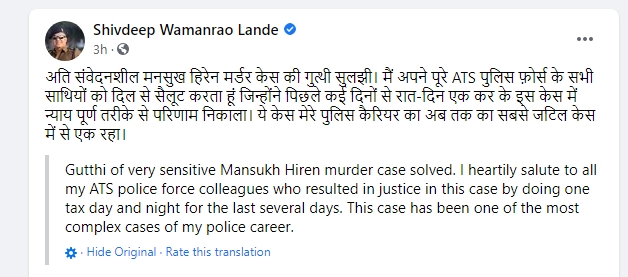
Shivdeep Wamanrao Lande, the Deputy Inspector General of Police (D.I.G.) for the ATS, posted a message on Facebook today, saying that the puzzle of the very sensitive Mansukh Hiren murder case has been solved. However, he didn’t give any detail about the same. Lande said that he heartily salutes all his ATS police force colleagues who worked day and night for several days, which have resulted in justice in the case. He further added that this case has been one of the most complex cases of his police career.

Screenshot of the post with machine translation by Facebook

The comments of the DIG came after the ATS made two arrests in the case today. The ATS had arrested a 55-year-old former police constable named Vinayak Shinde and a 31-year-old bookie named Naresh Dhare in connection with the case. Shinde is an accused in the Lakhan Bhaiya encounter case and he had worked with Sachin Waze in the team of encounter specialist Pradeep Sharma.

Mansukh Hiren case transferred to NIA

Even though ATS has continued to probe the Mansukh Hiren death case and made the two arrests today, the case has been transferred to the National Investigation Agency. Yesterday, the union home ministry had issued orders to the NIA to take over the case from the ATS. It is not known when the ATS will formally hand over the case to NIA.

Mansukh Hiren was found dead in Kalwa Creek in Mumbai on 5th March, just days after his Scorpio car laden with explosive gelatine sticks was found outside the residence of Mukesh Ambani on 25th February. Although initially Mumbai police tried to say that Hiren had committed suicide, soon it had become clear that it was a murder related to the explosive case. Earlier Hiren had lodged a complaint that his car was stolen.

By now it has revealed that the car was planted by Mumbai Police API Sachin Vaze, who knew Mansukh Hiren and had used the Scorpio car for several months earlier. He had kept the car at his residence before he had planted it near Antilia. To cover his traces, he had taken the CCTV footage from his building and destroyed them. The number plate of the Scorpio was found from a Mercedes he was using, and an Innova car that had trailed the Scorpio was found in Mumbai Police Commissioner’s office, which was parked there by Vaze. Apart from that, NIA has also recovered two more cars, one Land Cruiser Prado and another Mercedes.

It is suspected that Sachin Vaze killed Mansukh Hiren. In that context, it will be interesting to know what is the conclusion of ATS, after they ‘solved’ the case.

Stand up for the Black community, stand up for Muslims, stand up against racism and hate crimes

Now that we have your attention, let’s talk about Hindus and Hinduphobia.

It is an undeniable truth that crimes against Hindus are downplayed by global media and even Indian media time and again. The Bhainsa riots that occurred in Telangana has hardly received the attention that it deserves.

It is not the first time that Hindus have been attacked in Bhainsa and yet, this time around as well like all the other times, the media and pretended that it just did not happen. The most obvious instance of the slanted coverage of Hindu related matters in the media and preconceived agenda that dominates it became evident when a Muslim boy was thrashed for trespassing on the premises of a Hindu Temple.

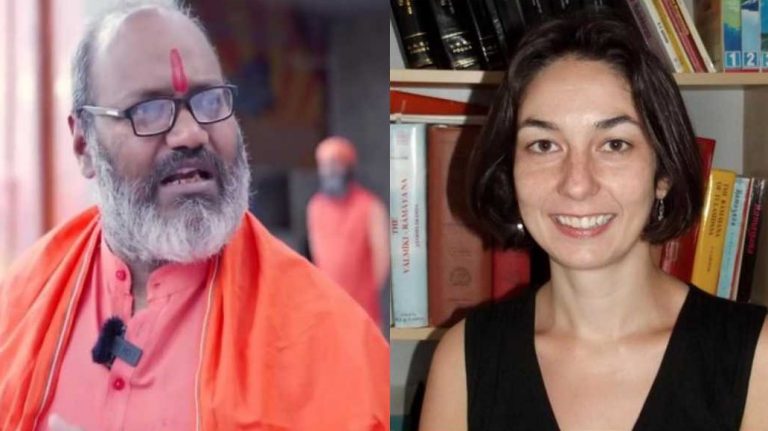
The media went to town with it and used the incident to paint Hindus as intolerant and bigots. But in the same temple, the Dasna Temple, there have been at least two incidents of dacoity in the past seven years. Yati Narsinghanand, the Mahant of the Temple, and other locals allege that there have been repeated instances of sexual harassment of Hindu women and there have been murders as well and yet, the media has kept mum on them all this time.

When the thrashing of a boy for trespassing receives more attention than sexual harassment and murder and theft and dacoity precisely due to the religion of the victims on the separate instances, it is bound to attract suspicions regarding the motivation behind the same.

The first time is a chance, second is coincidence and third is a pattern so goes the saying. And this is a pattern we have observed time after time after time for years and years. Media coverage is curated with one sole objective, to paint the Hindu community as oppressive bigots and the other community as oppressed victims despite the stark reality of events.

So why are we not talking about this? The reason is simple. For the media, Hindu lives count for very little. The Hindu community is a punching bag that is to be used to augment their secular credentials. And if Hindu sentiments are hurt in the process, then that is completely fine because at the end of the day, their reputation is only augmented in international liberal circles by such coverage.

It is this Hinduphobia that has led to a situation where every crime against the Hindu community is whitewashed and every act of self defense on the part of the community is considered further evidence of their bigotry. Only a day before this was written, Hindu houses were attacked by a Muslim mob in Delhi because a Muslim woman decided to marry a Dalit man out of her own volition.

When will the people who claim to care so much for ‘human rights’ and tolerance and communal harmony speak up for such victims? Probably not, because in their worldview, a Hindu can never be a victim. He is always the oppressor, always the bigot. It is textbook Hinduphobia.

Another glaring evidence of it came up in the manner in which Rutgers University defended its professor Audrey Truschke. The professor in question has a history of engaging in genocide denial and slandering Hindu Gods and Goddesses. She has even attempted to whitewash the crimes of the universally acknowledged Islamist maniac Aurangzeb whose cruelty even among Islamic tyrants was out of the ordinary.

When criticised by Hindus, Truschke has demonstrated an unnerving tendency of branding her critics Nazis and fascists, which is ironical considering the fact that it she who is defending a genocidal maniac and engaging in genocide denial. Hindus in Rutgers University demanded that Truschke be barred from teaching courses related to Hinduism due to her bigoted worldview.

Faculty members of the University defended her saying that students should be ‘intellectually challenged’. Is genocide denial an acceptable form of intellectual pursuit in this day and age? Will teaching African Americans the glory of slavery be considered ‘intellectually challenging’ them?

Would an ‘intellectual challenge’ involve an intellectual defense of Adolf Hitler’s genocidal rhetoric against Jews? In civil society, such ‘intellectual challenges’ would be considered abhorrent and rightly so. But somehow, when it comes to Hindus, all of this is considered perfectly acceptable.

Hate crimes against Hindus have been extremely frequent lately, perhaps fueled in part by the narrative that paints Hindus as bigots and fascists. Such rhetoric convinces antisocial elements of the righteousness of their bigotry and what follows are attacks against the Hindu community.

Liberals may continue to ignore the hate crimes and the rampant Hinduphobia that permeates large swathes of society today but in doing so, they only reveal the hollowness of their commitment towards the virtues of human rights and tolerance. It is well past time that we discuss Hinduphobia and hate crimes against Hindus. Failure to do so would have and continues to have devastating consequences for society.

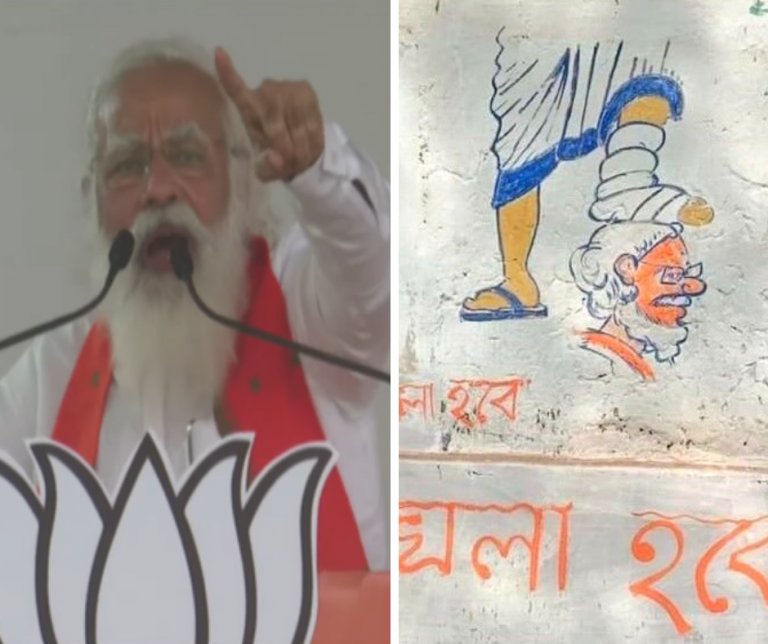
‘I will not let didi kick Bengal’s development’ says PM Modi taking a jibe at TMC’s drawings featuring Mamata Banerjee kicking his head

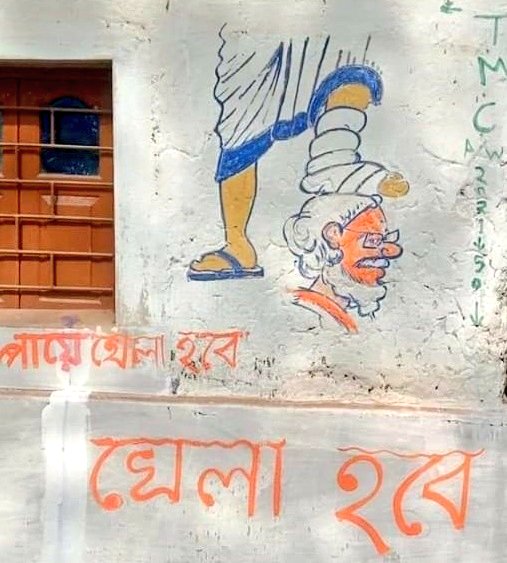
While addressing a rally in Bankura in West Bengal, Prime Minister Narendra Modi referred to the murals being drawn on walls in West Bengal where CM Mamata Banerjee is shown putting her leg on his head. This comes after TMC workers have been busy creating the images and circulating the same on Social Media. It shows West Bengal CM Mamata Banerjee putting her bandaged foot on Prime Minister Modi’s head.

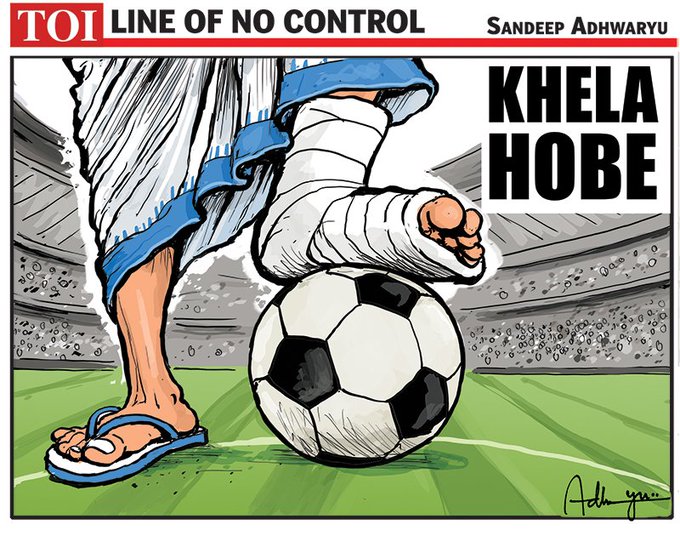
The images are a caricature of an earlier cartoon, where Mamata Banerjee’s bandaged foot was shown on a football. TMC workers decided to replace the football with the head of PM Modi. Criticising such tasteless imagery, PM Modi said that, Mamata Banerjee is insulting the culture of Bengal, a state responsible for giving a direction to the nation. He addedm, “if you want you can keep your foot on my head or kick me, but I will not let you kick the development of Bengal. I will not let you kick the dreams of Bengal.”

A wall with Mamata Banerjee and Prime Minister Narendra Modi’s caricature with the former kicking the head of Prime Minister. Image source: twitter handle of BJP India

The wall painting is based on a cartoon by Sandeep Adhwaryu, which was published in the Times of India with the tagline ‘Khela Hobe’ (game is on). It shows Mamata Banerjee’s legs with her bandaged injured leg put on a football. It was after Mamata Banerjee was injured in Nandigram, where she had alleged that she was attacked, but later it was revealed that it was an accident. Following the accident, images of Mamata Banerjee with her leg in plaster and bandage had appeared. The cartoon depicted that despite the CM suffering the injury, the game was still on.

Questioning the development or the lack of development in Bengal, Prime Minister claimed that since no scams were possible in direct benefit schemes by Centre like Ayushman Bharat, PM Kisan Samman Nidhi Yojna etc, these schemes were not implemented by the state government.

Prime Minister Narendra Modi in his speech said that the Centre has initiated efforts to provide water to every house through taps, but questioned Mamata Banerjee why do the daughters of Bengal still have to suffer for every drop of water and why there are no irrigation facilities for the farms.

Sharing the images of the rally, BJP India asserted the fact that Bengal is ready to get rid of the TMC government on May 02, 2021.

With TMC’s allegations that BJP will be rigging the EVM to ensure victory in the state, PM Modi said that the same EVM kept Mamata Banerjee in power for 10 years. He emphasized on the fact that every voter must exercise their power to vote without any fear.

In a run up to West Bengal elections, Prime Minister Narendra Modi is set to address four rallies in 10 days. BJP’s star campaigner for West Bengal and Home Minister Amit Shah is all set to launch BJP’s manifesto in Kolkata in a short while.

West Bengal elections

The much-anticipated elections to 294-seats of the West Bengal Assembly are scheduled to be held from March 27 in eight different phases. The results will be announced on May 2.

Currently, Mamata Banerjee’s Trinamool Congress holds 222 seats at present. However, BJP has made major inroads in the state in the Lok Sabha elections winning 18 seats out of 42 and establishing itself as the major opposition force in the state.

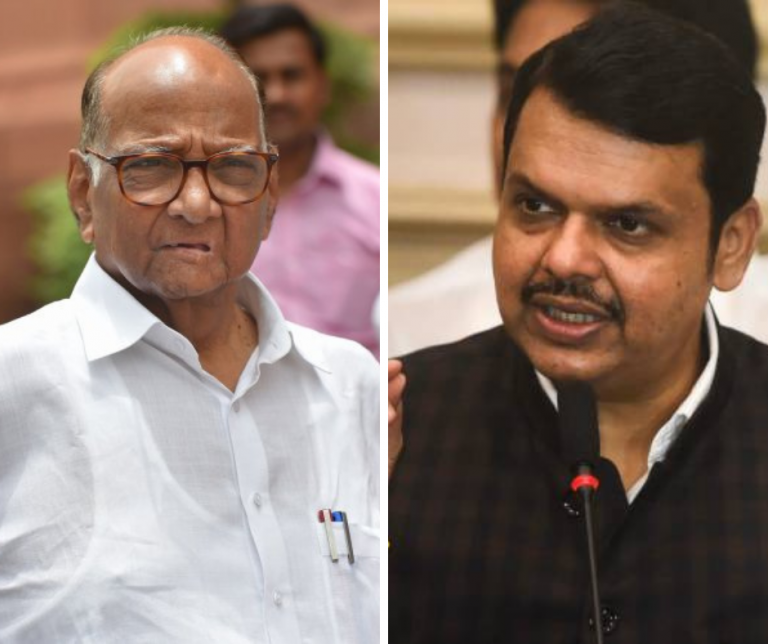
Devendra Fadnavis lashes out at Sharad Pawar, questions why he wants Julio Ribeiro to probe the case Param Bir Singh letter

Leader of opposition and ex-Maharashtra CM, Devendra Fadnavis in a press conference in Nagpur said that NCP supremo Sharad Pawar’s press conference earlier in the day was nothing but a whitewash and an attempt to fleet away from the truth.

Furthering his claim, Devendra Fadnavis said that Sharad Pawar in his press conference said that he wants Julio Ribeiro to investigate the case. Expressing his bewilderment, Fadnavis said, why would Sharad Pawar want a 90-year-old retired Indian police officer and civil servant to investigate the case is unclear.

Devendra Fadnavis alleged that it is because Sharad Pawar created this government that he is trying to defend them. Speaking about the letter written by Param Bir Singh, Fadnavis said that this is not the first such letter written to the government. He claimed that this was the very reason why an honest officer like Subodh Jaiswal had resigned after his report on corruption garnered no attention or action from the government.

Julio Ribeiro is a former cop who was Commissioner of Mumbai Police from 1982 to 1985. After retiring from service, he had also served as Indian Ambassador to Romania. He was a controversial police officer, who had advocated a ‘bullet-to-bullet’ policy when he was posted in Punjab to tackle the Khalisthani terrorism. Julio Ribeiro is referred as a ‘super cop’, and many police officers who had served under him went on to become ‘encounter specialists’. In this context, it is a mystery why Sharad Pawar wants him to probe a case where the accused police officers are former encounter specialists.

In the recent times, Julio Ribeiro has become a part of the anti-BJP left liberal group, who has been spreading the propaganda of ‘increased intolerance under Modi government’. He had also questioned the Delhi Police probe into the Delhi riots, which was strongly objected by IPS officers.

Julio Ribeiro is part of a collective that calls itself the ‘Constitutional Conduct Group’ (CCG). The primary objective of CCG appears to be composing open letters in order to build undue pressure upon institutions. This group has written open letters opposing the CAA and NRC, defending urban naxals and left-wing activists, against Ram Mandir in Ayodhya etc.

In what looks like a blame game, NCP supremo during his conference today alleged that Sachin Vaze was reinstated by Param Bir Singh. Passing the buck to Chief Minister Uddhav Thackeray, Pawar said, “It is the Chief Minister’s prerogative to take appropriate action and the CM has full right to take decisions on the allegations.”

On being asked about the action to be taken by MVA on Anil Deshmukh, Sharad Pawar informed that a decision will be taken tomorrow.

The MVA government is losing its foothold in this balancing act. While Congress leaders are visibly miffed with their alliance parties Shiv Sena and NCP for their alleged involvement in Ambani bomb scare gate and death of Mansukh Hiren, Shiv Sena on the other hand claims that Maha Vikas Aghadi is stronger the ever. However, Sharad Pawar can be seen dusting his hand off by claiming that Param Bir Singh’s allegations and bogus and it is the CM who should order an enquiry.

Top leaders of BJP Maharashtra have been pressurizing the government to sack Anil Deshmukh as the Home Minister stating that their agitation will not stop until he resigns.

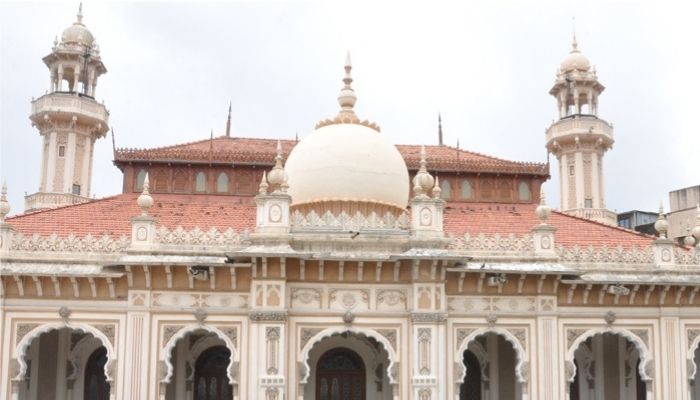
Juma Masjid in Mumbai invites ‘non-Muslims’ to know Muslims better but ‘only men allowed’. Here is why

In a new development, the Juma Masjid of Bombay Trust has invited non-Muslims for a meet and greet session at the masjid on Sunday (March 21) at 11 am in the morning.

A Twitter account named Indian Muslim history shared the invitation by the Juma Masjid on the social media site. “Humara Masjid mein aayiye, Humein samajhiye, humein jaaniye (Come to our mosque. Understand and learn about us),” read the invitation card.

It further emphasised, “An opportunity to meet, share and experience the values and culture of Indian Muslims. Please visit us to know and understand us better and experience our Masjids are all about.” Interestingly, the invitation is only addressed to non-Muslim men, as specified by the usage of ‘brothers’.

Questions are now being raised whether non-Muslim women have not been deliberately invited by the Juma Masjid of Bombay Trust. The entry of Muslim women, let alone non-Muslim women to mosques, have been the subject of controversy. In a statement by the All India Muslim Personal Law Board (AIMPLB) on January 29 last year, it claimed that Muslim women are allowed to offer ‘Namaz’ at mosques.

Muslim women allowed to pray at mosques, claims AIMPLB

AIMPLB had filed the response to a petition by one Yasmeen Zuber Ahmad Peerzade in the Supreme Court. The petitioner had sought the intervention of the apex court in the matter pertaining to entry of Muslim women to Masjids. Interestingly, AIMPLB emphasised, “A Muslim woman is free to enter Masjid for prayers. It is her option to exercise her right to avail such facilities as available for prayers in Masjid.”

But the question remains whether a Muslim woman can avail such facilities at all. President of the All India Muslim Women’s Personal Law Board, Shaista Ambar had asked, “If the Law Board is admitting that women are allowed to pray in mosques, then why isn’t it making any arrangements for women to do that?” She further added that Islamic clerics have always told women that they weren’t allowed entry in mosques.

Fatwas have called for ‘prohibition’ of Muslim women in Masjid

At the height of the Sabarimala debate, several Muslim men on social media had dismissed claims of Muslim women not being permitted entry in Masjids. This is despite the fact that several fatwas have been issued by Darul Uloom Deoband categorically stating that it is ”prohibited” for women to visit mosques and that such a ‘wrong practice must be stopped.’

While speaking to Opindia, a 21-year-old Muslim girl (on the condition of anonymity) said, “I was always told that I should stay home and pray and not go to mosque. Islam allows it. When a mosque is built, why can’t they make provisions of purdah for Muslim women? The fact that most mosques do not have such provisions show they intentionally don’t want us to enter Masjids.”

Given that the entry of Muslim women to most masjids are restricted, it is not difficult to understand why the invitation by Juma Masjid of Bombay Trust makes specific mention of ‘non-Muslim brothers.’