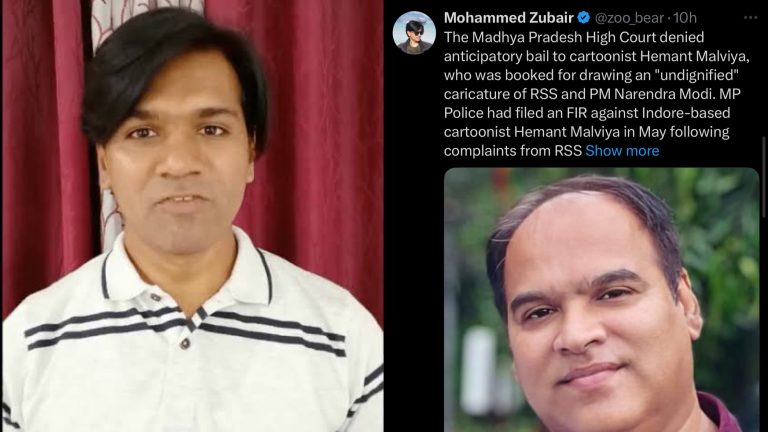
Earlier today, Alt News co-founder Mohammed Zubair, a self-styled crusader against “hate speech” and “blasphemy”, tweeted about the Madhya Pradesh High Court’s decision to deny anticipatory bail to Indore-based cartoonist Hemant Malviya. But true to his pattern of selective reporting and communal dog-whistling, Zubair once again chose distortion over disclosure.
His tweet painted a simplistic picture: that a cartoonist was denied bail merely for caricaturing the RSS and Prime Minister Narendra Modi. However, what Zubair conveniently left out and what the High Court explicitly acknowledged was the cartoonist’s demeaning reference to Lord Shiva. This omission was not accidental; it was deliberate, calculated, and consistent with Zubair’s long-standing modus operandi of peddling half-truths to provoke Islamist outrage while cloaking himself in the garb of a fact-checker.
The full story Zubair didn’t want you to see
In May, an FIR was registered against Hemant Malviya after complaints from an RSS worker and advocate Vijay Joshi. Malviya had drawn a caricature that not only mocked the RSS and Prime Minister Modi but also carried an endorsement of a vulgar, derogatory line invoking Lord Shiva, a clear affront to Hindu religious sentiments.
In its judgment, the Madhya Pradesh High Court made its position clear:
“In the considered opinion of this court, on the face of it, the conduct of the applicant in depicting the RSS, along with the Prime Minister of this country in the aforesaid caricature, coupled with his endorsement of a rather demeaning remark, dragging unnecessarily the name of Lord Shiva in the comments tagged to it, is nothing but the sheer misuse of the freedom of speech and expression… and falls under the definition of offence as contended by the complainant.”
Despite this judicial clarity, Zubair’s tweet omitted any mention of the Lord Shiva insult. Why? Because including it would dismantle the false narrative he wished to build, one of authoritarian overreach and persecution of dissenters. By presenting the case as a crackdown on criticism of the PM and RSS, Zubair attempted to inflame public sentiment and portray India’s judiciary as intolerant of political satire, when in fact the issue was one of religious slander.
From “fact-checker” to agenda-peddler
This isn’t a one-off case. Zubair’s track record is riddled with such half-truths and malicious framing. He infamously triggered the Sar Tan Se Juda (beheading) frenzy in 2022 by highlighting a snippet of BJP spokesperson Nupur Sharma’s debate comments that were drawn on directly from canonical Islamic texts regarding Prophet Muhammad’s marriage. Zubair posted the clip with suggestive commentary, unleashing a storm of Islamist threats and violence. The result? Nupur Sharma faced assassination threats, had to go underground, and India’s streets saw bloodshed in the name of “blasphemy.”
And yet, this same Zubair postures as a defender of free speech and civil liberties, so long as the speech in question attacks Hindu sentiments, not Islamic ones.
Hypocrisy at its peak
The contrast is telling. When Hindus voice concerns about being vilified, Zubair dismisses them as bigots. When Islamists threaten to behead someone over scriptural quotes, Zubair is silent or justifies the outrage as a reaction to “hurt sentiments.” He presents himself as a watchdog against hate, but his lens is deeply sectarian: he sees hate only when it suits his ideological narrative.
His tweet on the Hemant Malviya case is not just a dishonest omission. It is a continuation of a deeply dangerous playbook, one that seeks to radicalise one side by feeding it distorted grievances while mocking or silencing the concerns of the other.
‘Hate merchant’ masquerading as ‘fact-checker’
The Hemant Malviya episode reaffirms what many have come to suspect: that Mohammed Zubair is not an impartial fact-checker but a narrative mercenary. His platform is not about truth; it’s about weaponising selective truth to inflame communal tensions and undermine institutions.
By omitting the Lord Shiva reference, Zubair once again prioritised propaganda over principle. His brand of “fact-checking” is not journalism; it’s subversion in disguise.
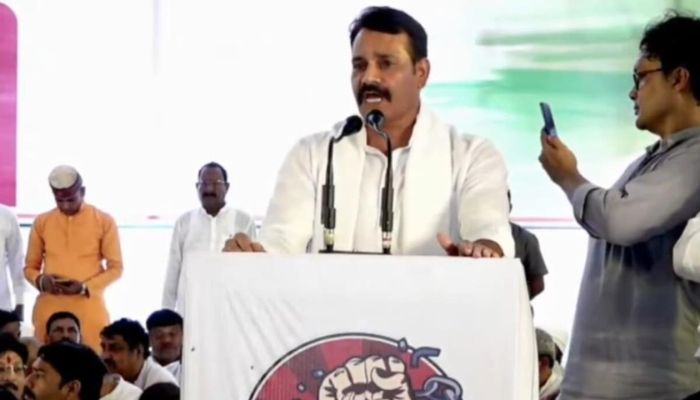
On Tuesday (8th July 2025), Congress MLA from Gwalior rural made outrageous remarks about those who Rashtriya Swayamsevak Sangh (RSS) while addressing crowd of party workers at a Nyay Satyagraha in Ashok Nagar. The Madhya Pradesh Congress leaders had gathered to court arrest in protest against the registration of FIR against the party’s state president Jeetu Patwari.
Congress MLA Sahab Singh Gurjar did not take any BJRSS leader’s name and took an indirect jibe, as he said, “Jo mard they wo jang mein gaye, jo hijde they wo sangh mein gaye [Those who were men went to the battlefield, those who were ‘Hijra’ (eunuchs) joined the Sangh. You understood, right? Just a hint is enough].”
Jo mard the vo jang me gye Jo hijde the vo sangh me gye.
Notably, the FIR against Jeetu Patwari was lodged on a complaint by one Gajraj Lodhi, who initially accused a BJP worker of assaulting him. However, he eventually retracted and alleged that Patwari misled him. Following this, an FIR was registered against the Congress leader. In response, the Congress party warned of protests if the FIR was not withdrawn by 7th July.
As the FIR was not withdrawn, several senior Congress leaders and workers gathered in Ashok Nagar for a ‘Nyay Satyagraha’ demonstration, however, Congress MLA Sahab Singh Gurjar ended up making an FIR-worthy statement against RSS leaders.
Sahab Singh Gurjar is often involved in controversies. Last year, he and several others were booked for allegedly assaulting women in Gwalior.
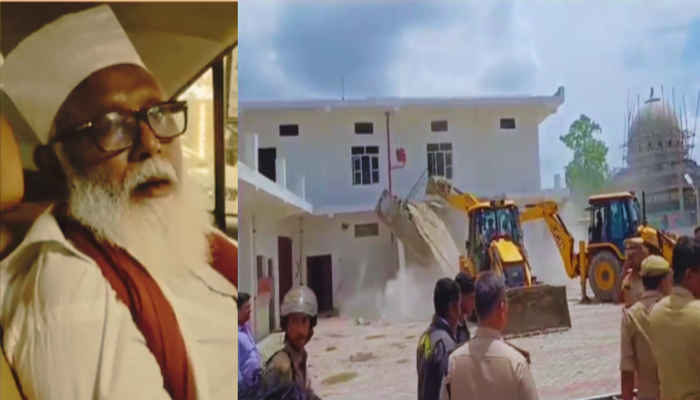
Uttar Pradesh Chief Minister Yogi Adityanath has assured that the state government will take stringent action against Jalaluddin alias Chhangur Baba, who was arrested on 5th July for running an Islamic conversion racket targeting particularly young Hindu girls.
“The Uttar Pradesh government will not tolerate any laxity in matters of law and order. The properties of the accused and all criminals associated with his gang will be confiscated, and strict legal action will be taken against them,” the CM wrote on X.
हमारी सरकार बहन-बेटियों की गरिमा और सुरक्षा के प्रति पूर्णतः प्रतिबद्ध है। प्रारंभिक जांच में सामने आया है कि आरोपी जलालउद्दीन की गतिविधियां समाज विरोधी ही नहीं, बल्कि राष्ट्र विरोधी भी हैं।
उत्तर प्रदेश सरकार कानून व्यवस्था को लेकर किसी प्रकार की ढिलाई नहीं बरतेगी। आरोपी और…
CM Yogi said that Chhangur Baba will be given an exemplary punishment as per the law. “There is no place in the state for those who disrupt peace, harmony, and the safety of women. They will be punished in accordance with the law in a manner that serves as an example for society,” he said.
Chhangur Baba’s lavish bungalow demolished
Meanwhile, intensifying action against Chhangur Baba, the authorities demolished his lavish bungalow located in the Madhupur village in the Balrampur, Uttar Pradesh, on Tuesday (8th July) morning. The demolition was carried out in the presence of the SDM and CO. The bungalow was an illegal construction. An eviction notice was put up on the gate of the residence on Monday (7th July). Inspector-in-charge Awadhesh Raj Singh said that security was ramped up in the area to avoid any untoward situation. However, the authorities faced opposition from the people living in the bungalow. Chhangur’s daughter-in-law, Sabira, created a ruckus before the demolition, alleging that her children were scared. Three notices, in total, were served by authorities before bolldozing the house.
अवैध धर्मांतरण का सिंडिकेट चलाने वाला छांगुर बाबा बलरामपुर के उतरौला में जिस घर में रहता रहा, वह घर किसी किले से काम नहीं! करीब तीन बीघे में फैले बाबा के घर में क्या-क्या हैं इंतजाम और कैसे होती है सुरक्षा? देखिए रिपोर्ट#ConversionMafia#ReporterDiary (@aap_ka_santosh) pic.twitter.com/a9cEfhb49G
The bungalow was built on a plot of land spanning 3 bighas. The land was registered in the name of Neetu Rohra. Chhangur Baba and his family lived in the bungalow along with Neetu Rohra, her husband, Naveen Rohra and daughter.
An active network in the UAE
Uttar Pradesh ATS is investigating the foreign funding network of Chhangur Baba’s conversion racket. Neetu Rohra, who shared the bungalow with Chhangur Baba, reportedly visited the United Aran Emirates (UAE) 19 times between 2014 and 2019. The agency is looking into the reasons for her trips to the UAE.
The ATS investigation revealed that the religious conversion of Neetu Ruhra, Naveen Rohra and their daughter was at Al Farooq Qamar Bin Khatab Centre, Dubai and was certified by the Islamic Affairs and Charitable Activities Department of Dubai Government on November 16, 2015. However, after examining their passports, the ATS found that they were not in Dubai on the said date.
Chhagur Baba set up fake businesses to whitewash foreing funds
Investigation by the ATS has further revealed that Chhangur Baba was running the conversion racket in a highly organised manner. He set up fake trusts and businesses, namely Aasvi Enterprises, Aasvi Charitable Trust, Aasipia Hasni Hussaini Collection, and Baba Tajuddin Aasvi Boutique, to facilitate the reception of foreign funds. Eight accounts linked to these businesses were opened in 2 banks.
Jalaluddin alias Chhangur Baba reportedly deposited Rs 6 lakh from one of his bank accounts into a foreign account. He also transferred Rs 10 lakh through NEFT. Authorities also uncovered suspicious financial transactions from the bank accounts of his associates. He was being assisted by a person named Idul Islam, from Pune, in spreading his conversion racket. In addition to that, he has been purchasing land and setting up bases in different states to operate his conversion racket from there.
According to the STF that led the initial probe against Chhangur Baba, he owns properties worth crores in Pune. He bought a property worth 16 crore in Lonavala, registered in the name of his associate Mohammad Ahmed Khan.
UP Women’s Commision demands death penalty for Chhangur Baba
Expressing outrage against Chhangur Baba and his religious conversion network, the Uttar Pradesh State Women’s Commission has demanded stringent action against him. Commission Chairperson Babita Chauhan said that Chhangur Baba should be awarded the death penalty. “CM Yogi Adityanath has made a strict law against religious conversion. Now it is the responsibility of society not to remain silent and raise its voice on this issue. Death penalty should be the only punishment for those who force daughters to change their religion through lies, greed and deceit,” she said.
“Our daughters are not a laboratory where the poisonous idea of conversion can be tested. Those who deceive our daughters and take away their religion are enemies of society. Such people should be hanged,” she added.
Similar pattern in Chhangur Baba’s conversion racket and Beawar Muslim Gang
Jalaluddin, originally from the Rehra Maafi village in the Balrampur district, used to sell rings. His fortune turned when he successfully contested the Panchayat elections in 2015 and became the village headman. His influence grew and he then introduced his son Mehboob into politics and made him contest 2022 Panchayat elections. But he lost despite spending huge amounts of money in the election.
However, he amassed massive wealth by operating the conversion racket, and has bought properties worth crores, built showrooms and bungalows and purchased luxury cars using foreign funding.Chhangur Baba’s Islamic conversion racket busted by Uttar Pradesh ATS, involves around 100 crores of foreign funding which was funnelled into 40 accounts.
The money for Chhangur Baba’s Islamic conversion racket was flowing in from the Gulf countries to implement what looks like a long-term Islamisation project. Chhangur Baba used to give money to Muslim men to lure young Hindu women and convert them to Islam. He used to perform the Nikaah of these Muslim with the Hindu girls they lured and converted. Jalaluddin had fixed incentives for converting Hindu girls based on their caste. He fixed ₹15-16 lakh was fixed for conversions of Brahmin, Sikh or Kshatriya woman, ₹10-12 lakhs for OBCs and ₹8-10 lakhs for other castes. This is strikingly similar to the pattern that emerged in the Beawar Muslim gang, where Muslim men targeted school-going Hindu girls, sexually exploited them and forced them to convert to Islam. They had fixed rates for Hindu girls based on their caste.
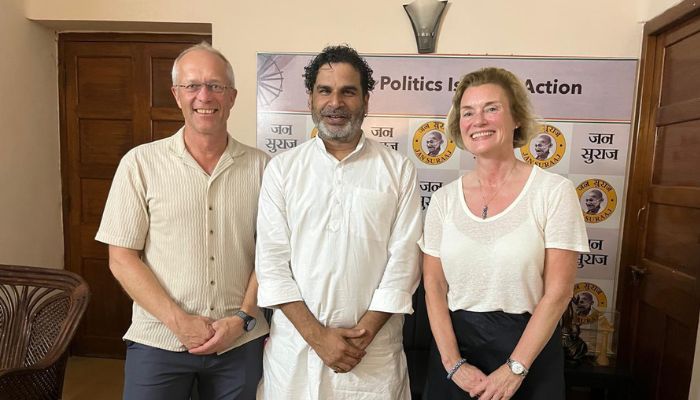
In a discreet meeting, that has drawn public attention, Norway’s Ambassador to India, May-Elin Stener, met with political strategist turned politician Prashant Kishor on Monday, July 8. On the surface, it might appear as routine diplomatic engagement. But when examined against Norway’s documented history as a soft-power regime change operator and Kishor’s ambitious plans for Bihar, this meeting demands some scrutiny.
Norway: The ‘benevolent’ meddler with a troubled past
Norway projects an image of progressive neutrality and humanitarian virtue. Yet, its foreign policy machinery has repeatedly engaged in destabilizing sovereign nations under the guise of democracy promotion. The prime examples are Libya, Ethiopia, Syria, Sri Lanka, Colombia and many more.
• Libya: A Case Study in Reckless Intervention Norwegian officials themselves admitted they had “very limited knowledge” of Libya before joining the 2011 NATO bombing campaign that toppled Muammar Gaddafi. Norway flew 596 strike missions, dropping 588 bombs. The result? A failed state consumed by terrorism, slave markets, and chaos, a catastrophe Norway now admits was “not a decision to be proud of”. This was regime change sold on false humanitarian pretexts, including debunked propaganda about “Viagra-fueled mass rape” promoted by Western officials.
• The Deep State Machinery Norway’s foreign adventures are not accidental. They are facilitated by a well-documented “deep state” (Maktnorge) centred in Oslo, with historic ties to NATO, US intelligence, and covert networks like Operation Gladio. This apparatus, rebooted after WWII with CIA support, treats Norway as a “vassal state” of the Atlantic alliance. Per capita, Norway is the world’s largest arms exporter and has participated in more recent wars than all but the US and Israel.
• Oil Wealth as a Weapon Norway’s $1.4 trillion sovereign oil fund – built on record “war profits” from Europe’s energy crisis following Russia’s invasion of Ukraine – funds its global ambitions. The fund owns 1.5% of global stocks and has financed initiatives tied to the Clinton Foundation, Bill Gates’ projects, and NATO-aligned regime change efforts. Economists are now urging Norway to tap this fund to directly finance Ukraine’s war effort, proving its use as a geopolitical tool.
Why Norway? Why Bihar? The covert convergence
Norway’s engagement in Bihar reflects a broader and disturbing pattern of strategic overreach, where ethical guises often mask deeper geopolitical ambitions. Historically, Norway has funded dissent under the banner of noble causes, as seen in 2021 when it indirectly supported Greenpeace’s lawsuit against its own government over Arctic oil drilling.
While domestically contested, this move bolstered Norway’s “climate leader” image globally, even as its state-owned energy giant Equinor continues expanding fossil fuel operations worldwide. In Bihar, backing strategists like Prashant Kishor allows Norway to position itself as an informal kingmaker, potentially destabilizing India’s federal dynamics under the pretext of promoting governance or environmental goals.
Simultaneously, Norway pursues “energy imperialism” through Equinor, which has aggressively sought new global markets. Bihar, rich in untapped minerals and bordering energy-deficient eastern states, represents a strategic prize.
A Pattern of subversion: Kashmir and beyond
Norway’s involvement in the region is not merely theoretical. Norwegian diplomats have previously attempted to mediate in Kashmir, presenting themselves as “neutral” facilitators. India promptly expelled them, recognizing the potential threat to its sovereignty. Their re-emergence in the region, in Bihar, a state that borders Nepal and has intricate security dynamics indicates a recalibrated strategy.
Norway funds numerous Indian NGOs under humanitarian banners. These networks could easily be activated to bolster Kishor’s grassroots image while embedding Oslo’s influence. Recall how Norway relied on “media and other countries” for regime change intelligence in Libya – a tactic transferable to Bihar.
The deep state’s toolkit
Norway’s approach to international engagement follows a consistent, some might say cynical, pattern. They start by identifying regions already labelled as “failed” or unstable – places like Libya, Ethiopia, Colombia or Bihar, India. Once a target zone is selected, they deploy the immense financial resources of their sovereign oil wealth, channeled through NGOs, foreign aid programs, or direct political financing. To gain local traction.
They actively seek out and co-opt ambitious regional leaders or power brokers hungry for international recognition and support – figures like political strategist Prashant Kishor. Crucially, they meticulously frame these interventions not as strategic meddling, but as virtuous efforts promoting democracy or humanitarian relief. This calculated strategy was starkly revealed by former Norwegian Prime Minister Jens Stoltenberg (now NATO Secretary-General) regarding Libya: “Norway joined the attack on Libya because ‘it will make good practice for the Norwegian Air Force’.” This quote lays bare the realpolitik often masked by virtuous rhetoric
India’s sovereignty at stake: A call for vigilance
This meeting is not mere diplomacy. It echoes hybrid warfare tactics, using seemingly benign institutions (embassies, pension funds) to destabilize targeted nations. India must audit all NGOs and “research initiatives” for Norwegian ties. Norway drills Arctic oil while lecturing India on climate. Its wealth stems from the very fossil fuels it now “ethically” divests from . The Intelligence Bureau (IB) must monitor foreign embassies’ engagements with regional leaders, especially before elections.
Norway’s ambassador meet Kishor dispite his irrelevance, He is a local leader, desperate for resources and validation, is the perfect vector for a petrostate posing as a philanthropist. Bihar’s future must be decided by Biharis—not by a trillion-dollar sovereign fund exploiting India’s democratic fissures. The shadows of Kashmir and Ukraine remind us: where Norway’s oil wealth flows, sovereignty often bleeds.
On 28th June, state-level Kabaddi player Brajesh Solanki died of rabies. He was bit by a puppy in May last week and ignored the bite as a sratch. He did not recieve post-exposure vaccine and started showing symptoms in the last week of June. On 6th July, a 60-year-old woman was mauled by two rottweilers at around 4:10 AM when she was going to the temple for morning ritual. In January 2025, a five-year-old girl, Samreen Kouser, was killed by a pack of dogs in Jammu and Kashmir. Not only stray dogs, but pet dogs, especially of aggressive breeds, have become a major threat in India. Such tragedies and millions of bite cases have been fuelling public panic.
According to official data, there were over 30 lakh cases of dog bites in 2023, whereas in 2022, 20.1 lakh cases were reported. The number rose again in 2024 with around 37 lakh dog bite cases reported across the country. In January 2025 alone, there were 4.29 lakh cases of dog bites in India. Is almost 40 lakh dog bite cases something to brush off under the rug just because animal lovers want every Indian to “share” resources with dogs?
According to a survey, around 80% of people have either faced or know someone who has faced a dog attack. While the number of rabies deaths reported officially by India every year is in hundreds, according to the World Health Organisation (WHO), the number of rabies deaths in India can be estimated between 18,000 and 20,000. WHO says that 36% of the overall deaths caused by rabies across the world happen in India.
The fear and anxiety caused by the increasing number of aggressive stray dogs who move and hunt in packs is growing. Notably, there are nations that have “cracked the code” on canine rabies. Countries like Mexico, Sri Lanka, and others have eliminated dog-mediated rabies. The question is, why has India lagged behind?
In this article, we will focus on eliminating the number of deaths by rabies.
Global Models – Success Stories Abroad
Mexico eliminated dog-mediated rabies in 2005
Mexico is the first country validated by WHO to eliminate human rabies from dogs. According to recent reports, there are around 15–20 million dogs in Mexico against a human population of 130 million. Though it reports around 1,00,000 cases of dog bites every year, the number of deaths by rabies mediated by dogs is virtually zero. Not to forget, there are almost 19 million dogs in Mexico.
Mexico runs a national “One Health” strategy with free mass dog vaccination and compulsory annual boosters since the 1990s. It has achieved 80% coverage in such campaigns. Continuous surveillance and public awareness have complemented the effort. In 1990, there were 60 cases of rabies deaths in Mexico, which has remained zero since 2006. In 2019, Mexico received WHO validation for “eliminating dog-transmitted human rabies” as a public health problem.
However, uncontrolled breeding and rising population of stray dogs due to abandonment is a major issue in Mexico as well. Despite the high number of dogs, death by rabies is negligible.
Massive vaccination programme in Sri Lanka
In the early 2010s, Sri Lanka set an ambitious goal of zero human rabies by 2020. Under a government-led One Health programme, it provides free rabies post-exposure prophylaxis at all government hospitals. Furthermore, the government has enforced strict dog vaccination and neutering rules. In 2015, there were 24 human rabies cases caused by dog bites, which fell to 5 in 2016. Sri Lanka also scaled up dog vaccinations. In 1990, the number of dogs vaccinated was around 4,00,000, which rose to 1.5 million dogs in 2015. Notably, there are around six million dogs in Sri Lanka.
While Sri Lanka reports around 3,00,000 dog bite cases every year, the number of deaths by rabies mediated by dogs is comparatively less. Around 20 people succumbed to death by rabies in 2024, out of which 11 were attributed to dog bites, one to a golden palm civet bite, and 8 cases were non-conclusive about the source.
Notably, there are around six million dogs in Sri Lanka. A large number of them are “semi-owned”, meaning they are community dogs that live in schools, temples, hospital premises, markets, and other public places. The government has made it mandatory that all dogs should get rabies vaccination within 4–6 weeks of birth. Furthermore, an annual booster dose is also mandatory. According to government data, the number of rabies deaths has been between 25–30 every year for the past few years.
Not to forget, Sri Lanka was the first country in South-East Asia to draft a national “Zero Rabies” strategy. WHO says that Sri Lanka is on its path to eliminate dog-mediated rabies by 2026, much before the global target of 2030.
Thailand leads the way
In 1992, Thailand passed the Rabies Prevention Act which mandates annual vaccination of all dogs. In the 1990s, only 20% of dogs were regularly vaccinated in the country, and the number of deaths by dog-mediated rabies in humans was in hundreds. Continued campaigns and public education, however, changed things drastically, and in 1995, only 74 such deaths were reported. In 2020, only 3 deaths by rabies were reported in Thailand.
There are around 8 to 12 million dogs in Thailand. The country operates regular mass vaccination drives and sterilisation schemes targeting 70% coverage. It also has intradermal PEP training nationwide. While reports suggest there are around 10 rabies deaths every year in Thailand, the numbers are steadily declining through rigorous control measures.
India’s NAPRE Plan
In 2021, India launched the National Action Plan for Dog-Mediated Rabies Elimination (NAPRE) program and in 2023, GoI launched National Rabies Control Programme (NRCP) for prevention and control of Rabies. Under NAPRE, which is led by the National Centre for Disease Control under the Ministry of Health and the Department of Animal Husbandry, India adopted a One Health approach, that is, coordinating the animal, human and municipal sectors.
The goal is zero human rabies by 2030, which is the global target set by WHO. The plan sets ambitious targets such as reducing dog bites by 50% by the end of 2025 and achieving 70% vaccination coverage of dogs. The programme emphasises mass dog vaccination, dog birth control through sterilisation, timely human post-exposure vaccination, improved waste management, and public awareness.
NCDC and partners have rolled out supporting systems. Each state now drafts a State Action Plan for Rabies Elimination (SAPRE) under NAPRE according to local needs. In March 2023, the Union government notified the Animal Birth Control (ABC) Rules 2023, which tightened standards for humane capture and sterilisation, vet qualifications, and monitoring of dog clinics.
While the expanded helpline 15400 is live and provides bite victims instant guidance on PEP, the national rabies dashboard which was announced is yet to go live.
According to reports, India has achieved a 75% reduction in rabies deaths in recent years. Millions of dogs are vaccinated every year. However, exact coverage is still improving.
Challenges in India
While the government is making efforts to control the dog population and deaths by rabies, there are well-documented gaps. First of all, there is a huge disparity between the dog population and the sterilisation and vaccination coverage. For example, in Amritsar, there are reportedly 50,000 stray dogs. However, in a five-year period, only 9,250 were sterilised. According to experts, unless 70% of dogs are neutered in an area, the population of stray dogs cannot be curbed in the long run. India is far from achieving the target. Furthermore, many ABC clinics are irregular. Catch-neuter-return drives stall without enough transport and kennels.
Another issue is the lack of manpower and infrastructure deficits. India has too few trained dog-catchers, vets and kennels. For example, in Tiruchirapalli, there are 10,000 stray dogs. Thirteen municipal kennels with a capacity of 150 dogs per month could only sterilise 496 of them in five months. The campaign lapsed when skilled catchers could not be found. Many towns report abandoned sterilisation drives once contracts expire.
Furthermore, there is massive legal pressure. Courts remain divided on solutions. In July 2024, the Supreme Court of India declined to entertain new PILs on stray dogs and directed petitioners to seek relief under the ABC Rules via state High Courts. The apex court reaffirmed that the ABC Rules 2023 now govern stray dog issues. Several state High Courts have ruled against those who want the stray dogs to be removed from their locality. In some cases, RWAs have been penalised on the complaints of animal lovers when they tried to establish feed areas away from parks etc. or tried to get the rabid dogs picked up by the municipal corporation.
There is poor inter-sectoral coordination. To control dog-mediated rabies deaths, there must be smooth coordination between the animal husbandry, public health, urban sanitation and police departments. However, these departments work in silos. Lines of accountability and data-sharing remain unclear.
Stray dogs often enjoy sympathy from dog lovers and animal welfare organisations. Feeding and caring for them have become another massive issue, where dog lovers walk with bags of dog food and give stray dogs food without considering the consequences of their actions in the locality. Dogs form packs and become a life-threatening issue for the locals. Notably, this popular support can stall sterilisation or relocation efforts. These dog feeders often do not care about sterilisation and resist any removal or “culling” of even rabid dogs. Courts have even suggested that people who feed strays be marked and held responsible for vaccinating “their” dogs.
In many cases, it has been seen that the Animal Welfare Board of India and local police threaten local communities if they try to get rid of rabid stray dogs. Many local leaders hesitate to act against notorious dog-feeding groups for fear of upsetting voters.
Currently, there is little enforcement against leaving out food waste or turning a blind eye to unvaccinated packs. Even the Supreme Court only suggested feeders could be held liable for attack victims’ costs. In practice, nobody is fined for sustaining stray colonies, nor for failing to manage garbage that feeds them.
Open garbage and street food waste make India’s cities a buffet for strays. Unless waste management is improved and feeding regulated, neutered dogs will simply be replaced by hungry newcomers, frustrating any control campaign.
India, while equipped with a well-structured plan on paper, still lags far behind these nations in actual implementation. It has the rules, the intent, and the resources, but until coverage, enforcement, public engagement, and surveillance improve to match global standards, the stray dog crisis and rabies threat will persist.
What India must do
India needs to treat rabies as the public health emergency it is. This requires high-level focus on par with other national disease campaigns. There must be fully funded, government-controlled sterilisation and vaccination campaigns. Outsourcing it to NGOs and animal welfare groups is not working.
There has to be enforced accountability and transparency. All sterilisation and vaccination drives must be reported and recorded in real time by the central government. India also needs a transparent dashboard of surgeries done and vaccines used. All reports must be made public in real time, and proper audits must happen to prevent “paper clinics” and inflated numbers.
Anyone and everyone who feeds stray dogs must be held responsible if any incident happens. They must face penalties or jail time if they fail to sterilise the dogs they feed and report rabid dogs for removal. Anyone coming in the way of the removal of rabid stray dogs, especially those that walk and hunt in packs, must be dealt with strictly, with fines and jail time. Furthermore, abandoning a dog or wilfully dumping garbage should be punishable.
Conclusion
India has enough financial resources. What lacks is veterinary expertise, institutional framework and the willingness to work to eliminate dog-mediated rabies. India has done it for polio, smallpox and other diseases, and it can do it for rabies as well. Sustainable political, bureaucratic, judicial and administrative will is what India needs to eliminate rabies. India needed decisive action yesterday, not tomorrow. It is time to act and not think about vote banks. The lives of thousands of citizens are on the line, and the government must act, fast.
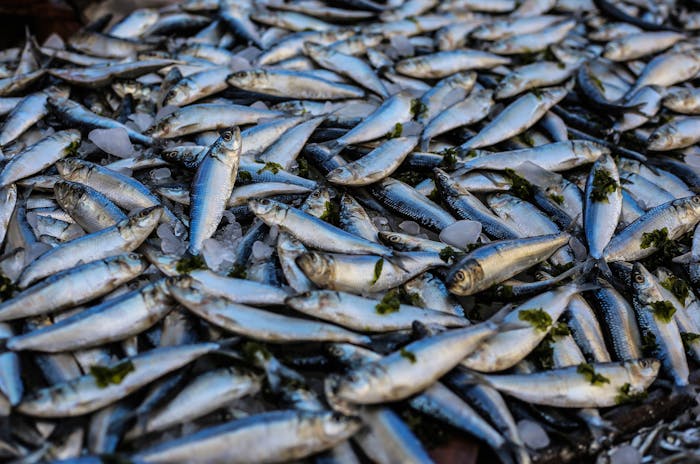
From depending on other states for fisheries to becoming a self-sufficient state, Assam has truly transformed in its fisheries production, marking a significant milestone in agricultural sustainability and rural empowerment.
Until a decade ago, the state used to rely on other states like Andhra Pradesh and West Bengal to meet the requirement of its fish demand. The state was producing only around 2.9 lakh metric tonnes (MT) while the annual requirement was nearly 4 lakh MT. However, with the help of technological interventions, government schemes, and community participation, it has helped to bridge the gap.
The Chief Minister of Assam, Himanta Biswa Sarma, posted on X, showing that the revolution in the state has taken place. It says, “Gone are the days when the State was completely dependent on the import of fish from other States for domestic consumption. Through targeted initiatives like fish seed distribution and training, Majuli is strengthening indigenous youths to be Atma nirbhar and lead the fishery revolution of Assam.”
Gone are the days when the State was completely dependent on import of fishes from other States for domestic consumption.
Through targeted initiatives like fish seed distribution and training, Majuli is strengthening indigenous youths to be Atmanirbhar and lead the fishery… pic.twitter.com/I3IUXIGT85
— Himanta Biswa Sarma (@himantabiswa) July 7, 2025
Majuli, the largest river island situated in Assam, is moving towards self-reliance through the production of quality fish. For a long time, it has been a perception that people don’t know how to produce quality fish seed. But it was soon discovered that only a few people have the skill for quality fish seed production. Not the unscrupulous worker, but now the local farmers will take up the opportunity. With training provided to 220 fish farmers, producing Rs. 8 crore worth of high-quality fish spawn. Majuli is not only capturing but also supplying to other districts as well. On July 15, 1 crore fish spawn is scheduled to be dispatched to Dhemaji. Majuli has launched a new wave of fishery revolution. Now the market belongs to the people of the land.
The chief minister has also announced the launch of a major initiative aimed at rejuvenating 129 beels, a wetland across the state. The estimated budget for this is approximately Rs 800 crore. To improve water management and enhance fish production in the state’s crucial ecosystems, the Sustainable Wetland and Integrated Fisheries Transformation (SWIFT) project, in partnership with the Asian Development Bank, is designed.
The project will restore nearly 4,000 hectares of Beel fisheries, which are significant for controlling floods, replenishment of groundwater, and regulation of river flow. These wetlands will also serve as a key reservoir for fishery resources, contributing significantly to the state’s hydrological balance. “Beels are the backbone of Assam’s water resources,” the CM said. “This initiative will not only rejuvenate these ecosystems but will also significantly boost the production of indigenous fish species, essential for both the local economy and food security.”
With the help of the project, it is expected to increase fish production by 1,200 kg per hectare annually, delivering a substantial economic benefit to communities that rely on these fisheries. This will also emphasize sustainable management practices to conserve indigenous fish species, contributing to Assam’s environmental sustainability goals.
Recently, Assam governor Lakshman Prasad emphasised the rich potential of Assam fisheries at a conclave organised in May. The event marked a milestone in Assam’s ongoing efforts to boost its fisheries. Assam’s chief secretary, Ravi Kota, wrote on X that the state’s fisheries sector has made impressive strides in recent years. Kota has identified six priority areas to elevate Assam’s position in the sector, like- Transition from self-sufficiency to export excellence, Expansion of scientific clusters, Promotion of entrepreneurship, Improved financial access for fish farmers, Quality assurance, certification and traceability, Integrated supply chains.
India has recently ranked as the second largest aquaculture producer globally, third in overall fish production. It stands fourth in global fish exports. Assam has made itself the fourth-ranked inland state nationally, producing 4.99 lakh MT of fish in 2023-24.
Following Union Home Minister Amit Shah’s directive two years ago for all northeastern states to become self-sufficient in egg, milk, and fish production, Assam has achieved self-sufficiency in fisheries. The state’s fisheries development strategy aligns with Prime Minister Narendra Modi’s Pradhan Mantri Matsya Sampada Yojana. This led to Assam positioning itself to become a model state in inland fisheries production.
The fisheries boom has not only improved nutritional security within the state but also generated thousands of jobs across allied sectors like transport, packaging, and retail. Fish prices have stabilized, and the income of fish farmers has seen a marked rise.
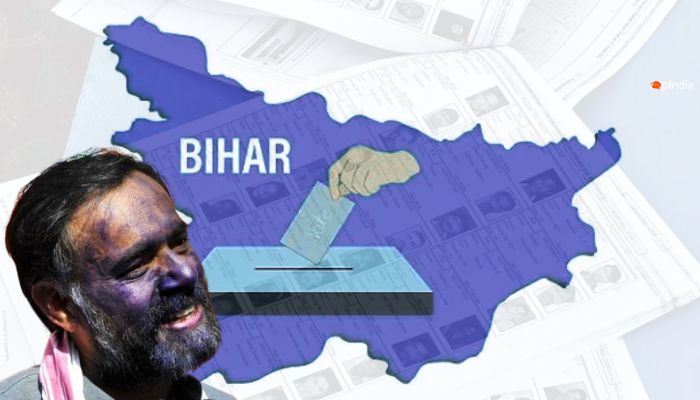
Conspiracy theories, lies and mudslinging dominate the political discourse of the anti-BJP parties whenever there are elections in any part of the country. While the political war of words over the imaginary irregularities alleged by the Congress party during Maharashtra elections has yet to water down, the pro-congress ecosystem has floated a fallacious narrative regarding the Special Intensive Revision (SIR) of electoral rolls being conducted in poll-bound Bihar.
Yogendra Yadav, the ichhadhari protestor-psephologist-politician-psephologist, has filed a petition in the Supreme Court seeking a stay on the ongoing SIR in Bihar calling the review process ‘arbitrary’. Salim aka Yogendra Yadav contends that conducting a de novo revision of the electoral rolls just months before the state elections is unjustified and could disenfranchise ‘vulnerable’ sections of the population.
The PIL emphasises how marginalised groups, including women, Scheduled Castes and Scheduled Tribes (SC/STs), and migrants—many of whom lack legal documentation—may be disproportionately affected by the Special Intensive Revision drive.
“The 90-day verification window, overlapping with Bihar’s monsoon season, is also criticised as impractical given the fact that a large number of these sections of people lack birth certificates, land documents, or other mandated identity proofs,” Yogendra Yadav’s plea states.
Interestingly, the Omidyar-funded NGO, the Association of Democratic Reforms (ADR), had earlier filed a similar plea before the Supreme Court calling the ECI’s order regarding SIR ‘arbitrary’ and claiming that “millions of voters could be deprived of their right to vote”.
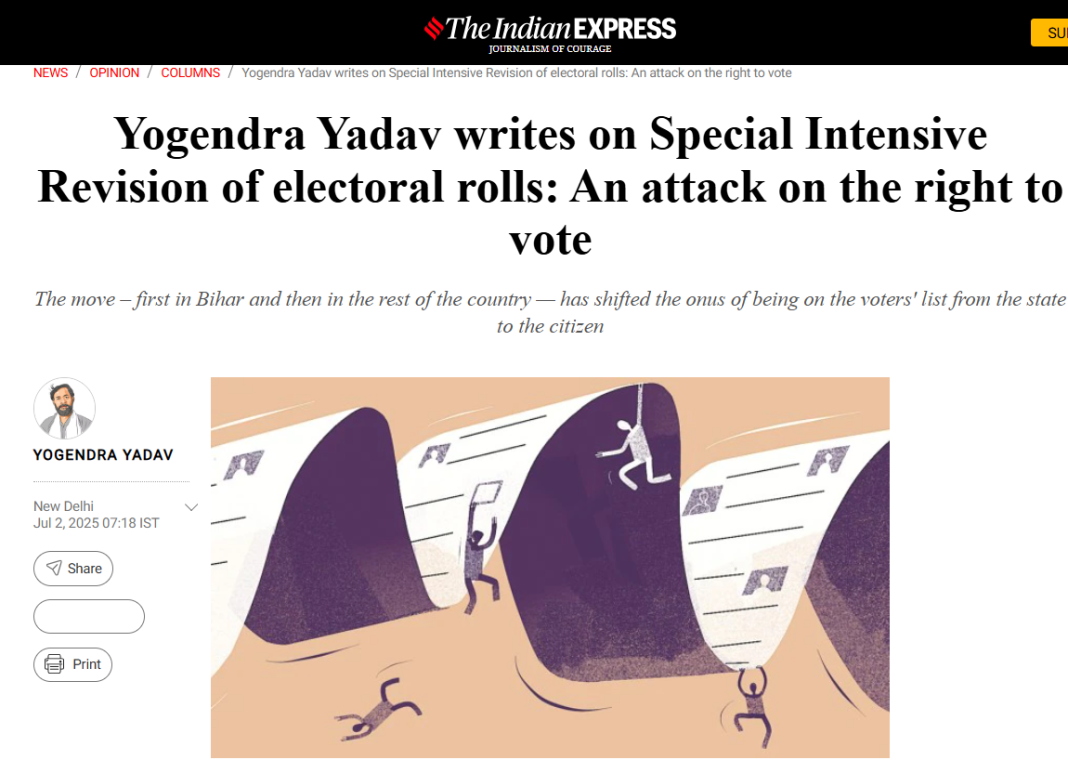
In addition to filing a PIL in the Supreme Court, the Duggal Sahab of political activism, Yogendra Yadav, also wrote an opinion piece in The Indian Express on the 2nd of July, 2025, in which he argued that reviewing electoral rolls would be an attack on the right to vote to insinuate that the SIR exercise is being carried out to disenfranchise a specific section of voters before the assembly elections in Bihar.
Yadav equated the Special Intensive Review to a backdoor National Register of Citizens (NRC). Not to forget, the Islamo-leftists including Yogendra Yadav have long been peddling falsehoods that NRC is the Modi government’s tool to strip Indian Muslims of their citizenship.
Social activist Yogendra Yadav @_YogendraYadav approaches Supreme Court challenging Election Commission of India’s “Special Intensive Revision” of electoral rolls In Bihar.
He says de novo revision of rolls a few months before State elections is arbitrary.… pic.twitter.com/7dMXtHMpEc
Recently, Yadav claimed that while ECI argues that an SIR in Bihar will help weed out illegal Bangladeshi and Rohingya infiltrators from the voter list, it will also remove over 2.5 crore Indian citizens from the electoral roll.
“If there are illegal foreign citizens in Bihar, they are primarily people from Nepal — most of whom are Hindus. This process could remove a few thousand Bangladeshi and tens of thousands of Nepali citizens’ names, but at the same time, there is a risk of approximately 2.5 crore Indian citizens’ names being removed as well. You don’t swing a hammer at your nose to kill a fly,” Yadav said.
However, the Election Commission of India fact-checked Yadav’s claims calling them “baseless and misleading”. The ECI stated that no eligible Indian citizen shall be left out and by the 7th of July 2025, over 2.88 crore people have already submitted their Enumeration Form.
— Election Commission of India (@ECISVEEP) July 7, 2025
Before this, the ECI fact-checked Congress leader Supriya Srinate’s claim that the right to vote is left to the decision of the Electoral Registration Officer (ERO) as “misleading”. The ECI said that while the last date for submitting the filled enumeration form is 25th July, the documents can be submitted during the Claims and Objections Period.
Moreover, while the ERO is the deciding authority, an appeal can be made against the ERO’s order. Thus, there is no question of any foul play in the SIR process to deliberately remove any specific section of people from the electoral roll.
— Election Commission of India (@ECISVEEP) July 7, 2025
Interestingly, on 8th July, Yogendra Yadav disputed the ECI’s fact-check against his misleading post and challenged the commission to make the list of 2.88 crore voters who have filed their enumeration form, public.
“Here is an open challenge to the @ECISVEEP Will you allow me to fact check the claim (that over 36% of electors had submitted filled Enumeration Forms by 7 July) that you have made in this “Fact check”? I challenge you to make public the list of these names. Besides, you cannot refute my apprehension (of 2.5 cr people being disenfranchised) by citing a principle in EC’s order. My point is that the EC’s order flies in the face of that principle. You cannot refute it by stating any figure of how many have filled the form. That’s besides the point. The issue I raise is whether they have or can fulfiled the documentary requirement set by the ECI order. My apprehension is based on official statistics about the coverage of the 11 certificates demanded by the ECI. Provide counter-evidence, if you have any. Or appoint a new fact checker,” Yadav posted on X.
Here is an open challenge to the @ECISVEEP Will you allow me to fact check the claim (that over 36% of electors had submitted filled Enumeration Forms by 7 July) that you have made in this “Fact check”? I challenge you to make public the list of these names. Besides, you… pic.twitter.com/Jmxw611ruC
Apparently, Yogendra Yadav wants the ECI to make names of crores of voters who have submitted their enumeration form public randomly just to make Yogendra Yadav overcome his apprehension. Also, the protestor for hire should answer how can the ECI release the list of names of voters even before completing the verification process.
What is Special Intensive Review and why is the Election Commission undertaking it in Bihar?
Yogendra Yadav and the opposition parties in Bihar, including Congress and Rashtriya Janata Dal (RJD), have dubbed the SIR as a diabolical attempt at ‘votebandi’ (mass disenfranchisement) to target anti-BJP voters, essentially Muslims. This, however, is yet another disgraceful attempt of the opposition and its extended ecosystem to cast aspersions on the integrity of the Election Commission even as the EVM hacking, VVPAT tampering, and additional votes lies to assert that the BJP is misusing the electoral system for its benefit with the connivance of the ECI.
Notably, the last comprehensive SIR in Bihar was conducted in 2003. Contrary to the ‘votebandi’ assertions by the opposition, the SIR is being carried out to address issues like rapid urbanisation, unreported deaths, new voters, the potential inclusion of ineligible foreign nationals, particularly, Rohingya and Bangladeshi infiltrators. These are standard administrative rationales for electoral roll revisions, it does not mean that the ECI is acting with partisan malice.
The SIR is not a de novo exercise scrapping the entire voter list as claimed by Yogendra Yadav. In fact, it is but a revision to verify and update existing rolls. While the opposition is projecting the special review as some sort of deliberate exclusionary purge being carried out in haste ahead of the elections, it is a robust process involving booth-level officers conducting door-to-door verification, assisting voters with form submissions, and taking live photographs to ensure transparency.
The Election Commission started the verification process on 25 June 2025 and it will continue till 26th July. After the exercise is over, a revised and correct voter list will be published on 30th September. As part of the verification process, Booth Level Officers (BLO) are visiting all houses across the constituencies. They carry the forms, which they hand over to the people and ask people to fill in their details, such as names, and addresses and attach some documents. These documents are needed to ensure that the person is eligible to vote.
If a voter’s name is on the voter list of 2003 (when the verification process was last carried out in Bihar), then he or she just has to confirm his/her information. If their parents’ names are on the list, then no additional documents are needed. However, if their parents’ names are not on the old list, then they need to provide some documents, like a birth certificate or any other relevant document.
The ECI has listed 11 admissible documents: Any Identity card/pension Payment Order issued to regular employee/ pensioner of any Central Govt/State Govt/PSU, Any Identity Card/Certificate/Document issued in India by Government/Local Authorities/Banks/ Post Office/LIC/PSU prior to 01.07.1987, Birth Certificate issued by the competent authority, passport, matriculation/ education certificate issued by recognised boards, Permanent Residence certificate issued by competent State Authority, Caste certificate, Forest Right Certificate, NRC (not applicable in Bihar), Family Register, prepared by State/Local authorities, any land/house allotment certificate by government.
While these are the listed admissible documents, the enumeration form has fields wherein the voters can fill in their Aadhaar number and Electronic Electoral Photo Identity Card (EPIC) number as well.
The ECI has also said that voters can challenge the ERO’s decision and also submit documents during the claims and objections period, further mitigating risks of arbitrary deletions.
Notably, the first visit of the Booth Level Officers (BLOs) to nearly 1.5 crore households in Bihar has been completed on July 4. Over 87 per cent of Enumeration Forms, that is 6,86,17,932 forms out of 7,89,69,844 forms have been distributed to voters. The said number of voters are the ones who have been enrolled as on June 24, 2025. The SIR exercise is expected to be completed by September and the final Electoral Roll for the state will be published on September 30, 2025.
Interestingly, on 4th July, INDI Alliance leaders led by RJD’s Tejashwi Yadav met Chief Electoral Officer Vinod Singh Gunjiyal demanding the inclusion of Aadhaar cards, ration cards, and MNREGA job cards as valid and admissible documents. This came even as there have been numerous reported cases of illegal Rohingya and Bangladeshi infiltrators obtaining counterfeit Aadhaar and other conventional ID-proof documents. Perhaps that is the main cause of the opposition’s chagrin.
It is essential to mention that the 2003 voter list has names of 4.96 crore people in Bihar. The Commission said that the people included in the list and their children do not need to provide any special documents.
While considering the socio-economic realities of Bihar, it is indeed true that a significant number of people in Bihar may not have documents other than voter cards, Aadhaar, and ration cards, the ECI’s multi-layered approach — leveraging existing rolls, field support, and post-verification corrections, is meant to accommodate Bihar’s socio-economic realities ensuring that the genuine voters are not excluded from the voter list.
Earlier, former Bihar CM Jitan Ram Manjhi had raised concerns over the presence of up to 20,000 fake voters enrolled in voter lists in some places. While the BJP-led NDA asserts that the SIR would bring transparency in the electoral process and weed out fake voters, the opposition is alleging foul play and claiming that Muslim, Dalit and tribal voters, who they believe are anti-BJP voters would be removed from the elector list.
Yogendra Yadav and his ilk are mindlessly politicising a routine electoral process as a part of their usual fearmongering tactics of ‘Democracy khatre mein’, ‘Samvidhan khatre mein’ etc.
Yogendra Yadav and his anti-BJP activism in the garb of ‘saving democracy’
This is not the first time that Yogendra Yadav has raised questions over the integrity of the Election Commission and the transparency of the electoral process. After the BJP gave a stunning defeat to the Congress party in the Haryana assembly elections last year, the Congress and Yogendra Yadav resorted to blaming the EVMs.
While Congress alleged EVM hacking in favour of the BJP, Yadav tweaked Congress’s allegations on EVMs and claimed it to be a technical issue. He repeated the Congress allegation that EVMs showing more votes had a 99% battery level, and therefore the unspoken allegation is that those EVMs were tampered with after the polls. He said that these are serious allegations, adding that this needs investigation.
Yadav also claimed that he could not understand the ECI response to the allegation because it was ‘too technical’. He said that as he is not an engineer, he does not understand things related to batteries. However, he claimed that this is a serious matter and ECI needs to probe and explain everything. While Yogendra Yadav thought the topic of battery level in devices is so technical that it needs an engineering degree to understand, that is not the reality. In today’s age, everyone uses battery-operated devices, and everyone knows that when fully charged, a device shows 100% charge, and as the battery is drained with use, the displayed charge level continues to come down.
Yadav has long been peddling similar conspiracy theories and lies as a fearmongering tactic right before the elections. In April last year ahead of the Lok Sabha elections, Yogendra Yadav quoted an interview of Sonia Gandhi loyalist Jean Dreze and said that “everyone should sit up and take note” when Jean Dreze said that the coming elections are “as good as rigged”.
The opposition and its propaganda machinery began peddling the ‘elections are as good as rigged’ narrative even before the voting simply because the wave did not seem in their favour. However, when the BJP actually missed the majority mark, suddenly the faith of this lot was restored in democracy, the electoral process and some sort of divine justice. In fact, they projected INDI Alliance’s defeat, though less humiliating this time, as their moral victory against the ‘BJP-controlled’ system’. But this restoration of faith in the electoral process was fickle, as the opposition began to conveniently accept the Janadesh in state elections where it won and blame the EVMs, VVPATs, Election Commission and everything under the sun but their own selves for the setbacks.
From Maharashtra to now Bihar, the opposition’s strategy remains to build a narrative that somehow the whole electoral process is rigged in favour of the BJP and yet they are fighting against it. If the anti-BJP alliance wins then they would project it as a triumph against the compromised ‘system’, if not then play the ‘Hum haare nahi hain, hame haraya gaya hai’ victimhood.
Yogendra Yadav, the farmer one day, and the social justice activist on another, has been at the forefront of opposing, protesting and crying hoarse over almost everything the Modi government does since 2014.
Interestingly, Yogendra Yadav had contested the 2014 Lok Sabha election from Gurgaon on Aam Admi Party (AAP) ticket only to lose his security deposit and a year later get kicked out of AAP. After a failed career in politics, Yogendra Yadav returned to psephology only to face embarrassments one after the other.
Be it anti-CAA protests, farmers protest or joining the Congress leader Rahul Gandhi’s controversial foot march Bharat Jodo Yatra, involvement in the 2020 anti-Hindu Delhi Riots, opposing Waqf Bill and delimitation, among other activities, Yogendra Yadav has been diligently trying to spread anti-Modi and anti-BJP propaganda.
Yogendra Yadav’s political activism directed at challenging every law or reform the Modi government brings, ‘intellectualism’, psephology and now the anti-ECI propaganda are all dedicated to opposing the BJP and ‘Hindutva’. While Yadav has lost relevance among the common people, the leftist media ecosystem and even the judiciary have been entertaining him for years.
Yogendra Yadav has a knack for spinning anti-BJP narratives through speculative framing, exaggerated claims, and twisting facts. In the case of SIR in Bihar, Yadav is pushing the narrative that somehow only those traditionally opposed to the BJP, would be disenfranchised suggesting that his chagrin is not over the possibility of genuine voters losing their voting rights, but anti-BJP voters losing their voting right. It remains to be seen if the Supreme Court heeds Yogendra Yadav’s alarmist narrative or upholds the ECI’s authority.
Twenty years to the day after Islamic terrorists devastated London, killing 52 innocent people and injuring over 700, the British ruling class has orchestrated a shameful spectacle. While families continue to grieve and survivors bear lifelong scars, the political and royal elite have tried to sanitize the brutal reality of jihadist violence. They have reduced it to vague expressions of sorrow about “lives lost,” as if the victims had simply dropped dead of their own accord.
7/7 attacks, the unforgotten horror
On July 7, 2005, four British Muslim suicide bombers – Mohamed Sidique Khan, Shehzad Tanweer, Germaine Lindsay, and Hasib Hussain detonated shrapnel-packed devices on three Tube trains at Aldgate, Edgware Road, and Russell Square-Kings Cross (Piccadilly Line), and a double-decker bus in Tavistock Square. The coordinated Islamist attack, inspired by Al-Qaeda, remains the deadliest terrorist atrocity on British soil since World War II. Limbs were torn off, carriages turned into charnel houses, and a bus ripped open like a tin can. This was not an accident. It was Islamic terrorism.
King Charles III: Craven platitudes from the throne
King Charles III offered polished euphemisms fit for a UN pamphlet, not a memorial for victims of Islamic terror. Speaking of “senseless acts of evil” and a “terrible summer’s day,” he peddled vapid calls for “mutual respect” while decidedly avoiding the words Islam, jihad, or Islamic terrorism. His reference to “lives lost” – as if citizens spontaneously dropped dead – is an insult to those torn apart by shrapnel bombs. Instead of naming the enemy who attacked his British subjects, the King preferred to sanitize the religious fanaticism that massacred them.
A message from The King to mark the 20th anniversary of the 7/7 bombings in London.
At the memorial, Starmer declared “those who tried to divide us failed”, a brazen lie. His government actively divides Brits by refusing to name Islamic extremism that has since 7/7 killed dozens of Britons, in multiple attacks. While laying wreaths, Starmer recycled hollow slogans about “standing against hate,” deliberately obscuring that the hate flowed from Quranic justification for killing “kuffar.” His office later confirmed language was vetted to avoid “offending communities” – placing jihadist sensitivities above British victims.
Clearly, for the PM of UK, protecting the fragile sentiments of the Muslim community was more important than naming the actual enemy of his country and his people. Just because the terrorists were associated with the Islamic terror outfit Al Qaeda, Starmer and the UK’s governing elite in general were afraid to name them, lest their precious Muslim vote bank get offended.
Twenty years on from the 7/7 attacks, we remember all those whose lives were lost and those whose lives were changed forever.
We honour the bravery of the first responders, and the strength of the survivors.
The national “service of remembrance” descended into interfaith theater. As 52,000 petals fluttered prettily from the dome, the Dean preached generic “hope” and “resilience,” framing the massacre as a natural disaster rather than religiously-motivated jihad. Survivors spoke of “darkness,” but clergy offered milquetoast homilies on “openness,” scrubbing all mention of the Islamist death cult that trained the killers. This was not remembrance, it was complicity in whitewashing terror.
“We honoured the 52 lives lost and prayed for healing and hope for everyone affected by the tragedy” posted Bishop of London Sarah Mullally, pretending the ‘lives’ were ‘lost’ in some kind of tragedy, like a natural disaster or an unfortunate accident, not cold blooded massacre planned and orchestrated by Islamic terrorists.
Today marks the 20th anniversary of the 7/7 attacks on London. At this morning’s special service of remembrance at @StPaulsLondon, we honoured the 52 lives lost and prayed for healing and hope for everyone affected by the tragedy. Photo credit: Graham Lacdao/St Paul’s Cathedral pic.twitter.com/yIqWWXAvln
Deputy PM Angela Rayner’s “remembrance”, as if the 7/7 victims just grew old and died
Deputy Prime Minister Angela Reyner joined this charade, issuing a statement so anodyne it could have been drafted by a committee of censors. “We remember all whose lives were tragically altered,” she intoned, emphasising “community healing” and “shared resilience.” Not a syllable acknowledged the Islamic terrorism, or even terrorism. Her office later confirmed the language was carefully vetted to avoid “inciting division”, code for appeasing Islamist (vote bank) sensibilities and their Leftist apologists.
Today we remember the 52 lives lost and hundreds injured in the 7/7 attacks 20 years ago.
My heart goes out to the survivors, families, and brave first responders.
We honour those lost – and stand strong for the values that define our country.
Why they stay silent: British establishment’s playbook
This establishment conspiracy of silence isn’t merely cowardice, it has been systematic and consistent. It has been seen in the calculated, sanitized language of betrayal and whitewashing that the British ruling class has been mainstreaming against their people. Figures like King Charles and Keir Starmer hiding behind phrases like “lives were lost” or “tragic events,” deliberately draping the actual perpetrators in garbs of obscurity, whitewashing and trivialising their crimes, is not new.
This is in stark contrast to their explicit condemnation of “far-right extremism”, a blatant double standard that smacks of cultural surrender. While politicians spout nonsense about “unity”, Home Secretary Yvette Cooper admitted that Islamic extremism remains the “biggest threat” to the UK’s national security.
The government seems fixated on policing speech rather than dismantling the jihadist networks posing the real danger. Perversely, the discourse reveals a stunning inversion of priorities, official concern often centres on Muslim “alienation” from counter-terror policies like Prevent, while survivors of actual terror attacks plead not to have all Muslims equated with extremists.
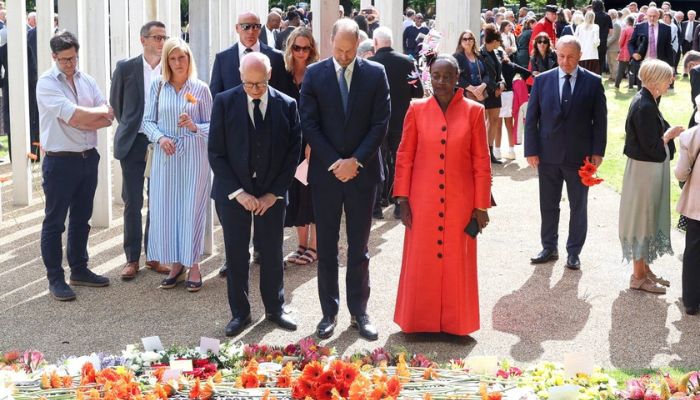
Fore the Liberal elite, the imagined victimhood of the Muslim community, over the mere mention of the declared, self-admitted religious motive of the perpetrators of a terrorist attack, takes precedence over the victims’ fundamental right to justice and a nation’s duty of honesty and transparency towards its people. This surrender extends to the highest levels, where the Royal Family’s actions, Prince William laying flowers at Hyde Park or King Charles offering interfaith platitudes, unwittingly normalize the very ideology seeking to dismantle civilised societies.
The grooming gang cover-up: Another act of cowardice and blatant appeasement by the British govt
The systematic cover-up of Britain’s grooming gang scandal reflects a decades-long institutional cowardice, mirroring past failures to confront uncomfortable ethnic realities. Baroness Casey’s damning audit exposed a critical pattern, Pakistani-heritage men were disproportionately represented among suspects in high-profile cases across Greater Manchester, West Yorkshire, and South Yorkshire. Yet police and councils actively ignored this evidence, with Casey noting authorities “avoided the topic altogether for fear of appearing racist or raising community tensions”. This deliberate blindness allowed perpetrators to operate with impunity while victims suffered.
Compounding this denial was the weaponization of data suppression. The audit revealed ethnicity data was missing for two-thirds of all grooming gang suspects nationally, a gap that was “no accident—it was policy”. Authorities invoked “community cohesion” to justify burying these patterns, with reports confirming senior figures blocked investigations to avoid antagonizing Muslim communities. In Telford, council leaders suspended licensing enforcement for taxi drivers linked to abuse, fearing accusations of racism, a move one inquiry branded “craven”.
Meanwhile, victims faced institutional gaslighting. Officials dismissed child rape as “consensual relationships” or “child prostitution,” even charging traumatized girls with offences like “drunk and disorderly” while their abusers walked free. Disturbingly, social workers sometimes attended Islamic “marriages” between abusers and underage victims, and fathers attempting to rescue daughters from abuse sites were arrested instead of the perpetrators. The Starmer government now pledges legal reforms, including mandatory rape charges for adults who abuse children under 16 and expunging victims’ unjust criminal records. But these promises follow decades of silence and inaction, leaving survivors to wonder if accountability will ever transcend political convenience.
7/7’s supressed truth: The Pakistan connection
The 7/7 London bombers were directly orchestrated by al-Qaeda operatives in Pakistan, debunking the “lone wolf” narrative. Mohammad Sidique Khan and Shehzad Tanweer travelled to Pakistan in 2004–2005, where they received explosives training at camps in Mansehra and Malakand run by the al-Qaeda-linked group Harkat-ul-Mujahidin (HUM). Khan was trained by senior al-Qaeda commander Abd al-Hadi al-Iraqi, who also instructed other UK plotters. Their activities were coordinated by Rashid Rauf, a British al-Qaeda operative in Pakistan who facilitated their bomb-making training, target selection (including the London Underground), and communication via coded messages.
The bombers’ ‘martyrdom’ final videos, recorded in Pakistan under Rauf’s supervision, were later edited by al-Qaeda’s media wing, al-Sahab, to include endorsements from Ayman al-Zawahiri, proving direct hierarchy involvement, parallel plots like the “Crevice” conspiracy further exposed the ISI’s role. Omar Khayyam, a key figure, testified that ISI operatives ran training camps and funded jihadist “proxy wars” in Kashmir. During Khyam’s 2006 trial, he abruptly halted testimony, stating “The ISI has had words with my family… They are worried I might reveal more” a clear instance of ISI intimidation silencing critical evidence in a British court.
This nexus underscores al-Qaeda’s central command in Pakistan and the ISI’s complicity in enabling attacks against the West.
7/7 bombers were trained in Pakistan by al-Qaeda and the ISI.
At the Old Bailey, Omar Khyam accused Pakistan's ISI of trying to threaten his family because he revealed their direct role in al-Qaeda training camps.
Britain’s leaders have perfected a lexicon of evasion. By trivialising and obscuring Islamist terror with terms like “senseless evil, “tragedy,”, “lives lost” etc, they absolve themselves of confronting the ideology that fueled it. By refusing to name Pakistani grooming gangs, they sacrifice vulnerable children at the altar of political correctness.
This is not “sensitivity” it is cowardice . When the Prime Minister lauds “unity” while whitewashing jihadism, he betrays the 52 people murdered on 7/7. When police ignore grooming gangs to avoid “racism,” they become accomplices to rape.
Islamic terrorism is not a phantom. It is real, it is ideological, and it must be named and confronted with, not shielded by identity politics. Until Britain’s leaders find the courage to speak plainly, their wreaths and memorials are not tributes. They are tombstones for truth.
As Bihar heads into a crucial electoral battle in November 2025, the opposition is once again turning to an old playbook: manufacturing outrage over voter disenfranchisement. At the heart of this narrative is the Association for Democratic Reforms (ADR), a so-called electoral reform NGO with deep financial and ideological ties to globalist networks, most notably George Soros’s Open Society Foundations, flanked by the Opposition Mahagathbandhan, a section of left-leaning intellectuals, and activist-lawyers like Prashant Bhushan.
Predictably, the NGO has filed a petition in the top court, scare-mongering “mass disenfranchisement” of voters, parroting the exact talking points being peddled by Congress leader Rahul Gandhi in his recent Bihar campaign speeches.
From filing litigation in the Supreme Court against the Election Commission of India (ECI), to rallying protests on the streets of Patna led by Rahul Gandhi, this nexus is attempting to project a routine, legally empowered revision of voter rolls—the Special Intensive Revision (SIR)—as a sinister plot to disenfranchise the poor and marginalized. A claim that wilfully ignores facts, the law, and the Election Commission’s constitutional mandate.
The Bihar bogey: Manufactured crisis before the polls
On June 24, 2025, the Election Commission of India (ECI) ordered a Special Intensive Revision (SIR) of the electoral rolls in Bihar. It’s a standard legal procedure aimed at removing bogus entries and ensuring electoral integrity. But ADR, with impeccable timing, filed a petition claiming that the directive would disenfranchise over 3 crore voters, particularly from marginalised communities.
The petition objects to the exclusion of Aadhaar/ration card as a valid ID, the burden of proof shifted to the voter, the requirement to prove parental citizenship, and “unreasonable” timelines in a “poll-bound” state.
From SC to Streets: Rahul Gandhi Joins the Propaganda Offensive
The Opposition’s hysteria over the ECI’s SIR order reached a crescendo with a call for a statewide bandh on July 9, announced by the Mahagathbandhan, led by the Congress. And not just any protest, Rahul Gandhi himself will lead it.
“Our leader Rahul Gandhi is coming to spearhead the protest. He will lead a grand march from the Income Tax roundabout to the Election Commission office,” said Bihar Congress chief Rajesh Kumar.
The Opposition has planned to block roads, disrupt transport, and paralyse civic life, all in the name of protesting an electoral clean-up that’s well within the legal purview of the Election Commission.
Kumar and other Congress leaders, including Pawan Khera and KC Venugopal, called the SIR “illegal,” alleging that 90% of Bihar’s population lacks the required documents—a statistic pulled out of thin air, with no empirical backing.
Prashant Bhushan amplifies propaganda with Pratap Bhanu Mehta’s alarmist article
Not just Rahul Gandhi, but several others too furthered the propaganda surrounding the SIR. On July 8, 2025, Prashant Bhushan took to X (formerly Twitter) to promote an article by Pratap Bhanu Mehta published in The Indian Express. Bhushan described it as a “brilliant article on how the EC’s ‘special revision’ exercise ahead of Bihar polls is designed to disenfranchise millions of voters.”
Must read: @pbmehta on the absurdity of the lapdog ECI’s attempt to disenfranchise millions of Bihar voters by the so called Special Intensive revision of electoral rolls, by demanding documents which vast majority don’t have pic.twitter.com/RAQizrl7zc
However, Mehta, in his column for the Indian Express, painted a dystopian picture of the EC’s order, calling it a “bureaucratic overreach”, “a pilot for a backdoor NRC”, and “a replication of the logic of demonetisation.” The article was a textbook example of fear-mongering, amplifying unfounded fears and stirring public sentiments against the Election Commission’s decision. But more curiously, it echoed almost verbatim the unsubstantiated claims made by ADR in its legal challenge.
But it is important to dissect the problematic assertions made by Mehta in his article. Mehta claims the documentation requirements are “bewilderingly complex”, failing to acknowledge that they are drawn from statutory norms used in prior voter roll revisions.
He alleges that “lakhs of voters could be excluded”, despite the EC already addressing similar concerns in earlier Summary Revisions. The article discredits the entire process of verification by Electoral Registration Officers (EROs) as being potentially “arbitrary”, despite such procedural safeguards being a core feature of Indian electoral processes for decades.
Most provocatively, Mehta declares that this is “not just about Bihar” but a “backdoor NRC”, a political dog whistle deliberately used to stoke fears among marginalised communities. The NRC has often been raised as a bugbear to mobilise anti-Modi forces, most notably during the passage of the CAA, when similar fears were raised to undermine the law meant for fast-tracking the citizenship of religious minorities from India’s troubled neighbourhood.
What does the law say?
Section 21(3) of the Representation of People Act, 1950, allows the ECI to initiate special revisions with “reasons recorded.” Contrary to ADR’s claims, these revisions are not sudden; the EC had already conducted a Special Summary Revision (SSR) earlier this year. The SIR is merely a follow-up mechanism to correct anomalies identified.
But for ADR, it’s not about the legality. It’s about creating a perception war. They know the average citizen won’t dive into statutory clauses. Instead, they plant doubt, knowing the opposition will do the rest.
Repeat offender: ADR’s lies on the Rafale Deal
But behind ADR’s activist language lies a disturbing truth: this is not the first time the NGO has interfered in the democratic process in India, nor is it just a neutral watchdog concerned about electoral integrity. Its funding trail, ideological leanings, and past activism reveal a deeper nexus that seeks to systematically weaken Indian institutions and fuel anti-government narratives, often timed suspiciously around elections.
During the 2019 general elections, ADR helped amplify one of the biggest fake news campaigns in recent memory: the Rafale deal controversy.
The entire “scam” was based on zero evidence, but was fanned by selective leaks, distorted contract comparisons, and ADR-backed reports shared by propaganda outlets like Huffington Post and The Wire.
Even after the Supreme Court dismissed all review petitions and gave the Modi government a clean chit, ADR continued to parrot questions around transparency, procurement procedures, and pricing—an attempt purely aimed to keep the manufactured outrage alive during elections.
It’s no coincidence that ADR’s misinformation was picked up by Rahul Gandhi’s infamous “Chowkidar Chor Hai” campaign line, which he had to later retract in court.
The Electoral bonds disinformation: A masterclass in duplicity
Perhaps the most sophisticated hit job by ADR came through its collusion with Huffington Post on the issue of electoral bonds.
ADR alleged that electoral bonds introduced “untraceable black money” into politics. But at the same time, Huffington Post’s headline (based on ADR’s data) contradicted itself by saying, “Electoral Bonds Are Traceable: Documents Nail Govt Lie On Anonymity.”
Let’s break that down: Are the bonds traceable or not? If traceable, where is the black money? If not traceable, why complain about anonymity?
This “head-I-win, tails-you-lose” strategy is a deliberate disinformation model.
ADR claimed that 95% of electoral bonds in the first tranche went to BJP. This was conveniently cited without full disclosures, timing, or party-wise receipts. These figures, riddled with assumptions and no primary audit trail, were used to build a misleading public narrative.
Weaponising institutions: Targeting the Election Commission
Earlier this year, ADR challenged the constitutionality of the CEC and EC appointment process, even after the Modi government passed a law that included the Leader of the Opposition in the selection panel, something no previous government had done.
What ADR claimed: The law violates Article 14 and the Supreme Court’s earlier interim order.
What actually happened:
The law was passed democratically by Parliament. SC rejected ADR’s arguments and upheld the appointment of Gyanesh Kumar and Sukhbir Singh Sandhu. The court said: “You cannot say that the Election Commission is under the thumb of the executive.”
Still, ADR, via Prashant Bhushan, infamous for his role in the anti-CAA, anti-NRC narratives and even hosting conspiratorial anti-Hindu riot meetings, continued to press the court to overturn the appointments.
Who funds ADR and why it matters
ADR’s activism isn’t just political, it’s foreign-funded and ideologically aligned with the global Left-liberal order.
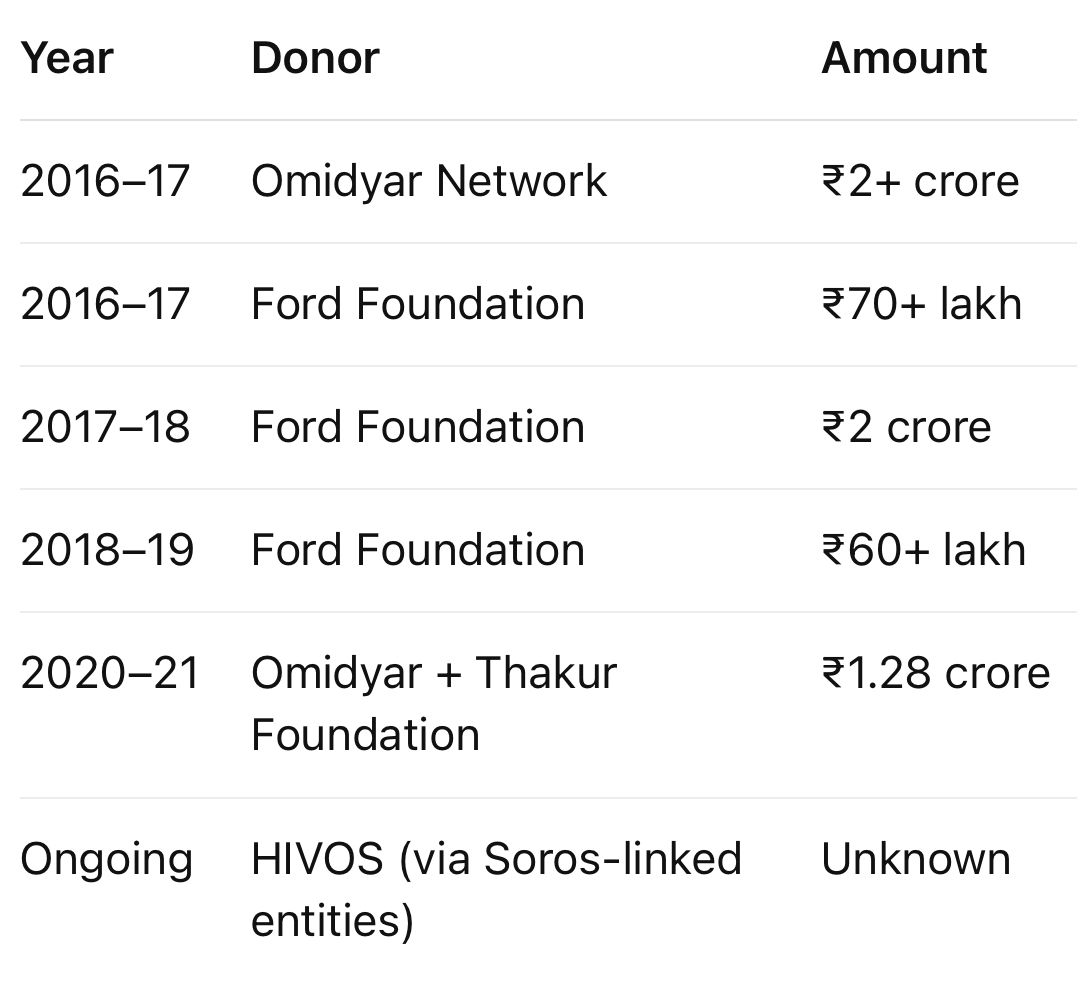
Here’s a snapshot of its FCRA funding trail:
HIVOS receives direct grants from foreign governments and Soros-linked Open Society Foundations. Omidyar Network funded Forbidden Stories, the platform that fabricated the Pegasus spyware scandal. Thakur Family Foundation funds The Wire and Caravan—far-left outlets known for anti-BJP misinformation. Mysterious foreign individual Archesh Shah from Sydney routinely donates ₹25,000, but remains digitally invisible.
This isn’t just foreign philanthropy. It’s a soft war on Indian sovereignty.
ADR: Part of a larger propaganda web
Put together, ADR plays the role of a “research-intellectual” arm in a wider globalist network:
Foreign-funded NGOs (ADR, Amnesty, Oxfam) Propaganda media (HuffPost, The Wire, Caravan) Judicial activism (via Bhushan, PILs) Political echo chambers (Rahul Gandhi, opposition parties)
Each arm plays its part: ADR creates “data” and “research”. Foreign and domestic media blow it up. Politicians amplify it on the ground. Judiciary gets pulled into unnecessary litigation. Public confidence in institutions is systematically eroded.
Foreign interference dressed up as reforms
ADR is not just an NGO. It is an instrument of political warfare, bankrolled by forces with zero stake in Indian democracy but great interest in disrupting it.
From spreading lies about Rafale, undermining the EC, creating hysteria over unwarranted matters, to now fueling voter suppression myths in Bihar, ADR has consistently acted in ways that harm India’s democratic institutions and cast aspersions over their credibility.
And each time, its script is picked up and amplified, word for word, by Rahul Gandhi and his allies.
It could hardly be a coincidence. In fact, it appears more like a symphony where different elements play their part towards a collective goal.
And that’s certainly not strengthening India’s electoral institutions. It’s regime change by subterfuge.
The Madras High Court has delivered a blistering rebuke to Tamil Nadu police for their “distressing and unfortunate” failure to act against former DMK Minister K. Ponmudy over derogatory remarks targeting Hinduism. The court warned that it would order a CBI probe if authorities fail to take immediate action.
Presiding over the case, Justice P. Velmurugan expressed severe dissatisfaction with the state police’s handling of 112 complaints against Ponmudy, a senior DMK leader who served as Forest Minister until his resignation in April. The court set a firm deadline of 8th July, Tuesday, for a final decision on whether to transfer the case to the Central Bureau of Investigation (CBI) due to “continued inaction” by Tamil Nadu police.
Judicial condemnation of remarks by K Ponmudy
This judicial urgency follows months of controversy surrounding Ponmudy’s speech on April 8th at a TPDK event. During this speech, he made vulgar analogies that linked Hindu religious symbols, specifically tilaks, to sexual positions offered by a prostitute. Justice N. Anand Venkatesh previously described these remarks as “obscene, derogatory, and calculated to spew venom” against Vaishnavites, Shaivites, and women.
Despite Ponmudy’s defense, claiming he was misrepresented by a “truncated video,” and his subsequent public apology, the court dismissed his arguments. The court stated that his comments were made “knowingly and with full consciousness” and likely violated hate speech laws outlined in the Bharatiya Nyaya Sanhita (BNS).
The Madras High Court on July 08 decided to keep pending its suo motu case against former Tamil Nadu Minister of Forests K Ponmudi for reportedly reciting a lewd joke that referred to the tilaks of Shaivites and Vaishnavites (Hindu sects).
The court’s frustration echoed its April interventions when it first directed police to file an FIR and later initiated a suo motu case after authorities ignored orders. Advocate General P.S. Raman’s admission that initial complaints were closed without FIRs drew scathing criticism, with justices emphasizing that “Law applies equally to all.” Notices have now been issued to the state DGP and Chennai Police Commissioner demanding explanations for the dela
Political fallout
Politically, the DMK moved swiftly to contain fallout, stripping Ponmudy of his deputy general secretary post on 11th April, publicly condemning his remarks through senior MP Kanimozhi, and accepting his resignation as Forest Minister by 27th April. Opposition parties, including the BJP and AIADMK, joined Governor R.N. Ravi in condemning the speech as a “shameful threat to societal harmony,” with BJP leaders filing formal police complaints citing sections of the BNS related to wounding religious feelings and promoting enmity.
What’s next?
With the High Court’s 8th July deadline here, Tamil Nadu police face two paths, immediately, register an FIR and commence prosecution or or relinquish the case to the CBI. The outcome will test the state’s commitment to curbing hate speech without political bias.
Legal experts note the court’s stance reinforces that constitutional accountability outweighs partisan loyalties. As Justice Venkatesh observed earlier, “The impression that public officials can get away with hate speech must be wiped off.”