Home Blog Page 3111

“Another act of systemic persecution of religious minorities”: MEA condemns vandalization of Hindu temple in Pakistan

The Ministry of External Affairs has condemned the vandalization of a Hindu temple in Karachi that took place on 8th June 2022. In the weekly media briefing on 9th June 2022, the official spokesperson of the Ministry of External Affairs Arindam Bagchi said, “We’ve noted a recent incident of vandalization of a Hindu temple in Karachi. We believe it’s another act of systemic persecution of religious minorities. We’ve conveyed our protest to Pakistan Govt, urging them to ensure safety, security & well-being of its minority communities.”

The response from the Ministry of External Affairs came within hours of the incident being reported in the Indian media. Arindam Bagchi informed this in the media briefing when asked about the stand taken by the Indian Government on this incident of temple desecration that took place in Karachi. Arindam Bagchi said that the Government of India has conveyed the protest to the Pakistan government and asked them to ensure the safety of the religious minorities in Pakistan. It is notable that incidents of temple desecration and idol vandalization in Pakistan are continuously increasing.

In one such incident of vandalism against the places of worship of the Hindus in the Islamic Republic of Pakistan, an idol of Lord Hanuman, placed in Shri Mari Mata Mandir in the Korangi area in Karachi was desecrated and the priest of the temple was also attacked. The temple is located in the ‘J’ area, a short distance from Korangi Police Station. 

Video of the attack circulating on social media shows how the idol of the Hindu deity Hanuman was severely damaged and other religious things kept in the temple were also destroyed.

According to journalist Aditya Raj Kaul, the temple was under construction hence the priest had brought the idols home located next to the temple. The miscreants vandalized the temple, destroyed the idols kept in his house, and also attacked the priest before fleeing. The police have not yet identified the people involved in the crime nor have made any arrests so far.

Alleged involvement of cops Nawab Ahmad, Akmal Khan and Naeem Akhtar, foreign funding, minors used as shields: New angles emerge in Kanpur violence case

The Kanpur police will be questioning Beckonganj Station House Officer (SHO) Nawab Ahmad, ACP Akmal Khan and the outpost in charge, Naeem Akhtar for their alleged role in the clash that took place on June 3. Violence had broken out after Namaz on Friday, June 3, when Islamists called for a forced shutdown in response to a remark made by BJP’s Nupur Sharma on Prophet Muhammad.

According to reports, the three aforementioned officers were aware that the Muslim community had given a call for a shutdown in the area to protest against BJP spokesperson Nupur Sharma, which could have resulted in confrontations, but they did nothing to prevent it.

It is also being alleged that the Beckonganj Station House Officer Nawab Ahmad, ACP Akmal Khan and the outpost in charge, Naeem Akhtar were constantly in touch with Hayat Zafar Hashmi. Hashmi is the president of Maulana Mohammad Ali Jauhar Fans Association and a former Secretary of Youth Congress. He is said to be the main conspirator behind the clashes in Kanpur.

According to Kanpur police, on May 27, the MMA Johar Fans Association had filed a complaint with the police station stating that, in response to Nupur Sharma’s remarks, the market will be closed on June 3 and a ‘Jail Bharo Andolan’ will be held on June 5. The Islamic body had also announced in a press conference that all the Muslim community-owned shops in the region, would remain shut on that day and that they would force other shopkeepers also to down shutters in protest. The same was communicated to the police officials by the LIU team. However, Beckonganj Station House Officer Nawab Ahmad and ACP Akmal Khan took no precautionary steps to avoid any sort of escalation. As a result, both are now being investigated.

Hindi news daily Patrika has also reported the Beckonganj Station House Officer Nawab Ahmad is also accused of destroying evidence. He had reportedly replaced the windscreen of the police jeep that was broken by the Islamists on the day of the violence.

Meanwhile, Joint Commissioner of Police Anand Prakash Tiwari claims that the riots on June 3 were meticulously planned because Islamists knew the Prime Minister and President of the country would be in town on that day, and the riots would have a global reach.

He further added that the role of Beckonganj Station House Officer Nawab Ahmad, ACP Akmal Khan and the outpost in charge, Naeem Akhtar are being investigated by the SIT team formed to probe the Kanpur violence. Further action will be taken only after the inquiry report is received.

It may be recalled that earlier, the Kanpur police had revealed that a total of 141 WhatsApp groups were found on Hashmi’s mobile, and most of them had conversations regarding the Kanpur clashes. Several other names have also come up after going through the chats who were also active in those groups. 

Mastermind of Kanpur violence Hayat Zafar Hashmi received foreign funding

In another significant development in the case, sources have alleged that Hayat Zafar Hashmi has been receiving foreign funds. Reports say that police are monitoring the bank accounts related to Hashmi to ascertain where he was receiving foreign funding. The details of one of his accounts at a private bank in Kanpur’s Babupurwa area reveal that a transaction of Rs 3.54 crore was made in his account on July 30, 2019. Thereafter, Rs 98 lakh was withdrawn from the same account in September 2021. Currently, Rs 1.27 crore is left in this account. The account details have been shared with the Income Tax department and the matter is also going to be under the supervision of ED.

“First, we are looking into the sources of money and then the purpose for which it was being used. Later, we will ascertain if the transactions were legal,” an SIT official said.

It may be noted that earlier, Kanpur Police Commissioner Vijay Singh Meena told ANI that the links with PFI or any other organisation behind the violence will also be investigated.

NCPCR orders police to investigate if minors were also used as shields

Meanwhile, the National Commission for Protection of Child Rights (NCPCR) has asked Kanpur police to probe whether minors were also used as shields in the June 3rd clashes and initiate action against those responsible under section 83 of the Juvenile Justice Act.

The child’s rights body took cognisance after a teenager had surrendered at the Colonelganj police station on Tuesday. According to reports, after seeing the minor’s name and photo in poster of 40 suspects involved in the clash released by the Uttar Pradesh police on Monday, his parents took him to the Colonelganj police station to surrender.

Pertinently, in its efforts to nab the rioters, UP Police had released a poster of 40 suspects involved in the clash that took place on June 3. The suspects in the poster were those who were caught on camera pelting stones and participating in the violence. The police had appealed to the public to help in the search for these people.

The NCPCR, meanwhile, has requested the police to produce the juvenile, who surrendered in Colonelganj before the Child Welfare Committee.

Kanpur violence

Notably, during the violence that took place in Kanpur on June 3, 2022, hundreds of Islamists clashed with the State Police and other civilians and pelted stones in the Becongunj area near Yatimkhana after the Friday Namaz. According to reports, the Islamists had singled out the Hindus by their names and assaulted them. The violence erupted after the Muslim community had given a call for a shutdown in the area to protest against BJP spokesperson Nupur Sharma, and the shutdown turned violent after the Friday prayers.

The Police responded to the violence and lathi-charged some of the protesters. While they tried to get the situation under control, fierce stone pelting continued intermittently.

OpIndia reported how this act of violence was not one that happened spontaneously but was actually a culmination of a series of well-thought events that occurred over the past nine days, ending in the Kanpur clash.

Pakistani politician and meme star Aamir Liaquat Hussain, whose 3rd wife had called him ‘worse than Devil’, found dead in his house

On Thursday, a former member of the National Assembly in Pakistan, Aamir Liaquat Hussain, was found dead at his home in Karachi. He was shifted to the private hospital where the doctors confirmed his death. He was 49.

According to the reports, Hussain who was also a popular television host had complained of discomfort on Wednesday but had refused to go to the hospital. His staff members heard him screaming out of pain on Thursday morning. They broke the closed door of his room and shifted him to the Aga Khan University Hospital.

National Assembly Speaker Parvaiz Ashraf also confirmed Hussain’s death on June 9 and postponed the proceedings of the House. Aamir Liaquat Hussain was also the former Pakistan Tereek-e-Insaf (PTI) MP.

Expressing sorrow over the sudden death of Liaquat, Pakistan President Dr Arif Alvi prayed for the strength of his family. “Prayers of forgiveness. The President expressed sympathy and patience to the family of the deceased”, an Urdu tweet from President’s office roughly read.

Pakistan Foreign Minsiter Bilawal Bhutto Zardari expressed shock over the news. “Dr Amir Liaquat Hussain led a dynamic life from journalism to politics. He proved his mettle in various fields of life from writing to speech”, he tweeted.

It is important to note that recently on May 10, Liaquat’s third wife Syeda Dania Shah had filed a divorce against him. Shah is 18 and married the 49-year-old politician in February this year. In an Instagram post, Shah had revealed that her marriage with Liaquat was nothing but ‘torment’. She added that Liaquat had beaten her when he was highly intoxicated. She had demanded haq mehr of over PKR 115 million, house and jewellery.

Reports mention that the Karachi Police could not detect any foul play in the case. While the basic search at the residence of the deceased has been conducted, the Police said that CCTV footage of his home in Karachi’s Khudakhud Colony will also be checked.

Liaquat, apart from being a politician and a television host, was also a comedian, and a popular face on memes on social media. Several memes made from clips of him are popular on social media in Pakistan and in India.

Mobocracy makes democracy bend to its will, the State bends down to accommodate the most violent, most vocal group

Aggressiveness and hostility have long been the means to increase political power in this country. When it comes to achieving political goals in India, controlling the street veto, and using the mob has been the norm, rather than the exception.

If you comprehend this, you will understand why Lalu Prasad Yadav renamed his different rallies ‘rallas.’ Rally is a feminine term in Desi English. However, Lalu Prasad Yadav’s Garib Ralla, Lathi Ralla, and many other such rallas symbolized street power, and that power was plainly reflected in the number of people engaging in the same. So, mob mobilization is the key, and mobocracy is the path to accomplishing what Lalu Prasad Yadav achieved in the 1990s.

Lalu Prasad Yadav is now a convicted felon, yet he was once a rising star in Bihar politics. For his political clout, he did whatever came to his mind at any given moment. His attempts were also effective from a political standpoint. Except for being labelled a criminal, he and his family are still on the rise. After all, what is the reason? The answer is mobocracy.

Lalu Prasad Yadav was the pied piper of Bihar. Is Bihar, nevertheless, the country’s sole state that witnesses this? No. We have many other states which have witnessed similar political movements and have seen the mob bending the state to its will. The practice is not limited to grabbing power. The crowd’s energy has shaped policies, laws, judiciary, sometimes acting as a mere vote bank, and sometimes acting as a threat.

The mob’s power has even been shadowing the constitution of India. The State has been accommodating the mob.

The country was supposed to be governed by the constitution. The constitution is a book, a very good book, but it is not the only book that shapes politics and power in this country. This reality has now been well acknowledged by the country’s new pied pipers. Attempts have been made to alter the pro-reservation Constitution through the Jat Andolan. Some rape allegations (though later dismissed) did manage to partially derail it, but it cause the disruption nevertheless. Gurjar Andolans destroyed properties worth crores, but the will of the mob has prevailed, even at the cost of uncountable inconveniences for the common Indian.

The Maratha agitation for reservations used slogans like “One Maratha, Lakh Maratha” to raise awareness of the importance of numbers. The slogans accentuate the word “crowd,” “mob,” “number,” and hence “power.” The power to alter the Constitution and the legislation of the nation. Crores of farmers are happily working in their fields, while a few thousand men sitting in air-conditioned tents outside Delhi drove tractors to the Red Fort, knowing that a big crowd might first challenge and then make the State bow down. The state eventually did succumb to mob power. The lawless mob managed to make the State bow down to its will. Mobocracy> democracy.

Those in positions of power are aware of this fact. They just do not say or write it. The phrases and symbols are clearly understood by the elected members of parliament. That is why, every now and again, they raise the cry of democracy, but in practice, they invariably bow down to the mobocracy. Mobocracy triumphs over democracy. Is this true? All of the examples given above are answers to this question.

Islam is a religion. Some people follow this religion. Now, please read carefully. The word people include human beings and not cows, bulls, dogs, or cats. Similarly, Buddhism, Jainism, Sikhism, etc., are also religions. These faiths are also practised by humans, not animals. You must be wondering why the word religion was introduced all of a sudden when we were talking about ‘mob’ or ‘crowd’. This is because the crowd is nothing but a large group of humans. The energy of the mob, which has been discussed previously, also relates to religion. Whether the mob can make the State bow down to it depends upon how focused and motivated that mob is.

The All India Muslim Personal Law Board, a religious body, had demanded a blasphemy law in India. And this demand was made by mobilizing the mob. As desired by them, the blasphemy law should dictate that if you say anything ‘negative’ about their religion’s symbols, you get capital punishment. They may also easily transform into a pied piper. Because they are backed by a mob that believes in beheading those who commit blasphemy. That mob had destroyed properties, halted trains and blocked roads for months over CAA, a one-time provision for some persecuted non-Muslims in India’s neighbouring countries.

Mob’s power has prevailed. The State is yet to formally notify the above law.

“The Shivling was 4 inches, became 12 inches when caressed. What is so special about the Shivling when everyone has a ling. Several Shivlings came out on the pavement at once. Condoms on the Shivling. Sita’s vagina bleeds after the rape.” If you are angry, then please read it all once again. All these lines are there in the news. And also notice the other mob and its reactions to such news headlines. It is the mob that does not shout ‘Sar Tan Se Juda’. This crowd does not demand beheading as a punishment for blasphemy. At the most, it may go to some court and file a case or two.

Now, let us have a look at the Nupur Sharma case that is all over the news. Let alone India, the ‘Sar Tan Se Juda’ mob was activated in foreign countries as well. What did the party (Bharatiya Janata Party) do? It listened to the demands of the mob and suspended its office-bearers. Now the question arises, is there any party/office/organization that suspended any of its members for derogatory remarks about Shivling? I haven’t come across any such news in the media.

Nupur Sharma reminds me of another name – Kamlesh Tiwari. Kamlesh Tiwari was a person. Now it just remains a name. He was jailed under the law of the land because somebody had made some allegations, and the police and lawyers produced him before the judge on the same charges and sent him to jail. What after that? Was the ‘Sar Tan Se Juda’ mob content with that? Did that mob believe in the law that jailed him? No, that mob was not satisfied with this. They killed Kamlesh Tiwari. The police arrested the murderers and the law is taking its own course in this case as well. But what course did the law take about the ‘Sar Tan Se Juda’ mob? Did it take any action against it? No. It did not. This again underlines that the mob is more powerful than the State.

“If you speak ill against Mahatma Buddha, we will pull out your fingernails, if you say something on Jain Tirthankaras, we will take gouge your eyes, If you say derogatory things about Ram or Sita, your tongue will be cut off”, there are no slogans that announce such things. The mob that has become aware that the State bows down to its whims, knows well that the above-mentioned groups of people can never match them in violence.

Can the followers of Ram, Shiva, Buddha and Tirthankaras start imitating the mob that makes the State bow down? The violent mob that has tamed the media enough to be branded as peaceful despite all the acts of beheadings and shootings and stabbings, is already demanding a strict blasphemy law in the country. Will the other people take notice, will they make pied pipers among themselves or helplessly wait for the State to be taken over and consumed by the most violent, most assertive mob?

Naveen Jindal gets death threats for ‘controversial’ tweet, demands security from govt, suspects hand of ‘toolkit’ gang in turning his tweet into a global issue

On the 9th of June 2022, former BJP leader Naveen Kumar Jindal got a summon from the Maharashtra police over his remarks about Islam. His comments are being deemed as “hate speech” by several Islamists.

Summons to Naveen Jindal

The summon by the Maharashtra police comes amidst Naveen Jindal’s life being in serious danger after he took to Twitter to make certain comments about Islam and Prophet Mohammad.

Naveen Jindal was removed from the party following his tweet, along with national spokesperson Nupur Sharma being suspended pending inquiry, who had made certain comments on Islam after being provoked by Islamists, who were mocking the Shivling found in Kashi during a television debate.

Jindal has been getting threats over social media since his comments were made viral after being translated in Arabic.

He has got several Direct Messages with threats that he would be murdered the moment he steps out of the house. OpIndia has got screenshots of some of those threats.

Abuses and threats to Naveen Jindal

Not just on Direct Messages, Jindal has got several tweets threatening him with dire consequences as well.

Abuses and threats to Naveen Jindal

How did the tweet by Naveen Jindal create a storm

Naveen Jindal is by no way a famous enough leader that his tweets would go viral instantaneously. This purportedly offensive tweet as well did not go viral or get much attention till it was picked up by certain elements from Islamic nations and was translated into Arabic. The translated tweet was then widely circulated and commented upon by Islamists.

When Naveen Jindal spoke to OpIndia about his tweet being translated, he categorically said that he suspected a conspiracy behind his tweet being translated to Arab and being made viral to instigate a global Islamist mob against him and through him, target India.

“I am not a famous person on social media. How did my tweet get translated to Arabic to instigate the global Islamists? Who found my tweet? If you look carefully, this is the modus operandi of the toolkit gang. They are always on the lookout for an opportunity to put Hindus on the spot and this time, I was their medium. My tweet was only asking a question. They may disagree with my tweet or even be offended, but the government must investigate about at whose behest was my tweet translated to Arabic to instigate the Muslim world against India”, Jindal said. “I don’t know Arabic but people have told me that they chose the wrong translation to make my tweet appear worse and abusive, which was followed by abuses to me and the Hindu religion”, he added.

It should be kept in mind that the comments by Naveen Jindal and Nupur Sharma were condemned by several Islamic nations. Islamists from these Islamic nations had even threatened to boycott Indian products and the diplomatic hassle ended with the Modi government making a statement about respecting Islamic beliefs.

Despite the suspension, Naveen Jindal also reiterated his commitment to the country, the BJP and the RSS – ‘RSS is in my blood’, he said.

Jindal further said that his family and he were under serious threat from the Islamists. Only recently, he took to Twitter to claim that there were several people taking a video of him leaving his home and that he had filed a police complaint in this regard.

Naveen Jindal has also appealed for security for him and his family. He said, “My family and I are under severe threat. We just sit and look at each other wondering if we will meet again. The government must initiate an investigation into this global conspiracy and also provide security so my family and I can be protected”.

Naveen Jindal used to be a journalist for 3 decades before he became a politician. His political career started in 2016 when he was appointed as the spokesperson for BJP Delhi. Naveen Kumar is known for launching India’s premier crime shows like ‘Crime Files’ and ‘Crime Reporter’ on news channels. In 2002, he produced a documentary titled “13 December Parliament Attack.” This was based on the terrorist attack on the Indian Parliament in 2001. With his 2003 documentary “Mission Akshardham” based on the terrorist attack on Akshardham Mandir in 2002, he exposed ISI’s link to the attack. 

Jindal has also authored a book about Madrasas. His book called Madarse Benakaab spoke about how Madrasas were used to radicalise Muslims and infuse hate in the Islamic community.

When asked about his past work, Jindal also said that he has been under threat for a long time due to his work. Islamists have tried to attack him in the past too and it is entirely possible that the current episode is also a continuation of that.

Did you know: 306 years ago, Mughals had stuffed Sikh warrior Baba Banda Singh Bahadur’s mouth with his son’s liver and heart before cutting him into pieces

The history of wars in India glorifies several Indian leaders who fought against invading forces s for the rights, faith, and freedom of the persecuted, common individuals. Many warriors, while fighting for the justice and independence of Bharatiyas also met their torment death at the hands of Islamist persecutors. One such warrior was Baba Banda Singh Bahadur, who fought against Mughal Emperor Bahadur Shah and his ‘jihadi’ activities in Punjab. Celebrated for his velour and commitment towards Dharma, Baba Banda Singh Bahadur’s story depicts the unimaginable atrocities done by the Mughals.

Back in the 18th century, Baba Banda Singh Bahadur was that one bright light, who gathered the army of thousands of Sikhs and revolted against the Islamic oppressors. While the state in pursuance of its policies fails to identify and glorify the rich history and heritage of Punjab, here’s the time to remember Baba Banda Singh Bahadur and his times on his 306th death anniversary today.

Over 300 years ago, when Mughals were torturing, establishing their power, and accomplishing crimes against the common people in the old Punjab, Baba Banda Singh Bahadar, the great disciple of Guru Gobind Singh ornamented himself with the arms against the tyranny to defend and safeguard the humanity. He led the campaign against the Mughal empire and pledged to punish Subedar Wazir Khan and his supporters who had killed Guru Gobind Singh’s two younger sons, Sahibzada Zorawar Singh and Sahibzada Fateh Singh along with others.

The Sikh warrior was conferred the title of Banda Singh Bahadur by Guru Gobind Singh

Born in Rajouri in Jammu’s Punch, Baba Banda Singh Bahadur was first named Lachhman Dev who possessed a sensitive heart. As a young man, he had shot a doe and was shocked to watch the mother and her aborted fawn in pain and dying. This experience was enough for him to decide to leave his home and reside in solitary. He then became a disciple of Bairagi Sadhu Janaki Das who gave him the name, Madho Das.

Madho Das settled in the Nanded area of Maharashtra after traveling all over Northern India. There, he built a small monastery to meditate upon God. In the year 1708, Guru Gobind Singh, who had travelled to Deccan with the Mughal Emperor Bahadur Shah happened to meet Madho Das. The equation between the duo appeared disturbing as Das made several failed attempts to humiliate the Guru. Das having tried all his powers on Guru Gobind Singh, accepted his defeat and with great humility surrendered to the Guru.

It is Guru Gobind Singh who conferred the title of Banda Singh Bahadur to Madho Das and encouraged him to fight for the righteousness and justice of the common people. He asked him to give away his recluse lifestyle and deputed him to end the Mughal persecution of innocents in Punjab. Further a Hukumnamah issued by the Guru sought many Sikhs to join Baba Banda Singh Bahadur’s struggle against the Mughals.

Wars against Mughals

Baba Banda Singh Bahadur reached Punjab in 1709 and established his base at Mukhlisgarh. He fought several wars against the Mughals putting Sayyed Jalaluddin, his brothers Sashal Beg and Bashal Beg, the executioner of Guru Teg Bahadar and Sahibzada Zorawar Singh and Sahibzada Fateh Singh respectively to death at Samana. Wazir Khan, the Nawab of Sirhind could not digest Baba Banda Singh Bahadur’s victory at Samana and sent urgent messages for help to Bahadur Shah.

Baba Banda Singh Bahadur War Memorial, Mohali (Image source- worldarchitecture.org)

At Chapper Chiri, in 1710, Baba Banda Singh Bahadur later put Wazir Khan to death as he had ordered the killing of two younger sons of the Guru after their refusal to accept Islam. He continued to fight against the Mughals even after Guru Gobind Singh’s death and defeated the rulers of Saharanpur, Nanauta, Jalalabad, the Ram Rayias of Ghudani, and Faujdars of Batala, Sonepat, and Sultanpur.

Mughals gave open call to ‘Jihad’

As Khalsa established rule over Punjab and also occupied Pathankot area, Lahore, the then capital of Punjab was threatened by Mughals who gave open call for ‘Jihad’ against Banda’s army. Enraged by the sequence of events, Emperor Bahadur Shah posed himself a challenge to attack and defeat Baba Banda Singh Bahadur and his army. He moved northwards from Delhi in June 1710 and poisoned some of the prominent men from Baba Banda Singh Bahadur’s army. Bahadur Shah also issued general warrant for his soldiers to kill the Sikhs, wherever they were found.

Baba Banda Singh Bahadur moved into the hills of Nahan and re-emerged at Kiratpur Sikhs. After Bahadur Shah’s death in the year 1712, Jahandar Shah became the emperor and then in 1713 Farukhsiyar became the Emperor, who continued the war against Baba Banda Singh Bahadur. In the year 1713, Farukhsiyar directed the Governor of Lahore Abdul Samad Khan and his son Zakariya Khan to kill Baba Banda Singh Bahadur and eliminate his troops in entirety. Though Baba Banda Singh Bahadur and his army adopted fierce tactics to strike back, the army of Baba Banda Singh Bahadur could not match the massive Mughal attack.

Baba Banda Singh Bahadur and his army entered the Haveli in Gurdaspur Nangal. They were surrounded by the Mughals who defeated them and tortured them badly. Later in December 1715, they were dragged to Lahore and from there were taken to Delhi. Around 720 the Sikhs were asked to convert to Islam and were executed in most inhumanly manner after they refused to renounce their religion.

Baba Banda Singh Bahadur made to eat his son’s flesh before death

Baba Banda Singh Bahadar and some 20 of his prominent soldiers were also put to untold mental and physical torture. The 20 soldiers were tortured to the extreme and were asked to convert to Islam. They were also asked to reveal the place where they had buried all the treasures they had during their better days. Failing to attain any such information, Mughals carried out a special procession on June 9, 1716. Baba Banda Singh Bahadar was made to dress in the mock attire of the emperor and was made to sit on the elephant, while his 20 odd soldiers were made to march behind him on the streets of Delhi. The procession headed to the Kutub-ud-din mausoleum of Bahadur Shah, near the present Kutab Minar.

The Sikhs, before their death, were again given the option to choose from between conversion to Islam or death. They all were later beheaded as they refused to convert to Islam. The Mughal army then arranged the heads of 20 Sikh soldiers in a circle around Baba Banda Singh Bahadur. They placed his 4-year-old son named Ajai Singh on his lap and ordered Baba Banda Singh Bahadur to kill him with a short sword. As Baba Banda Singh Bahadur stayed unmoved, one of them moved towards Ajai Singh and cut him into two. They removed flesh from inside the body of Ajai Singh and threw it on the face of Banda Singh. They also plucked flesh pieces of the deceased and stuffed the unfortunate father’s mouth with his son’s liver and heart.

Further, the Mughals barbarically tortured rock-faced Banda Singh and put him to death. They removed his eye balls first, then slashed his legs and separated both his arms from his body. Later they tore off his flesh with red-hot pincers and felt satisfied only after cutting his body up into a hundred pieces.

Banda Singh’s regime, though short-lived, had a far-reaching impact on the history of the Punjab. He treaded the glorious path of fighting for faith, justice and rights and motivated warriors like Baba Deep Singh, Chhajja Singh, Bhuma Singh, Hari Singh Dhillon, Jassa Singh Ramgarhia, Jassa Singh Ahluwalia, Budh Singh, Naudh Singh and Charhat Singh Sukerchakia and many others to keep aloft the ‘flame of liberty’ burning bright.

Prophet remarks row: Maharashtra Police summons Naveen Kumar Jindal over FIR in Bhiwandi, asks to appear on June 15

The Maharashtra Police has summoned former Bharatiya Janata Party politician Naveen Jindal for questioning in a case related to his remarks on the Islamic prophet Muhammad. The summon was issued by Bhiwandi Police Station Thane.

According to the summon, Jindal is asked by the police to appear at the Bhiwandi Police Station in Maharashtra on 15 June at 11:30 AM. It is worth noting that the Mumbra police station in Maharashtra’s Thane district has already called suspended BJP spokeswoman Nupur Sharma to testify in person on June 22.

The summon to Naveen Kumar Jindal

The Bharatiya Janata Party suspended National Spokesperson Nupur Sharma and Naveen Kumar Jindal from on June 5 in response to their statements on Prophet Muhammad and allegedly hurting Islamic sentiments, after many Islamic nations raised the issue with the Indian government. Both leaders apologised, stressing it was never their intention to hurt the feelings of any religious community.

Several cases have been filed throughout the country against Naveen Kumar Jindal and Nupur Sharma over their remarks on Prophet Muhammad. Several Islamist organisations, including terrorist organisation Al Qaeda have issued death threats to the leaders and their families.

The Delhi Police also on Wednesday filed an FIR against ex-BJP spokesperson Nupur Sharma, former BJP leader Naveen Kumar Jindal, ‘journalist’ Saba Naqvi and several others over allegations of promoting false information with the intention to create unrest in cyberspace.

The harsh realities of facing Islamic threats and radicalism: Why India cannot be France, China, or Israel

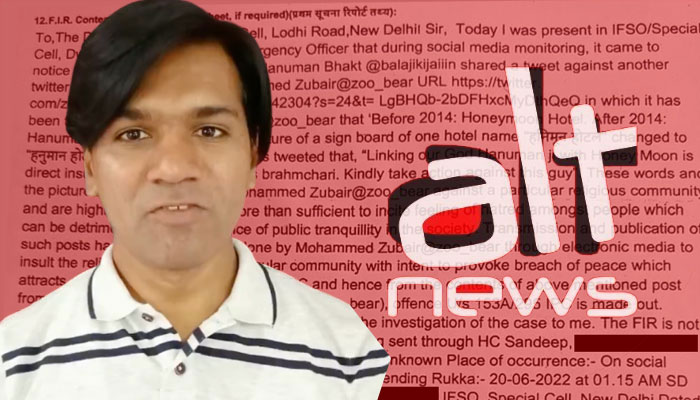
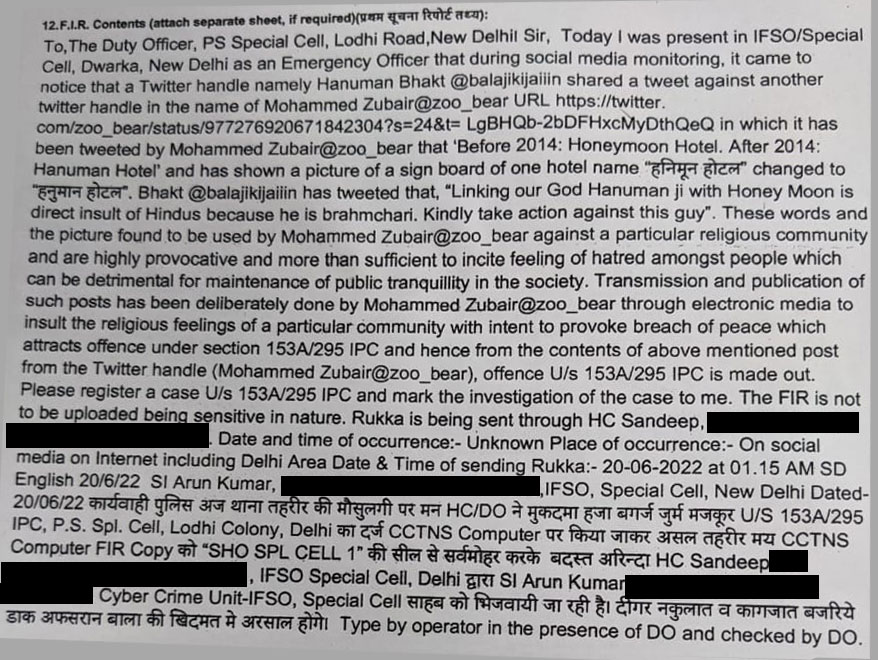
A lot of discussions have been happening around the Modi government’s response after Middle Eastern and other Islamic nations in India’s neighbourhood raised concerns over some remarks made by BJP spokesperson Nupur Sharma in a TV debate. The remarks were about Prophet Mohammed’s life, taken out of context and presented in an ugly manner by Alt News’ Mohammad Zubair who successfully raised a stink, and managed to get Nupur Sharma branded as a ‘blasphemer’.

The barrage of statements from Islamic nations started with Qatar, a major oil exporter, created a stir in a nation that already has a hundred issues it faces every day on account of religious conflicts, political clashes and ‘freedom of speech’. Faultlines of Hindu-Muslim conflict that have already inflicted deep wounds on the nation’s soul, and geography, are throbbing again.

The Indian government explained to the Islamic fundamentalist regime that the ruling party has taken adequate punishment measures against the said spokesperson and the government does not endorse, nor is complicit in her statements in any way, which is what hurt the Indians more, more than the coordinated campaign from Islamists living in India and their patrons abroad. More so because Nupur Sharma’s specific comments on the Islamic Prophet are generally perceived as facts, validated by Islamic texts, even though they were seen as negative because the context was an argument on religious beliefs that are mocked.

It is just that the Islamic hardliners want to assert that any rational discussion about Prophet Mohammad, any comments on his life and choices, except for total religious veneration, is an act of ‘blasphemy’ and should be punishable by death.

Islamic radicalism and its street power is a reality Indians are quite well acquainted with, they have lived with it. And several supporters were in no mood to accept any negotiation with the Islamists.

Some truths are hurtful. It is human nature to ignore them and pretend they do not exist. In India’s case, despite being a progressive nation that is rapidly becoming an economic superpower, there are geopolitical, demographical, social and historical realities that keep holding us back, making those faultlines mentioned above hurt and fester from time to time.

Why can’t India be like France?

As the debate progressed, one of the most discussed names was that of the Frech President Emmanuel Macron. In 2020, faced with the brutal murder of teacher Samuel Paty by an Islamic terrorist over the same ‘any comment on Prophet Mohammed is blasphemy’ idea, Macron had stood firm behind the French commitment to freedom of speech. He had defended Charlie Hebdo’s right to publish cartoons on Prophet Mohammad and had even projected them on government buildings. Macron sent a stern, bold message to the Islamic world, the same oil regimes that are displeased with India today, that France won’t be bowing down to Islamic radical beliefs and compromise against its progressive democratic ideas.

India cannot be like France, PM Modi cannot be Macron when it comes to displaying solidarity with critics of Islam and that is a reality. It is not that India, or rather the Indian government is unaware of the dangers of Islamic radicalism. They are more aware than any other country in the world because India has suffered, through centuries of invasion, a partition and hundreds of terrorist attacks, but because PM Modi’s reality is different than Macron’s reality.

Some of those realities were shared by a Twitter handle War Doge in response to Anand Ranganathan’s tweet.

France is a superior military power, it is a permanent member of the UNSC and also a member of the European Council, a powerful body that is capable of imposing crippling trade embargoes. It is not as dependent on Middle Eastern oil as India, France does not have tens of millions of citizens working under oil regimes.

India gets more than 70% of its oil from OPEC countries, most of them Islamic. Russia is far away. Even though we are buying more Russian oil, we cannot survive without Gulf oil. Face it. India has a large Muslim population spread all over the country, unlike France where most of the 5 to 8% of Muslims live in major cities. So, practically speaking, France can handle law and order better in the event of large scale protests.

In India, it is common for protests to turn violent and the government to succumb to demands by violent groups if they are persistent enough, the caste quota issues and farmer protests have proven that.

Appeasement has been imbibed into the DNA of the Indian State. The political leaders, both ruling and in the opposition are simply not designed, willing, or for that matter capable to handle violent protests. And through protests against false claims of abolishing the SC/ST Act, anti-CAA protests, and the most recent farmer protests, the disruptive forces have already tested blood.

If the central government had not taken a cautionary stand on the Prophet Mohammad comments issue, disruptive protests were coming, they knew that. That yellow flag on the Red Fort on 26 January 2021 where the Tricolour should have been, tells us all that needs to be told about the Indian State and its relation to street veto.

Macron clamped down on radical clerics, madrasas and Islamic preachers with an iron hand, India is far away from doing that. Sparing a Himanta Biswa Sarma in the east or a Yogi Adityanath in the North, appeasement of radical elements goes full-fledged for all of us to see and that is another reality whether we like it or not. So no, India cannot be like France. Not now, not in the near future.

India cannot be like Israel, we are too different

India cannot be like Israel either. Israel is less than half of Uttarakhand in size, has a far more homogeneous population and is self assertively a Jewish state. Giving a homeland to the persecuted, brutalised Jewish people is Israel’s story. It exists and is kept there in a hostile neighbourhood by Western powers, by spending huge amounts of money and effort. India is not that.

India’s story, whether we like it or not, is that of a secular democracy. There is a significant portion of Indians on both sides of the political spectrum that would like to see it changed, but it is not changing. Indians are fine with being a secular democracy and Indians have to come to terms with their own demographic realities, at whatever cost. Demography is our reality and our geopolitical destiny. No nation can sustain itself by antagonising 20% (some say 30%) of its population and that is a reality we must live with. India has to find ways to deal with the radicalisation and disruptive forces, external and internal. How firm or how effective those ways are going to be, will be decided again by the political realities of ruling forces.

India cannot be China

No, we are not China. We are a soft power. There is no precedent for India to assertively take over a neighbouring region to fulfil its expansionist ambitions like China took over Tibet or claims the whole of the South China Sea. We are not a communist dictatorship that decides how many children its citizen can have, and how they dress, speak, eat or live. The Indian government doesn’t control media and the internet like China does. The Indian government does not act against separatist elements stoking secessionist sentiments as China has acted in the Xinjiang region. China controls how much freedom of speech and how much freedom of religion its citizens are allowed to possess, and it is not very generous in that regard. India has not done that. Compare how India has handled Jammu and Kashmir to how China has handled Xinjiang and the picture is pretty clear.

China has always been expansionist, assertive and authoritative. Through wars, poverty, socio-political transitions and more, China has held its populace and internal politics in a firm grip. India and China, though both civilisation powers, are very different in their modern realities.

So the bottom line is that Modi is not going to be Macron, Jinping or Bennet. India’s realities are very different from these countries and no matter how much we wish for things to be different, they are not going to be. India has to feed and sustain 1.4 billion people while navigating diplomacy, trade, and geopolitical pressures in a very hostile neighbourhood. The Nupur Sharma episode, though fresh and sudden, is neither the first nor will be the last. The world is going through a major transition and this episode is one of many more challenges that are yet to come, internally and externally. All we can do is hope that the government that rules this huge and diverse country, manages to find a sustainable balance, without tipping the scales too far.

Hyderabad gang-rape: Police to appeal Juvenile Justice Board to allow minor accused to be tried as adults to ensure maximum punishment

The Hyderabad police probing the gang rape case of a minor will be pushing for the under-18 accused to be tried as adults so that they do not get lighter punishment on account of being juveniles. The minors are amongst the five who have been arrested in connection with the rape of a 17-year-old girl that happened on the night of May 28th in the city’s Jubliee Hill area.

According to reports, the Hyderabad police will be filing an appeal with the Juvenile Justice Board to allow the minor accused to be tried as adults.

“We are focussing on collecting evidence. Once the charge sheet is filed, we will ask the JJB (Juvenile Justice Board) to recommend they be tried as adults,” Hyderabad DCP D Joel Davis told TOI.

Following a 2015 amendment to the Juvenile Justice Act, individuals aged 16 to 18 who are accused of a “heinous offence,” defined as a crime punishable by at least seven years in jail, may do so. However, the Act specifies three conditions for a court to recognise such accused as adults: mental and physical capability, ability to understand consequences, and the circumstances of the offence.

According to Hyderabad Police Commissioner CV Anand, “to ensure maximum punishment,” the police would demand this in court.

As such, a minor cannot be sentenced to more than three years in prison under any circumstances. In this case, all minors are between the ages of 16 and 18, with one of them, the son of an AIMIM MLA, just a month short of becoming 18. The other minor accused also belong to politically influential families.

Earlier, reports had emerged about how the politically influential families of the five accused were using their political clout and influence to pressurise the victim’s family to drop charges against the accused.

According to the report, the accused’s family attempted to negotiate with the victim’s family through a few influential people, but the survivor’s family has been steadfast. The victim’s family has refused to give in to the pressure and has urged that the rapists be punished severely.

On 28th May 2022, a 17-year-old minor girl had gone to attend a party at the Amnesia and Insomnia Pub in Jubilee Hills, Hyderabad. The party was hosted by two of her friends. Some other boys also had met her in the same pub, from where she was taken in a Mercedes car and allegedly gang-raped by the accused. The Mercedes car in which the girl left the pub belongs to a TRS leader and an Innova car in which the crime took place belonged to a Waqf Board functionary.

The Lady of Heaven: How a movie on Fathima has exposed Islam’s Shia-Sunni conflict again as theatres in UK surrender before threats

The Shia-Sunni divide of the Muslims has now started to mushroom in the United Kingdom. On Sunday, several protestors gathered outside the Bolton Cineworld in Bolton town in the United Kingdom to protest a screening of The Lady of Heaven, a movie based on the life of Fathima, Prophet Mohammad’s daughter.

The topic has gotten considerable attention in the UK, with many people joining either the people demonstrating against the movie or the people seeking to release the movie on a large scale so that everyone can watch it. However, following protests by Muslim organisations against the movie, Cineworld Cinemas has chosen to pull the film from screening in their theatres. Following Cineworld, another movie theatre chain Showcase has also pulled down the movie from its screens in the UK.

Notably, the movie is made by Shia Muslims, and it is being opposed by Sunni Muslims. Several Islamic nations have already banned the movie, including Pakistan and Egypt. Even Shia majority Iran also has outlawed the film’s distribution, claiming that it was intended to divide Muslims. P

As reported by Variety, Sunnis are opposed to the film because it allegedly disrespects Prophet Muhammad, who is portrayed by an actor. According to 5 Pillars UK, an Islamic site, The Lady of Heaven would incite sectarianism among Sunnis and Shias in the United Kingdom.

Enlightened Kingdom Sets 'Lady Of Heaven'; Feature About Lady Fatima,  Daughter Of Muhammad – Cannes – Deadline
Poster of the movie.

Dan Snow, the host of the popular podcast HistoryHit, expressed his dissatisfaction over the withdrawal of the film, saying that the move against the movie is depressing and that now that he is aware of the issue, he will look into it more to know about Fathima. He said, “…The rest of us forced to submit to the arbitrary beliefs of a religious minority. I’d love to see a film about Fatimah, ‘Lady of Light’, thanks to their actions I’m more likely to search it out now.”

Similarly, Iranian writer Maryam Namazie expressed her concerns about the issue. She stated that it is not about Islamophobia or displaying the Prophet’s face, but rather because Sunnis dislike Shia perspectives on issues. She labelled 5 Pillars Uk as an ‘Islamist mouthpiece.’

A petition has also been started on Change.org to disallow the movie from being released in the United Kingdom. The petition, titled “Remove The lady of Heaven from UK cinemas,” has so far received over 122,000 signatures. As the petition reads, “This film has been created to cause heartache for all Muslims as well as spread false information on Islam. The film directly disrespects Prophet Muhammad who is depicted by an actor, deeply shocking and disrespectful to the best of creation. It is also a deeply racist film with all the main negative characters being portrayed by black actors. Furthermore, it also portrays the companions of our Prophet Muhammad in a bad manner.”

“We demand that cinemas remove this film from their screens,” the petition concludes, adding a review of the film labelled “pure, unadulterated sectarian filth.”

About the movie – The Lady of The Heaven

The film presents two narrative lines at the same time, the suffering of an Iraqi youngster who loses his mother during a conflict and the journey of Lady Fathima, Prophet Muhammad’s daughter. The film is produced by the Enlightened Kingdom, a company based in the United Kingdom. The film’s main element is Lady Fathima, Prophet Muhammad’s daughter. The screenplay of the movie is written by Shia Muslim cleric Sheikh Al-Habib and it is directed by Eli King.

Separated by 1400 years, an Iraqi youngster called Laith learns the value and power of patience in a war-torn nation. Following the death of his mother, the kid is placed in a new household, where a compassionate grandmother recounts the historical account of “The Lady” and how her suffering as the first victim of terrorism spiralled out of control into the twenty-first century.

The Lady of Heaven has garnered generally unfavourable reviews from reviewers, with barely minor acclaim, earning a Rotten Tomatoes score of 20%. The movie was dismissed by 5 Pillars, a UK-based Islamic media organisation, as “two hours plus of the most extreme Shia sectarian narratives about how the caliphate was supposedly “usurped” from the Ahl ul Bayt.”

The depiction of Aisha, one of the Prophet Muhammad’s wives, has drawn additional religious criticism.

The film was released in UK theatres on June 3, 2022. It was originally slated for release in 2020, but the release was delayed due to Covid-19 pandemic. Following protests by Muslim organisations against Cineworld theatres, the chain decided to pull the film off screens, which was followed by Showcase.

Who is Lady Fathima?

Fathima, often spelt as Fatimah, is the daughter of Muhammad, the Islamic prophet. Khadijah, the Prophet Muhammad’s wife, gave birth to her. Fatimah was the youngest of the couple’s children, according to Sunni Muslims, although Fatimah was the couple’s sole biological daughter, according to Shia Muslims. Ali, the fourth Rashidun Caliph and the first Shia Imam was Fathima’s spouse. Hasan and Husayn, the second and third Shia Imams, are among Fathima’s children.

Muhammad is believed to have thought of her as the greatest woman of all time and the person he loved the most. Her name remains famous among Muslims across the world. Fatimah has been equated to Mary, Jesus’ mother, particularly among Shia Muslims.

Fathima is particularly significant to the Shia since she was married to Ali, whom they see as the genuine heir to the Prophet Muhammad’s authority and the first of their imams. In 622, Fathima joined Muhammad on his journey from Mecca to Medina. She married Ali, the Prophet’s cousin, soon after arriving in Medina. They spent their early years in terrible poverty. Fathima was present to attend Muhammad as he was confronting his final illness in 632.

Following Muhammad’s death, she had a tense relationship with Abu Bakr, the caliph and leader of the Muslim community (ummah), and Fathima backed Ali in his refusal to submit to Abu Bakr’s authority.

She clashed with the caliph a second time for property she believed Muhammad had left her. Abu Bakr declined to ratify her claim, and Fathima, according to most sources, refused to talk to him after that. She died months later, maybe as a result of disease or injuries.