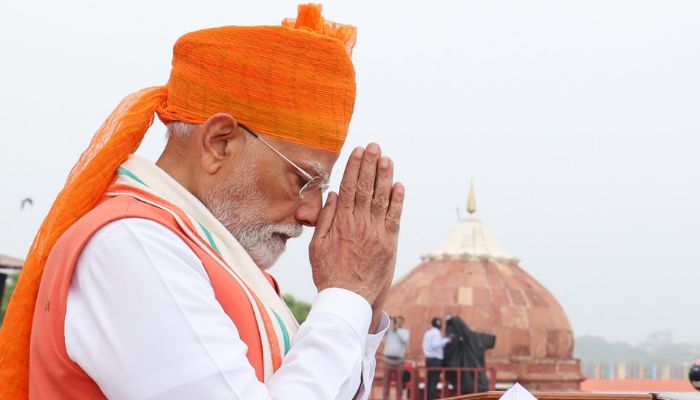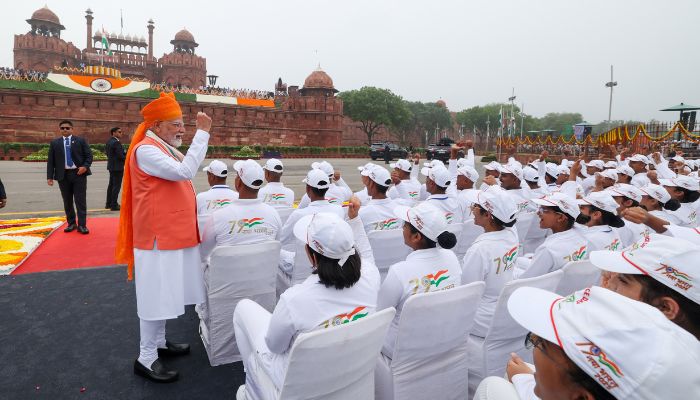
From the ramparts of the Red Fort, Prime Minister Narendra Modi on 15th August, announced the launch of a ‘High-Power Demography Mission. PM Modi raised concerns over demographic changes in border areas and said that it is a threat to national security.
PM Modi minced no words to warn the nation that a well-planned conspiracy is going on in the country to alter India’s demographic composition.
Addressing the nation on the 79th Independence Day, PM Modi warned against infiltrators affecting the livelihoods of Indian youth, targeting the sisters and daughters, and misleading tribal communities to seize land.
#WATCH | Delhi: PM Modi says, "In the next ten years, by 2035, I want to expand, strengthen, and modernise this national security shield. Drawing inspiration from Lord Shri Krishna, we have chosen the path of the Sudarshan Chakra…The nation will be launching the Sudarshan… pic.twitter.com/cQRaYeSLvp
— ANI (@ANI) August 15, 2025
Prime Minister Narendra Modi cautioned the nation about a conspiracy aiming to change India’s demography and said, “I would like to alert the nation about a concern, a challenge. Under a well-thought-out conspiracy, the country’s demography is being changed, and the seeds of a new crisis are being sown. Infiltrators are snatching away the livelihood of the youth of my country. Infiltrators are targeting the sisters and daughters of my country. This will not be tolerated. These infiltrators mislead innocent tribals and capture their land. The country will not tolerate this.
The Prime Minister further noted that changing democracy is a national threat and said, “When demographic change takes place in border areas, it causes a threat to national security…No country can hand it over to infiltrators…So, I would like to say that we have decided to start a ‘High-Power Demography Mission’.”
Prime Minister Modi’s strong remarks on demographic change come at a time when his government is cracking down on illegal Bangladeshi and Rohingya immigrants spread across the country, especially in the border states.
Amidst the Central government’s ongoing Operation Pushback, meant to detect, detain and deport illegal Bangladeshi and Rohingya infiltrators, PM Modi’s announcement of a high-powered demographic mission comes as an apt policy response to the demographic change crisis.
Much like it is in the case of grooming jihad, the Islamo-leftist cabal completely denies the existence of any deliberate scheme at play to alter India’s religious-demographic composition even as cases of Muslims like Chhangur Peer Jamaluddin running Islamic conversion rackets backed by foreign funding, are unearthed frequently and Christian Pentecostal pastors and missionaries running conversion events in the name of ‘prayer meets’.
However, demographic change is real and is taking place at a faster pace than is known. This change, however, is not only driven by illegal Muslim immigrants from Bangladesh and Myanmar but also by local factors, including differential population growth rates among different religious communities.
In Assam, the porous India-Bangladesh border has allowed illegal immigration of Bangladeshi Muslim nationals into India over the years. These Bengali-speaking Bangladeshi Muslim infiltrators obtain counterfeit documents like Aadhaar cards, ration cards, etc. After entering India, they take up menial jobs, become criminals, encroach tribal lands, harass local Indians in many cases, reproduce like there’s no tommorow and have altered the demographic balance in many districts.
The BJP government in Assam has been aggressively detecting, detaining and eventually deporting the identified Bangladeshi Muslim illegals. In 2019, the National Register of Citizens (NRC) exercise in Assam excluded around 1.9 million people from the register. The 2011 census revealed that Muslims constitute about 34% of Assam’s population, up from 30.9% in 2001, with districts like Dhubri, Barpeta, and Goalpara becoming Muslim-majority.
The influx of illegal Bangladeshi Muslim immigrants faces strong opposition from indigenous Assamese communities.
Similarly, in West Bengal, illegal infiltration of Bangladeshi immigrants is a big menace. In districts like North 24 Parganas, Murshidabad, and Malda, among others, the Muslim population has surged exponentially. The Trinamool Congress government in West Bengal is notorious for its leniency towards illegal Muslim immigrants for political gains. Other bordering states like Tripura, Jharkhand, and Jammu and Kashmir have also witnessed the influx of illegal immigrants.
In a research paper published in Economics and Political Weekly, Economist and member of the Ecnomic Advisory Council to the Prime Minister, Professor Shamika Ravi, Economists Mudit Kapoor, Sunil Rajpal and SV Subramanian, revealed that the Hindu population in a Hindu majority India is declining while the Muslim population, which political parlance is called a ‘minority’ but in reality, is second-largest religious majority, is increasing exponentially. The researchers relied on the census data on religion from 2001 to 2011 to describe the changes in religious composition across 640 districts.
The study titled “Change in Religious Composition across Districts in India from 2001 to 2011” stated that at the national level, the Hindu population came down slightly, from 80.46% in 2001 to 79.8% in 2011. But the Muslim population rose from 13.43% to 14.23%. Even Christians saw a marginal rise in their share.
The researchers found that the share of the Hindu population declined in 468 out of 640 districts of India. That is over 70% of the total districts. In 227 districts, the dip was even larger than the national average fall of 0.7%. The Muslim population increased in 513 districts, and the Christian population increased in 439 districts.
“Overall, the population growth in India from 2001 to 2011 was 17.7%. The dominant religion was Hindu in both censuses. The fastest population growth was among Muslims at 24.6%, and the lowest was among Jains at 5.4%. The share of the Hindu population declined from 80.46% in 2001 to 79.8% in 2011, a decline of approximately 0.7%. The percentage of the Muslim population increased from 13.43% in 2001 to 14.23% in 2011, an increase of 0.8%. Notably, the share of people who do not wish to state their religion has increased more than three times from 0.07% to 0.24% from 2001 to 2011,” the paper reads.
In West Bengal, beyond the menace of illegal immigration, the Muslim population has increased. In districts like Murshidabad, Malda, Uttar Dinajpur, and North and South 24 Parganas, the Muslim population grew at a higher rate than the Hindu population. Due to this, the Hindu share in these districts declined by over 1% in some districts, much higher than the national average.
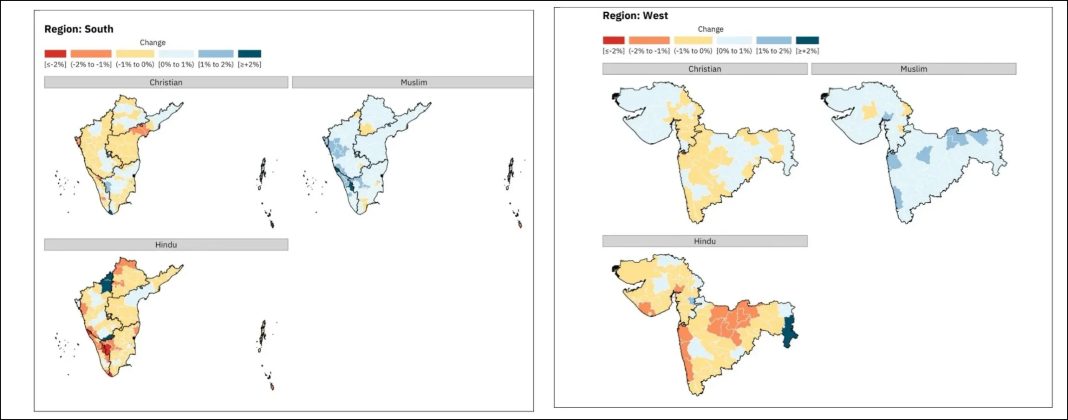
In Assam, the share of Muslims increased in most districts, especially the ones which are adjacent to Bangladesh. Dhubri, Barpeta, Goalpara, and Morigaon districts all witnessed a massive increase in Muslim populations. As discussed above, the influx of illegal Muslim immigrants, especially from Bangladesh, has been a major factor in the surge in the Muslim population here, alongside conversion. This rampant demographic change has sparked outrage among the indigenous population and fear that their lives, livelihoods, and religious and cultural identity are at risk.
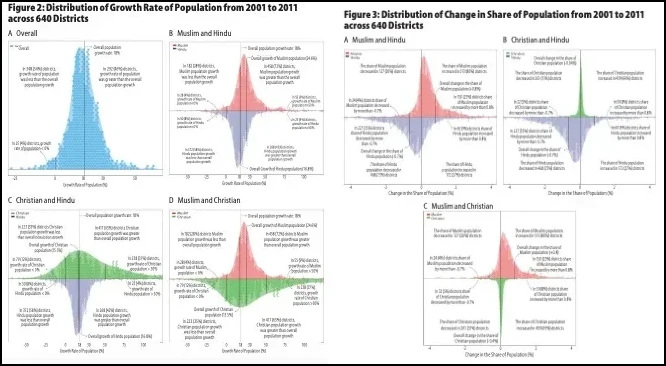
Upon comparing the distristribution of population growth rates across all districts in the country for Christians, Hindus, and Muslims, the researchers found that among the Muslims, there were 458 (72%) districts where the growth rate of the Muslim population was greater than the overall growth rate of 18%.
There were 268 (42%) districts where the Hindu population growth was greater than the overall growth rate of 18%, while for the Christians, there were 417 (65%) districts whose population growth rate was more than the overall population growth rate. It is also interesting to note that in 79 (12%) districts, the Christian population growth rate was less than zero, while the corresponding number of districts for Hindus and Muslims—where their population growth was less than zero—was 50 (8%) and 28 (4%), respectively.
“At the other extreme, we found that there were 238 (37%) districts where the Christian population grew by more than 50%, while the corresponding number for Hindus and Muslims, where their population grew by more than 50%, was 23 (4%) and 55 (9%), respectively,” the analysis published in Economic and Political Weekly (EPW) reads.
While analysing the distribution of the change in the share of the population across the districts for Christians, Hindus, and Muslims, the research found that the share of the Muslim population increased (from 2001 to 2011) in 513 (80%) of the districts.
The share of the Hindu population increased in 172 (27%) districts, and the share of the Christian population increased in 439 (69%) districts. In 150 (23%) districts, the share of the Muslim increased by more than +0.8% (the overall change in the share of the Muslim population); correspondingly for Hindus and Christians, the share of their population increased by more than +0.8% in 60 (9%) and 50 (8%) districts, respectively. In 227 (35%) districts, the share of the Hindu population decreased by more than -0.7%, while the corresponding decline in the number of districts for Muslims and Christians was 24 (4%) and 32 (5%), respectively. Clearly, the Hindu population has consistently been recording a decline, while the population of ‘minorities’, particularly Muslims, is rising.
Here are the demographic changes across districts of West Bengal, Assam and other North Eastern states of India between 2001-2011 (census). The data shows the change in shares of 3 major religions – ranging from dark red (rapid decline in share) to dark blue (rapid increase in… pic.twitter.com/3yuHrtCyd6
— Prof. Shamika Ravi (@ShamikaRavi) July 19, 2025
In the northeast states of Nagaland, Mizoram, Meghalaya, and Arunachal Pradesh, the Christian population is increasing rapidly. In 238 Indian districts, the Christian population increased by more than 50% between 2001 and 2011. It is pertinent to mention that Christian missionaries have been very active in these regions, luring non-Christian tribal populations into Christianity by offering financial inducements, jobs, education, and health benefits etc.
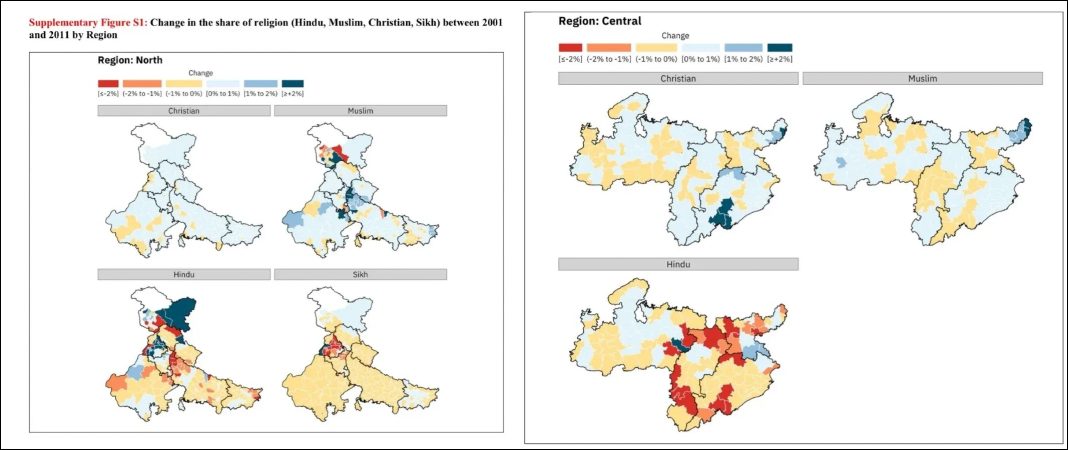
In West Bengal and Assam in the east, the Hindu population has declined and so is the case in the north-western districts of Uttar Pradesh, coastal districts of Maharashtra, Karnataka, and the Malabar region in Kerala. Similarly, in central districts in Maharashtra, Chhattisgarh, and Odisha has been a substantial decline in the share of the Hindu population.
“The central districts in Maharashtra, the coastal districts in Maharashtra, Karnataka, and the Malabar region, and the eastern districts in West Bengal and Assam experienced a substantial increase in the share of the Muslim population,” the paper reads.
The maps showing the surge and decline in India’s population based on religion present an alarming picture.
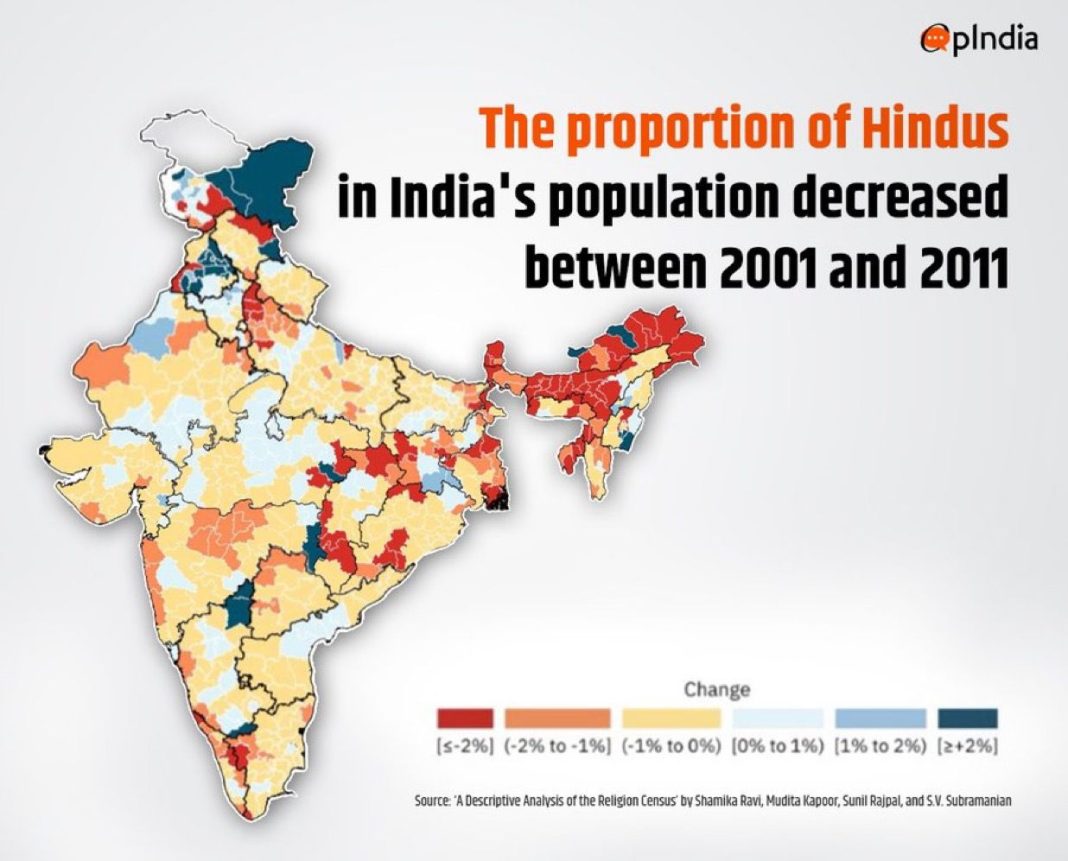
The analysis highlighted the diversity of religious changes at district levels in India is often overlooked when looking only at national or state levels. It is also essential to understand that changes in religious composition depend on the differences in growth rates between religions, not only their absolute growth, as well as the initial share of a religion in a district.
In January this year, a report published by think-tank Centre for Policy Studies (CPS), also raised concerns over possible religious-demographic imbalances in the states. The CPS report titled Religious Demography of India: Rising Religious Imbalance in the Declining Fertility Regime of Kerala, revealed that Muslims in Kerala (27% in Kerala, as per the 2011 census) overtook the Hindus, who form 54% of the state’s population in total live births after 2015. In the year 2019, out of the total live births, Muslims had a share of 44% while Hindus had a share of 41%.
Between 2008 and 2021, the share of Muslims in total live births witnessed a significant increase and in specific years, even overtook Hindus, while the Hindu community’s share in total live births dropped significantly, with similar trends recorded in Christian total live births.
The CPS report had found that between the time period of 2008 to 2019, the share of Muslims in live births has increased from 36.3% to 44.4% while the share of Hindus has correspondingly declined from 45.0 %to 41.0% and that of Christians from 17.6 to 14.3%.
In simple terms, Muslims’ share of live births in this time period increased by 8%, while that of Hindus went down by 4% and that of Christians by 3.3%. This means that the Muslim share in live births is much higher than their total share in Kerala’s population. It also found that natural accretion is highest for Muslims, declining for Hindus and Christians in Kerala.
As per a study published by the Economic Advisory Council to the Prime Minister of India, Narendra Modi (EAC-PM) last yaer, between 1950 and 2015, the population share of Hindus in India declined sharply by 7.8% while the Muslim share grew by 43.15%, Christians by 5.38%, and Sikhs by 6.58%. The share of Hindus in India’s population saw a decrease from 84% in 1950 to 78% in 2015, while that of Muslims witnessed an increase from 9.84% to 14.09% in the same period.
All these studies indicate a one-sided increase in the Muslim population while the Hindu population of the Hindu-majority India is consistently declining, with few exceptions, since India attained independence at the cost of relinquishing its territories to Muslims in 1947. India’s total fertility rate (TFR) has fallen below 2, and in several states, the situation is even worse.
These less-discussed alterations in India’s religious composition become even more disturbing when put in context with religious conversions, be it via deceit, financial allurement, Love Jihad, or other forms of coercion, and designs of those working on their sinister agenda of carrying out population jihad to outnumber the Hindu majority.
“Demography is destiny”, but why? The answer lies in history
It sounds cliché, but demography is destiny. History tells us that wherever Hindus became a minority, secularism departed. In fact, Bharat owes its secular character to its Hindu majority. Demographic changes, be it in the border states through influx of illegal Bangladeshi and Rohingya Muslim immigrants, or through rapid increase in population of Muslims compared to other religious groups, essentially threaten national security. OpIndia has reported on many occasions how Rohingyas and Bangladeshi illegals have been involved in cross-border smuggling, violent crimes and even religious conversion. Besides, they have also been capturing the livelihood, jobs, and resources of native Indians, endangering Indians in their own motherland.
Assam stands as a fitting example of how illegal immigrants encroached vast swathes of tribal lands, expelling the locals, often clashing with them. In the recent past, there have been several incidents of Muslims in Muslim-dominated areas desecrating Hindu temples by either vandalising idols of Hindu deities, dumping cow heads and other remains, etc. In June 2025, one such case was reported in Muslim-dominated Dhubri, where the severed head of a cow was found at a local Hanuman Mandir on the following day of Bakri Eid.
In addition, a dramatic alteration in India’s demography also threatens cultural erosion, as seen in Tripura, where the Hindu tribal and non-tribal population is overshadowed by Muslims. These demographic shifts have also resulted in frequent incidents of anti-Hindu violence. OpIndia reported earlier how Muslims have been carrying out temple desecration, mob violence against Hindus, slaughtering cows to incite local Hindus and whatnot, to assert their religious dominance.
Such a change in religious composition has resulted in ‘Muslim areas’ or ‘Muslim-dominated areas’, which these essentially the undeclared no-go zones for Hindus and other non-Muslim communities. There have been countless incidents wherein Muslim mobs pelted stones at Hindu processions passing through a Muslim area or near a mosque. In fact, in many cases, mobs are gathered by giving calls from mosques to pelt stones and attack Hindus celebrating their festivals or even a cricket match victory.
OpIndia has documented numerous such cases of anti-Hindu mob violence by Muslims on Ram Navami, Hanuman Jayanti, Kawad Yatra, India’s cricket world cup victory, or over the release of movies like Chhaava depicting Islamic invaders as what they were—jihadist barbarians.
While the change in religious composition of even a district is gradual, its adverse impacts are radical. There have been many cases where Muslims objected to Hindus celebrating their festivals like Holi, Diwali, Durga Pooja, Durga Visarjan, Ganeshotsav, etc, openly in Muslim-dominated areas, or even in mixed population areas, clashing and harassing Hindus.
This is not a needless villainisation but a fact that wherever the Muslim population has surpassed Hindus, the Hindu community is either forced to move away or live in fear. In Uttar Pradesh’s Sambhal, where a Muslim mob rioted last year over a survey of a disputed mosque, which is claimed to originally be the Harihar Temple, Muslims are in the majority. Here, many Hindu temples were found closed and abandoned for decades. Why? Because the Muslim majority had been illegally occupied by Muslims.
What emboldens Islamists is the political patronage they get from Muslim-appeasing political outfits, as, unlike Hindus and other non-Muslim communities, Muslims largely function as a consolidated votebank. As demographic composition changes, so do the political outcomes in specific constituencies because the dominant group dilutes the representation of the other groups. Change in demography brings change in the electorate, too.
Even in the pre-independence era, demographic changes, especially the concentration of Muslim populations in Bengal and Punjab, fuelled communal tensions, which translated into violence and political demands. History tells us how the Muslim League leveraged these demographics and pushed for separate electorates for Muslims. Being the masters of the art of divide and rule, the British granted separate electorates for Muslims, allowing them to vote only for Muslim candidates, while no such provision was made for Hindus. These separate electorates were formalised in 1909 through the Morley-Minto Reforms and expanded in the 1935 Government of India Act.
While the undercurrent of Muslim separatism was already there since Syed Ahmed Khan had in 1876 itself promulgated the wretched ‘Two-nation theory’, separate electorates essentially emboldened Muslims to pursue their agenda of carving out a country exclusively for Muslims.
Islam does not hold non-Muslims, especially idol-worshipping Hindus, in high regard; in fact, it labels them the worst of the sinners (mushriks), thus the Muslim intolerance of Hindus, Sikhs and other non-Muslim groups is not surprising. However, preferential treatment to Muslims in the form of separate electorates and the Muslim League’s capitalisation of these divisions sowed the seeds of secessionism and gave rise to the demands of Muslim autonomy.
While today, the Islamists and their liberal cheerleaders beat their chest and claim that Indian Muslims “chose” secular India over Islamic Pakistan in 1947, during the provincial elections in 1946, Muslims voted overwhelmingly for the Muslim League, which had stirred up religious passions with its demand for a separate Islamic State at the time. The Muslim League asserted that Hindus and Muslims cannot co-exist in the same country and thus, Muslims should have a country of their own carved out of India itself, post-independence.
In total, 87% seats were won by the Muslim League in India in 1946. The demand for a separate Islamic State bolstered the political demand for a separate state. Eventually, Jinnah gave the call for Direct Action Day, and bloodshed, rapes, chaos, and destruction ensued and on the corpses of countless humans, Pakistan was created.
Discussing this dark episode of history was important. Muslims assert their religious dominance in areas, even small colonies, where their population is higher than Hindus and other non-Muslims. In some states, demand reservations, resort to violence against Hindus in an attempt to force governments to fulfil their demands, as seen in the case of anti-Hindu violence during anti-Waqf Bill protests earlier this year. Partition has left a wound so deep that Indians, especially Hindus, cannot afford to entertain or allow any ideology, conspiracy or issue that endangers India’s territorial integrity. Such Muslim pockets today often have a character of “Mini Pakistan”.
Despite there being incidents of Hindus being attacked by Muslim mobs in ‘Muslim areas’ for celebrating India’s victory in cricket tournaments, Hindu festivals facing opposition from Muslims since Muslims are the majority in certain areas, yet Muslims are described as ‘victims’.
The concerns expressed by Prime Minister Modi over the changing demography are legitimate. It must be recalled that in 2021, Pew Research found that 74 per cent of Indian Muslims already prefer Sharia laws over Indian laws. With the Muslim exclusivist mindset already being mainstream, a Muslim-dominated demography will only worsen things for Hindus, because, be it Bangladeshi Islamists attacking Hindus after Sheikh Hasina’s fall, or Islamists in West Bengal attacking Hindus in Murshidabad during anti-Waqf Bill agitations, Hindus are the first casualty of Muslim dominance.
Even during the years preceding partition, Muslims, despite being driven by their religiously-mandated disdain for Hindus, portrayed themselves as victims all while carrying out atrocities on Hindus, Sikhs and other non-Muslims groups. India was partitioned on Islamic lines because the secular leadership gave in to the intransigence of the Islamic leadership. India is celebrating its 79th year of independence. While the Islamic Republic of Pakistan, which also underwent division in 1971 and Bangladesh came into existence with India’s help, has been a failed state, India has achieved remarkable all-around progress.
A lot has changed; however, this economic growth, military might, and global influence will be futile if India’s demography is altered. The government needs to address the issue of demographic change effectively. Formation of the High-Power Demography Mission is a good step in this direction, alongside fast-tracking the process of expelling illegal immigrants and implementing anti-conversion laws to foil the designs of those seeking to convert Hindus, Sikhs and other non-Muslim communities to either Islam or Christianity. It is only because Bharat is a Hindu majority (yet) that even after a bloodied partition on Islamic lines, constant attacks on the Hindu faith, political suppression and neglect of Hindus for a very long time, the country remains secular. Bharat sans Hindus is just Pakistan-in-the-making.