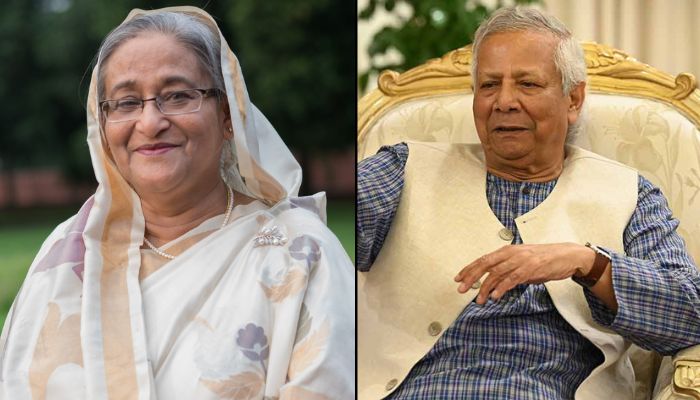
It has been 11 months since the Awami League government in Bangladesh was toppled through a well-coordinated regime change operation. The undemocratic ouster of Sheikh Hasina and her eventual escape to India meant that party leaders were left to fend for themselves against the systematic persecution by Islamists under the watch of ‘chief advisor’ Muhammad Yunus.
Numerous Awami League politicians and supporters alike were killed and tortured by violent mobs. The party was disenfranchised while its associate student and youth wings were disbanded. The Yunus regime curbed the political activities of the Awami League in the garb of ‘fighting fascism.’
Attempts were made to erase the existence of the political party and its contribution to the freedom movement of Bangladesh. As such, the future of the Awami League appeared dark and bleak. With no strong leader in its midst, worsened by popular discontentment, the story of the Sheikh Hasina-led party was written off completely.
Despite all the pessimism, the Awami League supporters are gradually rebuilding the party in the absence of Sheikh Hasina. They are taking to the streets, without fear for their safety and security, to challenge the Yunus regime and its puppets in the political arena.
Awami League supporters take NCP Islamists head-on
Such an act of resistance was on display when Awami League supporters challenged Islamists belonging to the National Citizen Party (NCP) – a political outfit comprising radicals who orchestrated the fall of Sheikh Hasina.
The incident occurred on Wednesday (16th July) in Gopalganj in the Dhaka Division of Bangladesh. Awami League supporters protested against the NCP during their ‘March to Rebuild the Nation’ programme.
Armed with sticks, they chased the Islamists who toppled the democratic Sheikh Hasina government in August 2024. The Awami League supporters chanted the slogan of ‘Joy Bangla’ and stormed the site of NCP rally.
Given that many members of the NCP served as ex-advisors to the interim government, Yunus quickly directed its security officials to curb the protests with an iron hand.
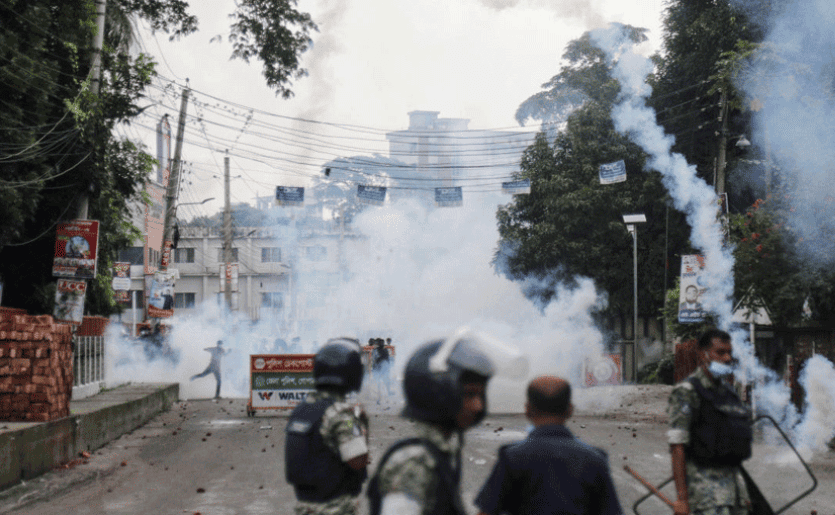
The police forces and Army officials initially fired tear gas shells and sound grenades, but later unleashed brutalities on Awami League supporters. According to media reports, Yunus’ security forces killed at least 4 protesters. A curfew was also imposed in the area.
Police and security personnel inflict brutalities on Awami League supporters, image via Reuters
Gopalganj is home to the mausoleum of Sheikh Mujibur Rahman, the Founding Father of Bangladesh. Sheikh Hasina had contested several elections in the past from this constituency.
Rattled by the protests of the Awami League supporters, the office of Muhammad Yunus stated, “This heinous act…will not go unpunished.”
Awami League rebuilding itself, with one protest at a time
In January 2025, supporters of the Awami League announced a 9-day roster of protests to bring an end to the undemocratic rule of Muhammad Yunus.
“People of Bangladesh do not want this interim government, which doesn’t have any constitutional validity, to be in power for even another day…. AL being a party of ordinary people of Bangladesh is organising the programmes to give voice to people’s concerns,” absconding Awami League leader A.F.M Bahauddin Nasim told The Telegraph
In February this year, Islamists masquerading as ‘student protestors’ launched attacks at the residence of Awami League leader Mozammel Haque in Bangladesh’s Gazipur. This prompted Awami League supporters to resist the attackers.
The Home Ministry of Bangladesh issued a statement, shrewdly labelling the clashes between the ‘student protestors’ and Awami League supporters as ‘terrorist attacks.’
Home Affairs Advisor Jahangir Alam Chowdhury declared, “Those who attempt to destabilise the country will be arrested.” The repeated dehumanisation and attempts to portray the Awami League as an ‘enemy of Bangladesh’ were soon followed by mass arrests.
? BREAKING: Early this morning, one of the coordinators of the anti-discrimination student movement(SAD), Hasnat Abdullah, and Sarjis Alam, openly ordered the MURDER of former Gazipur Mayor Jahangir Alam, Minister for Liberation War Affairs Mozammel Haque, and Gazipur District… pic.twitter.com/8sV7RQZaMj
In May this year, the Awami League protested against the decision of the Yunus regime to ban the political activities of the party.
Statement of Bangladesh Awami League in Protest of the Decision to Ban Its Activities — Today, the illegal and unconstitutional occupying fascist regime of Yunus has declared the banning of Awami League’s activities, leaving the people of Bengal stunned and outraged. This day… pic.twitter.com/i8eFY2R3Z2
— Bangladesh Awami League (@albd1971) May 10, 2025
How Muhammad Yunus oversaw persecution of the Awami League
Soon after coming to power on 8th August 2024, Muhammad Yunus chalked out plans to ban the Awami League. The plan did not go through due to fierce opposition from rival political parties.
In October 2024, the interim government banned the Bangladesh Chhatra League, the student wing of the Awami League, over supposed violence committed by its members since 2008.
In January this year, Yunus regime introduced new textbooks for primary and secondary students which falsely claim that the first declaration of independence of Bangladesh was made by Ziaur Rehman, the founder of BNP, and not Mujibur Rehman.
The ‘Nobel laureate’ has made it clear that he is willing to go to any length to distort the country’s history and erase the contribution of the Awami League in the Independence Movement.
The ‘student protestors’, who oversaw the ouster of Sheikh Hasina, had launched ‘Bulldozer procession’ outside the residence of Bangabandhu Sheikh Mujibur Rehman in February this year. They carried out vandalism and set the building on fire.
The radical elements, who enjoy the backing of the Yunus regime, also damaged murals of the founding Father of the Nation. They also carried out destruction and arson attacks on the residences of Sheikh Hasina’s late husband and cousins.
A demolished structure in front of residence of Sheikh Mujibur Rahman, image via Reuters
The ‘student protestors’ also attacked the homes of ex-President Abdul Hamid and former Bangladeshi army chief Moeen U. Ahmed. Far from condemning the vandalism, Yunus appeared to justify the actions. This explains why no ‘student protestor’ has been arrested.
He has also remained tight-lipped on attacks on Awami League leaders and the destruction of the party office.
The advisors to Muhammad Yunus such as Mahfuz Alam and Asif Mahmud Shojib Bhuyain had called for the disbanding of Awami League earlier this year.
Mahfuz Alam had announced, “The elections will be contested among pro-Bangladesh groups only.” He defined pro-Bangladesh groups as BNP, Jamaat-e-Islami etc and said that these parties would form a government through ‘fair electoral process’
“But Awami League’s rehabilitation will not be allowed in this country,” he emphasised, indicating that there are no plans to let Awami League contest elections in a ‘democratic’ Bangladesh.
Asif Mahmud Shojib Bhuyain had also declared that Awami League should be ‘eradicated politically and ideologically’ from the Islamic Republic.
He claimed, “The Awami League should not only be banned but also politically eradicated from Bangladesh. This is my personal stance. Now, discussion may take place on how it will be implemented. There are precedents of this in various countries”
“I have seen my brothers martyred by their [AL men] firing before my eyes. I have been a victim of disappearance; I have seen death up close. It is impossible to even think of the political rehabilitation of Awami League,” Bhuyain brazened out.
Islamist Sarjis Alam, who is close to the Yunus regime and now part of the NCP, had also demanded a blanket ban on the Awami League.
“We cannot hold voters accountable for the crimes of the party. However, the registration of the Awami League as a political party must be completely revoked,” Alam had declared.
Around the same time, Muhammad Yunus launched a campaign to hunt down Awami League (AL) leaders from across the country. The nefarious mission has been dubbed ‘Operation Devil Hunt.’
As part of the political witch-hunt, as many as 12,000 Awami League supporters and activists were put behind bars. The centrally supervised campaign was executed by the police, Bangladesh Army, Navy, Air Force, Border Guard Bangladesh (BGB), Ansar and the Coast Guard.
In May this year, the Yunus regime finally banned the Awami League under the Anti-Terrorism Act, days after the NCP launched a march to ensure the disbanding of the political party.
In July 2025, Awami League leader Sheikh Hasina was sentenced in absentia to 6 months in prison for ‘contempt of court’ by the Yunus-controlled Bangladesh International Crimes Tribunal (ICT).
Conclusion
Muhammad Yunus was tasked to lead Bangladesh following the undemocratic ouster of former Prime Minister and Awami League supremo, Sheikh Hasina.
He was expected to take the Islamic Republic on the path of ‘democracy’ in the politically turbulent time.
However, the regime of the Nobel laureate is busy pandering to Islamists, ensuring the revival of the opposition BNP and crushing the Awami League with an iron fist as part of a well-thought-out political strategy.
Despite his all-out efforts aimed at gutting Bangladesh’s premier political party, the Awami League is rebuilding itself slowly and steadily in the absence of Sheikh Hasina.
“Khabardaar! Baap hain hamare!”. This dialogue from a hit Bollywood movie sums up the outrage by the Islamo-leftist coterie over the revised NCERT books that reflect on the atrocities of Mughals. This discontinuation of the sanitisation, humanisation and glorification of Islamic invaders has triggered the All India Muslim Personal Law Board (AIMPLB), leftist ‘historians’ and the usual Mughal cheerleaders.
Before delving into the left-liberal meltdown over the much-needed pedagogical shift in the school textbooks published by the National Council for Research and Training, it is important to understand what revisions have been made in the syllabus.
From whitewashed ‘secular’ history to a factual ‘jihadist’ truth of Mughals: NCERT revamps syllabus
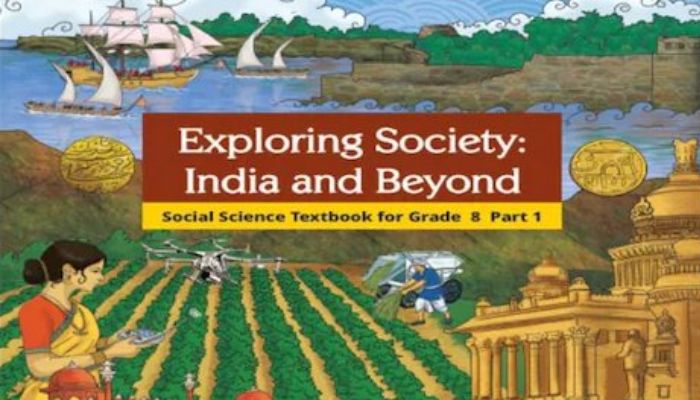
Akbar’s reign was a “blend of brutality and tolerance”, while Aurangzeb was a military ruler who banned “un-Islamic” practices and reimposed taxes on non-Muslims. This is how the new NCERT Class 8 Social Science textbook describes Mughal tyrants.
The book, to be introduced in schools from the 2025-26 academic year, marks a shift in tone in its portrayal of the Mughal emperors. It offers detailed accounts of bloodied conquest, religious decisions driven by Islamic fundamentalism, cultural contributions, and Jihadist brutality.
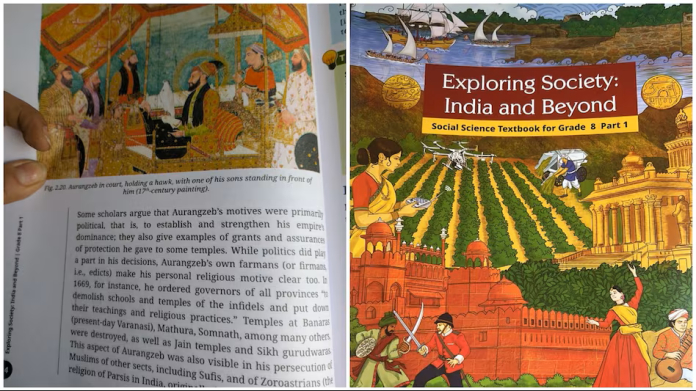
Source: NCERT
The NCERT has defended the inclusion of such details, saying: “While those happenings cannot be erased or denied, it would be wrong to hold anyone today responsible for them… Understanding the historical origin of cruel violence, abusive misrule, or misplaced ambitions of power is the best way to heal the past and build a future where, hopefully, they will have no place.”
The chapter, ‘Reshaping India’s Political Map,’ which discusses Indian history from the 13th to the 17th century, spans the rise and fall of the Delhi Sultanate and the resistance to it, the Vijayanagara Empire, the Mughals and the resistance to them, and the rise of the Sikhs.
The book traces the Mughal rise, beginning with Babur, described as “a Turkic Mongol ruler and military strategist,” who defeated Ibrahim Lodi at Panipat in 1526, using gunpowder and field artillery, effectively ending the Delhi Sultanate. Babur’s son, Humayun, struggled to hold the empire, briefly losing it to Sher Shah Suri.
The book recounts how Hemu, a Hindu general under the Suri regime, briefly ruled Delhi under the title Hemchandra Vikramaditya, before being captured and beheaded by Akbar’s forces after the Second Battle of Panipat. Akbar was declared emperor at 13 after Humayun’s accidental death, set out to consolidate the subcontinent.
The book describes his rule as a “blend of brutality and tolerance, shaped by ambition and strategy”. During the siege of Chittorgarh in 1568, Akbar ordered the massacre of some 30,000 civilians and the enslavement of surviving women and children.
It quotes from his own victory dispatch: “We have succeeded in occupying a number of forts and towns belonging to the infidels and have established Islam there… With the help of our bloodthirsty sword, we have erased the signs of infidelity from their minds and have destroyed temples in those places and also all over Hindustan.”
The book also talks about the ‘Jaziya’ tax. It is said that it was imposed on non-Muslims (Hindus) by some Muslim rulers. According to the book, this tax also became a cause of public humiliation for them.
According to the new book, this tax served not only the purpose of asserting dominance over non-Muslims, humiliating them, but also creating a financial and social pressure to convert to Islam. In the old book of class 7, Jaziya was described as a tax collected along with land tax, while the new book presents it as an independent and separate tax on the basis of religion.
Alongside military campaigns, Akbar abolished the jizya, welcomed Rajput nobles to his court, and promoted sulh-i-kul – or “peace with all”. He established a translation bureau at Fatehpur Sikri and commissioned the Persian translations of the Mahabharata (Razmnama), Ramayana, Bhagavad Gita, and Panchatantra.
His spiritual and political evolution is captured in a quote recorded by his biographer Abul Fazl: “Formerly I persecuted men into conformity with my faith and deemed it Islam. As I grew in knowledge, I was overwhelmed with shame. Not being a Muslim myself, it was unmeet to force others to become such.”
His successors, Jahangir and Shah Jahan, are noted for their patronage of art and architecture, with Shah Jahan remembered for building the Taj Mahal. But the book does not skip over political violence: it details the succession battles following Shah Jahan’s illness, in which Aurangzeb defeated his brother Dara Shikoh, executed rivals, and imprisoned his father.
Aurangzeb’s reign is described as the Mughal Empire’s period of greatest territorial expansion, though marred by constant warfare. His religious orthodoxy and policies, the book states, shaped the tone of his rule: “He gradually banned practices he regarded as un-Islamic, such as music and dance in his court, and reimposed the jizya tax on non-Muslims as well as a pilgrimage tax on Hindus travelling to their sacred places (both of which had been abolished by Akbar).”
It details the destruction of Hindu temples by Islamic jihadist invaders in Banaras, Mathura, and Somnath, and the persecution of Jain, Sikh, Sufi, and Parsi communities.
The revised textbook includes a preface directly addressing why such dark episodes of Islamic jihadist fanaticism have been retained: “History sometimes seems to be full of wars and destruction… Should we omit them entirely? … The best approach is to face them and analyse them so as to understand what made such developments possible and, hopefully, help avoid their recurrence in future.”
“It is important to study those darker developments dispassionately, without blaming anyone living today for them… The past continues to live with us and shapes the present.”
In addition to inculcating a more factual than whitewashed version of the Mughal dynasty, the revised NCERT syllabus also highlights the anti-Hindu actions and policies of the pre-Mughal Islamic invader-turned-rulers. Notably, the NCERT has added a “No one should be held responsible today for events of the past” disclaimer in the book.
The new book mentions that Malik Kafur, the Military General of Alauddin Khilji (Khalji dynasty), who reigned between 1296-1316, “attacked a number of Hindu centres such as Srirangam, Madurai, Chidambaram, and possibly Rameswaram”.
According to the book, the purpose of these attacks was not only looting, but also idol-breaking, i.e. destruction of religious symbols was its main objective.
The new NCERT book also contains a detailed description of the Maratha Empire. In this chapter, Shivaji is described as a skilled strategist and a visionary leader. He is described as a pious Hindu who respected other religions and rebuilt desecrated temples. The Marathas have been considered an important contributor to the cultural development of India. In the old book, Shivaji was described only as an efficient administrator and the founder of the Maratha state, but in the new book, his religious and cultural views have also been given importance.
The new book depicts in detail the rise and fall of the Delhi Sultanate, the Vijayanagara Empire, the rule of the Mughals, the resistance against them and the rise of the Sikhs. It is also worth noting that earlier, the Delhi Sultanate and Mughal history were taught in Class 7.
But now, with the changes in the new syllabus structure, it has been included in class 8. This new book is more critical, analytical and fact-based than ever before. It openly assesses the religious and military policies of the rulers, information about which was given only lightly in the earlier books.
NCERT’s revised syllabus on Mughals and other Islamic invaders triggers left-liberal meltdown
For long, leftist-Marxist historians like Romila Thapar, Ramchandra Guha, and Irfan Habib, among others, dominated the discourse on History in independent India. Their works often whitewashed the anti-Hindu Jihadist fanaticism of the Islamic invaders. While leftist historians eulogised almost all Islamic invaders from the Mamluks, Khaljis, Tughlaqs, to Lodhis and even attempted to justify the destruction of Hindu temples, levying jizya taxes and persecuting the native non-Muslim populace, their limerence for Mughals remained unparalleled.
Unsurprisingly, the left liberals are having a massive meltdown over the NCERT’s revised syllabus. They are claiming that Mughals are being ‘villainised’ by the ‘Hindu nationalist’ Modi government.
In this vein, Ruchika Sharma, a self-declared historian, appeared on IndiaToday’s program hosted by another Mughal fanboy, Rajdeep Sardesai, wherein she lamented that the NCERT syllabus has classified certain time periods as ‘dark ages’. She also claimed that several revisions in the new syllabus are “factually incorrect”. She also appeared on AajTak and made similar claims.
Is politics dictating school syllabi? Is this an attempt to villainize the Mughals? Or is this course correction by the NCERT?
However, it turned out that her own claims were factually incorrect. Sharma claimed that Akbar’s reign began in 1560 and that within two years of rule, Akbar abolished the Jizya tax. In reality, Akbar’s reign began in 1556, and he abolished the Jizya tax in 1564, that is, eight years after his coronation. It is also widely recorded in the historical accounts that Akbar ordered the massacre of 30,000 Hindus after capturing the Chittorgarh Fort in 1558.
The ‘wannabe Audrey Truschke’ with eye shadows also claimed that Jizya was simply a tax levied by the Muslim rulers; however, it was not a mere tax. The ‘jizya tax’ was a special kind of tax imposed on non-Muslims, primarily Hindus, with high rates. This cruel Islamic tax was a kind of reminder to the ‘kafirs’ that they are living in a Sharia-governed Muslim land.
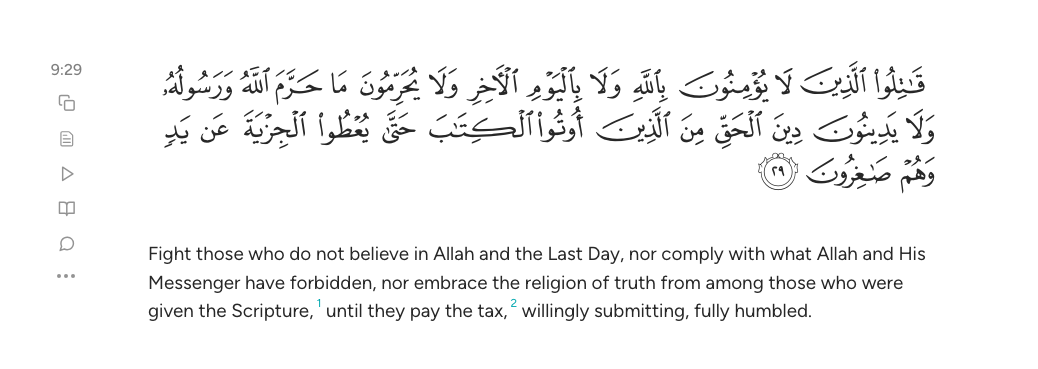
She asked what the primary source of the NCERT’s assertion was that Jizya was imposed to incentivise the conversion of non-Muslims to Islam. Well, if we actually go into finding the ‘primary source’ for this, it is the Islamic holy book Quran. Surah Tawbah (Chapter 9), verse 29 says: “Fight those who do not believe in Allah and the Last Day, nor comply with what Allah and His Messenger have forbidden, nor embrace the religion of truth from among those who were given the Scripture, until they pay the tax, willingly submitting, fully humbled.”
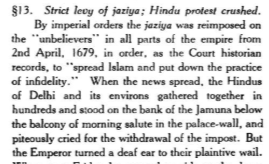
In his book History of Aurangzeb, noted historian Jadunath Sarkar mentions that Aurangzeb reimposed Jizya to spread Islam. By imperial orders the jaziya was reimposed on the “‘unbelievers’’ in all parts of the empire from 2nd April, 1679, in order, as the Court historian records, to ‘‘spread Islam and put down the practice of infidelity.” When the news spread, the Hindus of Delhi and its environs gathered together in hundreds and stood on the bank of the Jamuna below the balcony of the morning salute in the palace-wall, and piteously cried for the withdrawal of the impost. But the Emperor turned a deaf ear to their plaintive wail.”
Excerpt from Jadunath Sarkar’s book History of Auranzib Vol. III
In her desperate attempt to justify the brutalities inflicted by Mughals on Hindus, especially Akbar’s ordering of the massacre of Hindus in Chittorgarh Fort, Sharma claimed that even Hindu kings looted, plundered and killed people when they invaded other territory. However, she conveniently skipped the fact that Hindu kings never forced anyone to convert to their religion or follow their traditions, while Muslim invasions were mostly driven by the Jihadist desire to convert Dar-ul-Harb into Dar-ul-Islam.
Amusingly, Sharma was trying to factcheck the NCERT, but ended up spinning lies about Chhatrapati Shivaji Maharaj. She claimed that when Chhatrapati Shivaji Maharaj invaded Chikka Devaraja Wodeyar-ruled regions in southern Karnataka, he also plundered and ravaged the region. However, contrary to her imaginary claims, Shivaji Maharaj (1630–1680) and Chikka Devaraja Wodeyar (r. 1673–1704), though contemporaries, were never involved in any military conflict. The Marathas under Chhatrapati Shivaji Maharaj and the Wodeyars of Mysore were no adversaries. She also peddled lies about the Aryan Invasion Theory and the Indus Valley Civilisation, even as historical and scientific sources have debunked this theory.
Meanwhile, Professor Mohammad Suleman, founding member of the All India Muslim Personal Law Board (AIMPLB), has also expressed his chagrin over the revised NCERT syllabus of social science textbooks.
“Those in power, regardless of organization or ideology, are distorting history. It is well known and no secret. A country or society can only progress when history is viewed in its true context. Unfortunately, in our democratic setup, it is disheartening that those in power are rewriting history with distortions…” Suleman said.
Kanpur, UP: On changes in the NCERT 8th-grade social science textbook, Prof. Mohammad Suleman, founding member of the All India Muslim Personal Law Board (AIMPLB) says, "Those in power, regardless of organization or ideology, are distorting history. It is well known and no… pic.twitter.com/jJKKJlO8He
While the Islamo-leftist cabal is lamenting the NCERT’s revision of the social science syllabus, netizens largely welcomed the pivot towards educating students about the real, brutal but balanced history of India, especially the medieval history.
Lauding the NCERT, an X user wrote, “Finally NCERT shows some spine to tell the truth of Mughals & other invaders – new class 8 History textbooks to clearly talk about Mughal atrocities.”
Finally NCERT shows some spine to tell the truth of Mughals & other invaders – new class 8 History textbooks to clearly talk about Mughal atrocities pic.twitter.com/85Y6992zcl
Another one wrote, “This the best educational reform ever in the history of Bharat since 1947. After coming up with Mahakumbh and Bharat’s sacred geography, these are the best amendments done in NCERT books.”
This the best educational reform ever in the history of Bharat since 1947. After coming up with Mahakumbh and Bharat's sacred geography, these are the best amendments done in NCERT books.https://t.co/uMeVA6I9cH
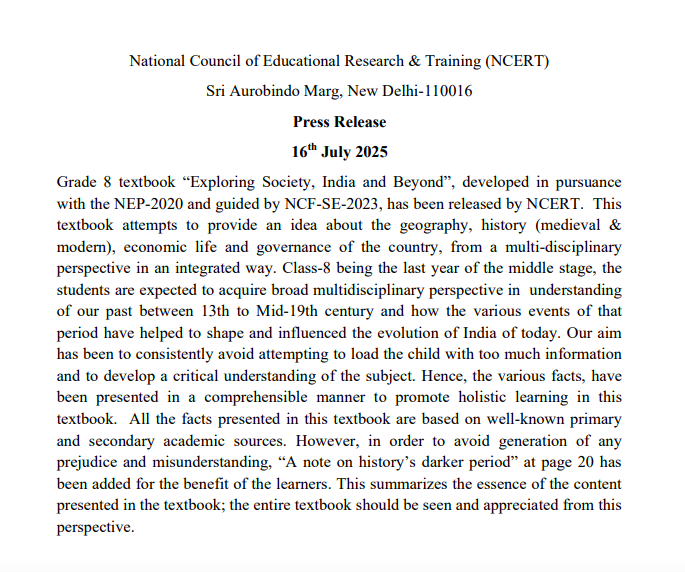
Amidst the controversy, the NCERT has clarified that the modifications made in the syllabus were necessary and that the facts stated were “based on well-known primary and secondary academic sources”.
In context of the changes made in the Class 8 book, titled ‘Exploring Society: Indian and Beyond’, which highlights “instances of religious intolerance”, the NCERT said, “This textbook attempts to provide an idea about the geography, history (medieval & modern), economic life and governance of the country, from a multi-disciplinary perspective in an integrated way.”
The NCERT further stated that the council intends not to burden the students without information overload and to develop critical thinking.
“Class 8 being the last year of the middle stage, the students are expected to acquire broad multidisciplinary perspective in understanding of our past between 13th to Mid-19th century and how the various events of that period have helped to shape and influenced the evolution of India of today,” the NCERT said in a press statement.
“A cautionary note has been inserted in one of the chapters to make it clear that no one should be held responsible today for events of the past. The emphasis is on an honest approach to history with a view to drawing from it important lessons for a better future,” the NCERT added.
Why changes in syllabus on Mughals, Sindhu Saraswati Civilisation, and integration of Indic knowledge systems in the NCERT textbooks triggering left liberals?
The NCERT has been revising the syllabus of textbooks of all the classes, aligning with the National Education Policy 2020 and the National Curriculum Framework 2023. The NCERT has integrated Indic knowledge with modern science into the syllabus of various classes, aiming to deepen students’ connection with India’s rich religious, and cultural diversity. The Indian Knowledge System is woven into the content and illustrations, enabling children to appreciate and connect with the vibrant culture and heritage of the country.
Recently released by the NCERT for the 2025-26 academic year, the textbook titled ‘Veena’ has been developed in line with the National Education Policy (NEP) 2020, aiming to connect students with both India’s scientific future and its civilisational roots.
One of the standout chapters, “Ganga ki Kahani,” captures the river’s journey from Gomukh to Gangasagar, taking readers through places like Haridwar, Varanasi, Prayagraj, and Kolkata. It offers more than just geography, narrating tales of ashrams, sadhus, and the grandeur of the Kumbh Mela, while also introducing cities like Patna and Kanpur, blending cultural, spiritual, and economic perspectives.
A chapter titled “AI” introduces students to the basics of Artificial Intelligence, how machines are trained to think, learn, and problem-solve like humans. It’s designed to spark curiosity and scientific thinking among middle schoolers.
While the NCERT’s push towards blending Indic knowledge and cultural heritage in the school textbooks has already discontented the leftist cabal, the fresh changes to present a balanced, fact-based, non-glorified history of the Islamic invaders have triggered this lot.
The left liberals, especially the historians, have long presented a glorified portrayal of Islamic invaders, particularly, Mughals. From accrediting them with bringing culture, food, music and ‘civilisation’ to whatnot, the leftist ‘scholars’ have always downplayed the role of Hindu rulers and the Hindu resistance against the Islamic invaders. In their bid to gloss over the brutalities of the Islamic tyrants, the leftist ecosystem created a loop of ‘citations’ to lend credence to their fictitious version of history to paint the Mughals as largely secular, liberal and peace-loving administrators.
And now, when the Central government is moving outside the loop of lies created by the leftist historians to provide the students with fact-based education about the history of India and its past rulers, the same Mughal apologists are crying hoarse.
Their outrage over the revised social sciences syllabus mirrors their earlier objections to renaming the Indus Valley Civilisation as the Sindhu Saraswati Civilisation, claiming that the ‘Hindu nationalist’ Modi government is pushing a Hindu-centric view of history.
The concerted efforts of the Islamo-leftists to discredit and downplay Hindu history, be it the glorious past, the Vedic era or the brutalities they were subjected to and fought against in the medieval era at the hands of Islamic invaders and tyrants, are now falling apart.
The Aryan Invasion Theory, which suggests that the foreign Vedic Aryans invaded the Indian subcontinent and clashed with the native Dravidians, displacing the existing Indus Valley civilisation, was debunked. The discovery of Vedic religious elements at Harappan sites, the absence of archaeological evidence for a violent invasion, as well as genetic studies showing limited Steppe ancestry in India, have devastated the Aryan Invasion Theory propagators. So far, the studies have hinted at cultural continuity rather than a disruptive and violent foreign incursion. Moreover, many scholars are of the view that the Vedic and the Harappan cultures could have been contemporaneous or even identical.
On one hand, the Aryan invasion narrative was debunked, on the other, the meticulously crafted pro-Mughal narrative has also been exposed in recent times. Leftists hold everything anti-Hindu dear, and even the slightest opposition to or deviation from their narrative devastates them. For long, the Marxist historians have projected Mughals as some sort of reformist and unifying forces against a so-called ‘regressive’ Hindu social order. They discredit Hindu history, dismiss anti-Hindu atrocities as exaggerated or contextually justified, to align with their ‘secular’ narrative that opposes Hindu ‘majoritarianism’. Probably, the left liberals want the younger generations, especially the Hindus, to remember only the imaginary goods of the Muslim rule and forget the brutal realities of those times.
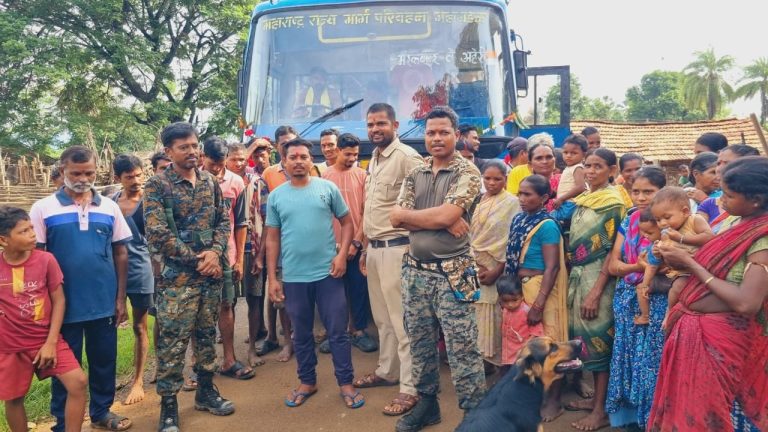
Marking a significant feat in the restoration of normalcy in the Markanar village of the Gadchiroli district in Maharashtra, once a Naxal-affected area, a state-run bus service to the village commenced for the first time since independence.
As the first bus arrived in the Markanar village on Wednesday (16th July), villagers cheered and welcomed it by waving the national flag. This was the first time the villagers had seen a bus service arrive in the village in over 7 decades since independence. The bus service started by the Maharashtra State Road Transport Corporation (MSRTC) will connect the area with the state transport network. According to a police release, about 1200 locals, including students, from Markanar and the nearby villages of Murumbhushi, Phulnar, Koparshi, Poyarkothi and Gundurwahi will benefit from the bus service. Next year, the bus service is expected to reach Murumbhushi.
“We were able to launch the MSRTC bus service after Markanar and the adjoining areas adopted the government’s ‘gaobandi’ scheme, banning entry of Maoists in return for development schemes. Commandos began reclaiming liberated zones and extended protection to road construction and the setting up of mobile phone towers. The rest is history now,” said SDPO Bhamragarh division Amar Mohite.
— AIR News Mumbai, आकाशवाणी मुंबई (@airnews_mumbai) July 16, 2025
Mohite said that earlier, the MSRTC bus linked Aheri to Kothi via Bhamragarh, but now, after the construction of a road, the bus will travel another 5 km to Markanar. “Barely 800m are left to link remote Murumbhushi to Markanar. Security forces provided cover to labourers and equipment, but the rains halted work,” the SDPO said.
Markanar village is situated at the foothills of Abujhmad, a former Naxal stronghold, in Bhamragad subdivision of the Gadchiroli district. The bus service, which will run from Markanar to Aheri, is said to have become a reality with the efforts of the local police. The district has struggled with poor connectivity and transport for a long period of time due to the Maoist activities.
Central and State governments working to uproot left-wing terrorism
The central and state governments, along with the security forces, are making collaborative efforts to uproot naxalism and connect naxal-affected areas with the mainstream. Earlier this month, the Maharashtra government introduced a bill titled the Maharashtra Public Security Bill 2024 to curb the spread of the Maoist ideology in the state. While presenting the bill in the state assembly, Maharashtra CM Devendra Fadnavis said that the Bill is meant to punish those who wish to overthrow the established institutions of the country. Explaining the reasons for the introduction of the Bill, Fadnavis said that the influence of the Maoist ideology is growing in the urban and rural areas of the state, particularly in districts like Gadchiroli and Konkan.
The central government had adopted a multipronged strategy to eliminate the menace of left-wing terrorism, including aggressive military operations and development efforts. The government has also been working towards strengthening security as well as civil infrastructure in the Naxal-affected areas by setting up security camps and enabling development projects.
Last year in January, the central government launched ‘Operation Kagar’ to completely eradicate the left-wing terrorism in Chhattisgarh, Maharashtra (Gadchiroli), Odisha, Jharkhand, Madhya Pradesh and Telangana. Under the operation, around 1 lakh para-military troops, including the Central Reserve Police Force (CRPF), its elite CoBRA units, District Reserve Guards DRG), and state police, equipped with modern technology, have been deployed in the left-wing terrorism affected areas to completely uproot the naxal terrorism from its last remaining strongholds. The security forces have been successful in eliminating the top leadership of the Naxal cadres under the operation, pushing the left-wing terrorism to the verge of extinction.
An alarming incident has been reported from Kota of Rajasthan where a minor girl, who was preparing for NEET, fell victim to the nefarious plan of a young Muslim man. He befriended her while concealing his true name and religion and attempted to lure her out of Kota. The accused identified as 25-year-old Razak, masqueraded as Adi. He is originally from Uttar Pradesh.
He has been arrested and the matter is being viewed as an incident of “love jihad.” The offender formed a friendship with the student on social media and attempted to lure her out of Kota through deception. While en route, she grew suspicious and successfully saved herself.
The girl then proceeded immediately to the police station. The cops detained him and brought him to Kota, after obtaining information. She was presented before the Child Welfare Committee. The members counselled her and then handed her over to her family. Child Welfare Committee Chairman Rajendra Singh Rathore stated that the underage girl believed the lies of the perpetrator who introduced himself as Adi on Instagram and tricked her.
Rathore added that the culprit travelled to Kota to meet her and then persuaded her to leave with him. According to him, the former broke her SIM card to ensure that no one could track them down. Nevertheless, she became wary of him when he was speaking to someone at his home. She noticed that the language he used sounded different and suspected he was a Muslim.
The girl managed to take the mobile phone from him and shared all the details with her elder sister who instructed her to promptly visit the nearest police station. With assistance from the driver, she arrived at the police station and recounted the entire occurrence after which Adi’s reality was exposed.
He was nabbed and is currently being questioned at the Bilal Kundi police station. He even lied about his age and claimed to be 18 years old. Given the gravity of the case, the cops are conducting an extensive investigation and more significant revelations pertaining to the case are expected.
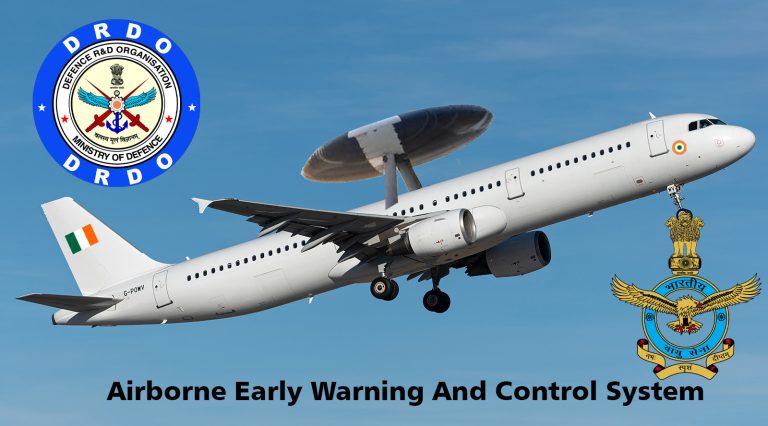
The Union government has granted approval for the production of next generation airborne early warning and control system, giving a much needed boost to the Indian Air Force. As per reports, IAF will get six AWACS aircraft under the project expected to cost around ₹20,000 crore. These command and control centres in the air will have the capabilities of tracking enemy aircraft and ground based threats at long distances, besides guiding IAF fighters during a battle.
These AWACS planes will be built on Airbus A321 planes bought by IAF from Air India. The Defence Research and Development Organisation (DRDO) will partner with multiple Indian firms and Airbus to integrate a sophisticated radar antenna and related systems onto the A321 aircraft, which served as passenger planes in the past. The AWACS planes carry a big distictive radar antena above their fuselage.
These planes will undergo extensive structural modifications, including the installation of a dorsal radar fin, to enable full 360-degree radar coverage. The main component that will turn the planes into AWACS is Airborne Early Warning and Control System (AEW&CS), also known as Netra. The second generation of the system, Netra MK-II, will be installed on the A321 planes.
The conversion of the passenger jets will reportedly take place in a Airbus facility, either in France or Spain. Seats and everything related to commercial operations will be removed, the fuselage will be structurally strengthened to accommodate the heavy radar and sensor arrays. The active electronically scanned array (AESA) radar panels are big and heavy, and therefore structural modification is required.
Moreover, an auxiliary power unit will be installed to meet the increased power demand of the systems, the cockpit instrumentation will be overhauled to military specifications, and consoles will be installed in the belly for mission operators. The planes will get active noise cancellations systems for efficient operations.
This is a crucial move enhancing the Indian Air Force’s (IAF) operational reach, elevating India into an elite group of nations with indigenously developed airborne surveillance technology.
The AWACS project represents a major leap in indigenous defence capabilities. While it reinforces the spirit of the “Make in India” initiative, it also moves a step ahead by embracing “Design and Develop in India”, marking a shift from simple manufacturing to full-scale innovation and systems integration.
As per a report by The Economic Times, the estimated time of completion of the project is three years. After completion of the project, it will benefit India by giving Indian companies hands-on experience in developing and integrating complex systems.
AWACS: the eyes in the sky
The Netra MkII, part of the AWACS India programme spearheaded by DRDO, has gained fresh momentum following government approval for the prototype production of India’s fifth-generation Advanced Multirole Combat Aircraft (AMCA).
These aircraft effectively operate as battle managers and early warning systems, coordinating air fights, spotting impending threats and providing real-time intelligence to interceptors and command centres. Their primary functions are air defence command and control as well as long-range radar surveillance. They can detect, track and identify air and surface contacts over long distances because of their enormous radar dome.
In a notable shift, this marks the first instance of an Airbus platform being used for such a mission, an area traditionally dominated by Boeing. This strategic move could also open up potential export avenues in the future.
At present, the Indian Air Force operates smaller Netra airborne warning systems built on Brazilian Embraer 145 aircraft, which have demonstrated their effectiveness in past conflicts with Pakistan. The IAF also fields three IL-76-based ‘Phalcon’ systems, developed jointly with Israel and Russia, although these have faced recurring issues related to availability and technical reliability.
The government signalled to work on the indigenous project to build six AEWC air aircraft in 2021, which will act in modern warfare as powerful “eyes in the sky”, to bolster the IAF’s surveillance capability, especially along the borders with China and Pakistan.
The Cabinet Committee on Security on September 8, 2021, approved the project of DRDO, which will entail mounting indigenous 360-degree coverage AESA (active electronically scanned array) radars on six Airbus-321 passenger aircraft to be acquired from the existing Air India fleet.
TOI reported, the IAF felt the operational necessity for more such aircraft during the aerial skirmish with Pakistani fighters in February 2019 after the cross-border Balakot air-strikes. The recent attack at Pahalgam has further accentuated the need.
Top government sources has rubbished the recent report by the Wall Street Journal and told CNN-News18 that there’s no justification for twisting the cockpit conversation in this way. They emphasized that no evidence so far suggests the fuel cutoff was deliberate. They also noted that the senior pilot, Captain Sumeet Sabharwal, has a strong aviation background. He was the son of a retired Civil Aviation Ministry official. “There is no basis to suggest he was under any kind of stress.”
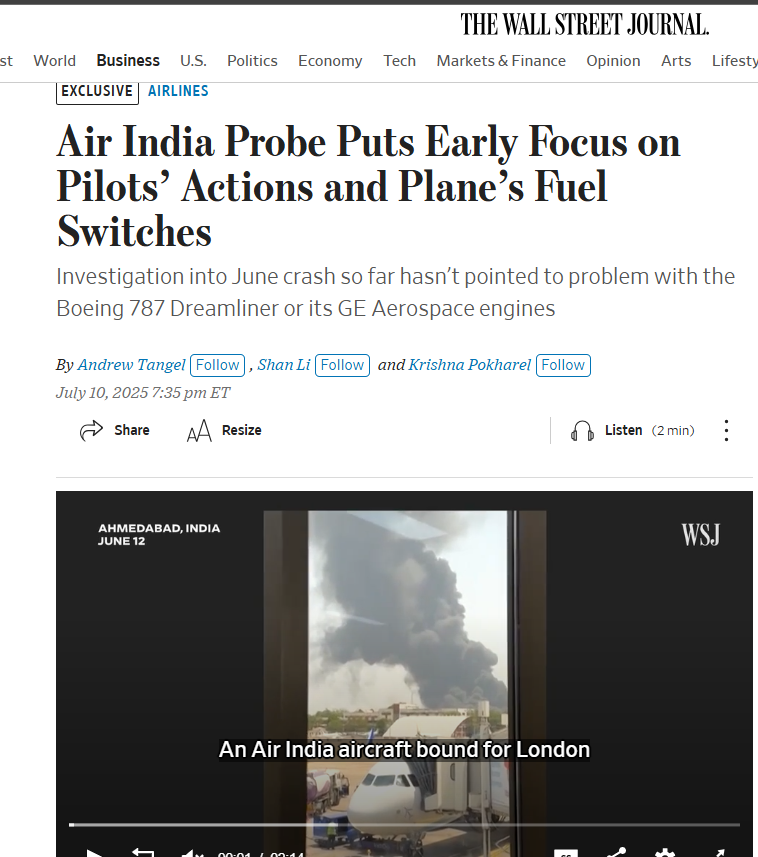
The Wall Street Journal’s recent article on the Air India crash on the June 12 crash of Air India flight AI171, which killed 260 people, is again at fault for what many are describing as a “deliberate attempt” to deflect blame from American plane manufacturer Boeing and place it on Indian pilots, even though no new facts have been discovered since the interim investigation report came out.
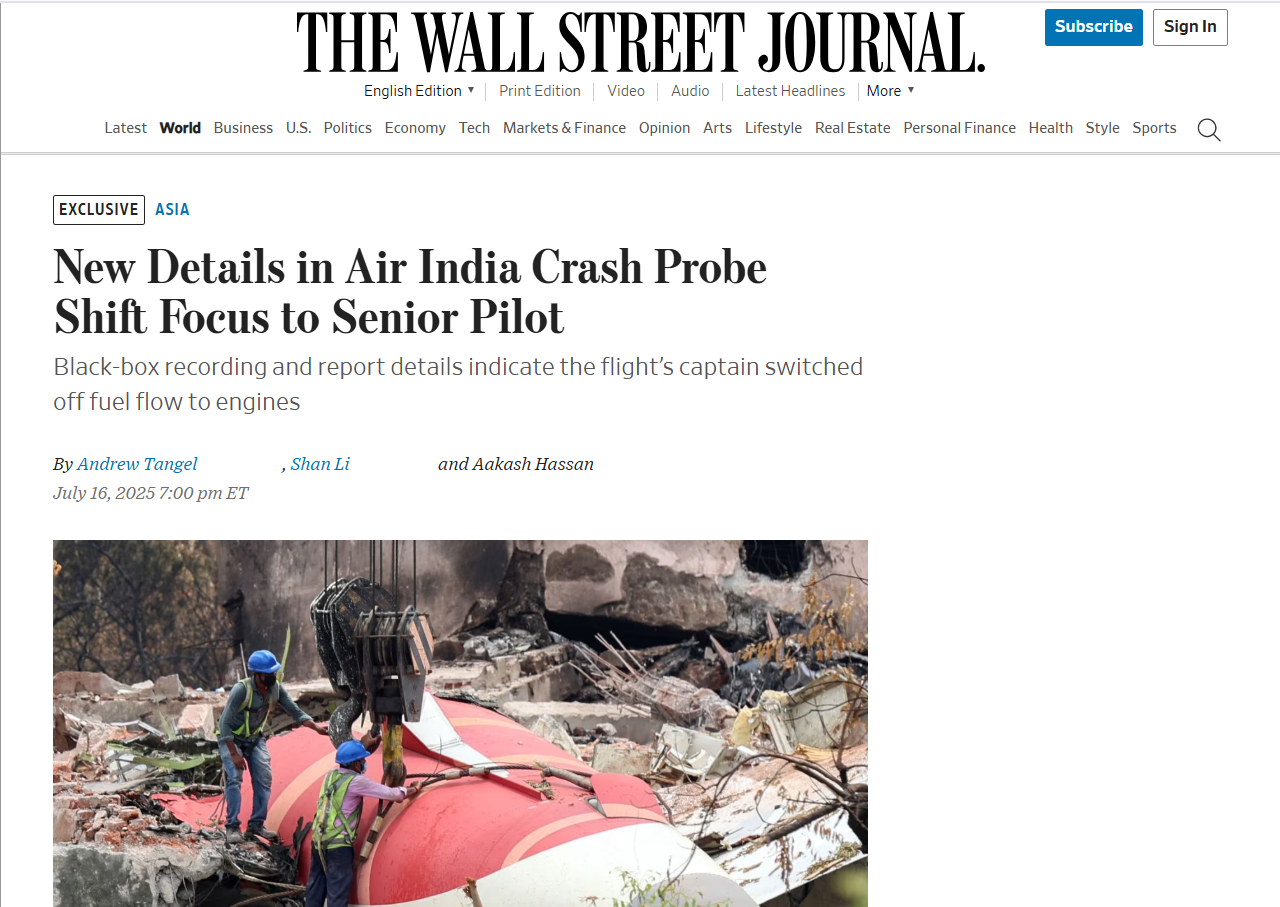
The Wall Street Journal’s recent article centred on cockpit voice recordings, asserting that it was the senior pilot, Captain Sumeet Sabharwal, who shut off the fuel controls in mid-air. Yet this assumption is founded on what amounts to speculation rather than any firm facts. India’s Aircraft Accident Investigation Bureau (AAIB) never actually identified which pilot flipped off the switches, if indeed it was done at all.
WSJ attempts to twist the narrative
The initial AAIB report did say that one pilot asked the other if the switches had been turned off, and the other pilot said no, but it did not identify these voices with names. The Wall Street Journal took it a step further, reportedly based on “people familiar with U.S. officials’ early assessment”, to identify the calm pilot as the captain and the hysterical one as the co-pilot. This subtle but important turn of events creates the impression that the captain might have either intentionally or accidentally caused the crash, although the official Indian report makes no such inference.
Exclusive: The captain of the doomed Air India flight likely switched off fuel flow, a black-box recording indicates, remaining calm while the first officer panicked https://t.co/C4kPTu9obN
This is not the first time the Wall Street Journal has leapt to Boeing’s defence. It was only a few days since the crash when the Wall Street Journal published an article on 10th June saying, “The probe into last month’s Air India disaster is targeting the behaviour of the jet’s pilots and does not yet indicate a flaw with the Boeing 787 Dreamliner.” Once again, they referenced anonymous US officials to imply that the US-made plane had nothing to do with the crash.
WSJ’s pattern of deflection
This seems like a trend in the way the Wall Street Journal covers aeroplane crashes with Boeing. The story tends to shift rapidly towards “pilot error” before thorough data are analysed. In the present instance, both Air India pilots, Captain Sabharwal, who had more than 15,000 hours of flying experience, and First Officer Clive Kunder, who had over 3,400 flying hours, were experienced.
However, rather than dwelling on potential technical defects, design faults, or maintenance issues, the American media is opting to raise doubts regarding the behaviour of the cockpit crew.
What does the report say?
Indian authorities, however, have been more nuanced in their approach. The initial 15-page report by AAIB, released last week, provided an exhaustive technical analysis. It happened that the Boeing 787-8 Dreamliner departed from Ahmedabad to London and had only just crossed 180 knots when the two engines lost power instantly. The two engine fuel control switches were toggled from the “RUN” to the “CUTOFF” position one second apart from each other, resulting in full engine shutdown.
Although the switches were turned back on about 10 seconds later, the plane had already started losing altitude and crashed shortly after, killing 260 people, including 19 on the ground. Only one person survived.
The Ram Air Turbine (RAT), which automatically deploys in case of total power loss, was found to be deployed by the report, which further confirms that both engines had failed. Notably, the AAIB report eliminated the possibility of a bird strike or obstruction during takeoff. The engines and important components are currently undergoing detailed scrutiny.
Investigation still in progress, but media trial already underway
Though Indian officials have yet to determine if the switch-off was a technical glitch, pilot mistake, or potentially a design flaw, the WSJ is in a rush to throw fingers. Air India CEO Campbell Wilson has already advised workers and the press against making hasty assumptions. He correctly noted that the investigation is far from over and is still being conducted.
US officials, such as Jennifer Homendy of the National Transportation Safety Board (NTSB), have not made a conclusive statement holding the pilots responsible, either. Homendy stated that the aim is to find out if there is any urgent safety threat to other Boeing 787 flights quickly. No safety notice from Boeing or the FAA has been made so far for the Dreamliner.
Former NTSB official Ben Berman has suggested that the flipping of both fuel switches only a second apart may have appeared intentional, yet even he does not go so far as to call it pilot error. That’s because, before the engines shut off, there were no indications of trouble or distress in the cockpit.
Pilots object to WSJ and US Media reports
Meanwhile, the Federation of Indian Pilots (FIP) raised concerns about how the preliminary report was interpreted and presented publicly by WSJ and other Western media.
“At the outset, we would like to register our dissatisfaction with the exclusion of pilot representatives from the investigation process… Assigning blame before a thorough, transparent, and data-driven investigation is both premature and irresponsible,” the statement said.
On Thursday, 17th July, Several opposition parties called for a statewide bandh in Odisha. The Bandh has been called to protest the self-immolation death of Soumyashree Bishi, a 20-year-old student at Fakir Mohan Autonomous College in Balasore. The political firestorm ignited by the tragedy intensified with revelations that Congress’ student wing orchestrated online harassment campaigns against the victim, even as senior party leaders positioned themselves as champions of justice.
The crime branch takes command of the investigation
On Wednesday, 16th July, the Odisha police handed over the case to the Crime Against Women and Children Wing (CAW&CW). DSP Iman Kalyan Nayak has been appointed as the chief investigating officer. He is very well known for handling sensitive cases. He will be supported by Inspector Panchali Rout. The team will function with the powers of the Officer-in-Charge of Sahadev Khunta Police Station, where the case was originally registered.
This investigation focuses on the charges under Section 75(1)(iii) for sexual harassment, Section 78 for Stalking, Section 108 for abetment to suicide and Section 351(2) for criminal intimidation of Bhartiya Nyaya Sanhita.
Authorities confirmed the probe will re-examine evidence and witness statements while scrutinizing the role of college authorities. “There is sufficient evidence against the two (Principal Dillip Ghosh and HoD Samir Kumar Sahoo) to prove abetment of suicide,” a senior police officer revealed.
A desperate final act
On 12th July, Soumyashree’s ordeal reached its peak when she set herself on fire outside Principal Ghosh’s chamber. CCTV footage obtained by police shows that the victim entering Ghosh’s office crying, staying for approximately 30 minutes, and emerging weeping before her final act. Minutes earlier, she had reportedly called a friend, revealing the principal was pressuring her to withdraw her sexual harassment complaint against HoD Samira Kumar Sahoo.
As per the friend, earlier the principal had asked for more timem, but did nothing even after 7–8. “In fact, he warned the victim of consequences if she failed to prove her complaint,” the friend said.
That friend said that she was trolled by juniors, who called her a “bad girl” on social media and campus and assassinated her character. “On June 30, us friends accompanied her for support. She had gone to the principal earlier too, but wasn’t heard. On June 30, we all went with her to demand action. The principal asked for 7-8 days but did nothing. The HoD instigated students to defame her.”
On 14th July, despite emergency treatment at AIIMS Bhubaneswar, Soumyashree succumbed to her injuries due to 95% burn injuries. Her death certificate listed the immediate cause as “septicemic shock” resulting from extensive burns, but the underlying causes traced back to alleged institutional betrayal.
Statewide Bandh demands accountability
A statewide Bandh was called in Odisha on Thursday, 17th July, led by the Congress party with the support of Left factions and other opposition parties. Shops remained shut and traffic was disrupted in many areas, including Bhadrak and Mayurbhanj. In Bhadrak, markets were closed and public transport was affected. Over 200 police platoons were deployed statewide to maintain order.
Protesters brandishing placards with Soumyashree’s image blocked highways and staged rail roko demonstrations. They demanded the resignation of the Education Minister, local MLA, and MP, Immediate termination of accused college officials, and a Judicial probe into institutional failures. OPCC President Bhakta Charan Das framed the bandh as moral rather than political: “Every school, college, and university is at risk if we don’t act now”.
VIDEO | Bhubaneswar, Odisha: Normal life affected, traffic disrupted on NH-16 due to statewide bandh (shutdown) called by opposition parties, including Congress over Balasore student student self-immolation case.
Once again hypocrisy of the Congress party has emerged when their leaders marched in protest. Rahul Gandhi spoke with Soumyashree’s father, calling the incident “a wound to the entire society” and blaming the “BJP’s system” for her death. But it has been revealed that members of the Congress students wing NSUI themselves were harassing the girl.
As per the victim’s friend who talked to media, Soumyashree was used as a political tool by opposition student union NSUI.
Documents and social media archives reveal that the National Students’ Union of India (NSUI), the student wing of the Congress party, launched a malicious online defamation campaign against her when she was alive. NSUI-affiliated accounts circulated posts branding Soumyashree as “Unstable and manipulative” for political gains, engaged in an “affair with the Education Minister for favours”, fabricating allegations to “gain sympathy marks”.
NSUI member Ajay Kumar Panda made a vile post claiming that Soumyashree has a transactional relationship with a senior minister. This post went viral, shattering Soumyashree’s morale and will, isolating her socially and psychologically. Taking to X, BJP spokesperson Sanju Verma shared pictures of Sourav Behera, an NSUI worker and Rahul Gandhi fan, calling him an accused in the 20-year-old girl’s self-immolation. Verma suggested that the deceased victim was associated with the BJP’s student wing ABVP and claimed that the victim was being harassed by Behera.
An Investigation was conducted by ABVP (BJP’s student wing) which shows images of the accused HoD, Dr. Sahu, dining comfortably with NSUI leaders.
This is Sourav Behera of NSUI
Sourav is an acolyte of Rahul Gandhi &like most Congressis,he is violently intolerant
He is one of the key accused in tragic self-immolation case of student (ABVP) at FM College in Odisha
Meanwhile, CPI(M) leader Suresh Panigrahi demanded judicial intervention, saying, “The victim appealed to everyone from local MLA to Education Minister… nothing happened”.
Family’s anguish amid digital persecution
Speaking to India today, Soumyashree’s father broke down, he said, “She did this after coming out of principal’s room. Something must have happened. I was not there…My daughter was forced to die. They should all be charged.”
Soumyashree’s brother filed a formal complaint at Bhograi Police Station, citing continued cyber-harassment even after her death. He stated, “People are making derogatory remarks and posting filthy posts… In our bad times, we are being made to bear this unnecessary trolling”. The FIR names four individuals for exploiting the tragedy politically and disseminating defamatory content.
On Tuesday (16th July), a police complaint was filed by a Hindu woman against one Aman Khan in Jabalpur city of Madhya Pradesh for inappropriately touching her and forcing her to convert to Islam.
According to reports, the victim worked as a receptionist at a local gym named Sai Fitness Gym, where the accused Aman Khan worked as a trainer.
As per the Station-in-charge Praveen Kumre, the victim said that Aman Khan used to inappropriately touch her and hurl abuses. Khan also used to force her to convert to Islam, and explain the ‘benefits’ of converting to Islam.
When she refused to convert, Aman Khan threatened that her that he would make her quit her job. She said that several women who worked in her position in the past had to quit because of Aman’s harassment.
The victim said that she complained about Aman’s behaviour to the gym owner earlier, but nothing happened. Thereafter, the victim approached the members of the Hindu Tiger Force, who accompanied her to the police station, where she filed a complaint.
The members of the organisation surrounded the police station and demanded swift action against the culprit. Subsequently, the police reached the gym to arrest Aman Khan, but he had fled by the time they arrived.
Police kept searching for him at several places, including his residence, but he was not found. Later on, on receiving the information that the accused had gone to the gym to take his things, the police reached the gym and nabbed him there.
The accused has been sent to judicial custody. A case under the relevant provisions of the Madhya Pradesh Freedom of Religion Act, and section 75 of the BNS has been filed against the accused.
Mukesh Rajak, a member of the Hindu Tiger Force, said Aman Khan used to hide his identity and pose as ‘Aman Raj’ before the women who used to come to the gym for training.
Sanjana Vishwakarma, a member of the Hindu Tiger Force, said that for a long time, the organisation has been receiving complaints about women being touched inappropriately while training at the gym.
But none of them came out to file a formal complaint out of fear. She said that the organisation had asked the administration to shut down the gyms that do not have female trainers.
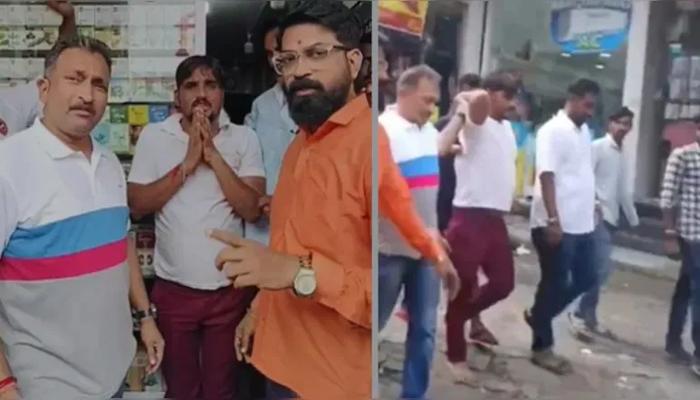
In another incident of language violence, a shopkeeper in Mumbai’s Vikhroli was assaulted by workers of the Maharashtra Navnirman Sena (MNS) over a WhatsApp status. The status was deemed to be offensive to the Marathi-speaking community.
The Rajasthani shopkeeper had posted a WhatsApp status that read, “Dekh liya Rajasthani ka power. Hum Marwari hamare saamne kisi ki nahi chalti” (Witnessed the power of a Rajasthani. No one can stand before us Marwaris).”
Later, a video came into light that depicts the shopkeeper being forced to apologise publicly. He was also threatened and physically attacked. The assault took place in the Tagore Nagar area of Vikhroli, a bustling suburb in Mumbai. This highlights the latest series of confrontations involving MNS workers over Marathi identity.
The WhatsApp status shows bragging of Marwari dominance over Marathi people, according to the local MNS workers, which has sparked outrage amongst them. The alleged video shows the man being slapped and verbally berated by them. The workers demanded that he apologise to the Marathi community for his remarks. In the footage, the shopkeeper is seen holding his ears and pleading, “I will not repeat such a mistake.”
The MNS workers issued a serious warning to him that if he posts any further messages against Marathi people, whether by him, his family, or his employees, he will meet serious consequences. The video of his assault was recorded, edited, and circulated, including a Marathi song in the background and a caption that reads: “This is how people will be treated if they say or write or speak anything against the Marathi people.”
The MNS logo is prominently displayed, a move that directly contradicts Raj Thackeray’s public directive to his workers to avoid recording such incidents. During a recent address, Mr Thackeray had instructed party members to refrain from filming their actions to avoid legal repercussions.
This is not an isolated example of MNS workers forcefully imposing their power on the Marathi language. On July 12, a similar incident was followed when an auto driver, Raju Patwa, who hails from Uttar Pradesh, was slapped by a group, including women, on a busy road near Virar railway station. The police have registered a case against 20 persons, including office bearers of Shiv Sena (UBT) and MNS, for assaulting the autorickshaw driver over his anti-Marathi remarks and refusal to speak the language.
Uday Jadhav, the Virar city chief of Shiv Sena (UBT), was present at the scene and later defended the assault, stating, “If anyone dares to insult the Marathi language, Maharashtra, or Marathi people, they will get a reply in the true Shiv Sena style.”
Shiv Sena (UBT) chief Uddhav Thackeray and Maharashtra Navnirman Sena (MNS) chief Raj Thackeray have come together after nearly 2 decades. They seem to be aligned together against the Hindi language after a bitter family fight lasting decades.
Reacting to Maharashtra Chief Minister Devendra Fadnavis’ statement that attacking random shopkeepers for not knowing Marathi is hooliganism, Uddhav Thackeray said, “Mr Fadnavis said we won’t tolerate hooliganism for language. If a Marathi manus (person) is asking for justice, and if you are calling us goons, then we are goons.”
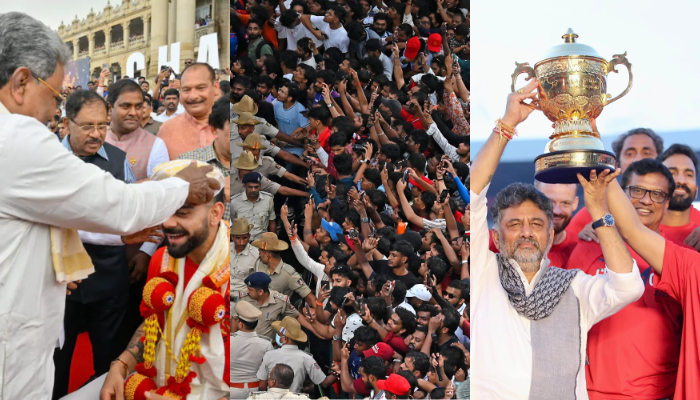
The High Court received the Karnataka government’s report on the stampede in Bengaluru that killed eleven people. However, Royal Challengers Bengaluru (RCB) has been held accountable for the tragedy by the Congress administration. They submitted that the crowd was invited ‘unilaterally’ and ‘without consultation or permission’ from the local authorities, to Chinnaswamy Stadium for a victory parade.
The Karnataka High Court ordered the report to be made public and rejected the state government’s request to maintain its confidentially, concluding that there were no legitimate reasons to agree to their appeal. According to the report, on 3rd June when the team eventually managed to clinch the IPL trophy after 18 years, its management called the police and told them about a potential victory parade.
“This was in the nature of an intimation, not a requisition for permission as required under the law,” it insisted and added that permissions of this kind must be secured at least seven days prior to the event. It aruged that the applicant or organizer failed to submit any applications to the licensing authority in the required formats. Therefore, the license-granting authority was unable to grant them a favourable consideration in the absence of the information that was needed in the formats specified.
The report read, “Accordingly, the PI of the Cubbon Park Police Station did not grant the permission to the request made by KSCA on 03.06.2025 at around 6.30 pm, due to a lack of information regarding the expected approximate gathering, arrangements made, possible bottlenecks, and the like, for both possible outcomes of the final match, i.e., whether RCB won or lost.”
Report cites RCB’s social media posts
According to the report, at 7:01 am the following day, RCB shared a picture on its official social media accounts “informing that there is free entry for people and inviting the public to participate in the Victory Parade, which would commence at Vidhana Soudha and conclude at Chinnaswamy Stadium” without first consulting the police.
The report then referred to similar posts that the team had shared on social media. It asserted, “Subsequently, on 04.06.2025, at 8:55 am, the RCB shared a video clip of Virat Kohli, a prominent player of the RCB team, onteam’s official handle @Rcbtweets on X, in which he stated that the team intended to celebrate this victory with the people of Bengaluru city and RCB fans on 04.06.2025 in Bengaluru.”
It further conveyed, “Thereafter, RCB made one more post at 3:14 p.m on 04.06.2024, announcing a Victory Parade to be held from Vidhana Soudha to Chinnaswamy Stadium from 5:00 PM to 6:00 PM, stating that this victory parade would be followed by celebrations at Chinnaswamy Stadium. This post mentioned, for the first and only time, that free passes (limited entry) were available on shop.royalchallengers.com, and until this point, there had been no information regarding the disbursement of passes, implying that the event was open to all based on RCB’s prior posts.”
The report mentioned that the posts from the RCB handles had a total of 44 lakh views and attracted an extensive amount of traction online. It stressed, “This led to a public gathering of immense proportions, exceeding 3,00,000, individuals. One basis for estimating the crowd size is the BMRCL ridership numbers for 04.06.2025, which transported around 9.66 lakh persons on that date (with the average ridership on regular days being around 6 lakh persons per day). Therefore, including those who travelled on foot, used public transport, and private means on 04.06.2025, the estimated gathering would be well beyond 3,00,000, individuals.”
Large crowds flooded the streets
According to the report, a significant number of people had gathered along the roads from HAL Airport, the team’s landing location, to Taj West End which was their destination, a distance of around 14 kilometres, besides the crowd that had assembled in and around the Chinnaswamy Stadium. “This created a need for extensive deployment of police personnel en route to manage such crowds and prevent any mishaps,” it pointed out.
The report stated that netizens shared visuals of this spontaneous crowding which intensified the mood and attracted more individuals to the stadium and on the way there. It contended, “This impromptu gathering of crowds on the roads necessitated the urgent deployment of large numbers of police personnel along the routes, in addition to those required at the stadium and surrounding areas. This situation arose due to a lack of proper planning by the Organisers and the failure to provide the necessary information in advance to the concerned authorities.”
The report informed that there was an unexpected spike in the number of persons near Chinnaswamy Stadium on 4th June at approximately 3 pm. It highlighted, “Around 3,00,000 individuals gathered in this limited space, far exceeding the stadium’s capacity of merely 35,000. Such a crowd concentrated at the entry gates of the stadium following posts made by the RCB/organisers on their official handles stating that entry to the event would be free for all.”
The report accused that the situation exacerbated when the organisers, RCB, DNA and KSCA in charge of gate control failed to open the gates in a timely manner and in an uncoordinated manner, causing agitated throngs to line up at the gates. “This prompted the crowd to force their way into the stadium by breaking open Gate Nos. 1, 2, and 21, due to complete mismanagement by the organisers,” it added.
Stadium gates 02, 2A, 6, 7, 15, 17, 18, 20, and 21 “experienced sporadic stampedes,” based on the report. Furthermore, it lauded the authorities and claimed, “In every instance mentioned, the police personnel at and around the gates responded immediately and effectively to regain control and deescalate the situation.”
Justification for not cancelling the celebrations
A sudden closure of the stadium’s victory celebrations “could potentially incite violence among the gathered crowd and adversely affect overall law and order across the city,” according to the report and hence the event was not stopped. It alleged that “a measured response was taken by curtailing the duration of the function. Instead of complete termination, a measured approach was adopted by allowing the event to proceed with significantly curtailed duration and enhanced monitoring.”
The report indicated that the decision was made after considering all factors involved. It stated, “This tactical decision considered the evolving ground situation, crowd psychology, the massive scale of gathering, and the information asymmetry amongst the assembled masses.”
The report further argued, “The risk of large-scale rioting both within the stadium premises and throughout Bengaluru necessitated this careful balancing approach, prioritizing overall public safety over immediate event cessation. It is common and known in Law & Order situations, that cancellation of anticipated events can incite the crowd tremendously and lead to widespread mob violence, as has been seen in several events were such decisions have been taken.”
CAT blames RCB
Royal Challengers Bengaluru (RCB) was previously found guilty by the Central Administrative Tribunal (CAT) for the stampede, claiming that the event was staged without the required permits. The Karnataka government’s suspension order against senior IPS officer Vikash Kumar Vikash, who was the subjected to the disciplinary action following the incident, was also overturned by the tribunal in its ruling.
The order pronounced, “Prima facie it appears that the RCB is responsible for the gathering of about three to five lakh people. The RCB did not take the appropriate permission or consent from the Police. Suddenly, they posted on social media platforms and as a result of aforesaid information the public were gathered. Because of shortage of time on 04.06.2026, the Police was unable to do the appropriate arrangements. Sufficient time was not given to the Police.”
On 24th June, the tribunal’s Bengaluru bench which included administrative member Santhosh Mehra and Justice B K Shrivastava, reserved its decision.
DCP’s letter exposes Congress government
Despite the government’s report about the instance, an official letter has already exposed how the Congress governemnt was eager to capitalize on the success of the RCB while disregarding all the warnings.
MN Karibasavana Gowda, the Deputy Commissioner of Police (DCP) for Vidhana Soudha, had protested against holding the RCB felicitation ceremony on the grand staircase of Karnataka Vidhan Soudha. He had brought attention to security issues, including a paucity of personnel in the security wing of Vidhan Soudha, inadequate time for preparation actions and the absence of CCTV at the crucial facility.
“As the Royal Challengers Bangalore team has a large fan following across the country, holding the felicitation at the grand steps of Vidhana Soudha may attract lakhs of cricket fans, potentially creating security challenges due to a shortage of officers/staff in the Vidhana Soudha security wing,” the official wrote in a 4th June letter.
He stated, “The event is to be held at 4:00 PM on 04.06.2025. There is a high chance that Secretariat officers/staff may bring their family members to the venue. Therefore, it is requested that orders be issued prohibiting staff from bringing families and declaring an afternoon holiday for Secretariat staff on the said date. Further, they should be instructed not to attend the event venue.”
He even highlighted, “Coordination with the Law & Order and Traffic Police departments is essential for such a large-scale event, and the current time frame seems inadequate for full preparedness. All online and offline passes for public entry to Vidhana Soudha be completely restricted on that day.”
The top cop asserted, “Organisers should be informed to make the stage available for inspection at least two hours in advance. As electrical equipment will be used at the event, a fitness certificate must be obtained from the concerned PWD (Electrical) Assistant Executive Engineer. A formal letter should be sent to them for this purpose.”
He emphasised that the government’s decision should be definitive and any harm to the heritage building Vidhan Soudha must be avoided at all costs. However, the government sought to profit off RCB’s 2025 IPL championship. For this, two events were organised. The Chinnaswamy Stadium hosted one and Karnataka Vidhan Soudha’s grand staircase hosted the other.
The event was approved by Congress to be held on 4th June, in the Legislative Assembly. A Rs 10,000 sanitation charge, a Rs 15 lakh refundable deposit and liability for any damage were demanded of the organisers.