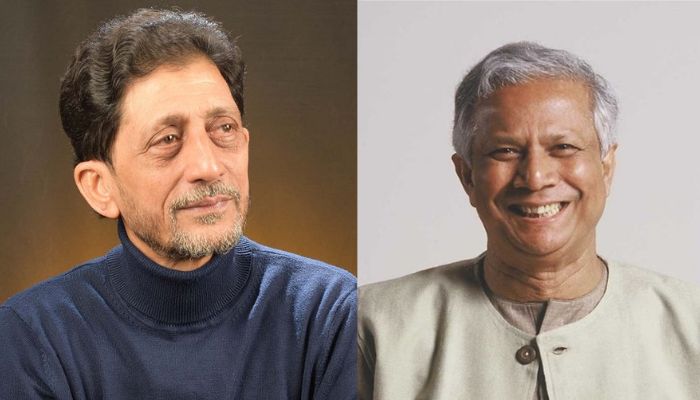
The Muhammad Yunus regime has yet again targeted intellectuals living in Bangladesh. On Thursday (9th July) night, the police arrested renowned economist Abul Barkat from his residence in the Dhanmondi area of Dhaka.
The development was confirmed by Md Nasirul Islam, the Joint Commissioner of Dhaka Metropolitan Police Detective Branch.
A case was registered against Abul Barkat in February this year by the Anti-Corruption Commission (ACC) of the Yunus regime. The renowned economist was made an accused in a case of embezzlement of funds worth Tk 297.34 crore.
ACC alleged that Abul Barkat, during his stint as the chairman of Janata Bank Ltd (2009-2014), granted loans to 22 companies of AnonTex Group through ‘forgery’ and ‘fraud’ in collusion with the ex-Governor of Bangladesh Bank.
It claimed that Barkat created false records to embezzle money, approved loans against non-existent buildings and factories and overvalued purchased land.
Abul Barkat is the former president of the Bangladesh Economic Association. He is an Economics Professor at the University of Dhaka.
The renowned economist has previously been bestowed with the ‘Order of the Rising Sun’ by the Japanese Government.
He has been a member of Transformation, Integration and Globalization Economic Research’s (TIGER) Scientific Research Advisory Board since 2021.
No Hindus will be left in Bangladesh after 30 years: Abul Barkat
In November 2016, Abul Barkat wrote a book titled, ‘Political economy of reforming agriculture-land-water bodies in Bangladesh.’
He warned that if the rate of exodus of the minority Hindu community continued, then there would not be any Hindus left after 30 years, i.e. 2046.
While speaking about the matter to Dhaka Tribune, “The rate of exodus over the past 49 years points to that direction.”
Abul Barkat highlighted that on average, 632 Hindus leave Bangladesh each day (~2,30,612 annually). He stated that 1.13 crore Hindus left Bangladesh between 1964 to 2013 due to discrimination and religious persecution.
He pointed that the exodus was at peak during the reign of military in Bangladesh, post independence in 1971.
During the book launch, it also came to light 60% of the Hindu population in Bangladesh were rendered landless by the government after their lands were classified as ‘enemy property’ before 1971 and ‘vested property’ after Independence.
Abul Barkat dedicated his book to his friends from childhood, who belonged to ‘Buno’ tribe, but have no trace now.
Muhammad Yunus tired to appease Islamic extremists
Bangladesh witnessed a drastic rise in Islamism after Yunus came to power. He first revoked the ban on the radical Islamist outfit ‘Jamaat-e-Islami.’
Thereafter, he released the leader of the radical outfit ‘Ansarullah Bangla Team (ABT)’ Muhammad Jasimuddin Rahmani.
At the same time, Muhammad Yunus downplayed the targeted attacks on the Hindu community by violent Muslim mobs. He has gone on record from lamenting about attacks on Hindus to saying that the claims of atrocities are ‘exaggerated‘.
In that way, the controversial US asset was able to placate Islamic extremists. Given that Awami Legaue was against Islamism, the interim government first banned its student wing ‘Chhatra League,’ and then the parent party.
Under the watch of Muhammad Yunus, Bangladesh saw a drastic rise in vigilante Muslim mobs, which unleashed violence under the pretext of protecting the tenets of Islam.
These mobs were largely unorganised and called themselves ‘Tawhidi Janata (meaning Revolutionary People).’ They came under the spotlight over acts of vandalism and harassment of people.
The Yunus regime introduced new textbooks for primary and secondary students, which falsely claimed that the first declaration of independence of Bangladesh was made by Ziaur Rehman (a favourite icon of Muslim hardliners in Bangladesh).
The interim government also appointed a Hizb ut-Tahrir terrorist named Mohammad Azaz as the administrator for the Dhaka North City Corporation (DNCC).
The situation had become so grim that Bangladeshi ambassador to Morocco Mohammad Harun Al Rashid was forced to slam the Muhammad Yunus-led interim government in a scathing Facebook post in March this year.
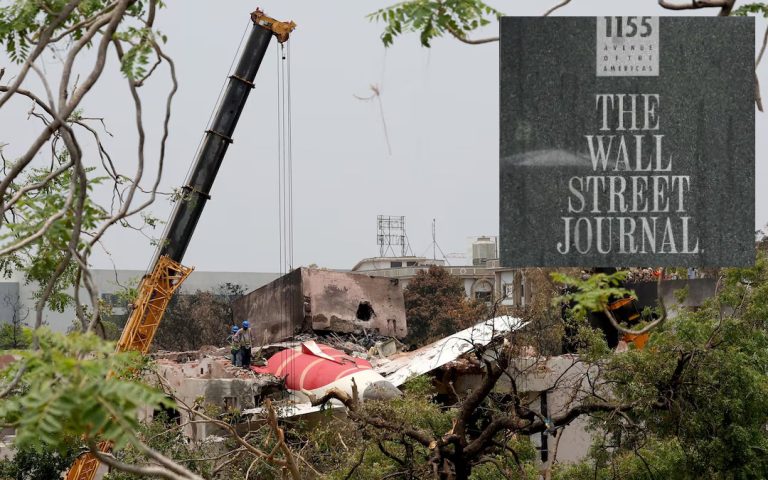
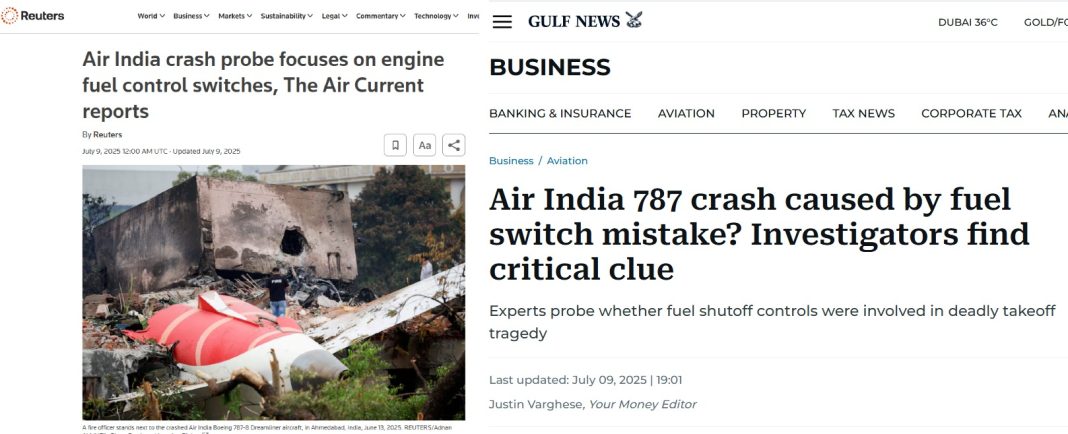
The Air India 787-8 Dreamliner aircraft manufactured by Boeing crashed on 12th June 2025 in Ahmedabad just after take off. Over 250 people died in this accident, leaving a lone survivor. While the Indian authorities are investigating the cause behind the deadly crash, the US-based newspaper The Wall Street Journal has already blamed the Air India pilots. The American media’s haste to blame the Indian pilots reeks of Boeing’s well-worn playbook: deflect, distract and dodge accountability even before the facts land.
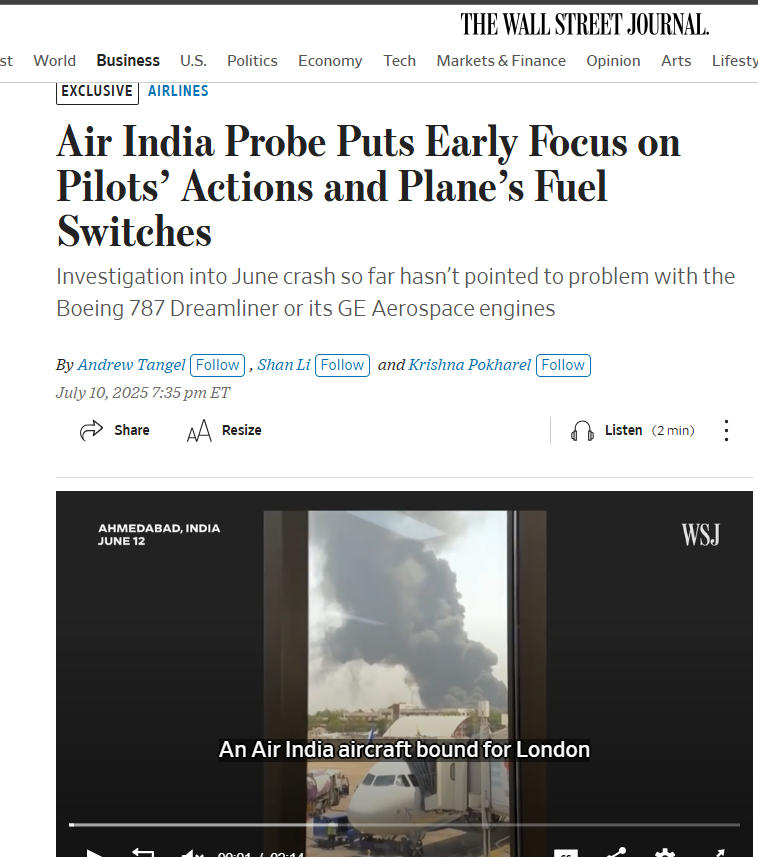
The Wall Street Journal article published on 10 July 2025 essentially absolved the US-based Boeing of any fault in the Dreamliner’s crash. Amusingly, the newspaper cited US officials to make this assertion.
“The investigation into last month’s Air India crash is focusing on the actions of the jet’s pilots and doesn’t so far point to a problem with the Boeing 787 Dreamliner, according to people familiar with U.S. officials’ early assessments,” the WSJ propaganda article reads.
The WSJ article posits that the two highly experienced Indian pilots Captain Sumeet Sabharwal and First Officer Clive Kunder, with the former having over 10,000 hours of flying time and the latter of around 3400 hours, intentionally or inadvertently turned off the fuel switches to both engines shortly after take-off, leading to a catastrophic loss of thrust and subsequent crash of the Boeing aircraft.
“The switches would normally be on during flight, and it is unclear how or why they were turned off, these people said. The people also said it was unclear whether the move was accidental or intentional, or whether there was an attempt to turn them back on,” the WSJ article claims.
Very shrewdly, the Wall Street Journal weaved a narrative based on its speculations to hand over a clean chit to Boeing and engine maker GE even before the release of the preliminary report by India’s Aircraft Accident Investigation Bureau (AAIB). Given Boeing’s opprobrious history of cover-ups and its fraught friendship with public trust, the timing of the WSJ’s propaganda piece raises serious questions.
Has Boeing unleashed its propaganda machinery ahead of the release of AAIB’s preliminary investigation report? Are Indian pilots who are not alive to defend themselves or present their version of events being blamed because there were indeed faults in the Boeing plane or GE engines?
After casting aspersions on the efficiency and integrity of the deceased Indian pilots, the WSJ proceeded to eulogise the Boeing Dreamliner and that there was no “problem with that model aircraft or its GE engines.”
Interestingly, WSJ is not the only media outlet that has pushed a pro-Boeing narrative; in fact, a section of the media is concocting a loop of potential lies to protect the US-based aerospace company.
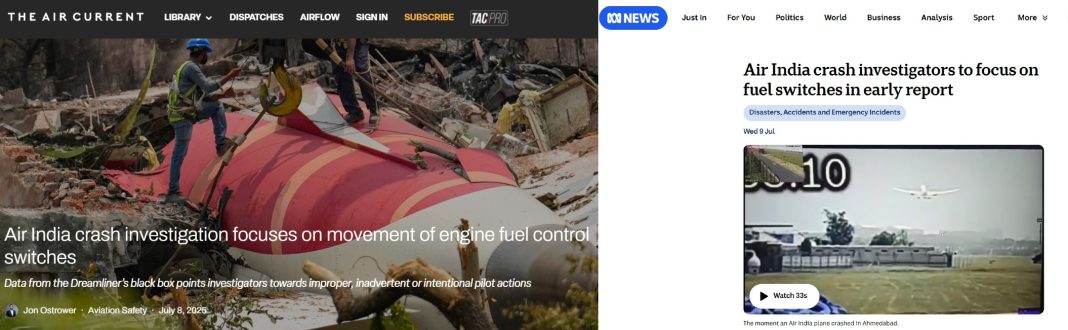
The Air Current also claimed that the “data available to the investigators does not indicate a mechanical or design issue with the 787 or its two GE Aerospace GEnx-1B engines. The TAC report suggested that since Boeing or GE did not issue any advisory or a multi-operator message (MOM) to operators in the 13 days that have followed the initial black box reading 2 in Delhi by the AAIB on June 25, there is little possibility of a mechanical failure. This, however, is nothing but speculation.
Unsurprisingly, many foreign news outlets like the ABC, Reuters, Gulf News and Indian media outlets like NDTV, CNBC and Indian Express have amplified the claims made in the TAC and WSJ report even as these claims are speculation driven and may have little to do with the actual findings of the AAIB’s preliminary report expected to be released on 11th July.
All these reports rely on anonymous US-based sources to emphasise pilot actions without any conclusive evidence. The lack of urgent mechanical advisories does not essentially rule out aircraft issues, as investigations take months to identify subtle issues. The timing of these reports, just before the AAIB’s preliminary findings are expected to be out, suggests that these reports have been deliberately put out with the intention of shaping public perception in favour of Boeing while scapegoating the deceased Indian pilots.
Unfortunately, earlier as well, the TRP-hungry Indian television anchors like Rajdeep Sardesai decided to platform an American TikToker and self-proclaimed aviation expert named Captain Steve Scheibner to determine the cause of the crash. Appearing on multiple Indian news channels after the tragedy, Captain Steve, a former US Navy pilot and self-proclaimed aviation expert, peddled a conspiracy theory that the pilots may have accidentally retracted the flaps instead of the landing gear during the initial climb. He described this as “a tragic mistake.”
This was when neither the black box nor the voice recorder was recovered. The Indian mainstream media did not even properly question the basis of Captain Steve’s conspiracy theory, blaming pilots who are not even alive to defend themselves.
Besides blaming the pilots, Captain Steve also suggested power loss, fuel contamination, a bird strike, or flap configuration error as possible causes behind the crash. After new evidence surfaced, especially a clearer video showing the deployment of the ram air turbine (RAT) on the aircraft, Captain Steve quickly shifted his stance. However, he had to face no consequences for peddling conspiracy theories and tarnishing the reputation of the highly experienced pilots who lost their lives in the deadly crash.
Not only IndiaToday, but CNBC-TV18, and several other mainstream media channels invited the American pilot-turned-TikToker to blame Air India pilots without a shred of evidence. Advertently or inadvertently, the Indian media has been pushing a Boeing-friendly agenda, which obviously aims to deflect scrutiny from mechanical or manufacturing issues.
Lobbying, coverups and accidents: Boeing has mastered the art of dodging accountability
Notably, the catastrophic incident has once again highlighted Boeing’s association with yet another tragic aviation event. Its stock was down about 5% on 12th June when New York stock markets closed. Last year, the company struggled with a safety crisis, quality control problems and a disastrous seven-week strike by the workers that cost it around $1 billion each month.
Boeing continues to cope with the fallout from two fatal crashes involving its 737 Max aircraft in 2018 and 2019, which claimed 346 lives. Earlier this year, the firm and the Department of Justice came to an agreement that would exempt it from criminal liability for the crashes.
Boeing is an American aerospace company, and a large part of its income comes from contracts from the US government. Boeing makes many military aircraft for America. Apart from this, the rules and policies of America apply to Boeing. It spends thousands of crores to ensure that these American policies work in its favour.
A report by the US stock market regulator SEC says that Boeing has spent more than $200 million (₹1700 crore+) on lobbying from 2010-2022. $26 million (₹225 crore) has been spent in 2021 and 2022 alone. A report by the SEC itself shows that Boeing has spent more than $320 million (₹2700 crore) on lobbying since 1998. The SEC says that Boeing ranks 9th in terms of spending on lobbying within the US.
Boeing is at number 9 in this arena, while in terms of market cap, it is at number 70-80 in America. This simply means that Boeing spends much more than its status on lobbying. Boeing gives money to both parties in America, i.e. Democrats and Republicans, to bend the rules according to its wishes.
Boeing’s history of controversies lends credence to suspicions of a coordinated blame-shifting effort. The US-based company faced intense scrutiny after the 2018 Indonesian Lion Air Flight 610 and 2019 Ethiopian Airlines Flight 302 involving the Boeing 737 Max, which killed hundreds of people. These deadly crashes were linked to flaws in the Manoeuvring Characteristics Augmentation System (MCAS) and other reasons.
It was revealed that in both accidents, MCAS continued to push the plane down while the pilots kept trying to fly it. The pilots failed in this, and this faulty system brought the plane down. When the pressure increased after the investigation of both accidents, Boeing admitted that it had hidden this information. Boeing admitted that it had not told the pilots about this new system. OpIndia reported in detail how Boeing bends the US laws to its whims and exploits loopholes to keep its profits soaring even at the cost of human lives. Boeing’s lobbying isn’t confined to the commercial sector.
The Boeing 737-800 operated by China Eastern Airlines crashed and caught fire in Guangxi province when it was en route from Kunming to Guangzhou in March 2022. President Xi Jinping ordered a swift investigation to find out the reason behind the incident, which stunned the country. Afterwards, every 737-800 operated by China Eastern Airlines was grounded.
According to the Civil Aviation Administration of China (CAAC), Beijing disagreed with Boeing’s initial explanation of pilot error and blamed the crashes on a malfunctioning Manoeuvring Characteristics Augmentation System (MCAS) design.
A Jeju Air flight 7C2216 belly-landed and went off the end of the runway at Muan International Airport in December 2024, smashing into a wall and exploding. Four of the six crew members and all 175 passengers on board were killed, while two crew members were hauled out unharmed. South Korean authorities then declared that they would conduct an urgent safety check on every Boeing 737-800 aircraft operated by the country’s airlines.
Last November, a cargo plane crashed close to Vilnius airport in Lithuania, resulting in at least one fatality and three injuries. During its final approach for landing, the Spanish cargo airline Swiftair, operating a Boeing 737 for DHL (Dalsey, Hillblom and Lynn), crashed close to a residence.
A Boeing 737 Max 9 plane’s unused cabin door fell off in midair in January, generating a stir in the aviation industry.
The company also has a significant presence in defence manufacturing, and even there, it has been accused of corruption.
Despite a litany of corruption allegations and a disturbing string of accidents tied to mechanical failures of Boeing aircraft, the US government continues to shield the company, enabling it to evade accountability. With a pliant media at its disposal, Boeing has mastered the art of deflecting blame, shrewdly spinning narratives to protect its reputation and interests while conveniently evading the scrutiny its alarming track record warrants.
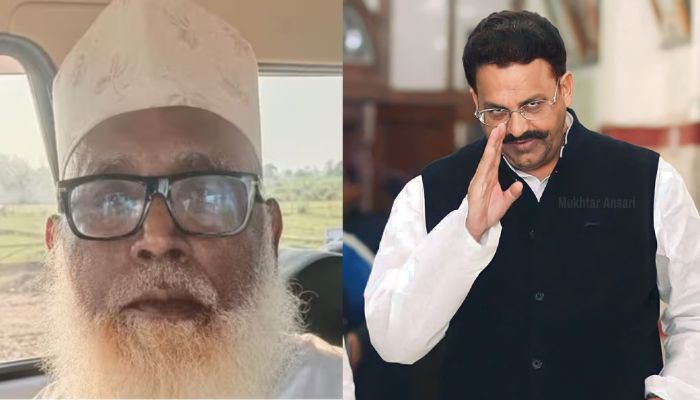
The connection between the Conversion racket leader Jalaluddin alias Chhangur Baba and mafia don Mukhtar Ansari has come to light. Investigations by the Uttar Pradesh Anti-Terrorism Squad (ATS) and Enforcement Directorate (ED) are ongoing. They are probing illegal funding, benami assets, and mafia links. Authorities have confirmed that bulldozers will continue to demolish illegal properties tied to the gang. The crackdown is part of a larger campaign against organized crime in the state.
Key findings from the investigation
The Uttar Pradesh Anti-Terrorism Squad (ATS) has confirmed that Jalaluddin alias Chhangur Baba had close ties with Mukhtar Ansari’s criminal syndicate. For 15 years, he used these connections to secure funding and carry out land deals.
Investigators have uncovered a vast financial network. Over ₹106 crore from Gulf countries was routed through more than 40 bank accounts linked to Jalaluddin, his associate Nasreen (also known as Neetu), and front organisations like Asvi Enterprises and Asvi Charitable Trust. This money was used to buy land in Uttar Pradesh and Maharashtra, including a plot in Lonavala worth ₹200 crore.
The probe also exposed a conversion racket. Vulnerable Hindu women, laborers, and widows were targeted. They were coerced into converting through false marriage promises, financial offers, or threats. There was even a “rate list” that set higher payments for converting women from certain castes, such as ₹15-16 lakh for Brahmin and Thakurs, ₹10-12 lakh for OBC and ₹8-10 lakh for other castes.
Bulldozers on illegal properties
For three consecutive days, 10+ bulldozers razed Jalaluddin’s 3 bigha Madhupur mansion. The property was illegally built on government land registered under Nasreen’s name. Apart from that, additional structures including an unauthorized college, hospital and madrassa spanning 6 bighas on gram samaj land were destroyed. District magistrate Pawan Agarwal affirmed, “strict action against illegal encroachments is part of our zero-tolerance policy”.
Legal and international dimensions
A multi-agency investigation is underway. The Enforcement Directorate (ED) has registered a money laundering case under the Prevention of Money Laundering Act (PMLA) to trace foreign funding. The Anti-Terrorism Squad (ATS) is pursuing charges under the UP Gangster Act and the Conversion Law.
Jalaluddin and Nasreen have been sent to seven-day police custody. The goal is to uncover possible terror links and identify benami (proxy) assets. Jalaluddin made more than 40 international trips, mainly to Islamic countries, to secure funding. Nasreen and her husband Naveen, who is also under arrest, travelled to Dubai 19 times. Nasreen ’s father, a scrap dealer based in Dubai, is also under investigation.
Government and police response
Chief Minister Yogi Adityanath strongly condemned Chhangur’s actions. He called them “anti-social and anti-national.” He promised that all of Chhangur’s assets would be seized.
ADG ATS Amitabh Yash spoke about the complexity of the investigation. He said the syndicate has been operating for 15 years. Their crimes include land fraud, document forgery, and intimidation. He assured that every accomplice, including those inside the government, will be held accountable.
Implications and next Steps
The Ansari link suggests deeper entrenchment of organized crime in religious conversion rackets. With ED joining the probe and bulldozers still operational, further arrests and demolitions are anticipated. Authorities confirm investigations will extend to Maharashtra, where Lonavala land deals and financial channels exemplify the syndicate’s interstate reach.
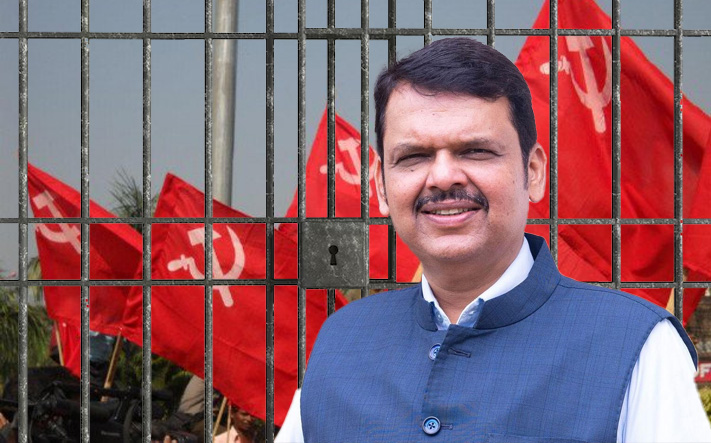
The Maharashtra government has introduced a law to check the spread of Maoist ideology in the state. The Bill, titled the Maharashtra Public Security Bill 2024, was passed in the state Assembly on Thursday (10th July) through a voice vote as some opposition members opposed the Bill.
CM Devendra Fadnavis tabled the Bill in the Assembly, which intends “to provide for effective prevention of certain unlawful activities of left-wing Extremist organisations or similar organisations and matters connected therewith or incidental thereto”.
Introduced the ‘Maharashtra Special Public Security Bill 2024’ which aims to eradicate Naxalism evolved from left-wing extremism.. ‘कडव्या डाव्या विचारसरणीतून’ उद्भवलेल्या नक्षलवादाचा समूळ नायनाट करण्यासाठी ‘महाराष्ट्र विशेष जन सुरक्षा विधेयक 2024’ ..
The Bill was presented in the Assembly after being reviewed by 25-member Joint Committee headed by Revenue Minister Chandrashekhar Bawankule and included several senior leaders. CM Fadnavis said that the Bill has been finalised after considering the suggestions from the public. “We studied over 12,500 suggestions and objections from the public before finalizing the draft. It is a balanced and progressive law more advanced than similar laws in states like Telangana, Andhra Pradesh, Odisha, and Jharkhand,” the CM said. He highlighted that around 64 left-wing organisations are currently active in Maharashtra, which is the highest number across all states.
Opposition raises concerns about the Bill
The lone CPI (Marxist) MLA in the Assembly, Vinod Nikole, opposed the Bill, saying that the law would be misused. “I am the only MLA from the Left party. Violent action should be curbed. There is MCOCA and UAPA. The CM has ended Naxalism in Gadchiroli, but I am opposing this Bill as it can be misused,” Nikole said. Amongst others who opposed the Bill were Rohit Pawar (NCP-SP), Bhaskar Jadhav and Varun Sardesai (Shiv Sena UBT), and Vishwajeet Kadam (INC). They registered opposition regarding some clauses in the Bill, including the term ‘urban naxal’. They claimed that some of the suggestions of the joint select committee were not included in the revised bill.
Highlights from the Bill
Allaying the concerns of the opposition, CM Fadnavis said that the Bill is not aimed at targeting Left parties or those criticising the government. The CM assured that the state government recognised dissent and citizens’ right to protest, and that the Bill is meant to punish those who wish to overthrow the established institutions of the country. “Some members have expressed apprehensions, but this Act is not against any left-wing political party. This is against those organisations which are inciting people to overthrow the Indian Constitution. This is for the internal security of the country. It is not against left-wing parties like CPI or CPI (M). We, in fact, respect them even though we have different ideologies. It is against those organisations whose motive is to demolish the established institutions of our country. They will face action,” Fadnavis said.
Explaining the reasons that led to the introduction of the Bill in the Assembly, Devendra Fadnavis said that the influence of the Maoist ideology is growing in the urban and rural areas of the state, particularly in districts like Gadchiroli and Konkan. He said the Maoists, who are facing extinction, are “trying to brainwash the youth of urban areas and make them stand up against the democratic system”.
The Bill seeks to ban individuals and organisations indulging in or promoting violence, guerrilla warfare, or attempting to destabilise the government through unlawful means. Justifying the legislation, Fadnavis said that the existing laws like the Unlawful Activities (Prevention) Act (UAPA) come into effect after the unlawlful activities has taken place, but the Bill includes preventive measures such as early intervention before the erruption of violence.
The Bill penalises any ‘unlawful activity’, which is defined as “any action taken by an individual or organization whether by committing an act or by words either spoken or written or by sign or by visible representation or otherwise, (i) which constitute a danger or menace to public order, peace and tranquility; or (ii) which interferes or tends to interfere with maintenance of public order; or (iii) which interferes or tends to interfere with the administration of law or its established institutions and personnel”. The punishment for an unlawful activity ranges from 2 to 7 years of imprisonment. To ensure fair and transparent implementation, the Bill provides for the constitution of a three-member authority, comprising a sitting or retired High Court judge, a district magistrate, and a public prosecutor, to oversee case reviews before prosecution.
Elaborating on the ambit of the legislation, the Chief Minister said that cases of violence during protests will be dealt with by the BNS and that the Bill will only be invoked when an organisation tries to “defy the Constitution or Constitutional authorities”. He added that the Bill targets organisations inspired by extreme Left ideologies which aim to challenge constitutional governance through armed struggle. Citing the example of the CPI (Maoist), Fadnavis said, “These groups reject democratic institutions and seek to replace them”.
Naxalism on the verge of eradication
The menace of Naxalism is nearing its end in the country after the consistent efforts of the government and the security forces. The Maoist cadre are staring at an invevitable end with dwindling numbers of footsoldiers and depleting leadership as a result of collaborative efforst of the central forces and the state police.
The Indian government has resolved to uproot Naxalism from the country by March 2026. To achieve this end, the government has adopted an aggressive military approach to counter Naxal terrorism which entered its last phase under Operation Kagar which was launched by the government in January 2024.
Under the operation, around 1 lakh para-military troops, including the Central Reserve Police Force (CRPF), its elite CoBRA units, District Reserve Guards DRG), and state police, equipped with modern technology, have been deployed in the left-wing terrorism affected areas to completely uproot the naxal terrorism from its last remaining strongholds. Since the inception of the operation, the security forces have eliminated over 400 naxal terrorists so far while more than 800 Maoists have surrendered. From 2019 to 2025, the central forces, in collaboration with state police, have established a total of 320 camps in Naxal-affected states, including 68 night-landing helipads. The number of fortified police stations, which was 66 in 2014, has now increased to 555.
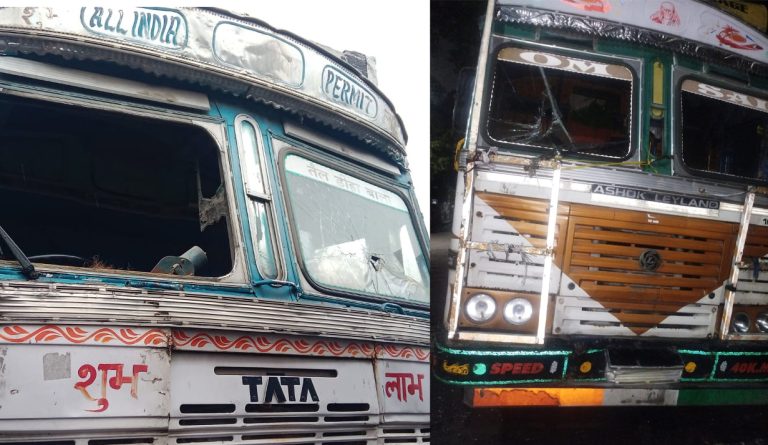
The trucker community, including both drivers and owners, staged a protest after a sub-inspector allegedly vandalised nearly 30 trucks near the West Bengal’s New Alipore railway siding in the N-block. Four sub-inspectors attached to the New Alipore police station were suspended by Lalbazar on the evening of Wednesday, July 9.
The protesters also launched a demonstration by parking their vehicles on the road from Wednesday morning. They claimed that the police took action because they refused to comply with an alleged “extortion attempt” of the cops. The truckers blocked the intersection road near the police station, causing inconvenience to school students and the general public.
Local sources claimed that the incident began around midnight on Tuesday, July 8, when truckers had parked their vehicles on Brahmabandhab Upadhyay Road and the adjacent New Alipore siding, a routine practice for decades. Around 12:30 AM, the police arrived and began vandalising the trucks under the pretext of ‘illegal parking’. Windows were shattered, and front tyres were deflated.
#WATCH | New Alipore, Kolkata (West Bengal): New Alipore Truck Owners Association alleges that at least 30 trucks were vandalised by New Alipore Police personnel last night over parking issue.
Association member Rajen Singh said, “Cops repeatedly demand money and harass us when we can’t pay. Our trucks have been vandalised earlier as well, but Tuesday’s harassment crossed all limits.” The police denied the harassment allegations but stated that a probe is underway “to ascertain the case details.”
The New Alipore police later persuaded the protesters to disperse by assuring them that action would be taken. Deputy Commissioner (South) Priyobrata Roy said, “We have suspended four sub-inspectors pending further enquiry.” Sources added that prima facie evidence, as sought by Lalbazar’s top brass, indicated that the conduct of the suspended officers was “not in line with the rules of service.”
“At least 30 trucks have been damaged in what we strongly condemn as an unprovoked act of vandalism by the police. The road in question has long been used for truck parking due to its proximity to the railway siding. If the police have an issue with on-road parking near the siding, then the siding needs to be relocated outside the city. We demand a clear explanation from the police—why was such destruction carried out? Who will bear the losses? As members of the trucker community, we are already burdened by relentless extortion and harassment. This latest incident only deepens our sense of injustice. We will not remain silent. We are determined to escalate the matter to the highest authorities to seek accountability and justice,” said Sajal Ghosh, secretary of the Federation of West Bengal Truck Operators’ Association.
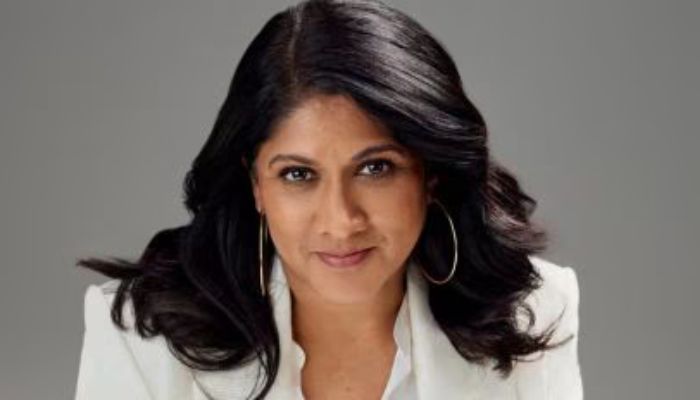
On Thursday, 10th July, Hindustan Unilever Limited (HUL) announced that Priya Nair has been appointed as the new Managing Director and Chief Executive Officer from 1st August 2025. She is succeeding Rohit Jawa, making her the first woman CEO in company’s 92-year history.
Priya Nair has become the first woman to lead HUL as CEO and MD. She will also join the HUL Board, subject to necessary approvals, and continue as a member of the Unilever Leadership Executive (ULE).
30 year journey with Hindustan Unilever
Priya Nair joined HUL in 1995. She started out in early roles like Consumer Insights Manager and Brand Manager. She worked on key products such as Dove, Rin, and Comfort. Over time, she led marketing for thelaundry business. She then managed categories like oral care, deodorants, and customer development.
Nair served as General Manager for Customer Development in HUL’s western region. Later, she took on leadership roles as Executive Director and CCVP for Home Care. She also led the Beauty & Personal Care division for South Asia.
Her strong performance in India led to global opportunities. In 2022, she became the Global Chief Marketing Officer for Unilever’s Beauty & Wellbeing unit. In 2023, she was promoted to President of the same division.
Educational background
Priya holds a Bachelor of Commerce (B.Com) in Accounts & Statistics from Sydenham College of Commerce and Economics Mumbai. After that, she attended Symbiosis Institute of Business & Management in Pune to pursue her MBA in marketing. Later, she joined Harvard Business School for a programme in Business Administration and Management.
She is married to entrepreneur Manmohan and has a daughter named Mehak. Before this appointment, Priya Nair was based in London. Her appointment is a historic milestone for gender diversity in Indian corporate leadership. Priya Nair is expected to lead HUL into its next phase of growth and innovation.
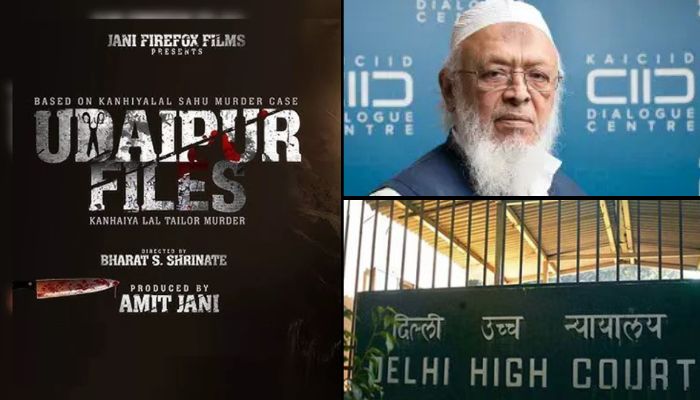
Ahead of the theatrical release of the ‘Udaipur Files : Kanhaiya Lal Tailor Murder’ on Friday (11th July), the Delhi High Court had put a stay on the release of the much anticipated movie.
The development comes days after the controversial Islamic outfit, Jamiat Ulama-i-Hind, moved the Delhi High Court, seeking a ‘ban’ on the film.
On Thursday (10th July), a 2-Judge Bench of the Delhi High Court comprising Chief Justice DK Upadhyaya and Justice Anish Dayal directed Jamiat Ulama-i-Hind to approach the Central government to exercise its revisional powers against the certification for ‘Udaipur Files : Kanhaiya Lal Tailor Murder.’
Such revisional powers are granted to the Centre through Section 6 of the Cinematography Act. The Delhi High Court noted that Jamiat Ulama-i-Hind must first exhaust its statutory remedy for revision by Monday (10th July).
The court directed that till the Central government makes a decision on the revision application of the Islamic outfit, the stay on the release of ‘Udaipur Files: Kanhaiya Lal Tailor Murder’ would continue.
“Since we are relegating petitioner to invoke revisional remedy, we provide that till the application for grant of interim relief is decided by the govt, if moved by petitioner, there shall be stay on release of the film,” it directed.
“It is not that it is impermissible for this court to exercise extraordinary jurisdiction even in a case where petitioner approaching court has not exhausted alternative remedy. But having regard to the facts of the case and taking into consideration the scheme of the Act, we are of the opinion that petitioner ought to have approached central govt under Section 6,” the court further stated.
Producer of Udaipur Files to approach Supreme Court
In the meantime, the producer of the film Amit Jani has announced that he would approach the Supreme Court of India in this matter.
“We had screened this film for their lawyer Kapil Sibal, so even after the screening, he had to oppose it because he had taken fees for it. Today, the High Court has stayed the release of this film. We are going to the Supreme Court to challenge this decision. They have been asked to go to the Central Government and the government will give its decision within seven days whether the film is right or wrong,” he stated.
Petition by Jamiat Ulama-i-Hind
It must be mentioned that Jamiat Ulama-i-Hind, which has a history of protecting terrorists, objected to the movie based on the brutal murder of tailor Kanhaiya Lal on 28th June 2022 by Islamic terrorists Muhammad Riyaz Attari and Muhammad Ghaus.
It has approached the High Courts of Delhi, Gujarat and Maharashtra to stop the release of ‘Udaipur Files Kanhaiya Lal Tailor Murder.’
“The movie, purported to be the story of the murder of one Kanhaiya Lal in 2022, in fact unabashedly depicts court scenes, the statement made by a sitting Chief Minister supporting one party in the case and also explicitly mentions the controversial statement made by a politician – Nupur Sharma – which had resulted in communal violence and, in turn, the gruesome murder of Kanhaiya Lal,” it claimed in its petition.
Screengrab of the tweet by Arshad Madani
Jamiat Ulama-i-Hind Arshad Madani had also confirmed the development on X (formerly Twitter). He also dog-whistled against the makers of the film, claiming that it carried ‘blasphemous’ remarks about Prophet Muhammad.
He also made veiled threats about Muslims unleashing mayhem and creating a law and order crisis across the country if the film is released.
Madani claimed that the film maligned the Muslim community and promoted hatred. The Jamiat Ulama-i-Hind President also whined about references made in the film about the Gyanvapi Mosque, an illegal structure built on the Vishweshwar temple.
Arshad Madani welcomes stay on release of Udaipur Files
In a tweet on Monday (10th July), Arshad Madani welcomed the decision of the Delhi High Court to put a stay on the release of ‘Udaipur Files: Kanhaiya Lal Tailor Murder’
He claimed, “The stay on the film’s screening has strengthened the supremacy of the Constitution. It also sends a clear message that no one can violate constitutional and moral boundaries in the name of art and freedom of expression.”
Madani brazened out, “In recent years, we have seen some objectionable films being made but they were not as repulsive as this film. In this one, an entire community has been portrayed as ‘criminals’ under the garb of a murder incident. This is why we decided to approach the court. We are pleased that our efforts have succeeded.”
Udaipur Files “फिल्म की स्क्रीनिंग पर स्टे और अदालत के अन्य आदेशों ने संविधान की सर्वोच्चता को मज़बूत किया है। यह एक स्पष्ट संदेश भी देता है कि कला और अभिव्यक्ति की स्वतंत्रता के नाम पर कोई भी व्यक्ति संवैधानिक और नैतिक सीमाओं का उल्लंघन नहीं कर सकता।” हाल के वर्षों में कुछ और…
He concluded, “We are fully confident that the final judgment will also be in our favour. This decision (by the Delhi High Court) doesn’t just stop the release of the film but also puts a stop to the nefarious agenda of communal elements.”
Udaipur Files: What we know about it
The ‘Udaipur Files: Kanhaiya Lal Tailor Murder’ was set to hit the theatres on Friday (11th July). The movie features actor Vijay Raaz in the lead role.
Other actors including Rajneesh Duggal, Preeti Jhangiani, Kamlesh Sawant, Kanchi Singh, Mushtaq Khan are part of the film.
Bharat S Shrinate is the director and writer of the film, which is based on the murder of Udaipur tailor Kanhaiya Lal. The producer is Amit Jani, and the distributor is Reliance Entertainment.
Jamiat Ulama-i-Hind and its history of defending Islamic terrorists
Jamiat Ulama-i-Hind has a history of providing ‘legal services’ to Islamic terrorists. The legal cell, set up by Arshad Madani in 2007, takes up the cases and enlists lawyers to defend the terror accused in the courts.
According to a New Indian Express report, the Jamiat Ulama-i-Hind has offered its services to around 700 accused. What is worrying about such interventions is that they have been able to get acquittals of at least 192 terror accused since 2007.
Most of the acquittals have not come because they were found innocent; instead, they were being released due to technicality or lack of evidence or because of the poor investigation by the police.
The 7/11 Mumbai train blasts, the 2006 Malegaon blasts and the Aurangabad Arms cases were some of the initial cases that were taken up by the JUH legal cell. Jamiat Ulama-i-Hind had also defended the accused in the 26/11 Mumbai terror attacks case, the 2011 Mumbai triple blasts case, Mulund blast case, Gateway of India blasts case.
On its website, the JUH has listed the terror-related cases it is fighting on behalf of the accused Muslims.
In 2013, Jamiat Ulama-i-Hind had provided free legal aid to Indian Mujahedeen terrorist Mirza Himayat Baig, who was accused in the German Bakery bomb blast case. The Indian Mujahideen terrorist was sentenced to death by a Pune court on April 18, 2013, along with co-accused Yasin Bhatkal.
Some of the other cases in which Jamiat has come forward to provide legal aid to terror-accused:
Lashkar Connection Case (Abdul Rahman V/s State SLP)
ISIS conspiracy case Kochi (State of Kerala v/s Arshi Qureshi & others)
ISIS conspiracy case Mumbai (Arshi Qurashi & others v/s State of Maharashtra)
ISIS conspiracy case (State of Rajasthan v/s Sirajuddin)
26/11 Mumbai attack case (Syed Zabiuddin v/s State of Maharashtra)
Chinnaswamy Stadium Bomb Blast Case (State V/s Qatil Siddiqui and others)
Jungli Maharaj Road Pune Bomb blast case (A.T.S. v/s Asad Khan & others)
Indian Mujahideen Case (Maharashtra VS Afzal Usmani & others)
Zaveri Bazar Serial Blast (State v/s Azaz Shaikh and others)
SIMI conspiracy case (Madhya Pradesh) State V/S Irfan Muchale & others)
Jama Masjid Blast Case (Delhi State V/s Qateel Siddqui Others)
Indian Mujahideen conspiracy case (State vs. Yasin Bhatkal & others) Ahmedabad Serial Blast Case 2008 (State V/s Jahid & Others)
In addition to supporting the terror-accused, the Jamiat Ulama-i-Hind had recently stoked a controversy by extending all possible legal and financial aid to the killers of Hindu leader Kamlesh Tiwari, who was brutally assassinated in his office in Lucknow.
The Jamiat had said that it is willing to bear all the legal costs and had also offered the head of their legal cell to defend the five accused in the Kamlesh Tiwari murder.
In June 2021, the Deoband-based organisation had also deputed its lawyers to defend alleged Al-Qaeda terrorists in Uttar Pradesh. The organisation had declared that it would provide legal assistance to the two terror suspects.
In February 2022, it came to the rescue of 49 terrorists, who were convicted for planning and executing 21 bomb blasts in Ahmedabad that killed nearly 56 innocent people.
Well, Jamiat Ulama-i-Hind has every right to defend convicts and accused that it perceives were implicated on false charges.
However, when it jumps to the rescue of those charged with terrorism, including convicts who have a watertight case against them, it is essentially sending a message to all radical elements that no matter what, they will continue to support them regardless of their culpability.
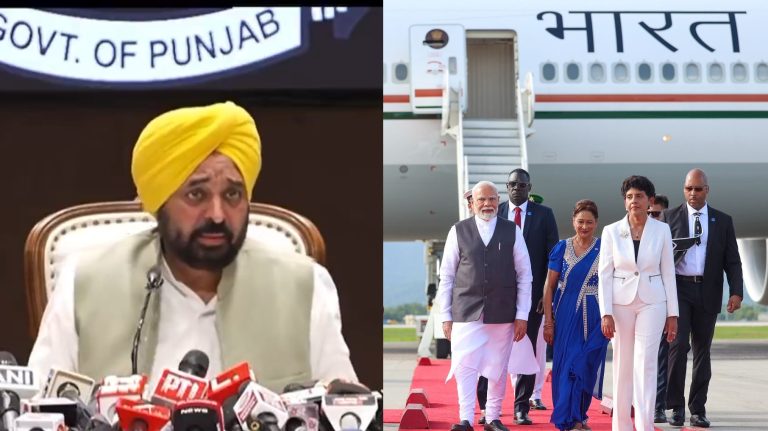
Punjab Chief Minister Bhagwant Mann on Thursday welcomed Prime Minister Narendra Modi’s return to India, making a sarcastic remark that questioned the significance of his trips to countries with small populations.
Mann jokingly mentioned that PM Modi might be visiting countries like “Magnesia,” “Galveaisa,” or “Tarvesia,” highlighting his perception that these visits are not substantial.
Mann questioned the relevance of PM Modi’s visits to countries with tiny populations, contrasting them with the large population of India.
“PM has gone somewhere. I think it is Ghana. He is going to be back and he is welcome. God knows which countries he keeps visiting, ‘Magnesia’, ‘Galveaisa’, ‘Tarvesia’. He does not stay in a country with 140 crore people. He is visiting countries where the population is 10,000 and he is getting the ‘highest awards’ there. Here, 10,000 people gather to watch a JCB… What has he gotten himself into!…,” said Mann.
#WATCH | Chandigarh | Punjab CM Bhagwant Mann says, "PM has gone somewhere. I think it is Ghana. He is going to be back and he is welcome. God knows which countries he keeps visiting, 'Magnesia', 'Galveaisa', 'Tarvesia'. He does not stay in a country with 140 crore people. He is… pic.twitter.com/lbOObtIRDB
PM Modi recently concluded a landmark five-nation tour, visiting Ghana, Trinidad and Tobago, Argentina, Brazil, and Namibia from July 2 to 9, 2025. This tour marked his longest foreign trip in a decade, spanning two continents and strengthening India’s ties with key nations in the Global South.
PM Modi’s visit to Ghana focused on enhancing cooperation in investment, energy, health, security, and development. He addressed the Ghanaian Parliament and was conferred with the country’s top civilian honour, “Officer of the Order of the Star of Ghana”.
Both nations agreed to upgrade ties to a Comprehensive Partnership and signed MoUs in fintech and traditional medicine.
Trinidad and Tobago visit marked the first time an Indian Prime Minister had visited the country since 1999. PM Modi addressed a joint session of Parliament, extended OCI card eligibility to the sixth generation of the diaspora, and donated 2,000 laptops to schools. He was awarded the country’s highest honour, “The Order of the Republic of Trinidad and Tobago”.
PM Modi’s visit to Argentina was the first bilateral visit by an Indian Prime Minister in 57 years. Discussions with President Javier Milei covered critical minerals, shale energy, defense, and pharmaceuticals. Argentina expressed interest in adopting India’s UPI platform and vaccines.
During the BRICS Summit in Rio de Janeiro, PM Modi held bilateral talks with President Luiz Inacio Lula da Silva, focusing on defense cooperation, renewable energy, and digital public infrastructure. He was conferred with Brazil’s highest civilian honor, the “Grand Collar of the National Order of the Southern Cross.”
In the final leg of his tour, PM Modi met with Namibian President Netumbo Nandi-Ndaitwah, discussing development cooperation, energy, health, and education. Namibia signed a licensing agreement to adopt India’s UPI platform, becoming the first country globally to do so. PM Modi addressed a joint session of the Namibian Parliament and was awarded the “Order of the Most Ancient Welwitschia Mirabilis.”
(This news report is published from a syndicated feed. Except for the headline, the content has not been written or edited by OpIndia staff)
When it comes to India’s strategy to tackle Pakistan, Indian left-liberal discourse automatically descends into the usual ‘Aman ki Asha’ mode, glossing over the Islamist Jihadist mindset of the Pakistani political and military establishment, backed by a significant section of the Pakistani populace. So far, the strategy has been to downplay the strong affiliation of Pakistani people with the wretched ‘two-nation theory’ that essentially formed the basis for India’s partition and Pakistan’s creation on Islamist lines. However, there has been a software update.
Now, the Indian liberals have started admitting that the two-nation theory is indeed one of the main causes behind the persistent Indo-Pak hostilities since 1947. But now, cultural exchanges, Bollywood, Pakistani dramas, shared subcontinental identity and millennial liberalism are being presented as progressive elements that can bring the Indian and Pakistani people together.
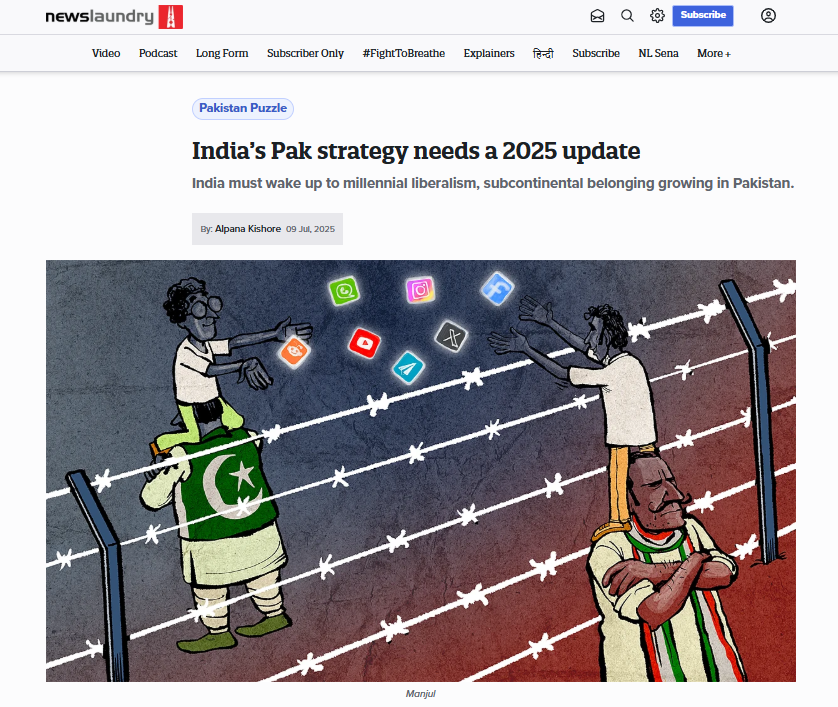
Leftist propaganda outlet Newslaundry has suggested a revamp of India’s Pakistan strategy. In the article titled “India’s Pak strategy needs a 2025 update” by Alpana Kishore, the Modi government’s approach to Pakistan has been described as the one characterised by a “zero-sum” mindset. Newslaundry suggests that India’s focus on military and economic containment is outdated and does not account for evolving social and cultural dynamics in Pakistan.
At the very onset, the article insinuates that India’s stance of treating Pakistan-sponsored terror attacks in India as an act of war, and scrapping the Indus Waters Treaty after the jihadist attack in Pahalgam, opposition to the collaboration of Pakistani artists with the Indian entertainment industry is inappropriate.
“A state as enemy – means its people are enemies. This supposedly new non-negotiable has failed to notice an important reality. It’s a different world from 1980. Today’s wars require responses that work in 2025,” the Newslaundry article reads.
It further asserts that things have undergone a significant change over the years, and that there was a time when “It was simply too incorrect for an Indian historian to say upfront, the Two Nation Theory was a terrible, racist idea because it would be seen as delegitimising a valid Pakistani identity and subsuming it as Indian. Yet these things are currently being said by Pakistanis!”
Firstly, two-nation theory though not devoid of the delusional superiority complex of belonging to martial Arab race, however, this divisive theory has been more about religion than race. The Two-nation theory promulgated by Sir Syed Ahmed Khan essentially stated that Muslims cannot co-exist peacefully with Hindus and thus should have a separate nation.
Syed Ahmad Khan said in 1876, “I am convinced now that Hindus and Muslims could never become one nation as their religion and way of life was quite distinct from each other.” Seven years later, he voiced similar sentiments. He said, “Friends, in India, there live two prominent nations which are distinguished by the names of Hindus and Mussalmans…To be a Hindu or a Muslim is a matter of internal faith which has nothing to do with mutual relationships and external conditions…Hence, leave God’s share to God and concern yourself with the share that is yours…India is the home of both of us…By living so long in India, the blood of both have [sic] changed.”
Twelve years later, he stated, “Now, suppose that the English community and the army were to leave India, taking with them all their cannons and their splendid weapons and all else, who then would be the rulers of India?… Is it possible that under these circumstances two nations—the Mohammedans and the Hindus—could sit on the same throne and remain equal in power? Most certainly not. It is necessary that one of them should conquer the other. To hope that both could remain equal is to desire the impossible and the inconceivable. But until one nation has conquered the other and made it obedient, peace cannot reign in the land.”
The article proceeds to calling the Pakistani millennials and their Gen Z successors as some sort of ‘gamechangers’. Alpana Kishore asserts that Pakistani Gen Z has been using social media to “question the choices and ideological beliefs of their ancestors, acquire information that contradicts official narratives and communicate globally, they have been able to condemn jihadists, engage with the other and push modern agendas.”
While it is true that a significant section of Pakistani youth, especially the supporters of PTI leader and now-jailed former Prime Minister Imran Khan have been questioning the corrupt practices of the Pakistan Army and its functioning as the country’s de facto ruler, even the most liberal of the liberal Pakistanis hold the two-nation theory dear. Holding the two-nation theory dear, essentially means that they cling to the belief that Muslims cannot co-exist peacefully with Hindus, who as per their Islamic belief are infidels/Kafirs.
It is further argued that studying and working together abroad has brought Pakistanis and Indians together, leading to their friendships and bonds. However, the supposed Indo-Pak diaspora bonds abroad hardly change any ground realities in Pakistan. In fact, many Pakistanis abroad falsely claim to be Indian to avoid negative perception and escape embarrassment they feel is attached to their nationality; however, this does not mean they actually identify as Indians or hold pro-India opinions.
The Newslaundry ‘Aman ki Asha’ piece focuses too much optimistically on ‘millennial liberalism’ and a shared subcontinental identity in Pakistan. It underestimates the authoritative influence of Pakistan’s military and intelligence apparatus, which continues to be the primary driver of its anti-India policies.
The article suggests that Pakistani youth’s worldview is “critically” shaped by their engagement with the Indian cultural multiverse, be it through Bollywood films, OTT, social media or diaspora countries. “It has kindled an inter-generational interest in an older, shared past and identities they see in rituals, festivals, language, fashion and music,” the article reads.
Newslaundry went on to suggest that despite the emergence of ‘jingoistic’ films within India, here, jingoistic essentially means that movies centred on Indo-Pak themes that do not whitewash Pakistan-backed cross-border terrorism, Pakistani millennials find their deepest India connection via Bollywood music and films.
However, even former Pakistani Army General Pervez Musharraf had deep admiration for Bollywood films and music, did that stop him from orchestrating the great betrayal of the Lahore Agreement signed between then Pakistani PM Nawaz Sharif and his Indian counterpart Atal Bihari Vajpayee, in the form of the 1999 Kargil war? Years later, Musharraf, the same Bollywood-loving Pakistani army general, boasted the Kargil betrayal as a ‘successful’ operation and even condemned Nawaz Sharif for having ordered the withdrawal of Pakistani troops from Kargil.
While the younger Pakistani generation may engage with Indian culture through films, OTT platforms, or social media, this cultural affinity does not essentially translate into political or strategic influence. Contrary to the liberal journalist’s assertion that Pakistanis have been able to condemn jihadis, in contexts outside Pakistan, be it the Pakistani terror group Lashkar-e-Taiba masterminded 21/11 Mumbai attacks, 2001 Parliament attack masterminded by Pakistani terrorist Masood Azhar, 2016 Uri attack, or the 2025 Pahalgam attack among others, Pakistanis never even acknowledged the involvement of Pakistani terrorists and their jihadist motivations.
Even after the Pahalgam attack, wherein terrorists including an ex Pakistani Army officer, belonging to The Resistance Front, an offshoot of LeT, shot innocent tourists after confirming their non-Muslim identity. The victims were asked to recite Kalma and failure of doing so invited a bullet. Many Pakistani celebrities and even common people condemned the attack. However, a common pattern seen across their condemnation of the attack was visible in their dexterity to diassociate Islam from the Jihadist mindset and motivation of the terrorists. “Terrorism has no religion”, “Islam does not teach hatred” and similar such messages poured in.
More than condeming the jihadist attack, the focus of the same Pakistani millenials and gen-Z was on making sure that the attack carried out by Muslim terrorists against Hindu civilians driven by their hatred for Hindus, is not seen as an act of Islamic terrorism. One thing must never be forgotten if we are to truly address the menace of Jihadi terrorism, while the two-nation theory was the driver of India’s partition of Islamic lines, the two-nation theory finds its roots in the Islamist hatred for non-Muslim communities, especially the idol-worshipping Hindus.
The Pakistani military and the ISI, continues to nurture, fund and shield anti-India terror groups like LeT, Jaish, among others. While the Newslaundry article does acknowledge the peristance of Pakistan’s Jihadi infrastructure, it downplays its centrality by suggesting that India should focus on engaging with liberal elements. However, the question arises is how? Are the relatively secular or non-jihadist millennials governing Pakistan? Pakistan continues to be dominated by its military, in fact, the Pakistani Army’s anti-India and anti-Hindu rhetoric suggests that there is hardly any difference between jihadis and the Pakistan ‘Aand’ Forces. Even Pakistan’s current DGISPR, Sharif Ahmed Chaudhary, is the son of a UN-designated terrorrist.
Forget showing any willingness to dismantle jihadist terror networks, Pakistan continues to deny any sort of involvement in the terror attacks in India despite evidence of linkages. Pakistan’s military leadership continues to issue nuclear threats to India.
Not to forget, just days before the Pahalgam attack, Pakistani Army Chief Asim Munir had spewed venom against India and Hindus. He even urged the Pakistani people not to forget to instil the venom of the two-nation theory into the younger generations and how they must continue to harbour hatred for Hindus. Such blatant expression of hatred for Hindus, who despite continued persecution exist in Pakistan as a minority, went without any outrage from the progressive liberal Pakistani millennials and Gen-Z.
Thus, the only rational response to Pakistan’s intransigence is India’s “zero-sum” approach.
No matter how much Pakistanis criticise its political and military leadership, they have so far not shown any interest in abandoning the two-nation theory. In fact, to this day, the Pakistan Army’s grip on power ensures that the anti-India and anti-Hindu rhetoric remains a unifying force for domestic legitimacy.
Alpana Kishore’s suggestion that a shared subcontinental identity could bridge divides ignores the fact that Pakistan’s establishment has consistently weaponised identity politics to keep the flames of hostility ablaze, particularly over Kashmir, which it calls its ‘jugular vein’. India has been very generous with Pakistan in attempting cultural and diplomatic engagement with Pakistan, even after the Kargil betrayal and continued cross-border terrorism. If history tells anything, it is that cultural overtures alone cannot alter Pakistan’s strategic calculus without addressing the role of its military and the puppet government it has installed.
Has Pakistan renounced its sinister desire of bleeding India with a thousand cuts through jihadist terrorism? Has Pakistan extradited terrorists like Hafiz Saeed, Syed Salahuddin, Masood Azhar, and many others involved in terror activities against India? Has Pakistan acknowledged that indeed a Pakistani terror group was behind the Pahalgam attack? Has Pakistan stopped patronising Jihadis? Has Pakistan given up its unjustified claim over Jammu and Kashmir? Has Pakistan handed over PoJK back to India? Have cross-border infiltration bids stopped from the Pakistani side?
People to people ties are always welcome, hostilities should end, unravelling Partition in a quest for answers is also good, in fact, it is paramount. While the Hindu majority regrets the partition of India on Islamic lines, this regret is not shared by a large section of Pakistani populace. It needs to be questioned and examined by Pakistani youth, why is it that Indians largely believe that the partition should never have happened, but Pakistanis celebrate it.
Films, music, social media, and all sorts of people-to-people interactions indeed contribute to bridging differences and curbing hostilities. However, in a country like Pakistan, which has Hindu-hating jihadists leading its institutions, be it the puppet government or its puppeteer Pakistani ‘Aand’ Forces, who every now and then threaten to ‘attack Ayodhya Ram Mandir’, ‘wipe out Hindus’, ‘stop the breath of Indians’ and ‘wage Jihad against India’ and whatnot, no art, no cultural exchange, nothing can resolve disputes.
“The point is actually this. Pakistan’s jehadi infrastructure and its Army remain intact and dangerous. Many of its young remain vulnerable to radical Islamist thinking. Jyoti Malhotras are a reality. There can be no lowering of guards where it matters. Yet, the digital world isn’t going anywhere,” the Newslaundry article argues.
However, the actual point is that governments are not run solely in the digital world, as long as the Hindu-hating and anti-India thinking finds takers in Pakistan, the jihadist forces continue to dominate the country. No matter how warm and loving the Indo-Pak digital world appears, the ground realities won’t change. Pahalgam did not happen in the digital world. This digital world and opinions expressed on it are fickle.
The Newslaundry piece itself points out that many Pakistani YouTubers who enjoyed significant Indian viewership have “fallen back into the weary old rhetoric”, although it blames this change in tone on Indian television media’s dramatic and hysterical reportage during Operation Sindoor.
Amusingly, Newslaundry mentions Diljit Dosanjh and Hania Aamir to argue that both are admired by many Indian and Pakistani millennials, and that Dosanjh’s music is a unifier. To be very honest, music is indeed a unifier. However, his music and movies, even those featuring Hania Aamir cannot bring any policy change in Pakistan. If social media has positively contributed towards bridging differences, its negative side cannot be overlooked.
Newslaundry argues that India’s portrayal of Pakistan as an “axis of evil” is flawed since not all Pakistanis are anti-Indian jihadis. While it is true that not all Pakistanis are jihadis or support their state’s policies, the Modi government’s strong stand against Pakistan, be it scrapping IWT, banning Pakistani channels, discontinuing trade or talks until Pakistan stops cross-border terrorism, is not driven by any ideological whim but the ground realities.
Pakistan is represented by a regime backed by the Islamist military. How can India engage with an unrepresented liberal faction? India cannot prioritise social engineering experiments over national security. The Newslaundry article offers no mechanism for the implementation of its suggestion to engage with Pakistan’s supposedly liberal and progressive younger generation. From media to social media, the Pakistani army controls the narrative, it muzzles the voices of its own people, carries out drone attacks on Pashtuns, Balochs and anyone opposed to them and blames India for the same. In such a case, India cannot mindlessly open channels for cultural exchange while the hostile neighbour’s rulers yearn to bleed India with a thousand cuts.
Towards the end of the ‘Aman ki Asha’ dream repackaged in relatively balanced rhetoric, author Alpana Kishore laments that the Modi ‘regime’ indulges in labelling Pakistanis as ‘Madrassachhaps’, however, the author made no mention of how numerous Pakistani millennials throw Hinduphobic and racist slurs like ‘Pajeet’ at Indians.
“Yet this regime’s single-tone signalling allows no space for this influence to work. By its offensive labeling of madrassachhaps and obsessive gloating about Indian economic might – it pushes fresh thinking across the border back into the old grand narrative of the Two Nation theory that says ‘I told you so’,” the Newslaundry piece reads.
There is nothing “fresh” about this ‘I told you so’ thinking. In fact, Indian Muslims, especially celebrities often receive the “Jinnah was right that Muslims who chose to remain in India will have to prove their loyalty for the rest of their lives”, from Pakistan’s ‘progressive-liberal’ millennials. Also, the ‘madrassachhap’ jibe, although not good when thrown out of context, is not intended to mock the religious identity of Pakistani Muslims, rather the mention of Madrassa comes simply because madrassas in the neighbouring country have been the first stage of the brainwashing of Pakistani youths, who then proceed to either become ‘Mujahids’ or radical Islamists at heart.
For India to engage with Pakistani ‘liberal progressive’ millennials, it is the Pakistani people who need to abandon the Islamist anti-Hindu and anti-India mindset and start opposing their military leadership’s anti-India activities. Instagram, movies and music are secondary drivers of paradigmatic change. It is only when Pakistan breaks itself free from the shackles of the country’s Islamist military regime that India can even consider softening its stance. Our national security demands a strategy rooted in realism, not ‘Aman ki Asha’ style idealism. It is essential for India to ensure that Pakistan’s anti-India actions face consequences rather than mindlessly hoping for change through cultural overtures alone.
The United Kingdom recently came together to commemorate the horrific 7th July 2005 London bombings, commonly known as 7/7, during which Islamiterrorists carried out four well-planned suicide assaults on the city’s transport network amid rush hour. Three attackers individually set off three homemade bombs on London Underground trains in Inner London in rapid succession. Another bomb was later set off on a double-decker bus in Tavistock Square by a fourth terrorist.
The Circle Line close to Aldgate, Edgware Road and the Piccadilly Line near Russell Square were the sites of the train explosions. 52 people lost their lives in the incident while over 800 more were injured. It was the first Islamist suicide strike in the United Kingdom and the deadliest terrorist act since the 1988 bombing of Pan Am Flight 103 near Lockerbie.
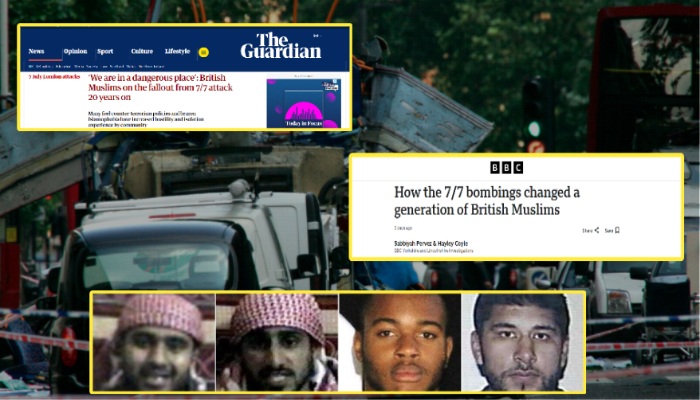
The suicide bombers were identified as 18-year-old Hasib Hussain, 19-year-old Germaine Lindsay, 22-year-old Shehzad Tanweer and 30-year-old Muhammad Sidique Khan. Sidique, Shehzad and Hasib were British-born sons of Pakistani parents and Germaine was born in Jamaica who embraced Islam and changed his name to Abdullah Shaheed Jamal.
While the nation mourned the victims, an astounding trend was visible among the royalty, politicians and media to sanitize the Islamic element of the assault. A collective effort had been underway, seemingly aimed at exonerating the jihadis for their atrocious actions in a desperate bid to protect the delicate feelings of a specific community. However, it raises the question of why naming the perpetrators by their true identity, ideology and motives should elicit such a reaction from any person or group?
This rationale, however, was lost as British media, in line with its ruling class, joined the effort to whitewash the attack, ultimately portraying the Muslim community as the true casualty of the terror strike. The genuine stories of individuals who were killed or whose lives were shattered and their grief of their families were overshadowed as the narrative of Muslim victimhood became prioritized over their real anguish and distress.
7/7 changed lives of Muslims: British media
One of the deadliest terrorist attacks not only in the country but also in the world, intended to bleed the Western country, had been portrayed as a painful experience for the members of the Muslim community residing in the nation. It is undeniable that some Muslims might have been affected by the attacks, as bombs do not distinguish between individuals of different faiths, unlike the Islamic terrorists. However, this does not alter the fact that they were not the intended targets.
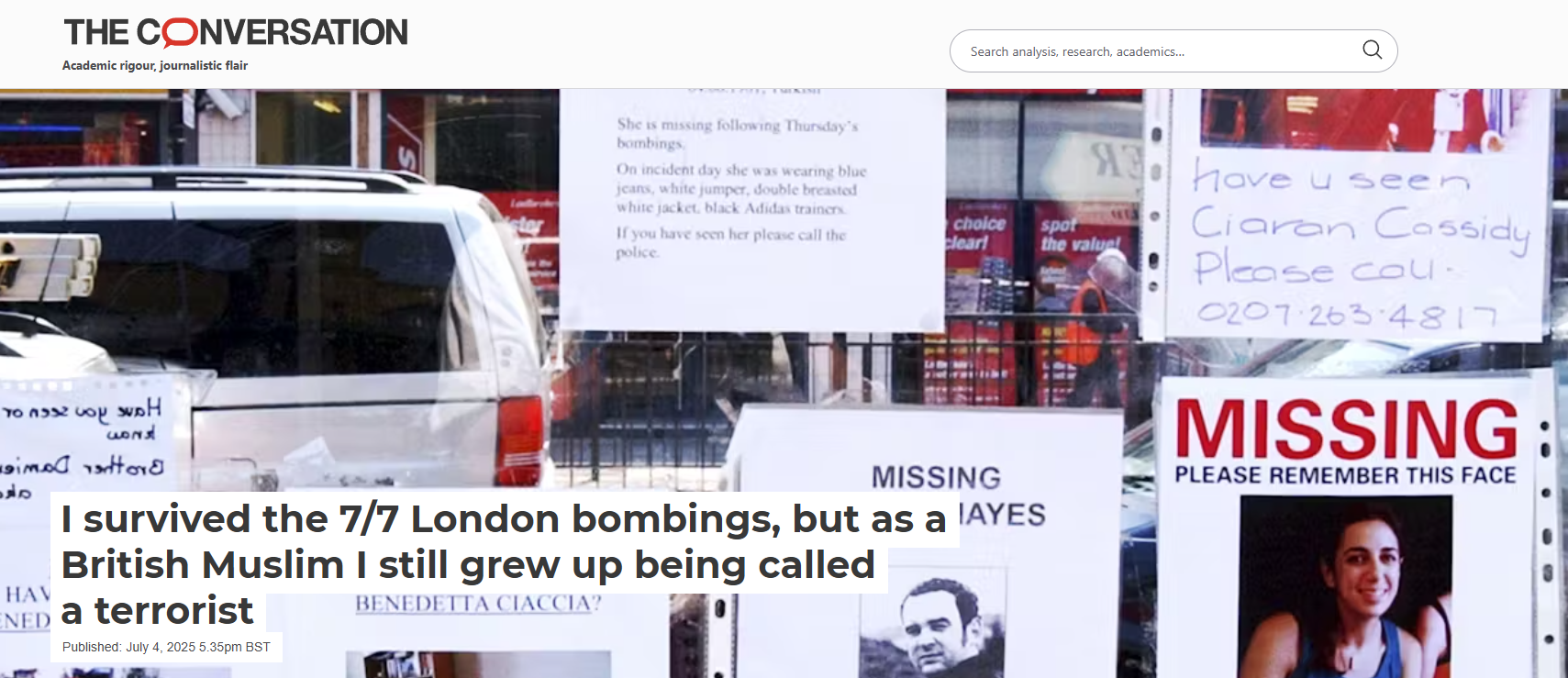
Nonetheless, the British media is working diligently to create the impression that the terror-hit was directed against Muslims. “The Conversation” featured a story of a Muslim woman who “survived the bombings” only to be labeled “terrorist” later. Notably, she emerged unscathed as she was at a considerable distance from the area, ensuring her physical safety.
However, she bemoaned about the absence of media coverage on her “fear, trauma or belongingness” and alleged that she has been continually attacked for her religious identity in the wake of the event. She also complained about “increased surveillance and marginalisation of Muslim communities in the UK.”
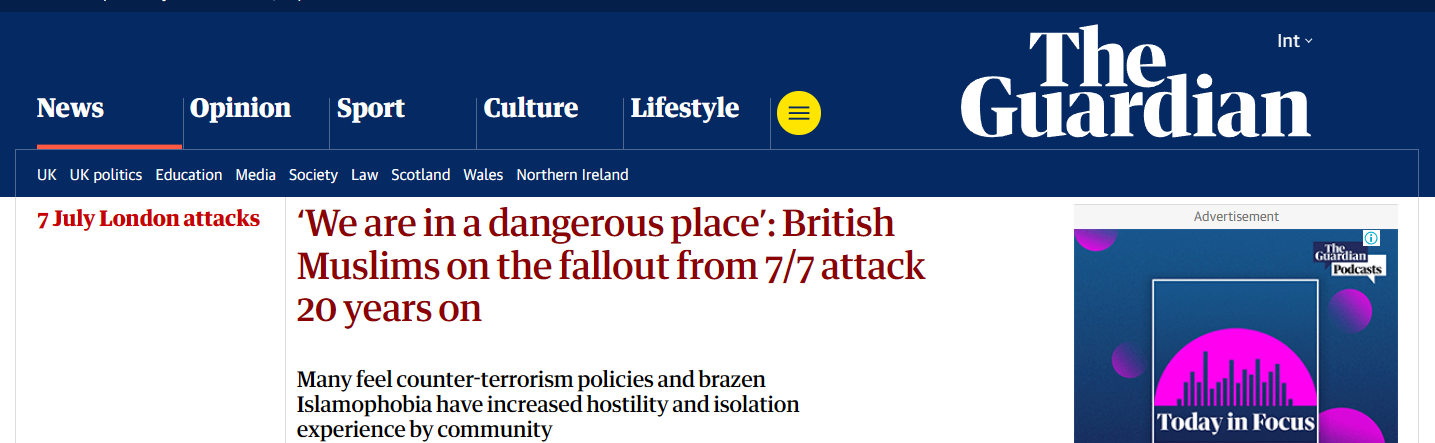
Taking a step further, “The Guardian” talked to the members of the Muslim community to strongly affirm the flawed narrative of Muslim victimhood. Nonetheless, the content was permeated with the same rhetoric, where the interviewees stated that their lives have been irrevocably transformed since the bombings 20 years ago and charged that the policies of the British government were racist, contributing to the rise of Islamophobia.
According to the article, police stop-and-searches and hate crimes involving religion have dramatically increased. It even bemoaned the fact that conviction rates for terrorism accusations skyrocketed as hundreds of such charges were filed every year.
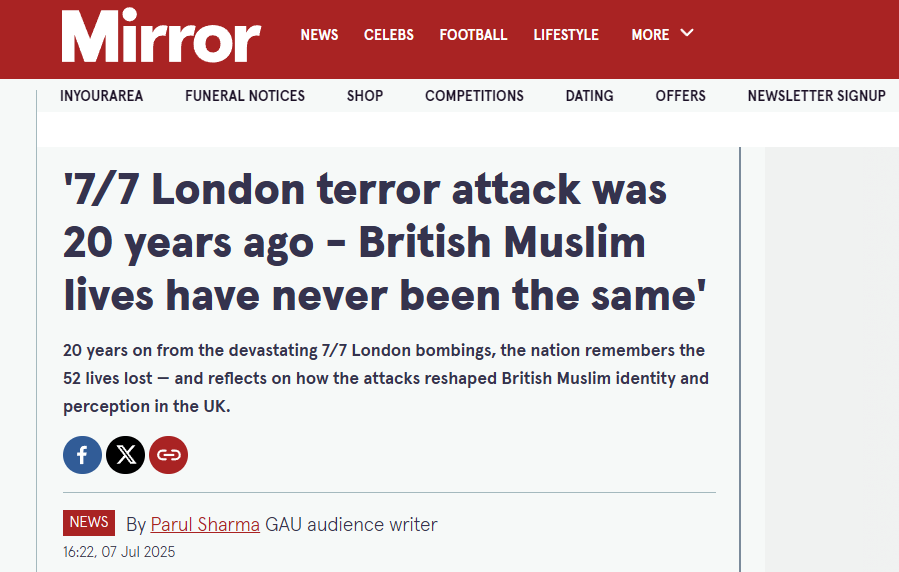
“Mirror” also indicated that the consequences of the attack were not shouldered by the victims, whose lives were permanently changed in a matter of moments, but by the Muslim community, which faced the repercussions in the aftermath. It shared interviews from the Muslim community with “The Guardian,” insisting that “the tragedy altered the very fabric of the British Muslim community in the UK,” to reinforce a similar agenda.
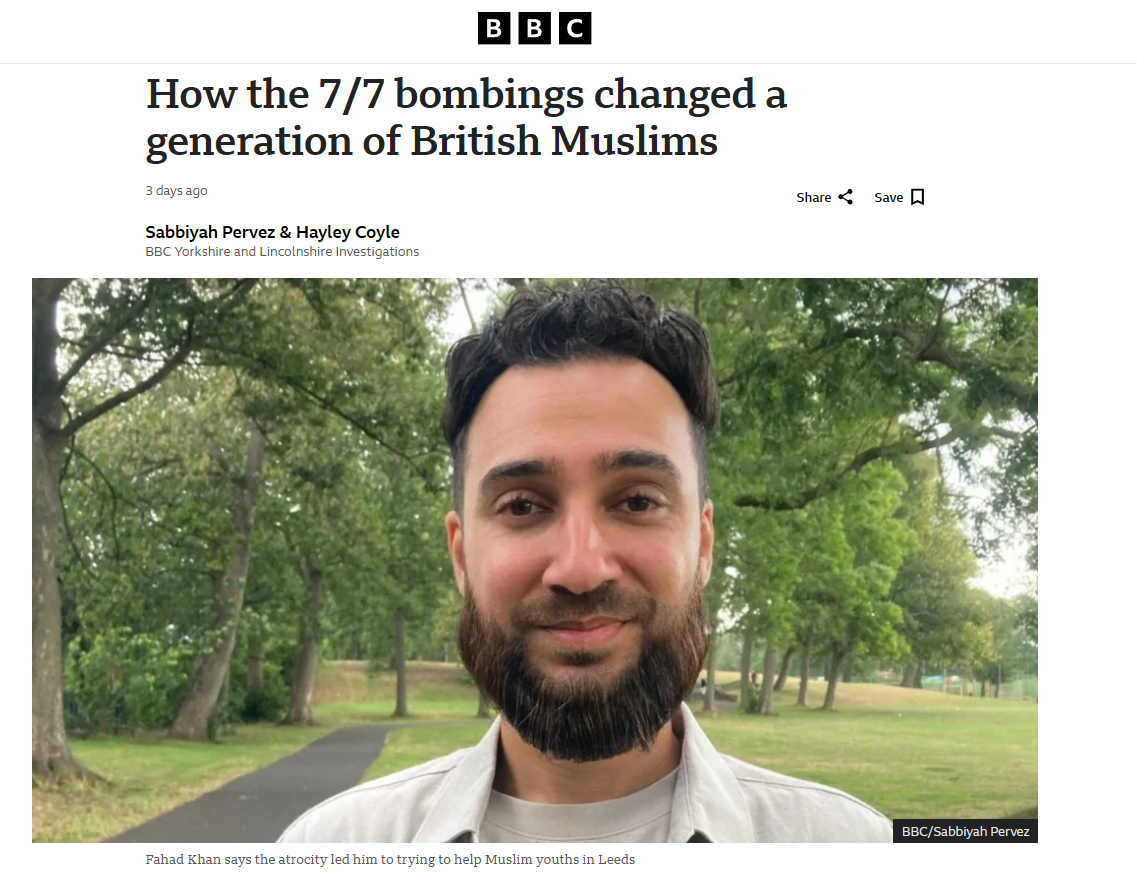
If all British media were engaged in whitewashing the attack, how could the habitual offender “BBC (British Broadcasting Corporation)” lag behind? They published a piece asserting that the incident transformed an entire generation of British Muslims, in which the authors criticized British policies and alleged that they specifically targeted the Muslim community.
Counter-terrorism initiatives such as Prevent were described as “toxic” and condemned as “counterproductive, making Muslim students feel isolated and contributing to a widespread sense of distrust among communities.”
The British broadcaster even released a news report concerning “Islamophobia” as the anniversary of 7/7 approached, calling on Mayor of London Sadiq Khan, whose time in office has witnessed a rise in crimes, particularly knife attacks, to enhance efforts and establish mandatory training across the Greater London Authority (GLA) to confront the issue. Khan’s parents landed in London from Pakistan.
The appeal was made by Hina Bokhari, a Liberal Democrat member of the London Assembly. She is the first woman from an ethnic minority (Pakistani) to serve as the head of a group on the assembly. Islamophobia is on the rise, she added, and it affects her and other Muslims.
The British media, government and authorities in an alarming show of recreancy and political correcteness, have also shied away from addressing the issue of Pakistani Muslim grooming gangs, choosing not to be labeled as racists rather than prioritizing justice, dignity and lives of minor girls of their country.
How British royalty, leaders try to underplay the role of jihadis in 7/7
The British monarchy and political elite had already trivialized the pain of the victims of the terror attack by diminishing it to ambiguous statements like “lost lives” as if there were no external influences driven by a violent ideology, accountable for their demise. King Charles III employed refined jargon, which could have been appropriate for a diplomatic address, during the memorial.
He made hollow appeals for “mutual respect” and conveniently evaded the terms jihad or Islamic terrorism that were responsible for the attack, while discussing “senseless acts of evil” and a “terrible summer’s day.” Prime Minister Keir Starmer also added to the euphemism and announced that “those who tried to divide us failed” at the event.
He emphasised the superficial phrases about “standing against hate” while laying wreaths, thus concealing the fact that the hate stemmed from a justification for murdering the unbelievers. More importantly, his staff acknowledged that the wording was carefully chosen to prevent “offending communities,” favouring Muslim sensibilities over British lives.
Likewise, a national “service of remembrance” turned into an interfaith performance. The Dean offered generic homilies on “hope” and “resilience” as 52,000 petals drifted beautifully from the dome, characterising the massacre as a natural calamity rather than an act fuelled by religious convictions. The clergy delivered sermons on “openness,” erasing any reference to the Islamist death cult that cultivated the assaliants. On the other hand, the survivors spoke about “darkness,” describing how profoundly their life changed after the attack.
The sham was joined by Deputy Prime Minister Angela Reyner, who released a banal statement under the guise of “community healing” and “shared resilience,” as well as announced, “We remember all whose lives were tragically altered.” There was no mention of Islamic terrorism or even terrorism. As expected, her staff also attested that the language was thoroughly examined to prevent “inciting division,” which is euphemism for pacifying Muslim sentiments and their Leftist lackeys.
Everlasting Muslim victimhood
The perception of victimization among Muslims shows no signs of abating, especially as the entire leftist-liberal ecosystem stands resolutely together to sustain this narrative, irrespective of the country or the incident. India, bordered by three Islamic countries and home to a 200 million strong Muslim population which continues to be treated as a minority rather than the second largest majority, has repeatedly suffered due to the same, where even acts of terrorism are underplayed by liberal parties, media and their entire cabal to appease Muslims and use them as vote-bank.
In any event or attack, the actual victims are routinely sidelined as they are replaced by Muslims, who are painted as the ones at the receiving end. Consequently, the entire narrative shifts towards the latter, allowing them to become the focal point while the original issue recedes into the background, leaving those who truly endured almost overlooked.
The most recent instance of this was showcased during the unfortunate Air India crash close to Ahmedabad, which resulted in the loss of 240 lives and devastated numerous families. Nevertheless, mourning the deceased was not as important to some of India’s liberal voices who were more concerned about the pilot’s religion. They shamelessly conveyed that the true tragedy would have been if the pilot had been a Muslim.
Amit Behere, a self-identified commentator, notorious for his offensive online discourse wroted, “Imagine if the pilot was a Muslim. Just imagine. And thank God he was not.” In addition to being callous, this statement was a glaring illustration of the ideological decay that has pervaded the liberal echo chamber. Many others like him also displayed their intellectual decay and insensitivity, blinded by their hateful agenda.
How Muslims were made victims of anti-Hindu Delhi riots
Major foreign news outlets like “Reuters,” “The Telegraph” and platforms like “The Print” disseminated a skewed, inaccurate and deceptive account of premeditated anti-Hindu Delhi riots which took place in February 2020, leading to a troubling trend of biassed reporting during the Lok Sabha Elections of 2024.
Additionally, the same lies were also promoted by the media in Bangladesh and Pakistan. They deliberately disregarded the vicious killings of numerous Hindus by Muslim mobs, including Dilbar Negi, chief constable Ratan Lal, and IB (Intelligence Bureau) officer Ankit Sharma.
A Reuters wire story that exclusively addressed the alleged Muslim riot victims was published by the Print and Pakistani newspaper Dawn. It made a blatant effort to depict victimisation and suffering on a unilateral basis. Likewise, the Delhi Riots of 2020 were defined as a “anti-Muslim pogrom” in a Pakistan Today story that was based on the Islamabad-funded Kashmir Media Service report.
However, the reports did not address how Hindus were intentionally targeted and lynched by bloodthirsty Muslim mobs, forcing the majority community to resort to self-defense to protect themselves. Furthermore, plans for the balkanization of the country were also in progress, as unveiled by Sharjeel Imam and Shahheen Bagh served as a facade to implement their violent agenda. The facts were omitted from the articles, as they would have exposed the meticulously crafted narrative.
Refusal to acknowlege real victims
“Hindus cannot be considered victims in India due to their majority status,” is the notorious defense frequently employed by Islamists and their liberal apologists, which has been discredited from Kashmir to West Bengal and Kerala.
However, as fabrications and falsehoods have never posed a problem for this ecosystem, individuals such as Arfa Khanum Sherwani, Rana Ayyub and Sayema have consistently defamed Hindus who have endured violence and stone pelting at the hands of Muslim mobs, during their sacred festivals and events, across the nation. The attacks on their temples and deities have also increased over the years.
Nevertheless, the Islamo-leftist network exerts considerable effort to portray Muslims as victims, subjected to a brutal regime, with their rights stripped away. Meanwhile, they create unrest, assault Hindus, challenge authorities and adminitration, while being consistently supported by their ecosystem.
Furthermore, the targeting of Hindu processions is rationalized under the pretext of entering the “Muslim areas,” while the attacks are simply dubbed as “communal tensions” to absolve radical Muslims of responsibility. Ironically, the Hindu majority population does not change India’s “secular” character, however, certain neighbourhoods become “Muslim areas” due to their demography.
Similarly, stone pelting, rioting and attacks on law enforcement personnel, executing their legal duties are frequently termed as outcomes of provocation or anger and even acts of retaliation against the system. On the contrary, legal measures against Islamists and jihadists are interpreted as judicial killings, state persecution, vendetta, majoritarianism, unlawful action and so forth.
The Hindus are even referred to as a “rotten community” by fanatics like Sharjeel Usmani to defend their co-religionists. To summarise these people “want to have their cake and eat it too.”
Conclusion
The severe anguish of the victims of Islamic terror has regularly been subordinated to the fragile feelings of Muslims. This was again pointed out in 2021 when the largest school board in Canada removed a woman who had escaped from the clutches of ISIS and was forced into sexual slavery as a teenager.
Students from some of the 600 schools of the Toronto District School Board were scheduled to meet with Iraqi-born Yazidi human rights activist Nadia Murad to discuss her upcoming book “The Last Girl: My Story Of Captivity.” She is a Nobel Peace Prize Laureate and United Nations Goodwill Ambassador. However, Helen Fisher, the superintendent of the school board cancelled the visit, asserting that the book would offend Muslims and “foster Islamophobia.”
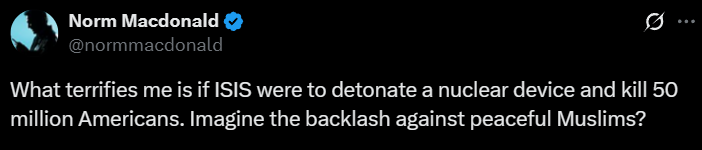
Highlighting this absurdity of this perpetual victimhood propaganda, a social media account mocked in 2016, “What frightens me is the possibility of ISIS (Islamic State of Iraq and the Levant) detonating a nuclear device and killing 50 million Americans. Can you envision the repercussions for peaceful Muslims?”
It is clear that these incidents are not isolated cases but a common occurrence that takes place repeatedly across various parts of the world, such as India, Canada, the United Kingdom and other countries. Nonetheless, if the energy expended on this is applied to ensure that the culprits are held accountable, acknowledge the ugly truth of jihad and Islamic terrorism and counter extremist elements, there would be no necessity to obscure any acts of terror, protect any sentiments or cry about Islamophobia. Crucially, the world would become a significantly safer place for all, including Muslims.