Home Blog Page 99

Women dragged, clothes torn, electricity cut: Read how TMC goons illegally occupied a school which provided free education, and how it was freed after BJP won elections- A ground report

The power transformation in West Bengal is not limited to the state’s political corridors; its echo is being heard in remote villages where, for the past many years, the ‘jungle raj’ of the leaders of the ruling party had prevailed. On Wednesday (06 May 2026) morning, an unexpected visual emerged in Jharkhali of South 24 Parganas district, which revived the hope of justice in the state. A local school named Aranyaj School, which was under illegal occupation of the local TMC leaders for almost two years, was finally freed.

For the past month, during the election period, the administrators of Aranyaj School had been receiving continuous death threats from local TMC cadres. However, the school administrators persisted, and the school was freed, despite TMC candidate Neelima winning on the SC-reserved seat from the Sundarbans area, where this school is located.

A video circulating on social media shows locals, including children, unlocking the gate of the school that had been illegally occupied by local TMC leaders since July 2024. As soon as the gate of the school was unlocked, a wave of joy swept through the entire Parbatipur area. Children who had been deprived of education and a bright future for two years had tears of joy in their eyes and innocent smiles on their faces, which had been snatched away on the fateful morning of July 2024.

Speaking to OpIndia, Abhijit Mukherjee from the Aranyaj Group said, “Started by Amrita Bose Gupta in 2023, this free English medium school was a centre for the education of poor children and the empowerment of women. In July 2024, it was snatched away by local TMC leaders. Now, after two years, there is an atmosphere of celebration throughout Parbatipur as the school has been reopened.”

This is not just the liberation of a school building, but the victory of the idea of ​​education and social empowerment, which the TMC goons tried to trample under their feet.

The terrifying morning when humanity was shamed

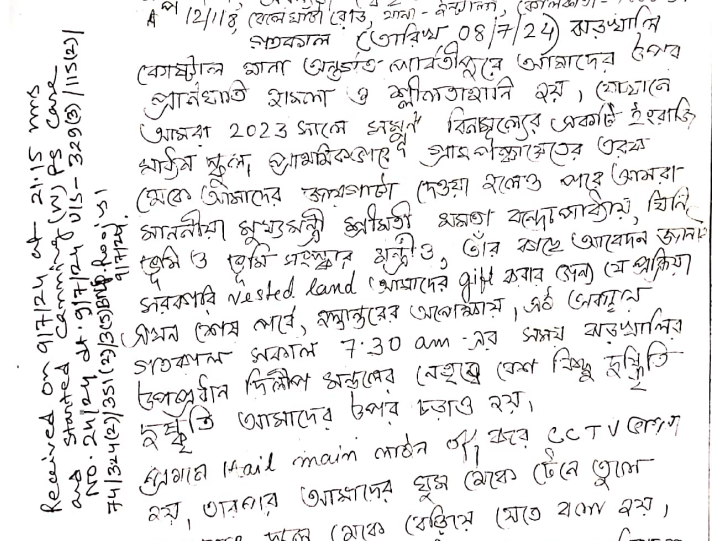
The picture of that day, as revealed in the FIR filed by Amrita Bose Gupta, manager of Aranyaj School, and her statements, is enough to shock any civilised society. The school, located in Parbatipur, under the jurisdiction of the Jharkhali Coastal Police Station, opened in 2023 with the noble purpose of providing free English-medium education to poor children.

According to Amrita Bose, at around 7:30 a.m. on July 8, 2024, when people present on the school premises were still asleep, dozens of rioters, led by Jharkhali’s deputy headman, Dilip Mandal, attacked. The attackers first cut off the school’s electricity and cut the wires to the CCTV cameras to ensure there was no evidence of their misdeeds.

In her complaint, Amrita, who was present at the school campus, stated that she and her team were dragged out of their sleep. They were subjected to abusive language, and their clothes were torn. Shockingly, the attackers were accompanied by some women, who beat Amrita and her companion, Upasana, and pulled their clothes. When Amrita tried to show a letter regarding the government’s land allotment, the accused, Parimal Mandal, tore up the official document and threw it away.
There was no pity even for the innocent and the elderly.

The brutality reached its peak when Amrita’s 8-year-old son was thrown to the ground and beaten. When her 65-year-old mother tried to save her grandson, the goons pulled down her nightdress. Even in her half-naked state, the elderly woman struggled to save her grandson. TMC workers kept kicking her back until she fell unconscious. Amrita was thrown down the stairs and was left in an unconscious state.

Systematic system of loot, temple of education turned into a ‘warehouse’

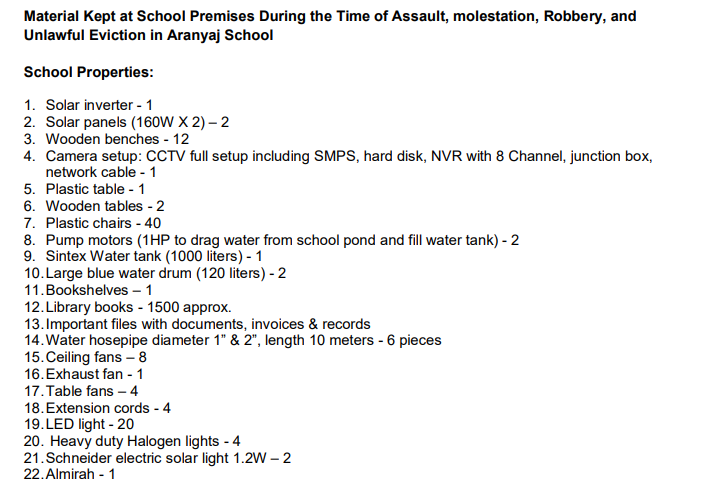
The TMC goons not only got the school evacuated, but also ruthlessly looted all the materials accumulated by the Aranyaj Society for Educational and Environmental Development after years of hard work. The inventory of the items looted from the school premises demonstrates that this was not merely a politically-motivated illegal occupation, but a well-planned robbery.

School and hostel property that was looted –

  • Education and Technology: Around 1500 books kept in the school library, an LCD projector set, a public addressing system, two CPU sets, an Asus laptop and important document files were stolen.
  • Energy and Infrastructure: One solar inverter, two solar panels (160W), 8 ceiling fans, 4 table fans, 20 LED lights and 4 heavy-duty halogen lights.
  • Furniture: 12 wooden benches, 40 plastic chairs, 2 wooden tables, and shelves.
  • Hostel Furnishings: 3 wooden beds, 20 blankets, 20 pillows and 5 bedding sets kept for teachers and volunteers.
Robbery of the rights of women and children

The NGO not only ran a school but also operated a sanitary napkin production unit to support women’s self-reliance. The attackers did not even spare the unit’s valuable machinery, which included:

  • 2 HP Pulveriser Machine and Wood Pulp Grinder.
  • 3 UV Radiation Sterilisers (2000 napkin capacity).
  • Ball press machine (weighing 100 kg) and 10 sealing machines.
  • 600 packets of finished sanitary napkins and 200 kg of raw materials like wood pulp.

Items, including 450 school uniforms for children, 150 waterproof bags, 150 sarees, 100 kg of rice, 20 kg of pulses, and even the refrigerator, were stolen from the kitchen. In addition to that, ₹20,000 was stolen from the organisation’s cash box and ₹15,000 from Amrita’s personal bag.

‘Powerful figures’ named in the chargesheet

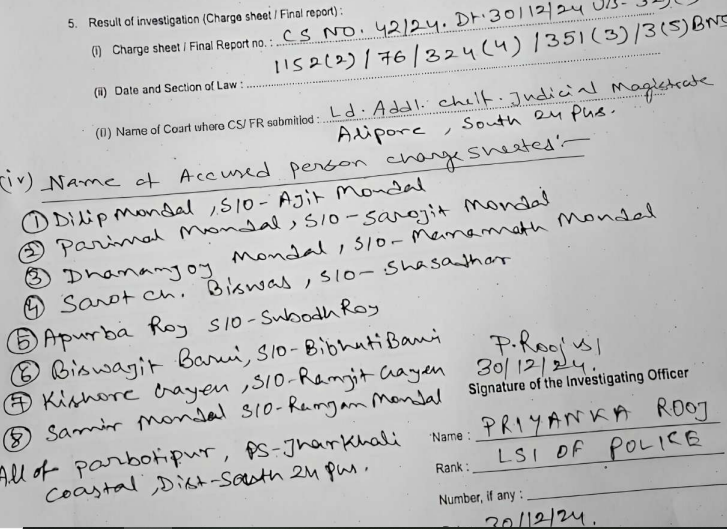
Serious questions have emerged regarding the conduct of the police in the entire case. Despite the FIR being filed on July 9, 2024, no significant urgency was shown in arresting the accused during the TMC government. The charge sheet filed by Investigating Officer Priyanka Rooj (LSI) is sufficient to expose these criminals.

The main accused against whom the charge sheet was filed-

  • Dilip Mondal (Jharkhali deputy head and mastermind of the attack)
  • Parimal Mondal
  • Dhananjoy Mondal
  • Saroj Chandra Biswas
  • Apurva Roy
  • Vishwajeet Bari
  • Kishore Gayen
  • Samir Mandal

All of them were charged under various serious sections of the Indian Penal Code (IPC), including 329(4) (causing grievous hurt), 115(2), 76, 324(4), 351(3), and 3(5). A charge sheet was filed in the court of the Additional Chief Judicial Magistrate in Alipore, but due to political protection, the accused roamed freely for two years.
The scenario changed with the change of power

With the fall of Mamata Banerjee’s government in the 2026 assembly elections, the administration’s lost credibility has finally returned. Locals say that as soon as the political protection of the culprits was lifted, the morale of these goons was shattered. The school, which endured years of silence and fear, is now resonating with the laughter of children.

A video circulating on social media shows local villagers and NGO workers working together to clean up the school and hoist the tricolour. The video not only shows the liberation of a school but also reflects the release of pent-up anger of the locals, which was suppressed for years.

Amrita Bose Gupta tells OpIndia about the situation of the past month

In an exclusive conversation with OpIndia, Amrita Bose Gupta explained that as the election atmosphere heated up, the illegal activities of TMC goons increased. She said that TMC leader Raja Gazi was behind the illegal activities, including the illegal occupation of the school, of Dilip Mandal and his gang. Amrita added that initially, she was not sure who was giving protection to Dilip Mandal and the gang, but later, she found out that it was Raja Gazi. Currently, the police are searching for him, and he could be arrested at any time. She explained that for the past month, the lives of everyone associated with Aranyaj School have been in constant danger.

Amrita revealed that she and her colleagues had received numerous death threats over the past month. Despite this, they devoted all their efforts to a change of government and campaigned vigorously for the BJP. Amrita attributed the liberation of the school to the BJP’s electoral victory. Even though the TMC candidate won the seat, the change in power in the state gave her and her team the courage to unlock the school.

Amrita Bose Gupta said that her focus is currently on reviving the school. Since the academic year has begun, bringing children will be a challenge, but it will take time to fully establish the school. She added that this school will run with the cooperation of the people, and no party support is needed. We will receive the law and order and justice we need from this new government; that will be enough for us.

BJP acknowledged Amrita’s struggle and tweeted the video

It’s important to note that while the TMC, which has been in power for a long time, and its supporters are hell-bent on ruining the future of young children, the BJP not only acknowledged Amrit Bose Gupta’s struggle but also posted a video of the school’s liberation on its official X handle. Amrita mentioned the moral support she is currently receiving from the BJP.

Hope for justice

The school is free, but Aranyaj now faces a mountain of challenges. Stolen goods, broken machinery, and two years of educational loss, who will compensate? Amrita Bose Gupta has appealed to the administration to not only put the accused behind bars but also ensure the recovery of every penny and item stolen.

Amid the ongoing chaos in the state, the most striking image is that of the children who returned to their school campus after nearly two years. During the period, the rooms where students used to study remained locked, and the walls where children’s dreams were supposed to be written were overshadowed by political conflict. The question now is whether this school will be able to return to its old glory, offering free education to poor children, job training for women, and a beacon of hope for rural society.
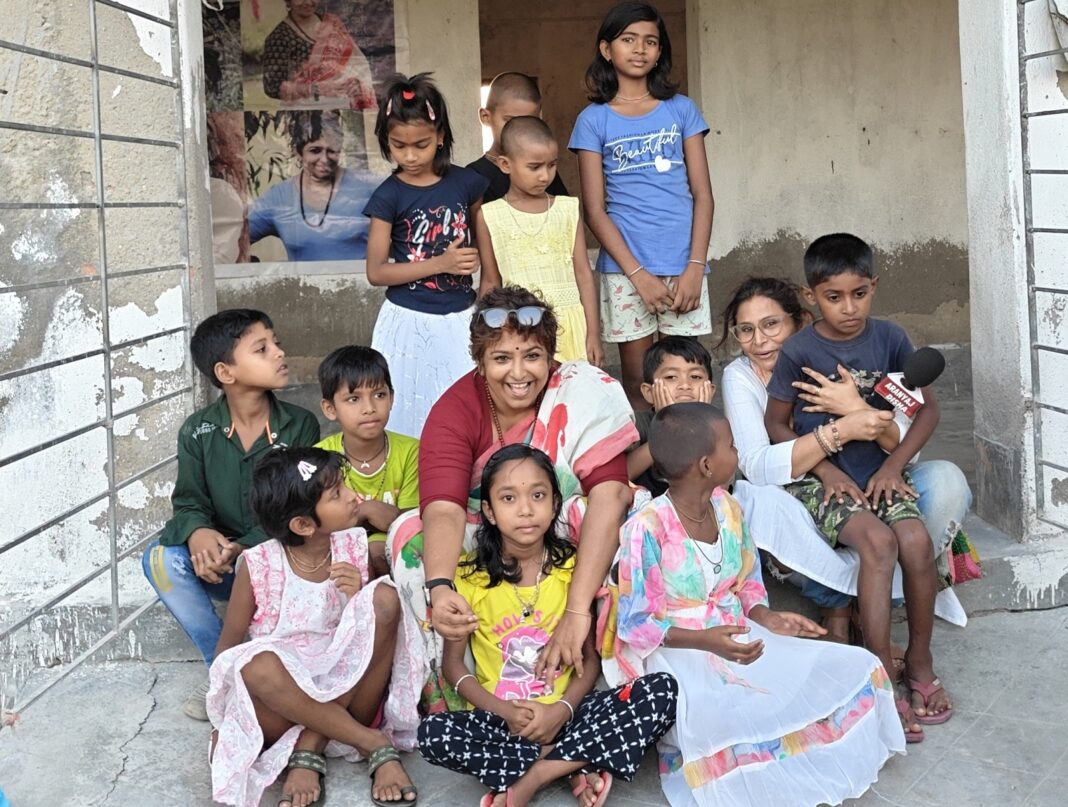
Amrita Bose Gupta with children (Photo courtesy: Special Arrangement)

This case also sets a precedent for other areas of Bengal where public welfare institutions and private properties have been seized by political influence. The liberation of Aranyaj School is a message that the arrogance of power is not eternal, and that justice and education ultimately prevail.

Today, every child in Parbatipur is saying, “We have our school back. Now we will study again.” This small victory could prove to be a big step towards the revival of Bengal.

(This article is a translation of the original article published at OpIndia Hindi.)
Modi govt approves Vadinar Ship Repair Facility in Gujarat: Read how it will make India Atmanirbhar in ship repair capacity

Beyond rhetoric, the Modi government has been actively boosting India’s economic growth in self-reliance by giving a much-needed revamp to the domestic shipbuilding and repair industry. In a major boost to India’s ambition of becoming Atmanirbhar in ship repair capacity, the Centre’s Cabinet Committee on Economic Affairs (CCEA), headed by Prime Minister Narendra Modi, approved the development of the Vadinar Ship Repair Facility in Gujarat on 5th May 2026.

Vadinar Ship Repair Facility: Modi government’s fresh addition to the efforts to boost the expansion of India’s ship repair ecosystem

The project, worth Rs 1,570 crore, will be developed jointly by the Deendayal Port Authority and Cochin Shipyard. Planned as a brownfield project, the Vadinar Ship Repair Facility will feature a 650 metres jetty, two large floating dry docks, workshops and associated marine infrastructure.

A brownfield for manufacturing sites is previously developed property, often a former factory or industrial plant, the reuse or redevelopment of which is complicated due to existing or potential environmental contamination.

What will make the Vadinar Ship Repair Facility an optimal location for repair operations, particularly for large commercial and foreign‑flagged vessels, is its natural deep draft, connectivity to major shipping routes, and proximity to key ports such as Mundra and Kandla.

Sharing an AI-generated informational video on social media, the Ministry of Information and Broadcasting said, “The Union Cabinet has approved the development of a state‑of‑the‑art Ship Repair Facility at Vadinar, Gujarat, marking a major expansion of the national ship repair ecosystem. The project will be jointly implemented by Deendayal Port Authority (DPA) and Cochin Shipyard Limited, with a combined investment of ₹1,570 crore. The initiative will contribute to regional economic growth and support India’s long‑term maritime objectives under Maritime India Vision 2030 and Maritime Amrit Kaal Vision 2047.”

Presently, India sends a large share of ship repair work abroad. However, after the Vadinar Ship Repair Facility becomes operational, it will enable high-value repairs domestically and aid in retaining business within India, in addition to generating over 1300 jobs. The project will also spur growth in the maritime cluster of Gujarat and ancillary industries, thus giving a boost to the regional economy.

Regarding the impact this project will have, the Cabinet Committee on Economic Affairs (CCEA) said in a statement, “The Vadinar Ship Repair Facility will directly address a critical gap in India’s ship repair infrastructure, as the country currently lacks adequate domestic capacity to repair large vessels exceeding 230 m in length. By enabling repair of vessels up to 300 m, the facility will allow high‑value repairs of large vessels within India. This will significantly reduce dependence on foreign shipyards and curb foreign exchange outflow.”

It further stated that enhanced turnaround times and strengthened repair capability on the western coast will improve the overall competitiveness of Indian ports.

The Vadinar Ship Repair Facility is expected to create sustainable employment, generating approximately 290 direct and around 1,100 indirect jobs across ship repair, logistics, and ancillary industries, while catalysing a broader maritime industrial ecosystem, the government said.

Modi government’s overhaul of India’s shipbuilding and repair sector

In recent years, the Modi government has taken several concrete policy decisions towards expanding India’s shipbuilding and repair ecosystem and curbing reliance on foreign facilities for routine and complex vessel work. OpIndia has reported earlier about the various initiatives launched by the Central government to revive and scale up India’s shipbuilding and repair industry.

India currently ranks 22nd in the global shipbuilding industry; however, it aims to enter the top 10 global rank by 2030 and become one of the top 5 countries by 2047. This ambition is a part of the Modi government’s broader visions, including the Maritime India Vision 2030 and Amrit Kaal Vision 2047, intended to capture a massive share of the global shipbuilding and ship repair markets.

In December 2025, the Ministry of Ports, Shipping & Waterways notified the operational guidelines for two major shipbuilding initiatives, the Shipbuilding Financial Assistance Scheme (SBFAS) and the Shipbuilding Development Scheme (SbDS), with a budget of Rs 44,700 Crore.

The SBFAS has been allocated a budget of Rs 24,736 crore. Under this scheme, the Central government will offer fiscal assistance ranging from 15% to 25% per vessel, depending on the vessel category.

The Modi government also launched the Shipbuilding Development Scheme (SbDS) to strengthen long-term capacity and capability creation. The scheme worth Rs 19,989 crore will cover the development of greenfield shipbuilding clusters, expansion and modernisation of existing brownfield shipyards. In addition, the SbDS provides for the establishment of an India Ship Technology Centre under the Indian Maritime University to support research, design, innovation and skills development.

Moreover, greenfield shipbuilding clusters will be provided 100% capital support for common maritime and internal infrastructure through a 50:50 Centre–State special purpose vehicle. In addition, existing shipyards will be eligible for 25% capital assistance for brownfield expansion of critical infrastructure, including dry docks, ship-lifts, fabrication facilities and automation systems. The SbDS also provides for a Credit Risk Coverage Framework, providing government-backed insurance for pre-shipment, post-shipment and vendor-default risks to improve project bankability and financial resilience.

In February 2025, Finance Minister Nirmala Sitharaman announced in her speech for the budget 2025-26  that ships above a specified size would be included in the harmonised master list (HML) for infrastructure, making them eligible for financial incentives. This enabled an influx of private investment in the shipbuilding industry and enhanced fleet modernisation.

The Modi government also announced the allocation of a Maritime Development Fund (MDF) with a corpus of Rs 25,000 crore. 

In September last year, it was reported that the Central government is considering investing ₹75,000 crore in the three new shipyards that are expected to be built along its east and west coasts.

In December 2025, the Ministry of Ports, Shipping and Waterways announced that it had approved a comprehensive package of Rs. 69,725 crores featuring a four-pillar approach to strengthen domestic capacity, maritime financing, shipyard development, skilling, and reforms. The government estimated that this move could stimulate the creation of more than 22 lakh direct and indirect jobs.

Clearly, the Modi government has its priorities set right in the face of the many industry challenges. The approval of the Vadinar Ship Repair Facility is the latest in a series of actions taken and showcases the Central government’s focus on supporting practical infrastructure projects alongside policy and financial backing.

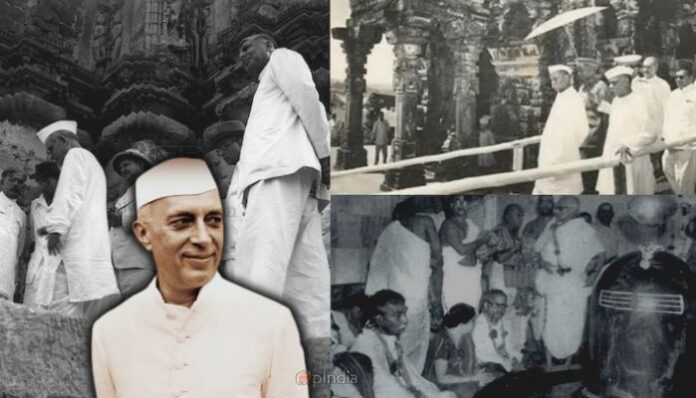
As PM Modi is set to visit Somnath to mark 75 years of its restoration, read how Islamic invaders repeatedly destroyed the ancient temple and Nehru opposed its reconstruction

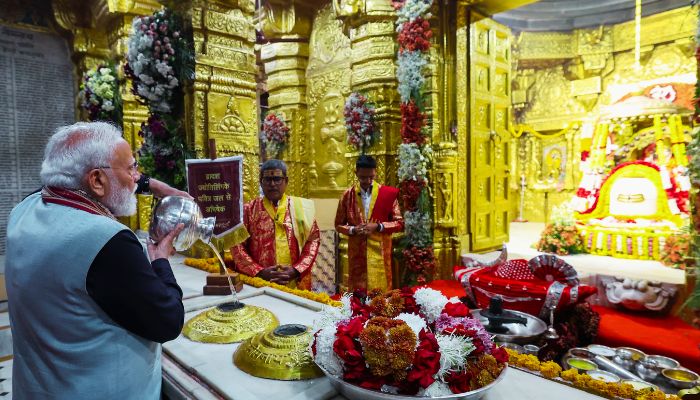
Prime Minister Narendra Modi is set to visit the iconic Somnath Temple in Gujarat on 11th May to mark the 75th anniversary of the restored Hindu temple’s inauguration by President Rajendra Prasad in 1951. PM Modi will participate in various religious, administrative and cultural events in Gir Somnath and Vadodara. Ahead of the visit, the Prime Minister, who hails from Gujarat, penned an opinion piece reflecting on the Somnath Temple as the eternal first Jyotirlinga and a profound symbol of Bharat’s civilisational spirit.

In the op-ed titled, “Somnath and Bharat’s unconquerable spirit!” published on 8th May, PM Modi discussed the civilisational continuity, the Somnath Mandir symbolises, noting that ever since the first Islamic attack a thousand years ago, Somnath has endured many assaults but always risen again with dignity and strength.

“Somnath gives us a civilisational message. The vast sea before it evokes timelessness. The waves tell us…that no matter how fierce the storms are or how turbulent the tides are, one can always rise again with dignity and strength. The waves return to the shore, as though reminding every generation that the spirit of the people can never be subdued for long,” the Prime Minister wrote.

From Lakulisha and Soma Sarman, Chakravarti Maharaja Dharasena IV of Vallabhi, Bhima Deva, Jayapala and Anandapala, Raja Bhoja, Karna Deva and Siddharaja Jayasimha, Bhava Brihaspati, Kumarapala Solanki and the Pashupata Acharyas, Vishaladeva Vaghela and Tripurantaka, Mahipaladeva and Ra Khangar, Punyashlok Ahilyabai Holkar, the Gaekwads of Baroda, to Veer Hamirji Gohil and Veer Vegdaji Bhil, PM Modi acknowledged and hailed the role played by these people in protecting the honour of Somnath Temple.

Prime Minister Modi rightly equates a pradakshina (circumambulation) of Prabhasa or Somnath with one of the entire earth, and celebrates the unbroken continuity of the Sanatan civilisation whose divine flame could never be extinguished, even in the face of consistent Islamic invasions and upheavals.

The Prime Minister also recalled the great contribution of Independent India’s first Home Minister, Sardar Vallabhbhai Patel, in reviving the dilapidated ruins of the Somnath Temple into a grand and glorious abode of Mahadev.

“In the 1940s, when the spirit of freedom swept across India and the foundations of a new republic were being laid under the leadership of towering figures like Sardar Patel, one thing continued to trouble him deeply…the condition of Somnath. On 13th November 1947, during Diwali time, he stood next to the dilapidated ruins of the temple with sea-water in his hands and said, “On this auspicious day of the (Gujarati) New Year, we have decided that Somnath should be reconstructed. You, people of Saurashtra, should do your best. This is a holy task in which all should participate.” On one clarion call of Sardar Patel, it was not only the people of Gujarat but also the people of the whole of India that responded enthusiastically,” PM Modi’s op-ed reads.

As PM Modi reminisces about the civilisational continuity, blows inflicted and consistent fightbacks by Hindus over the centuries, it is essential to remember how Islamic invaders destroyed the Somnath Temple.

Somnath Temple, the holy abode of Someshwara Mahadev and the many Islamic attacks it faced

The Somnath Mandir is a majestic temple situated near Prabhas Patan of Veraval in Gujarat.  It is one of Lord Shiva’s twelve sacred Jyotirlingas and finds mention in Chapter 13 of the Shiv Purana. Somnath is also described as Triveni Sangam, much like the one in Prayagraj, due to the meeting of the Kapila, Hiran and Saraswati rivers. 

For Muslims, especially the Islamic invaders in the medieval era, destroying the temples and idols of the Kafirs was upheld as their “religious duty”. While many Hindu temples were desecrated and destroyed during the Islamic invasions, Somnath in Gujarat and Jagannath Temple in Puri, Odisha, faced the maximum attacks, with each being invaded 17 and 18 times.

The first attack on the Somnath Temple came in 725 CE from an Arab named Junayd ibn Abd ar-Rahman al-Murri, also known as Al-Junayd during the Umayyad Caliphate. Junayd was appointed the governor of Sindh in 723. He invaded Gujarat and Rajasthan and ravaged, looted and destroyed the Somnath Mandir in 725. 

It was only in 815 CE that Nagabhata II, a Gurjar Pratihar monarch, visited the ruins of the Somnath Temple and rebuilt the temple using red stones.

The Islamic antagonism towards Hindus was perfectly embodied by Mahmud of Ghazni, who led 17 invasions on the Somnath Temple and desecrated the idols. In 1025, he plundered the holy idol of Somnath during his sixteenth expedition to India. “Somnath” is Sanskrit for “moon master.” Mahmud of Ghazni is said to have sworn to wage an annual Jihad against the country of Kafirs. Ghazni overthrew Hindu king Jayapala, defeated his successors Anandpala (in 1008) and Trilochanpala (in 1013).

In 1011, Mahmud of Ghazni attacked Thaneshwar and destroyed idols.  He burned the temples in Mathura during 1018–1019, and the idols were taken to Ghazni. His Jihadi fanaticism also devoured Mathura, Kannauj and the many temples on the way. However, Ghazni’s Somnath invasion became an unforgettable chapter in Bharat’s history, reflecting both the obsession and abhorrence Muslims harbour for Hindus, and the resilience of the Hindu civilisation to rise every time and continue the fight until the ultimate victory, no matter how long it takes.

Despite heavy losses and fierce opposition, the Jihadi army of Mahmud of Ghazni demolished the sacred temple. The defenceless guardians of the Somnath Temple fought bravely till the end. Thousands sacrificed their lives. Mahmud Ghazni fought a battle against the Hindus comprising the temple guards, Brahmins and locals defending the temple; the battle resulted in over 50,000 deaths.

After the slaughter, Mahmud entered the temple’s sanctum sanctorum, dismantled the Shivalinga and stole all the riches, which totalled over 20,000,000 Dirhams. 

The cruel ruler of the Ghaznavid Empire earned the disgraceful moniker ‘Butshikan’ or idol breaker due to his Jihad against Hindu temples.

Historical records state that Ghazni smashed and broke the Lord Somnath idol into four pieces during his 16th invasion of the Somnath Temple. Mahmud of Ghazni entered the temple after defeating the temple’s guardians and saw the magnificent idol of Lord Somnath there. He took his mace and attacked with such vigour that the Lord Somnath idol, which was reportedly five yards long, was shattered into pieces after he became enraged upon seeing the idol.

After the protectors of the Somnath temple were defeated, it is stated in Tariki-e-Alfi, a historical work compiled by a committee formed by Akbar, that Brahmins offered Mahmud of Ghazni an unheard-of amount of wealth in exchange for leaving the ling of Somnath undamaged. Mahmud, in response, said that after he died, he would rather love to be known in the presence of Allah as Butshikan (the destroyer of idols) rather than ButParast (the devotee of idols). He rejected the Brahmins’ offer and demolished the Somnath idol.

The fragments of the Somnath idol were buried inside the Jama Masjid in Ghazni and beneath the entrance to the Sultan’s palace, according to Al-Beruni, an Islamic scholar active during the reign of Mahmud of Ghazni. This was done so that people would step on them while visiting the mosque and the palace and continue to humiliate the idol worshippers.

The Islamic jihadi attacks on the Somnath Temple did not end with Mahmud Ghazni’s campaign. Somnath Mandir endured many more assaults from Islamic barbarians over the centuries. Besides the continued expeditions of Mahmud Ghazni, the attack ordered by the Delhi Sultanate king, Allauddin Khilji, is an important episode in the history of the continuous cycle of destruction and rebuilding of the Somnath Temple.

In 1299, Allauddin Khilji’s Delhi Sultanate army, led by commander Ulugh Khan, heavily damaged the Somnath Temple and looted its riches. The attack came during the Gujarat conquest against the Vaghela king Karna. The Rajput Prince Biram Dev of Jalore led a Hindu army that intercepted and defeated Ulugh Khan and the Delhi Sultanate forces returning with the Shivling from Somnath, and the plundered wealth.

As Allauddin Khilji’s illegitimate daughter Firoza fell in love with Biram Dev, Khilji asked him to convert to Islam. However, the Kshatriya prince blatantly refused. Enraged by this, Khilji deployed his army to Jalore. Biram Dev and his father, Kanhadadev, led the army that fought bravely; however, they were defeated and killed. Khilji’s forces destroyed many temples and ruined the Jalore Fort. The Jihadis, however, could not find the Shivling or the stolen goods from the Somnath Mandir.

Another major attack on the Somnath Temple was by Muzaffar Shah I, often called Zafar Khan, who was the monarch of the Gujarat Sultanate from 1407 to 1411. He was a Khatri or Tank Rajput before conversion to Islam. Zafar Khan went to Somnath in 1395 AD, when he destroyed the temple, constructed a Jumma mosque, spread Islam and set up a thana in the city of Somnath Patan, alias Deva Patan.

Similarly, Mahmud Begada desecrated Somnath in 1451 AD, and the Portuguese Christian fanatics also attacked the Somnath Mandir and took away its riches in 1546 AD.

Despite the continued attacks and destruction, the Somnath Temple was always rebuilt and restored to its glory by the Hindus.

The last destruction of the Somnath Temple transpired in 1665 AD under Mughal tyrant Aurangzeb. As he found that Hindus reconstruct the temples that Muslim Jihadis would destroy, Aurangzeb mandated that any Hindu temples, including the Somnath, that were rebuilt shall be razed. The intention was to prevent Hindus from resuming worship in these temples.

The Somnath Mandir was vandalised by local Muslims of Prabhas and some of Aurangzeb’s troops under his orders. Initially, Hindus outnumbered and drove out Aurangzeb’s forces. However, a larger army returned, and the temple was demolished, and the treasury was plundered.

Islamic invaders destroyed Somnath Temple, Jawaharlal Nehru opposed the temple’s reconstruction: Hatred of the enemies and the treachery of our ‘own’

After centuries of attacks, destruction, and systematic loot of the Somnath Mandir, it was assumed that at least after independence in 1947, the Hindu temple would be restored to its original glory by the government of our own. However, the first Prime Minister of an independent India, Jawaharlal Nehru, made it clear with his stance in this matter that Gora Sahebs were replaced by the Bhoora Sahebs, both indifferent to the plight and sentiments of the common people, particularly Hindus.

From the British Colonial Raj to Congress Raj, the blatant snubbing of Hindu rights continued in both pre- and post-independent India. This blatant disdain for Hindus was reflected in the conduct of Jawaharlal Nehru, who was outspokenly against the reconstruction of the Somnath Temple.

On 13th November 1947, Sardar Patel reached Junagarh to a roaring welcome from the state’s citizens. Patel promised to restore the Somnath Mandir. When he returned to Delhi, a cabinet meeting decided to reconstruct the temple and determine that the state would cover the costs.

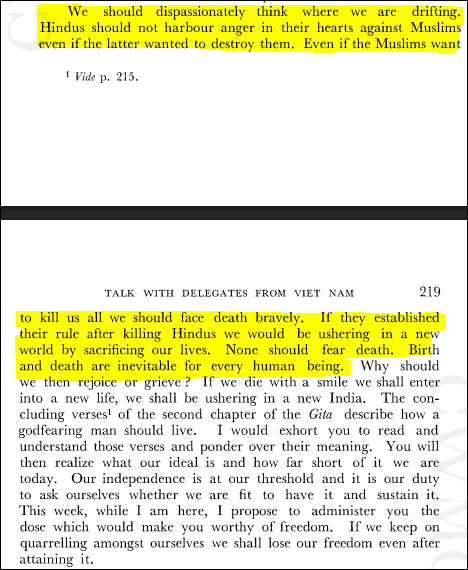
However, Mohandas Karamchand Gandhi, who once said that “Hindus should not harbour anger in their hearts against Muslims even if the latter wanted to destroy them”, said that it is the people who should cover the expenses of temple restoration. This led to the decision being overturned. Gandhi was killed in 1948, and Sardar Patel passed away in 1950.

Kanhaiyalal Maneklal (KM) Munshi, the cabinet minister at the time, became chairman of the trust’s advisory committee, which was tasked with restoring the temple. While Munshi was overseeing the restoration of the Somnath Temple, Jawaharlal Nehru was feeling a disgraceful unease (read heartburn).

In a clear declaration of his stance on the Somnath Mandir revival issue, Nehru told Munshi, “I don’t like your trying to restore Somnath. It is Hindu Revivalism.”

Between 1950 and 1951, Jawaharlal Nehru wrote a series of letters in which he expressed opposition to the reconstruction and consecration of the Somnath Temple. Nehru wrote around 17 letters to various officials, including Cabinet ministers, chief ministers, the President, the Vice President, and even to the Prime Minister of Pakistan, making his deep contempt for the Hindu community’s quest for reclamation of its destroyed temples known. He described the idea of restoring the Somnath Temple as ‘Hindu revivalism’.

Nehru had objected to President Rajendra Prasad’s decision to attend the Somnath Temple consecration ceremony. On 2nd March 1951, Prime Minister Jawaharlal Nehru ‘confessed’ that he was against the idea of President Rajendra Prasad associating himself with the grand opening ceremony of the Somnath Temple. He urged Prasad not to preside over the ceremony.

“…I confess that I do not like the idea of your associating yourself with a spectacular opening of the Somnath temple. This is not merely visiting a temple, which can certainly be done by you or anyone else, but rather participating in a significant function which unfortunately has a number of implications. Personally, I thought that this was no time to lay stress on large-scale building operations at Somnath. This could have been done gradually and perhaps more effectively later. However, this has been done. I feel that it would be better if you did not preside over this function,” Nehru wrote.

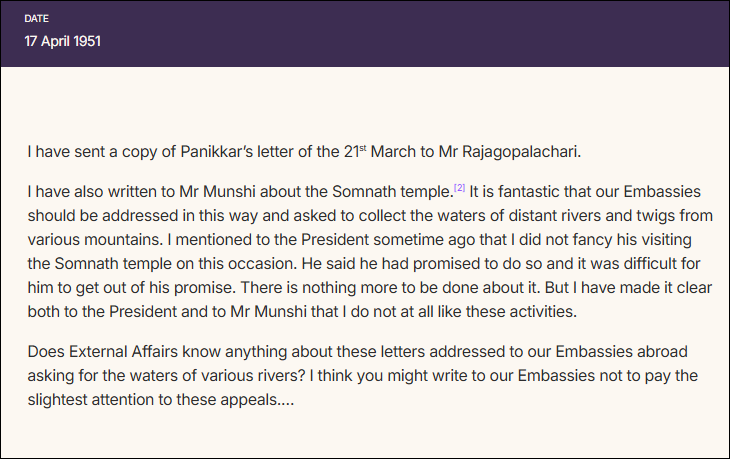
PM Nehru, ‘secular’ icon of the Islamo-leftist cabal to this day, had also written a note to the then Secretary-General and Foreign Secretary, in which he said that he did not like the idea of collecting waters of various rivers and twigs from mountains for the Somnath consecration ceremony. He also expressed his disappointment over then-President Rajendra Prasad visiting the Somnath Temple to attend the Pran Pratishtha ceremony.

“I have also written to Mr Munshi about the Somnath temple. It is fantastic that our Embassies should be addressed in this way and asked to collect the waters of distant rivers and twigs from various mountains. I mentioned to the President sometime ago that I did not fancy his visiting the Somnath temple on this occasion. He said he had promised to do so and it was difficult for him to get out of his promise. There is nothing more to be done about it. But I have made it clear both to the President and to Mr Munshi that I do not at all like these activities,” PM Nehru wrote in the note dated 17th April 1951.

Not only this, but PM Nehru also asked the Ministry of External Affairs official to write to Indian embassies abroad not to heed requests to fetch waters from various rivers for the relevant purpose.

PM Nehru was also ‘distressed’ over the association of the Indian and Saurashtra governments with the Somnath Temple consecration ceremony. “I have been much distressed at the association of the Government of India with the ceremony that is taking place at Somnath. I wrote to the Jam Saheb and to the Government of Saurashtra about it. I find now that in fact some Ministries of the Government of India, including our Ministry, had been consulted and in fact they encouraged various steps that were taken. I am afraid we can do nothing further in the matter now. But I think all this association is most unfortunate,” Nehru wrote in a note to MEA Secretary S Dutt on 9th May 1951.

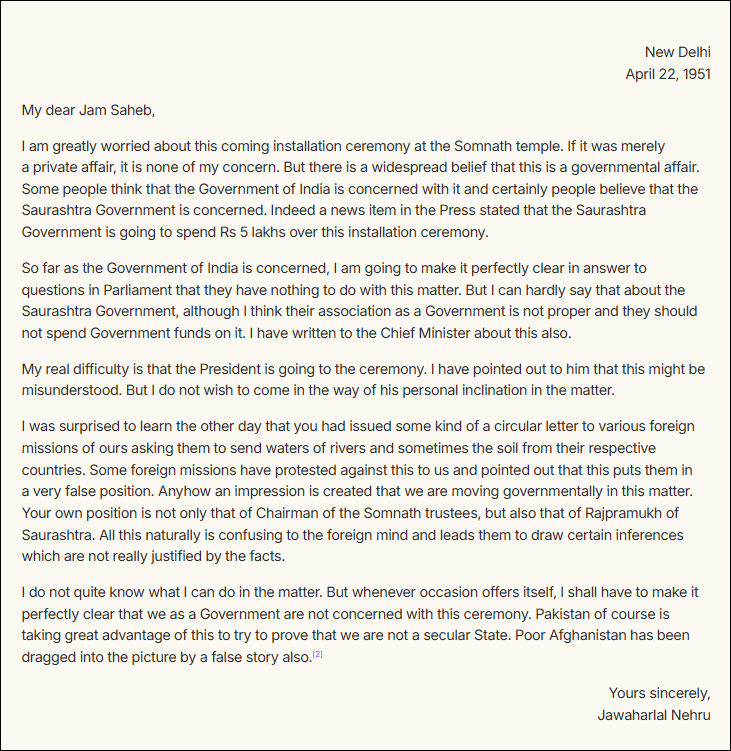
Nehru also wrote a letter to Navanagar Jam Saheb, Maharaja Digvijaysinhji Jadeja, expressing worry over the Islamic nation Pakistan accusing India of not being secular over government involvement in the Somnath Temple consecration. This overwhelming concern over what the Pakistani government would think about India came hardly five years after Pakistan came into existence, after the slaughter of Hindus, Sikhs, Buddhists and other Kafir communities.

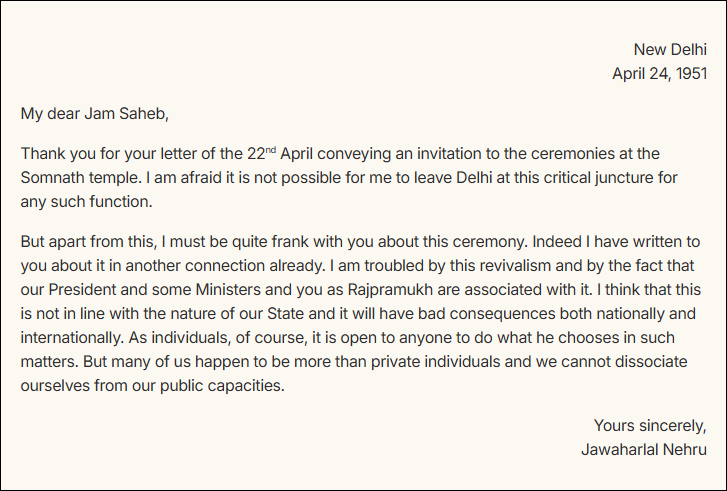
Not only this, Nehru even declined Navanagar Jam Saheb’s invitation to the Somnath Temple consecration ceremony, calling the event ‘Hindu revivalism’

The letter dated 24th April 1951 reads, “Thank you for your letter of the 22nd April conveying an invitation to the ceremonies at the Somnath temple. I am afraid it is not possible for me to leave Delhi at this critical juncture for any such function. But apart from this, I must be quite frank with you about this ceremony. Indeed I have written to you about it in another connection already. I am troubled by this revivalism and by the fact that our President and some Ministers and you as Rajpramukh are associated with it. I think that this is not in line with the nature of our State and it will have bad consequences both nationally and internationally. As individuals, of course, it is open to anyone to do what he chooses in such matters. But many of us happen to be more than private individuals, and we cannot dissociate ourselves from our public capacities.”

In one of the letters, Nehru told Home Minister C Rajagopalachari that the President should not go to the Somnath consecration ceremony. However, President Prasad rejected Nehru’s suggestion and attended the ceremony at the Somnath Temple.

While Congress carried forward Nehru’s opprobrious legacy of neglecting and suppressing Hindus and their historical grievances as ‘revivalism’ and ‘intimidation’ of minorities, the PM Modi-led BJP government changed the script. The Modi government carried forward Sardar Patel’s legacy. It ensured that, from Somnath to the Ram Mandir in Ayodhya to the Kashi Vishwanath Mandir in Varanasi, Hindu glory is not suppressed to appear ‘secular’ and appease Muslims.

No one killed 75 CRPF personnel? Chhattisgarh HC acquits 10 in 2010 Tadmetla ambush case: Here is how botched investigation, hostile witnesses caused the case to collapse

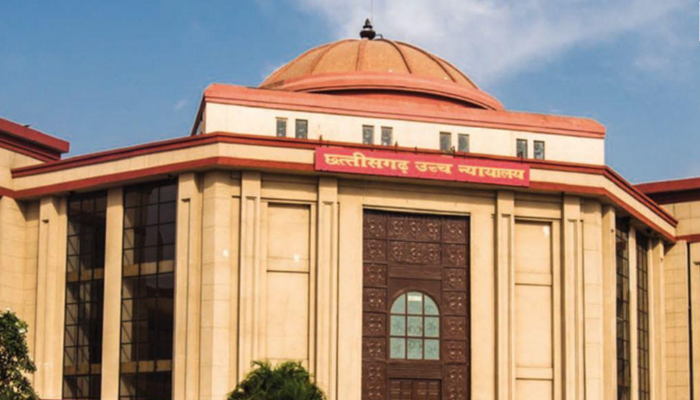
The Chhattisgarh High Court recently acquitted 10 accused in the 2010 Tadmetla ambush case, in which Naxalites brutally massacred 76 security personnel and looted their weapons. Passing the order of acquittal, a Division Bench of Chief Justice Ramesh Sinha and Justice Ravindra Agrawal expressed disappointment over the lack of reliable evidence, procedural lapses in the investigation, and failure to establish guilt beyond a reasonable doubt.

The decision was passed on an appeal filed by the state government against the trial court’s acquittal of the accused, as per a judgment passed on January 7, 2013. The Division Bench dismissed the appeal of the state government filed under Section 378 of the CrPC, noting that no direct evidence or eyewitness was available in the case. “In the present case, there is no direct evidence/eyewitness available on record. The case of prosecution is based on the ‘circumstantial evidence’, ” the High Court said in its order dated May 5, 2026.

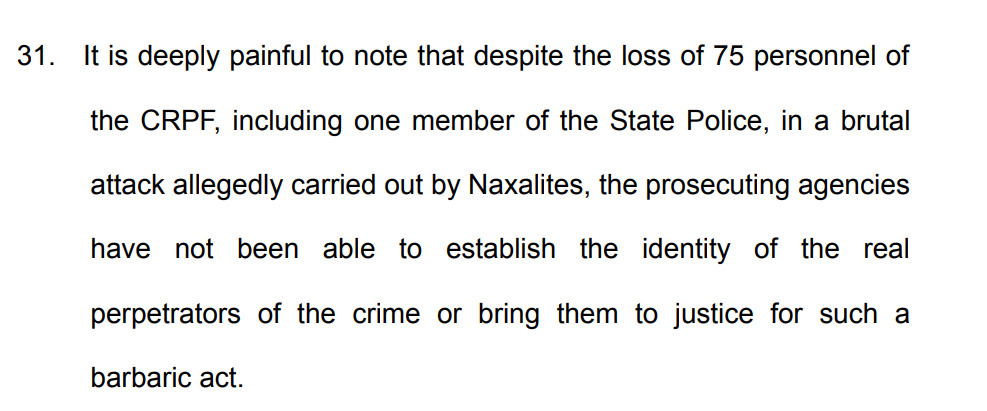
The High Court expressed dismay over the failure of the prosecution in establishing the identities of the accused, who carried out the barbaric attack. “It is deeply painful to note that despite the loss of 75 personnel of the CRPF, including one member of the State Police, in a brutal attack allegedly carried out by Naxalites, the prosecuting agencies have not been able to establish the identity of the real perpetrators of the crime or bring them to justice for such a barbaric act,” the High Court noted.

An excerpt from the judgment

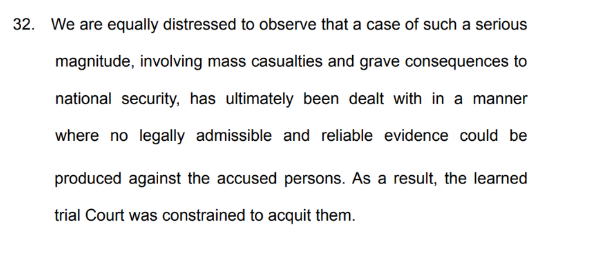
“We are equally distressed to observe that a case of such a serious magnitude, involving mass casualties and grave consequences to national security, has ultimately been dealt with in a manner where no legally admissible and reliable evidence could be produced against the accused persons. As a result, the learned trial Court was constrained to acquit them,” the court added.

An excerpt from the judgment

Lacunae highlighted by the High Court in the prosecution’s case

The High Court highlighted five major lacunae in the case of the prosecution:

Firstly, the High Court said that the prosecution could not furnish any direct evidence or eyewitness testimony linking the accused to the actual commission of the homicidal acts. None of the eyewitnesses identified the accused as the perpetrators of the crime.

Secondly, the confessional statement of the accused recorded under Section 164 Cr.P.C. was not corroborated by any independent evidence.

Thirdly, the explosive material, including pipe bombs, grenades, and rifles, was recovered from the place of the incident and not from the possession of the accused. The Forensic Science Laboratory (FSL) report was not presented before the court, due to which it could not be ascertained that the material recovered from the site was explosive.

Fourthly, the High Court noted that the record did not show a prosecution sanction required under the Arms Act, the Test Identification Parade of the accused was not conducted, and there were discrepancies in witness accounts.

Lastly, the prosecution could not establish the involvement of the accused in planting, handling, or using explosives.

The Advocate General submitted before the High Court that all the witnesses had turned hostile, and they did not identify the accused as the perpetrators of the crime. Besides, the Advocate General failed to provide a satisfactory answer when the court asked the reason for filing the appeal against the trial court judgment, when there was no evidence available to prove the guilt of the accused.

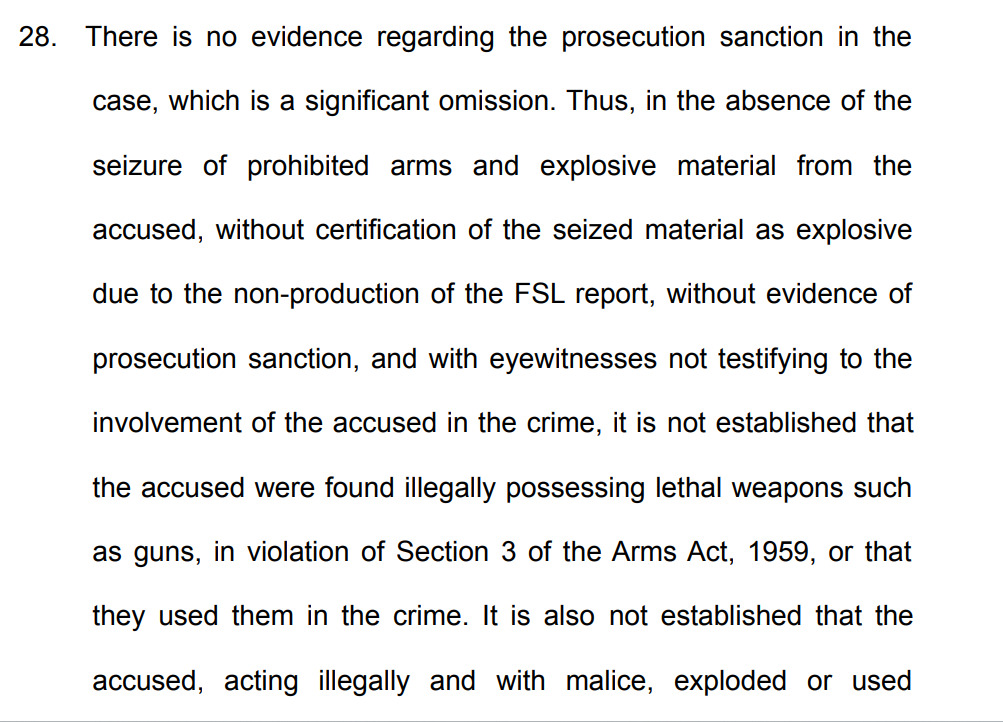
“There is no evidence regarding the prosecution sanction in the case, which is a significant omission. Thus, in the absence of the seizure of prohibited arms and explosive material from the accused, without certification of the seized material as explosive due to the non-production of the FSL report, without evidence of prosecution sanction, and with eyewitnesses not testifying to the involvement of the accused in the crime, it is not established that the accused were found illegally possessing lethal weapons such as guns, in violation of Section 3 of the Arms Act, 1959, or that they used them in the crime,” the High Court observed.

An excerpt from the judgment

Displeased over the manner of investigation of the case, the High Court asserted that the State must ensure high standards of investigation in future cases involving serious crimes to prevent recurrence of procedural lapses and to uphold
public confidence in the criminal justice system.

Background of the case

The ghastly incident happened on the morning of April 6, 2010, when Satyawan Singh, Deputy Commander, 62nd Battalion CRPF, was on Area Domination Patrol from April 4, 2010, to April 7, 2010, along with the company and police force, going towards the hilly forest of Chintalnar. On their way, the forces were ambushed by Naxalites, who opened heavy fire on them in the forest of Tadmetla village in the Sukma district.

75 CRPF personnel and a police man were killed in the barbaric attack, and their weapons were also looted. Before fleeing from the spot, the Naxalites also planted tiffin bombs. A case was lodged at the Chintagufa police station against the 10 accused. Two of the accused, including 19-year-old Barse Lakhma, who was the youngest accused in the case, died during the trial of the case.

‘Empires rose and fell, but Somnath continued to endure in our consciousness’: PM Modi pens a heartfelt note to mark 75 years since inauguration of the restored temple

At the start of 2026, I had gone to Somnath for the Somnath Swabhiman Parv, marking a thousand years since the first attack on the Somnath Temple. Now, I will be back in Somnath on 11th May to mark 75 years since the inauguration of the restored Temple by the then President of India, Dr Rajendra Prasad. In less than half a year, it is a privilege to be attending two important milestones relating to Somnath and its journey from ruin to renewal or what we describe as from Vidhvans to Srijan.

Somnath gives us a civilisational message. The vast sea before it evokes timelessness. The waves tell us…that no matter how fierce the storms are or how turbulent the tides are, one can always rise again with dignity and strength. The waves return to the shore, as though reminding every generation that the spirit of the people can never be subdued for long.

Our ancient scriptures say: प्रभासं च परिक्रम्य पृथिवीक्रमसंभवम्. It means, a Pradakshina of the divine Prabhasa (Somnath) is equal to a Pradakshina of the whole earth itself! While people have come here to pray, they have also experienced the remarkable continuity of a civilisation whose flame could never be extinguished. Empires rose and fell, tides changed, history moved through conquest and upheaval, yet Somnath continued to endure in our consciousness.

It is time to remember the countless greats who stood firm in the face of tyranny. There were Lakulisha and Soma Sarman, who transformed Prabhasa into a great centre of philosophy. Chakravarti Maharaja Dharasena IV of Vallabhi built the Second Temple there centuries ago. Bhima Deva, Jayapala and Anandapala will always be remembered for defending civilisational honour against invasions. It is said that Raja Bhoja too helped with the reconstruction. Karna Deva and Siddharaja Jayasimha played a vital role in restoring Gujarat’s political and cultural strength. Bhava Brihaspati, Kumarapala Solanki and the Pashupata Acharyas rebuilt and sustained the shrine as a great centre of worship and learning. Vishaladeva Vaghela and Tripurantaka protected its intellectual and spiritual traditions. Mahipaladeva and Ra Khangar were instrumental in reviving worship after destruction. Punyashlok Ahilyabai Holkar, whose 300th birth centenary is being marked, ensured the continuity of devotion in the most difficult of times. There were the Gaekwads of Baroda, who safeguarded the rights of pilgrims. And of course, our soil is blessed to have nurtured brave personalities like Veer Hamirji Gohil and Veer Vegdaji Bhil, whose sacrifice and courage have become a part of Somnath’s living memory.

In the 1940s, when the spirit of freedom swept across India and the foundations of a new republic were being laid under the leadership of towering figures like Sardar Patel, one thing continued to trouble him deeply…the condition of Somnath. On 13th November 1947, during Diwali time, he stood next to the dilapidated ruins of the temple with sea-water in his hands and said, “On this auspicious day of the (Gujarati) New Year, we have decided that Somnath should be reconstructed. You, people of Saurashtra, should do your best. This is a holy task in which all should participate.” On one clarion call of Sardar Patel, it was not only the people of Gujarat but also the people of the whole of India that responded enthusiastically.

Unfortunately, fate did not allow Sardar Patel to witness the fulfilment of the dream he had so passionately championed. Before the restored Somnath Temple could open its doors to devotees, he had departed from this world. Yet, his impact continued to be felt over the sacred shores of Prabhas Patan. His vision was championed by Shri KM Munshi, ably supported by the Jamsaheb of Nawanagar. In 1951, when the Temple was complete, it was decided to call the President of India, Dr. Rajendra Prasad, for the ceremony. Overcoming strong objections from the then Prime Minister Pandit Nehru, Dr. Prasad graced the ceremony, thus making it even more special and historic.

My mind also goes back to October 2001, when I had just taken over as Chief Minister. On 31st October 2001, the Jayanti of Sardar Patel, the Gujarat Government had the honour of organising a programme to mark 50 years since the Somnath Temple opened its doors. It also coincided with the 125th birth anniversary celebrations of Sardar Patel. The then Prime Minister Shri Atal Bihari Vajpayee and the then Home Minister Shri LK Advani attended the programme.

During his speech on 11th May 1951, Dr. Rajendra Prasad said that the Somnath Temple proclaims to the world that anything with unparalleled faith and love cannot be destroyed. He expressed hope that this Temple will live in the hearts of people. He also said that the restoration of the Temple was a fulfilment of Sardar Patel’s dream, but taking that spirit forward, it is important that we restore prosperity to the lives of people. These are important and inspiring messages he gave.

This is the path we have been walking for over a decade. I consider it my good fortune that, inspired by the principle of ‘Vikas Bhi, Virasat Bhi’, from Somnath to Kashi, Kamakhya to Kedarnath, Ayodhya to Ujjain, Trimbakeshwar to Srisailam, our team has had the opportunity to equip our spiritual centres with the latest facilities while at the same time preserving their traditional character. This, along with efforts to improve connectivity, ensures more people can visit them. It boosts the local economy, secures livelihoods and deepens the spirit of ‘Ek Bharat, Shreshtha Bharat.’

The struggles and sacrifices of those who laid down their lives to protect Somnath and those who rebuilt it time and again will never be forgotten. Countless individuals from different corners of India contributed to restoring its glory. They saw every part of Bharat as sacred, bound together by a sense of oneness that transcended geography. In a world often marked by divisions, this spirit of unity is more relevant than ever. Somnath will continue to stand tall in all its glory because the sense of unity and shared civilisational consciousness lives on in the hearts of every Indian. As a tribute to this, remembering the extraordinary courage of a thousand years, there will be special Pujas at Somnath for the next thousand days. It is gladdening to see several people donating for these Pujas as well.

I urge my fellow Indians to travel to Somnath in this special time. When you stand on the shores of Somnath, let its ancient echoes speak to you. You will not only be overwhelmed by devotion but will also feel the strong pulse of a civilisational spirit that refuses to fade, that is unbroken and unyielding. You will experience Bharat’s unconquerable spirit and understand why, despite every effort, our culture remained undefeated and you will have the opportunity to behold the vision of eternal triumph. It will surely be unforgettable.

Jai Somnath.

(Narendra Modi is the Prime Minister of India and is also the Chairman of the Shree Somnath Trust)

The Wire claimed SIR helped BJP win Bengal, here is why its theory falls apart under scrutiny

A fallacy means a flaw or mistake in reasoning. There are 230+ fallacies in this world. And one of the famous fallacies which people often use is the correlation-causation fallacy. It is the incorrect assumption that because two variables move together, one causes the other. But why are we talking about this fallacy here? Last night, The Wire published an article titled “Data shows SIR Helped BJP win Bengal”, which portrays how SIR was helpful for the BJP in winning the West Bengal elections, but the article is based on the correlation-causation fallacy and a fairytale. In this article, we will examine how these claims are not only false but also misleading.

Correlation is not causation

Throughout the article, The Wire’s argument is built around one statistic that deletions exceeded the victory margin in many constituencies. Based on the statistical overview, the article strongly argues that the Special Intensive Revision (SIR) favoured the BJP in the West Bengal elections.

However, this argument gets weakened and shows how illogical it is – Just because two things happened together does not simply prove that one caused the other. The fact that voter deletions occurred doesn’t prove the BJP’s victory, and the article can’t establish that the deletions would have changed the result. At best, it is a hypothetical possibility, but not a proven fact.

The article repeatedly compares the large number of deletions with narrow victory margins to create the impression that the outcome is heavily altered. But the article never proves the argument or puts any factual data that actually shows how “SIR helped BJP? It does not establish that the deleted voters would have actually voted, whether they were genuine or even existed. Whether the turnout patterns would remain identical.

Most importantly, the article explicitly states that “This does not prove that every such result changed because of SIR.” Basically, a kind of disclaimer that the arguments we are making don’t even make sense to us. This admission significantly weakens the article, which confidently claims that “Data Shows SIR Helped BJP Win Bengal,” yet the body is based solely on hypothetical modelling, assumptions, and statistical possibilities rather than direct evidence of causation. This article completely ignores other factors such as 14 years of anti-incumbency, organisational strength, candidate selection, government issues, polling turnout patterns, and shifting voter loyalties. 

The article depends on hypothetical models 

After establishing statistical overlap, the article moves into “What if”, a fairytale section where the writer starts to make different scenarios with the wrong basic information. These models are speculative exercises, but not evidence of manipulation. Let’s debunk the first simulation.

In this model, the writer assumes a worst-case scenario in which she claims that what if every deleted voter had voted for the runner-up (i.e., TMC) and every newly added voter had cast their ballot for the winner. If the SIR had not happened and the party had been operating under the worst-case electoral scenario described above, these 87 seats could have remained with the party that won them five years prior.

Basically, the TMC has won those 87 seats and also won the elections. But this scenario raises some questions. How do we know the deleted voters were genuine people who are still alive? If we still agree to find actual data, another question arises: why are we assuming that all the deleted voters will support the TMC, not the BJP, Congress, or the Left?  And also, will each of the single deleted voters vote?

This assumption is politically loaded and unrealistic. The conclusion depends entirely on the assumption itself. If the assumption changes, the result changes too. The model effectively builds its conclusion into its own premise. This was the first simulation; let’s debunk the second one.

In the second case, The Wire later uses a softer model based on 2021 voting patterns. The writer starts with another “what if” moment, arguing that if a “no-SIR counterfactual model” were used. In simple words, if the SIR had not happened and the deleted voters had voted as in the 2021 assembly election, then only 11 seats would have been flipped.

First, on what basis can one assume that all the voters will vote in the same way as they did in the last election?

Second, if true, the BJP’s tally falls from 207 to 198, the TMC rises from 80 to 91, and the BJP won the election with a majority in West Bengal. If the BJP still wins even after the hypothetical restoration of deleted voters, then the SIR alone cannot explain the election outcome.

The article itself ultimately undermines the idea that SIR was solely responsible for Bengal’s political shift. Adding phrases like “mathematically decisive”, rewritten outcomes, and “electoral factor in itself” doesn’t make the argument stronger or logical. Such language creates the impression of proven electoral manipulation, even though the analysis itself is speculative. Simulations may highlight statistical vulnerability, but hypothetical modelling cannot be treated as conclusive evidence of democratic distortion.

Selective presentation of data weakens the narrative

Data manipulation is the word that completely explains the Wire’s article. The Wire repeatedly focuses on constituencies where high deletions coincided with BJP victories. However, it underplays an equally important reality that TMC won several seats with extremely high deletions.

In the 20 Assembly seats that recorded the highest voter deletions, TMC won 13, BJP won 6, and one seat was won by Congress. If the SIR or voter deletions were systematically designed to damage the TMC and benefit the BJP, then TMC’s continued dominance of most of the highest-deletion constituencies creates a serious contradiction in the overall narrative.

The Hypocrisy of The Wire is revealed in how it talks about the seats, selectively emphasising where the BJP gained, but not giving attention to the seats where voter deletions happened in large numbers, and the TMC still won. It actually reveals how transparent the SIR process was and is portrayed as unfair by the left ecosystem. Data is being filtered through a political narrative rather than being examined consistently.

Large deletions alone cannot explain electoral outcomes. If the same phenomenon produces victories for multiple parties, then deletions by themselves cannot be treated as direct evidence of partisan engineering. Electoral outcomes vary because of local candidate strength, caste and communal equations, anti-incumbency, organisational machinery, turnout behaviour, and regional political trends. Therefore, it is wrong to isolate a single factor and treat it as decisive, as this oversimplifies the election.

Data analysis loses credibility when contradictory evidence is acknowledged only selectively while reinforcing a preferred political narrative, which the Wire did here. 

Bengal’s political shift started before SIR

The Wire’s analysis largely treats the Bengal verdict as a consequence of the voter list revision. But this ignores the broader political transformation that has been unfolding in the state for more than a decade. For decades, West Bengal was politically dominated by the Left, then by the TMC, with little presence of the BJP. However, during these years, West Bengal’s growth declined from a per capita income of 127.5 per cent of the national average to 83.7 per cent. West Bengal used to account for 27 per cent of industrial output; now it accounts for only 4 per cent.

Not only has West Bengal faced economic growth, but it has also faced several violent incidents during this time. But the political dominance steadily began to change after 2014, when the BJP expanded its vote share and emerged as an increasingly relevant force in the state. The transformation became even more visible during the 2019 Lok Sabha elections, where the BJP won 18 parliamentary seats in Bengal and firmly established itself as the principal challenger to the TMC.

This shift occurred years before the 2026 SIR exercise. The BJP’s growth in West Bengal is defined by sustained organisational expansion on the ground. The party is heavily involved in booth-level networks. Cadre building and grassroots mobilisation across districts that had historically remained outside its influence. Over time, it successfully expanded its support base in border districts, rural Hindu-majority regions, and areas witnessing growing communal polarisation.

Alongside this, anti-incumbency against the TMC also became a significant political factor. Allegations of corruption, recruitment scams, political violence, and controversies such as Sandeshkhali contributed to growing dissatisfaction in several parts of the state. In such a political climate, electoral shifts cannot be automatically attributed to voter list revisions alone.

By framing the Bengal result largely through the lens of SIR, The Wire tried to justify the crimes of TMC and its goons. Elections are shaped by changing voter preferences, organisational strength, ideological consolidation, and public perception.

Treating every major BJP gain as primarily the result of administrative voter deletions is a fake narrative pushed in the media, where people want to focus on the headline rather than the details. Putting a Headline like “Data Shows SIR Helped BJP Win Bengal” without presenting any facts and making assumptions shows how the left wing is so desperate to prove every election won by the BJP as a fraud or rigged. This desperation is visible in this article.

Conclusion

The Wire’s article raises important questions about the scale of the SIR exercise in West Bengal, but it does not conclusively prove that voter deletions decisively helped the BJP win the election. Much of its argument relies on statistical overlap and hypothetical simulations rather than direct evidence of electoral manipulation.

The central assumption is that the deletions exceeding victory margins automatically altered outcomes, which overlooks the many political factors that shaped Bengal’s verdict, including anti-incumbency, the BJP’s long-term organisational growth, polarisation, and shifting voter preferences.

Even the article itself admits that it cannot determine how deleted voters would have actually voted and that the BJP would still remain ahead even in its own “no-SIR” model. Electoral roll revisions deserve scrutiny in any democracy, but suspicion alone cannot be treated as proof.

Statistical possibility may raise questions, but it cannot substitute for concrete evidence of electoral distortion. Ultimately, Bengal’s verdict was shaped by broader political realities, not hypothetical arithmetic alone.

Why AC blasts are rising in India: Causes, risks and safety measures explained

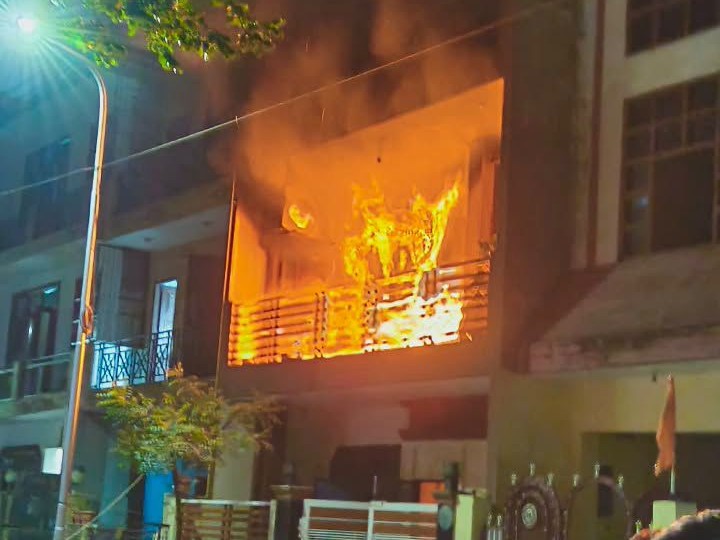
In recent weeks, there have been several incidents of AC blasts in the country. In a recent incident, an air conditioner exploded in a house in Greater Noida’s Beta Sector on the night of 6th May. Following the AC blast, the fire spread rapidly and engulfed the entire house. While no one was injured, the blast destroyed household items worth lakhs of rupees. Eventually, fire crews arrived and extinguished the flames.

Image via Dainik Bhaskar

In a similar incident reported in Delhi’s Vivek Vihar on 3rd May, a massive fire broke out in a four-storey residential building due to an air conditioner (AC) blast. The tragic incident left nine people dead and four others injured.  During the rescue operation, around 10 to 15 people were safely brought out from inside the fire-engulfed building.

There have been several other such incidents in recent weeks, raising a question: Why do AC blasts occur?

What is commonly referred to as AC ‘blast’ is actually a violent rupture or fire involving the compressor, which is the heart of the air conditioner’s outdoor unit, or the refrigerant circuit.

One of the most common reasons for the occurrence of an AC blast is pressure buildup in the compressor. The compressor squeezes refrigerant gas to high pressures, hundreds of psi, and if airflow is blocked due to dirty filters, the unit overheats, or if refrigerant levels are not appropriate, internal pressure surges. This may lead to failure of safety valves, and the compressor shell might rupture. This rupture occurs sometimes with enough force to generate an explosion-like sound and spray hot oil or refrigerant.

Another reason could be flammable refrigerants. For better efficiency, many modern AC models use mildly flammable refrigerants, including R32 and R290/propane. In case a leak occurs, the refrigerant mixes with air near an electrical spark, maybe from the capacitor, compressor, or faulty wiring, and it may ignite. While older R22 units were non-flammable, the modern eco-friendly R32 and R290 ones carry this risk.

Besides, electrical faults and other external factors may also lead to an AC blast. These factors may include voltage fluctuations, short circuits, substandard or old wiring.

In addition, overuse during peak summertime without necessary breaks strains the machine. An explosion may also occur due to poor installation, particularly an incorrect refrigerant charge.

Improper servicing has caused several technician deaths in recent years. If Nitrogen used for leak testing is not completely removed, it may result in residual pressure. Unsafe vacuuming leaves moisture, leading to acid formation that gradually corrodes parts.

The air conditioners must be turned off fully during repair or servicing. Turning the AC on during servicing may cause a diesel-like explosion inside the compressor.

In fact, many studies have documented several deaths of AC mechanics from such compressor explosions during routine servicing.

Precautions that may prevent AC blasts

There are simple yet effective precautions recommended by AC manufacturers and safety experts to prevent AC blasts. For homeowners, they should get the AC serviced every 6 months by a trained professional, properly and not just a gas top-up.

Regularly clean air filters and ensure that the outdoor unit coils remain dust-free, in addition to making sure that at least 1-1.5 feet of space around it for airflow.

The most basic thing to do is use a voltage stabiliser, as voltage fluctuations are a major trigger in Indian houses.

Ensure that vents are never blocked and do not run the AC throughout the day without breaks.

The location of installing an AC is also very important. The unit must always be installed in a well-ventilated area and avoid poor airflow areas or on balconies. Do not skip performing regular inspections of wiring and connections, and replace old capacitors.

During servicing, turn off the unit at the mains and completely discharge pressure before the mechanics begin their work. Ensure that the mechanics evacuate nitrogen fully and perform a deep vacuum. Make sure the unit is not turned on mid-servicing. Always demand branded gas and its invoice.

People must strictly avoid DIY gas refills or repairs, as this could be extremely dangerous in the wake of even the slightest mistake.

Generally, purchase ACs with proper safety features and in case there is a smell of burning or you hear unusual sounds coming from the AC’s outdoor or indoor unit, immediately turn it off, remove the plug and approach a trained technician.

Since most modern air-conditioner models have eco-friendly but flammable refrigerants like R32 or R290, ensure proper ventilation.

AC blasts are not random failures but an eventuality stemming from neglected maintenance, poor electrical infrastructure, or improper servicing. With better awareness and implementation of precautions, AC blasts are preventable.

One year of Operation Sindoor: How India shattered Pakistan’s terror infrastructure after the Pahalgam massacre and rewrote its counter-terror doctrine

Today, May 7, 2026, marks the first anniversary of Operation Sindoor, India’s unprecedented military response to Pakistan-sponsored terrorism. The operation was India’s highly measured and precise military action against Pakistan-backed terrorism in the wake of the barbaric Pahalgam terror attack. During the operation, the Indian armed forces carried out a coordinated attack on multiple terror sites located inside Pakistan and the Pakistan-occupied Kashmir (PoK).

Remembering Operation Sindoor, Prime Minister Modi hailed the valour and the commitment of the Indian armed forces and asserted India’s resolve to defeat terrorism and destroy its enabling ecosystem. “A year ago, our armed forces displayed unparalleled courage, precision and resolve during #OperationSindoor. They gave a fitting response to those who dared to attack innocent Indians at Pahalgam. The entire nation salutes our forces for their valour. Operation Sindoor reflected India’s firm response against terrorism and an unwavering commitment to safeguarding national security,” PM Modi wrote on X.

“It also highlighted the professionalism, preparedness and coordinated strength of our armed forces. At the same time, it showcased the growing jointness among our forces and underlined the strength that India’s quest for self-reliance in the defence sector has brought to our national security. Today, a year later, we remain as steadfast as ever in our resolve to defeat terrorism and destroy its enabling ecosystem,” he added.

Defence Minister Rajnath Singh hailed Operation Sindoor as a symbol of national resolve and a testament to India’s steady advance towards achieving the goal of Atmanirbharta (self-reliance). “On the anniversary of Operation Sindoor, we salute the valour and sacrifices of our armed forces, whose courage and dedication continue to safeguard the nation. Their actions during the operation reflected unmatched precision, seamless jointness and deep synergy across services, setting a benchmark for modern military operations. Operation Sindoor stands as a powerful symbol of national resolve and preparedness, showing that our armed forces are always ready to act decisively when it matters most. It also stands as a testament to India’s steady advance towards achieving #Atmanirbharta, enhancing capability while reinforcing resilience,” Singh posted on X.

Praising Operation Sindoor, Union Home Minister Amit Shah said that it will always remind our enemies of the infallible striking power of our armed force, meticulous intelligence of our agencies, and resolute political will. He saluted the Indian armed forces for their “unparalleled valour”.

“#OperationSindoor stands as an epochal mission of India that will always remind our enemies of the infallible striking power of our armed forces. History will remember it as the day of the precise striking power of our armed forces, meticulous intelligence of our agencies, and resolute political will rising together as one to destroy each and every address of terror across the border that dared to cast an evil shadow on our citizens at Pahalgam. This day will continue to bring the dreadful message to our enemies that no matter where they hide, they cannot escape. They are always within our sight and the fierce wrath of our firepower. On this day, I salute the unparalleled valour of our forces,” Shah wrote on X.

What triggered India’s Operation Sindoor

Operation Sindoor was India’s much-needed and long-overdue military action against Pakistan-sponsored terrorism, which has been a constant and evolving threat to India’s security. India has long suffered from terrorist attacks carried out by Pakistan-based terror groups over decades, but the April 2022 terrorist attack in the Baisaran valley of Pahalgham, J&K, last year came as a tipping point.

In the ghastly terrorist attack, Pakistani terrorists killed 25 Hindu male tourists in Pahalgam after verifying their religious identity. The terrorists asked male tourists in Pahalgam to recite the Kalma (an Islamic prayer) and removed their pants to verify if they were Muslims. After identifying Hindu males among the tourists, the terrorists brutally massacred them in front of their families. The animosity behind the attack can be ascertained from the fact that the terrorists left the women and children as witnesses of the bloodshed and asked them to “go tell Modi” about Markaz Subhan Allah of Jaish-e-Mohammad, Bahawalpur, Pakistan, what happened.

The terrorist attack triggered a massive military action by the Indian armed forces, which brought the Pakistani government to its knees and beg for a ceasefire. Operation Sindoor was not just India’s military response to terrorism; it marked a strategic shift in India’s counter-terrorism doctrine.

Operation Sindoor: India’s policy shift with respect to terrorism

Triggered by the Pahalgam terror attack, the Indian armed forces launched a massive military operation against terror launch pads in Pakistan and the Pakistan-occupied Kashmir. The Indian military action started in the early hours of May 7, 2025 and lasted less than half an hour. Within a span of about 25 minutes, India uprooted the entire terror infrastructure in Pakistan and the PoK. The Indian armed forces destroyed 9 terror sites through precision strikes carried out using missiles, glide bombs, Loitering munitions and other state-of-the-art weapons.

Terror sites destroyed in Operation Sindoor

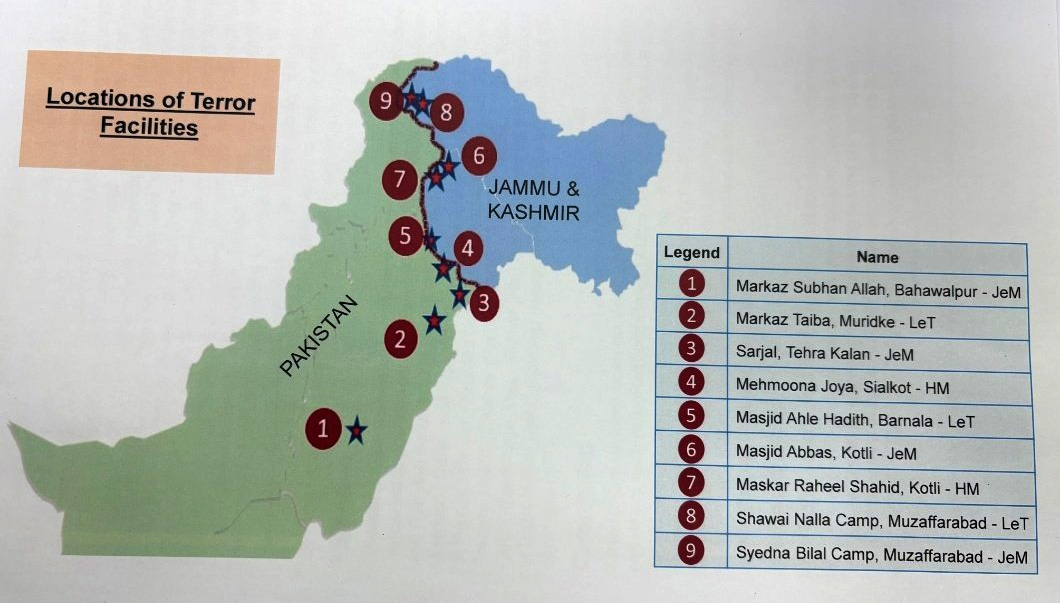
Here is a list of the 9 terror sites destroyed by the Indian armed forces in Operation Sindoor:

Markaz Subhan Allah of Jaish-e-Mohammad, Bahawalpur, Pakistan: It is the main centre of Jaish-e-Mohammad (JeM) for training and indoctrination of youth. It is located at NH-5 (Karachi- Torkham Highway) on the outskirts of Bahawalpur at Karachi Mor, and is spread over a 15-acre area, around 100 km away from the international border.

Markaz Taiba of Lashkar-e-Taiba, Muridke, Pakistan: Markaz Taiba is the ‘alma mater’ and the most important training centre of Lashkar-e-Taiba (LeT), located in Nangal Sahdan, Muridke, Sheikhupura, Punjab, Pakistan. Established in 2000, the centre is spread across 82 acres, and comprises a madrassa, market, residential area for terror entities, sports facility, a fish farm and agricultural tracts.

Sarjal / Tehra Kalan facility of Jaish-e-Mohammad, Sarjal, Pakistan: It is the main launching site of JeM for infiltration of terrorists into J&K. It is located in the Shakargarh Tehsil of Narowal District in Punjab, Pakistan. This facility is located inside the premises of a Primary Health Centre in Tehra Kalan Village of Sarjal area, so as to conceal its real purpose.

Mehmoona Joya Facility of Hizbul Mujahideen (HM), Sialkot, Pakistan: It is a Hizbul Mujahideen (HM) facility located near Kotli Bhutta Govt. Hospital in Head Marala area of Sialkot District of Punjab, Pakistan. This is one among several such terror camps running from government buildings in Pakistan with ISI’s assistance.

Markaz Ahle Hadith of Lashkar-e-Taiba in Barnala, PoK: It is one of the important Markaz of LeT in Pakistan-occupied Jammu and Kashmir and is used for infiltration of LeT terrorists and arms/ammunition into the Poonch – Rajauri – Reasi sector. It is situated at the outskirts of Barnala town on Kote Jamel road and is at a distance of 500 metres from Barnala town and 200 metres from Kote Jamel road.

Markaz Abbas of Jaish-e-Mohammad in Kotli, PoK: Markaz Saidna Hazrat Abbas Bin Abdul Mutalib (Markaz Abbas) of JeM is located in Mohalla Roli Dhara Bypass Road, Kotli, Pakistan-occupied Jammu and Kashmir. This Markaz is located approx. 02 km south-east of Kotli Military Camp.

Maskar Raheel Shahid of Hizbul-Mujahideen in Kotli, PoK: It is one of the oldest facilities of Hizbul Mujahideen (HM), located at approx. 2.5 kms from Mahuli Puli (a bridge on Mahuli Nalla on Mirpur-Kotli road) in Kotli District, PoK. Hizbul Mujahideen Head Syed Salahuddin used to welcome newly recruited terrorist cadres at this facility and supervise training activities being held here.

Shawai Nallah Camp of Lashkar-e-Taiba,  Muzaffarabad, PoK: Shawai Nallah Camp is one of the most important camps of LeT and is used for recruitment, registration and training of LeT cadres. This camp has been functional since the early 2000s. LeT head Hafiz Saeed used to welcome new inductees to this camp on their arrival.

Syedna Bilal Markaz of Jaish-e-Mohammad, Muzaffarabad, PoK: This is the main centre of JeM in PoK, located opposite the Red Fort, Muzaffarabad. This facility is spread over 08-10 Kanals, and has family quarters, office building and office of Al-Rehmat Trust, charity wing of JeM.

Perpetrators of the Pahalgam terror attack hunted down

After a manhunt of 96 days, the Indian security forces located and neutralised the terrorists who carried out the Pahalgam terror attack. The terrorists were identified as Hashim Musa alias Abu Suleman, Hamza Afghani, alias Afghan, and Zibran. They were classified as ‘A’ category terrorists linked to Lashkar-e-Taiba. Suleman, who was the mastermind of the Pahalgam attack, was also involved in several terrorist activities, including the Gagangir incident. Afgan and Zibran were also directly linked to the murders of civilians in the Baisaran Valley during the Pahalgam attack.

Pakistan’s drone attacks thwarted by India’s Iron Dome’

Triggered by India’s legitimate action on terror launch pads, the Pakistan Armed Forces launched multiple attacks using drones and other munitions along the entire Western Border as an act of revenge against Indian strikes on terror camps under Operation Sindoor. While Indian strikes targeted terror camps in Pakistan and PoK, the Pakistani Army resorted to ceasefire violations along the Line of Control in Jammu and Kashmir and targeted civilian areas.

Pakistan launched a coordinated drone strike on around 15 locations across northern and western India, including Srinagar, Jammu, Amritsar, Bathinda, and Chandigarh. These areas are strategically significant given their proximity to crucial defence infrastructure. However, Pakistan’s attack was thwarted by the Indian Armed Forces through India’s indigenous ‘Iron Dome’ Akashteer Air Defence System (ADS) along with S-400 Sudarshan Chakra ADS to foil Pakistani plans of targeting Indian civilians.

Indian strikes Pakistan’s military establishments

During Operation Sindoor, India caught Pakistan off guard and unleashed its military might against not just its terror hubs but also against its military establishments. During the wee hours of May 10, 2025, the Indian Air Force (IAF) targeted important and strategic Pakistan Air Force (PAF) bases with BrahMos-A cruise missiles. India carried out precision strikes on 11 airbases in Pakistan, including three critical Pakistani airbases: Jacobabad, Chaklala (Rawalpindi), and Sargodha.

Notably, the three airbases play a critical role in the operation, maintenance, and deployment of F-16 jets that have been supplied to Pakistan by the United States. These locations also house essential infrastructure, including training facilities and ammunition stockpiles.

Pakistan’s plea for a ceasefire

Pakistan, which was not expecting such a scale of Indian military response, panicked and rushed to the United States, seeking intervention. The Indian attack on Pakistani military establishments was described as the largest Indian military strike since 1971. Pakistan Army Chief General Asim Munir spoke to US Secretary of State Marco Rubio, requesting American intervention to de-escalate the spiralling tensions with India.

The US offered to mediate and help reduce further conflict between India and Pakistan. Finally, a ceasefire understanding was reached bilaterally between the two countries. However, hours after a ceasefire was agreed, Pakistan violated it and initiated another round of attacks on several cities across the Line of Control (LoC), which were effectively dealt with by the Indian armed forces.

Following the ceasefire understanding, the Indian Armed Forces and Defence Minister Rajnath Singh clarified that the arrangement should not be seen as a ceasefire, but as an understanding. India will continue to assess how Pakistan behaves in the coming days and will act accordingly. In April this year, a few days after the anniversary of the Pahalgam terror attack, the Indian Army posted a message on social media reiterating that Operation Sindoor was still on.

Gym trainers Akram and Alam Beg drugged Hindu woman’s pre-workout drink, raped, blackmailed her to extort money using video taken from hidden camera in Bareilly, arrested

In the Bareilly district of Uttar Pradesh, a Hindu MBBS doctor was raped and threatened by a Muslim gym trainer brother duo, Akram Beg and Alam Beg. The victim visited the Ultimate Fitness Gym since 2024, wherein her pre-workout drink was drugged by the now-arrested Muslim brothers.

Intoxicated pre-workout ‘weight loss’ drink, took Hindu woman to gym-attached private room with pre-installed hidden cameras and raped her: Alam and Akram perpetuated a cycle of rape-blackmail-extortion

The matter pertains to the Kotwali police station area. According to the complaint filed by the Hindu victim who joined the Ultimate Fitness Gym in 2024, accused Alam and Akram of spiking her pre-workout drink, which they gave her in the name of fast weight loss, raping her, recording her obscene videos and using them to blackmail her.

After the 40-year-old victim fell unconscious, Akram and Alam took the female doctor to a private room in the gym, where Akram raped her. They had already installed a camera in the room. The first incident of sexual abuse happened in 2024, and since then, the cycle of rape, blackmail, threats and extortion continued until recently.

The gym located near the Civil Lines Bada Dakkhana is reported to have been operating on the upper floor of a building owned by the brother of Cabinet Minister Dharampal Singh for nearly a decade. This gym had no female trainers, even though many attendees were women.

In April this year, Alam and Akram showed the victim her obscene videos and demanded Rs 10 lakh. When the victim stopped going to the gym, the accused duo arrived at her home in Rampur Garden and threatened to make her videos viral on social media if she refused to pay Rs 50 lakh, the victim said.

Out of fear, the Hindu victim gave Rs 80,000 to the Muslim accused; however, the duo continued to threaten her.

When the victim expressed her inability to pay the amount as massive as Rs 50 lakh, the accused Akram Beg pressured her to sell her plot worth Rs 90 lakh. Frustrated with the unending harassment and pressure, the Hindu woman mustered courage and lodged a police complaint.

Bareilly Police arrests Akram and Alam Beg, recovers pen drives with the victim’s obscene videos, ‘testosterone boosters’ and other things

In no time, the police registered a case and formed three teams and arrested Akram Beg on 5th May 2026. The accused duo was booked under BNS sections 308 (5)/64(2)(m)/78/61(2), and b/351(2).

During the arrest, the police seized several suspected “performance-enhancing” drugs, testosterone boosters, and syringes. In addition, the police also recovered a mobile phone and a pen drive which had the victim’s obscene videos. They also recovered an audio recording of the conversation between Akram and the victim, wherein the accused demanded money in exchange for not circulating her obscene videos online.

After interrogating Akram Beg, the police also arrested his brother Alam and recovered a pen drive from him.

Regarding the arrest of the accused duo and the items recovered, the Bareilly Police CO Ashutosh Shivam said, “Taking the above incident very seriously, Mr. Senior Superintendent of Police directed for immediate arrest of the accused, in which Kotwali police formed a team and with the help of surveillance and informer, both the named accused were arrested and from their possession 02 pen drives, 02 mobile phones iPhone red colour and OPPO, 09 potency enhancing vials, a wrapper containing 03 tablets, 06 injections and vials and Rs. 10000/- extorted by blackmailing were recovered. Legal action was taken against the arrested accused as per rules.”

The officer said that the accused duo blackmailed the victim for money and threatened to kill if she refused to comply with their demands.

It is reported that the same Muslim brothers who allegedly raped, blackmailed and threatened to kill the Hindu woman for two years, pleaded with the police, that they made a “mistake” and “will never do it again.”

Akram and Alam raped and blackmailed several women

While the present case led to Akram Beg and his brother’s arrest, the duo had not targeted only one Hindu woman. It has emerged that accused Akram Beg and Alam Beg implemented the same drug-rape-record-blackmail-extort modus operandi on several other women attending the gym they operated.

During police interrogation, Akram Beg reportedly admitted that he would deliberately get friendly with women who attended Ultimate Fitness Gym. He used to lure women with the promise of rapid weight loss and offered them spiked pre-workout drinks.

After the victims fell unconscious, the accused duo brought them to the private room within the gym, where they had hidden CCTV cameras installed. Alam and Akram are accused of recording the sexual abuse of their many victims and using the same to threaten and blackmail the victims later.

Notably, Alam Beg already has several cases of molestation and assault filed against him.

Meanwhile, Pankaj Srivastava, divisional president of the Hindu Mahasabha, has raised concerns over what he described as a gym-centred rape jihad. The Hindu activist demanded inspection of all gyms and made the appointment of female trainers in every gym mandatory.

Muslim gym trainers targeting Hindu women for sexual abuse, extortion and Islamic conversion: The unignorable pattern

In recent years, several cases of Muslim gym trainers targeting Hindu women to rape and pressure them into converting to Islam. In January this year, an Islamic conversion racket operating at five gyms in UP’s Mirzapur district was busted by the police after two Hindu women lodged separate complaints accusing Muslim gym trainers of sexually exploiting them, extorting money, and pressuring them to convert to Islam.

In April this year, a Muslim gym trainer, Shabbir Asgar Trunkwala, was arrested in Gujarat’s Surat for blackmailing a Hindu woman’s husband using her private photos and demanding Rs 5 lakh.

In July 2023, a Hindu woman filed a complaint against her fitness trainer, Kauser Ali Shabbir Ali Kubbawala, in Gujarat’s Surat, accusing him of cheating, rape and unnatural sex. Kauser had befriended the victim by posing as unmarried, lured her into his trap, raped her and brainwashed her against her husband. Eventually, he was arrested and jailed.

In April 2023, a gym trainer in the Gwalior district of Madhya Pradesh was booked for allegedly raping a woman by keeping her son at knifepoint. The Muslim man had introduced himself as a Hindu and had a friendship with the Hindu woman, but after she learned that he was Muslim, she ended communications with him. As revenge, he went to her house and raped her.

In February 2023, a gym owner in Bhopal named Momeen became friends with a Hindu girl using the Hindu name Anshu. After getting close to her, he managed to click some obscene photographs of her. He then threatened the victim with these pictures when his real identity was revealed.

In December 2022, one Intezaar Khan lured the victim, while pretending to be Sonu, on the pretext of marriage. The man also gave the woman a job as a manager in his gym. Following this, he raped her on the pretext of marriage. The accused are running an ASR gym in the Shahberi area in Greater Noida.

In September 2022, one Faizal Ahmad posed as Athrav Singh and married a Hindu girl under a false identity in Lucknow’s Chinat. The accused gym trainer, Faizal, was arrested on the complaint of the woman and sent to jail.

As the BJP sweeps Bengal, pro-TMC newspaper The Telegraph takes an abrupt pivot: Understanding why it’s opportunism and not an ideological shift

There is an adage: “All worship the rising sun”. As the sun of the Bharatiya Janata Party dawned in West Bengal, turncoats emerged not in political but in media circles as well. A Kolkata-based English daily, The Telegraph, has flipped from historically portraying the BJP as a ‘communal force’ and eulogising the TMC to flirting with the victorious saffron party.

From villainising the BJP as ‘communal’ and TMC as ‘inclusive’ to simping over the saffron party: The Telegraph and its flip-flop

The front page of the Calcutta edition of the newspaper published on 5th May dominated BJP’s Bengal victory, with a large front in saffron colour “BJP’s Bengal” with an illustration of the iconic Howrah Bridge worked into the lettering. Below it is the headline “Saffron tsunami sets aside TMC”.

The newspaper’s lead story opens with “A tectonic shift has reshaped Bengal’s political landscape… a blinding saffron storm swept away the green gulal that had coloured the state since 2011, clearing the path for Bengal’s first BJP chief minister.”

The lead piece carried an image of Prime Minister Narendra Modi arriving at the BJP headquarters in traditional Bengali attire after his party registered its maiden victory in West Bengal.

Moreover, the newspaper carried two more Bengal election-related stories. One of which headlined, “PM pledge on jobs, women’s safety”, covered PM Modi’s speech from the BJP HQ, where he announced the ‘change’ in West Bengal and said, “Banglay poriborton hopechhe”. The other story was about Mamata Banerjee’s ‘election rigging’ bogey.

This blatant change in tone of The Telegraph, which has been notorious for its anti-BJP propaganda, is also reflected in the front page of the newspaper’s 6th May publication.

The top headline of the newspaper particularly stands out as it directly targets former Chief Minister Mamata Banerjee. “Madam, this is what rejection looks like”.

Not only this, The Telegraph, once criticised as an unofficial TMC mouthpiece, also published an editorial hailing the Bharatiya Janata Party for sweeping the “elusive final frontier for the BJP merit examination.”

The Telegraph historically remained sympathetic to TMC’s ‘poribortan’, ‘welfare’ and ‘secular’ narratives; however, the editorial says that Bengal’s economy is in shambles and the BJP has a “herculean task” of bringing an economic resurgence.

The editorial’s concluding remark is particularly interesting as it reads, “Bengal has been disappointed — deceived before when it comes to meaningful transition. The BJP will break its pledge at its own peril.”

After staying silent over the TMC’s ‘syndicate raj’ in West Bengal, The Telegraph has also remembered the now-ousted Mamata regime’s opprobrious mess. The newspaper published an op-ed headlined, “Even Netaji was not spared: Bengal home owners, builders recall extortion mafia of TMC era.” The article described TMC’s control over the building syndicate as “a defining feature of Mamata Banerjee’s 15 years in power.”

Now let’s take a look at The Telegraph’s reportage from 2021, when the Trinamool Congress won the state assembly elections with a massive 215 seats while the BJP had to be content with just 77.

On the 3rd of May 2021, right after the TMC’s victory, The Telegraph’s front page carried a dominant headline “GOOD MORNING” in massive bold letters with “ALL” in the Indian tricolours. The lead story carried a celebratory subheading which read, “An inclusive vote against communalism.”

Over the years, OpIndia has documented The Telegraph’s pro-TMC bias and anti-BJP fake news. Back in July 2022, the English-language paper from the ABP group maintained strategic silence on the enormous amount of cash recovered from the house of TMC leader Partha Chatterjee’s close aide, Arpita Mukherjee, despite it being unignorably the biggest news of that time.

Instead of highlighting how TMC leaders and their aides were involved in corruption, The Telegraph did not even initially cover the news. Rather, The Telegraph chose to publish an ‘interview’ with Alt News’ Mohammed Zubair, whose online trolling and dog-whistling against ex-BJP spokesperson Nupur Sharma led to incidents of violence and at least three killings of Hindus by Islamists.

During the 15 years of TMC rule, The Telegraph always remained meek and pliable. In October 2020, when the TMC goons joined hands with the West Bengal Police and unleashed violence, brutally thrashing people on the streets of Kolkata, the self-declared ‘unputdownable’ media, ‘Telegraph’, chose to remain a mute spectator against the atrocities perpetrated by the Mamata regime.

In fact, the newspaper came in the TMC and West Bengal police’s defence to discredit the BJP. In one of its reports back then, The Telegraph resorted to hailing West Bengal police under Mamata Banerjee for showing restraint on the protesters. In Telegraph’s self-imagined reality, Mamata’s cops showed exemplary restraint against the BJP workers even as bombs and stones were hurled during the protest.

During the 2019 general elections, its editor had claimed in an article that removing Narendra Modi from power was the only hope for India’s redemption. The Bengal-based media house The Telegraph was called out by netizens for a headline that insulted the Dalit community as it compared the President of India, Ramnath Kovind, who is a Dalit leader himself, to ‘Covid-19’. The meltdown came after President Kovind nominated ex-CJI Ranjan Gogoi to the Rajya Sabha.“Kovind, not Covid, did it”, the headline read. 

One of the BJP and its supporter base’s core concerns has been the forced and deceptive conversion of Hindus to Islam and Christianity by Islamists and Christian missionaries, respectively. The Telegraph, which is now turning soft on the same BJP, had previously used the ‘spread of classical music in Kolkata’ to glorify conversion and evangelical work that marred Bengal.

There have been many other incidents wherein The Telegraph demonstrated that, contrary to its projected image of a ‘witty’ and ‘neutral’ news outlet, it is a far-left rag. However, such has been the turn of political winds in West Bengal that even such spiteful and devoid of journalistic ethics media organisations are changing tone.

From 2021’s defensive and celebratory tone in Mamata Banerjee’s favour to dramatic, overzealous and affirmative of the BJP mandate using ‘tectonic shift’ and ‘saffron tsunami’ type language, The Telegraph changed colours faster than a chameleon.

This opportunistic U-turn, however, should not be mistaken for an ideological change of heart. It is a classic case of commercial pragmatism. Beyond the tall claims of speaking truth to power, media outlets are commercial entities. In India, the media, especially print media, depends heavily on government advertising revenue. Holding a consistently hostile stance against the ruling dispensation may dry up ad releases, directly affecting revenues. Apparently, this performative tonal shift is driven by the imperative to secure monetary interests rather than any genuine admiration or appreciation for the BJP.