A young Hindu man in Parbatipur, in the Dinajpur district of Bangladesh is facing threat to his life after allegations of blasphemy were levelled against him. As per reports, a Hindu man named Sohag Das (24), a resident of Jaliapara village, North Shalandar in Chandipur Union, allegedly made a Facebook post against Prophet Muhammad on 16th June.
It is reported that his post was seen by some Islamist groups, which accused Das of hurting the sentiments of the Muslim community and committing blasphemy. A large number of people led by Islamist group Al Insaf Islami Sangh staged protests against him demanding his hanging. Massive protests were organised by Islamist groups on 17th June on a road at Bashirbania Hat College intersection calling for Das’s execution.
Leaders of various Islamist groups organised protest marches and delivered speeches against Das. The Islamist leaders reportedly said that the protests will continue until Das is hanged to death for allegedly insulting the Prophet. A leader of the protestors said, “We love the Prophet more than our life. Hurting in His Honour means Hurting the whole Muslim Ummah. We want highest penalty death sentence for this criminal”.
The religious affairs secretary of the youth society, Hafez Md. Jahangir Alam, general secretary Md. Mokarram Hossain, president of Bashirbania Hat Central Jame Mosque, Md. A. Quddus, and Tofazzal Haque were among the Islamist leaders who addressed the protests.
In videos shared on social media, protestors can be heard chanting ‘We want Sohag Das to be hanged’ slogans. The Islamist protestors urged Bangladesh’s Chief Advisor Muhammad Yunus to execute Das. They also demanded that the government should pass a law prescribing death penalty for insult of the Prophet.
The India-Canada relations, historically grounded in shared democratic values and economic ties, deteriorated drastically in 2024, when Canadian Prime Minister Justin Trudeau leveled baseless allegations against India regarding the killing of Khalistani terrorist Hardeep Singh Nijjar. Now, with Trudeau out of the picture and Mark Carney at the helm, Canada is looking to repair the damage done by Trudeau government.
PM Modi, who attended the G7 summit in Canada at the invitation of Mark Carney, met the Canadian PM in Alberta. During the meeting, they reaffirmed the importance of India-Canada ties, and the need to pursue a constructive and balanced partnership grounded in mutual respect for concerns and sensitivities, strong people-to-people ties, and growing economic complementarities.
The statement issued by New Delhi also added, “In this regard, both sides agreed to take calibrated and constructive steps to restore stability in the relationship, beginning with the early return of High Commissioners to each other’s capitals.”
In a significant development, it was announced by the MEA in its statement that India and Canada “agreed to take calibrated and constructive steps to restore stability in the relationship, beginning with the early return of High Commissioners to each other’s capitals.”
Notably, the leaders underscored the importance of restarting senior ministerial as well as working-level engagements across various domains to rebuild trust and bring momentum to the relationship.
PM Modi and PM Carney discussed opportunities for future collaboration in areas such as clean energy, digital transformation, artificial intelligence, LNG, food security, critical minerals, higher education, mobility, and supply chain resilience. They reaffirmed their shared interest in promoting a free and open Indo-Pacific. The leaders also discussed the importance of restarting the stalled negotiations on the Early Progress Trade Agreement (EPTA), to pave the way for a Comprehensive Economic Partnership Agreement (CEPA). They agreed to task their respective officials to engage further in this regard.
Since assuming office in March 2025, Mark Carney, has adopted a pragmatic and economy-focused approach in resetting Indo-Canada relations. Unlike former Prime Minister Justin Trudeau, who mindlessly blamed Indian government for plotting Nijjar’s killing to appease his Khalistani votebank, PM Carney has avoided direct references to the matter. Carney’s invitation to PM Modi for the G7 Summit, was a gesture reflecting the Canadian government’s renewed approach towards India. Despite the previous Trudeau government’s slandering and villainizing of the Indian government, PM Modi accepted the G7 invite, demonstrating India’s intent to start afresh as the Canadian government under a new leader mends its ways.
The Canadian government’s shift in approach towards India can also be attributed to a reduced reliance on pro-Khalistan Jagmeet Singh’s NDP. NDP’s electoral loss has facilitated a conducive domestic political environment for PM Carney to improved ties with India, without having to tackle excessive political pressure from Khalistan sympathisers. However, much like Trudeau, PM Carney has, so far, not done much to curb frequent anti-India demonstrations by Khalistani secessionists and terrorists.
As Indo-Canada ties are undergoing a reset, it is pertinent to take a look back at how Trudeau government’s self-serving support to Khalistani elements and blame game against India damaged once-thriving Indo-Canada ties beyond repair.
Khalistani secessionism, Justin Trudeau and strained Indo-Canada ties
Even before Justin Trudeau became Prime Minister of Canada in 2015, the country has had a past of fostering and shielding Khalistani elements. Justin Trudeau’s father and former Prime Minister Pierre Trudeau had shielded Kanishka bombing mastermind Talwinder Singh Parmar by refusing his extradition to India. Khalistanis have long been using Canadian soil to push their secessionist agenda under various governments, however, none had surrendered before Khalistanis the way Justin Trudeau did.
Notably, while pro-Khalistan Sikhs are a minority in Canada, they hold significant political influence and thus, not only Liberal Party leaders but even Conservatives try not to upset these anti-India elements.
Former Indian High Commissioner Ajay Bisaria had earlier said that Khalistani groups exert a disproportionate influence over Canadian politics. It is this influence that Khalistanis hold because of which Justin Trudeau allowed their anti-India activites, protests, referendums, attacks on Hindu temples and what not, all in the name of freedom of expression and right to protest.
Under Justin Trudeau’s watch, Khalistani separatists vandalised Hindu temples in Surrey, Georgetown, Toronto, Brampton, Vancouver and other areas of Canada, while the police little to nothing to stop this. Khalistani terrorists often deface walls of Hindu temples with Hinduphobic and anti-India slogans.
On 22nd July 2024, extremists defaced the Bochasanwasi Shri Akshar Purushottam Swaminarayan Sanstha (BAPS) Swaminarayan Mandir in Edmonton city in Alberta province of Canada. In the photographs, it could be seen that the wall of the Hindu temple vandalised with Hinduphobic, anti-Modi graffiti.
In September 2023, the Shree Mata Bhameshwari Durga Devi Society in Surrey British Columbia was sprayed with ‘Punjab is not India’ grafitti
In February 2023, a Ram temple in Mississauga was defaced with anti-India graffiti by unknown miscreants.
In January 2023, the Gauri Shankar Mandir was desecrated by Khalistani extremists in Brampton City in Ontario province of Canada. The walls of the temple were defaced with anti-India graffiti by Khalistanis associated allegedly with the banned outfit Sikhs For Justice (SFJ). The vicious slogan of ‘Khalistan Zindabad, Hindustan Murdabad’ was found spray-painted on the outer wall of Gauri Shankar Mandir.
In July 2023, Khalistani groups planned protests outside the Indian High Commission in Ottawa and consulates in Toronto and Vancouver. Back then, India issued a demarche, urging Canada to prevent any harm, however, PM Trudeau defended the protests as exercises of free speech, even if such protests involved violence and challenge to India’s territorial integrity.
In September 2022, some Khalistani terrorists defaced BAPS Swaminarayan Temple in Toronto with anti-India slogans. Several videos circulating on social media showed slogans of ‘Khalistan Zindabad, Hindustan Murdabad’ painted on the walls of the temple.
In February 2022 alone, six Hindu temples were attacked in Toronto.
Besides Hindu temples, the Khalistani fanatics have also targeted Indian High Commission and diplomats, and even then, the Trudeau government did not take any action against them even as the Indian authorities raised serious concerns.
In 2023, Khalistanis launched an attack on the Indian High Commission in Canada. They also hurled a grenade prompting the Special Cell to register an FIR under the UAPA and the Explosive Act in this instance.
At the time when Indian authorities launched a crackdown on pro-Khalistan leader Amritpal Singh, a dinner reception for High Commissioner of India to Canada Sanjay Kumar Verma in Surrey, British Columbia, on March 20, had to be cancelled due to violent protests by Khalistanis. Back then, OpIndia reported how an Indian-origin journalist Sameer Kaushal was “pushed and threatened” by the Khalistanis protesting.
Despite India registering strong protest, the Trudeau government took no action against the attackers and only gave hollow assurances to the Indian government.
On several occasions, the Canadian authorities refused to provide security to Indian officials for organising consular camps. In November 2024, India High Commission in Toronto cancelled its planned consular camps after the local authorities failed to ensure the security of the Indian diaspora from Khalistani protestors.
While not much has changed on ground in Canada even after Carney assumed office, under Trudeau, not a day passed without Khalistani terrroists raising anti-India slogans, performing mock killings of former Indian PM Indira Gandhi, current Prime Minister Naendra Modi, desecrating Indian flags and raising anti-Hindu slogans. Trudeau government, however, allowed the anti-India activities as Trudeau was afraid of upsetting his Khalistani vote bank even if that meant straining ties with India.
From farcical referendums on Khalistan, to parades depicting the 1984 assassination of Indira Gandhi by her Sikh bodyguards, Canada allowed perpetual disrespect of former and current Indian prime ministers, Indian diplomats, and the Hindu community.
Whenever India condemned Trudeau government’s complicity in rising Khalistani activities in Canada, Trudeau would defend his government’s permissiveness by invoking Canada’s Charter of Rights and Freedoms, freedom of speech and assembly. Trudeau’s backing of Khalistani elements, even if for political gains, amounted for interference in India’s internal matters and further inflamed tensions with India.
What further worsened the situation was the kiling of Khalistani terrorist Hardeep Singh Nijjar in possibly gang-related violence. Tensions between India and Canada escalated after Prime Minister Justin Trudeau alleged in Parliament last year that there were “credible allegations” of India’s involvement in the killing. India, however, firmly denied all such allegations, labeling them as “absurd” and “motivated,” while accusing Canada of providing a haven for extremist and anti-India elements.
Justin Trudeau launched his fresh attack against Indian diplomats and the Modi government, accusing them of being ‘persons of interest’ and being involved in criminal activities against Canadian citizens [read Khalistanis]. India rejected the allegations and called them “preposterous imputations” and part of the Trudeau government’s political agenda.
India recalled its High Commissioner to Canada following which the Trudeau government asked 6 Indian diplomats to leave the country. In a reciprocal move, New Delhi expelled 6 Canadian Canadian diplomats, asking them to leave the country before 20th October.
In an accidental moment of truth, Trudeau admitted last year that they had no evidence before accusing the Indian government of involvement in the killing of Khalistani extremist Hardeep Singh Nijjar. In an interview, Trudeau said that they had no proof to pinpoint the killing of Nijjar to India when they had first accused New Delhi of orchestrating the assassination on Canadian soil.
While the Trudeau government claimed that it does not pander to Khalistani elements, designated Khalistani terrorist and SFJ chief Gurpatwant Singh Pannun admitted to being in contact with Justin Trudeau’s office for the last three years and having shared information with them.
The desperation to deflect the attention of the Canadian people from allegations of Chinese interference in the last two federal elections in Canada as well as to appease the Khalistani votebank, particularly since Trudeau had grown highly unpopular among the public for a plethora of reasons, had reduced PM Trudeau and his government into clowns making a mockery of themselves at a global level.
Trudeau’s support for Nijjar, who fraudulently stayed in Canada, and indulged in anti-India activities, ran terror camps, attracted backlash from Canadian people as well, Trudeau opted to strain bilateral ties with India over baseless claims to consolidate anti-India votebank. Although eventually things went to a point that his own party decided to get rid of him and forced him to resign.
Justin Trudeau’s explicit backing of the Khalistani terrorists drove the India-Canada bilateral to the rock bottom. From allying with pro-Khalistan leader Jagmeet Singh’s NDP to mollycoddling Khalistani extremists, Trudeau desperately tried to appease his anti-India vote bank while also deflecting domestic failures.
While Prime Minister Mark Carney’s stance towards India seems positive, and might help restore normalcy in Indo-Canada ties, absolute resolution of disputes is impossible until Canada stops allowing Khalistani extremists to carry out anti-India activities. Be it referendums or protests involving stomping on Indian flags and raising anti-Hindu slogans, or threatening attacks against India. Canada needs to extradite wanted Khalistani terrorists to India, crack down on hate speech and anti-India and anti-Hindu elements. It is only when Canada curbs Khalistani terrorism that the two countries can rebuild trust and bolster ties.
On 25th June 1975 at midnight, India faced one of the gravest assaults on its democratic fabric. Then-Prime Minister Indira Gandhi faced the heat of the Allahabad High Court’s verdict that declared her election invalid due to electoral malpractices. To avoid losing the position of the PM, Gandhi imposed a national Emergency under Article 352 of the Constitution that lasted for 21 months.
Civil liberties were crushed during that period and fundamental rights suspended. Over 1,00,000 people were arrested under preventive detention laws. The government used the Maintenance of Internal Security Act (MISA) as a weapon against dissent. Pre-censorship orders were issued to silence the newspapers. Student movements were brutally ended, and political opponents were thrown into jails. The Rashtriya Swayamsevak Sangh (RSS) was banned on 4th July 1975, less than ten days after the Emergency was imposed.
In the middle of the authoritarian storm that India was facing, a 25-year-old full-time RSS Pracharak in Gujarat, Narendra Modi, chose the path of resistance, playing a significant role. Senior RSS leaders were imprisoned by the government. However, Modi managed to stay underground, leading an innovative and decentralised opposition to Indira Gandhi’s regime. His actions, strategy and fearless defiance shaped not only the movement but his own evolution as a national leader.
Who is the real “fascist” – Those who imposed the Emergency or Narendra Modi, who played a role in the resistance
There is a strange irony in Indian politics. The party, that jailed over a lakh citizens, banned the RSS, imposed pre-censorship on newspapers, tortured and murdered several citizens and reduced the Constitution to a personal diary of power, now call Narendra Modi who fought all that and played a significant role in resisting the Emergency a “fascist”.
Since 2014, when Prime Minister Narendra Modi took charge of the office, the Congress Party has launched a coordinated tirade to paint him with the darkest brushed from their own history book. Congress’s prince, the man who has been launched several times only to fail, Rahul Gandhi, time and again, likened PM Modi to Hitler.
In 2014, before Narendra Modi became the Prime Minister, he called PM Modi “Hitler”. Sadly, “scholars” were “okay” with the Hitler jibe. Congress’s communication team, who always forget to see the mirror before commenting on anyone, regularly uses words like “autocrat”, “dictator”, and compare PM Modi to Hitler. In 2023, Rahul Gandhi claimed that India has become a fascist country under Modi’s regime. The same Modi, who, in 1975, was evading arrests, distributing underground literature, and supporting families of jailed activists, while Congress was but blacking out headlines and switching off democracy.
In one of the most recent examples, Congress President Mallikarjun Kharge compared Modi government a “fascist rule”. He said, “The INDIA Bloc will continue to fight against the fascist rule of the BJP led by Modi.” All this, if had been said during actual Emergency at Indira Gandhi’s time, would have resulted in jail time. In 2018 as well, Kharge had compared PM Modi to Hitler.
The constituents of the INDIA Bloc thank the people of India for the overwhelming support received by our alliance. The people’s mandate has given a befitting reply to the BJP and their politics of hate, corruption and deprivation. This is a political and moral defeat of Prime… pic.twitter.com/oWyQSrxWBR
Let’s get this straight, Modi did not suspend fundamental rights. Everyone is free to criticise and everyone does, especially the opposition leaders without any fear of police action against them. Modi did not censor newspapers, it was Indira Gandhi who did it. Modi did not jail Congress leaders in large batches, or even ordinary students. It was Indira Gandhi who curb the dissent using the police force. Modi didn’t run the country on an unconstitutional whim, Indira Gandhi did.
But of course, in today’s politically convenient memory, resistance becomes oppression, and the oppressors rewrite themselves as saviours. If fighting a regime that shut down Parliament, press, protests, and personal liberty is fascism, then yes, Narendra Modi was a fascist of the purest kind. He fought the real fascist, not from a podium, not from a press conference, but from the shadows, in disguise, while carrying the Constitution in his pocket and the courage to defend it in his heart.
The question remains. Who is the real fascist? The one who imposed the Emergency, or Narendra Modi, who played a role in resisting it?
Modi’s call to duty – The making of an underground leader
When the Emergency was imposed, Narendra Modi was already a known name. He was a key figure during Gujarat’s Navnirman Andolan of 1974 that led to the fall of the Congress government in the state. Everyone saw him as a committed and strategic organiser. In 1972, he had become a full-time Pracharak. It was only three years later that the Emergency was imposed. However, the maturity, discretion and adaptability of Narendra Modi made him a key link in the underground RSS network and in a strategic position to execute the role given to him – that of resisting the emergency.
Modi had worked closely with senior Sangh leaders including Laxmanrao Inamdar (Vakil Saheb), Keshavrao Deshmukh and Vasant Gajendragadkar. He was also well-connected to the national-level Lok Sangharsh Samiti movement led by veteran leaders including Nanaji Deshmukh and Dattopant Thengadi. His instructions were clear: keep the organisation alive, ensure communication, and avoid arrest at any cost.
A master of disguises – How Modi became untraceable
During the Emergency, all state police, including Gujarat Police, were on high alert. Gujarat had been one of the most active RSS zones, and the government knew how essential it was for Indira Gandhi’s regime to control the dissent in the state. Intelligence surveillance was at its peak during that time. However, Narendra Modi managed to avoid arrest for the entirety of the Emergency.
To avoid detection, he assumed various disguises including a Sadhu in saffron robes, an elderly Sikh turbaned man, a street vendor selling incense sticks, and even a college-going ‘Sardarji’.
Narendra Modi as Sanyasi
In one of the high-risk missions to Mumbai, he posed as the son of Makaran Desai, who later became a BJP leader. Modi had crafted the plan himself, allowing him to travel with impunity under the cover of legitimacy.
Narendra Modi disguised as ‘Sardarji’
In one memorable incident, he visited Bhavnagar jail disguised as a Swamiji to meet Vishnubhai Pandya and other incarcerated leaders. He claimed to have come to conduct a satsang and gained entry into the jail. Once inside, he held discussions disguised as spiritual discourse. After one hour, he walked out of the prison without raising any red flags among the guards.
The strategist of codes, printing presses, and cyclostyle machines
At any given time, communication is the backbone of a strategic play. For leaders like Narendra Modi who were keeping the organisation alive, communication was the lifeline of the resistance. However, the risks were high. If caught, entire operations could be compromised. Modi innovated several methods to outsmart state machinery.
They needed printing machines to publish underground literature. It was Narendra Modi who oversaw the smuggling and operation of cyclostyle machines for printing. The pamphlets they printed condemned the Emergency, exposed atrocities, and called for the defence of democracy. The distribution of the pamphlets was also decentralised. They were hidden in luggage, tiffin boxes, or left at barber shops for silent circulation. Saints, priests, and religious preachers were enlisted to spread the material across rural India.
Phone numbers were encoded by digit-swapping. Meetings were held under the garb of religious functions such as Satyanarayan Puja. RSS meetings were often referred to as “Chandan Ka Karyakram”. Even the smallest details, like how slippers were placed outside a home, were tweaked by Modi to throw off the police who were trained to detect Sangh discipline.
Mobilising leaders, building escape networks
Narendra Modi moved pamphlets as well as people. Senior anti-Emergency leaders including George Fernandes, V. M. Tarkunde and Dattopant Thengadi visited Gujarat and the whole trip was coordinated by Modi. These meetings were held in safe houses, and multiple escape routes and decoys were in place to ensure the safety of the leaders.
The resistance was decentralised. Each volunteer or district functioned semi-independently while staying connected through covert channels. Modi was meticulous with logistics. Often, karyakartas assigned to escort leaders out of Gujarat had no idea who they were accompanying or why. Everything was planned to the last minute.
One time, Modi was disguised as a Sikh youth when police arrived at a meeting location with a tip-off. As they questioned him, Modi remained calm and redirected them elsewhere. The police did not realise that the man they were looking for was standing right in front of them.
Sustaining the movement and the morale
Revolution is not just about action, it is about resilience. Narendra Modi played his role during the emergency in ensuring that the families of jailed swayamsevaks never slept hungry and had all the financial support and medical care they needed. He personally travelled, made discreet visits, and became a lifeline for those who could no longer support themselves.
His words inspired the youth. In Porbandar, when all senior karyakartas were arrested, leading to a loss of morale among the young volunteers, Modi came forward and encouraged them. He said, “Even if you are alone, it does not matter. One person is enough if his intent is right. Democracy must win.”
Medical students were given specific roles, using their legitimate mobility to transport pamphlets. Children were used as couriers because they were least likely to arouse suspicion.
A poet in the storm
In the middle of the chaos, Modi wrote about the emergency and his role in the resistance. He composed a powerful poem in his diary and captured the idealism, sacrifice, and energy of the movement. A rough translation of the poem in Gujarati reads:
जब कर्तव्य ने पुकारा तो कदम कदम बढ़ गये जब गूंज उठा नारा ‘भारत माँ की जय’ तब जीवन का मोह छोड़ प्राण पुष्प चढ़ गये कदम कदम बढ़ गये टोलियाँ की टोलियाँ जब चल पड़ी यौवन की तो चौखट चरमरा गये सिंहासन हिल गये प्रजातंत्र के पहरेदार सारे भेदभाव तोड़ सारे अभिनिवेश छोड़, मंजिलों पर मिल गये चुनौती की हर पंक्ति को सब एक साथ पढ़ गये कदम कदम बढ़ गये सारा देश बोल उठा जयप्रकाश जिंदाबाद तो दहल उठे तानाशाह भृकुटियां तन गई लाठियाँ बरस पड़ी सीनों पर माथे पर कदम कदम बढ़ गये
It means, “When duty called, we marched without fear. When cries of ‘Bharat Mata ki Jai’ echoed, we left the comfort of life and offered our breath. Step by step, we marched.
Troops of youth marched ahead, shaking thrones and cracking doors. Watchmen of democracy rose, shedding divisions. Reading the challenge line by line, we marched.
The nation roared ‘JP Zindabad’. Tyrants trembled, batons fell. But on our chests and heads, we bore them. Step by step, we marched.”
It was not just a poem, it was prophecy.
Sangharsh Ma Gujarat – Writing the resistance
After the Emergency was lifted in 1977, Narendra Modi wrote about his role and his experience fighting the Emergency in “Sangharsh Ma Gujarat”. He wrote the book in just 23 days without any reference material. The book remains one of the most comprehensive regional accounts of the Emergency.
Cover of Sangharsh Ma Gujarat.
A page from the manuscript of ‘Sangharsh ma Gujarat’ titled ‘मीसा’ का कोड़ा बरसा.
It was launched by then-Gujarat CM Babubhai Patel and recognised internationally.
Book launch
Another book, ‘Aapatkal Ke Senani’, chronicled his role as an organiser and underground leader.
News clipping of book release
Legacy of a fighter who refused to be silenced
The Emergency shaped Narendra Modi in profound ways. His belief in decentralisation, quick crisis response, and people-first communication were all honed during this crucible. Today, as Prime Minister, he frequently references that period, not as a relic of the past, but as a living reminder of what unchecked power can do.
While others were silenced, Modi strategised. While others surrendered, he stitched together a resistance. And in the silence of jails and the secrecy of safe houses, he kept democracy breathing.
The story of Narendra Modi during the Emergency is not merely a tale of survival. It is the story of resistance, of moral conviction, and of a young man who chose the underground when others chose silence. A story that shaped not only a leader, but the very idea of fighting for India’s democratic soul.
The Central government has introduced FASTag-based Annual Passes, effective from August 15, Union Minister for Road Transport and Highways Nitin Gadkari announced on Wednesday. The passes for non-commercial vehicles is meant to enable ‘seamless and cost-effective travel across National Highways throughout the country.’
Talking about the introduction of the annual passes, priced at Rs 3,000, Gadkari said that the passes will be valid for one year of activation or 200 trips, whichever comes earlier.
“In a transformative step towards hassle-free highway travel, we are introducing a FASTag-based Annual Pass priced at Rs 3,000, effective from 15th August 2025. Valid for one year from the date of activation or up to 200 trips–whichever comes first–this pass is designed exclusively for non-commercial private vehicles such as cars, jeeps, and vans,” Gadkari said in a post on X.
Important Announcement ?
?In a transformative step towards hassle-free highway travel, we are introducing a FASTag-based Annual Pass priced at ₹3,000, effective from 15th August 2025. Valid for one year from the date of activation or up to 200 trips—whichever comes…
The Union Minister said that the introduction of passes is regarding the concerns raised regarding toll plazas, and this method will help simplify toll payments.
“This policy addresses long-standing concerns regarding toll plazas located within a 60 km range and simplifies toll payments through a single, affordable transaction. By reducing wait times, easing congestion, and minimising disputes at toll plazas, the Annual Pass aims to deliver a faster and smoother travel experience for millions of private vehicle owners,” Gadkari added.
A dedicated link for the activation and renewal of annual passes will soon be available on the Rajmarg Yatra App as well as on the official websites of the National Highways Authority of India (NHAI) and MoRTH.
The National Electronic Toll Collection (NETC) FASTag was first introduced in 2014. The tag uses RFID technology to enable cashless toll payments and aims to reduce congestion and improve efficiency at toll plazas.
Earlier on April 18, the Road Transport ministry highlighted that they are going to implement ‘ANPR-FASTag-based Barrier-Less Tolling System’ at select toll plazas too.
The advanced tolling system will combine ‘Automatic Number Plate Recognition’ (ANPR) technology, which will identify vehicles by reading their number plates, and the existing ‘FASTag system’ that uses Radio-Frequency Identification (RFID) for toll deduction, according to an official statement from the ministry.
Under this, vehicles will be charged based on their identification through high-performance ANPR cameras and FASTag Readers, without needing to stop at the toll plazas. In case of non-compliance, E-Notices will be served to the violators, non-payment of which may result in suspension of FASTag and other VAHAN-related penalties.
(This news report is published from a syndicated feed. Except for the headline, the content has not been written or edited by OpIndia staff)
The Supreme Court on Wednesday granted relief to a minor girl, aged 16, who was forced into child marriage and directed the Bihar and Delhi Police to ensure the safety of the girl and her friend.
The girl approaching the apex court has said that her family had married her off to a 32-33-year-old contractor on December 9, 2024, from whom they had taken a loan.
A bench of Justices Ujjal Bhuyan and Manmohan also issued notices to the Bihar and Delhi governments.
It asked the DGP of Bihar and the Police Commissioner of Delhi to provide full security to the girl and her friend and ensure no harm is caused to them. The bench also sought a status report from the police.
It further directed that the police have to be in touch with the girl and her friend so that, in case of emergency, necessary assistance can be provided to them.
The girl, a resident of Bihar, filed a petition in the apex court through her friend, saying that her family forcibly married her off and she has been subjected to physical abuse and harassment by her in-laws.
The teenager stated that she recently appeared for her Class 10 Board exams and wishes to continue her studies, but her in-laws are not agreeable to it.
She has appealed to the apex court to protect her from her family and husband and sought annulment of her forced marriage under the Child Marriage Prohibition Act, 2006.
The girl further explained that she willingly ran away from home with a friend. However, her family has now filed a kidnapping case against her friend, concealing the fact that her daughter was married.
The petition said that her husband has been pursuing the case personally and has told people in Madhopur village that he would not mind going to jail after killing her.
The petition stated, “The Petitioner is presently on the run with a friend (Saurabh Kumar) and fears they would be killed if they returned back to Bihar or were apprehended in the hunt launched for them.”
According to the plea, her husband, a civil contractor, claimed that the girl’s parents were indebted to them and she would have to continue in the marriage rather than go for further studies to pursue her dream of becoming a teacher or a lawyer.
She sought protection from any coercive action by police till the matter is finally decided by law.
(This news report is published from a syndicated feed. Except for the headline, the content has not been written or edited by OpIndia staff)
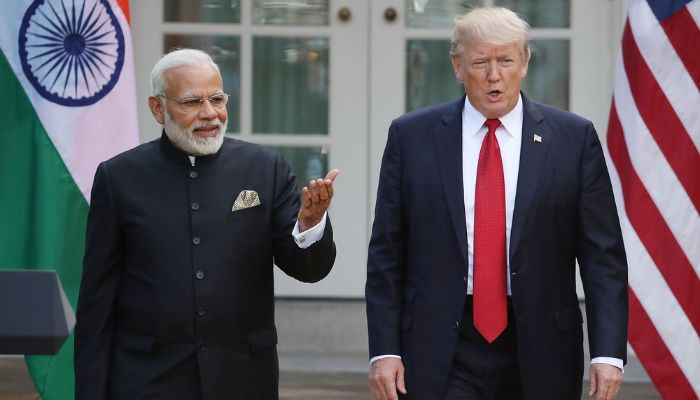
PM Modi put an end to US President Trump’s baseless and boastful claims that he brokered a ceasefire between India and Pakistan during Operation Sindoor. PM Modi, who was in Canada to take part in the G7 Summit, talked to Trump over phone on Tuesday (17th June) on the latter’s request and made it clear that there was no mediation by US. During his 35-minute-long conversation with Trump, PM Modi set the record straight by telling Trump that the US had no role in the ceasefire agreed between India and Pakistan last month.
Foreign Secretary Vikram Misri announced that Prime Minister @narendramodi had a telephonic conversation with US President #DonaldTrump, which lasted approximately 35 minutes. During the discussion, PM Modi briefed President Trump about Operation Sindoor. PM Modi clarified that… pic.twitter.com/1RuPVc778V
“PM Modi clearly told President Trump that during the entire course of events, at no point, and at no level, was there any discussion about a US-India trade deal or about US mediation between India and Pakistan,” said Foreign Secretary Vikram Misri while sharing the highlights of the conversation during a press briefing on Wednesday (18th June). “The Prime Minister said the talks regarding cessation of military action were held directly between India and Pakistan under the existing channels established between both militaries. It was done at Pakistan’s request,” Misri added.
According to Misri, PM Modi made it clear to President Trump that there was political unanimity in India over non-acceptance of third-party mediation on the Kashmir issue. “India has never accepted, does not accept, and will never accept mediation on the Kashmir issue,” PM Modi told Trump.
This was the first interaction between PM Modi and President Trump since Operation Sindoor. The phone call came after the scheduled between PM Modi and President Trump could not take place as the US President left early amid the G7-Summit due to the ongoing Israel-Iran conflict.
India and Pakistan agreed to a ceasefire on 10th May after Pakistan’s DGMO contacted his Indian counterpart requesting for a ceasefire. During Operation Sindoor, India first destroyed terror camps located deep inside Pakistan territory, and then struck 11 air bases across Pakistan. The terror supporting country tried to retaliate but India shot down all the drones and missiles launched by Pakistan towards India. After India inflicted serious damage on Pakistani air bases, the Islamic state requested for a ceasefire, to which India agreed.
However, even before an official communication could be made regarding the ceasefire by India, the US President jumped in and falsely took the credit for mediating between India and Pakistan. Even though India clarified later that the ceasefire with Pakistan was reached without the intervention of a third country, Congress leaders grabbed the opportunity to attack the Modi government using Trump’s false claims.
Congress caused global embarrassment to India
Despite India’s clear stand that the ceasefire was a bilateral decision, Congress leadership, including Rahul Gandhi, kept undermining India’s global position and casting aspersions on the Indian government by repeating the baseless claims of Trump who is known for his tendency to exaggerate. Senior Congress politician Jairam Ramesh posted several times on social media, demanding clarification from PM Modi on whether Trump’s repeated claims of brokering the ceasefire are true.
He described the issue as one of national embarrassment, and accused PM Modi of allowing Trump to “equate” India with Pakistan, and wondering if Trump is lying or telling half-truths. He was joined by Congress leader, Pawan Khera, who questioned whether PM Modi’s failure to reject Trump’s comments means they might be true.
The Congress Party even circulated a humiliating meme on social media showing that PM Modi surrendered before Pakistan on Trump’s instructions echoing the claims of Congress scion Rahul Gandhi. The media in Pakistan quickly seized upon the opportunity provided by India’s largest opposition party and utilized them to advance their malicious narrative. The statements of Congress leaders were used by Pakistani media to further their narrative and undermine India’s position internationally at such a crucial time when India was trying to convey to the world its stand against terrorism.
Despite Modi government including leaders from all political parties, including Congress, in the multi-party delegations that were sent out to different countries to convey India’s policy action against terrorism, some Congress leaders continued to accuse the Modi government of taking credit for Operation Sindoor.
Now that none other than Prime Minister Modi himself has clarified that there was no mediation by US between India and Pakistan, it remains to be seen it now Congress party retracts its position and acknowledge its mistake.
The conflict between Iran and Israel in the Middle East has increased the likelihood of regional escalation as the two nations continued to exchange missiles. Meanwhile, after several Iranian airstrikes broke through the Iron Dome and hit structures in Jerusalem, Tel Aviv and other cities, Israel turned to its newest aerial defense system, “Barak Magen” for the first time.
On the evening of 15th June, the new defense system successfully intercepted Iranian drones which were launched as retaliation for Israeli strikes on its military and nuclear infrastructure. The Israeli Navy shot down eight UAVs (Unmanned Aerial Vehicle) using its long-range air defense (LRAD) interceptor and the Barak Magen system which were fired from an Israeli Sa’ar 6 missile ship.
According to the Israel Defense Forces (IDF), Flotilla 3’s missile ships continue to be employed “across all arenas and serve as a force multiplier in the mission of defending the skies of Israel” in cooperation with the country’s air force. At this point, the Navy has eliminated about 25 drone threats since the start of the ongoing conflict. The C-Dome system, the naval equivalent of Iron Dome, brought down the majority of these drones.
It was determined that these UAVs were targeting Israeli residential areas. The Israeli Air Force and the naval response were closely synchronized, enabling effective layered interception and real-time threat tracking. On 16th June, Iran reportedly launched more than 100 UAVs, however, all were intercepted by the Jewish state.
Iran sent more than 100 UAVs at Israel. We intercepted them.
Barak Magen adds a potent naval layer to Israel’s defenses, boosting its current systems (Iron Dome, David’s Sling, Arrow, and the forthcoming laser Iron Beam).
Its purpose is to counter the growing threat of asymmetric aerial attacks, specifically precision weapons and drone swarms carried out by enemies such as Iran and its proxies. Barak Magen is designed for naval operations and offers instant protection against inbound threats from the air and sea, in contrast to land-based systems like Iron Dome or David’s Sling.
What is the Barak Magen
“Lightning Shield” or “Barak Magen” (the Hebrew name for Israel’s latest naval air defense system) is intended to supplement the Iron Dome defense system on land by providing a lightning-fast response to airborne threats originating from the water including UAVs, cruise missiles, high-trajectory projectiles, shore-to-sea missiles and even aircrafts, among others.
It is a customized variant of the Barak MX missile defense system, designed to defend naval vessels against aerial threats such as sea-skimming, ballistic and cruise missiles as well as drones. The equipment is installed on Sa’ar 6 corvettes which are advanced Israeli Navy vessels. Israel Aerospace Industries (IAI) created the aerial defense system to identify and eliminate a variety of airborne threats.
#BREAKING: The Israeli Navy intercepted eight attack drones launched from Iran overnight using the Barak Magen air defense system—for the first time in operational use.
Mounted on Sa’ar 6 missile ships, the system can counter a wide range of threats including drones, cruise… pic.twitter.com/8OhKOaZKzl
The nation’s defense ministry stated that the multi-mission radar weapon system consists of a long-range interceptor, a weapons system and an enhanced radar for threat detection. It is adaptable to different platforms and has been installed on Sa’ar 6-class corvettes to protect the nation’s offshore energy resources and Exclusive Economic Zone.
The EL/M-2248 MF-STAR radar and electro-optical sensors capable of extremely accurate 360-degree detection, a long-range interceptor that can neutralize threats up to 150 kilometers away and a modular architecture that enables it to be deployed across multiple naval platforms constitute the multi-layered Barak Magen system.
Barak Magen incorporates a combination of command systems, radar and a series of intelligent vertical launchers that are capable of firing several kinds of missiles. Short, medium and long-range interceptors fall under them and they are all released directly from the ship to strike oncoming threats from any direction. This enables the system to cover 360 degrees and handle many targets simultaneously.
It has Barak MRAD for short to medium ranges (up to 35 kilometers), Barak LRAD for medium to long ranges (up to 70 kilometers) and Barak ER for longer ranges (up to 150 kilometers). The same launcher can be used to operate all of these interceptors.
In November 2022, the Israel Defense Ministry launched the Barak surface-to-air missile’s first live-fire test from the INS (Israeli Navy Ship) Magen, one of its warships. Israel published a video of the missile’s launch from a Sa’ar 6-class corvette and its destruction of a target near sea level after it was developed.
Why is Barak Magen significant
Barak Magen’s goal is to protect Israel’s territorial waters and its critical infrastructures, especially the Mediterranean offshore gas fields of Leviathan and Tamar, thus securing its energy autonomy.
The air defense system “significantly enhances” Israel’s navy’s air and missile defense architecture, according to John Hannah, senior fellow at The Jewish Institute for National Security of America (JINSA) and co-author of a report released earlier this month on Israel’s defense against two massive Iranian missile attacks in 2024, reported Fox News.
He conveyed, “The Barak Magen is simply another arrow in the expanding quiver of Israel’s highly sophisticated and increasingly diverse multi-tiered missile defense architecture which was already, by leaps and bounds, the most advanced and experienced air defense system fielded by any country in the world.”
According to Hannah, the system offers long-distance defense for Israel’s growing oil and gas facilities in the eastern Mediterranean, as well as vital infrastructure and populated areas along Israel’s coastline, in addition to protection for the Israeli fleet. “It allows Israel to conduct interceptions at significant distances from the Israeli homeland, both out in the eastern Mediterranean and the Red Sea, and thereby adds critically important strategic depth when defending Israel’s tiny geographic area,” he pointed out.
Barak 8
With $1.2 billion in sales already secured, Israel’s Barak system has attracted interest from all around the world. One primary partner is India and according to an Indian government statement, Israel has worked together with India’s Defence Research & Development Organization (DRDO) to develop Barak 8, a surface-to-air missile version of the Barak defense system, to protect against aerial threats including drones, aircraft, anti-ship missiles and ballistic missiles.
Barak-8 could be used from land or the water and has a maximum range of 100 kilometers and an altitude of 20 kilometers. The air and naval forces of India and Israel use it to combat an assortment of aerial threats, such as ballistic missiles and drones.
On the morning of June 18, Foreign Secretary Vikram Misri shared a press statement detailing the phone conversation between PM Modi and US President Donald Trump.
U.S. President Trump had to leave the G7 Summit early, so the scheduled meeting between Prime Minister Modi and US President Trump could not take place. US President Trump and Prime Minister Modi had a formal phone call at the former’s request. The discussion lasted for over 35 minutes, Vikram Misri stated.
Foreign Secretary Vikram Misri announced that Prime Minister @narendramodi had a telephonic conversation with US President #DonaldTrump, which lasted approximately 35 minutes. During the discussion, PM Modi briefed President Trump about Operation Sindoor. PM Modi clarified that… pic.twitter.com/1RuPVc778V
This phone conversation is significant for many reasons, not just for the content of the discussion but also for its timing and messaging. Here is why:
It was the first time the two global leaders spoke after the Pahalgam attack
Vikram misri stated that in the phone call was the first time the two leaders spoke since the April 22 Pahalgam attack, where US President expressed condolences for victims and conveyed that USA supports India’s stand against terrorism. This is a significant point in itself because due to the boastful media statements made by the US president, it was insinuated as if there has been more talks between the US and Indian leadership. This was implied multiple times by Donald Trump where he kept claiming that he used trade as a leverage to make India ‘talk’ with Pakistan and ‘agree’ to a ceasefire.
By highlighting that it was the first time Donald Trump and PM Modi spoke directly after the Pahalgam attack, Vikram Misri made it clear once again that the claims of Trump being the key ‘peacemaker’ were false and misleading.
PM Modi reiterates ‘Goli will be answered with Gola’,
In the phone call, PM Modi reminded Trump that India had made it clear to the whole world that it will take significant retaliatiory action for the Pahalgam attack. PM Modi told Trump that India’s Operation Sindoor on the nights of 6-7 May was measured, non-escalatory and precision strikes against terror infrastructures located in PoK and Pakistan. He also told Trump that India has and will respond to any escalatory actions by Pakistan in a bigger manner, and that ‘Goli will be responded with Gola’.
PM Modi’s statement displays the calm conviction of a new India under his leadership, an India that does not depend on foreign powers to tell it what to do and how to respond, but retaliates with conviction to target the enemy and takes punitive military measures against any attacks on its sovereignty and safety.
JD Vance called PM Modi to warn about ‘big attack’ from Pakistan, was told that India will respond with a bigger attack
During the phone conversation, PM Modi also told Trump that after the first phase of India’s Operation Sindoor, on the night of May 9, US Vice President JD Vance called PM Modi to warn about a ‘big attack’ from Pakistan. The US vice president was communicated by India in very clear terms that India would retaliate in a bigger, stronger manner to any escalation from Pakistan.
India did exactly that, PM Modi told Trump, mentioning how India’s retaliatory strikes against Pakistan’s escalation hit military targest with precision and obliterated much of their air defence, establishing complete air dominance. Pakistan’s air bases were rendered inoperable by India’s air strikes. Following which, a battered Pakistan had to request a ceasefire from India.
Nowhere was a trade deal discussed: PM Modi reminds Trump
PM Modi reminded US President Trump that at no point in the discussion with Pakistani military leadership, and US leadership, trade with USA was even mentioned. He even mentioned that at no point India discussed ‘mediation’ with US leadership because India will never accept third-party mediation in bilateral issues with Pakistan and there is complete political consensus in India about the issue. PM Modi reiterated to Trump that all discussions about a halt in the military operation were held through the established military channels between India and Pakistan and no other country, and no trade deal was ever a part of these discussions.
PM Modi also told Donald Trump that Operation Sindoor is not over yet. He also reminded the US President that India will now treat any acts of terrorism as acts of war.
Modi declines Trump’s invitation for a stopover meeting in USA
In a bold and strategically significant move, PM Modi declined Trump’s invitation for a stopover in the USA on his return journey from Canada to India. PM Modi reportedly told Trump that he has scheduled engagements and commitments, and a stopover would not be possible.
The polite refusal is a powerful statement by PM Modi. Without uttering the words, he has subtly communicated to the USA that India is no longer a ‘minor country’ whose leaders would be flocking for a meeting with heads of bigger nations. PM Modi’s polite refusal for a stopover also communicates India’s priorities and power projection in today’s world.
Was Trump trying to ‘trap’ PM Modi in an attempt to show that he is hosting India and Pakistan together?
The timing of the stopover request is crucial here. Pakistan’s Army chief Asim Munir is currently in the USA, trying to get invited to ‘important’ events so he gets a one-on-one meeting with Donald Trump. Munir, who is the de-facto leader in Pakistan, is on a 5-day visit to the USA. He arrived on June 15. So it is quite clear that the ‘stopover’ that Trump requested to PM Modi, was to coincide with Munir’s prolonged stay.
Seeing the way the US President has been behaving with respect to India and Pakistan, prioritising his PR and personal glorification with the false claims of brokering a ceasefire, even going so far as to claim that he “stopped” a potential nuclear war, it would have been unsurprising to see him trying to have PM Modi and Asim Munir in the same room, or worse, at the same table.
By refusing a stopover visit to the USA, PM Modi has very smoothly avoided this trap, thus denying Trump the gratification of another massive personal PR campaign, and Munir an enormous image-saver to justify his existence. PM Modi has silently conveyed to both of them that India won’t be fooled into gimmicks and PR games. India won’t gratify useless stunts, and India won’t waste its time on vacuous posturings by vain leaders trying to project their importance.
After days of Munir being in the USA, reports have emerged today that Trump may finally meet him. Juxtaposing it with his request to PM Modi to stop in the USA for a meeting on his way back from the G7 Summit, one cannot shake away the thought that he might have been thinking to ‘use’ Munir’s current presence and orchestrate a Modi meeting to try and manufacture the biggest PR statement in his current term, to further project his self-fuelled claims of ‘peacemaker’.
Judging by Trump’s claims and boastfulness, it would not be too speculative to think he would have used the images of Modi and Munir being in the same room to claim he has stopped a potential ‘nuclear war’.
India and Pakistan are not equals, the USA, and the whole world needs to remember that
PM Modi’s phone conversation has conveyed a lot of things, and the most important message has been conveyed silently here. By declining Trump the gratification of hosting the leaders of India and Pakistan together, PM Modi has conveyed that India and Pakistan are not equals. That the world’s fourth largest economy with one of the strongest, most advanced military and a stable democratic government, won’t be hyphenated with a broken, terror-infested, unstable and poverty-stricken swamp of a landmass called Pakistan.
“India is here to stay. It is a multi-polar world, and India is one of the poles that will make its own rules and chart its own path. Ignoring and miscalculating India will be a mistake”, This is what PM Modi has managed to convey in a phone call during his return journey from the G7 Summit in Canada.
For the first time in the history of India, the 2027 census is going to be conducted digitally. The Central Government issued a notification regarding this on June 16, 2025. Sharing information about the census, Home Minister Amit Shah said that for the first time, caste data will also be collected in India’s 16th census.
भारत की जनगणना 2027 हेतु अधिसूचना जारी। इसके साथ जनगणना की प्रक्रिया प्रारम्भ होती है। संदर्भ तिथि: सभी राज्यों/केंद्र शासित प्रदेशों हेतु 1 मार्च 2027; परंतु लद्दाख, जम्मू-कश्मीर, हिमाचल प्रदेश व उत्तराखंड राज्यों के हिमाच्छादित क्षेत्रों के लिए 1 अक्टूबर, 2026 होगी ।@HMOIndiapic.twitter.com/QtS9PIB08J
— Census India 2027 (@CensusIndia2027) June 16, 2025
Census will be conducted in two phases
The notification states that the process of census of India’s population will be completed during the year 2027. The census process will start on October 1, 2026, in the four hilly regions in the north of the country, Jammu and Kashmir, Ladakh, Himachal Pradesh and Uttarakhand. In the rest of the country, the census will start from March 1, 2027. After the data is collected, it will be made public by December 2027. For this, mobile apps, online and other digital tools will be used. What makes it unique is that both census and caste census will be conducted under the Census Act 1948.
Delay due to COVID-19 pandemic
In India, census is conducted every 10 years. In 2011, the 7th census after independence was conducted. The next census was to be conducted in 2021, but due to the COVID-19 pandemic, it was postponed. Now, finally the notification for the census has been issued. However, since the cycle of the census has changed now, the notification for the next census may be issued in 2035.
How many people will be involved in conducting the census
For the first time, caste census will also be conducted in the 16th census. To carry out this humongous exercise, 34 lakh counters and supervisors, and 1.3 lakh census officers will be engaged and staff will be appointed and trained. The training will go on for about 2 months under the supervisors. During this time, people will be taught to use digital devices and mobile apps. ₹13 crore thousand are estimated to be spent for the census.
Delimitation commission will be formed after the census
In addition to this, delimitation of seats in Lok Sabha and Rajya Sabha is expected to begin in 2028. After the census, a delimitation commission will be formed and Lok Sabha seats will be re-determined keeping in mind the population. Some South Indian states have expressed their concerns regarding the delimitation. However, the central government has assured states like Andhra Pradesh, Tamil Nadu that the concerns of the southern states will be addressed in the delimitation process.
How is the 2027 census different
Census is being conducted in the country 16 years after the last census in 2011. New columns and menus for castes, sub-castes and OBCs have been included. Questions related to these will be asked in the questionnaire of this census which will be paperless. The data will be entirely digital and mobile apps will be used for this. Apart from Hindi and English, these apps will also have 14 regional languages . In 2011, data was collected door to door, and there was very limited use of technology.
There will also be questions related to health
The census process will be completed in two phases just like in 2011. In the first phase, information will be collected about the residential status, property etc of families. Subsequently, in the second phase, details like the age, caste, education, gender, employment and other information of the persons living in each house will be collected. This will give an idea of the demographic ratio, socio-economic and cultural status as well as the standard of living of the people. This data will be useful for the government in making plans and formulating policies. India has the highest number of diabetes patients in the world, so health related questions will also be asked.
Special arrangements will be made to transfer and store all the information related to the census so that the data is protected. The privacy of each individual will also be taken care of. The responsibility of conducting the census lies with the Registrar General of India and the Census Commissioner, both of these come under the Home Ministry.
The first census was conducted in 1881
The first census in the country was conducted in 1881. At that time the population of the country was 25.38 crores. Since then, the census is being held every 10 years. Caste data was collected in 1941 but it was not made public. After independence, the first census was conducted in 1951. At that time it was believed that caste census would divide the country and harm the unity and integrity of the country. Therefore, only SC-ST data was collected.
For the first time in the country, simultaneous caste census
Caste census will also be conducted in the Census 2027. This means that data relating to caste identity of people will also be collected. This data will reveal the concentration of a caste in an area and its socio-economic status. It can be useful for social welfare and other schemes and improve the standard of living of the people. After this census, government will have the data of all castes together for the first time since independence. The last caste census was conducted in 1931 by the British.
Once strategic partners in the volatile Middle East, Iran and Israel today sit on opposite ends of one of the region’s most dangerous confrontations. What began as a pragmatic partnership in the early days of Israeli statehood has now devolved into direct military clashes, proxy wars, and threats of mutual annihilation. The most recent escalation: Israel’s June 13 strikes on Iran’s nuclear and military infrastructure, and Tehran’s ballistic missile retaliation has brought decades of shadow conflict into open warfare, with terrifying implications for the region and beyond.
The latest flashpoint: Iran’s nuclear ambitions
On the morning of June 13, Israel launched a wide-scale military operation targeting Iran’s critical Natanz underground nuclear facility, multiple Islamic Revolutionary Guard Corps (IRGC) bases, and key air defense installations. The airstrikes reportedly killed several nuclear scientists and senior IRGC commanders. Israel justified the operation as a preemptive strike to cripple Iran’s allegedly advancing nuclear weapons program, which Tel Aviv has long seen as an existential threat.
Iran, meanwhile, denounced the attacks as a “massacre” that included civilian casualties and vowed swift retaliation. By evening, Iran fired dozens of ballistic missiles at Israeli air bases, targeting refueling stations for warplanes and damaging parts of central Tel Aviv, including areas close to the headquarters of the Israeli Defense Forces (IDF). Despite Israel’s advanced Iron Dome defense system, some missiles penetrated, shaking public confidence in Israel’s invincibility.
The conflict, now entering its fifth day, has shown no signs of de-escalation. Israeli Prime Minister Benjamin Netanyahu reportedly declared that the war could only end with the death of Iran’s Supreme Leader, Ayatollah Ali Khamenei — rhetoric that has shocked global observers and left the region on edge.
Once allies: The forgotten era of Iran-Israel cooperation
The current hostility is a far cry from the diplomatic warmth of the 1950s and 60s. In 1948, as most Muslim-majority nations rejected the formation of Israel, Shia-majority Iran and Turkey stood apart, choosing recognition over rejection. Under Shah Mohammad Reza Pahlavi, Iran leaned heavily into a pro-Western, anti-Soviet alignment, a position that brought it closer to both the United States and Israel.
Crude oil pipelines and energy trade sustained Israel’s economy after the Arab oil embargoes.
Arms and intelligence exchanges flourished. Israel’s Mossad and Iran’s infamous SAVAK (secret police) worked closely to counter Arab nationalism and Soviet influence.
The Shah’s Iran was one of the few Muslim nations with a resident Israeli diplomatic mission, and Israeli firms contributed to Iran’s infrastructure and agricultural development.
This period of covert friendship culminated in David Ben Gurion’s “Periphery Doctrine”, which sought alliances with non-Arab regional powers — Iran, Turkey, and Ethiopia — to isolate hostile Arab neighbors.
1979: The “Revolution” that changed everything
Everything changed in 1979.
The Islamic Revolution overthrew the Shah and replaced his pro-Western regime with a radical theocracy under Ayatollah Ruhollah Khomeini. The revolutionaries saw Israel not just as an occupying power in Palestine but as a “Little Satan”, a close ally of the “Great Satan” — the United States. The regime banned Israeli travel, severed diplomatic ties, and declared total solidarity with the Palestinian cause.
Iran’s foreign policy was reoriented around Islamic anti-Zionism and asymmetric warfare. By the 1980s, Iran began sponsoring Hezbollah in Lebanon, supplying them with training, funds, and weapons to wage a guerrilla war against Israel. This was followed by support for Hamas in Gaza, Islamic Jihad, and even the Houthis in Yemen — all part of a growing “Axis of Resistance” aimed at encircling Israel.
From proxy battles to open hostilities
For decades, Israel and Iran fought in the shadows:
Hezbollah’s 1983 suicide bombing in Beirut killed dozens of Israeli and Western personnel.
Israel retaliated with assassinations of Iranian nuclear scientists, cyber-attacks like Stuxnet, and precision airstrikes on Iranian arms convoys in Syria.
Iran responded with attacks on Israeli diplomats, cyber intrusions, and rocket strikes via Hezbollah and Hamas.
By 2023, the rivalry reached new heights. On October 7, Hamas launched a massive terror assault on Israel, prompting a brutal Israeli response in Gaza that decimated much of the Hamas leadership. Iranian proxies in Lebanon and Syria also engaged Israeli forces, prompting Tel Aviv to respond with airstrikes deeper into Iranian territory and its foreign bases.
Iran’s direct missile attacks on Israel last year marked the end of the era of indirect conflict. For the first time in decades, Iran and Israel were engaging each other head-on — no longer via proxies but with each other’s capitals in the crosshairs.
The current crisis: Diplomatic collapse and spiraling war
The latest Israeli strikes — particularly on Natanz, long seen as the crown jewel of Iran’s nuclear program — came just as Iran and the U.S. were preparing for renewed talks over uranium enrichment. Iran insists its program is peaceful; Israel views any enrichment as a red line. Tel Aviv reportedly believed that Iran was weeks away from developing a nuclear weapon, and decided it was time to act.
Iran’s response — launching ballistic missiles at Israeli cities — shattered illusions of containment.
Global reaction has been swift but largely ineffective. Western powers have urged restraint but are split on whom to blame. Arab states, many of which have normalized ties with Israel in recent years, have been conspicuously silent or cautiously neutral.
Looking Ahead: No way back?
The current crisis may be the most dangerous flashpoint in the Middle East since the 2003 Iraq War. With Israel openly seeking the elimination of Iran’s Supreme Leader and Iran vowing revenge, diplomacy is at a standstill. The conflict risks dragging in Lebanon, Syria, Iraq, and even global superpowers if it continues to spiral.
The irony is bitter: once strategic partners, Iran and Israel are now locked in a battle that could reshape the Middle East forever.
As history shows, alliances in this region are fragile, and enmity can be just as enduring. But with missiles flying, nuclear facilities under attack, and rhetoric crossing lines once unthinkable, the question isn’t whether Iran and Israel can be friends again — but whether either side will survive the war they’ve unleashed.