Home Blog Page 125

As India commemorates 150th anniversary of Vande Mataram, read how Congress and Nehru truncated India’s national song to please Islamists

India commemorated the 150th anniversary of its national song “Vande (Bande) Mataram” on 7th November with a postage stamp and coin as Prime Minister Narendra Modi referred to the revolutionary hymn as “a mantra, an energy, a dream, a solemn resolve, a prayer to mother India” during an event at the Indira Gandhi Indoor Stadium. He launched year-long commemoration of the 150 years of the National Song.

A year-long nationwide program has been launched in the honour of the occasion. State governments, cultural groups and educational institutions will observe it with a variety of events and activities.

Bankimchandra Chatterjee created “Vande Mataram” on the auspicious occasion of Akshaya Navami on 7th November 1875 to honour the homeland and was later included in his 1882 novel “Anandamath.” The song was originally performed in public at the Indian National Congress session in 1896 by Rabindranath Tagore who also composed its music.

It has been played with incredible devotion and passion throughout the centuries ever since. However, the song which instilled a profound sense of patriotism and sacrifice in every freedom fighter as well as stoked fear in the heart of the British Empire was subjected to fatwas and communal attacks.

The members of the Muslim community alleged that the song contained explicit Hindu religious implications and portrayed the motherland as Goddess Durga. The self-proclaimed leader of the freedom movement, the Indian National Congress rather than countering these elements and affirming the cultural and traditional foundations of the land, opted to respond in a completely contrary manner.

Hence, the song was mutilated as four stanzas were dropped out of six to satisfy a radical faction of society that ultimately betrayed the nation. The Congress party yielded to the dictates of the Muhammad Ali Jinnah led Muslim League and did not hesitate to amputate such an integral part of the country’s freedom movement.

The correspondence and addresses of India’s first prime minister Pandit Jawahar Lal Nehru, who was one of the pioneers of the Indian secularism and among the tallest faces of the party, emphasized how submissively its leadership acquiesced to appease the Islamists.

Removed stanzas from Vande Mataram: Nehru tells Jinnah

Nehru discussed about the forced religious controversy regarding “Vande Mataram” with Jinnah and he referenced the extensive statement from the Congress Working Committee in an intense attempt to point out his secular merits to the partitioner of India.

“First of all it has to be remembered that no formal national anthem has been adopted by the Congress at any time. It is true, however, that the Bande Mataram song has been intimately associated with Indian nationalism for more than thirty years and numerous associations of sentiment and sacrifice have gathered round it,” Nehru informed, according to the Congress and the Muslims.

The Working Committee, which met in Calcutta from 26th October to 1st November 1937, ruled that the Muslims community’s opposition to “Vande Mataram” was legitimate and suggested that only the song’s first two stanzas be performed at national events.

He initially conveyed, “Popular songs are not made to order, nor can they be successfully imposed. They grow out of public sentiment. During all these thirty or more years the Bande Mataram song was never considered as having any religious significance and was treated as a national song in praise of India. Nor, to my knowledge, was any objection taken to it except on political grounds by the government.”

Nehru swiftly focused on the central issue of how the party accommodated the Muslims by determining “to recommend that certain stanzas which contained certain allegorical references, might not be used on national platforms or occasions.”

He further stated, “The two stanzas that have been recommended by the Working Committee for use as a national song have not a word or a phrase which can offend anybody from any point of view and I am surprised that anyone can object to them. They may appeal to some more than to others. Some may prefer another national song and they have full freedom to do so.”

Nehru conveniently overlooked the fact that no one can truly appease an Islamist. If you give them an inch, they will take a mile and then some more. He then implored, “But to compel large numbers of people to give up what they have long valued and grown attached to is to cause needless hurt to them and injure the national movement itself. It would be improper for a national organisation to do this.”

Bande Mataram has religious connotations, my ideology supersedes the song: Nehru announces in an address

Nehru announced that his party had chosen to acknowledge the Muslim perspective regarding “Vande Mataram” because it aims to represent the viewpoint of all of India apparently including the fanatics as it is known as the “All India Congress.”

“There are certain words in it which certainly can be taken objection to by some. If so we have no sufficient answer to give to those who object. We do not very much mind the objections of some people who do it just for the sake of it,” he declared during a speech.

Nehru subsequently insisted that the statement issued by the Congress Working Committee was made after extensive discussions, reflections and considerations not solely for the citizens of Calcutta or Bengal (Bankimchandra Chatterjee’s native place) but for thirty-five crores of India.

“We have to deal with a large number of people who do not know the background of the Bande Mataram song. They have heard it and they have liked it and a sentiiment had grown around it. Few know how it arose and when it arose. Because of this ignorance of the background many honest misconceptions have arisen about it,” he pointed out.

Nehru articulated the critical role and crucial position of the song, which is condemned by a specific religious group, in India’s freedom struggle. He tried to label the strong opposition, rooted in religious fundamentalism as misunderstandings and “honest misconceptions.”

However, the All India Congress Committee willingly decided to pacify its historically favored voter base instead of elucidating these points, by arguing that while the initial verses of the song meet the secular standards of Congress and the later ones do not.

“We have recognised that in the rest of the song there is ideology, imagery, allegory, etc., which people of various groups cannot put up with. Remember, we are thinking in terms of a national song for all India. Therefore if there is an ideology which various groups in India cannot honestly and sincerely accept, then, it is an improper ideology for a national song,” Nehru argued further fuelling the objections raised by the Islamists.

Furthermore, in a distasteful display of his “secular” credentials, Nehru bragged that the song which motivated millions to live and die for their country is of minimal importance to him while creating a false equivalence between Hindu and Muslim ideologies to further pacify the latter.

“I, for myself, cannot really enthuse over an ideology, Hindu or Muslim. As soon as the ideology comes. I forget Bande Mataram. People’s mind is diverted to other thoughts and it introduces a sense of confusion in their minds, since their attention is diverted to allegories, phraseologies and ideologies which do not suit other people,” he boasted.

Nehru contended that the song’s latter sections were rarely heard in the rest of India and the Congress which recognised the practice had to dispel some “misapprehensions which were justified.” He then lauded, “I think the Working Committee’s statement is a good statement and a right statement. To all our. friends, who have seen some danger in it, I say that there is no danger in it and it is not disparagement of the song that has grown up in our national movement.”

Congress and Nehru, fundamentally, agreed that the concerns were baseless, yet they had to be upheld to sustain the facade of “secularism,” which is the suppression of Hindu rights, sentiments and feelings for Muslims.

No relation to Congress, India should have another national song: Nehru’s letter to Sardar Jafri

Nehru discussed the religious row surrounding “Vande Mataram” in a letter dated September 1937 to Urdu writer and poet Ali Sardar Jafri, asserting that the song is unrelated to the Congress. Nevertheless, he acknowledged that the song become deeply intertwined with the sentiment of independence and holds a significant place for the Indian people.

He stated, “The Congress has not officially adopted any song as a kind of national anthem. In practice however the Bande Mataram is often used in national gatherings together with other songs. The reason for this is that 30 years ago this song and this cry became a criminal offence and developed into a challenge to British imperialism.”

Nehru outlined that thousands of people suffered as a result and the populace began to identify the song with a struggle against British imperialism, making it symbol of nationalism in India. He insisted, “I do not think anybody considers the words to have anything to do with a goddess. That interpretation is absurd. Nor are we concerned with the idea that the author of the book, which contains this song, had in his mind when he wrote it, because the public does not think on these lines.”

Nehru clarified that the entire song and its lyrics were completely “harmless” and no one can “take exception to their meaning,” to further establish the “secular credentials” of the Congress, as a defence against accusations of communalism from the Muslim community. He then proceeded to reveal the true agenda and conveyed that “Vande Mataram” should not be regarded as a national song.

“It contains too many difficult words which people do not understand and the ideas it contains are also out of keeping with modem notions of nationalism and progress,” Nehru contended to justify his absurd statement and added, “We should certainly try to have more suitable national songs in simple language.”

Nehru after stressing that the creation was not associated with his party and was excessively complex to be designated as a national song, tried to perform a counterbalancing act and expressed, “But great songs and anthems cannot be made to order. It requires a genius for the purpose.”

“I suppose in time we shall get something good. Meanwhile, there is no reason why we should not give full permission for the use of the Bande Mataram as well as other favoured songs which many people have come to associate with our struggle for freedom,” he concluded.

Nehru understood the significance of the song for the nation, but sought to substitute it with another composition in the name of minor excuses as the real reason is clearly apparent in Congress politics, which has not evolved to this day.

Conclusion

Nehru and Congress, while aware of the astronomical significance of “Vande Mataram” and its incredible impact during the freedom struggle, decided to dismember and even wished to replace the song to indulge the Islamists without considering the long-term repercussions of their actions to embolden these forces.

Now, as the nation observes this pivotal occasion, it is equally necessary to understand the background and history of such vital elements of the national struggle, including how they were belittled for political motives as well as personal agendas, alongside the effect they had on the collective national conscious.

Fake Muslim names found in voter list of Bapunagar assembly constituency in Gujarat, locals demand SIR: OpIndia Ground Report

After successfully conducting the Special Intensive Revision (SIR) exercise in Bihar, the Election Commission of India (ECI) has launched the second phase of SIR in 12 states across the country, including Gujarat. This second phase of the SIR began on 4th November. Meanwhile, reports emerged from an area in the Bapunagar assembly constituency of Ahmedabad about some Muslim names being found in the voter list of the area, where only Hindu and Christian families reside. Locals questioned the inclusion of Muslim names in the voter list since there is no Muslim population in the area.

OpIndia visited the area and talked to locals to find out the details. The residents told OpIndia that they support the SIR exercise and that it should be initiated as soon as possible to remove fake names from the voter list.

Muslim names were also found included in the voter lists of Hindu-majority areas like Prerna Society and Narottamdasni Chali in Rakhial, Bapunagar assembly constituency, Ahmedabad. However, locals said that no Muslims reside in this area and that the addresses mentioned before the Muslim names in the voter list do not even exist in the locality.

From what the locals told OpIndia, it was clear that the area had been inhabited by Hindu and Christian families for years. We spoke to several other locals who corroborated the information. One local, who had been living in the locality for years, said that no Muslim family ever lived in the locality and that the Muslim names in the voter list were fake. He also said that the SIR exercise should be conducted to remove bogus names from the voter list.

Another local named Kanubhai spoke to OpIndia and said that he has been living in the Prerna Society since childhood. He said that none of the Muslim names mentioned in the voter list belong to anyone in the society. He added that a proper verification should be conducted, and only the names of those who actually reside in the society should be included in the voter list.

Similarly, an elderly woman, who had been living in this society for approximately 40 years, mentioned that no Muslim person lives in her lane and only people from the Hindu community reside there. She also said that some incorrect names have been added to the voter list.

Speaking to OpIndia, a young man, about 18-19 years old, said that he has been living in this society since birth. He also said that only Hindus live in both this chawl (tenement) and the society, there are no Muslims. He added that if fake names of voters have appeared in the voter list, they should be immediately corrected. He added that an SIR exercise is important to update voter rolls and remove fake names from them.

A local named Maheshbhai, who has been living in the area for 53 years, also repeated similar facts, speaking to OpIndia. He said, “I have been living here since birth, and I am not aware of any Muslim person buying or renting a house in this chawl or society.” He suspected that this could be a conspiracy and demanded an investigation into how the names of people from the Muslim community appeared on the voter list of a Hindu-majority area.

Regarding the verification of voter registration in the SIR process, he said, “Voter list verification is a correct measure. Verification must be done. This matter could have serious repercussions in the future, so it is right to stop it at the outset. It will be difficult to deal with it all at once after the matter escalates, so the process that is currently underway is correct.”

It is noteworthy that before every election, the voter list undergoes a revision process, but it is not reviewed from scratch, which results in such shortcomings. Processes like SIR are essential for a comprehensive verification of the electoral rolls. The error in voter lists in the Bapunagar area demonstrates why SIR is necessary not just in Gujarat but also in the rest of the country. Decades after the last SIR, the Election Commission is revising and verifying the entire voter list to remove bogus names and ensure that eligible and qualified voters are not left out.

This SIR was conducted successfully in Bihar, and it has now commenced in a total of 12 states and Union Territories, including Gujarat, West Bengal, and Uttar Pradesh. Under the SIR, BLOs will conduct door-to-door verification to verify documentary evidence and remove incorrect names from the voter list. This extensive exercise, aimed at removing fraudulent voters, will last for a month. Therefore, those whose names have been removed will be given ample opportunity to appeal. After the appeal period is over, a final voter list is likely to be published in February next year.

In Gujarat, there have been frequent cases where Bangladeshi infiltrators have created forged documents. If such illegal immigrants are also included in the voter list, they can be identified and their names can be removed from the voter list through SIR.

As Bihar Election Phase 1 concludes, AltNews’ Mohammad Zubair spreads fake news against DD News and PM Modi to further ‘vote chori’ lies

Phase 1 of Bihar Assembly Election concluded on the 6th of November 2025 with a record voter turnout of 64.66%, the highest ever in the state’s electoral history. The Election Commission of India (ECI) hailed the landmark figure as a reflection of voters’ faith in democracy and the success of several new voter-friendly initiatives introduced this year. In the midst of elections, the usual suspects were busy spreading fake news to cast a doubt on the electoral process. AltNews’ Mohammad Zubair took to X (formerly Twitter) to spread fake news against DD News and PM Narendra Modi with the intention of casting aspersions on the electoral process.

What Prime Minister Narendra Modi tweeted after Bihar Election Phase 1 concluded

On 6th November after the voting process concluded, Prime Minister Narendra Modi took to X to hail the electoral process and predict an NDA victory.

He tweeted, “In the first phase of voting in the Bihar Assembly elections, the NDA has gained a massive lead. Along with this, its wave is visible everywhere in the second phase as well. Amid this enthusiasm of the public and the masses, tomorrow afternoon around 1:45 PM, I will have the good fortune to communicate with my family members in Aurangabad, and around 3:30 PM in Bhabhua”.

The post by Prime Minister Narendra Modi was a rather standard post where political parties and their leaders express their estimate of victory and expressing confidence of their party being ahead in the polls.

What Doordarshan News tweeted, quoting PM Modi

Quoting the tweet by Prime Minister Narendra Modi, DD News tweeted, “पहले चरण में एनडीए की बढ़त, दूसरे चरण में भी लहर जारी बिहार विधानसभा चुनाव के पहले चरण की वोटिंग में एनडीए ने शानदार बढ़त बनाई है, जनता-जनार्दन के जोश के बीच कल दोपहर 1:45 बजे औरंगाबाद और 3:30 बजे भभुआ में अपने परिवारजनों से संवाद करेंगे”.

DD News essentially tweeted the exact words from the post of Prime Minister Modi, not only relaying his hope for a victory but more importantly, the line about his engagement in Bhabhua.

AltNews’ Mohammad Zubair and what he tweeted

Right after the tweet by DD News, AltNews’ Mohammad Zubair, who regularly dog-whistles against Hindus and spreads fake news, took to X to post a screenshot of DD News’ tweet and spread fake news.

He posted, “How does the national broadcaster @DDNewsHindi know that NDA is leading in the Bihar first phase?”

The insinuation of Mohammad Zubair’s tweet was that DD News had some inside information that the votes had been caste in favour of NDA. Essentially, parroting the same fake news of “vote chori” which is being spread by Rahul Gandhi, Congress and other opposition members.

The intention of the tweet was, clearly, to insinuate that the election had already been rigged and skewed in the favour of NDA. DD News, being the state broadcaster, was in the know of this rigging or had been instructed by the Modi government (or PM Mod himself) to tweet about an impending NDA victory.

Fact Check: How Mohammad Zubair was spreading fake news

The DD News tweet was a verbatim relay of what PM Modi had posted and the post by Prime Minister Narendra Modi was merely a political statement expressing the hope of victory. Doordarshan had in no way predicted an NDA win and from its post, it is evident that it was relaying, word for word, the post of the PM.

Mohammad Zubair deliberately used an English translation of the post by DD News so it was not, at first glance, evident that DD News was merely repeating the statement by PM Modi, thus attempting to portray as if the tweet was an independent analysis by the state broadcaster.

Further, the indirect assertion also was that PM Modi had, somehow, prior knowledge of the result of the election. This, however, is untrue. Political parties and leaders often declare that they are ahead in polls once voting ends. These political statements are made by all parties and all leaders. The statement in no way means that any prior knowlege of the result exists.

For example, just like PM Modi, Tejashwi Yadav of the RJD also took to X to claim that RJD was ahead in the polls after Phase 1 of voting concluded.

In a long post, Yadav claimed that after Phase 1, the support for Mahagathbandhan was visible. He tweeted, “For the first time in 20 years, an unprecedented wave of change is visible in favor of the Mahagathbandhan. Not just from every home, but from every heart, only one voice is resounding: this time, we will bring a new youth government, we will run the government from every home, and we will make every Bihari worry-free and a change-maker, that is, a CM”.

Now, if a news channel was to relay the exact words by Tejashwi Yadav, would it mean that the news channel, or Yadav himself, “rigged” the elections and had prior knowledge of the results? Clearly not.

Such fake news and misinterpretation by Mohammad Zubair amid an ongoing election is dangerous for the integrity of the election process since it casts aspersions on the authenticity of the process.

How Mohammad Zubair regularly spreads fake news, acts as mouthpiece of Islamists

Mohammad Zubair often resorts to fake news and ad hominem attacks to silence any criticism of Islam or even terrorism. He often tries to silence criticism of Islam, label critical, fact-based statements about his Faith by targeting individuals, playing the ‘Islamophobia card’ and unleashing his lynch mob at them. 

This has been his SOP (Standard Operating Procedure) of sorts for quite some time now. Zubair shrewdly avoids fact-checking arguments and tries to character assassinate the individuals raising those arguments instead.

For instance, he unleashed his lynch mob against Nupur Sharma over her remarks about the nature of the relationship between the Islamic Prophet Muhammad and Aisha. 

The facts shared by the then-BJP spokesperson in the context of a debate on Times Now have been reiterated by many prominent Islamic scholars. Zubair did not ‘fact-check’ Nupur Sharma and instead resorted to an ad hominem attack.

Recently, he tried to amplify the fake news about Dharamsthala to tarnish Hindus, had attempted to blame Hindus for violence by Muslims in Mhow, attempted to whitewash the genocide of Hindus in Bangladesh and spread fake news about Kanwariyas attacking the police. These are only some examples of the dangerous lies that are parroted by Mohammad Zubair on a regular basis. OpIndia has covered several of his shenanigans which can be read here.

Mainstreaming Hinduphobia: Racist hate-monger who made a career out of vilifying and dehumanising Indian diaspora gets hired by The Blaze. Here’s problematic things he has said

In what can only be described as a dangerous normalisation of racial hatred against Indians, Texas-based conservative media outlet The Blaze, a platform that projects itself as the “anti-woke” voice of American conservatism has decided to hire a man whose entire digital persona revolves around vilifying Indians, mocking Hindu culture, and dehumanising brown immigrants.

Meet Matt Forney, the poster boy of online hate, a self-professed “anti-globalist” and serial misogynist who has, for months if not years, been running a one-man hate campaign against Indian tech workers in the United States. A cursory glance at his X profile reveals his unhealthy obsession with Indian H1B workers. And this week, the American conservative media outlet, The Blaze, rewarded him for his unabashed dehumanisation of Indians working in the US.

On November 4, Forney proudly announced on X (formerly Twitter) that The Blaze has hired him as a “reporter” on H1B/Indian issues.

“I’m pleased to announce that @theblaze has hired me as a reporter on H-1B/Indian issues. My first article, on the H-1B and DEI-fueled collapse of USAA, is up now. Thank you to everyone at THE BLAZE for giving me this opportunity!”

Yes, you read that right. A man who literally calls for the deportation of every Indian in America, has been given a byline to report on “Indian issues.”

If irony could die of embarrassment, this would be its funeral.

The Blaze’s descent into moral bankruptcy

The Blaze is not some fringe blog on the internet. It’s a major American conservative outlet founded by Glenn Beck, one that claims to fight for truth, national interest, and American jobs. Yet in 2025, this “defender of free speech” decided to reward a man whose speech is indistinguishable from hate propaganda.

In doing so, The Blaze has signalled that it’s not interested in honest discussions about H1B visas or labour policy. It’s interested in dog-whistling to the worst instincts of its audience, by portraying Indians as parasites and foreign invaders.

And if you thought Forney was just some edgy online provocateur, think again. This is the same man who authored a sleazy “book” titled “Do the Philippines: How to Make Love With Filipino Girls in the Philippines”, a disgusting sexual travelogue dripping with racism, objectification, and colonial lust.

That’s the kind of man The Blaze just hired to cover something as consequential as H1B employment and Indian professionals.

If that doesn’t show you how “serious” the American conservative media is about labour anxieties, nothing will. The moral custodians of Western conservatism have outsourced their credibility to a man whose literary contribution to civilisation is a guidebook on sexual exploitation.

The long trail of bigotry

Matt Forney’s anti-Indian hatred is not new, not subtle, and not random. It’s been a sustained, obsessive campaign to depict Indians as corrupt, incompetent, untrustworthy, and dangerous. In fact, Forney has just given a new dimension to the deep-rooted Hinduphobia prevalent in the US.

Let’s take a look at some of his most vile statements, all of which are still proudly displayed on his X account.

1. “DEI = Deport Every Indian”

Forney routinely twists the term “DEI” (Diversity, Equity, and Inclusion) into “Deport Every Indian.” It’s not satire, not dog whistling against Indian disapora. It’s a slogan of ethnic cleansing disguised as a political critique. He has repeatedly called for the U.S. to mass deport Indian professionals, accusing them of “stealing jobs,” “ruining companies,” and “destroying America.”

Commenting on Kruti Goyal taking over as the CEO of Etsy Inc., Forney tweeted that it was yet another ocassion when an “unqualified Indian” becomes the head of an American company. He concludes his tweet with “DEI: Deport Every Indian.”

Nevermind the fact that Goyal is an American citizen with degrees from Stanford and Harvard. But Forney has never allowed facts to get in the way of his racist bigotry.

If anyone else had said “Deport Every Jew” or “Deport Every Black,” they’d be erased from polite society overnight. But “Deport Every Indian”? That’s apparently acceptable content for America’s conservative media.

2. Mocking Diwali celebrations at USAA

Forney recently posted a video of Diwali celebrations at USAA, a major American financial firm, to rant against Hindus and Indians working in the US.

“EXCLUSIVE: USAA throws parties for Indians while ignoring American holidays. Veterans are committing suicide from stress and layoffs,” he claimed.

So, according to Forney, a Diwali party for Indian employees causes white veterans to die. This is how Hinduphobia cloaks itself, by turning cultural visibility into moral offense. What’s worse, The Blaze decided this man should report on the very Indians he dehumanises.

3. “Do you feel safe flying Delta knowing Indians run its IT?”

In another tweet, Forney claimed: “NEW: a reader shares pictures of Delta Airlines staffers… almost entirely Indians. Given that Indians have been implicated in data breaches, scams, and identity theft, beyond being incompetent at their jobs, do you feel safe flying Delta knowing that Indians have taken over its IT department?”

This isn’t “critique of outsourcing.” This is the oldest racist trope in the book that brown people are dirty, dishonest, and unsafe to be around. Forney’s logic is straight out of the segregation era, except this time, the target isn’t African-Americans, it’s Indian techies.

4. “Your data and finances are not safe if Indians handle them.”

Months after Coinbase suffered a data breach, Forney used it to fuel his propaganda. Taking to X, he tweeted, “Remember that $400 million data breach Coinbase suffered? It was the result of hackers bribing Indian tech support staff. Your data and finances are not safe if Indians handle them. DEI: Deport Every Indian.”

So much for “data-driven journalism.” The man invents conspiracies, substitutes ‘Indians’ for ‘hackers’, and pushes them as fact, all to incite hate. Yet, that’s exactly the kind of “expert” The Blaze now employs to write about Indians in America.

5. “Freddie Mac has been taken over by Indians… posing a national security risk.”

Forney’s obsession with Indians borders on the delusional. In one of his “exclusive exposés,” he claimed: “An insider reports that Freddie Mac has been taken over by Indians on visas, posing a national security risk… the company is run like a big syndicate.”

He even alleged that Indian managers “discriminate against whites.” So, Indians are corrupt, criminal, AND racist now, according to a man who sees a foreign conspiracy every time he spots a brown face in a cubicle.

This isn’t journalism; it’s hate literature wrapped in corporate gossip.

And this is just the tip of the iceberg. Forney’s X profile is replete with posts attacking Indians, painting a target behind Indian diaspora, projecting them as immoral and corrupt by furthering dangerous stereotypes and linking random untoward developments with H1B workers.

The anatomy of a bigot

Matt Forney represents the new breed of Western bigots, not the hooded Ku Klux Klan racist of the 1960s, but the digital white nationalist who hides his hatred behind hashtags and “anti-globalist” rhetoric.

He knows that open racism won’t fly in polite circles, so he repackages it as concern for “American workers.” Every Indian engineer becomes a “job thief.” Every Hindu festival becomes a “foreign intrusion.” Every brown face becomes a “national security threat.”

And now, The Blaze has handed him a megaphone to mainstream that hatred.

Let’s be clear: this is not some isolated incident. It’s part of a broader pattern in the West, where Hinduphobia is the last socially acceptable racism.

You can’t mock Muslims. You can’t mock Jews. You can’t mock Blacks. But you can mock Hindus, laugh at Diwali, ridicule Sanskrit names, and accuse Indians of infiltrating America and still get a job at a top conservative outlet.

That’s what “free speech” means in the American moral dictionary.

The hypocrisy of Western media

The irony would be laughable if it weren’t so vile. This is the same Western media ecosystem that sermonises India daily, lecturing us about “minority rights,” “hate speech,” and “intolerance.”

Every other week, some New York Times columnist writes sound alarm bells of how “Modi’s India” is becoming an “authoritarian state.” CNN runs panels about “Hindu nationalism.” The Washington Post writes sob stories about “India’s shrinking liberal space.”

But when an American media company hires a man who calls for deporting every Indian, the same liberals and conservatives fall silent.

Because their commitment to “fighting hate” stops at the colour brown and religion Hinduism. Hinduphobia, to them, is not hate; it’s a political hobby. While the Left and the Right in the US are a sea apart, one thing that truly unites them is their shared hate for Hinduism, and by extension, for India and Indians.

The bigger picture: Why this hate sells

Forney’s bile isn’t just personal, it’s political. There’s a growing anxiety in the U.S. establishment about India’s rise.

For decades, India was seen as a pliant, post-colonial market good for cheap labour and moral lectures. But under PM Modi, India has refused to play that part. It buys oil from Russia, trades with Iran, signs deals with China, and talks to everyone on its own terms.

That defiance has rattled both the American Left and Right. So, what do they do? They attack the visible face of Indian success the diaspora. Indian professionals become the soft targets for America’s bruised ego. The recent strain in the diplomatic relationship between the two countries, powered by Trump and his aides’ obstinacy to blame and attack India for Russian oil purchase even as the US continued to import Uranium and other important commodities from Moscow, and its duplicity in not calling out China even though Beijing trumped New Delhi in its purchase of Russian oil.

Seen in this context, Forney’s “Deport Every Indian” campaign isn’t just xenophobia. It’s a reflection of a declining empire lashing out at a rising civilisation.

The human cost of normalised Hinduphobia

The most tragic part of this saga is that while Forney enjoys his new job, ordinary Indians in America pay the price. In the past few years, there’s been a sharp rise in racially motivated assaults against Indian-Americans. Students, cab drivers, and tech professionals have been shot, stabbed, or beaten by attackers shouting slurs like “Go back to your country.”

When hate becomes normalised in media, it doesn’t stay in tweets, it spills into streets as witnessed in the rising number of hate crimes Indians have faced in the West, particularly in the United States, in the last few months. When ideologues like Forney are allowed to blame Indians for everything that’s wrong in the US, it paints a target behind the diaspora and directs bigotry towards Indians living in the US, most of whom are hard-working individuals helping American multinational companies achieve their true potential.

Forney’s rhetoric is not “just words.” It’s psychological permission for violence. And by hiring him, The Blaze is complicit in that violence.

Matt Forney, a symbol of growing anti-Hindu, anti-India sentiments in the US

Matt Forney is not a journalist. He is a hate merchant. His career began with writing racist erotica about Filipino women. It evolved into demonising Indians. And now, thanks to The Blaze, it’s being rewarded with legitimacy.

That tells you everything you need to know about how serious the American conservative establishment really is about “labour anxieties.” They don’t want solutions, they want scapegoats. And Indians, apparently, make for convenient ones.

When The Blaze hires a man who thinks “Deport Every Indian” is a punchline, it’s not a media hire; it’s an endorsement of hate. And when the so-called guardians of Western morality stay silent, it exposes a simple truth: In the hierarchy of Western outrage, brown Hindu lives still rank somewhere below pageviews.

Delhi woman mauled by stray dogs seeks Rs 20 lakhs as compensation from MCD, but this won’t solve India’s stray dog crisis: Read why

0

A woman from Delhi has dragged the Municipal Corporation of Delhi (MCD) to the Delhi High Court for compensation after she was brutally attacked by a pack of stray dogs earlier this year. In the last hearing that took place on 29th October, the MCD sought additional time from the court to file its reply, which was granted by Justice Mini Pushkarna, and the matter will be heard next in March 2026. The petitioner, Priyanka Rai, was reportedly bitten on her feet in March 2025 while returning home riding pillion on a motorcycle.

According to the court documents accessed by OpIndia, Priyanka works as an Assistant Branch Manager at a bank. On 7th March at around 9 PM, she was returning home from a nearby market. A pack of stray dogs brutally attacked her in a residential lane near Khirki Village Road, Malviya Nagar. She suffered 42 dog bites, and one of those was a third-degree bite wound on her left foot which caused deep tissue injury, severe bleeding, and physical agony, the court document stated.

Source: Delhi High Court.

Petitioner calculates damages using Punjab and Haryana HC formula

In her plea, Priyanka relied on a formula devised by the Punjab and Haryana Court in its August 2023 judgment, where the court stated that the compensation should be based on the severity of the injury. The court had directed the Punjab, Haryana and Chandigarh governments to compensate dog bite victims with a minimum of Rs 10,000 per teeth mark and Rs 20,000 per 0.2 cm of wound where flesh is pulled off the skin. However, reports stated that even after 10 months of the judgment, the victims continued to wait for the compensation.

Using the formula, Priyanka claimed compensation of Rs 12 lakh for a total wound area of 12 cm and Rs 4.2 lakh for 42 tooth marks. She also sought Rs 3.8 lakh for psychological trauma. In total, the compensation sought by Priyanka is worth Rs 20 lakh. According to her submission in court, she continues to live in “psychological fear” due to the condition of stray dogs in her locality.

Supreme Court hearing stray dog menace case

While her case has made headlines, it is essential to recall the suo motu case being heard by the Supreme Court of India on the stray dog problem in the country. It all started with the death of a six-year-old girl, Chhavvi, in Delhi, who succumbed to a rabies infection months after being bitten by a stray dog. Anguished by the report on the matter in The Times of India, the Supreme Court bench comprising Justice J B Pardiwala and Justice R Mahadevan took suo motu cognisance and sought a reply from Delhi’s civic body in the matter.

On 11th August, just a couple of weeks after the apex court took cognisance, a judgment was passed ordering the MCD to remove all stray dogs from Delhi’s streets in a phased manner. The so-called dog lover lobby, irked by the judgment, rushed to the Chief Justice of India and sought intervention, and the matter was forwarded to a three-judge bench.

Within days, on 22nd August, the previous judgment was modified, and the release of dogs was allowed after sterilisation and vaccination. However, the court sought all pending cases related to stray dogs from High Courts across the country to be moved to the Supreme Court and asked all states and UTs to file affidavits on the implementation of ABC Rules in their respective jurisdictions.

Interestingly, while individuals and NGOs were allowed to intervene in the case, they could do it only after submitting a deposit of Rs 25,000 for individuals and Rs 2,00,000 for NGOs. On 3rd November, the Supreme Court allowed victims of dog bites to intervene in the ongoing stray dog matter without any deposit. The apex court will next hear the matter on 7th November.

Amid the ongoing matter, MCD officials were attacked in Delhi when they tried to pick up dogs for sterilisation and vaccination. A group of self-styled dog lovers not only attacked the MCD van but also threatened officials with consequences if they picked up the dogs.

Many self-styled dog lovers have staged protests, and while the Supreme Court has categorically ordered the stopping of public feeding, the dog lovers continued to do so using so-called loopholes in the matter.

Why compensation alone is not the solution

While Priyanka Rai’s plea has ignited the debate on the accountability of civic bodies once again, the issue of the stray dog menace runs deeper. Priyanka has the knowledge and financial background to drag the MCD to court. However, for every victim who approaches the courts, there are thousands who suffer in silence.

Since June, OpIndia has covered over 100 stray dog attacks, and most of the dog bite victims came from marginalised or poor families. Such families neither have the resources to hire lawyers nor the awareness to demand justice. The court’s formula may provide relief to a few, but compensation cannot substitute prevention and policy enforcement.

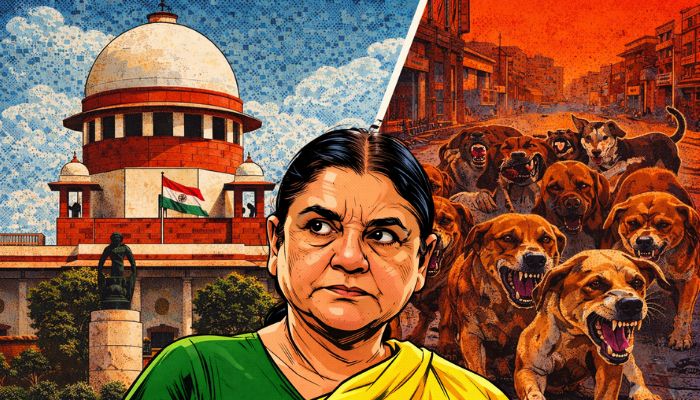
As part of OpIndia’s ongoing series on the stray dog menace, it is essential to underline that civic bodies have failed to manage the stray dog population, mainly due to the ABC Rules that came into effect in 2001 under the leadership of then-MP Maneka Gandhi and were revised in 2023 again under her leadership. Because of strict rules against the removal of dogs from the streets even if they are attacking people, both urban and rural spaces have turned into potential danger zones.

RTI reveals over 26 lakh dog bite cases in 2025 alone

According to a reply to an RTI filed by OpIndia, the Directorate General of Health Services, National Centre for Disease Control (NCDC) revealed that India has already recorded 26 lakh dog bite cases in 2025 till July, while 2024 witnessed over 37 lakh such cases. Such a high number of dog bite cases highlights the scale of the menace and exposes how the ABC Rules have failed to control it.

Number of dog bite cases between 2024 and July 2025. Source: NCDC, Government of India

As civic bodies across the country have failed to strictly enforce sterilisation drives, shelter management, initiatives to stop pet abandonment, and public awareness programmes, the dog population continues to rise. Compensation, even when granted, will remain a privilege accessible only to a few.

A growing public safety crisis

Every year, millions are bitten, and justice is nowhere to be found. Adequate medical aid is still a farce as victims are dying even after receiving all shots of anti-rabies vaccines. As the Supreme Court prepares to hear from victims, the question remains: will India continue to treat the stray dog crisis as a humanitarian debate or finally as a public safety emergency?

OpIndia is doing a series on the stray dog menace in India which can be checked here.

The Left’s hollow outrage: Why the Election Commission is right to exclude Assam from the current SIR exercise

The Election Commission of India (ECI) has announced a Special Intensive Revision (SIR) of electoral rolls in 12 states and Union Territories as part of its ongoing nationwide voter verification and cleansing exercise. Among the states covered are poll-bound regions like West Bengal, Tamil Nadu and Uttar Pradesh. Assam, though it has assembly elections scheduled in 2026, was not included in the list of states to undergo SIR next.

A state-wide SIR was recently completed in Bihar, where assembly elections are currently underway with the new, updated electoral roll.

Chief Election Commissioner (CEC) Gyanesh Kumar, while addressing a press conference on October 27, 2025, clarified that Assam’s case is legally distinct from all other Indian states. He pointed out that citizenship verification in Assam operates under separate provisions of the Citizenship Act, 1955, and the Assam Accord of 1985, which introduced Section 6A to the law. This section explicitly defines who qualifies as an Indian citizen in Assam, a framework different from the rest of the country.

As per Section 6A, immigrants who entered Assam before January 1, 1966, are deemed Indian citizens, while those who entered between January 1, 1966, and March 25, 1971, can become citizens only after fulfilling stringent criteria. Those entering after March 25, 1971, are to be considered illegal migrants. These provisions are unique to Assam, given its long-standing demographic anxieties and cross-border migration from Bangladesh. Therefore, a blanket SIR similar to Bihar or Bengal would directly clash with the state’s special citizenship mechanism and the ongoing, Supreme Court-monitored NRC process.

Kumar emphasized that a special order for Assam would be issued separately once the citizenship verification exercise under NRC nears completion. The logic is clear: conducting an SIR in Assam right now would mean a duplication of effort, potential double-deletions, and interference with the apex court’s timeline.

Why Assam is a legal outlier

The NRC in Assam ordered by the Supreme Court in 2013 has already excluded over 19 lakh individuals as “doubtful citizens.” However, appeals and re-verifications are still pending. The citizenship status of many remains legally unresolved. If the ECI were to simultaneously carry out a nationwide SIR in Assam, it could inadvertently remove or include names that are still under judicial consideration.

This is not merely an administrative inconvenience; it’s a constitutional minefield. The Election Commission cannot legally preempt or contradict the Supreme Court’s ongoing supervision of the NRC. Hence, the ECI’s prudence in holding back Assam’s SIR until a special order is issued is not just logical, it’s mandatory.

The Leftist U-Turn: Outrage for hire

But predictably, this pragmatic and legally sound decision has triggered another wave of selective outrage from the usual suspects in the left-liberal ecosystem that never misses an opportunity to politicize the ECI.

In Bihar and West Bengal, the same cabal comprising the likes of Mahua Moitra, Yogendra Yadav, Manoj Jha, and NGOs like People’s Union for Civil Liberties and Association for Democratic Reforms (ADR) had vehemently opposed the SIR. They had filed petitions in the Supreme Court earlier this year, arguing that the exercise was a conspiracy to “disenfranchise” large numbers of voters.

The Supreme Court, however, dismissed their plea, calling it a mere case of “trust deficiency.” The court reaffirmed that the SIR was a routine constitutional exercise meant to remove bogus voters, duplicates, and deceased persons, nothing more.

Yet, when the ECI decided not to conduct SIR in Assam this time, the same leftists and opposition leaders suddenly discovered a new outrage. Yogendra Yadav, who once wanted the ECI restrained, now wonders why the SIR is not being conducted in Assam. DMK spokesperson Saravanan Annadurai accused the ECI of turning into a “citizenship-finding unit.” Congress spokesperson Shama Mohamed called the ECI’s NRC-related explanation an “excuse.”

It is almost comical how quickly the narrative flips. When the ECI works to update the voter list in Bihar, it is bad. But it is suddenly wanted to interfere in an ongoing SC-monitored NRC process because the Secular-Liberal lobby thinks the chaos and confusion will provide them with further fuel to spread misinformation and vilify democratic institutions.

The Election Commission’s job is to keep the electoral roll updated and make sure that anyone dead, migrated out, or ineligible is not in the voter list. The ECI’s function is not to detect and deport illegal immigrants, issue citizenships, or examine the validity and legality of citizenships. In Bihar SIR, approximately 6.5 million voters were removed from the list. However, not all the names removed were illegal immigrants. Those removed included voters who died, those who failed to prove that they are citizens of India, those who permanently migrated to other places, and those voters who were present in more than one list.

The Opposition’s double standard: When convenience becomes principle

This selective indignation exposes the moral bankruptcy of India’s left-liberal opposition. Their stance on the ECI shifts not with principle, but with political expediency.

When the SIR threatened to clean up voter rolls in Bihar, a state with a large population of illegal Bangladeshi-origin voters who have historically benefited opposition parties, the exercise was branded “undemocratic.” But in Assam, where the same process could potentially reinforce the BJP’s nationalist credentials by validating the NRC outcomes, the Left now cries foul over its absence.

Let’s call this what it is: vote-bank panic.

The opposition fears that in states like Bihar and West Bengal, the cleansing of electoral rolls will expose the depth of illegal voting blocs that have skewed democratic outcomes for decades. In Assam, however, the same opposition wants to push the ECI into violating Supreme Court oversight just to craft a new narrative that the ECI, “under BJP pressure,” is shielding Hindu illegals while targeting Muslims.

It’s a cynical, circular game:

  • If SIR happens → “BJP-ECI conspiracy to delete Muslim voters.”
  • If SIR doesn’t happen → “BJP-ECI conspiracy to protect Hindu voters.”

Either way, the Left’s script stays the same: always attack the ECI, always question institutions, and always create distrust before elections.

The facts they won’t tell you

In Bihar, during the recently completed SIR, approximately 6.5 million names were removed from the electoral rolls. Not all were “illegal immigrants”, most were deceased voters, duplicates, or those who had migrated. The ECI’s function is not to decide who is an Indian citizen but to ensure that every eligible citizen gets to vote once, and only once.

Similarly, in Assam, the ECI’s caution stems not from political bias but from judicial restraint. The NRC process is still under review because both the Supreme Court and the Assam government have raised concerns over its accuracy, with many foreigners allegedly included and many indigenous people excluded. Chief Minister Himanta Biswa Sarma has publicly supported a fresh verification, and the state government has assured full cooperation with the ECI once the Supreme Court allows further action.

The real issue: Opposition’s insecurity

The fury over Assam’s exclusion is, therefore, not about democracy; it’s about losing control over the narrative. For years, the opposition has thrived on portraying the BJP as authoritarian and the ECI as compromised. Election after election, they have refused to admit their actual flaws and, instead of introspection and scrutiny of their own political message, or even the smallest attempt to find out why they have been rejected by the people, they have been hoping that blaming democratic institutions and creating mass public distrust in the country will help them achieve their goal.

The same “liberals” who cried foul when bogus names were deleted in Bihar are now demanding that Assam’s voter rolls be overhauled immediately, even if it means clashing with the Supreme Court monitored NRC. What they really want is chaos, a narrative of “ECI confusion” they can exploit in the run-up to 2026.

A lawful, logical pause

Far from being “irrational” as The Print’s editorial claimed, the ECI’s reasoning is meticulous and lawful. A special SIR for Assam will come, but only after the NRC process concludes under the Supreme Court’s watch. This ensures the integrity of both citizenship verification and voter registration.

The ECI’s restraint, in this case, demonstrates institutional maturity, not partisanship. Those who accuse it of bias today were the same who demanded judicial oversight yesterday. The only consistent thing about them is their inconsistency.

In truth, the Election Commission is simply doing what the Constitution requires, maintaining electoral purity without undermining judicial authority. Assam’s exclusion from the current SIR is not a political decision; it is a constitutional necessity.

The real question is not “Why no SIR in Assam?” But, “Why does the opposition oppose or support the same process depending on its vote-bank math?”

As the dust settles, one thing becomes clear: the ECI is standing firm on law and logic, while the opposition stands only on opportunism.

TNM invents Muslim victimhood story to undermine Madras HC decision on Thiruparankundram hill, tries to ignore Hindu rights, claims it is BJP’s attempt for another ‘Ayodhya’

The renowned “Thiruparankundram hill” situated in Madurai of Tamil Nadu had become a central point of religious disagreement between the Hindu and Muslim communities until the Madras High Court delivered its judgment in favor of the Hindus.

The naming of the hillock, the custom of animal sacrifice at the Sultan Sikkandar Badhusha Dargah (shrine) and the right of Muslims to pray in the Nellithoppu area were addressed in the October ruling. The High court highlighted that the name of the holy site will remain “Thiruparankundram hill,” animal sacrifice will be prohibited until a ruling from the Civil Court and Muslims could pray in the Nellithoppu area only during Ramzan and Bakrid, under strict conditions.

Notably, the place is extremely revered by the followers of Sanatan Dharma because it is home to the historic Arulmighu Subramania Swamy Temple, one of Lord Murugan’s six abodes.

Nevertheless, the infamous leftist mouthpiece “The News Minute” has sought to revive the issue despite the court’s ruling, aiming to provoke religious sentiments and target the Bharatiya Janata Party. The article titled “Ayodhya of the South – A timeline of time immemorial,” which was published on 5th November attempted to create a sensationalized portrayal of distorted facts and falsehoods to propagate the skewed narrative of Muslim victimhood.

The mention of Ayodhya is a clear indication of what the media house intended to accomplish with this piece conveniently overlooking the fact that the Ram Janmabhoomi verdict was rendered by the Supreme Court in consideration of the facts. However, this cabal only accepts such decisions when they serve their interests. Otherwise, they portray every institution as compromised or simply refuse to respect the rulings, as demonstrated in this situation.

Process of shaping Muslim victimhood and attacking the BJP gets underway

The article referenced a 4th July interview with 52-year-old chef Syed Abutahir who wished to sacrifice a goat at the aforementioned shrine in Thiruparankundram and claimed that the “Sunni Muslim moved the date of their Sufi pilgrimage to Christmas. Just so their non-Brahmin Hindu neighbours could join the feast.”

However, a police inspector informed them that animal slaughter is prohibited and did not allow them to proceed. The group including dargah committee members, the local jamaat and mutiple community leaders protested as the police responded with an immediate crackdown, targeting exclusively Muslim men with FIRs (First Information Report) while sparing Hindus, women and children were spared.

Image via Frontline – The Hindu

The piece commenced by portraying Muslims as individuals with warm, embracing hearts who postpone their significant religious practices for their “non-Brahmin” Hindu neighbours. However, it swiftly progressed to its agenda of attacking the “Hindutva forces” headed by the Hindu Munnani, the Rashtriya Swayamsevak Sangh (RSS) and the Bharatiya Janata Party (BJP) to escalate the issue as state assembly elections approached. The article further charged them with conducting a statewide agitation for complete control of the hill.

The media outlet emphasised that Hindus wanted to prohibit prayers at the dargah as well as animal sacrifice, arguing that the entire rock represents the body of the Hindu god Murugan. Abutahir even alleged there had been no problems with the Muslim practices at the site for years, suggesting that if there were no objections previously, there should not be any at present.

First and foremost, this argument is inherently flawed. The fact that a certain practice has been in effect for years does not necessarily mean it should be allowed to persist. Isn’t this how reforms such as the Triple Talaq Law were introduced to facilitate change and resolve the genuine concerns of the other side?

More importantly, this is not a recent dispute and has been around for more than a century. Hindus have always maintained their ownership of the entire hill especially after the dargah’s effort to erect a mandapam, in 1920.

Claims of “syncretic place of worship” and source of “communal harmony”

According to the piece, neither the local BJP unit nor any other Hindutva outfit were “in the pcture” when the police arrested them. The police had not received a formal complaint from any Hindu residents of Thiruparankundram regarding the animal sacrifice.

Interestingly, the Muslim side approached the court regarding the issue and asserted that it is a “syncretic place of worship that draws pilgrims from both or all religions” during the arguments. It even added that the “main individual who conducted the Halal ceremony at the dargah is a Hindu named Paramasivam, who is part of the Mukkulathor or Thevar community.”

His son described as a “devotee of the dargah” allegedly “signed a sworn statement to this effect, saying his family performs Halal and collects a portion of the meat as part of an ancient ritual barter.”

Image via Tamil Nadu Toursim

The efforts to depict the dargah which is an integral part of the Islamic faith, as a promoter of syncretic culture and communal harmony where even Hindus participate, are rather desperate.

The involvement of some Hindus in Eid or Christmas festivities or the attendance of non-Hindus at a temple, does not eliminate the religious nature of these occasions or sites. They are not a symbol of secularism and can not be stripped off their religious elements, even if people from different beliefs are involved.

Likewise, how can it represent communal harmony when Hindus have been struggling for their rightful claims to the hill for hundreds of years and are consistently denied the same? The actions of a few Hindus engaging in the dragah can not negate the strong feelings of the broader Hindu community. Furthermore, why should their faith not be considered equally important as that of others?

Casting doubts on official statements to sustain the bogus narrative

The public path leading to the shrine was blocked by Muslims, according to the Thiruparankundram Revenue Inspector. He outlined that they “prevented the police from doing their duty” and “used inappropriate words and slogans” including “down with police anarchy” in the complaint.

The piece then questioned, “Why would one set of pilgrims have a problem with another set visiting the same shrine,” while Abutahir insisted that he did not even recall seeing the official.

Image via Outlook Traveller

The answer to this could be akin to the reason Hindu processions are subjected to attacks during every festival and are regularly rejected permissions to pass through “Muslim areas.” However, the leftist lobby is not prepared for this discussion nor will they ever be. Nothing unsettles them more than inconvenient truths that expose reality of their preferred demographic. Therefore, they continue to gloss over every nefarious facet of the community.

The article informed that the Revenue Inspector’s accusations were restated by Madurai Commissioner of Police J Loganathan in his plea to the Madras High Court’s Madurai bench and lamented the latter’s unwillingness to mention how “Hindus from Rajapalayam travelled with their Muslim neighbours like a family to sacrifice a goat and participate in Sufi rituals” to further peddle the “communal harmony” narrative.

Abutahir reportedly spoke for almost fifteen minutes before abruptly ending the connection and vanishing. He also cut off communication with the Jamaat members who put the media house in touch with him and only agreed to continue the conversation after Madurai lawyer S Vanchinathan promised to take his case and blamed the local police for his disappearing act.

The piece then tried to illustrate a perfect representation of an ideal society where a lone Muslim family resides among Hindus, who are full of appreciation for the man in that household, to insinuate that this is the way individuals from both communities coexist until the BJP or Hindutva activists incite tensions between them.

It shrewdly shifts the responsibility onto the two while conveniently disregarding that this matter has been tied to Hindu religious sentiments for a long time and is completely unrelated to politics or such things. The piece essentially urges Hindus to relinquish their rights at the distorted altar of communal harmony or endure accusations for daring to raise their voice.

Anti-Hindutva rhetoric persists amid efforts to refrain from questioning the relevant authorities

According to the article, the police asserted to have received the orders from District Collector and barred them from mounting the hill but the jamaat discovered that no such order had been given when they verified. The officers then asserted that the instructions were issued on behalf of the district government by the Revenue Development Officer (RDO). However, the Muslims claimed that no such a directive had not been issued to the police.

If it is indeed true, isn’t this an administrative failure of the authorities under the Dravidian government? However, the article chose to criticize the Hindu groups and the BJP, which has merely 4 members in the state assembly, rather than posing questions to the responsible authority. It seems that speaking truth to power is only applicable when it pertains to the saffron party, irrespective of its status in power.

Afterward, the article addded that the Jains have presented archaeological evidence conveying that they established shrines long before the other two religions without pointing out how the Islamists did not even spare their caves and painted them green.

It then declared that the “evolving legal and political equations surrounding this conflict, detailing how police and bureaucratic actions created a vacuum that the BJP rapidly filled to escalate its Hindutva agenda.”

The piece to create an illusion of neutrality claimed that the “secular groups feel profoundly disappointed by the police and the Dravida Munnetra Kazhagam (DMK)-led state machinery, which they view as having actively undermined the Dravidian Model’s commitment to social justice.”

The entire article is dedicated to denounce Hindutva and the BJP, while the government which should be held accountable is only criticized for failing to provide “social justice” in the face of their growing presence in the state.

Notably, it is the same party whose ministers, MLAs and even MPs desire to eliminate Sanatan Dharma and have expressed their aversion to the religion in the most contemptuous manners. It is utterly ridiculous that the piece suggested that such an administration did not act against the mischievous “Hindutva forces” which, in fact, do not hold any authority in the state.

The media outlet then reiterated this rhetoric, stating that “Hindutva groups are labeling it the Ayodhya of South India.” It further condemned how “Hindu Munnani, Hindu Makkal Katchi, RSS, and the BJP together with around five lakh people gathered in Madurai on 22nd June for a Murugan ‘Maanadu’ (conference),” representing the largest Hindutva assembly in the history of the state.

There they pledged to seize possession of the entire hill which they considered was an embodiment of Murugan and demanded that animal sacrifices at the dargah be prohibited. The Hindu Makkal Katchi petitioned the court to prohibit the use of the name Sikkandar Malai and insisted that the hill be referred to as Skandar Malai in honour of one of Murugan’s several names.

Muslims continued their sacrificial practices at the location with Muslim leaders even visiting the site. However, the media organization objected at Hindus exercising their democratic right to assemble and present their case. The Hindus, if deviate even slightly from the prescribed path of secularism, assert their religious identity or make a genuine demand, would be labeled “Hindutva,” regardless of the court’s decision.

History of legal disputes goes back a century

The artcile alleged that “Behind each name and claim over the Kundram, Kundru or Malai is a story that goes back to a time about which there is very little recorded history.” However as aforesaid the dargah tried to construct a mandapam in 1920 but the Arulmigu Subramaniya Swamy Temple in Thiruparankundram requested a declaration of ownership over the complete area.

In 1923, the trial court declared that the temple had nearly the whole hill with the exception of approximately 33 cents of land at Nellithoppu where the dargah flagstaff and mosque are located. The highest court at the time, the Privy Council, upheld the temple’s rights to the hill “from time immemorial” in 1931 after the drgah’s appeal.

This stance was supported by further cases. The court forbade quarrying outside the shrine’s restricted boundaries in 1958 and in 2011, it prohibited any new construction or lighting without the temple’s consent. Following petitions related to tourism initiatives and flag installations were similarly denied.

Courts have continuously maintained the temple’s control of the hill for more than a century, acknowledging the dargah’s rights exclusively within its 33-cent tract.

Reality is in direct opposition to the propaganda

The reality stands in stark contrast to the portrayal that The News Minute attempted to create with the article. Hindus had to organize significant protests to counter the unlawful encroachments by Muslims while simultaneously engaging in legal battles to acquire permissions.

Animal sacrifice was allowed with the approval of the DMK government. The authorities were eventually compelled to act as the Hindu devotees agitated when banned Popular Front of India’s (PFI) political wing the Democratic Party of India (SDPI) attempted to incite communal tensions. Moreover, efforts to rename it as Sikandar Malai (hill) were also in progress despite accusations of Muslim appeasement directed at the DMK.

The dargah could be perceived as a representation of communal harmony and secularism by those with personal motives, yet the fact remains that it has been employed to trample on Hindu religious rights, encroach upon their holy space and violate their religious feelings. The high court’s decision and the legal background of the area also outline this same truth, which cannot be concealed by any amount of victimhood narratives or vested agenda from the liberal-leftist media, to keep the issue alive.

Rahul Gandhi’s ‘vote chori’ Hydrogen bomb defused: From alleged vote theft in Haryana to using a Brazilian model’s photo, every claim debunked

In his bid to push the fake ‘Vote Chori’ narrative, Rahul Gandhi finds creative ways to embarrass the Congress party. After the Congress prince’s ‘Vote Chori’ press conference in August this year failed to sow distrust in people against the Election Commission, Rahul Gandhi on 5th November put up another show to drop the so-called ‘Hydrogen Bomb’. However, multiple fact-checks have debunked the lies peddled by Rahul Gandhi.

The Congress MP claimed that the 2024 Haryana assembly elections were “stolen”. He cited several examples to back his claim, including that of a house in the Hodal area of Palwal district. with 66 voters and another with 501. The Leader of Opposition (LoP) also claimed that in the Sonipat district’s Rai, a stock image of a Brazilian national, Larresa, was used to cast votes 22 times at 10 booths.

“She has got multiple names, Seema, Sweety, Saraswati, Rashmi, Vimla,” Rahul Gandhi said.

However, every claim of the Gandhi scion has been found devoid of any factual merit.

Vote Chori in Hodal?

During the press conference, Rahul Gandhi claimed that in the Palwal district’s Hodal, “We found 66 voters registered in a house belonging to a BJP zila parishad vice-chairperson, and 501 voters in a house which could not be found.”

The house Rahul Gandhi mentioned is in the Gurdhana village in Hodal. Rajpal Gurdhana, the uncle of BJP Zila Parishad vice-chairperson, Umesh Gurdhana, told Indian Express that 66 voters Rahul Gandhi mentioned in his presser are all his relatives who reside on the same plot of land.

“My father, along with his three brothers, shifted to Gudhrana from the nearby Siha village around 80 years ago, and all of them got married and started their families. We had 10 acres of land, where we used to stay on five acres and do farming on the rest. This is the oldest pucca house, built in 1986 – House Number 150,” Rajpal Said.

He added that with a growing family, individual houses were constructed to accommodate increasing family members on the five acres of land. However, all are identified with a common house number.

“Four generations of our family live together. There is no question of vote theft. My voter ID was made in 2009, and whoever from my family gets a voter ID made, the BLO writes the address as House Number 150 only,” Umesh Gurdhana told IE.

Similar is the truth of House Number 265, mentioned by Rahul Gandhi, wherein he alleged 501 voters were illegally registered.

This address houses eight members of the Sorout family. A Ram Sorout, a resident of the address, said that his great-grandfather had 25-30 acres of land in the village, which the family divided into plots and gradually sold off.

Ram Sorout’s son, Pawan Sorout, said that at present, 200 houses and three private schools are situated on the piece of land in question. He added that all voters here have 256 as their registered house number.

However, one Shyamwati Singh, who is not associated with the Sorout family, also has her house number registered as 265. Residing with her husband and two children, Shyamwati Singh said that her family bought a piece of land here in 2013, adding that since the,n they have been voting in elections with this address.

Thus, Rahul Gandhi’s claim that fake voters have been registered at the same address in Hodal is false. While multiple voters are indeed registered on a single house address, they are not fake or illegal voters. The Congress leader essentially revealed only half-truths, which suited his ‘Vote Chori’ narrative.

Brazilian model’s stock photo used to cast multiple fake votes?

During his press conference on 5th November, Rahul Gandhi displayed a photograph of a Brazilian model, claiming that it appeared 22 times on the Haryana electoral rolls. The women whose photographs on the voter roll, Rahul Gandhi claimed, were those of a Brazilian model, “Matheus Ferorro”, confirmed that they have voted without incident and have not faced any issues while voting in the 2024 Haryana elections. In media interactions, these women showed their voter identification cards and slips issued by the ECI, confirming that they have participated in elections without fail, and the photo of the Brazilian model is wrong.

Rahul Gandhi alleged that the photo of a model was used over 20 times in voter rolls.
Brazilian influencer Larissa and Congress leader Rahul Gandhi (Images via X)

One of the women, Pinki, a resident of Macchraula village, did have an issue related to the image; however, it was not connected with the Brazilian model Rahul Gandhi talked about. She told IE that after moving to Delhi in 2016, she received her voter ID card with a wrong photo, but that was of another resident of her village and not any model.

Interestingly, Rahul Gandhi only picked constituencies to highlight alleged discrepancies and anomalies where his party’s candidate lost the election. In Hodal, Congress’s Uday Bhan lost to BJP’s Harinder Singh. In Rai, Jai Congress’s Jai Bhagwan Antil lost to the BJP candidate. The Congress prince did not find any such alleged irregularities in seats where his party’s candidate won.

Rahul Gandhi cries ‘vote chori’ after Congress lost Haryana despite leading in postal ballots: OpIndia debunked his lies

On 5th November, Rahul Gandhi claimed that “vote chori” or theft of votes happened in seats where Congress led in postal ballots but lost in the final results. His claims were based on a simple fact that on some seats, Congress was ahead of the BJP in the postal ballot counting, but when counting for the voting that happened via Electronic Voting Machine (EVM) occurred, the BJP defeated Congress.

OpIndia examined the final results of all the assembly seats for the Haryana state elections 2024 and found that there were four seats where the BJP took the lead in postal ballots but lost the final tally.

According to the data available on the Election Commission’s website, in Julana, Hathin, Nangal Chaudhry and Adampur, the BJP was ahead of Congress in postal ballots. However, the party eventually lost the final count to Congress.

Voter Anjali Tyagi featured in Rahul Gandhi’s ‘H-files’ presentation, says no “vote chori”, video misused: OpIndia ground report busted Congress’s lies

In another round of peddling lies that cast aspersions on the integrity of the Election Commission and undermine Indian democracy, Rahul Gandhi, in his press conference on Wednesday, presented a series of video clips and anecdotes to claim large-scale manipulation in the Haryana Assembly Elections 2024. Among the videos featured was that of Anjali Tyagi, a voter from Haryana, which Gandhi cited as proof of voter suppression.

However, just hours after his press conference, Tyagi herself came forward in an exclusive conversation with OpIndia’s Keshav Malan to categorically deny Gandhi’s allegations, asserting that her experience had been misrepresented and that her vote was “missed, not stolen.”

Gandhi had included Tyagi’s video in his slideshow to allege widespread voter fraud, suggesting that votes were manipulated to sway the election results.

However, speaking to OpIndia, Tyagi clarified that her experience did not align with Gandhi’s narrative. She stated that her vote might have been missed due to administrative errors rather than stolen, directly challenging the opposition leader’s assertions. Tyagi’s denial is significant as it undermines the core of Gandhi’s allegations, which were part of a broader strategy to question the integrity of the electoral process in Haryana.

Anjali Tyagi further expressed her belief that her video was misrepresented, suggesting it was used out of context to support a false narrative of voter fraud.  “I believe my video was incorrectly presented,” Anjali said in conversation with OpIndia.

Rahul Gandhi claimed photograph of a Brazilian model used in Haryana elections for multiple voters: Neither the model’s name nor his photo misuse claim turned out to be true

In the ‘H-Files’ presentation, Rahul Gandhi displayed a picture of a Brazilian model claiming that her name is Matheus Ferroro and said that this model has sometimes voted as Seema, sometimes as Sweety, and sometimes as Saraswati.

However, it turned out that the model’s name is not Mathews Ferrero, but of the photographer who took the photo. The photo can be found on the photographer’s profile on Unsplash and Pexels. The real name of the model is Larissa, and she has denied any involvement in Indian politics at all.

As her Instagram profile got flooded with comments and messages from Indian users after Rahul Gandhi displayed her picture in his ‘Hydrogen Bomb’ gimmick, Larissa put out a video refuting Gandhi’s claims.

“Welcome, my Indian followers, to my Instagram! It seems I’ve gained many Indian followers now. People were commenting on my photos as if I was elected! Folks, let me tell you the gossip. You’re laughing too much, aren’t you? I’m going to tell the gossip. Folks, they are using an old photo of mine…Just to be clear, it wasn’t me, it was only my photo, I have absolutely nothing to do with politics in India. My photo was purchased from a stock image platform and used without my involvement. It’s one of my old pictures from when I was about 20 or 18 years old,” Larissa Nery said in Portuguese.

“The use of my picture… I don’t know if this is an election or something else where voting is necessary. And… in India… really?? They are portraying me as an Indian woman to scam others, folks. It’s not me, I’ve never even been to India, I’m a Brazilian digital influencer and a hairdresser, and I love the Indian people,” she added.

Stunned by the sudden attention, social media chatter, and media calls for interviews, Larissa said, “Oh my god, how crazy. What madness is this, what world are we living in…”

The claims of the former model’s image being misused to cast ghost votes have already been debunked by several of the 22 women whose voter ID cards Gandhi displayed in his presser.

However, despite the Brazilian woman herself coming out and debunking Congress’s lies, the party leaders refuse to show even a shred of shame. Congress’s social media and digital platforms chairperson, Supriya Srinate, has published multiple X posts linking Larissa Nery to the fake ‘Vote Chori’ claim.

In one such post, she wrote, “Give the correct answer. Win a holiday package to Brazil from EC as a prize.” She attached an image of Larissa and asked, “Who is she?” and gave four options: Seema, Guniya, Saroj or none of the above.

Haryana CM slams Rahul Gandhi for quoting him out of context

Rahul Gandhi, during his address on 5th November, claimed that Haryana Chief Minister Nayab Singh Saini had said in a press conference before the results that they had all the “arrangements”, hinting towards the theft of votes. He became a clip-cutter and shared a trimmed clip of Nayab Singh speaking at a press conference on 6th October 2024, two days before the elections.

In the video, CM Singh was heard saying, “BJP will form the government alone… We have all the arrangements.” Gandhi claimed that the “smile on his face” and the use of the word “vyavastha”, or “arrangement” in English, hinted towards the theft of votes. According to Rahul Gandhi, if a leader smiles before the election results, he must have done something wrong. He said, “This gentleman was very sure and is smiling that BJP has some ‘vyavastha’ that is going to show itself,” despite exit polls favouring Congress.

However, upon checking the full video, one comes to find the proper context of what CM Saini said and it is nowhere close to what Rahul Gandhi claimed during his press conference.

During a pre-result press conference, a reporter asked CM Singh if the BJP would choose an alliance with another party to form a government. In reply, he said, “We will not need any kind of alliance. I have said from the very beginning that the BJP will form the government alone. We have all the arrangements… I am confident that the BJP will alone form the government, but if we need that (alliance), we will give it a thought; we have all the arrangements.”

Hence, the claim made by Rahul Gandhi about Haryana Chief Minister Nayab Singh hinting at “vote chori” is false. The full video clearly shows that the Chief Minister was referring to the BJP’s internal preparedness and confidence in forming the government without any alliance, not to any manipulation of votes. Gandhi’s interpretation of the clip was misleading and based on an edited portion of the original statement.

Clearly, after manipulating electoral data, twisting facts to suit his ‘Vote Chori’ narrative, Rahul Gandhi is using edited videos out of context to lend credence to the propaganda public is not buying despite all his theatrics.

Saini has now slammed Rahul Gandhi for using his edited clip to push his 2024 Haryana election fraud propaganda. “Rahul Gandhi is lying. Four generations of his family have ruled this country, and yet he has to resort to lying,” CM Saini said.

Failed to stir outrage over the Lok Sabha election and Maharashtra assembly election results, Rahul Gandhi alleged vote chori in Haryana

This, however, is not the first time that the Congress party has used dubious sources and manipulated facts to peddle the vote theft bogey. In August 2025, Rahul Gandhi did a similar press conference alleging vote theft with the intention of stirring a massive outrage against the Election Commission. While Congress wanted to establish the narrative that somehow the ECI and the BJP are working in collusion to undermine India’s democracy, it turned out that Rahul Gandhi’s PPT was prepared in the country of Myanmar. A metadata analysis of the PDF files uploaded on the ‘vote chori’ website revealed that all three versions of Rahul Gandhi’s presentation have been created in the Myanmar Standard Time (MMT). Congress leaders and the IT cell rushed to counter these allegations; however, they failed to give a satisfactory rebuttal.

Not only the origins, but also the content of Rahul Gandhi’s ‘vote chori’ presentation, are problematic. In fact, the 22-page presentation comes across as the Congress party’s desperate attempt at lending empirical credence to the rhetoric and theatrics it has been employing to push its “Hum hare nahi hain, hamein haraya gaya hai (we didn’t lose, we were deceitfully defeated)” narrative. OpIndia, however, reported how the ECI rebutted each and every allegation, be it inflated voter registration and turnout, foul play in the appointment of election commissioners, destruction of CCTV footage of the voting process or ECI’s outright refusal to share digital voter rolls, levelled by Rahul Gandhi.

During the August press conference, the Congress party cherry-picked cases involving management or technical issues and passed them off as proof of ‘vote chori’. This time, however, the party appeared more desperate than ever and resorted to peddling blatant lies.

Not to forget, in October, the Supreme Court rejected a petition which called for the establishment of a Special Investigation Team (SIT) to probe Rahul Gandhi’s allegations of vote theft. Rahul Gandhi had asserted irregularities in the voter list within the Mahadevapura assembly constituency in Bengaluru Central.

Rahul Gandhi made special mention of Karnataka’s Mahadevpura constituency to allege electoral fraud, saying that several voter entries in the voter list had “house number 0” and that numerous voters were listed at the same address during a press conference on 7th August. However, the ECI debunked his claims. Gandhi claimed that 80 fake voters were registered at one house in Mahadevpura, but it turned out that they were not fraudulent but migrant voters.

Gandhi had claimed that a house in Mahadevapura had 80 duplicate voters enrolled. But when local Booth Level Officer (BLO) Muniratna was approached, he informed that there was no duplication. The house in question has mostly been tenanted, and the tenants keep changing every year. No family has resided there permanently for the last 14 years. Most individuals use their rental contract as an address to vote, but end up leaving the place. Gandhi cherry-picked cases and passed them off as proof of vote chori since giving complete context that the houses he mentioned were tenanted and thus had multiple voters registered, many of whom had permanently shifted elsewhere, already were or set to be struck off from the electoral roll.

Interestingly, Rahul Gandhi had alleged ‘match-fixing’ even over the Maharashtra assembly elections of 2024, wherein the BJP registered a historic triumph. Voter inflation, voter turnout inflation, ECI destroying CCTV footage evident, ECI-BJP conspiracy and whatnot, the Congress party levelled every allegation it could think of to claim that the public’s mandate was stolen. The Election Commission, however, debunked each of these claims, and Congress failed to come up with any concrete counterargument. Even the Bombay High Court earlier dismissed a plea seeking to annul the November 2024 Maharashtra Assembly election results over alleged voting irregularities.

Congress flogging a dead horse to stir up Nepal-like ‘Gen-Z’ protests?

The Congress party has long been playing a Goebbelsian trick of repeating a lie until it becomes truth. Congress is clinging to the apocryphal narrative that the party and its media allies have concocted since their strategy is not to seek answers but only to keep repeating the same lies in the form of questions to keep the flame of ‘JanNayak fighting the system’ burning.

The successful Gen-Z protests in Nepal to topple the Oli government over corruption allegations have apparently given hope to the forever PM-in-waiting. This is why Gandhi has repeatedly been calling on the Indian Gen-Z to take note of his propaganda and perhaps hit the streets against the Modi government. The Indian Gen-Z and voters in general are, however, able to see through the lies being peddled by the Congress party.

From seeking foreign intervention in India’s internal affairs during his foreign trips to directly attacking the integrity of the Election Commission and transparency of the electoral processes, Rahul Gandhi and his party are undermining the very democracy they claim to defend.

Pakistan’s 40% ‘period tax’ challenged by young lawyer in the Supreme Court: How far behind is the Nation on menstrual hygiene?

Every month, millions of women go through menstruation, a simple biological process that’s as natural as breathing. Yet even today, society, policymakers, and the government treat it like a matter of shame or luxury. This attitude has now sparked a debate in Pakistan, led by a 25-year-old lawyer and activist, Mahnoor Omar. She has taken the government to court over what is being called the “period tax”: a total 40% levy on sanitary pads and menstrual hygiene products, including taxes and customs duties.

Omar argues that these taxes, both direct and indirect, make sanitary pads unaffordable for millions of women, especially those living in poverty or rural areas. As she points out, menstruation is not a choice or privilege; it’s a natural, recurring part of every woman’s life. Taxing menstrual products, she says, is no different from taxing women for simply existing in their bodies.

When pads are treated like luxury items

The crux of the issue lies in how Pakistan’s tax system classifies sanitary pads. While products like cattle semen, milk, and cheese are tax-free, menstrual products are placed in the same category as perfumes and cosmetics, considered “luxury goods”, and are taxed heavily.

This policy, activists say, is not only illogical but discriminatory. “How can something women need to maintain their health and dignity be seen as a luxury?” asks Mahnoor Omar. For her, it is not just a financial issue; it is one of respect, equality, and basic human rights.

Several countries, including India, Kenya, the United Kingdom, Canada, Australia, Colombia, and South Africa, have already abolished the so-called “pink tax.” However, Pakistan has still not declared sanitary pads as essential commodities, an opportunity to underscore how deeply gender bias is embedded in policy-making.

A tax that hurts women’s health

The impact of this tax goes far beyond money. According to UNICEF and other public health reports, taxes have pushed the retail price of sanitary pads up by nearly 40%. This makes them unaffordable for a large share of Pakistan’s 109 million women.

This results in only about 16% of women from rural settings using sanitary pads. The majority of them often revert to using old rags or any other unhygienic material. Such habits significantly increase the risk of infection and long-term reproductive health problems. During the floods of 2022, which destroyed basic supplies, women had to use whatever they could find under unsafe and unsanitary conditions.

Doctors and health experts caution that this situation amounts to a silent public health crisis. Poor menstrual hygiene doesn’t just cause physical diseases; it also fuels increased mental stress, shame, and exclusion.

Education is interrupted by period poverty

Sanitary pads have also hit education hard. In rural and low-income communities, many girls miss school on days of their periods or lack proper access to hygienic products or clean toilets, with some dropping out altogether.

Studies show that one in five girls in Pakistan misses school during her period. Over time, this means many lose nearly an entire academic year’s worth of classes. Surveys indicate that about 79% of women and girls say they cannot take part in school, work, or social activities during their periods.

Even more shockingly, approximately 41% of girls do not know what menstruation is when it first happens to them. No one discusses it in the home or at school. And this silence engenders fear, confusion, and stigma, and continues to hold girls back from full participation in life and learning.

The wall of shame and silence

But beyond the economics, a deeper barrier remains-the cultural shame related to menstruation. In most parts of Pakistan, even today, periods are considered dirty, embarrassing, or taboo. Nobody speaks about them openly, not families, not teachers, not even policymakers.

This wall of silence has translated into complete policy neglect. The government has no national menstrual health strategy, no comprehensive law, and no structured plan for menstrual hygiene management (MHH). This “policy vacuum,” as experts call it, keeps millions of women trapped in poor health and social exclusion.

But young activists and civic groups are finally breaking this silence. Organisations like “Mahwari Justice” travel to underprivileged areas, educating the community, distributing pads, and teaching girls to understand their bodies with pride rather than shame. They reshape the thinking of society over the issue of menstruation with one conversation at a time.

Sparks of change 

There are small but hopeful steps being taken. In Sindh province, school record systems have started including “menstrual facilities” as a key metric. This move aims to track whether schools are equipped with clean toilets, running water, and privacy for female students.

Global organisations like UNICEF are pushing Pakistan’s government to cut or remove the taxes on menstrual products entirely. Their message is clear: menstrual hygiene is not a luxury, it’s a basic health and human right.

The petition filed by Mahnoor Omar in court has fueled this debate, and no policymaker can afford to look the other way. Her legal fight is not about taxation but about changing the way society thinks about women’s bodies and needs.

The gender-blind policy problem

A central argument Omar raises is that government policies often suffer from what researchers call “gender-blindness.” This means that laws and economic strategies are created from a male perspective, without fully considering how policies affect women differently.

For example, when policymakers decide on tax rates, their main concern is usually government revenue. They rarely think about who will bear that financial burden. In the case of the period tax, it is women who pay both literally and symbolically.

Her case aims to change that mindset and push the government to adopt gender-sensitive policymaking, where women’s everyday realities shape national decisions.

Why should the sanitary tax be removed?

The first and foremost point is that menstruation is a natural process, not a hobby or luxury for which women should have to pay extra tax. Sanitary pads are a basic necessity for women, just like food, clothing, and shelter. They are directly related to women’s health, hygiene, and dignity. When the government imposes a tax on them, it fails to recognise them as essential items. This clearly reflects discrimination.

Why removing the tax isn’t enough

While eliminating the period tax would be an important victory, activists believe it’s only one part of a much bigger challenge. True menstrual justice requires tackling both the financial and social barriers that hurt women and girls.

That means breaking the cultural taboo, ensuring menstrual education in schools, and building proper sanitation facilities everywhere, especially in public schools and rural areas. Many schools in Pakistan still lack private toilets or clean water, forcing girls to stay home every month.

Only when these facilities and open conversations become normal can Pakistan achieve what activists call “period equity”, a society where no girl or woman is ashamed or held back because of her biology.

The bigger picture: Dignity, health, and rights

At its heart, this movement isn’t just about removing a tax; it’s about demanding dignity. Menstrual hygiene products are as essential as food, clothing, or housing. Treating them as optional luxuries degrades the basic health rights of women.

Every woman spends an estimated six to seven years of her life menstruating. To make her pay extra for that reality is to burden her for simply being female. This financial penalty reflects deep gender inequality and must end if Pakistan truly wants to move forward.

As Omar and her fellow activists put it, menstrual health is not a private or secondary issue; it’s a public, social, and human rights issue. And ignoring it means ignoring half the country’s population.

Bhagalpur ‘I Love Muhammad’ poster row: Police act swiftly after OpIndia’s ground report, arrest prime accused Mohammad Iftekhal over violence targeting Hindus

Days after communal tensions erupted in Bhagalpur’s Habibpur area over a controversial “I Love Muhammad” poster, police have arrested the prime accused, identified as Mohammad Iftekhal alias Shekhu, son of Mohammad Qasim, a resident of Chamlichak under Habibpur police station.

The arrest was made under Habibpur Police Station Case No. 188/25, registered on October 22, 2025, under multiple sections of the Indian Penal Code including 191(2)(3), 190, 126(2), 115(2), 109, 329(4), 324(4)(5), 299, 351(2)(3), and 352.

Earlier, Bhagalpur Police had confirmed the arrest of three individuals in connection with the violence that broke out on October 20–21 when a “special community poster” was forcibly pasted on a shop in the Station Road locality. According to the official police press note dated October 21, 2025, the poster had triggered violent clashes after members of the majority community objected to the provocative slogan being displayed without consent.

Following the initial incident, senior officers led by the Deputy Superintendent of Police (Town) formed an investigation team comprising local station officers and Circle Inspectors to restore order. The team conducted raids, detained suspects for questioning, and confirmed that the unrest was fueled by attempts to communalize the area through religious messaging.

The Habibpur locality, having a significant Muslim majority, saw targeted violence against Hindu families and businesses, with several residents alleging intimidation and forced shutdowns. Hindu shopkeepers claimed they were coerced into closing their shops and raising religious slogans to avoid attacks.

Police have maintained an increased presence in the area, with patrolling and monitoring continuing to prevent further flare-ups. Officials stated that law and order are currently under control and that further arrests may follow as the probe progresses.

The Bhagalpur Police reiterated its commitment to maintaining peace, appealing to citizens not to fall for rumors or provocative messaging spread through social media.

OpIndia ground report from Bhagalpur

OpIndia, which visited the epicentre of the violence in Habibpur, uncovered the deeper human story behind the unrest, a story of isolation, fear, and relentless persecution faced by the one of the Hindu families left in a predominantly Muslim neighbourhood.

In its ground video report, OpIndia spoke to Gauri Devi, the matriarch of this embattled family. Her testimony painted a chilling picture of what it means to live as a Hindu minority in Habibpur.

“We’ve lived here for generations,” she said, standing before her half-built home scarred by fire. “But ever since 2013, we’ve been told again and again, sell your house and leave. They say this place is no longer for Hindus.”

Gauri Devi recounted how in 2022, her home was set ablaze with petrol while the family was away for Puja. Property worth nearly ₹9 lakh was destroyed. “They didn’t want us rebuilding,” she told OpIndia. “They demanded money Rs 10,000 or Rs 20,000 each, just to let us put up our walls. Even after paying, they kept attacking.”

Her daughter-in-law, visibly shaken, added, “During Kali Puja, they tore down our banner of Kali Maa and shouted that no Hindu festival would be allowed here. When we protested, they pelted stones at our home. My aunt’s teeth were broken.”

‘We live like prisoners’: Life in Habibpur’s shadow

The family’s home today resembles a fortified outpost, surrounded by CCTV cameras, iron gates, and reinforced walls. “We’ve turned our home into a fortress,” Gauri’s son told OpIndia. “Every night, we sleep light, one sound outside and our hearts race.”

He gestured towards a small underground chamber at the back of their home. “That’s where we hide if mobs gather,” he said. “It’s not a bunker of comfort, but one of survival.”

The family’s old eatery, once a symbol of communal coexistence, now remains shuttered. “They warned us, don’t sell food here again, or we’ll shoot you,” Gauri said softly. “Now even feeding people has become a crime for being Hindu.”

Habibpur is a dense warren of lanes dominated by mosques and mazars, where Islamic flags flutter from almost every rooftop. In this setting, Hindus homes, lit up with diyas during Diwali or decorated for Kali Puja, become an act of defiance.

“They mock us for celebrating our gods,” Gauri said. “When my grandchildren light crackers, they snatch them away and say, ‘You Hindus are becoming too bold.’ But this is our home. Why should we leave?”

This sense of siege deepened after the October 2025 “I Love Muhammad” poster incident. Following tensions that night, a crowd allegedly gathered and began pelting stones at their house. The family has since lived in constant fear, surrounded by symbols of faith, yet cut off from the freedom to practise their own.