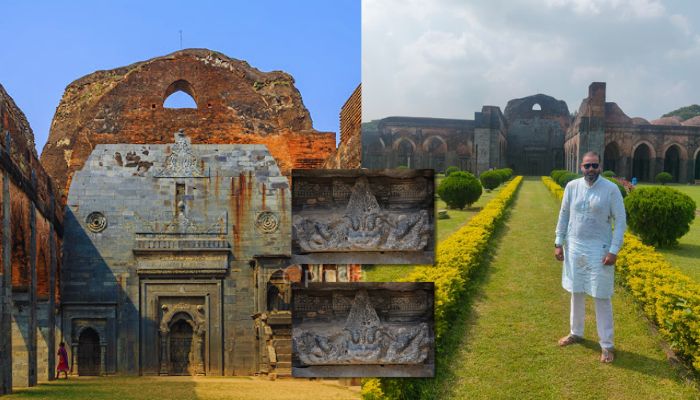
On 16th October, Trinamool Congress (TMC) MP Yusuf Pathan shared pictures from his visit to the Adina Mosque in West Bengal’s Malda district on his social media pages. Pathan’s description of the mosque, however, invited a factcheck from netizens.
Hailing Adina Mosque as architectural marvel, the cricketer-turned-politician wrote, “The Adina Mosque in Malda, West Bengal, is a historic mosque built in the 14th century by Sultan Sikandar Shah, the second ruler of the Ilyas Shahi dynasty. Constructed in 1373-1375 CE, it was the largest mosque in the Indian subcontinent during its time, showcasing the region’s architectural grandeur.”
The Adina Mosque in Malda, West Bengal, is a historic mosque built in the 14th century by Sultan Sikandar Shah, the second ruler of the Ilyas Shahi dynasty. Constructed in 1373-1375 CE, it was the largest mosque in the Indian subcontinent during its time, showcasing the region's… pic.twitter.com/EI0pBiQ9Og
In no time, netizens stepped in to factcheck the TMC MP by bringing up Hindu history of the structure in question.
Advocate Shekhar Kumar Jha shared an image of Lord Ganesh carving on the wall of the Adina ‘mosque’, and wrote, “Historic: Adinath Mandir became Adina Mosque.”
An X user “PlanH”, who ratioed Pathan’s post with reply, wrote, “Dear Yusuf Pathan, you are standing in the campus of one of the largest Hindu Temples, Adinath Temple, which was desecrated and occupied by Islamic invaders. Attached are some images for your reference. It is time to undo the injustice and barbarity, and reestablish the temple’s glory.”
Dear Yusuf Pathan, you are standing in the campus of one of the largest Hindu Temples, Adinath Temple, which was desecrated and occupied by Islamic invaders. Attached are some images for your reference. It is time to undo the injustice and barbarity, and reestablish the temple's… pic.twitter.com/CUc1z5lnHD
One “Abdul Kitabi” shared pictures of Hindu sculptures found inside the Adina Mosque complex and replied, “Dear Yusuf Pathan (@iamyusufpathan), you are standing in the campus of one of the largest Hindu Temples, Adinath Temple, which was desecrated and occupied by Islamic invaders. Attached are some images for your reference. It is time to undo the injustice and barbarity, and reestablish the temple’s glory. As a true Muslim we must give this mosque back to Hindus.”
Dear Yusuf Pathan (@iamyusufpathan), you are standing in the campus of one of the largest Hindu Temples, Adinath Temple, which was desecrated and occupied by Islamic invaders. Attached are some images for your reference. It is time to undo the injustice and barbarity, and… pic.twitter.com/pZ2gmcGOFS
One X user asked, “Have you people made anything of your own, or have you just taken over everything by demolishing others’ religious sites and claimed it as your own?
Adina Mosque or Adinath Temple: Another Hindu temple converted into a mosque by Islamic barbarians
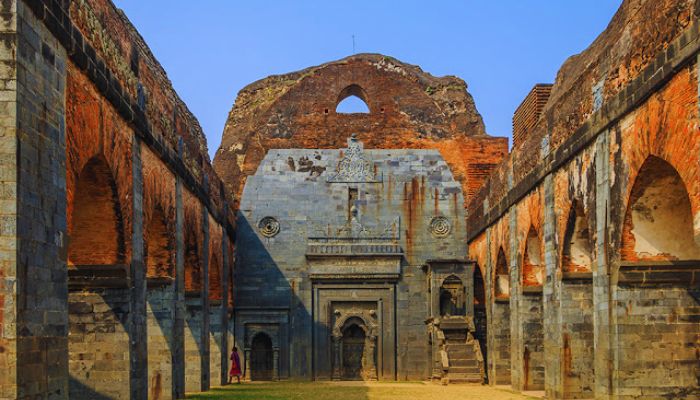
The Adina Mosque is located in the historic town of Pandua in West Bengal’s Malda district. Conventional historical sources say that the construction of this masjid was commissioned in 1373 and completed in 1375 by Sultan Sikandar Shah of the Illyas Shahi dynasty of the Bengal Sultanate. Largest mosque in the Indian subcontinent at that time, symbolised Shah’s military victories against the Delhi Sultanate.
However, historical and archaeological evidence indicate that the mosque was built using materials and stones salvaged from destroyed pre-existing religious Hindu structures from the Pāla–Sena era of 8th-12th centuries.
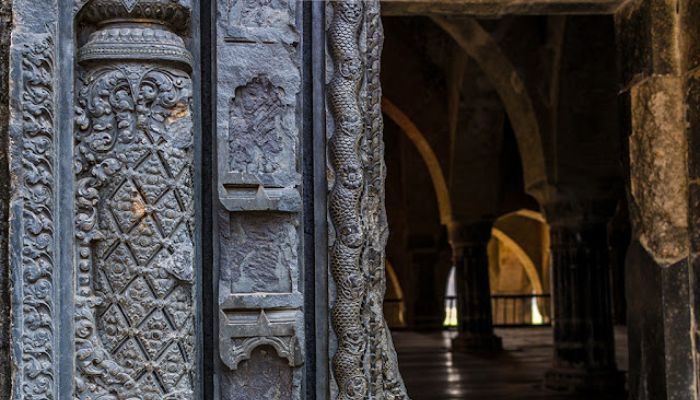
In fact, sculptural remnants indicate that what stands as Adina Mosque today was originally a temple dedicated to Lord Shiva, in his Adinath or First Lord form. The temple was known as the Adinath Temple. The complex also housed a temple dedicated to Lord Vishnu. Archaeological evidence indicates that temple doorway in black stone was used to make the pulpit of the Adina Masjid.
Terracotta and stone carvings on walls, doors, arches and mihrabs or prayer niches, depict Hindu deities like Lord Shiva and Ganesh. In addition, there is a significant presence of motifs like flowers, caitya arches, kiritmukha (face of glory) masks, beaded necklaces, and chain-and-bell designs. The Islamic architecture is devoid of this type of adornments, indicating that these motifs and carvings date back to Pāla–Sena era.
|| From Adinath (Shiva) temple to Adina masjid- Pandua, WB ||
The Adina mosque at Pandua, the largest in medieval India, was built by Sikandar Shah (r. 1358-89), after destroying a Shiva temple.
While recent left “historians” like Catherine Asher and Cynthia Talbot (2006)… pic.twitter.com/CGxPcPuJIP
The central mihrab of this mosque carries clear indications that the structure’s Hindu history. The front of this mihrab is placed in the cured wall decorated with a tri-foiled arch and the spandrel on either side arch has been decorated with rosettes and the panels inside the mihrab are also adorned with the designs of foiled arches and rosettes having chain and bells motifs hanging from the apex of the arches. These are Hindu decorative motifs as these sorts of chain and bell motifs are noticed on the shaft of the columns engraved during the Hindu period.
Broken Shivling, and other idols of Hindu deities have been reported visible on the temple premises and embedded walls. In fact, the nearby structures, including the Pandua Bridge has incorporate materials from Hindu ruins, indicating a broader spoilation of the area by Islamic barbarians.
While Yusuf Pathan intended to pass off a mosque erected on the ruins of an ancient Hindu temple as some sort of Islamic architectural marvel and that Sikandar Shah should be remembered and respected as an Indian Muslim ruler, the Islamic tyrant’s political and religious orientation Arabia and Ctesiphon in Iraq, not India.
The site’s abandonment after 19th-century earthquakes as well as its current status as a Protected Monument of National Importance under the Archaeological Survey of India (ASI) have curbed the scope of further excavations.
However, the issue of Adinath Temple has been raised by the BJP in the past and it reignited in 2024 when senior advocate Hari Shankar Jain appealed to Hindus to come forward and start worshiping in the disputed ‘Adina mosque’.
Advocate Hari Shankar Jain said, “In the Malda district of West Bengal, there is a so-called mosque. It is called the Adina Mosque. It was built by demolishing a grand Hindu temple. This took place during the reign of Sikandar Shah who ruled that area from 1363 to 1374. He demolished the temple and built the mosque.”
He also wrote a letter to Prime Minister Narendra Modi in this regard.
In February last year, a group of Hindus led by a young priest named Hiranmoy Goswami performed puja inside disputed mosque’s premises. Goswami, who had visited the Archaeological Survey of India (ASI)-listed monument, spotted idols of Hindu deities and a Shivling. Soon after, he along with his followers began performing puja and reciting mantras next to the Shivling. However, the Police eventually barred them from continuing puja rituals there.
Thousands of Hindu temples were destroyed during Islamic invasions in the medieval era. Many ‘historic’ mosques today stand atop the ruins of Hindu temples or have repurposed temples into mosques with significant architectural modifications. Babri structure in Ayodhya, Shahi Idgah Masjid in Mathura, Gyanvapi in Kashi are all examples of the Islamic takeover of Hindu temples. The legal manifestation of the political imposition of one-sided secularism–the Places of Worship Act of 1991, stands as a massive obstacle in the reclamation of destroyed or encroached Hindu temples, although the successful reclamation of the Ayodhya Ram Janmabhoomi gives renewed hope to the Hindu cause.
The Supreme Court, on Thursday (16th October), denied bail to PFI extremist Wasid Khan, who is facing charges under the Unlawful Activities (Prevention) Act (UAPA).
While refusing to interfere with the Madhya Pradesh High Court order, which upheld the trial court’s order denying bail to Wasid Khan, a Bench of Justice MM Sundresh and Justice Vipul M Pancholi dismissed Khan’s criminal appeal.
Citing the availability of material against him, the apex court noted that it prima facie revealed an attempt on his part to disrupt the communal harmony and wage war.
Appearing for the accused, Senior Advocate Shoeb Alam contended before the Supreme Court that the High Court concluded the existence of incriminatory evidence against Khan without considering the claim that he was not associated with the Popular Front of India after the Islamic outfit was banned in 2022. However, the argument was not accepted by the Supreme Court.
Wasid Khan had been working towards achieving a ‘Mughal order’ in the country
Notably, the Madhya Pradesh High Court, while refusing bail to Khan, observed that the seizure memo revealed that incriminating material like Books, CDs, a Computer, a pen drive, a bank account, pamphlets, certain lectures and written materials seized from the house of the accused indicated that he was working “to achieve and object of establishing a Mughal Order as it existed prior to Britishers taking over reign from the hands of the Mughals”.
“We have gone through the seizure memo and the seizure memo reveals that incriminating material like Books, CD, Computer, Pen-Drive, Bank-Account, Pamphlet, certain lectures and written materials have been seized from the house/office of the appellant which prima facie reveals that attempt is being made to cause disruption in the communal harmony amongst the members of the Society, so to achieve and object of establishing a Mughal Order as it existed prior to Britishers taking over Regin from the hands of the Mughals and started ruling the country before independence,” the High Court noted in its order dated May 17, 2025.
Opposing Wasid Khan’s bail plea before the Apex Court, Senior Advocate Nachiketa Joshi, appearing for the National Investigation Agency (NIA), pointed out that the evidence found against Khan included a “Vision 2047” document, which aims to transform India into an Islamic country with the application of Sharia law. Wasid Khan was arrested by the NIA on February 3, 2023. He has been facing charges under the following Sections of the IPC-
121-A (Conspiracy to commit offences punishable by Section 121-Waging or attempting to wage war),
153-A (Promoting enmity between different groups on grounds of religion, race, place of birth, residence, language, etc.),
120-B (Punishment for Criminal Conspiracy),
201 (Causing disappearance of evidence of offence, or giving false information, to screen offender), read with the following Sections of the UAPA-
13 (1)(b) (Whoever advocates or abets unlawful activity),
18 (Punishment for Conspiracy),
18-A (Punishment for organising terrorist camps),
18-B (Punishment for recruiting of any person or persons for terrorist act) of the Unlawful Activities (Prevention) Act (UAPA).
Other accused named in the case are Abdul Kareem alias Bekariwala, Mohd. Javed, Abdul Khalid, Abdul Zameel Sheikh, Abdul Rauf Belim, Mohsin Qureshi, Imran Tanwar Hussain, Mohd. Shakir Khan, Mohd. Shamsad, Tohsif Ahemed Cheepa, Shahzad Beg, Ishahk Khan, Mohd. Zuber Ahemed, Akib Khan, Mohd. Yusuf Molani, Khawaja Hussain, Sheikh Nasir alias Nasir Nadvi Sheikh, Anwar Khan alias Doctor Anwar Siddique, Wasid Khan, Gulam Navi Khan alias Sajid Gulam Navi, Gulam Rasul Shah, and Parvej Khan. The trial of the case has been going on in the sessions court.
PFI giving arms training to Muslim men to achieve “Vision 2047”
In its order rejecting the bail plea of Wasid Khan, a Special NIA Court noted that during an interrogation by the NIA, Khan revealed that he worked as the General Secretary of an organisation named National Confederation of Human Rights Organisations (NCHRO), which is the legal wing of the banned Islamic outfit PFI.
As the General Secretary of the NCHRO, Khan handled legal matters of radical Islamic organisations like PFI and SIMI, which advocate for the Sharia Law in India. Khan joined PFI in 2017 and was entrusted with the recruitment of new members to the Islamic outfit, imparting legal knowledge in the classes organised by the PFI, and working towards achieving the objectives of “Vision 2047”.
Khan is also said to have participated in a secret meeting organised in August 2022, in which other accused delivered speeches about Vision 2047, explaining the roadmap for achieving the vision. He further revealed that the objective of the PFI is to form an Islamic government in India with the support of the OBC and SC/ST communities and implement the Sharia Law by 2047.
To achieve this objective, the PFI has been giving arms training to Muslim men to carry out killings using knives smaller than 6 inches and 2-foot-long rods.
What is “Vision 2047” document
In July 2022, the Bihar police seized an 8-page document during a crackdown on a secret PFI operation in the state, in which it planned to launch an attack on PM Modi during his visit to Patna. The document titled “India 2047: Towards Rule of Islam in India” contained a detailed plan for the Islamisation of India in the coming years. The PFI circulated the document among its cadre to motivate them to act on the plan that aimed to dominate the ‘coward Hindus’ and subjugate them, a goal which, according to the PFI, would be achievable even with the support of 10% of Muslims.
Furthermore, the document mentioned a conspiracy to launch a full-fledged armed uprising against the Indian State with the help of their trained cadre and with the help of Islamic countries like Turkey. The plan also included appealing to other Islamic nations seeking their help in bringing the Indian state and the majority Hindus ‘to their knees’.
This was followed by two rounds of raids conducted by the NIA at multiple locations, in which the agency seized several incriminating documents and materials from PFI organisations settled in almost 17 Indian states. The documents included a training module to make IEDs and bombs from available domestic material, and also the ‘Vision 2047’ document and a CD, underlining the PFI’s goal of Islamisation of India.
After the discovery of the PFI’s vision document, the central government passed an order banning the radical outfit and its associated or affiliated fronts in September 2022 for a period of 5 years. The government maintained that the organisations operated as unlawful associations under the Unlawful Activities (Prevention) Act (UAPA). The affiliations banned along with the PFI include All India Imams Council, Campus Front of India (CFI), Rehab India Foundation, National Confederation of Human Rights Organisation (NCHRO), National Women’s Front, Junior Front, Empower India Foundation, and Rehab Foundation, Kerala.
The controversy around “I Love Muhammad” posters, which began in Kanpur, refuses to die down even after nationwide riots, violence, and unrest. Islamists are still baying for blood of the youth who allegedly tore down the “I Love Muhammad” poster. In conversation with OpIndia, a Muslim man from Bihar’s Siwan said that he is searching for a young man who allegedly tore down the “I Love Muhammad” poster and that if he is found, he will be burned alive.
OpIndia arrived in Siwan to cover the Bihar elections. The RJD has given the assembly election ticket to Osama Shahab, son of strongman Shahabuddin, from the Raghunathpur constituency in this district. During the coverage, we met a supporter of Osama Shahab.
Open threats and fear of Shahabuddin
Speaking to OpIndia reporter Anurag Mishra, the Muslim youth said, “Bhaijaan (Osama) said, ‘I should not be defeated. Anyone who tears the posters of I love Muhammad should be hunted down” He also stated that they are searching for a person in the nearby Baniya Toli area who has reportedly torn down one such poster, and if they find him, he will be taken directly to Shahabuddin’s house. The youth also said that no one would have dared remove the poster if Shahabuddin had been alive, because people know what would have happened then.
"भाईजान (ओसामा) बोले- पोस्टर फाड़ने वाले को ज़िंदा जला देंगे"
मुस्लिम युवक बोला- एक ने I Love Muhammad वाला पोस्टर फाड़ा, उसे ढूंढ रहे हैं… मिलने पर ले जाएगा शहाबुद्दीन के घर
I Love Muhammad’ controversy not confined only to Siwan
The controversy over the posters with ‘I Love Muhammad’ is not confined to Siwan only. Earlier, such posters have become the cause of controversy in many other states as well. The row erupted first in Uttar Pradesh’s Kanpur, when a signboard with ‘I Love Muhammad’ written on it was put up during the Barawafat procession. After this, this controversy spread to Kanpur, Unnao, Bareilly, Baghpat, Kaushambi, Lucknow, Maharajganj, Shahjahanpur of UP. Besides, it also happened in Kashipur of Uttarakhand, Nagpur of Maharashtra, Godhra of Gujarat, Hyderabad of Telangana.
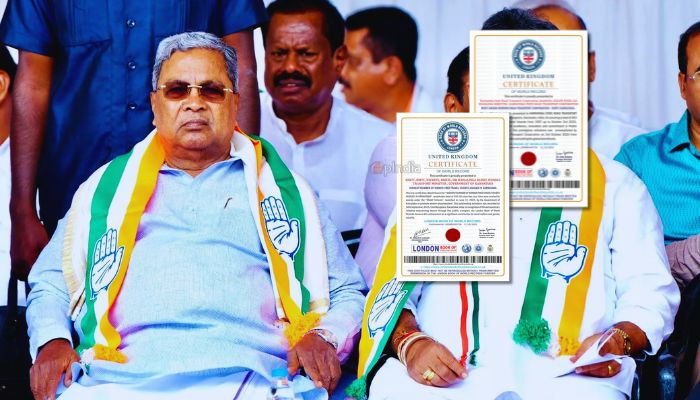
On Tuesday (16th October), Karnataka Chief Minister Siddaramaiah announced that his government’s “Shakti Scheme”, which provides free bus rides for women domiciled in the state, has been certified by the London Book of World Records (LBWR) for the highest number of free bus rides availed by women. He also claimed the Karnataka State Road Transport Corporation (KSRTC) has also been ‘recognised’ by the LBWR. However, the ‘world records’ Congress government boasted has sparked speculation if it is even real with a genuine value or a dubious PR exercise.
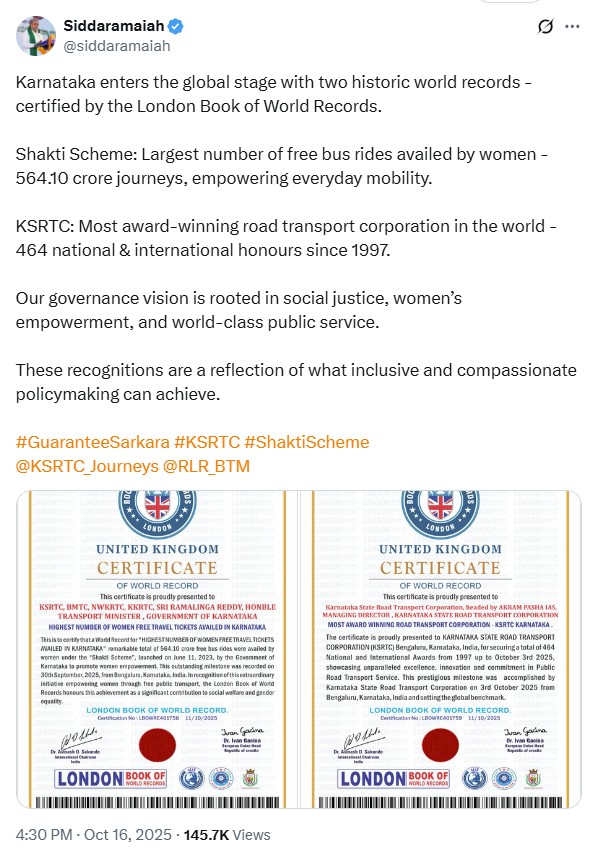
Taking to X, Chief Minister Siddaramaiah wrote, “Karnataka enters the global stage with two historic world records, certified by the London Book of World Records. Shakti Scheme: Largest number of free bus rides availed by women, 564.10 crore journeys, empowering everyday mobility.”
Post by Karnataka CM
“KSRTC: Most award-winning road transport corporation in the world, 464 national & international honours since 1997. Our governance vision is rooted in social justice, women’s empowerment, and world-class public service. These recognitions are a reflection of what inclusive and compassionate policymaking can achieve,” he added.
Karnataka enters the global stage with two historic world records – certified by the London Book of World Records.
Shakti Scheme: Largest number of free bus rides availed by women – 564.10 crore journeys, empowering everyday mobility.
The X post by the Chief Minister also includes two ‘certificates’ each issued for the Shakti Scheme and KSRTC.
This is to certify that a World Record for “HIGHEST NUMBER OF WOMEN FREE TRAVEL TICKETS AVAILED IN KARNATAKA” remarkable total of 564.10 crore free bus rides were availed by women under the “Shakti Scheme”, launched on June 11, 2023, by the Government of Karnataka to promote women empowerment. This outstanding milestone was recorded on 30th September, 2025, from Bengaluru, Karnataka, India. In recognition of this extraordinary initiative empowering women through free public transport, the London Book of World Records honours this achievement as a significant contribution to social welfare and gender,” the LBWR certificate recognising the Karnataka government’s Shakti Scheme reads.
“The certificate is proudly presented to KARNATAKA STATE ROAD TRANSPORT CORPORATION (KSRTC) Bengaluru, Karnataka, India, for securing a total of 464 National and International Awards from 1997 up to October 3rd 2025, for showcasing unparalleled excellence, innovation and commitment in Public Road Transport Service. This prestigious milestone was accomplished by Karnataka State Road Transport Corporation on 3rd October 2025 from Bengaluru, Karnataka, India and setting the global benchmark,” the certificate recognising KRSTC reads.
Both certificates are signed by one Dr Avinash D. Sakunde, who is mentioned as LBWR’s ‘International Chairman’ from India and Dr Ivan Gacina, the European Union Head from the Republic of Croatia.
Notably, while CM Siddaramaiah is patting his own back, the Congress government in Karnataka has been facing criticism for introducing freebie schemes like the Shakti, which allowed free bus travel to all women in all state-owned buses, while the four state transport corporations have been facing a severe financial crunch. KRSTC, Bengaluru Metropolitan Transport Corporation (BMTC), North Western Karnataka Road Transport Corporation (NWKRTC), and Kalyana Karnataka Road Transport Corporation (KKRTC) have consolidated liabilities worth Rs 6,330.25 crore.
Who is Avinash Sakunde, the ‘member of advisory committee to Delhi Minorities Commission’ and Ivan Gacina, the ‘President of Balkanofantastika’
Interestingly, the mainstream media widely reported on Chief Minister Siddaramaiah’s announcement of receiving the alleged certificates by the London Book of World Records. However, none delved into the background of this entity and who runs it.
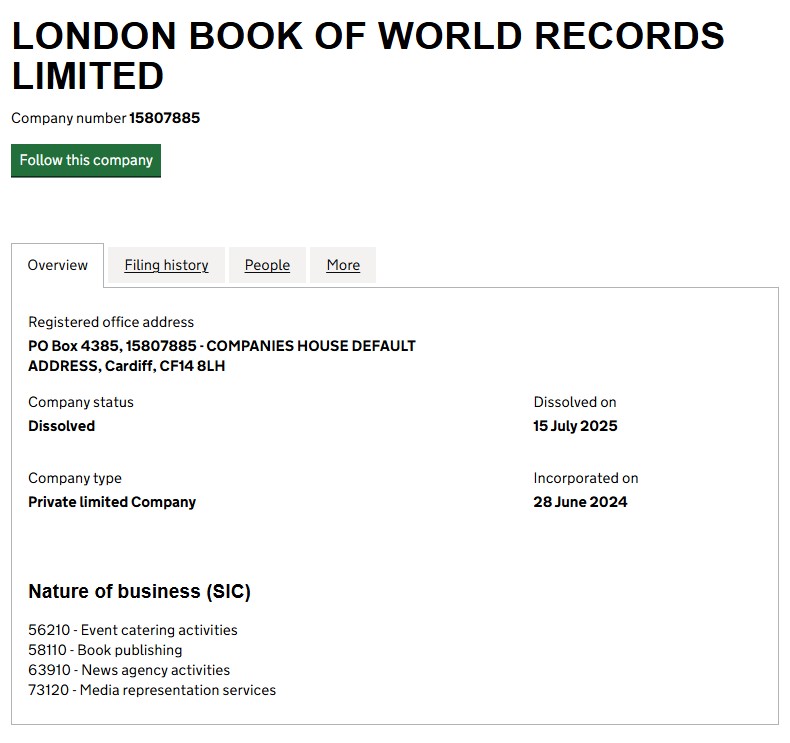
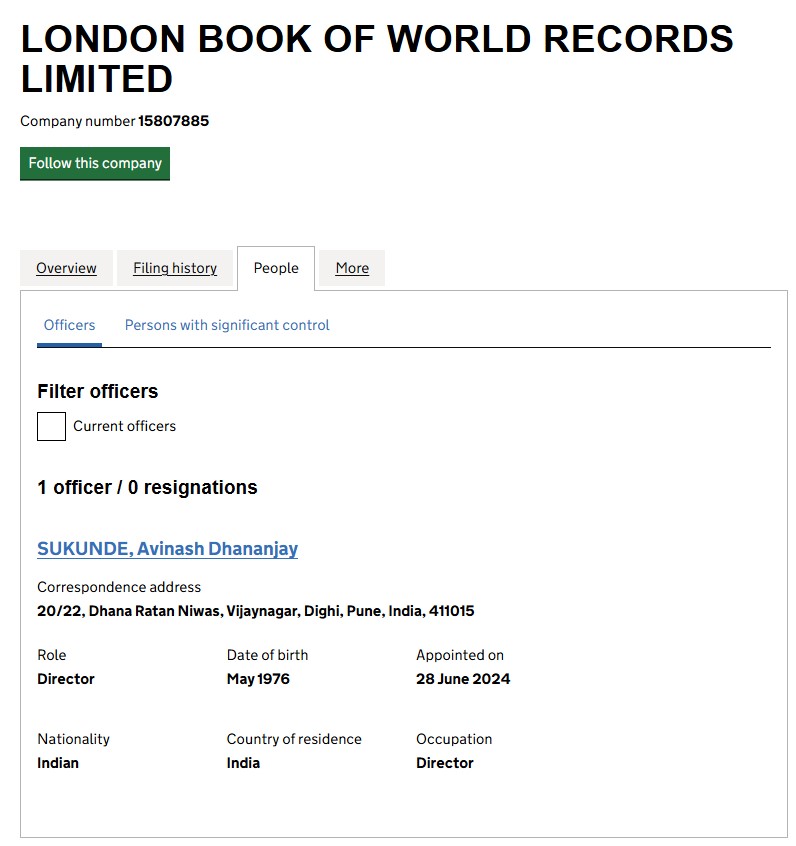
During our investigation, OpIndiafound that London Book of World Records, is a private company that was dissolved on 15th July 2025 as per the official records of the UK government. The LBWR’s nature of business is listed as event catering activities, news agency activities, book publishing, and media representation services.
The records show that Avinash Dhananjay Sukunde was appointed at the director of the London Book of World Records on 28th June 2024.
We checked social media profiles of Sakunde, including his Instagram and LinkedIn page. As per his Instagram bio, Dr. Avinash Dhananjay Sakunde is a “member” of an Advisory Committee to the Delhi Minorities Commission of the Delhi Government. However, upon checking the DMC’s website, we found no mention of Sakunde as a member of any advisory committee or of the commission.
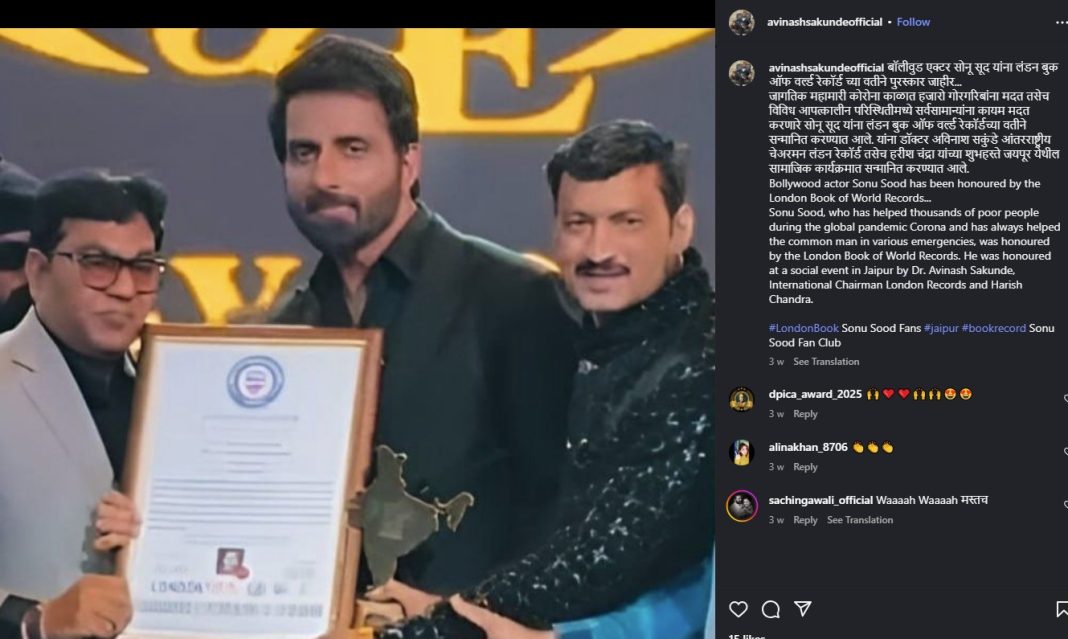
On his Instagram, Sakunde has posted videos of him awarding ‘London Book of World Records’ certificates to various individuals. He handed one such certificate to actor and activist Sonu Sood at an event in Rajasthan’s Jaipur.
Our quest to find out more about Ivan Gacina, the ‘European Union Head’, as per the certificate shared by CM Siddaramaiah, turned out to be very interesting.
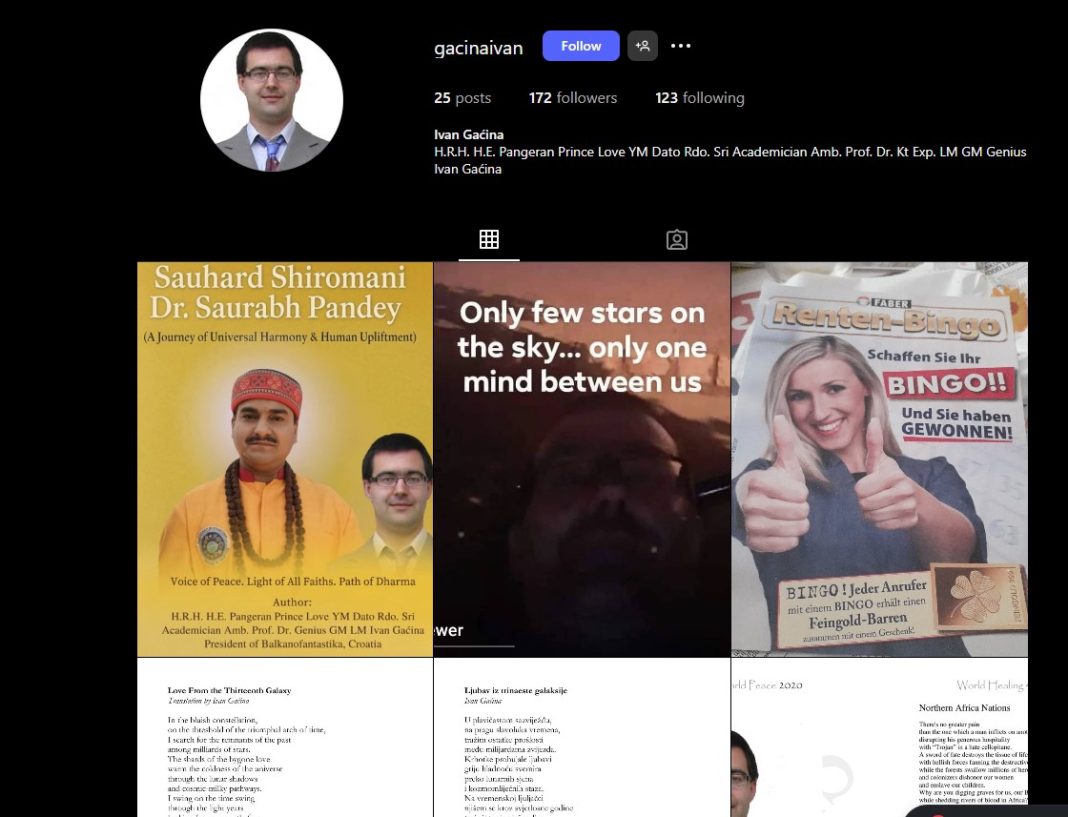
According to Dr Ivan Gacina’s Instagram profile, he is “H.R.H. H.E. Pangeran Prince Love YM Dato Rdo. Sri Academician Amb. Prof. Dr. Kt Exp. LM GM Genius.” In fact, as per one of his posts, Gacina is also the “President of Balkanofantastika”.
Another curious fact is that the word ‘Pangeran’ is of Malay and Indonesian origin. It is the Malay and Indonesian word for the son of a king and queen.
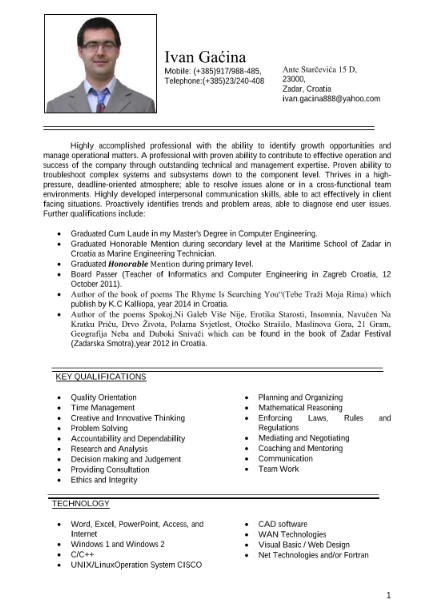
We also came across his resume on his LinkedIn profile. Gacina’s resume states that he from Zadar, Croatia. As per his employment history, Gacina has been a Computer Engineering teacher, a physics teacher, “teacher of mathematics in ADULT education”, cashier and waiter, among other things. He is also a poet. Everything about Gacina is odd, his social media presence, countless certificates, and yet there is just one or two images of this person found on the internet.
Source: Gacina’s LinkedIn profile
Besides the dubious profile of Sakunde and Gacina, another notable fact about the London Book of World Records is that this ‘UK-based’ private company has its office in Delhi’s Pahar Ganj. On its website, LBWR has mentioned one Hotel Superb in Tilak Gali, Chuna Mandi, Pahar Ganj, New Delhi as its “Head Office”.
The LBWR’s website also lists, 71–75 Shelton Street, London, United Kingdom as its “international office (UK branch)” and a “registered office in USA at the address: 30 N Gould St Ste R, Sheridan, WY 82801.
‘Karnataka govt applied for certificate’: Avinash Sakunde tells OpIndia
OpIndia contacted Avinash Sakunde, as per the contact info on the website, to gather more information about the ‘London Book of World Records’ and its activities. When asked about the criteria involved in deciding individuals or institutions to be awarded certification by LBWR, Sakunde said that there are many categories like sports, art and entertainment, social service etc, and the work done by individuals, groups or institutions is taken into note for certification.
We asked about Karnataka government and KRSTC receiving getting LBWR’s ‘world record’ certificate, he claimed that they (government) applied for the certificate.
“We gave them appreciation certificate based on the analysis of the paper filed by the Karnataka government in their application. Our decision was based on their paper. We gave them appreciation certificate for the good work they are doing. We also recently gave a certificate to (actor) Sonu Sood,” Sakunde said.
OpIndia also asked about Ivan Gacina and his role in LBWR. Regarding this, Sakunde said, “He is there only for name. He is my colleague. I handle everything, the administration is in my name.”
We further questioned if LBWR is a registered entity in India, if it is then whether it is an NGO or a private company. We also asked about LBWR’s status in the UK.
About this, Sakunde said, “We are registered in India as an NGO. In the UK, we are registered as a private company. A book publishing company.”
It is amusing that a ‘book publishing’ company in the UK, which is supposedly registered as an NGO in India, is issuing appreciation certificates for “world record”.
Another interesting point to note is that throughout the conversation with OpIndia, Avinash Sakunde nowhere mentioned that his company, London Book of World Records, was dissolved in the UK in July this year.
OpIndia’s investigation into the LBWR raises many questions. Firstly, why would the Congress government in Karnataka apply (as claimed by Sakunde) for a world record certification from a UK-based private company? Secondly, how is a company that was dissolved months about, as per the official records, still issuing world record recognition or appreciation certificates? Lastly, did the Siddaramiah government indulge in a dubious PR exercise from a dubious entity?
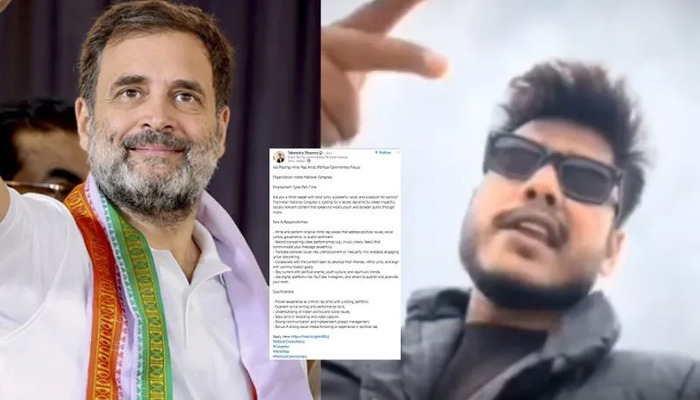
A rap song criticising the Modi government has been going viral on social media. The rap song, sung by a struggling rapper, is being promoted by the Congress IT cell as an expression of the Indian Gen Z’s anger against the government. A similar propaganda was seen being peddled on social media in India after the Gen Z protests in Nepal.
This video of the rap song, which portrays the age-old leftist rhetoric, was also shared by x user Ankit Mayank, who describes himself as Rahul Gandhi’s “Babbar Sher.” Sharing the video, Ankit wrote, “So, Gen Z in India is now using music to expose and speak out against the fascist regime. Fiery rap song, must share. Interesting times are ahead”.
So GenZ in India is now using music to expose & speak against the fascist regime
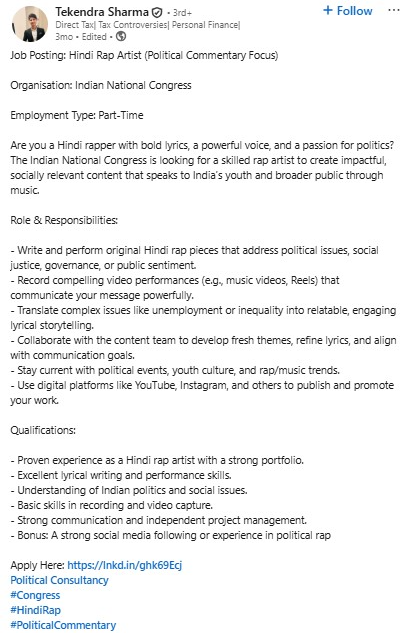
However, the truth about this rap song purportedly portraying Gen Z anger is far from what the Congress IT Cell is claiming. To find out, OpIndia launched an investigation, which led us to several LinkedIn posts about some job vacancies published by the Congress party.
In fact, for the past three months, Congress has been hiring rap songwriters, cartoonists, and food and travel influencers. OpIndia found three such vacancies posted from the account of a person named Tekendra Sharma. These posts clearly stated that these hirings were for Congress.
To understand the full story, OpIndia spoke to Tekendra Sharma over the phone. Sharma said that he had posted the recruitment advertisement for the Congress party, but he is not a member of the Congress party. He added that his job is to shortlist CVs and send them to the Congress party. In other words, Tekendra Sharma admitted that he posted recruitment for rap songwriters, influencers, and other vacancies at the behest of the Congress party.
Congress Party did not respond to OpIndia’s questions
This leads to the question of why the Congress party is hiring rap songwriters, influencers, and bloggers. OpIndia attempted to contact Congress for a response by sending emails to Congress media chief Jairam Ramesh and spokesperson Pawan Khera. The email contained several questions regarding Congress’s relationship with Tekendra Sharma, whether the party was actually conducting such a recruitment drive, and whether Congress views the anti-government content as organic or its own.
It’s been over 24 hours since this email was sent, but we haven’t received a response. The rapper who made the rap song is nowhere to be found. This is the usual pattern of the Congress party; first, they peddle propaganda, and when confronted with facts, they avoid responding. This clearly shows that the anti-government content that social media users believe to be Gen Z anger is being sponsored and spread by the Congress party.
Rap song videos on Congress’s social media
It’s no coincidence that after the recruitment of rap songwriters, the Congress party’s YouTube page has suddenly started posting rap songs. Whether it’s vote theft or PM Modi’s relationship with the United States, the Congress party has released rap songs targeting the government on all sorts of issues.
A rap song was recently posted on the Congress YouTube channel, in which PM Modi’s relationship with Donald Trump has been trolled with memes. The song has gone viral on social media.
There is another Congress-sponsored rap song titled “वोट चोर, गद्दी छोड़” (Vote Theaf, Leave the Throne). The video of the rap song portrays Rahul Gandhi as a leader with a spotless image, supports claims of vote theft and questions the Election Commission’s findings refuting Gandhi’s claims.
This suggests that Congress hired a rap songwriter to create anti-government content, spread it on social media and inciting Gen Z by portraying it as public anger.
After witnessing how the “Gen Z revolution” in Nepal led to the fall of the KP Oli government, Rahul Gandhi appears to be attempting a similar playbook in India. Over the past few months, he has increasingly tried to position himself as the voice of India’s youth, amplifying anti-establishment rhetoric, encouraging social media-driven dissent, and promoting influencer-led campaigns that mimic the Nepali model. From rap songs to meme-driven narratives, Congress’s ecosystem seems focused on manufacturing an image of “Gen Z outrage” against PM Modi, trying to incite online frustration and hoping it would turn into a political movement that becomes the undoing of the current dispensation.
Congress ecosystem’s anti-government ‘paid campaign’ on social media
This isn’t the first time the Congress ecosystem has promoted fake social media content in the name of Gen Z anger. Recently, Congress launched a “vote theft” propaganda campaign on social media. Numerous influencers and content creators created Reels on the issue, and some even apologised later. It was later revealed that the entire “vote theft” propaganda was part of a Congress-sponsored “paid campaign,” costing around ₹20,000 to ₹30,000. These are Congress’s tactics of brainwashing India’s Gen Z, who rely on social media for information.
This article is a translation of the original article published in OpIndia Hindi.
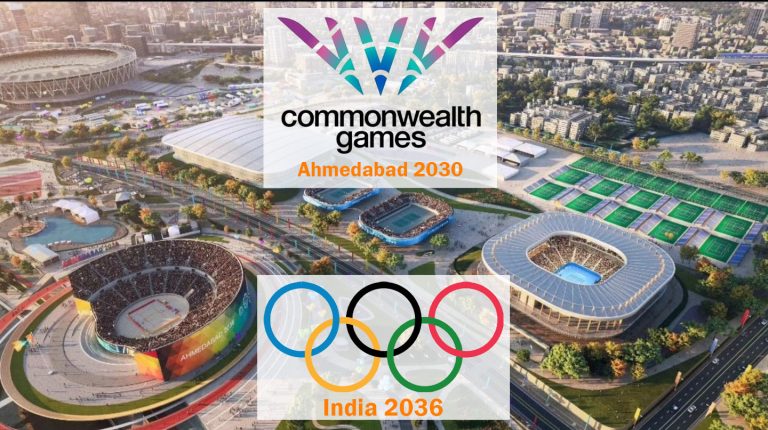
On 15th October, Union Home Minister Amit Shah announced that India will host the Commonwealth Games (CWG) in 2030. India will host the multi sport global stage 20 years after the scandal tainted 2010 Games. The Commonwealth Sport executive board has recommended Ahmedabad as the host city for the centenary edition of 2030. Abuja, the capital of Nigeria, was another proposed city to host the Games; however, Ahmedabad became the final choice.
A day of immense joy and pride for India.
Heartiest congratulations to every citizen of India on Commonwealth Association's approval of India's bid to host the Commonwealth Games 2030 in Ahmedabad. It is a grand endorsement of PM Shri @narendramodi Ji's relentless efforts to…
Formal approval is expected at the Commonwealth Games Federation’s General Assembly in Glasgow on 26th November 2025. This development is expected to become a stepping stone towards India’s ambition of hosting the 2036 Olympics, and the Central Government has touted it as a “day of immense joy and pride”.
In a statement, Amit Shah hailed the decision and credited Prime Minister Narendra Modi’s focus on sports infrastructure and talent development for making India “a marvel of sports destination”. President of the Indian Olympic Association, P. T. Usha, said in a statement that the Games will showcase India’s event capabilities and inspire youth. She called it a meaningful step towards the nation’s vision of Viksit Bharat 2047.
India last hosted the CWG in 2010 in Delhi, which was overshadowed by poor planning, construction delays, and serious allegations of corruption. The memory of that scandal looms large as India prepares for 2030. The stakes have been raised high for India as the Central Government has to prove that it has learned from the past and can deliver a transparent and efficient Games on time and on budget.
The shadow of 2010 – How the Commonwealth Games scam unfolded
When India won the bid for the 2010 Commonwealth Games in New Delhi, it was seen as a moment of national pride. However, it became a synonym for mismanagement and corruption. Here is the timeline of key events from the 2010 CWG saga that still casts a shadow over India’s sporting reputation.
It all began in November 2003, when India won the bid to host the 2010 Commonwealth Games. Canada was the top contender. India’s IOA had estimated the total cost of hosting the event at just Rs 1,200 crore. It was later criticised as “stunning in its short sightedness”. Soon, it was clear that the estimated budget was grossly unrealistic, and the final costs ballooned manyfold. There was also an allegation that India effectively bought support by giving a grant of 100,000 dollars to every Commonwealth nation’s Olympic committee as part of the bid. The “gesture” was later described by former sports Minister Mani Shankar Aiyer as akin to a “bribe”.
In December 2004, then Congress MP Suresh Kalmadi was appointed as Chairman of the CWG Organising Committee on the recommendation of the Prime Minister’s Office, despite objections from the then Sports Minister, the late Sunil Dutt. Kalmadi, by becoming the Chairman of the CWG, gained control over Games preparations. Later, the auditors flagged it as an early mistake.
Between 2006 and 2009, construction of stadiums and city infrastructure proceeded at a snail’s pace. The budget for the Games spiralled upwards in multiple revisions. Between April 2007 and September 2010, the official cost estimates were revised seven times. What was touted to be just Rs 1,100 crore soared from Rs 3,566 crore to Rs 11,687 crore, ten times the initial estimate. But this was not the end. By the time the Games happened, the total spending by various agencies soared to around Rs 18,532 crore, over fifteen times the original bid estimate.
Warning signs had emerged as the schedule of the Games came closer. In late 2009, Commonwealth Games Federation President Michael Fennell publicly warned that preparations were behind schedule and “time is your enemy” for the Delhi organiser. The CGF set up a special review panel to monitor progress monthly as a sense of urgency grew.
Then Sports Minister of India, MS Gill, assured that the government would pour in more funds as needed to ensure success. His assurance reflected how cost control had effectively been lost.
In July 2010, internal criticism from former Sports Minister and Congress leader Mani Shankar Aiyar came as he lambasted the Games expenditure. He claimed that Rs 35,000 crore was being spent on a “circus” while basic sports needs for India’s poor went unmet. He provocatively said he would be “unhappy” if the Games were successful, as it would encourage more such extravagance. He even levelled allegations that India “bribed” other Commonwealth nations, as mentioned above, to win the hosting rights. Kalmadi retorted by calling his remarks “irresponsible” and “anti national”.
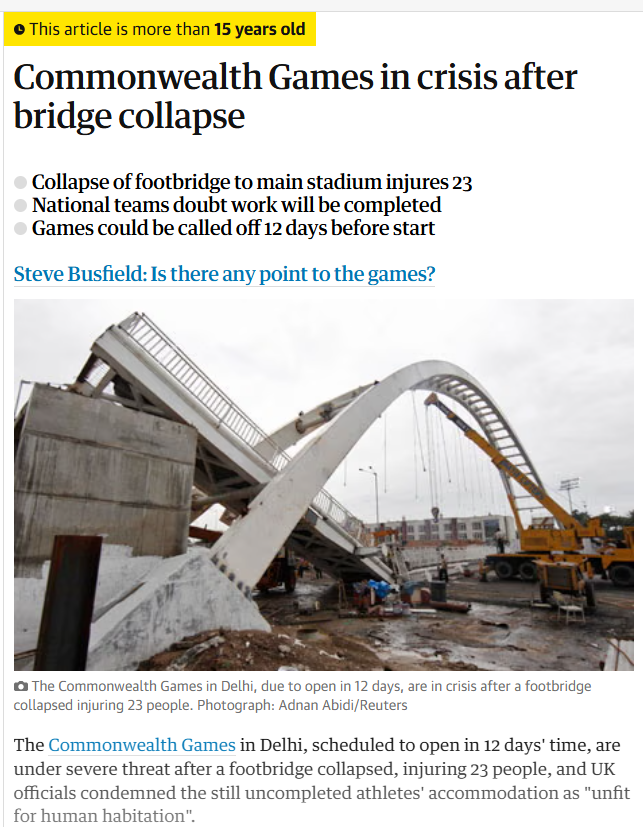
In September 2010, last minute chaos mounted. As athletes were about to arrive, Delhi’s preparations descended into crisis. Twelve days before the opening, on 21st September 2010, a newly constructed 95 metre foot overbridge collapsed outside the main venue, which was Jawaharlal Nehru Stadium. Around 27 workers were injured, exposing the shoddy construction practices.
Photos of collapsed bridge highlighted by international media. Source: The Guardian.
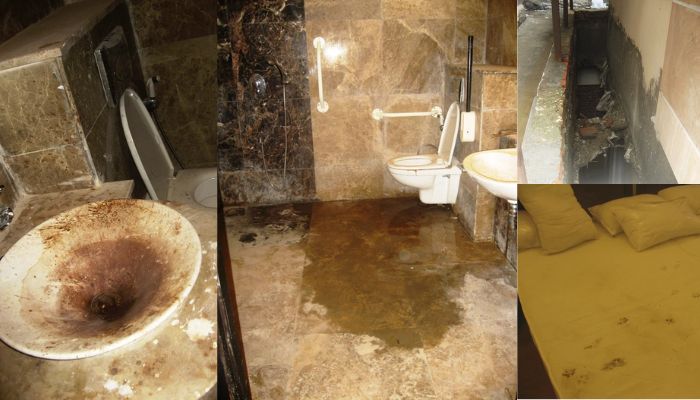
Bad construction was not the only problem. As the international teams checked in, they complained that the Athletes’ Village was filthy, incomplete and “unfit for human habitation”. Photos of waterlogged apartments and stray dogs in rooms made global headlines. Several countries’ delegation heads openly questioned if the Games should be held at all, as essential facilities were unfinished just days out. Commonwealth Games Scotland warned the situation was “unsafe” and asked the CGF to consider calling off the event if things did not improve.
Photos of filthy washrooms and rooms were shared by international media. Source: nationalpost
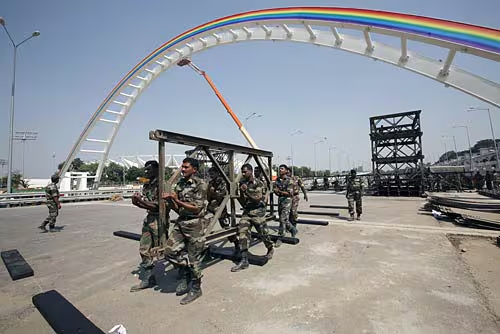
In a rare move, the Indian Army was called to bail out the organisers. Army engineers built a temporary Bailey bridge in just four days to replace the collapsed footbridge, working round the clock to avert a security and logistical nightmare. Even then, Indian officials insisted everything would be fixed in time, dismissing the problems as largely “cosmetic”. Emergency clean up and repair efforts succeeded in patching up the venues just in time.
Indian Army was called to construct the collapsed foot bridge. Source: India Today
Between 3rd and 14th October 2010, the 19th Commonwealth Games took place in Delhi on schedule. Over 6,000 athletes from 71 nations participated. Once the events began, India managed to deliver a reasonably successful sporting competition. India finished second in the medals tally.
The relief was short lived. The spectacle could not wash away the stain of pre Games troubles. Allegations of large scale corruption and financial irregularities began to dominate the narrative as the closing ceremony confetti was still settling.
After the Games were over, then Prime Minister Manmohan Singh moved quickly and, on 25th October 2010, appointed a high level committee headed by former CAG VK Shunglu to investigate irregularities in the Games. This Shunglu Committee was tasked with examining the conduct of all agencies involved, from the Organising Committee to the Delhi government and central ministries, and to recommend action. At the same time, India’s anti corruption watchdog, the Central Vigilance Commission, and the Central Bureau of Investigation (CBI) also started probing specific complaints of fraud during the CWG preparations.
In 2011, the CBI filed its first chargesheet, naming Suresh Kalmadi as the “main accused” in a conspiracy to award an exorbitant contract for the Timing, Scoring, Result system to a Swiss firm. On 24th April 2011, Kalmadi was arrested on charges of cheating, conspiracy and corruption. Several of his close aides, including Secretary General Lalit Bhanot and Director General V. K. Verma of the OC, were also arrested and charged.
They were accused of colluding to award a Rs 141 crore timing equipment contract to Swiss Timing at an allegedly inflated cost of Rs 95 crore higher than market rates. In the same year, India’s Comptroller and Auditor General presented a scathing audit report in Parliament on 5th August 2011. The report detailed massive cost overruns and rules violations in Games projects.
The CAG flagged the Delhi government and multiple agencies for “ill conceived” projects, wasteful expenditures and severe irregularities. Political pressure mounted on those implicated. Kalmadi, meanwhile, remained in Delhi’s Tihar Jail for nine months as an undertrial until he was granted bail in January 2012.
Between 2012 and 2015, investigations continued and the Shunglu Committee submitted six reports, one after another. The reports uncovered irregularities in various areas. The findings indicted Delhi’s Lieutenant Governor Tejinder Khanna and Chief Minister Sheila Dikshit for overruns in city infrastructure and the Games Village project. The committee also slammed broadcasting deals overseen by national TV officials and recommended prosecuting then Prasar Bharati CEO B. S. Lalli for the broadcasting contract worth Rs 246 crore awarded to a UK firm.
By 2012, the CBI filed 19 FIRs on different aspects of the CWG scam. The FIRs ranged from venue construction to street lighting contracts. Trials slowly ground forward in special CBI courts. In 2014, a special court accepted a CBI closure report in one case related to an inflated contract for the swimming pool complex, citing lack of evidence of criminal conspiracy by officials. The cases dragged for years due to the sheer complexity of the investigations spread across dozens of tenders and projects.
In 2015, the first convictions came five years after the Games. In August 2015, a Delhi trial court convicted six people in a scam involving the upgrading of street lighting in Delhi for the Games. Four Municipal Corporation of Delhi engineers and two directors of a private company, M/s Sweka Powertech, were found guilty of manipulating tender documents to inflate prices, causing a Rs 3.3 crore loss to the government. Sentences ranged from four to six years in prison. The convicts appealed in the High Court and the sentences were suspended pending appeal. The cases are still ongoing in the Delhi High Court.
Between 2016 and 2017, the CBI quietly closed at least one high profile case against Kalmadi and others related to Rs 70 crore of contracts given to a London based consultancy, Event Knowledge Services, for Games planning and management. The investigators failed to find sufficient evidence of wrongdoing. In another case, a special CBI court in 2017 convicted two contractors for cheating in the award of contracts to renovate stadiums, Shivaji and Talkatora stadiums. They were sentenced to two and a half years in prison. That court acquitted the officials from the New Delhi Municipal Council who were accused of colluding in that contract, due to lack of proof of their involvement. Also in 2017, a separate trial over the CWG scoring equipment ended in all eleven accused, including Kalmadi and Bhanot, being acquitted by a Delhi court. The court ruled that the prosecutors had failed to prove the charges, a setback for the narrative of a “scam”.
From 2020 to 2025, cases wound up with few held accountable. The CWG related cases either ended in acquittals or remained stuck in procedural limbo. According to media reports, eleven of the nineteen CBI FIRs had been closed without any charges. Only two cases had led to convictions. Both of them were under appeal with no jail time served. The prosecution against Kalmadi and other OC officials for the Swiss Timing contract continues at snail pace through witness testimonies thirteen years later, with no verdict yet.
In April 2025, a Delhi court officially accepted the Enforcement Directorate’s closure report in the last pending case, which stated there was “no case” against Kalmadi, Bhanot or others under anti corruption laws. The judge noted that the CBI had already closed its related case due to lack of evidence and therefore no “proceeds of crime” could be proven for money laundering. With that, fifteen years after the fact, the legal saga ended with no top official held criminally liable for what was widely perceived as a massive scandal, showing the lapses in Indian investigation techniques and the judiciary.
Key players and the massive scale of corruption
At the centre of the 2010 Commonwealth Games corruption scandal was then Congress MP Suresh Kalmadi, as he had extensive control over Games related contracts and spending. Kalmadi was a veteran sports administrator and was joined by key aides, including Secretary General Lalit Bhanot and V. K. Verma, who served as the Director General. Other key officials were T. S. Darbari and M. Jayachandran, along with officials across Delhi’s civic and construction agencies.
The alleged financial misconduct was vast. According to media reports, the scam might have involved misappropriation or misuse of up to Rs 70,000 crore, which aligned with the total public expenditure on the Games, making it the costliest CWG in history. In contrast, the previous CWG in Australia in 2006 cost under Rs 7,000 crore. The CAG found that estimated costs inflated fifteen fold between 2003 and 2010, without a credible final assessment.
Cost overruns were rampant across sectors. The Connaught Place renovation ballooned from Rs 76 crore to Rs 671 crore. The street lighting project rose from Rs 13 crore to Rs 37 crore. “Beautification” works, according to the CAG, wasted Rs 101 crore.
Investigating agencies said that contracts were often awarded at inflated prices, favouring select firms. The Central Vigilance Commission flagged exaggerated rates even before the Games. Examples often cited in media reports included toilet paper rolls billed at Rs 4,000 and umbrellas at Rs 6,000 each. The CAG concluded that delays were used to manufacture urgency, which allegedly enabled the procurement agencies to bypass procedures without a check on the spending.
One major example was the Rs 141 crore Time, Scoring, Results system contract to Swiss Timing, where actual costs were later estimated at just Rs 50 crore. It means that Rs 90 crore was paid over and above the actual costs. The Games Village, which was developed by Emaar MGF, faced CAG criticism over irregularities. The DDA had to inject Rs 766 crore to rescue the project. Several units were later sold commercially.
The Queen’s Baton Relay in London also drew scrutiny after Rs 3.8 crore was paid to obscure UK firms without tendering. Reportedly, it was done on a personal recommendation of Kalmadi’s aide. The CAG labelled the payments “highly suspicious”.
Over Rs 18,000 crore was spent for a twelve day event, which made the CWG a synonym for systemic graft and inefficiency in India’s public projects.
Infrastructure delays, inflated costs, and national embarrassment
In the weeks leading up to October 2010, Delhi’s lack of readiness dominated headlines and the sporting aspect of the Games took a back seat. Virtually every CWG project was delayed. Several venues were incomplete or being hurriedly finalised just before the opening ceremony.
Jawaharlal Nehru Stadium was the site for key events and ceremonies. Even this particular venue narrowly met deadlines. Shivaji Stadium, which was intended for hockey training, was completed two years after the Games in 2012, which made it unusable for the event. As late as September 2010, organisers were still racing to finish basic infrastructure, making it extremely embarrassing for India as the host.
On 21st September, the most damaging incident took place when the newly constructed footbridge outside Nehru Stadium collapsed while workers were pouring concrete. The bridge was being constructed at a cost of Rs 10.5 crore. Around 27 workers were injured, of whom five were rushed to hospital in critical condition.
The photographs of the twisted wreckage quickly made international headlines. The Delhi PWD Minister admitted a failure in securing key structural components. The situation got completely out of hand and the Indian Army had to be roped in on an urgent basis. One thousand soldiers, along with Army engineers, were deployed, who raised the Bailey bridge in just four days. The bridge was handed over to the authorities on 29th September. The military’s intervention was seen as a rescue mission for a civilian disaster.
The Athletes’ Village, which was constructed on the Yamuna riverbank, was supposed to accommodate 6,500 athletes and officials. However, it was declared “unfit for human habitation” by the advance delegations from Scotland and New Zealand. They cited problems like waterlogging, filth, stray dogs, faulty plumbing and exposed wiring. Some teams even threatened to delay or cancel participation. A series of exposés left India on the verge of losing face as the host of the Games.
Chief Minister of Delhi, Sheila Dikshit, and the Organising Committee led by Kalmadi scrambled to recover. Cleaning crews were deployed and Dikshit herself oversaw improvements. Officials blamed the condition on labourers and claimed issues would be resolved in “a couple of days”. The chaos was calmed down with an emergency clean up drive that only came after the international criticism. Athletes from England and Canada were initially housed in hotels and only moved into the Village after last minute fixes.
According to the CAG, the poor planning and compressed timelines led to a “substantial increase in cost that could have been avoided”. Global coverage, instead of celebrating India’s sporting potential, highlighted chaos, politicians comparing it unfavourably to China’s polished Beijing 2008 Olympics.
The CAG report and revelations that shocked India
While media exposés and opposition criticism made headlines, what made eyebrows raise and heads roll was the CAG report tabled on 5th August 2011. The report offered the first detailed, official confirmation of large scale mismanagement and corruption. The performance audit of CWG 2010 was scathing, targeting both the Organising Committee and several tiers of government. It revealed widespread procedural violations, favouritism, and systemic failures in governance.
Key findings of the CAG report
The report pointed at the massive cost escalation without oversight. The CAG report mentioned that the initial estimate was only Rs 1,200 crore in 2003, which rose to Rs 18,532 crore by 2010. The government failed at every stage to reassess or contain costs, which allowed the OC to have “virtually unlimited state funding” without accountability. The CAG observed a “complete breakdown of financial discipline”.
The audit noted that there were deliberate delays in decision making which led to false or manufactured urgency. It enabled the contracts to be awarded on a nomination basis or through compromised tendering. The whole process allowed the officials to circumvent normal competitive procedures under the pretext of time constraints.
The CAG confirmed that Kalmadi was appointed as the Chairman of the CWG OC by the PMO in 2004 despite “serious objections” raised by then Sports Minister Sunil Dutt. Though the PMO later denied wrongdoing, the CAG pointed to the decision as a key misstep. This particular point brought then Prime Minister Manmohan Singh under scrutiny, though he was never formally accused of any wrongdoing.
The CAG report noted that contracts for track surfaces, hockey turf and lighting were awarded in ways favouring expensive, foreign suppliers without merit based comparisons. A notable example involved imported streetlights that cost twice as much as Indian alternatives. Documents related to the purchase linked the decision to then Chief Minister of Delhi, Sheila Dikshit.
The Games Village contract awarded to Emaar MGF and the Queen’s Baton Relay expenses involving AM Films in the UK were highlighted for gross procedural violations. The Rs 246 crore broadcasting contract to UK based SIS Live also came under fire and the Shunglu Committee recommended criminal action.
The CAG noted that multiple overlapping committees were formed which led to a diffusion of responsibility. There was no single authority that was accountable, leading to delay in response to red flags and exacerbated coordination failures.
The CAG report included evidence of overpricing and falsified tenders which included examples such as post tender item rates being increased from Rs 800 to Rs 1,800. It suggested that the documents were tampered with. In some cases, altered bids were not forensically verified and the contracts were split to bypass tender rules.
The measured language of the CAG report did not mask the severity of its findings. The report confirmed public suspicions that the Games had been marred by waste, favouritism, and poor governance. The fallout of the report was almost immediate. The opposition parties used the audit to demand accountability.
A parallel report submitted by the Shunglu Committee further accused officials including the Chief Minister and Lieutenant Governor for cost overruns and mismanagement in the Village and city infrastructure projects.
The CAG report did not use terms like “scam”. At the same time, it did not leave any doubt about systemic failure. The implications extended beyond the CWG and it became symbolic of deeper institutional weakness. Reports suggested even some Congress leaders acknowledged the damage off the record. Law Minister Salman Khurshid’s defence in Parliament fell flat, and the episode became a touchstone for reform and political change.
Political fallout – how the UPA government faced public outrage
The CWG scandal became a major liability for the Congress led UPA government. At that time, Congress was already under fire for other corruption cases including the 2G spectrum scam. Public anger intensified between 2010 and 2011 with media exposing the wrongdoings, CAG findings being tabled and the Shunglu Committee submitting reports one after another.
It was the time for the Bharatiya Janata Party, the largest opposition party in the country at that time, to lead a fierce campaign against the UPA government. Party leaders accused Congress of “destroying national honour” and demanded the resignation of the then Chief Minister of Delhi. BJP spokesperson Ravi Shankar Prasad said in a statement that Dikshit should resign and if “she does not, she should be sacked”.
The attack on the government was so fierce that the Congress leaders found no other way but to shift blame. Dikshit and Kalmadi had ugly spats shifting blame to each other to the point Congress Party had to step in and ask them to stop.
Manmohan Singh’s office faced questions about Kalmadi’s appointment, as reportedly Dutt had objected to it. Congress argued that the CAG had not used the word “corruption” and that legal processes must run their course. The stance failed to alleviate public anger.
In April 2011, Anna Hazare launched a hunger strike demanding the Lokpal Bill. His protest grew stronger amid public outrage over multiple issues including scams like CWG and 2G. Suresh Kalmadi was arrested in the same month, and Congress suspended him from primary membership. Kalmadi, though not officially charged by then, became a political outcast in his home base of Pune.
The protests and political fallout continued and then came the General Elections of 2014. In 2013, when BJP started its campaign, UPA’s alleged scams including CWG were hot topics of discussion. Narendra Modi had joined the national campaign for the General Elections. He referred to the CWG scam in his rallies. In a speech in Pune, he said the Games had destroyed national honour and contrasted them with South Korea’s Olympics, which enhanced its global standing. He said, “One country uses sport to bring laurel to itself among the global community and another brings itself dishonour.”
In the same year, Delhi had Assembly Elections and Congress suffered a massive defeat in the hands of the Aam Aadmi Party. Though AAP joined hands with Congress to form government, which ran for a few months, Dikshit losing her seat was a massive setback and CWG corruption played a vital role in the defeat.
Years later, as prosecution faltered, Congress began claiming vindication. In 2025, Pune Congress leaders cited Kalmadi’s acquittal and ED case closure to suggest that the scam was politically motivated. However, the CAG and Shunglu reports remain evidence of systemic failure, and in public memory, the “CWG scam” still symbolises misgovernance and corruption.
The aftermath – trials, arrests, and convictions
The legal fallout from the scandal was lengthy, complex, and underwhelming in securing accountability. There is no doubt that the initial investigations were swift and trials began promptly. Between 2010 and 2012, the CBI registered 19 FIRs across different aspects. Kalmadi and others were charged with conspiracy, cheating, forgery, and corruption offences. Kalmadi and Verma spent time in jail between April 2011 and January 2012 before securing bail. The ED also pursued cases for money laundering accusations. There were day to day hearings in several matters. The proceedings slowed down due to heavy documentation, witness unavailability, and procedural delays. In one case, tampered tender documents were not sent for forensic analysis, prompting judicial criticism.
Convictions were rare. In two cases, six people were convicted but the cases are now under consideration at the Delhi High Court with sentences suspended.
Most major cases were closed or ended in acquittals. In 2016, the CBI shut the Swimming Pool Complex case for lack of evidence. In 2017, the main CWG trial over the TSR contract ended with the acquittal of Kalmadi, Bhanot, and all co accused; the court ruled no criminal conspiracy was proven. The ED’s linked case on EKS consultancy was closed in 2025 after a court accepted that there were no proceeds of crime to trace.
To date, no top political figure has been convicted in any case, reflecting systemic failure in terms of poor investigations, evidentiary lapses, and dwindling political will. While Congress claims vindication, BJP and others cite the CAG and CVC findings as evidence that wrongdoing did occur, even if unpunished.
Lessons learned or forgotten? Accountability in mega events
Following the 2010 CWG debacle, several changes happened. Reforms were introduced but their implementation remained inconsistent. Lack of a central coordinating authority was the key root cause identified by the CAG for confusion and mismanagement. Later events that fell under the Modi government, including the 2017 FIFA U 17 World Cup and the 2016 South Asian Games, were handled with tighter controls.
In 2011, then Sports Minister Ajay Maken introduced the National Sports Bill, which proposed transparency in sports bodies like the Indian Olympic Association and bringing them under audit and Right to Information provisions. The bill faced resistance and lapsed.
The ignored 2009 CAG preliminary audit became a cautionary tale and the Planning Commission and PMO issued some guidelines after 2010 for timely audits and adherence to early warnings.
Kalmadi was removed and banned from the IOC. The IOA was suspended by the IOC in 2012 for separate governance failures. A new constitution was adopted in 2014, introducing oversight. Leadership under athletes like PT Usha now reflects a shift towards credibility amid Olympic ambitions.
International bodies also adjusted. The Commonwealth Games Federation instituted tighter oversight for future hosts, helping ensure smoother preparations in Glasgow 2014 and Gold Coast 2018. Yet recent editions have struggled. Durban, 2022, and Victoria, 2026, withdrew, citing costs. The CGF has since limited sporting events, ten for 2026, to improve affordability.
While 2010 offered hard lessons, institutional reforms remain patchy. Government claims of new digital procurement systems and private sector expertise must now be tested. The 2030 Games represent an opportunity to show that lessons have been internalised, or risk a repeat of past failings.
What is different this time – new transparency and monitoring frameworks
India’s bid for the 2030 Commonwealth Games came with assurances of avoiding the pitfalls of 2010. Both Indian authorities and the CGF have outlined reforms to ensure transparency and accountability.
Although India is getting less time, the preparations are already on track. Many venues that will be used in 2030 already exist or are part of larger infrastructure upgrades connected to a potential 2036 Olympic bid. This will avoid the need for large scale, last minute constructions.
The Modi government has shifted to open tenders and e procurement, which offer transparency. The CGF’s own oversight has become stricter since 2010. Proactive monitoring and vigilance by the public and media have evolved exponentially since 2010. Any inflated contract or delayed project will become national news in no time.
Political stakes are higher. The 2030 CWG is seen as a stepping stone to the 2036 Olympics. The central government, including the Home Minister, is involved in the planning, leaving virtually no loopholes.
The road to 2030 – can India redeem its image?
India’s successful bid for the 2030 Commonwealth Games offers a chance to correct the legacy of 2010. Execution over the next five years will determine whether that trust was well placed.
If the Games are delivered smoothly, without delays or corruption, India could shed the stigma of 2010 and prove itself ready for larger events, including the Olympics. India seeks a narrative that will put it at the top spot as a go to destination for sporting events.
For India, success also means legacy. Delhi’s CWG infrastructure was underutilised. In contrast, if Ahmedabad builds multi use facilities and improves urban services, the event can spur long term gains. Mega events should catalyse city development, but within strict financial and transparency boundaries.
2030 is India’s second chance. A new generation leads the effort, with lessons from the past and tools of the digital era. If they succeed, the 2030 opening ceremony could mark a full circle moment for India, and the country will come out of the shame to progress towards proving its capacity and integrity on the global stage.
India is set to host 2030 Commonwealth Games in Gujarat’s Ahmedabad. In a meeting held on 15th October, the Commonwealth Executive Board recommended Ahmedabad’s name with a stamp of approval. India and Nigeria were competing to host the 2030 games. Now, it will be presented for formal approval at the Commonwealth Sport General Assembly to be held in Glasgow in November 2025 and will be officially given the green light.
Regarding this development, Olympic Association India President P. T. Usha said , “It will be a matter of pride for India to host the Commonwealth Games in Ahmedabad. These Games will not only showcase India’s world-class organising capabilities, but will also play a vital role in the journey towards a developed India 2047. We see the 2030 Commonwealth Games as a golden opportunity to inspire youth, strengthen international partnerships and contribute to the shared future of the Commonwealth countries.”
The discussion around the possibility of Ahmedabad being recommended for hosting the upcoming Commonwealth Games has going on for quite some time. Keeping this in mind, the central and state governments have been working together for many years to make Ahmedabad a hub of sports infrastructure.
Development of sports complex in Ahmedabad
As a part of the plan to make Ahmedabad ready for hosting international sporting events, the world’s largest cricket stadium, Narendra Modi Stadium, was built in Ahmedabad. Its capacity is more than one lakh spectators. In addition, the Sardar Vallabhbhai Patel Sports Enclave, of which this stadium is a part, is also being prepared in Ahmedabad, which is spread over 650 acres.
A total of 10 new stadiums will be built in this sports complex, which is currently under construction, where permanent and temporary facilities will be provided for sports like gymnastics, skateboarding, softball, tennis, etc. The construction work of all these stadiums is being handled by the government agency Gujarat Sports Infrastructure Development Corporation Limited.
A football stadium will also be set up in this enclave, and an athletes’ village and hotels will also be built. The village is said to have a capacity of three thousand players.
In addition, recently Home Minister Amit Shah also inaugurated the Veer Savarkar Sports Complex in Naranpura, Ahmedabad. Equipped with state-of-the-art facilities, this sports complex will also provide venues for many sports. This complex has been designed in accordance with the standards of the Commonwealth Games. In which more than 20 sports will be covered. The government has spent ₹824 crore on this complex.
Apart from this, special emphasis is also being given on transportation facilities. Bullet train service between Ahmedabad-Mumbai will also be started by 2030. Apart from this, there are plans to build a large sports infrastructure in one lakh square meters on the Sarkhej-Gandhinagar highway. Sabarmati Riverfront is also in the redevelopment phase, where infrastructure for various water sports will be set up.
How India is planning to bolster its Olympic bid
At the heart of all these preparations is the 2036 Olympics, which the government has expressed its desire to host in India. But before hosting a world-class sporting festival like the Olympics, some other events need to take place. That is why India has shown equal enthusiasm for the 2030 Commonwealth Games.
The Commonwealth Games will provide India with an opportunity to demonstrate to the sporting world that India has the world class capabilities to host such major sporting events and that there is no dearth of world-class infrastructure, political will, or sports ecosystem.
What makes India’s ongoing efforts even more significant is the dent on the country’s image caused during the UPA era during the 2010 Commonwealth Games in Delhi. The country’s image was badly damaged due to poor planning, allegations of financial irregularities and scams by the UPA government, and no such major event has been held in India since then.
Now that the new government is working to build a sports ecosystem and project India’s image to the world as a distinct, mature, and responsible nation, the Commonwealth and other international events will help in that.
Before the Commonwealth Games, the World Police and Fire Games will also be held in Ahmedabad in 2029. Law enforcement agencies from all over the world participate and tens of thousands of players come. Before that, the Women’s Volleyball World Championship will be held in 2027. The World U20 Athletics Championship is also being held in Ahmedabad in 2028. This year, the Commonwealth Weightlifting Championship (which is a qualifying event for the Commonwealth) and the Asian Swimming Championship will also be held in Ahmedabad, which is being held at the newly built Naranpura Sports Complex. The regular hosting of such important sporting events will add to the experience required for a successful organisation of Commonwealth Games, and if all goes well, the Olympics too.
Given the track record of the Modi government in Centre and the BJP government in Gujarat, there is no possibility of any UPA-era like scandal in such big sports events from now on.
The Modi government has already proven how serious it is in all such matters with the successful and grand organization of the G20. In which leaders from all over the world came to India and a successful organization could be held. All these sports events in Ahmedabad will also be organized in the same way, with the same seriousness and with the same pre-planning, which will only raise India’s place in the world of sports.
There is also a possibility, however, that the host for the 2036 Olympics will be decided even before the Commonwealth Games are held in 2030. But even by then, these efforts of India, along with other sports events, will have been noticed worldwide. This could massively benefit India’s bid for the Olympics.
The Modi government has repeatedly announced its intention to liberate the nation from the violent clutches of Left Wing Extremism (LWE) by 31st March 2026. Hence, an unprecedented operation has been initiated to fulfil this commitment which has achieved remarkable success. The Maoist movement has significantly weakened as numerous members, including high-ranking leaders, have either been eliminated or have surrendered.
Now, in a further advance towards a red-terror-free India, the most-wanted Maoist commander, Mallojula Venugopal Rao also referred to as Bhupathi, along with over 60 of his associates laid down arms in Gadchiroli of Maharashtra. He was a member of the Politburo and one of the last three top leaders of the banned Communist Party of India (Maoist).
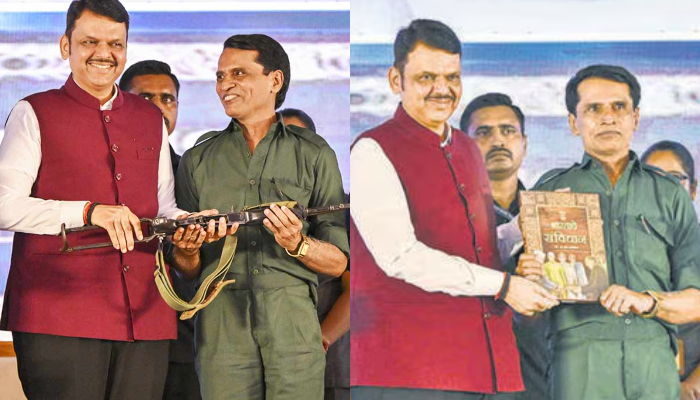
#WATCH | Gadchiroli, Maharashtra: Naxal Commander Mallojula Venugopal Rao alias Bhupati, surrenders in front of CM Devendra Fadnavis at the Gadchiroli Police Police Headquarters. Around 60 Naxalites surrendered today.
Bhupathi is recognized by various other names, including Sonu, Sonu Dada, Venugopal, Abhay, Master, Vivek and Venu. He had several bounties on his head, from Rs 1 crore to 10 crore, in states such as Odisha, Maharashtra, Chhattisgarh, Telangana and Andhra Pradesh. Maoist activity in the Gadchiroli area suffered a huge jolt as a result his surrender. Meanwhile, 78 cadres capitulated in Chhattisgarh on 15th October following the occurrences in Maharashtra.
Who is Mallojula Venugopal Rao
The 69-year-old was born into a Brahmin family in Peddapalli, Karimnagar district of Telangana, on 10th May 1956. He was the youngest son of Mallojula Venkataiah and Madhuramma’s three sons. His parents were part of a family of freedom fighters and priests. The two passed away, Madhuramma in 2022 and Venkataiah in 1997.
Their oldest son Mallojula Koteshwara Rao, also known as Kishenji, became one of the most powerful figures in the Maoist organisation until being slain in a police encounter in West Bengal on 24th November 2011 while the second son Anjanna, is a temple priest.
As the military leader and member of the Politburo, Kishenji led the operations in Lalgarh of Bengal since 2008. He was a founding member of the People’s War Group (PWG) and guided its union with the Maoist Communist Centre of India to create the CPI (Maoist) in 1980. Notably, Bhupati had begun his Maoist operations with the PWG.
The Radical Students Union and People’s War Group, two organisations that fostered Leftist ideology in undivided Andhra Pradesh, attracted him when he was pursuing a degree in commerce. During the 1970s and 1980s, the groups served as breeding grounds for Naxalite ideas.
Bhupathi first attempted to pursue a normal career, even working as an apprentice in the state public relations department in Adilabad, Andhra Pradesh, after graduating. However, he soon followed his sibling’s footsteps which left his life enveloped in violence for at least 40 years.
Emergence of a proficient Maoist propagandist
Bhupathi left his home and family to join Left Wing Extremism and swiftly moved through the ranks of the former People’s War Group (PWG) while operating under the aliases Bhupathi, Sonu, Master and Abhay. He operated out of Gadchiroli and Maad (Abujhmad) in Chhattisgarh where his role transitioned from field operations to ideological command.
Bhupathi was appointed head of the Dandakaranya Special Zonal Committee of the CPI (Maoist) in the Gadchiroli area. He was thereafter tasked with extending the movement to Western Ghats, which run from Goa to Idukki in Kerala, as part of their southern expansion plan.
Afterward, Bhupathi joined the party’s Central Military Commission and Politburo. He functioned as the party’s intellectual leader, its communication expert and the link between the outfit and the outside world beyond Chhattisgarh’s woods. He became Maoist voice after its spokesperson Cherukuri Rajkumar (Azad) was killed in 2010 and presided over the publications division.
“As official spokesperson, he used the alias Abhay and issued statements regularly, although his influence ran far deeper. He shaped ideological discourse, guided propaganda, and oversaw the janatana sarkar, the Maoist parallel governance system in Dandakaranya,” a senior Telangana Special Intelligence Bureau (SIB) officer disclosed, reported The Times of India.
Bhupathi created manifestos, booklets and policy declarations that effectively peddled the party’s nefarious agenda in the form of messaging and outreach. His leadership cemented their brutal authority throughout the far-flung tribal areas of the “Red Corridor” by implementing alleged local governance programs also known as janatana sarkar or people’s government.
The CPI (Maoist) relied on Bhupathi to manage the same in isolated forest areas by combining guerilla control and political supervision. “He mentored new cadres and emerging leaders, ensuring the organisation’s continuity and ideological consistency despite internal rifts and growing security pressure,” an intelligence officer mentioned.
“He promoted political education among cadres and sought to recalibrate armed struggle with political engagement, occasionally advocating short pauses in violence to reassess strategies,” the officer added. Bhupathi even founded a base inside Indravati National Park in Chhattisgarh.
Perpetrating acts of terror against the Indian state
Bhupathi improved guerilla warfare manuals while serving as the head of the People’s Liberation Guerrilla Army’s (PLGA) central military commission. It is the highest Maoist authority in charge of organising and authorising attacks on civilians and security personnel. He advised regional commanders and enforced stringent operational secrecy which enhanced their offensive capabilities.
Bhupathi spent almost 40 years planning and carrying out a number of major strikes in the “Red Corridor.” Over the years, he has been implicated in every deadly attack and conspiracy in the Gadchiroli belt. He is connected to hits on security forces in Maharashtra and is linked with planning multiple assaults in Chhattisgarh, Telangana, Odisha and Andhra Pradesh.
Dozens of CRPF, Special task Force (STF) and District Reserve Guard (DRG) troops were killed in these onslaughts. Bhupati oversaw these operations along the border between Maharashtra and Chhattisgarh as well. His platoons unleashed unbridled violence to instill fear throughout the region.
Bhupathi has been charged with orchestrating the 2011 Chintalnar massacre in the Dantewada district which claimed the lives of 76 Central Armed Police Force (CRPF) members. It was among the most deadly assaults in the history of anti-Maoist operations.
Bhupathi reportedly assumed leadership of Maoist resistance against “Operation Green Hunt” in West Bengal after his brother, especially during the Lalgarh movement. Mostly working from deep forest areas in central India, he remained a crucial strategist in the Maoist leadership.
Bhupathi’s actions enabled the anti-India movement to spread into regions like Telangana, southern Maharashtra and the Western Ghats. He influenced the group’s morale and its perception as a spokesman as he handled press releases, talks during hostage situation as well as the public and media articulation of Maoist beliefs.
Additionally, Bhupathi managed efforts to purportedly reach a balance between appeal to their sympathisers in the intelligentsia and civil society alongside Maoist inflicted terrorism. He became one of the most significant leaders in the history of the Maoist movement in India because of his ability to combine violence with strong organisational control and ideological drive.
Red curtain falls with Bhupathi’s exist
Last month, Bhupathi expressed his wish to put down his weapons and the authorities commenced talks with him. A senior cop revaled that Gadchiroli Police launched their intelligence network and started negotiations through sources in the Bhamragad district after he released press releases and leaflets last month announcing his intention to surrender.
According to him, Bhupathi took the decision as red terror is nearing its demise and the Gadchiroli Police created a favourable atmosphere. The latter published press releases and brochures pointing out his intentions. There was also a lot of discussion among Maoist circles over his surrender.
The officer conveyed that Bhupathi discussed his ideas of discarding the path of violence in a meeting with the people of the Phodewada area around ten days ago. On 13th October, a source close to him told Gadchiroli Police that Bhupathi and other Naxalites were going to give up arms near Hodari village in Bhamragad taluka that same evening.
Gadchiroli Police Superintendent Nilotpal, Inspector General of Police-Anti-Naxal Operations Sandeep Patil and other top personnel were keeping an eye on the situation. The entire group was taken into safe custody after the place of surrender was decided through the source. On the same night, six private vehicles with the surrendered Naxalites were driven to Gadchiroli and the surrender transpired before Chief Minister Devendra Fadnavis.
Disillusionment with the ideology
A letter was released by Bhupathi prior to his surrender in which he informed his fellow fighters that, given the current situation, he could no longer carry on the armed conflict. He apologised for his failure to stop their downfall and acknowledged that their course had been “completely wrong.” He added that the Maoists had suffered significant setbacks as a result of constant leadership errors.
Bhupathi was supported by the CPI (Maoist) North and West sub-Zonal Bureaus who also indicated an interest in integrating into society. On 15th August, he proclaimed in a written and verbal communication that they were prepared for a ceasefire. He reportedly made another speech in September and asserted that the Central Committee and Politburo had deliberated and decided on laying down arms even before Nambala Keshav Rao (Basavaraju) death in May.
“In view of the changed global and national circumstances, as well as the continuous requests from the Prime Minister, Home Minister and senior police officials to give up arms and join the mainstream, we are ready to give up arms and join the mainstream,” Bhupathi stated in the letter which led to a critical division as his sentiments were termed as personal by the party.
Notably, when CPI (Maoist) general secretary Basavaraju died Bhupathi was considered a potential replacement. However, the Maoist movement was already in a severe fall and cadre morale was crumbling. Furthermore, operations in Bastar and Gadchiroli had been intensified and senior leaders had either perished or captured.
Bhupathi’s wife Tarakka already turned herself in to the Maharashtra police together with ten other Maoists including 8 women amid the presence of chief Minister Devendra Fadnavis in Gadchiroli, in December 2018. She had a reward of Rs 25 lakh on her head and was sought for 66 offences.
The proactive operations such as the vital “Operation Kagar” launched by the Modi government seek to fully eliminate the terrorism imposed by Maoists within the country and Mallojula Venugopal Rao surrender is a momentous step in the direction. It is poised to strengthen the already effective policies of the government and stands as a testament to the collaborative efforts of our security forces, administration and centre in addressing the grave but waning threat.
In Kerala, “secularism” doesn’t mean equality. It means knowing whom to offend, whom to appease, and when to retreat. Nothing illustrates this better than the recent hijab controversy at St Rita Public School in Kochi, a dispute that began as a question of uniform rules but ended up unmasking the Communist Party of India (Marxist)’s cynical politics of religious appeasement.
When a school rule became a political theatre
St Rita Public School, a Catholic-run CBSE institution in Kochi, has a clear uniform policy. One Muslim student’s family demanded that she be allowed to wear a hijab, directly violating that code. The management refused, not out of malice, but to maintain equality among students.
What followed was a familiar Kerala drama: the father threatened the management, protests flared up outside the school, and the administration had to seek police protection and even approach the High Court for relief.
Instead of defending the institution’s right to maintain order, Education Minister V. Sivankutty swooped in with a politically charged directive ordering the school to let the student wear her hijab and continue studying. The CPIM had, once again, prioritised religious identity over institutional autonomy.
The move was a signal to Kerala’s Muslim electorate, an attempt to posture as the defender of Islamic sensibilities before the local body polls. What the government called “inclusivity” was nothing more than vote-bank arithmetic dressed up as compassion. Muslims form a sizeable chunk of Kerala’s population, a block that is fiercely united in it voting preferences as compared to Hindus, who are disunited and disconnected for the ruling class to consider them as an indispensable vote bank.
The Church pushed back, and the ‘secular’ minister folded overnight
Within 24 hours, the same minister who thundered about the girl’s “religious right” was begging for consensus. What changed? The Syro-Malabar Church struck back. Its media commission accused Sivankutty of “rekindling communal trouble” and enabling fundamentalism to enter Christian educational institutions. The Church-owned Deepika Daily published an editorial warning the government not to “remain silent under duress from fundamentalists.”
Suddenly, Sivankutty discovered moderation. He told reporters that the matter was “settled” and that the girl’s father had agreed to comply with the dress code. The episode was declared “closed.” In reality, it was a full-blown political retreat, proof that Kerala’s Communists will bend to one community only until another powerful bloc growls.
In one stroke, the CPM’s so-called secularism lay bare: pander to Muslims, placate Christians, and persecute Hindus.
A government that prays with one faith and prosecutes another
This is not an isolated case. The CPM’s pattern of appeasement is now a political doctrine in itself.
In August 2025, CPIM leader Bineesh Kodiyeri proudly posted a video of a Muslim hawker offering namaz inside a party office in Kollam. The act was celebrated online as “an expression of brotherhood.” Party leaders called it “the real spirit of Kerala.”
But when it comes to Hindu expression, the CPIM’s “spirit” vanishes faster than political morality.
In February 2024, CPIM goons stormed a school in Kozhikode to stop a Ganapati Homam being performed on Mahanavami, a ritual held annually with official permission. They attacked the organisers, called the police, and had the devotees arrested. The same party that had converted its office into a mosque decided that a school courtyard was no place for a Hindu prayer.
In “progressive” Kerala, Muslim piety is celebrated; Hindu devotion is criminalised.
Even Marxist ministers can’t pray
The hypocrisy runs deeper.
In 2017, CPIM minister Kadakampally Surendran was reprimanded for visiting the Guruvayur Temple and offering prayers with his family. The party’s internal committee said the act was “against Marxist principles.” Think about that, in Communist Kerala, a Hindu minister was punished for entering a temple.
Yet the same party publicly applauds a namaz held inside its own headquarters. This isn’t secularism. It’s a perverse hierarchy of faith, where Islam is romanticised, Christianity negotiated with, and Hinduism demonised.
The message is unmistakable: you can fold your hands before Marx or before Mecca, but never before a Hindu deity.
Documented anti-Hindu prejudice
The CPM’s 64-page political resolution from 2025 makes this bigotry official. It described the Ram Mandir inauguration as an “aggressive continuation of Hindutva,” mocked Hindu processions as “provocations,” and claimed that “minorities face police repression” as though Hindus never suffer from mob violence or targeted hate.
It went further, objecting to laws against love jihad, dismissing demands for temple restoration as “communal,” and sneering at the “mythological rewriting of history.” The same document offered a sympathetic explanation for Islamist radicalisation, blaming it conveniently on “Hindutva aggression.”
In short, Hindus are the problem; Islamists are the misunderstood. This is the ideological lens through which the CPM views Kerala, a worldview where the majority must forever atone for the sensitivities of the minority.
From classrooms to temples: The war on Hindu visibility
The CPM’s assault on Hindu space isn’t limited to party memos. It shapes governance and culture. When Hindu festivals are held in schools, police are deployed “to maintain order.” When temples hold public rituals, Left-affiliated groups demand restrictions in the name of “secularism.”
But when a Muslim group wants to block a road for Friday prayers, the government rushes to “facilitate” arrangements. When Christian managements demand staff appointments or curriculum exemptions, ministers sprint to church headquarters to negotiate. When Hindu bodies raise identical demands, they’re branded “communal.”
Kerala’s Marxism has morphed into minority-majoritarianism, an ideology that sees Hindus as expendable ballast and Islamists as indispensable voters.
The hijab row fits the pattern perfectly
Seen in that light, the St Rita controversy is not an accident. It’s the inevitable outcome of decades of selective secularism. The CPM’s instinctive reaction was to side with the Muslim parent, not because the law required it, but because politics demanded it. Only when the Church raised its voice did the government remember the virtue of neutrality.
Had the same incident occurred in a Hindu-run school, the CPM’s reaction would have been very different. The management would have been accused of “discrimination,” the SDPI would have staged protests, and the minister’s order would have stood firm. But because the Church pushed back, the party remembered the limits of its own arrogance.
This is not governance. This is religious brokerage, where the state operates like an auction house for hurt sentiments.
Kerala’s secularism: Equality before elections, not before law
What passes for “secularism” in Kerala is a grotesque parody. The CPM doesn’t believe in equality before the law, only equality before the vote shares. It bends for one community until another threatens to shift allegiance, then performs a rhetorical pirouette in the name of “harmony.”
This is why Hindus in Kerala increasingly view the state as institutionally hostile. Their temples are controlled by the government, their festivals restricted, their rituals mocked, while every demand rooted in Muslim or Christian identity is met with exaggerated deference.
From Sabarimala to St Rita, from Guruvayur to Kozhikode, the story is the same: appease, retreat, repeat.
Why this matters beyond Kerala
The hijab row may seem local, but it reveals a national problem: the moral collapse of India’s Left ecosystem. The same ideologues who accuse others of “communalism” have built their entire political survival on minority chauvinism. They celebrate Islamic assertion as “rights,” condemn Hindu expression as “bigotry,” and ridicule any call for equal treatment as “saffron politics.”
Kerala’s CPM is merely the most shameless practitioner of this art. It has replaced ideology with identity management. It no longer governs; it curates grievances.
The tragedy behind the theatre
What makes the St Rita episode truly tragic is that it could have been resolved quietly. The girl’s father himself told reporters he was ready to follow the school’s dress code. There was no crisis until the minister decided to manufacture one for political mileage.
In doing so, Sivankutty undermined both sides. He offended the Church, embarrassed the government, and deepened communal suspicion. His retreat wasn’t an act of wisdom; it was an act of political self-preservation.
And therein lies the essence of CPM’s Kerala model, rule by appeasement, retreat by fear.
Appeasement is not harmony
The hijab was never the issue. The issue is ideological hypocrisy. A party that cannot decide whether faith is sacred or regressive has no business sermonizing about secularism. The CPM’s Kerala government has turned the state into a laboratory of selective tolerance where Islam is appeased, Christianity negotiated, and Hinduism humiliated.
Every such episode chips away at public trust and deepens communal cynicism. When the law bends for some and breaks for others, equality becomes an illusion. The Left’s moral posturing collapses under its own contradictions.
Kerala deserves better than this. It deserves a government that treats citizens as citizens, not as commodities of religious arithmetic. Until that happens, the “God’s Own Country” will remain, under Communist rule, a God-forsaken playground of political hypocrisy.
Marking a major feat in indigenous defence technologies, the Indian Air Force successfully tested an indigenous parachute system developed by the Defence Research and Development Organisation (DRDO) on Wednesday (15th October). Indian Air Force personnel, Wing Commander Vishal Lakhes, VM(G) and Master Warrant Officers R J Singh and Vivek Tiwari, tested the Military Combat Parachute System (MCPS) by conducting a free-fall jump from 32,000 feet, making it the only currently operational parachute system capable of deployment above 25,000 feet.
This is a significant improvement over its earlier test trial in March 2025, when it was successfully tested for a free-fall jump from an altitude of 27,000 feet. In both test trials, the MCPS system displayed unparalleled reliability and efficiency.
Developed by DRDO’s Aerial Delivery Research and Development Establishment (ADRDE), Agra, and Defence Bioengineering and Electromedical Laboratory (DEBEL), Bengaluru, the MCPS significantly enhances the operational abilities of the Indian Air Force for modern airborne operations. High-altitude parachute systems are crucial for conducting operations in challenging terrain like mountainous regions and contested territories. They provide a leverage to special forces and airborne units engaged in operations in areas where conventional deployment is not possible. The MCPS has specifically been designed for difficult, high-altitude airborne operations to allow paratroopers to descend by evading enemy radars and air defence systems and cover large distances.
This is a robust and reliable parachute system, developed with inputs from operational units and equipped to handle challenges like extreme heights, low oxygen levels, extremely low temperatures and strong winds. The system will prove immensely useful in covert insertions, rapid troop deployment and disaster response in high-altitude or mountaineous areas like the Himalayas. It offers a range of enhanced tactical features, which are not available in any of the existing parachute systems used by the Indian Defence Forces.
Key features of the MCPS and how it will improve IAF’s operational capabilities
Lower Rate of Descent: Compared to existing parachute systems, the MCPS has been engineered to have a lower rate of descent. Reduced speed of descent will lower the risk of injury while landing and allow paratroopers to descend safely with a heavy combat load. This will improve survivability during descent in challenging terrains.
Increased Steering capabilities: The Military Combat Parachute System embodies advanced steering mechanisms, which offer improved steering control, allowing paratroopers finer lateral control and to navigate with enhanced precision. This also enhances the paratroopers’ ability to adjust their flight path in the air, dodge obstacles and land with accuracy even amid extreme weather conditions.
High-altitude deployment: This feature of the MCPS is critical for operations requiring long-range infiltration or covert operations. The deployment ability of 32,000 feet is unique to this parachute system, as the existing traditional systems lack this. This makes the system preferable for High-Altitude Low-Opening (HALO) and High-Altitude High-Opening (HAHO) style operations. HALO and HAHO are advanced military parachuting techniques used for covert insertions into hostile territory from altitudes ranging from 15,000 feet to 35,000 feet. HALO jump involves opening the parachute at a lower altitude after a period of free-fall, while in HAHO jump, the parachute is opened at a high altitude shortly after exiting the aircraft. The MCPS reduces the exposure to hostile air defences by allowing paratroopers to jump outside the reach of many air defences and extending the time for navigation and formation before descent.
NaVIC compatibility: Compatibility with India’s indigenous satellite navigation system NavIC (Navigation with Indian Constellation) is another unique feature of the MCPS. The feature has been incorporated in the system as the DRDO and the Ministry of Defence (MoD) wanted to ensure that the MCPS is not dependent on third-party global navigation satellite systems (GNSS) to avoid the possibility of jamming or denial of access during times of conflict. GNSS resilience is a way to reduce the risk of an adversary blocking or degrading the navigation for airborne forces, which would affect their capability for precise insertion and hinder the operations in electronic warfare environments. Thus, the NavIC compatibility of the MCPS system would ensure autonomy during military operations and block the interference of foreign actors.
Combat Load compatibility: The MCPS allows paratroopers to carry a full combat load. This means paratroopers engaged in airborne operations would be able to carry all necessary equipment, including weapons, communication devices and survival gear, without compromising their safety or efficiency during the operation.
Indigenous manufacturing and maintenance: Since the MCPS is indigenously designed and maintained, it will significantly reduce the turnaround time for maintenance or repair. This will also reduce dependency on imported parachute systems procured from foreign suppliers and improve availability, especially during prolonged operations.
The development marks a tactical enhancement in India’s defence capabilities and an advancement in the country’s self-reliance in the field of defence technologies. This is also a significant step towards equipping Indian security personnel with modern defence and warfare technology using indigenous innovations, and gradually reducing India’s dependence on other nations.