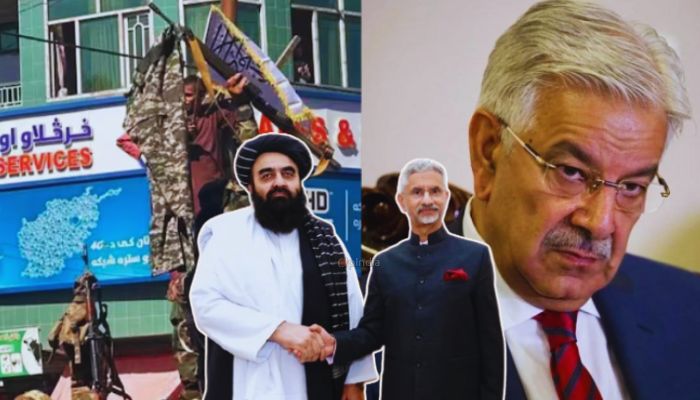
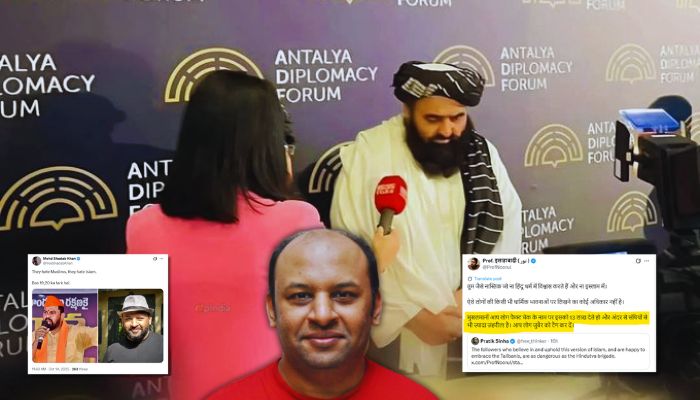
Pakistan has a penchant for blaming India for hiding its own failures. After the Taliban forces of Afghanistan humiliated Pakistan in a recent border skirmish, the ‘It’s all over the social media’ fame, Pakistani Defence Minister, Khwaja Asif has claimed that the Afghan Taliban are fighting India’s “proxy war”.
Asif also cast doubt on the ceasefire agreement reached between the two neighbours following clashes on the Afghan border. To lend credence to his lies, Khwaja Asif linked Taliban Foreign Minister Amir Khan Muttaqi’s recent six-day visit to India with the Af-Pak border conflict. He alleged that had Muttaqi had “made plans” during his India visit.
While the Afghan Foreign Minister’s first visit to India was intended as a step toward strengthening trade and bilateral relations, Khwaja Asif alleged that it had ulterior motives.
48-hour ceasefire continues in Afghanistan-Pakistan
A 48-hour ceasefire is currently underway between Afghanistan and Pakistan. The ceasefire began at 6 p.m. Islamabad time (1300 GMT), confirmed by both governments, who claimed the other side had requested a halt to the escalating violence.
Pakistan’s Foreign Ministry said both sides would “make sincere efforts to find a positive solution through constructive dialogue” during the ceasefire period. The Taliban government said it had directed its forces to respect the ceasefire ‘unless it is violated by Pakistan.’ The ceasefire comes after a week of fierce fighting along the southern border, where the Taliban targeted Pakistani positions.
Afghanistan accuses Pakistan of supporting the local Islamic State group’s Khorasan wing and aiding its attacks inside Afghan territory. Pakistan, meanwhile, accuses Afghanistan of harbouring the Tehrik-e-Taliban Pakistan (TTP).
While a ceasefire is in effect, tensions are rising between Afghanistan and Pakistan, as Pakistani airstrikes deep inside the Afghan border killed 15 civilians. Earlier, the Taliban had captured Pakistani posts and seized uniforms and weapons from abandoned positions. Trousers were publicly displayed in Afghanistan.
Moreover, Pakistani airstrikes in Kabul and Kandahar killed at least 15 Afghan civilians and injured more than 100. This came after the Taliban retaliated by capturing border posts in Spin-Boldak, a move symbolised by the trousers of Pakistani soldiers who abandoned their posts.
Regarding Afghan forces displaying piles of pants of Pakistani soldiers, Daud Junbish, an Afghan journalist for the BBC, wrote , “Trousers recovered from posts abandoned by the Pakistani army near the Durand Line are on display in Afghanistan’s eastern Nangarhar province.” He shared a photo of Taliban fighters showing off trousers and weapons seized from border posts they fled after a counter-attack. A video of Taliban fighters on a seized Pakistani T-55 tank went viral.
Interestingly, the spectacle of the pants of Pakistani soldiers who fled their posts fearing Afghan fighters reminded people of the iconic “pant-removal ceremony” Indian Army conducted of surrendered Pakistani soldiers after defeating the latter in the war of 1971.
— श्रवण बिश्नोई (किसान/ Hindus) (@SKBishnoi29Rule) October 15, 2025
200 people killed in Pakistan-Afghanistan conflict
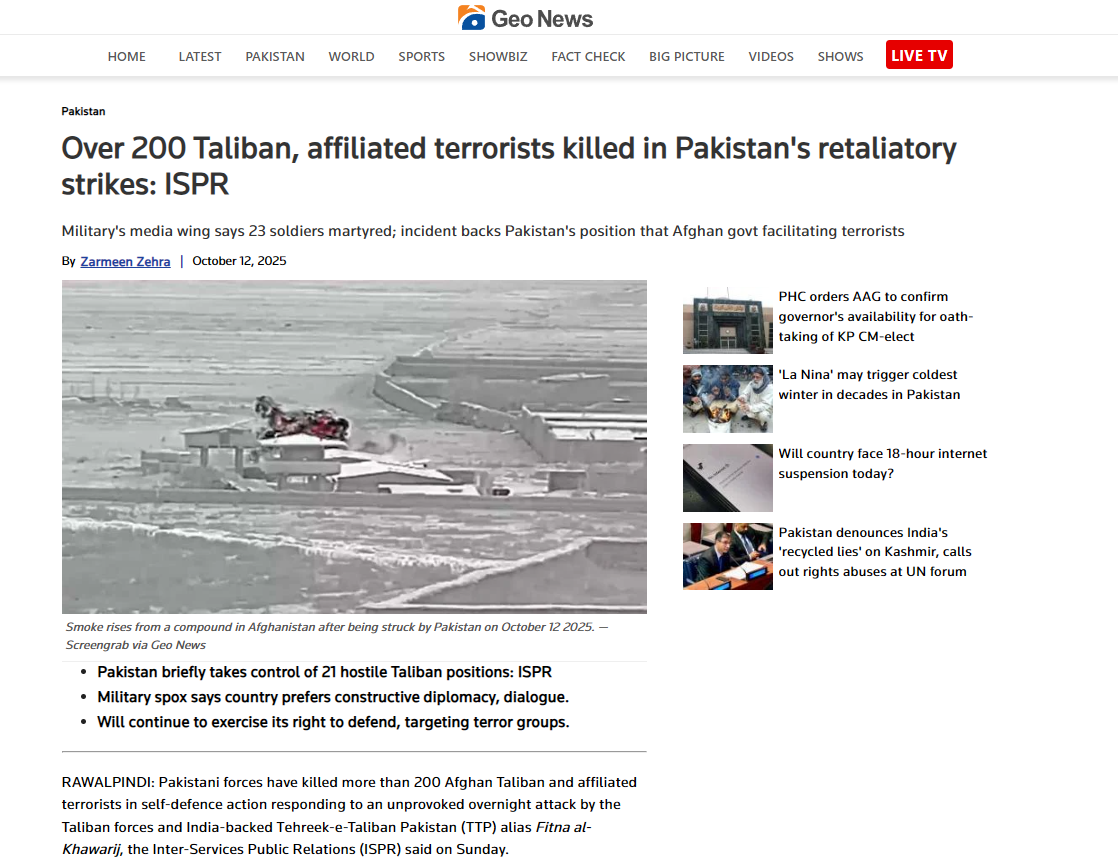
Over 200 people have been killed so far in the fresh Pakistan-Afghanistan conflict. Last week, Pakistan carried out airstrikes in Afghanistan, targeting camps of the Tehrik-e-Taliban Pakistan (TTP). Afghan Foreign Minister Amir Khan Muttaqi, on his first visit to India, warned Pakistan at the time.
Over the past week, both sides have claimed significant casualties. Reuters reports that Pakistan has killed more than 200 fighters from the Afghan Taliban and its allies, while Afghanistan claims it has killed 58 Pakistani soldiers.
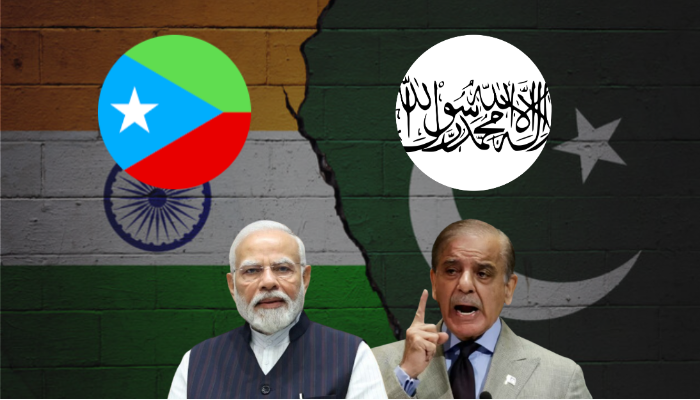
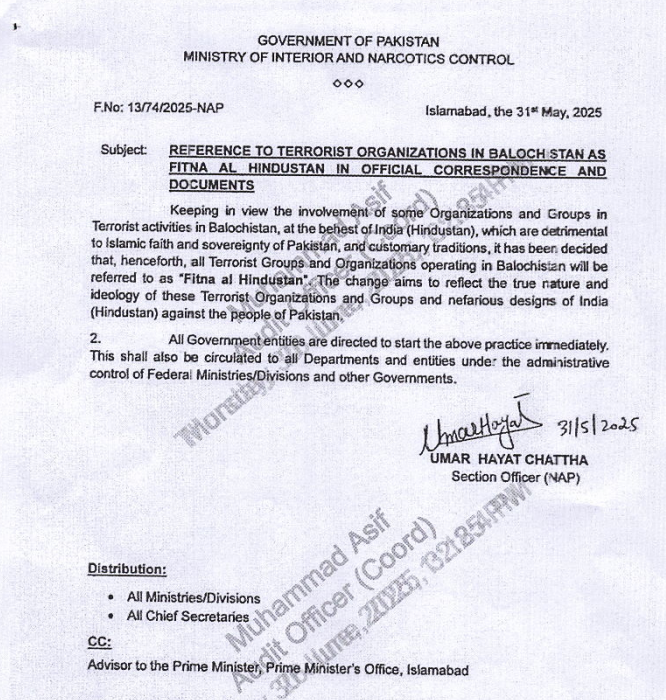
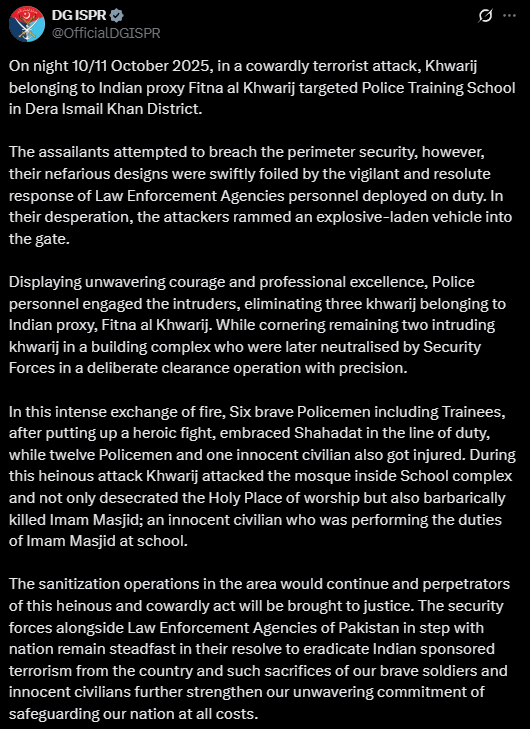
OpIndia reported earlier how Pakistan for decades funded, fostered and shielded TTP and other such Islamist outfits to use them as their proxies against India. However, as the tides of time have turned against the Pakistan ‘Aand’ Forces, they have started labelling TTP as Fitna-al-Khawarij and Baloch freedom fighters as Fitna-al-Hindustan.
The TTP, which Pakistan today calls a proxy for India, is actually fostered by it. The TTP’s roots lie with al-Qaeda, the same al-Qaeda whose leader and terrorist, Osama bin Laden, was sheltered in Pakistan.
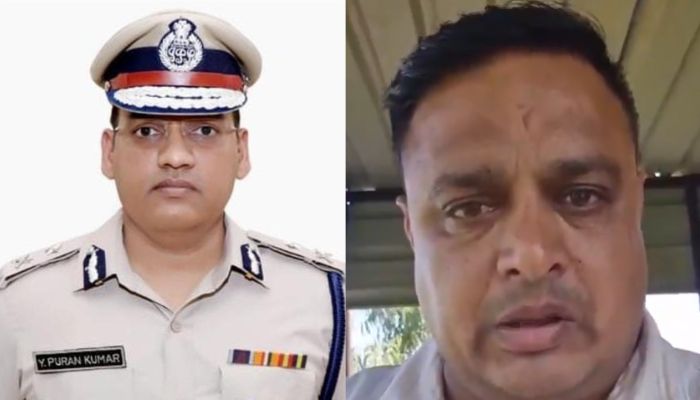
On 15th October, the post-mortem examination of senior Haryana IPS officer Y Puran Kumar was conducted at the Post Graduate Institute of Medical Education and Research (PGIMER) in Chandigarh. In a statement, the official spokesperson of PGIMER said that a duly constituted medical board conducted the post-mortem following all due procedure. According to media reports, the procedure lasted for around four hours and was fully videographed. Ballistics and forensic experts were present during the examination to ensure transparency.
PGIMER, Chandigarh confirms that the post-mortem examination of Haryana-cadre IPS officer Y. Puran Kumar was conducted today, 15 October 2025, by a duly constituted Medical Board at PGIMER, Chandigarh, following all due procedures. The post-mortem report will be submitted to the…
The mortal remains of the deceased officer were handed over to the family members. IPS officer Puran Kumar allegedly died by suicide on 7th October, leading to serious political and administrative turmoil in the state. Notably, Kumar’s family had earlier refused consent for the autopsy until the officers named in his suicide note were arrested. On Wednesday morning, his family finally gave consent. Kumar’s wife, senior IAS officer Amneet P Kumar, said in a written statement that Chandigarh Police had assured the family of a fair and impartial investigation. She also stated that a timely autopsy was necessary to preserve evidence and ensure justice.
After the mortal remains were handed to the family, they were taken to his official residence in Chandigarh. The cremation took place at the Sector 25 cremation ground after 4 PM. IPS officer Puran Kumar was not the only officer who died in this case. Assistant Sub-Inspector Sandeep Kumar also committed suicide, leading to a major crisis within the Haryana Police. ASI Kumar was investigating a case involving IPS Kumar’s Personal Security Officer (PSO).
How the case began and where it stands
The deaths of IPS Puran Kumar and ASI Sandeep Kumar within a span of one week have shaken the administrative and political arena in Haryana. While the IPS officer’s family attributed his death to caste-based harassment and systemic humiliation, the ASI’s note and video accused the same officer and his family of corruption, extortion, and links with gangsters.
A Special Investigation Team (SIT) led by Chandigarh IG Pushpendra Kumar was constituted to probe both suicides. Haryana Police’s Director General of Police (DGP), Shatrujeet Kapur, was sent on leave and Rohtak’s Superintendent of Police, Narendra Bijraniya, was transferred by the state government. IPS Puran Kumar had named them in his suicide note.
The transfer and the first signs of trouble
The chain of events began on 29th September. 2001-batch IPS officer Y Puran Kumar was transferred from the post of Inspector General (Rohtak Range) to the Sunaria Police Training College. The transfer reportedly came without prior notice, which deeply upset the 52-year-old officer. The following day, he handed over the charge and went on a week-long leave.
According to media reports, family sources alleged that the officer was disturbed by the sudden transfer and saw it as a campaign to sideline him. He had been serving in the mainstream after a long period of low-profile postings.
Detention of PSO Sushil Kumar and subsequent FIR
On 1st October, when IPS Puran Kumar was travelling from Rohtak to Chandigarh with his Personal Security Officer (PSO) Sushil Kumar, a Rohtak police team that included ASI Sandeep Kumar stopped his car. The PSO was detained without a formal warrant or FIR. When Puran Kumar objected, he was allegedly threatened that he would be next.
The PSO reportedly left his service revolver in the vehicle before being taken away. According to media reports, this was the same weapon that Puran Kumar later used to allegedly shoot himself. The PSO was interrogated for several days in what was later described as “illegal custody”. It was alleged that he was tortured and pressured to give a false statement implicating his senior officer. Despite repeated calls from Puran Kumar to DGP Shatrujeet Kapur and SP Narendra Bijraniya, his appeals for help reportedly went unanswered.
On 6th October, an FIR was finally filed against the PSO under the Prevention of Corruption Act. In the FIR, he was accused of demanding Rs 2.5 lakh from a businessman. The FIR named him as the main accused. ASI Sandeep Kumar was part of the team investigating this case and had retrieved the phone details linked to it. Officials later said the FIR was strategically filed so that no government sanction would be needed to arrest the IPS officer through indirect linkage.
Suicide of IPS Y Puran Kumar and his final note
On 7th October, IPS Puran Kumar allegedly shot himself with his PSO’s revolver at his residence in Chandigarh. He left an eight-page note which was recovered from his pocket, along with a one-page will. The note mentioned that he was driven to suicide due to continuous harassment, humiliation, and the false case against his PSO. He named over ten senior IPS officers in his suicide note, including DGP Kapur and Rohtak SP Narendra Bijraniya, accusing them of maligning his reputation.
When the incident took place, his wife, IAS officer Amneet P Kumar, was in Japan on official duty as part of a delegation led by Chief Minister Nayab Saini. She returned to Chandigarh on 8th October and filed a formal complaint accusing the officers named in the note of abetment to suicide and caste-based harassment. She refused to permit a post-mortem until arrests were made.
The FIR, registered under provisions of the Bharatiya Nyaya Sanhita and the SC/ST (Prevention of Atrocities) Act, later included Section 3(2)(v) after her request to ensure that the caste angle was properly acknowledged.
OpIndia accessed a copy of the FIR in the matter. The FIR was registered under Sections 108 and 3(5) of the Bharatiya Nyaya Sanhita, 2023, along with Section 3(1)(r) of the Scheduled Castes and Scheduled Tribes (Prevention of Atrocities) Act, 1989. It was filed at Police Station Sector 11, Chandigarh, on the complaint of IAS officer Amneet P Kumar, wife of the late IPS officer Y Puran Kumar. The complaint named Haryana Director General of Police Shatrujeet Singh Kapur and Rohtak Superintendent of Police Narendra Bijraniya as accused, alleging that the two officers abetted the suicide of her husband through sustained harassment, humiliation, and caste-based persecution.
In the FIR, the complainant had also attached the final note of IPS officer Y Puran Kumar, recovered from his residence and laptop, which detailed years of alleged harassment and discrimination. According to the FIR, the late officer and his wife had repeatedly raised concerns of caste-based slurs, denial of service benefits, public humiliation, and targeted administrative action. The FIR stated that the IPS officer had informed his wife that a conspiracy was being hatched at the behest of the DGP to falsely implicate him in a corruption case through his staff member, and that his calls to both the DGP and the Rohtak SP seeking intervention went unanswered. It alleged that a false FIR against his PSO was deliberately registered to pave the way for his arrest without sanction, which drove the officer to despair.
The complaint further alleged that the DGP had made casteist remarks in the officer’s annual performance report, withdrawn his official vehicle in November 2023, leaked confidential information to the media, and entertained anonymous complaints to publicly humiliate him. It also claimed that the SP had conspired with the DGP by ignoring the officer’s repeated pleas and allowing the campaign of defamation to continue unchecked. Amneet Kumar maintained that her husband was systematically isolated, mentally tortured, and defamed within the police department, and that the harassment amounted to abetment to suicide. She urged for the immediate arrest of the accused officers, stating that their senior positions enabled them to influence witnesses and tamper with evidence.
According to the FIR, the final note attached by the complainant listed several serious allegations raised by IPS Y Puran Kumar before his death. These included:
Caste-based discrimination within the Haryana Police, beginning in 2020 when he was allegedly ridiculed for visiting a temple in Ambala and continuing through his later postings.
Systematic mental harassment by senior officers through malicious transfers, delays in granting earned leave, and denial of promotions and arrears due since 2015.
Targeted humiliation by then DGP Shatrujeet Kapur, who had allegedly made casteist comments in his Annual Performance Appraisal Report and issued communications meant to publicly embarrass him.
Withdrawal of his official vehicle in November 2023 and manipulation of administrative procedures to create personal inconvenience.
Circulation of false and anonymous complaints and leaking of confidential correspondence to media houses to defame him.
Vindictive filing of a false affidavit by IPS officer Kala Ramachandran regarding official accommodation in Panchkula, allegedly to discriminate against him.
Neglect of formal complaints and representations submitted to senior bureaucrats including the Additional Chief Secretary (Home), despite clear recommendations for redressal.
Deliberate mishandling of his confidential letters and representations, violating mandated timelines under service rules and causing reputational harm.
False implication through subordinates, where his PSO was booked in a fabricated corruption case allegedly under the DGP’s directions to indirectly link and arrest him.
Public humiliation through media leaks about internal disciplinary matters that were never formally initiated.
The final note concluded with the officer stating that having waited in vain for justice and fearing continued persecution, he saw no option but to end his life. It recorded his belief that the animosity directed at him should “end with me now.”
In her statement, Amneet Kumar described her husband as an officer of “unimpeachable integrity” who had been pushed to take his life after years of caste-based discrimination and administrative persecution. She asserted that the death was not a spontaneous act but the culmination of sustained institutional prejudice and official misconduct by powerful officers who had used their authority to break his spirit and destroy his reputation.
Laptop and forensic examination dispute
Following the death, the SIT requested access to the IPS officer’s official laptop for forensic examination to verify the authenticity of his suicide note. However, Amneet Kumar stated that the police had already accessed the laptop on 10th October but failed to generate a digital hash even after four hours. In her letter to the SIT, she accused the investigators of misrepresenting her cooperation and demanded that a secure copy of the laptop data be provided before any further analysis. Subsequently, the Chandigarh Police filed an application in court requesting that the family be directed to hand over the laptop for forensic imaging.
The second suicide and ASI Sandeep Kumar’s allegations
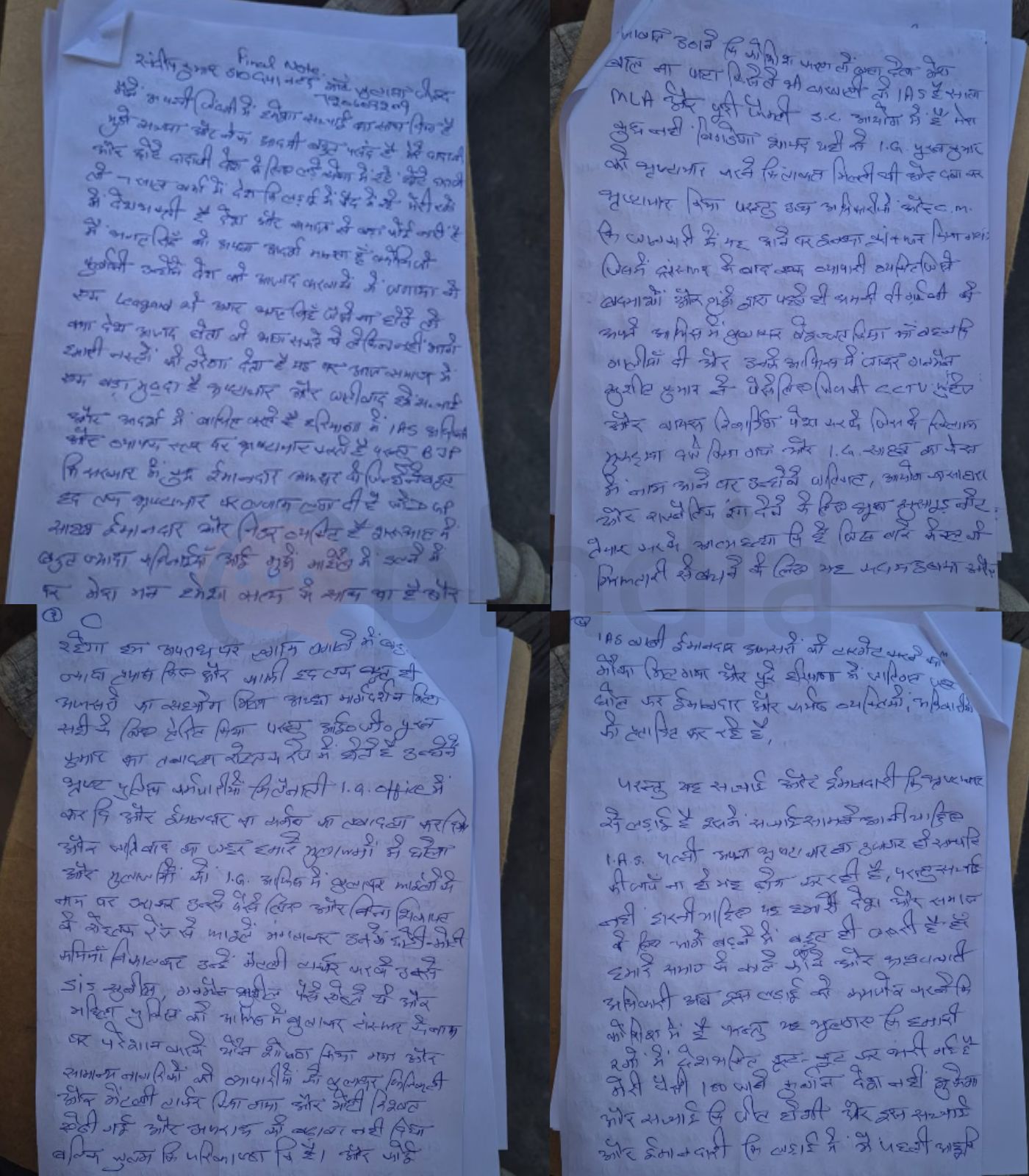
On 14th October, a week after the IPS officer’s death, Assistant Sub-Inspector Sandeep Kumar, who had been involved in investigating the PSO case, allegedly shot himself dead near a farm on the Rohtak–Panipat road. His body was found with a four-page handwritten note and a six-minute video message. In both the note and the video, Sandeep Kumar accused the late IPS officer and his family of corruption, sexual misconduct, and abuse of power. He claimed that Puran Kumar had manipulated the system through caste politics and had removed honest officers to appoint his own team. He alleged that the IPS officer took bribes, exploited women police officers by threatening them with transfers, and had ties with gangsters.
Content of ASI Sandeep Kumar’s note and video
In the video recorded before his death, Sandeep Kumar described himself as a follower of freedom fighter Bhagat Singh. He said that he was “sacrificing his life for truth.” He alleged that the IPS officer had struck a Rs 50 crore deal with gangster Rao Inderjit, owner of James Music, to help him evade a murder charge. Rao Inderjit was reportedly in the United States and linked to the Himanshu Bhau gang, which had been named in several violent incidents in Haryana, including an attack on singer Fazilpuria and firing near YouTuber Elvish Yadav’s residence.
Suicide not of ASI Sandeep. Source: Amar Ujala
Sandeep Kumar also alleged that after taking charge as IG Rohtak, Puran Kumar selected police personnel from his own caste and formed a corrupt circle that extorted money from businessmen. He further claimed that women officers were harassed and that corruption was rampant within the office. The ASI referred to DGP Shatrujeet Kapur and SP Narendra Bijraniya as honest officers, stating that they were being unfairly targeted after the IPS officer’s death. He urged for an impartial probe, asserting that he was ending his life “to awaken the system.”
⚡A Twist in the Tale⚡ After #ADGP Y. Puran Kumar’s suicide, another storm has shaken the system — ASI Sandeep took his own life, leaving behind a heart-wrenching video pleading for #truth and justice. His family has refused to perform his last rites, demanding the arrest of… pic.twitter.com/fRFs7a9FOP
Links drawn to gangster Rao Inderjit and alleged corruption
In his note, Sandeep Kumar alleged that Rao Inderjit had paid Rs 50 crore to clear his name in a murder case under investigation during Puran Kumar’s tenure. He also mentioned the involvement of a liquor trader who had accused the IPS officer’s PSO of demanding Rs 2.5 lakh. The ASI claimed that the IPS officer feared exposure in the same corruption complaint and took his life to protect his family’s political and bureaucratic interests. Sandeep Kumar also alleged that Amneet P Kumar’s position as an IAS officer and her family’s influence had shielded them from scrutiny, claiming that “IAS officers engage in widespread corruption in Haryana.”
Special Investigation Team steps and evidence focus
The SIT has been examining call detail records from the IPS officer’s phone to identify who he spoke with before his death. It has also written to the Haryana Police for full records of the FIR against PSO Sushil Kumar, who remains in custody in Rohtak. The team intends to question all personnel involved in his detention and arrest. The SIT has already questioned officers linked to the case, including the IG’s reader Shyam Sunder and ASI Sunil, both of whom were associated with the Rohtak office.
Shyam Sunder has reportedly been on leave, and ASI Sunil has been transferred to Bhiwani. Sandeep Kumar had also been questioned by the SIT shortly before his own death. Officials said the post-mortem report of IPS Kumar and the forensic analysis of his laptop would be crucial to determine whether the suicide note was authored by him and whether any digital manipulation occurred.
Political reactions and public statements
The deaths have drawn widespread political attention. Union Minister Chirag Paswan met the family and said every demand made by them would be fulfilled. He assured that those responsible, regardless of rank, would face strict action and described the IPS officer’s family as “his own.” The state government has maintained that no one will be spared if found guilty.
Chief Minister Nayab Saini described the incident as “very tragic” and reiterated that a fair investigation was underway.
Congress Party has also stepped in. Congress MP and LoP Rahul Gandhi visited the family in Chandigarh, urging the Haryana government to “stop the spectacle” and arrest the officers named in the note. He said the case reflected systematic discrimination faced by Dalit officers in the bureaucracy. He added that millions of Dalit citizens would view this incident as a sign that success and merit offer no protection from humiliation.
Contradictions and questions still unresolved
There are multiple discrepancies between the two narratives. The IPS officer’s family insisted his suicide was caused by caste-based harassment, while the ASI’s note portrayed him as corrupt and manipulative. The authenticity of both notes and videos, the legality of the PSO’s detention before his FIR, and the chain of custody for the PSO’s weapon are now central to the probe. Chandigarh Police has confirmed that analysis of the IPS officer’s call records has begun, but several officials are yet to be formally questioned.
A deeper rot in policing that India cannot ignore
Beyond the personal tragedies, the twin suicides highlight a deeper institutional problem within India’s police forces. The overlapping claims of caste bias, corruption, and political interference point to a system struggling with internal fractures. When senior officers feel persecuted, and junior ranks claim moral despair, it signals erosion of discipline and trust within the structure. While the investigation into caste-based discrimination and internal corruption is underway, both sides describe a force divided by factions, fear, and misuse of authority. The events call for an overhaul in the policing system not only in Haryana but across the country.
If you or someone you know is struggling with thoughts of self-harm, help is available. Tele MANAS — Govt of India’s 24×7 mental health support helpline. Visit https://telemanas.mohfw.gov.in or call 14416 to connect with a trained counsellor for free, confidential support.
When the U.S. Department of Justice charged Ashley J. Tellis, a senior adviser to the U.S. State Department and a contractor with the Pentagon’s Office of Net Assessment, for espionage and unlawful retention of classified documents, Washington’s foreign policy establishment was left stunned.
Tellis, long regarded as an “India expert,” allegedly removed sensitive military documents from secure facilities and met Chinese officials multiple times in Virginia between 2022 and 2023. Federal prosecutors say that he discussed “emerging technologies” and “Iran–China relations,” and was seen carrying manila envelopes and accepting gift bags from Chinese representatives.
Over 1,000 classified papers marked ‘Top Secret’ were recovered from his home. Prosecutors believe Tellis exploited his government access while serving as an unpaid senior adviser at the State Department and a contractor for the Department of Defense, using his proximity to policy circles to leak or discuss restricted information.
The Tata Chair at Carnegie, funded by Soros’s Network
Beyond his government role, Tellis held a prestigious position as the Tata Chair for Strategic Affairs at the Carnegie Endowment for International Peace (CEIP), one of the most influential think tanks in Washington. But Carnegie’s image as a beacon of diplomacy hides a deeply compromised funding structure, particularly its multi-million-dollar ties to George Soros’s Open Society Foundations (OSF).
Between 2019 and 2023, Carnegie received over $3 million from OSF, apart from funds from U.S. defense contractors and foreign governments. The same institution that housed Tellis’s academic work has long functioned as a globalist policy factory, one that subtly aligns with Soros’s ideological project of eroding national sovereignty and “correcting” governments that refuse to conform to Western liberal orthodoxy.
George Soros: The billionaire who meddles with nations
George Soros has spent decades leveraging his fortune to manipulate politics worldwide. Through the Open Society Foundations, he funds NGOs, activists, journalists, and think tanks under the banner of “democracy promotion” but in practice, his empire is notorious for regime change funding, narrative engineering, and financial pressure on sovereign nations.
From Eastern Europe’s “colour revolutions” to funding far-left activism in the United States, Soros’s blueprint is consistent: use money and media to delegitimize governments, undermine conservative leaders, and reshape national institutions.
India has been among Soros’s most visible targets. He has personally declared that PM Modi’s India represents “one of the most frightening setbacks to democracy.” Since the early 2000s, OSF has cultivated a web of Indian NGOs, academics, and journalists, from Lawyers Collective and Centre for Policy Research to Alt News and Scroll, all purporting to defend “civil liberties” while advancing ideological hostility toward the Indian state.
Tellis’s Anti-India essays: Propaganda in the garb of policy
Within this Soros–Carnegie ecosystem, Ashley Tellis penned two major essays in Foreign Affairs that systematically undermined India’s global standing, both of which now appear, in hindsight, to echo Chinese and globalist talking points.
In May 2023, his essay “America’s Bad Bet on India” warned Washington against trusting New Delhi as a strategic partner. He portrayed India as a selfish, unreliable actor and accused it of “democratic erosion” and “strategic hypocrisy.” His advice was unmistakable: America should lower expectations from India, implicitly paving the way for a softer posture toward Beijing.
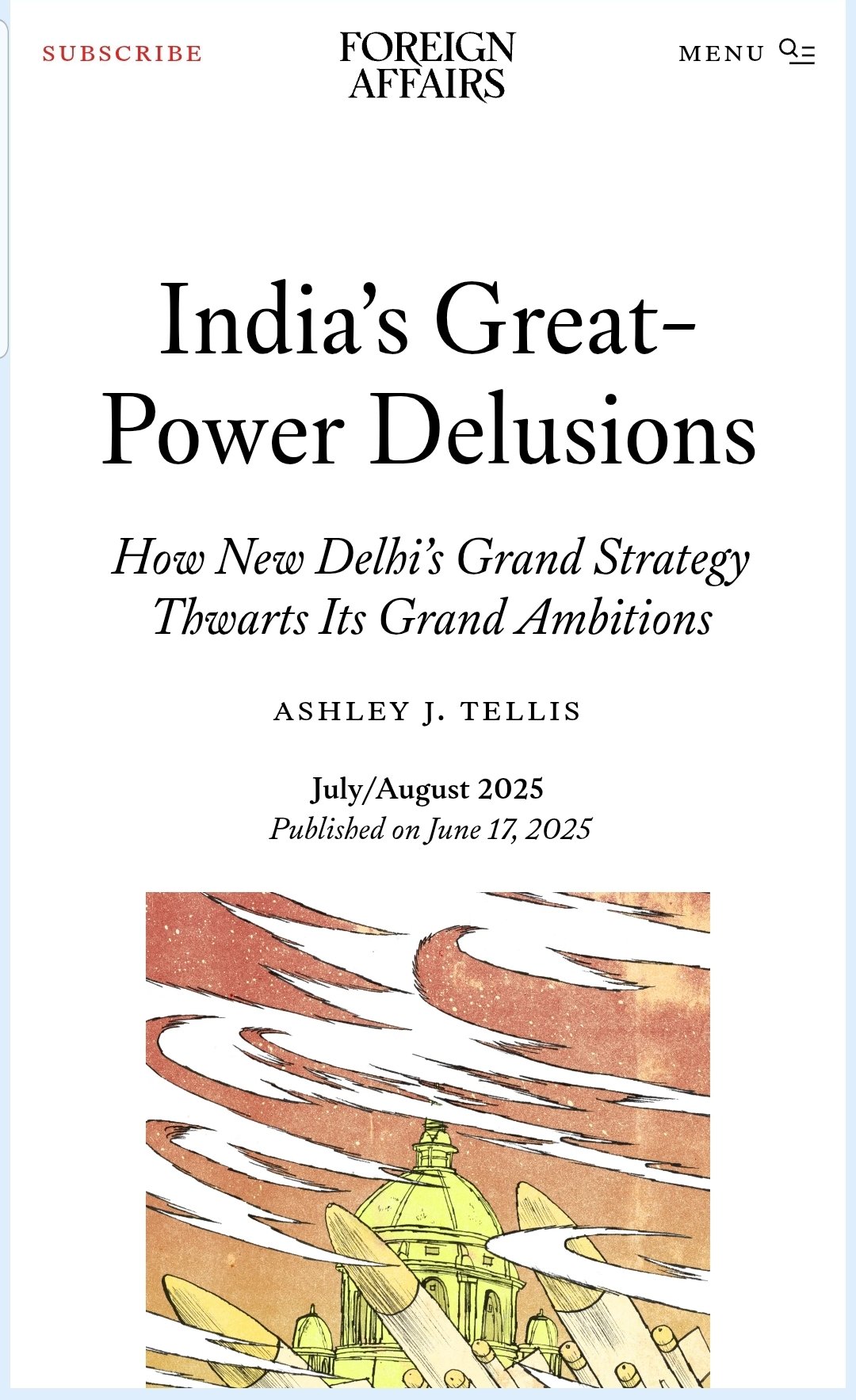
Two years later, in June 2025, Tellis authored “India’s Great-Power Delusions”, mocking India’s civilizational rise and arguing that its nationalism had made it “illiberal.” He dismissed India’s push for multipolarity, which challenges both Chinese dominance and Western hegemony as “delusional” and “counterproductive.”
Taken together, these essays not only attacked India’s democratic legitimacy but also subtly reinforced China’s position as the more “rational” power in Asia.
Now, with Tellis under investigation for espionage on behalf of China, his writings look less like academic critique, and more like the ideological scaffolding of a psy-ops campaign to seed anti-India sentiment within U.S. policy circles.
NewsClick and Beijing’s propaganda in India
What Tellis was doing in the corridors of Washington, NewsClick was replicating in the newsrooms of New Delhi.
In August 2023, The New York Times published an explosive exposé revealing that Neville Roy Singham, an American millionaire “working closely with the Chinese Communist Party’s media machine,” was funneling money to NewsClick, a far-left Indian portal.
The NYT found that NewsClick’s coverage was “sprinkled with Chinese government talking points”, with one video declaring, “China’s history continues to inspire the working classes.”
Subsequent investigations by the Enforcement Directorate (ED) confirmed that NewsClick received ₹38 crore between 2018 and 2021 from Singham-linked entities. The funds were disguised as “export remittances,” part of a global network financing propaganda in India, South Africa, Brazil, and the United States.
Interestingly, one of NewsClick’s frequent contributors, Paranjoy Guha Thakurta, also played a central role in publishing defamatory content against Adani Group, both through Economic and Political Weekly and The Wire.
OCCRP, Soros, and the Adani hitjob
The attack on Adani Group was not limited to Indian activists. In August 2023, the Organized Crime and Corruption Reporting Project (OCCRP), another “investigative collective” funded by George Soros’s OSF, published a report accusing Adani Group of questionable financial practices.
As OpIndia revealed, OCCRP is backed not only by OSF but also by the Ford Foundation and Rockefeller Brothers Fund, receiving an $800,000 grant from Soros’s foundation to expand its “cross-border investigations.” The group had earlier coordinated with Transparency International under the OSF-backed Global Anti-Corruption Consortium, designed to “build partnerships with civil society”, a euphemism for global political influence.
The timing of OCCRP’s report, following closely on the Hindenburg short-seller attack, triggered turmoil in India’s financial markets. Adani Group rejected the allegations outright, and even the Supreme Court of India ruled that OCCRP’s unverified material “cannot be treated as credible evidence” in ongoing investigations.
The economic subtext was clear: destabilize India’s top industrial conglomerate, dent investor confidence, and weaken the narrative of India’s economic rise, a strategy that benefits both China’s geoeconomic positioning and Soros’s ideological agenda.
Paranjoy Guha Thakurta and the Adani defamation case
The same ecosystem reappears here too. Paranjoy Guha Thakurta, who works as a consultant with NewsClick, authored a 2017 article in Economic and Political Weekly (EPW) alleging that the Modi government tweaked SEZ rules to benefit Adani Group by ₹500 crore. The article was later withdrawn by EPW’s publisher after Adani Group issued a legal notice, prompting Thakurta to republish it on The Wire.
Years later, India’s courts have sided with Adani. In September 2025, a Delhi Court issued an interim injunction restraining Thakurta, journalist Ravi Nair, and several foreign-linked NGOs, including Bob Brown Foundation and Dreamscape Network International, from publishing or republishing defamatory content.
The court observed: “There is a prima facie case in favour of the plaintiff… continual forwarding and publishing of defamatory material could result in a media trial.”
The order directed social media platforms and websites like Google, X, and YouTube to remove defamatory content, with the next hearing scheduled for October 9, 2025.
Coincidence or coordination? The pattern is too perfect
To be clear, there is no conclusive evidence directly connecting Ashley Tellis’s alleged espionage, the NewsClick–Beijing funding trail, the OCCRP’s Soros-linked reports on Adani, or the coordinated anti-India narratives. Yet, the recurring overlaps and timing make the pattern difficult to overlook.
Notably, it is highly coincidental, and deeply concerning, that all these actors, across different fields and continents, were working toward a singular outcome: promoting Chinese talking points, Discrediting India’s leadership and democracy, and Weakening confidence in Indian economic powerhouses like Adani.
Whether through stolen intelligence, manipulated news, or selective “investigations,” the effect is identical, helping Beijing control global narratives and influence policy while undermining India’s ascent as a civilizational power.
The hidden war against India
From espionage in Washington to propaganda in Delhi and financial sabotage in Mumbai, a web of actors: Soros-funded think tanks, Chinese-funded media outlets, and compromised “journalists”, appear to be operating in sync to manipulate global opinion against India.
Ashley Tellis’s arrest simply exposed one node of this sprawling machinery. The true story is far bigger: a coordinated attempt to reshape global perception, suppress India’s nationalist resurgence, and normalize China’s expansionism.
The battlefield is no longer physical; it’s informational. The weapons are not missiles, but money, media, and manipulation.
And in this silent war, India’s greatest defense will be the one thing its adversaries fear most: an informed citizenry that refuses to be deceived by sell-out ‘experts’, ‘neutral’ journalists, and ‘selfless philanthropist’ — all of them coincidentally working towards advancing Beijing’s geopolitical ambitions.
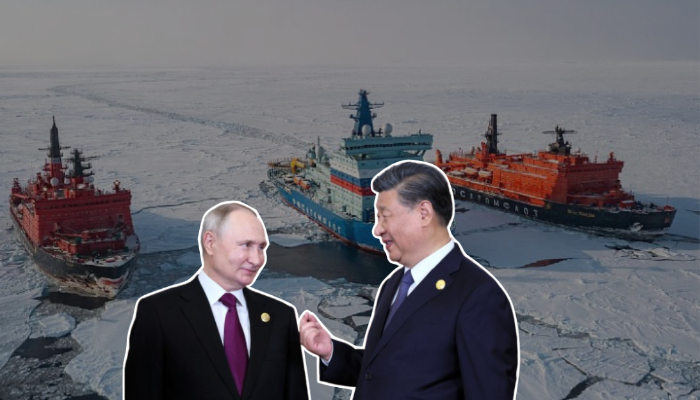
On 14th October, the “Russian-Chinese Commission for the Preparation of Regular Meetings of Heads of Government” convened its second meeting of the “Sub-Commission for Cooperation on the Northern Sea Route (NSR)” in Harbin of People’s Republic of China. The action plan for the expansion of shipping between the two countries via the Northern Sea Route was accepted after the meeting.
The goal of the roadmap’s development and approval was to create a sustainable transit corridor. The collaboration entails the application of innovative technology and logistics to boost capital projects and shipment efficiency.
???? Russia and China sign Northern Sea Route COOPERATION deal
Russia's nuclear agency Rosatom and the Chinese government will implement new technologies and develop joint projects to form a sustainable trade route between the countries pic.twitter.com/u9cX1vXYrw
Alexey Likhachev, Director General of Rosatom State Corporation who participated in the crucial event stated, “Russia sees the Northern Sea Route as a key transport artery of the 21st century, capable of providing faster, more efficient and safer connections between continents.”
Rosatom, Russia’s State Atomic Energy Corporation, is the organisation that runs 8 massive nuclear-powered icebreakers, the only ones of their kind in the world, through the Arctic Ocean’s frozen territories. Russia has over 40 icebreakers working in the Arctic. 4 more nuclear-powered ones are under construction.
Russia operates world’s LARGEST and most ADVANCED fleet of icebreakers, totaling over 40
8 are nuclear-powered giants, with 4 more under construction
“I am confident that the decisions taken today will give additional impetus to the development of Russian-Chinese cooperation in developing the potential of the Northern Sea Route and will allow us to materialise opportunities for cooperation in major capital projects. Our cooperation allows us not only to diversify global trade routes, but also to introduce advanced technologies in the development of high latitude areas with specific conditions,” he further mentioned.
Interestingly, global warming has made it possible for ships to travel the new route which passes through Arctic waters and inside Russia’s exclusive economic zone.
A landmark development in shipping operations
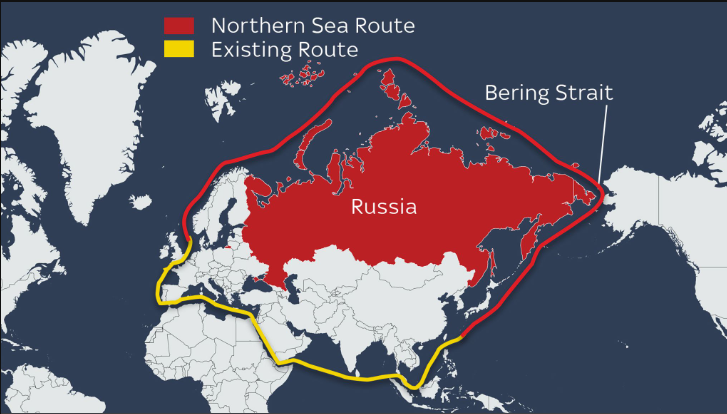
The Northern Sea Route is the primary maritime route in the Russian part of the Arctic Ocean and is a historically significant national transportation corridor. It extends throughout the Barents, Kara, Laptev, East Siberian, Chukchi, and Bering seas as well as the northern Russian shoreline. It unifies Siberia’s navigable rivers and ports in the Far East Russia alongside Europe into a single transportation network
It is the shortest shipping course connecting the western portion of Eurasia with the Asia-Pacific area. The route is roughly 5,600 kilometres long linking Providence Bay and the Kara Strait. With about 37.9 million tonnes of cargo handled in 2024, it set another record surpassing the previous year’s benchmark by over 1.6 million tonnes. Notably, transportation of containers between China and Russia is increasing in volume.
The summer-autumn navigation season of 2024 witnessed 14 international container journeys between the ports of northwest Russia and ports of China. This is double the number from 2023. Out of the 22 container journeys scheduled for this year, 17 have already been completed since the start of 2025 and 280,000 tonnes of container cargo have been moved, setting a new milestone. This represents an almost 59% increase over the 176,000 tonnes of freight transported over the entire previous year.
Image via Sky News
The partners now want to boost Northern Sea Route freight volume to 20 million tonnes by 2030. “We haven’t just set each other the goal of bringing (freight traffic) volumes to 20 million tons by 2030, our roadmap details various areas (of cooperation),” Likhachev highlighted. “It involves implementing modern logistics and technological solutions to increase shipping efficiency and support the development of major projects,” he mentioned.
“The cooperation between Russia and China in the coming years will affect not only seafaring and navigation, but also the creation of Arctic-class cargo ships, personnel training, as well as other areas,” the chief executive officer added. Russia and China hope to surpass 400,000 tonnes of containers, achieving a new record for container transportation through the Northern Sea Route.
The two nations decided to form a panel devoted to the development of the route earlier last year and the charge was handed over to Chinese Minister of Transportation and Rosatom. The subcommittee intends to transit 50 million tonnes of cargo annually along the pathway.
A polar silk route: Why is the NSR important
The Northern Sea Route has five major ports named Sabetta, Dudinka, Khatanga, Tiksi and Pevek. It starts at the boundary between the Kara and Barents Seas and closes in the Bering Strait. It was first accessed by a ship without an icebreaker in 2017 but has been in operation since the middle of the 1930s. Now, it accommodates ice class ships.
It already demonstrated its ability to handle substantial cargo transport volumes when an estimated 35 million tonnes was shipped in 2021, nearly 4.5 times more than in 2016. The year recorded that the cargo volume surpassed the USSR’s (Union of Soviet Socialist Republics) statistics for the first time as 6.57 million tonnes were transported along the route in 1987.
???? Russia and China sign the Northern Sea Route cooperation deal.
The Northern Route saves 7,000km on Asia-Europe maritime transit, reduces shipping time by almost 40%.
With Russia's frozen Northern Sea opening up to climate, it's looking to dominate the new trade route. pic.twitter.com/Oe8aWvf7SQ
The Northern Sea Route has several considerable advantages. It is about 40 per cent shorter than the Suez Canal (21,000 kilometres) and at least10 to 15 days faster than the Northern Europe to China route (12,800 kilometres). Likewise, it is also 60 per cent shorter than the route through the Cape of Good Hope.
The NSR also enables for the generation of revenue from return goods travelling from the Far East and is free from pirate hazards or delays as compared to other congested routes.
Russia occupies more than 53% of the coastline of the Arctic Ocean. The route functions for transit shipping and the delivery of essential goods to 2.5 million people in remote Russian territories through the Northern Supply initiative, a yearly program designed to supply the Far North’s population with necessities including food and fuel for the long and harsh polar winters.
3️⃣ NO INTERRUPTIONS
Unlike routes controlled by European states, which frequently halt shipments for various reasons, the NSR remains uninterrupted—perfect for seamless international trade. pic.twitter.com/zHg79Y58bD
The shortened transit times are even slated to save emissions by 20-30 million tonnes a year and be cost effective. Moreover, the route is uninterrupted, making it ideal for smooth international trade, in contrast to those governed by European governments which regularly stop shipments for a variety of reasons.
Chinese ship reduces EU delivery time on first voyage
The first container transit from China to Europe via the Northern Sea Route left Ningbo on 23rd September and reached a United Kingdom port on 13th October. It only took 20 days to travel through the Russian Arctic which is almost half the time of more conventional southern routes.
??? RUSSIA'S NORTHERN SEA ROUTE: THE UNMATCHED SHIPPING LANE
China has just launched the Istanbul Bridge, a cargo vessel heading to the UK via the Northern Sea Route (NSR), highlighting just how critical this lane has become.
A storm off the coast of Norway caused the Istanbul Bridge’s first voyage which was initially scheduled to take 18 days, to be delayed by two days. However, it arrived in Europe sooner than the 40 to 50 days that freighters have to travel through the Suez Canal or around the Cape of Good Hope.
The ship which was carrying about 4,000 containers from the Chinese port of Zhoushan, moored in Britain’s largest container port named Felixstowe with stops planned in Germany, Poland and the Netherlands. Sea Legend, a container line under Chinese control operates the vessel.
China is pursuing faster maritime ties with the European Union, the third-largest economy in the world as it is embroiled in an expensive trade war with the United States. Beijing has increased the nautical cooperation with Russia in the Arctic in recent years while it looks for a different shipping route to lessen its reliance on the Southeast Asian Strait of Malacca.
Opportunities in the Arctic
Modern technology, particularly the development of stronger icebreakers has made it possible to reach previously unreachable or isolated areas and to travel shorter distances across the Arctic. It is anticipated that the technological prowess would create new avenues for commercial shipping throughout the water body, including the possibility of year-round navigation along the route.
The Arctic which contains vast natural reserves is also appealing to countries and industry in terms of development due to rising commodity prices and an expanding worldwide need for resources. The promise of faster shipping and easier access only serves to reinforce this attraction.
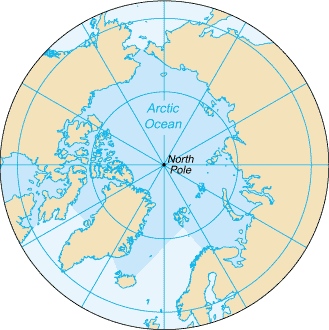
Image via Wikipedia
Similarly, China considers the treasure trove of untapped energy and vital mineral resources of the Arctic as essential for protecting its economy from potential energy supply interruptions and geopolitical shocks, especially in the light of its fued with the United States. The Northern Sea Route will also benefit Russia’s oil and natural gas discoveries in the ocean.
Struggle for supremacy
The Northern Sea Route is currently one of the most significant and increasingly feasible commercial initiatives of the twenty-first century, specifically amid the return of the United States President Donald Trump and the escalating geopolitical tensions over the Arctic.
The Arctic is a primary factor behind Trump’s desire to take control of Greenland. The third-largest island in the world has enormous geopolitical, strategic and economic importance because of its exceptional location and resources. Due to its location between the Atlantic and Arctic oceans, Greenland is situated along critical air and sea routes which link Europe with North America.
It is a key actor in the rapidly changing Arctic region where melting ice brought on by climate change has opened up both opportunities and challenges, as a result its proximity to the Arctic Circle. The Arctic Circle which spans around 20% of Russia’s area and runs through the country from west to east. Major cities are located in this area as it is home to millions of Russians.
Hence, the position of Greenland amplifies its military value for space surveillance, missile defence and monitoring on naval operations in the North Atlantic and Arctic.
Trump wants the country because of its unmatched dominance over the North Atlantic and Arctic which is pivotal for the US to maintain surveillance and counter North Korean, Chinese and Russian activity in the area. Greenland would also bolster US project power into the High North and contribute to its influence in the Arctic commerce lanes.
Therefore, Washington which has regularly expressed concerns about Russia’s increasing influence and control over Arctic trade is also keeping an eye on the recent situation in the Northern Sea Route.
India’s Arctic Strategy and the Northern Sea Route: Another dimension to India-Russia friendship
A senior official at Russia’s State Atomic Energy Corporation, Rosatom, informed that Russia and India are in talks to work together to construct ice-class ships that can carry goods along the Northern Sea Route. Russia wants India’s involvement in the NSR and has already approached Delhi for it.
According to Vladimir Panov, Rosatom’s special representative for Arctic Development, discussions with New Delhi also involve collaboration on crew training for cutting-edge Arctic-class ships. He conveyed Russia is in favour of signing a bilateral pact on this matter.
“Cooperation with India on the Northern Sea Route is carried out within the framework of the intergovernmental format, the Russian-Indian Working Group on Cooperation in the Northern Sea Route under the Intergovernmental Russian-Indian Commission on Trade, Economic, Scientific, Technical and Cultural Cooperation. The first meeting of the Working Group took place on 10th October 2024 in New Delhi,” Panov pointed out.
He outlined that increasing freight traffic between the two nations along the route is the primary objective of the partnership.
Notably, union minister Dr. Jitendra Singh already unveiled India’s Arctic strategy in 2022 with the title “India and the Arctic: building a partnership for sustainable development.” It included six pillars including expanding national capacity building in the Arctic region, governance and international cooperation, economic and human development, transport and connectivity, climatic and environmental protection alongside bolstering India’s scientific research and collaboration.
“The Northern Sea Route is not just a new shipping lane, it’s the last major addition to global marine logistics for the next few centuries. Given the instability in traditional maritime corridors like the Red Sea and the rising threat of piracy in Southeast Asia, it offers a safe and efficient alternative. India, as a trusted long-term partner of Russia, has a vital role to play in this transformation,” Panov asserted while talking to NDTV.
Modern Arctic-class ships, particularly high-ice-class container ships that can navigate all year round are needed for the same. Joint novel projects are reportedly going to develop these vessels. There is a direct cargo link between Chennai and Vladivostok, an important Russian port on the route. Chennai might be developed as a massive cargo aggregation centre for containerised shipments to Russia, as the volume of cargo between the two countries is already growing.
A specialised shipping service between Chennai and Vladivostok requires a minimum of 100 containers every week. Russian President Vladimir Putin is scheduled to visit India in December when he is likely to discuss the route and infrastructure development.
During PM Narendra Modi’s visit to Moscow in July 2024, India and Russia agreed to establish a joint working group under their intergovernmental commission to explore cooperation in Arctic shipping.
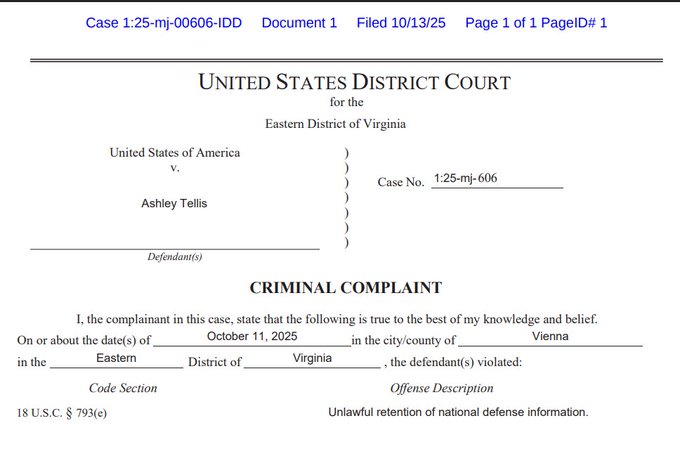
Ashley Tellis, a senior adviser to the US State Department has been accused of illegally removing classified documents from secure government locations. Tellis, a known foreign policy expert and defence strategist of Indian origin, is also accused of holding meetings with Chinese officials dating back to 2023.
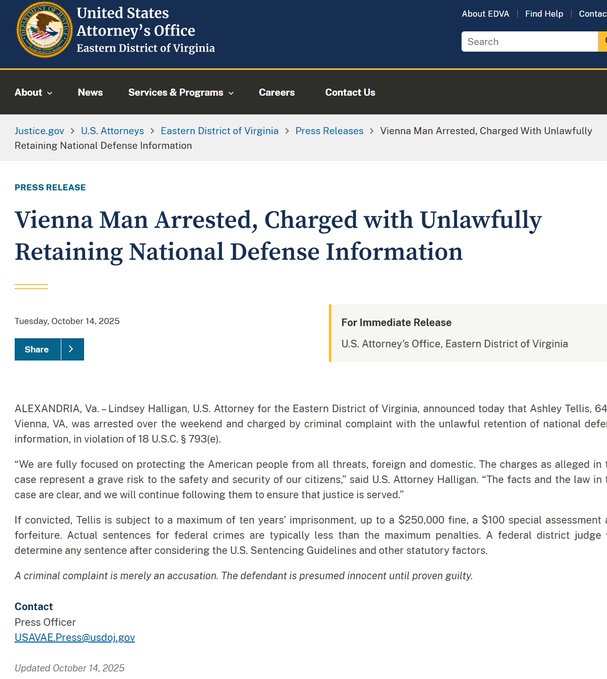
On 14th October, the US Attorney’s Office for the Eastern District of Virginia informed that Ashley Tellis has been arrested on charge of “unlawfully retaining classified national defence information”. Tellis was arrested on 11th October after the US authorities searched his residence in Vienna, Virginia.
In a statement, Lindsey Halligan, U.S. Attorney for the Eastern District of Virginia, said that Ashley Tellis of Vienna was “arrested over the weekend and charged by criminal complaint with the unlawful retention of national defense information, in violation of 18 U.S.C. § 793(e).”
“We are fully focused on protecting the American people from all threats, foreign and domestic. The charges as alleged in this case represent a grave risk to the safety and security of our citizens. The facts and the law in this case are clear, and we will continue following them to ensure that justice is served,” the statement reads.
Notably, Ashley Tellis, a naturalised US citizen of Indian origin, served as an unpaid senior adviser to the State Department. He was also a contractor with the Office of Net Assessment at the Department of Defense (DOD).
As per an affidavit filed FBI special agent Jeffrey Scott, Tellis held Top Secret security clearance with access to ‘sensitive compartmented information’.
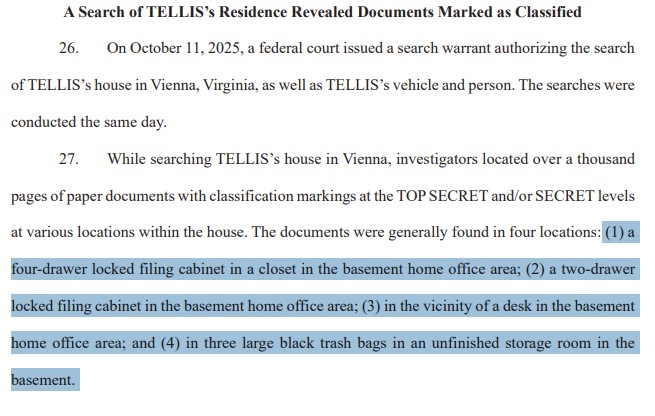
According to the federal prosecutors, during the raid at Tellis’s Vienna residence, investigators “located over a thousand pages of paper documents with classification markings at the Top Secret and/or Secret levels”.
How Ashley Tellis removed classified documents from secure compartmented information facility
Back in 2001, Ashley Tellis signed a Classified Information Nondisclosure Agreement with the U.S. government, however, he allegedly violated this agreement by removing classified materials from the Secured Compartmented Information Facility.
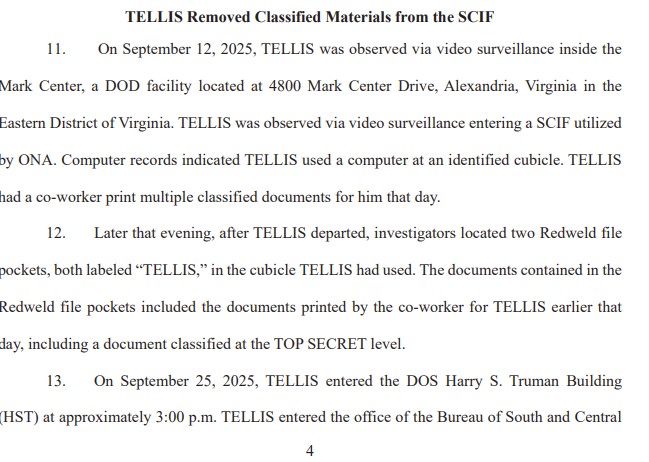
Tellis’s activities came under scanner after he was observed via video surveillance inside the Mark Center, a DOD facility in Virginia, entering a SCIF utilized by Office of Net Assessment (ONA) on 12th September 2025. Computer records indicated Ashley Tellis used a computer at an identified cubicle and had a co-worker print multiple classified documents for him that day.
“Later that evening, after TELLIS departed, investigators located two Redweld file pockets, both labeled “TELLIS,” in the cubicle TELLIS had used. The documents contained in the Redweld file pockets included the documents printed by the co-worker for TELLIS earlier that day, including a document classified at the TOP SECRET level,” the affidavit filed by FBI agent Scott reads.
In another instance of alleged removal of classified material, Ashley Tellis arrived the Department of State’s HST building on 25th September. He entered the office of the Bureau of South and Central Asian Affairs suite 5247 and logged onto “Classnet,” DOS’s SECRET-level computer system. He stayed for approximately one hour and then departed DOS.
“Later in the evening, Tellis returned to the HST building carrying a leather briefcase and logged on to Classnet. Tellis opened a PDF file from the desktop with a filename that referenced adversary fighter aircraft and the year 2024. The file opened as a 1288-page document with a title that referred to U.S. Air Force tactics techniques and procedures. The document had a Department of the Air Force Seal at the top and banner markings at the top and bottom that read SECRET//r Foreign Government Information/Risk Sensitive Notice/NOFORN//Foreign Intelligence Surveillance Act,” the affidavit reads.
Tellis re-saved the PDF as “Econ Reform”, opened the print window and entered “59- 172” in the “pages” window. He made multiple attempts to print the select pages of the sensitive document, however, the document did not print. Later, he opened an unclassified document concerning a public speech by a U.S. government official and printed the document. Minutes later, he reopened the “Econ Reform” document, printed pages 943-959 and then deleted the said file.
He then allegedly opened a PDF document classified “secret” or “NOFORN” which denoted information that may not be disseminated to individuals other than U.S. persons.
The file Ashley Tellis opened was a U.S. Air Force Weapons School document concerning military aircraft capabilities. He briefly scrolled through the document and then printed all 40 pages of the document.
“At approximately 8:53 p.m., TELLIS opened a PDF document classified SECRET//NOFORN. The file opened as another U.S. Air Force Weapons School document concerning military aircraft. TELLIS printed all 40 pages of the document,” the affidavit reads.
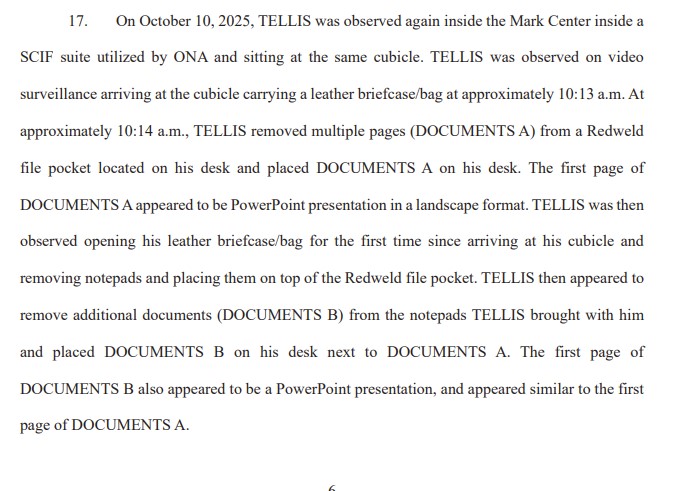
On 10th October, the authorities observed Tellis again inside the Mark Center inside a SCIF suite utilized by ONA and sitting at the same cubicle. He was noticed on video surveillance arriving at the cubicle carrying a leather briefcase at around 10 am. He removed several pages from a Redweld file pocket on his desk and placed a PowerPoint presentation-like document (Document A) on his desk. The affiant opine that the documents Tellis removed this time too were top secret “as it appears to be a document that was previously printed and left at the same cubicle utilized by TELLIS when TELLIS last came into the ONA SCIF on September 12, 2025.”
Relevant excerpts taken from the affidavit filed by the FBI agent before a federal court in Virginia
Tellis allegedly mixed the classified document into the pages of his notepads, kept them in his briefcase and left the office. He drove back to his home in Vienna.
Ashley Tellis and the China connection
Over the past few years, Ashley Tellis met several government officials of the People’s Republic of China (PRC) on multiple occasions, the court filing says. One such meeting took place on 15th September 2022, wherein Tellis and multiple PRC officials met for dinner at a restaurant in Fairfax, Virginia. During the meeting, Tellis brought a manila envelope, and the PRC officials entered the restaurant with a gift bag. The federal prosecutors alleged that Tellis handed over the envelope to PRC officials.
On 11th April 2023, Tellis met with Chinese government officials at a restaurant in Virginia. During the dinner meeting, Tellis and the Chinese officials were “overheard” talking about Iranian-Chinese relations and emerging technologies, including artificial intelligence.
In a similar meeting in March 2024, Tellis and the Chinese government officials discussed US-Pakistan relations.
On 2nd September 2025, just days before Ashley Tellis allegedly began removing classified documents, Tellis and some Chinese officials dined again. This time, they allegedly gave Tellis a red gift bag.
Search at Tellis’s residence led to the discovery of classified documents
Acting on a federal court’s order, investigators conducted a search at Ashley Tellis’s residence in Virginia’s Vienna on 11th October. During the searches, the investigators found over a thousand pages of paper documents with classification markings at the top secret or secret levels at various locations within the house.
“The documents were generally found in four locations: (1) a four-drawer locked filing cabinet in a closet in the basement home office area; (2) a two-drawer locked filing cabinet in the basement home office area; (3) in the vicinity of a desk in the basement home office area; and (4) in three large black trash bags in an unfinished storage room in the basement,” the affidavit detailed, adding that the investigators recovered a document with “secret” portion markings in the basement home office area.
If convicted, Tellis could face up to ten years in prison.
Ashley Tellis and his troubling track record
Ashley Tellis is currently the Tata Chair for Strategic Affairs and a Senior Fellow at the Carnegie Endowment for International Peace (CEIP). Interestingly, CEIP received funding from Hungarian-American investor and regime change specialist George Soros’s Open Society Foundation. Not to forget, the animosity of Soros towards the Modi government and his ambition to establish a puppet administration of his preference in New Delhi is well-known as he has openly expressed his malicious intentions regarding India on public forums. Soros has leveraged his wealth to regularly undermine India.
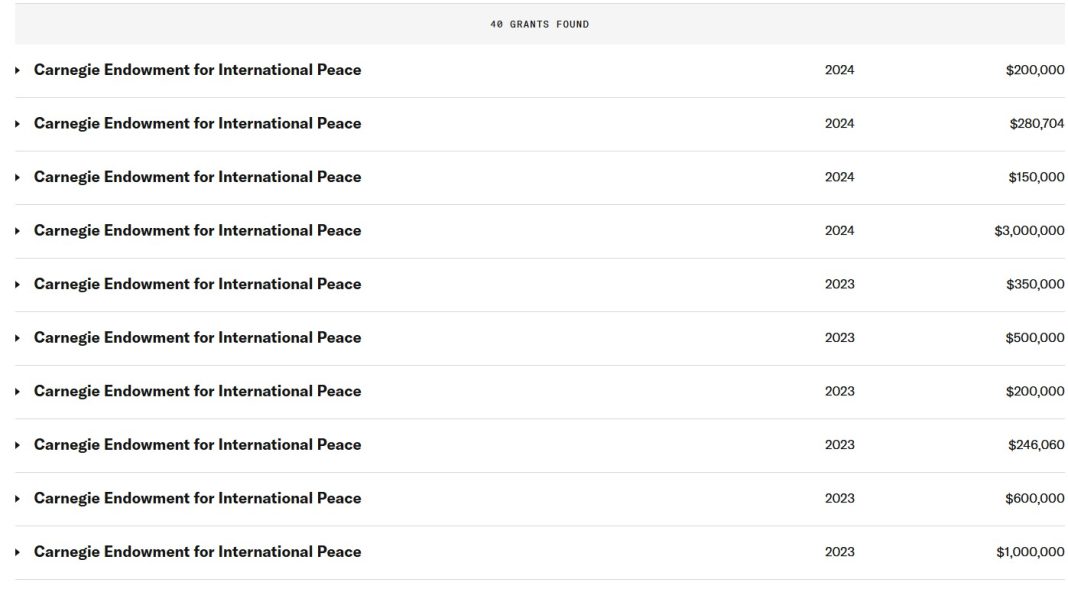
The CEIP has regularly been receiving funds from Soros’s Open Society Foundation. According to the group’s grants records, OSF granted lakhs of dollars to the CEIP for various purposes in around 40 such grants. In 2024, the OSF gave $3,000,000 to CEIP for “to provide general support”.
Source: OSF website
As a Senior Adviser to the Undersecretary of State for Political Affairs during the George W. Bush administration, he is attributed with having played a key role in negotiating the US-Indian civil nuclear deal. He also served as a research director at the Strategic Institute of the US Army War College.
Tellis also had a significant affiliation with the RAND Corporation, a non-profit global policy think tank. His involvement predates his transition to the US government service. Ashley Tellis served as a senior policy analyst at RAND, which also received funding from the Open Society Foundations for specific projects.
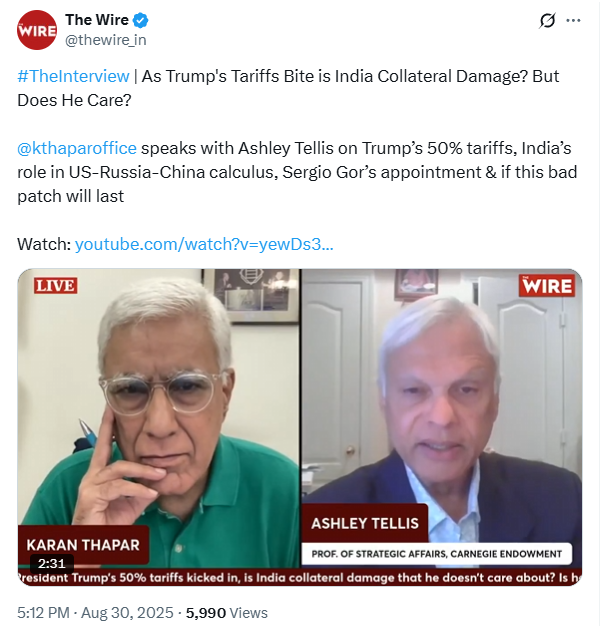
Unsurprisingly, Ashley Tellis was hyped by Indian left liberal media circle. From Newsclick, a leftist propaganda portal accused of receiving Chinese funding and violating FCRA rules, to The Wire, Tellis has been a favourite of Indian left liberal cabal. Tellis appeared in one of the interviews with Karan Thapar, who enjoys support among Indian leftists and Pakistanis alike.
In his articles, and interviews, Tellis never left an opportunity to slander the Modi government. He often advocated for India to do away its strategic autonomy and align with the US as a ‘junior partner’ to counterbalance China.
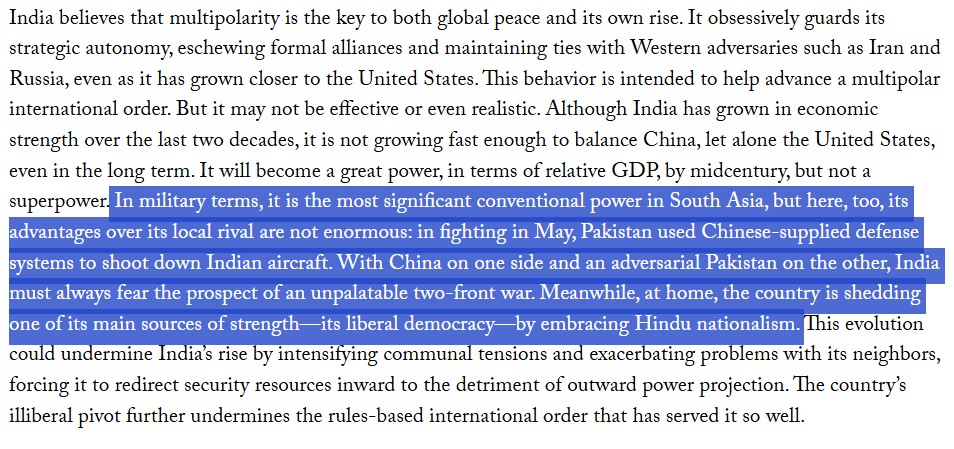
As a contributor to the Foreign Affairs magazine, Tellis persistently wrote anti-India articles in the pretext expert geopolitical analysis. In one such piece titled, “India’s Great Power Delusions”, Tellis argued that India’s belief in multipolarity and strategic autonomy “may not be effective or even realistic.”
His China love also found expression in the article as he mindlessly amplified Pakistan’s unfounded claim of shooting down Indian fighter jet using Chinese defence systems, during the May conflict wherein India inflicted severe blow to the hostile neighbour in the aftermath of the Islamic terror attack in Pahalgam.
“Although India has grown in economic strength over the last two decades, it is not growing fast enough to balance China, let alone the United States, even in the long term. It will become a great power, in terms of relative GDP, by midcentury, but not a superpower. In military terms, it is the most significant conventional power in South Asia, but here, too, its advantages over its local rival are not enormous: in fighting in May, Pakistan used Chinese-supplied defense systems to shoot down Indian aircraft. With China on one side and an adversarial Pakistan on the other, India must always fear the prospect of an unpalatable two-front war,” Tellis wrote in the article published in June this year.
Excerpt from Ashley Tellis’s article in Foreign Affairs magazine
Unsurprisingly, Tellis also expressed his disappointment over India’s alleged embrace of ‘Hindu nationalism’ and shunning of a ‘liberal democracy’.
In December 2023, Tellis told Nikkei Asia “It would be a mistake for New Delhi to conclude that India’s importance to the U.S. strategy for balancing against China gives India the latitude to unilaterally target U.S. citizens.” He said this in the context of the alleged plot to assassinate Khalistani terrorist Gurpatwant Singh Pannun.
Now, the arrest of Ashley Tellis for allegedly removing classified documents and spying for China has sent shockwaves in Washington’s policy circles and also triggered a discussion in India over his harshness towards Modi government’s foreign policy.
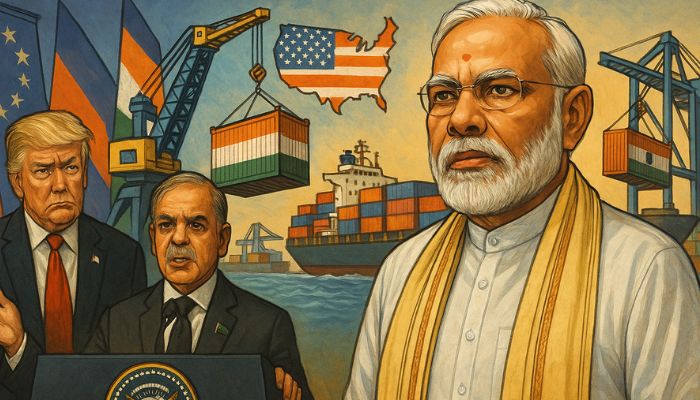
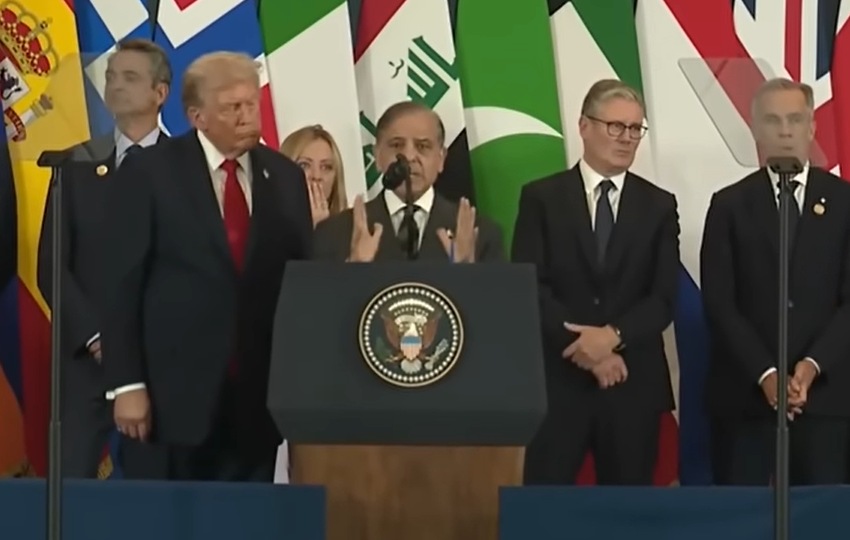
Within 24 hours of the President of the United States, Donald Trump, standing astride the Sharm el-Sheikh Gaza peace summit flanked by Pakistan’s Prime Minister, India made headlines of its own.
Source: White House
On 14th October, Google announced a $15 billion investment in a new AI Data Centre in Visakhapatnam. It is going to be the largest bet by Google on India ever. The data centre is being constructed in association with the Adani Group and Airtel.
Great to speak with India PM @narendramodi@OfficialINDIAai to share our plans for the first-ever Google AI hub in Visakhapatnam, a landmark development.
This hub combines gigawatt-scale compute capacity, a new international subsea gateway, and large-scale energy infrastructure.…
This starkly contrasts with Prime Minister Narendra Modi’s choice to skip the Trump-led summit and send a minister instead, even as Pakistan’s PM Shehbaz Sharif was beaming to share the stage with the US President.
The summit, in fact, was more of a “personal glorification spectacle” for President Trump, with world leaders reduced to “stage extras”. The developments that have happened should serve as a reminder that the optics from Sharm el-Sheikh were theatre, not strategy, something India strategically avoided becoming part of.
Google’s $15B India investment highlights real gains
The Google announcement has shown how US companies are interested in pouring real resources into India’s future. Google’s AI hub in Andhra Pradesh is its largest investment anywhere outside the US, not just in India. This is happening alongside similar tech gambits. Recently, Microsoft has pledged $3.7 billion for data centres in Telangana, and Amazon is planning to invest $12.7 billion more for cloud infrastructure in India by 2030.
A monumental day for India! Adani is proud to partner with @Google to build India’s largest AI data centre campus – in Visakhapatnam – engineered specifically for the demands of artificial intelligence.
The pattern is clear. Global tech giants see India as a booming market for a billion-plus internet users and a skilled workforce, worthy of huge long-term bets. It has to be noted that over the past decade, the Government of India has worked extensively to make it easier for business houses to invest in the country. These projects by tech giants will not only bring foreign investment but will create hundreds of thousands of direct and indirect jobs.
By contrast, US commitments to Pakistan have been very limited and highly conditional. Outside of military aid, which is tied to specific campaigns, American companies have shown no intentions of investing in Pakistan. The Google-Vizag deal alone dwarfs typical US portfolio flows to Pakistan, which total barely a few hundred million a year. In fact, even companies Procter & Gamble have shut operations in Pakistan including manufacturing as part of their global resturcturing. Its subsdiary Gillette Pakistan is also considering discontinuation measures. Microsoft has also announced its departure from Pakistan after 25-years of operations in the country. All these companies, and many more, are leaving Pakistan due to economic and political instability.
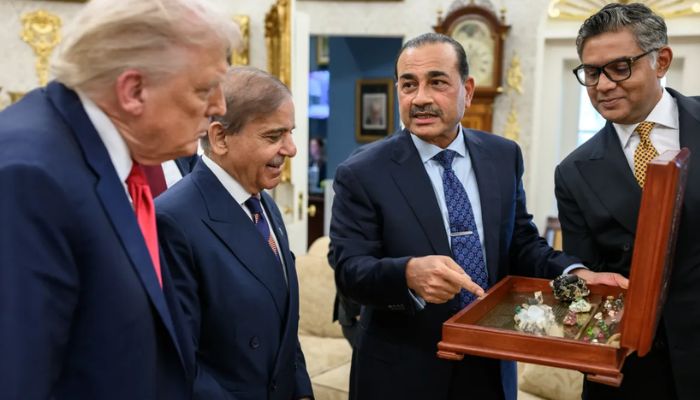
Furthermore, the recent announcements made by Trump regarding oil and rare earths in Pakistan are marred with controversies. First of all, there is no hard evidence that Pakistan will be able to provide the oil wells that it has promised to the US. Secondly, the rare earths that Pakistan recently flaunted in the White House during a meeting where Sharif and Army Chief Asim Munir met the US President and his team come from Balochistan.
Source: White House
For those who are unaware, the people of Balochistan do not consider themselves part of Pakistan and are struggling to get independence from the Islamic country. Baloch armed forces have been fighting with the Pakistani forces for a long time to establish a sovereign nation. Top Baloch leaders have repeatedly called out Pakistan’s bluff that it can provide rare earths to the US and categorically said that if Pakistan tries to do so, it will be stealing resources from Balochistan. So, whatever the US and Pakistan announce in terms of trade, deals, and economics, it is mostly on paper, and making it a reality is going to be extremely tough.
PM Modi skips Gaza summit, Sharif soaks up applause
It was not by accident that PM Modi stayed home while Pakistan’s leader flew to Egypt. India was invited for the peace accord and it did oblige, but via the Minister of State for External Affairs and Environment, Forest and Climate Change, Kirti Vardhan Singh. New Delhi’s choice of sending the MoS to represent India signalled clear intent that the PM was not interested in becoming part of Trump’s photo-fest.
India most likely avoided sharing the stage with Pakistan’s PM at the summit. Furthermore, the fact that the US President has claimed repeatedly that he ended the war between India and Pakistan, and India rejecting the claim multiple times including at the United Nations, has already irked Trump. So much so, he is willing to let Pakistan’s PM roll at his feet just to get validation for the claims.
It appears PM Modi wanted to avoid giving Trump a chance to make the claim again or Pakistan making the same claim at the peace accord in his presence. In fact, Sharif did give credit to Trump for “ending the war” between India and Pakistan while nominating him “again” for the Nobel Peace Prize at the Gaza peace accord. He called Trump “the man the world needed most”.
The optics were clearly not India-friendly. Pakistan’s PM stood right behind Trump, and Pakistan’s Army Chief Asim Munir was lauded as the “favourite field marshal” by the US President. Other world leaders were reduced to background cast in a performance only one man seemed to be headlining, and that was Trump.
In short, Sharif’s excitement was a desperate grab for American attention, not evidence of any deep US-Pakistani partnership, which he obviously got.
US-Pakistan ties have been transactional and security-driven
The transactional nature of US-Pakistan ties is nothing new. Over decades, US assistance to Pakistan has come and gone on Washington’s terms. In the late Cold War and post-9/11 periods, Pakistan was useful for the US as a regional proxy. Between 2002 and 2009, when Pakistan was under General Pervez Musharraf, Washington provided around $12 billion in aid. But when strategic needs changed, the taps were turned off.
Not to forget, in 1985, the Pressler Amendment made all US military and economic aid to Pakistan contingent on an annual presidential certification that Islamabad did not have nuclear weapons. In 1990, then-President George HW Bush actually suspended nearly all aid under Pressler, cutting military funds and halting the delivery of 71 F-16 jets. Just a year earlier, the Clinton administration had imposed broad sanctions after Pakistan’s nuclear test. These were not friendly gestures; they were punitive measures when Pakistan strayed from US goals.
During the US’s war on terror, the relationship with Pakistan was fraught. On 2nd May 2011, the US military, under Barack Obama’s leadership, killed al-Qaeda’s chief Osama Bin Laden. US Special Forces stormed Bin Laden’s compound without informing Pakistan. It was a starkly unilateral act, against which Islamabad publicly complained and called it “unauthorised unilateral action” on its soil.
From Islamabad’s view, such actions felt like a breach of trust. But from Washington’s perspective, Pakistan’s utility was limited. It is an ally of convenience for the US, but not one deserving unconditional support or even a say in counter-terror decisions.
The case with India is different. The US has no defence pact with Pakistan and no enduring economic engine to bind it. When the US feels the need, it does not hesitate to cut aid and strike targets without bothering to inform Pakistan. By contrast, US-India ties are governed by a broad “strategic partnership” that includes civilian technology, trade, and mutual security dialogue.
American policymakers openly describe India as a partner in the Indo-Pacific, an economic powerhouse, and a like-minded democracy. Pakistan never enjoyed that status outside of brief wars on terror. In short, Pakistan has always known that US engagement is strictly “yes, we need you for this mission” or “no, we punish you”, a Cold War-style caricature of alliance, not a peer relationship.
Pakistan’s craving for praise, with minimal returns
Given this history, Pakistan’s current spectacle of admiration seems all the more desperate. Pakistani leaders have grown accustomed to seeking validation from the US rather than building parity. Whether it was Gen Musharraf lobbying for George W Bush’s blessing in the 2000s or civilian leaders hoping each new US president might turn the tide of history, Islamabad has always chosen the path of flattery. In fact, in 2006, then-President Bush had called Musharraf “strong defender of freedom and the people of Pakistan”.
Yet these gestures yield little strategic payoff. Pakistan has faced severe limits on US investments and trade, mostly because of its leaders’ inability to pursue the US administration and companies for investment, and the economic and political instability that runs deep in Pakistan.
The neighbour is not part of any free-trade agenda, and foreign businesses shy away from its volatile environment. Instead, Islamabad gets token arms deals and security aid when Congress and the president allow it, punctuated by crises of trust. For example, when Pakistan’s deepening nuclear and missile programmes aroused US alarm, Congress stepped in through laws (Glenn, Symington, Pressler amendments) to sanction Islamabad.
Even today, arms sales to Pakistan require a presidential waiver. By contrast, American firms chase Indian consumers and Indian government contracts with enthusiasm. This is only because India offers market access and a friendly legal framework. Indian visionary leaders, including former Prime Minister Atal Bihari Vajpayee and Prime Minister Narendra Modi, have played vital roles in bringing foreign investments during their tenures.
Sharif thanked Trump for the “ceasefire” between India and Pakistan. One can sympathise with him, as a ceasefire meant fewer bombs falling near Islamabad. Sharif cannot openly admit that the ceasefire was actually brokered by India’s Directorate General of Military Operations, and not because of phone calls made by Trump or JD Vance. India categorically refused to accept third-country interference in its security-related matters, and it was only after Pakistan’s DGMO’s request to India’s DGMO that the ceasefire was announced, for which Trump ran to take credit.
India’s firm stand on the ceasefire brokerage did irk Trump. By 2025, American officials rarely even mentioned Pakistan when discussing South Asia. President Trump, between 2012 and 2018, called for cutting all aid to Pakistan. He repeatedly lashed out at Pakistan for sheltering Osama Bin Laden. However, since India took a firm stand in matters involving ceasefire and trade with Russia, especially for crude oil, the US has tilted towards Pakistan, possibly hoping India would react and bend to its demands.
However, India stood firm, even after the US imposed high tariffs on Indian imports. The thing is, India no longer wants to be compared with Pakistan in any terms. In fact, in a recent statement, Minister of External Affairs, Dr S Jaishankar, put it bluntly and said, “We have multiple neighbours, some are clearly better than others. Hyphenation normally happens with a neighbour who is not so nice.”
EAM Dr S Jaishankar in India Pakistan hyphenation: "We have multiple neighbours, some are clearly better than others. Hyphenation normally happens with a neighbour who is not so nice" pic.twitter.com/O5Yuf7TcrF
He added, “Now, you have to understand when we say de-hyphenation, that means it’s our objective and our approach that decisions made by third countries about us are not made keeping that relationship as the lens or as the factor of calculation or factor of primary calculation. Now, that doesn’t necessarily mean that they would accommodate us.”
Jaishankar said that while countries will always try to use situations to their advantage, the only real way for India to “de-hyphenate” from Pakistan is to outstrip it in power and capability. He added that, unlike the 1970s when people often equated India with Pakistan, “nobody talks like that anymore”, even though India cannot wish away a difficult neighbour.
In simpler words, the world no longer assumes India and Pakistan rise or fall together. India has its own track and is now pulling well ahead. This is exactly what India wants to show the world and is doing it perfectly.
India’s booming trade and investment ties with the US
The numbers tell the tale emphatically. According to the US Trade Representative (USTR), total bilateral trade (goods and services) between the US and India was $212.3 billion in 2024. By contrast, US-Pakistan trade barely hit $7.2 billion in 2024. The US exports more to India in a few months than to Pakistan in a year.
India is a top-20 US trading partner overall; Pakistan doesn’t even make that list. Those who say Pakistan and India should be “treated equally” by foreign governments need only look at this gulf. America is interested in India’s market and growth, but Pakistan is merely a blip on its economic radar which is only useful when it wants to project that the US has other “friends” in the region.
Notably, it is not only about trade. Critical sectors show the disparity as well. The US and India have deep ties in tech, defence, energy and education, which bring massive investments. American giants like Boeing, Raytheon and Lockheed Martin supply India’s armed forces. Meg Whitman’s Hewlett Packard and Elon Musk’s Tesla invest in Indian manufacturing and infrastructure. Though Trump sees Tesla’s decision to setup manufacturing plant in India as betrayal to the US.
In contrast, trade with Pakistan is mostly limited to military purchases from the US, which only resumed selectively after years of embargo. Recently, there were reports that the US was selling air-to-air missels as a new deal. However, the US has clarified that the media reports were false. Furthermore, Pakistan’s ties with China often make the US twitch.
In the digital realm, India now exports tens of billions of dollars in software and IT services to the US, while Pakistan is still mostly a consumer of software from abroad. In short, India’s relationship with the US is one of mutual market opportunity and strategic alignment, whereas Pakistan’s is purely utility-driven.
India’s rising status is also bolstered by its own growth. New Delhi gets credit for pursuing reforms, attracting foreign capital, and upholding rule-of-law standards. Pakistan, on the other hand, is more often scolded for political instability and human rights issues, making many US investment bankers cautious. Where India is courted as a future leader, Pakistan remains relegated to the security sidelines.
Outpacing, not obsessing – India’s strategy of strength
India’s leadership has consistently urged an India-first focus. The message is that we cannot afford to waste time on futile rivalries when our global opportunities are much larger. Prime Minister Narendra Modi himself hammered this point multiple times for years. In 2019, he declared, “We have wasted so much of our time on ‘India-Pakistan, India-Pakistan’. Let Pakistan drown in its own struggles, leave them behind, and let us march ahead.”
हमने बहुत सारा समय इंडिया-पाकिस्तान करते अपना बहुत सारा समय बर्बाद करदिया, अरे वो (पाकिस्तान) अपनी मौत मरेगा , तुम उसको छोड़ दो, हम आगे निकल चलो- प्रधानमंत्री @narendramodipic.twitter.com/qIxoFC7RvK
— ?? Reetesh Anand ?? (@IRiteshAnandBJP) April 1, 2019
This is not just rhetoric. The Indian government’s aim has shifted from keeping the neighbours in the economic trade circle to an India-first approach. The choices India has made in the last decade reflect a strategic choice to focus on India’s strengths.
Economically, India’s GDP and foreign investment inflows are multiples of Pakistan’s. Militarily, India’s budget and capabilities far exceed Pakistan’s. Diplomatically, India’s voice carries weight in forums (UNSC contender, G20 host) where Pakistan barely registers.
The US sees this too. American commentators now speak of “India-Pakistan” as a dated construct. They discuss Indo-Pacific strategy, Quad alliances, and supply chains. India is included; Pakistan is not. The only time Pakistan features in serious US policy today is in counterterrorism or regional stability contexts, often reluctantly.
In contrast, “India” features in trade talks, climate cooperation, technology partnerships and defence dialogues. India’s own doctrine of “strategic autonomy” allows it to partner closely with the US without sacrificing non-aligned choices. Pakistan has no such independent leverage since it depends so heavily on military aid and loans.
India’s push to build world-class digital and economic infrastructure (from AI hubs in Andhra to semiconductor parks in Karnataka) ensures that its relationship with the US is built on mutual advancement. Meanwhile, Pakistan remains locked in dependency on its army’s security aid and occasional Chinese investments, neither of which matches the scale of US tech and capital flowing into India.
Eye on the benefits, not optics
India is all about its own benefit and not about optics. The relations between the US and Pakistan are being carefully choreographed to present it as a strategic partner in South Asia. In reality, Pakistan’s instability is going to hurt the US sooner rather than later.
We should welcome Trump’s warm words for India from time to time and recognise that they reflect America’s appreciation of our progress. Conversely, we should treat Trump’s flattery of Sharif with more than a pinch of salt, which has come because we denied bending to his theatrics.
Pakistan will continue to celebrate any crumbs it gets from US attention, but India is busy forging a partnership that delivers real technology, jobs, and strategic muscle. In geopolitical terms, it is India that will outstrip and outgrow, and this is what India needs and deserves.
“You can’t keep snakes in your backyard and expect them only to bite your neighbours. You know, eventually they are going to turn on whoever has them in the backyard.” While one may disagree with Hillary Clinton’s political views or her policies, her insightful remarks about Pakistan, made more than a decade ago, have consistently held true.
Pakistan has repeatedly encountered the violent repercussions of its sinister strategies and actions designed to “bleed India by a thousand cuts” by fostering radicalism within its own territory. Terrorist groups, cultivated with the complete support of the Pakistani military, de facto owners of the country, have mushroomed in every part of the Islamic Republic.
Terrorism has become the only consistent tool in the country’s foreign policy. However, in a striking illustration of “one who digs a pit for others falls into it themselves,” Pakistan has been experiencing the turmoil it intended for India and its neigbouring countries.
Furthermore, as if leading the country into the deepest abyss of Islamic fundamentalism were not sufficient, they did not even spare its alleged regions especially, Balochistan which was forced into becoming a part of Pakistan.
This area has been stripped of its natural wealth to benefit the Punjab province, leaving the indigenous population to endure poverty and suffering. When the people speak out against this oppression, they are branded as terrorists and face severe human rights abuses at the hands of the Pakistan army.
Nevertheless, it would be not only naive but foolish to anticipate that Islamabad would reflect on its actions and rectify its course. Therefore, true to its track record, they resorted to blame India for the violence occurring within its borders, as usual, without any substantiating evidence. Pakistan has indeed mastered the art of accusing India for everything that happens within the country.
This could either be a manifestation of their delusional mindset or a strategic ploy to draw attention to India, thereby diverting from their own wicked actions and given their national character, the second possibility appears more plausible.
Pakistan’s attempt to paint Baloch rebels as “Fitna-al-Hindustan”
Now, in the recent episodes of “Let’s blame India,” the country has amusingly decided to rename the Baloch rebel factions fighting for the independence of their exploited territory as “Fitna-al-Hindustan,” (loosely translates to creating trouble at the behest of India) as if this would change the reality.
However, Pakistan is not genuinely concerned with the truth but rather with fabricating a false narrative to sell to its equally Islamist and anti-India population.
“Keeping in view the involvement of some and groups in terrorist activities in Balochistan, at the behest of India (Hindustan), which are detrimental to Islamic faith and sovereignty of Pakistan, and customary traditions, it has been decided that, henceforth, all terrorist groups and organizations operating in Balochistan will be referred to as Fitna-al-Hindustan,” the ministry of interior and narcotics control officially declared on 30th June.
“The change aims to reflect the true nature and ideology of these terrorist organizations and groups and nefarious designs of India (Hindustan) against the people of Pakistan,” the notification claimed.
Earlier, Lieutenant General Ahmed Sharif Chaudhry following the school bus explosion in the Khuzdar distrcit declared that it was the result of “Indian state-sponsored terrorism,” as part of a larger conspiracy he dubbed “Fitna-al-Hindustan,” reported Republic. Pakistan has repeatedly spread the lie despite the lack of independent proof or evidence.
For the past 12 months, the security establishment in Pakistan has officially adopted “Fitna-al-Hindustan” as a standard term for armed rebel organisations operating in Balochistan. It tries to portray them as pawns of India for a covert conflict with Pakistan, a position that New Delhi categorically refutes and lacks supporting data.
The language seamlessly conforms to longstanding tendency among policymakers and conspiracy theorists to ascribe the manipulation of fault lines to shadowy foreign influences instead of acknowledging genuine domestic apprehensions when violence occurs in Balochistan.
It was mainstreamed in 2025 after a series of high-profine incidnets including the hijacking of the Jaffar Express and wave of coordinated strikes Baloch insurgents known as “Operation Baam.”
The narrative is obviously useful to Pakistan’s military. It switches focus from the province’s political and economic unrest by persuading the domestic audience to put aside the urgent problems at home and band together against a renowned adversary as a homegrown resistance is shrewdly presented as a component of larger strategic conflict.
The evidence is nonexistent outside of Pakistan’s self-serving official pronouncements. Indian command-and-control over Baloch rebel outfits has not been confirmed by any impartial inquiry conducted by major international news companies, the United Nations or other governments. The accusations have been consistently denied by Indian officials.
On the other hand, the local concerns that have driven the movement continuously are documented. The province has accounted for a significant portion of the thousands of missing-persons cases that Pakistan’s own Commission of Inquiry on Enforced Disappearances has been tracking since 2011. Advocacy groups like Human Rights Watch and Amnesty International detail a pattern of extrajudicial executions, arbitrary arrests and internet shutdowns.
Pakistani Taliban presented as Indian proxy “Fitna al Khwarij”
The resounding success of “Fitna-al-Hindustan” among its limited spectators, as no one believes them with a sane mind or in the outside world, transpired after the introduction of “Fitna al Khwarij” into the discourse, last year.
Khwarij (also known as Kharijites or Khawarij) referred to “those who left” or “the seceders” in relation to a group of early Muslims who disassociated themselves from the authority of fourth Islamic caliph.
This effort, even more ludicrous than their other one, aimed to portray the hardline extremist group Tehrik-e Taliban Pakistan (TTP) with links to Al-Qaeda leaders as an Indian proxy. Interestingly, a globally notorious Al-Qaeda leader, Osama bin Laden, responsible for the 9/11 attacks was provided refuge in Pakistan’s Abbottabad, prior to his elimination by the United States in 2011.
Nevertheless, such facts have never distracted Pakistan from their propaganda.
According to the Director General of Inter-Services Public Relations, the Indian proxy “Fitna al Khwarij” carried out the fatal attacks in multiple locations in northwest Pakistan that killed three civilians and twenty security officials on 10th and 11th October. The TTP claimed responsibility for the strikes which included a suicide bombing at a police training academy in Khyber Pakhtunkhwa.
The Pakistani media, as anticipated, promptly aligned itself with the directives of their military superiors and perpetuated the disinformation. Citing the Inter-Services Public Relations (ISPR), it claimed that Pakistani forces had killed over 200 Afghan Taliban and affiliated terrorists in self-defence action in response to an unprovoked overnight attack by the Taliban forces and the Tehreek-e-Taliban Pakistan (Fitna al-Khawarij) which is backed by India.
Notably, the TTP’s rise can be directly attributed to Pakistan. Pakistan relentlessly endorsed the Afghan Taliban since its founding in 1994 and utilised the group to increase its “strategic depth” against its main adversary, India, both militarily and geographically within Afghanistan.
The strategy failed spectacularly, however, the fact remains that Pakistan accepted American dollars under the guise of the “War on Terror” while simultaneously supporting the Taliban and even celebrated their return to power in 2021.
The Afghan Taliban and its struggle to restore the Islamic Emirate of Afghanistan inspired Pakistani jihadists in the tribal territories that bordered Afghanistan. Hence, the Afghan Taliban, Al Qaeda and a number of Pakistani terror organisations facilitated by the Pakistani government, including Lashkar-e-Taiba and Harakat ul Mujahidin, endorsed the creation of the TTP which seeks to form its own Islamic Emirate in Pakistan.
The TTP received strong assistance from Pakistani state-sponsored terror groups and the Afghan Taliban. Meanwhile, Islamabad was aware of the same. The TTP’s emir even announced that his organisation “is a branch of the Islamic Emirate of Afghanistan.” However, the Pakistani establishment persisted in aiding the Afghan Taliban to restore their government in Afghanistan to hurt New Delhi through them.
Moreover, like the scenario involving the Baloch rebels, Pakistan has only rhetoric to hold India accountable, devoid of any evidence or proof.
Meanwhile, India supplied a wealth of evidence regarding the role of Pakistani terror groups in numerous terrorist attacks in the nation, such as the major 26/11 strikes in Mumbai.
However, the Pakistani government upheld a defiant stance, consistently asserting a lack of evidence to evade responsibility for taking action against the terrorists it nurtured and used to attack India. They refused to take any measures against the dreaded terrorists who roam freely on their land.
Invoke Islam, form terrorist factions to launch “uncoventional war” against India
Pakistan understands that a direct confrontation with India would lead to its humiliation, a fact that has been demonstrated repeatedly including during “Operation Sindoor” and the four wars fought between the two sides. Therefore, the country devised an “ingenious” strategy to use religion to create an army of brain dead religious zealots prepared to attack India at the drop of a hat.
Jaish-e-Mohammad (Army of Muhammad), Lashkar-e-Taiba (Army of the Pure), Hizbul Mujahideen (Party of Islamic Holy Fighters) and several similar terrorist organizations that invoke Islam, its prophet and revered figures find haven in Pakistan under the protection of its government and military.
Their intention has been clearly to invoke religion, instill extremism and employ indoctrinated minds to carry out jihad (Islamic holy war) against the infidel state of India. While this phenomenon is observed worldwide, it does not negate the truth that every terrorist organization in Pakistan utilizes religion to excuse the killing of innocent Indians and the violence in the country.
More importantly, Pakistan is not only hand in glove with them but has also rejoiced in the terror attacks and celebrated the terrorists as heroes.
“In the 1990s, the freedom struggle began in Kashmir. At that time, Lashkar-e-Taiba and 11 or 12 other organisations were formed. We supported them and trained them as they were fighting in Kashmir at the cost of their lives. The Kashmiri freedom fighters including Hafiz Muhammad Saeed and Zakiur Rehman Lakhvi were our heroes at that time,” President General Pervez Musharraf disclosed in a 2015 interview.
“In 1979, we had introduced religious militancy in Afghanistan to benefit Pakistan and to push the Soviets out of the country. We brought Mujahideen from all over the world, we trained them and supplied weapons to them. We trained the Taliban, sent them in. They were our heroes. Jalaluddin Haqqani, Osama bin Laden and Ayman al-Zawahiri were our hero. Then the global environment changed. The world started viewing things differently. Our heroes were turned into villains,” he outlined.
Musharraf added that Pakistan provided Kashmiri terrorists alias Mujahideen with aid and training to fight the Indian Army in Jammu and Kashmir. Pakistan introduced religious terrorism in Kashmir on the grounds that a Muslim-majority state cannot be part of a Hindu-majority nation and thus should be surrendered to Pakistan. Many terrorist hits, including those in Pahalgam and Pulwama, were executed as part of the same policy.
“Humne Hindustan ko ghus ke mara hai wahaan pe. Pulwama main jo humari kamyabi hai, woh Imran Khan ki leadership mein is Qaum ki kamyabi hai (We entered India and killed. Our success in Pulwama, under the leadership of Imran Khan, is a victory of our community),” voiced former minister Fawad Chaudhry. He added, “Uske hissedar aap aur hum sab hai (all of us are party to it).”
“If Pakistan’s land, skies or waters are threatened, there will be no compromise. We tried to convey this with our tactical brilliance in Pulwama, and now we’ve shown our strategic skills too,” Pakistani Air Vice Marshal Aurangzeb Ahmed bragged while addressing media.
The notable presence of Pakistani political figures and senior military personnel at the funerals of terrorists neutralized during “Operation Sindoor” exemplified the same. Pakistan’s close association with terrorist groups was the key factor for its inclusion on the Financial Action Task Force (FATF) grey list until October 2022.
Accuse India for every conceivable issue, manipulate domestic audience
The act of blaming India for virtually everything in Pakistan is not a new trend. It is a tried and tested ploy utilized regularly by Pakistani leadership. Former prime minister Nawaz Sharif was charged with acting as an Indian agent. Similarly, Imran Khan has been projected as the darling of Indian and Israeli media with claims that his social media is controlled from India.
This shows how Pakistan has routinely sought to cast its neighbour as a convenient scapegate for its own shortcomings, to pursue political objectives and even when trying to appeal to the masses.
Additionally, nothing in Pakistan attracts attention like Islam and the rhetoric that is critical of Hindus and India. Hence, a highly volatile mix is formed when the three are combined that effectively manipulates a population which is already deficient in education and awareness.
Pakistan has been a monumental failure in providing industry, employment, technology, political stability and infrastructure, among other pivotal things but it has successfully sold the idea of hostility towards India and Hindus to its people in the name of religion. As a result, they have almost annihilated the Hindu demographic from their country and wish to achieve the same outcome in India.
Furthermore, Pakistan is not a true democracy with the reins of power concentrated in the military’s hands and politicians are obligated to toe its line. The animosity towards Hindu majority India serves as the foundation for the existence of the defence forces in Pakistan. Thus, the hatred is normalised and is a fundamental aspect not only of their army and political framework but a popular sentiment among the general populace.
This is the reason that even as Pakistan’s economy collapses, inflation skyrockets, the nation is forced to depend on foreign aid including International Monetary Fund (IMF) doll outs and terrorism infests the country, enmity towards India continues to be the collective main concern while its leaders accumulate riches and the common people are doomed to die in stampedes as they wait in long lines for flour.
The textbooks of the nation are a vivid example of how Pakistan brainwashes its youth from an early age for the sake of propaganda. The terrorist and radical outfits in Pakistan are likewise formed and sustained for the same cause. Now, the country point fingers at India while the very weapon it created and sharpened to attack the latter ended up wounding itself.
Similarly, if anyone stands up for their rights and demands accountability, such as the Baloch or the repeated uprisings in Pakistan-occupied Kashmir (PoK), unprecedented horror is unleashed to silence them and they are labeled as Indian agents to discredit their critical worries and revolt against the oppression.
Conclusion
The chickens have indeed come home to roost for Pakistan. The country chose to invest in terrorism instead of development and now it is reaping the consequences. Changing the names of terrorist groups or those striving to emancipate themselves from the stifling grasp of Islamabad could further influence the impressionable Pakistani public, however, others can easily see through the underlying propaganda.
The truth is that Pakistan realises it is a terror state and a worthless entity and desperately wishes to drag India down to its level. This is best summarized by Field Marshal Asim Munir who threatened, “India is like a Mercedes traveling on a highway, while we are merely a dump truck filled with gravel. If the truck collides with the car, who will emerge as the loser?”
The Madras High Court has finally put an end to the long-running dispute over the Thiruparankundram Hill in Madurai, a site deeply sacred to Hindus as it houses the ancient Arulmighu Subramania Swamy Temple, one of the six abodes of Lord Murugan. In its latest judgment, the court has upheld the temple’s ownership of the entire hill, banned animal sacrifice, and prohibited using the name “Sikkandar Malai” for the hill.
The ruling was delivered by Justice R. Vijayakumar on Friday, 10th October after a split verdict earlier this year by two judges, Justice J. Nisha Banu and Justice S. Srimathy. Acting as the third judge, Justice Vijayakumar settled the matter once and for all, ruling in favour of the Hindu petitioners, S. Paramasivam, M. Kannan @ Solai Kannan, and A.P. Ramalingam of the Hindu Makkal Katchi.
The petitioners had approached the court demanding a complete ban on animal sacrifice and Muslim prayers on the hill, arguing that Thiruparankundram Hill is a sacred Hindu site where the practice of Kandoori (animal sacrifice) near the Sikkandar Badhusha Dargah defiled the religious purity of the temple and the surrounding area.
Court’s key observations and verdict
The court noted that the Archaeological Survey of India (ASI) had declared about 172 acres of the hillock as a protected monument through gazette notifications issued in 1908 and 1923. Under Rule 8 of the Ancient Monuments and Archaeological Sites and Remains Rules, 1959, bringing animals for any purpose or cooking and consuming food on the protected site is prohibited without permission from ASI.
The bench ruled that even if animal sacrifice was claimed as a customary religious practice, it cannot be allowed unless a competent civil court formally recognizes it. Therefore, it prohibited all forms of animal sacrifice, cooking, and consumption of non-vegetarian food in the Nellithoppu area until further orders.
The court also rejected the renaming of the hill as “Sikkandar Malai,” saying it was a “mischievous attempt to change its identity.” The court cited historical records that have always referred to the area as Thiruparankundram Hill.
Referring to past legal precedents, Justice Vijayakumar mentioned a 1920 civil court decree and a 1931 Privy Council decision (AIR 1931 PC 212) that confirmed the temple’s ownership of the entire hill, except for a small 33-cent area at Nellithoppu, which belongs to the Dargah.
The court further said, “If a person owns a house in the City of Madurai, he is at liberty to name the said house as per his wishes. However, he cannot either by himself or insist the others to call the entire City as per the name chosen by him.”
Justice Vijayakumar said that since the title in favour of Mohammedans applied only to a tiny portion, it was wrong to claim ownership or naming rights over the whole hill.
Limited permission for Muslim prayers
While asserting the Hindu temple’s rights over the hill, the court also made sure to balance the rights of both communities. It allowed Muslims to offer prayers only in the 33-cent area at Nellithoppu and that too only during Ramzan and Bakrid. The court also said that the temple pathway and steps must not be defiled, blocked, or disturbed in any way.
The judge clearly stated that no new religious practice can be introduced unless it is recognized by a civil court. This ruling, therefore, upholds Hindu sentiments and simultaneously puts a legal stop to unrecognized practices such as animal sacrifice.
With this, the High Court has confirmed the temple’s ownership, banned animal sacrifice, and recognized limited prayer rights for Muslims during specific festivals, putting a lid on a conflict that had been simmering for years.
How the dispute began
The Thiruparankundram issue has been at the centre of communal tension in Madurai for the past few years. Hindus believe that the entire hill is sacred, not just because it houses the Subramania Swamy Temple, but also because of the ancient Jain caves and centuries-old traditions tied to Lord Murugan worship.
However, the conflict escalated after Muslim groups began claiming parts of the hill as belonging to the Sikkandar Badhusha Dargah, referring to it as “Sikkandar Malai.” The Hindu community saw this as an attempt to Islamize a sacred Hindu space.
?Hindu voices roaring in TamilNadu! Against the Izzlamics attempted take over & their anti Hindu Dravidian support.#Thiruparankundram the sacred Kandhar Malai,belongs to our Lord Murugan & Hindus alone.@hindumunnani_tn is going all out to protect our faith ?… pic.twitter.com/0xpkianGje
On 4th February 2025, thousands of Hindus gathered at Palakkanatham in Madurai to protest against these claims. The protest, organized by the Hindu Front and supported by over 50 Hindu organizations, including the BJP, RSS, Hindu Munnani, and VHP, drew a massive crowd of devotees who raised slogans hailing Lord Murugan and protecting the temple’s sanctity.
? முருகன் யுகம்?
திருப்பரங்குன்றம் முருகனுக்காக மதுரை பழங்காநல்லதத்தில் கூடிய காவிப்படை ?
The protesters accused the state government and local authorities of turning a blind eye to encroachments on the hill in the name of religion. They also demanded a complete ban on animal sacrifice, calling it disrespectful to a site revered by millions of Hindus.
Muslims were attempting to convert the hill into an Islamic place of worship
The issue is believed to have begun last year on 27th December after a Muslim family led by Syed Abu Dahir, a 53-year-old from Malaiyadipatti attempted to take animals on the hill for sacrifice. The police detained the family which further irked 20 Islamists to protest against the police. This was followed by a protest by Muslims in January this year demanding free access to the hill. demanding the continuation of animal sacrifice calling it an old tradition. They even named the hill as ‘Sikandar Hills’.
On 18th January then, the Muslims led by the SDPI organized Sammanboj on the hill in which they had planned to sacrifice goats and chickens for meals. The police were informed about the plans backed by several social media posts that affirmed the Muslim community’s intentions. Hindu Munnani members meanwhile resisted Muslims’ effort to sacrifice animals on the hill, one of Lord Murugan’s six sacred abodes. They said that Muslims were attempting to convert the hill into an Islamic place of worship.
The police then posed barricades on the site informing the Muslims that sacrificing the animals was prohibited atop the hill, however, they could carry the cooked meat and consume it there. Following this, clashes erupted between Jamath members and the police, further intensifying the situation.
On 21st January, DMK Manapparai MLA Abdul Samad conducted and unofficially survey of the hill and claimed control of the premise. Indian Union Muslim League MP Nawaz Kani also claimed that the entire property was Waqf property and every Muslim had the right to pray at Dargah the way he wanted. He reiterated that the sacrifice of animals atop the hill was an old tradition and that it should continue.
It is crucial to note that Thiruparanundram Hill is a religious site of crucial significance to Hindus due to the presence of ancient Jain caves and Lord Murugan Temple atop. Several Hindus have worshipped the temple for centuries. The Jain caves on the hill, which have now been painted green, also date back to the 2nd century BCE and these have Tamil Brahmi inscriptions on them, as surveyed by the Archaeological Survey of India (ASI).
Jain caves (Image via The Commune)
However, the Muslims who were creating chaos around the hill have begun claiming the hills as ‘Sikandar Hills’ behind the Sikandar Badusha Dargah.
Police orders and political reactions
On 22nd January, the Madurai district police officially barred Muslims from transporting livestock for sacrifice to the Dargah. They clarified that while cooked meat could be taken for consumption, the transport of live animals like goats or chickens was not allowed.
The order triggered backlash from Muslim leaders. IUML MP Nawaz Kani protested against the police decision, claiming that animal sacrifice had been a long-standing tradition at the Dargah. He also argued that the property was Waqf land and that the restriction was temporary.
Kani compared the situation to Kashi Vishwanath and Gyanvapi, saying that both the temple and mosque coexisted peacefully there and that the same could happen in Thiruparankundram.
However, his remarks drew sharp criticism from Hindu leaders. Tamil Nadu BJP chief K. Annamalai said Kani’s comments were “divisive” and hurtful to Hindu sentiments. He said, “In the spiritual land of Tamil Nadu, all religions have their own rules of worship at their places. But what is happening at Thiruparankundram Subramanya Swamy Temple is unpleasant. Consuming non-vegetarian food at the Murugan Temple hill is not just wrong but a provocation to start a religious conflict.”
Annamalai added that Tamil Nadu had always been a land of religious harmony, and attempts to disturb that peace for political reasons were unacceptable.
Muslims’ claim over the Hill: A century-old dispute
While many thought this controversy was new, the Muslim claim over the Thiruparankundram Hill goes back more than a century. Historical records show that Islamists have been trying to assert ownership since the 19th and early 20th centuries by calling the hill “Sikkandar Malai.”
In the year 1931, the Islamists made similar claims saying that the hill was a Muslim property and that its name was ‘Sikandar Hills’. The Privy Council on 12 May 1931 took cognizance of the matter and said that Thiruparankundram Temple had proven its historical possession of the unoccupied portions of the hill, treating it as its property for generations.
The judgment recognized that the village of Thiruparankundram, where the temple is located, was part of the temple’s endowment. The council also noted that the temple’s ‘Ghiri Veedhi’ (circumambulation path) and the hill’s surroundings were historically part of the temple’s sacred land.
Image via Throughlocals
The subordinate judge at the time said clearly that “Malai means hill” and “prakaram” means the outer area of the temple, confirming that the entire hill forms part of the temple’s sacred precinct.
The records also show that there was no evidence of interference by Muslim rulers or invaders on the hill in the past. Some Muslim houses or small structures may have been built during brief periods of Muslim rule, but that did not change the temple’s ownership. Even the East India Company had recognized the temple’s rights over the land.
The Privy Council judgment explicitly stated that the hill was primarily a Hindu temple property, and the rights of the temple “could not be infringed upon by any other religious group.”
Historical and religious importance of Thiruparankundram
Thiruparankundram isn’t merely a temple hill, it’s one of Lord Murugan’s six homes, and millions of pilgrims from all over Tamil Nadu and elsewhere come here annually. The temple of Lord Subramanya Swamy is carved straight out of the rock of the hill, demonstrating how old and holy it is.
The hill also features 2nd-century BCE Jain caves with Tamil Brahmi inscriptions, preserved by the ASI. Hindus were recently infuriated when a few unknown individuals painted these ancient Jain caves green, an action perceived as intentional vandalism. The ASI registered a complaint under the Ancient Monuments and Archaeological Sites and Remains Act, 1958, and the Prevention of Damage to Public Property Act, 1984.
‘Humne strategy badli hai, ideology nahi’. No one has more clarity on their ideological and religious redlines as the Indian Islamists. The Islamist although have pretentiously embraced liberals and leftists to use them as their useful idiots to further their agenda, they conveniently throw these useful idiots under the bus, disown and disparage over even a slightest deviance from the unannounced protocol–unquestioned surrender.
In a latest episode of ‘Liberals are no different from Sanghis’, Islamists on social media are calling for defunding leftist propaganda and self-proclaimed ‘fact-checking’ portal Alt News after its founder Pratik Sinha dared to criticise Indian Islamists for “embracing” Taliban and upholding the Afghanistan-based Islamist outfit’s version of Islam.
It all started with an X post published on 12th October 2025, by a notorious Islamist who goes by the name ‘Professor Noorul’, which went viral, amassing more than 11,000 likes and over a million views. The post contained a poetic couplet in Hindi/Urdu, “तेरी तहज़ीब ने उतारा है तेरे सर से हिजाब, मेरी तहज़ीब ने मेरी नज़रों को झुका कर रखा है।“ (Your culture has removed the hijab from your head, My culture has kept my gaze lowered.”)
तेरी तहज़ीब ने उतारा है तेरे सर से हिजाब, मेरी तहज़ीब ने मेरी नज़रों को झुका कर रखा है। pic.twitter.com/wAv3zsVJVL
The included a photograph featuring Taliban foreign minister Amir Khan Muttaqi dressed in his traditional attire and a signature Taliban headgear and a female journalist in a pink blazer and pants, with her hair uncovered (read un-Hijabbed) and asking question to the Taliban minister during the Antalya Diplomacy Forum in 2022. Essentially, the insinuation was that the Hijab-less female journalist is Islamically “cultureless” but the Talibani leader is not and thus, has lowered his gaze.
The post came at a time when Muttaqi is on a visit to India. He had also visited Uttar Pradesh’s Deoband, the alma mater of the Taliban ideology.
Quoting this post, Alt News co-founder Pratik Sinha, equated this regressive version of Islam to Hindutva and wrote, “The followers who believe in and uphold this version of Islam, and are happy to embrace the Talibanis, are as dangerous as the Hindutva brigade.
The followers who believe in and uphold this version of Islam, and are happy to embrace the Talibanis, are as dangerous as the Hindutva brigade. https://t.co/beXVcmusKO
Doubling down, Professor Noorul/Ilahabadi, retorted that atheists like Pratik Sinha have no right to comment on anyone’s religious sensibilities. He went on to call on his co-religionists to stop funding Alt News, since the likes of Sinha are ‘more poisonous than Sanghis.’
“Atheists like you who believe neither in Hinduism nor in Islam. Such people have no right to write on anyone’s religious sentiments. Muslims, you people give this guy 1.3 million in the name of fact-checking, and deep down, you’re even more poisonous than the Sanghis! You people should tag Zubair,” he wrote.
तुम जैसे नास्तिक जो ना हिंदू धर्म में विश्वास करते हैं और ना इस्लाम में।
ऐसे लोगों की किसी भी धार्मिक भावनाओं पर लिखने का कोई अधिकार नहीं है।
मुसलमानों आप लोग फैक्ट चेक के नाम पर इसको 13 लाख देते हो और अंदर से संघियों से भी ज़्यादा ज़हरील! है। आप लोग जुबैर को टैग कर दें। https://t.co/IkdDOQbBuQ
In continuation of the clown-to-clown conversation, Sinha once again equated Hindutvawadis with Islamists, saying that “…you’re no different from the Hindutva brigade, they employ the exact same strategy and question why Hindus are donating to Alt News. You’re the other side of the same coin. You’re also equally misinformed if you think that only Muslims donate to Alt News. People from all walks of life donate to @AltNews.”
Responding to this, Noorul accused Sinha of perpetually trying to alienate Muslims from Islam while exposing a few Hindu extremists at times as a balancing act.
Another Islamist Mohammed Asif Khan jumped on the bandwagon to suggest that Sinha is almost ‘anti-Muslim’ for his critical comment against Islamists glorifying their regressive idea of ‘tehzeeb’.
Khan wrote, “O Prophet!” Tell the believing men to lower their gaze and guard their chastity. That is purer for them. Surely Allah is All-Aware of what they do. And tell the believing women to lower their gaze and guard their chastity, and not to reveal their adornments except what normally appears.” ~ Quran (24:30-31) This is a verse from the Qur’an… a book believed in by more than a billion people. And Pratik Sinha just compared those billion believers to the Hindutva brigade involved in lynching and persecuting Muslims. Such is the level of prejudice against Muslims that you call them “dangerous” simply because they have faith.”
"O Prophet!" Tell the believing men to lower their gaze and guard their chastity. That is purer for them. Surely Allah is All-Aware of what they do.
And tell the believing women to lower their gaze and guard their chastity, and not to reveal their adornments except what normally… https://t.co/1hthQbumVO
In response, Pratik Sinha disgracefully compared Taliban and Muslim radicals in general to Hindutva brigade even as the two are not even remotely similar. While Taliban has essentially banned female education and freedom of Afghan women to do jobs, move out in public without mahram or men from their family, the so-called ‘Hindutva brigade’ enforces no such regressive practices on women and celebrates women’s empowerment.
The reason I am against religion is because it brainwashes people and produces logic like, "If you don’t follow religion, you can’t criticize it."
Every bit of progress the world has seen has come from people who refused to conform to conservative practices, who wrote about… https://t.co/v3GlgkQQVx
Moreover, unlike the Taliban who did not even rescue women from earthquake rubble since their Shariah beliefs prohibit men from touching women, except one’s wife, the RSS and ‘Hindutva Brigade’ have always been the first to respond and rescue men, women, children and the elderly during times of crisis.
“All the Muslim men I know in real life don’t lower their gaze when they talk to women. Clearly, they don’t follow Quran word-by-word. Religions were formed in medieval times, and a lot of it deserves to be discarded because it is not relevant anymore. Modern countries work through rule of law, and not rule of religion. And that is why the fight to uphold the rule of law, which is being dismantled under the current government. Of course, there are Muslim men who are religious radicals, and I’m comparing them to the Hindutva brigade. Some lessons in comprehension are needed here perhaps Asif,” Sinha wrote.
All the Muslim men I know in real life don't lower their gaze when they talk to women. Clearly, they don't follow Quran word-by-word. Religions were formed in medieval times, and a lot of it deserves to be discarded because it is not relevant anymore. Modern countries work… https://t.co/ltJJdAVAcA
Meanwhile, one Mohammed Shadab Khan, who aften peddles fake news to further the Muslim victimhood narrative, equated Pratik Sinha with former firebrand BJP leader Tiger Raja Singh and wrote, “They hate Muslims, they hate Islam. Bas 19,20 ka fark hai.”
Another notorious Islamist, Wasim Akram Tyagi also slammed Pratik Sinha and wrote, “A lot of ‘free thinkers’ are criticizing this picture. The reason for the criticism is simply that the Taliban government’s foreign minister is talking with his gaze lowered in front of the female journalist—why isn’t he looking directly into that female journalist’s eyes while speaking? Amazing! If he were to look directly into her eyes while speaking, there would still be an uproar, and if he doesn’t, there’s still an uproar. If he does look directly into her eyes while speaking, these very same ‘free thinkers’ would gleefully hurl taunts at him! But now they’re calling it ‘dangerous.’”
बहुत सारे ‘फ्री थिंकर’ इस तस्वीर की आलोचना कर रहे हैं। आलोचना की वजह बस यह है कि महिला पत्रकार के सामने तालिबान सरकार के विदेश मंत्री नज़र नीचा करके बात कर रहे हैं, वो उस महिला पत्रकार की आँखों में आँखें डालकर बात क्यों नहीं कर रहे हैं। कमाल है! वो आँखों में आँखें डालकर बात करें… pic.twitter.com/Lgn12WgdZB
It is interesting to note that Alt News and its co-founders, Pratik Sinha and Mohammed Zubair, received flak from Islamists over their reportage on Islamist-manufactured ‘Bhagwa love trap’ conspiracy theory. The same Islamists who downplay, rather dismiss real and reported Love Jihad/grooming jihad cases as ‘hoax’ or celebrate the same, criticised Alt News for its reports on incidents involving Muslim mobs attacking Hindu men and their Muslim female friends or partners alleging ‘Bhagwa love trap’.
Pratik Sinha’s repeated and desperate attempts to drag Hindutva into the argument to justify and ‘balance’ his criticism of Taliban did not help either.
Amusingly, male Islamists do not spare even Muslim women when it comes to defending religiously driven regression and misogyny. In this vein, when RJ Sayema, a known Muslim victim card player often at the receiving end of criticism for her anti-Hindu social media commentary, questioned how come lowering gaze before a woman forgives the Taliban minister’s injustices against women.
“Do those who have taken injustice against women to the extreme think that by talking to someone with their eyes lowered, their sins are forgiven? Have they become people of good character? Really, Wasim?” she wrote.
जिन लोगों ने औरतों के साथ नाइंसाफी की इंतहा की है, वो किसी एक से आँखें झुका के बात कर रहे हैं, इससे उनके गुनाह माफ हो गए? वो अच्छे अख़लाक़ के हो गए? वाक़ई वसीम? https://t.co/C3ehoP1sv9
In response, Tyagi not only downplayed Taliban’s regressive bans on women rights in Afghanistan and countless injustices they have endured in the Taliban rule but also compared their anti-women policies with the alleged oppression done by countries with ‘modern’ culture.
Islamists want total surrender, no criticism
This, however, is not the first time that secular liberals have been condemned, ostracised from the Islamo-leftist ‘progressive’ ecosystem, or labelled as ‘Sanghis’ by Islamists. In September this year, an outrage erupted over an event in a university in Kerala wherein Hijab-clad Muslim women were segregated from men in Taliban-style restrictions.
Reacting to the visuals that surfaced online from the said ‘ProfCon’ event, Ruchika Sharma, a self-declared ‘historian’ who has made it her life’s mission to whitewash the anti-Hindu crimes of Islamic tyrants of the Medieval era, said, “Just a hijab is not enough, women must be segregated, made to sit at the back and screened off. Literally punish them for being born a woman but we will call it their choice”.
This post criticising deliberate invisibilisation of Muslim women, Ruchika Sharma, who otherwise gets praise from Mughal fanboys and fellow Islamist apologists, received severe backlash from Islamists. The same Islamists who hailed Sharma as a ‘honest’ and ‘brave’ historian for whitewashing medieval era Islamic tyrants like Aurangzeb, did not shy away from labelling her an ‘Islamophobe’. Sharma got called an Islamophobe by Islamists while she had once admitted to not calling out her Muslim abuser just so that ‘Sanghis’ do not use it further their ‘Islamophobic communal agenda’.
Similarly, when Arfa Khannum Sherwani from Islamo-leftist propaganda portal The Wire endorsed Sharma’s opinion, she too could not escape the wrath of misogynist Islamists, who schooled her on how free mixing of men and women is not allowed in Islam.
Apparently, no one is immune from Islamist fundamentalism and religiously mandated misogyny which finds manifestations in the form of online outrage, labelling even habitual Islam apologists as ‘Sanghi’, Talibanic anti-women policies and in extreme cases–Sar tan se juda. Islamists not only denounce their liberal allies even at the slightest deviance from unquestioned surrender but also their co-religionists for not being ‘Muslim enough’ as per their standards.
A shocking murder took place in the Jawan town of Aligarh, Uttar Pradesh, in which 20-year-old Karan was brutally killed, reportedly over a Facebook status update. The prime accused, Mohammad Asad, and seven others have been arrested after he entered a police station and admitted to having committed the crime.
The entire incident occurred on Saturday night, 11th October. Maharani, Karan’s mother, reported that her son was called out of their home at about 9:30 PM. After a dispute, Karan was taken to a nearby abandoned house where he was brutally attacked by the asad and his friends. They hit his head on the wall and then used a knife to cut his neck and stab him until he was dead.
हिंदू युवक की हत्या के विरोध में हरिगढ़ के जवां में जन सैलाब उमड़ रहा है,समुदाय विशेष के लोगों ने की है हत्या @aligarhpolice अब तक आठ लोगों को गिरफ्तार कर चुकी है,तहरीर के आधार पर की जा रही है कार्यवाही,गांव के लोग कर रहे हैं आरोपी के घर पर बुलडोजर चलवाने की माँग । pic.twitter.com/QFoBhdcl9n
After hearing his elder brother’s screams, the 12-year-old younger brother came outside and raised an alarm, and all the accused fled from the spot. The surprising thing is that after killing Karan. Asad directly reached the police station after the murder, then he allegedly washed his hands and feet stained with blood at a tap of the police station and then calmly informed the police that he had murdered someone. The police immediately arrested him and went to the spot. On the basis of the complaint registered by Karan’s mother, all eight accused were apprehended.
By Sunday morning, anger spread among the Hindu community. Karan’s family, led by a crowd of thousands, refused to burn his body. They blocked the Moradabad Highway, seeking financial assistance and demanding that the buildings of the accused should be demolished by a bulldozer. The protest turned violent, with some individuals raining stones on police vehicles. The scene only began to normalise in the evening after police issued a written promise to consider their demands.
Karan’s mother said that the killing was not merely for the Facebook post but was the culmination of older tensions. She explained that three years ago, the local Aheria community (to which Karan belonged) constructed a temple in the locality, which Asad’s family and a few other Muslim families opposed. She says they nursed a grudge ever since. The police have sent a heavy contingent to the town to ensure peace, but they have not yet declared the precise motive behind the murder.