Home Blog Page 732

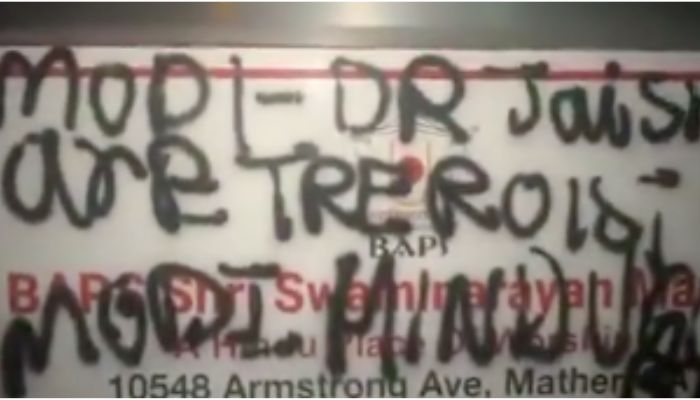
‘Modi, Hindus Go Back’: BAPS Mandir defaced with anti-Hindu graffiti in Sacramento, California

On the night of the 25th of September the BAPS Shri Swaminarayan Mandir in Sacramento, California, was desecrated with anti-Hindu and anti-India graffiti. This act of vandalism came just days after a similar incident occurred at the BAPS Mandir on Long Island, New York. It is being alleged that Khalistani extremists were behind this anti-Hindu hate crime.

Hateful slogans such as “Hindus go back”, “Modi=Hitler”, “Modi-Dr Jaishankar are terrorists”, “Modi Hindu Go Back”, and “F$%k Modi” were spray-painted on the Hindu temple in Sacramento, causing concern in the local Hindu community. The local Hindu community condemned this hate crime and sought action against those behind it.

In an official statement, Bochasanwasi Shri Akshar Purushottam Swaminarayan Sanstha (BAPS) condemned the anti-Hindu hate crime and said that they are working with the local law enforcement authorities on this incident. In addition, BAPS informed that a prayer meeting was organised on Wednesday.

“Less than 10 days after the desecration of the BAPS Shri Swaminarayan Mandir in Melville, New York, our Mandir (Hindu place of worship) in Sacramento, California was desecrated and vandalized with hateful messages. Our condemnation of hate remains resolute; our sadness has only deepened; and our prayers for all, including those with hate in their heart, have grown stronger. The BAPS Shri Swaminarayan Mandir in Sacramento is home to a vibrant Hindu community engaged in numerous activities and projects to support the larger community.  We are and shall remain an integral part of this community’s fabric. BAPS is working with law enforcement authorities on this hate crime,” the statement issued by BAPS reads.  

Notably, the Hindu temples in the US have been continuously targeted by anti-Hindu and anti-India elements. On 16th September, BAPS Shri Swaminarayan Mandir located in Melville hamlet in the New York State of the United States was vandalised by extremists. In visuals that have surfaced on social media, it could be seen that the sacred Hindu temple was desecrated with disturbing slogans of ‘Fuck Modi’, ‘Modi is Terrorist’ and ‘Hindustan Murdabad.’ A noticeable gap was maintained between the words ‘Hindu’ and ‘stan’, thereby implying the ‘breasts of the Hindu’. 

Attacks on Hindu Mandirs in the US

In January this year, Vijay’s Sherawali Temple in Hayward City in California state of the United States was desecrated with pro-Khalistani slogans. The temple was spray-painted with slogans such as ‘Khalistan Zindabad’ and ‘Modi is terrorist.’ 

In a statement, the temple administration said, “Jai Mata Di Bhakto’s. With deep regret, we would like to inform you (that) the Temple was vandalized last week. We have informed the police and they have classified it as a hate crime.

“A few other Hindu Temples in the area have also been vandalized (most likely by the same culprits). We pray for those who wish harm and hatred on others that Mata Rani cleans their souls and gives them happiness and eradicates hate from their hearts,” it added.

On 22nd December 2023, the Swaminarayan Mandir Vasana Sanstha in Newark City of California, was defaced with pro-Khalistan, anti-Modi and anti-India slogans. The outer wall of the temple was defaced with slogans such as “Khalistan”, “Shaheed [Martyr] Bhindrawale”, “F$%k Modi Jindabad” and “Modi Is Terrorist”.

Similar attacks have taken place in the past, both in the United States and its neighbouring Canada, wherein Hindu temples have been attacked, vandalised and defaced with derogatory graffiti.

Delhi Police Special Cell’s IFSO unit busts “Digital Arrest” fraud, three arrested for using mule and fake bank accounts

0

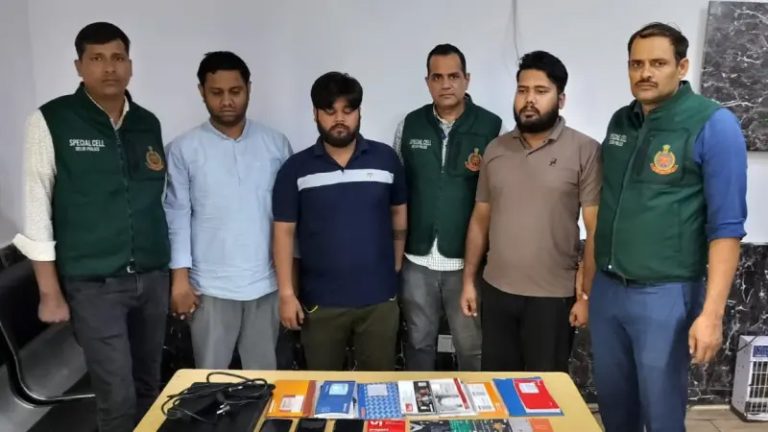
Delhi Police Special Cell’s IFSO Unit have arrested three suspects for their alleged involvement in a module responsible for providing, handling, and using mule/fake bank accounts in connection in “Digital Arrest fraud”.

The accused were allegedly operating fake companies to siphon the proceeds of their crimes abroad.

On September 12, 2024, a complaint was filed at IFSO, Special Cell alleging that on the morning of September 9, 2024, she received a phone call wherein someone claimed to be an officer at the Customs Office, Mumbai Airport, Terminal 2. After confirming her identity, the caller informed her that customs officials had intercepted a parcel on September 6, 2024, containing 16 fake passports, 58 ATM cards, and 40 grams of MDMA, with her details listed as the sender. The caller further claimed that Mumbai Police had issued an arrest warrant against her, and she must surrender.

The fraudsters escalated the intimidation by asserting that a CBI investigation was underway and that her arrest was imminent. Till the pendency of physical arrest, she was put under “digital arrest” by keeping continuous surveillance through WhatsApp video calls. Over the course of these calls, different individuals posing as senior officers from the Mumbai Police, CBI and various law enforcement agencies, pressured her to transfer funds under the pretext of verifying her accounts to avoid money laundering charges. In total, she was defrauded of Rs55 lakhs. On the receipt of the complaint a case u/s 318(4)/308(2)/61(2)(4)/3(5) BNS & 66C/66D IT Act was registered and investigation taken up.

Through a detailed analysis of mobile numbers and bank accounts used by the suspects, investigators identified the proprietors of a fake company, Camellia Services Apartment LLP. With the aid of mobile and technical surveillance, the police traced and arrested three individuals: Prabhat Kumar, Rajesh Kumar (alias Raja), and Arjun Singh in Burari.

Prabhat and Rajesh were found to be the proprietors of Camellia Services Pvt. Ltd., which was used to funnel the defrauded funds. Passbooks, chequebooks, company banners, and other documents were seized. Arjun Singh had facilitated the opening of fraudulent bank accounts for the operation. During the investigation all the bank accounts wherein cheated amount was transferred. Out of the total cheated amount, Rs 20 Lacs were frozen in an HDFC bank account and an order to release the said amount to the victim has been obtained from the court.

The syndicate impersonated officials from the police, CBI, customs, and other government bodies. They would inform victims that parcels containing prohibited items had been intercepted, with their names listed as the sender. Initially, they threatened the victims with arrest and severe penalties, but later shifted to a more sympathetic tone, suggesting it could be a case of mistaken identity. To resolve the issue, they instructed victims to lodge a formal complaint and transfer their savings into specified accounts for “verification,” falsely promising that the funds would be refunded after the verification process.


(This news report is published from a syndicated feed. Except for the headline, the content has not been written or edited by OpIndia staff)

Wrestler-turned-politician Vinesh Phogat misses anti-doping test, National Anti-Doping Agency issues notice: Here is what it means

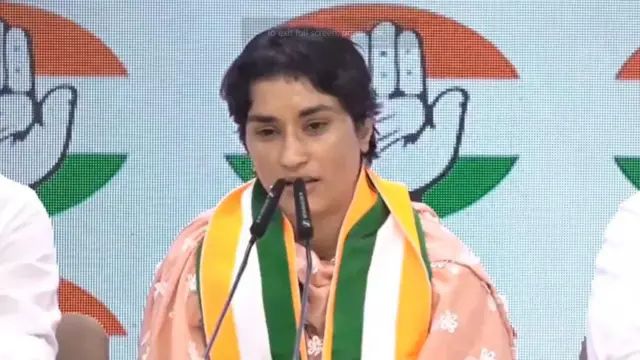
Vinesh Phogat, who retired from wrestling in August after losing out on a gold medal after she was disqualified for being 100 gms overweight, seems to be in the eye of the storm yet again. On Wednesday, the National Anti-Doping Agency (NADA) served a whereabouts notice to wrestler-turned-politician Vinesh Phogat for failing to be present at the location for her dope test.

National Anti Doping Agency, India is an autonomous body under the Ministry of Youth Affairs & Sports, Government of India. NADA India implements the Anti-Doping Program in India and works closely with the World Anti Doping Agency (WADA). The World Anti-Doping Agency is a foundation initiated by the International Olympic Committee.

Athletes registered with NADA’s Registered Testing Pool (RTP), including Vinesh, are required to provide details about their availability for doping tests and also disclose the location where they would be present for sample collection. The athlete’s failure to be present at the pre-decided location for the purpose of sample collection for the dope test invites a whereabouts notice.

According to reports, Vinesh Phogat had disclosed that on the 9th of September, she would be in her home in Kharkhoda village, Sonepat, from where her sample would be collected by NADA. In its notice, NADA said that Vinesh Phogat failed to be present at the location for the purpose of the dope test.

The NADA notice stated: “This formal notice is to inform you of an apparent failure to comply with the whereabouts requirements of the Anti-Doping Rules (ADR), and to invite you to submit any comments before a final decision is made.”

After the notice is served, the athlete, in this case, Vinesh Phogat, must either acknowledge her failure to make herself available for the dope test or provide evidence that she was at the location for the required 60 minutes.

While NADA has served the notice to Phogat, according to an Indian Express report, action is unlikely in the case. For NADA to take action against an athlete, the athlete has to fail to make themselves available for the dope test 3 times in a span of 12 months. This appears to be Phogat’s first failure.

Vinesh retired from the sport following her disqualification from the Paris Olympics, where she made it to the final but was unable to compete in the gold-medal match due to being overweight. After her disqualification from the Olympics, Phogat received a “gold medal” from the Khap Panchayat in Haryana. Soon after, she got back to her politics and joined the “farmers protest” at the Shambhu border.

Recently, Vinesh and fellow wrestler Bajrang Punia joined the Congress party, and she is now running in the upcoming Haryana Assembly elections from the Julana constituency, where she has been actively campaigning.

How the usual suspects had wrongly blamed the Modi government for Vinesh Phogat’s disqualification

Vinesh Phogat originally contested in the 53 kg category. But during the time she was off the mat for more than one-and-a-half years due to injuries and the protests against the Wrestling Federation of India (WFI) chief Brij Bhushan Sharan Singh, Antim Panghal secured an  Olympic quota for India in the 53kg category. She then decided to switch to the lighter weight – 50 kg category – to ensure her place in the Olympics.

Despite not being against the rules, she was allowed to contest in qualifiers in both the 50 kg and 53 kg categories. She lost the qualifying match in the 53 kg category but won in 50kg. Therefore, she had to keep her weight below 50kg because she qualified for the 50 kg category in the Paris Olympics. But she has been struggling to maintain her weight below the allowed limit for several months now. Her weight was around 2.7 kg a day before the finals, and despite various efforts, including cutting hair, shortening clothes, and sitting in the sauna, the weight could not be brought below 50kg.

Therefore, Vinesh Phogat was disqualified on technical grounds, and the govt had no role to play in this.

Pertinently, weight category requirements are rigidly enforced by the International Olympic Committee (IOC) and the relevant wrestling federations. Notably, the United World Wrestling (UWW) rules say, “If an athlete does not attend or fails the weigh-in, he/she will be eliminated from the competition and ranked last without rank.”

India’s solar PV module manufacturing capacity increases from 2.3 GW to 67 GW in 10 years under Make In India initiatives

India’s solar PV module manufacturing capacity has increased from 2.3 GW to 67 GW in the last 10 years because of measures taken under Make In India initiatives, the Ministry of Renewable said.

Furthermore, 48 GW of fully or partially integrated solar PV module manufacturing projects are currently under implementation under the solar PLI scheme, the ministry said as “Make in India” initiative of Government of India completes 10 years,

Union Minister for New and Renewable Energy Pralhad Joshi posted on X “India’s renewable energy sector has contributed immensely to the #10YearsOfMakeInIndia. From PLI to VGF, we are extending all possible support to our domestic industries. We are committed to establishing India as a major global player in the complete value chain of clean energy solutions.”

In a statement, the ministry said that one of the key focuses of the Government is to support and incentivize domestic manufacturing in the renewable energy sector.

“Several measures have been taken by the Union Government to promote the domestic manufacturing of renewable energy equipment, such as solar PV modules, cells, and upstream components like ingots, wafers, and polysilicon,” the statement read.

These efforts also include the manufacturing of wind turbines, electrolysers for green hydrogen production, and battery energy storage systems for utility-scale electricity storage applications.

Solar PV manufacturing remains a significant focus of the Government’s efforts, the ministry said.

“The Government is committed to making India self-reliant (Atmanirbhar) in solar PV manufacturing and establishing India as a major player in the global value chain. This commitment is demonstrated by the Rs. 24,000 crores outlay for the PLI Scheme for High-Efficiency Solar PV Modules and additional policy interventions, such as the imposition of basic customs duties and domestic content requirements,” the ministry said in the statement.

“Since 2014, India’s installed solar PV module manufacturing capacity has grown from 2.3 GW to approximately 67 GW, thanks to various measures under the “Make in India” initiative. This increase makes India capable of meeting domestic demand while also catering to exports,” it added.

The country has seen rapid growth in solar PV module production capacity, jumping from 8 GW in 2021 to 67 GW per year in the last 3.5 years alone.

“Furthermore, over 48 GW of fully or partially integrated solar PV module manufacturing projects are currently under implementation under the solar PLI scheme. Once completed, these projects will attract an investment of approximately Rs. 1.1 lakh crores and create direct employment for around 45,000 people,” the statement said.


(This news report is published from a syndicated feed. Except for the headline, the content has not been written or edited by OpIndia staff)

BHU professor’s controversial paper on Covaxin adverse effects retracted by journal, Bharat Biotech slaps Rs 5 crore defamation on all authors

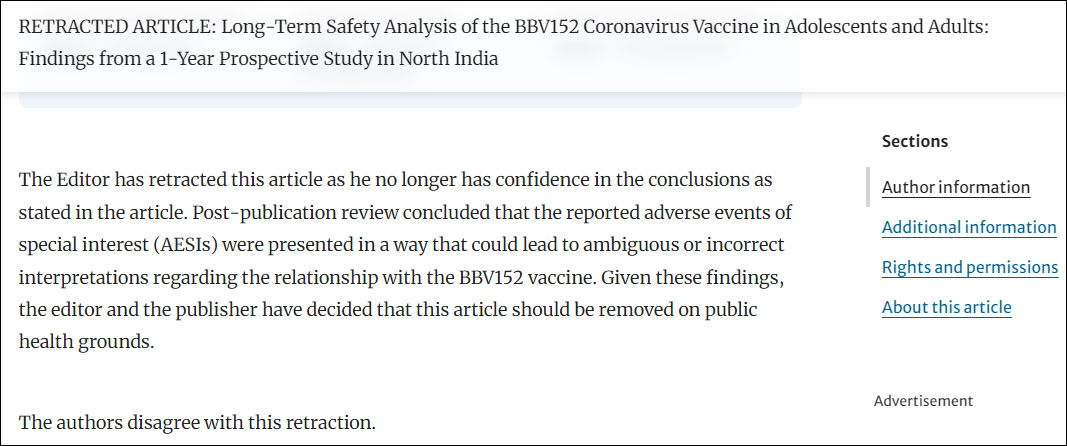
On 24th September, the journal Drug Safety retracted a paper it had published in May 2024 regarding the safety of Covaxin, a homegrown COVID-19 vaccine made by Bharat Biotech. The note on Springer about the retraction of the article reads, “The Editor has retracted this article as he no longer has confidence in the conclusions as stated in the article. Post-publication review concluded that the reported adverse events of special interest (AESIs) were presented in a way that could lead to ambiguous or incorrect interpretations regarding the relationship with the BBV152 vaccine. Given these findings, the editor and the publisher have decided that this article should be removed on public health grounds.”

The authors, however, disagreed with the retraction. The retraction came almost two weeks after Bharat Biotech sued eleven BHU researchers who authored the paper along with Drug Safety, the journal of the International Society of Pharmacovigilance.

SS from Springer.

Journal’s editor, Nitin Joshi, who is based in Auckland, New Zealand, informed the authors about the journal’s intent to retract the paper on 28th August. Replying to him, one of the co-authors wrote, “This unilateral decision of yours to retract the paper not only risks defaming the authors but also sets a troubling precedent where academic journals may appear submissive to external pressures, including those imposed by industry and others.”

The retraction came almost two weeks after Bharat Biotech sued eleven BHU researchers who authored the paper along with the journal Drug Safety. The case was filed in the City Civil Court, Hyderabad. In its suit, Bharat Biotech International Limited (BBIL) alleged that the claims made by the researchers and the journal created “shock, alarm and hesitancy” among the public over the efficacy of Covaxin and the company’s other products.

The company further stated that the study was “defamatory” and sought a permanent injunction against the research paper. The company sued the researchers involved in the study for Rs 5 crore in damages along with interest.

The petition, accessed by Times of India, noted that BBIL termed the study as poorly designed with a flawed methodology. It also noted that the statements made by the researchers had “irreversibly damaged” the reputation of the company, its products, and commercial interests.

BBIL urged the court to pass orders to take down the study and issue a permanent injunction to restrain the researchers from further publishing defamatory and flawed studies on Covaxin and BBIL.

Responding to the case filed against them, BHU researchers denied the allegations and termed the petition as an instance of a SLAPP (strategic lawsuits against public participation). They claimed the sole objective of the petition was to muffle or stifle any type of criticism or research about the vaccine.

‘Incorrect, misleading and unacceptable’ – How ICMR reacted to flawed study by BHU researchers

On 20th May, the Indian Council of Medical Research (ICMR) strongly refuted the ‘study’ done by researchers at Banaras Hindu University (BHU) where it was suggested that over 30% of the people who received the made-in-India COVID-19 vaccine, Covaxin, experienced side effects. In its statement, ICMR not only labelled the study as “incorrect, misleading and unacceptable” but also demanded that it should be retracted by the publisher, Springer.

Flawed study raises concerns

The study titled “Long-Term Safety Analysis of the BBVl52 Coronavirus Vaccine in Adolescents and Adults: Findings from One Year Prospective Study in North India” stirred controversy as it reported several adverse effects from the vaccine. The side effects included nervous system disorders, skin disorders, menstrual abnormalities and hypothyroidism. The study was conducted by Dr Upinder Kaur and Dr Sankha Shubhra Chakrabarti of BHU. The sample size of the study was 1,024 Covaxin recipients and the information about the possible side effects was collected via telephonic conversation a year after the vaccination.

Methodological issues highlighted

ICMR, in its statement, pointed out that there were several methodological flaws in the study. For example, there was no control group of unvaccinated individuals which made it impossible to conclude that the side effects occurred due to the vaccination. Furthermore, the study did not provide any baseline information and background rates of observed events. Such information is crucial for assessing any changes in incidents after the vaccination was taken by the recipients.

Bharat Biotech defends Covaxin

The manufacturer of Covaxin, Hyderabad-based Bharat Biotech, responded to the controversy and defended Covaxin. The company stressed that the study done on the vaccine should consider a broad range of data to avoid any bias. The company further added that the researchers should compare the data of vaccinated and non-vaccinated individuals to get accurate results. Bharat Biotech highlighted that multiple peer-reviewed studies have confirmed Covaxin’s excellent safety profile.

The company said, “For such a study in safety to be effective, informative and to avoid investigator bias, the following data points are also required: AESI safety profile of the subjects before participation in the study; Comparison of safety profile of non-vaccinated subjects during the study; comparison of safety profile of subjects who received other vaccines during the study; all study participants should be followed during the study, instead of only a subset; several studies have been executed on the safety of COVAXIN, and published in peer-reviewed journals, demonstrating an excellent safety track record.”

Mali: Islamic terror outfit Jama’at Nusrat al-Islam wal Muslimeen gives ‘ultimatum’ to Christians to either give funds, fight for them, convert to Islam or flee their homes

In the West African country Mali, the Islamist terrorists have given an ‘ultimatum’ to the Christian inhabitants to either support their terror activities against the military power or leave their homes. The situation has worsened to the extent that there is a threat to the Christian community’s existence in the landlocked country. As per the “Open Doors” organisation that monitors Christian persecution, the Islamist terrorists had threatened the Christians residing in Central Mali to either support their terror activities through money and manpower, convert to Islam and shut down their churches or leave their houses.

The Islamist terrorists said to belong to Jama’at Nusrat al-Islam wal Muslimeen (JNIM) summoned pastors in the Mopti region and gave them three options if they intended to continue staying in the region. The options are to provide men to fight against the army, Give the jihadists money to hire mercenaries, or convert to Islam and close their churches.

Notably, the Islamic terrorists in this region are collecting “Zakat” from Christians, Muslims and tribals. Speaking to Open Door, Pastor Yabaga Diarra said: “Because the jihadists conquered the land, they feel it belongs to them, so they are telling the Christians to pay them a Zakat tax which is an Islamic tithe. Muslims and non-Christian practitioners of tribal faiths are already paying it.”

The Islamist attack in Mali commenced in April 2012, when terrorists attacked government forces and seized control of northern Mali. They established an authoritative Sharia regime in the north, demolishing churches, other Christian properties, schools, and health facilities. According to the International Rescue Committee, over 7.1 million people in Mali currently require humanitarian aid, with nearly 400,000 of them being internally displaced. The Islamist terror groups have been killing civilians, government officials and UN peacekeeping forces as well. So far, the Mali military has failed to regain control of the region taken over by Islamic terrorists.

In 2023, the US State Department named domestic and transnational terrorist groups that attacked Mali. These Islamic terrorist groups included Al-Qaeda in the  Islamic Maghreb and its affiliates Ansar al-Dine, Macina Liberation Front, and al-Mourabitoune, which were united under the umbrella group JNIM (Jama’a Nusrat ul-Islam wa al-Muslimin/ “Support Group for Islam and Muslims”), as well as the Islamic State in the Sahel. These terrorists target individuals they “perceive as not adhering to their interpretation of Islam” and control large areas in the north and centre.

The Open Doors report says that the Islamic jihadists have been relentlessly destroying evidence of Christian presence in the territories they control. Christian foreign missionaries, particularly women, are the main targets of Islamic terrorists. Béatrice Stöckli, a Swiss Christian missionary in Timbuktu, was abducted by terrorists in 2016 and killed in 2020.

Among the many atrocities faced by the non-Muslim communities in the Jihadist-controlled region of Mali includes on-the-spot killing of Christian converts if their conversion is discovered or merely suspected, Christians are denied resources and prevented from accessing water and land to grow crops. In addition, the Islamic dress code, and Quranic and Arabic teaching were made compulsory in the school curriculum when Muslim leaders sought to open schools there.

Furthermore, in a bid to spread Islam, the Jihadi terror groups kidnap girls and sometimes even married women and then forcibly “marry” or “remarry” them to some of their members, resulting in a life of sexual slavery. Christian men and boys are subjected to brutal physical and sexual assault, compelled to join the armed groups and also forced to convert to Islam. The Mali Christians also face several restrictions in travelling for religious reasons, particularly outside of the capital city, Bamako.

Himachal Pradesh: Congress govt follows Yogi’s steps, orders street vendors, outlet owners selling food to display name

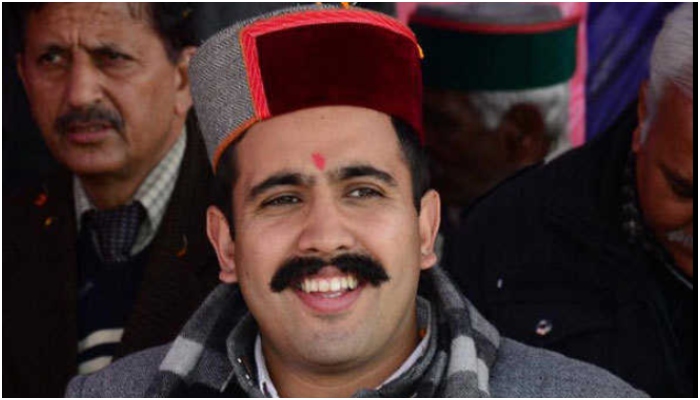
Himachal Pradesh Minister and Congress leader Vikramaditya Singh on Wednesday said that an order related to the mandatory display of outlet owner’s details has been issued during a joint meeting with the Public Works Urban Development and Municipal Corporation, adding that every shopkeeper and street vendor has to display their identification.

“We did a meeting with the UD (Urban Development) and the Municipal Corporation. To make sure that hygienic food is sold, a decision has been taken for all the street vendors… especially those selling edible items,” Vikramaditya told reporters on Wednesday.

He further said that the people had expressed their concerns and doubts over the hygiene of the food sold on the streets.

“People expressed their concerns and doubts, and considering this, we have decided to implement a similar policy to that in UP, in which it has been made mandatory that vendors have to display their names and IDs… Every shopkeeper and street vendor has to display their identification,” he added.

Earlier today, Vikramaditya Singh also announced the development through a Facebook post and said that the decision was taken during a joint meeting with the Public Works Urban Development and Municipal Corporation.

“In Himachal, every restaurant and fast food outlet will be required to display the owner’s ID to ensure that people face no difficulties. Instructions for this have been issued in the Urban Development and Municipal Corporation meeting held yesterday,” Singh wrote in a Facebook post.

This comes after, the Uttar Pradesh government on Tuesday directed that the name and address of operators, proprietors, and managers should be mandatorily displayed at all food centres.

CM Yogi also directed that chefs and waiters should wear masks and gloves, besides making the installation of CCTV cameras in hotels and restaurants mandatory.


(This news report is published from a syndicated feed. Except for the headline, the content has not been written or edited by OpIndia staff)

SC cautions against biased oral observations after HC judge’s remarks – something that should have also been done when Nupur Sharma was humiliated by its own judges

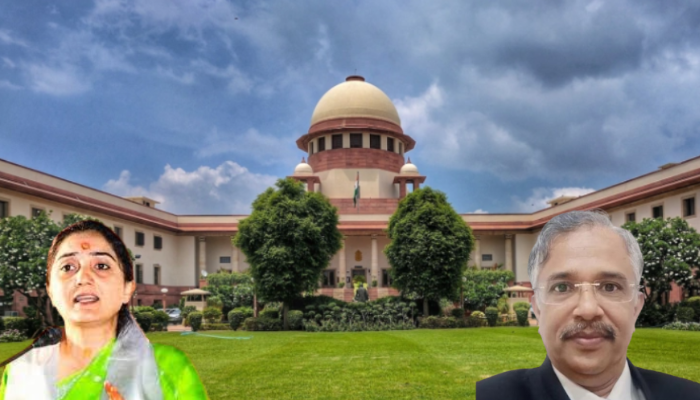
“Casual observations may well reflect a certain degree of individual bias particularly when they are likely to be perceived as being directed against a particular gender or community. Courts therefore have to be careful not to make comments in the course of judicial proceedings which may be construed as being misogynistic or prejudicial to any segment of our society,” was what the Supreme Court observed on 25th September to the remarks made by Justice Vedavyasachar Srishananda of the Karnataka High Court.

Justice Vedavyasachar Srishananda of the Karnataka High Court had referred to the Muslim-majority Gori Palya area in Bengaluru as “Pakistan” and passed a misogynistic statement during a hearing on 28th August after which he was rebuked by the 5-judge bench comprising Chief Justice of India DY Chandrachud, Justices Sanjiv Khanna, BR Gavai, Surya Kant and Hrishikesh Roy. Notably, the apex court further stressed the importance of decorum and restraint from judges in the digital age when court proceedings are live-streamed and observed.

The court highlighted, “Casual observations may well reflect a certain degree of individual bias particularly when they are likely to be perceived as being directed against a particular gender or community. Courts therefore have to be careful not to make comments in the course of judicial proceedings which may be construed as being misogynistic or prejudicial to any segment of our society.” 

The court clarified that such comments could be interpreted unfavourably which would affect the court of the judge as well as the larger legal system. Furthermore, the highest court closed the proceedings while it expected and hoped that “the demands which have been placed on all stakeholders in the judicial system in the electronic age would elicit appropriate modulation of behaviour both on the part of the bench as well as the bar.”

The court further noted, “The heart and soul of judging is the need to be impartial and fair. Intrinsic to that process is the need for every judge to be aware of our own predispositions because it is only based on such awareness that we can truly be faithful to the fundamental obligation of the judge to deliver objective and fair justice. We emphasise this because every stakeholder must understand that the only values which must guide judicial decision-making are those which are enshrined in the Constitution of India.” The case was closed after the judge apologised.

The Supreme Court observations are certainly refreshing given that there have been times when the observations and oral remarks made by judges have exceeded the judicial brief and travelled to the realm of prejudicial. However, while the High Court judge has offered his apology after the Supreme Court took suo motu cognizance of his remarks, one has to wonder who will impress upon the highest court in the country, that oral observations that have in the past emanated from the Supreme Court in certain cases have been prejudicial, biased and caustic.

Supreme Court’s apathy towards Nupur Sharma

On one hand, the Supreme Court cautioned judges to refrain from making inane remarks that are detrimental to any community, on the other, some of its venerated justices indulged in the same in the past when they blamed former Bharatiya Janata Party spokesperson Nupur Sharma for provoking Muslims, holding her accountable for the brutal murder of Kanhaiya Lal – beheaded by jihadis for supporting her.

Nupur Sharma submitted a petition with the Supreme Court in 2022, requesting that all of the First Information Reports (FIRs) filed against her from various states be transferred to Delhi for additional inquiry as her life was constantly under threat. Her request was, however, met with a verbal assault and shocking responses from the justices, who now want to appear impartial and just.

Justice Surya Kant then referred to her as arrogant as the supreme court, which swears by the constitution and stands for everyone’s right to free speech, held her “loose tongue” responsible for the violence perpetrated by the radicals in the nation. The court wanted her to apologize to the country and mocked, “They must be red carpeting you,” when informed that she was cooperating with the inquiry.

“Sometimes the power goes into the head. People think that I have backup and say anything,” Justice Surya Kant further slammed her while Justice Jamshed Burjor Pardiwala alleged, “The statement of Nupur Sharma was responsible for the unfortunate killing in Udaipur.” The justices who should have stood with the aggrieved party opted to condemn her and tacitly side with the Islamists who were wreaking havoc on the streets.

Nupur Sharma was regularly receiving death, beheading and rape threat by Islamists and many Hindus who supported her were mercilessly killed by the jihadis after she responded to a fellow panellist Tasleem Ahmed Rehmani’s disparaging statements against the Shivling and Hindu faith during a debate show.

Surprisingly, the Supreme Court preferred to consider the matter in isolation and made no notice of Tasleem Rehmani’s provocation. The bench resolved to place all the onus of occurrence on Nupur Sharma and asked, “What is her business to make these remarks,” and added, “She should have gone to the TV and apologised to the entire nation,” when the bench was told that she had already withdrawn her comments and apologised for them.

It is worthy to be mentioned here that Nupur Sharma did not make hateful remarks, as insinuated by the judges of the Supreme Court. Sharma only mentioned what has been written in the Hadits – as affirmed by several Islamic scholars across the world. In fact, the very same assertions about Prophet Mohammad have been made by Zakir Naik himself – who is a fugitive but is considered an Islamic authority by the Muslims.

The court also ruled that since Nupur Sharma mentioned “if she had hurt any sentiments,” her withdrawal was conditional and too late. Her apology, in contrast to Justice V Srishanandan’s, was characterized as being too little, too late and was treated further with disdain. “The way she has ignited emotions across the country. This lady is single-handedly responsible for what is happening in the country,” Justice Surya Kant pronounced.

Moreover, Nupur Sharma’s attempt to safeguard herself from the fanatics was viewed as an act of arrogance. “The petition smacks of her arrogance, that the magistrates of the country are too small for her,” the Supreme Court conveyed and reiterated, “If you are a spokesperson of a party, it is not a license to say things like this.” In simple terms, Nupur Sharma was found guilty of blasphemy by the Supreme Court of India, thereby approving the calls from the Islamists for her execution and murder.

The lofty rhetoric about being unbiased and diligent in the age of media scrutiny was all but forgotten in the sensitive case of Nupur Sharma when the victim was portrayed as the offender by the highest court that yielded before the Islamic zealots. An innocent woman was almost thrown to the wolves without a second thought by the temple of justice which suddenly seemed quite concerned about the judiciary’s reputation and projection in the media as well as adhering to the Constitution.

The court remarked, “All parties, judges, lawyers and litigants must be aware that proceedings reach audiences who are well beyond the physical precincts of the court and thus all must be aware of the wider impact of observations on the community at large. As judges, we are conscious of the fact that each individual has a set of predispositions based on early or later experiences of life,” during the recent hearing. Unfortunately, the sentiment seemed to have been lost in relation to Nupur Sharma and hence the distressed woman endured such a harsh reaction from the court.

Justice Vedavyasachar Srishananda apologised

The bench headed by Chief Justice of India (CJI) DY Chandrachud informed that Justice V Srishanandan had apologised for his remarks after the Supreme Court intervened over the viral video recordings, and decided not to pursue the case any further. The court previously underlined its dissatisfaction with the judge’s remarks that were directed towards a particular gender and community, stating that such remarks should be avoided.

The bench pointed out, “The perception of justice to every segment of society is as important as the rendition of justice as an objective fact. Since the judge of the Karnataka High Court is not a party to the proceedings, we desist from making any further observations, saving except to express our serious concern about both the reference to gender and to a segment of the community. Such observations are liable to be construed in a negative light, thereby impacting not only the court of the judge who expressed that but also the wider judicial system.”

The bench observed that the judge’s declaration of remorse, which was made in open court on 21st September following the Supreme Court’s suo motu cognizance, was taken from the Report of the Registrar General of the High Court. “You can’t call any part of the territory of India as Pakistan. It is fundamentally contrary to the territorial integrity of the nation. The answer to sunlight is more sunlight and not to suppress what happens in court. The answer is not to close it down,” CJI DY Chandrachud stated earlier during the hearing.

The petition brought before the court on a suo motu basis concerned the widely circulated recordings of Justice V Srishanandan of the Karnataka High Court’s contentious remarks during a landlord-tenant conflict. He was seen calling a Muslim-dominated region of Bangalore “Pakistan” in one video and offensive comments to a woman advocate in a matrimonial dispute in another video. He claimed that she seemed to know a lot about the other side and that might even be able to tell the colour of their undergarments.

On 20th September, the Supreme Court sought a report from the Karnataka High Court’s Registrar General after the footage went viral online. The bench, however, acknowledged the high court judge’s “contrite apology” and declared that the suo motu matter would be closed in the “interest of justice” and “institutional respect” for the high court.

The court concluded, “The learned judge has indicated that certain observations made by him were quoted out of context in the social context, the observations were unintentional and were not intended to hurt any individual or section of the society, an apology is tendered if any individual or section of the society has been directly or indirectly hurt. Bearing in mind the contrived apology which has been tendered by the judge of the high court in the course of the open court proceeding, we consider in the interest of justice and dignity of justice to not pursue the proceedings further.”

The Supreme Court’s observation ensuring that judges be mindful of their oral observations is a welcome one. It is indeed the need of the hour to ensure judges act responsibly when dealing with sensitive cases, however, the highest court of India would also do well to remind its own judges that what is good for the goose, has to be good for the gander. It is time that Supreme Court judges implement the very observations that they have passed in the case of the High Court judge making unsavoury oral observations.

Threatening to exile Hindus out of Mewat? Haryana BJP fumes after Congress MLA Maman Khan, accused of inciting Nuh violence, says he has a ‘list’

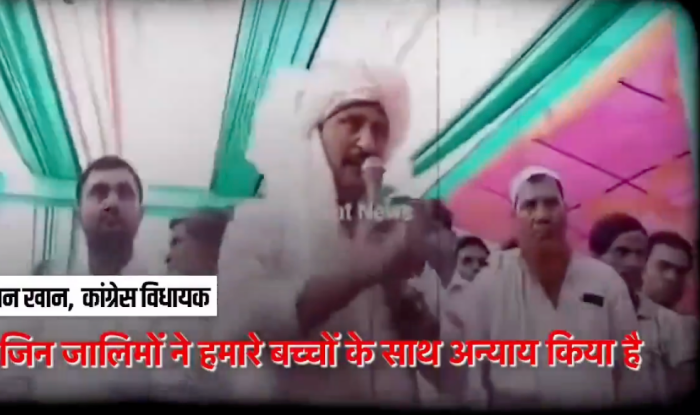
During the assembly election campaign, Maman Khan, the controversial Haryana Congress MLA, has once again delivered an inflammatory speech. He said that as soon as the Congress government is formed, he will ensure that certain people will have to leave Mewat. During the Nuh riots, the MLA from Ferozepur’s Jhirka assembly seat was accused of inciting Muslims to attack Hindus.

Assembly election in Haryana will take place on 5 October, and the Congress has once again given Maman Khan a ticket from the Ferozepur Jhirka constituency. He travelled to Bewa village for the election campaign. Maman Khan addressed the crowd, warning that some people had done injustice to Mewat’s children. When Congress forms the government, they will be forced to leave Mewat.

Speaking about the anti-Hindu Nuh riots, Maman Khan said: “I know that when this incident happened, the stoves were not lit in many houses. The government put me in jail without any reason, but we should not lose courage. My family and your family are not different. We all have one family. We should not be sad that the stove was not lit in my house, the stove was not lit in your house.”

“My child did not eat roti, your child did not eat roti. Everyone is in pain. Everyone knows. The time will come and the government will be formed. Insha Allah . I know each and every one of those cruel people who have done injustice to our children. I know each and every one of them. I will not spare those who have given the list under any circumstances. They will have to leave Mewat, they will not be able to live here and will have to go out,” Khan continued.

BJP reacts strongly, says Maman Khan is threatening Hindus

The BJP has reacted strongly to the warning given by Maman khan. The party had asked if Maman Khan is threatening Hindus, and has stated that the Congress always plans to create riots. They have highlighted how Maman Khan’s speech sounds like a veiled warning to Hindus, insinuating that they may have to leave Mewat if Congress comes to power.

Haryana BJP wrote on social media, “If Congress comes to power, it will incite riots. If even by mistake Congress gets to form the government, Hindus will have to migrate out of the area.

Meanwhile, the state’s forest minister and BJP leader Sanjay Singh said that if Maman Khan dares, he should try and touch any one person. He demanded that the Election Commission should take note of the warning speech and disqualify Maman Khan.

It is pertinent to recall that on the 31st of 2023, Islamists attacked the Jalabhishek Yatra of Hindus, killing several and injuring dozens of people, including police officials. While Congress and the usual suspects tried their best to put the blame for the violence on VHP and Bajrang Dal, investigations showed that the attacks on the Hindu procession was planned in advance. Maman Khan is facing UAPA charges for inciting the violence. He was arrested on September 14, 2023, and was later granted bail on October 4, 2023 in the Nuh violence cases.

Speaking on Maman Khan’s role, Nuh superintendent of police Narender Bijarniya had then said, “He played an important role in spreading rumours during the Nuh violence and was in touch with some suspects involved in pelting stones and setting vehicles on fire. He has also been accused of paying people to attack the Braj Mandal yatra and create a ruckus.”

Arfa Khanum claims news of Love Jihad, Spit Jihad and Land Jihad are fake; Here are 13 such cases just from past few days

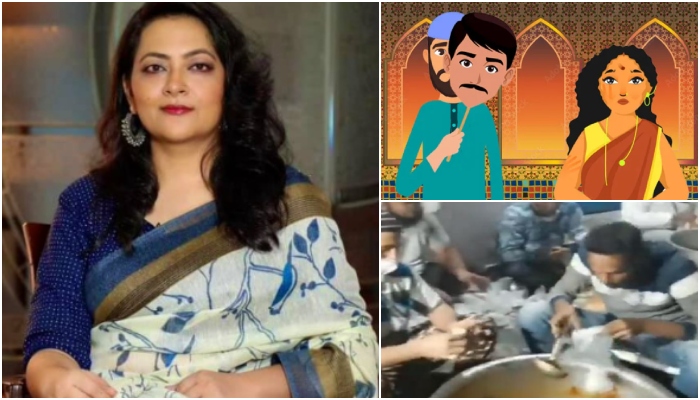
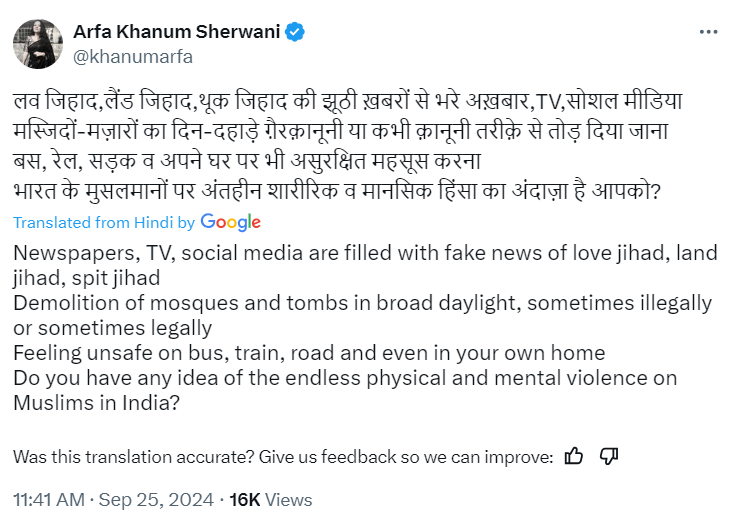
The Wire’s Arfa Khanum Sherwani on Wednesday, 25th September, stated that the incidents of Love Jihad, Spit Jihad, and Land Jihad were fake and that the news mediums and the social media platforms were attempting to spread such fake incidents at a massive level. She also claimed that the minority community in India was surviving in fear and that its members felt unsafe.

“Newspapers, TV, and social media are filled with fake news of love jihad, land jihad, spit jihad Demolition of mosques and tombs in broad daylight, sometimes illegally or sometimes legally Feeling unsafe on bus, train, road, and even in your own home Do you have any idea of ​​the endless physical and mental violence on Muslims in India?” she said on X in a random post.

It is important to note that Sherwani has been habitual in peddling the misleading narrative which believes that the incidents of Love Jihad and Spit Jihad are fake. Many even today consider love jihad a hoax, but several cases continue to be reported almost daily in which Islamist men deliberately trap Hindu women in a love affair and then force them to convert to their religion.

The Islamist men target the Hindu women using fake Hindu identities. Then they sexually assault, and torture them before forcing them to convert their religion to Islam. When the Indian government imposed a ban on the terrorist outfit Popular Front of India (PFI), several incriminating documents were recovered from the PFI hideouts. In one of the documents, it was mentioned that Muslim men would be offered hefty money, a fancy home, and all the required support for trapping Hindu women in a ‘love affair’ and then converting them to Islam.

OpIndia has in the past few years reported several such cases from various parts of the country including Uttar Pradesh, Madhya Pradesh, Maharashtra, Himachal Pradesh, Karnataka, etc. The lives of Hindu women are ruined due to these deliberate trappings, so much so that sometimes they even have to face brutal deaths.

Love Jihad cases in last few days

In one of the recent cases reported on 21st September, the body of a 26-year-old woman named Mahalakshmi was found chopped into around thirty-two pieces and kept inside a fridge of an apartment in Bengaluru’s Vyalikaval. Her estranged husband, Hemant Das, later unveiled that his wife had an extramarital affair, and he believed her lover Ashraf was responsible for the heinous murder. 

According to Hemant Das, the deceased was in a relationship with Ashraf from Uttarakhand and worked at a salon in Nelamangala. He is suspected of his role in the crime. He also mentioned that several months ago, Mahalakshmi had gone to the Seshadripuram police station and submitted a blackmail complaint against Ashraf.

On 22 September, it was revealed that a man named Fahad Hussain trapped a woman after concealing his identity and pretending to be Deepak in Agra, Uttar Pradesh. Later, the girl came to know that his real name is Fahad Hussain. Forced by the circumstances, she embraced Islam and did Nikah with him, all in the name of love. However, Fahad started to force her into prostitution after the marriage. When Fahad married another woman, she protested, and he assaulted her and even tried to kill her. The woman has filed a case against Fahad and her brother

On 23rd September, a man named Fahad Hussain trapped a woman after concealing his identity and later turned her life into a living hell in Agra, Uttar Pradesh. The accused introduced himself as Deepak to the girl and forced her to be in a relationship with her. The girl then was made to embrace Islam before performing Nikah, all in the name of love. However post marriage, Fahad forced her into prostitution.

On 25th September, a Hindu woman filed a complaint in Chhattisgarh saying that one Riyaz, originally from Jammu and Kashmir, befriended her on social media pretending to be Gulshan Manhas, a Hindu. A few months later, the accused married her in a temple as per Hindu customs, but after she had a child with him, he began pressuring her to convert to Islam. He assaulted and threatened her to death when she refused to accede to his demands.

On 22nd September, 32-year-old Mohammad Ziarul from Bihar changed his name to Shankar Yadav to marry a Hindu girl. He hid his identity from the girl and also forced her to convert to Islam. However, the woman learned the truth and complained about the man to the police leading to his arrest. As reported earlier, this was Ziarul’s seventh such marriage.

In a shocking case, a man identified as Mohammad Shehbaz arrested for theft in a train was found to have trapped multiple woman by pretending to be ‘Major Harshit Chaudhary’. After he was caught stealing a bag from Vande Bharat express, his fake ID proof with the name Major Harshit Chaudhary was found, and this led to the revelation of his true identity and his involvement in love jihad cases. During his interrogation, he got a call from his wife, and the police told her that he is actually a Muslim, not Hindu. The woman then filed a complaint against him. It was also found that he was in touch with 24 women through matrimonial sites using his fake identity.

On 16 September, it was revealed that Mohammad Azam Zaidi trapped a Hindu woman by posing as a Hindu and started harassing her after marriage. After a complaint was filed, he authorities registered a case and arrested the accused on 15th September.

Land Jihad

Last week, it was revealed that the Delhi Waqf Board has been laying claim to Hindu temples, DDA offices, DTC bus depots and even MCD garbage dumps as its properties. As per reports, more than 200 properties in Delhi under the control of two different central government agencies had been declared as Waqf properties. This was revealed by Urban Affairs and Road Transport secretaries and Railway Board chairman along with other ministry officials in presentations to the Joint Committee on the Waqf (Amendment) Bill.

Similarly, the Archaeological Survey of India (ASI) made a presentation before the Joint Parliamentary Committee examining the Waqf Amendment Bill, 2024, where it supported the amendment citing its ongoing tussle with Waqf Boards around India over 120 historical monuments. the Archaeological Survey of India gave a detailed presentation in the JPC meeting on issues related to Waqf in protected monuments and sites and explained the problems they are facing with so many historical monuments. They also discussed why the Waqf Board Amendment Bill is necessary.

In Assam earlier this month, a Muslim mob attacked police during the demolition of illegal encroachments in tribal block and belt areas near Guwahati, injuring several cops including a magistrate. In the resultant firing by police, two attackers were killed and some others were injured. It was revealed that encroachers have own land in neighbouring districts, but they had started to settle in the tribal areas in Sonapur area. After locals complained about the same, the administration served them eviction notice. But when they ignored the notices, an eviction drive was launched.

On 21 September, Brihanmumbai Municipal Corporation (BMC) cancelled a to demolish the alleged illegal section of a mosque in Dharavi, after huge numbers of locals gathered on the streets. The local Muslims prevented the administration team from reaching the mosque by blocking the road, and damaged some vehicles. After the trustees of the mosque agreed to remove the illegal construction on encroached public land, the BMC decided to cancel the demolition.

Spit Jihad

On September 13th, the Loni Border police station arrested a 29-year-old juice salesman on charges of putting urine in juice, and his minor companion (15) was also detained. According to ACP Bhaskar Verma, the arrest was conducted in response to a public complaint. People had complained that Aamir, the juice salesman, was offering customers fruit juice mixed with human pee. Verma stated that when police arrived at the scene and inspected his juice cart, they discovered a plastic can full of urine. According to him, the police interrogated Aamir about this, but he couldn’t provide a satisfactory answer.

On 7 September 2024, Yamin’s son Chand was seen spitting on the rotis being cooked at a dhaba in Noida. After the video went viral, police filed a case and arrested Chand. In the video recorded at A-One Dhaba in Rabupura market, Chand was seen spitting on rotis while making them. He was seen spitting on not just one but several different rotis.

Following this, UP Chief Minister Yogi Adityanath also instructed the launch of a statewide campaign to inspect all such eateries and carry out police verification of their employees. As per official sources, the chief minister’s directives were issued during a high-level meeting with senior officials. The chief minister stated that, if necessary, regulations should be revised to ensure the health and safety of the general public.

Adityanath mentioned that reports of human waste and other substances allegedly mixed into food products and juices have emerged from various parts of the country. He described these incidents as ‘repulsive.’ “The names of the owners, managers, and others working there must be prominently displayed at every dhaba, restaurant, and eatery…police verification of all the persons working there must be conducted,” Adityanath said.

He also instructed that CCTVs be installed not only in customer seating areas but throughout other parts of the restaurant.

These are just a few instances of love jihad, land jihad and spit jihad that emerged in the last couple of weeks. Many such incidents go unreported, and some are while reported by local media, they do not reach national media.

Similar comments made by far-leftist propagandist Alishan Jafri

Notably, this is not the first time that such comments have been passed by a leftist terming the cases of love jihad or spit jihad as fake. A week ago, on 17th September, Alt News Co-founder Mohammed Zubair and ‘Journalist’ Alishan Jafri attempted to downplay multiple incidents of love jihad and land jihad as they claimed that these incidents are deliberately given attention by a mob who allegedly doesn’t want the Muslim community to stay in the country. Zubair shared the video of Jafri in which the latter said that incidents of love jihad and land jihad were false narratives.

“First, a false narrative like ‘love jihad, land jihad, and spit jihad’ is started in a small circle, then a campaign is run and later it is converted into a law,” Jafri said while addressing an unknown gathering. He also said that the mob allegedly hating Muslims was also targeting their businesses by spreading a ‘false narrative’ that Muslims spit on the food they sell.

Jafri during his address gave an example of the state of Uttar Pradesh where recently, the Yogi government had asked all the traders to display their names on the shops along with the shop names amid the Kawar yatra. “This was a part of the huge campaign. How would people judge whether the food was pure or impure just by knowing anyone’s name?” Jafri sarcastically indicated in the 11-minute-long video.

He further added that concerted efforts were being made at the organizational and state levels to maintain the communal disharmony within the country. He also called out PM Modi for allegedly making comments against the Muslim community during the elections. “Such statements get converted into a larger narrative against a particular community further provoking hate,” he added.

Obviously, Jafri conveniently left out mentioning that Kawariyas often are sticklers for the type of food they can consume while being on a religious pilgrimage and the growing incidents of Muslim stall owners adulterating the food they served, most notably the Ghaziabad case where Aamir Khan, owner of Khushi Juice Centre, was caught mixing urine with juice he served to his customers.

Conclusion

Leftist Islamists such as Arfa Khanum Sherwani, Mohammed Zubair, Alishan Jafri, and others have dismissed similar occurrences as part of a huge hoax narrative. They have selectively embraced the habit of downplaying events against Hindus, arguing that they pose a threat to India’s minority communities. Aside from rejecting Love Jihad and Land Jihad, leftist Islamists have downplayed the Genocide against Hindus that occurred in Kashmir and Kerala.

The Islamists as mentioned in the incriminating PFI document also mentioned that the extremists want the rule of Islam in the country by the year 2047 when India would complete its 100 years of independence. Moreover, such Islamists who look up to the rule of Islam by 2047 are provided funds from several Islamic countries to propagate the narrative against the majority community in India. Is it the right time to see who is posing a threat to the country’s independence, is it the majority or the minority?