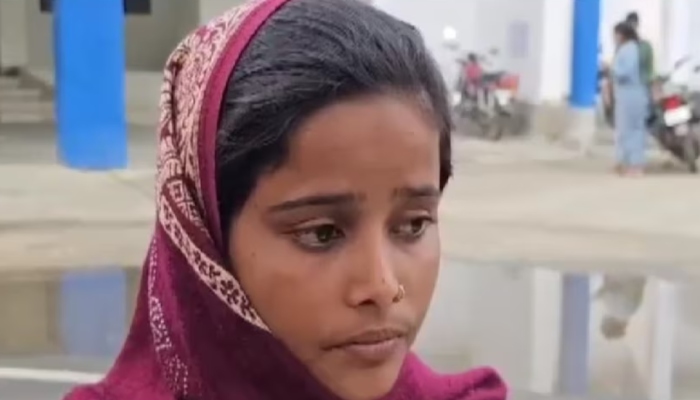
In the Kodarma region of Jharkhand, the police have filed an FIR against an individual named Suleman for allegedly murdering a Hindu man identified as Ghanashyam Das. The accused Suleman is said to have murdered the victim for marrying his niece, Sultana. The FIR in the case was registered on 14th December but it is reported that to date, the police have taken no action in the case.
According to the report by Aaj Tak, Sultana and victim Das were in love. The woman married the latter 3 years after the death of her earlier husband. Sultana was worried about the future of her two kids so she decided to marry Das after falling in love with him.
While the family of the woman had no problem with her second marriage to a Hindu, her maternal uncle, Suleman, had warned her regarding the marriage. He had threatened that he would do something unfavourable to stop the marriage. While the two married without any incident, the accused murdered Das 10 months after he tied the knot with Sultana.
Suleman is said to have spiked drinks offered to Das with poison, after which he immediately passed away. The accused believed that the woman had sinned by marrying a man belonging to the Hindu religion.
The woman has appealed to the police to take strict action against the accused. She said that she expects justice to be delivered to her second husband who was brutally murdered by the accused. The murder is said to be executed on 13th December, and the police filed an FIR in the case on 14th December.
Further investigations into the case are underway.
The news got picked up by various mainstream media giving the impression that all four Shankaracharyas are against the Pran Pratishtha, which is not the case.
The Congress claimed that all four Shankaracharyas – Shankaracharya Swami Shri Avimukteshwarananda Saraswati of Badrikashram Jyotirmath in Uttarakhand, Shankaracharya Swami Shri Nischalananda Saraswati of Purvaamnaya Govardhanmath in Puri, Shankaracharya Swami Shri Bharati Teerth Ji of Sringeri Mutt and Shankaracharya Shri Swami Sadanand Saraswati of Paschimannaya Dwarka Shardapeeth – are opposed to the way the ceremony is being held, and they will not attend the same.
While the Shankaracharyas of Jyotirmath and Puri have indeed said that they will not attend the event, no such announcements were made by Dwarka and Sringeri , but their names were also added in the claims.
Therefore the Dwarka and Sringeri Maths issued statements refuting such claims, and they urged the devotees to celebrate the inauguration of the Ram Mandir in Ayodhya.
Why are Shankaracharyas of Jyotirmath and Puri opposing the ceremony?
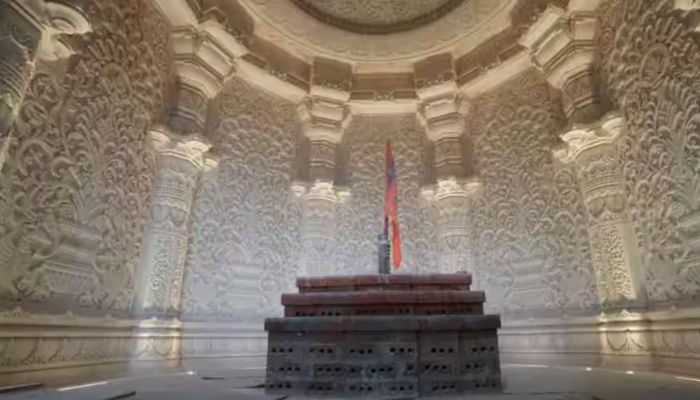
Shankaracharya Swami Shri Avimukteshwarananda Saraswati of Jyotirmath has expressed objection to the Pran Pratishtha on the grounds that the consecration cannot be done until the temple structure is complete as per Hindu scriptures.
Shankaracharya Swami Nischalanand Saraswati Maharaj of Puri has not opposed the event but only said that His decision is rooted in the deviation from the established traditions during the consecration of the Ram Lalla idol.
“The Shankaracharyas uphold their own dignity. This is not about ego. Are we expected to merely sit outside and applaud when the Prime Minister installs the idol of Ram Lalla? The presence of a ‘secular’ government does not imply the obliteration of tradition,” He said.
Some reports also claim that both Shankaracharyas have said that the ceremony is a political one while their statements on record state that their reservation is limited to rituals and traditions.
So is Pran Pratishtha happening as per Shastras or not?
While the subject is being widely debated just 6 days ahead of the Divine ceremony, many experts well-versed with the subject have supported the Pran Pratishtha.
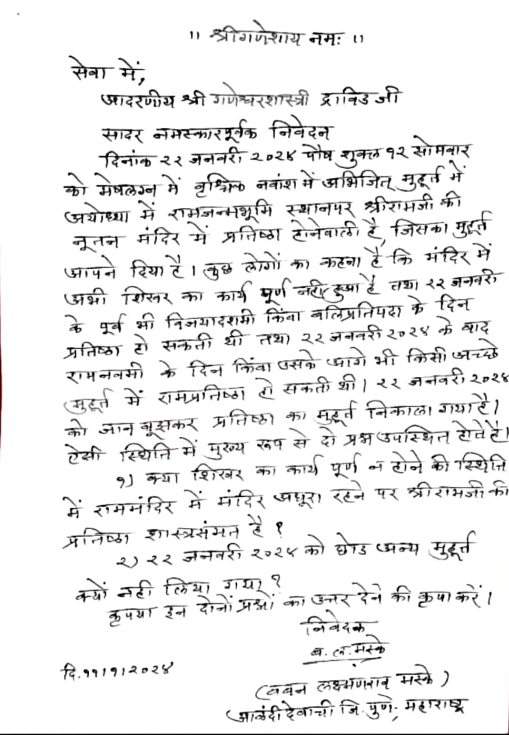
Renowned Hindu astrologist Shri Ganeshwar Shastri Dravid Ji, who has himself identified and scheduled the auspicious time for the Pran Pratistha on 22nd January, had reportedly issued a response to a question in this regard.
Question by Pune-based Baban Lakshmanrao Maske to renowned astrologer Shri Ganeshwar Shastri Dravid Ji
Replying to a query of a Baban Lakshmanrao Maske of Alandi Devachi town in Pune whether Pran Pratishtha can be done without the completion of the shikara (pinnacle), Shri Ganeshwar Shastri Dravid Ji wrote:
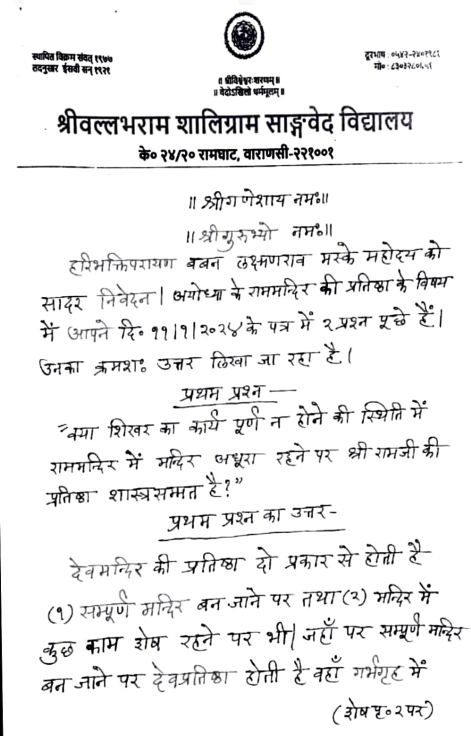
Response by astrologer Shri Ganeshwar Shastri Dravid Ji
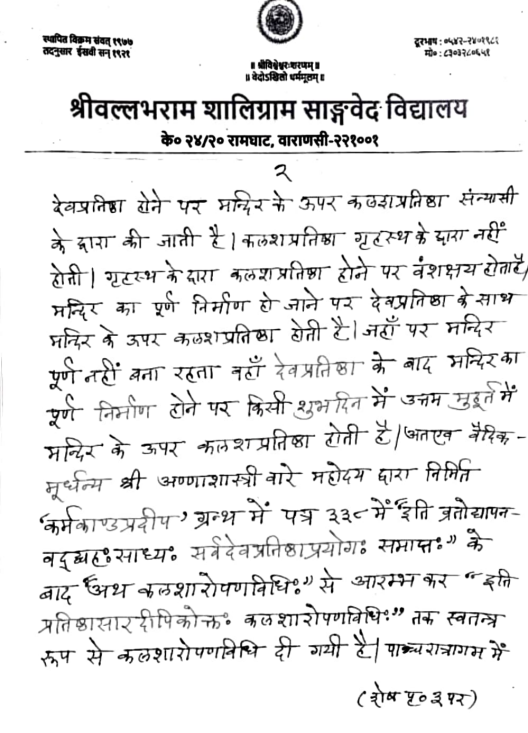
“The pratishtha of the temple of the deity is done in two ways; one, on the completion of the temple and two, on the part completion of the temple. When the Dev (Pran) Pratishtha is done upon the full completion of the temple, then a sanyasi (ascetic) is required to place the Kalash atop the temple. The Kalash Pratishtha is not done by a non-ascetic or a person with family life because, if done so, then the concerned person’s lineage would not be carried forward and will die with him. Once the Mandir is complete, Kalash pratishtha is done along with Dev (Pran) Pratishtha. When the Mandir is not complete, Dev Pratishtha is done there followed by Kalash Pratishtha on the completion of the Mandir as per auspicious time.”
Response by astrologer Shri Ganeshwar Shastri Dravid Ji
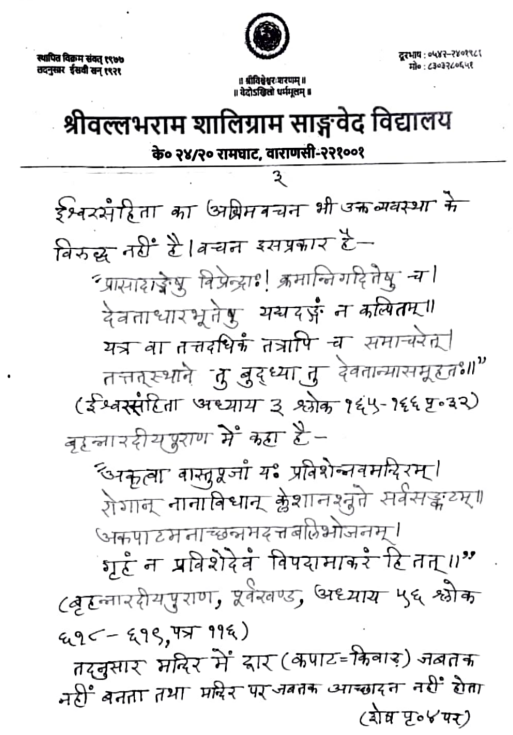
The esteemed astrologer goes on to state citations from a number of Hindu scriptures that approve the Pran Pratishtha so far as certain conditions are met. He further states in his reply:
Response by astrologer Shri Ganeshwar Shastri Dravid Ji
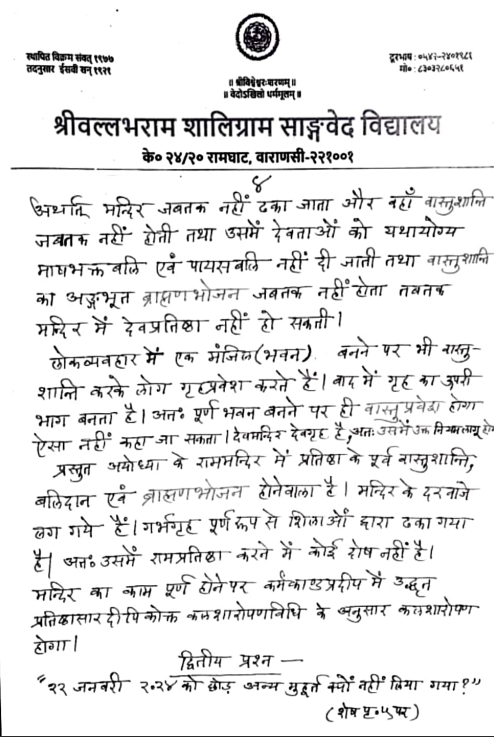
“Accordingly, until and unless the doors of the temple are not built, the temple is not covered, vastu shaanti is not done, Masha Bali and Payasa Bali is not performed and Brahman Bhojan is not performed, Pran Pratishtha cannot happen. As per social requirements, Griha Pravesh is also done when at least one floor of the structure is complete and vastu shaanti is performed. After this, the topmost part of the structure is built. Meaning that it is not necessary that vastu pravesh can be done only when the entire structure is complete. Dev Mandir (temple of the deity) is Dev Griha (home of the deity) meaning the rules of consecration and inaugurating a house will be applied to the temple. Before Pran Pratishtha, vastu shanti, balidaan and Brahman Bhojan will be performed in the Ram Mandir. The doors of the temple have been attached. Which is why there is nothing wrong in performing the consecration. Once the temple is entirely constructed, the Kalash Pratishtha will be performed as per scriptures.”
Response by astrologer Shri Ganeshwar Shastri Dravid Ji
Sanskrit scholar and author Nityānanda Miśra has also supported the evidence cited by Shri Ganeshwar Shastri Dravid and has also cited other scriptures that allow the Pran Pratishtha before the completion of the temple structure.
Citing 161st shloka from chapter 33 titled ‘Linga Lakshanam” from the Hindu book on vastushastra, Mayamatam, Miśra states that if the size of the Shiva Linga idol is large then it should be consecrated where it is dwelling.
He cites that if the temple is half-built then a middle-sized Shiva Linga idol should be placed and when the temple structure is complete then small Shiva Linga should be consecrated by a qualified individual.
“So this is based on applicability. When the Shiva Linga idol will be too big then its consecration cannot be done after the temple structure is complete because how will it be taken through the doors? So its consecration would have to be done before the temple structure is complete,” the author said.
He concluded adding that the discussion on the Pran Pratishtha should be on the grounds of what the scriptures say and the discussion should not end by merely saying that the consecration is against the rituals and scriptures.
Another counter to the reservation that Pran Pratishtha cannot be done until the Ram Mandir construction is complete was delivered by Amit Tripathi, author of the renowned “Shiva Trilogy”.
He stated that in ancient times, temple construction often spanned centuries, emphasizing that the Garbhagriha (sanctum sanctorum) is done then an idol is placed and ‘Pran Pratishtha’ can happen.
Responding to a question over Congress allegations that the Pran Pratishtha is being done in an incomplete temple and the word used by the Congress is ‘Paap’, Amish Tripathi pointed out three major pooja ceremonies that happen.
“I don’t want to comment on politics. But in my understanding, my grandfather was a Pandit in Varanasi, he used to do Pran pratishtha poojas and he was a teacher too at Banaras Hindu University. What I learned from my grandfather was that at the beginning of the construction itself, a major ceremony that happens is to mark out the Garbhagriha (sanctum sanctorum). That’s the first major Pooja and the second is that when the Garbhagriha is complete, then the idol is placed in there and once that is done, ‘Pran Pratishtha’ can happen,” he said.
He emphasized that ancient temples, such as the Kailasa Mahadev temple, often took decades or even more than a century to build. In these cases, the architects knew they wouldn’t be alive to see the completion.
“There are no ancient temples in Northern India as they all were destroyed but you can find them in the South. It’s not about just one temple, it’s about multiple temples in the complex. So the third ceremony is when the entire temple complex gets completed and the main temple spires also get completed, one can perform the ‘Purna Kalasha’ at the top. I am assuming that the Garbhagriha (sanctum sanctorum) is complete. From my understanding, I think Pran Pratishtha can happen,” he added.
Pankaj Saxena, co-founder and Director of Culture Research for Brhat shared extensive information on X, formerly Twitter, in this context. He writes that it is a misconception that Pran Pratishtha of Shri Ram in Ram Mandir cannot be done before the temple is complete.
2. Firstly, the core essence of temple building that one gets from studying any Agama is that the temple is built around the deity, not the other way around. The kṣetra radiates from the brahmasthana which is decided upon the vastupurusha sthapana.
— Pankaj Saxena | पंकज सक्सेना (@PankajSaxena84) January 13, 2024
He says that Hindu scriptures state that the temple is built around the deity and not the other way around. “The kṣetra (area) radiates from the brahmasthana (spot where Deity is placed) which is decided upon the vastupurusha sthapana (installation of the complex).”
He further writes, “Secondly, as the great temple expert, iconographist and Puranic scholar @artist_rama said, prana pratishtha can be done anytime after the garbha-griha is ready. Completion of the entire superstructure is not necessary.”
Saxena states that no Hindu scripture prohibits the Pran Pratishtha before the entire temple is complete. He cited examples given by other X users to say that several Hindu temples in India in the past have been consecrated before the entire structure was complete.
According to Hindu temple architecture expert Ramakrishna Kongalla, it is easier to place the Kalasha (Holy pitcher) atop the topmost roof of the temple if the vigraha (statue) is already placed. Ramakrishna Kongalla is the Assistant Professor in Tourism at the Indian Institute of Tourism and Travel Management, Gwalior.
Saxena listed the names of such Hindu temples which had Pran Pratishtha before the structure was complete. These included Matangeshvara temple in Khajuraho where the Shiva Lingam is much bigger than the temple gates and thus the vigraha was consecrated first and the temple was built around it.
Similarly, in the Bhaskaresvhara temple in Bhubaneswar, the vigraha was consecrated first and temple built around it. The Shri Ulgalanda Perumala temple dedicated to the Trivikrama svaroopa of the deity first had the vigraha consecrated and temple built around it after.
“Rock cut temples are also a testimony to that. Most of the rock cut temples are excavated top down. In that case that part of the temple is built first which is higher, so jagati and adhisthana of the temple emerge later, far after the vigraha emerges and is consecrated,” Pankaj Saxena wrote.
He points out that several such temples built by the Hoysala and Chalukya dynasties have incomplete shikhara to this day but they are active and fully functional temples.
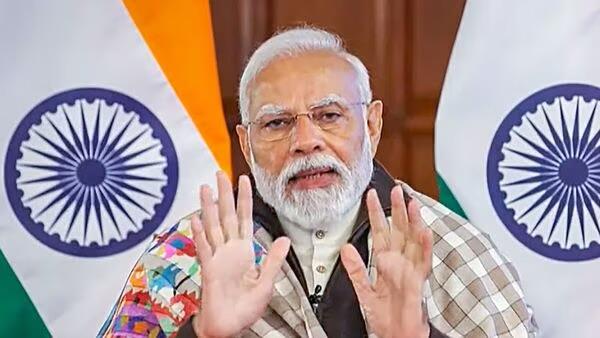
Noting that he had been invited for the ‘Pran Pratishtha’ at Ram Temple in Ayodhya with the blessings of the people, Prime Minister Narendra Modi on Monday said it is natural to remember Mata Shabri when thinking of Lord Ram and that the BJP-led government was laying thrust on the welfare of tribal brothers and sisters.
Speaking at an event in which he released the first instalment to one lakh beneficiaries of Pradhan Mantri Awas Yojana under Pradhan Mantri Janjati Adivasi Nyaya Maha Abhiyan (PM-JANMAN), the Prime Minister said the government schemes should reach the most backward tribal brothers and sisters.
“This is the objective of PM Janman Maha Abhiyan. The government is putting all its efforts into ensuring that every scheme of the government reaches them. Now none of my extremely backward brothers and sisters will be left out of the benefits of the government scheme,” he said.
The Prime Minister spoke of the festivals of Uttarayan, Makar Sankranti, Pongal, and Bihu being celebrated in various parts of the country. He also referred to ‘Pran Pratishtha’ at Lord Ram temple in Ayodhya on January 22.
“There is a festive atmosphere in the country at this time. Uttarayan, Makar Sankranti, Pongal, Bihu…On one hand, when Diwali is being celebrated in Ayodhya, on the other hand, one lakh of my extremely backward tribal brothers and sisters, who are members of my family are celebrating Diwali at their homes, this in itself is a great happiness for me. Today money is being transferred to their bank accounts for a pucca house. I congratulate all these families and wish them a very happy Makar Sankranti,” he said.
“After a few days, on January 22, Lord Ram will also give us darshan in his grand temple and I am fortunate that I have been invited to the ‘Pran Pratishtha’ ceremony at Ram temple in Ayodhya. I have also started an 11-day special ‘anushthan’ ahead of the ‘Pran Pratishtha’ ceremony,” he added.
The Prime Minister said the story of Lord Ram is not possible without Mata Shabri.
He said when Lord Ram left Ayodhya on ‘vanvas’, he left as a prince but he emerged before people as Maryada Purshottam and referred to his meetings with Mata Shabri, Kevat and Nishadraj.
“The story of governance today is not possible without the welfare of the poor, deprived and tribal brothers and sisters. We are working with this thinking. We devoted 10 years to the welfare of the poor and got 4 crore houses constructed for the poor. Those who were never cared for, today Modi cares for them, worships them,” he said.
According to the story of Ramayana, Shabari would pluck berries for Lord Rama. She would pluck one, taste it and, if it was sweet, she would put it in her basket, discarding the bitter ones. She intended to give the good berries to Rama. She didn’t know that offerings must not be tasted. Once Lord Rama arrived at Shabari’s ashram, she offered the fruits to him which Lord Rama ate.
Prime Minister Narendra Modi had said last week that he will commence a special 11-day ‘anushthan’ (ritual) on January 22, the day of the Pran Pratishtha ceremony of the idol of Ram Lalla in Ayodhya’s Ram Temple.
PM-JANMAN was launched for the socio-economic welfare of Particularly Vulnerable Tribal Groups (PVTGs) on November 15 last year on the occasion of Janjatiya Gaurav Diwas.
PM Modi participated in the event through video conferencing and interacted with PM-JANMAN beneficiaries on the occasion.
PM-JANMAN, with a budget of approximately Rs 24,000 crore, focuses on 11 critical interventions through nine ministries and is aimed at improving the socio-economic conditions of the PVTGs by saturating PVTG households and habitations with basic facilities such as safe housing, clean drinking water and sanitation, improved access to education, health and nutrition, electricity, road and telecom connectivity, and sustainable livelihood opportunities.
(This news report is published from a syndicated feed. Except for the headline, the content has not been written or edited by OpIndia staff)
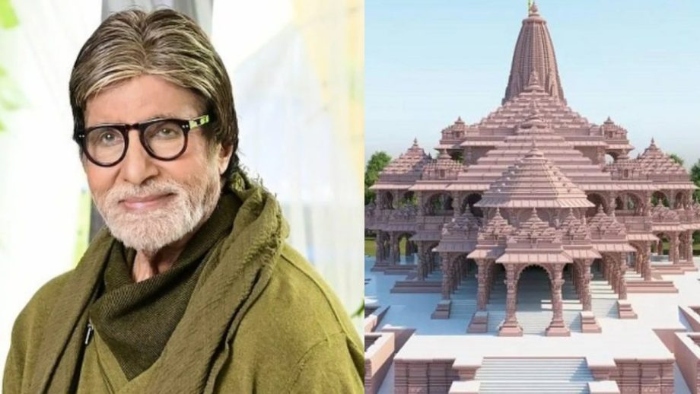
Bollywood megastar Amitabh Bachchan has reportedly purchased a plot in The Sarayu, a seven-star enclave in the holy town of Ayodhya where the historic Ram Mandir is slated to open its doors later this month.
According to reports, the Mumbai-based developer The House of Abhinandan Lodha (HoABL) who is building the seven star enclave has refused to comment on the size and value of the deal citing client confidentiality, however, the real estate industry sources said the plot where Bachchan intends to build a home measured around 10,000 square feet and was valued at Rs 14.5 crores.
Speaking to Hindustan Times, Big B said, “I am looking forward to embarking on this journey with The House of Abhinandan Lodha for The Sarayu in Ayodhya, a city that holds a special place in my heart. The timeless spirituality and cultural richness of Ayodhya have forged an emotional connection that transcends geographical boundaries. This is the start of a heartfelt journey into the soul of Ayodhya, where tradition and modernity seamlessly co-exist, creating an emotional tapestry that resonates with me deeply. I am looking forward to building my home in the global spiritual capital.”
The Sarayu, as per reports, will be launched on January 22, the same day Ram Lalla will be enthroned at the sanctum-sanctorum of the Bhavya Ram Temple after the Pran Pratishtha ceremony.
The project will span over 51 acres and will include residential plots, villas on 31 acres, and even high-rise luxury flats on 15 acres.
Along with the Brookfield group’s Leela Palaces, Hotels and Resorts, the project will also have a five-star palace hotel. The House of Abhinandan Lodha and the Brookfield Group, owners of the Leela Palaces, Hotels & Resorts, have partnered to build an opulent, contemporary palace hotel in Ayodhya.
The luxury hotel in Ayodhya will be part of The House of Abhinandan Lodha’s larger development in the Saraayu Project. It is anticipated that the 100-key luxury hotel in Ayodhya will require an investment above Rs 450 crore and that it will be operational by March 2028.
The hotel in Ayodhya will be spread over a five-acre land parcel and will be developed around the theme of Indian culture and heritage. “This venture not only signifies the transformation that Ayodhya is witnessing but also sets the stage for opulence and hospitality that respects Ayodhya’s rich legacy. As India’s largest branded land developer, we aim to contribute significantly to Ayodhya’s cultural and economic landscape,” Abhinandan Lodha, Chairman, of The Abhinandan Lodha Group, told Economic Times.
Days after West Bengal Police arrested CPI (Maoist)’s West Bengal in-charge Sabyasachi Goswami alias Kishor, the investigation has revealed that the banned outfit is increasing its footprints in Bengal’s minority belt, as reported by The New Indian Express.
As per the report, the outfit is increasing its activities in the minority-dominated pockets of Murshidabad and Nadia districts along with Junglemahal, which is a backward region in the western part of the state. The area had witnessed a bloodbath over a decade ago.
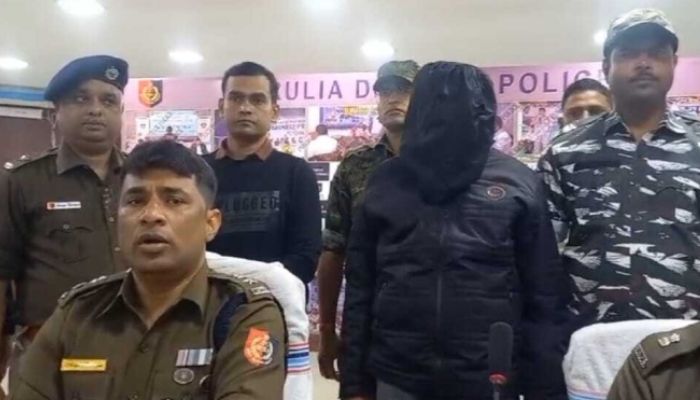
Notably, West Bengal Police on 12th January (Friday) arrested Maoist leader Sabyasachi Goswami alias ‘Kishore Da’. He was carrying a reward of Rs 10 lakh on his head from Purulia district, a senior police officer had said. A few rounds of bullets, one 9mm pistol, and a few documents have been recovered from his possession, the police official added.
The top Maoist leader was also on the list of most wanted fugitives by the NIA and other states’ police for his role in resurrecting Left Wing Extremism in the Assam-Bengal corridor.
The Bengal police after a chase arrested Goswami from Purulia and interrogated him. During interrogation, they learned that the CPI (Maoist) had infiltrated minority communities in Murshidabad and Nadia, which are near the India-Bangladesh border. These are newly added areas to the Maoists’ operational scope since 2019.
As per the police’s investigation, Goswami and his followers used villagers to take refuge and create corridors for the clandestine movement of organisation members.
A Police officer said, “Goswami’s interrogation revealed that the banned outfit has set up a base in many pockets in the two India-Bangladesh border districts, Murshidabad and Nadia, as the Muslims in these areas strongly opposed the CAA. He and his followers managed to take minority villagers into confidence and used many villages to take refuge and as corridors for the secret movement of the operatives of the organisation.”
Under Goswami’s leadership, many frontal organisations like Sangrami Krishak Manch came up to hold mass protests on several local issues, the report added.
The Police revealed that recently, Goswami wrote a letter to an underground operative in which he mentioned the names of a few people who had been tasked to do a secret meeting in the guise of frontal organisations in these districts.
The cop added, “In a recent letter to an underground operative of the outlawed outfit, Goswami also mentioned the names of a few who are assigned to secretly organise open meetings under the banner of frontal organisations in the two bordering districts.”
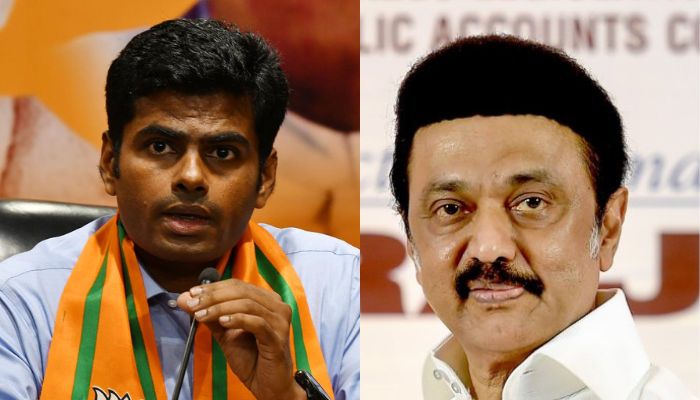
Tamil Nadu BJP president K Annamalai on Monday released the third part of ‘DMK files’ with strong allegations against the opposition’s coalition, INDIA bloc in connection with the 2G scam investigation.
In a post on X, Annamalai claimed that the ruling party in the state, DMK and its alliance partner, Congress purportedly collaborated to strategically decide the timing of CBI raids.
He further accused the DMK and Congress of manipulation to suit the investigative process to their convenience.
The post included an audio conversation allegedly between DMK MP and former Minister TR Baalu and a former chief of Tamil Nadu State Intelligence, MS Jaffar Sait.
“This is one of the many tapes that will expose the corrupt nature of the I.N.D.I. Alliance, which held a different name between 2004-14. #DMKFiles3,” Annamalai’s post mentioned.
“First tape: Conversation between DMK MP & former Min. Thiru TR Baalu & MS Jaffar Sait, a former chief of TN State Intelligence. During the 2G probe, DMK & Congress decided the timing of the CBI Raids, manipulated news deliberately to dilute the probe and fixed the process to suit their convenience,” it further stated.
BJP leader K Annamalai also hinted that more revelations are to be followed in the coming days. Meanwhile, in the 2G Spectrum Allocation case the Delhi High Court is continuing the hearings on the appeals by the CBI and ED against the acquittal of former Telecom Minister A. Raja and others in the case.
Earlier in April 2023, Annamalai in his ‘DMK files part-2’ targeted Tamil Nadu Chief Minister MK Stalin and accused the CM of looting crores of money, allegedly to the tune of Rs 1,30,000 crores from the people.
Later in July 2023, the BJP chief submitted a memorandum to Governor RN Ravi in this regard. In the first part of ‘DMK files’ which was also released earlier in 2023, the BJP chief accused DMK leaders of possessing disproportionate assets.
He also then released a nearly 15-minute video clip “DMK Files (Part-I) ” showcasing the valuation of the assets.
(This news report is published from a syndicated feed. Except for the headline, the content has not been written or edited by OpIndia staff)
A young man’s endeavour to cleverly deceive authorities by posing as his girlfriend turned into a comedic show at an examination centre in Faridkot, Punjab.
On January 7, a multi-purpose health workers exam was conducted by the Baba Farid University of Health Sciences at DAV Public School in Kotkapura. Angrez Singh from Fazilka decided to write the exam by donning the guise of his girlfriend, Paramjit Kaur. Decked out in red bangles, a bindi, lipstick, and a ladies’ suit, Angrez Singh was ready.
Nevertheless, the scene was now primed for Punjab’s most unforeseen comedic performance, as university officials promptly became aware of the ruse and lodged a complaint with the police.
As per the police, Angrez Singh went to great lengths in his attempt, employing counterfeit voter and Aadhar cards to establish his identity as Paramjit Kaur. The scheme appeared flawless until the crucial instance when his fingerprints did not align with those of the actual candidate on the biometric device.
In a regrettable turn of events, the authentic candidate, Paramjit Kaur, had her application rejected by the administration. Simultaneously, legal proceedings have been initiated against Angrez Singh.
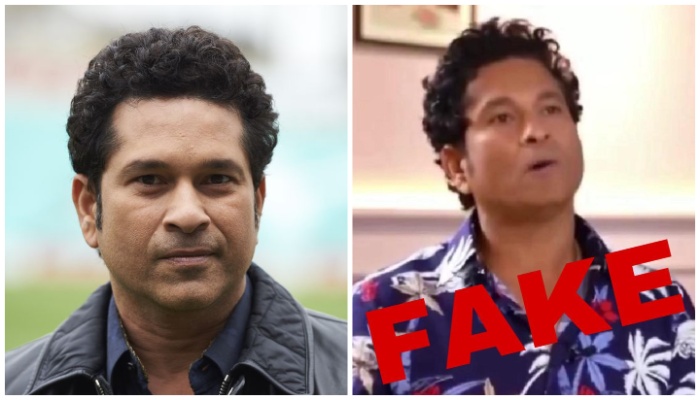
Cricket legend Sachin Tendulkar has become the latest victim of the malicious creation and dissemination of deep fake content. The master blaster on Monday, January 15 took to X to address the disturbing misuse of technology, urging vigilance and swift action against the spread of misinformation as he shared a deepfake video where he can be seen advertising for a gaming app and even advocating for its ability to help people earn money.
Raising concerns over the problems posed by the insidious use of AI tools for image and video editing, Tendulkar wrote, “These videos are fake. It is disturbing to see rampant misuse of technology. Request everyone to report videos, ads & apps like these in large numbers. Social Media platforms need to be alert and responsive to complaints. Swift action from their end is crucial to stopping the spread of misinformation and deepfakes.”
These videos are fake. It is disturbing to see rampant misuse of technology. Request everyone to report videos, ads & apps like these in large numbers.
Social Media platforms need to be alert and responsive to complaints. Swift action from their end is crucial to stopping the… pic.twitter.com/4MwXthxSOM
The deepfake video shared by the cricket icon, featured him endorsing a gaming app called the Skyward Aviator Quest. Not only does Tendulkar appear to be endorsing the app in the video, but he also heard claiming that his daughter Sara is using the app these days and also earning a lot of money through it.
It’s obvious from the video that it was heavily edited to not only look but also sound like the cricket player.
Notably, Tendulkar’s case is not an isolated incident. In recent times, the malicious creation and dissemination of deepfake content, often including pornographic material, has become a potent weapon for blackmail and character defamation. Several celebrities like actors Katrina Kaif, Alia Bhatt and Priyanka Chopra have recently fallen prey to this deepfake menace. The severity of the issue first came to the fore after actress Rashmika Mandana highlighted how she fell victim to this targeted abuse.
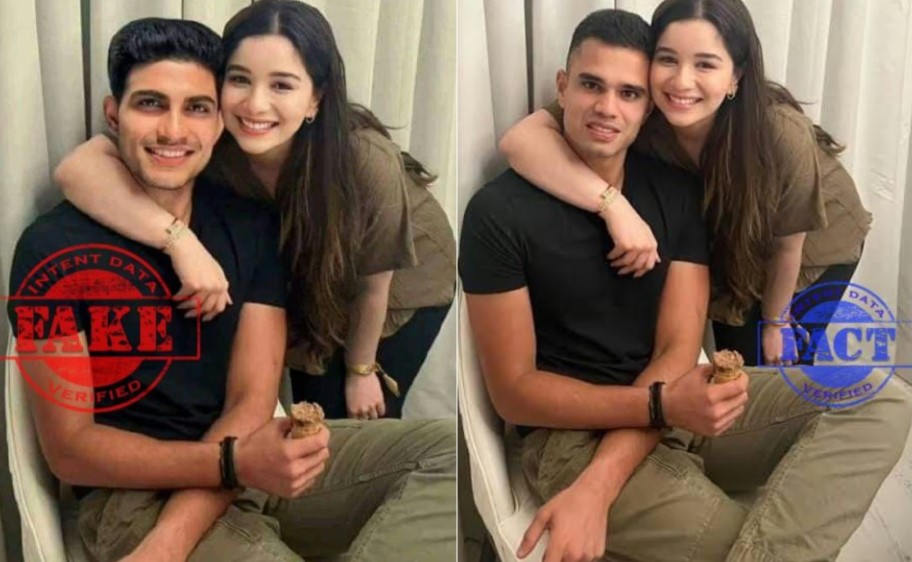
In November last year, the former India cricketer daughter Sara Tendulkar also fell victim to deepfake technology when her morphed picture with rumoured boyfriend Shubman Gill went viral on social media during the ICC World Cup 2023 in November.
The original picture had Sara hugging her brother Arjun Tendulkar but his face was replaced with Gill’s by the person who morphed the picture and posted it online.
Image source: Free Press Journal
What are deep fakes?
Deep fakes, a blend of “deep learning” and “fake,” represent a concerning and rapidly evolving aspect of artificial intelligence manipulation. These sophisticated forgeries use digital software, machine learning, and face-swapping technologies to generate artificial videos that look strikingly similar to original videos of a person or an event. These videos can depict events, statements or actions that have never happened.
The term “deep fake” comes from using deep learning neural networks to swap one person’s face with another, creating a convincing illusion. Deep fakes involve training machine learning algorithms on extensive datasets of images and videos of a target individual. The algorithms analyse and learn the person’s facial expressions, gestures, and vocal nuances, enabling them to superimpose the target’s image onto another person’s body or environment. The results are incredibly realistic, making it difficult for viewers to distinguish the falseness of the content.
In November last year, Prime Minister Narendra Modi highlighted the threats of deep fakes in new-age digital media content. “I recently saw a video in which I was seen singing a Garba song. There are many other such videos online,” said PM Modi adding that the looming threat of Deepfake has become a great concern and can create a lot of problems for all of us.
On 7th November, the Ministry of Electronics and Information Technology of India (MeitY) issued an advisory to the social media companies. The ministry reaffirmed the existing guidelines. There are three main laws and guidelines that are in place for such fake videos. The first is Section 66D of the Information Technology Act, 2000 and the second is Rule 3(1)(b)(vii) of IT Intermediary Rules 2021, and the third is Rule 3(2)(b) of the IT Intermediary Rules 2021.
The Centre also said that the creation and circulation of Deepfakes carry a strong penalty – Rs 1 lakh in fine and three years in jail.
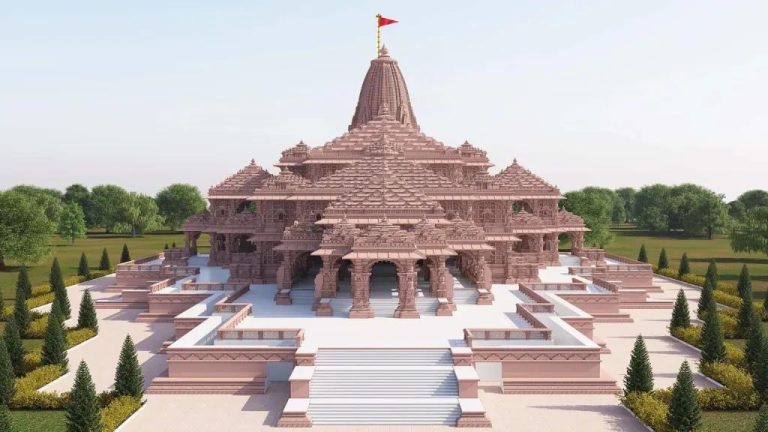
Preparations are underway for the auspicious Ram Mandir Pran Pratishtha in Ram Nagri, Ayodhya Dham, on 22nd January 2024, which is just a week away. Along with the festivities and rituals, the country is also paying homage to countless unsung Ram Bhakts who sacrificed their lives to reclaim the revered birthplace of Shri Ram in the five centuries-long drawn struggle.
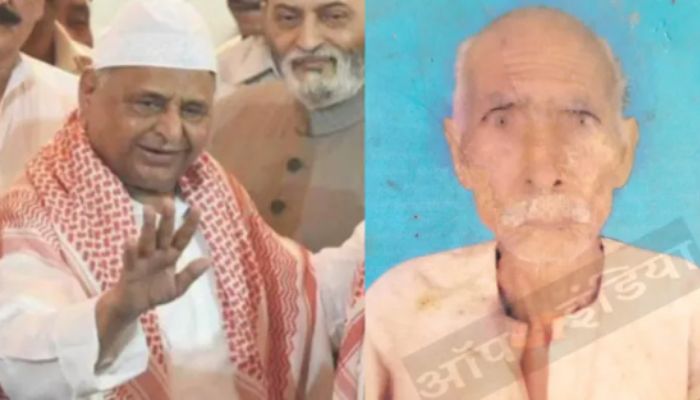
During ground reporting in Ayodhya, the OpIndia team learned that the first massacre at the hands of the police in the Mulayam Singh regime took place 8 days before 30th October 1990. Evidently, on 22nd October 1990, the police, who had gone to raid based on information about Kar Sevaks being present, opened fire in a village in Basti district near Ayodhya. In this indiscriminate firing, three Ram Bhakts from the village lost their lives, while many others were injured.
Ram Chander Yadav was the first martyr in the massacre that took place on 22nd October 1990. The in-charge of the Duboulia police station received information about the presence of Kar Sevaks in the village of Sandpur. Their informant had informed the police that the Kar Sevaks gathered in the village were planning to march towards Ayodhya. The police surrounded the village. In an atmosphere filled with devotion to Ram Lalla, people from the village of Sandpur and surrounding areas gathered in protest against the police action targeting Ram Bhakts. During the protest, the police took orders from higher-ups and opened fire on the villagers.
We visited the home of the martyr Ram Chander Yadav to gather information about their current situation.
The victim Ram devotee Ram Chander was a minor
Ram Chander Yadav was originally from the village Barasana Tedhwa in the Basti district. This area falls under the jurisdiction of the Duboulia police station. The Sarayu River is located approximately 1 kilometer away, and its other bank touches the boundary of Ayodhya city.
When we reached Ram Chander’s house, his brother Ramnath Yadav was present there. Ramnath Yadav mentioned that Ram Chander Yadav was the third among five brothers. He told the OpIndia team that Ram Chander was around 16 years of age when he was fatally shot on 22nd October. The surviving brothers managed to overcome the sorrow in their own ways, engaging in various small jobs to sustain the family.
Thatched and Unplastered House
Ram Chander Yadav’s surviving family is living in a state of extreme poverty. Their house is divided into two parts. The first part is thatched, and the second part consists of a section of a Pucca house, which lacks both flooring and plaster. For agricultural activities, the family took a loan and acquired a tractor-trolley. Now, at nearly 60 years old, Ramnath Yadav shared that, in the sorrow of losing his son, his father Ram Narayan Yadav had lost his life, and a few days later, his mother also passed away.
According to Ramnath, his brother Ram Chander had just started helping them manage expenses for household activities when he became a victim of police bullets during the Mulayam government.
He was shot in the head
Ram Chander Yadav was a staunch devotee of Lord Ram and Mahadev Shiva. Ramnath Yadav became emotional while recalling the incidents that transpired on 22nd October 1990. He said that villagers had gathered near a field against the excesses of the policemen targeting Ram devotees. During this time, the police surrounded them, and without warning, opened fire on the villagers. In this indiscriminate firing, Ram Chander Yadav was hit and he fell into the fields. He wasn’t provided with any medical treatment. Due to being shot in the head, Ram Chander couldn’t survive for long, and in a short while, he breathed his last.
Raids were conducted to nab the remaining brothers
Ramnath Yadav told the OpIndia team that during the firing, it was chaotic, and it wasn’t clear who went where. After the police left, people started searching for their relatives and family members. Ram Chander didn’t return home. Family members learned about Ram Chander being shot in the firing. After some efforts, they found out that Ram Chander’s body was kept at Basti District Hospital. The family was about to leave to collect the body when the police team again raided the village.
During the raid, the police also tried to apprehend the remaining brothers of late Ram Chander. Fearing the police excesses, the remaining brothers of the victim also left the house and ran away. Consequently, only Ram Chander’s old father and mother were left in the house. According to Ramnath, there was such fear of the police at that time that the other young members of his Yadav-dominated village also left their homes and hid somewhere.
The dead body was not allowed to enter the village
Speaking with the OpIndia team, Ramnath recalled that 22nd October 1990 was the most difficult time for his family. He added that when the remaining brothers and well-wishers of the village fled away fearing a police raid, his old parents somehow had to go to Basti, about 50 kilometers away. At that time even vehicles were not running due to strict police security. Even Ramnath doesn’t know how his father Ram Narayan Yadav along with his wife reached the dead body of his brother.
When Ram Narayan Yadav reached Basti Hospital with his wife, he was told that his son’s body was lying in the postmortem house. When he reached there, Ram Narayan saw a heavy police force deployment. When his wife started crying after seeing her son’s dead body, the police stopped her.
Ram Narayan received clear orders that he could not take his son’s body to the village under any circumstances. The father of the deceased pleaded for cremation as per Hindu rituals but the then authorities did not budge.
Ultimately, the cremation of Ram Chander Yadav took place at the cremation ground on the banks of the river in the city, a short distance away from the Basti District Hospital. During this period, apart from the old parents, a heavy police force remained deployed. Ram Chander’s family returned to their village empty-handed at night. Due to the remaining sons absconding out of fear of the police, the other posthumous rites of Ram Chander also took a long time.
Couldn’t keep even a single picture
Other members of the family also have resolute faith in Sanatan Dharma. Ramnath Yadav mentioned that they are very happy with the construction of Lord Ram’s temple in Ayodhya. Unfortunately, according to Ramnath, they couldn’t save even a single picture of his brother. As per Ramnath, there was limited use of cameras and other facilities in 1990, and because of their poor economic condition, they couldn’t take photos, and towards the end, the entire family had to flee due to police actions.
Ramnath wishes that his brother Ram Chander should also be remembered during the construction of the Ram Mandir in Ayodhya. His family wishes that the government should build a memorial of Ram Chander Yadav in Ayodhya.
Approximately 74 per cent of surveyed Muslims express satisfaction with the ongoing construction of the Ram temple in Ayodhya, a recent survey by two groups revealed. Most respondents believe this construction project will contribute to fostering closer ties between Hindus and Muslims.
As per the survey findings, a majority of Muslims assert that the Supreme Court decision in 2019 has fortified democracy, and they feel that the community is more secure under the leadership of Prime Minister Narendra Modi.
The Ram Jan Survey was collaboratively carried out by the Ayurveda Foundation Charitable Trust and the Muslim Rashtriya Manch (MRM), a Muslim advocacy group affiliated with the Rashtriya Swayamsevak Sangh (RSS).
Providing insights into the survey with this publication, Shahid Sayeed, the national executive member and the individual overseeing national media for the Muslim Rashtriya Manch, revealed that a significant number of Muslims acknowledged that Modi has enhanced the nation’s global standing, emphasizing the need to prevent disruptive forces from tarnishing Islam’s reputation.
“The survey aimed to gauge the perspectives of Muslims on topics such as Sri Ram/Jai Siya Ram/Maryada Purushottam and the sentiments of the Muslim community towards the Modi government. Additionally, the survey examined the accuracy and fairness of portraying Muslims and Islam in public discourse,” stated Shahid Sayeed.
He added, “Approximately 70 per cent of those surveyed expressed confidence in the Modi government, with 72 per cent of Muslims acknowledging a perceived lack of substantial concerns from the Opposition.”