Home Blog Page 139

From Purnia to Darbhanga, Hindu faith under attack as Islamists try to incite and create unrest ahead of Bihar Vidhan Sabha election

As the Bihar Assembly elections approach, certain elements are making efforts to vitiate the atmosphere. Their aim is evident: to divide the society, instigate discord between Hindus and Muslims and exploit this for vote-bank politics. Two recent events in Purnia and Darbhanga illustrated how some individuals are trying to provoke religious sentiments by stirring tensions.

The defacement of the Goddess Durga idol in Purnia and the dispute regarding the immersion of the idol of Baba Vishwakarma in Darbhanga have pointed out that peace and harmony in Bihar are under threat. We will look into these occurrences and understand how they are nothing but a tool to gain political advantage.

Attack on idol of Goddess Durga

The destruction of the Goddess Durga idol at Majgama Haat in Purnia incited widespread outrage in the area. These idols were in the process of being created for Durga Puja, a significant holy festival for the Hindu community. On the morning of Friday, 19th September, people noticed the damage and their anger boiled over.

Locals detained a Muslim youth accused of vandalization. The furious crowd assaulted him, tied his hands with a rope, blocked the road and began arson. The situation escalated to the point where authorities had to intervene. They managed to save the young man from the mob and secured him in a government facility.

However, the enraged mob also turned against the cops. This event led to a tense environment in Purnia. The residents flooded the streets, setting tires ablaze and the police faced challenges in restoring order. Nonetheless, the pressing question remains: why did this happen? Was it merely the action of a person or was there a meticulously designed conspiracy at play?

Chaos over idol immersion in Darbhanga

An unrest erupted regarding the immersion of the idol of Baba Vishwakarma in Kataharia village located within the jurisdiction of the Singhwara police station in Darbhanga. This marked the inaugural celebration of Baba Vishwakarma Puja in the village. A procession was organized for the immersion, however, some persons raised objections and halted the procession from traversing their village.

This led to a charged atmosphere as locals asserted that the procession adhered to the approved route, yet the protest erupted unexpectedly. The authorities attempted to manage the situation. The Sub-Divisional Magistrate (SDM) and Sub-Divisional Police Officer (SDPO) arrived at the apot with a substantial police presence but their efforts were ineffective.

The administration eventually had to alter the procession’s route to prevent further disputes. Consequently, the idol was transported for immersion via the Gaighat police station area in Muzaffarpur district which was a longer path. This incident provoked the ire of the local populace. A young man remarked, “We offer juice during their festivals but today the route of our sacred event was blocked.” It is apparent that the religious sentiments of the people have been wounded, leading to anger.

What is the motive behind these incidents

Upon reviewing these two incidents in Bihar, it is evident that there is a deliberate attempt to disturb the atmosphere prior to the Bihar Assembly elections. The instances in Purnia and Darbhanga are not coincidental. Both events have provoked religious sentiments and their timing appears to be meticulously orchestrated.

Major festivals like Durga Puja are approaching in the state with the assembly elections likely to follow soon after. Hence, some individuals are attempting to incite tension between Hindus and Muslims, thereby polarizing the voting demographic. Voter polarization is a well-established aspect of Bihar’s political dynamics.

Certain parties, particularly those that profess to be supportive of Muslims such as the Rashtriya Janata Dal (RJD) and All India Majlis-e-Ittehadul Muslimeen (AIMIM) intend to capitalize on such incidents. Their goal is to unify Muslim voters and convey that the Bharatiya Janata Party (BJP)-Janata Dal United (JDU) alliance is against their interest.

Development vs political conspiracy

The timing of the Purnia incident is particularly significant. Prime Minister Narendra Modi recently unveiled projects totaling ₹40,000 crore there. Initiatives related to trains, airports and other development projects were inaugurated. Bihar is swiftly advancing along the path of development. The BJP-JDU coalition government has made efforts to improve law and order while fostering development. Nevertheless, as discussions about development intensify, few elements tried to disrupt the peace and harmony.

The Mahagathbandhan believes that it is unable to confront the NDA on the plank of development. Therefore, it seeks to provoke religious and communal problems. The events in Purnia and Darbhanga serve as exmaples of the same. Incidents such as the vandalism of idols and the obstruction of idol immersions stir public emotions and propagate animosity within society. As a result, the focus shifts away from development, prompting individuals to become mired in emotional issues.

Strategy to vitiate the atmosphere before the polls

All communities in Bihar coexist and participate in each other’s festivals. So, why are such incidents taking place? It is evident that this is a ploy by certain individuals aiming to divide society. The residents of Bihar, regardless of being Hindu or Muslim, uphold values of peace and fraternity. However, some political factions want to disrupt this unity for their own gain.

A similar scenario was observed in Darbhanga. A young man remarked that he takes part in the festivals of the Muslim community, so why was route to his festival obstructed? This question lingers in the minds of all Biharis. People recognize that this is merely a component of a political strategy.

Such events are expected to escalate prior to the assembly elections in Bihar. Additional controversies may arise concerning idol immersion during significant festivals such as Durga Puja. The objective is to create a rift between Hindu and Muslim voters. Certain parties aim to consolidate Muslim voters in their favor. This type of political ploy poses a threat to the development and peace of Bihar.

The occurrences in Purnia and Darbhanga are manifestations of a conspiracy intended to poison the atmosphere leading up to the Bihar elections. These incidents are a strategy to split society and polarize the votes. However, the people of Bihar are discerning. They understand that their true priorities are development, employment and peace. It is crucial for us to recognize these political gameplans and come together to advance the state. The strength of Bihar is rooted in its peace and harmony which cannot be shattered by anyone.

Who was Zubeen Garg, why lakhs of people are paying him last respect: Read about Assam’s biggest cultural icon who left this world too early

Guwahati on Sunday witnessed an unprecedented scene, lakhs of people lining up on the both sides of the road from the airport to the city. Everyone just wants to do one thing, to catch a final glimpse of the man whose voice had been the soundtrack of their lives. Thousands of people surrounded the vehicle transporting the mortal remains of singer Zubeen Garg to his residence in Kahilipara, creating a massive unannounced procession, and slowing down the schedule by several hours.

52-year-old Zubeen Garg – a singer, composer, actor, filmmaker and activist, and Assam’s biggest cultural icon – died suddenly in Singapore on Friday. He was vising Singapore to attend the North East India Festival, which now has been called off. On Friday, he had gone on a yacht tour along with around 18 people. They stopped the vessel at a place and jumped into the water to swim. Zubeen was initially wearing a life jacket, but later took it off as it was not fitting properly. During the second swim without the jacket, he became motionless, and the yacht crew immediately rescued him.

He was administered CPR on the yacht and at the port after returning, but was not successful. He was then transferred to Singapore General Hospital and admitted to ICU. But as he was not responding, he was declared dead.

What followed was an outpouring of emotion and grieve, and sent shockwaves through Assam. The tragic demise brought Assam to a standstill, markets were shuttered on Saturday, a three-day state mourning was declared, half-yearly exams postponed, spontaneous candle-light processions were held, and people are lighting diyas in front of Garg’s portrait at every street corner in every city, town and village in Assam.

This is no ordinary farewell; this is a testament to a cultural icon whose absence has carved an irreplaceable void in the heart of every Assamese.

Singapore authorities conducted an autopsy yesterday and handed over the mortal remains to Zubeen’s friends and colleagues accompanying him. The mortal remains was flown to New Delhi, from where it was transported to Guwahati. CM Himanta Biswa Sarma reached Delhi last night to supervise the entire process.

It was earlier announced that Zubeen Garg will be taken to his residence in the morning, from there he will be taken to Sarusajai Stadium where people will be able to pay him last respect from 9 am till 7 pm. But, the presence of lakhs of people at the airport and on the road leading to his stadium meant that the entire schedule had to be tossed away, as the convoy reached the residence well pass 12 in the day.

The sea of people gathering to pay the last respect to Zubeen Garg shows who he was form them, a living symbol of their language, culture, emotions and aspirations. For people outside Assam and mainstream media, he may be the mere ‘Ya Ali’ singer, but for people of Assam, he was the most consequential cultural figure to emerge in the state in the last three decades.

Zubeen Garg was more than a singer, he was the soul of Assam, a bridge between tradition and modernity, and a fierce advocate for his homeland’s identity. Over his career spanning over three decades, he sang thousands of songs, composed music for films in multiple languages, acted in and made films, and released poetry and books – a genuinely multi-disciplinary artist.

From Humble Beginnings to the Heartbeat of Assam

Born Zubeen Borthakur on April 18, 1972, in Tura, Meghalaya, to a family deeply immersed in the arts, Zubeen’s early years were a melody of influences. His mother, the late Ily Borthakur, was a renowned Sattriya dancer, actress and singer, while his father, Mohini Mohon Borthakur, is a retired Magistrate, also a lyricist and poet who writes under the pen name Kapil Thakur.

Garg started to sing from the age of three, his first guru was his mother. He also learnt to play several musical instruments, including the tabla and guitar. He could play over a dozen instruments, and was usually seen playing one while singing at concerts.

 Zubeen Borthakur spent his childhood in Jorhat, where he absorbed the rhythms of Bihu, folk music and the classical strains of Sattriya music, blending them with his innate talent for melody. By his teens, he was already a local sensation, performing at school functions and cultural events, his voice carrying the raw emotion of the Brahmaputra Valley.

He had enrolled at B Barooah College in Guwahati to do BSc, but he dropped out before completing the degree to pursue a full-time career in music.

His first album Anamika was released in 1992, and was an instant hit. While releasing the album, he dropped the Borthakur surname and used Garg, the name of his gotra. He was careful about creating a distinct identity for himself, with different surname, long hairs. After that, he released albums at regular intervals, each more hit than the previous. NK Production of Assam produced and marketed all of his earlier albums, which came in cassette tapes before transitioning to CDs and then streaming.

Zubeen’s first album Anamika, it included a song by Kavita Krishnamurthy too

Some of his most popular solo albums are Maya (1994), Asha (1995), Zubeenor Gaan (1995), Rong (1996), Mukti (1997), Sobdo (1998), Pakhi (1999), Shishu (2002), Jantra (2004), Mukha (2006), Rumaal (2008), Baahi (2011), Rock (2012), Maa (2019) and Silaa (2020). Apart from these solo albums, his songs were included in thousands of other albums of other artists. Producers would include just one Zubeen’s song to market it as Zubeen’s album, which would ensure superhit status for the album. Parallelly, he also sang for a large number Assam movies.

A fan’s collection of almost entire discography of Zubeen Garg (source: Guwahati Plus)

His track “Mayabini Ratir Xur” for the movie Daag captured the ethereal beauty of Assam’s landscapes and the ache of unrequited love, resonating deeply with a youth hungry for music that mirrored their world. He had famously asked people to sing this song after his death, which have been done diligently by his fans across the state. Even CM Himanta Biswa Sarma and other officials recited song in front of Zubeen’s casket at Delhi Airport last night.

He was not just a singer, he also wrote a large number of songs, and also composed songs written by him and others. Over the years, he composed and sang over 5,000 songs in Assamese alone.

He recorded an average of 800 songs a year, and thus have recorded around 38,000 songs in several languages, including Hindi, Bishnupriya Manipuri, Adi, Boro, Dimasa, English, Goalpariya, Kannada, Karbi, Malayalam, Marathi, Mising, Nepali, Bhojpuri, Odia, Sanskrit, Sindhi, Tamil, Telugu, and Tiwa, apart from Assamese.

He also produced several Assamese movies and acted in them, establishing himself as a popular film hero. He had several movies lined up, including sequels.

Zubeen Garg moved to Mumbai in mid 90s to work in the Hindi movie industry, and recorded few Hindi albums and remixes. He bought a house in Mumbai and recorded his several of his albums there.

However, his initial success in Bollywood was limited, with music directors preferring to use his voice only for high-pitch segments of songs, which was difficult for other singers but he could do it effortlessly. He soon realised that such typecasting will ruin his career, and stopped accepting such offers. Later he attained success in Bollywood. Apart from ‘Ya Ali’ from Gangster, some other famous Hindi songs are Rama Re from Kante, Jaane Kya from Pyaar Ke Side Effects, Subah Subah from I See You, Teri Tamanna from The Killer, Dil Tu Hi Bataa from Krrish 3 etc. However, he later moved back to Guwahati, saying that he didn’t like living in Mumbai.

Zubeen Garg has also given his voice for several Bengali movies. He has recorded Bengali versions of most of his popular Assamese songs.

His career shaped the musical tastes of a generation in the state. Youths aspired to become the next Zubeen Garg, and many have succeeded, carving their own place in Assam’s music industry.

Zubeen Garg’s sister Jongki Barthakur was aslo a talented singer and actor. But she died in a tragic road accident in 2002. She was travelling with Zubeen Garg’s team to perform at a cultiral event. Zubeen was also in the same vehicle initially, but switched to a different car before the accident. Zubeen often posted about her on social media.

The Cultural Icon of Assam

For the people of Assam, Zubeen Garg was not merely an entertainer, he was a cultural icon. He arrived at the musical scene in Assam when popular Assamese songs were mostly ‘inspired’ by other music, a trend also seen in Hindi film music also of the time. Zubeen Garg effortlessly blended Assam’s folk songs with modern music and instruments, and created an entire new genre of music for the state.

He was the voice that defined an era, empowering identity through lyrics that wove tales of the mighty Brahmaputra, the lush tea gardens, and the unyielding spirit of the Assamese people.

Fresh and original, his songs were always instant hits, with cassettes selling in lakhs immediately after release. He brought sale volumes to the industry unheard in the past. What elevated Zubeen to the pinnacle of Assamese cultural icons was his authenticity.

His concerts drew lakhs of people, transforming grounds into seas of swaying fans chanting his tunes. Instead of chasing Bollywood glamour, Zubeen returned to Assam to invest in local talent and infrastructure, and serve the Assamese cultural landscape.

His songs, spanning devotional bhajans, folk songs, romantic ballads, movie melodies and protest anthems, mirrored the multifaceted soul of Assam, from its spiritual depth to its socio-political fire.

Notably, he was a people’s star, was always approachable. While visiting various towns in Assam to perform, he would often sit with local youths, gossip and drink with them till early morning. Zubeen’s simplicity made him relatable, made him ‘Zubeen Da’ of everyone. Despite being a celebrity, people could relate to him as he spoke in the same manner as them.

However, he was also criticised for his casual approach to performing on stage, sometimes he was visibly drunk on the stage. He would often rudely turn down a fan for requesting a song he didn’t want to sing, and people loved him for his such behaviour, as he talked and behaved like a friend, not a star with an aura who needs to speak with dignity. He didn’t even hesitate from using swear words sometimes, which other artists can’t even think of.

He was his own person, fiercely independent. He didn’t listen to anyone. He had promised multiple times to stop drinking, only to break that promise each time. He didn’t care about his image, even his health, which took a big toll.

While maintaining his simplicity, Zubeen Garg was aware of his celebrity status and his fandom in Assam. In a candid video that has gone viral now, he was heard telling a friend, ‘nobody will care when you die, but when I die, Assam will be shut down for a week’.

Zubeen Garg was also deeply involved in philanthropy, and was very vocal about social issues. He played a role in mobilising public sentiment for social causes and used celebrity status for civic ends. He led rescue efforts during disasters such and flood, and donated generously to the needy. He listened to his conscience, speaking out on issues like language rights, identity of Assam and women’s safety.

His music became a rallying cry for Assamese people during turbulent times, including the anti-CAA protests in 2019-2020. Although he was close with top BJP leaders like Himanta Biswa Sarma and Sarbananda Sonowal, he was very critical of CAA, and was familiar face of the protests. When five people died in the protests, he sang his ‘Mrityu etiya hohoj’ (now death is easy) at a protest venue, making people extremely emotional.

He championed environmental causes, protesting deforestation and river pollution, and was an advocate for wildlife conservation.

Further, Zubeen mentored young artists, produced albums for emerging talents, and used his platform to highlight Assam’s crafts and culture. As a cultural icon, he was fearless, compassionate, and unapologetically Assamese.

Outrage with Mourning

While the entire state is mourning the untimely death, some fans are also outraged, and angry on Zubeen’s manager Siddharth Sharma and North East India Festival’s organiser Shyamkanu Mahanta. Fans allege that their negligence was the cause of the tragic death.

This is because, Zubeen Garg was facing health issues, and was hospitalised several times in the last few years. He had collapsed and had seizures multiple times, leading to hospitalisations. His heavy workload and careless lifestyle had taken a toll his health, and his fans were already worried about the same. He had to reduce the number of his public performances, and he was visibly tired after such performances on several occasions.

Therefore, people believe that Zubeen’s colleagues should not have allowed him to go to the boat trip and swimming, as any physically strenuous activity could be fatal to him.

Several FIRs have been filed against the duo at several police stations in Assam. Therefore, CM Himanta Biswa Sarmar has ordered to merge all the cases and handed over the same to the CID to investigate.

Assam govt has also requested the Singapore govt to conduct a thorough probe to see if there was any conspiracy angle behind the incident. 18 people who were present in the yacht with the singer are already being questioned by the Singaporean authorities.

While Zubeen’s wife Garima Saikia Garg has appealed people to not target Siddharth and Shyamkanu, CM Sarma said that as FIRs have been filed, they will be questioned by the police.

The Final Journey

Lakhs of people of all ages have arrived in Guwahati to pay their last respect to their beloved artist. The entire state government has been involved in the arrangements for memorable last moments. Starting from the Chief Minister himself, various cabinet ministers are supervising various arrangements.

The unprecedent number of people have meant that even the best preparations are not enough. The govt had planned to bring the mortal remains to Zubeen’s residence by earlier morning and transport the same to Sarusajai Stadium after an hour, and had announced that public would be allowed to pay the last respects from 9 AM.

However, the casket was too big to fit in any chartered flight, and they had to transport to same by an Air India flight at 4.30 AM. When the flight reached Guwahati, there was a sea of humanity, and they proceeded towards the Kahilipara with the vehicle carrying the casket. Therefore, what was meant to be a quick less than hour transport turned into an unannounced massive procession, with the journey taking over 6 hours.

The mortal remains of Zubeen Garg reached the stadium only after 2 pm today. As a result, the CM has announced that fans will be able to see their beloved singer for the whole night and then the whole day tomorrow. “Bhogeswar Baruah Stadium will remain open throughout the night today for the public to pay their respects to Zubeen. Tomorrow also, the mortal remains of Zubeen will be kept at Sarusajai for people to offer their homage,” the CM posted on social media.

Zubeen’s wife Garima Saikia Garg

Therefore, it is likely that the last rites will be performed on Tuesday.

The government has already started selecting a proper site for cremation, which will then be turned into a memorial. Such a memorial was built for Dr. Bhupen Hazarika on a plot donated by Gauhati University, where he was cremated.

The CM and the top officials of the govt visited the shortlisted sites in the Sonapur area on the eastern outskirts of the city, and one of them will be finalised after discussions with the family.

Congress supporters share trimmed clip of Delhi CM’s interview to falsely claim BJP won through EVM hacking: Here is the truth

Congress supporters on social media circulated a trimmed video of Delhi Chief Minister Rekha Gupta’s interview with NDTV on Saturday (20th September) to claim that the BJP openly admitted to hacking Electronic Voting Machines (EVMs).

The short clip was edited in a way that only a portion of Gupta’s reply was shown, giving the impression that she had accepted the charge of EVM manipulation.

Screengrab of the trimmed video

In the misleading version, the interviewer is heard saying, “ABVP or BJP are winning only because they are hacking EVMs and the Election Commission supports you.” To this, Rekha Gupta is seen replying, “Yes, when they were doing it for 70 years no one had a problem, but when we did it suddenly it became wrong. That’s right.” This cut version was then widely shared with captions suggesting BJP had admitted to EVM hacking. .

However, OpIndia accessed the original video and fact-checked the trimmed clip circulated by Congress supporters on social media, which revealed a different story. In the longer video, the interviewer clearly frames the question as Rahul Gandhi’s claim that the BJP wins only by hacking EVMs. Responding to this, Gupta said, “When they win, it is people’s mandate. When we win, it suddenly becomes EVM hacking. Can someone tell me in which book this formula is written? From where has Rahul Gandhi studied?” She accused him of misleading ordinary citizens by creating such perceptions.

Further in the interview, when told that Gen Z might rise against BJP, Gupta replied, “The youth and GenZ have already spoken. The ABVP’s victories in universities show how much support is with us.” She concluded by saying, “The blessings of the people are with Prime Minister Modi and will always remain so.”

The contrast between the trimmed and original videos highlights how Congress can resort to such instincts to spread a misleading narrative and fuel their long-standing charge of ‘vote theft’ through EVM hacking.

Remember when Rahul Gandhi said his aim was to dent PM Modi’s credibility? Yogendra Yadav says no affidavit or proof will be given for “vote chori” campaign: Read why

“I am going to rip that strength to pieces. I am going to take it and shred it,” Rahul Gandhi infamously conveyed in reference to Prime Minister Narendra Modi’s credibility during an India Today interview amid the 2019 Lok Sabha elections. He further claimed that the lie would be successfully propagated due to his persistence.

While this statement might be a few years old, the Lok Sabha MP, his party and their entire ecosystem have continued to live by the same. The Congress-led I.N.D.I. Alliance and its supporters have left no stone unturned in their efforts to malign the prime minister and the present government despite numerous failures and criticisms.

In the unrelenting chase for power and the prolonged frustration over the inability to secure the Indian electorate’s favour, the opposition has resorted to vilifying the nation’s institutions including the Election Commission, branding them as anti-democratic and corrupt.

The comprehensive campaign against “vote chori (theft),” the assault on the essential Special Intensive Revision (SIR) drive in Bihar, allegations of voter disenfranchisement and the ongoing demonization of the Election Commission and Chief Election Commissioner of India, Gyanesh Kumar, represent an extension of the same malicious agenda.

Nevertheless, akin to their established premise of shoot and scoot, the Gandhi scion and his allies have religiously refrained from providing their allegations in a sworn affidavit, despite repeated requests from the election authority. They want their assertions to be accepted as gospel truth by the nation, yet refuse to present any evidence to aid their critical accusations while orchestrating press conferences and public rallies to incite voters against the government and the election commission.

Yogendra Yadav exposes real intention behind the allegations

Currently, Congress advocate and full-time propagandist Yogendra (Salim) Yadav has stepped into the limelight and announced what was already evident, considering the dubious history of his political masters. In an interview with Arfa Khanum Sherwani from “The Wire,” recognized as another vital source of fabricated narratives and disinformation, he announced that the grand old party will not furnish any evidence in support of its accusations of vote chori.

The interaction that was released on 20th September on the official YouTube channel of the media outlet alleged that the Bharatiya Janata Party was directly involved in vote theft. During the discussion, Yogendra Yadav insisted that even BJP supporters have become doubtful and believe that the party is engaged in some unethical practices.

He then rejected the notion of taking legal action, stating that submitting affidavits or approaching courts is pointless. Yadav stressed that this situation revolves around public perception rather than factual evidence and Rahul Gandhi has effectively influenced public sentiment to his advantage. Additionally, he noted that anti-BJP and neutral voters have been viewing the ruling party with scepticism.

Yadav clearly outlined the rationale behind the lack of proof or submission, pointing out that the allegations were never about truth but designed to target the BJP and PM Modi with the aim to shift voter support to the opposition. Reaffirming his assertion of the saffron party’s purported participation in vote theft, he added that the latter’s supporters are suggesting that PM Modi is fine but something is not quite right.

Yadav announced that this subject has been addressed with Union Home Minister Amit Shah during party meetings and gatherings. However, just as Rahul Gandhi, he too avoided substantiating his claims with any proof.

Notably, the Congress ecosystem has stripped away its facade and much like the past instances of leveraging the country’s institutions to attack the central government headed by the BJP, this new set of allegations is no exception. Yadav stated that the BJP is directly committing “vote theft,” highlighting how the Congress and opposition have only utilized the electoral body to advance their political agenda without a second thought about the damage they inflicted on its reputation.

They evidently do not care about the harm caused to the nation or its foundational elements of democracy while pursuing their political objectives. It mirrors the manner in which the opposition has relentlessly attacked other institutions such as the judiciary, depicting it as an extension of the centre when judgements do not align with their interests.

Conclusion

After resounding failure of their efforts to remove PM Modi from Delhi and with no likelihood of a return in the foreseeable future, Congress and its supporters have concocted outrageous allegations in hopes of regaining power at the centre and “voti chori” is simply an expansion of their intentions to demean the country’s leader.

Rahul Gandhi and the opposition have started a political project against the Election Commission and the BJP through press conferences, presentations and political programs maintaining that significant voter fraud is occurring in the country. They charge that people are being added and removed from the voters list to benefit the BJP.

In a politically calculated move, the concerns were not raised within the 45-day period allotted to legally challenge the election outcome after the results were declared. Moreover, as anticipated, they have refused to submit the same under oath even now despite demands from the Election Commission, which took the matter seriously and aimed to ensure transparency.

Likewise, the falsehoods have been regularly busted by the Election Commission and other fact-checks, similar to how Rahul Gandhi was humiliated before the Supreme Court and forced to provide a written apology during the Rafale controversy. Nevertheless, since the truth has not deterred him or his supporters from their sinister goals, it is unlikely to do so now.

After exposing Kapil Sibal and the propaganda around Umar Khalid’s bail, former CJI Chandrachud talks about the insidious lies around Judge Loya’s death

Former Chief Justice of India D.Y. Chandrachud finally gave answers to the long-running questions about the death of Judge B.H. Loya. In an interview with Lallantop on Saturday (20th September), Chandrachud said, “People can disagree with a judgment. That’s part of democracy,” he said, but it is wrong to attack the intentions of judges.” 

According to him, it’s not just unfair but dangerous when debates move away from evidence and turn into attacks on the judiciary itself.

Recalling the night of Judge Loya’s death

Chandrachud walked through the sequence of events and said, Judge Loya, who was in Nagpur in November 2014 to attend a colleague’s wedding, was staying at a government guest house called Ravi Bhavan along with other judges. The question arose as to how three judges can live in the same room. 

In response, Justice DY Chandrachud said, “During the hearing, we had told the court that you (the counsellor) do not know about the judiciary, the country and the society. When we have gone to a wedding, many judges live together. Many times, 20-25 or 10-15 judges live together.”

On the same night, Justice Loya woke two colleagues early in the morning around at 4 am, saying he wasn’t feeling well. Then, the two judges helped him and took him to the hospital in the auto. The question was, why didn’t they take the car. 

In response, Justice DY Chandrachud said, “Maybe they didn’t know, it was a normal thing. Not every judge has his own driver, his own car. When I was also a Supreme Court judge, my driver did not live in my house. Their house is different. Not at all in the district judiciary…”

Justice DY Chandrachud further said that both the judges made Justice Loya sit in the auto. He then told the driver to take him to a nearby hospital. He was undergoing treatment at a nearby hospital. Then the doctors said that the issue of cardiac is, you will have to be taken to the cardiac hospital. The judges asked where the nearest cardiac hospital was.

He then took Justice Loya to the Cardiac Hospital. By that time, he suffered a massive heart attack and died. The question arose as to why the attitude of the two judges accompanying Justice Loya was not ordinary; why did they take them to the hospital in an auto? 

In response, DY Chandrachud says, “Unlike high-earning lawyers, I do not travel with drivers or private cars. Even when I was the CJI, my driver was not living with us. He even cited another recent instance where a judge in transit had a heart attack and died despite prompt attention, to show that sudden medical crises can happen despite best efforts.”

The third argument was that when Justice Loya was suffering, why did he not take him directly to the cardiac hospital? Why was he taken to Orthopaedic Hospital? In response, Justice DY Chandrachud said, “In our homes, if parents have a problem, then we think about how to solve it immediately. The judges did the same. Can we say that the two judges, with Justice Loya, wanted to kill him in the meantime?”

You can criticise a judgment, but don’t question judges’ intentions: Ex-CJI

At last, Chandrachud underlined a simple point: judges’ decisions can be debated, but accusing judges of bad faith is a different and dangerous thing. He said the Supreme Court examined the Loya case on its merits and answered every question placed before it. People are free to disagree with the decision; they are not free, he said, to impugn the personal motives of the judges who heard the matter.

The former CJI also warned that even if a fresh inquiry were ordered, it would not end the controversy. Chandrachud argued that a fresh investigation would be seized upon by critics as proof of a cover-up if it found nothing, or as proof of conspiracy if it found anything at all. He said this pattern, repeatedly demanding probes to keep a political narrative alive, is what ultimately damages public faith in institutions.

He described attempts to drag the judiciary into political battles as a worrying trend. While legal rulings are open to criticism and debate, turning that debate into campaigns that cast doubt on the personal integrity of judges was unacceptable, he said. That, he added, harms the very confidence society needs to have in the justice system.

The Supreme Court judgement in 2018

On 19th April 2018, A Bench of then Chief Justice of India (CJI) Dipak Misra and Justices A.M. Khanwilkar and D.Y. Chandrachud based its conclusion on three aspects: One, the “indisputable” written statements given by the four judges and colleagues of Judge Loya to the Maharashtra police; two, there is nothing wrong when friends and colleagues share the same room at the guest house, Ravi Bhawan; and three, Judge Loya had called his wife on 30th November, 2014, telling her he was staying at Ravi Bhawan. 

The statements by the judges were made to the police, which launched a “discreet enquiry” in 2017 after articles appeared in a magazine raising suspicions about Judge Loya’s death in Nagpur in November 2014.       

The verdict traces the journey of Judge Loya and his fellow judges to Nagpur to attend a wedding, their itinerary there and how they stayed in one room in Ravi Bhawan. Judge Loya, at the time of his death, was the CBI Special Judge hearing the 2005 Sohrabuddin Sheikh encounter case in which BJP president Amit Shah was an accused. Amit Shah was discharged from the case by Judge Loya’s successor in office.      

In the written judgment by Chandrachud, the court described the PILs as a “vituperative assault on the judiciary,” a misuse of public interest litigation that aimed more at sensationalising a death than at discovering the truth. The judges warned that such petitions could be driven by political motives and might unfairly scandalise judicial officers.

Chandrachud closed his interview with a direct appeal: people can and must hold courts to account, but they must not reduce judicial processes to political score-settling. Criticism is part of democratic life; vilifying judges personally is not. He urged citizens and lawyers alike to protect the credibility of the judiciary, because once public trust erodes, the whole rule-of-law framework suffers.

DY Chandrachud on Umar Khalid case

Former Chief Justice of India DY Chandrachud also made sharp observations on Umar Khalid in the same interview. While responding to a question on why activist Umar Khalid has not been granted bail for five years.

Chandrachud said the real problem lies in the mindset of some lawyers and political groups who want their cases heard only by certain judges. “This is the biggest threat to our system today,” he said, warning that if such practices are allowed, the entire justice delivery mechanism will collapse.

He compared the situation with other cases and pointed out the dangers of choosing “pro-industry” or “pro-labour” judges depending on convenience. Earlier, in February 2025, during an interview with journalist Barkha Dutt on her channel Mojo Story, Chandrachud had also touched upon Umar Khalid’s bail petition and the role of senior lawyer Kapil Sibal.

Without commenting on the merits of the case, the former CJI explained that repeated adjournments were a major reason behind the delays. Court records showed that Khalid’s legal team, led by Sibal, had sought at least seven adjournments before finally withdrawing the bail plea in February 2024, citing “a change in circumstances.”
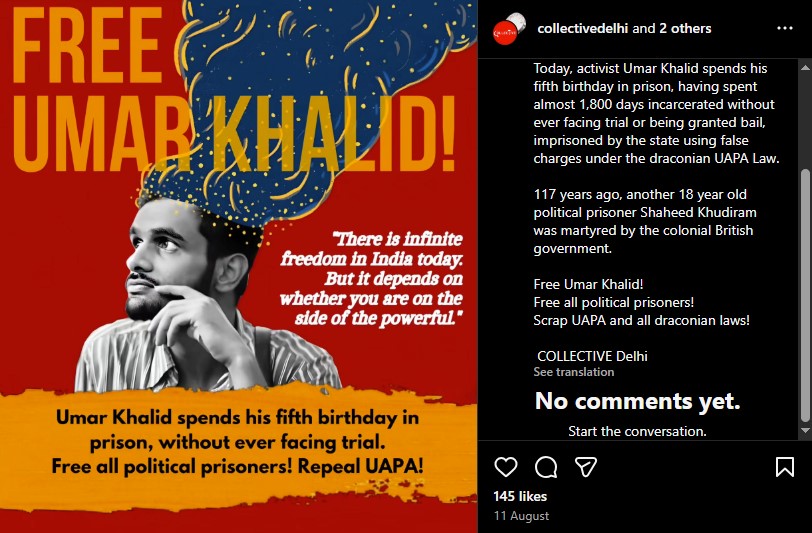
He further said, “Bail matter, we wish to withdraw. There has been a change in circumstances, so we will try our luck in the trial court.” Chandrachud stressed that media narratives often ignore such details, creating a perception that courts are at fault, when in reality, repeated delays by the defence weaken the process.

Uttarakhand: Samad Ghazi rapes minor Hindu girl, victim’s family says she was being groomed and brainwashed

A startling incident involving a 14-year-old student from Ramnagar of Uttarakhand gained significant attention on social media recently. In a video that has now surfaced online, two students wearing burqas were found exiting a computer coaching center in a scooter. An investigation uncovered that a Muslim student was escorting her Hindu classmate home while dressed in a burqa.

The family of the Hindu girl initially regarded it as a mere amateur act but the situation escalated when she failed to return home after school. The police conducted an inquiry after a complaint was lodged by the family and found that she frequently visited a Muslim student’s residence after school. It was also revealed that the minor had been in contact with an individual named Samad Ghazi.

The family members charged that their daughter was trapped and subjected to brainwashing. A medical assessment carried out by the police validated the occurrence of rape which only heightened the distress. Meanwhile, Hindu groups in the region have labelled it as a case of love jihad and voiced concerns about the potential involvement of a larger gang.

They asserted that incidents akin to those depicted in the Kerala Files are taking place in Ramanagara and if immediate probes are not initiated, a violent demonstration will ensue. Citing the MPHIC school as an example, the organizations indicated that 20-30 more cases could likely surface from there, necessitating an extensive high-level investigation.

The authorities have announced that a case has been filed under Section 140(3) of the CrPC against unidentified persons and efforts are ongoing to locate the suspects. They have assured the organizations that a thorough investigation will expose everything related to the matter. This case is presently generating apprehensions regarding the educational and social environment of the area.

Assam govt announces 3-day state mourning on demise of cultural icon Zubeen Garg, elaborate arrangements made for lakhs of fans to pay last respect in Guwahati

Assam government has declared three days of state mourning following the untimely demise of renowned singer Zubeen Garg in Singapore. The state mourning will be from Saturday to Monday, 20th to 22nd September. During this period, there will be no official entertainment, dinners, or ceremonial functions.

An official statement by the Chief Secretary said, “The Government of Assam expresses deep shock and sorrow at the passing of Shri Zubeen Garg, eminent singer, filmmaker and cultural icon.”

The statement added, “Seva Saptah programmes that involve ceremonial events or distribution of benefits are postponed as a mark of respect. However, service-oriented activities such as health camps, Nikshay Mitra support for TB patients, and plantation will continue.”

The 52-year-old heartthrob of Assam died in Singapore yesterday while swimming in the sea during a yacht tour. Earlier it was mistakenly reported the he died in a scuba diving incident.

Zubeen Garg is vising Singapore to attend the North East India Festival, which now has been called off. Assam CM Himanta Biswa Sarma confirmed that the singer had gone on a yacht tour along with around 18 people. They stopped the vessel in the sea, and jumped into the water to swim. Zubeen was initially wearing a life jacket, but later took it off as it was not fitting properly. During the second swim without the jacket, he became motionless, and the yacht crew immediately rescued him.

He was administered CPR on the yacht and at the port after returning, but was not successful. He was then transferred to Singapore General Hospital and admitted to ICU. But as he was not responding, he was declared dead.

Singapore govt has conducted an autopsy, and handed over the mortal remains to Zubeen’s friends and colleagues accompanying him. The mortal remains are being flown to New Delhi, from where it will be transported to Guwahati by the special plane. CM Himanta Biswa Sarma has reached Delhi to supervise the entire process.

Assam has lost its biggest cultural icon after Dr. Bhupen Hazarika, causing a spontaneous mourning across the state. Markets and shops in almost towns in the state were closed on Saturday as a mark of collective mourning. Yesterday and today, large number of people lit diyas in front of Zubeen’s portraits at public places in cities, towns and villages. Candlelight processions were also carried out.

The body of Zubeen Garg will reach Guwahati by early morning on Sunday, and will be taken to his residence in Guwahati’s Kahilipara. A large number of people are present at and around the house since yesterday. CM Sarma has requested people to allow the family, including Zubeen’s wife Garma and 85-year-old father, to have some private moments with the deceased for the last time.

After keeping at the residence for around an hour, the body will be taken to Sarusajai Stadium (Bhogeswar Baruah Sports Complex) in the city at 9 AM on Sunday for the whole day, where people will be able to pay their last respects to the singer-composer. Lakhs of people are expected to arrive in the Guwahati for the same.

The administration posted on X, “The Government of Assam, with deep sorrow, informs that the mortal remains of Shri Zubeen Garg, an artist larger than life, a cultural icon, filmmaker, and the eternal heartthrob of millions, will be kept at Arjun Bhogeswar Baruah Sports Complex (Sarusajai Stadium) tomorrow, September 21, from 9:00 AM to 7:00 PM, for friends, followers, and admirers to pay their last respects.”

Social media posts and media reports show that people have booked trains tickets and busses in large numbers to reach Guwahati. Even flight tickets to Guwahati are full. Singer Deeplina Deka, who has sung several songs with Zubeen Garga, yesterday said that she is in Mumbai currently and she had to book a flight with an 11-hour layover because all direct flights were booked.

The administration has made elaborate arrangements to handle this massive crowd. Trucks will not be allowed to enter city, and the truck parking areas at numerous warehouses on the Guwahati bypass, where the stadium is located, will be used to park the buses carrying the fans of Zubeen Garg.

CM Himanta Biswa Sarma said that enough arrangement for toilers and drinking water will be made. People who want to stay longer at the spot will be able to rest at the nearby helipad, so that the stadium is not crowded and people paying last respects can enter and exit without much hurdle.

The administration has that the mortal remains will be kept at the stadium till 7 PM on Sunday. However, earlier CM Himanta Biswa Sarma said that if there are demands to keep him longer, the government will agree. Therefore, the mortal remains can be kept at the stadium on Monday also. The date and place for the last rites have not been made yet. It will be decided after discussions with family, his close friends, and notable organisations of the state.

The selection of place will be important, as it will be turned into a memorial place for the beloved singer. A similar memorial was built for Dr. Bhupen Hazarika on a plot donated by Gauhati University, where he was cremated.

There are demands that the last rites should take place in Jorhat, the upper Assam town when Zubeen spent his school and college days. His musical journey also began from Jorhat. Some people have already identified a plot in the town near the national highway for the place of cremation and samadhi.

CM Sarma has said that a cabinet meeting will be held at 6 PM tomorrow to decide on the cremation venue of Zubeen Garg.

However, Zubeen spent his work life in Guwahati, during which period he recorded around 40,000 songs in 40 different languages and dialects. His family is also currently located in Guwahati, including his 85-year-old ailing father who may not able to make the road journey that takes around 7-8 hours. Therefore, there is a strong possibility that the cremation will take place in Guwahati.

The singer also has a house in Mumbai, where he had moved in hope of working in Bollywood movies. But after singing for few movies, including the ‘Ya Ali’ song, he moved back to Guwahati, saying that he didn’t like the attitude of the industry there.

Chief Minister Himanta Biswa Sarma is personally overseeing all the activities. He was campaigning for BTC elections on Saturday when the news was received, after which he and BJP cancelled all campaign activities and rushed to Guwahati. He has been communicating with Indian High Commissioner in Singapore, Singapore’s High Commissioner to India Simon Wong, and people who were accompanying Zubeen Garg in Singapore. Notably, Pabitra Margherita, Union Minister of State for External Affairs, who is a former actor and a friend of Zubeen, was also in Singapore and coordinated in the process.

The state government cancelled the ongoing half-yearly examinations in the state on Saturday. The CM said that holiday will be declared for schools and colleges on the day of the cremation too.

Congress party’s latest allegations of Modi govt favouring Adani are nothing but repeated lies, baseless claims and bizarre accusations

On 18th September, the Securities and Exchange Board of India (SEBI) dismissed the allegations of stock manipulation against Gautam Adani and his group of companies made by U.S. short-seller Hindenburg Research. In its conclusion, SEBI said that there was no violation of listing agreement or SEBI Listing Obligations and Disclosure Requirements (LODR).

SEBI made the conclusion on its probe on Hindenburg’s allegations that Adani entities used Milestone and Rehvar as conduits to funnel money, avoiding disclosure as related party loans. SEBI found that while funds were indeed rotated via Milestone and Rehvar, all loans were genuine, interest-bearing, and repaid. Moreover, at the time, the LODR definition of RPTs did not cover such indirect transactions. While an amendment in 2021 included such transactions, it was prospective, not retrospective, therefore there was no violation as per law applicable at that time.

Following the clean chit by SEBI, the Congress party has renewed is ‘Modani’ attack on Modi government and Adani Group. Party leader Jairam Ramesh on Friday released a statement reiterating its 100 questioned asked in 2023 under the title “Hum Adani ke hain kaun”.

In the statement Congress party mentioned several allegations against the Modi government, accusing it of misusing govt agencies and laws to benefit the Adani Group. The specific allegations mentioned in the statement are: “The misuse of agencies such as the ED, CBI, and Income Tax Department to force companies to sell off their assets to the Adani Group. Biased privatisation of critical infrastructure assets like airports and ports for the companies to sell off their assets to the Adani Group, Biased privatisation of critical infrastructure assets like airports and ports for the benefit of only the Adani Group, the misuse of diplomatic resources to funnel contracts to the Adani Group in different countries, especially in the neighbourhood, the import of over-invoiced coal by Ahli and Chang, which contributed to sharp increases in the prices of electricity drawn from Adani power stations in Gujarat, a 2,000 crore ($250 million) bribery scheme allegedly orchestrated by Gautam Adani and seven associates to secure high-priced solar power contracts in India -regarding which the Modi government has refused, for nearly a year, to serve a US SEC summons to the PM’s partner.”

While these are serious allegations against the Modi government, all of them are baseless, and most have already been debunked earlier.

Allegation of govt pressure

Congress claims govt misused central probe agencies to sell assets to Adani. While they didn’t name any company in the statement, Jairam Ramesh mentioned about Adani Ports buying Dhamra Port in Odisha from L&T and Tata Steel in 2014. The port was built by L&T and Tata in 2011, and they sold it to Adani in 2014. The deal was announced in May 2014, the month when Narendra Modi became the Prime Minister for the time.

As the deal was completed in May 2014, it is clear that the talks for the deal was going on for several months, as such corporate deals don’t happen in just days. Which means, the entire deal took place when Dr. Manmohan Singh was the prime minister. If there was any pressure from govt agencies on L&T and Tata to sell the port to Adani, it will mean such pressure would have come from the Congress government.

Moreover, L&T and Tata Steel are major corporate houses of India, and have considerable legal strength. They are also among the most respected companies for their integrity. If there were any pressure on them, they would have contested it instead of surrendering. By making the allegations against Modi government and Adani Group, Congress is also making allegations against Tata Steel and L&T, accusing them of not disclosing vital information.

Similarly, earlier the Congress had accused that GVK was forced to sale its stake in Mumbai airport to Adani Airports. But the fact is, GVK was in heavy debt burden and was forced to sale Mumbai airport. Responding to Rahul Gandhi’s allegations in parliament that the company was forced by the govt, GVK had denied any such pressure.

The company had said in a statement, “GVK reiterates that the decision to sell its stakes in Mumbai Airport to Adani, was taken by the management and there was absolutely no question of any extraneous pressure being exerted on us.”

GVK Group Vice Chairman Sanjay Reddy had said, “whatever we did was in the interest of the company and the lenders who we had to repay and therefore, we had to close the transaction with Adani because we didn’t see any light of day with the other investors.”

Privatisation

Congress then accuses “biased privatisation of critical infrastructure assets like airports and ports,” alleging wrongdoing in Adani group winning bids to operate several ports and airports in the country. Jairam Ramesh wants people to believe that such airports and ports were personally handed over to Gautam Adani by PM Narendra Modi.

But the fact is, all such privatisations took place after elaborate tender processes where several companies submitted bids. While ports are privatised at the state level, airports are awarded based on competitive bidding. In case of airports, bidder which bids highest value for each passenger wins the bid to operate the airport.

Therefore, Adani group won the bids by offering highest value for Indian passengers. If the Congress party has problem with that, it means that it does not want private companies to pay highest value for Indian passengers at airports.

In November 2018, the central government had cleared the privatisation of six AAI-run airports—Ahmedabad, Guwahati, Jaipur, Thiruvananthapuram, Mangaluru and Lucknow—on a public-private partnership model. As many as 32 technical bids were received from 10 companies to operate these six airports. Adani Airports won the mandate to operate all the six government-owned airports for the lease period of 50 years. The Adani Group offered ₹177, ₹174, ₹171, ₹168, ₹115 and ₹160 for Ahmedabad, Jaipur, Lucknow, Thiruvananthapuram, Mangaluru and Guwahati airports, respectively, highest bids for all of them.

It is important to note that by winning bids, the company does not own the airport, it only wins the right to operate the airport for the defined period of time.

The Congress party’s allegations on airport deals is not new, they have been repeating it for years, and have been comprehensively debunked. In its 100 questions, Congress alleged that Adani was awarded the 6 airports despite having zero experience in running airports. But when GMR and GVK were awarded Delhi and Mumbai airports respectively during the Manmohan Singh government, these companies also didn’t have any airport experience.

Diplomatic pressure

The next claim of Congress, that Modi govt put diplomatic pressure on foreign governments forcing them to hand over projects to Adani group is most bizarre. It is outlandish to even think that sovereign governments of major economies will take economic decisions based on diplomatic pressure.

Moreover, Jairam Ramesh seems to have forgotten that when Adani group won mining bids in Australia, his own party was in power. Carmichael coal mine in Queensland was handed over to Adani group in 2011-12, when Dr Manmohan Singh’s UPA-2 government was in power.

In 2022, Adani Port won the bid to acquire Haifa Port in Israel in collaboration with Israel’s Gadot Group, which has been considered as a very important and strategic purchase by the company. Adani-Gadot won the tender against stiff competition from local and global players. It was one of the largest privatisation by the Israel government, and it is bizarre to even suggest that the Israeli govt selected the winning bidder on Modi government’s pressure.

Moreover, if there was any hint of any wrongdoing, other bidders in the tender would have gone to court, which didn’t happen. The same is true with bids won by the company in the India, the companies that lost the bids have not accused any bias in awarding the tenders.

It is notable that Haifa Port will be a major transit point in the upcoming India-Middle East-Europe Economic Corridor. Therefore, the port has strategic importance to India. Therefore, it serves the interest of the country if the port is owned by an Indian company. By questioning the deal, the Congress party is opposing India having such strategic advantage in the global stage.

Electricity prices

Jairam Ramesh claimed that prices of electricity supplied by Adani power stations in Gujarat increased because of alleged over-invoicing of coal. This is another baseless allegation, because, if price of a power plant is much higher than competitors, it would not find any buyer.

The power distribution companies sign power purchase agreement with power generators, where the price is determined. Power generators can’t dictate price, as the Congress party is alleging. Even though Adani Power is India’s largest private sector thermal power producer in India, majority of power in the country is produced by public sector entities by NTPC and NHPC. Therefore, private sector power producers can’t charge arbitrarily higher prices.

Moreover, Adani Power has supplied power to several states under Congress governments too. This implies that the Congress party is accusing its own state governments of purchasing electricity from Adani Power at higher prices.

Solar power bribery allegation

At last, Jairam Ramesh raised the allegation that Adani group paid bribes of around ₹2,000 crore to officials of several states to sign power purchase agreements with Solar Energy Corporation of India (SECI). The allegations had surfaced after the charges were made against the company by a US court.

However, apart from that case in the US, there is no other evidence of any such bribery. ₹2,000 crore is a lot of money, and unless this money is found and traced back to the company, this remains just an allegation.

Adani Group had appointed an independent law firm to look into the allegations, and the review found the Adani Green and its subsidiaries were in compliance with all applicable laws and regulations. Andra Pradesh government, one of the states where officials allegedly received bribes, have also said that there is no evidence to support the allegations.

Notably, as per filings by the US Securities and Exchange Commission (SEC), Gautam Adani met with the Chief Minister of Andhra Pradesh in 2021. At that time the CM of Andhra Pradesh was YSRCP chief YS Jagan Mohan Reddy. In fact, none of the states alleged to have received bribes between 2021 to 2022 were ruled by BJP during that time, all of them had anti-BJP parties in power.

Conclusion

Therefore, all the allegations made by Congress leader Jairam Ramesh are false, baseless, and some are bizarre. Tenders won by Adani group in India and in other countries were result of competitive bidding processes, and there is no evidence or even any allegation of undue pressure from Modi govt on those bids. Similarly, power purchase agreements are signed under transparent processes. And it is laughable to even allege that Modi govt can influence foreign governments like Australia and Israel to decide on major deals.

These are not new allegations, the Congress party has been making the for years, and all of have been debunked earlier. By continuously making allegations on major economic events in the country, the Congress party is attacking not just the Modi government, but also targeting India’s growth story.

Kerala HC turns to Sharia in a case about a blind beggar threatening his wife with polygamy, cites Quran in judgement: Full details

0

The Kerala High Court on Monday (15th September) cited Muslim customary Law and Quranic principles to assert that Muslim men cannot take multiple wives if he cannot treat them equally. Ironically, the court even asked the state to protect women who are victims of polygamy.

Justice PV Kunhikrishnan made the observation while hearing a plea by a 39-year-old Perinthalmanna woman seeking ₹10,000 monthly maintenance from her husband, who lives by begging.

Earlier, the petitioner had moved the Family Court, which dismissed her plea on the ground that her 46-year-old husband from Kumbadi, Palakkad, who survives by begging, could not be ordered to pay maintenance.

The court, in a satirical vein, even invoked a Malayalam adage meaning “Don’t put your hand into a begging bowl.”

The High Court took note of the wife’s submission that the husband threatened to pronounce Talaq on her and marry for a third time.

Justice Kunhikrishnan, however, noted that the husband was no saint. “Even though he is blind and a beggar, as the petitioner, his second wife, claims, he has been threatening her with a third marriage,” the court remarked.

The Court also urged the state to provide counselling to the blind Muslim man to convince him not to perform a third marriage.

“Appropriate counselling should be given to the respondent to avoid another marriage by him, resulting in another woman being left as a destitute wife. The Department concerned of the government should provide counselling to the respondent, assisted by competent counsellors, including religious leaders,” the High Court noted.

“This is his second marriage, while his first wife is alive…In addition to that, the affidavit of the petitioner is that the respondent is going to marry again after pronouncing Talaq to the petitioner. He is blind and admittedly a beggar. Admittedly, the respondent belongs to the Muslim Community, and he is taking the benefit of his customary law, which, according to him, allows him to marry twice or thrice,” the High Court observed.

Monogamy is the rule and polygamy is the exception: HC

The judge remarked that polygamy among the Muslim community is practised in ignorance of the Muslim customary law. Explaining the Muslim law and Quranic principles, the judge said that a Muslim man, who has no capacity to maintain a second or a third wife, is not permitted to marry again.

“These types of marriages happen in the Muslim community because of the lack of education, lack of knowledge of the customary law of Muslims, etc. A court of law cannot simply recognise the first, second or third marriage of a Muslim man when he has no capacity to maintain his wives, “the High Court said.

“There is a misconception that a Muslim man can marry more than one woman in all situations if he wishes to do so…If a Muslim man can give justice to his first wife, second wife, third wife and fourth wife, then only marriage more than once is permissible,” the court added.

State government to provide food and clothing to the man and his wives: HC

Empathising with the blind man, the High Court said that the State should ensure that no citizen begs for a livelihood and provide food and clothing to such persons. However, the court acknowledged that it is not possible for the government to be aware of all the persons begging. ” It is the duty of the elected government in a democratic country to ensure that its citizens do not beg. The government may not always be aware of individual cases of begging, and therefore, this court cannot blame the government,” the court stated.

The High Court said that the government should ensure that the Muslim man and his wives are provided food and clothing and directed that a copy of the judgment be forwarded to the Secretary, Social Welfare Department, State of Kerala.

Delhi Police detain 12 Jamia students during march marking 17 years of Batla House encounter, AISA alleges peaceful protestors mishandled, police deny claims

0

Delhi Police detained at least 12 students of Jamia Millia Islamia on Friday, 19th September, during a march held to mark 17 years since the Batla House encounter. Police said the students were stopped only after they tried to move outside the campus and raised what officers described as “provocative slogans.”

The students, however, told a different story. They said the march has been organised every year, except during the COVID pandemic, in Jamia Nagar to demand a judicial inquiry into the 2008 encounter. They also said they had decided beforehand not to raise slogans or do anything that could cause confrontation with the police.

Students at Jamia said Friday’s march was peaceful but was interrupted near the university’s Gate No. 7. According to them, police took them off campus and detained them. The All India Students’ Association (AISA) said that the incident happened in full public view while the SHO of Jamia Nagar police station was present. AISA claimed that women students were among those detained and that some students were taken far outside Delhi.

The police, however, denied these claims. An officer said the students had tried to come off campus while shouting slogans, which is when 12 of them were detained. They were all released within two hours, the officer added, and no student is currently under detention.

Still, the incident has upset many on campus. Mishkat Tehrim, AISA President, said, “I thought we would be safe inside campus… I have never seen something like this after the CAA-NRC protests.”

Saiyed Ishfaq, AISA’s Delhi State President, who was among those detained, also alleged that students were forcibly picked up and dropped far from the university. 

“The Jamia administration purposely left the gate open, creating confusion… I was detained on campus. Women students were dragged by guards…”, Ishfaq further added. 

Police denied these claims and said no student was dragged. The Jamia administration has not given any official response yet.

Background of the Batla House encounter

The Batla House encounter happened on 19th September 2008, following a series of bomb explosions in Delhi, which resulted in the deaths of 39 individuals and injuries to 159. 

Delhi Police’s Special Cell, acting on a tip-off, stormed into a flat in Jamia Nagar, Okhla, where suspected terrorists had taken shelter. During the ensuing gunfight, Inspector Mohan Chand Sharma and Head Constable Balwant Singh were wounded; Sharma later died of his injuries. Two men in the flat, Atif Ameen and Mohammad Sajid, were also killed.

Twenty-four-year-old Atif Amin was a student of Jamia Millia Islamia, and 17-year-old Sajid was an aspirant of Jamia School.

The killing of Atif Amin, who was the chief bomber of the terrorist outfit ‘Indian Mujahideen’, had dealt a severe blow to the group, which had earlier been responsible for terror attacks between 2007 and 2009, in Delhi, Ahmedabad, Jaipur, Surat and Faizabad.

On the second anniversary of the encounter, a shooting took place at the gates of historic Jama Masjid, Delhi, in which two foreign tourists were injured; apart from that, a car bomb with a failed timer was also found in the vicinity.

Two others accused, Shahzad Ahmad and Ariz Khan, were arrested in 2010 and 2018 for the murder of Inspector Mohan Chand Sharma. They were firstly given the death sentence, which was later reduced to life imprisonment. 

The National Human Rights Commission (NHRC) had also given clean chit to Delhi Police of any foul play in the encounter, and the Delhi High Court had also rejected a plea seeking a magisterial inquiry.