The Bihar assembly election was one of the most unpredictable contests in recent years. Amid the traditional tug-of-war between the National Democratic Alliance (NDA) and the Mahagathbandhan (MGB), a new entrant, Prashant Kishor’s Jan Suraaj Party (JSP), grabbed attention not by winning seats but by shaping outcomes in dozens of constituencies.
Jan Suraaj, founded by political strategist Prashant Kishor, entered the 2025 Bihar Assembly election promising clean governance, decentralised leadership and people-driven politics. But failed to translate its social media buzz into electoral success. Even though the party’s performance disappointed its followers, it offers insight into the difficulties of starting a political movement from scratch in India’s complex electoral environment. Even though the party’s performance disappointed its followers, it offers insight into the difficulties of launching a political movement from scratch in India’s complex electoral environment.
Where Jan Suraaj Contested and What Its Presence Actually Looked Like ?
Jan Suraaj’s entry into the 2025 Bihar Assembly election was wide in terms of seats but thin in terms of depth. The party fielded candidates across many constituencies, yet its vote share was uneven and scattered, lacking a concentrated base. Jan Suraaj contested 238 seats across Bihar but failed to open its account, securing zero seats while gaining 3.5% of the total vote share. In fact, the JSP received less than NOTA in about 60 seats, and its vote percentage was lower than that of Independents, who won about 5%. Even in the seats it contested, the pattern was inconsistent:
1. Some Jan Suraaj candidates received only symbolic support, barely registering in the final tally.
2. Some managed to pick up mid-level vote numbers, usually from non-aligned young voters or floating voters.
There was no constituency where Jan Suraaj emerged as a top-tier contender, nor did it secure dominant vote clusters in any region. Even the party came in second place in only one seat and third in 115 others, showing that it has some appeal, but not much strength anywhere in the state. It received 10,000–15,000 votes on 18 seats, 15,000–20,000 votes on 11 seats, 20,000–25,000 votes on three seats, 35,000–40,000 votes on two seats, and 58,000 votes on 1 seat, possibly because the NDA candidate’s nomination was rejected. Jan Suraaj was the default beneficiary in two of its top four candidate seats, where nominations for either the NDA or the Mahagathbandhan candidate were denied.
The larger electoral picture: A multi-cornered contest, not a three-way fight
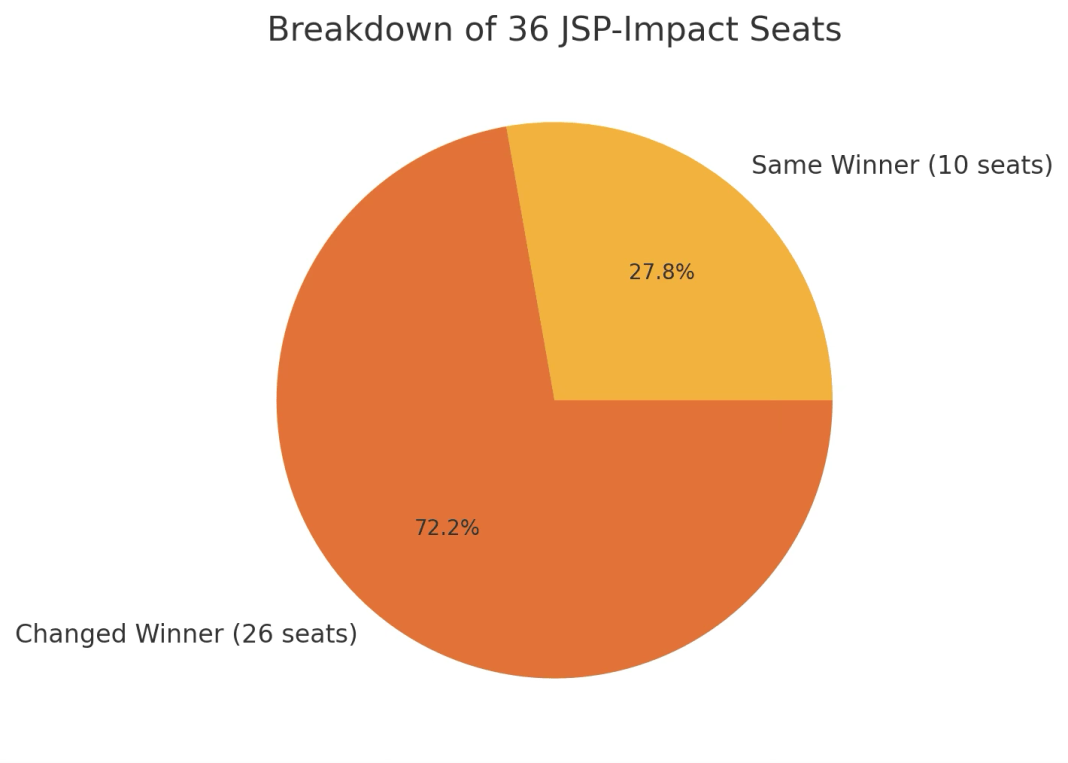
Within the 36 constituencies where JSP’s vote count exceeded the final winning margin, there is a crucial distinction that defines the fundamental nature of its impact. Of these 36 seats, 10 were ultimately won by the same party that had won them in 2020, despite JSP polling more votes than the margin of victory. These seats show that JSP did not overturn the electoral outcome or shift the constituency’s political preferences. In the remaining 26 seats, a different story is portrayed simplistically. These seats saw a change in winner between 2020 and 2025, but the shift cannot be automatically linked to JSP alone.
While JSP’s vote count was higher than the margin in all of them, these contests were influenced by multiple factors, including the presence of stronger third-party players such as LJP, RLSP, AIMIM, and independents. Many of these seats had already become unstable due to local anti-incumbency, candidate switches, alliance breakups between elections, and shifting caste blocs. For example, in the 2020 election, the Sherghati constituency was won by RJD with a margin of 16690 votes over JDU, the runner-up. We also note that in the 2020 election, Chirag Paswan’s LJP was contesting alone in more than 100 seats and dented the NDA alliance.
In this seat, LJP had gained more than 24000 votes, but in the 2025 election, LJP was part of the NDA alliance and won the seat with more than 13000 votes, underscoring the importance of other parties.
Let’s take another example of the Cheria-Bariarpur constituency. In the 2020 election, RJD won this seat with more than 40000 votes, while LJP was the bigger factor, winning more than 25000 votes. But in this election, LJP was in the NDA; JDU Won that seat. Does that mean Jan Suraaj had no relevance? No, in some cases the winning party changed because the original 2020 winner lost ground on its own, and in others JSP was only one of several dividing forces that contributed to a close finish. Also, in some seats, it definitely dented the MGB parties’ support for the NDA.
Taken together, these 26 seats show change but not necessarily change driven solely by JSP. They illustrate that JSP acted as part of a wider pattern of vote fragmentation in Bihar. It contributed to tighter margins and added a layer of unpredictability, but a combination of different parties, local conditions, and competitive equations shaped the actual seat flips. Thus, while JSP’s vote share exceeded the winning margin in these 26 constituencies, the overall interpretation remains that JSP was one of the factors, not the factor, in determining how these seats shifted from their 2020 outcomes.
How PK’s campaign may have indirectly benefited the BJP?
While Jan Suraaj did not align with any alliance, one perceptible trend emerged across several constituencies: Prashant Kishor’s broad outreach and aggressive communication about Bihar’s governance issues unintentionally shaped voter psychology, potentially helping the BJP in certain areas. This influence was not through votes directly shifting to JSP but through the awareness environment created around the election.
PK’s campaign highlighted unemployment, migration, education gaps, and the failures of successive governments. However, for many voters, especially those who feared a potential return of what is commonly referred to as “Jungle Raj”, PK’s messaging did not translate into votes for Jan Suraaj. Instead, it amplified their sense that the election was entering a high-risk zone. This perception pushed many undecided, anti-RJD, and cautious voters to consolidate behind the BJP, which they viewed as the only strong counterweight to prevent an MGB resurgence.
This behavioural pattern emerged because:
1. Voters understood that a vote for Jan Suraaj would not change the government and might be “wasted” in a tight contest.
2. JSP did not look capable of defeating either NDA or MGB, so risk-averse voters chose the safer, more established alternative.
3. PK repeatedly attacked both alliances, but the fear of RJD’s past governance led many voters to interpret his criticism of JDU as a signal that only the BJP could stop MGB.
4. Anti-RJD voters became more alert due to PK’s state-wide padyatra narratives about systemic issues.
Conclusion
The numbers make one thing clear that Jan Suraaj did not emerge as a decisive political force in terms of winning seats, but its scattered vote share undeniably shaped the contours of the 2025 Bihar election. In 36 constituencies, JSP’s votes exceeded the winning margin yet only 10 of those seats kept the same winner from 2020, while the remaining 26 seats saw changes driven by a mix of JSP’s presence, stronger third parties like LJP and AIMIM, local anti-incumbency, and shifting caste alignments. At the same time, Prashant Kishor’s state-wide messaging created a heightened political awareness that, intentionally or not, pushed many risk-averse voters toward the BJP as a bulwark against the return of RJD-led governance.
In the end, the Bihar election was not decided by any one player but by a combination of tight margins, fragmented votes, and a political field more crowded than ever. Jan Suraaj did not change who governed Bihar, but it did change how competitive, unpredictable, and divided the race became and that influence, even without seats, is now part of the state’s electoral record.
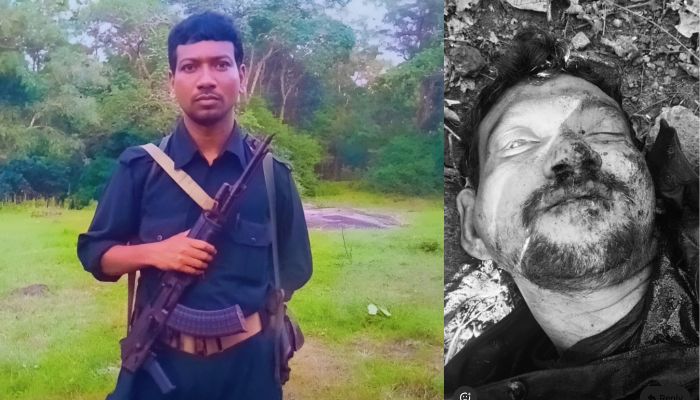
On 18th November, security forces eliminated India’s most-wanted Naxal commander Madvi Hidma in an encounter in the Maredumilli forests of Alluri Sitharama Raju district of Andhra Pradesh. The security forces conducted an operation between 6 am and 7 am near the Chhattisgarh border. Hidma’s wife Raje and senior cadres including Chelluri Narayana and Tech Shankar were also killed in the encounter. According to officials, a group of Naxals led by Hidma was trying to flee Chhattisgarh when they were intercepted.
Top Maoist leader Hidma was killed in an encounter in the Maridmalli forest of East Godavari district, Andhra Pradesh. His wife, Raji (R.A.J.), was also killed in the exchange of fire along with four others. In total, six Maoists were gunned down. These are the latest pictures… pic.twitter.com/Y19ps8PTlW
Hidma’s death is yet another decisive blow to the CPI (Maoist) in recent years. Home Minister Amit Shah has already stated several times that India will be free from Naxal extremism by March 2026. Notably, security agencies had set a deadline for Hidma’s capture by 30th November and he was eliminated just 12 days before.
A career defined by terror across Bastar
Hidma was a native of Purvathi in Sukma district of Chhattisgarh. He was one of the most feared and enigmatic Naxal commanders operating in the Dandakaranya region. Hidma was also known by aliases including Hidmalu and Santosh. He rose through the ranks over nearly two decades to become the head of the People’s Liberation Guerrilla Army (PLGA) Battalion No 1, considered the Naxals’ most lethal strike unit.
Hidma was the youngest member of the CPI (Maoist) Central Committee and the only tribal from Bastar to reach that level. His rising influence earned him a cumulative bounty exceeding Rs 1 crore from central and state agencies.
Who was Madvi Hidma?
Hidma was born in 1981 in Purvathi village of Sukma district. He belonged to a poverty-stricken tribal community in south Bastar. As he rose through the ranks, Hidma became one of the most dreaded Naxal commanders in the country. In the late 1990s, he joined CPI (M). He was only a teenager and began as a ground-level organiser. Soon, he became an expert in guerrilla warfare and ambush operations.
While most of the top Naxal commanders chose to stay away from the fighting units, Hidma remained with such units and led ambushes himself most of the time. He gained the attention of the security agencies after the deadly 2010 Dantewada attack which marked him as the principal architect of Naxal violence in the region.
Hidma carried bounties worth over Rs 1 crore. However, he remained invisible to intelligence agencies. Earlier this year, a photograph finally surfaced. He continuously moved across forest areas and relied on dense jungle cover to remain hidden with his inner security ring of loyal cadres.
According to security agencies, Hidma was the central figure behind almost every major Naxal ambush in south Bastar. His involvement was confirmed in the 2010 Dantewada massacre that led to the deaths of 76 CRPF personnel, the 2013 Jhiram Valley attack that wiped out senior Congress leadership in Chhattisgarh, and the 2017 Sukma strike that left 26 CRPF personnel dead.
Hidma was also behind the Sukma-Bijapur ambush of 2021 where 22 security personnel lost their lives. His battalion operated with sophisticated weapons and manoeuvred through the rugged and little-charted Abujhmad forest belt.
He was also reportedly present at the site of the 2011 Tadmetla attack leading to the deaths of 75 CRPF personnel and assisted senior commander Papa Rao in planning the strike.
Why Hidma remained untraceable for years
According to the officials, Hidma had intimate understanding of the Abujhmad, Sukma and Bijapur forest corridors. Furthermore, his four-layered security ring made him nearly impossible to track. His unit was equipped with automatic rifles and was trained in guerrilla warfare. He consistently operated with extreme mobility, making him a headache for the security forces. His wife Raje was an active member of the same battalion and reportedly participated in several major attacks.
Thanks to Operation Kagar, Hidma’s security shield and ability to move freely across forest cover weakened. Security agencies ran coordinated operations across Chhattisgarh, Telangana and Andhra Pradesh that forced him to go deeper into the forests where his movements were eventually intercepted.
Speaking to the media, a senior Chhattisgarh Police officer said, “Hidma had acquired a heroic image among his cadres, and his elimination is a major step towards ending Naxal terror in the Bastar region.”
The state of the insurgency
According to Chhattisgarh Police IG Bastar P Sundarraj, the region witnessed decisive gains against the Naxal network. He said, “Left Wing Extremism has been a major security challenge for decades, but the past few years have been significant for security forces. In the last two seasons, over 450 Naxal bodies have been recovered, including those of top commanders like Basavaraju.”
He added that more than 300 cadres, including Central Committee and Divisional Committee members, have surrendered in recent months. Over 2,200 Naxals have joined the mainstream in the last 20 months.
Modi Government on path of ending Naxalism in India
According to reply received in response to an RTI filed by OpIndia, it was revealed that under the leadership of Prime Minister Narendra Modi, Left-Wing Extremism (LWE) has receded sharply across the “Red Corridor” over 11 years.
A reply to OpIndia’s RTI on Naxalism from the Left-Wing Extremism (LWE) Division of the Ministry of Home Affairs (MHA), Government of India, shows that Chhattisgarh recorded the highest LWE surrenders (6,153) and the highest LWE killings (1,129) among the ten tracked states from May 2014 to 30th September 2025.
The year 2016 registered the most surrenders (1,440), while 2025 (till 30th September) logged the most LWE killings (311), which indicates shrinking insurgent space and intensified, intelligence-led operations. Minister of Home Affairs Amit Shah has publicly set March 2026 as the target to end the Naxal problem under Operation Kagar.
OpIndia received data on 10 states that are West Bengal, Kerala, Chhattisgarh, Jharkhand, Andhra Pradesh, Bihar, Odisha, Telangana, Madhya Pradesh and Maharashtra. According to the data, a total of 8,751 Naxals have surrendered since May 2014 and 1,801 Naxals have been killed. A total of 548 security personnel have lost their lives during operations and 1,630 civilians have been killed during that period. Furthermore, security forces have recovered 5,277 arms from LWEs between May 2014 and 30th September 2025.
The figures align with the Centre’s policy shift to coordinate inter-state operations, development-led outreach and targeted rehabilitation, which reduced the conflict to limited pockets. In a recent statement, HM Shah mentioned that the Naxal movement has reduced to just three districts across the country.
On 16th November, Booth Level Officer (BLO) Aneesh George was found dead in his house. Aneesh, who was a 44-year-old school employee from Ettukudukka in Kannur, Kerala, was serving as BLO for ward no 18 during the Special Intensive Revision (SIR) of electoral rolls in the state. The Payyannur Police has registered a case of unnatural death in the matter.
Before the basic facts of the investigation were even settled, a very specific storyline began to take shape on national televisions and digital platforms. The death was immediately presented as a direct consequence of “unbearable SIR workload” and the case was used to target the Election Commission of India and its ongoing revision of the electoral rolls.
Within the next 24 hours, what happened was not careful journalism but a textbook case of how a tragedy can be weaponised to malign an entire democratic exercise and to paint not only the Central Government but also the autonomous body that is the ECI in a bad light.
How national media framed the suicide as a SIR workload story
Several prominent media houses and journalists quickly cast Aneesh’s death as a result of SIR related workload. For instance, in its report, Times Now claimed that the BLO died by suicide as he was under “intense SIR related workload stress”. The report added that the district administration, in a later statement, said phone records showed no indication of work-related distress. That important nuance, however, was not what travelled widely on social media. It was the phrase “SIR related workload stress” that fit the emerging narrative.
A tragic incident has been reported from Kerala’s Kannur: BLO Aneesh has allegedly died by suicide. His family says he was under intense SIR-related workload stress.
In the latest update, the district administration has issued a statement saying 'no work-related distress was… pic.twitter.com/ZvYVbtF3vY
India Today aired a segment along the lines of “SIR pressure claims two lives; BLO suicides shake election roll revision”. The narrative was pushed by India Today’s anchor Rajdeep Sardesai who pushed the idea that the SIR exercise had turned deadly. In his own post, quoting the India Today report, he said “two alleged deaths by suicide and one suicide attempt of BLOs over SIR in three different states because of unrealistic targets and deadlines”, and accused the ECI of brushing the matter aside. He lamented that such stories were not seen on “prime time” where “noise and opposition bashing” supposedly dominated.
Get real India: 2 alleged deaths by suicide, one suicide attempt of BLOs over SIR in 3 diff states because of unrealistic targets and deadlines. Will @ECISVEEP as always brush it aside? Watch a story that you won’t find on prime time across so called news channels where noise and… https://t.co/z44f59PDQw
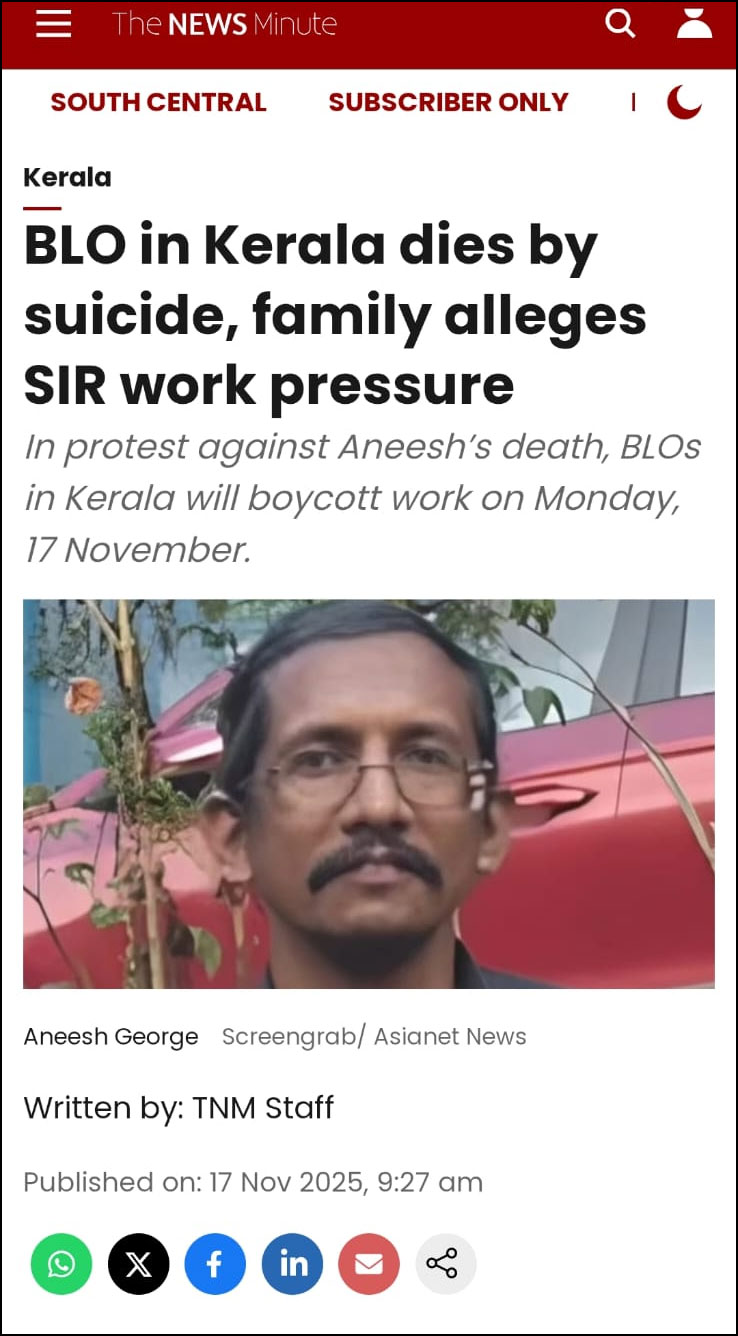
Digital portals followed the same script. The News Minute ran a news titled “BLO in Kerala dies by suicide, family alleges SIR work pressure”. They described SIR as the background and foreground of the tragedy. Selected parts of the family’s statements about stress were quoted to set the narrative.
Source: TNM
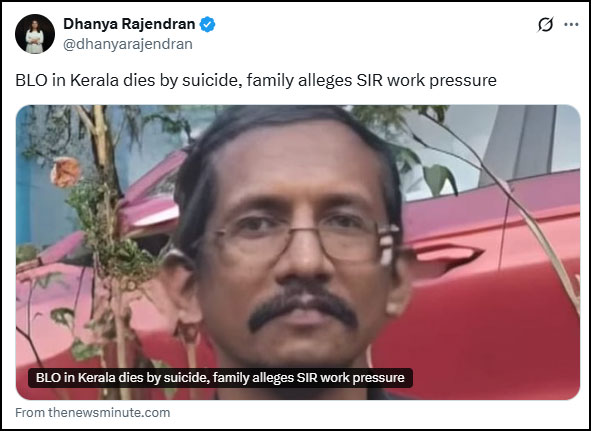
Dhanya Rajendran, founder of The News Minute, pushed the headline that a BLO in Kerala had died by suicide and that the family alleged SIR work pressure.
Source: X
In short, from television studios to digital newsrooms, the default conclusion was clear even while the probe had barely begun. The narrative was placed in the mind of the public that SIR killed the BLO.
What the administration actually said about workload and SIR
While social media debates raged, the district administration and the Chief Electoral Officer of Kerala issued statements that were not quite in line with the “SIR killed him” line.
The Chief Electoral Officer, Rathan U Kelkar, said no formal complaints about work pressure had been received from BLOs. He also stated that for a period of 31 days, BLOs were assigned only SIR duties so that there would normally be no question of additional workload. BLO duties, he added, were carried out in a team based manner and officers, including himself and district collectors, had joined field visits to support staff.
The Kannur district collector Arun K Vijayan pointed out that the information available so far from police and administrative enquiries did not establish a clear link between SIR duties and Aneesh’s death. In an official note, he clarified that Aneesh’s form distribution work was progressing satisfactorily. Out of 1,065 forms, Aneesh had already distributed 825, with 240 remaining, and when contacted on the morning of the incident he had said he would complete the work himself.
These are not stray WhatsApp forwards but formal observations from the authorities responsible for the very process that was being blamed. Yet, those statements did not receive the amount of the attention that the “SIR workload” tagline did.
The part many national outlets underplayed – allegation of CPM pressure
As the SIR story was getting traction on national platforms, another set of facts began to surface through local reporting and statements from the Congress in Kerala. In a press interaction, Martin George, District Congress Committee President of Kannur, released an audio clip of a phone conversation between Aneesh and a Congress Booth Level Agent (BLA).
According to Times of India and the New Indian Express reports, int the audio, Aneesh could be heard speaking about pressure from local CPM leaders regarding how he carried out door to door work during the SIR exercise. Notably, in an earlier report, The New Indian Express had also cited SIR pressure as the reason of suicide.
Congress leaders alleged that while political parties were allowed to depute their own booth level agents to accompany BLOs, CPM functionaries insisted that Aneesh drop the Congress agent and instead take CPM leaders along on his visits. It was claimed that a CPM booth level agent threatened Aneesh, allegedly warning him that a false complaint could be filed accusing him of distributing Congress pamphlets during official work.
The Congress demanded that a case be registered against the CPM functionary concerned, saying the suicide was not due to workload but due to political intimidation.
The New Indian Express report went further into the context. It described how Aneesh was not very familiar with the booth area he had been assigned, how he had limited interaction with the wider community, and how that unfamiliarity added to his stress when coupled with political pressure. Family members and acquaintances told the newspaper that he had been visibly tense, often awake till late night and pacing restlessly as he tried to finish his BLO duties.
In other words, an emerging picture suggested a mix of factors, with alleged pressure from CPM workers forming a significant part of the story. Yet the loudest national conversation still portrayed the tragedy almost purely as an example of “SIR workload killing BLOs”.
Congress’s shifting position raises questions about its motives
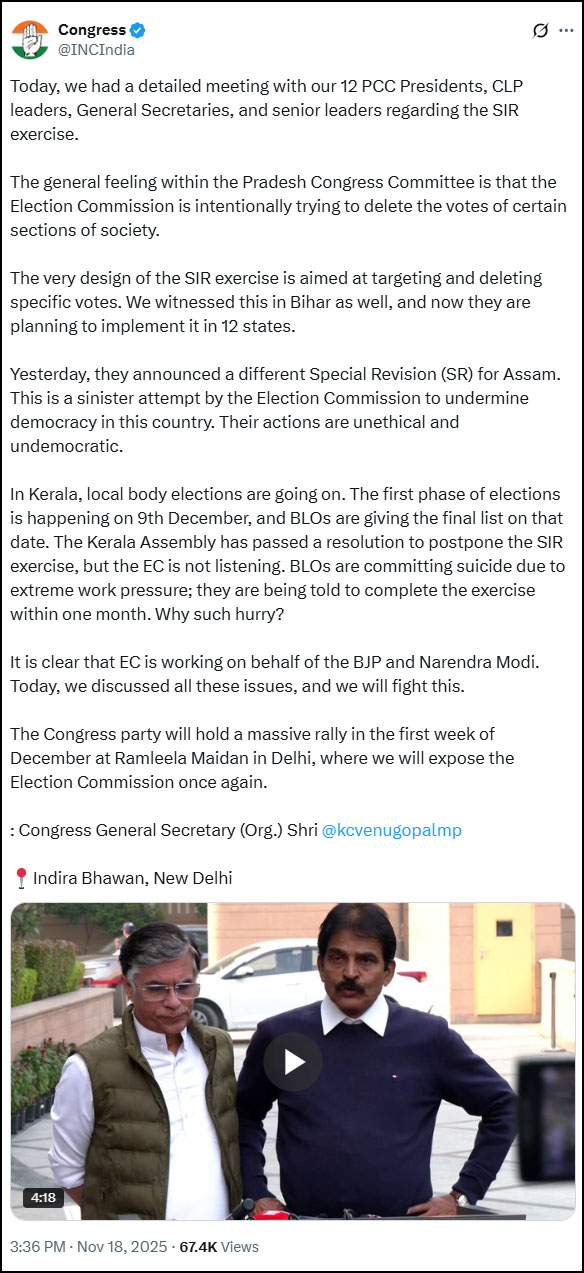
In a striking twist, while the Kerala Congress leadership publicly accused CPM workers of intimidating the BLO and even released an audio clip to support this claim, the national leadership of the party has now taken a completely different line. Congress General Secretary KC Venugopal issued a statement alleging that the very design of the SIR exercise is intended to “delete specific votes”, accusing the Election Commission of acting on behalf of the BJP and claiming that BLOs are “committing suicide due to extreme work pressure”.
Source: Indian National Congress/X
The same party that, at the state level, blamed CPM for threatening the BLO is, at the national level, using the incident to target the SIR process and the ECI. This contradictory stance not only exposes a political tug of war within the party but also raises serious questions about whether the tragedy is being selectively interpreted to suit different narratives in Kerala and in Delhi.
What the available facts actually say
Putting all the material together, a more balanced picture looks very different from the linear story sold initially. Aneesh George was a BLO during SIR in Kannur and he tragically died by suicide. His family and relatives did speak of stress related to his work and his difficulty in handling responsibilities in an unfamiliar area, and their grief and perception must be respected.
At the same time, the district administration and the Chief Electoral Officer have so far found no concrete indication of work related distress in phone records or formal complaints, and maintain that his SIR work was progressing on schedule. Local Congress leaders have released an audio clip and alleged that CPM functionaries put political pressure on Aneesh, insisting that he sideline Congress booth agents and threatening to file false complaints, while CPM denies these charges and blames the Election Commission for workload.
There is, therefore, no settled investigation backed conclusion that SIR workload alone was responsible for the suicide. Political pressure from CPM workers is a serious allegation that must be probed, and work strain is a factor mentioned by the family, but the final word must come from a proper inquiry rather than from prime time assertions.
Conclusion
Given the evidence available so far, the national media’s rush to blame SIR and the Election Commission for Aneesh’s death is premature and, in many cases, a deliberate narrative play. Outlets like The News Minute, India Today and commentators such as Rajdeep Sardesai ignored key facts, including the administration’s denial of any record of work related distress and the serious allegation that CPM functionaries intimidated the BLO. A complex case was flattened into a convenient anti SIR story. The exact reasons behind the tragedy require proper investigation, and the claim that SIR workload alone caused his death is not supported by facts.
Disclaimer: This report has been updated to include newly emerged statements from the Congress leadership and additional contextual information relevant to the ongoing investigation.
The Mahagathbandhan in Bihar suffered a spectacular defeat in the Bihar assembly election at the hands of the National Democratic Alliance (NDA). Afterward, amidst the unfounded claims of vote theft and unwarranted attacks on the Special Intensive Revision (SIR) drive, the reality behind their humiliation has been surfacing each day. The opposition fostered an atmosphere with the help of social media to indicate a substantial victory, but it was at odds with the reality.
The I.N.D.I. Alliance appeared to disregard the notion that the election is primarily an offline contest where the online narrative can only serve a limited purpose. It devoted all its energy in creating online echo chambers that merely reiterated the chosen propaganda. The opposition’s engagement on social media platforms was greater than its involvement on the ground.
This responsibility was delegated to social media influencers who might have declared the coalition’s triumph in the digital realm, however, the illusion was shattered when the latter awoke to the stark embarrassment of profoundly disappointing poll results. Now, the Mahagathbandhan has been defeated, however, those who labored on social media to deceive the public and influence their opinion with a fabricated narrative regarding the opposition’s potential grand performance in Bihar are now demanding their payment.
RJP hired YouTubers to disseminate their agenda, party officials abused their funds
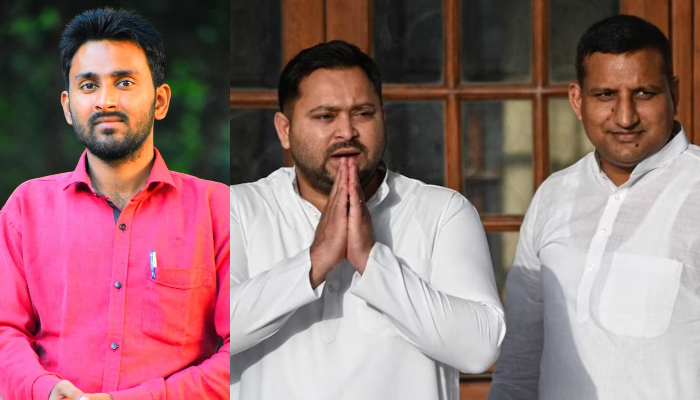
Furthermore, the same was validated by part-time journalist and full-time propagandist Zakir Ali Tyagi who confirmed that multiple YouTubers were recruited by Rashtriya Janata Dal (RJD) under this plan. He further complained to Tejashwi Yadav that the party is currently declining to compensate for their immense “hard work.”
हेलो @yadavtejashwi ! मैं आपको एक बहुत ही महत्वपूर्ण जानकारी दे रहा हूँ!
आपकी पार्टी ने जिन लोगों को सोशल मीडिया (ख़ासकर यूट्यूब) पर पार्टी के समर्थन में माहौल बनाने व बनवाने की ज़िम्मेदारी सौंपी थी, उन्होंने दर्जनों बार दिल्ली के यूट्यूबर्स के साथ मीटिंग की और ट्रको में भर-भर…
“The individuals that your party entrusted with the responsibility of building and securing support on social media, especially on YouTube, organised a multitude of meetings with YouTubers in Delhi. They loaded these YouTubers into trucks and took them to Bihar, making them work relentlessly around the clock and completely exhaust themselves. Yet, when the moment arrived to remunerate their hardwork, the middlemen straightforwardly responded that no money had been allocated by the party,” Zakir wrote on X.
Ironically, he inadvertently highlighted how each element of RJD is saturated with corruption and mentioned that afterward several YouTubers returned to Delhi as the party intermediaries who helmed the entire campaign consumed the complete share allocated to the former and retained 15-20% of the amount, even if they paid some YouTubers. Meanwhile, these accused persistently flashed new vehicles such as the Creta and Brezza, during the polls.
“This not only caused electoral damage to your party but also tarnished its image, as a result of which the party got less space on social media,” Zakir added. He then pleaded to “hardworking” RJD MP Sanjay Yadav, who is currently in the spotlight following the allegations of Lalu Prasad Yadav’s daughter, Rohini Acharya.
“There can be no doubt regarding his integrity, however, those affiliated with his office have repeatedly violated his trust. He remains unaware of how his reliable associates have exploited his confidence, deceiving and cheating the diligent YouTubers. Certain people linked to the party have transformed this election into an opportunity for personal gain, putting every effort to secure substantial profits.” Zakir remarked.
Zakir implored Tejashwi and Sanjay to apprehend these culprits who not only duped the YouTubers but also the party, thereby causing harm not only in elections but also tarnishing the reputation. “The YouTubers are in distress and it would be preferable to retrieve their money and hand over it to them.”
The party’s personnel clearly cannot even be trusted with the small amount of money designated for those endorsing their manipulative agenda. Can the administration of a vital and large state like Bihar be entrusted to such individuals? Interestingly, the public has made a sound choice for their future through the power of their vote even without awareness of this incident.
Zakir Ali’s questionable past actions
On 24th October, Zakir posted an “early morning” photo of a Muslim man with Tejashwi in a helicopter and conveyed, “You were asking what did Muslims receive in Bihar? They got to sit in a helicopter,” during the peak of the election campaign.
The question arises as to why a statement of this nature would be issued to instruct his community members to feel content just because a skullcap donning person was able to accompany a top Mahagathbandhan leader in a helicopter.
आप कह रहे थे मुसलमान को बिहार में क्या मिला? सुबह सवेरे तस्वीर आ गई हैं हेलिकॉप्टर में बैठने के लिए मिला! pic.twitter.com/QeIf5urdmz
The man who accuses the BJP and its affiliates over trivial issues related to the community ironically wishes for them to be pleased and satisfied with a hollow helicopter ride which has no bearing on the life of any ordinary Muslim.
Their hypocrisy is evident to everyone and the leniency they extend to the opposition, considering its history of appeasing Muslims is well-known. Nevertheless, to create such an impression for the community during a critical election paints a very strong message for those who can read between the lines.
Similarly, a mere glance at Zakir’s profile would narrate the tale of his support for anti-NDA propaganda from various elements which he sought to amplify to create a narrative for his favoured coalition. While every person has the right to hold and express their views as well as opinions, there seemed to be a concentrated effort on his part to glorify the alleged failures of the NDA government.
Who could have benefited from his efforts had he succeeded? Hence, his allegation concerning the non-payment to YouTubers casts significant aspersions on many of his past actions as well. Does this suggest that the “journalist,” akin to his numerous others peers was also advocating for the opposition?
However, whether this is true or not, the fact remains that the opposition was not only defeated in the elections, but the YouTubers assembled for their propaganda also did not obtain their dues, ending up in a dual hardship for these people.
Opposition mocked PM Modi over his social media remark while hiring YouTubers for peddling narrative
Rahul Gandhi claimed, “Instagram reels are the 21st century addiction,” after Prime Minister Narendra Modi stressed that mobile data in India “is now within everyone’s reach.”
“Modi gave you addiction. Earlier, people would get addicted to alcohol and drugs. Today, Instagram and Facebook have the same effect. Youth today watch Reels and share with one another 24 hours. But does it fill your pockets,” the former announced in Purnia during an election rally.
नरेंद्र मोदी ने बिहार आकर युवाओं से कहा- हमने आपको सस्ता डेटा दिया है, ताकि युवा रील बनाकर पैसा कमा सकें।
जबकि सच यह है कि Reel, 21वीं सदी का नशा है। जब आप रील देखते हो तो पैसा अडानी-अंबानी और जियो की जेब में जाता है।
“He did not tell you that when you make reels and watch the videos, the money doesn’t come to your pocket. It goes to Ambani, it goes to Jio,” the Gandhi scion claimed. “If the unemployed are not engaged on Instagram and Facebook, they would reach Modi’s residence,” he reiterated later amid disparaging remarks against PM Modi.
“If Narendra Modi had a proper education, he would not discuss creating reels with the youth but focus on improving education and guiding them in the right direction. He would emphasise the importance of constructing an airport or a university, yet he chooses to say, create reels,” Congress leader Supriya Shrinate wrote while citing an interview of a “Bihari youth.”
“नरेंद्र मोदी पढ़े-लिखे होते तो युवाओं से रील बनाने की बात नहीं करते- बेहतर शिक्षा की बात करते, सही रास्ता दिखाते
यहां हवाई अड्डा या यूनिवर्सिटी बनाने की बात करते, लेकिन वो कहते हैं- रील बनाओ”
The controversial RJD spokesperson, Kanchana Yadav, whose party relied on social media to secure victory in the Bihar assembly elections, asserted that PM Modi was promoting reels as a means of employment and alleged that he advised the youth to create reels due to his inability to provide them with jobs.
पकौड़े के बाद अब मोदी जी ने रील्स बनाने को रोज़गार बताया।
बिहार के युवाओं से कहा कि नौकरी नहीं दूँगा, रील्स बनाकर रोज़गार करो।
“There was a time when 1 GB of data cost up to ₹269, but now it’s available for just ₹15. That’s cheaper than a cup of tea. Big connection at a small cost, that’s the digital revolution of the Modi government,” the prime minister outlined on 10th October.
“Now we have created a system where 1 GB of data costs no more than one cup of tea, this chaiwala has ensured this,” he voiced during a speech in Samastipur. “The youth of Bihar have benefited the most from this. The reels being made and all the creativity you see are because of the BJP-NDA government,” he mentioned, adding that several Biharis are generating good money by making reels on Instagram.
It seems that social media is not considered an addiction when it is utilized to promote the Mahagathbandhan’s narrative and to secure its success, even if it is rooted in falsehoods.
PM Modi was just emphasising how the digitisation policies of his government have benefited the youth, including via social media, which is a fact. Many individuals gained national recognition due to their online content and even entered the television or film industry. However, the entire opposition not only twisted his comment but attempted to depict that he was urging everyone to forsake employment, studies and other development in favour of solely engaging with social media.
It has become a source of income for many such as the YouTubers employed by RJD. Now, it is another issue that their earnings were taken over by party members, leaving them empty-handed.
The fabrications, their administrative failures, major corruption charges coupled with their hypocrisy contrasted against the significant growth and progress of the state under the NDA government, exemplify why Indian voters consistently choose PM Modi and NDA over them.
Conspicuous silence of YouTubers after the Bihar election results
Zakir refrained from naming any YouTubers who were associated with the party’s agenda. Nevertheless, some YouTubers including Ravish Kumar, appear to enter a state of hibernation after the results were declared on 15th November. Notably, Ajit Anjum was also dormant for two days and only shared a video on 17th November in relation to Prashant Kishor’s dismal performance.
There could be many reasons for this but one cannot help but wonder how their previously active online presence has suddenly faded. They are evidently very disheartened by the election outcome. Anjum, voicing his frustration even commented on how the leaders, ministers and workers of the Bharatiya Janata Party invested everything into the contest while remaining out of the social media limelight. The same was pointed out by another BJP detractor, Saba Naqvi.
बीजेपी ऐसे लड़ती है चुनाव दृश्य -1 25 अक्टूबर को बक्सर के एक होटल में मैं अपनी टीम के साथ डिनर कर रहा था . दूसरी टेबल पर बीजेपी का फटका डाले कुछ नेता टाइप के लोग बैठे थे . उनमें से एक सज्जन बार -बार मेरी तरफ़ देख रहे थे . मैं भी उन्हें पहचानने की कोशिश कर रहा था . तभी वो मेरे… pic.twitter.com/VAJp1h8pTW
His statement also implied that the opposition’s electoral visibility was primarily a product of constant online engagement and very little grassroots effort. However, Anjum swiftly clarified that he simply described the reality which does not mean that he will stop disseminating the opposition’s agenda under the guise of neutral journalism. The post was retweeted by Ravish.
Anjum and others might have underscored the BJP’s work ethics due to growing anger over repeated electoral losses but they continue to attack the Election Commission and avoid direct criticism of the Mahagathbandhan for their monumental failure. Even though they are aware of the truth as clearly illustrated by the aforementioned post, they refuse to openly accept that the opposition’s defeat stemmed from its own shortcomings and the NDA’s diligent efforts.
The same could be the reason for their reluctance to address the Mahagathbandhan’s disappointing number of seats, in their videos. Similarly, the exposure by Zakir exacerbated their problems regarding how their preferred parties aimed to skew the online narrative in their favor rather than committing to genuine work on the ground.
At this point, these “journalists” have no plausible justification to defend the opposition and continue to mislead the public to sway their opinion against the truth and gain more views.
NDA’s thumping victory in Bihar, RJD’s soap opera
Bihar assembly elections took place on 6th and 11th November and the results were announced on 14th November after a record-breaking voter turnout, attributed to SIR program.
The Bharatiya Janat Party won 89 seats followed by the Janata Dal (United) with 85 seats, the Lok Janshakti Party (Ram Vilas) with 19 seats, the Hindustani Awam Morcha (Secular) with 5 seats and the Rashtriya Lok Morcha with 4 seats. The Mahagathbandhan, on the other hand, had a terrible electoral showing and barely managed to reach the 35-seat threshold.
Now, while the NDA is occupied with portfolio discussions and finalising a date for the oath-taking ceremony, the Lalu-Rabri family is embroiled in an embarrassing family drama following Rohini Acharya’s severance of ties with her family and her announcement of leaving politics. Her other sisters have also reportedly distanced themselves from the family. Tej Pratap Yadav also extended support to his sisters.
Acharya previously shared a post on social media in which she named Tejashwi’s close associates Sanjay Yadav and Rameez Nemat Khan, outlining that they are the cause of the conflicts within the Yadav family and the RJD’s poor electoral performance. The discussion that should focus on the party’s astonishing loss in the election is now eclipsed by these events, effectively redirecting all attention and blame away from Tejashwi.
Likewise, Zakir’s post unveiled the fraudulent strategies, alienation from reality and the extensive corruption that has permeated every facet of the RJD. The alliance’s effort to trick the public not only resulted in their downfall but also yet again laid them bare before the voters.
On Sunday (16th November), the controversial Cable News Network (CNN) reported on rising anti-India racism in the United States but ended up quoting notorious Islamists and anti-India bigots.
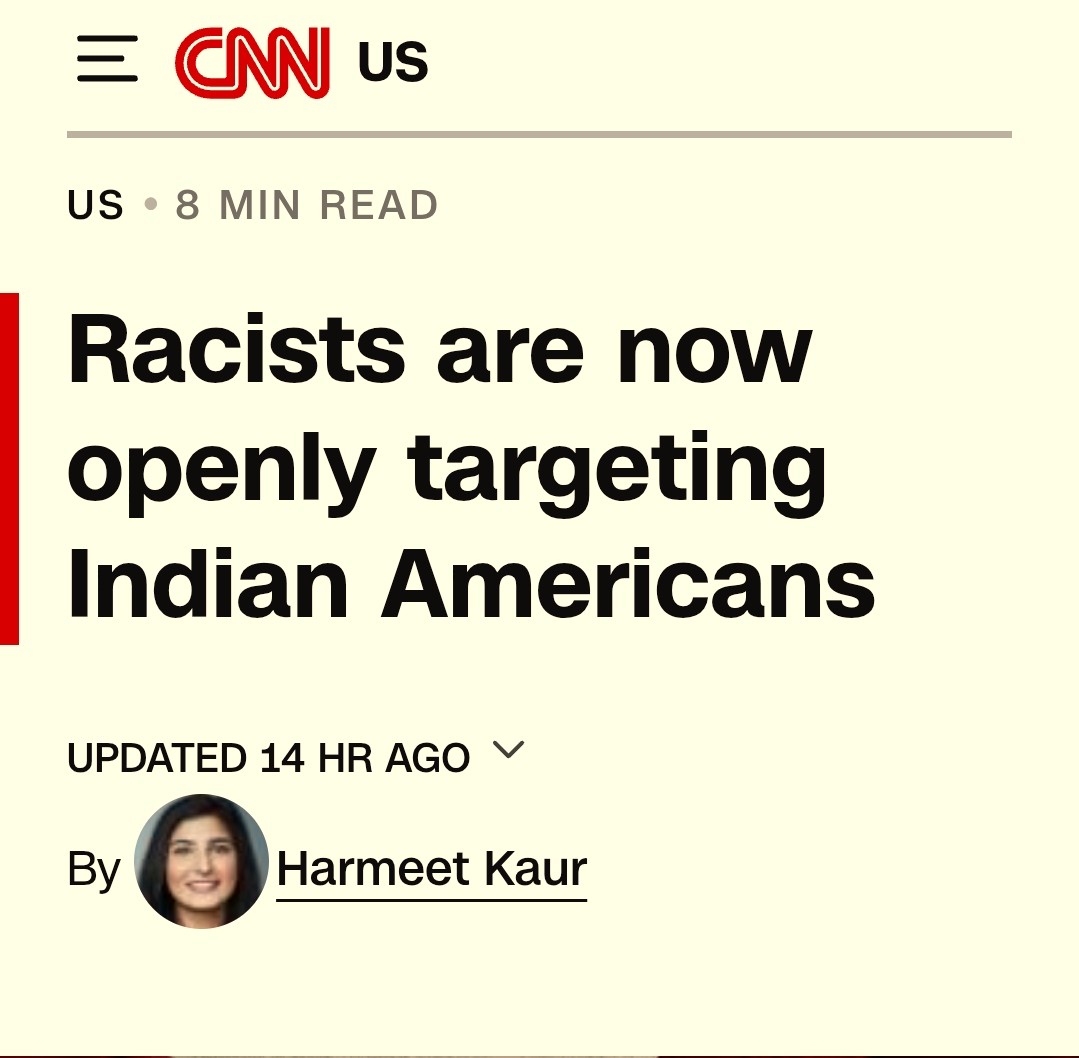
The Amercian news media company, which otherwise has a history of pedding anti-India propaganda, published an article (archive) titled ‘Racists are now openly targeting Indian Americans.’
CNN highlighted how Indian-origin FBI Director Kash Patel, Nikki Haley, Vivek Ramaswamy were abused by white Christian nationalists for wishing their followers on Diwali.
Screengrab of the article published by CNN
“Some Indian American conservatives seem shocked that segments of the political right are now taking aim at them,” the article noted.
CNN atributed the rising anti-India racism to the ‘political right’, rise of ‘fringe figures’, and US President Donald Trump’s crackdown on immigration. “Some members of the MAGA coalition are openly suggesting that only white Christians belong in America,” it added.
While it was evident that the American news channel published the article to berate the Republicans and champion the cause of anti-racism, CNN roped in individuals known for anti-India and anti-Hindu rhetoric.
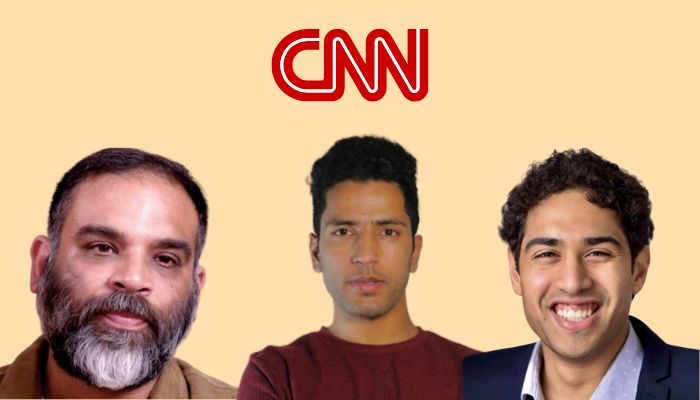
1. Raqib Naik
One of the experts quoted by CNN happened to be Raqib Naik. He was referred to as the Founder and Executive Director of the ‘Center for the Study of Organized Hate.’
“Raqib Naik, the center’s founder and executive director, said that his team recorded nearly 2,700 posts promoting racism and xenophobia against Indians and Indian Americans in October alone,” the American news company claimed.
For starters, Naik is an Islamist and a vicious fake news peddler. He is the founder of anti-Hindu disinformation outlet ‘Hindutva Watch,’ the Twitter account of which was withheld in India in January 2024.
HW started as a Twitter handle in 2019, & its website also became operational in the same year. It had no fathers until owned by Raqib Hameed Naik in 2023 with the help of WaPo journo Pranshu Verma. Verma didn’t even check the dates claiming it was founded in April 2021!
The anti-India radical is infamous for denying the Hindu genocide perpetrated by Islamists in the Kashmir Valley in the early 1990s. Naik had previously mocked the Hindu ‘Shivling’ found inside the Gyanvapi mosque in Kashi.
Despite this, CNN presented Naik as a researcher on ‘anti-India bigotry’ on social media.
2. Rohit Chopra
The American news media company also quoted one Rohit Chipra, who was introduced as a Professor at Santa Clara University in the US.
“(He) studies far-right online communities and…co-authored the reports for the Center for the Study of Organized Hate with Naik,” it stated.
Chopra runs a Hinduphobic X handle by the name ‘IndiaExplained,’ which was previously suspended for calling for the assassination of Indian Prime Minister Nanrendra Modi.
The Twitter poll ran by Rohit Chopra.
Chopra encouraged his followers to participate in a poll about how the Indian Prime Minister would be killed by his own Home Minister Amit Shah.
In one tweet, the vile Professor shared a picture of Narendra Modi and claimed, “Dressed like he’s headed to rape a devotee, murder a wife or start a riot.”
After his tweets went viral, he was de-platformed by prominent global think tank Observer Research Foundation (ORF).
Tweet by Rohit Chopra
According to NDTV journalist Shiv Aroor, the same ‘Professor’ was being investigated for child pornography several years ago.
This explains why he had gone all out to defend ‘Dismantling Global Hindutva’ conference and downplay the explicit Hinduphobia generated throught the single event.
Interestingly, CNN had no qualms to rope him in as an ‘expert’ on anti-India racism in the US.
Chopra who has consistently fuelled anti-India and anti-Hindu rhetoric told the American news channel, “This should serve as a kind of wake-up call — that racism that’s directed at people of color and minority groups, you are not exempt from. And maybe that should spark some kind of reflection about questions of solidarity with other vulnerable groups.”
3. Siddharth Venkataramakrishnan
Another controversial ‘expert’ quoted by CNN in its article happens to be Siddharth Venkataramakrishnan, who works as an analyst at Institue for Strategic Dialogue (ISD).
He had previously attempted to donwplay ‘love jihad’ as a conspiracy theory, despite 1000s of documented cases. For the unversed, it is a ploy to convert non-Muslim women to Islam under the pretext of love (often by concleaing one’s true identity).
The propagandist, who is yet to squeak a word about ‘Bhagwa love trap‘ campaign and its far reaching effects, had targeted OpIndia for a hit-piece by ‘TheWired’.
“Siddharth tells WIRED that the narratives in these articles are then picked up and spread on other platforms such as X and Telegram, noting how “in some of these places there’s even more explicit calls for violence against Muslims or for the removal of Muslims.” Such narratives fall under the umbrella of Hindutva, or Hindu nationalism, a political ideology which claims that India is a Hindu nation under threat from outside influences such as Islam and Christianity,” an article by ISD pointed out.
The Institue for Strategic Dialogue, where Siddharth Venkataramakrishnan works as an analyst, has peddled lies not only about Hindutva and attempted to blame ‘Hindu nationalism’ (albeit without evidence) for the 2022 Leicester riots.
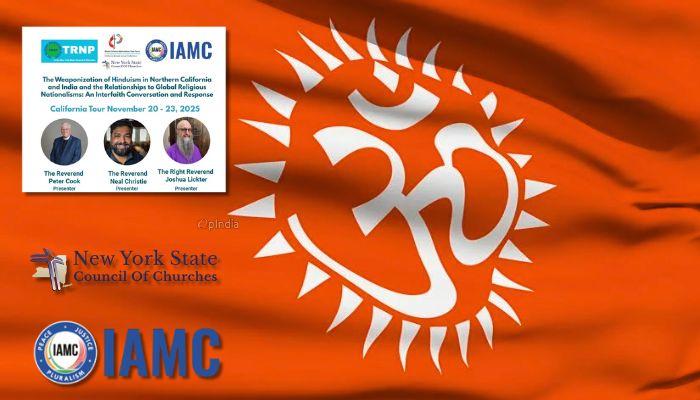
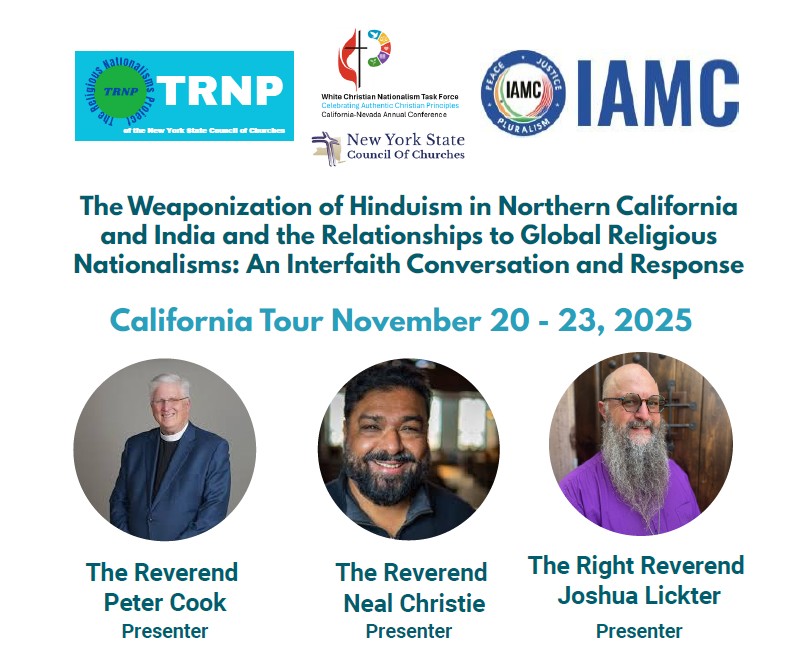
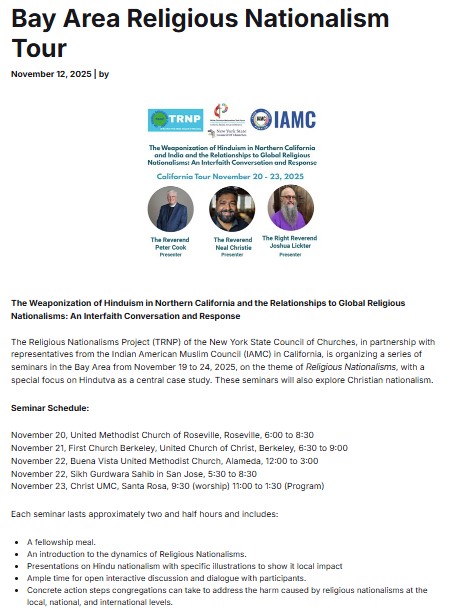
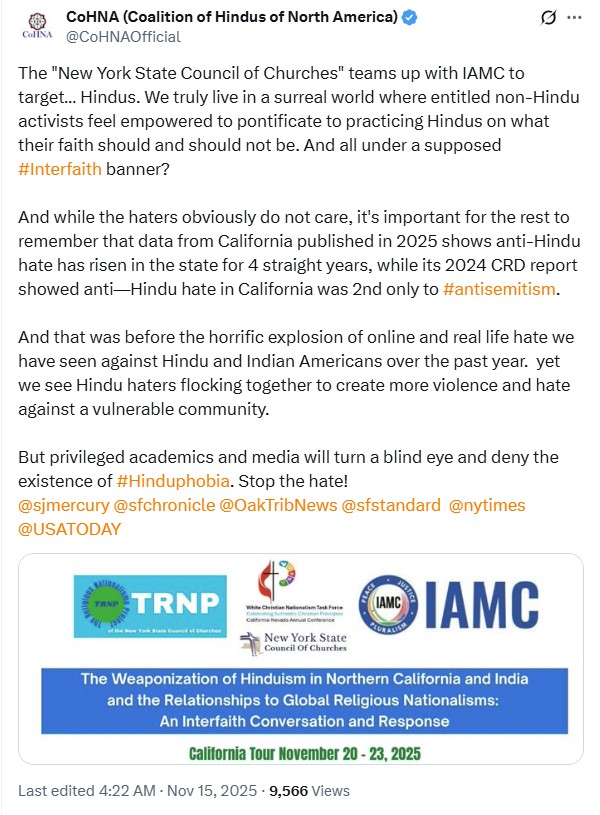
Amidst surging Hinduphobia in the United States, a Christian nationalist outfit and the Islamist group, the Indian American Muslim Council (IAMC), have joined forces to further vilify the Indian American Hindus and their faith. The New York State Council of Churches (NYCOC), through its Religious Nationalisms Project (TRNP), has announced a series of interfaith seminars from 20th to 23rd November, in North Carolina’s Bay Area.
The events titled “The Weaponization of Hinduism in Northern Carolina and India and the Relationships to Global Religious Nationalisms” are being co-organised by the Islamist group IAMC. The additional sponsorship for these anti-Hindu events comes from the White Christian Nationalisms Task Force of the California-Nevada Conference of the United Methodist Church.
As per the promotional material of the scheduled events, the seminars will be held at several locations, including the United Methodist churches in Roseville, Alameda, and Santa Rosa; First Church Berkeley (United Church of Christ). One of the seminars will also be held at a Sikh Gurudwara Sahib in San Jose.
This series of seminars will be on the theme of Religious Nationalisms, with “a special focus on Hindutva as a central case study.” The events will have three presenters: The Reverend Peter Cook, The Reverend Neal Christie, and The Right Reverend Joshua Lickter.
American Hindu rights groups call out Christian-Muslim collaboration to peddle Hinduphobia
The collaboration of a church-linked Christian outfit and a rabid anti-Hindu Islamist IAMC has sparked outrage among American Hindus.
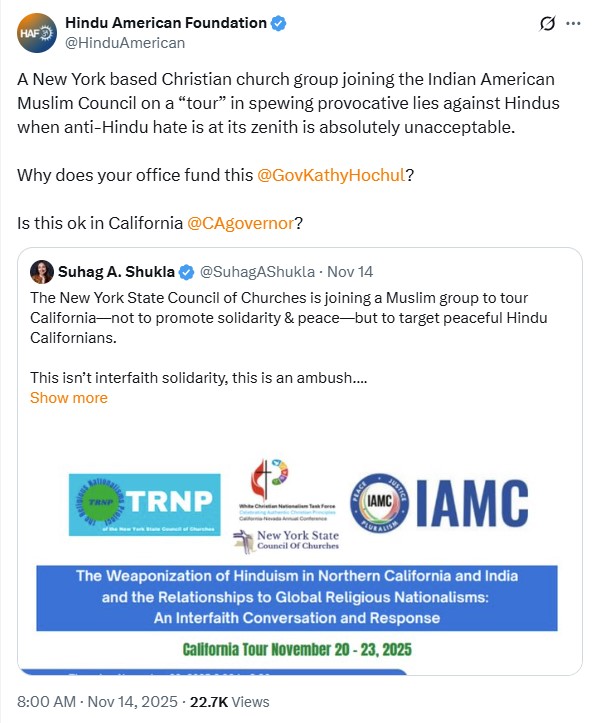
The Hindu American Foundation (HAF) criticised the anti-Hindu tour and highlighted that it comes at a time when hatred against Hindus is increasing in the US. The HAF also questioned the city authorities why such an event is being allowed in California and why public funding is involved in such an anti-Hindu propaganda event.
“A New York based Christian church group joining the Indian American Muslim Council on a “tour” in spewing provocative lies against Hindus when anti-Hindu hate is at its zenith is absolutely unacceptable. Why does your office fund this @GovKathyHochul? Is this ok in California @CAgovernor?” the HAF wrote on X.
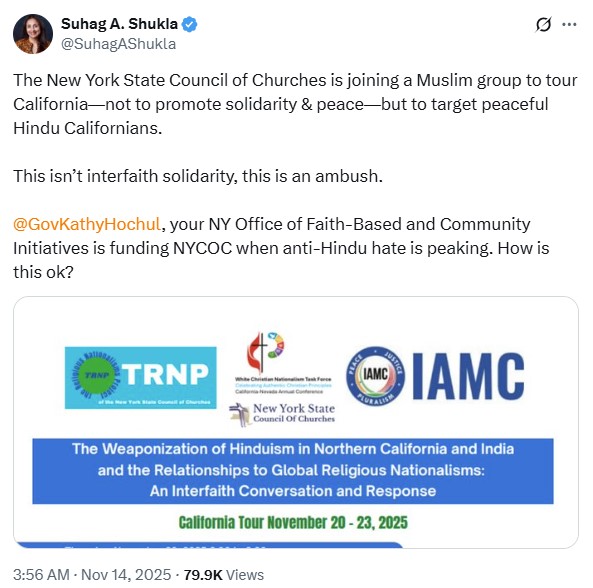
Suhag Shukla, the Executive Director of the HAF, said, “The New York State Council of Churches is joining a Muslim group to tour California—not to promote solidarity & peace—but to target peaceful Hindu Californians. This isn’t interfaith solidarity, this is an ambush. @GovKathyHochul, your NY Office of Faith-Based and Community Initiatives is funding NYCOC when anti-Hindu hate is peaking. How is this ok?”
Meanwhile, the Coalition of Hindus of North America (CoHNA) also echoed the criticism of the anti-Hindu seminars and accused the NYCOC-IAMC-organised tour as a tool to “pontificate to practising Hindus on what their faith should and should not be.”
IAMC and its anti-Hindu/anti-India activities and past Hinduphobic collaboration with the New York State Council of Churches
The Indian American Muslim Council (IAMC) is a Washington-based Islamist outfit which has been involved in anti-India activities and pushing an anti-Hindu agenda for many years. In 2021, IAMC, along with the Council on American-Islamic Relations (CAIR), campaigned to designate India as a “Country of Particular Concern”.
During the India-Pakistan conflict in May this year, when the Indian Armed Forces eliminated Islamic terrorists and their infrastructure deep inside Pakistan, the IAMC and CAIR condemned India’s Operation Sindoor.
The Indian American Muslim Council is reported to have links with the banned Islamic terror outfit, Students’ Islamic Movement of India (SIMI). Besides, the Indian American Muslim Council has ties with Lashkar-e-Taiba (LeT) and Jamaat-e-Islami (JeI) through its founder, Shaik Ubaid. The IAMC is a Jamat-e-Islami-backed lobbyist organisation claiming to be a rights advocacy group. The IAMC has also been involved in promoting antisemitism.
The IAMC has also formed the Hindus for Human Rights (HfHR) group, which is an open anti-Hindu and anti-India organisation based in the US.
Not to forget, in 2021, ‘Hindus for Human Rights’ also endorsed the anti-Hindu event ‘Dismantling Global Hindutva’ conference. It also came up with a “special toolkit” to propagate against Indian Prime Minister Narendra Modi during his State visit to the US in June 2023.
In June 2023, Congress scion Rahul Gandhi was seen sitting alongside Sunita Vishwanath during an event hosted by the Hudson Institute. In October 2023, the X account of HfHR was withheld in India in response to a legal demand.
In the past, the IAMC had reportedly collaborated with and even paid money to various groups in the USA to get India blacklisted by the USCIRF (United States Commission on International Religious Freedom). IAMC had been caught spreading fake news and misinformation to further the Islamist cause in India. It had also been slapped with the UAPA in 2021. The IAMC often publishes dubious reports and propaganda materials slandering American Hindus and Hindus in India, under the pretext of countering ‘Hindu nationalism’.
From seminars to surveys, reports to speeches, the IAMC has long been vilifying the American Hindus and their faith. In September 2024, IAMC conducted a ‘survey’ [pdf] with the ulterior motive to brand the religious minority group as ‘racist’, ‘intolerant’ and ‘Islamophobic.’ OpIndia reported how the IAMC survey passed off vague and subjective opinions from its respondents as absolute truth.
Unsurprisingly, the upcoming ‘Weaponization of Hinduism’ seminars are not the first anti-Hindu collaboration of the NYCOC and the IAMC. In August 2024, the Federation of Indian Associations NY-NJ-CT-NE decided to include a Ram Janmabhoomi Temple float in the India Day Parade to mark the 78th Independence Day of India. This, however, did not go well with the IAMC and the New York State Council of Churches, who, along with other Islamists, pro-Khalistan and other anti-Hindu groups, wrote a letter to the New York Governor Kathy Hochul and then Mayor Eric Adams, peddling lies to oppose the inclusion of the Ram Mandir float in the parade.
These organisations have claimed that VHPA, an offshoot of Vishwa Hindu Parishad (VHP) “has been designated as a militant religious organisation by the Central Intelligence Agency’s World Factbook”. However, OpIndia reported back then that while it is true that VHP and Bajrang Dal were designated as “militant religious organisations” on 4th June 2018, the names were effectively removed from the list by 25th June 2018. It was a mistake to call these two organisations “militant”, and the CIA itself had rectified it in less than a month.
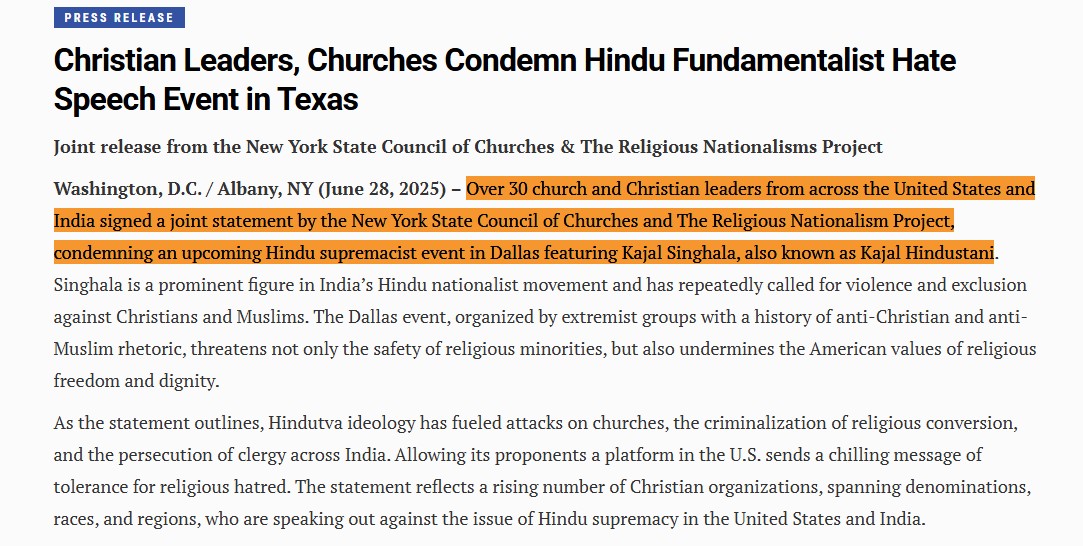
In June 2025, the NYSCOC and TRNP joined the IAMC in issuing a statement slandering an event hosting several Hindu activists in Dallas. These anti-Hindu groups linked Hindutva with violence and religious hatred. They also hurled sweeping allegations about religious freedom and tolerance in India, insinuating that somehow Christians and Muslims are under threat in the Hindu-majority country.
Amidst rising racism against Hindus and Indians in America, anti-Hindu elements attempting to ride the wave and further their nefarious designs
From the 1907 anti-Indian mob violence in Washington, the 1910 Detroit Times “Hindoos (Hindus) Continue to Flock to the US” article referring to Hindus as ‘Oriental scum’, the discriminatory Johnson-Reed Act of 1924, the Dot Busters group in 1980s which targeted Hindus Americans based on their religious and racial identity and assaulted them, to the individual cases of religiously-motivated hate crimes against Hindus post 2001, attempts at revisingCalifornia’s K-12 history-social science curriculum to include stereotypical representation of Hindus and Hinduism in textbooks, Hindus in the US, have faced hatred, discrimination and violence.
Earlier, these Hinduphobic attitudes found manifestation in anti-Asian racism and labelling of Hindus as ‘caste-ridden savages’ and ‘heathens’, and attacks. It manifests today in temple desecrations, school bullying, media propaganda and online hatred. A 2022 Network Contagion Research Institute report documented a 1,000% increase in anti-Hindu slurs online, blending white supremacist “replacement” fears with Islamist narratives accusing Hindus of “genocide” in India.
Just months back, White and Christian supremacists ignited the H1-B visas debate after Donald Trump nominated American-born Indian Sriram Krishnan as senior policy advisor for Artificial Intelligence at the White House Office of Science and Technology Policy.
What began as an online attack slandering Sriram soon snowballed into a full-fledged campaign against H1-B visas for highly-skilled Indians. This was followed by derision and insults directed at Hindus and Hinduism.
The Christian supremacists have normalised slandering and mocking Hindu deities, labelling them ‘demonic’ and ‘false gods’. In September this year, Alexander Duncan, the Republican Senate candidate for Texas, called Lord Hanuman a ‘false god’ and objected to the construction of his statue in the US, saying that America is a ‘Christian’ nation, although by law, America is not a Christian nation.
Weeks back, Donald Trump’s Trade Adviser, Peter Navarro, who Trump has unleashed as his attack dog to vilify India over its Russian oil purchases, resorted to slandering the Brahmin community. In an interview with Fox News, Navarro invoked caste and accused the Brahmins of India of “profiteering at the expense of the Indian people.”
OpIndia has been consistently reporting how the Anti-Hindu lobby in the US has been actively running a sinister campaign to push a caste discrimination narrative aimed at undermining and villainising the Hindu community in the US, particularly the Brahmins. Many universities, including Harvard University, Colby College, Brown University, and California State University, have even added caste to their non-discrimination policy. In 2023, the California State Senate in the US passed legislation (SB-403) that banned caste-based discrimination in the State, although it was later vetoed. Not to forget the 2019 CISCO caste discrimination case, which was widely used to vilify the Hindu community as casteist and incompatible with American values. This case was dismissed after no wrongdoing was found.
In 2021, the BAPS Swaminarayan Temple in New Jersey was raided by the American authorities after a lawsuit alleging forced labour and caste discrimination was filed. The American legacy media targeted the Hindu temple and its authorities; however, this too turned out to be a case of all propaganda, not facts, intended to malign the reputation of Hindus in America. The US authorities recently closed the investigation in this case as none of the allegations were found to be true.
In 2024, the anti-Hindu lobby opposed House Resolution 113, which condemned Hinduphobia in the US.
In recent years, hate crimes against Indian Americans have also been on the rise. According to the FBI’s 2020 data, hate crimes against Indian Americans are up by 500 per cent.
Besides, politics and social media, even the American media and academia perpetuate anti-Hindu bias through selective outrage and erasure. OpIndia has on numerous occasions reported how newspapers like the New York Times, among others, have also been complicit in spinning and amplifying anti-Hindu narratives.
OpIndia earlier reportedhow the DEI programs have been normalising hatred against Brahmins in the US. In their attempts to foment the same hate Nazis had for Jews, several DEI programs were creating prejudices against Hindus, particularly the so-called “upper-caste” Hindus like Brahmins, who are already at the receiving end of hate campaigns of the anti-Hindu elements.
The vandalism of Hindu temples in the US has become a disgraceful norm in the US. In September 2024, the BAPS Shri Swaminarayan Mandir in Sacramento, California, was desecrated with anti-Hindu and anti-India graffiti. This act of vandalism came just days after a similar incident occurred at the BAPS Mandir on Long Island, New York. While Khalistani terrorists have been the frequent perpetrators of these anti-Hindu crimes, now the Christian supremacists are also intensifying opposition to Hindu symbols, statues and temples.
It was reported last year that in California, anti-Hindu incidents ranked second only to antisemitism, with 23.3% of religious hate calls tied to Hinduphobia. In July 2025, a video of a White American berating an Indian man with “Why are you in my country? I don’t like you guys here. There are too many of you guys here. Indians! You guys are flooding all the white countries. I am tired of it. Americans are sick of this sh**. I want you to go back to India…”
Recently, in Irving, Texas, three masked men carrying “Don’t India My Texas” signs showed up in a suburb where thousands of Indian tech professionals reside.
Irving, TX. A group of masked men with “Take Action Texas” are seen holding signs calling Hindu deities “foreign demons,” peddling Hinduphobia and hate against Indian Americans. And running a X handle promoting this bigotry. @thecityofirving, we hope that you take note and… pic.twitter.com/yw49Nqhyy3
— CoHNA (Coalition of Hindus of North America) (@CoHNAOfficial) October 25, 2025
There has been a rising tide of racism and religious hatred against the Hindus in the US. While not all crimes against Indian Americans are driven by religious hatred, the online hate against Hindus has also contributed to this. It must not be forgotten that even the H1-B visas debate began with ‘Indians are taking over our jobs’, but soon turned into blatant Hinduphobia.
The hatred and racism against Hindus and Indians in the US have become so rampant that even the Hindu leaders in the Republican Party are not immune to such attacks. From vilifying FBI Director Kash Patel and US Director of National Intelligence, Tulsi Gabbard for wishingeveryone a happy Diwali, mocking the Trump administration for celebrating Diwali in the White House, attacking JD Vance’s Hindu wife Usha Chilukuri, and questioning Vivek Ramaswamy’s Hindu faith, to making absurd ‘Indians poaching wildlife in Canada and America’ claims, Indians and Hindus are facing attacks of all kinds just for existing.
FYI: >White men wiped out Cheetahs in India. From 10,000 cheetahs in 1600's, they went extinct by 1950. >White men killed 80,000 tigers in 50 yrs in India which brought them on the verge of extinction. Duke of Windsor shot 17 tigers in one week in 1921. British civil servant… https://t.co/feNREx6iAepic.twitter.com/dTpow44663
— Stop Hindu Hate Advocacy Network (SHHAN) (@HinduHate) October 19, 2025
These Hinduphobic attacks are not confined to mere online trolling and mockery, rather it extend to politics, academia and day-to-day life in the US. In a recent exposé, it emerged that the leaders of a Republican Party-affiliated group, Young Republicans, exchanged racist, anti-India, anti-Black, pro-Nazi, and homophobic messages in a Telegram group chat. From furthering hygiene stereotypes against Indians to suggesting that Indians are not trustworthy, the Republican leaders of the now-disbanded group demonstrated how India-hate has been normalised in the American political circle. The White racists and Christian supremacists have also been villainising Indian Americans to lend credence to their ‘White Replacement Theory’. Besides, ‘Nuke India’ calls by this lot online has also become a new ‘cool’ among American racists and Hinduphobes.
The growing pressure from White Christian nationalists to not come across as any less Christian hardliner is such that even US Vice President JD Vance had thrown his Hindu wife under the bus to prove his strict adherence to Christianity. From crediting Usha for helping him rediscover his Christian faith and respecting her faith to now wishing that she convert to Christianity, Vance changed his colour faster than a chameleon all to seek validation from Christian supremacist supporters.
Earlier this year, Rutgers University’s Centre for Security, Race and Rights (CSRR) put out a report and a roadshow around a familiar thesis that is “Hindutva in America”. It framed Hindutva as a far-right project, treated diaspora groups as RSS fronts, and claimed that Hindutva is a menace to American pluralism. Last month, they held a panel discussion with Sahar Aziz, Professor of Law at Rutgers, and two speakers, doctoral student Nikaytaa Malhotra and anti-Hindu “historian” Audrey Truschke panel discussion based on the report.
OpIndia reported earlier about Audrey Truschke’s track record of whitewashing heinous crimes committed by the Mughal tyrants against Indians. Through her books, articles and speeches, Truschke has constantly been vilifying the Hindus, Hinduism and India. In September, Religion Dispatches published Truschke’s propaganda piece titled: “WHAT IN THE WHAT?? Hindu Nationalism, Explained”,wherein she fuelled hatred against Hindus by lying about the roots of violence in the West.
Amidst rising Hinduphobia in the US in myriad forms, the Islamist and Christian outfits coming together to further exacerbate the already concerning situation in the US is intolerable. Hinduphobia is being institutionalised in the US with the tacit support of the ruling administration all while Hindu Indian-Americans remain law-abiding citizens contributing to the growth of the country they live in.
On 10th November, a massive car blast shook Delhi. The explosion was later found to be connected to the elaborate Islamist terror module that has been unearthed across Kashmir, Delhi and Haryana, involving doctors, former medical students, questionable funding channels and Al-Falah University whose Chancellor has a dubious past. However, instead of acknowledging the scale of the jihadi network, a section of social media rushed to seize upon one detail that fit their preferred script, that is, the brief detention of a Hindu woman doctor, Dr Priyanka Sharma. As the media caught whiff of the questioning of a Hindu doctor, channels ran the reports and speculations grew. However, after only a couple of hours, it was reported that Dr Sharma was released by the police after questioning.
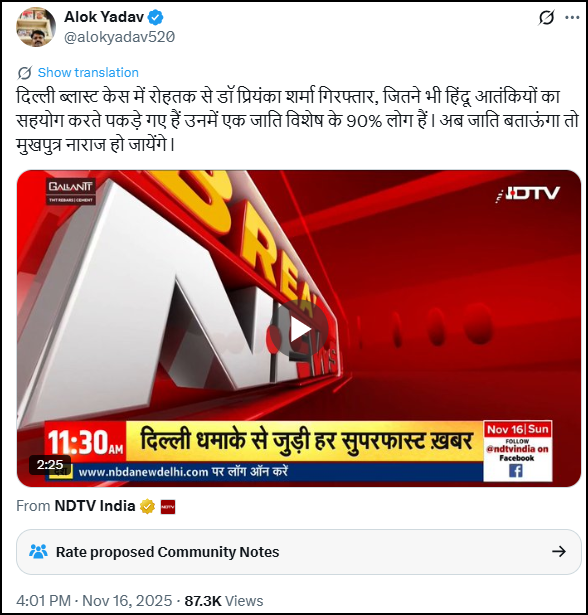
But the ecosystem had got the card that could trump all the hate the Islamist terror module was getting. The ecosystem that consistently cries that “terrorism has no religion” was suddenly jubilant. They finally had a “Hindu name” to throw into the mix. Though she was not arrested, named as accused or placed under any restrictive legal custody, Dr Sharma became a target of vicious attacks. X user Alok Yadav said, “In the Delhi blast case, Dr Priyanka Sharma from Rohtak has been arrested. Among all the Hindus caught helping terrorists, 90% belong to one particular caste. Now if I name the caste, the mainstream will get upset.”
Source: X
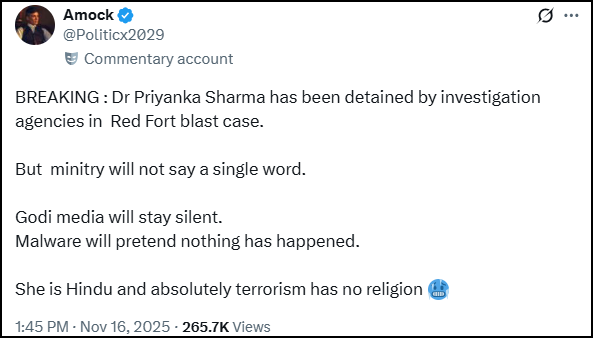
X user Amock said, “BREAKING: Dr Priyanka Sharma has been detained by investigation agencies in Red Fort blast case. But ministry will not say a single word. Godi media will stay silent. Malware will pretend nothing has happened. She is Hindu and absolutely terrorism has no religion.”
Source: X
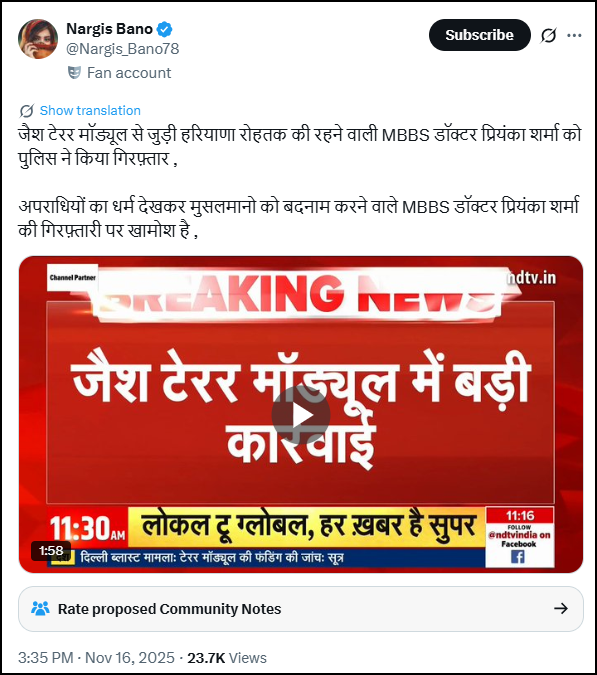
Social media user Nargis Bano claimed Dr Priyanka Sharma was arrested and said, “The people who defame Muslims by looking at the religion of criminals are silent on the arrest of MBBS doctor Priyanka Sharma.”
Source: X
Detention is not arrest, even if social media insists otherwise
It is important to spell out what should be obvious. Detention for questioning is not the same as arrest. It is a routine practice for police to detain or call individuals for brief questioning while investigating cases, especially when such a massive terror module has been busted linked to a terror attack in the National Capital. There were no charges filed against Dr Sharma, no formal arrest memo was issued and no accusation was levelled. It was a temporary interaction between her and the police that the law allows to collect information.
An arrest, on the other hand, involves formally taking someone into custody. Specific sections are invoked and the arrested person has to be produced before a magistrate to establish grounds for criminal suspicion. None of this happened in Dr Sharma’s case. Police merely questioned her because her name appeared in the phone trail of Adeel, a former GMC Amritsar staffer who has already been arrested. Dr Sharma was released by the police and her phone was, however, retained for forensic analysis, another routine procedure. Yet a few predictable commentators declared she had been “arrested,” “caught supporting Hindu terrorists” and similar falsehoods. They knew the difference. They simply did not care.
A multi-state jihadi network, not a communal scavenger hunt
What is actually unfolding is far more serious than the social media circus suggests. The Red Fort blast investigation and the “white-collar” module in Kashmir have exposed an interlinked jihadi network involving Adeel, an arrested staffer from GMC Anantnag, Dr Muzammil Ganai, already in custody, and Umar Nabi, the driver of the explosive-laden Hyundai i20. Two Haryana-based doctors from Al-Falah University have also been arrested by Delhi Police.
This is what a genuine counter-terror operation looks like. Agencies are leaving no loose threads, which is why they are questioning anyone connected academically or professionally with the arrested individuals. A Muslim doctor from West Bengal who studied at Al-Falah was also questioned and released and an entire MBBS batch may undergo routine questioning. But selectively amplifying the name of a Hindu woman and pretending it somehow “equalises” a jihadi module is not investigation, it is agenda.
The familiar game of absolving the guilty
The moment the module’s Islamist links became clearer, some commentators grew uncomfortable. So they desperately clutched at Dr Sharma’s brief detention to proclaim Hindu involvement, even insinuating caste angles. Their goal is transparent. They want to erase the words “Islamist module” from the discourse and replace it with a muddy, politically convenient grey zone. This behaviour is not new. Every time an Islamist terror network is exposed, a section of the commentariat scrambles to invent balance, to float red herrings, to falsely secularise what is an explicitly radical network.
Calling out the dishonesty
The police are doing their job. They are questioning anyone who ever worked with the arrested doctors. Most of them will be cleared and released within hours, as seen already. This is how terror cases are cracked in the real world. What must be called out is the intellectual dishonesty of those who are taking a detention and propagating it as a Hindu arrest, solely to shield a very real, very dangerous Islamist network. Such spin-doctoring does not just insult public intelligence, it undermines the fight against terrorism itself.
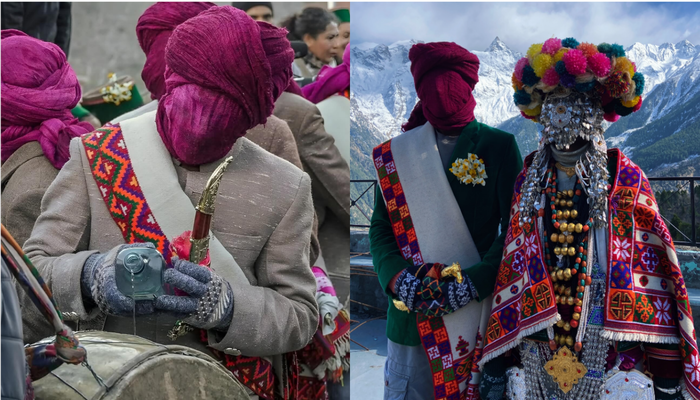
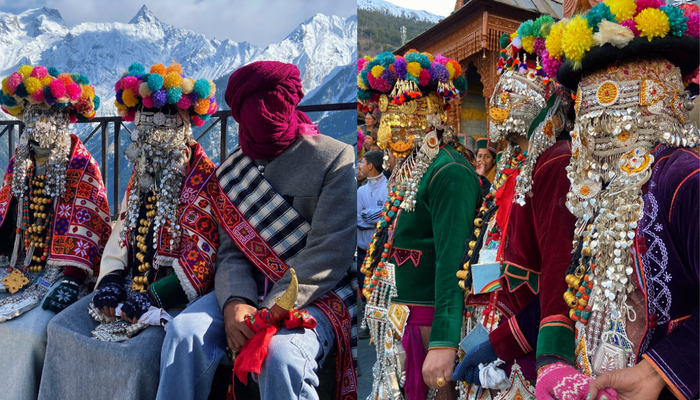
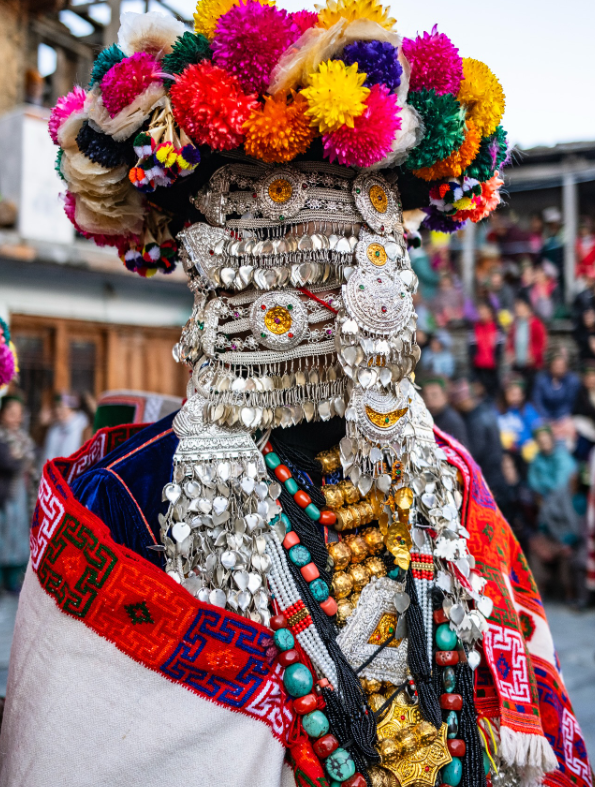
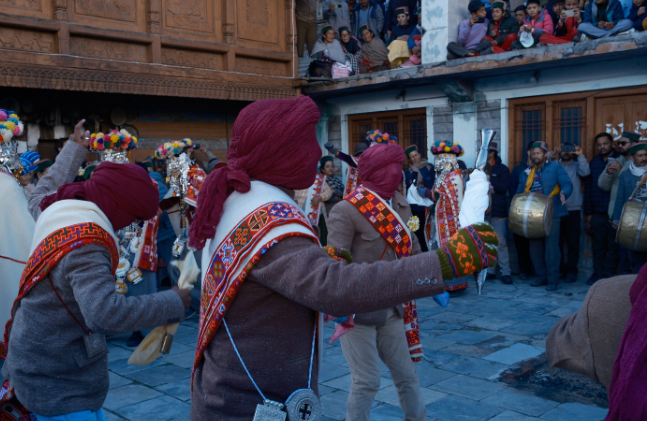
Social media has recently been abuzz with intriguing and captivating visuals of a mysterious celebration happening in the backdrop of snow-clad mountains. The dreamy pictures and videos showed masked people dressed in woollen attire with kaleidoscopic, intricate patterns and layers of ornate jewellery, dancing to the beats of local music.
Image via Instagram/@guyfrom_kinnaur
The pictures captured by travellers depict a winter festival called Raulane, celebrated in Kinnaur, Himachal Pradesh. The vibrant mountain festival is deeply rooted in the folklore and spiritual tradition of the local people, and offers a glimpse into their centuries-old culture. Raulane is a sacred tradition that is observed in honour of the mystical fairies, who are believed to protect the people living in the villages of Kinnar during piercing winters. Locals believe that mystical fairies, called Saunis, are celestial beings who descend from the mountains to offer protection and warmth to them during harsh winters. The festival forms a bridge between the locals and the mystical fairies and marks an expression of the former’s gratitude towards the latter.
Image via Instagram/@kanwar_photos
The locals, who take part in the celebration, are not just performers dressed in vibrant ensembles; they are people for whom the festival is a way to connect with their roots and preserve their unique culture. The celebration also marks a seasonal transition and offers a farewell to the mystical fairies as the spring season approaches.
mage via Instagram/@kanwar_photos
In the festival, men, selected through ancestral customs, dress as Raula, meaning ‘groom’, and Raulane, meaning ‘bride’, in heavy Kinnauri woollen fabrics. After donning the traditional attire, the participants transition into ritual figures, who act as intermediaries between the locals and the Saunis. The celebration begins with an announcement- “Two men will be married”. This is not an actual marriage between two men, but a symbolic ceremony to represent the union of mystical spirits.
The celebration includes a cheerful procession, filled with laughter, local songs and prayers. The laughter of the Raula represents an assurance of an abundant harvest in the coming season. After the festivities begin, the pair of Raula and Raulane visit the ancient Nagin Narayan temple. The celebration peaks inside the temple, filling the entire atmosphere with a deep spiritual energy. In the temple premises, the Raulas and the Raulanes perform a slow and intuitive dance, which is believed to open a gateway between the humans and the celestial Saunis.
For centuries, the ancient sacred festival remained a private communal celebration. However, with increased tourism and social media, the festival has now garnered the attention of the outside world. But the locals have been guarding the sacred tradition with great dedication and faith.
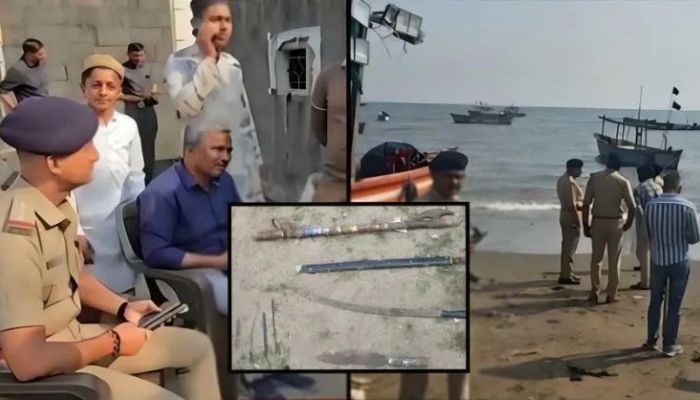
A major search operation in Gujarat’s coastal belt led to the recovery of deadly weapons from a dargah in Kodinar, located in the Gir Somnath district. The discovery was made on Sunday, 16th November, after police teams, including the Special Operations Group (SOG), launched a massive combing drive across sensitive villages and port areas after the Red Fort blast in Delhi on 10th November.
According to officials, the operation was ordered by District Superintendent of Police (SP) Jaideepsinh Jadeja, who directed teams to scan the coastline for illegal activities. More than 100 police personnel took part in the operation, including two DySPs, six PIs, seven PSIs, officers from SOG and LCB, and the bomb disposal squad. Police teams from Kodinar, Una and Veraval also conducted surprise inspections at Mul Dwarka port and questioned people living in nearby villages.
Weapons found inside the Dargah during inspection
During this extensive search, the SOG team reached the Hazrat Kachi Peer Baba dargah in Kodinar’s Mul area. While checking the premises, the police recovered sharp weapons, including an axe, knives, and swords. At the time of the inspection, the dargah’s caretaker (munjavar), Aminsha Ismailsha Kanojia, was present. Police found that he had no permission to keep any of these weapons.
The weapons were seized on the spot, and Aminsha Ismailsha was taken into custody for questioning. Later, an FIR was registered against him under Section 135 of the Gujarat Police Act. The complaint was filed by Head Constable Gopal Singh Mori from the SOG. A copy of the FIR has been accessed by OpIndia.
Police officials said the recovery of weapons has raised serious questions, especially about how these weapons reached the dargah, who brought them, and whether they were meant for any unlawful activity. These aspects are now being probed.
Police say more irregularities found in the area
SP Jaideepsinh Jadeja confirmed to OpIndia that the combing operation was launched after the Delhi car blast case. He said that while checking sensitive coastal areas, the team searched the dargah as well and found weapons kept without any kind of documentation.
He added that the police also found several other violations during the operation. In many areas, people from other states were living on rent without informing the police, which is mandatory under local regulations. Action has also been taken in cases where other rules were found to be violated. Jadeja said that similar inspections and combing operations will continue in the district.
Recent tensions in Gir Somnath over illegal structures
This incident comes at a time when tensions have already been high in the region. Last week, during a demolition drive in Gir Somnath, a team of police and district officials was attacked when they went to remove an illegal structure connected to a dargah. Cases were filed against several people, including women, after the incident.
Recently, a group of Kashmiri men living in the district were also detained for questioning. However, police said that nothing suspicious was found in that case. The SP clarified that these incidents are separate, and no link has been established with the weapons recovered from the Kodinar dargah.
Weapons hidden earlier in Kalol cemetery also under probe
This is not the first time that weapons have been found in shrines or graveyard premises in Gujarat. The report also highlights that Gujarat ATS had recently arrested three terrorists who had come to pick up weapons hidden inside a cemetery in Kalol, Gandhinagar.
Earlier, two terrorists from Uttar Pradesh had brought weapons from Rajasthan and buried them in the same cemetery. Another man from Hyderabad, identified as Syed Jaikar, had arrived to collect them. The ATS arrested the suspects before they could leave Gujarat, and interrogation is still underway.
The recovery of weapons from the Kodinar dargah has now added another angle to the series of security concerns in the state’s coastal and sensitive regions. Police say they are probing whether the seized weapons have any larger connection or were stored for local disputes.
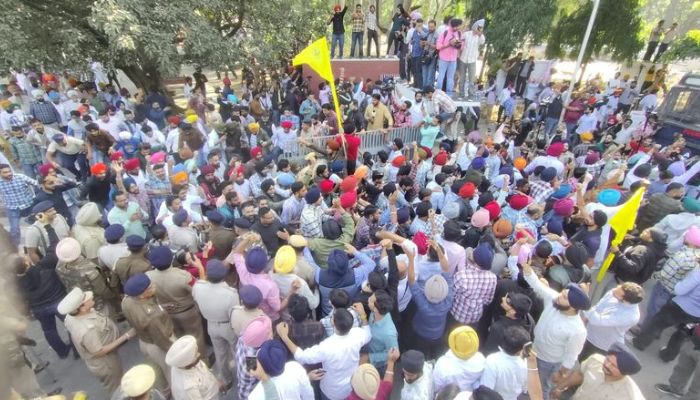
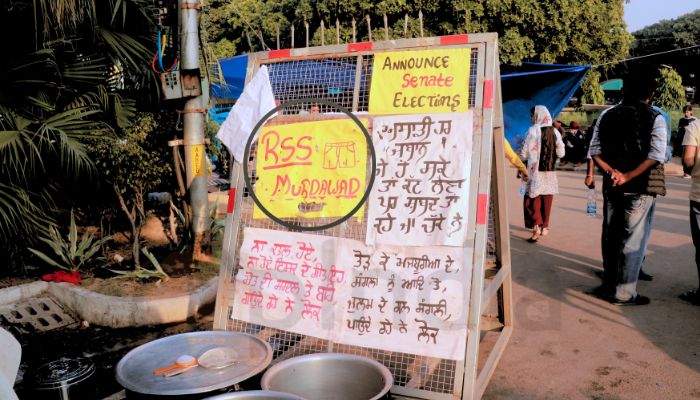
On 16th November, when OpIndia visited Panjab University in Chandigarh, the scene on the ground did not match the feverish noise that has been doing the rounds on social media. Inside the campus, many students were sitting calmly at the protest site, repeating the same, simple demand, that is, announce the Senate election schedule. The students with whom OpIndia talked wanted to return to classes as soon as the dates are announced and resume their studies. The worry of missing important coursework was visible on their faces. The students at Panjab University wanted clarity, not chaos.
One student, Avtar Singh, made it extremely clear that the strike would end the moment the schedule was announced. He said the students knew it takes over 200 days to conduct Senate elections, and none of them were asking for an overnight miracle. They wanted the process to begin, which indeed has already begun as announced by the university a few days ago.
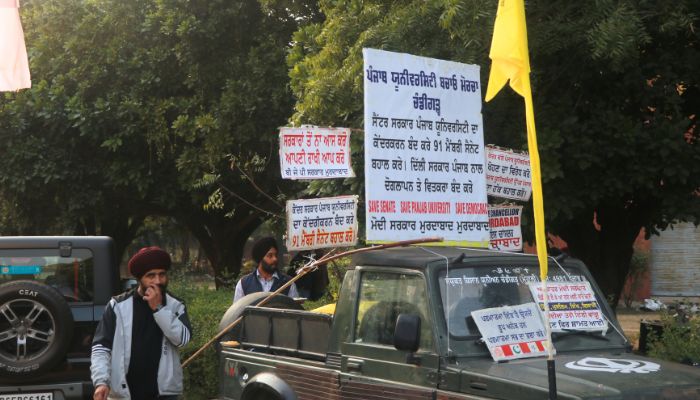
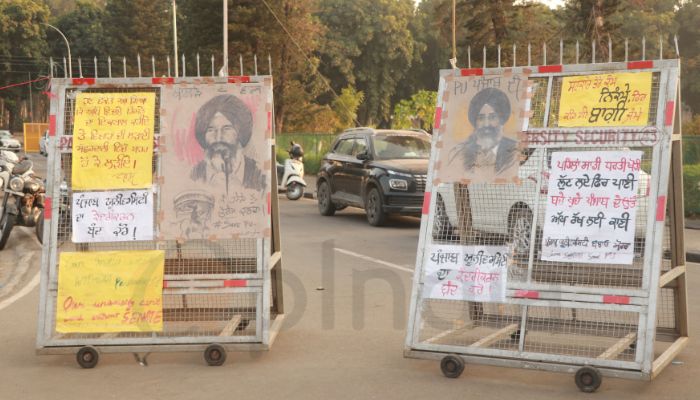
However, step outside the inner circle of students, and the scene changed completely. There were tractors, langar vehicles, loudspeakers (though they were quiet when we visited), political banners, farm union flags and groups that ideally had nothing to do with the university’s internal governance. Those groups and people, who called themselves union members, politicians and activists, had taken over the space that belonged exclusively to the university students, current or former.
Source: OpIndia On Ground Reporter
Just like what happened during the farmer protests, where farmers’ legitimate issues were drowned under political opportunism and identity mobilisation, the peaceful demand for Senate polls has now been dragged into a state vs Centre confrontation. And predictably, the loudest voices in this new swirl were not students, but those who piggybacked on the students’ protests for their own agendas.
From the moment the gates were broken on 10th November, it became clear that outsiders had come with their own agendas. The FIR itself documents that the crowd that forced open Gate No 1 had a large number of non-students. Police officials said in statements that while some PU students were at the front, the barrier breaking and pushing largely came from people who had nothing to do with the university. And yet, these very clashes are being projected as the natural consequence of the Senate issue. They are not. They are the result of opportunistic hijacking, and the students themselves know it.
Speaking to Times of India, even Vice Chancellor of Panjab University, Renu Vig, said that students admit it is no longer about senate. She said, “They haven’t said this directly to me, but through wardens and committee, students have conveyed a sense of helplessness.”
What the students actually want, and how fear is being seeded among them
If we look beyond the slogans, the political speeches, the farm union theatrics and the social media noise, the demands of the students are very clear. They want the Senate restored through elections. They want a legitimate governing body as defined by the Panjab University Act. And they want the uncertainty of the past one year to end. That is all. They are not the ones who raised the demands about Chandigarh’s ownership. They are not demanding identity-based claim over the university. They are not shouting about federalism. They are not asking the Centre to pack its bags and leave the Union Territory.
From the discussion OpIndia had with the people present at the protest site, it was evident that the students want clarity on Senate and want to go back to their classes as soon as possible. While the protests are against the Central Government’s decision to make Senate membership nomination based, a notification that has already been taken back by the Union Government, they are not against the Centre per se. They just want clarity about their future.
We noticed that a parallel campaign is being run within the campus to make students believe that the moment the Centre “takes control” of the Senate, the university will become a dictatorship, fees will be raised, and Punjab will lose the institution permanently. These exact lines were repeated to us by people who were not students but were present at the site. The fear is being manufactured. It is not organic. And it serves the political groups that have descended on the campus far more than it serves the students.
There are whispers that the notification was an attempt by the Central Government to “snatch” the university from the state. The situation, which should have been resolved on the day the Central Government revoked the notification, somehow has turned into an existential threat. The confusion, well, is not accidental.
It mirrors what we saw during the farmer protests, where several groups ran parallel narratives of fear, identity and distrust. The farmer protests created a deep valley between the farmers and the union. The original issues drowned under unrelated agendas. Here too, Punjabiyat, centre vs state politics, regional identity, and even religious identity narratives are being piggybacked on a student demand for internal university elections.
What are the Senate and the Syndicate?
The Senate and the Syndicate are the two statutory governing bodies of Panjab University. The Senate is the supreme authority, comprising over one hundred members, including elected graduates, professors, student representatives and nominees of the Centre and the state. It frames policies, approves budgets, oversees appointments and takes major academic and administrative decisions. The Syndicate functions as the executive body with around fifteen to twenty members. While the Senate takes decisions, the Syndicate implements them.
How political unions, kisan groups and majdoor organisations hijacked the protest
If anyone still believes that this is purely student driven protests, they have not been to the Panjab University Bachao Morcha protest site in the past few days. When OpIndia reached the campus, there were tractors, langar stalls, political posters and non-students all around the protest site.
This pattern is not unfamiliar. We saw it during the farmer protests as well. A specific set of actors specialise in identifying a legitimate grievance, stepping into the scene under the guise of “support”, and then shifting both the tone and direction of the movement until the original issue becomes unrecognisable. That is precisely what happened here.
What began as a Senate election demand slowly turned into:
A Punjab versus Centre issue
Punjab versus Haryana
Identity ownership of Chandigarh
Slogans of Punjabiyat
Political parties arriving in batches
During the clash between the outsider protesters and police on 10th November, SSP Kanwardeep Kaur climbed atop the gate and tried to reason with the crowd as the number of outsiders trying to enter was simply too large for the police to contain without escalating force. The gates were brought down by the protesters and a wave entered the campus. That day, tractors, trolleys, union representatives, political workers, and people carrying flags of organisations that have no stake in the university’s governance entered the campus.
Ideally, neither police nor outsider groups, organisations and individuals have a say in such protests and they are supposed to stay outside. However, things did not happen the way they should have.
Senior leaders of AAP, Congress and SAD chief Sukhbir Singh Badal showed up. Farmer union chiefs like Balbir Singh Rajewal, Harinder Lakhowal and Inderpal Bains arrived with cadres. Even the father of jailed MP Amritpal Singh and family members of historical radical figures reached the campus.
Figures like Lakha Sidhana, a gangster-turned-activist, singer Satinder Sartaj and many others visited the campus. The actual student leaders who should have been the voice of the protests the whole time were pushed aside so that these leaders could speak on the stage.
This infiltration brought with it an entirely different vocabulary. Slogans like “Chandigarh Punjab da” and “Raj Karega Khalsa” filled the air. These slogans have nothing to do with Senate elections, nothing to do with the Panjab University Act, and nothing to do with restoring democratic bodies. But they have everything to do with political positioning, identity signalling and creating the impression that the university belongs to a specific cultural group rather than to all of its students and stakeholders.
In the middle of this noise, the original student-led demand was almost lost. What the political players want from these protests is vastly different from what the students want. And the gap between those two agendas is what is causing the chaos.
The Nihang presence and the subtle introduction of pro Khalistani rhetoric
Among the many groups that appeared on campus that day were Nihangs. OpIndia spoke to one of the Nihangs present during the agitation. On the surface, he insisted they were there only to support the “children”. He repeatedly framed their presence as protective, even paternal. But during that conversation, he introduced a line that revealed a deeper undercurrent that has nothing to do with Senate elections.
He said, and we quote nearly verbatim, “When Hindus talk about making India a Hindu Rashtra, no one says anything. But when others demand something, it becomes a problem.”
He did not explicitly use the word “Khalistan”, but he did not need to. Anyone who has covered Punjab long enough understands exactly what “others demand something” implies in this context. It is coded language, used often by those who want to push separatist narratives without directly triggering legal scrutiny.
This is where the protest crosses into dangerous territory, far beyond elections and campus democracy. When individuals representing Nihang groups begin using unrelated national comparisons and subtly pushing identity-based grievances inside a university movement, it means the protest has become a vessel for wider ideological messaging.
The students leading the Senate movement categorically denied inviting any political party or union to the protests. But the moment the gates were forced open and external groups poured in, the space was no longer in the students’ control. The protest had become porous. And once that happens, narratives that have nothing to do with the issue at hand enter quietly, disguised as “support”. The students we talked to said these groups “should be present” as they support them, however, there were some voices who were confused, and even disliked the students’ movement being hijacked.
For instance, Hindustan Student Association (HSA) officials categorically refused to side with separatist slogans and claims of Punjab over the university.
Cracks within the Morcha as the Punjab versus Haryana narrative takes over
While the political circus grew louder outside the gates, the first real sign of discomfort came from within the Panjab University Bachao Morcha itself. On 12th November, Mohit Manderana, joint secretary of the PU Campus Students’ Council and one of the prominent faces of the earlier affidavit campaign, resigned from the Morcha. His resignation is a crucial marker because it signals what many students are whispering privately but are too afraid to say publicly, the movement has drifted far away from its purpose.
However, he did not step away from spreading fear of “BJP and RSS ideology”. In a statement, he said, “The struggle was meant to save Panjab University from political interference, especially from BJP and RSS ideology. But the November 10 protest became about regional ownership, not about saving the university.” His statement shows how fearmongering is being done from all channels possible.
In a video, he was seen saying it is a personal matter of “Punjab and Haryana” and they will resolve it at home. “We don’t need a Delhi agent,” he said.
On the other hand, a couple of students talked to OpIndia on condition of anonymity and said they were deeply uncomfortable with the explosions of “Chandigarh Punjab da” chants, the entry of leaders who had nothing to do with Senate elections, and the sudden flood of content online claiming that Haryana wanted to “capture” the university.
Notably, this Punjab versus Haryana narrative is not new. Since reorganisation of Punjab in 1966 that led to the formation of Haryana and Himachal Pradesh, this tussle between the states has been prominent but it did not enter the university campus the way it has entered now.
The Senate elections have never historically been reduced to a territorial fight. Students from both states have studied together for decades. Haryana has its own universities and does not fund PU. Himachal has its own institutions too. The governance issue was administrative, not regional.
But once political players entered the scene, it became convenient to push a narrative of “Punjab’s last symbol under attack”. The Senate issue gave way to slogans about land, identity and history. Predictably, Haryana based student groups responded, and the protest became a battleground for sentiments rather than statutes.
Manderana’s resignation was therefore more than a disagreement. It was the first visible rupture caused by this hijacking. And if insiders are not aligned, it is only a matter of time before students reclaim their space or the protest collapses under its own weight.
ABVP’s position on the ongoing protests
Akhil Bhartiya Vidyarthi Parishad (ABVP) Panjab University president Pavindra Singh Negi told OpIndia that while ABVP stands with the students and supports their genuine demand for the Senate election schedule, the organisation is not actively participating in the protests because they have been hijacked by outsiders. He said the government has already withdrawn the notification and even the High Court has asked students to return to classes, leaving little reason for continued agitation.
According to him, it is now outsiders who are turning the protests into something entirely different to suit their own agendas. He also expressed concerns over the postponed exams as it will delay results and create problems in placement. He said, “Students met us today as well. They were concerned over postponed exams. How will they match the placement dates if results are not out on time?” he questioned.
How fear is being manufactured among students, and who benefits from it
Fear is a powerful political tool, especially when injected into a young student population that is already living in academic uncertainty. Over the last week, a very specific set of fears has been deliberately circulated among students:
That a central takeover will bring dictatorship
That fees will skyrocket
That elections will never take place
That PU will be “snatched away” from Punjab
That Chandigarh will be altered permanently
That Punjab’s identity is under assault
That this is the “last chance to save the university”
Every one of these fears is factually questionable, but politically convenient.
These narratives did not originate inside hostels or classrooms. They came from outside, from farm union leaders who arrived with speeches loaded with emotion, from identity groups repeating the Punjabiyat slogan cycle, from political leaders hunting for a new anti-Centre flashpoint, and from ideological elements who saw the protest as a fresh battlefield for grievances that have nothing to do with Panjab University.
Source: OpIndia On Ground Reporter
When I asked one of the “supporters”, a well-versed legal aide, to explain how fees would be increased as other central universities also have very affordable fee structure, he could only explain it by saying “it happens like this only, doesn’t it”?
But fear spreads faster than facts, especially when thousands of people are standing outside a university shouting that “Punjab’s last institution is being taken away”.
It is important to underline that the Ministry of Education withdrew the contentious notification on 7th November. The Senate structure was restored. The university sent the schedule to the Vice President’s office on 9th November. Even the High Court acknowledged that the schedule must be processed, and elections must be held expeditiously. Yet, for reasons that have little to do with the PU Act, several groups want the protests to continue.
Why? Because the chaos serves them.
What is happening is systematic emotional amplification. And every extra day of fear helps groups who have no interest in Senate elections but have immense interest in keeping the agitation alive.
The High Court’s intervention and how it punctures the fear narrative
On 14th November, the Punjab and Haryana High Court delivered what might be the most rational voice in this entire situation. While hearing a petition filed by former Senate members, the bench led by Chief Justice Sheel Nagu made two points that should have immediately calmed the campus, if only the agitators were actually interested in calming it.
First, the Court made it abundantly clear that academic activity must resume. The judges stated, plainly, that students are in university to study and that education should not be halted because of an administrative matter. When the counsel said students are protesting because Senate elections are delayed, the bench cut through the noise:
“Please go back to your classes.”
This is not a minor remark. A constitutional court telling students to attend classes undermines the entire hysteria being circulated that the university is on the brink of collapse or takeover.
Second, the Court stated that the elections must be held expeditiously and that the university has already sent the schedule to the Chancellor, the Vice President of India. The Court also noted that the Panjab University Act does not actually require the Chancellor’s “approval” for the schedule. This means the process is already in motion.
The Additional Solicitor General representing the Centre confirmed that:
The contentious notification has been withdrawn
The government wants the elections held
The schedule is being processed
The exercise is massive, involving almost three and a half lakh registered graduate voters
He also emphasised the need for a “cordial atmosphere” for elections to proceed. This is common sense: no election of this scale can happen in the middle of barricade breaches, outsider mobilisation and political sloganeering.
In short, the High Court officially validated the students’ real demand that elections must happen and simultaneously dismissed the need for the chaos around it. The High Court’s words cut directly through the fear mongering spread by unions and political groups.
Why outsiders want the protest to continue, the political incentives at play
To understand why the protests ballooned far beyond the students’ original intent, you have to look at who benefits from keeping the campus in a state of unrest. And none of these beneficiaries are students.
Political parties
For parties like AAP, Congress and SAD, Panjab University is a convenient symbolic battlefield. With elections approaching and narratives shifting constantly, PU is being framed as the “last bastion of Punjab’s identity under threat”. The optics of marching through the campus, shouting slogans and attacking the Centre serve political mileage that has nothing to do with the Senate.
AAP ministers arrived. Congress MLAs gave emotional speeches. SAD leaders posed as defenders of Punjab. But where were these leaders when PU budgets were slashed, when hostels faced shortages, or when academic decisions were delayed? Their sudden affection for the university is more timed than sincere.
Farmer unions
After the splits within the Samyukta Kisan Morcha and dwindling mobilisation post 2021, several unions are eager to stay politically relevant. Backing student protests gives them the appearance of moral authority, even though Senate elections have nothing to do with agricultural issues.
Source: OpIndia On Ground Reporter
This is why Punjab saw union leaders arriving with entire contingents in tractors and trolleys. The optics of “sons of farmers fighting for Punjab” is emotionally powerful, but strategically disconnected from the students’ concerns.
Mazdoor unions and ideological outfits
These groups see protests as opportunities to push their overarching political narratives. Their slogans rarely match student demands. Instead, they mirror the same ideological spread we witnessed during the farmer protests, where multiple organisations attached themselves to the agitation regardless of the original grievance.
Many of these organisations benefit from chaos itself. The longer the crisis, the more airtime and visibility they gain.
Extremist-seperatist voices
The presence of individuals like the Nihang who subtly hinted at pro Khalistani parallels shows another layer. These actors see PU as a symbolic site. A place associated with Punjab’s cultural identity. If they can seed narratives about historical betrayal, state oppression or cultural ownership inside a student space, they get ideological returns far beyond the campus.
Opposition parties seeking an anti-Centre flashpoint
The Centre’s withdrawn notification is being used as a stick to beat the BJP with, despite the fact that the notification is no longer active. This is exactly what has been done with the farm laws. Though they were withdrawn in 2021, they are still a fearmongering tool for political parties, unions and so-called activists.
Content creators and activists
Let us not forget the new-age protest beneficiaries. Influencers, fringe activists, local agitators and some student leaders themselves gain social capital when chaos continues. A settled protest gets them nothing. A prolonged agitation gives them followers, visibility, and an identity as “youth leaders”, even if they have little to do with the core issue.
Across all these layers, one pattern emerges clearly. The students want clarity. The outsiders want crisis.
The simplest proof of this came from Avtar Singh, the PU student who told us directly that the moment the election schedule is announced, the strike will end. However, he supported the presence of Kisan and Mazdoor unions at the site, something that should have been avoided at the first place.
The students understand the 240-day timeline. They understand the administrative process. They are not afraid of the Centre. They are not trying to hold PU hostage.
It is the outsiders who want the protest to continue, because the Senate schedule ends their utility.
Conclusion – the real danger is the hijack, not the Centre
After two weeks of protests, barricades, FIRs and political theatrics, the real question is simple. What exactly is the threat? The Centre has withdrawn its notification. The High Court has pushed the Senate process forward. The PU Act is clear. The real danger is the ease with which a student demand for election dates was hijacked by kisan unions, majdoor groups, political parties and identity-based outfits. Students who only want to study are being fed manufactured fears while outsiders use the campus for relevance. The court wants classes to resume. Only those with political motives want the chaos to continue.