Home Blog Page 3160

Karnataka: Another temple-like structure found under a mosque in Mangaluru, VHP plans to perform rituals

The Vishwa Hindu Parishad (VHP) is planning to performThamboola Prashe‘, a Hindu ritual, on May 25, to arrive at a solution to the controversy that erupted after a temple-like structure was discovered during the demolition of a mosque in Malali near Ganjimutt in Mangaluru.

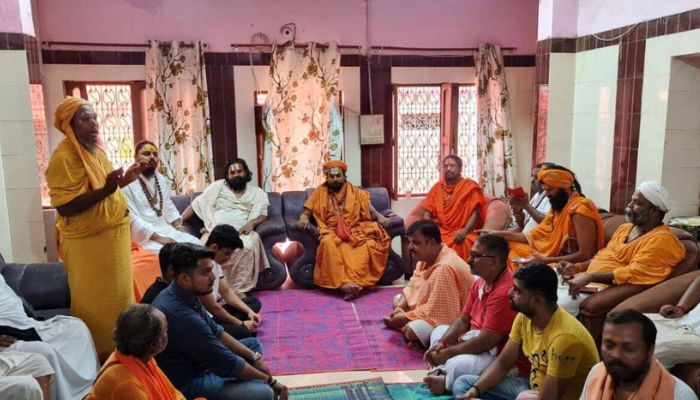
Hindu activist groups recently held a meeting and planned to hold a “Thamboola Prashe” ritual around the mosque premises on May 25. The meeting was attended by BJP MLA Bharat Shetty, Vishwa Hindu Parishad (VHP) leaders, including Sharan Pumpwell.

Earlier last month, a Hindu temple-like architectural design was found underneath the Juma Masjid in Malali, on the outskirts of Mangaluru. The structure was found during the renovation work underway at the mosque.

According to a report published in TOI, the VHP is also planning to seek the services of a famous astrologer from Kerala, to check if the mosque was built after a temple was encroached upon.

Earlier, the Vishwa Hindu Parishad (VHP) had also demanded that the mosque’s licence be revoked and that the Archaeological Survey of India (ASI) conduct an investigation after a temple-like structure was discovered inside the mosque in Gurupara Hobli.

Hindu activist groups, including Vishwa Hindu Parishad (VHP), had appealed to the district administration to stop the work till the documents are verified. Following the controversy, the Dakshina Kannada Commissionerate ordered to maintain the status quo of the structure till further orders. The administration had said that they would look into the land records and appealed to people to maintain peace.

Shivling discovered inside wuzukhana of Gyanvapi mosque

While the temple-like structure was found inside the mosque in April 2022, the controversy has reignited, in the light of the Gyanvapi dispute, where a Shivling was found inside the wuzukhana of the mosque, a place where Muslims wash their hands, feet and gargle before proceeding to offer namaz. The Muslim side, however, rejected the assertion and claimed that it was a “fountain, not a Shivling”.

After petitioner Sohan Lal Arya informed that a Shivling was found inside the complex of the disputed Gyanvapi structure, a Varanasi court Monday issued an order that directed authorities to immediately seal the area where the Shivling was found. In its order, the court stated that the Shivling discovery is substantial evidence and asked the CRPF commandant to secure the premises and prevent Muslims from entering the place where Shivling was found.

The Varanasi court directed the local administration to seal the area where Shivling was found inside during the court-mandated videography survey of the Gyanvapi Masjid complex. It stated that, at a time, only 20 Muslims should be allowed to enter the premises to offer Namaz. It also asked authorities to make sure that the Muslims are barred from performing Wuzukhana in the Gyanvapi premise’s pond, the place from where the Shivling has been discovered.

WHO awards ASHA workers with Global Health Leaders Award, Muslim mobs had attacked them at various places during the Covid pandemic

On May 22, World Health Organization (WHO) awarded India’s Accredited Social Health Activist Workers (ASHA) for their exemplary contribution to linking the general public with the health care system. In a press release, WHO said, “ASHA (which means hope in Hindi) are the more than 1 million female volunteers in India, honoured for their crucial role in linking the community with the health system, to ensure those living in rural poverty can access primary health care services, as shown throughout the COVID-19 pandemic.”

It added, “ASHAs worked to provide maternal care and immunization for children against vaccine-preventable diseases; community health care; treatment for hypertension and tuberculosis; and core areas of health promotion for nutrition, sanitation, and healthy living.”

Prime Minister Narendra Modi also extended his delight over the award. In a tweet, he said, “Delighted that the entire team of ASHA workers have been conferred the World Health Organization Director-General’s Global Health Leaders’ Award. Congratulations to all ASHA workers. They are at the forefront of ensuring a healthy India. Their dedication and determination are admirable.”

ASHA workers were attacked by Muslim mobs during the Covid pandemic

While the world admires the ASHA workers contribution to the health care system in India, they often get attacked for doing their job. During the initial days of coronavirus pandemic, several reports surfaced where ASHA workers were attacked by Muslim mobs for merely doing their job in Muslim dominated areas.

In May 2020, a complaint was filed against quarantined members of the Muslim community for allegedly threatening the ASHA workers. Nineteen members of the Muslim community were booked in Uttar Pradesh’s Mau. The ASHA workers had asked them to follow the quarantine norms. Agitated by suggestions, the members of the Muslim community had threatened to kill them.

In April 2020, three men identified as Mehaboob, Khaleel and Zeeshan were advised by an ASHA worker to wear masks and follow guidelines issued by the health department. Irked by the suggestions, they attacked her. ASHA worker Sumayya Firdose filed an FIR against them. She said that she asked the men who were loitering around to wear masks and maintain social distancing. Enraged, the youth abused and threatened to kill her if she did not ‘mind her own business. Reportedly there were Police nearby that rushed to her rescue.

Again in April 2020, ASHA workers were attacked by members of the Muslim community in Darbhanga, Bihar. ASHA workers who had come to seek information about the residents with a travel history in the village were subjected to a brutal assault by members of the minority community. Sarees of the female ASHA workers were pulled by the miscreants while the survey form given by them was torn into pieces.

In the same month, ASHA workers and Police personnel were attacked in Panchkula, Haryana, by the members of the Muslim community. a Muslim mob of nine miscreants had attacked a police party and ASHA workers at Indira Colony in the city where they had gone for a health checkup.

In another incident in April 2020, a nurse and ASHA workers were attacked by Muslim residents in Bengaluru’s Sadiq layout for trying to carry out tests on suspected corona symptomatic patients and also for collecting information on fever and cough from the residents of the locality.

Another Jug Jugg Jeeyo copying controversy: Pakistani singer Abrar Ul Haq accuses Karan Johar of copying his blockbuster hit ‘Nach Punjaban’

Pakistani singer and politician Abrar Ul Haq has accused producer Karan Johar of stealing his song ‘Nach Punjaban’ for the upcoming Dharma Productions film Jug Jugg Jeeyo. In a tweet, Abrar said that he had not sold rights for his song “Nach Punjaban” to anyone, and that producers like Karan Johar should not copy the song. He further said legal action against Johar’s production house would follow.

He said, “I have not sold my song “Nach Punjaban” to any Indian movie and reserve the right to go to court to claim damages. Producers like Karan Johar should not use copy songs. This is my 6th song being copied which will not be allowed at all.”

In a follow-up tweet, he said, “Song “Nach Punjaban” has not been licensed to anyone. If someone is claiming it, then produce the agreement. I will be taking legal action.” Abrar Ul Haq’s song Nach Punjaban was released in 2002.

Karan Johar was accused of copying the script of the film

Earlier, Vishal A Singh, a creative executive producer, and Chartered Accountant accused Dharma Productions of using a script he shared in 2020 to make Jug Jug Jeeyo.

In a tweet, Vishal said that he had registered the script named ‘Bunny Rani’ with Screenwriting Association in January 2020. A month later, in February 2020, he mailed Dharma Productions for an opportunity to co-produce the film with them, for which he had received a reply from the production house as well. He alleged that they picked his story and made Jug Jugg Jeeyo. “Not fair, Karan Johar,” Vishal wrote.

Jug Jugg Jeeyo scheduled to release in June

Jug Jugg Jeeyo is an upcoming Bollywood film by Dharma Productions starring Varun Dhawan, Kiara Advani, Anil Kapoor, and Neetu Kapoor. Produced by Hiroo Yash Johar, Karan Johar, and Apoorva Mehta, the film is directed by Raj Mehta. The film deals with the sensitive subject of divorce and separation with a comic touch. The film is set for a theatrical release on June 24.

Fact-check: Did a man in Saudi Arabia marry four women from the same school

A post is being circulated on social media platforms that reads ‘The female student, her teacher, the supervisor of the teacher and the principal of the school have one common husband’. The screenshot of the said post is from Life in Saudi Arabia. Several netizens have shared the post from their profiles.

BJP IT Cell head from Lucknow, Abhishek Tiwari said, “The school must have been built by the Sheikh himself.”

Prominent Twitter user Renuka Jain also shared it with the Hashtag #JustSaying.

Netizen Riniti Chatterjee Pandey also shared the report with laughing emojis.

Another user Roomi said, “Lapant of the year.” Lapant means a person with a bad character.

OpIndia tried to find out if the viral story was indeed true. During our investigation, we found out that the post is not new and has been circulating for a long time. It dates back to 2012 when it was first published in several portals, including Life In Saudi Arabia, Independent, and others.

The report in Life In Saudi Arabia stated that a man had married for the fourth time. The new wife was still studying in a secondary school. Incidentally, another wife of the man was a teacher in the school. His two other wives were the supervisor of the teacher and the principal of the school.

A Gulf News report claimed that all four women were happily living together. The story was shared by one of the wives (the teacher), who explained how she and the other wives managed to make it work.

According to Gulf News, the family became a hot topic of discussion in the school as it was an ‘unusual case’. Another teacher in the report was quoted saying, “We often talk about it, and all the teachers and students see the fun part of it.” She added, “The principal treats the teacher and the student normally like she does with the rest of the staff and students.”

Verdict: Though the report is true, it is from 2012.

Rahul Gandhi makes another pitch for foreign intervention in India, rants against his own country just because he is not the one ruling it

Gandhi-scion Rahul Gandhi was yet again at the receiving end of severe criticism for his speech at the recently held ‘Ideas for India’ conference in the United Kingdom. In his speech at the Congress party event organised by the non-profit think-tank Bridge India, Rahul Gandhi shared several ideas, where he promoted sub-nationalism besides instigating anarchy in the country by calling for a ‘mass action’ against the Indian state.

Speaking at the event in the United Kingdom, Congress leader Rahul Gandhi resorted to scaremongering, asserting that a civil war is impending in India, which would not surprise him as the country is extremely unstable. The Congress MP claimed that India was in a horrible position and that a political revolution was required.

To corroborate his wild claims, Rahul Gandhi stated that the Bharatiya Janata Party has poured kerosene around the country and that a single spark is enough to blow the country up. Congress leader Rahul Gandhi also claimed that the “deep state” RSS controls the country, causing the damage.

Upping the ante on the Indian state, Rahul Gandhi called for a ‘mass action’ within the country while at the same time calling for foreign interference to end the nexus of the ‘deep state’ and save his ‘Idea of India’.

During his controversial address, Rahul Gandhi signalled his desire for foreign intervention two times. The first one is during the mention of the Russia Ukraine issue, and the second one is when he criticised Indian diplomats for being unwilling to take orders from Europeans.

In response to India’s role in the Russia-Ukraine crisis, Rahul Gandhi replied that Ladakh is to China what Ukraine is to Russia. The Congress leader asserted that one would have to understand the “parallels” between the Ukraine crisis and the ongoing situation in India. Essentially, Rahul Gandhi called the western countries to treat the internal affairs of India as they view the Russian-Ukrainian conflict while subtly asking the US to play a role in India’s political affairs.

Again, during his interaction at the event, Rahul Gandhi also revealed how he has spoken with the diplomats of the European countries as he disclosed that several European bureaucrats had told him that Indian foreign service has changed, and they have become arrogant. Rahul Gandhi lamented that the Indian diplomats no longer fall in line with diktats of the west.

“I was talking to some bureaucrats from Europe, and they said that the Indian Foreign Service has completely changed, they do not listen to anything. They are arrogant. Now they are telling us what orders they are getting, there is no conversation,” said Rahul Gandhi, adding that what Indian foreign service officials were doing was wrong.

Again, Rahul Gandhi insinuated that Indian diplomats should comply with western powers more than pursue their own strategic interests. It looks like Rahul Gandhi is more than happy for the western powers to dictate Indian political and strategic choices than India to protect its sovereign decision-making ability.

Rahul Gandhi – a repeat offender of begging for foreign interference in India’s affairs

Well, this is not the first time that Rahul Gandhi is advocating for foreign meddling in Indian affairs.

In March 2021, during his interview with Brown University professor, Rahul Gandhi had indirectly asked the western countries not to recognise BJP’s electoral success by comparing the party’s victory to Iraqi dictator Saddam Hussien and Libya’s Gaddafi. Rahul Gandhi had claimed Saddam Hussein and Gaddafi won elections too, just like PM Modi, and hence one should not equate elections with the successful function of democracy. Both Libya and Iraq were destroyed by Western bombings.

Taking a jibe at the Centre, he added that both Saddam Hussein and Gaddafi did not need votes but used the electoral process to capture power. These comments were made during a talk show with leftist professor Ashutosh Varshney of USA’s Brown University, who had asked Rahul for his commentary on the ‘decline in democracy’ in India. However, it is interesting to note that Gaddafi came to power in Libya in September 1969 as the leader through a military coup which overthrew the British-backed King Idris and not through a democratic electoral process.

Again in April 2021, Rahul similarly sparked anger by requesting American intervention in India’s domestic affairs. The Kerala MP had then stroked a massive outrage by asking for American interference in India’s internal matters.

In an interaction with Ambassador Nicholas Burns of the Harvard Kennedy School, Rahul Gandhi had asked for American interference in India towards the end of the program after host Nicholas Burns had delivered his concluding remarks. After Burns concluded the session, Rahul Gandhi asked why he did not hear anything from the US establishment about what was happening in India.

“If you are saying partnership in democracy is, I mean, what’s your view on what is happening here?” Burns was visibly shocked after hearing this open offer from Rahul Gandhi asking America to comment on India’s internal matters.

It is important to note that such remarks by Rahul Gandhi expose sinister overtones on so many levels. At first, Rahul Gandhi, who seems highly frustrated regarding his repeated electoral defeats, is looking to play with existing faultlines within the country. Today, it is not an unknown fact that the Gandhis no longer have any goodwill in the country. Their charisma and entitlement are now just limited to the Congress party and a few quarters of the Lutyens intellectual circuit.

As there are no takers for the Gandhis, and electoral success remains elusive for them, Rahul Gandhi perhaps wants the ‘deep state’ in the west to play a more active role in India’s affairs, indirectly, he wants to project himself as a more compliant candidate for the West, as against PM Modi. By undermining the legitimate, peaceful and democratic election process of India where his party’s candidates and policies have been decisively rejected by the people of India, Rahul Gandhi’s rants are a plea to the Western powers to intervene in India’s internal affairs. He wants Western powers to ‘remove’ the democratically elected government of India, so his family can rule.

Hence, Rahul Gandhi continues to dog-whistle against the Indian state, especially against the Hindus on foreign soil, while he pleads for their help to ascend the throne, which Rahul Gandhi thinks he is entitled to.

Karnataka: Congress MLA Zameer Khan feeds a man then eats the same chewed food from his mouth to ‘set example against caste discrimination’, watch video

Congress Chamarajapete MLA and former minister BZ Zameer Ahmad Khan fed a man some food with his own hands and then ate the same chewed food by getting the man to take the food out of his mouth. He fed Swami Narayana of the Dalit community and then ate the same chewed food by making Narayana take it out of his mouth to provide him with his hands.

This incident occurred during what appears to be a joint BR Ambedkar Jayanti-Eid celebration. The tweet by ANI stated that the move was “…an attempt to set an example seemingly against caste discrimination.” One can see Swami Narayana’s bewildered expressions as he is made to take out chewed food from his mouth and feed the Congress MLA Khan.

It should be noted that the same Congress MLA, Zameer Ahmad Khan, also joined the Karnataka hijab controversy by arguing that the Islamic veil protects women’s beauty from potential rapists. He claimed that the hijab’s function as the girls grow up is to keep them behind Purdah since their beauty should not be seen. Hijab is used to conceal their attractiveness, he had claimed.

In February of this year, a criminal case of defrauding, trespassing, and threatening was filed against Congress MLA and former minister BZ Zameer Ahmed Khan, his brother, and others. On the order of the Seventh Additional Chief Metropolitan Magistrate, Sampigehalli police station.

According to the FIR, Shahista Nazeen Khanum had a plot at Chokkanahalli, Yelahanka. On August 4, Khan, his brother Jameel Ahmed Khan, and others reportedly trespassed into their property with bulldozers and guns and warned them not to build anything there.

Tasneem Fathima, Khanum’s sister who has the Special Power of Attorney had stated that her sister possessed a 5,300-square-foot property in Yelahanka.

Organiser of the London event where Rahul Gandhi spoke wants India fragmented and become how the West would want it to be

They all are in this together. The global left-wing alliance is a reality and not a hidden conspiracy. Pushparaj Deshpande of ‘Samruddha Bharat’ who was responsible for floating opposition leaders like Trinamool Congress’ Mohua Moitra and RJD’s Tejashwi Yadav in London for Rahul Gandhi’s Cambridge University event, has put his cards in the open about rallying as a coercive progressive alliance to change the ‘narrative in India’. This could be read as bringing PM Modi and the BJP down from power.

“NCP and Shiv Sena did not come as their offices are being raided by the ED. DMK is having to fly directly to Davos. Congress, CPM, Trinamool, and RJD were represented,” informed Deshpande while talking about the event aimed at bringing Indian opposition parties together in the event hosted by leftist organizations at Cambridge.

The event saw coming together so-called academics, students, activists, entrepreneurs, venture capitalists, lawyers and other professionals among the Indian diaspora. The conference where other leaders including Rahul Gandhi spoke, was organised by Bridge India, a think-tank with links to the Congress party. One of the partners of Bridge India is Samruddha Bharat run by Pushparaj Deshpande as a Managing Trustee.

While Deshpande’s association with Congress started with working on policy and politics with the Congress party, he was also involved with the infamous Rajiv Gandhi Foundation known for receiving funds from China and other governments in potential quid pro quo. Deshpande’s part in churning the ‘Ideas for India‘ is laid with anarchy, with a worldview of contesting identities and arming them against each other.

Employing the Indian diaspora to drive ideological war

“The diaspora is an integral part of India. It is natural that since they have a lot of stake in India we also solicit their support for the constitutional idea of India,” Deshpande claimed while talking to TOI about the event. Deshpande rallied for the diaspora’s support who is calling for help with his four-year-old organisation’s central mission of ‘changing the narrative’ in India. He talks of ‘reshaping hearts and minds’ of the Indians living abroad because they “have a voice with their government, in the media, they do a lot of business, they can nudge the Indian government to conduct itself in a certain way.”

Inauguration of Samruddh Bharat

Deshpande’s agenda is clear. Also, Samruddha Bharat’s hosting of Rahul Gandhi is not a standalone event – while as mentioned on their own website, the organisation was launched by Rahul Gandhi himself alongside other party loyalists. Its publications, where Congress leaders are involved, revolve around the narrative that Congress wishes to spin – whether it is deriding Hindus by calling India “majoritarian” or peddling the narrative that essentially divorces Dalits from Hindus.

Now, this makes it amply clear that Rahul Gandhi’s talk in London was an in-house event hosted by the Congress. However, the impression that one gets from the poster is that it is an event organised by the University of Cambridge.

Categorizing Hindus as ‘casteist’ and ‘communalist’

“There is the Tamil, Bihari, Marathi, even Gujarati diaspora — the second and third generations are very liberal. There is the Muslim, Christian and Sikh diaspora. All of these groups, their image of themselves is as secular, liberal, plural and cosmopolitan. They don’t see themselves as casteist or communalist or as people endorsing banning girls from wearing the hijab. This is a set of diaspora communities aligned with our values but we have not been reaching out to them, so now we are trying to tap into that,” Deshpande says.

Deshpande’s deliberate use of the phrase ‘casteist or communalist’ is poignant while attributing the same to the Hindu diaspora. He downplays the religious identity of the members of the diaspora being Hindu – and goes on to categorise them on a linguistic basis to divide them further. This expression roots from the classic Congress toolkit of dividing the Hindu majority over linguistic and casteist lines. The unification of Hindus and their political consolidation threaten Congress the most, and that is why intellectual exercises in subjugating the Hindu identity as fascist, majoritarian and communal are on their way.

What Rahul Gandhi does in Indian Politics, is what his footsoldiers do on international platforms. Gandhi’s recent attempts at separatism and his threats of violence suggesting a probable disintegration of India would eventually materialise with the intentional fanning of micro identities that exist in the political and ideological realms. With the Congress ecosystem not in stature to exercise power, its attempts to destabilise the nation have already set a dangerous precedent.

Toeing the Western line

“The West is very worried, the UK especially, about racism and communalism in their societies. No UK political party would want to be seen to endorse the systematic targeting of minorities, so how can the West sit silently on what is happening in India? They expect India to be a regional antidote to China. Are they really expecting us to be a regional antidote when we are going the China and Russian way,” Deshpande said while talking to the media.

Deshpande’s concerns over India not playing the game of the West are hilarious. While India since 2014 has gradually started to chart its own narrative and assert it strategically in the global arena, here is a Congress think-tanker wanting India to abide by what his supposed White master wants him to do. In Deshpande’s worldview, India must realise that the West sees it as its challenge to China, and thus India should see herself in the same light.

In a similar tone, During his interaction at the event, Rahul Gandhi complained that several European bureaucrats have told him that Indian foreign service has changed, and they have become arrogant as they ‘don’t listen’ to their counterparts. EAM S Jaishankar while refuting Rahul Gandhi’s comments said that it is not arrogance but confidence that the Indian officials are showing under the Modi government. That putting nation’s interest first is confidence.

However, this is not the first time the organiser of Rahul Gandhi’s event in Cambridge has spoken in similar fashion as the West would want India to be.

Challenging the ‘Hinduisation’ of Adivasis

“The people of RSS’ Vanvasi Kalyan Ashram do not care about our dignity, self-respect. They do not think that we have a separate identity and think we are Hindus,” remarked Pushparaj Deshpande while attributing a quote at a seminar in 2021. While describing the rehabilitation work of RSS as a process of ‘Hinduisation’ of tribals, he remarked that this stands as a rockstone under which Adivasis are getting trampled.

With a series of books published by Samruddha Bharat, Deshpande talks about ‘changing the hearts and beliefs of the people in the nation’ – Logon ke dilo aur Aasthaon ko badalna hai. He talks about creating a consensus among journalists, academics and politicians and implementing ideological manifestos in non-BJP ruled states especially when it comes to the issues of tribals.

From empowering separatism by contesting identities to being in a dire confusion over national interests to the denigration of Hinduism and native Dharmic practices, Samruddha Bharat headed by Pushparaj Deshpande is anything but what its name claims. It ticks all the boxes in playing an ideological younger brother to the narrow divisive Politics of Congress.

United States embassy in Pakistan condemned by Islamists for supporting LGBT rights, gets warned not to disrespect Islamic principles

Islamists have lambasted the United States Embassy in Islamabad, Pakistan, over a Tweet supporting LGBT rights. The tweet was made on May 17, the International Day Against Homophobia, Biphobia, and Transphobia. It seeks to organise international events that raise awareness of LGBT rights abuses and generate interest in LGBT rights work throughout the world.

The tweet said, “Mission Pakistan works to strengthen and support the LGBTQI+ community. We strive every day to ensure the human rights of the LGBTQI+ community are respected and protected from oppression. We continue to press for full equality.”

The tweet was condemned by Islamists in Pakistan stating that the embassy needs to obey the social norms of Pakistan. Islami Jamiat -e- Talaba, a student organization in Pakistan, condemned the tweet writing, “What an alarming moment for all the Pakistanis that the @usembislamabad is openly advocating #LGBT rights in the Islamic Republic of Pakistan. They have willfully forgotten that the laws of the land must be duly respected.”

“Advocacy of LGBT is akin to absolute disregard for the constitution of Pakistan, our culture and traditions, and above all, Islamic principles. @JamiatPK condemns the statement of @usembislamabad in the strongest words,” they wrote.

They also warned the US against interfering in social matters stating, “The vigilant nation of PK knows well to protect its values, so the US and all like-minded ones should never dare to transgress the boundaries.” Several other users also slammed the US Embassy for its remarks.

It is notable that when compared to gendered persons, lesbian, gay, bisexual, and transgender (LGBT) people in Pakistan do not enjoy real equality and face societal challenges. Even in big cities, gays and lesbians need to keep their sexual orientation hidden since same-sex sexual relations are illegal under Pakistani law and are seen with contempt and hatred in Islamic society.

Quad leaders’ meet: PM Modi pens a column in Japanese newspaper Yomiuri Shimbun, here is what he wrote

PM Modi is currently in Japan to attend a Quad leaders’ meet. On May 23, Prime Minister Narendra Modi shared his op-ed in the Japanese newspaper Yomiuri Shimbun. In a tweet, he wrote, “Penned an op-ed on the vibrant relations between India and Japan. Ours is a partnership for peace, stability and prosperity. I trace the journey of our special friendship, which completes 70 glorious years.”

In his op-ed, PM Modi described the relationship between India and Japan in three words Special, Strategic and Global. However, he added that India and Japan have far more possibility of a stronger bond. PM Modi traced the cultural ties between the two nations and drew parallels on how the two countries share the same values on democracy, freedom and rule-based international order.

He remembered how Bodhisena, the Indian monk who spread Buddism in Japan during the Nara era, and Swami Vivekananda, the great religious leader of India, helped strengthen the ties between the two countries. He also mentioned the influence of Japan on MK Gandhi as the famous Japanese Three Monkeys “See, Hear, Say” are associated with him.

70-years of partnership

PM Modi said India and Japan are celebrating 70 years of partnership. PM said his belief in the India-Japan relationship started building up when the then-PM of Japan visited Gujarat when PM Modi was Chief Minister of the state. Japan had extended its support for the “Vibrant Gujarat Summit”.

He mentioned how Japan had become an irreplaceable collaborator in the process of promoting development and modernization. Multiple projects like the automobile industry, industrial corridor and more show how Japan supported India. The two countries are now looking forward to strengthening the bond in the post-covid period.

He said the two countries could be essential cornerstones of stability and security in the region. The cooperative relationship between the two countries is expanding into various fields, including defence. The two countries will further cooperate in the cyber, space, and underwater areas.

Full text of Pm Modi’s op-ed (Translated using Google Translate)

Special, strategic and global. These three words, which describe the relationship between Japan and India, have unparalleled importance one by one, but they are far from the possibility of the bond between the two countries.

Cultural ties go back centuries. A strong belief in sharing the values ​​of democracy, freedom and rule-based international order, as well as the alignment of regional and global perspectives, underlies trust and the relationship between India and Japan as genuine partners.

From Bodhisena (an Indian monk who spread Buddhism in Japan during the Nara era) to Swami Vivekananda (a great religious leader in India), the cultural ties between the two countries are mutual. It has a long and rich history of respect and learning. Among the collections that Mahatma Gandhi cherished is a small statue of the three wise monkeys, “See, hear, say.” Also, Judge Radhabinod Pal (India, the only person in the Tokyo Tribunal who was blamed for Japan’s war for innocence) is well known in Japan. The praise of Tagore’s poetry for Japan and his interaction with Tenshin Okakura was the driving force behind the early networking of artists and intellectuals from both countries.

As the two countries celebrate their 70th anniversary of diplomatic relations, this deep relationship lays a solid foundation for a mature partnership between India and Japan in modern times.

My own belief in this partnership began during the time of Prime Minister Gujarat. He was not only due to the sophistication of Japanese technology and skills but also because of his attitude of earnest and long-term involvement in Japanese leadership and business. As a result, Japan has become a preferred partner in the industrial sector in Gujarat (state). It has also shown its most outstanding presence since the start of the investment attraction event “Vibrant Gujarat Summit”.

Japan also proved that India is an irreplaceable collaborator in the process of promoting development and modernization. From the automobile industry to the industrial corridor, Japan’s investment and development support footprint extends throughout India. The high-speed rail project between Mumbai and Ahmedabad symbolizes Japan’s broad cooperation in the most important efforts towards a “new India.”

The two countries have had long-term traffic since the establishment of diplomatic relations in 1952. However, in my opinion, the best time is yet to come. India and Japan are now looking to revitalize and rebuild their economies during the post-coronavirus period, further deepening our involvement in all areas, from trade to investment to defence and security. There is room for the unknown.

Over the last few years, India has embarked on strengthening its foundations in manufacturing, services, agriculture and digital technology infrastructure. Japan is an indispensable partner for the sustainable transformation of India. For Japan, India’s sense of speed and scale, combined with simplification and incentives for business practices, bold reforms and ambitious plans, will be a unique opportunity. India also has more than 100 unlisted unicorns (with a corporate value of more than $ 1 billion), creating a vibrant entrepreneurial environment. The Japanese capital has already played an important role and has much greater potential.

The connection between the peoples of both countries has played an indispensable role in deepening mutual understanding. Many Indians are now working in Japan and contributing to the Japanese economy and society. Just as Japanese business executives are contributing to India’s economic growth, this complementary relationship can be expanded in a wide variety of ways.

But our relationship has even greater responsibilities and goals. The spread of the new coronavirus infection, global tensions, and destructive actions that could threaten the stability and security of the Indo-Pacific build a robust supply chain that is not dominated by coercion or exploitation, human-based development models and power. Reiterated the need for stable international economic relations. The partnership between the two countries will help promote these objectives.

To that end, we will contribute to the construction of an open, free and inclusive Indo-Pacific. It is characterized by a safe ocean connection, integration by trade and investment, and respect for sovereignty and territorial integrity as documented in international law.

As two democracies located in the strategically important Indo-Pacific, both countries can be important cornerstones of stability and security in the region. That is why the cooperative relationship between the two countries is expanding into a wide range of fields, and the defence cooperation between the two countries is rapidly becoming closer, from joint exercises to information exchange and the defence industry. The two countries will further cooperate in the cyber, space, and underwater areas.

In addition to security, we have development, infrastructure, connectivity, sustainability, health, and vaccines, along with frameworks such as the “Quad” of Japan, the United States, Australia and India, countries that share values ​​both inside and outside the region. Promote initiatives in this region, such as capacity building and humanitarian response in the event of a disaster. The peaceful and prosperous Indo-Pacific region is also very important for a better future for the whole world.

A crisis can sometimes be a bigger challenge and accelerate change. That is why, now that the world is at a turning point, the cooperative relationship between the two countries requires heavier responsibility and urgency. India and Japan can meet these demands if they have everything they have built over the last few decades that they share.

In March of this year, in New Delhi, Prime Minister Kishida and I presented a roadmap for deepening the “India-Japan Special Strategic Global Partnership” towards a peaceful, stable and prosperous post-Corona world. As we celebrate the 70th anniversary of the establishment of diplomatic relations, we are building a decisive cooperative relationship in this region. I am confident that the meeting with Prime Minister Kishida will make solid progress towards the realization of this ambitious agenda.

PM Modi’s Japan visit

Prime Minister Narendra Modi is currently in Japan on his two-day visit to attend the Quad summit. This will be the second in-person Quad meeting. India, the United States, Japan and Australia are part of this group. The new PM of Australia Anthony Albanese and US president Joe Biden will be present at the summit too.

ET publishes offensive memes on Shivling despite multiple FIRs over those memes, once again highlighting the callousness of media towards Hindu sentiments

In its print edition on May 22, 2022, The Economic Times (ET) published a meme mocking Hindus by depicting the Bhabha Atomic Research Centre as a Shivling and captioned BOM BHOLENATH. The image was included in the MEME’S THE WORD Column of the print edition.

The meme on Shivling.

Another cartoon in the column mocks the call to open the Taj Mahal’s closed gates in the basement.

The cartoon on Taj Mahal.

It is worth noting that this has occurred at a time when multiple judicial proceedings have been initiated over disrespectful remarks and social media posts about the Shivling unearthed in the disputed Gyanvapi complex close to the Kashi Vishwanath Mandir. A complaint was recently filed against TMC MP Mahua Moitra, ‘journalist’ Saba Naqvi, Retired IAS Surya Pratap Singh, Peace Party’s Shadab Chouhan, and RJD leader Kumar Divashankar for making derogatory tweets about Lord Shiva following the discovery of a Shivling inside the disputed Gyanvapi mosque’s wuzukhana.

A Delhi University professor Ratan Lal was even arrested and then granted bail, for sharing another similar offensive meme over the Shivling.

Yet, publishing this meme on Shivling and Lord Shiva by the Economic Times demonstrates the callousness with which they treat the sentiments of the Hindu faith. If it was about any other faith, a cartoon/meme offending other religions, no mainstream media would have touched it with a barge pole but apparently, it is ok to laugh at Hindus’ religious beliefs and their symbols.

Mocking Hindus and their beliefs has become a threshold these days for media outlets to be considered truly liberal. Furthermore, this is not mere negligence; media outlets doing so consciously and repeatedly demonstrate their hostile objectives of offending Hindu feelings without having to face any opposition. In this case, it is well known across the globe that Kashi Vishwanath is one of the most revered locations and major pilgrimage destinations for Hindus, but still, a caricature and meme of such insulting nature was published in a national daily.

Making fun of Hindu feelings has become the new normal for the whole mainstream media, not just ET. It illustrates that the media is unconcerned about the Hindu faith. For them, anything Hindu is essentially simply ‘RSS/BJP,’ and hence they portray themselves as anti-establishment while being overtly anti-Hindu. So much so that they would wish death upon ‘Sanghis’ just because they do not align with them on political ideologies.

They do not acknowledge the fact that Hindus have their own identity and they are not just an extension of a political party or any organization.

Such incidents mocking the Hindu faith are commonplace because the media and the general public know very well that there is no risk of any backlash from the offended Hindus, who are at most going to file some FIRs that will not go anywhere. As we saw in the case of DU professor Ratan Lal who got bail the very next day.

Professor Ratan Lal of Delhi University was arrested for hurting Hindu sentiments on social media, but he got bail instantly because he stated in court that he is a Hindu. This is the reality where anyone can make disparaging remarks about Hindus, their festivals, and their culture without fear of any consequences because the offender can simply claim that it is one’s freedom of expression and, as a member of the same religion or community, he knows what is offensive and what is not!

Hence, with the fear of any backlash eliminated, media outlets and organizations wilfully take these risks, knowing that the severity of court punishment will be minimal, if at all!

Everyone is familiar with the Charlie Hebdo incident. If the caricature had been of the Prophet or the Quran, ET would have been attacked on social media and maybe at their offices, with the meme’s originator executed. The fact that something like this has not occurred illustrates the tolerance of a religion founded on the values of universal acceptance and harmony.

Many media outlets, including the Times Group, labeled Charlie Hebdo’s caricatures as offensive and provocative. However, when it comes to Hinduism, the double standards are clear. This meme on the sacred Shivling marks the epitome of freedom of expression for Economic Times. They feel free to publish and republish cartoons that are disrespectful to Hinduism, but they dare not publish drawings or memes that criticise Islam since they are fully aware of the ramifications.

Moreover, this is on Hindus too. It is on to Hindus to acknowledge this fact about media and consume content that is not disrespectful to their faith. The same is true when reporting on situations such as love jihad,religious  conversions, and a variety of other issues in which Hindus are only the victims and are the ones facing censure. The more Hindus consume and encourage such stuff, the more they will be riduculed in every way imaginable.