On Monday (June 13), Congress scion Rahul Gandhi appeared before the Enforcement Directorate after he was issued summons by the central agency in connection to a money laundering case related to the National Herald case.
He was interrogated for several hours and his statement was recorded under the Section 50 of the Prevention of Money Laundering Act (PMLA). Reportedly, the Congress leader was quizzed by the Assistant Director of the ED and the questioning was supervised by a Deputy Director.
Gandhi’s statement was typed out by another officer. He may be summoned for further questioning on Tuesday (June 14). It must be mentioned that the ED had recorded the statements of all those involved in the case, with the exception of Rahul Gandhi and Sonia Gandhi.
#WATCH | Congress leader Rahul Gandhi accompanied by party leaders and workers marches to the Enforcement Directorate office in Delhi to appear before it in the National Herald case pic.twitter.com/8sd7VctfEG
Although Sonia Gandhi was asked to appear before the central agency on June 8, she had to be hospitalised for Covid-19. She has now been asked to appear before the Enforcement Directorate on June 23, 2022.
Rahul Gandhi was summoned by ED on Monday (June 13) in relation to a case that was lodged 9 months ago. The case sought to investigate financial irregularities under PMLA associated with National Herald.
Citing sources, India Today reported that the Congress scion was quizzed about his association with two key companies, namely, Young Indian Limited (YIL), and Associated Journals Limited (AJL). He was asked about the Congress’ keenness to revive National Herald and the loans sanctioned to keep it afloat.
The publishing company of the National Herald goes into debt
National Herald was started by India’s first Prime Minister Jawaharlal Nehru in 1938 to convey the concerns of Congress’ liberal brigade. Following India’s independence, it metamorphosed into the mouthpiece of the Congress party.
The Associated Journals Limited (AJL) was the publishing company of the National Herald newspaper. It was also involved in the publication of the Urdu newspaper Qaumi Awaz and Hindi paper Navjivan. By April 2008, AJL was in huge debt and owed the Congress party a whopping sum of ₹90.26 crores.
The party had sanctioned loans to the company from time to time at 0% interest to keep it afloat. When it became unsustainable, AJL formally drew curtains over the printing and publication of its newspapers in 2008. The number of shareholders was down to 1000 in 2010 from 5000 at the time of its establishment.
Debt owed to Congress party transferred to Gandhi-owned company
Another company by the name of Young Indian Limited (YIL) was created in 2010 as a private, not-for-profit charity under Section 25 of the Companies Act of 1956. The Gandhis (including Rahul and Sonia) owned 83.3% of the shares in YIL (as per Income Tax records).
Congress leaders Motilal Vora and Oscar Fernandes owned 15.5% and 1.2% of the shares respectively. YIL paid ₹50 lakhs to the Congress party and transferred the debt of ₹90.26 cr owed to it by AJL to itself.
Given that AJL was not in a position to clear its debt, the Young Indian Limited acquired a majority of its share equities and eventually the whole company. As such, all assets of the Associated Journals Limited were incorporated into the Gandhi-owned Young Indian Limited.
This included real estate assets, worth over 2000 crores, which are located in posh localities of Mumbai, New Delhi, Lucknow, Bhopal, Indore, Patna and others. After acquiring AJL, Young Indian Limited announced that the publication of newspapers was not the objective of the not-for-profit charity.
Nonetheless, in 2016, YIL relaunched the 3 newspapers, including the National Herald, in a digital format.
Allegations levelled by Subramanian Swamy
In 2011, BJP leader Subramanian Swamy claimed that YIL was floated by the Gandhis to acquire the real-estate assets of AJL. He also accused Rahul Gandhi and Sonia Gandhi of defrauding their own party and approached the trial court in 2013.
He claimed that YIL was able to write off debt totalling ₹90.26 crores for just ₹50 lakhs. Swamy said that the decision of the Congress party to extend loans to AJL for commercial purposes was illegal.
The BJP leader alleged that the land, on which the National Herald House is built, was given at a concessional rate by the government to carry out the publication of newspapers. He claimed that the building was being illegally used by the Gandhis for renting and commercial purposes.
Progress of the National Herald scam case so far
In 2013, Subramanian Swamy approached the trial court in Delhi against Young Indian Limited. Metropolitan Magistrate Gomati Manocha noted that the evidence suggested that YIL was a cover to ‘convert public money to personal use’.
The trial court held that a prima facie case was made out against the accused for cheating, criminal conspiracy, criminal breach of trust and misappropriation of property. The judge noted that the accused in the case “acted in consortium with each other to achieve the said nefarious purpose/design”.
The Metropolitan Judge, however, added that the accused would be able to refute the allegations levelled against them. When the Gandhi family was summoned by the trial court, they got a stay on the order from the Delhi High Court.
A probe by the Enforcement Directorate (ED) was initiated in August 2014, then closed in the following year owing to a technical problem and resumed again in September 2015. The trial court also took into consideration an investigation conducted by the Income Tax Department.
The Gandhis and other accused in the National Herald scam case were granted unconditional bail by the Patiala High Court in December 2015. However, the court refused to quash the proceedings against them citing ‘no political vendetta.’
It also noted that it was one of the exceptional cases where national leaders of the Congress party were under scrutiny. The court pointed out that it would be ‘preposterous’ to deny criminality in the transactions involved in the case.
The Gandhi family then approached the Supreme Court, which directed them to face criminal proceedings for a free and fair trial. In 2020, Subramanian Swamy approached the Delhi High Court against a trial court order dismissing his petition to lead evidence.
The Delhi High court stayed the proceedings of the trial court and issued notices to all the accused in 2021.
Union minister Smriti Irani on Monday criticised the Congress party’s ‘Satyagraha’ march to show support for Rahul Gandhi, who is being questioned by the Enforcement Directorate in the National Herald case. During a press conference, Smriti Irani characterized the march as a “blatant attempt” by the Gandhi family to intimidate investigative agencies. Never before has a political family attempted to hold a government investigation agency hostage, she added.
Smriti Irani stated that Congress is not protesting to safeguard democracy but to save Rahul Gandhi’s 2,000 crore properties. She said, “Congress leaders have taken to the streets to pressurize an investigating agency openly because their corruption has been exposed… It’s an attempt to protect the assets of the Gandhi family.”
While detailing the ED’s case to the media, the Minister stated that in 1930, a firm called Associated Journals Limited (AJL) was created with the intention of printing a newspaper. Its stockholders included 5,000 freedom fighters. “Today, a company that was to be run by freedom fighters has been usurped by the Gandhi family,” Smriti Irani remarked.
“In 2008, this company incurred debts of 90 crores and decided to enter the real estate market. Another business, Young India, was established in 2010 with an initial capital of five lakh, and Congress General Secretary Rahul Gandhi was appointed as its Director. Mr Gandhi owned 75% of the firm, with the remainder owned by his mother Sonia Gandhi and Congress leaders such as Motilal Vora and Oscar Fernandes,” Smriti Irani went on to elaborate about the scam.
“Young India received nine crore shares of AJL, representing 99 per cent of the entire shares of AJL. The Congress Party then lent AJL 90 crore, which was never repaid,” she further said, adding that people who donated funds to Congress for welfare works ended up funding the Gandhi family.
This firm, as Irani stated, was not founded to conduct social work. It obtained a licence under Section 25 of the Companies Act at the time of its formation, allowing it to undertake purely charitable activities. However, Young India admitted in 2016 that it has done no charitable activity in its six years of existence.
She alleged that Rahul Gandhi has business dealings with Dotex Merchandise Private Limited. Dotex Merchandise Private Limited is connected to a Havala entry operator in Kolkata who exchanges cheques for cash. According to the union minister, the Financial Intelligence Unit has flagged this company’s financial operations.
“Is it true that this company has relations with companies that are owned by Rahul Gandhi, Sonia Gandhi and Priyanka Gandhi Vadra?” Smriti Irani advised Congress workers to ask this question from the Gandhi family.
She also quoted a phrase from a 2019 Delhi High Court verdict, “The entire transaction of transferring of shares of AJL to Young India was nothing but a clandestine and surreptitious transfer of the lucrative interest into the premises of Young India.”
Congress leaders creating a ruckus at the ED office
Earlier in the day, before Congress leader Rahul Gandhi went for interrogation at the Enforcement Directorate office in Delhi in connection with the National Herald money laundering case, Congress leaders and workers caused a ruckus and opposed the authorities outside the ED office.
Several other Congress leaders were held by police for attempting to cause unrest before Rahul Gandhi’s attendance in the ED office. Along with other workers, police detained Congress spokesperson Randeep Singh Surjewala, senior leader Harish Rawat, and Congress leaders Rajni Patil, Akhilesh Prasad Singh, L. Hanumanthaiah, and Thirunavukkarasar Su.
Monday, 13 June, saw Rahul Gandhi reaching the Enforcement Directorate office for questioning after the agency summoned him over money laundering charges in the National Herald case. In a reaction to this development, the Congress party workers staged protests in Delhi and other cities as part of ‘Satyagraha’ against the inquiry.
Meanwhile, Delhi police detained several other Congress leaders for trying to foment trouble before Rahul Gandhi’s appearance in the ED office. Along with other workers, Congress spokesperson Randeep Singh Surjewala, senior leader Harish Rawat, Congress leaders Rajni Patil, Akhilesh Prasad Singh, L. Hanumanthaiah, and Thirunavukkarasar Su. were detained by the police.
At a time when senior Congress leaders were holding agitations and demonstrations in support of Rahul Gandhi, one Congress MP was conspicuously absent. Shashi Tharoor was in the United Kingdom, to preside over the London event of the Jaipur Literature Festival. While other Congress leaders were being detained by police, Tharoor was sharing a picture with Geetanjali Shree, author of the recent Booker Prize winner ‘The Tomb of Sand’ (English translation of the Hindi original Ret Samadhi by Shree). Sharing the image, Tharoor tweeted, “Toasting birthday girl novelist Geetanjali Shree with a strawberry in London last night as @JLFLitfest comes to a celebratory end!”
Toasting birthday girl novelist Geetanjali Shree with a strawberry in London last night as @JLFLitfest comes to a celebratory end! pic.twitter.com/udZQcZwfhI
After the tweet from Tharoor, Congress supporters were miffed with Tharoor regarding the timing of his tweet. Many Congressis on Twitter questioned Tharoor’s loyalty towards the party while his fellow Congress leaders were staging protests and getting detained in support of Rahul Gandhi.
Screengrab of a Tweet from @VJtwiter28
‘Solidarity’, he means. Screengrab of a Tweet from @ateetKaushik
Congress workers asking Shashi Tharoor over his absence on Twitter
Screengrab of a Tweet from @anubratach
Screengrab of a Tweet from @ssr99
After Congress loyalists questioned Tharoor over the timing of his tweet, other Twitter users also decided to pull his leg with memes and jokes.
Screengrab of a Tweet from @thispodcastguy
Screengrab of a Tweet from @Meme_Canteen
Screengrab of a Tweet from @Spoof_Junkey
Meanwhile, earlier today, before Congress leader Rahul Gandhi appeared for questioning at the Enforcement Directorate office, the Congress leaders created a ruckus in the capital and protested against the normal functioning of the agency.
Nupur Sharma, the former BJP spokesperson, has been caught in a dangerous storm after she made certain innocuous comments during a TimesNow debate. After Indian Muslims like AltNews’ co-founder Mohammad Zubair dog-whistled against her, she was declared a ‘blasphemer’ and several Islamist outfits, including Taliban and Al Qaeda, are now demanding her head on pike. Amid the death threats, Indian Islamic outfits have come out to demand a law that punishes those who speak ‘against’ Islam.
Darul Uloom Deoband, an Uttar Pradesh-based Islamist outfit, has demanded that Nupur Sharma be punished for her statements against Islam. They said that those who make objectionable statements against the symbols of Islam “to spread hatred in the country” need to be punished severely.
But these are the statements one expects from Islamist outfits. However, the statement by Maulana Mufti Abul Qasim, the VC of Darul Deoband, is a telling sign of the things to come. Qasim issued a statement on Wednesday demanding a special law that strictly punishes those who insult Islam.
Reportedly, Maulana said, “I strongly condemn the insulting remarks against our beloved Prophet. Religious sentiments of the followers of any faith cannot be provoked in the name of freedom of expression. Insulting the Prophet will not be tolerated by Muslims in India or abroad”. According to reports, he further said that the Indian government should enact a special law “to deal with cases where religious symbols of Muslims are targeted”.
The Maulana further spoke about communal harmony while talking about how the Muslim community deserves a special law. He said, “India is a secular country and people here have been living together for centuries. These communal and extremist elements are not only harming the country’s social harmony but also disturbing the nation’s secular fabric and ethos”.
At the very outset, let us marvel at how the Islamist’s hate is also dressed up as harm to the “social fabric” caused by their victim. Essentially, they fracture the harmony and social fabric with arson, rioting, protests, and slogans like “Gustakh-e-Rasool Ki Saza, Sar Tan Se Juda”, and then blame their victim, who they want to behead for hurting their fragile emotions just enough to send them down the path of violence. This sleight of hand is almost amusing as it keeps repeating itself over and over again. They take offence to just about anything, run riots, commit violence and then, blame the person exercising their freedom of speech for fracturing social fabric and harmony. It almost appears as a blackmailing tactic. Do as we please or we will burn your country and blame you for it.
Besides this oft-repeated pattern, what was carefully tucked away in his statement, was the demand for a “special law” meant only to protect the frangible feelings of the Muslim community. While blaming the victim for the violence unleashed by the Islamists, Maulana Mufti Abdul Qasim demanded that the state enact a special law that outlaws hurting the sentiments of Muslims and insulting their religious symbols. The demand has come from several other Islamic quarters as well. In fact, Bollywood actor Naseeruddin Shah also said that in Islamic nations, the crime of Blasphemy would be punishable by death, however, in India, no action has been taken. While he did not directly ask for a special law or for the death penalty, his insinuations were rather clear – the ‘moderate Muslim’ would be more than happy if a special law was enacted that specifically punished, in the harshest terms, those who hurt feelings of the Muslim community.
The demand for a special law may seem innocuous and an impossibility that we must summarily ignore, however, one has to acknowledge that what is happening now is a dangerous repeat of the events that led to the breaking up of India.
In this regard, it would bode well to remember the case of Mahashay Rajpal, who published Rangeela Rasool and was ultimately assassinated for it. We mostly hear that Mahashay Rajpal was assassinated for publishing satirical work on Prophet Muhammad called Rangeela Rasool, but we seldom hear why he chose to publish the book. In 1923, Muslims published two particularly offensive books to Hindus. “Krishna teri geeta jalani padegi” used derogatory and vulgar language against Shri Krishna and other Hindu deities and “Uniseevi sadi ka maharshi” which contained derogatory remarks on Arya Samaj founder Swami Dayanand Saraswati (incidentally written by an Ahmadi).
We must bear in mind that this was an era before the existence of Section 295A, therefore, thankfully, the conversation around the law cannot be used to skirt the issue of radical Islam and how its street power not only affects change in policy and law, but also has scant regard for the law of the land when they decide to eliminate those who do “gustakhi” against “Rasool”.
In response to this provocation by Islamists, Pandit Chamupati Lal, a close friend of Mahashay Rajpal, wrote a short biography of the Islamic Prophet, Mohammed. “Rangeela Rasool” was a short pamphlet which satirised the life of the Prophet of Islam. Pandit Chamupati made Mahashay Rajpal promise that he would never reveal the name of the author – he knew the consequences of it. Anonymously published under the name “doodh ka doodh aur panee ka panee”, the book enraged Muslims.
Staying true to the values of one-way brotherhood, Mohandas Karamchand Gandhi wrote in his pamphlet “Young India”, condemning Rangeela Rasool. While Gandhi ignored the provocation by Muslims, by the end of June 1924, the colonial government banned the book. The Muslim community, partly emboldened by MK Gandhi’s endorsement of their hurt sentiments and whitewashing of the provocation against Hindus, filed multiple cases against the book under 153A. In May 1927, Mahashay Rajpal, who published the book, was acquitted of all charges with the court observing that commentary based on facts on historical figures, including the prophet of Islam, cannot be said to promote enmity between groups. As soon as the verdict was delivered, Muslim mobs went into a frenzy. They rioted and demanded the head of Mahashay Rajpal. They were chants about how the murder of Rajpal was acceptable because, under Sharia, the punishment for blasphemy is death.
With the Muslim mobs going on a rampage, 295A was passed to assuage the feelings of the mobs and in the same year, there were two unsuccessful attempts at Mahashay Rajpal’s life.
On April 6th, 1929 a 19-year-old carpenter named Ilm ud din stabbed Mahashay Rajpal on his chest eight times while he was seated in the outer verandah of his shop. Though he was offered to give up the name of the author, Pandit Chamupati Lal, during the court proceedings, he refused and did not yield. He paid the price for it. He paid the price for publishing that book despite the court acquitting him and the Muslims getting a special law to protect their fragile feelings.
Not too long after India was torn apart by those who were convinced that the Muslim community could be placated. Before the Rangeela Rasool controversy, Hindus saw the Khilafat movement, the support it got from Congress and Mohandas Karamchand Gandhi and after that, Hindus saw the rise of a Muslim leader like Mohammad Ali Jinnah, leading India’s partition.
While Rangeela Rasool did not cause the partition, there was a common thread – a clear, stark, unmissable thread. Mahashay Rajpal’s murderer was represented in the court of law by Mohammad Ali Jinnah and Iqbal, who is eulogised today by the Left Liberals, wrote a song in his honour. Pakistan gave him the honour of Ghazi.
The partition of India happened on religious lines. It was not because Hindus did not concede to the demands for concessions made by Muslims or because Muslims felt persecuted in syncretic India – it was because the Muslim community came together and proclaimed that they were a nation unto themselves and that they could not coexist with Kafirs, ie Hindus. The idea of Islamic religious nationalism significantly impacted the psyche of the Muslim community where their allegiance to the Ummah, the global Muslim brotherhood, far outweighed their allegiance toward India. The Muslim community asserted that the Muslims of India were a “nation” with their distinct religious, cultural, and political ideology and could not possibly survive with Hindus, who they considered a separate nation, per se.
Did the Two-Nation Theory result from the feeling of persecution and alienation by the Muslim community as so many Left historians would have us believe? Was it first propagated by Veer Savarkar as they claim? Certainly not. Syed Ahmad Khan, the founder of Aligarh Muslim University said in 1876, “I am convinced now that Hindus and Muslims could never become one nation as their religion and way of life was quite distinct from each other.” Seven years later, he voiced similar sentiments. He said, “Friends, in India, there live two prominent nations which are distinguished by the names of Hindus and Mussalmans…To be a Hindu or a Muslim is a matter of internal faith which has nothing to do with mutual relationships and external conditions…Hence, leave God’s share to God and concern yourself with the share that is yours…India is the home of both of us…By living so long in India, the blood of both have [sic] changed.”
Twelve years later, he stated, “Now, suppose that the English community and the army were to leave India, taking with them all their cannons and their splendid weapons and all else, who then would be the rulers of India?… Is it possible that under these circumstances two nations—the Mohammedans and the Hindus—could sit on the same throne and remain equal in power? Most certainly not. It is necessary that one of them should conquer the other. To hope that both could remain equal is to desire the impossible and the inconceivable. But until one nation has conquered the other and made it obedient, peace cannot reign in the land.”
Jinnah had later famously said, “It is a dream that the Hindus and Muslims can ever evolve a common nationality,” he said. “Hindus and Muslims belong to two different religious philosophies, social customs and literary traditions. They neither intermarry nor eat together, and indeed they belong to two different civilisations which are based mainly on conflicting ideas and conceptions.” This was said by Jinnah in 1940 in an address to the Muslim League at the time, only a few years after he represented the killer of Mahashay Rajpal.
The murder of Mahashay Rajpal was the Two-Nation Theory being written with the blood of a man in painful detail. The Muslim community truly believed that Hindus and Muslims were too distinct in their faith and way of life to ever live together peacefully. In the case of Rangeela Rasool, those who had written provocative books about Hindu Devi and Devatas were never harmed. Their initial provocation was glossed over completely by MK Gandhi and the intelligentsia at the time, so much so, that most people don’t even know today that Rangeela Rasool was a response to the Hindu faith being satirised and not a product of blind hate.
In that situation, the Muslim community itself thought that the insult to Hindus was acceptable, naturally, since insulting the faith of the Kafirs is par for the course in the Islamic faith, however, Gustakh-e-Rasool invited a death penalty, whether the law of the land endorsed that punishment or not. The Muslim community wanted to live by Sharia and whether the state granted their wish or not, they were more than willing to snatch it, enforce it, and do what it takes – which meant taking a knife and murdering Mahashay Rajpal.
The fact that Jinnah defended the killer of Rajpal also makes evident that the murder itself was an act of bravery for the Islamic world. He was defended by the very leader who would, a few years later, create a “land of the pure” for the Musalmans because according to their divine law, the death penalty was justified for the Kafir. Koenraad Elst mentions this in his book ‘Decolonising the Hindu Mind’.
Koenraad Elst’s book ‘Decolonising the Hindu Mind’.
Today, when there are demands for a special law to protect the easily-hurt sentiments of the Muslim community as a result of the comments by Nupur Sharma on TimesNow, one must look back and take lessons from history.
Nupur Sharma, who seems to have shaken the foundation of several Islamic nations, not just the Islamists back home, made the comments she did after Muslim panellists on TimesNow and other channels repeatedly mocked the Shivling found in the disputed Gyanvapi structure. There were Maulanas who mocked why Hindus worship a penis, others who pointed to random structures in the middle of the road to tell Hindus to go worship that structure as well, and overall, the painting of the Hindu community as a barbarian cult simply because they wanted their places of worship back, once demolished by Muslim invaders. Much like the Rangeela Rasool controversy, the initial provocation against the Hindu community was forgotten, however, Nupur’s response to the comments was turned into an international rallying point for the Islamic world, with ‘Gustakh-e-Rasool ki saza sar tan se juda’ slogans, enactments of her beheading, her effigies being hung in the middle of the road and more.
The Islamist mobs that took the street have scant regard for the law of the land, much like the mobs that rioted after Rangeela Rasool’s first edition sold out quickly, and they truly believe that their Islamic laws are above the laws of the land – the laws made by Kafirs living in a Kafir state.
If the Rangeela Rasool controversy and the murder of Mahashay Rajpal was the Two-Nation Theory in action, then, the Nupur Sharma incident is its action replay.
Karl Marx, the Father of Communism, stated in 1854, “The Koran and the Mussulman legislation emanating from it reduce the geography and ethnography of the various people to the simple and convenient distinction of two nations and of two countries; those of the Faithful and of the Infidels. The Infidel is “harby,” i.e. the enemy. Islamism proscribes the nation of the Infidels, constituting a state of permanent hostility between the Mussulman and the unbeliever.”
Back then, we had the likes of Mohandas Karamchand Gandhi who condemned Mahashay Rajpal and not the frenzied Muslim mob. Back then, we had Gandhi embrace the Moplah Muslims and blame the Hindus for their own genocide after he gave his support to the Khilafat movement. Back then, we saw a new law promulgated simply to spare the delicate feelings of the Islamists.
Today, we hear the Liberals condemn Nupur Sharma instead of the frenzied Muslim mob. Today, we have political leaders ousting Nupur Sharma and asserting that she affected our relationship with the Islamic world, resulting in the Muslim mobs taking to the streets and rioting after Jumma Namaz. Today, we have those who deny the very existence of radical Islam and the challenges that India faces and those, who called the Delhi anti-Hindu riots an ‘anti-Muslim pogrom’. Today, we see the demands for a special law to spare the feelings of the Islamists.
Bharat stands at a delicate precipice. We refused to recognise the Two-Nation Theory in action back then and if we choose to close our eyes today, if we choose to repeat the mistake of fixating on the idea of brotherhood, pluralism, syncretic culture and all the other punch words that politicians like to mouth, Maa Bharati will see a time soon, where her very existence would be under threat yet again. We would see a time where we would wish we had learnt our lessons from the first partition of India – and that day, we would look at our children and find it onerous to explain why we did nothing when we could stop what appears to be an eventuality today.
In Odisha’s Mayurbhanj district, an unusual incident of man-animal conflict has come to the fore. On June 10, a 60-year-old woman named Maya Murmu from the Raipal village in Mayurbhanj’s Rasagobindapur area was attacked and trampled by an elephant in the forest near her village.
As per reports, the woman was taken to the hospital in critical condition where she was declared dead. The woman’s family and neighbours had waited till the medical formalities and post-mortem examination were done and had brought the woman’s dead body back to the village in the evening for her last rites.
The report in Odia newspaper Sambada dated 11.06.22
While the villagers were preparing for the woman’s last rites, the elephant that had reportedly attacked the woman several hours earlier came back aggressively. While the villagers ran to save their lives, the tusker then reportedly started attacking the dead woman’s corpse. The furious pachyderm went on trampling the woman’s body.
Odia media have reported that the tusker even waited near the mangled corpse for over an hour. Sambada and Kanak News have reported that the tusker then started roaring, following which other members of the herd came to attack the village.
The tusker reportedly went to the village to attack the house of the woman it had killed earlier. The mud house was smashed and trampled by the elephant and even their goats were killed. The herd then attacked other houses, ate grains and went on a rampage breaking several houses.
The villagers have told Kanak News that they had run away then the elephant came to attack the corpse. They reportedly saw the elephant lifting the corpse and taking it away to trample and destroy it so brutally that her intestines came out. One woman who had climbed a tall tree to save her life had to spend the night on the treetop as the village was under attack.
It is notable here that elephant attacks are often reported in Odisha. Many parts of the state are forest-covered and man-animal conflicts have become increasingly common.
Though it is not known why the elephant had attacked the woman and displayed such behaviour even after attacking, the incident has sparked discussion about animals displaying a ‘vengeful’ behaviour, often towards humans who cross territories with them.
Elephants, long memory and ‘vengeful behaviour’ by animals
Elephants have a long memory. Some scientists studying elephant herds attacking villages in Kenya had theorised earlier that the attacks might be acts of ‘revenge’ over the widespread poaching activities in the region several years earlier. They have also reported that due to poaching and increasing competition for territories, elephants may even have grown to ‘dislike’ humans in certain cases.
A 2006 report in the New Scientist has stated that in some instances, even with plentiful territories and an abundance of food, some herds had repeatedly attacked villages, blocked roads, and caused damage to human settlements. The rampant poaching in the 1970s and 1980s is believed to have created a generation of young elephants who had witnessed the death of family members, often their own matriarch, and growing up without the guidance of the matriarch may have made them experience the elephantine equivalent of post-traumatic stress disorder.
“They are certainly intelligent enough and have good enough memories to take revenge”, Dr Joyce Poole, the research director at the Amboseli Elephant Research Project in Kenya was quoted.
The ‘revenge’ acts are not limited to humans. There have been reports of elephants targeting, chasing and brutally killing rhinos and other beasts. Incidents of ‘revenge’ attacks in India have not been limited to elephants either. In Kerala, a tiger was reported to stalk and kill the very poacher that had killed its mate. A female leopard in Himachal was tracked to have crossed into Uttarakhand and Uttar Pradesh following the same route a poacher had taken after capturing her cubs and taking them away.
In Russia’s far-eastern Primorye region in 1997, an Amur tiger was documented to have stalked a poacher named Vladimir Markov. Markov had shot and injured the massive tiger and had even stolen the carcass of the animal it had killed. The injured tiger had stalked the poacher, found his cabin, destroyed every object that had Markov’s scent and then had waited for Markov to come. When Markov finally came, the tiger had dragged him into the bushes and had eaten him.
This will move you !! Funeral procession of the weeping elephants carrying dead body of the child elephant. The family just don’t want to leave the baby. pic.twitter.com/KO4s4wCpl0
Elephants have been known to display behaviours associated with a long memory. They mourn their dead and even come back to the place where their calves had died.
On 2 April 2022 (Saturday), violence had broken out in Karauli, Rajasthan during the Hindu New Year procession. Policemen trying to control the violence, along with Hindu activists involved in the procession, were injured in the attack by a Muslim mob. The police, however, had accused both Hindus and Muslims in their FIR related to the violence. Some of the accused who were arrested under that FIR are already out of jail while some others are still absconding. OpIndia on June 10, 2022, inquired about the current situation from Vaibhav Pal, who has been named as an accused in the incident.
Vaibhav Pal told OpIndia, “We had completed all the legal formalities of the procession. That is why the administration was with us and we were taking out the procession. We had no idea what happened after that. The place where the incident took place is the main road and was on the way to the temple, there was no Muslim majority population there. The homes of Muslims start from about 100 meters away from the incident site. The attack took place on the main road in which women and children were also involved.
Hindus were not attackers but victims of the attack
Vaibhav Pal said, “There was no attack or violence from the side of Hindus, we are the victims. About 70 people from our side were injured and our vehicles were also vandalized. After facing this violence, a case was registered against us only. Now dozens of Hindus have run away from their homes due to the fear of the police. Apart from those who have run away, many other Hindus are also in a state of panic. I am named in this case and have not been able to go to my house since then. Although the police are not doing anything wrong with my family in my absence, maybe because even they know that we are innocent. However, I don’t know what the Congress government is doing about the whole case.”
Amit Sharma’s condition is out of danger now
Vaibhav Pal further said, “Amit Sharma, who was injured most critically in the stone-pelting from the roofs is fine now and his condition is out of danger. Along with this, a Sangh worker was also stabbed, whose condition is now fine. Many others had also suffered injuries in the stone-pelting but are now recovering after treatment.”
After the incident, cases were filed selectively against Hindu youth
Vaibhav said, “The day the violence took place, the police registered an FIR and named dozens of people from both sides. After the passage of about 8 to 10 days, the people of the Muslim community selectively lodged FIRs against many Hindu boys in different incidents. These FIRs, registered during the course of several days, number close to 80. About 60 to 70 Hindu youths were named in these cases, most of whom are currently hiding and wandering here and there. The purpose of these FIRs is only to harass Hindus. Action is also being taken unilaterally in this.” Vaibhav also sent copies of dozens of FIRs to OpIndia.
Several Hindus arrested by Police after FIR
Vaibhav further said, “Almost all the people named in the FIR have been arrested except 1 or 2. Many of them have also got bail. On the day of the incident, even a Hindu going somewhere for his work in Karauli was also caught and named in the FIR. The action is totally one-sided. Most of those named in the FIR are in the age group of 20 to 22 years. When the police have written in its own FIR that the procession was going on peacefully, then why we were named as accused, it is not clear till now.”
Those working for Hindutva on target
Vaibhav said, “While registering the FIR, all those who used to work for Hindutva in Karauli were kept under watch. Even those having belief in Dharma were deliberately targeted. There are 30-40 people who were caught under Section-151 later on. Sahib Gurjar and Rajaram Gurjar of Hindu Sena have been made the main accused of violence by the police. Congress party MLA Lakhan Singh Meena fully supported the Muslim side.”
Main accused Matloob absconding
Vaibhav further said, “Matloob has not been caught so far. There are discussions in the area that Mushtaq Ahmed, a close aide of the main accused Congress leader Matloob, stabbed RSS worker Vipin. Mushtaq Ahmed is a compounder in a government hospital right here in Karauli. It is not known whether the police will take action against him, but Mushtaq is still said to be working at the counter distributing medicines in the hospital. It is also discussed in Karauli that the Congress MLA had helped the main accused Matloob to escape. All the people sent to jail from Muslim side have got bail.”
All the people named in FIRs are students, and their financial condition is bad
According to Vaibhav most of the boys implicated in the cases are young students and their financial condition is very bad. “They don’t have money for lobbying. Their studies are getting affected and there is no one to speak on their behalf. There are many such families among Hindus and they are not able to get bail. Meanwhile, the government is directly engaged from the other side with the support of Congress MLA”, Vaibhav added.
The National Herald scam is one of the most high-profile legal cases in Indian history since current members of the Gandhi family are directly accused. After an unconditional bail in 2015, it was for Rahul and Sonia Gandhi to finally appear for questioning at the ED office in connection to the money laundering case in Delhi. The mere news of the ED summoning the Gandhis had rattled the Congress supporters – who then complained of the Modi Government ‘misusing’ its power to target Rahul Gandhi.
However, the Gandhi family’s uncanny reluctance to submit themselves before the constitutional procedure results from their entitlement to see themselves as a family above the institutions of the nation. After spearheading the national politics for about seven decades after India’s Independence, members of the Nehru-Gandhi family have been asked to follow the rules of the State. While the money laundering accusation against the Gandhis has come after AJL’s unjustified acquisition of prime properties across Indian cities, appearing before the ED for a scheduled inquiry was a given.
The date came June 13. While Sonia Gandhi was given a later date of June 23 given her ‘health concerns’, all eyes were now on Rahul Gandhi to see whether he appears before the central body. The Congress party announced to stage protests across the country at 25 party offices. Calling it a ‘Satyagrah’, Congress workers on Monday in large numbers took out agitations against the notice served to Rahul Gandhi, as he reached the ED office.
#WATCH | Congress leader Rahul Gandhi accompanied by party leaders and workers marches to the Enforcement Directorate office in Delhi to appear before it in the National Herald case pic.twitter.com/8sd7VctfEG
For creating a disturbance in civic order, several Congress leaders were detained from outside the All India Congress Committee’s (AICC) office. The party had planned the march from party headquarters to the ED’s office. Amidst heavy police presence, the party workers took out a march from the party headquarters to the investigative agency’s office.
The police detained several other Congress leaders for trying to foment trouble before Rahul Gandhi’s appearance in the ED office. Along with other workers, Congress spokesperson Randeep Singh Surjewala, senior leader Harish Rawat, Congress leaders Rajni Patil, Akhilesh Prasad Singh, L. Hanumanthaiah, and Thirunavukkarasar Su. were detained by the police.
#WATCH Congress leader Rahul Gandhi surrounded by hundreds of party workers marches to the Enforcement Directorate office to appear before the agency in the National Herald case pic.twitter.com/EN1sjuOqfx
Delhi | Congress leaders Rajni Patil,Akhikesh Prasad Singh, L. Hanumanthaiah &Thirunavukkarasar Su. detained in Mandir Marg PS for protest in support of Rahul Gandhi who’s appearing before ED in National Herald case
During the so-called Satyagrah March, Congress leader Priyanka Gandhi arrived in a gesture to meet detained Congress leaders like Adhir Ranjan Chowdhury and KC Venugopal at the Tughlaq Road Police station.
Delhi | Congress leader Priyanka Gandhi Vadra meets party leaders who were detained during the party’s ‘Satyagrah’ march at Tughlaq Road Police Station pic.twitter.com/U2ERjogHXF
Congress leaders, while talking to the media raised questions over the enquiry of Rahul Gandhi by the investigative body. Randeep Singh Surjewala, in a press conference, said that the BJP Government has imposed an ‘undeclared emergency‘ in Delhi, whereas, Congress MP Karti Chidambaram called it a ‘blatant misuse‘ of ED.
Enquiry by Supreme Court SIT against Narendra Modi
As the Congress party took over the nation to its whims when Rahul Gandhi reached the ED premises, one should be reminded of the time when Narendra Modi, the then CM of Gujarat was called for an SIT questioning in 2010. In the 2002 Godhra riots case, Supreme Court-monitored SIT was formed to look into the allegations of one Zakia Jafri and as part of the process in March 2010, the sitting chief minister of the state was grilled by the SIT for nine hours.
Narendra Modi answered every question that was asked to him regarding the case. Moreover, former CBI director R K Raghavan detailed about the inquiry in his book while he wrote, “When (we) asked him whether he would like to break for lunch, he initially turned down the offer. He brought his own bottle of water and did not accept even a cup of tea from the SIT during the marathon questioning comprising hundred-odd questions. Such was the energy of the man.”
When Modi came out of the enquiry following all legal procedures, he talked to the media asserting that he wanted to cooperate fully with the law. “The Supreme Court SIT had written to me a letter in which I was asked to visit the ED personally. On March 27, today, I am here before the SIT. They had a detailed discussion with me and have asked me all the questions they intended to ask. I have said this already that laws in the constitution are Supreme and as a citizen and the Chief Minister, I am too bound by the law,” Modi expressed after his grilling by the SIT was over.
In September 2013, The SIT gave a clean chit to Modi against Jafri’s allegations. The Ahmedabad court too rejected a protest petition filed against the clean chit given to Narendra Modi in the 2002 riots case. It was only then, that the BJP workers and Modi supporters held celebratory demonstrations in Gujarat and Delhi. Enthusiastic party workers burst crackers at the BJP headquarters after Modi, now the sought-after PM was cleared of all allegations.
BJP leader late Arun Jaitley, while acknowledging Modi’s faith in following the democratic process held, “There were pre-emptive and punitive arrests, cases were filed, people were punished, there were investigations by the SIT, there was a Supreme Court-monitored probe, an amicus curiae, then the SIT’s report to the magistrate, Mr Modi himself was interrogated for over nine hours.”
What’s the difference?
Two parties – one which claims to have brought democracy to India and the other which is often tainted to have backsided while upholding the same principles showcase different behaviour when real democracy is to be exercised. No BJP karyakarta protested while the sitting Chief Minister of Gujarat quietly went and appeared before the Supreme Court SIT. Narendra Modi too, through his demeanour, practised his commitment to following the rule of law.
Rahul Gandhi’s case was assumably different. While the Gandhis always thought of themselves as a family, way above India’s institutions, it was thus appalling for Congress workers to see their leader being made to answer tough questions before the ED. While the fifth-generation dynast was only asked to follow the investigation procedure, the party employed its members – from sitting Chief Ministers to ground-level workers to hold Delhi hostage, as Gandhi reached the ED office.
The police have revealed that the Islamists who ran amok on the streets of Ranchi in Jharkhand on June 10, after the Friday Namaz in protest against Nupur Sharma’s remark, used a WhatsApp group named ‘Wasseypur gang’ to mobilise the rampaging mob. The Ranchi police are now searching for the admin of the group. As per the report, the admin of the group was trying to gather the mob at Iqra masjid, one of the two places where violence broke out.
The police is currently going through the group and members of the group along with messages shared.
So far, one person has been arrested and 16 others have been detained in the case. According to authorities, an investigation into the identification procedure is underway, and required action will be taken against the identified accused, the police added.
The police have registered 25 FIRs against “thousands” of people in the aftermath of violent protests by Islamists against former BJP spokesperson Nupur Sharma that also reached the Jharkhand capital of Ranchi. Violent protests broke out in the city on Friday, 10th June, over the alleged ‘blasphemous’ comments by Nupur Sharma, and as per the police, the protests gathered pace after the Friday Namaz.
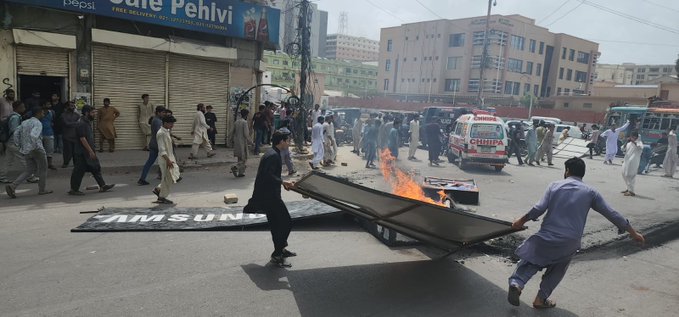
Islamists took to the streets in protest against the remarks of Nupur, and all the shops in the area were closed as a part of the protest. After the Friday prayers, the protests grew in intensity and resulted in stone-pelting, arson and vandalism. Islamists pelted stones at police officials and set vehicles ablaze. A local Police officer was injuredduring the violence along with some other police personnel. As per reports, the rioters also opened fire.
Police had also fired in the air besides resorting to lathi-charge to control the mob which spilt out on the road after Friday prayers and pelted stones and shouted slogans.
Till late evening on Friday, six injured were brought to Sadar Hospital. Two others had sustained bullet injuries and were referred to RIMS hospital where they succumbed to their injuries on Saturday.
Following the violence during the protests against Nupur Sharma, a curfew has been imposed in the violence-hit areas in Ranchi. The internet service has also been suspended. The administration has asked the citizens not to venture out or will be taken into custody. Section 144 has been imposed.
Amidst the ongoing controversy over the comments on Prophet Muhammad by former BJP spokesperson Nupur Sharma and former Delhi BJP leader Naveen Jindal, people are raising questions over the hypocritical response to comments on Islamic Prophet when compared to comments on Hindu Gods. Much worse comments on Hindu Gods and traditions have been made which did not attract FIRs or calls for capital punishment while there are mobs supported by ‘liberals’ in every city asking for Nupur’s head
Over the past few years, many celebrities, journalists and politicians have gotten away with abusing Hindu Gods without any backlash. In fact, some of them have grown in their careers because of it. Here is an indicative and not an exhaustive list of such remarks and social media reports.
Arvind Kejriwal and Aam Aadmi Party
Let’s start with the Chief Minister of Delhi Arvind Kejriwal. While he had recently mocked Kashmiri Hindus’ misery and called ‘The Kashmir Files’ a fake film, there have been several instances where he had mocked Hindu Gods, holy symbols and traditions.
Before Ram Mandir was a distant reality, Kejriwal had said in 2014 that his Nani (grandmother) would never approve of it. He had repeatedly called for building Schools, Colleges and Hospitals in place of the Ram Mandir.
Apart from mocking Hindus over Ram Mandir, in 2019, CM Kejriwal shared a derogatory image where a person with a broom (his party’s symbol) in his hand was running behind the Hindu holy symbol Swastika trying to beat it up.
Derogatory Tweet by Arvind Kejriwal. Source: Twitter
In another tweet, Kejriwal shared a cartoon depicting Bhagwan Hanuman burning JNU to divert attention from alleged problems faced by the government of India.
Kejriwal is not the only one in AAP to give anti-Hindu statements or indulge in activities that go against Hindus. AAP leader Sanjay Singh, in an attempt to gain relevancy in politics, had run a misinformation campaign alleging funds misappropriation by the BJP and Ayodhya Ram Mandir Trust in June 2021.
In August 2020, the official Twitter handle of AAP had shared pictures of Kanchenjunga in Sikkim, held sacred by both Hindus and the Buddhists, Kamet Peak, and Nanda Devi hills in Uttarakhand, where lies a sacred temple of Nanda Devi, an incarnation of the Hindu Goddess Durga. It drew analogies between these sacred peaks and a humongous landfill at Ghazipur in Delhi. The contentious tweet was accompanied by the caption, “Highest Mountains of India.”
AAP mocked Hindu scared mountains. Source: Twitter
Shivling at Gyanvapi complex wuzukhana
The recent discovery of the Shivling at the Gyanvapi structure in the wuzukhana where the people who went to offer namaz inside the disputed structure would wash hands, triggered a slew of jokes on the Shivling.
TMC MP Mahua Moitra had shared a picture of Bhabha Atomic Research Centre with a snide remark saying that hoped it was not next on the digging list.
Derogatory tweet by Mahua Moitra. Source: Twitter
In a now-deleted Tweet, Saba Naqvi shared a picture of Bhabha Atomic Research Centre to take a swipe at the Shivling discovered inside the Gyanvapi compound.
Derogatory tweet by Saba Naqvi. Source: Twitter
RJD leader Kumar Divashankar made a derogatory reference to Shivling in his tweet mocking the BJP.
Derogatory tweet by Kumar. Source: Twitter
Peace Party’s Shadab Chouhan, who is known for his polarising tweets, posted a scornful tweet after a Varanasi court ordered to seal Gyanvapi mosque after a Shivling was found inside its wuzukhana. Chouhan had posted a picture of a curb-side lined with small poles to claim the judge would seal the area if someone made a claim of Shivling.
Derogatory tweet by Shadab. Source: Twitter
All India Majlis-e-Ittehadul Muslimeen’s (AIMIM) leader Danish Qureshi had posted an extremely offensive comment on Shivling on social media, taking a dig at the discovery of the Shivling inside the disputed structure of Gyanvapi mosque. While he had added a rider that his intention was not to hurt the devotion of anyone and he only wanted to enhance his knowledge, his subsequent test made it clear that his only intention was to insult the concept of Shivling in Hinduism. Though he was arrested by Gujarat Police over the comment, it is very much possible that he would not face any strict action anytime soon.
Social media post by Danish Qureshi
Leaders are not the only ones to make derogatory comments. Economic Times had published a meme mocking Hindus by depicting the Bhabha Atomic Research Centre as a Shivling and captioned BOM BHOLENATH. The image was included in the MEME’S THE WORD Column of the print edition.
Meme published by Economic Times. Source: Twitter/AskAnshul
Another cartoon in the column mocks the call to open the Taj Mahal’s closed gates in the basement.
Catroon published in ET. Source: ET
Ratan Lal, an Associate Professor of History at Hindu College in Delhi University, had made a derogatory post on social media about the Shivling found in Gyanvapi disputed structure. He had said if that was a Shivling, “it seems that perhaps Shiva Ji was also circumcised”.
— RP Singh National Spokesperson BJP (@rpsinghkhalsa) May 17, 2022
Professor Ravi Kant Chandan had remarked during a debate over Gyanvapi disputed structure that it was demolished by Auragzed after he allegedly noticed illegal activities happening on the premises by the Pandits. The book and story he referred to have no trace in any historical document, and the book’s author himself had suggested not to take the book seriously.
Freelance journalist Raqib Hameed Naik, a notorious Hinduphobic element, put out an image of the White House and a fountain in front of it to discredit the recent findings of Shivling at the Gyanvapi. As per the ‘journalist’, the survey team did not find a Shivling, instead unearthed a fountain, which as per him, is being used by the Hindu side to push for ownership of the site.
Now-Deleted post by Raqib Hameed Naik. Source: Twitter
Insulting the faith
Dr Jitendra Kumar, an assistant professor of the department of forensic medicine at JN Medical College attached to the Aligarh Muslim University, was teaching about sexual offences in his classroom. In the PowerPoint presentation he used to explain the topic, Dr Kumar made derogatory references to Hindu deities. Summarizing a brief history of rape, he linked rape to Hindu deities. Kumar was suspended from the University pending inquiry but there was no update on any strict action taken against her.
Slide used during Kumar’s lecture.
How can one forget the derogatory remarks made by alleged comedian Munawar Faruqui against Maa Sita and 59 Karsewaks who were killed in Godra train burning incident in 2002. His multiple shows were cancelled over time after Hindus protested against him. However, he was still given chance in a reality show Lock Upp that he won.
Controversial Islamic preacher Ilyas Sharafuddin has compared the Shivling to a male body part and said that Hindus have a habit of worshiping the idol and male private organ. He was one of the participants at the ‘Taal Thok Ke‘ debate hosted by Zee News. Quoting the Vedas, Geeta, and Upanishads, Sharafuddin first argued that the Hindu texts mention that ‘people who would worship idols would be sent to hell’. “Hindus should not worship idol, ling and private parts of a human body”, he blatantly said in the debate named ‘Gyanvapi Survey video reveals the presence of Shivling?’ Not listening to the other participants, he burst into laughter and said, “Private parts ki puja nahi honi chahiye (private parts should not be worshiped)”.
— Major Gaurav Arya (Retd) (@majorgauravarya) June 8, 2022
Bengali film actress Saayoni Ghosh had shared extremely offensive cartoons on her Twitter profile. When she was threatened with action, she claimed her account was hacked. Later TMC gave her ticket for assembly elections.
Now-deleted post by TMC’s Saayoni Ghosh. Source: Twitter.
Apart from celebrities, leaders and media houses, brands also have a habit of mocking Hinduism and when called out, they often get support from the left-liberals. In recent times, several objectionable campaigns and brands were launched targeting Hindus. Though in most of the cases the ads were removed after the backlash from Hindus, the brands got away without any serious consequences of the anti-Hindu ads.
In 2019, Red Label launched an ad campaign on Ganesh Cathurthi projecting Hindus as hateful bigots. The ad showed a man shopping for a Ganesh idol to take home, where he talked to an elderly idol maker about the kind of idol he wanted to buy. The idol maker had a deep knowledge of Hindu mythology, not surprising for the profession he is in. During the conversation the idol maker pulls out a skull cap and wears it, indicating that he is Muslim. Seeing this, the prospective buyer hesitates and said that he will come back next, clearly implying that he did not want to buy an idol from a Muslim. The idol maker then offered him tea and has some chit-chat, which ‘reformed’ the Hindu man, who immediately ordered the idol. Red Label, a brand by Hindustan Unilever, has a habit of releasing such ads and taking them back after backlash.
An ad was released by jewellery brand Tanishq that glorified Love Jihad in 2020. A massive outrage broke over various social media platforms with users calling for the boycott of the jewellery brand Tanishq for their latest advertisement which showcased a Hindu woman married into a Muslim family, preparing for her baby shower. Heeding to criticism, the controversial advertisement which was accused of promoting ‘love jihad’ has been pulled down from YouTube.
In 2021, popular ethnic garment brand Fabindia launched a Diwali campaign and collection ‘Jashn-e-Riwaaz’ that did not go well with people on the internet. Several social media users have objected to yet another appropriation of a Hindu festival and sentiments. The cultural appropriation has left social media users uncomfortable, just ahead of another Hindu festival. Not many favoured Diwali being loosely translated to ‘Jashn-e-Riwaaz’. The campaign was removed after the backlash. FabIndia claimed it was not even Diwali campaign which was indeed a laughable excuse.
The Allahabad High Court on Monday dismissed a writ petition filed by Alt News co-founder Mohammad Zubair challenging the FIR filed against him on June 1 for using derogatory language against Mahant Bajrang Muni Udasin, Rashtriya Sanrakshak of Rashtriya Hindu Sher Sena along with Yati Narsinghanand and Swami Anand Swaroop.
Zubair was booked under sections 295(A) of the Indian Penal Code (IPC) and Section 67 of the Information Technology Act, 2000.
Allahabad High Court refuses to quash FIR against Mohd Zubair, co-founder of Alt News, over his tweets calling Yati Narsinghanand, Bajrang Muni and Anand Swaroop as ‘Hate mongers’. Zubair has been booked u/S 295-A IPC.#allahabadhighcourt#HateCrimepic.twitter.com/B8CvhTXFjg
While refusing to quash the FIR filed against him, the Allahabad HC Bench of Justice Ramesh Sinha and Justice Ajai Kumar Srivastava opined that the writ petition filed by Mohammad Zubair “lacks merit”. It also said that the prima facie records suggest that there is enough ground for investigation in the case. Hence the court dismissed Zubair’s writ petition.
A copy of the Allahabad HC judgement
It may be noted that seeking the quashing of the FIR, Zubair’s lawyer had argued in court that the Alt News’ co-founder, through his tweet, had not insulted or attempted to insult a religious belief of a class by his tweet and the impugned FIR has been lodged against him just for harassment with oblique motive, hence the FIR is liable to be quashed.
Meanwhile, opposing Zubair’s plea, the Advocate General of Allahabad submitted that the petitioner is a habitual offender and earlier also he has been involved in making offensive tweets for which four cases have been registered against him.
After hearing both sides, the court rejected Mohammad Zubair’s petition, stating that the case is still in its early stages and that the investigation has not yet begun, aside from some preliminary efforts made on the date of the case’s registration. It further stated that a review of the case record reveals a prima facie case at this time and that there appears to be sufficient ground for further inquiry in the matter.
FIR registered against Alt News co-founder Mohammed Zubair
On June 1, Khairabad Police of Sitapur district in Uttar Pradesh filed a First Investigation Report (FIR) against Alt News co-founder Mohammed Zubair for using derogatory language against Mahant Bajrang Muni Udasin, Rashtriya Sanrakshak of Rashtriya Hindu Sher Sena along with Yati Narsinghanand and Swami Anand Swaroop. The FIR was registered based on the complaint of Bhagwan Sharan, district head of Rashtriya Hindu Sher Sena, under sections 295(A) of the Indian Penal Code (IPC) and Section 67 of the Information Technology Act, 2000.
Zubair’s derogatory tweet against Mahant Bajrang Muni Udasin
On May 27, while targeting Times Now editor Navika Kumar, Zubair said in a tweet, “Why do we need Hate Mongers like Yati Narasinghanand Saraswati or Mahant Bajrang Muni or Anand Swaroop to arrange a Dharam Sansad to speak against a community and a Religion when we already have Anchors who can do a much better job from News Studios.”
Zubair was accusing Navika Kumar of encouraging “a rabid communal hatemonger & a BJP Spokesperson” Nupur Sharma during a debate. It is notable that after Zubair pointed out the comments by Nupur Sharma on Prophet Mohammad during the same debate accusing her of insulting the prophet and Islam, she has been receiving repeated death threats and rape threats. Even bounties also have been announced on her head by Islamist organisations. The vile campaign against Nupur Sharma reached rock bottom on June 10, when Islamists carried out violent protests accompanied by arson and stone-pelting in several parts of the country wishing for the ex-BJP spokesperson’s arrest and also death.
Speaking to OpIndia, Mahant Bajrang Muni Udasin demanded strict action against Mohammad Zubair. “He uses his verified Twitter account to target Hinduwadis who talk about their religion. He incites to file FIR against Hinduwadis. Once FIR is registered, he demands their arrest.” Demanding Zubair’s arrest, Mahant said, “I request CM Yogi Adityananth and administration to arrest him and take strict action as per law.”